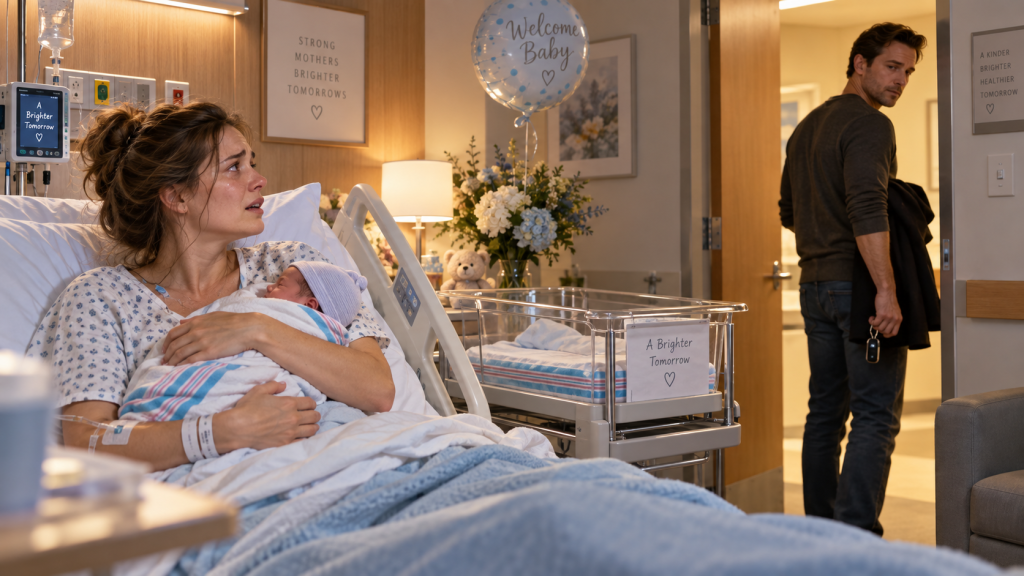
After fourteen exhausting hours of labor, I was finally holding our newborn son against my chest. I was drained, emotional, and happier than I could put into words. I thought the difficult part was finally behind us.
Then my husband leaned close to my ear and whispered one strangely specific request.
Before I could ask what he meant, he grabbed his jacket and keys and walked out of the hospital room.
I stared at the empty doorway.
And when I finally understood what James had just asked me to do, the happiness I had felt only seconds earlier was replaced by a terrible sense that something was wrong.
James and I had been married for three years.
If there was one word I would have used to describe my husband, it was prepared.
James planned everything.
He kept schedules.
He made lists.
He researched decisions most people would make without a second thought.
Sometimes I teased him that he could turn choosing a restaurant into a research project.
So when we discovered I was pregnant, nobody was surprised when James immediately began preparing for fatherhood with the same intensity.
Months before my due date, the crib was assembled.
He researched car seats for hours, comparing safety ratings and reading more reviews than I knew existed.
He organized the nursery.
He made lists of everything we might need.
By the time I reached my third trimester, my hospital bag was already packed beside our bedroom door.
Nothing about James suggested hesitation.
If anything, he seemed more prepared for our son’s arrival than I was.
When my water broke late Tuesday night, his careful planning immediately took over.
He stayed calm.
He grabbed our bags.
He drove me straight to the hospital.
And during the fourteen hours that followed, James barely left my side.
When I needed ice chips, he brought them.
When the contractions became harder, he held my hand.
Whenever I said I couldn’t keep going, he reminded me that I could.
He seemed exactly like the husband I had always known.
Steady.
Reliable.
Prepared.
Then our son arrived.
The relief was overwhelming.
After the nurses completed their routine checks, they weighed him, wrapped him in a tiny hospital blanket, and gently placed him in my arms.
I looked down at his face.
Everything around me seemed to disappear.
For months, I had imagined that moment.
But nothing had prepared me for actually holding him.
Our son.
Our baby.
James stood beside the bed watching us.
Eventually, once the doctors were satisfied that both the baby and I were doing well, the staff began leaving the room.
For the first time since arriving at the hospital, the three of us were alone.
I was completely exhausted.
But I remember thinking that I had never felt happier.
I looked up at James.
I expected him to smile.
Maybe he would make some joke about how little sleep we were going to get.
Maybe he would say our son had my nose or his chin.
Maybe he would simply sit beside me and take in the fact that we had become parents.
Instead, James remained standing.
Something about him had changed.
Not dramatically.
He wasn’t angry.
He didn’t look frightened.
If anything, he was almost too calm.
Then he leaned toward me.
His mouth came close to my ear.
And in the same ordinary voice he might have used to remind me to pick something up from the grocery store, he whispered a very specific request.
For a moment, I thought exhaustion had made me misunderstand him.
“What?”
But James was already straightening.
He crossed the room.
Picked up his jacket.
Then his keys.
“James?”
He didn’t explain.
He simply walked toward the door.
I stared at him, still holding our newborn son against my chest.
“Where are you going?”
He paused only briefly.
Then he left.
The door closed behind him.
For several seconds, I couldn’t move.
My mind kept replaying what he had whispered.
Once.
Twice.
Then again.
I tried to make it make sense.
It didn’t.
James had spent nine months preparing for every possible detail of our son’s arrival.
He had just stayed beside me through fourteen hours of labor.
And now, minutes after our baby was placed in my arms, he had made a request so unusual and so specific that I couldn’t understand why it mattered at that exact moment.
Then something occurred to me.
A tiny detail from earlier in my pregnancy.
Something James had said months ago that I had completely dismissed at the time.
Suddenly, I remembered another conversation.
Then another.
Little moments I had never connected because there had never been a reason to.
Until now.
I looked toward the closed hospital door.
My exhaustion disappeared beneath a growing sense of unease.
Whatever James was doing, this wasn’t spontaneous.
He had thought about it before.
Maybe for much longer than I realized.
I tightened my arms gently around our sleeping son.
Then I reached for my phone.
Because if James could walk away moments after our child was born without explaining himself, I wasn’t going to sit there pretending his request was normal.
And before that night was over, I would discover why the most organized man I knew had planned for something he had never once told me about.
PART 2
I reached for my phone.
My hands were still trembling from labor.
Our son slept against my chest, warm and impossibly small beneath the hospital blanket.
We had chosen his name months ago.
Noah.
James had written it on a whiteboard in the nursery before the crib was even assembled.
NOAH BENNETT.
He had stood back afterward and smiled.
“Looks official now.”
At the time, I thought it was sweet.
Sitting alone in that hospital room, I suddenly wondered how many things James had made official without telling me.
Because the sentence he had whispered before walking out would not leave my head.
“If a woman named Dr. Levin comes in carrying a blue folder, sign the last page. Don’t read through everything right now. It’s just blood-bank paperwork. I’ll explain when I get back.”
Blood-bank paperwork.
Why?
We had never agreed to bank Noah’s cord blood privately.
We had discussed it once.
Months earlier.
James had brought it up at breakfast with the same intense curiosity he brought to everything.
“Do hospitals automatically save cord blood?”
“No idea.”
“Can they test a baby’s blood for compatibility with another person?”
“I guess?”
“Would they need both parents?”
I had laughed.
“James, why are you interrogating me about newborn blood before I’ve even bought maternity jeans?”
He smiled.
“Just researching.”
That had been the end of it.
Or so I thought.
Now, fourteen hours after labor began and less than an hour after Noah entered the world, my husband had told me to sign a document without reading it.
Then left.
Prepared men do not accidentally know the color of a folder someone is going to carry into a hospital room.
I opened my messages.
Nothing from James.
I typed:
Where are you?
Three dots appeared.
Disappeared.
Appeared again.
Then:
Parking garage. Handling something. Rest. I’ll be back soon.
Handling something.
I looked at Noah.
His mouth made a tiny movement in his sleep.
My anger softened instantly into fear.
Not for myself.
For him.
I pressed the call button beside the bed.
A nurse came in a few minutes later.
Her name was Allison.
She had been in and out throughout labor.
She smiled when she saw Noah sleeping.
“How are we doing?”
“I need to ask you something strange.”
Her smile faded slightly.
“Okay.”
“Is anyone from a blood bank supposed to come see me?”
She paused.
“A blood bank?”
“Or hematology.”
“Someone named Dr. Levin.”
Allison thought.
“Not that I know of.”
“My husband said a woman might come with paperwork for me to sign.”
“What kind of paperwork?”
“He said blood-bank paperwork.”
Allison looked toward the bassinet.
Then back at me.
“Did you arrange private cord-blood banking before delivery?”
“No.”
“Directed donation?”
“I don’t know what that is.”
Her expression changed.
Only slightly.
“It would usually be something discussed in advance.”
“I didn’t discuss anything.”
She pulled the computer closer.
“Let me look at your chart.”
I watched her scroll.
Then scroll again.
“There’s nothing here authorizing any additional blood collection beyond routine newborn care.”
Relief came first.
Then something colder.
“Could James have arranged something separately?”
“He could contact outside organizations.”
“But anything involving you or Noah would still require appropriate consent.”
I swallowed.
“Can you put a note in the chart?”
“What kind of note?”
“That nobody is to take any extra blood or have me sign outside forms until I know exactly what they’re for.”
Allison looked directly at me.
“Yes.”
No judgment.
No questions about my marriage.
Just yes.
“And can you tell the nursery?”
“Absolutely.”
She typed.
Then asked:
“Do you want your husband present when anyone discusses this with you?”
I hesitated.
What kind of question was that?
Of course I did.
James was my husband.
Noah’s father.
The man who had held my hand while I pushed.
Then I remembered:
Don’t read through everything.
“No.”
The word surprised me.
“I want someone to explain it to me first.”
Allison nodded.
“I’ll make sure they do.”
James had left his tablet in the hospital bag.
I noticed it when Allison walked out.
I knew his passcode.
There had never been secrets between us.
At least that was what I had believed.
The tablet was mostly used for shared calendars, grocery lists, baby registries, and home documents.
I opened the browser.
Recent tabs.
Car-seat installation.
Hospital parking.
Newborn sleep guidelines.
Exactly what I expected.
Then:
HLA sibling match probability half sibling
My heart stopped.
I read it twice.
HLA.
I did not know what it meant.
I searched.
Human leukocyte antigen.
Tissue matching.
Transplant compatibility.
Bone marrow.
Stem cells.
I stared at the screen.
Half sibling.
Noah did not have a half sibling.
James had no children.
I had no children.
We had talked about previous relationships before marriage.
James had dated.
So had I.
There were no secret marriages.
No children.
No complicated history.
That was what he told me.
My heart began beating harder.
I went back to the browser history.
More searches.
newborn HLA typing turnaround
cord blood leukemia sibling directed donation
can half siblings be stem cell matches
minimum age sibling bone marrow donor
My stomach turned.
This was not research from nine months ago.
The latest search was yesterday.
While I was walking circles around our kitchen trying to encourage labor.
James had been researching whether our unborn son could donate bone marrow.
I put the tablet down.
Then immediately picked it back up.
No.
Facts.
I needed facts.
I opened his email.
His personal account required another password.
The shared family account did not.
I searched:
Levin.
Seven results.
The oldest was five months earlier.
Subject:
Bennett / directed compatibility consultation
My fingers went numb.
The message was from someone named Dr. Miriam Levin, Pediatric Hematology and Transplant Services.
I opened it.
The first line made my breathing stop.
Mr. Bennett, as we discussed, there is no guarantee that a paternal half-sibling will be a suitable donor for Sophie.
Sophie.
Who was Sophie?
I kept reading.
The email was cautious.
Clinical.
Dr. Levin explained that any testing involving a newborn would require proper parental consent and independent medical review.
That cord-blood or later stem-cell donation could not simply be promised in advance.
That the baby’s welfare would need to be considered separately from the recipient’s need.
And then:
I also want to reiterate that the child’s mother needs to be fully informed before any testing beyond routine newborn care is arranged.
My hands began to shake.
Fully informed.
I wasn’t.
I scrolled down.
James’s reply:
Understood. I’ll handle that conversation closer to delivery. She has had a difficult pregnancy and I don’t want to introduce unnecessary anxiety until we know there is something useful to discuss.
I stared.
A difficult pregnancy?
I had been healthy.
Tired.
Uncomfortable.
But healthy.
He had made my ignorance sound protective.
I searched Sophie’s name.
Twenty-three emails.
My vision blurred.
The first included an attachment.
A photograph.
I opened it.
James stood beside a hospital bed.
His hand rested on the shoulder of a little girl with dark hair and a thin face.
She looked about eight.
Maybe nine.
She was smiling.
So was he.
And I knew immediately the photograph was recent because he wore the gray coat I bought him last Christmas.
The email underneath was from a woman named Rachel Morgan.
She was so happy you came. She won’t stop talking about Dad finally seeing her room.
Dad.
The word hit me physically.
I lowered the tablet.
Noah shifted against me.
I looked down at him.
My husband had another child.
I did not understand how.
But there she was.
Sophie.
Calling him Dad.
I searched Rachel.
That was worse.
The emails went back almost two years.
Not romantic.
At least not most of them.
Medical appointments.
School.
Insurance.
Arguments.
Then one from eighteen months earlier:
The test confirmed it. 99.98%. James, I know this is a shock, but Sophie deserves to know you.
I covered my mouth.
So maybe he had not known before.
Maybe James had only learned Sophie was his eighteen months ago.
That should have made me feel better.
It didn’t.
Because we had been married then.
He had learned he had a daughter.
And said nothing.
There were messages about lawyers.
A formal acknowledgment of paternity.
Child support.
Private visitation.
James asking Rachel not to contact me.
Then Rachel:
I don’t understand why your wife doesn’t know.
James:
Because my marriage is complicated enough right now. I’ll tell her when the timing is right.
Timing.
He loved timing.
Everything carefully scheduled.
Everything placed into a calendar.
Apparently truth needed an appointment too.
Then the messages changed eleven months earlier.
Sophie was sick.
At first, doctors believed it was viral.
Then abnormal blood counts.
More tests.
Bone marrow biopsy.
Diagnosis.
Acute leukemia.
I stopped.
My anger collided with something else.
A child.
A sick child.
Whatever James had done, Sophie had done nothing.
I looked again at the photograph.
The pale face.
The hospital bed.
I felt grief for someone I had never met.
That almost made what James had hidden hurt more.
If he had told me—
I would have cared.
I would have understood his fear.
I would have sat beside him.
I would have helped.
Instead, he had decided I was an obstacle to manage.
The timeline became clear.
Eleven months ago, Sophie was diagnosed.
Ten months ago, James suddenly told me:
“Maybe we shouldn’t wait another year to start trying.”
I remembered the conversation perfectly.
We were folding laundry.
I was thirty-one.
James had always said thirty-three sounded like the right age for children.
Then suddenly:
“Why wait?”
I smiled.
“Who are you and what did you do with my five-year plan husband?”
He laughed.
“We’re stable.”
“We have the house.”
“I think I’m ready.”
I had kissed him.
Two months later, I was pregnant.
My chest tightened.
No.
Surely not.
I searched again.
Emails.
Dates.
One between James and Rachel from ten months earlier.
Rachel wrote:
The transplant team said siblings are often the first people they test, but Sophie doesn’t have siblings.
James answered:
Not yet.
I stopped breathing.
Not yet.
My pregnancy test had been positive three weeks after that message.
I stared at the screen.
He had wanted Noah.
But why?
Because he wanted a child with me?
Or because Sophie needed one?
I hated myself for even asking.
Then I found the message that answered too much.
Rachel:
You cannot have a baby just because Sophie might need a donor. Please tell me that is not what you’re doing.
James:
That’s not the only reason. Emma and I were always going to have children. We’re just moving the timeline up. If our baby can help Sophie too, I’m not going to apologize for that.
Emma.
There was my name.
I closed my eyes.
He had moved the timeline up.
Without telling me why.
He had made a reproductive decision for both of us while withholding the fact that another child’s medical needs were part of his calculation.
Maybe he did want Noah.
Maybe both things were true.
That did not make it better.
A new message appeared on James’s tablet.
From Rachel.
I froze.
Did the baby arrive? Sophie’s counts dropped again this morning. James, please don’t pressure Emma. Dr. Levin said she needs to understand everything first.
My throat closed.
Pressure Emma.
So Rachel knew I did not know?
I scrolled up.
Recent messages.
James:
She doesn’t know all the details yet.
Rachel:
All the details or any of the details?
No reply.
Then yesterday:
James, you promised you would tell her before delivery.
James:
I’ll tell her after. She’s too close to labor now.
Rachel:
That is not consent.
I read that sentence twice.
That is not consent.
A woman I had never met had apparently understood something my husband did not.
Or refused to.
My phone rang.
James.
I stared at his name.
Then answered.
“Where are you?”
“Getting something from the car.”
“You’ve been gone forty minutes.”
“I had to make a call.”
“To Rachel?”
Silence.
The silence was so immediate I knew.
“Emma.”
His voice changed.
Careful.
“Listen to me.”
“Who is Sophie?”
Nothing.
“James.”
“How do you know that name?”
I almost laughed.
Of all possible questions.
Not:
What did you see?
Not:
Let me explain.
How do you know?
“Your tablet.”
His breath changed.
“You went through my email?”
“You told me to sign blood-bank paperwork without reading it.”
“That gave me a question.”
I looked at our son.
“It gave me twenty-three more.”
“Emma, this is not the moment.”
I nearly screamed.
“Then when was the moment?”
Silence.
“Eighteen months ago when you learned you had a daughter?”
“Eleven months ago when she got leukemia?”
“Ten months ago when you suddenly decided we should start trying for a baby?”
“Five months ago when Dr. Levin told you I had to be informed?”
“Which moment would’ve worked for you, James?”
He exhaled.
“You just delivered.”
“Yes.”
“You’re exhausted.”
My anger went cold.
“Do not do that.”
“Do what?”
“Use my body as a reason I can’t understand what you did.”
Silence.
Then:
“Sophie is my daughter.”
“I figured that out.”
“I didn’t know about her until last year.”
“I figured that out too.”
“She’s sick.”
“I know.”
“Very sick.”
His voice cracked for the first time.
And despite everything, my heart hurt for him.
Because I could hear the father underneath the liar.
“I’m sorry she’s sick.”
I meant it.
James went quiet.
Then:
“The treatments aren’t working the way we hoped.”
“They’re looking for transplant options.”
“She has no full siblings.”
“And the baby—”
“Noah.”
“What?”
“His name is Noah.”
“I know his name.”
“Then say it.”
Silence.
He finally whispered:
“Noah could be a match.”
There it was.
I closed my eyes.
“Is that why you wanted him?”
“No.”
The answer came instantly.
Too instantly.
“Not only.”
I opened my eyes.
The room blurred.
“Not only?”
“Emma, don’t twist this.”
“I don’t have to.”
“You just told me.”
“We already wanted children.”
“Eventually.”
“Yes.”
“And then Sophie got sick.”
“Yes.”
“And three weeks later you told me you suddenly couldn’t wait.”
He did not answer.
My throat tightened.
“You used my body to solve a problem you never told me existed.”
“No.”
“I moved our plan forward.”
“Without telling me why.”
“I knew you wanted a baby.”
“That does not mean you get to secretly add a second purpose to my pregnancy.”
His voice hardened.
“My daughter might die.”
I went silent.
Because that was true.
A little girl might die.
Nothing about my anger changed that.
Then I said quietly:
“And my son was born less than an hour ago.”
“He is not a treatment plan.”
James sighed.
“You’re making this uglier than it is.”
That sentence killed the remaining softness in me.
“No.”
“I’m finally looking at it without you explaining it first.”
I ended the call.
Ten minutes later, Allison returned.
She was not alone.
A woman in her fifties stood beside her.
Dark blue suit.
Hospital identification.
No blue folder.
“Mrs. Bennett?”
“Yes.”
“I’m Dr. Miriam Levin.”
My stomach tightened.
She saw it.
“I understand my name may have come up unexpectedly.”
“That is one way to say it.”
She pulled a chair closer but did not sit until I nodded.
“Your husband contacted our transplant program several months ago.”
“I know.”
Her expression changed.
“You know now?”
“Yes.”
“Not before today.”
She closed her eyes briefly.
“I’m sorry.”
Those two words from a stranger almost made me cry.
“Did you know he hadn’t told me?”
“I had concerns.”
“That isn’t what I asked.”
“No.”
She met my eyes.
“I did not know with certainty that he had withheld everything.”
“His communications suggested he planned to discuss it with you.”
“He didn’t.”
“I understand.”
I looked at Allison.
Then back at Dr. Levin.
“Is someone coming with paperwork?”
Her face tightened.
“There is paperwork prepared for an optional HLA compatibility test.”
My arms tightened around Noah instinctively.
“Prepared by who?”
“Our office drafted appropriate consent materials after your husband requested information.”
“But no testing can proceed without valid consent.”
“Mine?”
“Depending on the specific test and hospital policy, parental authorization is required.”
She paused.
“More importantly, we will not proceed while there is disagreement or evidence you have not been fully informed.”
I breathed for what felt like the first time in an hour.
“So nobody is taking blood from Noah.”
“Not for HLA testing.”
“Not unless this is discussed properly.”
“No.”
Relief.
Then anger.
“James told me to sign the last page without reading it.”
Dr. Levin’s expression went completely still.
“He told you what?”
I repeated it.
Every word.
Blue folder. Sign the last page. Don’t read through everything. Blood-bank paperwork.
She looked toward Allison.
Then back at me.
“That is not how informed consent works.”
“I’m beginning to understand that.”
Her voice softened.
“Mrs. Bennett, Sophie’s situation is serious.”
“I know.”
“And testing Noah does not mean he would automatically become a donor.”
“I know.”
“There would be additional evaluation.”
“Independent review.”
“A risk-benefit assessment.”
“No one should present a newborn as simply available because another child is ill.”
My throat tightened.
“Did James?”
Dr. Levin hesitated.
“He was very focused on knowing whether Noah could be compatible.”
Focused.
That sounded like James.
“What did you tell him?”
“That a match would only answer one question.”
“Not every ethical or medical question after it.”
I nodded.
Then asked:
“Did he tell you I agreed?”
A pause.
“Yes.”
My heart sank.
“How?”
“He forwarded an email.”
“I want to see it.”
Dr. Levin looked uncomfortable.
“I’ll need to follow the proper process for releasing records.”
“Was it supposedly from me?”
“Yes.”
“What did it say?”
She chose her words carefully.
“It indicated you understood Sophie was Mr. Bennett’s biological daughter and that you were willing to discuss directed testing after delivery.”
My entire body went cold.
“I never sent that.”
Dr. Levin stopped.
“What?”
“I didn’t even know Sophie existed.”
Silence.
Allison looked at her.
Then me.
Dr. Levin asked:
“What email address do you normally use?”
I told her.
Her expression changed.
“The message did not come from that exact address.”
My heart pounded.
“What address?”
She showed me on her phone.
At first glance, it looked mine.
My first name.
Last name.
Numbers.
Then I saw it.
One extra letter.
A fake account.
Someone had created an address almost identical to mine and used it to tell a transplant team that I already knew about James’s secret daughter.
My hands began to tremble again.
“James created that?”
“I cannot tell you who created it.”
Dr. Levin said it carefully.
“But I am going to document what you’ve just told me and notify the appropriate hospital staff.”
Facts.
Again.
I was learning to love facts.
James returned twenty minutes later carrying a blue folder.
He stopped when he saw Dr. Levin.
Then looked at me.
Then Noah.
Then the tablet beside my bed.
His face changed.
Not dramatically.
But enough.
“You went through everything.”
I stared at him.
“Not everything.”
“That seems to be the problem.”
Dr. Levin stood.
“Mr. Bennett, I need to speak with you separately.”
He barely looked at her.
“Emma, can we have five minutes?”
“No.”
His jaw tightened.
“I just need to explain.”
“You’ve had eighteen months.”
“That’s unfair.”
I almost laughed.
“Unfair?”
“You had a secret daughter.”
“A secret medical plan involving our baby.”
“A fake email address using my name.”
“And now you are standing beside the hospital bed where I gave birth fourteen hours after labor started, holding a blue folder you told me to sign without reading.”
I looked at the folder.
“Open it.”
James did not move.
“Emma.”
“Open it.”
Dr. Levin said quietly:
“You should give the folder to me.”
He hesitated.
That was enough.
Allison moved toward the door.
Not threatening.
Just present.
James handed Dr. Levin the folder.
She opened it.
Her expression changed almost immediately.
“This isn’t our current consent packet.”
My pulse quickened.
“What is it?”
James said:
“It’s an earlier version.”
Dr. Levin continued reading.
Then frowned.
“There are pages here that did not come from our hospital.”
James’s face went pale.
“What pages?”
I asked.
Dr. Levin did not answer immediately.
She pulled out a document clipped behind the medical information.
The heading read:
PARENTAL AUTHORIZATION FOR DIRECTED MINOR DONOR EVALUATION
My stomach turned.
Below that:
Potential Donor: Noah James Bennett.
Intended Recipient: Sophie Morgan.
Relationship: Paternal Half-Sibling.
I stopped breathing.
My son had been alive less than two hours.
He already existed on paperwork as a potential donor for a sister I had not known existed when I woke up that morning.
Then I saw my own name.
Mother: Emma Bennett.
Under it—
a signature.
Mine.
Except I had not signed anything.
I stared at James.
He went completely still.
Dr. Levin looked at the page.
Then at him.
“This is not a hospital-generated consent form.”
James said nothing.
“Where did you get this?”
Still nothing.
I whispered:
“James.”
His eyes finally met mine.
And I knew before he spoke that there was more.
Much more.
Dr. Levin turned the page over.
Attached to the back was an email printout.
A message sent six weeks earlier from the fake address carrying my name.
I understand what is at stake for Sophie. James has my permission to arrange whatever compatibility testing is necessary immediately after delivery. Please keep the discussion brief at the hospital because I do not want to become overwhelmed.
My eyes burned.
Overwhelmed.
Even my supposed emotions had been forged.
Then Dr. Levin pulled out the final page.
She read it.
Stopped.
Read it again.
“What?”
I asked.
She did not answer.
“Dr. Levin.”
She turned the page toward me.
At the top was a separate legal consultation summary.
Not from the hospital.
From an attorney.
James had apparently met with someone months earlier about the circumstances under which a parent could consent to medical procedures for a minor if the other parent was “temporarily incapacitated following childbirth.”
My whole body went cold.
I looked up at him.
“You researched whether you could consent for me while I was recovering from labor?”
James finally spoke.
“It was a contingency.”
A contingency.
Of course.
The most prepared man I had ever known.
Always planning.
Always anticipating.
Always creating backup options.
I looked down at Noah.
Sleeping.
Perfect.
Completely unaware that before he ever took his first breath, his father had already written plans for what could happen if I was too exhausted to object.
Dr. Levin kept reading.
Then she reached the last paragraph.
Her expression changed in a way I had not seen before.
Not anger.
Alarm.
“Mrs. Bennett.”
“What?”
“I think you need to see this.”
She handed me the page.
There was a handwritten note at the bottom.
James’s handwriting.
I recognized every letter.
If Emma refuses after delivery, do not argue in hospital. Wait until discharge. Once testing confirms match, she’ll understand why we had to do it.
My vision blurred.
Once testing confirms match.
Not if I consent.
Not if we agree.
Once.
I looked at James.
He had planned around my refusal before he ever bothered to ask.
And suddenly I understood the most frightening thing about all his preparation.
James had never been preparing for our son’s birth.
He had been preparing for my answer.
And somewhere in that blue folder was a plan for what he intended to do if that answer was no.
PART 3
I looked at James.
He had planned around my refusal before he ever bothered to ask.
And suddenly I understood the most frightening thing about all his preparation.
James had never been preparing for our son’s birth.
He had been preparing for my answer.
And somewhere in that blue folder was a plan for what he intended to do if that answer was no.
For several seconds, nobody moved.
Noah slept against me, unaware of the adults standing around his first hours of life and the decisions that had already been attached to his name.
James looked at Dr. Levin.
Then at Allison.
Finally at me.
“Emma, you’re making this sound worse than it is.”
My whole body went cold.
There are sentences that end arguments.
And there are sentences that end illusions.
That one ended mine.
I stared at him.
“You forged my consent.”
“I did not forge anything.”
I pointed toward the paper.
“My name is on it.”
“It was a draft.”
“My signature is on it.”
“It wasn’t filed.”
“You created an email address pretending to be me.”
His jaw tightened.
“I was trying to keep the process moving.”
The process.
Not our marriage.
Not my trust.
The process.
Dr. Levin stepped forward.
“Mr. Bennett, regardless of whether this document was formally submitted, these materials cannot be used as parental consent.”
James barely looked at her.
“I understand.”
“No.”
Her voice remained calm.
“I’m not sure you do.”
He turned.
She held up the page.
“A parent cannot manufacture the other parent’s agreement because he believes the outcome is important.”
“I know Sophie’s situation better than anyone in this room.”
“That may be true.”
“But you do not know Emma’s consent better than Emma.”
Silence.
I felt something inside me settle.
Not heal.
Not yet.
Settle.
For months, James had been building plans because he believed preparation gave him the right to control uncertainty.
But human beings were not emergency checklists.
I was not a contingency.
Noah was not a resource.
And Sophie, however sick she was, deserved better than being turned into the reason everyone else’s boundaries disappeared.
I looked at James.
“Leave.”
His face changed.
“Emma.”
“Leave the room.”
“You just had a baby.”
“Yes.”
“You’re emotional.”
Allison moved toward the doorway.
I almost laughed.
Of course he said it.
The oldest escape route.
If I disagreed, I was emotional.
If I cried, I was overwhelmed.
If I hesitated, I needed him to decide.
If I said no, he would prepare another path.
I looked directly at him.
“I am exhausted.”
“I am sore.”
“I have barely slept.”
“And I understand exactly what you did.”
His mouth opened.
“Leave.”
He looked at Noah.
That hurt.
Because there was love on his face.
Real love.
That was the cruelest part.
James loved our son.
He loved Sophie too.
But somewhere along the way, fear had convinced him that love gave him permission to arrange people.
Dr. Levin stepped toward the door.
Allison called hospital security.
James heard it.
His shoulders dropped.
Then he said the one thing that nearly broke me.
“If Noah is a match and Sophie dies because you refuse—”
“No.”
I cut him off.
My voice was quiet.
“You do not put her death on me.”
His face tightened.
“She is my daughter.”
“And Noah is my son.”
“He’s my son too.”
“Yes.”
I swallowed.
“And that means you protect him.”
“You don’t pre-spend his body.”
James flinched.
Good.
He should have.
Security arrived.
This time, James did not argue.
He picked up his jacket.
He looked at me once.
Then left.
The door closed.
I stared at it.
And cried so hard Allison had to take Noah for a few minutes because my arms were shaking.
Dr. Levin stayed.
She waited until I could breathe again.
Then she said:
“No testing will happen today.”
I nodded.
“No tomorrow either unless you have had time to understand the situation.”
I looked at her.
“What happens if I say no forever?”
“Then Noah is not tested through our program.”
“And Sophie?”
“We continue pursuing other medically appropriate options.”
“Are there others?”
“Yes.”
That answer came immediately.
Not easy options.
Not guaranteed ones.
But options.
Unrelated donor registries.
Additional treatment.
Clinical pathways.
Possibilities depending on her disease status and medical evaluation.
James had made Noah sound like a door that might close on Sophie’s life.
Dr. Levin corrected that.
“He may be one possible avenue.”
“Not the only human being standing between Sophie and death.”
My throat tightened.
“Has James been telling Rachel that?”
“I can’t speak for what he told her.”
“I can tell you what I told him.”
She paused.
“I told him repeatedly not to build expectations around an unborn child.”
I looked toward the door.
“He built expectations around everyone.”
Rachel called me that evening.
I almost ignored it.
Then I remembered her message.
That is not consent.
So I answered.
“Emma?”
Her voice shook.
“Yes.”
“I am so sorry.”
I closed my eyes.
“I didn’t know he had made documents.”
“I believe you.”
She started crying.
Not dramatically.
Quietly.
“I told him to tell you.”
“I saw the messages.”
“Sophie doesn’t know about Noah.”
That surprised me.
“What?”
“She knows her father’s wife was pregnant.”
“But she does not know James was talking about the baby as a donor.”
Relief.
A small mercy.
Rachel continued.
“I wouldn’t let him tell her.”
“Why?”
“Because she’s nine.”
Her voice cracked.
“And she already thinks every failed treatment is somehow her fault.”
My anger softened around the edges.
Not toward James.
Toward the situation.
“How sick is she?”
Rachel was quiet.
“Very.”
I closed my eyes.
“I’m sorry.”
“Thank you.”
Then:
“Emma, I need you to understand something.”
“I never asked him to have another child for Sophie.”
“I know.”
“I was horrified when I realized he was moving your timeline because of her.”
I looked at Noah sleeping in the bassinet.
“Why didn’t you tell me?”
The question came out more sharply than I intended.
Rachel accepted it.
“I should have.”
Silence.
“I told myself he was your husband.”
“That he had to be the one.”
“That contacting you would blow up your marriage.”
I almost laughed.
“My marriage was already blown up.”
“I just didn’t know.”
“I know.”
She cried.
“I was scared he’d stop seeing Sophie if I pushed too hard.”
That landed differently.
Fear again.
James at the center.
Everyone adjusting around the thing he might do.
I was beginning to see a pattern.
Not violent.
Not loud.
But controlling.
Prepared.
Always prepared.
Rachel whispered:
“I’m sorry.”
I believed her.
Not because apologies fix everything.
Because she did not ask me to comfort her afterward.
That mattered.
I stayed in the hospital two more days.
James was not allowed back into my room.
He was permitted updates about Noah only through appropriate channels, and only as hospital policy and parental rights allowed.
I did not block him out of spite.
I also did not pretend nothing had happened.
Those two things could exist together.
Before discharge, a hospital social worker named Karen met with me.
Then an attorney.
Then another patient advocate.
The forged email and false consent paperwork were preserved.
The hospital opened an internal review because someone had attempted to bring in documents resembling medical authorization that did not originate through their proper process.
Dr. Levin documented everything.
Including the fact that she had repeatedly told James I needed to be fully informed.
James’s blue folder stopped being a private marital argument.
It became evidence of choices he had made.
Not proof of every motive.
But proof enough that I was no longer willing to trust him with mine.
I did not go home with James.
My sister Leah picked me up.
She arrived with a car seat she bought on the way because I refused to use the one James had installed.
That was irrational.
I knew it.
The car seat had done nothing wrong.
But I could not look at another item he had meticulously prepared without wondering what else had been attached to it.
Leah did not argue.
She simply said:
“Mine has excellent safety ratings.”
I laughed despite myself.
“James would approve.”
Then I cried.
She reached across the console.
“No.”
She squeezed my hand.
“You don’t have to make him part of every thought anymore.”
That was the first time someone said it.
It took months before I learned how.
James came to Leah’s house three days later.
He did not force his way in.
He stood on the porch holding an envelope.
Leah stayed inside with Noah.
I stepped outside.
Still sore.
Still moving carefully.
Still furious.
James looked exhausted.
“I brought the original documents.”
“Give them to my lawyer.”
His face fell.
“You have a lawyer?”
“Yes.”
“Emma.”
“What did you think was going to happen?”
“I thought we would talk.”
“We are talking.”
“No.”
He shook his head.
“This isn’t us.”
I almost smiled.
“That’s the problem.”
He stared.
Then whispered:
“I panicked.”
“Sophie was getting worse.”
“Every call from Rachel sounded like a clock.”
“I felt like I had one child dying and another child coming, and there was something I might be able to do.”
“Something?”
I asked.
“Or someone?”
He closed his eyes.
“I love Noah.”
“I never said you didn’t.”
“I wanted him.”
“Even if Sophie had never existed.”
“Maybe.”
His face twisted.
“Emma, I don’t know how to prove that.”
“You can’t.”
He looked down.
Then:
“I moved the timeline up.”
“Yes.”
“I shouldn’t have.”
“No.”
“I should have told you about Sophie.”
“Yes.”
“I should have told you why I wanted the HLA test.”
“Yes.”
“And the email?”
He went silent.
That was the line he still could not cross.
I waited.
Finally:
“I created it.”
The words were almost inaudible.
My heart broke cleanly.
No ambiguity.
No explanation.
No technicality.
“You pretended to be me.”
“Yes.”
“Why?”
“Because Dr. Levin kept asking whether you knew.”
My stomach turned.
“So instead of telling me…”
“I told her you knew.”
He covered his face.
“I told myself I was buying time.”
“For what?”
“Until Noah was born.”
“And then?”
He looked at me.
“I thought once he was here, you’d understand.”
There it was.
The core of everything.
He did not think my consent mattered before the outcome became emotionally harder to refuse.
He wanted the baby in my arms.
Sophie’s illness in front of me.
A possible match already discussed.
Then he believed my no would become morally impossible.
I whispered:
“You were waiting until saying no would hurt enough.”
His eyes filled.
“I didn’t think of it like that.”
“I know.”
“That’s what scares me.”
I filed for legal separation that week.
Then divorce.
People thought that was fast.
It wasn’t.
The marriage had been changing for eighteen months.
I had simply learned about it in one afternoon.
James fought the divorce at first.
Not violently.
Emotionally.
Letters.
Apologies.
Therapy appointments he scheduled for us without asking.
Promises.
He kept trying to fix the damage using preparation.
It might have been funny if it had not been so sad.
Eventually, my attorney told his:
“Mr. Bennett needs to stop scheduling reconciliation for a woman who has declined it.”
That sentence became one of Leah’s favorites.
The false email and forged-looking parental consent documents were investigated.
The legal consequences were less cinematic than people imagine.
Some documents had never been formally used to authorize an actual medical procedure.
That mattered.
The fake email, false representations, and signature issues were documented and evaluated separately.
James faced professional and legal consequences connected to impersonation and the documents, but no one pretended every disturbing choice automatically became the most serious crime imaginable.
The family court cared about something different.
Judgment.
Trust.
Decision-making.
Whether James could separate his fear about Sophie from his responsibilities toward Noah.
For a while, his time with Noah was supervised.
Not because I wanted to punish him.
Because he had demonstrated that when terrified, he could convince himself that another person’s boundaries were obstacles.
That had to change.
And if he wanted to be Noah’s father, he had to change it where other people could see.
The question everyone eventually asked was the same.
Did I test Noah?
Not immediately.
For six weeks, I said no.
Not never.
No now.
I needed the question to become mine.
Not James’s.
Not Sophie’s illness.
Not guilt.
Mine.
During that time, I met Rachel.
Without James.
We sat in the hospital cafeteria while Sophie was upstairs.
Rachel looked older than her photographs.
Fear does that.
She showed me Sophie’s school picture.
Gap between her front teeth.
Purple glasses.
A crooked ponytail.
“She likes astronomy.”
Rachel smiled through tears.
“She knows every moon of Jupiter.”
I looked at the picture.
This was not the abstract child James had used in arguments.
This was Sophie.
Nine.
Sick.
Scared.
Innocent.
I asked:
“Does she want a sibling?”
Rachel laughed softly.
“She wants a telescope.”
That broke something open inside me.
Good.
Sophie was not waiting for Noah to save her.
Adults had created that weight.
Not her.
I looked at Rachel.
“If I agree to testing, it will not mean I agree to donation.”
“I know.”
“If he’s a match, every next decision gets made separately.”
“Yes.”
“By doctors who are thinking about Noah too.”
“Yes.”
“And James does not get to control the process.”
Rachel nodded.
“Absolutely.”
I went home.
Held my son.
Thought for three days.
Then called Dr. Levin.
“I’m willing to discuss compatibility testing.”
Not because James had been right.
He had not.
Because choice only becomes yours when you are free to make either answer.
I wanted my yes to belong to me as much as my no had.
Noah was tested.
A small blood sample.
Nothing dramatic.
I cried anyway.
Then we waited.
James was informed through the agreed process.
He did not call me.
For once, he waited where he had been told to wait.
Three days later, Dr. Levin called.
“Noah is not a suitable match.”
I sat down.
Relief came first.
Then guilt for the relief.
Then sorrow for Sophie.
Three feelings in one breath.
“Okay.”
“I’m sorry.”
“So am I.”
And that was it.
The whole secret plan.
The accelerated pregnancy.
The blue folder.
The forged consent.
All of it built around a result James could never control.
Noah was not a match.
Human beings had refused to become his spreadsheet.
Sophie found an unrelated donor four months later.
Not quickly.
Not easily.
But she found one.
Treatment was brutal.
There were complications.
There were setbacks.
I learned about them from Rachel.
Never because I was required to.
Because, despite everything, I cared.
A year after Noah was born, Sophie’s doctors used the word remission.
Carefully.
No promises.
Monitoring.
But remission.
I cried when Rachel called.
So did she.
James sent me a message through the parenting app.
She made it.
I stared at it.
Then replied:
I’m glad.
Nothing more.
No rewriting history.
No pretending his choices had been necessary because Sophie survived.
A good ending for Sophie did not transform bad decisions into good ones.
That mattered.
James changed slowly.
That surprised me.
For the first year, he apologized like a man trying to obtain a result.
“I’m sorry, so come home.”
“I understand now, so increase my time with Noah.”
“I’m in therapy, so trust me.”
Then one day his apologies changed.
He stopped attaching requests.
That was the first real evidence.
He wrote:
I was afraid Sophie would die, and I turned that fear into permission to make choices that were not mine.
I read it twice.
Then:
I treated being prepared as though it made me entitled to prepare other people’s answers.
That one stayed with me.
He continued:
Noah deserved to be born as a child, not as an option. You deserved to know every reason I wanted to change our plans. Sophie deserved a father who could love her without making her illness everyone else’s obligation.
For the first time, I believed he understood.
I did not go back.
Understanding does not obligate reunion.
But I began trusting him differently as Noah’s father.
Supervision eventually ended.
Schedules expanded.
James showed up.
On time, naturally.
He packed too many diapers.
Over-researched preschools.
Brought emergency kits for emergency kits.
Some parts of him remained James.
But when Noah was old enough to say no, James practiced hearing it.
That mattered more to me than any apology.
Our divorce became final eighteen months after Noah’s birth.
I kept my name.
James kept his.
We shared parenting under a structured agreement.
Sophie eventually met Noah when he was three.
Not as donor and recipient.
Brother and sister.
That was Rachel’s condition.
Mine too.
Sophie knelt in the grass.
Noah stared at her purple glasses.
Then asked:
“Are you Daddy’s other kid?”
I nearly died.
Sophie laughed.
“Yep.”
He considered this.
Then handed her a plastic dinosaur.
That was apparently enough.
They became siblings in the slow, ordinary way children sometimes do when adults stop turning relationships into strategy.
Birthdays.
Video calls.
Arguments over toys.
Nothing medical.
Nothing owed.
Just family becoming something chosen honestly.
Years passed.
Noah turned eight.
Sophie was seventeen.
Still in remission.
She had the telescope.
A better one now.
For Noah’s eighth birthday, she came over and helped him find Jupiter.
He shouted when he saw it.
Sophie laughed.
I stood by the back door watching them.
James arrived later for cake.
We could be in the same room by then.
Not friends.
Not enemies.
Parents who had survived the wreckage of one kind of relationship and learned not to make our child live inside it.
At one point, James stood beside me.
He looked toward Sophie and Noah.
“I used to imagine this.”
I knew what he meant.
The siblings.
Together.
I said:
“This version?”
He went quiet.
Then shook his head.
“No.”
That answer mattered.
Because this version had no hospital forms.
No match results.
No plans.
Just two children arguing over whose turn it was to use the telescope.
James whispered:
“This version is better.”
“Yes.”
It was.
I kept the blue folder for years.
My attorney had copied everything.
The original eventually came back to me after the legal process ended.
I put it in a box.
Once a year, maybe, I looked at it.
Then stopped.
On Noah’s tenth birthday, I found it while cleaning.
The pages felt smaller than I remembered.
The fake email.
The false signature.
The legal consultation about maternal incapacity.
The handwritten note:
If Emma refuses after delivery, do not argue in hospital. Wait until discharge.
I stared at it.
Then tore that page in half.
Not the evidence.
The evidence had served its purpose.
This was only my copy.
I tore it again.
And again.
Then threw it away.
No ceremony.
No speech.
Some things deserve less power than we give them.
People sometimes ask whether James was evil.
I don’t think that question helps.
He was frightened.
He was controlling.
He lied.
He manipulated.
He forged my voice when the truth of my voice became inconvenient.
Those things were wrong.
Love for a sick child did not make them less wrong.
Fear can explain terrible choices.
Explanation is not permission.
That is the distinction James lost.
It is the distinction I never want Noah or Sophie to lose.
The strangest part is that James really was prepared.
He prepared the nursery.
The car seat.
The hospital bag.
The feeding schedule.
The insurance.
He researched everything.
And yet the one thing he never prepared for was the possibility that I might know the truth and still choose differently than he wanted.
That was the flaw in all his planning.
He could anticipate medical scenarios.
Legal scenarios.
Timing.
Transportation.
Documents.
But he treated another human being’s consent like uncertainty to eliminate.
Consent is not uncertainty.
It is the answer.
Years after that hospital room, Noah asked why his father and I divorced.
He was thirteen.
Old enough for a real answer.
Not every detail.
Enough.
I said:
“Your dad was very scared about Sophie.”
Noah knew her history by then.
He nodded.
“And when people are scared, they sometimes convince themselves that getting the result they want is more important than how they get it.”
He looked at me.
“Did Dad do that?”
“Yes.”
“With me?”
My throat tightened.
“In a way.”
He went quiet.
Then asked:
“Did he want me just because of Sophie?”
There it was.
The question I had once asked myself in the hospital.
I answered carefully.
“No.”
“I believe your father wanted you.”
“But I also believe Sophie’s illness affected when he decided he wanted a baby.”
“And he should have told me.”
Noah thought about that.
Then:
“Because you were the one having me.”
I smiled.
“Exactly.”
He nodded.
Simple.
Children can understand consent more clearly than adults when adults stop dressing control in complicated language.
That night, I remembered the first moment I held Noah.
Fourteen hours of labor.
My whole body trembling.
James beside me.
The room finally quiet.
I had thought the difficult part was over.
Then he leaned down and whispered:
If a woman named Dr. Levin comes in carrying a blue folder, sign the last page. Don’t read through everything right now.
For years afterward, that sentence represented betrayal.
Eventually, it represented something else.
The moment I learned that love should never require someone to sign before they understand.
That urgency does not erase autonomy.
That a good cause does not make deception good.
And that even when another person is suffering terribly, my child does not become a solution before he becomes a person.
Sophie survived.
Noah grew.
James became a better father than he had been husband.
Rachel and I became something almost like family.
And I learned that an ending does not need everyone restored to their original place.
Some marriages end.
Some trust returns in smaller forms.
Some people deserve forgiveness without renewed access.
Some relationships become healthier only after they stop trying to be what they once were.
That was our ending.
Messy.
Uneven.
Real.
On Noah’s eighteenth birthday, Sophie came home from college.
She was twenty-six by then.
Healthy.
Bright.
Still obsessed with astronomy.
After dinner, she handed Noah a small box.
Inside was a silver pendant shaped like Jupiter.
He laughed.
“You are never letting that go, are you?”
“Nope.”
She hugged him.
Not because he saved her.
He hadn’t.
Not because he owed her.
He didn’t.
Because he was her brother.
That was all.
And watching them, I finally understood what James had nearly stolen from both of them.
Not blood.
Not marrow.
Choice.
The chance to meet each other without debt.
The chance to become siblings without one being born carrying the other’s survival on his shoulders.
That was the gift no medical test could have given them.
We gave it back by refusing to make either child responsible for what adults feared losing.
James stood across the room.
Older.
Quieter.
He caught my eye.
Then looked at Noah and Sophie.
He did not say anything.
He did not need to.
For once, there was nothing left to organize.
No form.
No contingency.
No backup plan.
Just two children we loved, living lives none of us could completely prepare for.
And that was finally enough.
The most organized man I knew once believed love meant planning for every possible answer.
He was wrong.
Love is not preparing around someone’s no.
Love is giving them the truth before they answer.
Love is letting the answer belong to them.
James spent months planning for what he would do if I refused.
In the end, the decision that changed all of us was the one he had never truly prepared for.
I learned that I could say no.
Then, when I was finally free to choose, I learned that I could say yes for my own reasons too.
And from that day forward, every important choice in Noah’s life began the way it should have from the very beginning—
not with a blue folder,
not with fear,
not with someone else’s plan,
but with the truth.
THE END STORIES! THANK YOU FOR READING GOOD LUCK !❤️
Related Posts