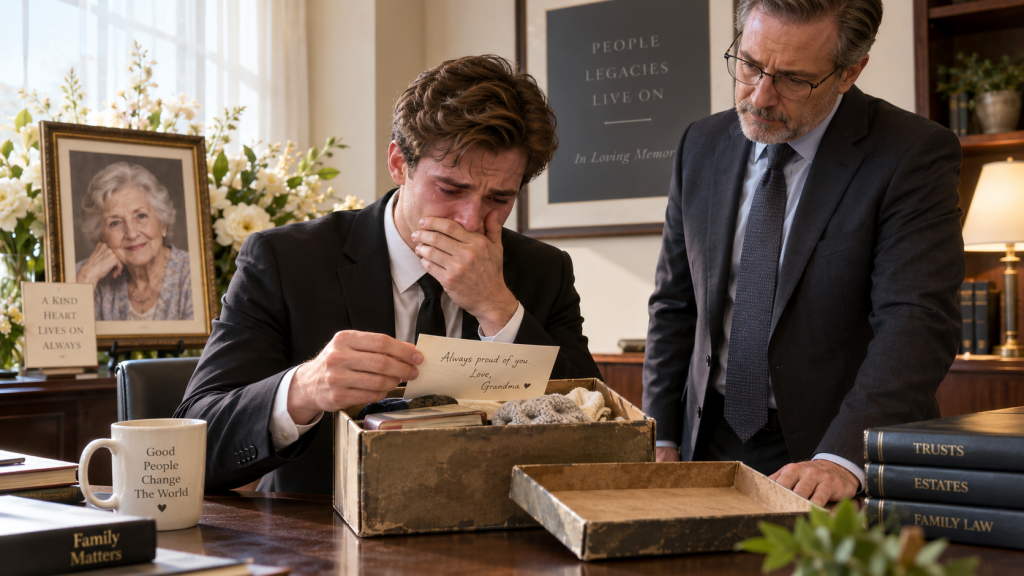
I married a lonely elderly woman for her money and a roof over my head. But after her funeral, her attorney gave me a box and said, “She told me this is what you truly wanted.”

When I married Evelyn, I was twenty-five, broke, drowning in debt, and sleeping in my pickup behind a grocery store.
She was seventy-one. A widow. Gentle in the way she spoke. She had a cozy house in a peaceful neighborhood.
And no, I did not marry her because I loved her.
I told myself I was only trying to survive. Stay a few years, pretend to be a loyal husband, inherit the house one day, and finally break free from the life that had trapped me.
I never thought Evelyn could see right through me.
But while I was quietly counting down the days, she showed me more kindness than I ever deserved.
She cooked dinner every night. She bought me new boots when my old pair split apart. She placed a warm winter coat beside the front door after noticing mine could barely close.
“You’ll freeze wearing that,” she said, as if it were nothing.
And the worst part?
I hardly cared.
The truth was, I never really saw Evelyn as my wife. I saw her as a clock ticking down.
Every doctor’s visit made me listen closer. Every bottle of pills on the counter reminded me that someday, everything inside that house might become mine.
I know how terrible that sounds now.
But at the time, I convinced myself I was just being clever.
Then one morning, Evelyn collapsed in the kitchen. Three days later, she was gone.
At the funeral, her relatives stared at me like I was filth.
“Gold digger.”
“He finally got exactly what he wanted.”
And honestly, some part of me believed I had.
But when the lawyer read the will, my stomach dropped.
The house was left to her niece. Most of her money was given to charity.
I received nothing.
Then the lawyer placed an old shoebox on the table in front of me.
My name was written across the lid in Evelyn’s careful handwriting.
I frowned. “What is this?”
The lawyer looked at me steadily and said, “She said this is what you truly wanted.”
My hands shook as I opened the box.
And the first thing inside made my entire body turn cold.
PART 2 — THE THINGS EVELYN GAVE ME BEFORE I KNEW I NEEDED THEM
The first thing inside the shoebox was not money.
It was worse.
A collection notice.
Mine.
I recognized the red lettering before I even unfolded the paper.
FINAL DEMAND.
For three years before I married Evelyn, that phrase had followed me everywhere.
Mailbox.
Email.
Voicemail.
Windshield once, after a process server found the truck I slept in.
I had owed money to everyone.
A hospital.
Two credit cards.
A personal loan I took out when my transmission died.
An old apartment complex that charged me after an eviction.
A technical-school balance.
Then interest.
Fees.
More interest.
By the time I was twenty-five, I had stopped knowing the exact number.
I only knew it was larger than anything I could imagine paying.
The notice in my hands was from North Ridge Recovery.
Original balance:
$11,842.16.
Across the front, in thick blue ink, someone had stamped:
ACCOUNT SATISFIED — BALANCE $0.00
I stared at it.
Then at the attorney.
“What is this?”
Martin Hale had handled Evelyn’s legal affairs for nearly twenty years.
He was a quiet man with square glasses and the unnerving patience of someone who knew silence made people keep talking.
“Keep looking.”
he said.
I pulled out another letter.
Different creditor.
PAID IN FULL.
Then another.
SETTLEMENT COMPLETED.
Another.
ACCOUNT CLOSED — NO BALANCE DUE.
My hands started shaking.
I spread them across Martin’s conference table.
Hospital debt.
Credit cards.
Technical school.
Apartment judgment.
Every one of them.
Zero.
I looked at him.
“No.”
Martin said nothing.
“No.”
I repeated.
“She didn’t…”
My voice failed.
Martin finally said:
“Evelyn began negotiating your debts approximately seven months after your marriage.”
I stared.
“Why didn’t I know?”
“She did not want you to.”
“That’s impossible.”
“It was complicated.”
“Debt collectors don’t just forget to tell you somebody paid them.”
“Some settlements were handled through counsel.”
“Others were satisfied through arrangements Evelyn made after acquiring certain accounts from collection agencies.”
I blinked.
“She bought my debt?”
“Some of it.”
My stomach turned.
“That sounds insane.”
Martin almost smiled.
“She was occasionally creative.”
That was one word for it.
I looked at the stack again.
All those years, the calls had gradually stopped.
I noticed.
Of course I noticed.
But by then I had moved into Evelyn’s house.
I was working regularly.
I had changed my phone number.
I assumed accounts had been sold to different collectors.
I assumed trouble was simply waiting somewhere I could not see it.
That was how I lived back then.
Every quiet week felt temporary.
I had no idea the silence had a name.
Evelyn.
“How much?”
I asked.
Martin took off his glasses.
“Do you really want the number?”
“Yes.”
“Just under forty-three thousand dollars including negotiated settlements and legal expenses.”
I almost laughed.
Forty-three thousand.
More than I had earned the entire year before we married.
“She paid forty-three thousand dollars for debts I created?”
“She resolved them.”
“That isn’t what I asked.”
“Yes.”
He replied.
“She paid.”
I pushed away from the table.
My chair scraped hard against the floor.
Her relatives had been right.
Gold digger.
Parasite.
She had known it.
And she had paid anyway.
“I didn’t ask her to do that.”
“No.”
“I would have told her not to.”
Martin looked at me.
“Would you?”
The question irritated me.
“Yes.”
He kept looking.
Then I remembered myself at twenty-five.
Sleeping behind a grocery store.
Washing in gas-station bathrooms.
Ignoring unknown phone numbers.
Counting the medications of a seventy-one-year-old woman and wondering how long until her house might become mine.
Would I really have refused?
I sat down.
“I don’t know.”
“That is probably more accurate.”
Under the debt letters was a small envelope.
My name again.
Inside was a receipt from Garrett Technical Institute.
I recognized that too.
Two years into my marriage, I had taken an evening certification course in industrial maintenance.
I had almost quit after the first month because tuition was too expensive.
Then the school told me an adult-return scholarship had covered the remaining balance.
I believed them.
Why wouldn’t I?
I looked at Martin.
He nodded before I asked.
“Evelyn funded the scholarship.”
My throat tightened.
“There was no scholarship?”
“There was.”
“What?”
“She established one.”
I stared.
“For me?”
“For students over twenty-four returning to trade education after financial hardship.”
“That is very specific.”
“Yes.”
“Did anyone else get it?”
“Eventually.”
“How many?”
“Twenty-seven students so far.”
That silenced me.
She had not simply paid my tuition.
She had built something large enough that helping me would not look like charity.
And then kept helping strangers after I was gone from the program.
I thought about the night I brought home my final certificate.
I had placed it on the kitchen counter like I did not care.
Evelyn picked it up with both hands.
“Industrial electrical systems.”
she read.
“Very impressive.”
“It’s just a certificate.”
“No.”
she said.
“It is evidence.”
“Of what?”
“That you finish things when you decide they belong to you.”
I had rolled my eyes.
I wanted the house.
She was proud of a certificate.
At the time, I thought she was naive.
Now I realized she had paid for the piece of paper and still let me believe I had earned every inch of it myself.
Maybe because I had.
Money had only opened the door.
I had still gone through it.
There was a photograph beneath the tuition receipt.
Evelyn had taken it without me knowing.
I was asleep at the kitchen table.
Work clothes.
Head on crossed arms.
A textbook open beside me.
A cup of coffee near my hand.
On the back, in Evelyn’s handwriting:
He does not know it yet, but he is leaving.
My chest tightened.
Leaving what?
Her?
The debt?
The person I had been?
I turned the photograph over again.
“Why did she keep this?”
Martin said:
“You will have to ask her.”
I looked at him.
“She’s dead.”
He glanced at the shoebox.
“Not exactly.”
The next envelope was thicker.
Inside was a key.
Plain silver.
Small plastic tag attached.
UNIT 14.
I frowned.
“Storage?”
Martin nodded.
“Later.”
“What’s in it?”
“She specifically asked me not to tell you until you finish the box.”
I almost laughed.
Even dead, Evelyn was controlling the order of information.
That was absolutely something she would do.
I kept going.
There were receipts for boots.
The winter coat.
Dental work I had thought insurance covered.
A repair on my truck.
A new set of tires.
Every small rescue I had accepted without understanding how many of them she had quietly arranged.
At first, shame rose in me.
Heavy.
Hot.
Then something else.
Anger.
I stood again.
“She knew.”
Martin looked up.
“She knew exactly why I married her.”
“Yes.”
The answer came too quickly.
My heart stopped.
“What?”
Martin folded his hands.
“Evelyn was not confused about your intentions.”
I stared.
“How?”
“She told me before the wedding.”
Everything inside me went cold.
“No.”
“She did.”
“What did she say?”
Martin looked toward the shoebox.
“There should be a letter.”
I started digging.
Not carefully anymore.
Receipts.
Photographs.
Old envelopes.
Then I found it.
Cream paper.
Her handwriting.
FOR WHEN HE FINALLY STOPS PRETENDING HE FOOLED ME.
I sat down.
Hard.
I opened it.
Dear Aaron,
So that was who I was in this story.
Aaron Mills.
Twenty-five when I married her.
Thirty when I buried her.
Five years.
I had spent five years believing I was the smartest person in a quiet little house.
Evelyn continued:
If Martin gave you this letter, then I am dead, you have already heard that the house is not yours, and I assume you are currently feeling some mixture of anger, humiliation, relief, and self-pity.
I laughed.
Out loud.
Martin looked away politely.
Before you decide I tricked you, let us correct something.
You tried to trick me first.
I covered my face.
God.
Then:
You were never very good at it.
Of course.
She wrote about the first months after we met.
I had forgotten how observant she was.
Or maybe I had never understood.
I had been doing odd repair work then.
A friend of a friend sent me to Evelyn’s house to replace rotting boards on her back steps.
The job was supposed to take two days.
It took four because the framing underneath was worse than expected.
Evelyn kept bringing lemonade outside.
I thought she was lonely.
She probably was.
One afternoon, she asked where I lived.
I said:
“South side.”
Technically true.
My truck was usually parked south of downtown.
She asked if I had a wife.
No.
Girlfriend.
No.
Children.
No.
Then she asked:
“Do you always keep all your clothes in your vehicle?”
I had looked toward the cab.
Two shirts hung behind the seat.
My stomach dropped.
She knew.
I lied anyway.
“I’m between apartments.”
Evelyn only said:
“I see.”
Apparently she saw a great deal.
The letter continued.
The first time you ate dinner with me, you put half the chicken into a napkin when you thought I was not looking.
I remembered.
I was saving it for breakfast.
The first night I let you sleep in the guest room, you locked the door.
I had.
People who feel safe do not usually lock bedroom doors in houses belonging to seventy-one-year-old women who walk with a cane.
I swallowed.
You were frightened long before you became dishonest. I understood the order.
That sentence hurt.
I kept reading.
We had not married immediately.
That was another part I had simplified in my own mind.
I worked for Evelyn for months.
Then stayed in the guest room after she discovered I was homeless.
I found regular employment at a maintenance company.
Still, I had debt.
No savings.
No rental history anyone wanted.
And Evelyn liked having someone in the house.
We ate dinner together.
Watched old game shows.
Argued about thermostat settings.
Then one evening, she mentioned her niece wanted her to move into assisted living.
I joked:
“You need a husband. Then they’d leave you alone.”
Evelyn looked at me.
Maybe that was when the idea began.
Two weeks later, I proposed.
Not romantically.
I said we got along.
I could help around the house.
She would not be alone.
I could contribute.
All technically true.
I did not mention that I had searched county property records the week before.
I knew the house was paid off.
I knew Evelyn had investments.
I knew her late husband had left her comfortable.
I had already imagined myself owning the place.
I thought I hid that.
According to the letter:
You looked at my house the way hungry people look through bakery windows.
I stopped reading.
The room blurred.
Martin quietly slid a tissue box toward me.
I ignored it.
Then used one anyway.
Evelyn continued:
I said yes because I was lonely.
At least that was true.
But loneliness was not the only reason.
My fingers tightened.
I also said yes because you needed something I knew you would not accept if I offered it honestly.
I read the sentence twice.
What?
You could accept marriage because marriage allowed you to pretend the arrangement was balanced.
A room would have felt like charity.
Money would have felt like charity.
A job recommendation would have felt like charity.
But if you convinced yourself you were using me, then every meal, every coat, every quiet night under a roof could be accepted without gratitude making you feel small.
I stopped breathing.
She had known me better than I knew myself.
I had thought greed gave me power.
Maybe greed had simply been the story I needed so I could receive help without admitting I needed it.
That realization made me sick.
“You let her marry me knowing this?”
I asked Martin.
He sighed.
“I advised her not to.”
“Good.”
“I advised a cohabitation agreement.”
“Good.”
“I advised separate finances.”
“Good.”
“And I strongly advised that she not marry a twenty-five-year-old man who had openly looked up the value of her property.”
My face burned.
“She knew about that too?”
“Aaron.”
Right.
Of course.
“What did she say?”
Martin almost smiled.
“She said, ‘He is not dangerous. He is desperate.’”
My eyes filled.
“She couldn’t know that.”
“No.”
“She couldn’t.”
Martin leaned back.
“That is why I remained concerned.”
“Then why did you allow it?”
“I was her lawyer, not her father.”
Fair.
Then:
“She signed a prenuptial agreement.”
I blinked.
“I signed one.”
“You did.”
“I barely read it.”
“I know.”
Shame again.
“The house was always protected?”
“Yes.”
“Her investment assets too?”
“Largely.”
“So there was never a realistic chance I’d inherit everything?”
“Correct.”
I laughed.
Five years.
Every medication bottle.
Every doctor appointment.
Every ugly calculation.
And Evelyn had already locked the door before I entered.
Not to punish me.
To make my scheme harmless.
“What if I had left?”
I asked.
Martin looked at me.
“What?”
“What if she stopped being useful to me?”
“If I got tired of waiting?”
“If I met someone else?”
He nodded toward the letter.
I read.
There is a possibility you will leave when you realize I am not dying quickly enough.
My stomach turned.
If you do, let him go, Martin. Do not threaten him with agreements or guilt.
I stared at the words.
A kindness that requires captivity is not kindness.
My eyes filled again.
She had given me an exit.
I never knew.
That mattered more than I wanted it to.
The worst part was that, somewhere along the way, I had stopped planning to use it.
Not consciously.
I never woke up and announced:
I love my elderly wife now.
It happened embarrassingly slowly.
A thousand ordinary things.
Evelyn hated thunderstorms but pretended she did not.
After one bad storm, I started staying in the living room until she fell asleep.
I told myself it was because I wanted quiet.
She developed arthritis in her hands.
I opened jars.
Then started chopping vegetables.
Eventually I cooked two nights a week.
Badly.
She ate everything anyway.
One winter she caught pneumonia.
I sat beside her hospital bed for four nights.
No inheritance thought.
No house calculation.
Only terror.
When she recovered, I was furious at her for refusing to use the walker.
She laughed.
“You sound married.”
I snapped:
“I am married.”
She looked at me strangely.
I did not understand why.
Now I did.
Maybe that was when she first believed me.
Three years into the marriage, I was offered a maintenance supervisor job in another city.
More money.
Better benefits.
I turned it down.
Evelyn asked why.
I said:
“Rent is expensive there.”
Lie.
The company offered relocation assistance.
She knew.
Of course.
She said only:
“That was foolish.”
I became angry.
“I’m staying here.”
“You should not stay because of me.”
“I didn’t say I was.”
“No.”
she said.
“You rarely say the important part.”
I stormed out.
Then came home with groceries.
That was us.
Not romantic in the way people like to define romance.
No candlelit anniversaries.
No public declarations.
I never called her the love of my life.
She never asked.
But somewhere between the boots and the pill organizer and arguing over whether canned soup expires, she stopped being a clock.
She became Evelyn.
And I hated myself for realizing it too late.
I kept reading.
You probably think leaving you nothing in my will means I did not believe you changed.
My throat tightened.
Yes.
That was exactly what I thought.
It means the opposite.
I stared.
If I left you the house, you would spend the rest of your life wondering whether the worst version of you had been right all along.
My breath caught.
You would tell yourself you stayed because you eventually received what you came for.
So I removed that question.
I bent forward.
Could not see.
You did not stay for the house, Aaron.
I know because I watched you choose me after you had enough money to leave.
My hands shook.
She knew about my savings.
By year four, I had almost twenty thousand dollars.
Good credit again.
Certification.
Steady work.
I could have left.
I didn’t.
Not because I had suddenly become noble.
Because home had become a woman complaining that I cut tomatoes too thick.
The letter continued.
I left the house to Rebecca because her mother grew up in it and because she has three children who already fill the rooms when they visit.
Her niece.
The woman who glared at me at the funeral.
Fair.
The charities received most of my remaining estate because I have more money than any dead person needs.
I laughed again.
Then:
You receive what I believe you wanted before greed taught you to call it something else.
My chest tightened.
A clean name.
Useful hands.
Work you can keep.
And the knowledge that you can survive without waiting for someone else to die.
I stopped.
Martin was looking out the window now.
Giving me privacy inside his own office.
There were still things in the box.
At the bottom, beneath Evelyn’s letter, was a folder from my employer.
I opened it.
A recommendation letter.
Written by Evelyn.
Not to my boss.
To a small industrial company across town that had recently opened a maintenance division.
The letter was dated four months before she died.
Aaron Mills is irritatingly stubborn, suspicious of praise, and capable of repairing almost anything except his own opinion of himself.
I laughed through tears.
Then:
He is honest now, though I cannot promise he always was.
My face burned.
He shows up. That is rarer than skill.
There were no instructions that they hire me.
No leverage.
Just a recommendation.
Attached was a business card.
The company owner had written:
Call me when you’re ready. Evelyn already told me you’ll pretend you’re not.
I almost threw the card.
Martin laughed for the first time.
“She enjoyed planning ahead.”
“Apparently.”
Then came a bank envelope.
My stomach tightened again.
I did not want more money.
Not anymore.
Inside was not a check.
It was a statement.
An account in my name.
Balance:
$8,416.27.
I stared.
“What is this?”
Martin explained.
For the last three years, Evelyn had paid me for major repair work I performed on the house.
Not chores.
Actual projects.
Deck restoration.
Bathroom plumbing.
Fence replacement.
Electrical work.
Each time, I refused payment.
“Don’t be ridiculous.”
I would say.
“I live here.”
Apparently she paid me anyway.
Into an account created years earlier as a compensation account with documents I had signed when she formally hired me for maintenance work before our marriage.
I had forgotten it existed.
The deposits were legitimate payments for labor.
Not inheritance.
Not death benefit.
Mine already.
“She said you would object.”
Martin said.
“I do.”
“She anticipated that.”
“Of course.”
“She also said to remind you that refusing wages does not make work more loving.”
That sounded exactly like her.
I stared at the number.
Eight thousand dollars.
Not enough to transform my life.
Enough for deposit on an apartment.
Emergency savings.
Tools.
Breathing room.
Exactly Evelyn’s style.
Never a throne.
A step.
Then I reached the photograph.
The one that made everything else stop.
Old.
Maybe thirty-five years old.
A young man stood beside Evelyn on the front porch.
He looked twenty-six or twenty-seven.
Thin.
Work jacket.
Dark hair.
Crooked smile.
Something about him felt familiar.
Not his face exactly.
The posture.
Hands buried in pockets.
Shoulders slightly forward, as if apologizing for occupying space.
I turned it over.
Thomas — 1987. Last Christmas home.
I looked at Martin.
“Who is Thomas?”
His face changed.
Finally.
The lawyer who had remained composed through everything looked tired.
“You should finish Evelyn’s letter first.”
“There’s nothing else.”
“There is.”
He pointed.
The bottom of the shoebox had a false cardboard insert.
I had not noticed.
I lifted it.
Underneath was another envelope.
Thicker.
On the front:
ABOUT THOMAS. READ ONLY AFTER EVERYTHING ELSE.
My stomach tightened.
I opened it.
The first line changed the entire room.
Aaron, there is one reason I recognized the look in your eyes when I found you sleeping in your truck.
I stopped.
Then:
I had seen it once before in my son.
I looked at the photograph.
Thomas.
Evelyn had a son.
In five years of marriage, she had never told me.
“What happened to him?”
I whispered.
Martin looked down.
“Read.”
Thomas was twenty-seven when he died.
My chest tightened.
He had been living in his car for nearly four months.
I stopped breathing.
The grocery store.
My pickup.
No.
Evelyn continued.
He had debts.
A drinking problem he hid well.
A pride problem he hid badly.
And a mother who believed allowing him to suffer consequences would force him to become responsible.
My hands went cold.
I refused to give him money.
Then I refused to let him come home until he agreed to treatment.
I believed I was being strong.
The next sentence was barely legible because Evelyn’s handwriting had shaken.
Thomas froze to death in his car during a January cold snap.
I covered my mouth.
No.
Martin said nothing.
The letter continued.
He had been parked behind a grocery store.
My entire body turned cold.
I looked up.
Martin’s face told me before I asked.
“The same one?”
He nodded.
The room disappeared.
I had slept behind Henderson Market because the parking lot was quiet after midnight and security rarely bothered cars near the loading dock.
I had spent four months there.
Through autumn.
Into winter.
The first time Evelyn found me, I thought she had recognized my clothes in the truck after I worked on her porch.
Apparently that was not all.
She had driven past Henderson.
Seen my pickup.
Seen blankets taped over the windows.
And thirty-three years had collapsed.
“She followed me?”
I asked.
“Not exactly.”
Martin said.
“She shopped there.”
“After your repair job started, she noticed your truck parked there repeatedly.”
My stomach tightened.
“So she knew before she offered the guest room.”
“Yes.”
“Why didn’t she tell me about Thomas?”
“Because she did not want you to become him.”
I looked at the photograph.
“What does that mean?”
Martin nodded toward the letter.
I did not bring you home because you reminded me of Thomas.
I brought you home because I remembered what happens when people make suffering a test of character.
Tears fell onto the page.
You were not my son.
I was not entitled to turn you into him.
You were a stranger with bad intentions and a good pair of hands who needed somewhere warm.
I laughed through tears.
That was probably the most accurate description of me ever written.
Then:
When you proposed marriage, part of me knew it was foolish.
Part of me also knew I was lonely enough to accept foolishness if it came with conversation at dinner.
Honest.
Always.
But do not make Thomas the reason for our marriage.
He was the reason I noticed you.
You were the reason I said yes.
That broke me.
I had spent years believing Evelyn was gullible.
Then years fearing she had been some saint who loved me despite what I was.
Neither was true.
She had needs too.
Loneliness.
Guilt.
Regret.
Maybe the desire to repair an old failure through one new kindness.
She used me a little too.
Not cruelly.
But honestly.
She wanted company.
Someone in the house.
Someone to argue with.
Someone to ask whether she had taken her pills.
Our marriage had begun with two people taking something from the arrangement.
The difference was Evelyn had known that.
I hadn’t.
At the bottom of the letter, one paragraph remained.
There is one thing about Thomas I never told Martin until last year, and it is the reason the key is in the box.
I looked immediately at the silver key.
Unit 14.
My pulse started pounding.
After Thomas died, I boxed everything from his apartment and car.
I could not bear to open any of it.
For thirty-three years, it remained in storage.
I looked at Martin.
“You knew?”
“Only recently.”
Then I kept reading.
When I met you, I thought perhaps helping you would quiet my guilt.
It did not.
Guilt is greedy that way.
Eventually I understood I did not need another son.
I needed to finally face the one I lost.
My eyes blurred.
I began opening Thomas’s boxes last year.
Then:
Inside one, I found something that does not belong to me.
My body went still.
It belongs to you.
I stared at the page.
No.
There was no possible reason anything owned by a man who died before I knew Evelyn should belong to me.
“What is she talking about?”
I demanded.
Martin’s jaw tightened.
“I don’t know.”
“She told you nothing?”
“She told me only that after reading something in Thomas’s belongings, she changed her instructions for the shoebox.”
My skin prickled.
“What did she find?”
“I genuinely do not know.”
I looked again at the key.
Unit 14.
Then the final lines.
I am sorry I waited until death to make you open that door.
Cowardice does not become wisdom simply because the coward is old.
Go to the storage unit.
Open the green metal box beneath Thomas’s winter coat.
Whatever you think of me afterward, please know this:
The house was never what you wanted most.
Neither was my money.
You wanted proof that somebody could know the worst thing about you and still leave the door unlocked.
My throat closed.
Then the final sentence:
I knew, Aaron.
I left it unlocked anyway.
I lowered the letter.
For a long time, neither Martin nor I spoke.
Then he pushed the silver key toward me.
“Storage facility closes at six.”
I looked at the clock.
4:52.
I should have gone home.
Should have waited until morning.
Should have grieved properly.
Instead, I picked up the key.
Unit 14 was on the far side of an old storage complex beside the railroad tracks.
Martin came with me.
Not because I asked.
Because Evelyn had requested it.
The lock was stiff.
My hand slipped twice.
Then the door rolled upward.
Dust.
Cardboard.
Old furniture.
A bicycle.
Three plastic tubs.
And one long garment box.
I found the winter coat immediately.
Brown wool.
Heavy.
Old-fashioned.
Underneath it sat a green metal box.
Exactly as Evelyn described.
My name was not on it.
Thomas’s was.
I crouched.
The latch opened easily.
Inside were photographs.
Receipts.
A few cassette tapes.
A pocketknife.
A watch.
Then an envelope.
Yellowed.
Unopened.
On the front was an address I recognized.
Not Evelyn’s.
Mine.
Not my current address.
The house where I grew up.
And written across the top:
RETURN TO SENDER.
My heart stopped.
I looked at Martin.
“I was four years old when Thomas died.”
Martin stared at the envelope.
Neither of us moved.
I turned it over.
The sender’s name was written in faded ink.
Thomas Whitmore.
Evelyn’s son.
Addressed to:
Michael Mills.
My father.
My knees nearly gave out.
“What the hell?”
I whispered.
Martin looked as shocked as I felt.
My father had died when I was nineteen.
He had never once mentioned Evelyn.
Or Thomas.
I opened the envelope.
Inside was a four-page letter.
The first line made my hands go numb.
Michael,
I know you told me never to contact you again, but before I disappear, you deserve to know the truth about what happened to the money.
I stopped breathing.
The money.
What money?
I looked at Martin.
He had gone pale.
Then I read the next line.
Evelyn thinks I lost everything because of drinking and debt.
A pause.
She does not know that most of the debt was mine because I took it for you.
My heart began pounding so violently I could hear it.
Then:
And she never knew about Aaron.
I dropped the letter.
Martin caught it before it hit the floor.
Neither of us spoke.
I was four when Thomas died.
My father knew him.
Thomas knew my name.
Evelyn had found the letter only months before she died.
And suddenly, the marriage I had spent five years believing began with my greed seemed to have started decades before I ever knocked on her door.
Martin slowly handed the page back to me.
“What did Evelyn say was in this box?”
I whispered.
He swallowed.
“Only that after you read it, you might finally understand why she changed her will.”
I stared at him.
“She changed her will?”
His face told me there was still more.
“When?”
“Six weeks before she died.”
“Why?”
He looked toward Thomas’s green metal box.
Then at me.
“She said the house still wasn’t yours.”
My chest tightened.
“But she said something else was.”
“What?”
Martin’s voice dropped.
“The truth about why your father spent the rest of his life hating the Whitmore family.”
And in that dusty storage unit, holding a letter from a dead man who somehow knew my name when I was four years old, I realized Evelyn had not left me one final gift.
She had left me a door.
And whatever waited behind it had been locked long before I ever married her.
PART 3 — THE DEBT THAT NEVER BELONGED TO ME
For a long time, I could not pick the letter back up.
It lay open inside Thomas’s green metal box.
My father’s name was at the top.
Mine was buried halfway down the page.
And suddenly the storage unit felt colder than the January night Evelyn’s son had died.
Martin stood beside me without speaking.
I stared at Thomas’s handwriting.
Evelyn thinks I lost everything because of drinking and debt.
She does not know that most of the debt was mine because I took it for you.
Then:
And she never knew about Aaron.
My name.
Written by a dead man thirty-three years before I married his mother.
I finally reached for the letter.
“Read the rest.”
Martin said quietly.
So I did.
Thomas and my father had met at a machine-repair shop outside Columbus in 1984.
Dad was twenty-four.
Thomas was twenty-three.
They worked second shift repairing conveyor motors and industrial pumps.
According to Thomas, my father could rebuild a gearbox from memory but could not keep fifty dollars in his checking account longer than a weekend.
Thomas was the opposite.
Careful.
Methodical.
The man who labeled extension cords.
The kind of man who probably would have driven Evelyn insane if he had lived long enough.
They became friends.
Then, when I was three, my mother left.
I knew that part.
My father always told me she “wasn’t made for family.”
That was the entire explanation.
He became a single parent.
Worked too much.
Lost jobs.
Found others.
Dragged me through cheap apartments where the walls smelled like other people’s cigarettes.
Then he decided he wanted something better.
He and Thomas planned to open a small equipment-repair business.
Two garage bays.
Secondhand tools.
One service van.
Nothing glamorous.
Just enough, they believed, to stop working for men they hated.
The bank would not lend my father enough.
His credit was already damaged.
Thomas signed.
Then signed again.
And when the business began failing almost immediately, Thomas used credit cards and a personal loan to keep it alive.
I stared at the letter.
Dad had never owned a repair shop as far as I knew.
Then a memory surfaced.
Not even a memory.
An image.
A faded sign leaning behind our garage when I was young.
M & T INDUSTRIAL REPAIR.
I used to use it as a ramp for toy cars.
I had never asked what M and T meant.
Michael.
Thomas.
Thomas’s letter continued.
You keep saying I ruined myself for you. Stop saying that.
I swallowed.
I signed because I wanted the shop too.
Important.
He was not writing himself as a martyr.
I believed the numbers because I wanted them to be true.
I kept borrowing because admitting we had failed felt worse than owing more money.
That sentence sounded painfully familiar.
How many bad choices begin not with greed but with the refusal to admit the previous choice failed?
Then:
Some of what I owe is because of you. Some is because I drank. Some is because I was arrogant. Nobody gets to put all of it in one box.
I had to stop.
Martin looked at me.
“You all right?”
“No.”
“Good answer.”
I almost laughed.
Then I kept reading.
The business lasted fourteen months.
My father tried.
Thomas tried.
That mattered too.
They worked.
They were not running some scam.
Then a major customer failed to pay them.
The service van transmission died.
My father missed rent.
Thomas maxed out two cards.
The bank accelerated part of the loan.
Everything collapsed slowly and then all at once.
My father wanted to declare bankruptcy.
Thomas refused.
Pride.
Again.
He took more debt personally because Dad had me.
That was where my name entered.
Thomas wrote:
I could sleep in a car if I had to. Michael could not put a four-year-old in one.
My vision blurred.
I reread it.
Then I noticed a photograph beneath the letter.
I had missed it before.
Small.
Glossy.
Faded almost orange.
Two young men stood beside an old blue service van.
One was my father.
I knew him immediately.
Thin.
Dark hair.
Mustache he later denied ever having.
Beside him stood Thomas.
The same young man from Evelyn’s Christmas photograph.
And sitting on Thomas’s shoulders was a little boy in a red winter coat.
Me.
My hand started shaking.
I turned the picture over.
Thomas had written:
Aaron, 4. Mike says he never shuts up. Kid stole my hat.
I sat down on the concrete floor.
There are photographs that show you what happened.
Then there are photographs that prove a life existed before your memory learned how to hold it.
I stared at my four-year-old face.
I was laughing.
Both hands wrapped around Thomas’s forehead.
His hands held my ankles.
Safe.
Casual.
Real.
“I knew him.”
I whispered.
Martin crouched beside me.
“Yes.”
“I knew him.”
Maybe not enough to remember.
But once.
Somewhere inside my childhood, Thomas Whitmore had carried me on his shoulders.
Another memory appeared.
A toy truck.
Yellow plastic.
One wheel always fell off.
A man at a kitchen table repairing it with a screwdriver.
I had believed for years that the man was my father.
Now I was not sure.
“Tom.”
I whispered.
Martin looked at me.
“What?”
“I think I remember someone named Tom.”
My throat closed.
“Jesus.”
I pressed both hands against my face.
Evelyn had married a man who had once been carried around by her son.
Neither of us knew.
At least not until the end.
No inheritance could have made the world feel stranger.
Thomas’s letter explained the debt.
It also explained the hatred.
After the shop closed, my father took whatever work he could find.
He began repaying Thomas in small amounts.
Two hundred.
Three hundred.
Sometimes fifty.
Thomas wrote:
You have paid me seventy-two hundred. I wrote it down. Stop telling people you never paid me anything.
I looked through the green box.
There it was.
A small ledger.
Michael Mills.
Payments.
Dates.
Every dollar.
My father had not run away from the debt completely.
Another family story corrected.
But the money came too slowly.
Thomas was already spiraling.
He drank more.
Lost his apartment.
Missed work.
Then lost the job.
Evelyn knew about the drinking.
Knew about the debts.
But apparently not why so much money had disappeared.
Thomas had hidden Michael from the full story because he did not want Evelyn blaming him.
He also did not want her knowing there was a child involved.
Me.
Why?
Thomas explained:
You know how my mother is. If she knows there is a child, she will try to fix everything. Then she will hate you when she cannot.
Despite myself, I smiled.
That sounded like Evelyn.
Then:
Do not let her turn you into the villain because I was too proud to admit the shop failed.
My throat tightened.
He had tried to protect my father.
Evelyn never received the protection.
Thomas’s drinking worsened that winter.
Evelyn begged him to enter treatment.
He refused.
She offered to pay.
He refused.
Then finally she made the decision that haunted her for the next thirty-three years.
He could come home—
but only if he agreed to treatment.
No drinking in the house.
No disappearing with her money.
No promises without action.
A boundary.
Not cruelty.
Not unreasonable.
Still, it ended terribly.
Thomas slept in his car.
A January cold snap came.
He had been drinking.
He fell asleep with the heater off.
By morning, he was dead.
Twenty-seven.
My father learned what happened two days later.
He went to Evelyn’s house.
Martin had not been there.
But he later saw correspondence about the aftermath.
Dad tried to explain the business debt.
Evelyn was consumed by grief.
She had found collection notices.
Bank statements.
Transfers.
Michael’s name.
She knew enough to misunderstand the rest.
She accused him of using Thomas.
My father, already drowning in guilt, responded with the cruelest possible sentence.
Martin found it years later in a note Evelyn wrote after the confrontation.
Dad told her:
“If you had opened your door, Thomas would still be alive.”
I shut my eyes.
There are sentences people say once that live inside another person for decades.
Evelyn’s answer had been just as cruel.
“If you had paid what you owed, he never would have needed my door.”
Then she ordered my father off her property.
My father never returned.
“So that’s why he hated her.”
I whispered.
Martin nodded.
“Apparently.”
I thought about my father.
He died when I was nineteen.
Heart attack.
Forty-two years old.
He spent most of my childhood suspicious of wealthy people.
Widows in particular.
Whenever an older woman appeared on television talking about charity, Dad would mutter:
“Money makes people think kindness belongs to them.”
I had never understood why.
Once, when I was fifteen, a teacher suggested I apply for financial aid for a summer program.
Dad exploded.
“We don’t take charity from people who want to own the thank-you.”
At the time, I thought he was proud.
Now I understood there had been a woman behind those words.
A grieving mother.
A closed door.
A dead friend.
A debt neither of them knew how to carry.
But Thomas’s letter did not absolve Dad either.
That mattered.
Near the end, Thomas wrote:
Michael, you owe money. That is true.
You also keep using shame as a reason not to answer the phone.
My chest tightened.
Aaron needs a father who can admit he failed at something without acting like failure makes him disappear.
I had to stop again.
The sentence felt written to me.
Not because Thomas knew the adult I would become.
Because apparently men in my family repeated themselves.
Debt.
Shame.
Silence.
Sleeping in vehicles.
Pretending we chose isolation because admitting we needed help felt worse.
My father had done it.
I had done it.
Same family.
Different decade.
Then came the line that destroyed me.
Tell Aaron none of this is his debt.
I stared.
Four-year-old me.
A man dying inside a year, worried I might someday inherit guilt from a failed repair shop.
I helped because I chose to.
If helping you turns into something you make that boy repay, then I helped the wrong way.
I lowered the paper.
For five years, I had married Evelyn partly because I believed taking from someone wealthy was how I finally balanced a life that had taken too much from me.
I thought the world owed me.
A house.
Comfort.
A break.
Apparently, before I could even read, one dead man had already warned my father not to teach me that help becomes debt.
Nobody listened.
Maybe nobody had the letter.
It had been returned.
Never delivered.
Truth sitting in a metal box while everyone built their own version without it.
The last paragraph was addressed to my father.
I’m going south for a while.
Thomas apparently meant another job.
He never made it.
If Mom calls you, answer.
She is going to think this is your fault because blaming you will be easier than admitting I am sick.
Then:
Do not blame her for not letting me come home without treatment. She has done that enough times already.
I froze.
Thomas had defended Evelyn too.
Even then.
He knew.
She is allowed to have a boundary, Mike.
My father never read those words.
For the rest of his life, he blamed Evelyn for a boundary Thomas himself understood.
And Evelyn spent decades blaming herself for enforcing it.
Two people carrying opposite versions of guilt because the one man who could have corrected both was dead.
That felt almost obscene.
I read the final lines.
Take care of Aaron.
And if you ever get back on your feet, buy the kid a better coat. That red one is too small.
I looked at the photograph.
The red winter coat.
Then something else hit me.
Evelyn.
My first winter in her house.
The old coat I owned would barely close.
She placed a new one beside the door.
You’ll freeze wearing that.
I could not breathe.
She had not known then.
She had not known about the red coat.
Not until the end.
That kindness had not been Thomas.
Not guilt.
Not repayment.
It had simply been Evelyn noticing I was cold.
That mattered more than almost anything.
Inside the green box were more records.
Not a hidden fortune.
Thank God.
Bank statements.
Loan papers.
The little payment ledger.
Two photographs of my father.
A few notes.
Enough to establish the broad truth.
Not enough to answer every question.
Real dead people are inconsiderate that way.
They leave holes.
Martin and I spent the next two weeks verifying what could be verified.
Old business registration.
M & T Industrial Repair.
Thomas Whitmore.
Michael Mills.
Closed in 1987.
A bank lien.
Equipment liquidation.
The personal loan.
My father’s payment checks.
All real.
No grand conspiracy.
No secret inheritance.
Just two young men who started a business they could not save and then let shame destroy more than bankruptcy ever would have.
There was one more letter.
Evelyn’s.
Written six weeks before she died.
That was the document Martin said had changed her final instructions.
I read it at her kitchen table.
Not the lawyer’s office.
Not the storage unit.
Her kitchen.
Rebecca, Evelyn’s niece, had allowed me thirty days to pack my things before she took possession of the house.
I had already found an apartment.
Small.
Second floor.
No garage.
Mine.
The house still smelled like Evelyn’s cinnamon tea.
I sat where I had sat every morning for five years and opened the letter.
Aaron,
I found Thomas’s letter three months ago.
I swallowed.
I have spent those three months doing what I have always been best at: interfering privately while pretending not to.
I laughed.
Then cried.
Martin helped me confirm that Michael Mills was your father.
There.
No coincidence left.
For several days, I believed this explained everything.
Why I noticed you.
Why I brought you home.
Why I married you.
Then I remembered something inconvenient.
I smiled.
She continued.
I did not know.
That sentence was underlined.
I did not know Michael was your father.
I did not know Thomas had known you.
I did not know about the business.
I did not know about the red coat.
My throat closed.
Do not let this new information steal the truth of what actually happened between us.
I stopped.
There it was.
The danger I had already begun falling into.
Turning five years of marriage into destiny.
Repayment.
A dead son sending me to his mother.
Evelyn refused.
Even from the grave.
Thomas may be why your truck behind Henderson Market felt familiar to me.
But I would have noticed any young man sleeping in January with blankets over his windows after losing my son that way.
Fair.
You were not sent to me.
You were a man repairing my steps badly enough that it took four days.
I laughed aloud.
Then:
I chose you.
My eyes blurred.
Later, you chose me.
Simple.
That was enough.
Then she addressed the will.
When I found Thomas’s letter, my first impulse was to leave you the house.
I stopped.
There it was.
The thing I once wanted more than anything.
I thought perhaps life had returned Michael’s debt to me in the form of his son.
My stomach turned.
That was grief talking.
Good.
Your father did not owe me Thomas’s life.
You certainly do not owe me payment for it.
Then:
And I do not owe you the house because Thomas once helped keep a roof over your head.
I closed my eyes.
Fair.
Clean.
No inherited ledger.
If I leave you money as repayment for something Thomas chose thirty-three years ago, I will turn his kindness into exactly the kind of debt he begged your father not to give you.
I started crying.
There was the reason.
Not punishment.
Not test.
The opposite.
Freedom.
She continued.
So I changed my will.
My chest tightened.
I removed the financial bequest I had briefly added for you after finding the letter.
I stared.
She had almost left me money.
Then chose not to.
And somehow, reading that did not hurt.
It relieved me.
Instead, I leave you Thomas’s papers, his photograph of you, and every claim I ever carried against Michael Mills—legal, moral, imagined, or otherwise.
I laughed through tears.
Consider them canceled.
Then:
There are no accounts to settle between our families.
That sentence felt like a door opening.
The eight thousand dollars in your maintenance account is yours because you earned it.
The certification is yours because you studied for it.
Your job is yours because you learned how to do it.
Your restored credit is yours because I could settle old balances, but I could not make you stop creating new ones. You did that.
I smiled.
She was right.
Do not give those things back because shame tells you accepting help made them counterfeit.
My hand tightened around the letter.
I had already planned to donate the eight thousand.
Of course she knew.
If you give away every good thing I helped you reach, you will still be letting your pride make decisions.
There it was.
Caught again.
Dead and still annoying.
Then the letter softened.
I know why you married me.
I closed my eyes.
I also know why you stayed.
My throat tightened.
Those are different truths.
Then:
I do not require the first one to disappear before I can believe the second.
That broke something open in me.
For weeks, I had been trying to rewrite the beginning because the ending hurt.
Maybe I had loved her.
Eventually.
So perhaps I needed to pretend I had always been better than I was.
Evelyn refused that too.
I had married her for money.
That was true.
I had stayed after I could leave.
Also true.
I had counted her pills once.
Then later counted them because I was terrified she would miss one.
Both men were me.
I did not need to erase one to honor the other.
The last page said:
Thomas died believing he had failed.
Michael lived believing he had been betrayed.
I lived believing I had closed the door that killed my son.
My eyes filled.
All three of us spent too much time turning pain into blame because blame gives grief somewhere to sit.
I read that sentence twice.
Do not inherit that habit.
Then:
You wanted my house because you thought a house would prove you could never be thrown out again.
My chest tightened.
You wanted my money because you thought enough money would make humiliation impossible.
Neither would have worked.
She was right.
Of course.
What you wanted was the ability to believe that needing help did not make you contemptible.
I covered my mouth.
Then:
I hope I gave you enough evidence.
I could not finish for several minutes.
At the bottom:
There is one final thing I want you to do.
Of course.
Open the front door before you leave this house for the last time.
I frowned.
Then:
Do not lock it until Rebecca arrives.
I laughed through tears.
The unlocked door.
Her metaphor made literal.
You spent too many years believing shelter had to be stolen before someone could take it away.
Walk out of one home knowing you are allowed to enter another.
Then:
And Aaron—
My hand shook.
I loved you.
No qualification.
Not like Thomas.
Not instead of Thomas.
Not because of Michael.
You.
I pressed the letter against my chest.
There are sentences that arrive too late and still manage to find the exact place they were meant to reach.
Rebecca arrived two days later to begin sorting the house.
She still did not like me much.
Understandable.
At the funeral, she had looked at me like I had spent five years circling her aunt’s bank account.
She had not been completely wrong.
We stood in Evelyn’s kitchen.
Awkward.
Then I handed her the key.
“The house is yours.”
She looked at me.
“I know.”
I almost laughed.
Family resemblance.
Then she said:
“Aunt Evelyn told me something before she died.”
My stomach tightened.
“What?”
“She said not to confuse the man you married with the man who buried you.”
I stared.
Rebecca’s eyes filled.
“She loved you.”
“I know.”
That was the first time I said it without flinching.
Rebecca nodded.
Then:
“She also said if you tried to steal the dining table, I should call the police.”
I laughed so hard I had to sit down.
Evelyn.
Perfect.
We sorted Thomas’s belongings together.
The things that belonged to the Whitmore family went to Rebecca.
His watch.
Childhood photographs.
Letters from Evelyn.
The brown winter coat.
Rebecca gave me the photograph of Thomas carrying me.
“You should have this.”
I held it carefully.
“You sure?”
“You’re in it.”
“So is your cousin.”
“Exactly.”
For the first time, our histories did not need to compete.
The photograph belonged to both.
She also gave me Thomas’s old pocketknife.
I tried to refuse.
She rolled her eyes.
“Aunt Evelyn warned me you do this.”
Of course.
So I took it.
Not because I deserved it.
Because it was offered.
Another skill I had to learn.
I moved into my apartment the following week.
Eight hundred square feet.
White walls.
Cheap cabinets.
View of a laundromat roof.
I loved it.
The first night, I sat on the floor eating takeout because I owned no table.
Then I realized something.
I was not afraid.
No one could tell me to leave because I had not tricked my way inside.
I had signed the lease.
Paid the deposit with money Evelyn had paid me for work.
My credit was good.
My name was on the electricity.
Ordinary things.
I had spent half my life believing ordinary security belonged to other people.
Now it was mine.
Not inherited.
Not stolen.
Built.
With help.
Those last two words took me longest to put beside each other.
I accepted the job interview Evelyn arranged.
The owner, Paul Mercer, looked at my résumé.
Then at Evelyn’s recommendation.
“She called you stubborn.”
“She was being kind.”
He laughed.
I got the job.
Not because Evelyn ordered him to hire me.
He made that very clear.
“You screw up, I fire you.”
“Fair.”
I stayed seventeen years.
Became plant maintenance manager.
Then operations supervisor.
Eventually trained apprentices.
The first one who came to me with bad credit and nowhere stable to live made something inside me ache.
His name was Javier.
Twenty-three.
Proud.
Angry.
Sleeping on a cousin’s sofa.
I wanted to give him money.
Stopped.
Remembered Evelyn.
Instead I asked:
“What would actually help?”
He stared at me suspiciously.
Good.
I recognized the look.
I helped him find a union hardship fund.
Showed him the technical-school scholarship Evelyn had created.
He applied.
Got it.
I never told him why that scholarship mattered to me.
Not then.
Later.
When he finished.
Twenty-seven students became fifty.
Then eighty.
When I became financially stable, I began contributing to it.
Not forty-three thousand dollars.
Not some grand act of repayment.
One hundred dollars a month.
Then more when I could afford it.
Martin once asked if I was trying to pay Evelyn back.
I said:
“No.”
He raised an eyebrow.
So I corrected myself.
“Not anymore.”
Good.
Help moves forward better than backward.
I visited my father’s grave for the first time in eleven years.
I took Thomas’s letter.
Not because Dad could read it.
Because I needed to say things where I knew I could not be interrupted.
I sat on the grass.
“Thomas didn’t blame you.”
Wind.
Nothing.
“I think you blamed yourself enough for both of you.”
I looked at Dad’s name carved into stone.
“You should have told me.”
That anger remained.
“You should have told me about the shop.”
“About Thomas.”
“About Evelyn.”
“You let me grow up believing needing anyone made me weak.”
My throat tightened.
Then:
“But I think somebody taught you the same thing.”
That did not excuse him.
It made him human.
I placed a copy of the photograph against the stone for a moment.
Four-year-old me on Thomas’s shoulders.
My father smiling beside him.
Three people before the debt became the only story.
Then I took the photograph home.
The dead do not need originals.
The living sometimes do.
I visited Thomas too.
His grave was beside Evelyn’s husband in the Whitmore family plot.
Evelyn had been buried there after her funeral.
I stood between their stones.
Mother.
Son.
Then laughed softly.
“You both caused me a ridiculous amount of paperwork.”
No answer.
Thomas’s grave was simple.
THOMAS EDWARD WHITMORE
1960–1988
BELOVED SON
I touched the top of the stone.
“Thank you for the red coat.”
Technically, I did not know whether Thomas bought that coat.
The photograph suggested he had been part of that winter.
That was enough.
Then:
“You were wrong about one thing.”
Wind moved through the trees.
“You said none of it was my debt.”
I smiled.
“You were right.”
Then:
“It just took us a while.”
For years, I did not know what to call Evelyn.
Wife sounded strange when I told new people.
People would ask how long we were married.
Five years.
Then age differences came out.
Expressions changed.
So eventually I stopped explaining unless it mattered.
She was Evelyn.
The woman I married for shelter.
The woman who knew.
The woman who paid debts without telling me.
The woman I once waited to die.
The woman whose death broke me.
All true.
No single sentence got ownership of her.
I never inherited her house.
I am grateful now.
Rebecca raised her children there for another decade.
Then sold it after the youngest went to college.
She called me before closing.
“I thought you should know.”
I stood in my apartment kitchen.
By then I could have afforded a house of my own.
Maybe not Evelyn’s neighborhood.
Enough.
“You okay?”
Rebecca asked.
I thought.
“Yes.”
And I meant it.
“Do you want anything from the house?”
I looked around my own kitchen.
The table I had bought myself.
Work boots near the door.
A winter coat hanging on a hook.
“No.”
Then I remembered.
“One thing.”
“What?”
“The spare key Evelyn used to hide under the ceramic frog.”
Rebecca laughed.
“Seriously?”
“Yes.”
She mailed it to me.
Worth maybe two dollars.
I kept it.
Eventually, I bought a small house.
Two bedrooms.
Old garage.
Terrible roof.
I was forty-one.
The mortgage approval came by email while I was eating lunch at work.
I stared at the screen.
Then went into the maintenance storeroom and cried behind shelves of motor grease.
Not because I finally had property.
Because nobody had to die for me to get it.
That distinction mattered more than the deed.
The first night, I left the front door unlocked for ten minutes.
Just ten.
Evelyn would have called that irresponsible.
She would have been right.
But I stood on the porch and looked inside.
My couch.
My lamp.
My keys on the counter.
A home I could walk out of without believing the universe would punish me.
Then I locked the door.
Because growth is not stupidity.
Years later, Martin retired.
At his retirement lunch, he handed me another envelope.
I stared at him.
“No.”
He laughed.
“What?”
“If Evelyn wrote another letter, burn it.”
“She didn’t.”
“Promise?”
“Yes.”
Inside was a copy of the scholarship report.
One hundred twelve students helped since Evelyn founded it.
I stared.
At the bottom was the name.
Evelyn Whitmore Second Start Scholarship.
I smiled.
“Second Start?”
“She named it.”
“Of course.”
Then Martin said:
“She told me once that people like redemption stories too much.”
I looked at him.
“What did she mean?”
“She said redemption makes it sound like a person becomes worthy after being unworthy.”
My throat tightened.
Then:
“She preferred second start.”
I smiled.
That sounded exactly like Evelyn.
Not erased past.
Another beginning.
I spent years trying to decide whether I deserved what she gave me.
I finally stopped.
Deserving was the wrong question.
Evelyn chose.
Thomas chose.
My father chose.
I chose.
Some choices were wise.
Some selfish.
Some loving.
Some disastrous.
The point was not to calculate whether everyone had received the morally correct amount.
That kind of accounting had already ruined enough lives.
Thomas helped my father.
My father could not repay him fast enough.
Thomas died carrying guilt.
Evelyn blamed Dad.
Dad blamed Evelyn.
I grew up learning help was dangerous.
Then I married Evelyn to take what I could before she died.
A perfect inheritance of fear.
Until someone interrupted it.
Not with money.
With an unlocked door.
I still have the shoebox.
It sits in the top of my closet.
Inside:
The satisfied debt notices.
The scholarship receipt.
Evelyn’s letters.
Thomas’s letter.
The photograph of me on his shoulders.
The silver storage key.
And the spare key from beneath Evelyn’s ceramic frog.
Nothing inside is worth much money.
Once, that would have disappointed me.
Now I understand.
The box contains the first complete version of my life I ever received.
Not the flattering version.
The true one.
A desperate young man married an elderly woman partly because he wanted her money.
She knew.
She married him anyway for reasons of her own.
He changed.
Not cleanly.
Not immediately.
She loved him without pretending the beginning had been beautiful.
Then she died without rewarding his original greed.
Instead, she gave him proof that his life had already become larger than it.
That was harder to accept than a house.
And much more valuable.
Sometimes I think about the sentence Martin said after the funeral.
“She told me this is what you truly wanted.”
At the time, I thought Evelyn was mocking me.
No house.
No fortune.
A shoebox.
I had been furious for perhaps thirty seconds.
Then terrified.
Then ashamed.
Years later, I finally understood what she meant.
I had thought I wanted enough money that nobody could ever look down on me again.
I thought I wanted a deed with my name on it.
A warm house.
Paid bills.
Security.
But beneath all of that was something smaller.
More humiliating.
More human.
I wanted to knock on a door while having nothing useful to offer and still hear someone say:
Come inside.
My father had needed that.
Thomas had needed that.
Evelyn had needed it too, though in a different way.
Lonely people need doors opened just as badly as homeless people do.
Maybe that was our marriage.
Two people pretending the arrangement was about something else because admitting need felt too exposed.
Then, slowly, we stopped pretending.
Not completely.
Enough.
The last winter Evelyn was alive, we had one terrible snowstorm.
The power flickered twice.
Wind hit the windows.
She was sitting on the couch under three blankets complaining that the weather report was “hysterical nonsense.”
I checked the front lock.
Then the back.
She noticed.
“You know no one is coming in this weather.”
“I know.”
“Then why do you keep checking?”
“Habit.”
She studied me.
Then asked:
“Do you still think someone is going to make you leave?”
I remember becoming angry.
“No.”
“Aaron.”
“No.”
Then she smiled.
Not kindly.
Accurately.
“Good.”
At the time, I thought she believed me.
Now I think she knew I was lying.
Again.
But she did not push.
That was Evelyn’s final kindness.
She understood that people sometimes need years after safety arrives before the body believes it.
I believe it now.
Most days.
Not because I became wealthy.
I did not.
Comfortable.
Stable.
Enough.
Not because nobody could ever reject me again.
People did.
Not because I stopped needing anyone.
That would have been another form of the same sickness.
I believe it because I finally learned that losing a home is not the same thing as losing yourself.
Debt is not identity.
Receiving help is not ownership.
And love is not proven by what someone leaves you when they die.
Sometimes the strongest proof is what they make possible while they are still alive.
Evelyn gave me boots.
A coat.
Meals.
Time.
Education.
A quiet room.
Annoying advice.
Then, at the end, no house at all.
Perfect.
Because if she had given me the house, I might have spent the rest of my life wondering whether the man who married her for money had won.
Instead, she left me with no place to hide from the truth.
I had stayed after I could leave.
I had loved her after there was no strategic reason to.
And when she died, what hurt was not losing the inheritance.
It was losing Evelyn.
That was the answer.
The one she already knew.
I was twenty-five when I entered her house believing I had found a clever way to survive.
I was thirty when I walked out carrying a shoebox.
No deed.
No fortune.
No wealthy widow left to protect me.
Just my own name.
My own work.
My own mistakes.
And enough truth to stop living as if every kindness came with an invoice.
Before I left for the final time, I did exactly what Evelyn asked.
I packed the truck.
Placed the shoebox on the passenger seat.
Walked back through the empty living room.
Then opened the front door.
I stood there for a moment.
Behind me was the house I once wanted badly enough to marry for it.
Ahead of me was an apartment I had earned enough to rent.
Rebecca’s car had just turned onto the street.
I could have waited inside.
Instead, I stepped onto the porch.
The door remained open behind me.
For the first time in my life, that did not frighten me.
Because Evelyn had been right.
The house was never what I truly wanted.
I wanted to know that somebody could see exactly who I was—
greedy,
frightened,
ashamed,
unfinished—
and still believe I was worth letting inside.
Evelyn did.
Then, eventually, she taught me how to open the door for myself.
And that was the only inheritance I ever needed.
THE END STORIES! THANK YOU FOR READING GOOD LUCK !❤️
Related Posts