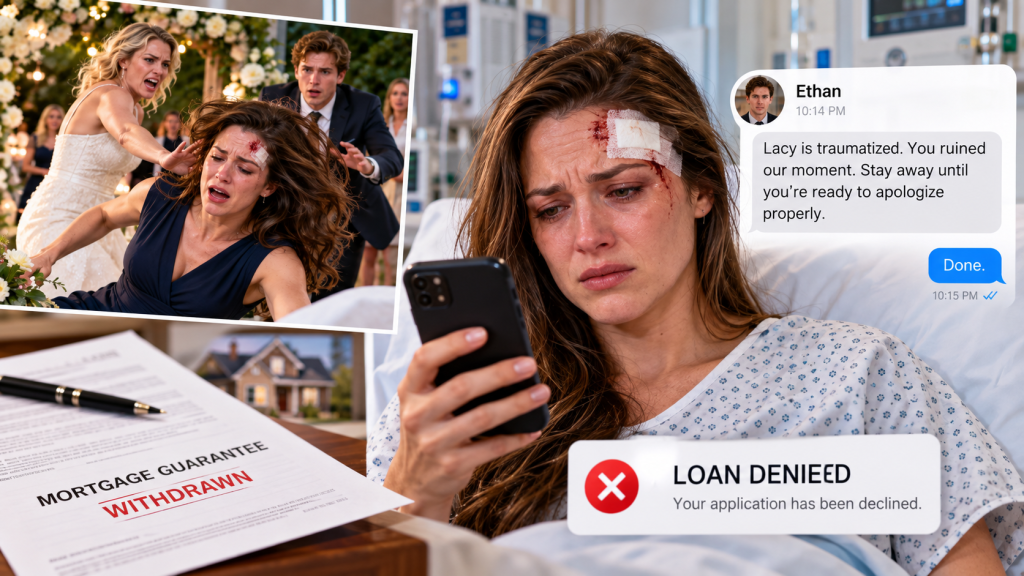
“Lacy is traumatized. You ruined our moment. Stay away until you’re ready to apologize properly.” That was the message my younger brother sent while I was lying in the emergency ward with six fresh stitches across my brow, dried blood still tangled in my hair,

and the sharp smell of antiseptic burning the back of my throat. He didn’t ask whether I was in pain. He didn’t ask whether the doctors thought I had a concussion. He didn’t even ask how badly his fiancée had hurt me. Ethan was furious because my injury had apparently “ruined the mood” of what was supposed to be one of the happiest evenings of their lives. I stared at his message until the words blurred on the screen. Then I typed one word. “Done.” I pressed send, placed my phone facedown against the thin hospital blanket, and made a decision neither Ethan nor Lacy would understand until Monday morning. I withdrew as guarantor for the mortgage on their dream home. Two days later, their loan was denied, and the R$40,000 deposit they had put down was suddenly in danger of being lost. But that part came later. The disaster had started that afternoon at my parents’ house, where the entire family had gathered to celebrate Ethan and Lacy’s engagement. I was thirty-six, nearly nine years older than Ethan, and for most of his life I had been the person who rescued him whenever something went wrong. When he crashed his first car, I paid the insurance excess. When he dropped out of university for a year, I let him stay in my apartment rent-free. When he started his small design business and couldn’t qualify for equipment financing, I co-signed. I never kept a list. I never reminded him. He was my little brother, and helping him had always seemed as natural as breathing. So when he called me four months earlier, excited because he and Lacy had found a beautiful house in a gated development, I wasn’t surprised when he eventually asked for help. “The bank loves the application,” he said, “but they need someone stronger financially as guarantor.” I should have said no. Instead, I heard the same hopeful voice I remembered from when he was ten years old, begging me to teach him how to ride a bicycle. “Send me the paperwork,” I said. Ethan nearly cried with gratitude. Lacy sent me three heart emojis and called me “the best future sister ever.” That sweetness lasted until the engagement party. Lacy had always had a temper, but that day she was unusually tense. Everything had to be perfect—the flowers, the champagne, the photographs, even where people stood when she entered the garden. I arrived twenty minutes early to help my mother arrange food. The first thing Lacy said when she saw me was, “You’re wearing that?” I looked down at my navy dress. “What’s wrong with it?” “Nothing,” she replied, smiling without warmth. “It’s just very… noticeable.” I ignored her. An hour later, after several glasses of champagne, she became worse. She corrected my mother in front of guests, snapped at the caterer, and accused one of Ethan’s friends of taking attention away from her because he announced that his wife was pregnant. Ethan laughed everything off. “She’s stressed,” he kept saying. “Today means a lot to her.” Then came the photograph. Lacy wanted everyone gathered on the stone patio beneath an arch covered in white flowers. My father was adjusting his jacket when I noticed one of the decorative stands leaning dangerously close to my five-year-old niece. I stepped forward and moved the child away. At that exact moment, Lacy shouted, “Can you stop interfering for five seconds?” I turned toward her. “The stand was falling.” “It was fine.” “It nearly hit Emma.” Her face hardened. “You always have to make yourself important.” The garden became quiet. Ethan looked embarrassed but said nothing. I lowered my voice. “Lacy, you’ve been drinking. Maybe we should take the picture and calm down.” That was the sentence that did it. She marched toward me, furious. “Don’t tell me what to do at my own engagement party.” “I’m not—” She shoved me with both hands. I stumbled backward. My heel caught the edge of the patio step, and the world tilted violently. I remember the sickening crack of my head striking the corner of a stone planter. Then warmth streamed down the side of my face. Someone screamed. My mother ran toward me. For several seconds I couldn’t focus my eyes. I touched my forehead and looked at my fingers. They were covered in blood. Lacy immediately started crying. Not because I was hurt. Because everyone was staring at her. “She provoked me!” she shouted. “She ruined everything!” Ethan didn’t come with me to the hospital. My father drove while my mother held a towel against my head. Ethan stayed behind with Lacy because, as he later explained by text, “she was having a panic attack.” The doctor cleaned the wound, checked me for neurological symptoms, and stitched my brow. I was still waiting for discharge when Ethan’s message arrived. “Lacy is traumatized. You ruined our moment. Stay away until you’re ready to apologize properly.” I read it twice, expecting some hidden sign that my brother had lost his mind. There wasn’t one. I typed, “Done.” Then I remembered the mortgage documents sitting in my email. The final guarantee had not yet been activated because the lender was still completing its last approval stage. I called my financial adviser from the hospital corridor. “I need to withdraw my guarantee immediately.” He hesitated. “That may collapse the loan.” I looked through the small glass window in the emergency-room door and saw my reflection: pale face, swollen eye, white bandage across my forehead. “I understand.” “They may lose their deposit.” “I understand that too.” My voice no longer shook. “Please remove me.” By Monday morning, I had confirmation in writing. At 10:17, Ethan called. I didn’t answer. At 10:19, he called again. Then Lacy. Then my mother. Finally, at 10:26, a message appeared. “WHAT DID YOU DO?” I stared at those four words and felt something inside me settle into perfect calm. Thirty seconds later another message arrived. “The bank denied everything. They’re saying we could lose R$40,000. Call me NOW.” I placed the phone on my desk and returned to work. For the first time in my adult life, my brother had told me to stay away, and I had decided to respect his wishes completely. What Ethan didn’t realize yet was that the mortgage guarantee wasn’t the only thing in his life that existed because I had quietly been standing behind him.
PART 2 — THE SIGNATURE I NEVER GAVE THEM
At 10:31 Monday morning, my mother called for the fourth time.
I finally answered.
Not because I wanted to.
Because I knew if I didn’t, she would eventually appear in my office carrying a casserole and enough anxiety to qualify as weather.
“What happened?”
she demanded.
No hello.
No question about my stitches.
No question about the headache that had kept me awake most of Sunday night.
Just:
“What happened to Ethan’s mortgage?”
I leaned back in my chair.
Outside my office window, the city looked offensively normal.
People crossed the street.
A bus stopped.
Someone walked a golden retriever past a café.
Meanwhile, my family was behaving as though I had detonated a building.
“I withdrew as guarantor.”
Mom became silent.
Then:
“You what?”
“I withdrew my guarantee before final activation.”
“Why?”
For one second, I thought she was joking.
Then I remembered that families can normalize almost anything if it happens often enough.
“Because Lacy shoved me hard enough to split my forehead open, Ethan stayed at the party with her, and then he texted me from the emergency ward telling me I was the one who needed to apologize.”
Mom exhaled.
“He was upset.”
“So was my skull.”
“That isn’t funny.”
“No.”
I touched the stitches beneath the small bandage.
“It really isn’t.”
Mom lowered her voice.
“You know they may lose the house.”
“No.”
“They may lose their deposit if they cannot complete under the purchase contract.”
“That is not exactly the same thing.”
“You know what I mean.”
“I do.”
I also knew more than Ethan apparently did.
My financial adviser had spent Sunday reviewing the mortgage documents with a lawyer.
The guarantee had not yet become irrevocable.
The bank was still completing final underwriting.
I had every right to withdraw before execution.
So I did.
The R$40,000 deposit was not necessarily gone either.
Their purchase contract contained a financing condition with a short cure period.
They had time to find another lender, provide more capital, renegotiate with the seller, or request an extension.
None of those options were comfortable.
None were my responsibility.
Mom whispered:
“Couldn’t you have waited until everyone calmed down?”
I stared at the wall.
That question said more than she intended.
“Wait for what?”
“For Ethan to decide whether telling me to disappear was temporary?”
“He didn’t mean forever.”
“He meant it when he sent it.”
“You know how he is when he’s emotional.”
“Yes.”
I did.
That was part of the problem.
Ethan had always been emotional.
Then I had always been practical.
He panicked.
I solved.
He spent.
I lent.
He crashed.
I insured.
He struggled.
I stepped in.
For years, we called that sibling love.
Somewhere along the way, Ethan had started treating the second half of that pattern as infrastructure.
“I am not doing this to punish him.”
I said.
Mom sighed.
“It certainly looks like punishment.”
“No.”
“Punishment would be interfering with something that belongs to him.”
“The guarantee was mine.”
“My income.”
“My credit.”
“My legal exposure.”
“My choice.”
I paused.
“I simply stopped lending him those things.”
Mom went quiet.
I heard the faint ticking of her kitchen clock in the background.
Then:
“He trusted you.”
That sentence almost made me laugh.
Instead, it hurt.
“So did I.”
Silence.
Then I hung up before I said something I would regret.
At noon, the headache became worse.
I closed my office door and turned off the lights.
The emergency physician had told me I had a mild concussion.
No skull fracture.
No intracranial bleeding.
Six stitches.
Rest.
Reduced screen time.
Return immediately if certain symptoms worsened.
Nothing catastrophic.
I was lucky.
That word irritated me.
People call you lucky after something bad happens and fails to become worse.
Still, medically, I was.
The stone planter had caught me above the eyebrow.
Another few centimeters might have changed everything.
My father texted shortly after lunch.
How’s your head?
I stared at the message for a moment.
Then smiled.
Finally.
A normal question.
Hurts. Doctor says mild concussion. I’m okay.
He replied:
Your mother is losing her mind over the house. I told her the house can wait.
My throat tightened.
Then:
I found something from Saturday. Call me when you feel up to it.
I called immediately.
“What did you find?”
Dad hesitated.
“The patio camera.”
I sat straighter.
My parents had installed security cameras after several break-ins nearby.
One covered the side entrance.
Another faced the rear garden.
I had forgotten completely.
“Did it record what happened?”
“Yes.”
My fingers went cold.
“All of it?”
“Enough.”
Dad sent the file.
I watched it once.
That was enough too.
The camera angle came from above the French doors.
No sound.
But the picture was clear.
Everyone assembling beneath the flower arch.
Emma standing near the decorative stand.
Me noticing.
Stepping forward.
Moving her gently away.
The stand tilted seconds later.
Not enough to fall completely.
Enough to prove I had not imagined the risk.
Then Lacy approached.
Even without sound, I could see the argument.
Her shoulders tight.
My hands down.
Then both of hers went against my chest.
Not a tap.
Not an accidental bump.
A shove.
My body moved backward.
My heel caught the patio edge.
Then my head struck the planter.
I watched myself disappear out of frame.
Dad stopped the clip there.
Good.
I did not need to watch the blood.
The most painful part was Ethan.
He stood five feet away.
He saw the push.
For several seconds after I fell, he moved toward me.
Then Lacy grabbed his arm.
She was crying.
He turned back toward her.
My mother rushed past him toward me.
Dad came running from the other side of the garden.
Ethan stood between us.
Then chose Lacy.
I watched that three-second decision twice.
Then closed the video.
Some betrayals arrive as words.
Others are visible only when you know where to look.
“Do you want me to send this to anyone?”
Dad asked.
“Send me the original file.”
“I already saved three copies.”
I almost smiled.
My father had discovered chain of custody.
“Good.”
“Are you going to the police?”
I looked at the stitches reflected faintly in my dark computer screen.
“I don’t know.”
He did not pressure me.
Another gift.
“Okay.”
Then he said:
“I’m sorry I didn’t stop it earlier.”
“You drove me to the hospital.”
“I mean Lacy.”
Dad’s voice became rough.
“She had been getting worse all afternoon.”
“We kept excusing it because she was stressed.”
I closed my eyes.
“So did Ethan.”
“Yes.”
Neither of us said what we were both learning.
Excusing small cruelty does not cause the larger cruelty.
But sometimes it teaches someone the room will keep accommodating them.
That evening, Lacy posted something online.
I knew because three people sent screenshots.
White background.
Elegant black lettering.
Sometimes the people closest to you weaponize money when they can no longer control you emotionally. Protect your peace.
No name.
No mention of my stitches.
No mention of the shove.
No mention that the “money” she referred to was a guarantee I had not yet become legally bound to provide.
Below it, comments appeared.
So sorry you’re dealing with this before the wedding.
Jealousy is ugly.
You two deserve your home.
I stared for twenty seconds.
Then closed the screenshot.
I did not respond.
My attorney would have approved.
My nervous system wanted a parade.
Ethan left three voicemails that night.
The first was angry.
“You promised us.”
The second was more desperate.
“The seller only gave us ten business days.”
The third sounded almost like my brother.
“Please just call me.”
I listened to that one twice.
Then still did not call.
Because the version of Ethan I always rescued tended to reappear the moment consequences became uncomfortable.
I loved him.
That did not mean every emergency he felt was mine to solve.
Tuesday morning, my financial adviser called.
His name was Daniel Rocha.
He had managed my accounts for seven years and had developed the unfortunate habit of asking questions before I could make emotional financial decisions.
Usually annoying.
Currently useful.
“I reviewed your other contingent obligations connected to Ethan.”
My stomach tightened.
“What other obligations?”
Pause.
“You don’t remember?”
That was never a good beginning.
Four years earlier, I had personally guaranteed a financing line Ethan used to purchase printing equipment, high-end workstations, and fabrication tools for his design studio.
I remembered.
Barely.
The outstanding balance was manageable.
The guarantee remained active until the facility’s annual renewal unless the lender released me earlier.
I could not simply cancel yesterday and pretend the bank had never relied upon me.
Good.
Contracts were supposed to mean something.
“What else?”
I asked.
“His office lease.”
I closed my eyes.
Of course.
Two years earlier, Ethan’s business was too young to satisfy the landlord.
I guaranteed the first lease term.
It expired in four months.
“And there’s the small revolving business facility.”
“How much?”
“Authorized up to R$120,000.”
My eyes opened.
“I thought that expired.”
“It renewed automatically last year.”
“How much is currently drawn?”
“About R$63,000.”
I rubbed my forehead.
The concussion did not appreciate this conversation.
“What can I legally withdraw from?”
Daniel explained.
Not everything immediately.
Important.
The existing equipment financing remained my responsibility under the contract until paid, refinanced, or formally released.
The revolving line allowed a guarantor to give notice against future renewal, but current obligations remained protected.
The office lease could be allowed to expire without renewal of my guarantee.
In other words, I could not pull money out from underneath debts that had already been extended on my word.
Nor did I want to.
That would not be a boundary.
That would be chaos.
“What do you recommend?”
I asked.
“If your goal is to stop future exposure, notify each institution that you will not renew or increase guarantees beyond current contractual obligations.”
“Do it.”
He paused.
“You understand Ethan may need to refinance?”
“Yes.”
“His borrowing costs could increase.”
“I understand.”
“His business might have to reduce its credit lines.”
“I understand that too.”
Then:
“Do it properly.”
That sentence mattered.
I was not trying to ruin Ethan.
I was stepping away from being the invisible column holding up parts of his life.
If the building remained strong, good.
If it needed new supports, he had time to find them.
But I was done being assumed.
Two days later, Ethan called from a number I didn’t recognize.
I answered.
“Whose phone?”
“Dad’s.”
I almost laughed.
“You’re at their house?”
“Yes.”
“Is Lacy there?”
Pause.
“No.”
“Why are you calling?”
His voice tightened.
“I got letters from the bank.”
“Which bank?”
“All of them, apparently.”
Good.
Daniel worked quickly.
“You’re withdrawing from my company too?”
“No.”
“It sure looks like it.”
“I am not withdrawing from obligations already in force.”
“I’m giving notice that I will not renew my personal guarantees when they expire.”
Silence.
Then:
“Why would you do that?”
I closed my eyes.
He genuinely did not understand.
“Ethan, you told me to stay away.”
“That was about the party.”
“You told me I ruined your engagement.”
“Lacy was hysterical.”
“She pushed me.”
“You kept provoking her.”
My body became very still.
“What did I do?”
“You told her she was drunk.”
“She was drunk.”
“You embarrassed her.”
“She shoved me into stone.”
“She didn’t mean for you to hit your head.”
There.
The defense.
Intent.
As if the fact she had not selected the exact corner of the planter transformed everything into weather.
“She intended to shove me.”
I said.
Silence.
“You saw her.”
“I saw an argument.”
“No.”
“You saw her push me.”
He exhaled sharply.
“Why are we talking about this? I’m trying to save my business.”
That sentence almost hurt more than the hospital message.
Because he had returned immediately to the real emergency in his mind.
His.
“You should refinance.”
I said.
“With what?”
“With your business.”
“You know the studio is still growing.”
“Then show the lender your revenue.”
“They want stronger collateral.”
“That’s something you need to solve.”
His breathing became louder.
“You helped me build this.”
“Yes.”
“And now you’re walking away.”
“No.”
“I helped you begin.”
“I never agreed to guarantee your borrowing forever.”
“You never said there was an expiration date on being family.”
I closed my eyes.
“No.”
“But apparently you put one on treating me like one.”
Then I hung up.
My hands shook for several minutes afterward.
Boundaries sound powerful afterward.
During them, they can feel like tearing muscle.
Dad called that evening.
“Ethan came here.”
“I know.”
“He’s upset.”
“I know.”
Then Dad surprised me.
“I showed him the video.”
I stopped breathing.
“You what?”
“He kept telling your mother that Lacy barely touched you.”
“So I put the footage on the television.”
My pulse quickened.
“What did he say?”
“Nothing.”
For once.
Nothing.
Dad told me Ethan watched the shove three times.
The second time, Dad paused immediately before Lacy’s hands hit my chest.
Then immediately after.
No argument.
No sound.
No emotional interpretation.
Just movement.
Ethan apparently sat on the sofa for nearly a minute.
Then whispered:
“I remembered it differently.”
That sentence did something to me.
Not enough for forgiveness.
Enough to make me sad.
People often remember events in the shape that allows them to continue loving their choices.
The camera had no such need.
“Did Lacy see it?”
I asked.
“No.”
“Ethan asked me not to show her.”
Of course.
“Why?”
“He said she’s fragile right now.”
I laughed.
My stitches pulled.
Bad idea.
Dad continued:
“I told him maybe you were fragile when you were bleeding on my patio.”
I smiled.
“Thanks, Dad.”
“I should’ve said it Saturday.”
“Saturday you were holding a towel against my head.”
“Still.”
We let the silence sit.
Then:
“He wants to meet you.”
“I don’t know.”
“I told him that’s your decision.”
Good.
More progress than I expected from one week.
I agreed three days later.
Not at my apartment.
Not my parents’ house.
A café near my office.
Public.
Lacy was not invited.
Ethan arrived fifteen minutes early.
He looked exhausted.
For one terrible second, I saw him at ten years old again.
Skinny knees.
Missing front tooth.
Terrified of falling off the bicycle.
Don’t let go.
I had promised I wouldn’t.
Maybe that was where everything started.
Except children are supposed to learn eventually that the person running behind the bicycle cannot keep holding the seat forever.
Ethan looked at my forehead.
The bruising had turned yellow-purple around the stitches.
His face changed.
“I’m sorry.”
I waited.
“For what?”
His eyes dropped.
“For not going to the hospital.”
That was a beginning.
“And?”
“For the message.”
“And?”
He swallowed.
“For saying you provoked her.”
My chest tightened.
“Did I?”
“No.”
“Why did you say it?”
He looked toward the window.
“Because if you didn’t…”
He stopped.
I waited.
“If you didn’t, then what Lacy did was harder to defend.”
There.
Truth.
Small and ugly.
I appreciated it.
“She says she barely remembers pushing you.”
Ethan continued.
“I don’t care.”
“She’d had a lot to drink.”
“I know.”
“She’s been under pressure.”
“I know.”
“She’s ashamed.”
“Good.”
He flinched.
“I don’t mean destroyed.”
I corrected.
“I mean shame can be useful when it tells you that you crossed a line.”
He nodded.
Then:
“She wants to apologize.”
“Then she can write one.”
“You won’t see her?”
“Not yet.”
He looked disappointed.
I let him.
Then the conversation changed.
Of course it did.
“The mortgage.”
he said.
I almost smiled.
“There you are.”
“What?”
“Nothing.”
He rubbed his face.
“The seller extended the financing deadline by seven days.”
“Good.”
“It’s not good.”
“It’s better than losing the contract today.”
“We tried another lender.”
“And?”
“The rate is terrible.”
“That happens when a borrower needs a stronger guarantor and no longer has one.”
Ethan stared at me.
“So you really won’t do it.”
“No.”
“Even if Lacy apologizes?”
That was the question I had been waiting for without knowing it.
“No.”
His face fell.
“This isn’t a punishment I reverse when she behaves.”
“Then what is it?”
“A decision.”
“About what?”
“Risk.”
I leaned forward.
“Four months ago, I agreed because I trusted you.”
“You still can.”
“No.”
His face hardened.
“Because of Lacy.”
“Partly.”
“What else?”
“Because you watched her hurt me and immediately decided protecting her feelings mattered more than checking whether I was injured.”
His jaw tightened.
“And because afterward, your first instinct was still to tell me what I owed you.”
He looked down.
“Ethan, I’m not putting my finances behind a thirty-year mortgage for two people whose response to conflict is this.”
Silence.
“You can rebuild trust.”
“But I am not gambling my house, my savings, or my credit on the possibility that you will.”
He stared at his coffee.
“You make it sound like I’ve used you my whole life.”
“No.”
I said it immediately.
That surprised him.
“You didn’t.”
“I chose to help.”
“I loved helping.”
“I still love you.”
My throat tightened.
“But somewhere along the way, gratitude became expectation.”
“When the car happened, you cried because I helped.”
“When you stayed with me after university, you cleaned my kitchen every night because you felt guilty.”
“When I co-signed the equipment financing, you sent me flowers.”
“This time?”
I looked at him.
“You called me selfish before I had even finished withdrawing.”
His eyes filled.
“You stopped seeing support as something I was giving.”
“You started seeing it as something that was already yours.”
Ethan cried.
Quietly.
I almost reached across the table.
Old reflex.
I kept my hands around my coffee instead.
He needed to survive being sad without me rushing in to make it stop.
So did I.
“I don’t want to lose the company.”
he whispered.
“You don’t have to.”
“The bank may cut the credit line.”
“Then reduce expenses.”
“Refinance.”
“Bring in a partner.”
“Show stronger revenue.”
“Sell equipment you don’t need.”
“I don’t know.”
“Exactly.”
I looked at him.
“You built the studio.”
“You can solve parts of it too.”
His mouth twisted.
“You always solved everything better.”
“That doesn’t mean I was supposed to keep solving it.”
Before we left, I gave him one thing.
Not money.
A folder.
Copies of every guarantee I still had connected to him.
Expiration dates highlighted.
Current balances.
Notice periods.
What I remained legally responsible for.
What I would not renew.
He looked through it.
“You made this?”
“My adviser did most of it.”
“Why?”
“So you have time.”
He looked up.
“If I wanted to destroy you, I wouldn’t give notice.”
His eyes filled again.
“I’m not pulling the floor out.”
“I’m telling you when I’m no longer holding up the ceiling.”
He nodded.
That was the closest we came to hugging.
We didn’t.
Lacy’s apology arrived the next morning.
Email.
Four paragraphs.
The first three were mostly explanations.
Stress.
Alcohol.
Feeling judged.
Fear that I disliked her.
Then the final paragraph changed.
None of that gave me permission to put my hands on you. I pushed you. You were injured because I pushed you. I am sorry.
I read that sentence three times.
There.
No:
If you felt hurt.
No:
I’m sorry things got out of hand.
She named what she did.
I replied with one line.
I received your apology. I need distance, and I expect you to respect that.
She did not answer.
Good.
My stitches came out the following week.
Tiny scar.
The doctor said it would fade.
I was not sure I wanted it to disappear completely.
Not because I needed a monument.
Because every time I touched the raised line above my eyebrow, I remembered the moment I finally stopped confusing rescue with responsibility.
Still, scars are allowed to soften.
So are lessons.
The mortgage did not recover quickly.
Another lender offered terms Ethan and Lacy could technically afford but disliked.
Higher rate.
More down payment.
Stricter conditions.
Mom and Dad refused to guarantee.
That shocked Ethan.
Mom called me afterward.
“I told him no.”
I smiled.
“How did that feel?”
“Terrible.”
“Good.”
“That is a strange response.”
“You’ll recover.”
She laughed.
Then became quiet.
“I think maybe we made this worse over the years.”
My chest tightened.
“How?”
“Every time you rescued Ethan, we praised you.”
“Every time he needed rescuing, we called him sensitive.”
“That taught both of you something.”
I leaned back.
“What?”
“That your competence was family property.”
There.
My own mother.
Naming it.
I almost cried.
The seller gave Ethan one final extension.
He and Lacy considered walking away and fighting to recover as much of the deposit as the contract allowed.
They also considered accepting the expensive mortgage.
I stayed out.
That was harder than withdrawing the guarantee.
Advice is another form of rescue when no one has asked for it.
I was learning silence too.
Then Daniel called me one Thursday afternoon.
Three weeks after the engagement party.
His voice was strange.
“Are you at your desk?”
“Yes.”
“Did you submit anything new to Banco Real Norte?”
I frowned.
“No.”
“Anything concerning Ethan’s mortgage?”
“No.”
Pause.
“Did you sign a revised family support declaration?”
I became perfectly still.
“What?”
He exhaled.
“Okay.”
“That answers my question.”
My fingers tightened around the phone.
“What happened?”
“The mortgage underwriter contacted me because my office information appears in the original guarantee file.”
“And?”
“They received a reconsideration package yesterday.”
My heart started pounding.
“From Ethan?”
“I don’t know who transmitted it yet.”
“What’s in it?”
Daniel hesitated.
That hesitation frightened me more than any answer could.
“Daniel.”
“There is a letter.”
“What kind?”
“An updated statement saying you withdrew as formal guarantor because of a temporary family dispute but remain willing to support Ethan and Lacy financially if necessary.”
My body went cold.
“I never said that.”
“I know.”
“How much support?”
“It says up to R$250,000 in liquidity if they experience payment difficulty during the first three years.”
I stood so quickly my chair hit the wall.
“No.”
“I know.”
“I never authorized that.”
“I know.”
“Tell the bank immediately.”
“They already know there’s a dispute.”
“Why?”
“Because the underwriter compared it with your written withdrawal.”
My pulse hammered.
“Good.”
Then Daniel became quieter.
“There’s more.”
Of course there was.
“The letter includes your financial profile.”
“What profile?”
“A summary of your investment accounts.”
My stomach dropped.
Not exact current balances.
But enough.
Approximate liquid assets.
Property value.
Income.
Information I had originally provided months earlier as part of the legitimate guarantee process.
“Could they have gotten it from the mortgage file?”
“Possibly.”
“Ethan had copies of some of the application documents.”
“Possibly.”
“Lacy?”
“Possibly.”
Good.
No guessing.
“Anything else?”
“Yes.”
There was an attached declaration.
Four pages.
Legal language.
Not from the bank’s standard forms.
Prepared separately.
It stated that I understood my withdrawal had caused temporary financing difficulty but that I remained committed to the buyers’ long-term financial stability.
The language was careful.
Not quite a new guarantee.
More like a comfort letter.
A statement designed to reassure the lender that if Ethan failed, his financially stable sister would probably step in.
Exactly the assumption I had spent the last three weeks trying to end.
“Whose signature?”
I asked.
Daniel did not answer immediately.
I already knew.
“Mine.”
“Yes.”
My legs weakened.
I sat.
“Digital?”
“A scanned signature appears above your typed name.”
My throat tightened.
“Does it look real?”
“Very.”
I closed my eyes.
Years of birthday cards.
Loan applications.
Business documents.
Copies everywhere.
Of course it could look real.
“When was it dated?”
“Yesterday.”
I was at work yesterday.
That did not automatically prove anything.
Scanned signatures can be legitimately authorized without physical presence.
Except I had authorized nothing.
“Who witnessed it?”
“There is no notary.”
“Just a declaration.”
“Who sent it?”
“The broker uploaded the package.”
“Who gave it to the broker?”
“We’re finding out.”
I stood again.
Then stopped myself.
Evidence.
Not anger.
Evidence first.
“Send everything to my attorney.”
“Already done.”
“Tell the bank in writing I did not sign, approve, authorize, or consent to that declaration.”
“Already drafted.”
“I want my financial information removed from any reconsideration packet where legally possible.”
“We’ll request it.”
“Preserve the original upload metadata.”
Silence.
Then Daniel said:
“You sound very calm.”
I looked at my reflection in the office window.
The scar above my brow still pink.
“I’m not.”
My attorney, Camila Torres, called less than an hour later.
She handled my financial and contract matters and had already reviewed the original withdrawal.
Her first instruction:
“Do not call Ethan.”
I almost laughed.
“Wasn’t planning to.”
“Do not call Lacy.”
“Definitely wasn’t planning to.”
“Do not accuse either of them of forgery.”
“Fine.”
“We know someone submitted a document you deny authorizing.”
“We do not yet know who created it.”
Correct.
Painfully correct.
The mortgage broker responded that evening.
His name was Rafael Mendes.
He sounded terrified.
Not because he admitted doing anything wrong.
Because mortgage professionals do not enjoy discovering that documents in their file may be unauthorized.
He said Ethan had contacted him several days earlier asking whether any form of family support short of a formal guarantee might help.
Rafael told him a lender could consider additional evidence of financial backing, but any statement would have to be genuine and independently evaluated.
Two days later, the support declaration arrived by email.
“From Ethan?”
I asked.
Rafael hesitated.
“No.”
My chest tightened.
“Who?”
“Lacy.”
Silence.
According to Rafael, Lacy wrote:
Ethan’s sister has calmed down and agreed she does not want the house lost over a family argument. Attached is her updated support declaration and financial summary.
My hands began shaking.
“Did you speak to Ethan after receiving it?”
“Yes.”
“What did he say?”
Rafael became careful.
“He said he would review the final package.”
“That isn’t my question.”
“Did he say the document was mine?”
Pause.
“He said, ‘If she sent it, submit it.’”
Not confirmation.
Not innocence.
Ambiguity.
I hated ambiguity.
“Did the lender rely on it?”
“No.”
Relief flooded through me.
“The underwriter flagged the contradiction before reconsideration.”
“Good.”
“Nothing was approved.”
“Nothing funded.”
“Good.”
No financial loss yet.
No completed false loan.
Important.
The problem was still serious.
But the system had caught it.
Then Rafael said something that changed the shape of the conversation.
“There was another attachment.”
I closed my eyes.
“What?”
“A document concerning Ethan’s design company.”
My pulse increased.
“Why would the business be in the mortgage packet?”
“Because the buyers were trying to demonstrate additional income stability.”
“What document?”
“An amended personal guarantee schedule for his business credit line.”
I stopped breathing.
“What does that have to do with me?”
Rafael was silent.
Then:
“Your name is on that too.”
The office suddenly felt too small.
Camila asked Rafael to send the packet directly to her.
Twenty minutes later, it arrived.
I opened it while she stayed on the phone.
Page one.
Ethan’s company.
NORTHLINE DESIGN STUDIO LTDA.
Existing revolving facility.
Current guarantor:
Me.
That part was legitimate.
Then an amendment.
Extension of guarantee for another three years.
Increased facility limit from R$120,000 to R$220,000.
My name.
My financial details.
And at the bottom—
my signature.
Again.
I stopped breathing.
“That one changes an actual obligation.”
Camila said quietly.
“Yes.”
“Did you sign it?”
“No.”
“Authorize Ethan to sign for you?”
“No.”
“Authorize Daniel?”
“No.”
“Anyone?”
“No.”
My voice cracked.
“No.”
The document was dated eight days after the engagement party.
Five days after I had formally notified the bank that I would not renew the business guarantee.
Someone had not merely misunderstood my boundary.
Someone had tried to reverse it on paper.
I stared at the signature.
It was good.
Very good.
The curve of the first letter.
The shortened middle stroke I developed in my twenties.
The exact impatient slash I made at the end of my surname.
For a second, I almost questioned myself.
That was how convincing it looked.
Then I remembered where I had been on the date beside the signature.
At a follow-up appointment.
My forehead still bandaged.
My mother beside me in the waiting room.
I had signed one thing that morning.
A medical consent form allowing the doctor to remove my stitches the following week.
Nothing else.
“Camila.”
“Yes?”
“I want the bank to preserve every record.”
“They will.”
“Email headers.”
“Yes.”
“Upload logs.”
“Yes.”
“Original file metadata.”
“Yes.”
“Do not let anyone call this a family misunderstanding.”
Her voice hardened.
“I won’t.”
Then Daniel called again.
He had spoken to the business lender.
The amendment had not yet been processed.
Another gift of timing.
Because my previous written notice was already in the file, the credit officer saw the contradiction and froze the request.
No increased line.
No extension.
No new liability attached to me.
For the second time in three weeks, a lender had stopped something because I had put my boundary in writing before someone else tried to redefine it.
Paper had protected me.
That irony was not lost on me.
“Who submitted the business amendment?”
I asked.
Daniel hesitated.
“The lender received it through Northline’s online portal.”
“Whose login?”
“Ethan’s company administrator credentials.”
My stomach turned.
Ethan.
Then Daniel added:
“But according to the bank, more than one employee may have access to that portal.”
Good.
Do not jump.
“And the file itself?”
“Metadata shows it was created on a laptop registered to Northline.”
“Which employee?”
“They’re checking.”
Again.
Not enough.
That night, I sat at my dining table with the hospital video paused on my laptop.
Lacy’s hands against my chest.
My body falling backward.
Beside it, the mortgage support declaration.
My signature.
Then the business guarantee extension.
My signature again.
Three weeks earlier, I had believed the worst thing my brother could do was choose his fiancée’s comfort while I bled.
Now someone close to him had apparently decided my no was merely another obstacle that paperwork could repair.
That frightened me more.
Because I understood the pattern.
I had spent nearly thirty years saying yes to Ethan.
Yes to money.
Yes to rooms.
Yes to guarantees.
Yes to second chances.
Maybe I had said it so often that the first real no sounded, to someone, like a clerical error.
Something to correct.
Something temporary.
Something that could be replaced with the version of me everyone preferred.
Dad came over.
I showed him the documents.
He aged in front of me.
That is the only way I can describe it.
He sat at my dining table and stared at Ethan’s company name.
Then my forged-looking signature.
His shoulders dropped.
“Do you think Ethan did this?”
“I don’t know.”
“What about Lacy?”
“She sent one of the packets.”
“That doesn’t prove she created the signatures.”
He looked at me.
“You’re being very careful.”
“I have to be.”
My eyes burned.
“If I accuse them before I know, then I become one more person in this family deciding feelings are evidence.”
Dad nodded.
Slowly.
Proudly, maybe.
Sad too.
Mom arrived later.
Dad had called her.
When she saw the business guarantee amendment, she sat without removing her coat.
“No.”
she whispered.
It sounded less like denial than prayer.
I knew exactly what she meant.
Please let there be an explanation.
Please let the child I love not have crossed this line.
Family makes investigators out of strangers and defense attorneys out of parents.
I reached across and took her hand.
Not because I was comforting Ethan.
Because she was my mother.
Pain did not need to be rationed.
At 9:42 p.m., my phone rang.
Ethan.
Camila had told me not to speak to him until we understood more.
So I let it ring.
Then a message.
Please answer. I know about the documents.
Another.
I didn’t sign your name.
My heart pounded.
Then:
I swear to you, I didn’t know about the mortgage letter until today.
I stared.
Mortgage letter.
Specific.
Nothing yet about the business guarantee.
Then another message arrived.
But there’s something I need to tell you before you see the bank records.
My breathing slowed.
Mom leaned toward me.
Dad stood.
I did not answer.
Thirty seconds later:
Lacy had access to my office laptop because she’s been helping with the house application.
My stomach tightened.
Then:
She knew where your old guarantee documents were saved.
Mom covered her mouth.
Still not proof.
Access is not authorship.
I knew that.
Then the final message arrived.
And this time, my hands actually went numb.
I found the file she used.
Below it was an image Ethan had taken of a folder on his laptop.
The folder was named:
SISTER FINANCIAL — SIGNATURES
Inside were scans of documents I recognized.
My old equipment guarantee.
The mortgage application.
A tax declaration.
A copy of my identification.
And a file created eight days after the engagement party.
Its name was:
NEW SIGNATURE FINAL.png
For several seconds, nobody in my dining room spoke.
Then another message appeared.
From Ethan.
Only six words.
There’s something worse in that folder.
I stared at the screen.
Then the phone rang again.
This time, I answered.
Ethan was crying.
Not angry.
Not defensive.
Terrified.
“What did you find?”
I whispered.
He tried to speak once.
Failed.
Then finally said:
“Lacy wasn’t only trying to save the house.”
My grip tightened around the phone.
“What was she trying to do?”
Silence.
Then Ethan answered:
“She was trying to make sure you could never stop guaranteeing my life again.”
And that was when I realized the mortgage had never been the biggest thing at risk.
PART 3 — THE GUARANTEE THAT FINALLY EXPIRED
For several seconds after Ethan said the words—
“She was trying to make sure you could never stop guaranteeing my life again.”
—I could not answer.
My mother was still sitting across from me with one hand covering her mouth.
Dad stood beside the dining table, staring at my phone as though Ethan might somehow climb through it.
My scar throbbed faintly above my eyebrow.
Not because the wound was reopening.
Because sometimes the body remembers before the mind finishes understanding.
“What did she make?”
I asked.
Ethan inhaled shakily.
“A document.”
“What kind?”
“I don’t know what it would actually do legally.”
Good.
At least he had learned that much.
“But it’s called a Continuing Family Financial Support Authorization.”
My stomach dropped.
“Read it.”
“Camila told me not to touch anything else.”
I closed my eyes.
“Good.”
That surprised him.
I could hear it.
“Take photographs of the screen if your lawyer tells you to.”
“Do not forward files to yourself.”
“Do not delete anything.”
“Do not let Lacy near the laptop.”
“She’s not here.”
“Where is she?”
“At her sister’s.”
“Does she know you found the folder?”
Silence.
Then:
“No.”
For once, Ethan had done the correct thing before calling me.
That mattered.
Within forty minutes, Camila had spoken with Ethan’s attorney.
By midnight, the laptop was sitting in a lawyer’s evidence cabinet instead of Ethan’s apartment.
No dramatic midnight confrontation.
No Lacy racing across town to smash a computer.
Just preservation.
The kind of boring decision that sometimes determines whether truth survives.
The next morning, a forensic technician created a full copy of the device.
Then everyone waited.
I hated waiting.
Apparently justice and dentistry share a business model.
The first file was exactly what Ethan had described.
CONTINUING FAMILY FINANCIAL SUPPORT AUTHORIZATION
My full name appeared at the top.
My identification number.
Home address.
Approximate income.
Investment holdings.
Property value.
All information gathered from legitimate documents I had previously supplied when I agreed to help Ethan.
The document said I recognized that my brother’s financial stability was a “long-standing family commitment.”
I almost laughed.
Long-standing family commitment.
Apparently decades of helping him had become a legal concept.
Then came the dangerous part.
The declaration stated that I intended to remain available as a secondary source of financial support for Ethan’s mortgage, business credit, vehicle financing, and “related household obligations” for five years.
Five.
Years.
“That doesn’t automatically bind me, does it?”
I asked Camila.
“No.”
Relief.
Immediate.
“A private document does not magically make you responsible for every future debt merely because your name appears on it.”
“Good.”
“But?”
“There’s always a but.”
“But if someone used an apparently signed version to persuade a lender that you had agreed to support a transaction, it could create serious problems.”
“Especially if a lender relied on it.”
My skin went cold.
“Was there a signed version?”
“Yes.”
Of course.
My signature sat at the bottom.
Copied cleanly.
Almost perfectly.
Underneath was something else.
A supposed authorization allowing Ethan’s lenders to verify my financial information through Daniel’s advisory office.
I had never signed that either.
Then a clause stating that my support would remain available despite “temporary interpersonal disagreements.”
I stared.
Temporary interpersonal disagreements.
That was what six stitches had become.
That was what being shoved into stone had become.
Not violence.
Not betrayal.
A temporary disagreement.
Something paperwork could outlive.
Camila kept reading.
Then stopped.
“What?”
I asked.
“There’s a provision saying any withdrawal of your support should be disregarded unless confirmed through two separate written notices thirty days apart.”
I actually laughed.
“Can she invent that?”
“She can type anything she wants.”
“That does not make it enforceable.”
“Good.”
“But it tells us what whoever drafted this was trying to accomplish.”
Yes.
My no had become the problem.
So someone wrote a document designed to make my no harder to believe.
Then came the email drafts.
Those were worse.
A folder inside Lacy’s cloud-sync directory contained messages written as though they came from me.
Not sent from my actual account.
Drafted.
Prepared.
One read:
Daniel, I was emotional when I asked you to remove my support. Please let the lenders know I remain committed to Ethan financially. I do not want a family argument to damage his future.
My hands began shaking.
Another:
Ethan has always been responsible with money. I am comfortable remaining backup support while he establishes the new household.
False.
Not because Ethan had always been reckless.
He hadn’t.
But I had never written those words.
Another:
Please treat my previous withdrawal as temporary unless I confirm otherwise after thirty days.
There it was again.
Erase the no.
Delay it.
Outwait it.
Then the forensic technician found a browser history.
Searches.
Not secret dark-web instructions.
Ordinary searches anyone could make.
Questions about continuing guarantees.
Family support letters.
Whether lenders accept scanned signatures.
How to rescind a guarantor withdrawal.
Some results were harmless.
Some misunderstood.
Some irrelevant.
But together with the documents, they showed planning.
Lacy had not woken up one morning and accidentally attach my signature to two financial applications.
She had been trying to find a structure that made my prior generosity look ongoing.
Then there was the file named:
NEW SIGNATURE FINAL.png
The one Ethan had shown me.
Forensic comparison linked it to an old equipment-finance agreement I had legitimately signed years earlier.
My signature had been cropped.
Cleaned.
Background removed.
Saved as a transparent image.
Then inserted into the mortgage support declaration.
And the business guarantee extension.
Same digital image.
Same microscopic imperfections.
Same tiny break in the first stroke.
For years, I had signed papers to help Ethan.
Now one of those genuine acts of love had been turned into raw material for a false one.
That hurt in a way I had not expected.
Camila said:
“We need to discuss a police report.”
I became silent.
Not because I wanted to protect Lacy.
Because making something official changes its weight.
The shove had already been captured on camera.
Hospital records documented the injury.
Now there were banking documents carrying my signature without authorization.
This was no longer just a family screaming match that had become financially ugly.
There were institutions involved.
Lenders.
Identity records.
Financial declarations.
Possibly attempted fraud.
I looked at my scar in the dark reflection of my office window.
“Okay.”
One word.
Again.
This time it meant something different.
I filed the report.
Facts only.
The engagement party.
The push.
The hospital.
The mortgage withdrawal.
The unauthorized declaration.
The business guarantee amendment.
The financial information.
The files discovered on Ethan’s laptop.
I did not tell the officer Lacy was evil.
Did not speculate about what prison sentence she deserved.
Did not say Ethan was innocent.
Because I did not know everything yet.
I gave them records.
That was enough.
Ethan was interviewed too.
So was Lacy.
Their stories were not identical.
That mattered.
Ethan admitted he knew Lacy was trying to find alternative financing after I withdrew.
Of course.
He admitted he gave her access to his laptop because she had been helping manage mortgage paperwork.
He admitted she knew where old copies of my guarantee documents were stored.
Then came the part he had not told me yet.
The part that made my anger shift toward him again.
Two days after the bank rejected the original mortgage application, Lacy told him:
“I think I can fix this.”
Ethan asked how.
She said:
“Your sister is just angry. We need something showing the bank she’ll still help if things go wrong.”
And Ethan answered:
“Do whatever you can. I can’t lose the house over this.”
When he told me, my chest became cold.
“You said that?”
We were sitting in Camila’s office.
His lawyer beside him.
“Yes.”
“Did you know she was going to use my signature?”
“No.”
“Did you ask?”
“No.”
“Did you ask whether I had agreed?”
He looked down.
“No.”
There.
The line.
Not forgery.
Not innocence.
Something in between.
“Why not?”
I asked.
His voice broke.
“Because I wanted to believe you’d calm down.”
My eyes filled.
“And?”
“And I didn’t want to know too much.”
Silence.
That sentence mattered more than he understood.
I didn’t want to know too much.
The refuge of people who benefit from something suspicious.
“I thought if Lacy found another legal way to prove you would help us…”
He stopped.
“You had already told me you would not.”
I said.
“Yes.”
“So there was nothing left to prove.”
His face crumpled.
“I know.”
Then came the business guarantee.
That was harder for Ethan.
The portal used his administrator credentials.
At first, investigators could not determine who uploaded the amendment.
Then device records narrowed it.
Lacy’s laptop had accessed Northline’s portal using credentials saved in Ethan’s browser sync.
The file uploaded from that device.
Cloud history showed she edited the document.
Created the signature image.
Exported the final PDF.
Ethan had not created it.
But there was another message.
Lacy to Ethan:
If the bank keeps the old guarantee active for a few more years, your cash flow problem disappears.
Ethan:
She already told them she’s leaving it.
Lacy:
She says things when she’s angry.
Then Ethan:
I can’t ask her again right now.
Lacy:
Then don’t.
No response afterward.
That was it.
Not authorization to forge.
Not proof he knew.
But he had seen where Lacy’s thinking was going.
And instead of telling her to stop, he looked away.
When I asked him why, he whispered:
“Because every time before this, you came back.”
My throat tightened.
“What?”
“When we fought.”
“When I made mistakes.”
“When I couldn’t pay something.”
“You would get mad.”
“Then help anyway.”
He looked at me.
“I thought this would be the same.”
There.
The deepest truth.
My consistency had become evidence against my own boundary.
Not because helping was wrong.
Because nobody, including me, had ever made clear that generosity was not renewable without consent.
“Ethan.”
I spoke quietly.
“If someone gives you something ten times, what do they owe you the eleventh?”
He stared at the floor.
“Nothing.”
“Say it again.”
His eyes filled.
“Nothing.”
That was the lesson.
Expensive.
Late.
Necessary.
Lacy’s explanation was different.
She admitted creating the documents.
Eventually.
At first, she said they were drafts.
Negotiation tools.
Things she hoped I would sign later.
That did not explain why signed copies were submitted.
Then she said she assumed Ethan had authority to use my old signature because I had previously guaranteed his business debts.
That did not survive scrutiny either.
Past consent is not a signature subscription.
Finally, through counsel, she gave a fuller statement.
She believed I was “punishing” Ethan.
She believed I would eventually relent.
She believed losing the house over one argument would be absurd.
And she believed she was preserving something I would ultimately want preserved.
There.
Control wearing the clothes of common sense.
The sentence from her interview that stayed with me was this:
“She has always helped him. I thought I was documenting what everyone already knew.”
Everyone already knew.
That I would pay.
Guarantee.
Rescue.
Adjust.
So why should my actual no matter more than the family story?
That was the belief underneath everything.
The criminal case did not become a television drama.
No federal agents burst into the engagement party.
No judge delivered a speech about sisterhood.
Lacy’s conduct was separated into what could actually be proved.
The shove.
The resulting injury.
The unauthorized financial documents.
The use of my copied signature.
The submissions to lenders.
Because the mortgage had not been funded and the business credit increase had been stopped, the financial losses were limited.
That affected the outcome.
So did her eventual admission and cooperation.
She entered a plea resolving several offenses related to the assault and document misuse.
The sentence included a short custodial component followed by supervision, financial penalties, restitution for certain costs, and a no-contact condition.
Not decades.
Not nothing.
Consequences proportionate to what happened.
Ethan was not charged with forging my signature.
Investigators found no evidence that he created or inserted it.
His messages showed ignorance of important details.
They also showed deliberate avoidance.
That became a moral consequence more than a criminal one.
His business lender took a much colder view.
Northline’s borrowing privileges were restricted.
The proposed increase was canceled permanently.
The lender required fresh controls over who could access its financial portals.
Ethan had to replace administrative credentials and provide new internal procedures.
Trust, once damaged, also becomes paperwork.
The mortgage collapsed completely.
The seller refused another extension.
For a few days, Ethan kept hoping I would reverse everything.
Then something changed.
He stopped asking.
That was the first sign he had understood.
The deposit did not simply vanish.
The financing condition gave them rights.
Lawyers negotiated.
Because the loan had failed during the permitted financing period and no completed funding occurred, most of the R$40,000 was eventually returned.
Some contractual costs and fees were lost.
Painful.
Not ruinous.
They did not get the dream house.
The world continued.
Dream houses are surprisingly replaceable compared with trust.
The engagement did not survive.
I did not tell Ethan to leave Lacy.
That mattered to me.
I had spent enough years making decisions around him.
He needed to make one himself.
For almost two months, they tried counseling.
Then Lacy continued insisting that her worst mistake was “going too far while trying to protect their future.”
Ethan eventually realized she still saw his future as something she had been entitled to protect with my signature.
He ended the engagement.
Quietly.
No social-media announcement.
No public humiliation.
When he told me, I said:
“I’m sorry.”
He looked confused.
“You hated what she did.”
“Yes.”
“I still know you loved her.”
Both can be true.
Again.
Families hate that.
Life requires it.
My parents changed too.
Slowly.
Mom apologized for the Monday phone call.
Not perfectly.
Then better.
“I asked about the mortgage before I asked about your head.”
“Yes.”
“I’m ashamed.”
I looked at her.
“Why did you?”
She cried.
“Because I knew you would be okay.”
That old trap.
The competent one will survive.
Therefore the emergency belongs to someone else.
I sighed.
“Mom, knowing I will probably survive something doesn’t make it less important that it happened.”
She nodded.
“I know now.”
Good.
Not complete.
Enough.
Dad became more direct with Ethan.
That was new.
When Ethan once complained that refinancing the business would cost him more, Dad said:
“Then pay more.”
Ethan stared.
Dad continued:
“Your sister paid less because she was giving you her credit.”
“That had value.”
“Now you know how much.”
I nearly applauded.
Growth is embarrassing when parents discover it late.
Still useful.
My withdrawal from Ethan’s financial life happened gradually.
The existing equipment financing remained protected under the original contract until Ethan refinanced it.
He did.
At a higher rate.
Smaller balance.
His.
The office lease came up for renewal.
The landlord asked for my guarantee again.
Ethan said no before they even contacted me.
He downsized the studio instead.
Smaller office.
Less impressive lobby.
Lower rent.
Profitable.
Remarkable.
The revolving business line expired.
I was formally released.
I received the letter by email.
GUARANTOR OBLIGATION TERMINATED
I stared at those words longer than necessary.
Then printed them.
Not because I distrust email.
Because some sentences deserve paper.
I placed the letter in a folder.
No celebration.
No champagne.
Just relief.
Northline Design Studio did not collapse.
That mattered.
For years, I had secretly believed Ethan needed me because without me everything might fall apart.
That belief had fed my rescuing as much as his expectation did.
It is uncomfortable to admit that being needed can become its own form of identity.
When Ethan finally had to operate without my credit, he adapted.
Sold one expensive machine he barely used.
Renegotiated supplier terms.
Raised prices.
Took on a smaller partner.
Turned down a flashy office expansion.
Within eighteen months, the business was healthier.
Smaller.
Realer.
I was proud of him.
From a distance.
That was different too.
We did not become close again immediately.
For nearly a year, we saw each other only at our parents’ house.
Birthdays.
Christmas.
Emma’s school recital.
He was polite.
So was I.
There was love underneath.
Also damage.
Nobody forced an embrace.
Thank God.
Family photographs are not court orders.
Then one afternoon, almost eighteen months after the engagement party, Ethan came to my apartment alone.
He carried a small cardboard box.
I frowned.
“What is that?”
“Old documents.”
My stomach tightened.
“Excellent opening.”
He almost smiled.
Inside were every original financial paper of mine he still possessed.
Old guarantee copies.
Income summaries.
Identification scans.
Tax pages.
Loan applications.
He had worked with his lawyer and accountant to determine what Northline legally needed to retain.
Everything else came back to me.
He also gave me a certificate confirming the digital copies had been deleted from personal devices and moved, where retention was required, into controlled company storage.
I looked at him.
“You didn’t have to do this personally.”
“Yes.”
he said.
“I did.”
Then he placed a flash drive on the table.
“What’s that?”
“Nothing from you.”
I waited.
“My new business contingency plan.”
I laughed despite myself.
“Why are you giving me that?”
“I’m not.”
He picked it back up.
“I wanted to show you that it exists.”
“For what?”
“If the company gets into trouble.”
“I have a reserve.”
“Insurance.”
“Lower credit limit.”
“A partner.”
“And instructions that nobody calls you.”
My throat tightened.
“Seriously?”
“Yes.”
“What if you’re desperate?”
He looked at me.
“Then I get to be desperate.”
There.
The sentence I had been waiting thirty years to hear.
Not:
Then you save me.
Just:
I get to survive my own emergency.
I started crying.
Ethan did too.
“Stop.”
I said.
“You started.”
“I have stitches trauma.”
“They came out a year ago.”
“Emotional stitches.”
“That is not medically recognized.”
We laughed.
Then, finally, I hugged him.
Not because everything was erased.
Because enough had changed to make contact feel safe again.
He whispered:
“I’m sorry I made your yes feel permanent.”
My arms tightened around him.
That was the apology.
Not for needing help.
Not for accepting help.
For believing help renewed itself automatically.
I stepped back.
“I’m sorry too.”
He frowned.
“For what?”
“For teaching you that rescuing you was the fastest way to end discomfort.”
His face softened.
“We both learned something terrible.”
“Yes.”
“Expensively.”
“Very.”
We laughed again.
Lacy disappeared from my life after her case ended.
I heard occasionally that she rebuilt hers.
Good.
I did not need her permanently ruined.
I needed her unable to use my name.
There is a difference.
Years later, a mutual acquaintance told me Lacy had married someone else.
I said:
“I hope she’s happier.”
And meant it.
Forgiveness was not friendship.
Forgiveness was simply reaching a point where imagining her future no longer changed my pulse.
The scar above my eyebrow faded.
Not completely.
A thin pale line remained.
For a while I wore makeup over it.
Then stopped bothering.
Emma, my niece, noticed when she was eight.
“What happened there?”
Everyone at the table went quiet.
Children have a gift for stepping directly onto buried family land mines.
I looked at Ethan.
He looked back.
Then I answered simply.
“I fell.”
Emma frowned.
“That’s boring.”
“It was extremely dramatic.”
She accepted that.
No need to hand a child the entire history of adult failure over dessert.
Later, Ethan asked:
“Why didn’t you tell her?”
“Because one day you can.”
“If it matters.”
He stared.
“You don’t want her knowing what Lacy did?”
“That’s your history too.”
“I don’t need to weaponize it.”
His eyes filled.
That might have been the moment he finally understood how different boundaries were from revenge.
I never became someone who refused to help family.
That would have been another prison.
I helped my parents when Dad needed surgery.
I paid for Emma’s graduation trip years later.
Not because Ethan asked.
He did not.
I gave her a gift.
Clear amount.
No loan.
No guarantee.
No expectation.
When Ethan found out, he called.
“You didn’t have to.”
“I know.”
“Do you want me to repay—”
“No.”
Pause.
“Okay.”
Beautiful word.
I learned to ask myself a question before every financial favor.
Would I still want to give this if the person could never repay me, praise me, or need me again?
If yes, maybe gift.
If no, slow down.
If the answer involved signing twenty-five years of my financial life to somebody else’s decisions, I called a lawyer.
Growth.
Expensive growth.
My mother eventually stopped introducing me as:
“The one who always saves everyone.”
I did not realize how much I hated that description until she stopped.
At a family dinner years later, someone mentioned Ethan’s business.
Mom smiled.
“He built it himself.”
I looked at her.
She noticed.
Then added quietly:
“Eventually.”
I laughed so hard Dad spilled his wine.
Ethan did build it.
Not alone.
Nobody does.
Employees.
Partner.
Lenders.
Clients.
Accountants.
But the support became transparent.
Contracted.
Paid for.
No sister hidden underneath like rebar everyone forgot existed.
That made me proud.
One evening, years after everything, Ethan and I sat on my balcony.
He had coffee.
I had wine.
We were talking about nothing important.
Then he glanced at the faint scar above my brow.
“Do you ever think about that night?”
“The engagement party?”
“Yes.”
“Sometimes.”
He looked down.
“I hate the person I was in the hospital message.”
I considered.
“You should.”
He looked up, startled.
I smiled.
“But you don’t have to be him forever.”
His eyes filled.
There.
Accountability without lifelong exile.
I had learned that too.
“I really thought Lacy was the emergency.”
he whispered.
“I know.”
“She was crying.”
“You were bleeding.”
“I know.”
He rubbed his face.
“How did I not see it?”
I thought about the video.
His body turning toward me.
Then back toward her.
“Because seeing it would have required you to do something difficult.”
He nodded.
“That’s probably it.”
Then:
“You know what the worst part is?”
“What?”
“I think I knew you would forgive me.”
My chest tightened.
“Yes.”
“I relied on that.”
I looked at him.
“And now?”
He smiled sadly.
“Now I know forgiveness and access aren’t the same thing.”
Good.
He had been listening.
I never bought a bigger house.
Never needed to.
My life stayed comfortable.
Quiet.
Mine.
The R$250,000 someone tried to promise on my behalf remained exactly where it belonged.
Under my control.
Some invested.
Some spent.
Some given freely.
None converted into proof that I loved my brother enough.
Years later, when I changed financial advisers, Daniel handed me one final folder.
Inside were the old guarantee documents.
The withdrawal letters.
The attempted forged declarations.
The release notices.
Everything.
“You can keep the originals archived.”
he said.
“I will.”
“Or destroy copies you no longer need after your attorney confirms retention requirements.”
I nodded.
Then I found the first mortgage guarantee I had signed for Ethan.
My genuine signature.
Strong.
Confident.
Voluntary.
For years, I had looked at that page with anger because Lacy later used similar documents to build the fake signature.
That day, I saw something else.
The original signature was not a mistake.
I had wanted to help.
At the time, with the information I had, I said yes.
Nobody stole that generosity retroactively.
What happened later did not make the earlier love foolish.
It simply meant the next answer changed.
That distinction healed something.
Boundaries do not require us to rewrite every yes as regret.
Sometimes yes was right then.
No is right now.
Both belong to the same person.
That is what consent means.
Not consistency.
Choice.
I kept one document.
The release from Ethan’s final business guarantee.
I framed it.
Small frame.
On a shelf in my office.
Visitors assumed it was some financial certification.
Technically, I suppose it was.
No one needed the whole story.
Sometimes I looked at it after a difficult day.
GUARANTOR OBLIGATION TERMINATED.
At first, those words meant Ethan’s debt was no longer mine.
Eventually, they meant something larger.
I was no longer guaranteeing everyone’s comfort with my silence.
No longer guaranteeing that family conflict would end because I surrendered first.
No longer guaranteeing that I would absorb the cost simply because I could.
No longer guaranteeing access to future versions of my generosity.
That obligation had expired too.
If I could return to the emergency ward now, I would see myself beneath fluorescent lights.
Dried blood in my hair.
Six stitches above my brow.
Phone in my hand.
Ethan’s message on the screen:
Lacy is traumatized. You ruined our moment. Stay away until you’re ready to apologize properly.
I would not tell myself about the mortgage.
Not the forged declarations.
Not the business loan.
Not Lacy’s case.
Not even the apology Ethan would give years later.
I would say only:
When you type done, mean what you are actually done with.
Not your brother.
Not love.
Not generosity.
You are done with the assumption that being the strongest person in the family means everyone else gets to lean without asking.
You are done letting another person’s emergency automatically outrank your injury.
You are done confusing rescue with proof of love.
Then make the calls.
Read the contracts.
Honor what you already promised.
Withdraw from what has not yet become binding.
Put every future yes back where it belongs.
In your own mouth.
That Monday morning, Ethan thought I had destroyed his mortgage.
I hadn’t.
I had removed my name from a risk I no longer accepted.
The house was never his until the financing closed.
My credit was never family property.
My signature was never hereditary.
And love was never a continuing guarantee.
It had simply taken all of us far too long to read the terms correctly.
My scar is barely visible now.
The lesson isn’t.
And for the first time in my adult life, when someone I love needs something from me, I do not begin by asking:
How can I save them?
I ask:
What do I actually want to give?
Sometimes the answer is yes.
Sometimes it is no.
Sometimes it is:
I love you, but this is yours to carry.
And every one of those answers can still be love.
THE END STORIES! THANK YOU FOR READING GOOD LUCK !❤️
Related Posts