➡️ PART 3 ENDING PART ➡️
“The one your son already filed.”
For several seconds, nobody moved.
Not David.
Not Arthur.
Not me.
Even the morning seemed to go quiet around us.
The birds in the maple tree were still singing, cars were passing somewhere beyond the end of the street, and a neighbor’s sprinkler clicked steadily across a lawn.
But inside my head, there was nothing.
Just those five words.
The one your son already filed.
I looked at David.
“What deed?”
He didn’t answer.
Sarah did.
“The transfer.”
David spun toward her.
“Shut up.”
It was the first time I had ever heard my son speak to his wife that way.
Sarah laughed.
A short, ugly sound.
“Oh, now you want me to shut up?”
“Sarah.”
“You told me this was handled.”
Arthur stepped forward.
His voice was quiet.
That somehow made it more intimidating.
“Lisa, don’t say anything else.”
I looked at him.
“Arthur—”
“Not another word about ownership.”
His eyes remained fixed on David.
“We call your attorney.”
David shook his head.
“Jesus Christ, there’s no need for that.”
Arthur finally looked at him.
“You just tried to enter a locked house with a sledgehammer, and your wife says you’ve filed a deed involving property that doesn’t belong to you.”
His voice remained almost gentle.
“There is absolutely a need for that.”
Sarah crossed her arms.
“David didn’t steal anything.”
I stared at her.
“I didn’t say he did.”
She froze.
Arthur looked at me.
So did David.
That was the first moment I understood something important.
People who are hiding things often answer questions you haven’t asked.
I stepped backward into the house.
“Arthur.”
“Yes?”
“Call Eleanor.”
Eleanor Price had been my attorney for fourteen years.
She had handled the probate paperwork after my husband, Michael, died.
She had updated my will.
She had reviewed the house title when I refinanced years earlier.
And unlike my son, she had never once told me to sign something without explaining every page.
David stepped toward me.
“Mom, please.”
I held up one hand.
He stopped.
“You had three months to call me Mom.”
His face tightened.
“You had three months to remember what that word means.”
“Lisa,” Sarah said sharply, “you’re being dramatic.”
I turned toward her.
“No.”
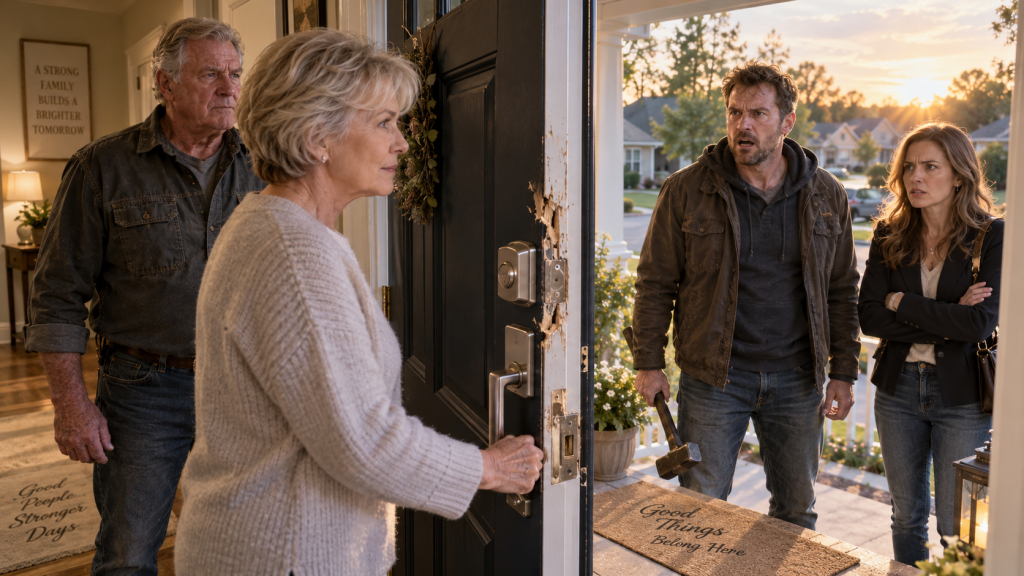
I looked at my damaged door.
“At six o’clock on a Sunday morning, you brought a man with a sledgehammer to break into my house.”
“He’s your son.”
“And?”
That one word silenced her.
Being my son did not turn a sledgehammer into a house key.
Arthur called Eleanor.
I heard him explain only the essentials.
Possible deed.
Possible unauthorized filing.
Attempted entry.
Property owner present.
Then he listened.
“All right,” he said. “We’ll wait.”
He ended the call.
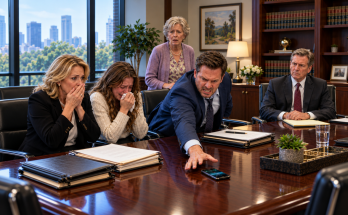
“She wants nobody touching any paperwork and nobody discussing the deed until she checks the county records.”
David rubbed both hands over his face.
“This has gotten completely out of control.”
I almost laughed.
“You’re right.”
I pointed toward the hammer.
“You should have stopped at the key.”
He looked at me.
For one second, I saw the child he used to be.
Then it vanished.
“Can we please talk privately?”
“No.”
“Mom.”
“No.”
“Without Arthur?”
“Arthur stays.”
David’s jaw hardened.
“He’s not family.”
That hurt Arthur.
I saw it.
He hid it quickly, but I saw it.
Arthur had held David when he was a baby.
He had stood beside Michael at our son’s baptism.
After Michael died, Arthur repaired the broken fence David had promised to help me fix.
He taught David how to change brake pads.
He attended graduations.
Birthdays.
My son’s wedding.
David could say Arthur wasn’t family because there was no shared blood.
But blood is a very poor measuring tool for loyalty.
“Arthur has behaved more like family this weekend than you have in three months.”
David went still.
I regretted the sentence immediately.
Not because it was untrue.
Because I had said it to wound him.
I did not want to become cruel simply because somebody else had been cruel first.
So I corrected myself.
“That was meant to hurt you.”
David looked surprised.
“I shouldn’t have said it that way.”
Sarah rolled her eyes.
“Oh, wonderful. Group therapy on the porch.”
I ignored her.
“What I mean is that Arthur helped me protect my home when I learned that you were planning to take control of it.”
David looked down.
“That is true.”
Then a police cruiser turned onto the street.
Sarah’s expression changed.
Arthur glanced at me.
“You okay?”
“No.”
He nodded.
“Good answer.”
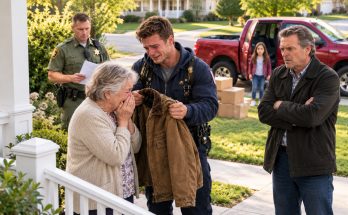
Two officers stepped out.
I explained what had happened.
David tried to interrupt twice.
One officer stopped him.
Arthur showed them the security footage.
The camera had captured everything.
David arriving with the sledgehammer.
Trying the locks.
Sarah telling him to break the door.
The first blow.
The second.
Then me opening it before the third.
Watching it on Arthur’s phone was different from living it.
On the screen, the hammer looked enormous.
The first strike landed inches from where my head would have been if I had opened the door two seconds earlier.
David watched too.
His face changed.
I think that was when he finally understood what he had done.
Not what he intended.
What he had actually done.
“Mom.”
I looked away.
One of the officers asked whether I wanted to make a formal complaint regarding the property damage.
I looked at my son.
His eyes were wet.
Once, when David was eight, he broke our bedroom window throwing a baseball.
He had hidden behind the garage because he was terrified Michael would be furious.
Michael found him there.
Instead of yelling, he sat beside him.
When David finally confessed, Michael said:
“Accidents are expensive. Lies are more expensive.”
I had forgotten that sentence for years.
Now it returned.
I looked at the splintered door.
Then at the man my little boy had become.
“Yes,” I said.
David closed his eyes.
“Mom.”
“I’m not asking anyone to arrest you because I’m angry.”
My voice trembled.
“But I’m not pretending this didn’t happen.”
The officers documented everything.
Because the legal situation regarding residency and access was complicated, they made it clear that the property dispute itself would need to be handled properly.
But damaging the door was not something David could simply call a family disagreement and erase.
Eventually, they left.
David and Sarah remained near their car.
I closed the damaged door.
Arthur stood beside me.
I leaned against the wall.
Then my legs gave out.
Arthur caught my arm.
“Easy.”
I sat on the bottom stair.
And cried.
Not gracefully.
Not quietly.
I cried until my chest hurt.
Arthur sat beside me.
He didn’t tell me everything would be okay.
He knew better.
After a while, I whispered:
“He was going to take my house.”
Arthur stared toward the door.
“We don’t know exactly what he filed yet.”
“He was going to take it.”
Arthur didn’t argue.
That was what hurt.
At eight thirty, Eleanor called.
Her first sentence was:
“Lisa, I need you to listen carefully.”
My stomach tightened.
“What?”
“I found the filing.”
Arthur sat across from me.
I put the phone on speaker.
Eleanor continued.
“A deed was submitted eleven days ago.”
My mouth went dry.
“What kind?”
“A quitclaim deed.”
“To whom?”
There was a pause.
“From you to yourself and David jointly.”
I stopped breathing.
Arthur’s face became stone.
“I never signed that.”
“I know.”
“How do you know?”
“Because the signature doesn’t look like the one on your estate documents, and the notarization raises questions.”
My hands began shaking.
“Eleanor.”
“Yes?”
“Does he own my house?”
“No.”
The word came firmly.
“Do not panic.”
I closed my eyes.
“The filing exists. That does not mean an unauthorized or fraudulent deed becomes legitimate merely because somebody recorded it. But we need to move quickly and formally.”
“Who notarized it?”
“I’m checking.”
I looked at Arthur.
He was already writing notes.
“Could David have done this without me?”
“Someone did.”
That answer chilled me more than anything.
“Eleanor, what do I do?”
“You do nothing with David directly. Preserve every message. Preserve the camera footage. Do not sign anything. Do not destroy anything. I’ll coordinate the appropriate next steps.”
I swallowed.
“And Lisa?”
“Yes?”
“Do not let guilt turn this into something smaller than it is.”
My eyes filled.
She knew me too well.
I thanked her.
Then sat in silence.
Arthur eventually said, “Coffee?”
“No.”
“Tea?”
“No.”
“Whiskey?”
I looked at the clock.
“It’s eight forty in the morning.”
“So that’s a maybe.”
I laughed.
One tiny laugh.
It saved me for approximately five seconds.
Then my phone rang.
David.
I stared at his name.
Arthur shook his head.
I declined the call.
A text arrived.
Mom please let me explain.
Then another.
It isn’t what Sarah made it sound like.
Then:
I wasn’t trying to steal the house.
I read that one twice.
Arthur said nothing.
I typed:
Communicate through Eleanor.
Then I blocked his number.
My finger hovered over the screen afterward.
Blocking your child feels unnatural.
Even when the child is forty-two.
There is some primitive part of motherhood that believes you must always remain reachable.
For fever.
For heartbreak.
For flat tires.
For bad dreams.
For emergencies.
Nobody tells you what to do when the emergency is your child.
By Monday afternoon, Eleanor knew more.
The deed had been notarized through a mobile notary.
The identification record associated with the signing did not match reality.
There were inconsistencies.
Enough that Eleanor’s tone became very serious.
She asked whether I had recently signed any documents David presented.
“No.”
“Anything digital?”
“No.”
“Any tax forms?”
“No.”
“Power-of-attorney forms?”
“Absolutely not.”
“Did David have access to personal documents?”
I stopped.
For three months, he had lived in my house.
My mail came through the front slot.
My files were in my bedroom.
That was why I eventually installed the deadbolt.
But before that?
“Yes.”
The word tasted terrible.
“Possibly.”
“What about your driver’s license?”
“In my purse.”
“Did you ever leave it unattended?”
“In my own home?”
I almost laughed.
“Yes.”
Of course I had.
Because it had been my home.
The place where I was supposed to be able to put down my purse without wondering whether my son would photograph my identification.
Eleanor asked me to make a list of anything David might have accessed.
Tax records.
Social Security information.
Mortgage documents.
Bank statements.
Insurance.
The list grew.
So did my nausea.
I spent Monday afternoon changing passwords.
Freezing credit.
Calling financial institutions.
Reviewing accounts.
Nothing obvious was missing.
That should have comforted me.
It didn’t.
Tuesday brought the second shock.
The notary called Eleanor back.
She remembered the signing.
Not me.
Sarah.
According to the notary, Sarah had arranged everything.
She claimed her mother-in-law had mobility problems and preferred signing at home.
But the appointment had not taken place at my house.
It happened at a short-term rental across town.
A woman had presented identification bearing my information.
Arthur was sitting in my kitchen when Eleanor told me.
He slowly lowered his coffee.
“A woman?”
“Yes,” Eleanor said.
“Who?”
“We don’t know yet.”
I felt something colder than anger.
They had not simply copied my signature.
Someone had pretended to be me.
I thought about Sarah telling David:
She’s getting forgetful.
Document it.
Supervised care.
Power of attorney.
The house.
This had not been one impulsive bad decision.
It had steps.
Planning.
Preparation.
My son had sat at my dinner table while some version of this was happening.
That realization hurt worse than the forged signature.
That evening, David came to the house alone.
He did not approach the door.
He stood on the sidewalk.
Arthur saw him through the window.
“He’s here.”
I looked outside.
No Sarah.
No hammer.
Just David.
He looked exhausted.
For several minutes, he stood there.
Then he placed an envelope in the mailbox and left.
Arthur retrieved it.
My name was written across the front.
Mom.
I almost threw it away.
Instead, I opened it.
The first line was:
I knew about the deed.
I sat down.
The second:
I did not know Sarah had someone impersonate you.
I kept reading.
David wrote that Sarah had convinced him the deed was temporary.
That they needed his name attached to the property to qualify for financing.
That once their finances stabilized, they would reverse it.
He knew I had not agreed.
He knew Sarah planned to “handle the paperwork.”
He admitted he deliberately avoided asking how.
He wrote:
I told myself not knowing the details meant I wasn’t part of it.
My hands shook.
Then:
I understand now that I didn’t avoid knowing because I trusted her. I avoided knowing because I knew enough to understand it was wrong.
That sentence broke something open.
Not forgiveness.
Truth.
There is a strange relief when somebody finally stops insulting you with excuses.
David continued.
He and Sarah were in serious financial trouble.
Much worse than I knew.
Their apartment lease had not simply “ended.”
They had fallen behind.
Their supposed new place had never existed.
They had accumulated credit-card debt.
A failed business investment.
Loans.
Sarah had lost a major client.
David had hidden all of it from me.
Moving into my house was never meant to last a few weeks.
They needed somewhere free.
Then Sarah began talking about my house.
Its value.
My age.
Inheritance.
David wrote that at first he refused.
Then he began listening.
Then calculating.
Then rationalizing.
He convinced himself the house would eventually be his.
He convinced himself I had retirement savings.
He convinced himself assisted living might actually be good for me someday.
Someday became soon.
Good for me became convenient for them.
By the end, he had managed to turn stealing from his mother into financial planning.
His final paragraph read:
Dad would be ashamed of me.
I put the letter down.
That was when I cried.
Not because I wanted Michael to be ashamed of our son.
Because I knew David was right.
Arthur walked toward the window.
He gave me privacy without leaving.
After a while, I said:
“I keep wondering where I failed.”
Arthur turned immediately.
“No.”
“I raised him.”
“Yes.”
“I taught him better.”
“Yes.”
“Then how—”
“Lisa.”
His voice was firm.
“You raised a child.”
He sat across from me.
“You did not manufacture a machine.”
I looked at him.
“He grew up. He made choices.”
“But—”
“No.”
Arthur rarely interrupted me.
That made me listen.
“You don’t get credit for every good thing your adult child does.”
He paused.
“And you don’t own every bad thing either.”
Tears filled my eyes.
“He’s still my boy.”
“I know.”
“I remember him sleeping on my chest.”
“I know.”
“I remember his first day of kindergarten. He wouldn’t let go of my coat.”
Arthur’s eyes softened.
“I remember.”
“I remember Michael teaching him to ride a bicycle.”
My voice cracked.
“How does that little boy become a man who discusses putting his mother in a facility to get her house?”
Arthur was quiet for a long time.
Then he said:
“One choice at a time.”
That was the terrible answer.
Not one dramatic transformation.
One compromise.
One rationalization.
One silence.
One moment when wrong becomes inconvenient instead of impossible.
Then another.
And another.
Until a man holding a sledgehammer believes the locked door of his mother’s house is the problem.
The investigation continued.
I will not pretend it was quick.
Real consequences move slower than anger.
Documents had to be reviewed.
Statements taken.
Records requested.
Lawyers wrote letters.
People returned calls.
Some didn’t.
The deed was challenged.
Evidence accumulated.
Eventually, the fraudulent transfer was unwound and my ownership confirmed.
The house remained mine.
Mine.
That word had never mattered so much.
But the deed was only part of it.
There were consequences for the attempted fraudulent transaction and the false notarization.
The woman who impersonated me turned out to be someone connected to Sarah.
Not a close friend.
Someone willing to participate for money.
Sarah had organized far more than David claimed to understand.
But David had signed documents.
He had communicated about the plan.
He had benefited from it.
He was not innocent.
That mattered.
Sarah tried to place nearly everything on him once consequences became real.
David tried, briefly, to place nearly everything on Sarah.
Then something changed.
Maybe it was his lawyer.
Maybe the security footage.
Maybe losing access to me.
Maybe seeing his father’s photograph when he closed his eyes.
I don’t know.
But eventually, David stopped saying:
Sarah made me.
And started saying:
I agreed.
That was the first adult thing I had heard from him in months.
His marriage collapsed.
Not because I wanted it to.
I took no pleasure in that.
Sarah left him before everything was resolved.
For several months, David lived in a small rented room.
He sold his expensive car.
Sold his gaming equipment.
Worked overtime.
His life became very small.
Mine became quiet.
I repaired the front door.
Arthur insisted on doing the trim himself.
“I’ll pay you.”
“No.”
“Arthur.”
“No.”
“You’ve already done enough.”
He sanded the replacement wood.
“Michael would’ve done this.”
The sentence caught me.
I looked at his hands.
Those enormous contractor’s hands, older now.
Scarred.
Steady.
“You miss him.”
Arthur stopped working.
“Every day.”
Michael had been gone eighteen years.
Some friendships remain present in absence.
Arthur looked at the door.
“He would’ve been furious.”
“At David?”
“Yes.”
“Would he forgive him?”
Arthur smiled sadly.
“Eventually.”
“You sound sure.”
“I knew your husband forty-three years.”
He resumed sanding.
“He could stay angry about a bad golf shot for a decade.”
I laughed.
“But David?”
Arthur shook his head.
“He’d love him.”
I looked down.
“Love isn’t the same as letting him back in.”
“No.”
Arthur met my eyes.
“It isn’t.”
That became my lesson.
For most of my life, I confused love with access.
If I loved someone, they got a key.
A room.
A place at the table.
My time.
My money.
My patience.
My forgiveness.
But love does not require unlimited access.
You can love someone from behind a locked door.
You can pray for them without giving them your bank password.
You can hope they heal without volunteering to become the thing they consume while healing.
You can love your child and still say:
You may not live here.
It took me months to understand that.
David wrote every week.
Actual letters.
Not texts.
I didn’t answer the first seven.
The eighth was different.
Mom,
I keep wanting to explain why I did what I did.
Every explanation sounds like another excuse.
So I’m trying to stop.
I wanted something that wasn’t mine.
I thought because I would inherit it someday, taking control early wasn’t really stealing.
I thought because you loved me, you would eventually forgive me.
That means I used your love as part of the plan.
I am more ashamed of that than anything.
I folded the letter.
Then unfolded it.
Read that line again.
I used your love as part of the plan.
There it was.
The deepest betrayal.
Not the deed.
Not the assisted-living conversation.
Not the spare keys.
He had counted on my love making consequences temporary.
He thought motherhood meant permanent immunity.
I wrote back.
Three sentences.
David,
I love you.
I am not ready to see you.
Keep becoming someone you can respect even if I never open the door.
Mom.
He did.
At least, he began.
He went to counseling.
I know because months later he told me, not because I demanded proof.
He worked.
Paid restitution and costs he was responsible for.
Stopped asking me to rescue him.
Most importantly, he stopped asking when I would forgive him.
That mattered more than he understood.
Sarah contacted me once.
Her message was long.
She said she was sorry things had “spiraled.”
I disliked that word.
Things had not spiraled.
People had made decisions.
She wrote that she had genuinely believed I would be happier in a community with people my own age.
I did not respond.
There is no useful conversation with an apology that still contains the original justification.
A year passed.
Then another.
Arthur continued coming by.
Sometimes to fix things.
Sometimes because there was nothing to fix.
One Saturday, he arrived carrying two coffees.
“What broke?”
“Nothing.”
“Then why are you here?”
He handed me a cup.
“I’m retired. I require supervision.”
I smiled.
We sat on the porch.
The repaired door looked almost new.
Arthur pointed toward it.
“Still locking it?”
“Every night.”
“Good.”
Then he said, “David called me.”
I stiffened.
“When?”
“Yesterday.”
“What did he want?”
“To apologize.”
“To you?”
“Yes.”
“For what?”
Arthur looked at me.
“For saying I wasn’t family.”
My eyes filled unexpectedly.
“What did you say?”
“I told him he was an idiot.”
I laughed.
“Then?”
“I accepted.”
“You forgave him?”
Arthur shrugged.
“He didn’t try to steal my house.”
I laughed harder.
Then he became serious.
“He asked how you’re doing.”
“What did you tell him?”
“That if he wants to know, eventually he should become someone you feel safe telling.”
That stayed with me.
Safe.
Not sorry.
Not punished.
Not forgiven.
Safe.
That was the standard.
Two years and four months after the Sunday morning with the sledgehammer, I saw my son again.
I chose the place.
A coffee shop.
Public.
Neutral.
Arthur offered to come.
I said no.
David was already sitting when I arrived.
I almost didn’t recognize him.
He looked older.
Not dramatically.
But consequences had settled into his face.
He stood.
“Mom.”
My chest hurt.
There is no armor strong enough to stop that word when it comes from your only child after two years.
“Hello, David.”
He did not hug me.
Good.
He waited.
I sat.
He sat.
For several minutes, we discussed nothing important.
Coffee.
Weather.
Traffic.
Then I finally said:
“Why?”
His eyes lowered.
“I don’t have an answer that makes it better.”
“I’m not asking for better.”
He nodded.
“I was scared.”
“Of what?”
“Failing.”
I waited.
“Sarah and I were drowning financially.”
“So you decided to drown me instead?”
His face tightened.
“Yes.”
The answer surprised me.
No defense.
He continued.
“I thought I deserved the house eventually.”
“Why?”
“Because I’m your son.”
I looked at him.
“Do you still think that?”
“No.”
“Why not?”
“Because inheritance isn’t ownership.”
He swallowed.
“And being your child doesn’t make your property mine.”
Good.
“Why the assisted-living plan?”
His eyes filled.
“That is the part I hate most.”
“Answer.”
“Because if we could convince ourselves you needed care, then taking the house wouldn’t feel like taking it.”
My stomach twisted.
“So you needed me to become incompetent in your story.”
“Yes.”
“Were you going to lie to a doctor?”
“I don’t know how far it would’ve gone.”
“That’s not an answer.”
He looked at me.
“I had already gone too far.”
Better.
I leaned back.
“Did you think I was forgetful?”
“No.”
“Confused?”
“No.”
“Unable to live independently?”
“No.”
“So you knew.”
“Yes.”
The coffee shop continued around us.
Milk steaming.
Cups clinking.
People laughing.
I stared at my son.
Then asked the hardest question.
“Did you love me while you were doing it?”
He began crying.
“Yes.”
I believed him.
That was almost worse.
“How?”
“I don’t know.”
He wiped his face.
“I think that’s what counseling has been hardest about.”
He looked at me.
“I thought loving someone meant I couldn’t be the kind of person who would hurt them deliberately.”
His voice shook.
“So every time I did something wrong, I renamed it.”
Borrowing.
Planning.
Helping.
Preparing.
Tax reasons.
Future inheritance.
Concern.
“Anything except what it was.”
“Yes.”
I nodded.
“That sounds familiar.”
He looked confused.
“Your father once told you accidents were expensive and lies were more expensive.”
David stared.
Then his face collapsed.
“You remember?”
“Yes.”
“I think about that all the time.”
We sat there crying.
Two ridiculous people in a coffee shop.
Then David said:
“I don’t expect my key back.”
That mattered.
I looked at him.
“You’re not getting it.”
“I know.”
“You’re not moving into my house again.”
“I know.”
“You will never have power of attorney.”
“I understand.”
“You will not manage my finances.”
“I understand.”
“And my estate plan has changed.”
His eyes flickered.
Pain.
Then acceptance.
“Okay.”
He didn’t ask how.
Didn’t ask what he would receive.
Didn’t ask whether he had been removed.
Just:
Okay.
I had, in fact, changed my estate plan.
Not to punish him.
To protect myself.
There were independent safeguards.
Clear instructions.
No assumption that being my only child made David the automatic person to control everything.
Some assets would eventually go to him if circumstances remained appropriate.
Some would go directly to grandchildren.
Some to charities Michael and I had supported.
The house?
That decision remained mine.
Exactly as it should.
I looked at David.
“I do still love you.”
He covered his mouth.
“I know.”
“No.”
I reached across the table.
Not touching him.
Just placing my hand near his.
“I need you to hear it.”
He nodded.
“I love you.”
His tears fell.
“But love is not the same thing as trust.”
“I know.”
“And forgiveness isn’t restoration.”
“I know.”
“Trust will take whatever time it takes.”
“I understand.”
I watched him.
Then I moved my hand forward.
He took it.
That was all.
No hug.
No dramatic reconciliation.
A hand across a table.
Sometimes healing begins quietly enough that nobody else in the room notices.
Over the next year, we met occasionally.
Coffee.
Lunch.
Eventually dinner.
David never came to the house.
I did not invite him.
Then one December afternoon, I needed help moving a heavy cabinet.
Arthur had hurt his back.
I stared at David’s number for ten minutes.
Then called.
“Hello?”
He sounded startled.
“Are you busy Saturday?”
“No.”
“I need help.”
He was quiet.
“Where?”
“My house.”
Another silence.
“Are you sure?”
“Yes.”
He arrived Saturday at ten.
No key.
He knocked.
That detail nearly made me cry.
I opened the door.
For a second, neither of us moved.
The last time he had stood there, a sledgehammer had been lying on the porch.
Now he held a toolbox.
“Come in.”
He stepped across the threshold.
Slowly.
His eyes moved toward the repaired trim.
He touched it.
“I’m sorry.”
“I know.”
We moved the cabinet.
He repaired a loose hinge.
Then asked:
“Anything else?”
The old David might have opened cupboards looking for projects.
Might have changed something without asking.
This David waited.
“No.”
“Okay.”
I made coffee.
We sat at the kitchen island.
The same place I had been sitting at 5:58 that Sunday morning.
I realized it only after we sat down.
David realized too.
He looked toward the hallway.
“Mom?”
“Yes?”
“I still have nightmares about that hammer.”
“So do I.”
He looked devastated.
“I almost hit you.”
“Yes.”
“I didn’t know you’d open the door.”
“I know.”
“That doesn’t matter.”
“No.”
His eyes filled.
“I don’t ever want to be that man again.”
I looked at him.
“Then don’t be.”
Simple.
Hard.
Possible.
Years passed.
David rebuilt his life.
Slowly.
Not impressively.
That was important.
There was no miraculous business success.
No lottery.
No convenient inheritance.
He rented a modest apartment.
Drove an old car.
Paid his bills.
Eventually he began dating someone named Rebecca.
The first time he told me, he looked terrified.
“I’m happy for you.”
“Really?”
“Yes.”
“Do you want to meet her?”
“Eventually.”
Rebecca turned out to be kind.
Not perfect.
Kind.
The first time she visited my house, she asked before moving a dining chair.
I almost laughed.
David noticed.
“Don’t.”
“I didn’t say anything.”
“You were thinking loudly.”
Rebecca looked confused.
“Long story,” I said.
Years later, David married her.
Small ceremony.
I attended.
When he saw me before the ceremony, he hugged me.
By then, hugs were allowed again.
He whispered:
“Thank you for coming.”
“You’re my son.”
He pulled back.
There had been a time when he used those words as leverage.
Now they meant something gentler.
At the reception, he made a short speech.
He thanked friends.
Rebecca.
Me.
Then he said:
“My mother taught me something I should have learned much younger.”
I became nervous.
He looked directly at me.
“A home is not yours because somebody loves you enough to let you inside.”
His voice cracked.
“You make yourself worthy of being welcomed by how you behave once the door opens.”
The room became quiet.
I cried.
Arthur, sitting beside me, handed me a napkin.
“You’re leaking.”
“Shut up.”
He smiled.
David did not tell everyone the whole story.
He didn’t need to.
Some things can remain private without becoming secrets.
There is a difference.
Privacy protects dignity.
Secrecy protects deception.
It took our family a long time to learn that.
On my seventy-fifth birthday, David gave me a small box.
I glared at him.
“What?”
“No paperwork?”
He laughed.
“Open it.”
Inside was a brass key.
For one horrifying second, I thought he had lost his mind.
Then I saw the tag.
DAVID & REBECCA’S HOUSE.
I looked up.
“We bought a place.”
“You bought a house?”
“Yes.”
“With your own money?”
He laughed.
“Yes, Mom.”
I turned the key over.
“What is this for?”
“In case of emergencies.”
I stared at him.
“Are you sure?”
He understood the question beneath the question.
“Yes.”
“You trust me with your house?”
His eyes filled.
“I learned from somebody that keys should be given, not taken.”
I cried.
So did he.
Arthur pretended to be fascinated by cake.
A few months later, I used the key once.
David and Rebecca were away.
A pipe burst.
I entered.
Turned off the water.
Called him.
That was all.
I did not rearrange his kitchen.
Did not judge his furniture.
Did not open drawers.
Did not treat access as ownership.
When he came home, he hugged me.
“Thanks, Mom.”
“You’re welcome.”
And that little moment meant more than he knew.
Because we had finally learned what a key actually means.
Permission.
Not entitlement.
I stayed in my house for many years.
Not because I needed to prove anything.
Because I loved it.
Michael had restored the oak console.
I kept it exactly where it belonged.
Sometimes people suggested I downsize.
Eventually, David did too.
But the first time he mentioned it, he said:
“Only if you want to.”
I noticed.
“Thank you.”
“For what?”
“For learning.”
He smiled.
“I’m trying.”
At seventy-nine, I decided on my own.
The stairs were becoming irritating.
The garden was too much.
Rooms sat empty.
I wanted something smaller.
I called David.
“I’m selling.”
He became silent.
Then:
“Are you sure?”
“Yes.”
“Okay.”
No excitement.
No calculation.
No question about money.
Just:
“What do you need me to do?”
I smiled.
“Help me pack.”
So he did.
We spent three weekends boxing forty years of life.
Photographs.
Christmas decorations.
Michael’s tools.
David’s school projects.
A ceramic ashtray he made at age nine even though nobody in our family smoked.
“Why did we keep this?”
I asked.
He looked offended.
“Art appreciates.”
“It looks like a diseased pancake.”
“Philistine.”
We laughed.
Then we reached the oak console.
David ran his hand across it.
“Dad restored this.”
“Yes.”
“I remember.”
“You were little.”
“I remember the sawdust.”
My throat tightened.
“So do I.”
David looked at me.
“You taking it?”
“Of course.”
“Good.”
He carried it carefully.
More carefully than anything else.
The house sold to a young couple with two children.
On closing day, I walked through every room alone.
The kitchen.
The hallway.
David’s childhood bedroom.
My bedroom.
The porch.
Then I stood at the front door.
The repaired trim was still visible if you knew where to look.
I touched it.
Once.
That door had welcomed my husband home.
My son home.
Grandchildren.
Friends.
Christmas guests.
It had also been attacked by the same child I once taught to knock before entering.
For years, I thought that damage represented the worst morning of my life.
Now I saw something else.
The door had held.
That mattered.
Not perfectly.
It had cracked.
Splintered.
Needed repair.
But it held.
Maybe people are like that too.
I locked it for the last time.
Then handed the keys to the new owners.
Voluntarily.
That word mattered.
Nobody took my house.
I chose when to leave it.
I chose where to go.
I chose what happened to the money.
I chose my next home.
Choice was the thing David and Sarah had nearly stolen before they ever touched a deed.
And choice was what I protected.
My new place was a one-story cottage fifteen minutes away.
On moving day, David carried in the oak console.
“Where?”
“Entryway.”
He set it down.
Rebecca looked at it.
“Beautiful.”
David grinned.
“Don’t suggest metal.”
She looked confused.
I laughed until my stomach hurt.
Arthur arrived later carrying wine.
He was older.
Slower.
Still stubborn.
He stood in the doorway.
“Nice place.”
“You approve?”
“No stairs.”
“That’s romantic.”
“I’m practical.”
“You always were.”
He looked at the oak table.
Then at me.
“Michael would like it here.”
My eyes filled.
“You think?”
“Yes.”
We stood quietly.
Then Arthur smiled.
“He’d complain about the garage.”
I laughed.
“That sounds right.”
Arthur remained part of my life until he died three years later.
Losing him felt like losing another piece of Michael.
David sat beside me at Arthur’s funeral.
Afterward, he said:
“I was wrong.”
“About what?”
“When I said he wasn’t family.”
I looked at him.
“Yes.”
He swallowed.
“I knew it even when I said it.”
“I know.”
“I wanted to hurt him.”
“I know that too.”
“I apologized.”
“He told me.”
David smiled.
“What did he say?”
“That you were an idiot.”
He laughed through tears.
“Sounds like Arthur.”
“Yes.”
We stood beside the grave.
Then David whispered:
“He saved our family.”
I thought about it.
“No.”
David looked at me.
“He helped.”
I took my son’s hand.
“But you saved your part when you decided to change.”
That mattered.
I never wanted David believing redemption had been handed to him by another person.
Arthur protected me.
Eleanor protected my legal rights.
The police documented what happened.
Professionals dealt with the consequences.
But nobody could make David become different.
He had to do that himself.
And he did.
Not perfectly.
Not instantly.
But enough.
By the time I turned eighty-two, David and I had Sunday breakfast together twice a month.
He knocked every single time.
Even though I had eventually given him a key to my cottage.
One morning, I asked:
“Why don’t you use the key?”
He shrugged.
“I like hearing you say come in.”
I looked away because I did not want him seeing me cry.
He saw anyway.
“Mom?”
“I’m fine.”
“You’re crying.”
“Old people leak.”
He laughed.
Then hugged me.
We made pancakes.
Rebecca came later.
Grandchildren arrived.
My little cottage filled with noise.
At one point, I stood in the kitchen and watched David kneeling beside his granddaughter, helping her tie a shoe.
He was gentle.
Patient.
Gray at the temples.
Older than Michael had been when he died.
That realization hit me.
My son had lived long enough to become a man his father never got the chance to be.
Not because he avoided mistakes.
Because he survived becoming someone he was ashamed of and chose not to remain that person.
There is courage in that too.
Years after the original deed had been corrected, I finally told David what my estate plan said.
Not because he asked.
He never did.
We were sitting on my porch.
“I’ve left you something.”
He looked uncomfortable.
“Mom, I don’t want to discuss this.”
“I do.”
“Spend it.”
“I plan to.”
“Good.”
“The rest is divided.”
“Fine.”
“Some to you. Some to the grandchildren. Some to charity.”
He nodded.
“Okay.”
“The house isn’t an issue anymore.”
“I know.”
I watched him.
“Does any part of you resent that?”
He thought before answering.
“No.”
“Really?”
“Really.”
Then he smiled sadly.
“I spent years thinking inheritance was money people owed you for waiting until they died.”
My chest tightened.
“That’s an ugly sentence.”
“I was an ugly version of myself.”
He looked toward the yard.
“Now I think if you leave me anything, it’s a gift.”
He turned back.
“And if you leave me nothing, I already got more chances than I deserved.”
I touched his hand.
“You deserved the chance you used.”
His eyes filled.
“Thank you.”
I squeezed his fingers.
“Don’t make me sentimental.”
“Wouldn’t dream of it.”
When I think back now to that Sunday morning, the details remain astonishingly clear.
5:58.
Black coffee.
Arthur across the island.
The key sliding into a lock that no longer recognized it.
David pounding.
Sarah shouting.
The sledgehammer.
The first crack.
The second.
My hand on the deadbolt.
Arthur behind me saying:
“Let them try. I’ll handle this.”
Then opening the door.
For years, I wondered whether I should have waited.
Called police first.
Stayed behind the reinforced door.
Maybe.
But memory isn’t a courtroom.
I cannot retry the morning.
What matters is what happened afterward.
I did not surrender the house.
I did not sign power of attorney.
I did not let guilt turn theft into a misunderstanding.
I did not let motherhood erase boundaries.
And eventually, I did something even harder.
I allowed my son to become more than the worst thing he had done.
That did not mean pretending it never happened.
It meant remembering accurately.
David tried to take control of my home.
He participated in something deeply wrong.
He frightened me.
He broke my trust.
Those things remain true.
David also confessed.
Accepted consequences.
Changed.
Rebuilt his life.
Respected every boundary afterward.
Became safe again.
Those things are true too.
Human beings are inconvenient that way.
We want villains to remain villains.
We want good people to remain good.
We want one label that saves us from having to think.
Life rarely cooperates.
Sometimes the person holding the sledgehammer is the same person who once fell asleep on your chest.
Sometimes the person who betrays you can become the person who spends years proving he understands why you locked the door.
Forgiveness did not require me to forget either version.
It required me to stop pretending only one could be real.
Sarah disappeared from my life.
I heard things occasionally through David.
She moved.
Remarried eventually.
I wished her no harm.
I also never invited her back into my world.
Forgiveness and reconciliation are not synonyms.
Some relationships heal.
Others end.
Both outcomes can be healthy.
My relationship with David healed because he changed what made the relationship unsafe.
Without that, love would not have been enough.
That is perhaps the most important thing I learned.
Love is precious.
But love without boundaries can become permission.
Love without truth can become denial.
Love without consequences can become an accomplice.
I loved my son enough to open my home when he needed help.
Then I loved myself enough to change the locks when he abused that help.
Eventually, I loved him enough to let him face what he had done without rescuing him from it.
And years later, I loved him enough to open another door when he had become someone who knew how to enter respectfully.
Those were all acts of love.
Even the lock.
Especially the lock.
One Sunday morning, many years later, I woke before six.
Old habits.
I made coffee.
Sat at my little kitchen table.
Outside, dawn was barely beginning.
At exactly 5:58, someone touched my front door.
I froze.
For one ridiculous second, I was back there.
The old house.
Arthur.
The hammer.
Then came a knock.
Three gentle taps.
“Mom?”
David.
I looked at the clock.
5:58.
I laughed.
Actually laughed.
Then walked to the door.
Through the window, I saw him holding two paper cups and a bag of pastries.
No sledgehammer.
No Sarah.
No entitlement.
Just my son.
I opened the door.
“You’re early.”
“I couldn’t sleep.”
“You have a key.”
“I know.”
“So why knock?”
He smiled.
“It’s your house.”
Four words.
That was all.
It’s your house.
The sentence he should have understood from the beginning.
The sentence it took him years to learn.
I stepped aside.
“Come in.”
He did.
And that was the difference.
The first time, he had believed being my son gave him the right to enter.
This time, he waited to be invited.
We sat at the table.
He handed me coffee.
Black.
Exactly how I liked it.
“Remember the last time I showed up at 5:58?”
I stared at him.
“Are you seriously bringing that up?”
“Bad choice?”
“Terrible.”
“Sorry.”
I laughed.
He did too.
Then his expression softened.
“Mom?”
“Yes?”
“I’m glad you changed the locks.”
I stared.
He looked down at his coffee.
“I hated you for it at the time.”
“I know.”
“I thought you were humiliating me.”
He shook his head.
“But if you hadn’t stopped me…”
His voice faded.
“You might have kept going.”
“Yes.”
He looked at me.
“You were the first person who loved me enough not to help me lie to myself.”
My eyes filled.
“That sounds like something your therapist taught you.”
“It is.”
“I knew it.”
He laughed.
Then I reached across the table.
My son’s hand was older now.
Veins visible.
A scar across one knuckle.
I remembered the tiny hand that once wrapped around my finger.
Both belonged to him.
The child.
The man.
The man who failed.
The man who changed.
I squeezed his hand.
“Your father would be proud of who you are now.”
David stopped breathing.
I had never said that before.
Not because I wanted to punish him.
Because I needed to believe it before I said it.
His eyes filled immediately.
“Really?”
“Yes.”
He looked down.
“Even after—”
“Your father knew people make mistakes.”
“This wasn’t a mistake.”
I nodded.
“You’re right.”
He had learned even that distinction.
“It was a series of choices.”
“Yes.”
“And then you made a different series.”
He wiped his face.
“That doesn’t erase it.”
“No.”
“It doesn’t make it okay.”
“No.”
“Then how could Dad be proud?”
I smiled.
“Because being proud of who you’ve become doesn’t require approving of who you were.”
David cried.
I did too.
Then, because our family had apparently become incapable of emotional dignity, we ate pastries while crying into napkins.
Sunlight slowly filled the kitchen.
I thought about Michael.
Arthur.
The old house.
The oak table standing now in my cottage hallway.
The first spare key that disappeared.
The locks Arthur installed.
The deed that nearly took my home.
The repaired door.
All those years.
And I realized something.
That Sunday morning had once seemed like the day my family broke apart.
It wasn’t.
The breaking had happened before.
Quietly.
While Sarah rearranged my kitchen.
While David treated my money like communal property.
While boundaries became inconveniences.
While resentment grew.
While entitlement disguised itself as family.
The Sunday morning was simply when the crack became visible.
And once a crack becomes visible, you finally have a choice.
Ignore it.
Cover it.
Or repair what can be repaired and replace what cannot.
I replaced the locks.
I repaired the door.
I changed my legal protections.
I ended one relationship.
I rebuilt another.
Most importantly, I changed myself.
The woman who first let David and Sarah move in believed saying no to family was selfish.
The woman who came out the other side knew better.
A boundary is not a punishment.
A locked door is not hatred.
And access to your life is not something another person inherits simply because they share your blood.
Access is earned through respect.
Maintained through trust.
And lost through violation.
Sometimes it can be earned again.
Sometimes it cannot.
The person on the inside gets to decide.
That is what ownership really means.
Not merely having your name on a deed.
Having authority over your own life.
Your space.
Your money.
Your time.
Your decisions.
Your door.
Years earlier, Sarah had said:
“We live here too.”
She believed residence created ownership.
David believed inheritance created ownership.
Both were wrong.
A home is not just wood and plaster.
It is the one place where your nervous system is supposed to unclench.
Where your belongings may remain where you put them.
Where nobody turns your memories into curbside trash because they clash with a “vibe.”
Where nobody leaves laundry instructions as though you are staff.
Where nobody quietly builds a case that you are incompetent because your independence is inconvenient.
My house had been mine long before anyone tried to change the paperwork.
And my life was mine long after I sold it.
That was the part nobody could record at the county office.
Years later, when my granddaughter asked about the small scar on David’s hand, he told her he got it doing something stupid.
She demanded details.
He glanced at me.
I raised an eyebrow.
Then he said:
“I once thought Grandma’s house belonged to me because I was her son.”
My granddaughter frowned.
“But it was Grandma’s.”
“Yes.”
“So why did you think it was yours?”
David smiled sadly.
“Because adults can be very stupid.”
She considered this.
“Did Grandma yell at you?”
I laughed.
“A little.”
David shook his head.
“She did something worse.”
“What?”
“She made me take responsibility.”
My granddaughter looked horrified.
We laughed.
Then David added:
“And it saved me.”
I looked at him.
He meant it.
One day, after I am gone, perhaps that story will be told differently.
Family stories always are.
Maybe the sledgehammer will become larger.
Maybe Arthur will become seven feet tall.
Maybe Sarah will become more villainous.
Maybe I’ll become some fearless grandmother who never doubted herself for a second.
That version would be easier.
It would also be false.
I was afraid.
Terribly.
I doubted myself.
I cried.
I wondered whether protecting my home made me a bad mother.
I nearly called David a dozen times because the silence hurt.
I wanted to rescue him even while I was furious.
Strength did not mean those feelings disappeared.
Strength meant I did not let them make the decision.
That distinction changed my life.
Courage is not always standing in a doorway while somebody holds a sledgehammer.
Sometimes courage is sitting alone afterward and refusing to call the person who hurt you simply because you cannot tolerate their discomfort.
Sometimes courage is allowing consequences to finish their work.
Sometimes courage is saying:
I love you.
And:
No.
In the same sentence.
David finished his coffee that Sunday morning.
Then stood.
“I should go. Rebecca will wonder where I am.”
I walked him to the door.
He stepped outside.
Then turned.
“Breakfast next Sunday?”
“Not at 5:58.”
“Eight?”
“Nine.”
“Eight thirty.”
“Nine.”
“Fine.”
He smiled.
“Love you, Mom.”
“I love you too.”
He walked toward his car.
I stood in the doorway watching.
At the driveway, he turned and waved.
I waved back.
Then he left.
I closed the door.
Not because I was afraid.
Because it was cold outside.
I turned the deadbolt.
Habit.
Healthy habit.
Then I walked into the hallway.
Michael’s oak console stood against the wall.
Exactly where I wanted it.
On top sat photographs.
Michael.
Arthur.
David as a little boy.
David and Rebecca on their wedding day.
My grandchildren.
Me.
A whole family.
Imperfect.
Damaged.
Repaired in places.
Missing people we still loved.
Containing people we had learned to love differently.
I ran my fingers across the oak.
I could almost see Michael sanding it all those decades ago.
Sawdust in his hair.
Laughing.
Alive.
For a moment, I wished he could see us.
Then I smiled.
Maybe what mattered wasn’t whether he could.
I could.
I could see the entire road from the young couple who bought this table to the widow who fought to keep her home to the old woman standing safely inside a house she had chosen for herself.
And I was grateful.
Not for the betrayal.
Never for that.
We do not have to call suffering a gift simply because we learned from it.
I was grateful for what I did afterward.
For the morning I finally understood that motherhood did not require surrender.
For Arthur showing up with tools instead of advice.
For Eleanor taking me seriously.
For a reinforced door.
For consequences.
For second chances that came only after change.
For my son learning that a key is permission, not ownership.
For myself, finally learning the same thing about love.
I went back into the kitchen.
My coffee had gone cold.
I poured it out.
Made another cup.
Black.
No blender in sight.
I carried it to the window and watched the morning brighten.
Peace is an ordinary thing.
That is why people underestimate it.
No dramatic music.
No applause.
No victory speech.
Just a quiet house.
A locked door.
Your own furniture where you left it.
Coffee made the way you like it.
And the knowledge that nobody inside your life is there because they forced their way through the entrance.
They are there because you opened it.
That Sunday, all those years ago, my son arrived believing a key entitled him to my home.
When the key failed, he reached for a hammer.
It took him years to understand what the locked door was trying to teach him.
It took me almost as long to understand it myself.
The lock was never there because I stopped loving him.
It was there because I had finally remembered to love myself too.
And when David eventually came back into my life, he did not return because he found another key.
He returned because he learned how to knock.
And this time—
I was the one who chose to open the door.
THE END STORIES! THANK YOU FOR READING GOOD LUCK !❤️
Related Posts