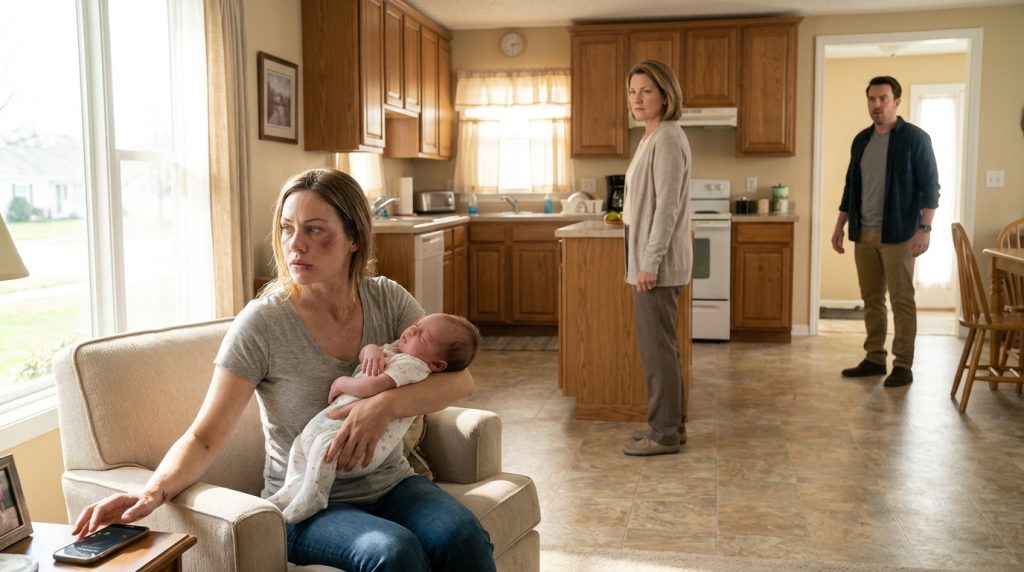
➡️ PART 3 ENDING PART ➡️
For several seconds, I could only stare at the evidence bag in the detective’s hand.
My newborn was asleep beside me beneath a hospital blanket, a monitor tracing every fragile heartbeat across a glowing screen.
My own face felt swollen and heavy.
One eye barely opened.
Every breath pulled painfully through my ribs.
But none of that frightened me as much as the detective’s words.
“What do you mean she helped him hide it?”
Detective Elena Ramirez pulled a chair closer to my bed.
She did not open the evidence bag.
Instead, she set it carefully on the table.
“Before I explain, I need to ask you something.”
I nodded.
“Has your husband ever hurt the baby before tonight?”
My first instinct was to say no.
Not because it was true.
Because that was the answer I had trained myself to give.
No.
Everything is fine.
He’s tired.
He’s stressed.
The baby cries a lot.
Money is tight.
He didn’t mean it.
I looked toward the bassinet.
My child’s tiny chest rose.
Fell.
Rose again.
I started crying.
“Yes.”
Detective Ramirez did not look surprised.
“How many times?”
“I don’t know.”
That answer broke something open inside me.
I genuinely did not know.
There had been the time he squeezed the baby’s arm too hard because the crying would not stop.
The night he shook the bassinet and shouted.
The afternoon he covered the baby’s mouth with his hand until I pulled it away.
The morning he threw a bottle across the kitchen because formula had gone up in price.
Every time, I had changed the language.
He grabbed.
He didn’t squeeze.
He startled the baby.
He didn’t shake anything.
He lost his temper.
He wasn’t dangerous.
I had edited reality until I could survive living inside it.
Detective Ramirez waited.
Finally, I whispered:
“More than once.”
“Did his mother know?”
“Yes.”
“Did she ever intervene?”
I looked down.
“No.”
“Did she ever encourage him?”
My stomach turned.
“Not exactly.”
“What did she say?”
I closed my eyes.
“She said babies used to be disciplined differently.”
The detective said nothing.
“She said I was making him weak by picking him up whenever he cried.”
Still nothing.
“She told him I was turning the baby against him.”
My voice cracked.
“Our baby was six weeks old.”
Detective Ramirez’s jaw tightened.
“What else?”
“She said men get angry when women make the house stressful.”
“Did she ever tell you not to seek medical care?”
My eyes opened.
“How did you know that?”
That was when Detective Ramirez opened the evidence bag.
Inside was a small spiral calendar.
Blue cover.
I recognized it immediately.
My mother-in-law’s.
She carried it everywhere.
“What is that doing here?”
“We found it in a kitchen drawer.”
“So?”
“She made notes.”
My skin went cold.
“What kind of notes?”
Detective Ramirez opened a photocopy.
Not the original.
Evidence stayed protected.
She pointed to a date three weeks earlier.
Beside it, my mother-in-law had written:
Baby bruise — tell pediatrician crib rail.
Another date:
He got angry again. Keep her calm before appointment.
Then:
No hospital. Too many questions.
My hands started shaking.
I stared at the words.
There it was.
The part I had spent weeks wondering whether I imagined.
She knew.
Not vaguely.
Not imperfectly.
She knew enough to prepare explanations.
Detective Ramirez turned another page.
There were notes about me.
Face swollen. Makeup before sister visits.
Tell neighbors she fell carrying laundry.
Don’t let her call mother when emotional.
I covered my mouth.
The room disappeared behind tears.
My mother-in-law had not merely failed to protect us.
She had documented the management of our injuries like household maintenance.
Milk.
Diapers.
Appointments.
Bruises.
Lies.
All in the same handwriting.
“Why would she write this down?”
I whispered.
“We don’t know yet.”
The detective answered carefully.
“Some people document everything. Sometimes records they believe protect them later become evidence against them.”
I looked toward my baby.
“What else did you find?”
Detective Ramirez hesitated.
“A damaged phone.”
My heart stopped.
“What phone?”
“An older model. Hidden inside a box in the garage.”
“I don’t understand.”
“Do you recognize this?”
She showed me a photograph.
Black case.
Cracked corner.
I did.
“That was mine.”
“When?”
“Last year.”
“What happened to it?”
I swallowed.
“My husband broke it.”
“Why?”
“I was going to call my sister.”
“After an argument?”
“Yes.”
“Did he assault you that night?”
I looked away.
“Yes.”
The detective nodded slowly.
“The phone still contained recoverable material.”
“What material?”
“Some photographs.”
I remembered.
I had taken pictures in the bathroom mirror.
Not because I planned to report him.
Because I needed proof for myself.
My husband could become so convincing afterward.
He would tell me he barely touched me.
That I bruised easily.
That I had fallen.
That stress distorted memory.
I had photographed my own injuries because some tiny part of me was afraid that if I did not preserve reality, he would eventually persuade me it had never happened.
“I took those.”
“I know.”
“I thought they were gone.”
“They weren’t.”
I started crying harder.
The detective waited.
Then she said:
“We also recovered messages between your husband and his mother.”
I looked at her.
“What did they say?”
“Enough that we’re investigating her role separately.”
“Is she arrested?”
“She was taken in for questioning. Charging decisions will depend on the evidence and prosecutors.”
I nodded.
For the first time that night, I did not ask what would happen to my husband.
I asked:
“Is my baby going to be okay?”
Detective Ramirez looked toward the monitor.
“The doctor should answer that.”
As though summoned by the words, Dr. Patel entered.
He had kind eyes.
I hated kind eyes that morning.
Kindness made me cry.
Cruelty I knew how to survive.
Kindness got underneath the armor.
He examined the monitor.
Then the baby.
Then me.
“The oxygen levels are good.”
I swallowed.
“Brain damage?”
“We don’t currently see evidence of neurological injury.”
“Currently?”
“We need to be careful with promises.”
My chest tightened.
“But your baby responded quickly once the pressure stopped, oxygenation improved, and the initial examinations are reassuring.”
I cried.
“Will the baby be normal?”
Dr. Patel pulled the chair closer.
“I know why you’re asking.”
He said.
“But let’s not make your child earn the word ‘okay’ by meeting some perfect future standard.”
I stared at him.
“Right now, your baby is stable.”
“Breathing independently.”
“Feeding.”
“Responding appropriately.”
“We’ll continue monitoring and arrange follow-up.”
He paused.
“Today, those are very good things.”
I looked into the bassinet.
Tiny fingers.
Tiny nose.
The mouth that had turned blue was pink again.
Alive.
That was enough for that morning.
More than enough.
I reached through the opening and touched one little hand.
The fingers closed around mine.
I broke.
Not politely.
Not quietly.
I bent over as far as my injuries allowed and sobbed.
“I’m sorry.”
I whispered.
“I’m so sorry.”
Dr. Patel remained beside me.
Detective Ramirez did too.
Neither told me to stop crying.
Neither told me everything would be fine.
Neither offered the kind of false comfort that sounds beautiful because it costs the speaker nothing.
Finally Dr. Patel said:
“You protected your baby last night.”
I shook my head.
“I should’ve left sooner.”
“You protected your baby last night.”
“I stayed.”
“You called for help.”
“I stayed before that.”
He waited.
I whispered:
“What kind of mother stays?”
Dr. Patel’s expression softened.
“A frightened one can.”
That sentence followed me for years.
Not because it erased my responsibility to make different choices.
Because it helped me understand why shame was not going to save either of us.
Shame kept people hiding.
Truth gave us somewhere to begin.
By noon, a hospital social worker named Naomi came to see me.
She asked where I could safely go after discharge.
I had no answer.
Our house was not safe.
My mother-in-law’s house was worse.
My parents lived nine hours away.
My sister lived forty minutes away.
I had not spoken honestly to her in almost a year.
My husband hated my sister.
He said she interfered.
He said she judged him.
He said she was trying to destroy our marriage.
Looking back, I understood why.
She noticed things.
People who depend on secrecy rarely like witnesses.
“Can I call my sister?”
I asked.
Naomi handed me a phone.
My sister answered on the second ring.
“Hello?”
I could not speak.
“Hello?”
Then:
“Claire?”
My name in her voice destroyed me.
“Rachel.”
Silence.
Then:
“Oh my God. Claire?”
I cried.
“I need you.”
There was no hesitation.
“Where are you?”
“The hospital.”
“What happened?”
I looked at the baby.
“I can’t explain on the phone.”
“Are you safe right now?”
“Yes.”
“Is the baby with you?”
“Yes.”
“Is the baby safe?”
“Yes.”
“I’m coming.”
That was all.
No:
I told you so.
No:
Why didn’t you call sooner?
No:
How could you let this happen?
Just:
I’m coming.
Forty-seven minutes later, Rachel walked into my room.
She stopped in the doorway.
Her face changed when she saw me.
I watched anger arrive.
Then grief.
Then discipline.
She swallowed all three because she understood I could not carry her emotions too.
She came to the bed.
“Can I hug you?”
I nodded.
She held me carefully.
For the first time in months, I felt like somebody’s little sister.
“I’m sorry.”
I whispered.
“For what?”
“For not listening to you.”
“Not now.”
“I defended him.”
“Claire.”
“I stopped answering you.”
“Not now.”
“I told you he would never hurt the baby.”
Rachel took my face gently between her hands, careful not to touch the bruises.
“Listen to me.”
I did.
“We can talk about all of that someday.”
“But today we get you and the baby safe.”
That became our rule.
Safety first.
Understanding later.
The baby remained in the hospital for two nights.
I stayed for three.
My husband remained in custody initially while the case moved forward.
There were hearings.
Protective orders.
Investigators.
Doctors.
Photographs.
Statements.
The emergency-call recording.
My mother-in-law’s notebook.
Recovered messages.
My old phone.
Medical records.
Neighbors who had heard arguments.
A cashier at the pharmacy who remembered my husband berating me because formula cost more than he expected.
A pediatric nurse who remembered how strangely my mother-in-law answered questions for me.
The truth had witnesses.
I had simply believed none of them could see enough.
Rachel took us home with her.
Her guest room became ours.
The first night, I did not sleep.
Every time the baby cried, I panicked.
Not because of the crying.
Because my body expected footsteps.
A door opening.
His voice.
Make it stop.
The baby woke at 1:14.
I grabbed the bottle.
My hands shook so violently that formula spilled across the dresser.
Rachel appeared in the doorway.
I flinched.
She stopped.
“It’s me.”
I stared.
“It’s just me.”
The baby cried.
“I know.”
I said quickly.
“I’m making it.”
“Claire.”
“I know the baby needs to eat.”
“Nobody said otherwise.”
“I’ll clean it.”
“The formula?”
“Yes.”
“Later.”
“The carpet—”
“Claire.”
She came closer.
“The baby is allowed to cry here.”
I froze.
“What?”
“The baby is allowed to cry.”
Another cry.
Louder.
Rachel smiled sadly.
“See?”
Nothing happened.
No footsteps.
No shouting.
No fist against a wall.
No one counted the scoops of formula.
No one complained about diapers.
The baby cried.
And the world did not end.
I sat on the bed.
Rachel handed me the bottle.
I fed my child.
Slowly.
The tiny body relaxed against mine.
Rachel sat on the floor beside us.
Neither of us spoke.
When the bottle was empty, I whispered:
“He hated this.”
“What?”
“Feeding.”
“Why?”
“Money.”
Rachel looked at me.
I continued.
“He used to calculate how much each bottle cost.”
Her face tightened.
“He said the baby was greedy.”
“Claire.”
“I know.”
“No.”
She took my hand.
“A newborn cannot be greedy for food.”
“I know that now.”
“You knew it then too.”
I looked at her.
“You were just living with someone who punished you for saying what you knew.”
That was different.
For months, I had been telling myself I was stupid.
Weak.
Blind.
Rachel gave me another possibility.
I had known.
I had simply been trained to distrust my own knowledge.
Healing began there.
Not with becoming fearless.
With learning to believe myself again.
The criminal case took more than a year.
Real cases do not move like television.
There were delays.
Motions.
Evaluations.
Negotiations.
Hearings rescheduled because someone was unavailable.
Weeks when nothing seemed to happen.
Then days when everything happened at once.
My husband initially denied everything.
He claimed I had attacked him.
He claimed I had mishandled the baby.
He claimed the marks on the baby’s neck came from clothing.
He claimed my injuries resulted from falling.
Then investigators played the emergency recording.
His story changed.
He admitted striking me but claimed panic.
He denied intentionally harming the baby.
Then came medical evidence.
His mother’s notes.
Recovered messages.
One message between them hurt more than I expected.
It had been sent three weeks before the final assault.
His mother wrote:
You need to control yourself around the baby. Marks cause questions.
My husband replied:
Then tell Claire to stop making the kid scream.
His mother:
I will talk to her.
That was it.
No horror.
No:
Never touch that baby again.
No:
I’m calling the police.
Just strategy.
Marks cause questions.
I read those words once.
Never again.
The prosecutor had copies.
I did not need them living inside me.
My mother-in-law denied encouraging abuse.
She insisted she had been trying to keep the family together.
That phrase made me physically ill.
Keep the family together.
As though togetherness were always moral.
As though a family could not become a cage.
Eventually, my husband accepted a plea agreement on serious charges related to the assaults and child abuse.
The exact legal language mattered in court.
But emotionally, what mattered to me was that he had to stand before a judge and admit that he had intentionally used unlawful violence against me and endangered our child.
He did not receive a magical lifetime sentence.
I will not invent one.
He received years of incarceration, followed by strict conditions.
There were separate family-court proceedings concerning parental rights and contact.
The baby’s safety remained central.
My mother-in-law also faced consequences based on the evidence of her conduct, though her case was different from her son’s.
She had not inflicted every injury herself.
But standing beside violence while actively helping conceal it was not transformed into innocence merely because her hands had not made every bruise.
At sentencing, I was allowed to speak.
For weeks, I tried to write something powerful.
I failed.
Every version sounded like someone else’s idea of courage.
Then Rachel said:
“Stop trying to sound strong.”
So I wrote the truth.
I stood in court.
My husband sat across the room.
I had not seen him in months.
He looked smaller.
That surprised me.
In my memories, he filled rooms.
His moods controlled weather.
His footsteps changed my breathing.
His anger decided whether dinner tasted safe.
But in court, he was simply a man sitting beside an attorney.
Power changes shape when fear stops feeding it.
I unfolded my paper.
“My name is Claire.”
My voice shook.
I continued anyway.
“I used to think the worst thing my husband did was hurt me.”
I looked at him.
“It wasn’t.”
“The worst thing he did was teach me to question whether being hurt counted.”
The courtroom became still.
“He taught me that bruises were arguments.”
“That fear was oversensitivity.”
“That controlling money was responsibility.”
“That isolation was privacy.”
“That apologies erased repetition.”
“And that if I could only become quieter, cheaper, easier, more obedient, and less human, perhaps he would become kind.”
My hands shook.
“I tried.”
“I became quieter.”
“He became louder.”
“I spent less.”
“He found new things to resent.”
“I stopped calling people.”
“He became more controlling.”
“I apologized for things I did not do.”
“He still hurt me.”
Then I looked toward the prosecutor.
“After our baby was born, I believed becoming a father might soften him.”
“It did not.”
“Our child did what newborns do.”
“Cried.”
“Ate.”
Needed diapers.
Needed warmth.
Needed patience.”
“My husband treated those needs as personal insults.”
I stopped.
Breathed.
“The night police came, I believed my baby might die in my arms.”
My husband lowered his head.
I did not care.
“I need the court to understand that I am not here because I hate him.”
That surprised people.
Maybe him too.
“I spent years organizing my life around his emotions.”
“I refuse to organize this statement around them too.”
“I am not asking whether he feels ashamed.”
“I am not asking whether he misses us.”
“I am not asking whether prison frightens him.”
“I am asking for safety.”
“For my child.”
“For me.”
“And for anyone else he might someday convince that love means absorbing his anger.”
Then I spoke about his mother.
“I was told a good wife should be an outlet.”
I looked directly at her.
“That sentence almost cost my child a life.”
Her face crumpled.
I continued.
“A wife is not an outlet.”
“A baby is not an outlet.”
“A family is not a place where one person’s rage is redistributed into everyone else’s body.”
I folded the paper.
“That is all.”
It wasn’t eloquent.
It wasn’t perfect.
It was mine.
The judge sentenced him later that day.
I did not feel victorious.
That disappointed me.
I expected relief to arrive like sunlight.
Instead, I walked outside and vomited beside Rachel’s car.
She held my hair.
“I thought I’d feel better.”
I whispered.
“You might later.”
“I don’t.”
“Then don’t.”
I looked at her.
“You don’t have to perform closure because a judge said some numbers.”
That was Rachel.
Always returning me to reality.
The sentence was not healing.
It was accountability.
Healing remained mine.
Our baby grew.
That mattered more than court.
At three months, there was the first real laugh.
I cried so hard I frightened the baby.
At six months, sitting up.
At nine months, crawling toward electrical outlets with suicidal enthusiasm.
At thirteen months, first steps.
At sixteen months, the word “Mama.”
I cried again.
Rachel rolled her eyes.
“You cry at everything.”
“I nearly lost this.”
She stopped teasing.
Then I corrected myself.
“No.”
“What?”
“I nearly lost my baby.”
I looked down at that tiny face.
“But I don’t want the rest of childhood to belong to what nearly happened.”
Rachel smiled.
“Good.”
That became important.
Trauma had already taken enough.
I did not want every birthday turned into:
Look how close we came to losing you.
Every milestone did not need to become a memorial to violence.
My child deserved a childhood that belonged to the living.
We moved into our own apartment when the baby was eighteen months old.
Small.
Third floor.
Terrible plumbing.
A kitchen barely large enough for two people.
I loved it.
The first thing I bought was formula.
We no longer needed it.
The baby had transitioned away months earlier.
But I bought one can.
Rachel stared at it on my kitchen counter.
“Claire.”
“I know.”
“You know that’s expensive?”
I laughed.
Really laughed.
“Don’t.”
She realized what she had said.
“Oh God.”
Then she laughed too.
I kept that can unopened for almost a year.
Not as a shrine.
As proof.
I could buy food.
Nobody could interrogate me.
Nobody could count scoops.
Nobody could decide hunger was too expensive.
Eventually, I donated it before it expired.
That felt better.
Therapy was harder than court.
In court, I knew who had done what.
Therapy asked why I had stopped believing myself.
Why fear felt familiar.
Why apologies affected me.
Why I confused endurance with loyalty.
My therapist, Dr. Lena Morris, never asked:
“Why didn’t you leave?”
Instead she asked:
“What made leaving feel impossible?”
Money.
Fear.
Isolation.
Threats.
Shame.
A newborn.
Sleep deprivation.
My husband’s apologies.
His mother’s normalization.
The belief that marriage was supposed to survive difficult seasons.
The terror that nobody would believe me.
The hope that tomorrow would be different.
Dr. Morris wrote those things on a board.
Then she asked:
“Do you see weakness?”
I looked.
“No.”
“What do you see?”
“A trap.”
“Good.”
Then she erased one word.
SHAME.
“Whose?”
she asked.
I cried.
“His.”
“Again.”
“His.”
“Louder.”
“His.”
That did not magically cure me.
But it gave shame an address.
I stopped forwarding all of it to myself.
Years passed.
My child became a little person.
Curious.
Funny.
Stubborn.
At four, there was a fascination with dinosaurs.
At five, an obsession with pancakes shaped like animals.
At six, endless questions.
At seven, the question I had dreaded.
“Where’s my dad?”
I had prepared.
Therapy.
Books.
Advice.
Nothing made the moment easy.
I sat on the bed.
“Your biological father is alive.”
“Why doesn’t he live here?”
“Because when you were a baby, he hurt us.”
My child’s face changed.
“Me too?”
I swallowed.
“Yes.”
“Why?”
“He had serious problems with anger and chose to hurt people instead of handling his feelings safely.”
“Was I bad?”
My heart broke so cleanly I could almost hear it.
“No.”
I moved closer.
“Never.”
“Did I cry too much?”
“No.”
“Babies cry because that’s how they communicate.”
“Were diapers too expensive?”
I froze.
“Who told you that?”
“Nobody.”
A pause.
“You always say babies need lots of diapers.”
I breathed again.
“Diapers cost money.”
“Food costs money.”
“Clothes cost money.”
“Children need things.”
“That never makes the child bad.”
My child looked down.
“Did he love me?”
There was no perfect answer.
“I don’t know what he felt.”
I said.
“But love is not only a feeling.”
“It is also how we treat people.”
“And what he did was not loving.”
My child nodded slowly.
“Do I have to love him?”
“No.”
“Can I?”
“Yes.”
That answer surprised us both.
“You’re allowed to have your own feelings.”
I said.
“You never have to choose a feeling to make me comfortable.”
That became one of the most important promises I made as a mother.
My child would not become responsible for managing my emotions.
Not even about him.
Especially about him.
At eight, nightmares began after more questions about the past.
We returned to therapy.
At nine, they faded.
At ten, my child asked to read parts of the court record.
I said not yet.
At twelve, we shared more.
Age-appropriate.
Truthful.
Never graphic.
I learned that honesty does not require dumping adult horror into a child’s lap.
Truth can have doors.
You open the ones a child is ready to walk through.
At fourteen, my child asked:
“Did Grandma—his mom—really watch?”
I closed my eyes.
“Yes.”
“Why didn’t she help?”
“I can’t fully answer for her.”
“Did she hate us?”
“I don’t know.”
“Do you hate her?”
“No.”
That answer surprised my child.
“Why not?”
“Because I don’t want to spend that much energy carrying her.”
“That’s not forgiveness.”
“No.”
“What is it?”
“Distance.”
My child thought.
“Distance sounds easier.”
“Sometimes it is.”
My mother-in-law wrote letters over the years.
I returned most unopened.
Once, when my child was sixteen, a letter arrived addressed directly to them.
I did not open it.
I told my child.
“There is a letter from your paternal grandmother.”
“Did you read it?”
“No.”
“Why?”
“Because it’s addressed to you.”
“Can I?”
“Yes.”
“Do you think I should?”
I took a breath.
“That choice belongs to you.”
My child opened it.
Read quietly.
Then handed it to me.
“Can you read it?”
“Yes.”
The letter was six pages.
My mother-in-law apologized.
At least, she tried.
Some sentences were real.
Others were still defenses.
She wrote:
I came from a generation where women handled family problems privately.
My child interrupted.
“That doesn’t explain watching.”
“No.”
I continued.
I believed keeping my son calm was the safest thing for everyone.
My child shook their head.
“She means keeping him happy.”
“Probably.”
Then:
I should have protected you.
I stopped.
There it was.
Simple.
Late.
Incomplete.
But true.
My child asked:
“Do you believe her?”
“I believe she should have protected you.”
“That’s not what I asked.”
Teenagers.
Relentless.
“I believe she regrets some of what happened.”
“Do you forgive her?”
“This isn’t about me.”
“I know.”
“I’m asking.”
I thought.
“No.”
“Will you?”
“I don’t know.”
My child nodded.
“Me neither.”
We folded the letter.
My child did not respond.
That was their right.
When my child graduated high school, Rachel sat beside me.
The principal called the name.
My baby—
the newborn whose blue lips once made me believe I was watching life disappear—
walked across a stage.
Healthy.
Tall.
Annoyed by the graduation cap.
Alive.
I cried.
Obviously.
Rachel handed me a tissue.
“You’re predictable.”
“Shut up.”
My child looked into the audience.
Found me.
Smiled.
I thought about that hospital monitor.
The tiny hand closing around my finger.
Today, those are very good things.
Dr. Patel had been right.
We did not need promises about an entire life.
We needed the next breath.
Then the next.
Then the next.
Enough breaths become years.
My child went to college.
Studied early childhood education.
Not because of trauma.
I was careful about that.
When people said:
“After everything you went through, it makes sense.”
My child corrected them.
“I like teaching.”
Good.
Pain did not deserve ownership over every choice.
I rebuilt too.
I went back to school.
Accounting.
The irony made Rachel laugh.
“You?”
“What?”
“The woman who used to cry over bank statements?”
“I cried because he controlled them.”
“Fair.”
Numbers became freedom.
I learned budgets.
Taxes.
Credit.
Savings.
Retirement accounts.
All the things my husband had used to make me feel stupid.
At thirty-eight, I bought a house.
Nothing huge.
Three bedrooms.
A maple tree.
A porch.
I stood in the empty kitchen after closing and cried.
The realtor panicked.
“Are you okay?”
“Yes.”
“Do you need water?”
“No.”
I touched the countertop.
“This is mine.”
She smiled.
“Yes.”
“No.”
I laughed through tears.
“You don’t understand.”
She didn’t.
She didn’t need to.
The refrigerator was mine.
The cabinets were mine.
The grocery budget was mine.
If a child cried in that house, nobody would punish the child for costing money.
That was enough.
I dated eventually.
Slowly.
Very slowly.
The first man became irritated when I canceled dinner because my child had the flu.
There was no second date.
The second complained that I was “too independent.”
No third date.
Then I met Aaron.
He was a widower.
Electrician.
Terrible dancer.
Kind without making kindness feel like a performance.
On our fifth date, he asked about my former marriage.
I told him a shortened version.
He became quiet.
I tensed.
There it was.
Pity.
Judgment.
Questions.
Instead, Aaron asked:
“What makes you feel safe now?”
I looked at him.
“What?”
“What makes you feel safe?”
“No yelling.”
“Okay.”
“No grabbing.”
“Obviously.”
“Don’t say obviously.”
He stopped.
I continued.
“Because it wasn’t obvious in my house.”
Aaron nodded.
“Okay.”
“No controlling money.”
“Okay.”
“If I say I need space, you give it.”
“Okay.”
“And don’t ever tell me what I should’ve done back then.”
He held my gaze.
“Okay.”
We dated three years.
He never once asked why I had stayed.
That mattered more than flowers.
We married when I was forty-three.
Small ceremony.
Rachel beside me.
My child standing with Aaron.
Before the wedding, Aaron asked my child privately:
“Are you okay with this?”
My child said:
“Mom doesn’t need my permission.”
Aaron smiled.
“No.”
“But I care whether you’re okay.”
My child hugged him.
I cried when I heard about it later.
Of course.
Aaron never tried to become a replacement father.
That mattered too.
He became Aaron.
A person.
A safe adult.
Someone who showed up.
Someone who understood that love does not need to erase history to build something new.
My former husband was eventually released after serving his sentence.
By then, our child was older.
There were legal processes concerning any possible contact.
Professionals became involved.
Safety plans.
Choices.
Boundaries.
I will not turn that into a dramatic confrontation.
There wasn’t one.
My child ultimately chose not to build a relationship with him at that time.
Later, as an adult, they exchanged letters.
I did not read them unless invited.
One evening, my child came to my house carrying an envelope.
“I wrote him.”
I nodded.
“Do you want me to read it?”
“Yes.”
The letter said:
I know what you did.
Mom did not teach me to hate you.
That is important because I know you may want to blame her for how I feel.
My feelings come from the facts.
I stopped.
My child nodded for me to continue.
I do not remember the night you hurt me.
Sometimes I am grateful for that.
Sometimes I hate that other people remember something about my body that I don’t.
I have spent years deciding whether not remembering means it belongs to me less.
It doesn’t.
I wiped my eyes.
You were my father.
I was a newborn.
I needed food.
I cried.
You responded with violence.
Nothing I did caused that.
Then:
I am not writing to punish you.
I am writing because if we ever have contact, there is one condition before all others.
You do not rewrite what happened.
You do not blame stress.
You do not blame money.
You do not blame Grandma.
You do not blame Mom.
You do not blame a crying baby.
You own your actions.
I stopped reading.
My child whispered:
“Keep going.”
If you cannot do that, we have nothing to discuss.
He replied three weeks later.
My child read his response privately.
Then shared part with me.
He wrote:
I hurt you.
I hurt your mother.
I blamed everyone except myself for years.
There is no excuse.
You owe me nothing.
My child did not immediately forgive him.
Did not visit.
Did not call him Dad.
But years later, they met once in a therapist’s office.
Then again.
A cautious relationship developed.
Limited.
Structured.
Entirely on my child’s terms.
Some people were uncomfortable with that.
They wanted a simpler ending.
Either:
He was evil forever, and nobody spoke to him again.
Or:
He apologized, everyone forgave him, and the family healed.
Life refused both scripts.
My child chose limited contact.
I respected it.
I did not make their relationship a referendum on my healing.
He had been my abuser.
He was also their biological father.
Those truths intersected without becoming identical.
I never saw him socially again.
That was my boundary.
My child respected that too.
My mother-in-law died in her eighties.
My child attended the funeral.
I did not.
That was not revenge.
It was peace.
Afterward, my child came to my house.
“How was it?”
I asked.
“Sad.”
“Did you cry?”
“Yes.”
“Good.”
“Good?”
“You cared enough to cry.”
My child sat beside me.
“I still don’t know if I forgave her.”
“You don’t have to decide.”
“Can you grieve someone you didn’t forgive?”
“Yes.”
“Can you love someone you don’t trust?”
“Yes.”
“Can you miss someone you were safer without?”
I smiled sadly.
“Yes.”
“That seems unfair.”
“Most complicated truths are.”
Years later, my child had a baby.
My grandchild.
The first time I held that tiny body, my hands shook.
Not because I thought I would drop the baby.
Because memory lives in strange places.
The weight.
The warmth.
The newborn smell.
Then the cry.
A normal hungry cry.
My whole body went rigid.
My child noticed.
“Mom?”
“I’m okay.”
“Are you?”
I looked down.
Tiny red face.
Open mouth.
Demanding milk with the absolute confidence of someone who had never been taught that need was dangerous.
I started crying.
My child understood.
“It’s okay.”
They whispered.
Then, to the baby:
“You can cry.”
I covered my mouth.
My child smiled through tears.
“You can cry as loud as you want.”
Aaron walked into the room carrying a bottle.
“Food delivery.”
My child laughed.
I fed my grandbaby.
Nobody counted the ounces.
Nobody complained about the cost.
Nobody called hunger greed.
The baby drank.
Burped.
Fell asleep.
Such an ordinary moment.
That was what made it sacred.
Safety is often boring to people who have always had it.
To those who haven’t, ordinary can feel miraculous.
I became a grandmother who kept too many diapers.
Naturally.
My child teased me.
“Mom, there are seventy-four diapers in that closet.”
“Babies poop.”
“We know.”
“What if there’s a shortage?”
“There isn’t.”
“What if—”
“Mom.”
“Fine.”
I stopped buying diapers.
For approximately six days.
Aaron betrayed me by telling everyone about the emergency package hidden in the garage.
I considered divorce.
Briefly.
He made pancakes.
Marriage survived.
We grew older.
Rachel did too.
Every year on the anniversary of the emergency call, she sent me the same message:
You called.
For years, I answered:
Barely.
Then one year she replied:
Barely still counts.
She was right.
Courage is sometimes romanticized until ordinary frightened people cannot recognize themselves inside it.
I was not fearless when I made that call.
I was bleeding.
Terrified.
Confused.
Still partly convinced I might be destroying my family.
My hands shook so badly I nearly dropped the phone.
I did not deliver a powerful speech.
I did not fight my husband dramatically.
I pressed a button.
Left a line open.
And hoped somebody heard.
Somebody did.
That was enough.
At sixty-eight, I was invited to speak to a group that trained nurses and social workers to recognize domestic abuse.
I almost declined.
Then I agreed.
I brought no photographs.
No dramatic recordings.
No evidence bag.
I stood at the front of the room and said:
“When you meet someone who has not left yet, please do not confuse staying with consent.”
The room became quiet.
“Ask what leaving costs.”
“Ask what they fear.”
“Ask who controls money.”
“Ask who has access to transportation.”
“Ask whether their phone is monitored.”
“Ask whether they have somewhere safe to go.”
“Ask whether children or pets are being threatened.”
“Ask whether the person has been taught that needing help makes them disloyal.”
I paused.
“And when they tell you something frightening, resist the urge to ask the question that centers your confusion.”
Why did you stay?
“Try another question.”
What happened when you tried to leave?
Or:
What would you need to be safer?
I told them about Dr. Morris.
About Rachel.
About Detective Ramirez.
About Dr. Patel.
Not as heroes.
As people who did their jobs without making me earn compassion.
Then I told them about my mother-in-law.
“Abuse does not always survive because nobody sees it.”
I said.
“Sometimes people see it and rename it.”
“Temper.”
“Stress.”
“Marriage problems.”
“Discipline.”
“Financial pressure.”
“A private matter.”
I looked around the room.
“Language can become camouflage.”
“Be careful what you help hide by naming it softly.”
Afterward, a young nurse approached me.
She was crying.
“My sister is in something like that.”
I did not tell her what to do.
I gave her information.
Resources.
Questions.
Then I said:
“Stay connected if you safely can.”
She nodded.
“Even if she keeps defending him?”
“Yes.”
“Even if she gets angry with me?”
“Yes.”
“Why?”
“Because isolation helps him.”
That was something Rachel had understood before I did.
She never stopped answering.
Years passed.
Aaron died when I was seventy-nine.
Cancer.
A gentle death, if death can be called gentle.
My child and grandchild were with us.
Near the end, Aaron looked at me.
“Did I do okay?”
I laughed through tears.
“At what?”
“This.”
“Dying?”
“No.”
“Us.”
I squeezed his hand.
“You made me feel safe enough to be annoying.”
He smiled weakly.
“That’s not exactly poetry.”
“It is from me.”
“Fair.”
He closed his eyes.
Then opened them.
“Claire?”
“Yes?”
“You never needed me to save you.”
I started crying.
“I know.”
“You know that, right?”
“Yes.”
“You saved yourself before I arrived.”
I shook my head.
“People helped.”
“That’s not the opposite of saving yourself.”
That was Aaron’s final lesson to me.
Independence had become another trap for a while.
After abuse, I believed needing anyone was dangerous.
Aaron taught me that accepting help did not surrender ownership of my life.
He died the following morning.
I missed him terribly.
But grief did not make me unsafe.
That distinction would have been impossible for my younger self to understand.
At eighty-four, I moved into a smaller home near my child.
At eighty-seven, my grandchild found an old box while helping me clean a closet.
Inside was the copy of my victim-impact statement.
A hospital bracelet.
A protective order.
And the old unopened formula label I had peeled from the can before donating it.
My grandchild held it.
“Why did you keep this?”
I smiled.
“Long story.”
“I have time.”
So I told it.
Not everything.
Enough.
My grandchild was nineteen.
Old enough for truth.
When I finished, there were tears.
“Mom never told me all of that.”
“It wasn’t her story to tell in detail.”
“Did Grandpa Aaron know?”
“Yes.”
“Did Aunt Rachel?”
“All of it.”
“Were you scared?”
“Very.”
“Do you hate him?”
The question came from another generation.
The answer remained complicated.
“No.”
“Why?”
“Because hate stopped being useful.”
“Did you forgive him?”
“I stopped needing an answer to that question.”
My grandchild frowned.
“How?”
“I realized forgiveness was not a door I had to walk through to prove I healed.”
“What did you do instead?”
“I lived.”
That was the answer.
I lived.
Long enough for my bruises to disappear.
Long enough for my child to stop being a frightened newborn and become a parent.
Long enough for formula cans to become ordinary grocery-store objects.
Long enough for crying babies to sound like babies instead of alarms.
Long enough to love again.
Long enough to bury someone who had loved me gently.
Long enough to become old.
Age itself felt like rebellion.
My husband had once made me believe I might not survive a night.
I got decades.
At ninety-one, my health began declining.
Nothing dramatic.
Heart.
Lungs.
Bones.
The ordinary rebellion of a body that had carried me farther than anyone could reasonably demand.
My child, now grown gray around the temples, sat beside me one afternoon.
“Mom?”
“Yes?”
“Do you remember that night clearly?”
I knew which night.
“Yes.”
“Everything?”
“No.”
“Do you remember me?”
I smiled.
“Always.”
“What do you remember?”
I closed my eyes.
“Your weight against my chest.”
My child’s eyes filled.
“What else?”
“Your crying.”
“Sorry.”
I opened my eyes.
“Never apologize for that.”
They laughed through tears.
“What else?”
“Your lips turning pink again.”
A tear rolled down my child’s face.
“What else?”
“The police at the door.”
“What else?”
“My phone.”
“What else?”
I thought.
“Your grandmother’s voice.”
My child looked down.
“What did she say?”
“You know.”
“I know the general version.”
I was quiet.
Then:
“She said you and I should absorb his anger.”
My child stared.
“And you still let me decide whether to know her later?”
“Yes.”
“Why?”
“Because I didn’t want her controlling another choice in our family.”
My child began crying.
I reached for their hand.
“You gave me so much freedom.”
“I tried.”
“Were you scared I’d choose him?”
“Yes.”
That surprised them.
“You never said.”
“It wasn’t your job to manage my fear.”
My child lowered their head.
“Mom.”
“Yes?”
“I’m glad you called.”
“So am I.”
“What if the police hadn’t come?”
I smiled sadly.
“But they did.”
“I know.”
“What if questions can eat an entire life.”
I squeezed their hand.
“We know what happened.”
“Stay there.”
That night, I wrote my final letter.
I had no fortune to reveal.
No hidden inheritance.
No dramatic confession.
Just words.
My child read them after I died.
I was ninety-two.
The letter began:
My darling,
The first time I thought I might lose you, you were small enough to fit against one arm.
You were crying because you were hungry.
There was nothing wrong with your crying.
There was nothing wrong with your hunger.
There was nothing wrong with needing me.
I need you to know that first.
Then:
For too many years, our family story began with what he did.
I would like it to end somewhere else.
Not with his hands.
Not with my bruises.
Not with your grandmother’s terrible words.
Not even with police at the door.
Those things happened.
We do not honor truth by pretending otherwise.
But what happened to us is not the same thing as who we became.
My child stopped reading.
Rachel’s daughter continued for them.
You became a child who laughed.
A teenager who argued.
An adult who chose your own work.
A parent who told your baby, “You can cry.”
I became a woman who learned to sleep through the night.
A sister who answered the phone.
A student.
An accountant.
A homeowner.
A wife again.
A grandmother with an unreasonable diaper inventory.
Laughter moved through the room.
Then:
None of that makes what happened worthwhile.
Please never say trauma was a gift because something good grew afterward.
Flowers growing over ruins do not mean the building needed to burn.
We made something beautiful after harm.
That beauty belongs to us.
Not to the person who caused the harm.
The room became silent.
I spent years asking why your father hated paying for the things you needed.
Eventually I stopped asking.
A newborn does not need a philosophical defense for requiring food.
Children cost money.
Children require time.
Children interrupt sleep.
Children cry.
Adults are responsible for managing their own frustration without making children pay for existing.
Then:
Your grandmother once said we should be an outlet for his anger.
She was wrong.
People are not outlets.
A spouse is not a punching bag for disappointment.
A child is not a container for rage.
Love is not measured by how much mistreatment you can absorb before breaking.
Sometimes love looks like staying.
Sometimes love looks like leaving.
That night, loving you meant calling.
Then:
For years I was ashamed that I did not leave sooner.
Please bury that shame with me.
I stayed for reasons that made sense inside fear.
Then, when I could, I reached for help.
People reached back.
Both truths belong to me.
Then:
Do not make me a hero.
Heroes are often turned into people who were never frightened.
I was terrified.
My hands shook.
I nearly dropped the phone.
I still loved the man I was calling police on.
I still wondered whether I was overreacting.
I still feared destroying the family.
Courage did not remove those feelings.
It moved one finger anyway.
My child began crying again.
Remember Rachel.
She did not save me by giving one perfect speech.
She saved space for me to return.
Remember the detective.
She believed evidence more than excuses.
Remember Dr. Patel.
He would not promise a future he could not guarantee, but he gave me the truth I could hold that day.
Remember Dr. Morris.
She asked what made leaving difficult instead of asking why I had failed to leave.
Remember Aaron.
He never demanded that I prove I was healed before he loved me.
Then:
And remember yourself.
You survived something you do not remember.
You never owed your life to that night.
You did not have to become extraordinary to justify surviving.
You were allowed to be ordinary.
I hope I gave you that.
My child whispered:
“You did.”
The letter continued.
If anyone reading this ever finds themselves afraid inside their own home, I want you to remember something I learned too late.
Peace is not the absence of noise when everyone is terrified to make a sound.
That is silence.
Peace is a baby crying at two in the morning and knowing nobody will be punished for it.
Peace is buying groceries without explaining every receipt.
Peace is disagreeing without checking where the exits are.
Peace is sleeping.
Peace is being able to need something.
Peace is saying no.
Peace is hearing no and remaining kind.
Then came the final page.
The night our old life ended, I was lying on the floor holding you against my chest.
I believed I had failed you because I had not left sooner.
Now, after all these years, I understand the moment differently.
I was not at the end of my failure.
I was at the beginning of our escape.
The phone line was open.
Someone was listening.
Then came the knock.
Police. Open the door.
For years, I remembered those words as the sound of terror.
Eventually they became something else.
The sound of a door finally opening.
At my memorial, my child did not speak about the violence first.
They told everyone about my pancakes.
Apparently they were terrible.
I object from beyond the grave.
They told people I hoarded diapers.
That I loved old mystery novels.
That I sang off-key.
That I once drove forty minutes back to a restaurant because I thought the waiter had accidentally undercharged me by four dollars.
They told people about Aaron.
Rachel.
My career.
My stubbornness.
My terrible gardening.
Then, only near the end, my child said:
“My mother survived domestic violence.”
Not:
My mother was a battered woman.
Not:
My mother was a victim.
Survived.
A verb.
Something that happened in a life filled with other verbs.
“She once told me that the most important thing she learned was that people should not have to become extraordinary to deserve safety.”
My child looked toward my grandchild.
“Babies deserve safety because they are babies.”
“Adults deserve safety because they are people.”
“You do not have to earn the right not to be harmed.”
Then my child smiled through tears.
“My mother also taught me something else.”
“When my own baby was born, I became terrified the first time the crying wouldn’t stop.”
“I called Mom.”
“I said, ‘I don’t know what the baby wants.’”
“And she said, ‘Maybe nothing is wrong. Sometimes babies are just loud.’”
People laughed.
“Then she stayed on the phone with me for forty-five minutes while my baby screamed.”
“No advice.”
“No judgment.”
“She just stayed.”
My child paused.
“That was when I understood exactly how far our family had traveled.”
“Once, a crying baby had triggered violence.”
“One generation later, a crying baby triggered a phone call.”
“And somebody answered.”
That was our inheritance.
Not the bruises.
Not the fear.
Not the silence.
The answer.
The hand reaching back.
The open line.
Years later, my grandchild had a daughter.
A tiny, furious newborn with excellent lungs.
At three in the morning, she screamed for milk.
Her mother picked her up.
Walked through a quiet house.
Warmed a bottle.
Her husband stumbled sleepily into the kitchen.
“What does she need?”
“Food.”
“Again?”
“Yes.”
He yawned.
“She’s impressive.”
He changed the diaper while the bottle warmed.
The baby screamed louder.
Nobody became angry.
Nobody complained about the cost.
Nobody told her she had eaten enough.
Nobody treated her hunger as disrespect.
Her father kissed the top of her head.
“Yeah, yeah.”
he whispered.
“Dinner’s coming.”
The bottle was ready.
The baby drank.
The house became quiet again.
Not the silence of fear.
The quiet that comes after a child has been heard.
On the refrigerator was an old framed copy of one sentence from my final letter.
My grandchild had put it there years earlier.
PEACE IS BEING ABLE TO NEED SOMETHING.
Beneath it, someone had added another line in pencil:
AND LOVE DOESN’T PUNISH YOU FOR ASKING.
That was where the story truly ended.
Not on the floor.
Not with a bruise.
Not with a baby’s blue lips.
Not with a mother-in-law choosing her son’s anger over a child’s safety.
Not with handcuffs.
Not with a courtroom.
Those were chapters.
Terrible ones.
But chapters are not entitled to become the whole book.
The ending came decades later in an ordinary kitchen.
A hungry baby.
A tired mother.
A sleepy father.
A bottle warming beneath soft light.
No fear.
No rage.
No one counting the cost of keeping a child fed.
Just a baby crying because babies cry.
And two parents answering because that is what love does.
The child drank.
Her eyes slowly closed.
Her tiny hand relaxed against her mother’s chest.
And somewhere, carried quietly through generations that would never fully understand what it had cost to create such an ordinary moment, lived the promise I had made while holding another newborn so many years before:
You may cry.
You may be hungry.
You may need.
You may ask.
You may take up space.
You never have to become silent to deserve love.
And if the darkness ever becomes frightening—
call.
Someone should answer.
Someone should come.
Someone should open the door.
THE END STORIES! THANK YOU FOR READING GOOD LUCK !❤️
Related Posts



