The click of the lock sounded louder than a gunshot. Dean remained beside the kitchen door with one hand resting on the deadbolt. The grocery bag hung from his other hand.
For six years, I had watched that man carry groceries into my house. Milk. Bread. Cereal for the girls. Birthday cakes. Flowers on the anniversary of Daniel’s disappearance.
He had fixed leaking faucets, driven Sophie to college interviews, shoveled snow from my driveway, and sat beside me on nights when grief had become too heavy to carry alone.
Now he was staring at Daniel’s old phone as though it were a bomb.
“Laura,” he said quietly, “give me the phone.”
Sophie moved closer to me.
“No.”
Dean’s eyes shifted toward her.
“Sophie, sweetheart, this has nothing to do with you.”
She stared at him.
“My father disappeared.”
Her voice shook.
“My brothers disappeared.”
“It has everything to do with me.”
Dean placed the grocery bag on the floor.
“Neither of you understands what you found.”
“Then explain it.”
My voice surprised me.
It was calm.
Almost cold.
Dean looked at me.
“Give me the phone first.”
“No.”
His jaw tightened.
I had known Dean for twenty-two years.
He had always been the softer brother.
Daniel was careful and serious.
Dean was spontaneous.
Daniel planned vacations months in advance.
Dean arrived at airports twenty minutes before boarding.
Daniel balanced our accounts every Sunday evening.
Dean once forgot to pay his electricity bill for three months despite having enough money in the bank.
They argued.
They laughed.
They loved each other.
Or I had believed they did.
“Daniel said you knew,” I whispered.
Dean’s face changed.
“He said if he didn’t come home, I shouldn’t believe the boat story.”
Dean closed his eyes.
Sophie whispered:
“Uncle Dean?”
He opened them again.
There were tears there.
“Give me the phone.”
“Why?”
“Because that video can get people killed.”
A chill moved through me.
“People already died.”
Dean looked at me.
Something about his expression made my stomach twist.
I took one step toward him.
“Didn’t they?”
Silence.
“Dean.”
He looked away.
“Didn’t they?”
Sophie grabbed my arm.
Dean whispered:
“I don’t know.”
The room tilted.
“What did you say?”
“I said I don’t know.”
“You stood beside me at four funerals without bodies.”
“I know.”
“You watched me bury four empty coffins.”
“I know.”
“You told me they were dead.”
“I believed they were.”
“But you didn’t know?”
“No.”
I slapped him.
The sound cracked through the kitchen.
Dean didn’t move.
A red mark spread across his cheek.
Sophie gasped.
I had never struck anyone in my life.
I wanted to do it again.
Instead, I whispered:
“Unlock the door.”
Dean looked at me.
“Laura—”
“Unlock it.”
“I need you to listen.”
“Unlock my door.”
He didn’t.
Sophie reached into her pocket.
Dean noticed.
“Sophie, don’t.”
She pulled out her phone.
“What?”
His face went pale.
“Put it down.”
“Why?”
“Sophie.”
“What are you going to do?”
He stepped toward her.
I moved between them.
“Don’t touch my daughter.”
Dean stopped instantly.
The pain on his face looked genuine.
That somehow made me angrier.
“I would never hurt her.”
“You’ve been lying to her for six years.”
“I was trying to keep all of you alive.”
“From whom?”
Dean looked toward the windows.
Then back at Daniel’s phone.
“Did you connect that phone to anything?”
Sophie frowned.
“What?”
“Wi-Fi. Computer. Charger. Anything.”
She hesitated.
“I charged it.”
“What charger?”
“Dad’s old cable.”
“Did it connect to the internet?”
“I don’t know.”
Dean swore under his breath.
“Turn it off.”
“No.”
“Turn it off now.”
Sophie clutched the phone.
Dean stepped forward.
I blocked him again.
“Explain.”
He looked at me.
For several seconds, he seemed to be deciding whether six years of lies could survive another minute.
Then his shoulders dropped.
“Daniel called me the night before the fishing trip.”
My heart pounded.
“What did he say?”
“He said he had found evidence connected to a company called Halcyon Maritime.”
The name meant nothing to me.
Dean continued.
“Daniel’s engineering firm had been hired to inspect structural problems at several private shipping facilities near the Great Lakes. He discovered invoices that didn’t match the work.”
“What kind of invoices?”
“Security upgrades. Storage. Transportation. Consulting.”
“So?”
“They were fake.”
I stared.
“How did Daniel know?”
“Because some of the contractors supposedly doing the work didn’t exist.”
Sophie asked:
“What does that have to do with Dad?”
“His signature was on approvals he had never signed.”
My skin went cold.
“Someone forged his name?”
Dean nodded.
“Millions of dollars were moving through projects Daniel supervised.”
I remembered the months before he disappeared.
Late nights.
Headaches.
Daniel sitting at the dining table with spreadsheets.
I had thought he was overworked.
“What did he find?”
Dean glanced toward the phone.
“A payment trail.”
“To whom?”
“I never knew all the names.”
“You expect me to believe that?”
“No.”
He looked at me.
“I expect you to hate me.”
“That part will be easy.”
He flinched.
Sophie asked:
“Why did Dad mention you?”
Dean took a breath.
“Because he came to me.”
“For help?”
“Yes.”
“Why you?”
“Because I worked for Halcyon.”
I stared at him.
“What?”
“Not directly. I was a subcontractor. Logistics.”
“You told us you worked in commercial insurance.”
“I did later.”
“Dean.”
“For three years before Daniel disappeared, I handled transportation records for one of Halcyon’s subsidiaries.”
The room seemed to become smaller.
“So you knew.”
“Some of it.”
“How much?”
“Enough to know Daniel was in danger.”
“And instead of going to police—”
“It wasn’t that simple.”
“It is always that simple when children are involved.”
Dean’s face tightened.
“I didn’t know he was taking the boys.”
My heart stopped.
“What?”
“He told me he was going to meet someone at the lake.”
“Who?”
“A federal investigator.”
Sophie stared.
“Dad was meeting the government?”
Dean nodded.
“He had contacted someone.”
“Name.”
“I only knew him as Walsh.”
“What agency?”
“I don’t know.”
“You expect me to believe—”
“I was deliberately kept out of it.”
“Why?”
“Because Daniel didn’t trust me.”
That silenced me.
Dean gave a bitter smile.
“He was right not to.”
“Why?”
“Because Halcyon already knew he had been asking questions.”
I felt cold.
“How?”
Dean looked down.
“Me.”
Sophie whispered:
“You told them?”
“I didn’t tell them what he found.”
“You told them something.”
“Yes.”
“What?”
“That he had concerns about billing irregularities.”
I stared at him.
“You betrayed him.”
“I thought I was protecting him.”
“By warning the people he was investigating?”
“I thought if they knew he was suspicious, they would remove him from the project.”
“You thought criminals would politely transfer him?”
“I didn’t know what they were then.”
His voice rose.
“I thought it was fraud.”
“What did it become?”
Dean didn’t answer.
“Dean.”
He looked at me.
“Smuggling.”
The word hung between us.
“What kind?”
“I never knew everything.”
“Drugs?”
“No.”
“Weapons?”
“I don’t think so.”
“People?”
“No.”
“Then what?”
“Industrial technology. Restricted components. Proprietary systems. Things that could be sold overseas for enormous amounts of money.”
Sophie whispered:
“And Dad found proof.”
“Yes.”
“The flash drive.”
“Yes.”
I looked at Daniel’s phone.
“Where is it?”
“I don’t know.”
“He showed it in the video.”
“I know.”
“How?”
“Because I saw the video before.”
My blood went cold.
Sophie and I spoke at the same time.
“What?”
Dean closed his eyes.
“Daniel sent me a copy.”
“Then why was it still on this phone?”
“He must have recorded it here and transferred it.”
“You watched my husband say that if he disappeared I shouldn’t believe the accident?”
“Yes.”
“And you said nothing?”
Dean’s eyes filled.
“No.”
I crossed the kitchen and slapped him again.
This time he stumbled backward.
“You watched me search that lake.”
“I know.”
“You watched Sophie stand at the dock screaming for her father.”
“I know.”
“You held Emily while she asked when her brothers were coming home.”
“I know.”
“You helped me choose four empty coffins!”
“I know!”
Dean’s voice cracked.
“I know!”
Silence.
He pressed both hands against the counter.
“I have lived with every second of it.”
I stared at him.
“You got to live with it.”
He looked up.
“My sons didn’t.”
His face collapsed.
“Or maybe they did, and you stole six years from us.”
Dean said nothing.
Sophie suddenly whispered:
“Mom.”
I turned.
She was looking at Daniel’s phone.
“What?”
“The video isn’t the only thing.”
Dean went rigid.
Sophie tapped the screen.
“There’s a locked folder.”
Dean crossed the room.
“Don’t open it.”
She stepped back.
“Why?”
“Because if Daniel put what I think he put there—”
“What?”
“Turn off the phone.”
“No.”
“Sophie!”
“Stop shouting at her!”
Dean froze.
Then something buzzed.
Not Daniel’s phone.
Dean’s.
He pulled it from his pocket.
One look at the screen drained the color from his face.
“What?”
I asked.
He didn’t answer.
“Dean.”
He turned the phone toward us.
Unknown number.
One message.
YOU SHOULD HAVE DESTROYED IT SIX YEARS AGO.
Sophie gasped.
I stared.
“Who sent that?”
Dean grabbed Daniel’s phone from Sophie’s hand.
She shouted.
He powered it off.
“Hey!”
“We’re leaving.”
“This is my house.”
“Not anymore.”
“What?”
“If that phone connected to anything, someone may know it came online.”
“You’re insane.”
“Maybe.”
He looked directly at me.
“But Daniel was not.”
He moved to the window.
Pulled the curtain aside by half an inch.
His face tightened.
“Do you recognize that car?”
I looked.
A dark sedan sat across the street.
“No.”
“How long has it been there?”
“I don’t know.”
Sophie whispered:
“I saw it when I came home.”
“When?”
“About two hours ago.”
Dean unlocked the kitchen door.
“You wanted it unlocked.”
He looked at us.
“Now we’re leaving through the garage.”
I didn’t move.
“Why should I trust you?”
“You shouldn’t.”
His answer came immediately.
“Trust Daniel.”
He pointed toward the powered-off phone.
“He was afraid.”
A car door closed outside.
Dean’s expression changed.
“Now.”
For the first time in six years, I followed him because I was afraid not to.
We left through the garage.
Dean drove.
Sophie and I sat in the back.
I hated the position.
It felt like surrendering control.
“Where are we going?”
“Police station.”
That surprised me.
“You’re finally going to tell them?”
“Yes.”
“Why now?”
“Because whoever sent that message knows.”
“Knows what?”
“That Daniel’s phone exists.”
Sophie whispered:
“Maybe it’s just someone trying to scare you.”
Dean looked at her through the mirror.
“I changed my number three months ago.”
Silence.
“Only six people have it.”
I looked behind us.
The sedan pulled away from the curb.
“Dean.”
“I see it.”
He turned right.
The sedan turned.
Another right.
It followed.
My pulse hammered.
“Call 911.”
Dean handed me his phone.
I did.
We stayed on the line until two police cruisers met us near a gas station.
The sedan disappeared before they arrived.
Dean gave officers the message.
Then he gave them something else.
A name.
Special Agent Thomas Walsh.
Retired.
Alive.
And living in Wisconsin.
I stared at Dean.
“You said you only knew him as Walsh.”
“I lied.”
I almost laughed.
“Of course you did.”
Dean looked exhausted.
“I’ve known where he was for six years.”
“Why?”
“Because he is the reason I kept quiet.”
The local police contacted federal authorities.
By midnight, Sophie and I were sitting inside an interview room.
Dean sat elsewhere.
I refused to let him near us.
A federal agent named Priya Shah arrived shortly after one in the morning.
She listened.
Asked questions.
Took possession of Daniel’s old phone.
I resisted.
“That is the last thing I have with his voice on it.”
“We’ll preserve it.”
“You don’t understand.”
“I do.”
“No, you don’t.”
She waited.
I looked down.
“Please.”
Her voice softened.
“We’ll make a forensic copy.”
I let go.
Sophie held my hand.
At 3:12 a.m., Agent Shah returned.
Her expression had changed.
“We opened the hidden folder.”
My heart pounded.
“What was inside?”
“Documents.”
“What kind?”
“Financial records. Photographs. Copies of shipping manifests.”
“The flash drive?”
“No.”
“Anything about the fishing trip?”
“Yes.”
I stopped breathing.
She sat.
“There was a second video.”
Sophie squeezed my hand.
“Show us.”
Agent Shah hesitated.
“Mrs. Carter—”
“Show me.”
She placed a tablet on the table.
Daniel appeared.
My husband.
Six years younger.
Alive.
Sitting in his truck.
The date was the morning of the fishing trip.
The boys were apparently outside.
I could hear Noah laughing.
My oldest son.
Seventeen years old.
I covered my mouth.
Daniel looked into the camera.
“Laura, I’m sorry.”
My vision blurred.
“If you’re seeing this, then I failed to fix something before it reached you.”
He looked over his shoulder.
“I made a mistake bringing the boys today.”
I gripped the table.
Daniel continued.
“I thought meeting Walsh at the lake would be safe because it was public. I thought we’d fish afterward and come home Sunday.”
His face tightened.
“But Dean called this morning.”
I looked at Agent Shah.
She said nothing.
Daniel continued.
“He says Halcyon knows about the meeting.”
My chest constricted.
“I don’t know whether I trust Dean, but I’m not taking chances.”
Then Daniel held up something.
A flash drive.
“I made copies.”
He looked directly into the camera.
“One is with me.”
He swallowed.
“The other is somewhere only Laura can find.”
I leaned toward the screen.
“Where?”
As though he could hear me.
Daniel almost smiled.
“Remember where we promised never to hide anything from each other.”
The video ended.
I stared.
“No.”
Sophie whispered:
“What does that mean?”
I knew.
I stood so quickly the chair fell backward.
“I know where the copy is.”
Agent Shah stopped me.
“Where?”
“Our first house.”
“What?”
“Daniel and I rented a tiny house when we got married.”
“Do you still own it?”
“No.”
“Then—”
“The tree.”
Sophie frowned.
“What tree?”
I could barely speak.
“There was an oak behind the house.”
Daniel and I had been twenty-three.
Broke.
Newly married.
We had buried a metal box beneath that tree.
Love letters.
A bottle of wine.
A photograph.
We promised we would dig it up on our twenty-fifth anniversary.
A ridiculous little time capsule.
We joked it was the only place neither of us was allowed to hide secrets.
“That’s what he meant.”
Agent Shah was already making a call.
By sunrise, federal agents were speaking to the current property owner.
At 9:40 a.m., they found the box.
Inside were our letters.
The photograph.
The bottle.
And a sealed plastic package that had not been there twenty-two years earlier.
A flash drive.
Daniel had returned to the tree.
He had hidden the evidence.
The drive changed everything.
But it did not answer the question that mattered to me.
Where were my husband and sons?
The evidence reconstructed part of the story.
Daniel reached the lake that Saturday morning.
Walsh never arrived.
Because someone had sent Walsh a message claiming Daniel had canceled.
The message came from Daniel’s number.
But Daniel had not sent it.
Someone had cloned his phone credentials.
The boys and Daniel launched the boat at 9:18 a.m.
Security footage showed them leaving the dock.
At 10:03, another boat departed from a private marina seven miles north.
Registered to a Halcyon subsidiary.
At 12:47, Daniel’s phone stopped transmitting.
At 4:20 that afternoon, a fisherman reported hearing what sounded like an explosion.
No one connected it at the time.
The damaged Carter boat was found the following morning.
Investigators had assumed it struck debris, took on water, and drifted.
But the original photographs told another story.
A forensic marine engineer reviewed them.
The damage had not come from impact with rocks.
It had been deliberately created.
The boat had been staged.
The blood found inside at the time had been Daniel’s.
But only a small amount.
Not enough to establish a fatal injury.
There had been no blood from the boys.
I sat across from Agent Shah as she explained.
“What are you saying?”
“We cannot conclude they died on that boat.”
My entire body shook.
“Then why did they disappear?”
“We don’t know.”
“Six years.”
“I know.”
“You’re telling me you had evidence for six years and nobody noticed?”
“The original investigation treated it as a boating accident.”
“My husband left warnings.”
“Those warnings were not known to investigators.”
“Dean knew.”
“Yes.”
“Walsh knew something was wrong.”
“He believed Daniel had changed his mind and disappeared later.”
I stood.
“So four people vanished and everyone just accepted it?”
“No.”
Her voice remained calm.
“Search teams spent weeks looking for them.”
“They searched water.”
“Yes.”
“What if they weren’t in the water?”
Agent Shah said nothing.
That silence changed my life.
Dean finally told the complete version of his story.
Or as complete as I believed he was capable of telling.
Daniel had called him at 6:15 on the morning of the trip.
He told Dean he planned to meet Walsh.
Dean panicked.
Because two days earlier, a Halcyon executive named Victor Raines had asked Dean whether Daniel had copied internal records.
Dean denied knowing.
Raines told him:
“If your brother turns a billing dispute into something larger, everyone around him will regret it.”
Dean called Daniel.
Told him the meeting was compromised.
Daniel accused Dean of betraying him.
They argued.
Then Daniel hung up.
At 11:30, Dean received a photograph.
Daniel’s truck at the dock.
From Raines.
Beneath it:
Your brother made his choice.
Dean drove to the lake.
He arrived around 1:00.
Daniel’s truck was there.
The trailer was there.
No boat.
No Daniel.
No boys.
He called Raines.
No answer.
Then, at 2:17, Daniel called him.
That detail nearly stopped my heart.
“He called you?”
Dean nodded.
“From what number?”
“Unknown.”
“What did he say?”
Dean cried.
“He said the boys were alive.”
I couldn’t breathe.
“Alive where?”
“He wouldn’t say.”
“What else?”
“He said, ‘Tell Laura I’m sorry.’”
My knees weakened.
“Then?”
“He said not to contact police yet.”
“Why?”
“He said they were being watched.”
“Who was with him?”
“I don’t know.”
“Did he sound hurt?”
“Yes.”
“How?”
“Breathing hard.”
“And the boys?”
“I heard someone crying.”
“Which one?”
“I think Ethan.”
My youngest son.
Eleven.
My baby boy.
I pressed both hands over my mouth.
Sophie was crying beside me.
Dean continued.
“Daniel said he had made a deal.”
“What deal?”
“He said if he gave them the original drive, they would let the boys go.”
“Did they?”
“I don’t know.”
“You never heard from him again?”
Dean hesitated.
My blood went cold.
“You did.”
“One more time.”
“When?”
“Three days later.”
I stood.
“You told me he was dead while he was calling you?”
“I didn’t know where he was!”
“What did he say?”
Dean was sobbing now.
“He said, ‘They changed the deal.’”
The room went silent.
“What did that mean?”
“I don’t know.”
“What else?”
“He said, ‘Don’t tell Laura. They’ll use her and the girls.’”
I stared.
“And you obeyed.”
“Yes.”
“For six years.”
“Yes.”
“You let me believe they were at the bottom of that lake.”
“I thought they were dead.”
“You didn’t know.”
“No.”
I walked out before I did something I would regret.
Sophie followed.
In the hallway, she collapsed against me.
“Mom.”
I held her.
“Mom, what if they’re alive?”
The cruelest thing about hope is how quickly it can become another form of pain.
I had spent six years learning to survive death.
Now someone had taken death away from me without giving me life in its place.
“I don’t know.”
She cried.
“I don’t know, baby.”
The investigation reopened.
This time, it was not a boating accident.
It was a disappearance connected to a criminal conspiracy.
Victor Raines had died four years earlier.
Heart attack.
Convenient, perhaps.
Natural, according to records.
Halcyon Maritime had dissolved.
Several executives had moved overseas.
Two were dead.
One refused to cooperate.
Then agents found a former Halcyon security contractor named Martin Voss.
Voss was living in Arizona.
He initially denied everything.
Then investigators showed him the recovered flash drive.
His lawyer contacted prosecutors forty-eight hours later.
Voss wanted immunity consideration.
He had a story.
I was not allowed in the interview.
Agent Shah told me afterward.
“Voss says the plan was to frighten Daniel.”
“By attacking a boat carrying children?”
“He says he didn’t know the boys were aboard until the operation began.”
“What operation?”
“To intercept Daniel before he met Walsh.”
“Intercept.”
I hated the word.
“What actually happened?”
“According to Voss, they approached Daniel’s boat.”
My hands trembled.
“Daniel recognized one of them.”
“Who?”
“Raines.”
I closed my eyes.
“Daniel tried to get away.”
“Yes.”
“There was a collision?”
“A minor one.”
“And then?”
“Raines threatened him.”
“With what?”
“A firearm.”
I stopped breathing.
“The boys?”
“Voss says they were frightened but physically unharmed at that point.”
At that point.
“What happened next?”
“They forced Daniel and the boys onto the Halcyon boat.”
I gripped the edge of the table.
“They kidnapped my family.”
“Yes.”
The word I had been waiting six years to hear.
Kidnapped.
Not drowned.
Not lost.
Taken.
“What happened to their boat?”
“They damaged it and left it adrift.”
“To fake the accident.”
“Yes.”
“What happened to Daniel and the boys?”
Agent Shah paused.
“Voss says they were taken to a warehouse near the state line.”
“All four?”
“Yes.”
“For how long?”
“Two days.”
My heart pounded.
“They were alive for two days?”
“According to Voss.”
I began crying.
I had spent those two days standing beside a lake.
Begging search crews to keep looking.
While my sons were somewhere else.
Alive.
Waiting.
“Then what?”
“Daniel agreed to surrender the drive.”
“He didn’t have the only copy.”
“No.”
“Did they know?”
“Apparently not.”
“What happened after he gave it to them?”
“Raines became concerned Daniel had already spoken to federal authorities.”
“So he changed the deal.”
Agent Shah nodded.
“Voss says there was an argument.”
“What happened?”
“He says he left.”
I laughed bitterly.
“Of course.”
“He claims he refused to participate further.”
“Do you believe him?”
“That is for investigators and prosecutors to evaluate.”
“What does he say happened after he left?”
“He doesn’t know.”
“Then he’s useless.”
“Not entirely.”
She slid a photograph toward me.
A warehouse.
“Voss gave us the location.”
The warehouse still existed.
Abandoned.
Federal agents searched it.
Six years had passed.
Dust.
Rust.
Broken windows.
Graffiti.
But inside a back room, beneath layers of paint, they found scratches on a wall.
Four sets.
Tall.
Medium.
Two lower.
And words.
Faint.
Carved into concrete.
MOM, WE WERE HERE.
Sophie screamed when Agent Shah showed us the photograph.
I couldn’t make a sound.
I knew the handwriting.
Noah.
My oldest son.
He used to write his M like two mountains.
The message had his mountains.
Underneath were three initials.
N.
C.
E.
Noah.
Caleb.
Ethan.
All three boys had been alive inside that warehouse.
Daniel too.
At least long enough for Noah to leave a message.
I touched the photograph.
“Why would he write that?”
Sophie whispered.
“For us.”
I shook my head.
“No.”
Something bothered me.
Noah was smart.
He had been seventeen.
Daniel had raised him to think in emergencies.
We used to hike.
Daniel taught all the children:
If you’re lost, leave information.
Direction.
Time.
Number of people.
Not just emotion.
“There’s something else.”
Agent Shah looked at me.
“What?”
“Noah wouldn’t only write that.”
They returned to the warehouse.
This time, investigators examined every inch of the wall.
Behind a rusted metal cabinet, they found another carving.
D said remember 41.8781 / -87.6298
Coordinates.
Chicago.
Agent Shah called me.
“Do those numbers mean anything?”
I recognized the location immediately.
“Downtown.”
“What specifically?”
“Near Daniel’s old office.”
Agents searched records.
The coordinates pointed to a parking structure.
Level four.
Space 118.
There was nothing there now.
But six years earlier, Daniel had leased a storage locker in the adjoining building.
Nobody knew.
Inside archived records, investigators found the rental.
The locker had been emptied five years earlier for nonpayment.
Contents sold.
My heart sank.
Then Agent Shah found the auction record.
One buyer had purchased everything.
A retired teacher named Harold Finch.
He still had a cardboard box from the lot because it contained family photographs and he had felt guilty throwing them away.
Inside the box was a notebook.
Daniel’s notebook.
Most pages were ordinary.
Work calculations.
Fishing lists.
Grocery reminders.
Then the final pages changed.
Names.
Dates.
And one sentence circled three times.
If Raines knows, Dean is compromised.
I stared at it.
Dean had not merely failed Daniel.
Daniel knew he was dangerous.
But another note mattered more.
N knows cabin route.
“N?”
I whispered.
“Noah.”
We had a cabin.
Not ours.
My father’s old hunting cabin in northern Wisconsin.
Sold twelve years earlier.
But Daniel had taken Noah there when he was little.
They had driven the back roads.
“N knows cabin route.”
Why write that?
Agent Shah asked:
“Who owned the cabin after your father?”
I didn’t know.
Records did.
A couple from Minnesota purchased it.
Then sold it eighteen months after Daniel disappeared.
To a holding company.
My heart stopped.
“What company?”
Agent Shah looked at me.
“North Pines Holdings.”
“Connected to Halcyon?”
“We’re checking.”
It was.
Through two layers of ownership.
The cabin had been purchased by a Halcyon-associated entity seven months after the disappearance.
Why?
Agents searched it.
New owners lived there now.
They allowed access.
Nothing obvious.
Then a cadaver dog alerted near an old shed.
I thought I was going to die waiting for the call.
They dug.
They found bones.
One set.
Adult male.
I collapsed.
For twenty-six hours, I believed they had found Daniel.
Then DNA came back.
Not Daniel.
Victor Raines.
The Halcyon executive who supposedly died of a heart attack four years earlier.
The man buried under his name in Michigan was not Victor Raines.
Everything changed again.
If Raines’s death had been staged, whose body had been cremated under his identity?
Why was Raines buried at a cabin connected to my family?
And who killed him?
The answer came from a ring found with the remains.
Raines had died approximately five and a half years earlier.
Months after my family disappeared.
Meaning he had survived the warehouse.
Then someone killed him later.
The investigation expanded across states.
Records revealed North Pines Holdings had been controlled by a man named Samuel Kerr.
Kerr had worked as Raines’s financial adviser.
He disappeared from public records three years earlier.
Then Sophie found something.
Not police.
Not federal agents.
Sophie.
She was looking through old family photographs.
She came running into my room at midnight.
“Mom.”
“What?”
She held a picture.
Daniel and the boys on a fishing trip the summer before they vanished.
“Look at the background.”
I looked.
Trees.
Lake.
A bait shop.
“What?”
“The sign.”
I zoomed in.
KERR’S LANDING
My skin went cold.
We had always called the place Pine Hollow Marina.
But years earlier it had been Kerr’s Landing.
Samuel Kerr’s family had owned property near the lake.
Sophie whispered:
“What if this wasn’t random?”
It wasn’t.
Samuel Kerr was Victor Raines’s cousin.
The network had family roots around the lake.
They knew every road.
Every private dock.
Every abandoned property.
And six years earlier, a traffic camera captured a van leaving the warehouse district the night after Daniel’s second call to Dean.
The van belonged to Kerr.
Agents enhanced old footage from a toll station.
Four people were visible inside.
Driver.
Front passenger.
And shapes in the back.
Not enough for identification.
But there were four passengers.
Four.
Daniel and the boys?
Possibly.
The van crossed into Wisconsin.
Toward the cabin.
Hope became unbearable.
Then investigators found a witness.
An elderly woman named Ruth Bell.
She had lived two miles from the cabin.
She remembered a van arriving one night six years earlier.
Why?
Because a boy knocked on her door.
My heart stopped when Agent Shah told me.
“What boy?”
“She doesn’t know.”
“How old?”
“Teenager.”
Noah.
“What did he say?”
Ruth had been eighty-one then.
Her memory was imperfect.
But she remembered the boy was soaked from rain.
Terrified.
He asked to use a phone.
Before she could let him inside, headlights appeared.
The boy ran.
A man got out of the vehicle.
Told Ruth the teenager was his son.
Said he had behavioral problems.
Then they left.
“Did she describe the man?”
“Yes.”
“Daniel?”
“No.”
“Raines?”
Agent Shah placed a photograph in front of me.
Ruth had identified Samuel Kerr.
My oldest son escaped.
Even if only for minutes.
Noah had reached a house.
He had tried to call.
I cried until I couldn’t breathe.
Then Ruth remembered one more thing.
The boy had dropped something.
She kept it.
For six years.
A small metal fishing lure.
Blue and silver.
My hands shook when I saw it.
I had bought three identical lures the Christmas before they disappeared.
One for each boy.
Their initials engraved on the underside.
This one said:
N.C.
Noah Carter.
Sophie kissed it.
Then handed it to me.
My son had held it.
After the lake.
After the warehouse.
After the world told me he was dead.
He had been alive.
The investigation now had a route.
Lake.
Warehouse.
Wisconsin.
Then nothing.
Until financial analysts found something strange.
Three months after the disappearance, Samuel Kerr withdrew $480,000 in cash.
Two days later, three identity records appeared under different names.
Three boys.
Ages seventeen, fourteen, and eleven.
The birth dates were close to my sons’.
Not exact.
The records were later flagged as fraudulent.
But no one had connected them.
The names were:
Nathan Cole.
Calvin Reed.
Eli Reed.
My hands trembled.
“N. C.”
“C. R.”
“E. R.”
Different surnames.
Same ages.
Then photographs surfaced from a private school enrollment application in Ontario.
Agent Shah came to my house personally.
She sat at my kitchen table.
Sophie beside me.
Emily and Grace, my younger daughters, had come home too.
All three girls knew the investigation had changed.
None of us knew what was coming.
Agent Shah placed three photographs down.
The room disappeared.
Noah.
Older.
Thinner.
Hair longer.
But Noah.
My son.
Caleb.
My middle boy.
Ethan.
My baby.
Alive.
The photographs were taken five years and eight months earlier.
Three months after they disappeared.
Sophie screamed.
Emily fell to the floor.
Grace kept saying:
“No.”
Not denial.
Disbelief.
“No, no, no, no.”
I touched Noah’s photograph.
His eyes.
Daniel’s eyes.
“Where?”
“Ontario.”
“Where are they now?”
“We don’t know.”
I looked at her.
“You found them once.”
“The school closed four years ago.”
“Records?”
“Incomplete.”
“Parents?”
“The boys were enrolled by a man claiming to be their guardian.”
“Who?”
“Samuel Kerr.”
My blood went cold.
“Why would their kidnapper enroll them in school?”
Agent Shah hesitated.
“We don’t know that Kerr remained their kidnapper.”
“What does that mean?”
She placed another document down.
A handwritten statement found in archived school records.
Guardian explanation.
Children relocated following domestic threat. Father deceased. Mother location confidential for safety.
I stared.
“He told them I was dangerous?”
“Possibly.”
“Noah was seventeen. He knew who I was.”
“Yes.”
“He would have told someone.”
“Unless he believed contacting you would put you in danger.”
Daniel’s warning.
They’ll use Laura and the girls.
What had they told my sons?
That we were being watched?
That if they called, we would die?
My heart broke all over again.
Then Agent Shah placed one final photograph on the table.
School security camera.
Samuel Kerr.
And beside him—
Daniel.
I stopped breathing.
My husband was alive three months after the accident.
Standing outside a school in Ontario.
He had not died at the lake.
He had not died in the warehouse.
He had crossed the border.
With our sons.
Sophie whispered:
“Dad was with them.”
I couldn’t speak.
Emily looked at me.
“Mom… did Dad leave us?”
“No.”
The word came immediately.
But doubt entered me.
Why no call?
Why no letter?
Why six years?
Agent Shah said:
“We believe Daniel may have entered an informal protection arrangement.”
“Informal?”
“Not government witness protection.”
“Then what?”
“We don’t know yet.”
Samuel Kerr had apparently turned against Raines.
The theory that emerged was extraordinary.
After Daniel surrendered the original drive, Raines decided to kill him anyway.
Kerr objected when he realized the boys would also have to disappear permanently.
Kerr helped Daniel and the boys escape.
They went to Wisconsin.
Noah tried to flee because he did not trust Kerr.
Daniel convinced him to return.
Then Raines tracked them to the cabin.
A confrontation occurred.
Raines died.
Daniel, Kerr, and the boys fled to Canada.
Why not contact police?
Because Daniel believed Halcyon had people inside law enforcement and federal contracting circles.
Why not contact me?
Because someone had threatened us.
And because Dean was compromised.
They believed any contact could expose our location.
But six years?
That was the part I could not forgive without answers.
Then came the break.
Nathan Cole—the identity Noah had used—had resurfaced.
Not in Canada.
Montana.
A driver’s-license renewal.
Photograph.
Current.
Agent Shah showed me.
My son was twenty-three.
Beard.
Longer hair.
Older face.
But Noah.
Alive.
I touched the screen.
“Find him.”
Agents did.
He was living outside Bozeman.
Working as a mechanic.
No criminal record.
No wife.
No children.
When agents approached him, he initially denied being Noah Carter.
Then they mentioned my name.
He sat down on the pavement and cried.
Two days later, my phone rang.
Unknown number.
I answered.
“Hello?”
Silence.
Then a man’s voice.
Older.
Deeper.
But mine.
“Mom?”
My legs gave out.
I fell against the kitchen cabinet.
“Noah?”
He started crying.
I screamed.
Not words.
Just his name.
“Noah!”
Sophie ran downstairs.
I put the phone on speaker.
“Mom.”
“Oh my God.”
“Mom, I’m sorry.”
“No.”
I sobbed.
“No, baby. No. Where are your brothers?”
“They’re alive.”
Sophie collapsed beside me.
“Both?”
“Yes.”
“Caleb?”
“Alive.”
“Ethan?”
“Alive.”
“Where?”
“Mom.”
“Where are they?”
“They’re safe.”
“And your father?”
Silence.
The joy inside me froze.
“Noah.”
His breathing changed.
“Where is Dad?”
“He died.”
I closed my eyes.
“When?”
“Four years ago.”
“How?”
“Cancer.”
Cancer.
After all of it.
Not a bullet.
Not the lake.
Cancer.
My husband survived kidnapping, conspiracy, flight across a border, and years in hiding.
Then cancer took him.
I sobbed.
“Why didn’t he call me?”
Noah cried.
“He wanted to.”
“Then why?”
“Because we thought they were still watching you.”
“For six years?”
“We were kids, Mom.”
My anger vanished at those words.
We were kids.
Of course.
Noah had been seventeen.
Caleb fourteen.
Ethan eleven.
Daniel had made the decisions.
Then after Daniel died, Noah became responsible for his brothers.
He continued the only rule he had been taught.
Stay hidden.
Keep Mom and the girls safe.
“Why now?”
Noah whispered:
“Because the agents showed me Dean was cooperating.”
Sophie grabbed the phone.
“Noah?”
Silence.
Then:
“Sophie?”
She screamed his name.
They both cried.
I sat on the kitchen floor listening to two of my children speak for the first time in six years.
There are moments the human heart is not built to contain.
That was one.
Caleb called next.
Twenty now.
His voice had changed completely.
But he still said:
“Momma.”
The way he had as a child.
I broke again.
Then Ethan.
Seventeen.
My eleven-year-old boy had become a young man without me.
“Mom?”
“Yes.”
“I don’t know what to say.”
“You don’t have to say anything.”
“Are you mad?”
“No.”
“Really?”
I closed my eyes.
“Not at you.”
He cried.
“I missed you.”
“I missed you every second.”
The reunion happened three days later.
Federal authorities wanted privacy.
No media.
No extended family.
Just us.
I stood inside a secure government facility with Sophie, Emily, and Grace.
The door opened.
Noah entered first.
Tall.
Daniel’s shoulders.
My eyes.
I couldn’t move.
Neither could he.
Then he whispered:
“Mom.”
I ran.
I hit him so hard with the hug he staggered backward.
He laughed while crying.
I touched his face.
His beard.
His hair.
His shoulders.
As though my hands needed proof.
“You’re real.”
“I’m real.”
Caleb entered.
I screamed again.
Then Ethan.
My baby.
Six feet tall.
I slapped both hands over my mouth.
He smiled nervously.
“Hi, Mom.”
I crossed the room.
Held him.
He began sobbing against my shoulder.
“I tried to remember your voice.”
That sentence nearly killed me.
“I’m here.”
“I forgot sometimes.”
“I’m here now.”
The girls joined us.
Six siblings.
Together.
For the first time in six years.
We cried.
Laughed.
Stared.
Touched faces.
Compared heights.
Sophie punched Noah’s arm.
“You idiot.”
“I know.”
“You absolute idiot.”
“I know.”
Then she hugged him again.
Emily wouldn’t release Caleb.
Grace kept staring at Ethan.
“You were shorter than me.”
“I’ve had six years.”
“You cheated.”
He laughed.
And for one impossible hour, grief released us.
Then I asked the question.
“Where is your father buried?”
The boys became quiet.
Noah answered.
“British Columbia.”
Daniel had died under another name.
David Nolan.
There was a grave.
A real one.
I visited two months later.
The stone was simple.
DAVID NOLAN
Beloved father.
Nothing about husband.
Nothing about Daniel Carter.
I stood there with all six children.
Noah handed me an envelope.
“Dad wrote this for you.”
My hands trembled.
“When?”
“A few weeks before he died.”
“Why didn’t you send it?”
“He made us promise not to until it was safe.”
I looked at my son.
“You were nineteen.”
“I know.”
“You shouldn’t have had to carry that.”
His eyes filled.
“I know.”
I opened the letter.
Daniel’s handwriting.
My husband.
Laura,
There is no apology large enough for what I have done to you.
I had to stop.
Then continued.
If this reaches you, then either the danger has passed or one of our children has finally become wiser than I was.
Through tears, I almost laughed.
I thought I could expose something dangerous without bringing danger home. I was wrong.
When they took us from the lake, I believed I could trade the evidence for our freedom. I was wrong again.
Samuel saved our lives. I know you may never believe that, but he did. Raines intended to kill all four of us. Samuel stopped him.
After Raines died, Samuel told me the people behind Halcyon would look first at you, then the girls, then Dean. I believed disappearing was the only way to keep you alive.
My hands shook.
I told myself it would be weeks. Then months. Then every month of silence made returning harder.
I cried harder.
There it was.
Not just danger.
Shame.
Fear.
A terrible decision becoming easier to continue than reverse.
I watched the girls grow through photographs Samuel obtained from public pages. I watched you stand beside four empty graves.
I stopped breathing.
That was the moment I almost came home.
I pressed the letter against my mouth.
I should have.
Three words.
The truth.
Whatever danger remained, I should have found a way to tell you we were alive. I convinced myself silence was protection because I was afraid to admit how much damage the silence itself was causing.
I cried.
Please do not let the boys carry my guilt. They obeyed me because they were children. Even Noah. Especially Noah.
Noah turned away.
Tell Sophie, Emily, and Grace that their father loved them every day he was gone. Tell them love does not excuse absence. I know that now.
Tell Dean I forgive him for being afraid, but fear does not erase consequences.
And Laura, if you can, remember me as the man I was before I became frightened enough to mistake disappearance for protection.
I loved you.
I love you still.
Daniel.
I sat beside his grave for hours.
I was angry.
Relieved.
Heartbroken.
Grateful.
Furious.
There was no single emotion large enough.
Daniel had been a victim.
Daniel had also made choices that hurt us.
Both were true.
He saved our sons.
He abandoned his daughters to grief.
Both were true.
He loved me.
He failed me.
Both were true.
I placed my hand against the stone.
“You should have called.”
Wind moved through the trees.
No answer.
Of course.
“You should have trusted me.”
Nothing.
“I would have run with you.”
My voice broke.
“I would have taken the girls anywhere.”
Noah stood several yards away.
I whispered:
“You idiot.”
Then I kissed my fingers and touched the stone.
“I still love you.”
That was true too.
Dean faced consequences.
Not prison for kidnapping.
He had not participated in it.
But investigators found that years earlier he had falsified logistics documents for Halcyon without fully understanding the larger conspiracy.
He entered a cooperation agreement.
He lost his job.
His reputation.
And, for a long time, us.
He asked to see me six months after the boys returned.
I agreed.
We met at a coffee shop.
He looked ten years older.
“Laura.”
“Dean.”
“Thank you for coming.”
“I almost didn’t.”
“I know.”
He looked down.
“How are the boys?”
“Ask them yourself when they’re ready.”
He nodded.
“Fair.”
Silence.
Then:
“I’m sorry.”
I stared.
“You don’t get to fit six years inside two words.”
“I know.”
“You watched me grieve.”
“I know.”
“You knew Daniel had survived the lake.”
“Yes.”
“You knew the boys had survived.”
“For at least three days.”
“You should have told me.”
“Yes.”
“Even if Daniel told you not to.”
Dean cried.
“Yes.”
I had expected excuses.
He gave none.
That made it harder to hate him.
“Why didn’t you?”
“I was a coward.”
I stared.
“That’s it?”
“No.”
He wiped his face.
“I was afraid Halcyon would hurt you.”
“Anything else?”
“Yes.”
“What?”
“I was afraid you’d find out what I had done.”
There it was.
Like Elisa in another life.
Fear becoming self-protection.
“You let me believe they were dead partly because you were protecting yourself.”
“Yes.”
I stood.
Dean looked up.
“Laura.”
“I don’t forgive you.”
He nodded.
“I know.”
“Maybe someday.”
“I understand.”
“But you do not get to ask for it.”
“I won’t.”
I left.
Two years passed before I invited him to Thanksgiving.
Not because he deserved absolution.
Because Ethan asked.
“Mom, Uncle Dean messed up.”
“He did.”
“Dad forgave him.”
“That was Dad’s choice.”
“I know.”
He hesitated.
“I want to see him.”
So Dean came.
The first dinner was awkward.
Painfully.
Then Caleb made a joke about Dean’s terrible mashed potatoes.
Someone laughed.
Then someone else.
Families do not heal in speeches.
They heal in strange little permissions.
A chair offered.
A plate passed.
A joke allowed to land.
Trust did not return overnight.
Some of it never returned.
But something else grew.
More honest.
Less innocent.
The criminal investigation continued.
Samuel Kerr was eventually located in Portugal.
He had been living under another name.
He returned voluntarily after negotiating through counsel.
His testimony completed the story.
He had helped kidnap Daniel.
That was true.
He had also saved Daniel and the boys when Raines decided to kill them.
That was true.
He had killed Raines during the confrontation at the Wisconsin cabin.
According to evidence, Raines had drawn a weapon first.
Prosecutors evaluated the circumstances.
Kerr still faced charges for his earlier participation in the conspiracy and kidnapping.
He pleaded guilty to multiple offenses.
Before sentencing, he asked to speak to me.
I almost refused.
Then curiosity won.
We met through attorneys.
Samuel Kerr was seventy-one.
Thin.
White hair.
Quiet voice.
“You look like Daniel described you.”
I stared.
“He talked about me?”
“Constantly.”
My anger sharpened.
“Then why didn’t you let him call?”
Kerr looked down.
“Because I was afraid.”
That word again.
I almost laughed.
“I am so tired of frightened men destroying my life.”
He accepted that.
“I deserve that.”
“Did you threaten my family?”
“No.”
“Did you tell Daniel we would die if he contacted us?”
“I told him people connected to Raines might watch you.”
“Were they?”
“For a time.”
“How long?”
“Months.”
“Not six years.”
“No.”
My eyes filled.
“So eventually he could have come home.”
“Yes.”
The word hurt.
“Why didn’t he?”
Kerr looked at me.
“You should ask Daniel.”
“He’s dead.”
“I know.”
“Then answer.”
Kerr breathed slowly.
“By the time I believed the danger had passed, Daniel believed returning would expose the boys to prosecution questions, immigration problems, publicity, and retaliation from people we could not identify.”
“Those sound like excuses.”
“Some were.”
“What else?”
“Shame.”
I closed my eyes.
“He knew what he had done to you.”
“Yes.”
“He was ashamed to come back.”
“Yes.”
I whispered:
“So he stayed gone because staying gone was easier.”
Kerr did not answer.
That was answer enough.
“Did he love me?”
“Yes.”
“Don’t.”
I pointed at him.
“Do not give me a comforting answer because he’s dead.”
Kerr met my eyes.
“He kept your photograph in his wallet until the day he died.”
I looked away.
“He talked about your first apartment.”
My throat tightened.
“The oak tree.”
“Yes.”
“He said you hated fishing.”
“I do.”
“He said you pretended to enjoy it for the boys.”
I almost smiled.
True.
“He loved you.”
Kerr continued.
“He also hurt you terribly.”
I looked back.
“Both can be true.”
“Yes.”
I hated that sentence.
Because it was true.
The boys struggled after returning.
Of course they did.
Noah had spent six years acting like a second father.
He did not know how to stop.
He called Ethan constantly.
Checked Caleb’s location.
Panicked when they didn’t answer.
One evening Ethan finally shouted:
“You’re not Dad!”
Noah went silent.
Then left.
I found him sitting in his truck.
“Hey.”
He wiped his face.
“I’m fine.”
“Terrible lie.”
He laughed bitterly.
“I don’t know how not to watch them.”
I understood.
“Neither do I.”
He looked at me.
“What if something happens?”
“Something already happened.”
“That doesn’t mean it can’t happen again.”
“No.”
I sat beside him.
“But we cannot make fear our family business.”
He stared.
“That sounds like something Dad should have learned.”
“Yes.”
Noah cried.
“I was supposed to protect them after he died.”
“You were nineteen.”
“I promised him.”
“You were nineteen.”
“He made me promise.”
“He shouldn’t have.”
Noah looked at me.
“You’re allowed to put that promise down.”
His face collapsed.
I held my grown son while he cried like the seventeen-year-old who had vanished.
Caleb struggled differently.
He hated closed spaces.
Warehouses.
Basements.
Windowless rooms.
He worked through it slowly.
Ethan barely remembered our old family life clearly.
That hurt in a different way.
He remembered my spaghetti.
The sound of Sophie practicing piano.
Daniel whistling.
Our dog, Max.
He did not remember the color of his childhood bedroom.
One afternoon, he stood inside it.
I had preserved the boys’ rooms for six years.
His old dinosaur blanket was still folded in the closet.
He touched the wall.
“Was this mine?”
“Yes.”
He stared at a faded mark near the doorframe.
His height.
Age ten.
Daniel’s handwriting.
Ethan touched it.
“I don’t remember this.”
“You don’t have to.”
He looked at me.
“Does that hurt you?”
“Yes.”
His eyes filled.
“Sorry.”
“No.”
I hugged him.
“You do not owe me memories.”
That became another family rule.
You do not owe anyone memories.
We made new ones.
Emily taught Ethan to drive stick shift.
Terrible decision.
Grace dragged Caleb to concerts.
Sophie and Noah argued about everything exactly as they had before.
One evening, all six children sat around my table.
I stood in the kitchen doorway.
Nobody noticed me.
They were fighting over pizza toppings.
Noah insisted pineapple was immoral.
Sophie called him uncultured.
Ethan stole Grace’s drink.
Caleb laughed so hard he nearly fell off his chair.
I cried silently.
Six years earlier, I would have traded everything I owned for that argument.
Everything.
The girls had lost six years too.
That truth mattered.
The reunion did not erase what happened to them.
Sophie had become my second adult after Daniel disappeared.
She should not have.
She had been eighteen.
She postponed college for a year to help me.
Emily developed panic attacks whenever someone was late coming home.
Grace stopped swimming because water reminded her of the lake.
Their brothers returning did not magically restore those years.
We went to family therapy.
All seven of us.
The first session was chaos.
Sophie shouted at Noah.
“You were old enough to find a phone!”
Noah shouted back.
“You think I didn’t want to?”
“You were in Canada!”
“We thought they would kill you!”
“Who?”
“We didn’t know!”
“Exactly!”
Sophie cried.
“You didn’t know!”
Noah cried too.
“Dad made the decisions!”
“And then Dad died!”
“I was nineteen!”
The room went silent.
Sophie covered her face.
Noah whispered:
“I was nineteen.”
Again.
Not an excuse.
A fact.
Sophie crossed the room.
Hugged him.
“I know.”
That was the beginning.
Not the end.
Healing rarely has an end.
Three years after the boys came home, we returned to the lake.
All seven of us.
Dean did not come.
Neither did anyone else.
I stood on the dock where Daniel’s truck had been found.
The water was calm.
Insultingly beautiful.
For six years, I had imagined my husband and sons beneath that surface.
I had hated the lake.
Now I knew it had been innocent.
Water had carried the lie.
People had created it.
Noah stood beside me.
“Dad hated that boat.”
I looked at him.
“What?”
“He complained about the steering all morning.”
I laughed.
“He told me it was perfect.”
“He lied.”
“Apparently a family tradition.”
Noah smiled sadly.
Then handed me something.
A fishing lure.
Blue and silver.
The one Ruth Bell had preserved.
His initials underneath.
“Keep it.”
I shook my head.
“It’s yours.”
“No.”
He closed my fingers around it.
“It got back to you before I did.”
I cried.
We rented a boat.
I almost couldn’t step aboard.
Ethan held out his hand.
“Mom?”
I stared at the water.
Then at my youngest son.
He smiled.
“We can stay on shore.”
I thought about Daniel.
Fear.
Protection.
Silence.
All the things fear had stolen.
“No.”
I took Ethan’s hand.
“We’re going.”
We went onto the lake.
Not far.
Just enough.
Caleb brought four flowers.
One for the years we believed each missing man dead.
Three sons had returned.
One husband had not.
We placed Daniel’s flower on the water.
I watched it drift.
“I spent six years thinking you were here,” I whispered.
The children stood around me.
“You weren’t.”
My voice broke.
“But part of me was.”
I let that part go.
Not Daniel.
Not love.
The lake.
The imagined grave.
The story that had imprisoned me.
The flower moved farther away.
Sophie took my hand.
“Ready?”
I nodded.
“Yes.”
We returned to shore.
Years passed.
Noah married.
Caleb became a physical therapist.
Ethan studied engineering.
That one frightened me.
“Seriously?”
I asked.
He laughed.
“Mom.”
“Your father was an engineer. Look how that went.”
“Engineering didn’t kidnap him.”
“Details.”
He smiled.
Then became serious.
“I want to build things that don’t fail people.”
I hugged him.
“Then build them.”
Sophie became an attorney.
Emily taught elementary school.
Grace became a photographer.
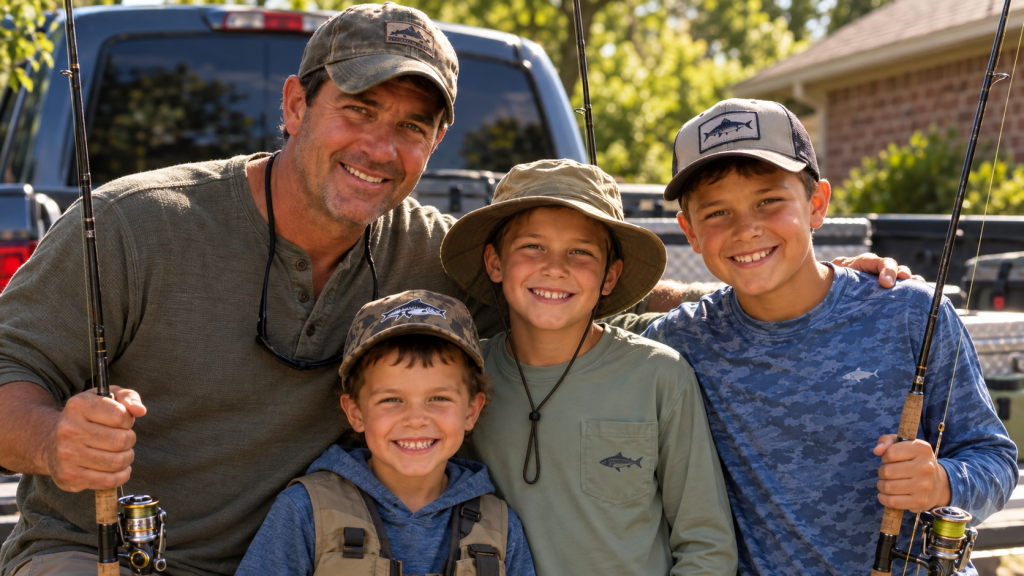
One Christmas, we recreated the photograph from the morning of the fishing trip.
Not intentionally at first.
The boys were standing in my driveway.
Noah held a cooler.
Caleb had fishing rods.
Ethan was laughing.
I froze on the porch.
Sophie noticed.
“Mom?”
The world doubled.
Then.
Now.
Daniel beside the truck.
Three boys young enough to believe every father knew the way home.
I started crying.
Noah saw me.
“Oh, Mom.”
“I’m fine.”
“You’re obviously not.”
I held up my phone.
“Stand together.”
They did.
Three sons.
Older.
Scarred.
Alive.
I took the photograph.
Then Sophie, Emily, and Grace joined them.
“Another one,” I said.
Six children stood in my driveway.
I took the picture.
This time, everyone came home.
That photograph sits beside the old one now.
I did not throw the first away.
Painful history does not have to be destroyed for happiness to exist beside it.
Dean eventually became part of family gatherings again.
Never in the same way.
Trust, once shattered, does not grow back in its original shape.
But he showed up.
Quietly.
Without demanding forgiveness.
When Noah needed help moving, Dean came.
When Grace married, Dean sat in the back row.
When Ethan graduated, Dean applauded until his hands were red.
One evening, years later, he stood beside me on the porch.
“Do you forgive me?”
I looked at him.
“You said you would never ask.”
“I know.”
“Then why ask now?”
“Because I’m getting old.”
I smiled sadly.
“Age doesn’t create entitlement.”
“I know.”
He looked away.
“Forget I asked.”
I watched him.
Then said:
“I don’t know if forgiveness is one decision.”
Dean looked back.
“Some days I forgive you.”
His eyes filled.
“Some days I remember Sophie screaming at the lake and I hate you.”
He nodded.
“That’s fair.”
“Some days you’re Daniel’s stupid little brother again.”
He laughed through tears.
“He’d appreciate that.”
“And some days you’re the man who lied to me for six years.”
“I know.”
I took his hand.
“All of those things are true.”
He squeezed mine.
“Okay.”
That was enough.
The Halcyon case ended with convictions, pleas, settlements, and government investigations.
Newspapers wrote about it.
Documentaries were proposed.
We refused most interviews.
Our family had already spent too many years living inside someone else’s secret.
We did not owe the world our grief as entertainment.
Noah eventually spoke publicly once.
Not about the kidnapping details.
About missing children.
He said something I will never forget.
“Families need answers, but answers are not the same as endings.”
He looked at me from the stage.
“Sometimes an answer begins another kind of life.”
He was right.
For six years, I believed my life had ended at a lake.
Then Sophie found a phone.
A dead battery.
An old video.
A sentence from her father.
Don’t believe the boat story.
That phone did not give me my old life back.
Nothing could.
Daniel was still gone.
My sons had grown up in hiding.
My daughters had grown up in grief.
I had lost years I could never reclaim.
But truth gave us something grief never could.
A direction.
A door.
A way forward.
On the tenth anniversary of Daniel’s disappearance, all six children came home.
We ate dinner.
Too much food.
Too much noise.
Grandchildren running through rooms.
Someone spilled wine.
Ethan burned bread.
Sophie criticized everyone’s life choices.
Normal.
Glorious.
Normal.
After dinner, Noah brought out Daniel’s old phone.
Federal investigators had returned it years earlier.
The battery no longer worked reliably.
But we had copies of the videos.
“Do you want to watch it?”
he asked.
I knew which one.
The garage.
Daniel’s warning.
For years, I couldn’t.
That night, I nodded.
All six children gathered.
Daniel appeared on the television.
Young.
Alive.
Afraid.
“Laura, if you ever see this, something has gone terribly wrong.”
My children became silent.
I watched his face.
For the first time, I did not see a ghost.
I saw a frightened husband making imperfect decisions.
A father trying to protect his children.
A man who succeeded in some ways.
Failed terribly in others.
A human being.
When the video ended, nobody spoke.
Then Ethan said:
“I barely remember his voice.”
Noah put an arm around him.
Grace cried.
Emily leaned against Sophie.
I looked at Daniel’s frozen face on the screen.
“Your father loved you.”
I swallowed.
“He also made mistakes that hurt us.”
They listened.
“We don’t have to turn him into a hero to love him.”
Noah nodded.
“And we don’t have to turn him into a villain to admit he was wrong.”
Sophie whispered:
“Both.”
“Yes.”
Both.
That word had become the shape of our family.
Grief and gratitude.
Anger and love.
Loss and return.
Daniel saved our sons.
Daniel left us behind.
Dean betrayed him.
Dean tried to protect us.
Samuel helped kidnap them.
Samuel later saved their lives.
Noah survived.
Noah suffered.
The boys came home.
The lost years did not.
Both.
I finally understood that healing is not choosing the prettier half of the truth.
It is becoming strong enough to hold all of it.
Before everyone left that night, I asked for a photograph.
Groans.
Complaints.
Children.
Grandchildren.
Dean standing uncertainly at the edge.
“Get in,” I told him.
He stared.
“You sure?”
“Yes.”
He joined us.
We crowded into the living room.
The camera timer blinked.
I looked around.
Sophie.
The daughter who found the phone.
Noah.
The son who carved a message into concrete.
Caleb.
The boy who learned to breathe inside closed rooms again.
Ethan.
The child who forgot my voice and found it again.
Emily.
Who learned that people being late did not always mean tragedy.
Grace.
Who returned to the water.
Dean.
Who learned that fear does not excuse silence.
And me.
The woman who had buried four empty coffins.
The camera flashed.
For a second, I imagined Daniel standing behind us.
Not as a ghost.
As memory.
The man before the lake.
The father with fishing rods.
The husband who checked the weather ten times.
The idiot who thought he could protect everyone alone.
I smiled.
The photograph captured it.
Years later, when my grandchildren ask about the two pictures on my mantel, I tell them the truth in a way they can understand.
The first photograph shows four people leaving for a fishing trip.
The second shows a family after learning that coming home can take many forms.
Sometimes people come home through a front door.
Sometimes through a telephone call.
Sometimes through truth.
And sometimes the person you lose never returns at all, but the truth about them finally does.
I still keep Daniel’s letter.
The paper has softened along the folds.
Sometimes I read the final lines.
Remember me as the man I was before I became frightened enough to mistake disappearance for protection.
For years, I thought protection meant preventing pain.
Now I know better.
You cannot promise the people you love that nothing terrible will happen.
You cannot control every road.
Every lake.
Every stranger.
Every betrayal.
You cannot love someone so fiercely that danger loses their address.
What you can do is tell the truth.
You can trust the people you love enough to let them face reality beside you.
Daniel’s greatest mistake was believing he had to carry danger alone.
Dean made the same mistake.
Then Noah.
Fear passed through the men in our family like an inheritance.
Each one believed silence protected someone.
It didn’t.
Silence only made the fear larger.
Sophie broke it.
My daughter.
Standing in my kitchen.
Holding an old phone.
“Mom, I know what really happened back then.”
She had no idea those words would bring her brothers home.
Neither did I.
One spring afternoon, years after everything ended, Sophie and I sat on my porch.
She had children of her own by then.
Her oldest son was planning his first fishing trip with Noah.
She laughed when she saw my expression.
“Mom.”
“What?”
“Stop.”
“I didn’t say anything.”
“Your face did.”
“Life jackets?”
“Yes.”
“Emergency radio?”
“Yes.”
“Weather?”
“Checked.”
“Twice?”
“Eight times, because Uncle Noah is basically Dad now.”
I smiled.
“Full tank?”
“Yes.”
“Location sharing?”
“Yes.”
She took my hand.
“They’re coming home Sunday.”
The old fear moved inside me.
Quiet.
Familiar.
Then I looked at Sophie.
Six years of grief had once taught me that departures could become permanent without warning.
But I refused to let fear become another inheritance.
So I nodded.
“Tell them to have fun.”
Sophie smiled.
“That’s growth.”
“Don’t get disrespectful.”
She laughed.
Sunday evening, a truck pulled into the driveway.
My grandson jumped out carrying a fish far smaller than the story he told about catching it.
Noah followed.
Older now.
Laughing.
They came home.
I stood in the doorway.
And for just one second, I was back in that driveway decades earlier.
Daniel.
Noah.
Caleb.
Ethan.
Coolers.
Fishing rods.
The last photograph.
Then the memory passed.
Because this was not that morning.
This was now.
Noah climbed the steps.
“Mom, why are you crying?”
“I’m old.”
“That doesn’t answer the question.”
“It answers most questions.”
He kissed my forehead.
My grandson ran inside.
I looked toward the road.
Empty.
Peaceful.
No dark sedan.
No secrets.
No one hiding.
I whispered:
“Thank you.”
Noah turned.
“What?”
“Nothing.”
He smiled.
We went inside.
That night, I opened the drawer where I kept Daniel’s phone.
I held it one final time.
Then I placed it beside his letter.
For years, I had believed that phone contained the worst thing that could happen to a family.
It didn’t.
It contained a doorway.
Painful.
Terrifying.
Necessary.
The truth did not return the years.
It did not resurrect Daniel.
It did not make Dean innocent.
It did not erase the warehouse from my sons’ memories or the lake from my daughters’ nightmares.
Truth is not magic.
But it gave us the one thing a lie never could.
A chance to choose what happened next.
And that was enough.
I turned off the light.
Downstairs, my family was laughing.
All six children were home for the weekend.
Their voices traveled through the house.
For years, silence had been the loudest sound in those rooms.
Now I could barely hear myself think.
I loved every second of it.
I stopped at the top of the stairs.
Noah was arguing with Sophie.
Caleb was stealing food from Emily’s plate.
Grace was showing Ethan photographs.
Grandchildren were running through the hallway.
Dean was losing badly at cards.
Life had returned in the messiest possible way.
Not the life I had before.
Something new.
Something built from everything we had survived.
I touched the railing.
Then looked toward the old photograph hanging on the wall.
Daniel and our three boys beside the truck.
Four smiling faces.
For six years, I thought that photograph marked the end of my family.
I had been wrong.
It marked the beginning of a story none of us understood yet.
A story about what fear can destroy.
What silence can steal.
What truth can uncover.
And how sometimes the people we mourn are not waiting beneath dark water.
Sometimes they are somewhere far away, carrying the same grief, believing their silence is protecting us.
Sometimes love makes people brave.
Sometimes it makes them foolish.
Sometimes both.
But the truth, however late, gives everyone a choice again.
Sophie gave us that choice when she found the phone.
Daniel gave us the first clue when he recorded the video.
Noah gave investigators the next one when he carved coordinates into a warehouse wall.
And after six impossible years, one by one, my sons found their way home.
Not unchanged.
Not unhurt.
Not as the boys who left.
But alive.
Alive was enough.
More than enough.
I walked downstairs.
Sophie looked up.
“Mom, tell Noah he’s cheating.”
“I am not!”
“You looked at Caleb’s cards!”
“Caleb holds his cards facing outward!”
“That isn’t my fault!”
I laughed.
“What?”
Sophie asked.
“Nothing.”
I sat among them.
For once, there was nowhere else I needed to look.
No lake to search.
No phone to unlock.
No mystery waiting behind a door.
Everyone I could still hold was within reach.
And the man I could no longer hold had finally left me the truth.
I thought of Daniel’s last letter.
I love you still.
My eyes filled.
I whispered so quietly no one heard:
“I love you too.”
Then Ethan threw a playing card at Noah.
Everyone started shouting.
I laughed through my tears.
And for the first time since the morning my husband drove away with our sons, I understood something I had once believed impossible.
I had survived the unanswered question.
Then I survived the answer.
Now, finally, I was allowed to live.
THE END STORIES! THANK YOU FOR READING GOOD LUCK! ❤️
Related Posts