I did not answer Austin’s message. Not immediately. The ship was moving slowly away from Miami, the city turning into a bright line behind us while the Atlantic opened ahead like something enormous and unfinished.
I stood at the rail with Ernest’s old photograph tucked inside my wallet. It showed the two of us in Key West twenty-seven years earlier. He was sunburned. I was laughing at something outside the frame.
Neither of us knew what our knees would eventually sound like when we climbed stairs. Neither of us knew how many nights would be spent beside hospital beds. Neither of us knew that our son would grow up, marry, become a father, lose jobs, borrow money,
apologize, promise to repay us, and somehow reach adulthood still believing his mother’s life existed mostly as a backup generator for his own.
The ocean wind lifted my hair.
My phone buzzed again.
Austin: Mom, answer me.
Then:
Austin: This is serious.
Then:
Austin: Chloe says you moved the animals. Where are they?
I smiled.
So Denise had already heard from them.
Another message.
Austin: We came back to the house because Chloe forgot something. Why are the cages gone?
I frowned.
They had said they were leaving for the Bahamas.
Apparently their vacation had not even lasted until lunch.
My phone rang.
Austin.
I let it ring.
Again.
Then Chloe.
Again.
I slipped the phone into my purse.
For the first time in my life, I allowed my son to experience the natural consequence of not receiving immediate access to me.
It felt almost criminal.
Which told me how unhealthy the pattern had become.
A woman beside me leaned against the railing.
She was perhaps my age.
Silver hair cut to her chin.
Large sunglasses.
A straw hat that looked expensive and impractical.
She nodded toward my phone.
“Family?”
I laughed.
“That obvious?”
“Only family can call five times before eight in the morning and make you look guilty for not answering.”
I looked at her.
She smiled.
“I’m Ruth.”
“Theresa.”
“First long cruise?”
“First cruise longer than four days.”
She whistled.
“And you chose a year.”
“Yes.”
“Running away?”
The question should have offended me.
Instead, I considered it.
“Maybe.”
Ruth nodded.
“Nothing wrong with running from a burning building.”
I laughed.
“What are you running from?”
She lifted her coffee.
“Three adult daughters who believe retirement means I became available full-time.”
I stared.
She grinned.
“Oh, we’re going to be friends.”
We were.
But that came later.
At 8:05, I finally called Denise.
She answered on the first ring.
“You are a legend.”
“I’m too old to be a legend.”
“No.”
“You are absolutely not.”
“What happened?”
She started laughing.
“They showed up at your house.”
“Why?”
“Apparently Chloe left some kind of makeup bag.”
“Of course she did.”
“They rang the bell.”
“And?”
“I answered through your doorbell camera.”
I had given Denise temporary access.
“Please tell me you were polite.”
“I was extremely polite.”
That meant no.
“What did you say?”
“I said, ‘Good morning, your abandoned dependents are safe.’”
I covered my face.
“Denise.”
“What?”
“A cat, rabbit, and two birds are not abandoned dependents.”
“They were abandoned by the people who left them with a grieving widow without asking.”
I could not argue.
“Where are they?”
“At my house.”
“All of them?”
“The birds are insulting my husband.”
“Already?”
“One learned to say something that sounds suspiciously like ‘idiot.’”
“That was probably Austin.”
Denise laughed so loudly I had to hold the phone away.
Then she became serious.
“They are safe.”
“Thank you.”
“The cat is out of the carrier.”
“Good.”
“The rabbit ate hay.”
“Good.”
“And Austin is furious.”
There it was.
“About the animals?”
“About you.”
I looked at the horizon.
“What did he say?”
“He demanded to know where you went.”
“What did you tell him?”
“That you were unavailable.”
“You didn’t tell him about the cruise?”
“Of course not.”
I smiled.
“Thank you.”
“He has a key.”
My calm disappeared.
“To my house?”
“Yes.”
“I thought he only had the old spare.”
“He tried it.”
“Did it work?”
“No.”
Relief.
I had changed the locks after Ernest died.
Not because of Austin.
Because Ernest had given keys to half the neighborhood over forty years and no one remembered who still had one.
Denise continued.
“Then Chloe started yelling through the camera that you had stolen their animals.”
I laughed.
“What did you say?”
“I gave them my address and told them they were welcome to collect their pets anytime after noon.”
“And?”
“They said they were going to the airport.”
“For their vacation?”
“I guess.”
I shook my head.
“Then why come back?”
“Makeup bag.”
“Right.”
“Theresa?”
“Yes?”
“Did they leave you those animals because they genuinely thought you’d enjoy the company?”
“No.”
“Good.”
“I wanted to make sure I wasn’t unfairly judging them.”
“No.”
She exhaled.
“Okay.”
I knew that tone.
“What?”
“There’s something else.”
My fingers tightened around the phone.
“What?”
“Your son asked me whether you had signed any papers before leaving.”
I went still.
“What kind of papers?”
“He wouldn’t say.”
I thought of the folder.
The property records.
The note.
Once Mom signs, we can use the house equity for the investment.
She’ll agree. She always does.
“No.”
I said quietly.
“I signed nothing.”
“Good.”
“Denise?”
“Yes?”
“If Austin comes back, don’t let him inside.”
“You don’t even need to ask.”
“I’m serious.”
“So am I.”
“Call police if he tries.”
There was a pause.
“Theresa.”
“Yes?”
“Are you afraid of him?”
That question hurt.
“No.”
I thought.
Then corrected myself.
“Not physically.”
“Okay.”
“I’m afraid of how much I taught him to expect.”
Denise became quiet.
“That can change.”
“I hope so.”
“It already has.”
I looked at the ocean.
“Yes.”
Maybe it had.
After breakfast, I found the ship’s library.
I had imagined cruises as buffets and deck chairs.
I discovered they also contained quiet corners where women could call attorneys without hearing their sons in the next room.
My lawyer was Margaret Ellis.
She had handled Ernest’s will.
When I told her about the folder, she stopped me halfway through.
“You photographed everything?”
“Yes.”
“Send them.”
“I already did.”
“I see them.”
Silence while she opened the files.
I waited.
“Theresa?”
“Yes?”
“Do not sign anything Austin sends you.”
“I wasn’t planning to.”
“Do not authorize anyone to access your home financially.”
“Okay.”
“Did you ever give him power of attorney?”
The question made my stomach tighten.
“During Ernest’s hospitalization.”
“What kind?”
“I don’t know.”
“Who prepared it?”
“The hospital social worker gave us forms.”
“Was it limited to medical decisions?”
“I think.”
“Thinking is not enough. I’ll locate the record.”
“Could he use that against the house?”
“Probably not if it was a healthcare proxy, but we verify.”
“Okay.”
“Who owns the house?”
“Ernest and I did.”
“Jointly?”
“Yes.”
“With survivorship?”
“I believe so.”
“I have the deed from the estate file.”
She clicked on something.
“Yes. Title passed to you.”
I exhaled.
“Can Austin do anything without me?”
“Not lawfully based on what I see.”
“Based on what you see.”
“Exactly.”
“Margaret?”
“Yes?”
“What are they trying to do?”
She examined the photographs.
“One page appears to be a home-equity estimate.”
“Yes.”
“Another is a projected investment return.”
“What investment?”
She paused.
“Have you heard of Blue Harbor Development Group?”
“No.”
“Chloe’s brother?”
“Matthew?”
“Yes.”
My stomach dropped.
“Matthew works in real estate.”
“He appears to be raising capital for a short-term rental project.”
“Where?”
“Florida.”
Of course.
“Bahamas?”
“No.”
She laughed softly.
“Fort Myers.”
I stared at the library wall.
“What does my house have to do with it?”
“The handwritten note suggests Austin and Chloe expected you to borrow against your house and invest some or all of the proceeds.”
“How much?”
“There’s a number.”
I already knew I did not want to hear it.
“How much?”
“Four hundred thousand.”
My heart stopped.
“Four hundred thousand dollars?”
“Yes.”
I almost shouted in the quiet library.
“My house is paid off.”
“I know.”
“Ernest and I spent thirty-two years paying it off.”
“I know.”
“They wanted me to put four hundred thousand dollars against it?”
“That appears to be what they discussed.”
“For Chloe’s brother?”
“Possibly.”
“I have never invested in anything in my life except certificates of deposit and Ernest’s union retirement plan.”
Margaret sighed.
“This may have been their pitch.”
I looked at the photograph again.
One page showed arrows.
House value.
Available equity.
Projected returns.
Monthly distributions.
It was dressed up beautifully.
They had even estimated my “new monthly passive income.”
I almost laughed.
Passive income.
There is nothing passive about risking the roof over your head.
“What should I do?”
“Nothing today.”
“That feels impossible.”
“Do not confront them until I review all documents.”
“Why?”
“Because I want to know whether this is merely an ugly family plan or whether anyone has already represented that you agreed.”
My stomach turned.
“What do you mean?”
“Applications.”
“Emails.”
“Preapproval requests.”
“Investor commitments.”
“Things like that.”
I closed my eyes.
“Would Austin forge my signature?”
Margaret was silent.
I hated the silence more than an answer.
“I don’t know.”
Neither did I.
That was the problem.
Three hours later, Austin sent a voice message.
I listened once.
Then again.
“Mom, I don’t know what kind of stunt this is, but Chloe is crying. The animals are at some stranger’s house, and we have a flight in two hours. You said you’d watch them. You agreed. So whatever point you’re trying to make, congratulations. You made it. Now call me.”
I almost responded.
Old Theresa reached for the phone immediately.
Explain.
Apologize.
Fix.
Then I heard Ernest’s voice in my memory.
Not something profound.
Something he said whenever Austin called us with another emergency.
“We keep putting out the fire before he smells smoke.”
At the time, I thought Ernest was being unkind.
Now I understood.
I typed:
The animals are safe with Denise. You may collect them from her or arrange care directly. I am unavailable. Please direct anything concerning my home or finances to Margaret Ellis.
I read it.
No apology.
No explanation.
No mention of the cruise.
Then I sent it.
Austin called seven seconds later.
I declined.
Chloe texted:
Wow. Your husband dies and suddenly you become selfish.
That one hurt.
Deeply.
Not because I believed it.
Because Ernest had been gone eight days.
Eight days.
And she used his death as a weapon.
My hands shook.
I nearly responded with everything.
The couch I slept on after her baby was born.
The mortgage payment I covered when Austin lost work.
The groceries.
The car repair.
The childcare.
The wedding deposit Ernest and I helped with.
The birthday money.
The countless small things nobody remembered because I had made them too easy.
Instead, I typed:
Please arrange care for your pets directly.
Send.
Then I turned the phone off.
That afternoon, the ship held a memorial gathering for passengers traveling after loss.
I did not plan to attend.
Ruth dragged me.
“You’re going.”
“No.”
“Yes.”
“I don’t like group grief.”
“Nobody likes group grief.”
“Then why attend?”
“Free champagne afterward.”
I stared.
She smiled.
“Got you moving.”
The gathering took place in a small lounge overlooking the sea.
There were sixteen of us.
Widows.
Widowers.
A woman grieving her sister.
A man whose best friend had died.
No one gave speeches about moving on.
No one said everything happens for a reason.
Thank God.
We simply said names.
When it was my turn, I whispered:
“Ernest.”
The facilitator asked:
“What is one thing you miss?”
I thought I would say his laugh.
His hands.
His terrible singing.
Instead I said:
“Being known before I had to explain.”
That destroyed me.
I cried for the first time since boarding.
Not because Austin was selfish.
Not because Chloe was rude.
Because Ernest knew every version of me.
Twenty-two-year-old Theresa who thought boxed macaroni was cooking.
Thirty-year-old Theresa holding a feverish baby.
Forty-five-year-old Theresa furious because he forgot their anniversary.
Sixty-year-old Theresa helping him into a shower after chemotherapy.
He knew when my silence meant anger.
When it meant exhaustion.
When I was pretending pain was smaller than it was.
And now the one person who could look at me and say, “You’re doing that thing again,” was gone.
Afterward, Ruth sat beside me on deck.
“What thing?”
I looked at her.
“What?”
“You said your husband knew when you were doing a thing.”
I laughed.
“He said I carried people until I hated how heavy they were.”
Ruth nodded slowly.
“Smart man.”
“He didn’t say it that elegantly.”
“What did he say?”
I smiled.
“Theresa, stop rescuing people and then getting mad they keep drowning near you.”
Ruth started laughing.
“I like Ernest.”
“I did too.”
“Did he know about this cruise?”
That question surprised me.
“No.”
Then I hesitated.
“Maybe.”
“What does that mean?”
“We talked about one.”
“When?”
“Years ago.”
“Specific cruise?”
“A world cruise.”
Ruth stared.
“You bought a year-long cruise a week after his funeral because you two talked about it?”
“Yes.”
“Theresa.”
“What?”
“You’re not running away.”
“What am I doing?”
She looked toward the ocean.
“Finishing something.”
I cried again.
I was getting tired of crying.
Three days into the voyage, Margaret called.
I was in Nassau.
Ironically.
The same Bahamas Austin and Chloe had supposedly wanted me to subsidize with free pet care.
I answered from a quiet café near the port.
“I found the power-of-attorney forms.”
“And?”
“Healthcare only.”
Relief.
“No financial authority.”
“Correct.”
“Good.”
“There’s another issue.”
Of course there was.
“What?”
“Blue Harbor.”
I sat straighter.
“They submitted a preliminary investor list to a private lender.”
“What does that mean?”
“Your name appears.”
Everything around me seemed to stop.
“Why?”
“According to the document, you were listed as a prospective limited investor for four hundred thousand dollars.”
“Prospective means I didn’t agree?”
“Correct.”
“Did anyone say I did?”
“Not in the version I have.”
“How did you get it?”
“I contacted counsel for the project after seeing the material you sent.”
“And?”
“They were surprised.”
“Why?”
“Because Austin apparently described your participation as ‘family committed, documentation pending.’”
My fingers went numb.
“He said that?”
“In an email.”
I closed my eyes.
“Is that illegal?”
“Do not jump ahead.”
“I’m asking.”
“It can be serious to misrepresent investor commitments, but we need context.”
“Okay.”
“More importantly, I told counsel you have not committed.”
“What did they do?”
“Removed your name.”
Relief.
Then anger.
“Can Austin add it back?”
“Not credibly now.”
“Good.”
“There’s more.”
I almost laughed.
“Of course.”
“Matthew called me.”
“Chloe’s brother?”
“Yes.”
“What did he say?”
“He claimed he believed you had already agreed.”
I stared at the table.
“Based on what?”
“Austin.”
The pattern.
Always Austin.
Always the person between me and somebody else.
“Did Matthew know I hadn’t?”
“He says no.”
“Do you believe him?”
“It doesn’t matter what I believe yet.”
Lawyers.
Always facts.
“What happens now?”
“Nothing unless you want something to happen.”
“I want them to leave my house alone.”
“That’s straightforward.”
“I want my name off everything.”
“Done.”
“I want to know if they forged anything.”
“So far, I have found no forged signature.”
I exhaled.
That mattered.
Ugly entitlement was bad enough.
I did not need to turn my son into a criminal in my imagination if the evidence did not support it.
“Margaret?”
“Yes?”
“Why did Austin need me to invest?”
“Because Blue Harbor’s lender required additional equity commitments before releasing construction financing.”
“So my four hundred thousand helped them qualify.”
“Potentially.”
“And if the project failed?”
“You could lose the investment.”
“And still owe the house loan.”
“Yes.”
I sat there staring at a stranger’s pastry.
Four hundred thousand dollars.
The house Ernest and I paid off.
The only home I had known for thirty-six years.
Risked so my son could say yes to his wife’s brother.
I whispered:
“He thought I’d agree.”
Margaret was silent.
“He wrote it down.”
“Yes.”
“She’ll agree. She always does.”
“I saw.”
I swallowed.
“I taught him that.”
“No.”
Her answer was immediate.
“I enabled it.”
“That is different from teaching someone entitlement.”
“Is it?”
“Yes.”
Her voice softened.
“You may regret your boundaries.”
“You may regret not having set them earlier.”
“But Austin is responsible for what he decided those patterns meant.”
I looked at the ocean.
“I don’t want to lose my son.”
“Then don’t confuse losing control of him with losing him.”
That sentence stayed with me.
The next day, Austin finally sent something different.
Not anger.
Not demands.
A photograph.
The cat.
Back at their apartment.
The rabbit beside him.
Bird cage in the background.
Below it:
We picked them up.
I replied:
Good.
Two minutes later:
Are you really on a cruise?
I stared.
How did he know?
Then another message.
Denise’s husband told Dad’s old fishing buddy, who told Uncle Ray.
Small towns.
Global intelligence agencies had nothing on retired men with fishing contacts.
I sighed.
Then:
Yes.
His reply took almost a minute.
For how long?
I typed:
A year.
Three dots.
Gone.
Three dots again.
Then:
WHAT?
I smiled despite myself.
A year.
The phone rang immediately.
This time, I answered.
“Hi, Austin.”
“Are you insane?”
Not hello.
Not how are you.
“Possibly.”
“A year?”
“Yes.”
“You just buried Dad.”
“I know.”
“You’re grieving.”
“I know.”
“Then why would you make a decision like this?”
“I made it deliberately.”
“Mom.”
“What?”
“You cannot disappear for a year.”
I looked around Nassau.
“I appear to have managed.”
“That is not funny.”
“Depends who you ask.”
He exhaled hard.
“What about the house?”
There it was.
“What about it?”
“Who’s watching it?”
“Handled.”
“By who?”
“People I trust.”
“You don’t trust me?”
The question was so direct that I answered directly.
“Not with the house right now.”
Silence.
Then:
“Because of that folder.”
“Yes.”
“Mom, you went through our apartment.”
“I went to return your spare key.”
“And opened private documents.”
“My name was on the folder.”
“You still shouldn’t have read it.”
“Maybe.”
“That’s an invasion of privacy.”
“Perhaps.”
He sounded relieved that I admitted something.
Then I continued.
“Now explain why my paid-off house was being treated as collateral for a four-hundred-thousand-dollar investment I never agreed to.”
Silence.
“Austin.”
“It wasn’t collateral.”
“Margaret says the plan involved a home-equity loan.”
“That doesn’t mean—”
“Austin.”
He sighed.
“We were going to ask you.”
“After listing me as family committed?”
Silence.
“How do you know about that?”
“Margaret.”
He muttered something.
“What?”
“Nothing.”
“No.”
I leaned back.
“Ruin breakfast.”
“What?”
“Nothing.”
Wrong family.
Wrong phrase.
Years before that phrase would become someone else’s story.
I almost laughed at myself.
“Tell the truth.”
He went quiet.
Finally:
“Matthew needed one more investor.”
“And you volunteered me.”
“I said you might be interested.”
“You said I was committed.”
“I said family committed.”
“That is worse.”
“It was informal.”
“To a lender.”
“He needed confidence.”
“So you used mine.”
“No.”
“You used my name.”
“Mom.”
“You assumed I would sign.”
He became defensive.
“You’ve helped before.”
“Yes.”
“You invested in Dad’s business.”
“That was thirty thousand dollars in a hardware store thirty years ago, and your father paid me back.”
“You helped me when I lost my job.”
“Yes.”
“You gave us money when Ava was born.”
“Yes.”
“So why are you acting like we’re monsters for thinking you might want to invest?”
“Because you did not ask.”
“We were going to.”
“When?”
“When we got back.”
“After the Bahamas.”
“Yes.”
“After leaving your animals at my house while I was eight days widowed.”
His voice softened slightly.
“Mom.”
“No.”
I had finally found the anger.
Not explosive.
Clean.
“You walked into the house where your father’s funeral flowers were still alive.”
He said nothing.
“You did not ask whether I had slept.”
Silence.
“You did not ask whether I had eaten.”
Silence.
“You did not ask whether I needed anything.”
“Mom—”
“You dropped cages onto my rug.”
He exhaled.
“We thought the animals would keep you company.”
“No.”
“What?”
“Do not rewrite it.”
Silence.
“Chloe handed me instructions.”
“Fine.”
“You told me that was why I was there.”
“I didn’t mean—”
“You meant I was available.”
His voice rose.
“You are my mother.”
“And?”
“What does that mean to you, Austin?”
Silence.
“Does it mean I exist where you left me?”
“That’s not fair.”
“Then answer.”
“You’re family.”
“Yes.”
“Family helps.”
“Yes.”
“But help is offered.”
Silence.
“It is not assigned.”
His breathing changed.
I continued.
“And four hundred thousand dollars is not help.”
“We would’ve paid the loan.”
“With what?”
“The project distributions.”
“And if the project failed?”
“It’s a good project.”
“That is not an answer.”
“It’s projected to—”
“Your father is dead.”
He stopped.
I did not mean it as a weapon.
But the words came.
“My husband is dead.”
My voice broke.
“The man who spent thirty-two years paying off that house is dead.”
Austin said nothing.
“And nine days later, you are discussing putting debt back on it without even asking me.”
His voice became small.
“I didn’t think of it that way.”
“I know.”
That was the entire problem.
He hadn’t thought of me.
Only what I could provide.
Then he whispered:
“I’m sorry.”
I closed my eyes.
Old Theresa wanted to rescue him from discomfort immediately.
“It’s okay.”
I almost said it.
Instead:
“I hear you.”
He was quiet.
“What does that mean?”
“It means I heard your apology.”
“You don’t accept it?”
“I didn’t say that.”
“Then?”
“I need more than an apology right now.”
“What?”
“Different behavior.”
Silence.
Finally:
“Are you coming home?”
“No.”
“Not even for Christmas?”
“I don’t know.”
“A year is insane.”
“Maybe.”
“Mom.”
“Yes?”
“Dad would never have wanted you to leave like this.”
There are sentences people say because they know where the wound is.
Austin regretted it immediately.
I could hear it in the silence.
“Mom.”
I did not speak.
“I shouldn’t have said that.”
“No.”
“I’m sorry.”
“You don’t know what your father wanted.”
“I know he loved the house.”
“He loved me more.”
My voice shook.
“And if you use him again to argue that I should stay somewhere you find convenient, I will end the call.”
Silence.
“Okay.”
“Do you understand?”
“Yes.”
“Good.”
Then something unexpected happened.
Austin started crying.
Not manipulation.
I knew my son’s fake tears from childhood.
These were not those.
“I miss him.”
My anger softened.
So did I.
“I know.”
“I keep thinking I should call him.”
“Me too.”
“I had his number open yesterday.”
My throat closed.
“I still have his voicemail saved.”
“Which one?”
“The one where he yelled at me about changing the oil.”
I laughed through tears.
“He loved that lecture.”
“I know.”
We cried together.
For five minutes, no house.
No investment.
No cages.
Just mother and son grieving the same man differently.
Then Austin whispered:
“I’m sorry I didn’t hug you at the funeral.”
There it was.
The thing I had not told him hurt most.
I cried harder.
“Thank you.”
“I saw the house.”
“What?”
“At the cemetery.”
He sounded ashamed.
“I looked at you and thought about the house.”
“Why?”
“Because Chloe and I had been fighting about money.”
I waited.
“Matthew needed investors.”
“So you looked at me burying your father and saw equity.”
He sobbed.
“Yes.”
That honesty was ugly.
But honest.
I did not comfort him out of it.
After we hung up, I stood alone beside the harbor.
Then I took Ernest’s photograph from my wallet.
“Your son is an idiot.”
The wind almost stole the picture.
I gripped it tighter.
“Your son.”
As if Austin hadn’t spent forty-one years being mine too.
I laughed.
Then cried again.
The cruise continued.
Mexico.
Colombia.
Panama.
Costa Rica.
Crossing the Pacific.
Days became strange.
Ports.
Sea days.
Breakfast with Ruth.
Trivia with a retired chemistry teacher named Howard who knew every answer except pop culture.
I learned watercolor badly.
I danced once and hated it.
I danced again and hated it less.
At night, I missed Ernest so much my chest physically hurt.
Then sometimes I would go an entire afternoon without thinking of him and feel guilty.
Grief creates impossible rules.
Remember constantly.
But heal.
Move forward.
But don’t move too far.
Laugh.
But not too soon.
Travel.
But not because you’re escaping.
Eventually, I stopped asking grief for permission.
Three months into the cruise, Margaret emailed me.
Need to discuss Ernest’s estate file. Not urgent. Call when convenient.
I called immediately.
“What happened?”
“Nothing bad.”
“Then never begin an email like that again.”
She laughed.
“Sorry.”
“What is it?”
“I found a sealed letter in Ernest’s safe-deposit materials.”
“For me?”
“Yes.”
My breath caught.
“Why didn’t we see it before?”
“It was inside an envelope labeled ‘Travel.’ We focused on estate documents first.”
“Travel.”
“Yes.”
“Can you open it?”
“Not without your permission.”
“Open it.”
Paper rustled.
Then Margaret went quiet.
“What?”
“I think you should hear this.”
“Read.”
She began.
Theresa,
If you are reading this, one of two things happened.
Either I finally convinced you to take the trip, or I died before I could.
If it’s the second one, I am sorry.
I started crying immediately.
Margaret stopped.
“Continue.”
She did.
You have spent most of our marriage insisting you were happiest when everyone else was okay.
I believed you for twenty years.
Then I realized you were happiest when everyone else was okay because you thought that was the only time you were allowed to relax.
That is not the same thing.
My knees went weak.
I sat on the edge of the bed.
I put money aside for the world cruise.
Not enough for everything.
But enough that you cannot use money as your excuse.
There is an account number in the estate papers.
Take it.
Use it.
Do not give it to Austin.
I laughed through tears.
Margaret did too.
Then continued.
I love our son.
But we have helped him too quickly for too long.
If I am gone, he will lean on you harder.
Do not let his grief become another reason you stop living.
Help him when you choose.
Not because he assumes.
And if Chloe rolls her eyes while reading this, tell her I said she still owes me twenty dollars from gin rummy.
I laughed so hard I cried more.
Then came the final paragraph.
Take the cruise, Tess.
Eat dessert.
See the places we talked about.
Complain about the pillows.
Find something beautiful and do not immediately think about who else would enjoy it.
Enjoy it yourself.
That will be hard for you.
Do it anyway.
Love,
Ernest.
Margaret stopped.
I could not speak.
“Theresa?”
“I bought the cruise before I knew.”
“I know.”
“He knew me.”
“Yes.”
“He knew.”
I held the phone against my chest.
The next morning, I booked a shore excursion I had been avoiding because it was expensive.
A helicopter ride over a coastline Ernest would have loved.
As the aircraft lifted, I looked down at cliffs and impossible blue water.
My first thought was:
Austin would love this.
I laughed.
Then said aloud:
“No.”
The pilot looked at me in the mirror.
“You okay?”
“Yes.”
I looked at the ocean.
“I love this.”
That was hard.
Ernest had been right.
Back home, Austin and Chloe’s investment plan collapsed.
Not because I sabotaged it.
Matthew failed to raise enough equity.
The lender walked away.
Chloe blamed me.
She sent a long email.
I read it once.
She wrote about family support.
Opportunity.
Legacy.
How I had “misunderstood” their intentions.
How the investment might have doubled.
How my refusal had embarrassed Matthew.
Then:
You had resources sitting in a house you weren’t even using.
That sentence clarified everything.
My house.
My paid-off home.
My security.
To Chloe, unused resources.
Assets existed to deploy.
People too, apparently.
I forwarded the email to Margaret.
Then I replied myself.
My home is not idle capital. It is my home. My retirement security and my grief are not family resources to allocate. Please do not contact me about investments again.
She did not respond.
For two months.
Then:
Fine.
Progress.
Austin called more carefully after that.
He asked:
“Is this a good time?”
Every time.
At first it sounded scripted.
Then natural.
He stopped beginning with requests.
He told me about Ava’s school.
The rabbit chewing a cable.
The parakeet saying “idiot” in front of Chloe’s mother.
I nearly fell off a deck chair laughing.
He found work.
Not glamorous.
Steady.
He and Chloe downsized their vacation plans.
The Bahamas trip had happened.
Three nights instead of seven.
They paid for a pet sitter next time.
Miracles.
At month five, Austin asked:
“Can I borrow twenty-five hundred dollars?”
I was walking around Kyoto.
I stopped.
Old reaction:
“What happened?”
Instead:
“What for?”
“Car transmission.”
“Do you have savings?”
“Some.”
“How much?”
“Enough to cover fifteen hundred.”
“And the rest?”
“Credit card.”
“So why borrow from me?”
Silence.
Then he laughed uncomfortably.
“Because you’re cheaper.”
I laughed too.
“Honest.”
“Is that a no?”
“Yes.”
He was quiet.
Then:
“Okay.”
I waited for anger.
None.
He said:
“I figured I’d ask.”
“And I answered.”
“Yeah.”
“Are you upset?”
“A little.”
“Okay.”
“That’s allowed.”
Silence.
Then:
“You really changed.”
I looked at a temple garden.
“I think I stopped volunteering for resentment.”
He laughed.
“I don’t know what that means.”
“Me neither.”
He used his credit card.
Paid it off over three months.
Nobody died.
This was astonishing.
At month six, Ruth and I celebrated my birthday in Singapore.
She gave me a scarf.
Howard gave me a book.
The dining staff brought cake.
I cried because Ernest always sang Happy Birthday too loudly.
Then Austin called.
“Happy birthday, Mom.”
“Thank you.”
“Did you get the package?”
“What package?”
“Check with reception.”
Inside was a small box.
A new pair of earrings.
Not expensive.
Silver.
Simple.
And a note.
Dad would probably say these aren’t as nice as the ones you sold for his medicine. He’d also say you should stop selling your things for everybody else. Happy birthday. I’m trying. Love, Austin.
I sat on the bed for twenty minutes.
Then called him.
“I love them.”
He sounded relieved.
“Chloe picked them.”
I smiled.
“Tell her thank you.”
“She wanted gold.”
“Of course.”
He laughed.
Then became serious.
“Mom?”
“Yes?”
“I found Dad’s old ledger.”
“What ledger?”
“The one from when you helped me after I lost my job.”
My stomach tightened.
“What about it?”
“He wrote everything down.”
“Your father wrote down grocery lists.”
“He wrote every check you two gave us.”
Silence.
“I didn’t know it was that much.”
I looked out the window.
“How much?”
“Thirty-seven thousand.”
I closed my eyes.
Over three years.
Rent.
Medical bill.
Car.
Baby expenses.
I had never totaled it.
Neither had Austin.
“I thought it was maybe fifteen.”
“No.”
“Why didn’t you tell me?”
“Would you have changed anything?”
He was quiet.
“No.”
“That’s why.”
He sighed.
“I’m ashamed.”
“Don’t turn shame into another emergency I have to solve.”
He laughed weakly.
“That sounds like therapy.”
“Cruise wisdom.”
“Same thing with better buffet.”
I smiled.
Then he said:
“I’m going to pay it back.”
“No.”
“What?”
“No.”
“I want to.”
“Your father and I gave you that money.”
“Some was loans.”
“Did you sign anything?”
“No.”
“Then consider it help.”
“But—”
“No.”
He went quiet.
I continued.
“If you want to honor it, build savings so Ava does not have to rescue you someday.”
He laughed.
“Fair.”
“And stop asking me to finance real estate.”
“Definitely fair.”
That call changed something.
Not because he repaid me.
Because for the first time, he looked backward at what he had received without immediately deciding it meant more should continue.
Month seven brought a storm.
The ship changed course.
Passengers complained.
Ruth loved it.
“Adventure.”
“We’re seventy-one.”
“Exactly. Time-sensitive adventure.”
I was sixty-eight.
She routinely added years to everyone.
During the storm, I dreamed of Ernest.
Not mystical.
Just a dream.
He was in our kitchen fixing the cabinet hinge he had fixed badly six times.
I said:
“You’re doing it wrong.”
He answered:
“Then stop watching.”
I woke laughing.
Then crying.
Grief had become like weather.
Still powerful.
Less surprising.
At month eight, Chloe called me directly.
Not text.
Not through Austin.
“Mrs. Theresa.”
That formal name again.
“Chloe.”
“Do you have a minute?”
“Yes.”
“I owe you an apology.”
I sat down.
“Okay.”
She hesitated.
“I was angry about the investment.”
“I know.”
“I thought you were punishing us.”
“I wasn’t.”
“I know now.”
“What changed?”
Silence.
“Matthew.”
I waited.
“The project he wanted you to invest in.”
“Yes?”
“He found other investors eventually.”
My stomach tightened.
“And?”
“It failed.”
I closed my eyes.
“How badly?”
“Badly.”
“Did you invest?”
A long silence.
“Twenty thousand.”
“Oh, Chloe.”
“I know.”
“Can you afford the loss?”
“We’ll survive.”
“What happened?”
“Construction costs.”
“Permits.”
“Insurance.”
“Bookings were overestimated.”
She laughed bitterly.
“All the boring things people say will be fine when they want your money.”
I felt no satisfaction.
Only relief.
Had I invested four hundred thousand borrowed against the house…
I stopped the thought.
Chloe whispered:
“You would’ve lost a lot.”
“Yes.”
“I kept thinking about the note.”
“What note?”
“The one in the folder.”
My stomach tightened.
“You knew I saw it?”
“Austin told me.”
Silence.
“She’ll agree. She always does.”
I said nothing.
“I wrote the first line.”
“What?”
“Once Mom signs, we can use the house equity.”
I went still.
“Austin wrote the other.”
“Yes.”
“Why are you telling me?”
“Because I was blaming him for months.”
“For what?”
“For making it sound like you’d definitely do it.”
She inhaled.
“But I believed it too.”
That mattered.
“I thought you would.”
“Yes.”
“Because you always had.”
“Yes.”
“I didn’t think about what that meant.”
Silence.
“What does it mean now?”
“That I treated your generosity like a standing agreement.”
I closed my eyes.
That was more insight than I expected.
“I’m sorry.”
I breathed slowly.
“Thank you.”
“I’m also sorry about the animals.”
I almost laughed.
“All three cages?”
“All three cages.”
“Four animals.”
“The birds count as one emotional unit.”
I laughed.
She did too.
Then:
“I was awful after Ernest died.”
My throat tightened.
“Yes.”
She cried.
“You said you’d just buried him, and I said everyone has problems.”
“Yes.”
“I think about that constantly.”
“You should not torture yourself.”
“I know.”
“But you should learn from it.”
“Yes.”
I appreciated that she did not ask:
Do you forgive me?
Sometimes apologies are strongest when they do not demand a receipt.
At month nine, I reached Australia.
I stood in front of the Sydney Opera House and took a photograph.
My instinct was to send it to everyone.
Instead, I kept it.
For ten minutes.
Just mine.
Then I sent it to Austin.
Growth is not extremism.
He replied:
Dad would complain the roof looks unfinished.
I laughed out loud.
Ernest absolutely would have.
Month ten, I got sick.
Nothing dramatic.
A respiratory infection.
But fever in a foreign port can make a widow feel suddenly old.
The ship doctor treated me.
Ruth brought soup.
Howard brought three books and accidentally gave away the ending to one.
Austin called every day.
Not to demand I come home.
To ask how I felt.
On the fourth day, he said:
“Do you need me to fly out?”
The offer stunned me.
“No.”
“I can.”
“I know.”
“Are you sure?”
“Yes.”
“Okay.”
No guilt.
No performance.
Just an offer.
I smiled after hanging up.
Maybe people can change when you stop protecting them from the need to.
Month eleven, Margaret called again.
“Your property taxes are paid.”
“I know.”
“Home insurance renewed.”
“Yes.”
“Security inspection completed.”
“Thank you.”
“You do realize you can stay gone longer.”
I laughed.
“No.”
“You sound disappointed.”
“I miss my bed.”
“That’s fair.”
“And my kitchen.”
“You hated cooking.”
“I miss hating my kitchen.”
She laughed.
Then:
“What are you doing with the house long-term?”
I looked out at the sea.
“I don’t know.”
That answer would once have terrified me.
Now it felt honest.
“Do you want Austin to inherit it?”
I paused.
“Yes.”
“Entirely?”
“I don’t know.”
“Then we should update your estate plan when you return.”
“Okay.”
“Before he asks.”
I laughed.
“He’s learning.”
“I’m glad.”
Month twelve arrived.
The ship crossed back toward Florida.
Passengers became emotional.
A year at sea does strange things to strangers.
You learn breakfast preferences.
Medication schedules.
Who cheats at trivia.
Who snores during lectures.
Who lost whom.
Ruth was staying aboard for another three months.
“Show-off,” I said.
“Coward,” she replied.
Howard cried when he said goodbye and blamed allergies.
I packed slowly.
Ernest’s photograph went into my purse.
So did the scarf from Ruth.
The silver earrings from Austin and Chloe.
A stack of postcards I had never mailed because I liked owning them.
On the final night, there was a farewell dinner.
Someone asked what everyone had learned.
One woman said patience.
One man said appreciation.
Ruth said:
“Never buy the drinks package before reading the fine print.”
Then they looked at me.
I thought.
“I learned that being needed and being loved are not the same thing.”
The table quieted.
“And?”
Ruth asked.
I smiled.
“I’m trying to enjoy both without confusing them.”
The next morning, Miami appeared.
A year earlier, I watched it disappear while Austin demanded to talk about my house.
Now I stood at the rail and wondered who would be waiting.
I had told nobody my exact arrival time except Margaret.
And Denise.
And somehow Ruth.
Which meant everyone probably knew.
When I entered the terminal, I saw them.
Austin.
Chloe.
Ava.
Denise.
Even the cat was represented on a homemade sign Ava held.
WELCOME HOME GRANDMA
The cat’s face had been glued onto the O.
I laughed.
Then cried.
Austin did not rush me.
That mattered.
He waited until I reached him.
“Hi, Mom.”
“Hi.”
“Can I hug you?”
My heart broke in the best way.
“Yes.”
He held me.
Not casually.
Not like patting a countertop.
Really held me.
I felt Ernest in the empty space between us.
Then Chloe hugged me.
“Welcome home.”
“Thank you.”
Ava screamed:
“GRANDMA!”
That hug nearly knocked me over.
On the drive home, Austin asked:
“Do you want to stop anywhere?”
“No.”
“Food?”
“No.”
“Coffee?”
“No.”
“House?”
“Yes.”
He smiled.
“Yes, ma’am.”
When we turned onto my street, I started crying before the house appeared.
Then there it was.
Same porch.
Same shutters.
Same oak tree Ernest hated because it dropped leaves exactly where he parked.
Denise had maintained everything beautifully.
Flowers near the steps.
Fresh paint on the railing.
No cages.
Austin carried my suitcase toward the door.
Then stopped.
“I don’t have a key.”
I stared at him.
He looked embarrassed.
“I figured I should wait until you decide.”
Another small thing.
Huge meaning.
I unlocked the door.
The house smelled closed.
Familiar.
Mine.
Ernest’s photograph still stood in the living room.
The memorial candle was gone.
The funeral lilies long dead.
But his reading glasses sat on the side table where I had left them.
I touched them.
Then sat down.
Everyone became quiet.
Ava whispered:
“Grandma sad?”
I smiled.
“Grandma is everything.”
She accepted that.
Children often understand complexity better than adults.
After lunch, Austin said:
“Can we talk?”
I looked at him.
“About the house?”
He immediately shook his head.
“No.”
I smiled.
“Good start.”
He sat across from me.
Chloe stayed beside him.
“We want to tell you something.”
I waited.
“We opened a savings account.”
“For?”
“Emergencies.”
I smiled.
“Good.”
“We’ve got twelve thousand.”
“That’s good.”
“We want to pay you back.”
“No.”
He sighed.
“I knew you’d say that.”
“Then why ask?”
“Because I need to say something.”
He looked at Chloe.
Then back at me.
“I spent most of my adult life thinking your help meant I was safe.”
I remained quiet.
“When Dad was alive, if something went wrong, I knew one of you would fix it.”
“Yes.”
“I thought that was love.”
“It was love.”
He nodded.
“But I turned it into expectation.”
My eyes filled.
“Yes.”
“And when Dad died, instead of thinking, ‘Mom lost her husband,’ I thought, ‘Now Mom has the house.’”
His voice broke.
“I hate that.”
I wanted to save him from the shame.
I didn’t.
He needed to walk through it.
“I was scared about money.”
“I know.”
“Chloe was scared too.”
She nodded.
“That doesn’t excuse what we did.”
“No.”
He swallowed.
“I don’t want your house.”
I laughed.
“That’s good because you’re not getting it today.”
He smiled through tears.
“I mean I don’t want you to make decisions because you think you owe me something.”
I stared.
“Dad left me something.”
“What?”
He reached into a folder.
My stomach tightened automatically.
He laughed.
“Not real estate.”
“Good.”
“A letter.”
Of course Ernest had written one for him too.
Austin handed me a copy.
Mom doesn’t need another dependent after I die.
That was the first line.
I laughed so suddenly I cried.
Austin did too.
He continued from memory.
“Dad wrote that if I ever used grief as an excuse to lean harder on you, he’d come back and haunt me.”
“That sounds like him.”
“He said the house was yours.”
“It is.”
“He said your money was yours.”
“Yes.”
“He said if I needed help, I could ask.”
“Yes.”
“But asking and expecting were not the same thing.”
I looked toward Ernest’s photograph.
“That man apparently spent his final months preparing a curriculum.”
Austin laughed.
“He knew us.”
“Yes.”
“He also said something else.”
“What?”
Austin’s face became serious.
“He said he thought he made it too easy for me to stay a boy.”
My eyes filled.
“What do you think?”
“I think he was right.”
Silence.
Then:
“I’m trying to grow up before Ava notices.”
From the kitchen, Ava shouted:
“I NOTICE EVERYTHING!”
We all burst out laughing.
Perfect timing.
That evening, everyone left except Austin.
He stood at the door.
“Mom?”
“Yes?”
“You going away again?”
“Eventually.”
“For a year?”
“Maybe.”
He groaned.
“I walked into that.”
“Yes.”
He hesitated.
“Can I ask something selfish?”
“You can ask anything.”
“Will you tell me next time?”
I thought.
“Yes.”
“Not because I control you.”
“No.”
“Because you’re my mom.”
I smiled.
“And because you’d like to know where I am.”
“Yes.”
“That’s reasonable.”
He hugged me.
Then stepped back.
“And the house?”
I raised an eyebrow.
He raised both hands.
“Joke.”
“Risky.”
“I learned from Dad.”
After he left, I walked through every room.
Ernest’s closet.
The kitchen.
The guest room where Chloe and I once argued about how long I should stay after Ava was born.
The laundry room where I had hidden and cried during one of Ernest’s worst treatment weeks.
The house contained decades.
Not equity.
Life.
The next morning, Margaret arrived with estate documents.
“You look annoyingly healthy.”
“I had a year-long buffet.”
“Fair.”
We updated my will.
Slowly.
Carefully.
Austin would inherit something.
Ava would have an education trust.
Charities I cared about received portions.
The house?
I made a choice nobody expected.
I created a life-estate plan that allowed me complete control while alive, with instructions that after my death, the property would be sold unless specific conditions made family ownership sensible.
No automatic promise.
No invisible entitlement.
Margaret asked:
“Why not leave it directly to Austin?”
“Because I don’t want him waiting for it.”
She smiled.
“That is unusually honest.”
“I learned on a boat.”
I also added instructions regarding long-term care.
Medical decisions.
Finances.
Everything organized.
Not because I expected betrayal.
Because clarity is kindness when people are grieving.
Then I gave Austin copies.
He stared.
“You’re giving me your estate plan?”
“Yes.”
“Isn’t that weird?”
“Less weird than you estimating my home equity at my husband’s funeral.”
He winced.
“I deserved that.”
“Yes.”
He read.
Then looked up.
“You might sell the house?”
“Yes.”
“When?”
“If I want.”
“Where would you go?”
“I don’t know.”
He smiled.
“Okay.”
That answer made me proud.
No panic.
No calculation.
Okay.
Two years later, I sold the house.
Not because Austin wanted it.
Because I did.
The stairs had become annoying.
The yard was too much.
Ernest’s ghost lived in every room in a way that had become comforting and confining at once.
I bought a smaller condominium near the water.
Austin helped me move.
At one point he carried a box labeled:
ERNEST — IMPORTANT
He paused.
“Can I open it?”
“Yes.”
Inside were old tools.
Fishing photographs.
Tax receipts.
A broken watch.
He laughed.
“This is important?”
“To your father, yes.”
We sat on the floor.
For two hours, we went through Ernest’s things.
No house.
No money.
Just memory.
Austin held one fishing lure.
“He yelled at me for losing one like this.”
“He yelled at everyone about fishing gear.”
“I miss him.”
“So do I.”
We cried.
Then Austin asked:
“Did the cruise help?”
I thought.
“With grief?”
“Yes.”
“No.”
He looked surprised.
“What did it do?”
“It taught me I could carry grief somewhere beautiful.”
He nodded slowly.
“That sounds like help.”
“Maybe.”
Five years after Ernest died, Austin and Chloe bought their first house without my money.
Small.
Three bedrooms.
Ugly brown kitchen.
Austin called me from the driveway.
“We got it.”
I screamed.
He laughed.
“Mom.”
“You got it?”
“We got it.”
“No help?”
“No help.”
“No family committed?”
He groaned.
“I will never live that down.”
“Correct.”
At the housewarming, Chloe handed me a drink.
“Look at the kitchen.”
“It’s terrible.”
“I know.”
“We can remodel someday.”
“With whose money?”
She stared.
Then started laughing.
“Ours.”
“Correct answer.”
She hugged me.
Our relationship never became mother-daughter perfect.
It became real.
She could be sharp.
I could be stubborn.
She apologized faster.
I stopped keeping mental ledgers.
That was improvement.
Ava grew up believing Grandma traveled.
That became part of my identity.
Not grandma who babysits.
Not grandma who pays.
Grandma who disappears to Greece and returns with terrible magnets.
At eleven, Ava asked:
“Why did you go away for a whole year?”
I looked at Austin.
He smiled nervously.
“Tell her.”
So I did.
Not every detail.
Enough.
“Your grandpa died.”
“I know.”
“I was very sad.”
She leaned against me.
“And sometimes when people are sad, they realize things.”
“What did you realize?”
“That I had forgotten how to live a life that belonged to me too.”
She thought.
“Because you were taking care of Grandpa?”
“Partly.”
“And Dad?”
Austin covered his face.
I laughed.
“Yes.”
“A lot because of Dad.”
She grinned.
“Was he annoying?”
“Extremely.”
“Hey.”
We ignored him.
Ava asked:
“Were you mad?”
“Yes.”
“At Dad?”
“Yes.”
“Do you still love him?”
I looked at Austin.
“Very much.”
She frowned.
“How?”
“Anger and love can live in the same house.”
Austin whispered:
“Rent-free, apparently.”
I laughed.
Ava looked at him.
“Did Grandma leave because you gave her animals?”
Austin sighed.
“This family preserves every mistake forever.”
“Yes.”
We laughed.
Then he answered his daughter honestly.
“I treated Grandma like she would always fix things for me.”
“Why?”
“Because she often did.”
Ava looked at me.
“Why?”
There it was.
The question that belonged to me.
“Because helping made me feel useful.”
“Is useful bad?”
“No.”
“Then?”
“Sometimes I forgot useful is something you do.”
I touched her nose.
“It isn’t who you are.”
She thought about that.
Then ran outside.
Children absorb what they need.
The rest waits.
Ten years after the cruise, I turned seventy-eight.
Ruth flew in.
Yes.
Still alive.
Still loud.
Still adding years to everyone.
Howard sent a trivia book.
Austin threw a party.
No cages.
I made sure.
At dinner, he gave a toast.
“I spent most of my twenties and thirties believing my parents’ love came with an invisible emergency fund.”
Everyone laughed.
I shook my head.
“It did.”
More laughter.
Austin continued.
“My dad tried to teach me limits.”
“Mom ignored him.”
“That is not how I remember it.”
“It is how Dad wrote it.”
Traitor.
Austin smiled.
“When Dad died, I thought Mom would shrink.”
My eyes filled.
“Instead, she got on a ship.”
He raised his glass.
“And somehow she came back bigger.”
I cried.
He did too.
“I’m sorry I learned so late that loving you was not supposed to mean using you.”
The room became quiet.
I stood.
He looked alarmed.
“What?”
“I have to ruin your speech.”
“Mom.”
“I love you.”
“I love you too.”
“And you were not using me every time you needed help.”
He stared.
“Sometimes people need help.”
“Yes.”
“Family should help.”
“Yes.”
“The mistake was not asking.”
He nodded.
“And the mistake was me saying yes when I wanted to say no.”
He looked surprised.
“That part is mine.”
We raised our glasses together.
Growth should not turn history into a courtroom where only one person is guilty.
I enabled.
Austin expected.
Chloe pushed.
Ernest warned.
We all participated in different ways.
Only responsibility let us change.
Years later, when my legs became less cooperative, Austin started helping me more.
That was an uncomfortable reversal.
The first time he offered to drive me to a medical appointment, I said:
“I can get a taxi.”
“I know.”
“I can drive.”
“You complained about your night vision yesterday.”
“I was exaggerating.”
“Mom.”
“I do not need rescuing.”
He smiled.
“I know.”
“Then why are you here?”
“Because I want to help.”
That sentence changed everything.
Want.
Not obligation.
Not assignment.
Not:
That’s why you’re here.
I handed him the keys.
“Fine.”
He drove.
At the clinic, he carried my bag.
I let him.
Learning to receive without becoming resentful was another lesson.
One I had not expected.
On the way home, Austin stopped at the cemetery.
Ernest’s grave.
We sat nearby.
Austin looked at the headstone.
“Dad would be eighty-four.”
“Yes.”
“He’d hate my car.”
“Yes.”
“He’d ask why I paid for navigation when phones exist.”
“Yes.”
Austin smiled.
Then:
“I wish he’d seen me get better.”
My throat tightened.
“He did.”
Austin looked at me.
“He saw the beginning.”
“How?”
“He knew enough to write the letter.”
Austin cried.
So did I.
The sky was gray.
Like the funeral.
But I was not the same woman standing there with cemetery dirt on her shoes.
That woman believed grief meant her life had narrowed.
It hadn’t.
Grief had changed its shape.
So had I.
At eighty-one, I took another cruise.
Only six weeks.
Austin complained.
“You said next time you’d tell me.”
“I am telling you.”
“You leave tomorrow.”
“That counts.”
“Barely.”
Chloe laughed.
“Your mother is never changing.”
“Good.”
This time, before I left, Austin brought the cat’s successor to my condo.
A different cat.
He stood at the door holding the carrier.
I stared.
He grinned.
“Joke.”
I grabbed a cushion.
He ran.
I threw it anyway.
The neighbors heard us laughing.
Maybe that is the best revenge life offers.
Not watching people collapse without you.
Watching relationships survive after everyone learns they are responsible for carrying their own cages.
Austin learned.
So did I.
The year-long cruise became family mythology.
Depending on who told it, I either escaped grief, abandoned everyone, found myself, punished my son, saved my retirement, or became “Grandma Ocean.”
The truth was less tidy.
I was grieving.
I was angry.
I was tired.
I wanted to see the world.
I wanted silence.
I wanted Ernest.
I wanted Austin to miss me.
Yes.
I can admit that.
Part of me wanted my absence to inconvenience him.
That was human.
But revenge lasted maybe a week.
Freedom lasted longer.
The world became larger.
My son became more capable.
My daughter-in-law became less entitled.
My granddaughter grew up seeing an older woman whose life did not end when her husband’s did.
And I learned that leaving people to solve their own problems is not the same thing as abandoning them.
Sometimes it is the first time you trust them enough to grow.
Near the end of my life, Ava interviewed me for a college project about family history.
She placed her phone on the table.
“Okay, Grandma.”
“I hate this already.”
“Question one.”
“Go.”
“What was the bravest thing you ever did?”
I laughed.
“Nothing involving bravery.”
“Grandma.”
I thought.
“Buying the cruise ticket.”
“Because Grandpa died?”
“No.”
“Because Dad was annoying?”
“Tempting.”
She smiled.
“Why?”
“Because I bought something entirely for myself while still believing that doing things entirely for myself was selfish.”
She looked at me.
“Was it?”
“No.”
“What did Grandpa think?”
“He left me a letter telling me to go.”
She smiled.
“So he knew.”
“Yes.”
“What about Dad?”
“He thought I was insane.”
“Accurate.”
We laughed.
Next question.
“Did you ever regret leaving?”
I thought.
“Sometimes.”
Her eyes widened.
“Really?”
“Yes.”
“Why?”
“I missed people.”
“That means you should’ve stayed?”
“No.”
I smiled.
“Missing someone does not prove leaving was wrong.”
She wrote that down.
“Good quote.”
“Charge your professor.”
She laughed.
Then:
“What did you learn about family?”
I looked toward a photograph on the shelf.
Ernest.
Austin.
Chloe.
Ava as a child.
Me.
“Family should be somewhere you can ask for help.”
She nodded.
“And somewhere you can hear no without turning love into a hostage.”
Her pen stopped.
“That’s dark.”
“It’s true.”
“Anything nicer?”
I smiled.
“Yes.”
“Family is also who learns your worst patterns and still believes you can grow beyond them.”
She looked at me.
“That’s better.”
“I contain multitudes.”
“You learned that on the cruise?”
“I learned everything on the cruise according to this family.”
Years later, Ava gave me the finished project.
The title was:
GRANDMA OCEAN: HOW THERESA MARTIN STOPPED BEING EVERYONE’S EMERGENCY PLAN
I laughed for five minutes.
Austin complained.
“I look terrible in this.”
“You were terrible in that part.”
“Mom.”
“History.”
He kissed my forehead.
This time, it did not feel like someone patting a countertop.
It felt like my son.
My grown son.
A man who had learned to hug his mother while she was alive instead of asking about the house beside her husband’s grave.
That mattered.
On the twentieth anniversary of Ernest’s death, Austin and I returned to Key West.
Just us.
Chloe encouraged him to go.
Ava had children of her own.
I walked slowly by then.
Austin matched my pace.
We carried the old photograph.
Same place.
Different bodies.
We stood near the water.
“Dad looks ridiculous.”
“He thought he looked handsome.”
“Was he?”
“To me.”
Austin smiled.
“Mom?”
“Yes?”
“Did you ever forgive me for the house?”
I looked at him.
“I forgave you years ago.”
“Then why do you still joke about it?”
“Because forgiveness is not amnesia.”
He laughed.
“Fair.”
“You forgive me for spoiling you?”
He frowned.
“Did you?”
“Absolutely.”
“I thought we decided helping wasn’t bad.”
“It wasn’t.”
“But?”
“I sometimes made dependence easier than growth.”
He looked toward the sea.
“Maybe.”
“Maybe?”
He smiled.
“Don’t ruin your legacy.”
I hit his arm.
He laughed.
Then became serious.
“Dad said something to me before he died.”
My chest tightened.
“What?”
“He said, ‘Your mother thinks love means she should never let anyone fall.’”
I stared.
“That sounds like him.”
“I asked what was wrong with that.”
“What did he say?”
Austin smiled sadly.
“He said, ‘People need to learn whether their own legs work.’”
I cried.
Austin took my hand.
“Mine work.”
“I know.”
“Mostly because you finally got on a ship.”
I looked at him.
“No.”
“What?”
“Because you chose to stand.”
He smiled.
We scattered nothing.
Ernest was buried back home.
We did not need ashes.
We had memory.
The sun went down.
Austin helped me back toward the hotel.
Halfway there, I stopped.
“What?”
“I want ice cream.”
He laughed.
“Now?”
“Yes.”
“Dinner is in twenty minutes.”
“I’m eighty-eight.”
“Fair.”
We bought ice cream.
Sat on a bench.
Watched tourists.
I thought about Ernest’s letter.
Eat dessert.
I did.
The next morning, Austin asked:
“Do you want to see the cruise ships?”
We walked to the harbor.
A massive ship sat in port.
Balconies.
White decks.
People leaning over rails.
I smiled.
Austin noticed.
“What?”
“Nothing.”
“You’re thinking about leaving again.”
“Maybe.”
“You’re eighty-eight.”
“Ruth would go.”
“Ruth is ninety-three and dangerous.”
“Exactly.”
He laughed.
Then said:
“Go.”
I looked at him.
“What?”
“If you want to.”
“I don’t.”
“Oh.”
I smiled.
“That’s the point.”
I no longer needed to leave to prove I could.
I no longer needed to stay to prove I loved anyone.
Choice had become ordinary.
That was the life I wanted.
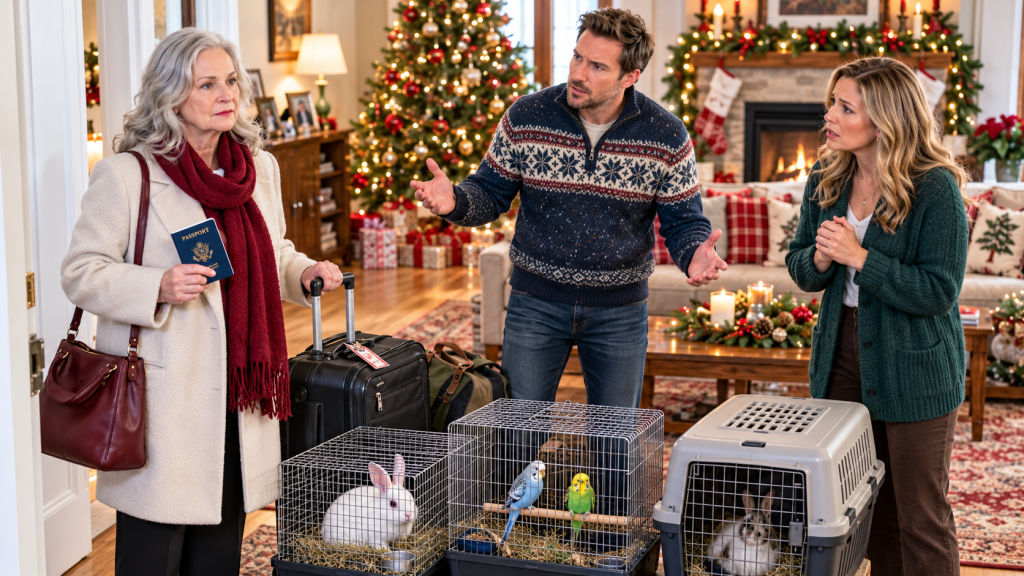
When I was seventy years old, Austin dropped three cages into my living room and assumed I would take care of everything because that was what I had always done.
Two parakeets.
A rabbit.
A frightened cat.
A grieving widow.
He saw four creatures needing management.
He did not see the woman standing among them.
Not then.
But he learned.
So did I.
At sunrise the next morning, my ship sailed from Miami.
I thought my disappearance would turn their lives upside down.
It did.
But not because they suffered without me.
Because eventually, everyone had to stand where I had always stood and ask:
What belongs to me?
What is mine to carry?
The pets belonged to Austin and Chloe.
Their vacation belonged to them.
Their brother’s investment belonged to them.
Their debt belonged to them.
Their emergencies belonged to them.
My grief belonged to me.
My home belonged to me.
My money belonged to me.
My time belonged to me.
My love belonged to me too.
And because it belonged to me, I could give it freely instead of spending it under pressure.
That changed everything.
The house was eventually sold.
The pets grew old.
The birds stopped saying “idiot.”
Unfortunately.
The rabbit lived longer than anyone expected.
The cat forgave Austin before I did.
Ernest remained dead.
There was no twist for that.
No miracle.
No secret island where he waited.
Loss remained loss.
But my life did not have to become his grave.
That was the hardest thing I learned.
I could miss him and travel.
Love him and laugh.
Grieve and dance badly.
Remember and move.
I could keep his photograph in my wallet while standing somewhere he never got to see.
Love did not demand I freeze at the moment he left.
And motherhood did not demand the same thing.
Austin’s adulthood did not mean my permanent availability.
My usefulness was not my identity.
When my ship returned after one year, I came home to the same family.
But not the same relationships.
Because one woman had finally stopped saying yes automatically.
Sometimes entire families change because one person refuses the old role.
Not angrily.
Not forever.
Just long enough for everyone to discover the world keeps turning.
My son learned to solve problems.
My daughter-in-law learned to ask instead of assign.
I learned to receive apologies without immediately erasing consequences.
And Ernest, even gone, gave me one final permission.
Take the cruise, Tess.
So I did.
And if I could return to the morning Austin dropped those cages beside Ernest’s memorial photograph, I would not yell.
I would not lecture.
I would not throw them out.
I would look at the woman I was.
Seven days widowed.
Exhausted.
Still wearing grief like something heavy around her shoulders.
And I would tell her:
You are allowed to go.
You are allowed to let them be disappointed.
You are allowed to be loved without being useful every minute.
You are allowed to spend money on a horizon instead of another emergency.
You are allowed to leave the cages with someone responsible.
You are allowed to lock the door.
You are allowed to board the ship.
You are allowed to look back.
And you are allowed to keep going anyway.
Because the people who truly love you may be upset when your boundaries first appear.
Some may resist.
Some may accuse.
Some may call you selfish because your old selflessness benefited them.
But if there is real love underneath the habit, something better can eventually grow.
Not dependence.
Relationship.
Not obligation.
Choice.
Not “We can always count on you.”
But:
“Can we ask?”
And sometimes:
“No.”
And still:
“I love you.”
That was the life waiting for me beyond Miami.
I just had to sail far enough to find it.
THE END STORIES! THANK YOU FOR READING GOOD LUCK! ❤️
Related Posts