Alvarez stood in the doorway with snow still melting from the shoulders of her jacket. “Sir, Walt’s family is here—and they brought someone who says he knows your father.” For several seconds, I simply stared at her.
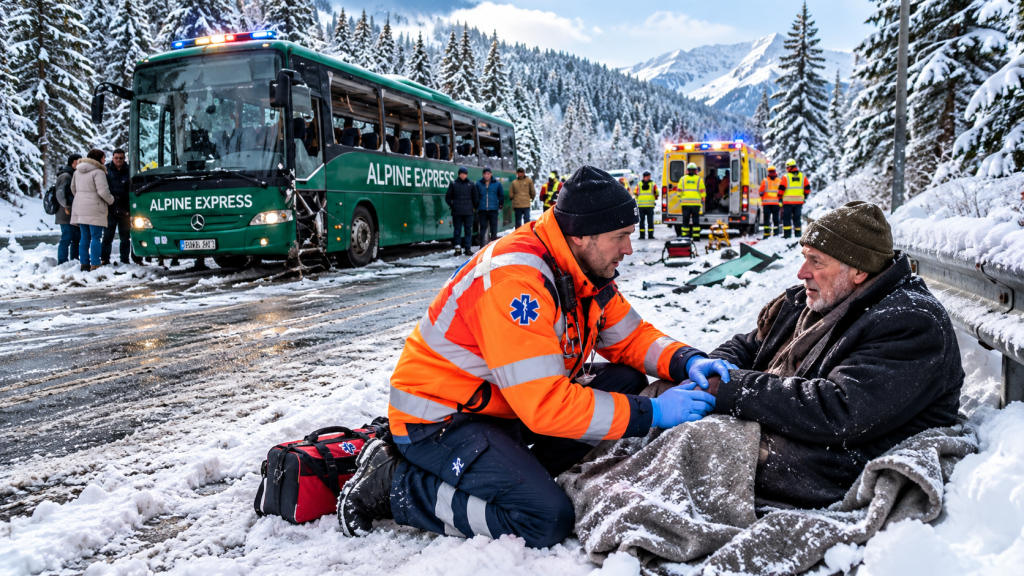
It was almost midnight on Christmas Eve. My hands still smelled faintly of diesel despite two washes. Every muscle in my back hurt from lifting passengers through the bus hatch. My father had called seven times.
His message was still glowing on my phone. Daniel, I made a terrible mistake. Please call me. And now a stranger who knew him was standing somewhere outside my operations room. “Who?” Alvarez hesitated. “Leonard Grant.”
The name meant nothing at first.
Then something shifted in my memory.
Jason’s wedding.
A photograph Dad had texted me months earlier because I had been overseas.
Jason beside his new wife, Emily.
Behind them stood her parents.
Leonard and Susan Grant.
I looked at Alvarez.
“Grant?”
“Yes, sir.”
“Emily Grant’s father?”
Her eyebrows lifted.
“You know him?”
“My stepbrother married his daughter.”
Alvarez blinked.
“Well.”
She leaned against the doorframe.
“That seems inconvenient.”
I almost laughed.
“Where is he?”
“Conference room.”
“And Walt?”
“Still at Memorial Hospital.”
My stomach tightened.
“How is he?”
“Stable.”
Relief moved through me.
“His leg is badly injured, but they think he’ll keep it.”
I closed my eyes for half a second.
Good.
That was enough.
Then Alvarez added:
“Apparently Mr. Grant was at your father’s Christmas dinner tonight.”
I looked at her.
“What?”
“He said he watched the rescue footage from your father’s living room.”
The room suddenly felt much smaller.
“Did he say anything else?”
Alvarez gave me a look I knew well.
The look soldiers give officers when information is both relevant and none of their business.
“Only that he really wants to talk to you.”
I put my phone away.
“Let’s go.”
Leonard Grant stood the moment I entered.
He was tall, broad-shouldered, maybe sixty.
His expensive Christmas sweater looked strange beneath the borrowed winter coat someone had clearly handed him at the hospital.
Beside him stood a woman I recognized from Jason’s wedding photograph.
Susan.
Emily’s mother.
Her eyes were swollen from crying.
She crossed the room before I could say anything.
“Captain Mercer?”
“Yes, ma’am.”
She hugged me.
Not politely.
Not gently.
She wrapped both arms around me and held on.
“My father is alive because of you.”
I froze.
Then carefully hugged her back.
“Your father stayed alive because a lot of people worked very hard tonight.”
She stepped away.
“I saw the footage.”
“The footage showed maybe six minutes.”
“It showed enough.”
“No, ma’am.”
I shook my head.
“State Patrol stabilized the scene. Fire crews handled the tanker risk. Medics kept him alive after we got him out. Sergeant Alvarez coordinated half the evacuation.”
Alvarez immediately looked offended.
“Do not drag me into your humility problem, sir.”
Susan laughed through tears.
Good.
Laughter felt needed.
Leonard had not moved.
He stared at me with a complicated expression.
Finally:
“You really are Richard’s son.”
I nodded.
“Unfortunately.”
That escaped before I could stop it.
Alvarez suddenly became fascinated by a bulletin board.
Leonard almost smiled.
“I spent four hours at your father’s house tonight.”
“I heard.”
“You were supposed to be there.”
The words were quiet.
Not a question.
I looked at Susan.
She looked away.
“What did Dad tell you?”
Leonard exhaled.
“That the Army had changed your schedule.”
My jaw tightened.
“He said your leave was canceled.”
Of course.
Susan added softly:
“He told us you volunteered to stay because duty was important to you.”
“That part became true later.”
Leonard’s expression hardened.
“What does that mean?”
I considered how much family dirt I wanted to unpack in an Army conference room at midnight.
Then remembered my father had already done the lying for both of us.
“He called me three nights ago and asked me not to come.”
Susan covered her mouth.
Leonard stared.
“Why?”
I laughed once.
“No idea.”
“That’s not true.”
He had seen my face.
I looked down.
“He said he didn’t want my Army career overshadowing Jason’s promotion.”
Silence.
Susan whispered:
“Oh, my God.”
Leonard’s jaw moved.
“My daughter said something felt wrong.”
I said nothing.
“He kept changing the subject whenever we asked about you.”
Susan sat.
“Emily asked where you were twice.”
“What did Jason say?”
Neither answered immediately.
That told me enough.
“Mr. Grant.”
Leonard looked furious.
“Jason said you were always choosing the Army.”
Something inside me went very still.
“What exactly did he say?”
Susan answered reluctantly.
“He said, ‘Daniel’s married to the uniform. Family has never really been his priority.’”
I looked toward the window.
Outside, snow crossed the base lights sideways.
Eighteen years.
Birthdays missed because of deployments.
Funerals attended by video.
Christmas packages opened weeks late.
Phone calls made from places where the connection dropped every thirty seconds.
I had carried guilt for every absence.
Apparently Jason had converted that guilt into a character flaw.
Alvarez cleared her throat.
“Sir.”
I turned.
She knew me well enough to see what was happening.
“Walt’s family also brought something.”
Susan reached into her purse.
A small plastic bag.
Inside was a bent metal keychain.
A little red fire truck.
“What is that?”
“My father had it in his pocket.”
She smiled through tears.
“One of his grandkids gave it to him.”
“Which one?”
“My granddaughter Sophie.”
“She’s three.”
“Trouble?”
Susan laughed.
“The youngest.”
My chest tightened.
Walt’s weak smile inside the tanker.
The youngest. She just learned to walk.
I looked at Susan.
“I asked him which grandchild caused the most trouble.”
“I heard.”
“What?”
“The reporter recorded the audio.”
I closed my eyes.
Wonderful.
National television had apparently broadcast my complete inability to shut up during a rescue.
Susan smiled.
“You kept him talking about Sophie.”
“He needed something to focus on.”
She pressed the keychain into my hand.
“He asked me to give you this until he can thank you himself.”
“No.”
I tried to return it.
She closed my fingers around it.
“Please.”
I looked at the little red truck.
Paint chipped.
Worth maybe four dollars.
Suddenly heavier than any medal I had ever worn.
“All right.”
Leonard stepped closer.
“There’s something else you should know.”
I looked up.
His voice changed.
“This dinner tonight wasn’t just awkward after the news came on.”
I waited.
“It blew apart.”
I almost smiled.
“Why?”
“Because Walt is Susan’s father.”
I stared at him.
“I understand that.”
“No.”
Leonard shook his head.
“Jason didn’t.”
“What?”
“Neither did your father.”
That took a second.
Susan explained.
“Emily uses my husband’s last name.”
“Of course.”
“Dad has been living in Arizona most of the year.”
“He was visiting us for Christmas.”
“Jason met him twice.”
“Briefly.”
My mouth opened.
Then closed.
“So when the news showed Walt…”
“Emily screamed.”
Leonard said.
“She recognized her grandfather immediately.”
I could almost see Dad’s living room.
Christmas tree.
Wine.
Guests.
Jason talking about his promotion.
Then the television showing me crawling into the tanker where his wife’s grandfather was trapped.
Leonard continued.
“When they showed you pulling Walt out, Emily started crying.”
“And then the anchor said your name.”
Susan looked at me.
“That was when your father dropped the glass.”
So it had not simply been pride.
It had been the sudden collision of every lie in the room.
Leonard’s voice hardened.
“I asked Richard, ‘That’s your son?’”
My stomach tightened.
“What did he say?”
“He said yes.”
“And?”
“I asked why you weren’t at dinner.”
Silence.
“He repeated that your leave had been canceled.”
I felt strangely calm.
“Did anyone correct him?”
Leonard nodded.
“Jason did.”
That surprised me.
“What?”
“He said, ‘Dad, stop.’”
I stared.
“Then Emily asked Jason whether you’d actually been invited.”
Susan lowered her eyes.
“He wouldn’t answer.”
My stomach sank.
Leonard continued.
“Your father finally admitted he had asked you not to come.”
“What happened?”
“My daughter walked out.”
I stared.
“Emily?”
“She told Jason she needed air.”
“Her grandfather was being transported to a trauma center, her brother was already heading there, and she had just learned her husband participated in excluding the man who helped save him.”
I shook my head.
“Jason didn’t know I’d be on the rescue.”
“That isn’t why she was angry.”
Leonard looked directly at me.
“She said, ‘If Daniel had been sitting at this table like he was supposed to be, he wouldn’t even have been on that road tonight.’”
I almost corrected him.
Then stopped.
I would have been hundreds of miles away.
That was true.
But fate is not arithmetic.
If I had gone home, another officer would have led the rescue.
Maybe they would have done better.
Maybe worse.
Maybe exactly the same.
I was not interested in turning my father’s rejection into destiny.
“I volunteered because others had kids.”
Leonard nodded.
“I know.”
“Dad telling me not to come didn’t save Walt.”
“No.”
“People doing their jobs did.”
“Yes.”
I appreciated that he didn’t argue.
Then Susan said something softly.
“But your father still has to live with the fact that he sent you away.”
That landed harder.
My phone vibrated again.
Dad.
I looked at the screen.
Leonard saw.
“You going to answer?”
“No.”
He nodded.
“Good.”
I looked at him.
“Sir.”
“I’m not telling you what to do with your father.”
“It sounded like it.”
“Fair.”
He smiled slightly.
Then his face became serious.
“But I’ll tell you what I told Jason.”
“What?”
“People who lie to protect someone’s pride usually end up humiliating them worse.”
That stayed with me.
At 1:30 Christmas morning, Walt regained full consciousness.
At 2:10, Susan received permission for a brief call.
She put him on speaker.
His voice sounded weak.
“Captain?”
“I’m here, Walt.”
“You still asking stupid questions about grandchildren?”
I laughed.
“Yes, sir.”
“Good.”
“How are you feeling?”
“Like somebody parked a truck on me.”
“Technically—”
“Don’t.”
Susan started laughing.
Walt continued.
“They tell me you crawled in there.”
“With help.”
“I saw the trooper.”
“Good man.”
“Yeah.”
A pause.
“Captain?”
“Yes?”
“You got family?”
I looked at Leonard.
Alvarez.
Susan.
My phone with my father’s unanswered messages.
“Yes.”
“Go see ’em.”
I smiled sadly.
“Complicated.”
“All families are complicated.”
He coughed.
“Doesn’t mean you let ’em be stupid forever.”
Susan groaned.
“Dad.”
“What?”
“You’re medicated.”
“Still right.”
I laughed.
“Rest, Walt.”
“You kept the truck?”
I looked at the keychain.
“Yes.”
“Bring it back.”
“I will.”
“Good.”
Then his voice softened.
“Thank you.”
I looked down.
“You’re welcome.”
The call ended.
At 3:00 a.m., I finally listened to my father’s voicemail.
Not the text.
The voicemail he had left after the seventh call.
His voice was shaking.
“Daniel, it’s Dad.”
A pause.
“I don’t know how to say this.”
Another.
“I saw the news.”
“I saw what you did.”
“I…”
Silence.
Then:
“I told people you couldn’t come.”
My jaw tightened.
“I lied.”
That mattered.
At least he said it.
“I thought I was keeping the evening peaceful.”
I almost turned it off.
Then:
“Jason asked me months ago if Christmas could be about him for once.”
There it was.
Not exactly what Dad had told me.
I sat straighter.
“He said every family event becomes about you.”
His voice cracked.
“Your deployments.”
“Your promotions.”
“Your stories.”
“I told him that wasn’t fair.”
“But he said Emily’s parents were coming and he wanted them to see him without comparing him to his soldier brother.”
My anger shifted.
Not away.
Just direction.
Dad continued.
“I agreed.”
“I thought it was one dinner.”
“I thought you’d understand.”
“I shouldn’t have asked.”
“I shouldn’t have lied.”
“And I shouldn’t have spent eighteen years telling myself that asking you to be smaller was the same as helping Jason feel bigger.”
I stopped breathing.
That sentence was different.
Closer to truth.
“I’m sorry.”
“I don’t expect you to call.”
“Just…”
His voice broke.
“Please know I’m sorry.”
The message ended.
I sat alone in the operations room until Alvarez returned carrying coffee.
She placed one cup near me.
“You look terrible.”
“Thank you.”
“You’re welcome.”
She sat.
“Family?”
“Yes.”
“Want advice?”
“No.”
“Good. I didn’t have any.”
I laughed.
Then she looked at me.
“Actually, one thing.”
I raised an eyebrow.
“You told Private Callahan last month that avoiding a difficult conversation doesn’t make it disappear. It just lets it choose the timing.”
I stared.
“Did I?”
“Yes.”
“I’m irritating.”
“Extremely.”
She stood.
“Get some sleep, sir.”
I didn’t.
By Christmas afternoon, the rescue story had become much larger than any of us wanted.
National networks reused footage.
A photograph of me carrying the little boy from the bus circulated online.
Public affairs called.
Then brigade.
Then division.
Every senior officer gave the same instruction in slightly different language.
Do not freelance with media.
Fine by me.
I did not want to talk.
The Army statement credited the joint response.
State Patrol.
Fire departments.
Emergency medical teams.
National Guard support.
My unit.
Exactly as it should.
But television prefers faces.
Mine had become one.
At 2:17 p.m., Jason called.
I watched the screen.
Ignored it.
Then he texted:
Please answer. Not Dad. Me.
I waited.
Then called.
He answered immediately.
“Daniel.”
“Jason.”
Silence.
We had known each other since we were twelve.
Stepbrothers on paper.
Competitors by accident.
Sometimes friends.
Sometimes not.
“How’s Walt?”
“Stable.”
“Emily’s at the hospital.”
“I know.”
“She won’t talk to me.”
“That sounds like something between you and Emily.”
“I know.”
Another silence.
Then:
“I asked Dad not to invite you.”
Straight.
No excuse yet.
I appreciated that.
“How long ago?”
“October.”
My stomach tightened.
“Two months.”
“Yes.”
“Why?”
Jason exhaled.
“Because I’m tired of being your stepbrother.”
The sentence cut strangely.
“What does that mean?”
“You know exactly what it means.”
“No.”
“Daniel.”
“No.”
My voice hardened.
“You wanted me excluded from Christmas. Explain it.”
He was quiet.
Then:
“Every room.”
“What?”
“Every room we’re in together, eventually someone asks about you.”
“That isn’t true.”
“It is to me.”
“Then give me examples.”
He laughed bitterly.
“Graduation.”
I remembered.
Jason’s college graduation.
I had flown in from training.
Wore civilian clothes.
Sat in the back.
“One of Dad’s friends asked about Afghanistan.”
“You answered for twenty minutes.”
“Because he kept asking.”
“Exactly.”
I closed my eyes.
“What else?”
“My engagement party.”
“What happened?”
“You had just made captain.”
“I didn’t announce it.”
“Dad did.”
“That’s Dad.”
“Everyone toasted you.”
“One person toasted me.”
“Three.”
I almost laughed.
“Jason.”
“My promotion dinner last year.”
“I wasn’t even there.”
“Dad showed people your ceremony pictures.”
Silence.
That one wasn’t mine either.
But I was beginning to understand something.
Dad had spent years using my accomplishments as parental currency.
Then, when Jason objected, Dad managed the imbalance by excluding me rather than changing his own behavior.
Jason continued.
“You don’t know what it’s like.”
“You’re right.”
“I don’t.”
I kept my voice calm.
“But you also don’t know what it’s like to be told your presence is the problem.”
He said nothing.
“I didn’t ask Dad to show pictures.”
“I didn’t ask people to toast me.”
“I didn’t ask anyone to compare us.”
“I know.”
“No.”
I stood.
“You knew enough to ask him not to invite me.”
His voice broke.
“I wanted one Christmas.”
“You could have had one Christmas without making me disappear.”
“How?”
“Talk to me.”
He was silent.
“You could have said, ‘Daniel, this night matters to me. Can you help keep the focus off work?’”
He inhaled sharply.
“I would have said yes.”
“I didn’t know that.”
“You didn’t ask.”
Silence.
“You decided the easiest solution was removing me.”
“I’m sorry.”
“That doesn’t answer why Dad told me it was his idea.”
Jason whispered:
“Because I asked him not to tell you.”
There it was.
“What?”
“I said if you knew it was me, you’d hate me.”
I almost laughed at the absurdity.
“So Dad agreed to let me hate him instead?”
“He said he could handle it.”
Of course he did.
The family system revealed itself in one sentence.
Dad protecting Jason from consequences.
Dad volunteering to absorb resentment.
Jason avoiding the conversation.
Me expected to understand.
Everyone calling it peace.
“How did that work out?”
Jason laughed once.
Badly.
“It didn’t.”
“No.”
“I’m sorry.”
I sat again.
He continued.
“I watched you on television.”
“So?”
“I felt like garbage.”
“This isn’t about the rescue.”
“I know.”
“Do you?”
“Yes.”
His voice cracked.
“I was sitting in Dad’s living room talking about my promotion like it was the most important thing in the world.”
“It was important.”
He went quiet.
I continued.
“Your promotion matters.”
“It doesn’t stop mattering because I pulled people out of a bus.”
“Daniel.”
“No.”
“This is exactly the problem.”
“What?”
“You keep treating our lives like they’re on one scoreboard.”
He breathed slowly.
“Your promotion can be good.”
“My career can be good.”
“Emily can be proud of you.”
“Dad can be proud of me.”
“Those things don’t cancel each other out.”
Jason started crying.
I had never heard him cry as an adult.
“I don’t know how to stop comparing.”
That was honest.
For the first time, I softened.
“Maybe start by noticing when you’re doing it.”
Silence.
“Emily said the same thing.”
“She’s smart.”
“Yes.”
“Is she leaving you?”
“I don’t know.”
I closed my eyes.
“That’s between you two.”
“I know.”
“I won’t call her.”
“I wasn’t asking.”
Good.
Then:
“Dad wants to fly out.”
My body tensed.
“To Colorado?”
“Yes.”
“I don’t want him here.”
“I’ll tell him.”
“No.”
I corrected myself.
“I’ll tell him.”
Jason went quiet.
Then:
“Can I ask one thing?”
“What?”
“Did you volunteer for the shift because Dad told you not to come?”
I looked out at the snow.
“Partly.”
His breath caught.
“So if I hadn’t—”
“No.”
I cut him off.
“Don’t do that.”
“But—”
“No.”
“You did something selfish.”
“Yes.”
“That doesn’t make you responsible for the storm.”
Silence.
“For the bus.”
“For Walt.”
“For anything that happened on that highway.”
“I don’t want you turning guilt into another way to make tonight about you.”
That stung him.
I heard it.
“Fair.”
I softened.
“Deal with what you actually did.”
“Leave the rest alone.”
“Okay.”
We ended the call quietly.
My father arrived in Colorado anyway.
Of course he did.
He did not try to enter the base.
At least he had that much judgment left.
He texted me at 9:40 the next morning.
I’m at a hotel near the airport. I will wait until you decide whether you want to see me.
I stared at the message.
Alvarez looked over my shoulder.
“That’s better than showing up at the gate.”
“Yes.”
“You going?”
“I don’t know.”
She sipped coffee.
“Helpful.”
I glared.
She smiled.
Then public affairs entered with another problem.
The rescue was under operational review.
Not disciplinary.
Standard.
But there were questions about my decision to enter the tanker cab before specialized extraction equipment arrived.
I knew that was coming.
Major Ellis, my commander, closed the office door.
“You understand why.”
“Yes, sir.”
“You made a judgment call.”
“Yes.”
“You exposed yourself and others to risk.”
“Yes.”
“Would you do it again?”
I hesitated.
The wrong answer was immediate heroism.
The honest answer required thought.
“Under identical conditions?”
“Yes.”
“Knowing what I knew then?”
“Yes.”
“I would probably make the same call.”
Ellis nodded.
“Why?”
“Driver was deteriorating.”
“Cab instability increasing.”
“Fuel leak was being monitored.”
“State fire had established what they considered a workable extraction window.”
“I did not act alone.”
“Good.”
He studied me.
“Television makes things look cleaner.”
“I know.”
“It looks like you ran heroically into danger.”
“That isn’t what happened.”
“I know.”
He leaned back.
“Make sure you keep saying that.”
“I will.”
Because that mattered too.
The rescue had already started turning into a family weapon.
Daniel the hero.
Jason the selfish brother.
Dad the ashamed father.
Real life was messier.
I had made a risky decision.
Professionals around me had made it possible.
Luck mattered.
Weather mattered.
Walt’s condition mattered.
The entire event could have ended differently.
I refused to let television flatten it.
The review eventually found my actions within the emergency command framework.
No reprimand.
No secret court-martial.
No medal pinned on my chest the next morning.
Just paperwork.
Statements.
Lessons.
Exactly as serious work often looks afterward.
Three days after Christmas, I drove to my father’s hotel.
I almost turned around twice.
Dad was sitting in the lobby.
He stood the second he saw me.
For a moment, he looked older than I remembered.
Not because three days had aged him.
Because shame changes posture.
“Daniel.”
“Dad.”
He moved as if to hug me.
Stopped.
Good.
“Can we sit?”
“Yes.”
We chose a corner.
He folded his hands.
I waited.
He started:
“I’m sorry.”
I said nothing.
“I shouldn’t have called you.”
Still nothing.
“I shouldn’t have lied to the Grants.”
Nothing.
“I shouldn’t have agreed to Jason’s request.”
There.
Closer.
He swallowed.
“And I shouldn’t have spent years treating your accomplishments like something the family needed to manage.”
My chest tightened.
“Why did you?”
He looked down.
“Because I failed both of you.”
“That’s too easy.”
His head lifted.
“What?”
“‘I failed both of you’ sounds noble.”
He flinched.
“Tell me what you actually did.”
Silence.
He breathed slowly.
“I compared Jason to you.”
“Yes.”
“Constantly.”
“Yes.”
“Even when I thought I was complimenting him.”
I waited.
“I’d say, ‘Daniel was never this organized.’”
“Or ‘Daniel hated math too.’”
“Or ‘Daniel made captain.’”
“Or ‘Daniel bought a house.’”
His eyes filled.
“I kept using you as a measuring stick.”
I had not fully understood that.
“I wasn’t there for most of that.”
“No.”
“That was part of the problem.”
He rubbed his hands.
“You became an idea.”
“What idea?”
“The son I could brag about.”
That hurt more than expected.
He continued.
“You were far away.”
“Doing something people respect.”
“I could tell stories.”
“I could show pictures.”
“I could be proud without dealing with the harder parts.”
“What harder parts?”
His face broke.
“That you barely called me.”
I stared.
“What?”
“That you didn’t come home much.”
“Dad.”
“I know.”
“No.”
I leaned forward.
“You asked me not to come home.”
“Now.”
His voice cracked.
“I mean years ago.”
I started to speak.
He raised a hand.
“I know why.”
“Deployments.”
“Training.”
“Schedules.”
“I know.”
“But part of me resented it.”
My anger sharpened.
“You resented my service.”
“No.”
“I resented how proud I was of something that kept taking you away.”
That silenced me.
Dad looked toward the window.
“Your mother would have understood better.”
My chest tightened.
My mother had died when I was fifteen.
Cancer.
Fast.
Ugly.
Dad remarried Karen three years later.
Jason was twelve when our families merged.
Dad continued.
“Your mother believed leaving home could be a kind of success.”
“I believed family meant staying close.”
“You joined the Army.”
“And every year, you became more independent.”
“I told everyone I was proud.”
“I was.”
“But I also felt abandoned.”
I stared.
“You were the parent.”
“I know.”
“No.”
My voice rose.
“You don’t get to tell your kid his adulthood abandoned you.”
He nodded immediately.
“You’re right.”
That disarmed me.
He continued.
“I’m not saying it was fair.”
“I’m telling you what I felt.”
I sat back.
That distinction mattered.
“Then Jason came.”
“He was local.”
“He wanted advice.”
“He needed help.”
“He worked with me for a while.”
“He came over Sundays.”
“I told myself he appreciated family more.”
My jaw tightened.
“You told him that?”
Dad closed his eyes.
“Sometimes.”
There it was.
Comparison in both directions.
I had been the successful son used to make Jason insecure.
Jason had been the present son used to make me feel guilty.
Dad had built the competition and then spent years complaining about it.
“You made us rivals.”
Tears filled his eyes.
“Yes.”
The word barely came out.
I looked away.
We sat in silence.
Then I asked:
“What did Karen know?”
Dad stiffened.
“About Christmas?”
“Yes.”
“She knew Jason asked.”
“And?”
“She thought it was a bad idea.”
That surprised me.
“What?”
“She told me not to do it.”
I stared.
“I assumed—”
“I know.”
He shook his head.
“Karen has made mistakes.”
“But this wasn’t hers.”
I felt shame.
For years, some part of me had blamed my stepmother for every time Dad favored Jason.
Easy story.
Stepmother arrives.
Father changes.
But apparently Dad had made plenty of choices without assistance.
“She said Jason needed to learn he could be proud without removing you.”
I laughed bitterly.
“So why did you agree?”
Dad’s answer was simple.
“Because I wanted an easy Christmas.”
There it was.
No trauma.
No manipulation.
No grand explanation.
Convenience.
He wanted the uncomfortable person removed.
Me.
“And then you called me.”
“Yes.”
“You didn’t even ask.”
“No.”
“You told me.”
“Yes.”
“Why?”
“Because if I asked, you might say no.”
I stared.
He looked ashamed.
“That’s the ugliest part.”
“No.”
I shook my head.
“It might be the most honest part.”
He cried quietly.
Then I asked:
“Do you know what I did after you called?”
“You canceled your ticket.”
“How?”
“The airline notification came to an old shared email.”
Of course.
“I sat in my car for almost an hour.”
Dad’s face collapsed.
“I didn’t know.”
“I know.”
“I thought about calling back.”
“Why didn’t you?”
“Pride.”
“Mine too.”
I nodded.
“Then I volunteered for the overnight shift.”
He looked down.
“If I hadn’t called—”
“No.”
I cut him off.
“Jason tried that.”
Dad looked up.
“You are not responsible for the storm.”
“I know.”
“For Walt.”
“I know.”
“For the bus.”
“I know.”
“Then stop trying to turn what happened into punishment from the universe.”
He exhaled shakily.
“What am I responsible for?”
“The phone call.”
He nodded.
“The lie.”
“Yes.”
“The years before it.”
“Yes.”
He closed his eyes.
“That’s enough.”
“Yes.”
For the first time, I saw him not as the man who had ruined Christmas.
But as the man who had spent years trying to control emotional weather inside a family by moving people around like furniture.
Jason feels small?
Move Daniel out.
Daniel feels neglected?
Tell him Jason needs more support.
Karen feels caught?
Change subject.
Dad feels guilty?
Buy gifts.
Nobody confronts anything.
Then wonder why every room carries tension.
“I need something from you.”
I said.
He straightened.
“Anything.”
“Don’t say anything.”
He stopped.
“I haven’t told you.”
“Sorry.”
“That.”
“What?”
“You rush to fix.”
He looked down.
“Yes.”
“What I need is not private apology.”
His eyes returned to mine.
“You lied in a room full of people.”
“Yes.”
“You correct it in a room full of people.”
Dad swallowed.
“Okay.”
“Not because I need an audience.”
“I know.”
“Because Jason needs to hear you stop protecting him.”
Dad nodded.
“And because the Grants deserve the truth.”
“Yes.”
“And Karen.”
“Yes.”
“And Emily.”
He looked pained.
“Yes.”
“Will you do that?”
“Yes.”
“Even if Jason gets angry?”
Dad’s face tightened.
Then he nodded.
“Yes.”
That was the test.
Not whether Dad loved me.
I knew he did.
Whether he could tolerate someone else’s discomfort without sacrificing me to eliminate it.
A week later, everyone gathered again.
Not Christmas.
No tree ceremony.
No formal dinner.
Just Dad’s living room.
Jason.
Emily.
Leonard and Susan.
Karen.
Dad.
Me, on video from Colorado.
I hated the arrangement.
But I was not flying across the country for a family accountability meeting.
Dad stood near the same fireplace where he had dropped his wineglass.
He looked at the screen.
Then at everyone else.
“I owe all of you the truth.”
Jason stared at the floor.
Dad continued.
“Daniel’s leave was not canceled.”
Leonard already knew.
Susan already knew.
Emily did too.
But hearing it plainly mattered.
“I asked him not to come.”
Karen closed her eyes.
Dad looked at Jason.
“Jason asked me months ago if Christmas could be focused on him.”
Jason’s face tightened.
Dad continued.
“He told me he was tired of being compared to Daniel.”
“That was real.”
“I should have listened without making Daniel responsible for it.”
Jason looked up.
Dad’s voice shook.
“Instead, I agreed not to invite him.”
“And when Daniel asked why, I made the decision sound entirely mine.”
“I did that because Jason was afraid Daniel would be angry with him.”
Jason whispered:
“Dad.”
Dad looked at him.
“No.”
Jason froze.
“I’ve protected you from difficult reactions for too long.”
The room went silent.
Dad continued.
“I also lied to the Grants.”
“I said Daniel’s leave had been canceled.”
“I did that because I was ashamed of what I had done.”
Leonard nodded once.
No reassurance.
Good.
Then Dad said:
“For years, I compared my sons.”
“Sometimes by praising Daniel.”
“Sometimes by praising Jason.”
“I treated their achievements like points.”
“And then I blamed them for feeling competitive.”
Karen started crying.
Dad looked at her.
“You warned me.”
She nodded.
He continued.
“I didn’t listen.”
Then he looked at me on the screen.
“I’m sorry.”
I nodded.
Not forgiveness ceremony.
Acknowledgment.
Then he turned to Jason.
“And I’m sorry to you too.”
Jason’s face hardened.
“For what?”
“For making Daniel the standard you thought you had to beat.”
Jason looked away.
Dad continued.
“You did not invent that alone.”
“I helped.”
“Then when you asked me to remove him from Christmas, I agreed instead of telling you the truth.”
“What truth?”
Dad’s voice softened.
“That you do not become more impressive when your brother is absent.”
Jason cried.
Nobody moved.
Emily sat beside him but did not touch him yet.
Dad continued.
“And Daniel does not become less loved when attention is on you.”
That was the sentence we had needed twenty years earlier.
No one applauded.
Good.
Families do not need applause for finally saying normal things.
Afterward, Leonard spoke.
“I want to say something.”
Everyone looked at him.
He faced Jason.
“You know why Emily is angry.”
Jason nodded.
“You think it is because Daniel saved Walt.”
Jason hesitated.
“Partly.”
“No.”
Leonard shook his head.
“It’s because she watched you let your father lie.”
Jason flinched.
“You knew where Daniel was supposed to be.”
“Yes.”
“You knew why he wasn’t there.”
“Yes.”
“And when we asked, you stayed quiet.”
Jason’s voice cracked.
“Yes.”
Leonard leaned back.
“My daughter needs to decide what that means for your marriage.”
“I know.”
“You don’t get to use Walt’s rescue to force forgiveness.”
“I won’t.”
“Good.”
Then Leonard looked at me through the screen.
“And Captain?”
“Yes?”
“You still owe us a keychain.”
I smiled.
“I know.”
Walt spent eleven days in the hospital.
I visited on day twelve after he transferred to rehabilitation closer to base.
He looked terrible.
Which meant alive.
His right leg was braced.
Bruises across half his face.
He grinned when I entered.
“Army man.”
“Truck driver.”
“Got my fire truck?”
I handed him the keychain.
He inspected it.
“You scratched it.”
“I pulled you out of a tanker.”
“Excuses.”
I laughed.
Then he held it.
“Sit down.”
I did.
He looked at me for a long moment.
“My granddaughter tells me I almost caused a divorce.”
“That seems unfair.”
“She says your family is a mess.”
“Accurate.”
He smiled.
“Mine too.”
I looked at his leg.
“How are you?”
“Mad.”
“Why?”
“Can’t walk.”
“Yet.”
“Doctors say months.”
“Then months.”
He grunted.
“You sound like them.”
“Occupational hazard.”
He turned the keychain in his fingers.
Then:
“Emily tells me your dad sent you away.”
“I’d rather not make this visit about that.”
“Good.”
He nodded.
“Because I don’t care.”
I laughed.
“You brought it up.”
“I’m old.”
“I get privileges.”
Apparently.
Then he became serious.
“You know what I remember from the cab?”
“What?”
“You telling me to talk about my family.”
“I was trying to keep you conscious.”
“I know.”
“But every time I drifted, you asked another question.”
“Yes.”
“You know the last thing I thought before they pulled me out?”
“No.”
“I was angry because Sophie would grow up thinking Grandpa disappeared at Christmas.”
My throat tightened.
“I didn’t want that.”
He looked toward the window.
“People disappear from families in more ways than dying.”
I said nothing.
“My son didn’t talk to me for six years.”
That surprised me.
“Why?”
“I was a difficult bastard.”
At least he was concise.
“He came back?”
“Yes.”
“How?”
“I stopped demanding he do it.”
I looked at Walt.
He shrugged.
“Turns out apologies work better when they’re not followed by instructions.”
I smiled.
“I’ll pass that along.”
“Don’t.”
“Why?”
“Your dad needs to learn his own lesson.”
Fair.
Before I left, Walt said:
“Captain.”
“Yes?”
“The boy from the bus wants to meet you.”
I froze.
“The little kid?”
“His mom contacted Susan.”
“I’m not good at that.”
“At children?”
“At being thanked.”
Walt smiled.
“Get good.”
The boy’s name was Noah.
Eight.
He came to base with his mother two weeks later after public affairs approved it.
He carried a drawing.
Crayon.
An overturned blue bus.
Snow.
A stick figure wearing green.
The proportions were horrific.
My arms reached the ground.
Apparently I was part gorilla.
He handed it to me.
“That’s you.”
“I figured.”
“You have a big head.”
“Thank you.”
His mother laughed.
Noah looked serious.
“You told me I did what I was supposed to.”
“Yes.”
“I didn’t.”
“What?”
“I cried.”
I crouched.
“That was allowed.”
“I was scared.”
“That was also allowed.”
“But brave people aren’t scared.”
There are moments when words matter.
More than rank.
More than cameras.
More than medals.
I looked at him.
“Brave people are scared all the time.”
He frowned.
“Really?”
“Really.”
“Then what makes them brave?”
“They do the next right thing while they’re scared.”
He considered that.
“Like climbing out?”
“Yes.”
“You listened.”
“You held on.”
“You kept moving.”
His face relaxed.
“So I was brave?”
“Yes.”
He smiled.
Then hugged me.
I closed my eyes.
Later, I found out that clip also reached national television.
Of course it did.
Dad sent only one message.
You sounded like your mother.
That one got me.
I called him.
Not because everything was fixed.
Because that sentence deserved a response.
“What did Mom say?”
Dad laughed softly.
“She used to tell you courage wasn’t being fearless.”
“I remember.”
“You were afraid of thunderstorms.”
“I was six.”
“You were terrified.”
“Dad.”
“You’d come into our room pretending you needed water.”
“I hate you.”
He laughed.
Then silence.
Comfortable for the first time in months.
“Daniel?”
“Yes?”
“I miss her.”
“So do I.”
That was the beginning of something better.
Not because we solved Christmas.
Because we started talking about things that existed beneath it.
My mother.
His grief.
My leaving home.
His resentment.
My resentment.
Jason.
Karen.
The weird family we built after losing one woman and gaining two new people who never asked to inherit our unfinished pain.
I called Karen separately.
“I owe you an apology.”
She sounded surprised.
“For what?”
“I assumed the Christmas thing was partly you.”
She was quiet.
“Why?”
I laughed.
“Do you really want that answer?”
“Yes.”
“Because Jason is your son.”
“And Dad usually bends toward him.”
“That made me convenient.”
“Yes.”
She sighed.
“I’ve benefited from it before.”
That surprised me.
“What do you mean?”
“I didn’t stop him enough.”
I waited.
“When you were younger, I knew your father overcompensated for Jason.”
“Because Jason’s biological father disappeared.”
“Yes.”
“I thought Jason needed extra reassurance.”
“He did.”
“But sometimes reassurance became preference.”
I said nothing.
Karen continued.
“And because you were capable…”
I laughed bitterly.
“There it is.”
“I know.”
“What?”
“The strong one.”
“Yes.”
She sounded ashamed.
“You got less because you seemed to need less.”
“That isn’t fair.”
“No.”
“I’m sorry.”
I leaned back.
“Thank you.”
She continued.
“I told Richard not to exclude you this Christmas because I finally understood where it led.”
“What changed?”
“Jason’s wedding.”
I frowned.
“What about it?”
“Your father spent half the reception talking about your deployment.”
I closed my eyes.
Of course.
“Jason heard.”
“Yes.”
“And later he told me he felt invisible at his own wedding.”
That hurt.
Not because it was my fault.
Because I understood him better.
“So Dad created this.”
“Not alone.”
“No.”
She paused.
“Jason is responsible for what he asked.”
“Richard for agreeing.”
“I’m responsible for not confronting the pattern sooner.”
“And you?”
I smiled sadly.
“I’m responsible for mostly leaving instead of telling everyone how much it hurt.”
Karen was quiet.
“That sounds fair.”
We were learning.
Jason and Emily separated for three months.
Not because of me.
I reminded people constantly.
The rescue had exposed something.
It did not create it.
Emily later told me Jason’s silence at dinner was one of several times he avoided conflict by letting someone else carry the cost.
He had hidden a credit-card balance.
Not huge.
But secret.
He had agreed with her privately about boundaries with Dad, then backed down publicly.
Patterns repeat across relationships until someone names them.
Jason started therapy.
I teased him once.
“Look at you.”
He replied:
“Shut up, Captain America.”
We were not healed.
But sarcasm had returned.
That helped.
Six months after Christmas, Jason called.
“Promotion ceremony.”
“What?”
“My official ceremony.”
He had been promoted months earlier, but corporate restructuring delayed the formal event.
“Congratulations.”
“You coming?”
I paused.
“Do you want me there?”
“Yes.”
“Are you sure?”
“Yes.”
“What if someone asks about the rescue?”
He was quiet.
Then:
“I’ll tell them it was my night.”
I laughed.
“That’s not better.”
“What?”
“You don’t control what people ask.”
“Then what do I do?”
“Answer whatever you want.”
“I can redirect.”
“I can leave early.”
“Or we can both exist.”
He sighed.
“Therapy has made you unbearable.”
“Your therapist or mine?”
“Both.”
I went.
Civilian suit.
No uniform.
Not because he asked.
Because it was his workplace.
Jason stood onstage while his boss spoke about his leadership during a difficult year.
I watched.
Proud.
Genuinely.
Then his boss mentioned family support.
Jason looked toward our table.
Dad.
Karen.
Emily, who had moved back in with him.
Me.
Jason said:
“I need to thank my brother.”
My stomach dropped.
No.
He continued.
“Not for anything he did for my career.”
Good.
“I spent a lot of years believing his success took something from mine.”
The room became quiet.
Dad looked down.
Jason continued.
“I was wrong.”
“He taught me recently that two people can be proud at the same table.”
My throat tightened.
“So tonight, I’m proud of this.”
He touched the small award on the podium.
“And I’m proud of him.”
He looked at me.
“Both fit.”
I nodded.
That was enough.
No standing ovation.
No public humiliation.
Just truth.
Later, I pulled him aside.
“You didn’t need to do that.”
“I know.”
“Then why?”
“Because I wanted to.”
That mattered.
A year after the rescue, the state recognized the entire multiagency team.
Not me.
The team.
Firefighters.
Troopers.
Medics.
Soldiers.
Dispatchers.
Tow operators.
Even the bus driver, who had helped keep passengers calm while injured.
We stood together.
That felt right.
Walt attended using a cane.
No wheelchair.
He walked slowly.
Sophie, now four, ran circles around him.
Trouble.
Exactly as advertised.
Noah came too.
He had grown approximately twelve feet.
At least it looked that way.
Dad attended.
So did Jason.
Before the ceremony, Dad asked:
“Where should I sit?”
It was a small question.
An enormous one.
“Wherever you want.”
“You sure?”
“Yes.”
He sat beside Jason.
I smiled.
Afterward, a reporter asked Dad:
“What’s it like being Captain Mercer’s father?”
I saw the old instinct rise.
The pride.
The story.
Then Dad said:
“Today I’m mostly grateful to be one of the families of the people who served that night.”
Perfect.
No biography.
No ownership.
No using my work to enlarge himself.
Later, Jason nudged him.
“Look at you.”
Dad frowned.
“What?”
“Growth.”
Dad told him to shut up.
We laughed.
That Christmas, I went home.
Not because I owed them a holiday.
Because I wanted to.
Dad did not assign seats.
Karen cooked too much.
Jason and Emily came.
Leonard and Susan came later for dessert.
Walt came wearing a ridiculous Santa hat.
I stared when he entered.
“You’re here?”
He spread his arms.
“Try getting rid of me.”
Sophie ran in behind him.
Then Noah’s family arrived because apparently our Christmas had become a rescue-scene reunion.
The house was loud.
Too warm.
Messy.
Perfect.
At dinner, Dad raised his glass.
My entire body tensed.
Jason noticed.
“Dad.”
Dad stopped.
“What?”
“No speeches.”
Dad frowned.
“I was going to say merry Christmas.”
“Dangerous.”
Everyone laughed.
Dad lifted the glass.
“Merry Christmas.”
That was all.
I looked around.
No one asked my rank.
No one asked Jason’s title.
Nobody performed.
Then Walt leaned toward me.
“So, Captain, ever tell them about the time you scratched my keychain?”
I groaned.
Family peace lasted eight minutes.
Progress.
Years passed.
I stayed in the Army.
Made lieutenant colonel eventually.
Later colonel.
Every promotion felt complicated because of the history.
Dad attended when he could.
Jason attended some.
Sometimes neither.
Life became less ceremonial.
Better.
When Dad talked about my career, he learned to ask first.
“Can I tell them about Korea?”
“No.”
“What about the rescue?”
“No.”
“Your promotion?”
“You can tell them I got promoted.”
“That’s boring.”
“Exactly.”
Jason became vice president at his company.
Then left six years later and started a consulting firm.
Dad wanted to invest.
Jason said no.
We all stared.
“What?”
Dad asked.
Jason smiled.
“I want to know if my legs work.”
Walt’s lesson had traveled.
Dad laughed.
“Fair.”
Jason’s company struggled the first year.
He did not ask me for money.
Good, because soldiers are famously wealthy.
By year three, he was doing well.
At family dinner, Dad bragged about him for twenty minutes.
I listened.
Then realized something.
It did not hurt.
Because Dad no longer needed one son to disappear while praising the other.
Pride had become abundance instead of allocation.
My relationship with Jason changed most when we stopped forcing the word brother.
For years, everyone had said:
“You’re brothers.”
As if legal vocabulary should automatically produce intimacy.
We were stepbrothers.
Then rivals.
Then adults with shared parents.
Eventually, through choice, we became brothers.
That happened one night when Dad had a heart attack.
Minor.
As minor as heart attacks get.
Jason called me from the hospital.
I was stationed on the East Coast.
“Daniel.”
“What happened?”
He told me.
I booked the first flight.
At 3:00 a.m., we sat beside each other in a hospital hallway.
Jason handed me terrible coffee.
“This feels familiar.”
“What?”
“Medical crisis.”
“No tanker.”
“Yet.”
We sat quietly.
Then he said:
“You know what Dad told me before they took him upstairs?”
“What?”
“Call your brother.”
My chest tightened.
“He said brother?”
“Yes.”
“Not Daniel?”
“No.”
Jason looked at me.
“I didn’t hate it.”
“Me neither.”
Dad recovered.
He enjoyed the drama far too much.
Told everyone he had “nearly died.”
The cardiologist explicitly told him to stop saying that.
He ignored her.
Some growth has limits.
When Dad turned seventy-five, he asked me to help clean the garage.
That should have been my first warning.
No one wants to clean a garage at seventy-five.
He was looking for something.
Eventually, he pulled down a plastic storage bin.
My name was written on it.
I frowned.
“What is this?”
He looked embarrassed.
“Stuff.”
I opened it.
Newspaper clippings.
Promotion announcements.
Printed Army newsletters.
Photographs.
Letters I had sent from training.
Every Christmas card.
A program from my commissioning ceremony.
A copy of an article about the rescue.
No.
Not one copy.
Eleven.
I stared at him.
“You had eleven?”
“Different newspapers.”
“Dad.”
“What?”
“You could have told me.”
His face softened.
“I know.”
I held a clipping from my first deployment.
“You hid all this in the garage?”
“Karen wouldn’t let me put everything in the living room.”
Reasonable.
Then I found another box beneath it.
Jason.
College certificates.
Business articles.
Baseball photos.
His promotion announcement.
Wedding photos.
I looked at Dad.
“Two boxes.”
He smiled.
“Two sons.”
Simple.
Late.
Enough.
I put both bins back.
Dad said:
“Take yours.”
“No.”
“Why?”
“It belongs here.”
He nodded.
That mattered too.
Dad died when I was fifty-seven.
Not at Christmas.
Not dramatically.
A stroke.
Fast.
I reached the hospital six hours before he died.
Jason was already there.
Karen held Dad’s hand.
I stood on the other side.
Dad could not speak clearly.
But he recognized us.
At one point he looked at Jason.
Then me.
His eyes filled.
He moved his fingers.
We leaned closer.
He whispered something.
I could not understand.
Jason did.
“What?”
I asked.
Jason laughed through tears.
“He said stop competing.”
I laughed too.
“Seriously?”
Dad’s mouth moved.
Maybe smile.
Maybe annoyance.
Then I took his hand.
“We stopped.”
His eyes closed.
I hope he heard me.
After his funeral, Jason and I stood outside the church.
Snow.
Not a blizzard.
Just snow.
He looked toward the road.
“You remember that Christmas?”
“Which one?”
He glared.
I smiled.
“Yes.”
“I think about it every year.”
“Me too.”
“You still mad?”
I thought.
“No.”
“Really?”
“I was.”
“For a long time?”
“Yes.”
He nodded.
“Fair.”
I looked at him.
“You?”
“At you?”
“Yes.”
“No.”
“Dad?”
“Sometimes.”
“Myself?”
He laughed.
“Frequently.”
Then he became serious.
“I’m glad you didn’t forgive us immediately.”
That surprised me.
“Why?”
“Because I think we would’ve learned nothing.”
Maybe.
Boundaries sometimes give people the space to meet their own behavior.
Dad’s will was ordinary.
No shocking fortune.
No secret inheritance.
No final manipulation.
He left Karen protected.
Then divided personal things.
I received his old watch.
Jason got his grandfather’s tools.
There was one envelope addressed to both of us.
Jason read it aloud.
Boys,
You are both too old for me to call you boys, but I’m dead, so argue with someone else.
I spent too much of your lives confusing fairness with balance.
When one of you rose, I worried about the other feeling lower.
So I pushed.
Pulled.
Compared.
Protected.
And interfered.
I should have simply loved you both and let your lives be different.
The world has enough room for both of you.
I’m sorry it took me so long to understand that.
Take care of Karen.
Take care of each other.
And Daniel, if some television reporter asks about this letter, I will haunt you.
Dad.
Jason laughed.
I cried.
Then:
“He really thought you’d put everything on television.”
“I was on television once.”
“For ten straight years.”
“Not my fault.”
We folded the letter.
Kept copies.
The original went into the two-box garage archive.
Years later, after I retired from the Army, I was invited to speak at a leadership event.
They wanted the Christmas rescue story.
I almost declined.
Then I agreed on one condition.
No “hero” introduction.
The organizer looked disappointed.
Marketing likes heroes.
Reality needs teams.
I stood onstage.
Told them about the bus.
The tanker.
Walt.
State Patrol.
Fire.
Alvarez.
The medics.
I explained what television did not show.
The dispatcher who redirected ambulances.
The mechanic who helped stabilize the vehicle.
The soldier who gave his gloves to a passenger.
The bus driver who kept injured people calm.
Then I told them about Christmas dinner.
Not every detail.
Enough.
“Leadership,” I said, “sometimes fails because we think attention is scarce.”
The room became quiet.
“We act like one person’s competence threatens another person’s worth.”
“My family did that.”
“Organizations do it too.”
“One employee gets praised, and another manager panics about morale.”
“One soldier succeeds, and someone assumes a teammate must feel diminished.”
“So we start dimming people instead of expanding recognition.”
I thought of Dad.
Jason.
Me.
“Good leadership is not making every light equal.”
“It is building a room large enough for all of them.”
Afterward, a young officer approached.
“My older sister is a surgeon.”
I smiled.
“Congratulations to her.”
He laughed.
“Exactly.”
Then:
“Every family dinner turns into her career.”
I understood.
“What do you do?”
“Logistics.”
“That matters.”
“I know.”
“Does your family?”
He shrugged.
I told him:
“Don’t ask them to stop being proud of her.”
“What do I do?”
“Ask them to learn how to be proud of you too.”
He stood quietly.
Then nodded.
I wish Jason had heard that twenty years earlier.
I wish I had too.
Walt lived another fourteen years after the crash.
We stayed in touch.
Not weekly.
Not dramatically.
Birthday texts.
Christmas cards.
He mailed me photographs of Sophie getting older.
Walking.
School.
Braces.
Driver’s license.
Every photo came with some version of:
Still trouble.
When she graduated high school, Walt invited me.
I went.
She hugged me.
“You’re the tanker guy.”
“That is a terrible title.”
“Grandpa talks about you constantly.”
I looked at Walt.
He pretended not to hear.
After graduation, Sophie gave him a new red fire-truck keychain.
The old one had almost no paint left.
He kept both.
When Walt died, Susan asked me to speak at his funeral.
I said no initially.
Then Sophie called.
“Please.”
So I did.
I talked about a man trapped in a tanker who, while injured and terrified, smiled when I asked which grandchild caused the most trouble.
Sophie cried.
Then laughed.
I held up the old keychain.
“He made me carry this for twelve days.”
Someone shouted:
“Control issues.”
The room laughed.
Walt would have approved.
Afterward, Sophie said:
“You keep it.”
I shook my head.
“No.”
“He wanted you to.”
“How do you know?”
“He wrote it down.”
She handed me a note.
Captain,
You returned the truck like I asked.
I’m giving it back.
Stop arguing with dead people.
Walt.
I laughed until I cried.
The little truck sits on my desk now.
Beside Dad’s watch.
Two objects.
Two men.
Two lessons.
Walt taught me people can return after years of anger if apologies stop becoming demands.
Dad taught me something less graceful.
That love can be real and still behave badly when fear is running it.
Jason taught me that jealousy is not always hatred.
Sometimes it is grief over a place you think you do not have.
And I learned that strength does not mean pretending rejection does not hurt.
For years after that Christmas, people assumed the most important moment was Dad dropping the wineglass when my name appeared on television.
It was dramatic.
I understand why people remember it.
The glass hit hardwood.
Red wine spread.
The room went silent.
The national anchor said:
Captain Daniel Mercer.
And suddenly Dad had to confront the fact that the son he asked not to attend Christmas was on screen helping strangers survive theirs.
But that was not the real turning point.
The real turning point came afterward.
When the cameras were gone.
When Walt was alive.
When the snow melted.
When nobody was impressed anymore.
Dad still had to apologize.
Jason still had to admit envy.
I still had to admit how deeply their rejection hurt.
Karen had to admit she had watched comparisons for years.
Emily had to decide whether she could trust her husband.
No news crew filmed any of that.
Real repair rarely gets broadcast.
It happens in hotel lobbies.
Therapy offices.
Hospital corridors.
Phone calls.
Living rooms.
Awkward dinners where someone almost compares two people and catches themselves.
Tiny moments where old habits reach for control and someone says:
“No.”
Years after Dad died, Jason and I spent Christmas together at my house.
Our children were grown.
His grandchildren were loud.
I never had children of my own.
But somehow his grandkids treated me like a combination uncle, climbing structure, and source of military stories they were absolutely not old enough to hear.
One of them asked:
“Grandpa Jason, was Uncle Daniel always a hero?”
Jason nearly choked on coffee.
I stared at the child.
“No.”
Jason laughed.
“Absolutely not.”
“What was he?”
“Annoying.”
I nodded.
“Accurate.”
The child frowned.
“But he saved people.”
I smiled.
“So have firefighters.”
“Doctors.”
“Teachers.”
“Parents.”
“Strangers.”
“People do brave things sometimes.”
“That doesn’t turn them into a different species.”
Jason looked at me.
Then told his granddaughter:
“Your uncle was scared that night.”
She looked shocked.
“You were?”
“Yes.”
“But you still went in?”
“Yes.”
“Why?”
I thought of Noah.
Eight years old.
Snow on his eyelashes.
Brave people aren’t scared.
I gave the same answer.
“Because being afraid doesn’t remove what needs to be done.”
Jason became quiet.
After the child ran away, he said:
“That applies to more than tankers.”
“Yes.”
“Calling you after Christmas was terrifying.”
I looked at him.
“You’re comparing that to a fuel tanker?”
He laughed.
“Fine.”
“Poor metaphor.”
“Terrible.”
Then he became serious.
“I’m glad you answered.”
“I almost didn’t.”
“I know.”
“I’m glad I did.”
We sat quietly.
The tree lights reflected in the window.
Snow outside.
Nothing dramatic.
No national news.
No wineglass falling.
Just family.
Different because people had finally stopped treating love like a spotlight that could only point at one person.
Sometimes I still think about that phone call three nights before Christmas.
Dad’s voice.
“Don’t come home this year.”
For a long time, those words meant rejection.
Then anger.
Then something else.
A warning.
Not from fate.
From a family pattern that had reached its limit.
If I could go back, I would not pretend it didn’t hurt.
I would not tell younger me:
Everything happens for a reason.
I hate that phrase.
A bus did not overturn so my father could learn a lesson.
Walt did not nearly die so my brother could become less jealous.
A storm is weather.
An accident is an accident.
People suffered that night.
Some carried injuries for years.
Meaning came afterward because we chose what to do with what happened.
That distinction matters.
Dad’s mistake did not cause the rescue.
The rescue exposed Dad’s mistake.
It forced truth into a room where everyone had been protecting appearances.
Jason wanted one perfect Christmas where he felt impressive.
Dad wanted one peaceful Christmas without competition.
I wanted to pretend being excluded did not matter.
Then television showed all of us something none of us had planned.
Not that I was better than Jason.
That was never the lesson.
The lesson was that Jason’s worth never depended on my absence.
Mine never depended on his failure.
Dad did not need to choose which son deserved the room.
He only needed to stop treating pride like a limited resource.
That took him far too long.
It took all of us too long.
But we learned.
The Christmas after I retired, I found the original canceled airline ticket in an old email folder.
Denver to home.
December twenty-third.
Seat 14A.
I stared at it for a long time.
One button had changed the week.
Cancel.
That was all.
A ticket canceled.
An overnight shift accepted.
A storm.
A highway.
A bus.
A tanker.
A man named Walt.
A national broadcast.
A shattered wineglass.
People love stories because details line up neatly in retrospect.
Life did not feel neat while I was living it.
It felt cold.
Confusing.
Painful.
There were no violins when I canceled that ticket.
No narrator saying:
This will change everything.
I sat alone in my apartment afterward and ate cereal.
That was it.
And maybe that is worth remembering too.
The moments that change us rarely announce themselves.
Sometimes they sound like a parent saying:
“Don’t come home.”
Sometimes like a sergeant saying:
“Sir, we’ve got a bus rollover.”
Sometimes like a frightened child asking:
“Am I brave if I cried?”
Sometimes like a grown brother saying:
“I don’t know how to stop comparing.”
Sometimes like an old father saying:
“I wanted an easy Christmas.”
Truth can be painfully ordinary.
So can courage.
At Dad’s grave years later, I once told him:
“You were wrong.”
The cemetery was empty.
I felt ridiculous.
Then I continued.
“You thought bringing me home would overshadow Jason.”
I laughed.
“You should have seen him after you died.”
“He handled everything.”
“Funeral.”
“Karen.”
“Paperwork.”
“Everyone.”
“He was incredible.”
Wind moved through the trees.
I placed my hand on the stone.
“There was room for both of us.”
I stood.
Walked away.
No answer.
Didn’t need one.
I already knew.
There had always been room.
We just had to stop behaving as if love came with one chair.
And every Christmas now, wherever I am, I look at the little red fire truck on my desk.
I think about Walt.
Noah.
Alvarez.
Dad.
Jason.
That road.
That living room.
And the strangest gift my family ever received.
Not national attention.
Not praise.
Not a rescue story.
The truth.
Because once the truth finally entered the room, nobody could ask me to become smaller again.
And nobody had to.
THE END STORIES! THANK YOU FOR READING GOOD LUCK! ❤️
Related Posts