Mr. Brooks paused. “Your mother says the missing $18,600 was only the beginning. She documented every transfer you made after your authority was revoked.” Arthur did not move.
For the first time since arriving at my house, he no longer looked angry. He looked afraid. “What transfers?” His voice came out too quickly. Mr. Brooks studied him. “You don’t know?”“I know what I did.”
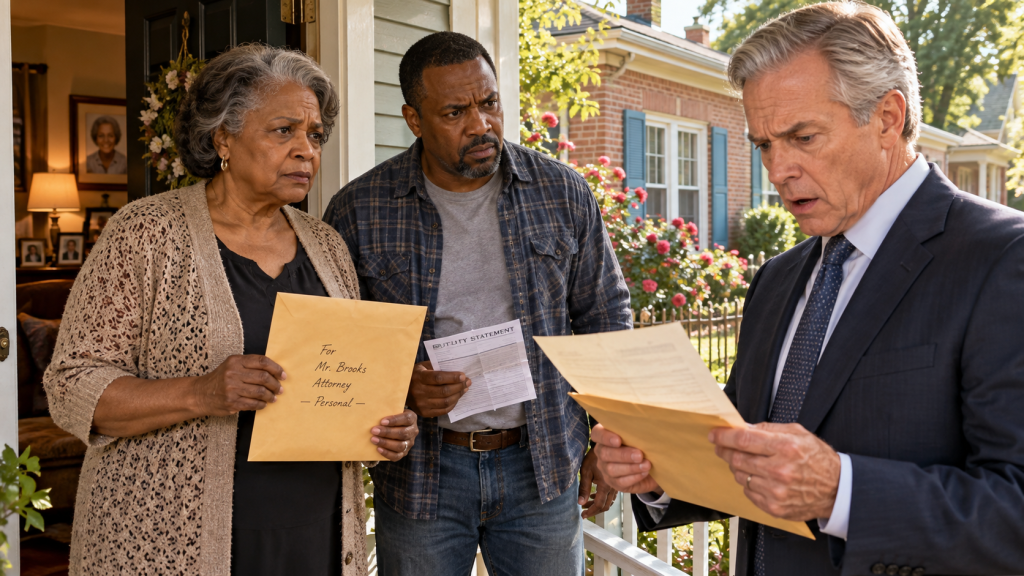
“Then why are you asking?” Arthur looked toward the street. His jaw worked. “Because I don’t know what she thought I did.” Mr. Brooks looked back at the papers.
“There are fourteen additional transactions.”
Arthur’s face tightened.
“How much?”
The lawyer did not answer immediately.
That silence somehow made the number feel larger.
“$27,940.”
Arthur’s eyes lifted.
I felt my stomach drop.
“On top of the eighteen thousand?”
Mr. Brooks nodded.
Arthur shook his head.
“No.”
“Arthur—”
“No.”
He stepped closer and reached toward the envelope.
Mr. Brooks pulled it back.
“Those numbers aren’t right.”
“They are bank records.”
“She gave me some of that.”
“Which transfers?”
Arthur stared at the highlighted pages.
“I’d have to look.”
Mr. Brooks’s voice became colder.
“You told me yesterday that your mother had become confused and that you believed Clara Jenkins had manipulated her into changing her will.”
“She did become confused.”
“You did not mention forty-six thousand dollars in transfers to your business and personal accounts.”
Arthur’s face flushed.
“They weren’t all mine.”
I folded my arms.
“Whose were they?”
He looked at me as if I had no right to ask.
Maybe I didn’t.
But Martha had put those papers in my hands.
Arthur said:
“Some were expenses.”
“For what?”
“Repairs.”
“To Martha’s house?”
“Yes.”
I looked across the yard.
Her gutters sagged.
The back steps had been patched twice with scrap wood.
Her kitchen faucet had leaked for six months before I finally replaced the washer myself.
“What repairs?”
Arthur’s voice rose.
“Things you didn’t know about.”
Mr. Brooks read from the statement.
“Payment to Summit Renovations, $6,800, memo: bathroom renovation.”
I stared at Martha’s house.
“She never had her bathroom renovated.”
Arthur looked away.
“Plans changed.”
Mr. Brooks continued.
“Payment to Summit Renovations, $4,200, memo: exterior masonry.”
I almost laughed.
“Martha complained about the crack beside the chimney until the week she died.”
Arthur said nothing.
Mr. Brooks turned another page.
“Payment to Arthur Sterling personally, $3,900.”
“That was reimbursement.”
“For?”
“Travel.”
“To visit your mother?”
Arthur’s mouth tightened.
“I handled things for her.”
“When?”
Silence.
Mr. Brooks’s expression changed.
He had arrived as Arthur’s advocate.
Now he was becoming something else.
Not my advocate.
The truth’s.
Arthur noticed.
“You’re supposed to be representing me.”
“I am.”
“Then stop interrogating me on her porch.”
“Then stop giving me new facts after I’ve already accused another person of exploiting your mother.”
The words hit hard.
Arthur’s eyes moved toward me.
I did not smile.
There was nothing satisfying about this.
Martha was still dead.
Arthur was still her son.
And whatever was inside that envelope had been written by an eighty-four-year-old woman who apparently believed she needed to prepare evidence against her own child.
There was no winning inside that.
Mr. Brooks continued reading.
“Your mother writes that after she revoked your financial authority, you retained access to one credit card because the bank failed to remove the authorized-user status.”
Arthur’s face changed again.
“She knew about that?”
I felt cold.
Mr. Brooks looked up.
“Yes.”
“How much?”
I asked.
“Approximately $9,300.”
Arthur finally sat down.
Not on one of my chairs.
On the top porch step.
He pressed both hands over his face.
“I was going to pay it back.”
The sentence was so familiar now that it had lost meaning.
Mr. Brooks closed the folder.
“When?”
Arthur said nothing.
“When were you going to pay it back?”
“My business was supposed to close a municipal contract.”
“And?”
“It fell through.”
“So your mother financed the gap?”
“She knew I was struggling.”
“That is not consent.”
Arthur looked up at him.
“You think I don’t know that now?”
Mr. Brooks’s voice softened slightly.
“I don’t know what you know.”
Arthur laughed bitterly.
“Apparently nobody does.”
I looked at him.
“Did Martha confront you?”
His eyes snapped toward me.
“What?”
“About the later transfers.”
“That’s none of your business.”
“She gave me the envelope.”
“That doesn’t make you family.”
“No.”
I swallowed.
“You’re right.”
Arthur looked away.
I continued.
“But if she confronted you and you kept doing it, then this isn’t about confusion.”
His shoulders stiffened.
Mr. Brooks waited.
Finally Arthur said:
“She confronted me once.”
“When?”
“Last year.”
“What did you tell her?”
He stared at the dead porch light next door.
“I told her the money was temporary.”
“What did she say?”
His mouth moved.
No sound came.
Then:
“She said, ‘You have been temporary for three years.’”
The sentence sat between us.
I closed my eyes.
That sounded exactly like Martha.
Not cruel.
Precise.
Arthur’s voice broke.
“She said every emergency in my life somehow became hers.”
Mr. Brooks stayed silent.
“She said I only called when something was wrong.”
He laughed softly, but there was no humor in it.
“I told her that wasn’t true.”
“Was it?”
I asked.
He turned toward me.
Anger returned for a second.
Then disappeared.
“I don’t know.”
That answer frightened him more than denial.
Mr. Brooks handed him the letter.
“Read the rest.”
Arthur stared at it.
“No.”
“It’s addressed to you.”
“I don’t want to.”
“You came here demanding answers.”
“I wanted answers about her.”
Mr. Brooks’s voice sharpened.
“This is her answer.”
Arthur took the letter.
His hands shook.
He began reading silently.
I watched his face.
First anger.
Then disbelief.
Then something deeper.
The expression a person makes when they discover the story they have been telling themselves no longer fits inside the facts.
Finally he spoke aloud.
“Arthur, I know you think I am punishing you.”
He stopped.
His throat moved.
Then he continued.
“I am not.”
Another pause.
“I have spent most of my life confusing helping you with preventing you from facing consequences.”
Arthur’s eyes filled.
“When you were sixteen and wrecked your father’s car, I told the insurance company I had been driving.”
“When you dropped out of college the first time, I told the family you were taking a medical leave.”
“When Summit Renovations nearly failed in 2018, I gave you twelve thousand dollars and told your wife it came from a business investor.”
Arthur closed his eyes.
I had not known any of that.
He continued.
“I thought protecting you from embarrassment was the same as loving you.”
His voice cracked.
“It wasn’t.”
Mr. Brooks looked away.
Arthur read:
“When you transferred money from my account without asking, I was angry.”
“When you lied afterward, I was ashamed.”
“Not of you.”
“Of myself.”
“Because I finally saw what I had taught you.”
Arthur stopped.
His shoulders shook.
I moved toward the door.
This felt private.
He noticed.
“Stay.”
I turned.
His eyes were wet.
“Why?”
“Because apparently she wanted you here.”
I wasn’t sure that was true.
But I stayed.
Arthur continued.
“I taught you that if you were frightened enough, your mother would clean up the mess.”
“I taught you that forgiveness could arrive before honesty.”
“I taught you that I would rather pay your debts than watch you fail.”
“So you never learned whether failure could be survived.”
Arthur lowered the letter.
His face had gone pale.
Mr. Brooks spoke gently.
“There’s more.”
“I know.”
Arthur looked at me.
“She always wrote too much.”
I laughed despite myself.
“Yes.”
He almost smiled.
Then read again.
“I changed my will because I do not want my last act as your mother to be one more rescue.”
“That house would pay your debts.”
“For a while.”
“Then there would be another emergency.”
“I love you too much to give you another escape route.”
Arthur broke.
Not dramatically.
He simply bent forward and covered his face.
His shoulders moved.
No sound came at first.
Then a low sob.
I stood frozen.
This was the man who had come to my door accusing me of exploiting a vulnerable old woman.
The man who had not known she fell in February.
The man who had taken money without permission.
And all I could see suddenly was somebody’s son reading the last honest thing his mother had ever written him.
I went inside.
Not to abandon him.
To give him privacy.
Mr. Brooks followed twenty minutes later.
Arthur remained on the porch.
The attorney stood in my hallway.
“I owe you an apology.”
“No.”
“Yes.”
“You believed your client.”
“I accepted his theory before seeing all available information.”
“That’s what attorneys do.”
“No.”
He shook his head.
“That is what careless attorneys do.”
I looked through the window.
Arthur was still sitting on the step.
“What happens now?”
Mr. Brooks exhaled.
“That depends on him.”
“Will he challenge the will?”
“He told me yesterday that he intended to.”
“And now?”
“I don’t know.”
“What does the will actually say?”
He hesitated.
“Martha left the house to the Richmond Aging-in-Place Foundation.”
I nodded.
“And Arthur?”
“A smaller cash bequest.”
“How small?”
“Ten thousand.”
I looked at him.
“So she didn’t cut him out.”
“No.”
“She specifically wrote that she did not want him to interpret the will as rejection.”
My throat tightened.
“And the rest?”
“After debts, taxes, and expenses, the residual estate also goes to the foundation.”
“And me?”
He almost smiled.
“Twenty-nine dollars.”
I looked at the check again.
I had never wanted an inheritance.
But somehow Martha leaving me the exact amount of one month’s water bill made my chest ache more than any fortune could have.
Mr. Brooks continued.
“She also instructed the executor to evaluate whether the unauthorized transfers should be recovered from Arthur.”
I closed my eyes.
“He’s going to hate that.”
“Yes.”
“Would she really sue her own son?”
“She is dead.”
“You know what I mean.”
He was quiet.
“She wanted accountability.”
“That isn’t the same as punishment.”
“No.”
I looked toward the porch.
Arthur was standing now.
He wiped his face.
Then came inside without asking.
Normally I would have objected.
I didn’t.
He placed the letter on my kitchen table.
“You knew she kept peppermints by the door.”
“Yes.”
“What kind?”
“Red-and-white ones.”
He stared at me.
“She hated the green ones.”
“I know.”
He laughed once.
“Of course you do.”
Then he looked around my kitchen.
“Martha sat here?”
“Sometimes.”
“How often?”
“Once or twice a week.”
His face tightened.
I immediately understood.
“I’m sorry.”
“For what?”
“That hurt.”
He looked at me.
Then away.
“Did she talk about me?”
“Yes.”
“What did she say?”
I hesitated.
“Arthur.”
“What did she say?”
I sat across from him.
“She missed you.”
His jaw tightened.
“That’s all?”
“No.”
“Tell me.”
“She was angry.”
“I know.”
“She thought you treated her independence like a problem to solve.”
He looked down.
“She thought you only saw the falls, the bills, the missed appointments.”
“I was worried.”
“I know.”
“No.”
He looked up.
“You don’t.”
“I was terrified.”
“Dad died.”
“She was alone in that house.”
“She wouldn’t move.”
“She wouldn’t install railings.”
“She kept driving after dark even after backing into a grocery cart return.”
I blinked.
“She never told me that.”
Arthur laughed sadly.
“There.”
For the first time, there was something almost equal between us.
He knew things I didn’t.
Good.
I had been afraid without realizing it that Martha’s death would turn intimacy into competition.
Who knew her better?
Who loved her more?
That would have been another way to reduce her.
Arthur continued.
“I asked her to move closer to me.”
“She heard, ‘Give up your house.’”
“I suggested assisted living.”
“She heard, ‘You’re incompetent.’”
“Maybe I said things badly.”
“You did.”
His eyes flashed.
Then he laughed.
“God, you sound like her.”
“I’ll take that as an insult.”
“You should.”
He looked at the letter.
“I thought she had replaced me with you.”
I froze.
“What?”
“Every time I called, she talked about Clara.”
He looked at me.
“Clara drove me.”
“Clara fixed this.”
“Clara brought soup.”
“Clara found a plumber.”
“She never said it like an accusation.”
“But I heard it like one.”
My chest tightened.
“So you called less.”
“Yes.”
“Why?”
“Because every call made me feel like a bad son.”
I stared.
“That seems backward.”
“It was.”
He rubbed his forehead.
“I kept thinking I’d fix the business.”
“Then I’d repay her.”
“Then I’d visit.”
“Then I’d prove I wasn’t a failure.”
“Then?”
“Then became three years.”
I thought of Martha waiting beside the phone.
The birthday call lasting four minutes.
The empty chair across from her at Thanksgiving.
“Did you love her?”
The question came out before I could stop it.
Arthur’s face changed.
“Don’t.”
“I’m asking.”
“Of course I loved her.”
“Then why are you acting like the love is obvious but the damage is confusing?”
He stared at me.
“That’s not fair.”
“No.”
I nodded.
“Probably not.”
He looked away.
Mr. Brooks finally spoke.
“Arthur, we should go.”
Arthur ignored him.
He looked at the sealed envelope.
Now open.
“What else is in there?”
Mr. Brooks checked.
“Medical capacity evaluation.”
“Revocation records.”
“Bank statements.”
“A memo from Martha’s estate attorney.”
“Anything else?”
“Yes.”
“What?”
“A USB drive.”
My stomach tightened.
Arthur’s face went blank.
“What’s on it?”
Mr. Brooks looked at me.
Then Arthur.
“It is labeled ‘For Court If Needed.’”
Arthur whispered:
“Oh, Mom.”
He laughed weakly.
“She made recordings.”
I looked at him.
“You know?”
“She started recording everything after Dad died.”
“Why?”
“She said people remembered conversations according to what helped them sleep.”
That was Martha.
Mr. Brooks examined the drive.
“I’m not playing this here.”
Arthur looked at him.
“Why?”
“Because if you contest the will, this becomes evidence.”
Arthur stood.
“Then I want to hear it.”
“Not on Mrs. Jenkins’s kitchen laptop.”
“I don’t have one.”
I said.
Both men looked at me.
“What?”
“I use a tablet.”
Arthur almost smiled.
Then he stopped.
“David.”
Mr. Brooks shook his head.
“Office.”
“When?”
“Today.”
Arthur nodded.
Then looked at me.
“You coming?”
“No.”
“Why not?”
“Because that is between you and your mother.”
His face softened.
“I accused you.”
“Yes.”
“In front of your house.”
“Yes.”
“And if the recording says—”
“I don’t need Martha to prove to me that I didn’t manipulate her.”
He studied me.
Then nodded.
Arthur left.
I stood at the window as he got into his car.
Mr. Brooks lingered.
“You handled that better than I would have.”
“That’s because you charge by the hour.”
He laughed.
Then became serious.
“I suspect this is not finished.”
He was right.
Three days later, Arthur challenged the will.
I learned from a certified letter.
Not a call.
Not an apology.
Legal language.
Claims of undue influence.
Questioned capacity.
Improper isolation.
Suspicious charitable disposition.
And my name.
Again.
I sat at my kitchen table reading the filing while Martha’s empty house watched me through the window.
I expected rage.
Instead, I felt tired.
Arthur had heard the letter.
He had seen the records.
And still—
Then my phone rang.
Mr. Brooks.
“I’m no longer representing Arthur.”
That surprised me.
“Why?”
“I advised him against filing the challenge as currently framed.”
“And?”
“He hired someone else.”
I closed my eyes.
“Did you hear the recording?”
“Yes.”
“What’s on it?”
A pause.
“Martha.”
“That is not helpful.”
“She is very clear.”
“About?”
“Everything.”
I waited.
Brooks continued.
“Arthur asked her for money six weeks before she changed the will.”
“How much?”
“Seventy-five thousand.”
I nearly dropped the phone.
“For what?”
“To refinance Summit Renovations.”
“And she said no?”
“Yes.”
“Then she changed the will?”
“Three weeks later.”
“That looks bad.”
“For Arthur’s theory?”
“No.”
“For everyone.”
I stood.
“Did she say why?”
“On the recording.”
“What did she say?”
“I think you should hear it from the estate attorney.”
“Who is that?”
“Helen Rowe.”
I remembered her from the funeral.
Gray hair.
Quiet voice.
No nonsense.
“She’s expecting your call.”
I called.
Helen answered:
“Clara Jenkins.”
“You say that like I’m trouble.”
“Martha said you were.”
I laughed.
“She liked you.”
“That’s unfortunate.”
Helen’s tone softened.
“Are you all right?”
“No.”
“Good answer.”
I sat.
“What is on the recording?”
“Martha anticipated a challenge.”
“Obviously.”
“She recorded several meetings with my knowledge.”
“What did she say about me?”
Helen paused.
“Would you like to hear it?”
My throat tightened.
“Yes.”
Helen sent me a secure link.
I listened alone.
Martha’s voice came through my tablet speakers.
Alive.
Dry.
Impatient.
“Do we have to do this again?”
Helen’s voice:
“Yes.”
“Because my son is dramatic?”
“Because clear records prevent litigation.”
“That has never stopped Arthur from litigating.”
I laughed and cried at once.
Martha continued.
Helen asked:
“Are you changing your will because of Clara Jenkins?”
“No.”
“Did Clara ask you to change it?”
“No.”
“Did she ask for your house?”
Martha snorted.
“Clara won’t accept a casserole dish without trying to return it.”
My hand flew to my mouth.
Helen asked:
“Has she ever suggested you leave assets to her?”
“No.”
“Has she discussed your estate?”
“Only once.”
“What did she say?”
“That I should leave my jewelry to someone who won’t wear it while gardening.”
I laughed.
Martha continued.
“I am leaving Clara twenty-nine dollars.”
“Why?”
“Because she has paid my water bill for years.”
“Does she know you know?”
“No.”
“Why haven’t you stopped her?”
Silence.
My breath caught.
Martha’s voice became softer.
“Because sometimes allowing someone to care for you is a kindness too.”
I started crying.
She continued.
“Clara thinks I don’t know.”
“She thinks she’s protecting my pride.”
“She is wrong.”
“I know exactly what she does.”
“Why not tell her?”
“Because then she’ll stop.”
I laughed through tears.
That woman.
Helen asked:
“Do you need Clara’s financial help?”
“No.”
“I can pay the bill.”
“Then why let her?”
“Because after George died, everyone wanted to help by changing my life.”
“Arthur wanted me to move.”
“My doctor wanted me to stop driving.”
“My cousin wanted me to sell the house.”
“Clara paid twenty-nine dollars and never asked me to become someone else.”
I could not breathe.
Helen was quiet.
Then:
“Why the charity?”
Martha answered:
“Because staying home safely should not depend on whether you happen to live next door to a stubborn woman with access to the utility portal.”
I cried harder.
The recording continued.
“Arthur thinks the house is his future.”
“It isn’t.”
“It is my house.”
“When I am gone, I want it to become somebody else’s chance to stay in theirs.”
Helen asked:
“Are you angry with Arthur?”
“Yes.”
“Does that influence this decision?”
“Of course it influences it.”
“Be careful.”
“I am eighty-four.”
“I am done pretending feelings and decisions live in separate rooms.”
Helen laughed softly.
Martha continued.
“I am angry he took money.”
“I am angrier he lied.”
“I am sad he stopped visiting.”
“I am ashamed that I trained him to expect rescue.”
“All those things are part of the decision.”
“Can you explain the decision without anger?”
“Yes.”
“Do so.”
Martha inhaled.
“If I leave Arthur the house, he will sell it.”
“He will pay debt.”
“He will feel relieved.”
“For six months.”
“Then he will find another emergency.”
“I do not want my final act to be teaching my son that his mother’s death is another solution.”
I covered my face.
Helen asked:
“Do you understand that Arthur may feel rejected?”
“Yes.”
“What would you want him to know?”
Martha was quiet for a long time.
Then:
“That I love him.”
My heart broke.
“That I love him enough to let him be angry.”
“That I love him enough not to rescue him again.”
“That I wish I had learned the difference sooner.”
The recording ended.
I sat there long after the screen went dark.
Then I called Helen back.
“He heard that?”
“Yes.”
“And still filed?”
“Yes.”
“Why?”
“People do not stop being who they are because one recording is persuasive.”
I looked across at Martha’s house.
“What happens now?”
“We defend the will.”
“Do I have to testify?”
“Probably.”
“About what?”
“Your relationship with Martha.”
“I hate this.”
“Martha expected that.”
“Of course she did.”
Helen almost laughed.
“She left instructions.”
“What instructions?”
“If you are asked whether you influenced her, you are to answer truthfully and not become ‘a martyr with good posture.’”
I stared.
“She wrote that?”
“Exact words.”
I laughed until I cried again.
The court process lasted eight months.
Eight miserable months.
Depositions.
Documents.
Questions that took kind things apart and examined them for hidden motives.
Why did I pay the bill?
Why secretly?
Did Martha ever give me gifts?
How often did I enter her house?
Did I drive her to appointments?
Did she discuss Arthur?
Did I discourage contact?
No.
Did I discuss assisted living?
Sometimes.
Did I tell Martha not to move?
No.
Did I benefit from her remaining next door?
Emotionally?
Yes.
Financially?
No.
Arthur’s new attorney, a man named Paul Grant, was very good.
That made him unpleasant.
At my deposition, he asked:
“Mrs. Jenkins, would you describe yourself as Martha Sterling’s closest companion during the last years of her life?”
I thought.
“No.”
“No?”
“I would describe myself as her neighbor.”
“Who saw her several times each week.”
“Yes.”
“Who drove her to medical appointments.”
“Sometimes.”
“Who paid a recurring utility bill.”
“Yes.”
“Who helped her after falls.”
“Yes.”
“Who held legal documents.”
“One sealed envelope.”
“Who knew intimate details of her relationship with her son.”
“Some.”
Grant leaned forward.
“Yet you want this court to believe you were merely a neighbor.”
I looked at him.
“No.”
He paused.
“I want the court to understand that neighbor is not a small word.”
For the first time, he looked surprised.
I continued.
“Martha was not my mother.”
“I did not replace Arthur.”
“I did not become family because I drove her to cardiology.”
“I was the person next door who happened to show up.”
“Sometimes that matters.”
Grant recovered.
“Did you enjoy being needed?”
The question hit unexpectedly.
I looked down.
“Yes.”
Helen glanced at me.
Grant noticed.
“Could you explain?”
“I liked being useful.”
“To Martha?”
“To everyone.”
“Did Martha’s dependence on you make you feel important?”
I wanted to say no.
Then I heard Martha’s voice.
Do not become a martyr with good posture.
“Yes.”
Grant’s eyebrows lifted.
“Sometimes.”
He smiled slightly.
“So you had an emotional incentive to keep Martha dependent on you.”
“No.”
“Why not?”
“Because enjoying being useful and wanting someone helpless are not the same thing.”
Grant studied me.
“Did you ever discourage her from moving?”
“I told her I would miss her.”
“Is that discouragement?”
“It’s honesty.”
He nodded.
“Did she stay?”
“Yes.”
“Did you benefit emotionally?”
“Yes.”
The room went quiet.
Grant sat back as if he had won something.
Maybe he had.
But I had learned something too.
Martha had known I liked helping.
Maybe too much.
Maybe secrecy had protected my pride too.
If I had asked her directly, she might have said no.
Paying the bill without asking had let me avoid that.
Good intentions do not become bad because they are imperfect.
But they are still imperfect.
That realization stayed with me.
Arthur testified two months later.
I sat in the courtroom.
He looked older.
Not physically.
Emotionally.
His attorney asked him about Martha’s decline.
Falls.
Medication.
Driving.
Memory mistakes.
Arthur described her putting milk in a cabinet once.
Calling him by his father’s name twice.
Forgetting a doctor’s appointment.
All true.
Then Helen cross-examined.
“Mr. Sterling, did your mother know the value of her house?”
“Yes.”
“Did she know she had one son?”
“Yes.”
“Did she know who Clara Jenkins was?”
“Yes.”
“Did she understand that leaving the house to charity meant you would not receive it?”
Arthur looked down.
“Yes.”
“Did she understand you wanted it?”
His mouth tightened.
“Yes.”
“Did she tell you no when you asked for seventy-five thousand dollars?”
“Yes.”
“Did you then stop calling her for six weeks?”
Silence.
“Yes.”
“Why?”
Arthur’s lawyer objected.
Overruled.
Arthur swallowed.
“Because I was angry.”
“At her?”
“Yes.”
“For refusing to give you money?”
“Yes.”
Helen nodded.
“Did you take money from her account without permission?”
His attorney objected again.
The judge allowed it because it related to motive and trust.
Arthur whispered:
“Yes.”
“How much?”
“I don’t know exactly.”
“More than thirty thousand?”
“Yes.”
“More than forty?”
He closed his eyes.
“Yes.”
“Did you repay it before she died?”
“No.”
“Did she ask?”
“Yes.”
“What did you say?”
Arthur looked toward me.
Then at the judge.
“I said I would.”
“Did you?”
“No.”
Helen’s voice softened.
“Mr. Sterling, do you believe your mother loved you?”
Arthur’s eyes filled.
“Yes.”
“Do you believe she was angry with you?”
“Yes.”
“Do you believe both things can be true?”
Long silence.
“Yes.”
That answer ended something.
Not the case.
Something inside him.
The court upheld Martha’s will.
The written opinion was forty-three pages.
I read six.
Enough.
The judge found Martha had testamentary capacity.
Had independent counsel.
Had expressed consistent intent.
Had not been isolated by me.
Had not been coerced.
And had left me no substantial benefit.
Arthur’s challenge failed.
There was no dramatic courtroom collapse.
No judge calling him greedy.
No applause.
Just:
“Petition denied.”
Arthur sat still.
Then nodded.
Outside, reporters waited because a local newspaper had picked up the unusual story.
Elderly widow.
Neighbor paying bills.
Son challenging will.
Charity receiving house.
I hated every second.
One reporter shouted:
“Mrs. Jenkins, do you feel vindicated?”
I stopped.
Helen touched my arm.
“Keep walking.”
But I answered.
“No.”
The reporter blinked.
“Why not?”
“Because my friend is still dead.”
Then I walked away.
Arthur did not.
He stood on the courthouse steps and let cameras surround him.
I expected anger.
Instead he said:
“My mother made her decision.”
A reporter asked:
“Do you accept it?”
Arthur looked exhausted.
“I’m learning to.”
That became the headline.
Not the money.
Not me.
SON SAYS HE IS “LEARNING TO” ACCEPT MOTHER’S FINAL WISH
I thought Martha might have approved.
The estate then pursued repayment.
That hurt Arthur more than losing the house.
Summit Renovations was already failing.
To settle, he sold equipment.
A rental property.
A vintage truck his father had restored.
That one almost broke him.
I learned because he called.
Not to complain.
To ask a question.
“Do you still have any pictures of Mom’s garage?”
“What?”
“The old garage.”
“Yes.”
“Why?”
He was quiet.
“Dad’s truck is in some of them.”
My heart tightened.
“You sold it.”
“Yes.”
“You didn’t want to.”
“No.”
“Then why?”
“I owed the money.”
Simple.
I emailed him every photograph I had.
In one, Martha stood beside the truck holding a garden hose.
Arthur called again.
“That was Dad’s birthday.”
“How do you know?”
“The shirt.”
I smiled.
“You know things I don’t.”
“Some.”
We were quiet.
Then he said:
“Thank you.”
It was the first time.
Not for evidence.
Not for staying.
For something small.
“Arthur?”
“Yes?”
“I’m sorry about the truck.”
“So am I.”
“But?”
“But paying back money is supposed to cost something.”
That sounded like growth.
The charity took possession of Martha’s house the following spring.
They did not sell it.
That surprised everyone.
Instead, they renovated it.
Wide doorways.
Better lighting.
A small ramp.
Grab bars.
Lever handles.
Non-slip flooring.
A downstairs bedroom.
The house became a demonstration center for older homeowners who wanted to remain independent safely.
They called it the Sterling House.
I hated the name at first.
Too formal.
Martha would have hated it more.
The director, Evelyn Carter, showed me the new sign.
“What do you think?”
“She would ask how much it cost.”
Evelyn laughed.
“Probably.”
Then she handed me a letter.
“What is this?”
“Martha left it for the charity.”
I stared.
“Another one?”
“She liked paper.”
I read.
To whoever ends up deciding what to do with my house:
Do not make it tasteful.
Tasteful houses are boring.
The blue shutters stay.
The roses may be trimmed but not disciplined.
The upstairs wallpaper should be removed immediately because George chose it and he had many fine qualities but no eye for wallpaper.
I laughed.
Evelyn smiled.
I continued.
If you use this house to help old people remain at home longer, remember this:
Safety matters.
Choice also matters.
Do not speak to an eighty-year-old woman as if she turned eight overnight.
Do not assume falling once means she wants to surrender her kitchen.
Do not confuse concern with authority.
And for heaven’s sake, fix the porch light.
I cried.
Evelyn waited.
Then:
“There’s a postscript.”
I read.
If Clara Jenkins is hovering nearby trying to help without being asked, give her a job with clear boundaries.
I laughed so hard Evelyn had to sit down.
That was how I became a volunteer.
One afternoon a week.
Not in charge.
Martha would have enjoyed that most.
We helped families evaluate houses.
Connected seniors to small grants.
Installed handrails.
Found transportation.
Paid emergency utility bills.
I never handled the money.
That was deliberate.
I met older people who reminded me of Martha.
Stubborn.
Funny.
Terrified.
Proud.
I also met adult children who reminded me of Arthur.
Exhausted.
Frightened.
Trying to keep parents alive and accidentally speaking as if survival were the only value.
The work softened something in me.
It made me understand Arthur more without excusing him.
Concern can become control when fear speaks too loudly.
Love can become entitlement when history is treated like a contract.
A year after the court case, Arthur appeared at the center.
I saw him through the window.
For a moment, I thought he had come to complain.
Instead he carried a toolbox.
Evelyn greeted him cautiously.
“Mr. Sterling.”
“Arthur.”
“All right.”
He looked around.
“Need anything fixed?”
Evelyn glanced at me.
I shrugged.
“I’m not in charge.”
Arthur looked amused.
“Martha finally got you trained?”
“Apparently.”
Evelyn said:
“We don’t have a volunteer application from you.”
“I can fill one out.”
“Why?”
Arthur looked toward the old living room.
“Because I know the house.”
That was not enough.
Evelyn knew it.
“So did Martha.”
He nodded.
“Because I want to.”
Still not enough.
Evelyn folded her arms.
“Because you lost the case?”
Arthur’s mouth tightened.
“Yes.”
“Because you feel guilty?”
“Yes.”
“Because you think volunteering earns something back?”
He looked at the floor.
“Maybe.”
Evelyn waited.
Then Arthur said:
“I don’t know what the pure reason is.”
That honesty saved him.
Evelyn handed him an application.
“Start with the loose railing behind the shed.”
He smiled faintly.
“Yes, ma’am.”
Arthur returned the next Saturday.
Then the next.
He was good with his hands.
Better than I expected.
He replaced damaged trim.
Adjusted doors.
Installed rails.
Built a workbench.
He did not talk much.
At first.
Then older clients started liking him.
One woman named Mrs. Perez refused to let him install a shower bar.
“I’m not disabled.”
Arthur said:
“Neither is the wall.”
She stared.
“What?”
“It just needs a bar.”
She let him install it.
Later I said:
“That was manipulative.”
He smiled.
“Effective.”
“Your mother would approve.”
“No.”
“She’d ask whether the screws were level.”
We laughed.
That became easier over time.
Martha stopped being the battlefield between us.
She became the person we both missed.
There was a difference.
On the second anniversary of her death, Arthur and I sat on the porch after everyone left.
He brought two cups of coffee.
Mine had sugar.
Correct amount.
I noticed.
“You remembered.”
“Mom took hers the same way.”
“No.”
He frowned.
“What?”
“She took hers black.”
Arthur stared.
“No, she didn’t.”
“Yes.”
“Growing up she used cream and sugar.”
“Not the last six years.”
He looked offended.
“When did that change?”
“Apparently before I met her.”
He sat back.
“I hate this.”
“What?”
“That there are versions of her I never knew.”
My chest tightened.
“There are versions you knew that I never will.”
He looked at me.
“Like?”
“What did she sing in the car?”
Arthur smiled.
“Badly?”
“Obviously.”
“Patsy Cline.”
“I didn’t know that.”
“She loved Patsy Cline.”
“What did she cook when you were sick?”
“Chicken and dumplings.”
“Did she yell when you got in trouble?”
“No.”
“Really?”
“She got quiet.”
I shivered.
“That sounds worse.”
“It was.”
“What was your father like with her?”
Arthur looked toward the roses.
“Funny.”
“Everybody thinks Dad was serious because of the photos.”
“He was ridiculous with her.”
“Used to hide notes in her purse.”
“What kind?”
“Bad jokes.”
I smiled.
“I didn’t know.”
Arthur looked at me.
“Big enough.”
“What?”
“She was big enough for both versions.”
The sentence surprised me.
I nodded.
“Yeah.”
“Big enough.”
That became our rule.
Whenever one of us felt jealous about a memory, we said it.
Big enough.
Martha’s life had been big enough to contain both.
Three years after the funeral, Arthur finished repaying the estate.
The charity received the final amount.
He brought me the receipt.
“Done.”
I looked at it.
“Congratulations.”
“I don’t feel better.”
“That seems unfair.”
He laughed.
“I thought I would.”
“What do you feel?”
“Late.”
I understood.
He folded the paper.
“I spent years saying I’d repay her.”
“Now I did.”
“And she isn’t here.”
“No.”
“What am I supposed to do with that?”
I thought.
“Stop expecting repayment to become resurrection.”
He stared.
“That’s harsh.”
“Yes.”
“Martha?”
“No.”
“That one is mine.”
He smiled.
“Not bad.”
Then he said:
“I want to apologize to you.”
My stomach tightened.
“For the porch?”
“Everything.”
“You don’t have to.”
“I know.”
That was the difference.
He continued.
“I wanted you to be a villain.”
“I know.”
“If you were manipulating her, then I wasn’t simply absent.”
“If you wanted the house, then her changing the will wasn’t about me.”
“If you had influenced her, then I could keep believing she would have chosen me otherwise.”
I listened.
“I treated your kindness like evidence because that was easier than looking at mine.”
His voice cracked.
“I’m sorry.”
I nodded.
“Thank you.”
He waited.
I realized he expected something.
“What?”
“Do you forgive me?”
The question was honest.
I thought carefully.
“I don’t know.”
His face fell slightly.
I continued.
“I’m not angry the way I was.”
“But forgiveness feels like a bigger word.”
He nodded.
“That’s fair.”
I smiled.
“You can survive not getting the answer immediately.”
He laughed.
“Apparently that is the family lesson.”
“Yes.”
Arthur began calling his daughter.
I knew about Rebecca only because Martha had mentioned her twice.
Arthur and Rebecca had been estranged for years.
Different reasons.
Same pattern.
“She moved to Oregon.”
Arthur told me one afternoon while sanding a door.
“She wanted me to visit.”
“I kept saying after the next contract.”
I froze.
“That sounds familiar.”
“I know.”
“What happened?”
“She stopped asking.”
“And you?”
“I told myself she had her own life.”
“Did she?”
“Yes.”
“Did that mean she didn’t want you?”
Arthur stopped sanding.
“No.”
“How do you know?”
“Because she told me last week.”
I smiled.
“You called.”
“Yes.”
“How was it?”
“Terrible.”
“Good.”
He laughed.
“She cried.”
“I cried.”
“We blamed each other.”
“Then?”
“She said I could come for Thanksgiving.”
My heart lifted.
“Are you going?”
“Yes.”
“Good.”
He pointed the sandpaper at me.
“Do not make this sentimental.”
“I wouldn’t dare.”
He went.
The next year Rebecca came to Richmond.
She walked through the Sterling House slowly.
Touching walls.
Looking at family photographs Arthur had donated copies of.
When she met me, she said:
“So you’re Clara.”
I smiled.
“That depends what you’ve heard.”
She laughed.
“Grandma said you were nosy.”
“Accurate.”
“Dad said you’re impossible.”
“Also accurate.”
Then she hugged me.
That was unexpected.
“Thank you.”
“For what?”
“For making him uncomfortable long enough to change.”
I looked at Arthur.
He had heard.
“I hate this family.”
Rebecca smiled.
“We’re working on it.”
Years passed.
The center grew.
A utility emergency fund was created.
I donated occasionally.
Anonymously at first.
Evelyn discovered me.
“Clara.”
“What?”
“You cannot secretly pay everybody’s utility bill.”
“I can try.”
“Martha’s postscript specifically warned me.”
“Dead women should not have administrative authority.”
Evelyn laughed.
We named the fund the Neighbor Water Assistance Program.
No donor name.
No plaque about me.
Just practical help.
Applications were simple.
No humiliating essay about why someone deserved water.
That mattered to me.
Arthur volunteered there for twelve years.
Long enough for most new staff not to know he had once challenged the will that created the center.
One young employee asked him:
“How did you get involved?”
Arthur looked at me across the room.
I raised an eyebrow.
He said:
“My mother left me a very complicated volunteer application.”
The girl looked confused.
I laughed.
At seventy-one, Arthur became sick.
Pancreatic cancer.
I learned from Rebecca.
Not him.
That annoyed me.
I called.
“You were going to tell me when?”
“When I had a plan.”
“Your mother would slap you.”
“Probably.”
“You don’t need a plan to tell someone you’re sick.”
Silence.
Then:
“I was scared.”
That softened me.
“When’s your appointment?”
“Tuesday.”
“I’ll drive.”
“No.”
“Arthur.”
“I can drive.”
“After chemotherapy?”
Silence.
“I’ll drive.”
He sighed.
“You really are becoming her.”
“Take that back.”
He laughed.
Treatment was brutal.
Arthur became thinner.
Quieter.
Receiving help tortured him.
One afternoon, I brought soup.
He stared at the container.
“I can make food.”
“Then make food.”
“Why did you bring this?”
“Because you’re sick.”
“I don’t want pity.”
“It’s soup.”
He glared.
I set it down.
“Your mother once told me pride is a terrible seasoning.”
Arthur froze.
“She said that?”
“No.”
I smiled.
“But she should have.”
He laughed despite himself.
Cancer changed our conversations.
Not because death made everything profound.
Sometimes it made things stupid.
He complained about hospital parking for twenty minutes while waiting for scan results.
He argued that chemo chairs were designed by enemies of the spine.
He became obsessed with a nurse named Tasha because she could start an IV on the first try.
But eventually, late at night, the deeper questions came.
“Do you think Mom knew I loved her?”
We were sitting at my kitchen table.
I answered immediately.
“Yes.”
“How?”
“She told me.”
He stared.
“What?”
“She said you loved her.”
“When?”
“The year before she died.”
“Even after the money?”
“Yes.”
Arthur’s eyes filled.
“What exactly did she say?”
I remembered.
Martha on my porch.
Thunderstorm.
Peppermint between her fingers.
“She said, ‘Arthur loves me. He just thinks love should be understood without maintenance.’”
Arthur closed his eyes.
I waited.
“That hurts.”
“I know.”
“She was right.”
“I know.”
“I thought because I loved her, she should know.”
“She did.”
“Then why wasn’t it enough?”
I took his hand.
“Because knowing someone loves you and feeling cared for are different.”
Arthur cried.
“I should’ve come.”
“Yes.”
“I should have called.”
“Yes.”
“I should have paid her back.”
“Yes.”
“You really are terrible at comfort.”
“Yes.”
He laughed through tears.
“What do I do with all that now?”
“You stop trying to make suffering prove you’re sorry.”
He looked at me.
“What?”
“Guilt can become another form of selfishness.”
“That sounds cruel.”
“It can be.”
“If every day becomes about how terrible you feel, you’re still centering yourself.”
Arthur stared.
I continued.
“You repaid the estate.”
“You changed.”
“You called Rebecca.”
“You showed up.”
“Let those things be true too.”
He looked down.
“Big enough?”
I smiled.
“Big enough.”
Arthur’s cancer responded for almost a year.
Then stopped.
Rebecca came home.
Not moved permanently.
Came.
There was a difference.
She stayed for weeks at a time.
Arthur apologized to her.
Not once.
Many times.
Because real apologies often need repetition when damage happened repeatedly.
One afternoon I arrived to find them arguing.
Rebecca stood in the kitchen.
“You don’t get to suddenly act like Dad of the Year because you’re dying.”
Arthur sat in a chair.
“I didn’t say that.”
“You keep trying to give me things.”
“I have things to give.”
“I wanted you ten years ago.”
The room went silent.
I turned to leave.
Rebecca said:
“Stay.”
I stopped.
Arthur looked destroyed.
“I know.”
Rebecca shook her head.
“No.”
“You know now.”
“That’s different.”
He nodded.
“Yes.”
She cried.
“I spent years thinking Grandma mattered more.”
Arthur’s face tightened.
“I thought you didn’t need me.”
“That was convenient.”
“Yes.”
He looked at her.
“It was.”
No defense.
That changed the room.
Rebecca sat.
“I’m still angry.”
“I know.”
“I love you.”
“I know.”
She almost smiled.
“Don’t say you know.”
Arthur laughed weakly.
“Family habit.”
They hugged later.
Not then.
Later.
Timing matters.
When Arthur entered hospice, he asked to visit the Sterling House one last time.
Evelyn had retired, but the new director opened after hours.
Arthur arrived in a wheelchair.
He hated the chair.
Naturally.
We rolled him up the ramp.
He stared at it.
“Mom would despise this.”
“She’d pretend to.”
He smiled.
Inside, he asked to sit in the old living room.
It was now a consultation room.
One of Martha’s original bookshelves remained.
Arthur touched the wood.
“Dad built this.”
“It leans.”
“He was terrible.”
We laughed.
Then he looked at me.
“I came to your porch with a lawyer.”
“You did.”
“What an idiot.”
“Yes.”
He smiled.
“Still terrible at comfort.”
“Consistent.”
His face became serious.
“I thought if I proved you were bad, Mom’s decision would stop meaning something about me.”
“I know.”
“The worst thing was finding out you really only paid the water.”
I laughed.
“Sorry.”
“No.”
“That was it.”
“Twenty-nine dollars.”
“You didn’t even know she knew.”
“No.”
He looked around.
“And all this came from that.”
“No.”
I shook my head.
“This came from Martha.”
He nodded.
“Right.”
Then he whispered:
“I miss her.”
“Me too.”
Arthur died twenty-three days later.
Rebecca called at dawn.
“He’s gone.”
I sat on the edge of my bed.
For a moment, I could not understand why grief felt so large.
He had once been my adversary.
Then a volunteer.
Then a friend.
Maybe.
I never called him that while he was alive.
I wish I had.
At his funeral, Rebecca handed me an envelope.
“Dad left this.”
I stared.
“If that man left me legal documents—”
“He didn’t.”
I opened it.
A check.
Twenty-nine dollars.
I laughed immediately.
Then cried.
The note read:
Clara,
Mom was right.
You make receiving anything unbearable.
Spend this irresponsibly.
Do not pay a utility bill.
Do not donate it to the center.
If you refuse, I will ask Mom to haunt you with me.
Arthur.
I sat down.
Rebecca laughed through tears.
“What will you buy?”
“I don’t know.”
“Cake?”
“I already did that once.”
“Something ridiculous.”
We went together.
Twenty-nine dollars bought two milkshakes and a plate of overpriced french fries at a diner Martha had once refused to enter because she said twelve dollars for potatoes was evidence civilization had failed.
We raised our milkshakes.
“To Martha.”
Rebecca smiled.
“To Dad.”
I added:
“To poor financial decisions.”
We drank.
Years later, people still asked me about the story.
Usually after seeing an article online.
The neighbor who paid water bills.
The son who challenged the will.
The house donated to charity.
They wanted a simple moral.
Kind neighbor good.
Greedy son bad.
I never gave them one.
Because it stopped being true almost immediately.
Arthur did take money.
He did lie.
He did accuse me.
He did challenge his mother’s will even after hearing her explain it.
Those facts remained.
So did the later ones.
He repaid what he could.
Then all of it.
He volunteered.
He repaired homes.
He rebuilt a relationship with his daughter.
He learned to receive help.
He admitted where he had been wrong.
People deserve the burden of every true sentence about them.
Not just the worst one.
Martha understood that better than anyone.
She loved Arthur.
She did not trust him with her accounts.
Both true.
She missed him.
She was furious with him.
Both true.
She wanted him to come home.
She would not leave him the house.
Both true.
Love is not the absence of boundaries.
Sometimes boundaries are the last form love takes when rescue has become destructive.
I learned something about myself too.
For years, I told the story of the water bill as if I had done something perfectly generous.
Quiet.
Selfless.
No expectations.
Mostly true.
Not entirely.
I liked being needed.
I liked solving a problem before Martha could refuse my help.
I told myself secrecy protected her dignity.
It did.
But secrecy also protected me from hearing no.
That mattered.
The center taught me to ask more.
“Would you like help?”
Not:
“Here is what I decided you need.”
Sometimes people said no.
That was difficult.
Sometimes they made choices I thought were unsafe.
That was harder.
But Martha had been right.
Age is not identity.
Help that removes every choice stops feeling like help.
By the time I was eighty-one, I finally understood from the other side.
I fell on my back steps one winter.
Not badly.
Bruised hip.
Bruised pride.
I told nobody for three days.
Rebecca called.
“You sound weird.”
“I always sound weird.”
“What happened?”
“Nothing.”
“Clara.”
I sighed.
“I fell.”
“Are you hurt?”
“No.”
“Did you call the center?”
“No.”
“Why?”
“I’m not helpless.”
She became quiet.
Then:
“Grandma Martha says hello.”
I laughed despite myself.
A home-safety specialist visited.
Recommended a rail.
I said no.
She smiled.
“I have been warned about you.”
“By who?”
“Everyone.”
I got the rail.
I hated it for two weeks.
Then loved it.
Receiving help remained difficult.
Maybe it always is for certain people.
Martha had known that too.
On the twentieth anniversary of her death, the center installed a plaque near the porch.
I almost objected.
Then read it.
MARTHA STERLING
1935–2019
HELP SHOULD PRESERVE DIGNITY, NOT REPLACE IT.
Underneath, in smaller letters:
PLEASE USE THE HANDRAIL.
I laughed so loudly a volunteer came outside.
“Are you all right?”
“Yes.”
I touched the rail.
“She’d hate this.”
The volunteer smiled.
“Who?”
“Martha.”
“You knew her?”
“I paid her water bill.”
The young woman’s eyes widened.
“You’re Clara?”
I groaned.
“Unfortunately.”
She laughed.
“You’re kind of famous here.”
“That is terrible news.”
She pointed toward the office.
“There’s an old framed copy of the twenty-nine-dollar story.”
“Burn it.”
“I think it’s laminated.”
“Martha’s revenge continues.”
I sat on the porch after the volunteer went inside.
The roses moved in the summer wind.
Trimmed now.
Never disciplined.
Blue shutters freshly painted.
Porch light working.
Water running.
Always water running.
I thought of the morning Arthur came to my door.
His anger.
The lawyer.
The envelope.
I remembered how certain he was that kindness had to hide a transaction.
What did you expect in return?
That question stayed with me.
At first, I believed the answer was nothing.
Later, I realized it was more complicated.
I expected Martha to have water.
I expected her to keep living next door.
I expected our friendship to continue.
I expected nothing in her will.
But no relationship truly contains nothing expected.
We expect honesty.
Respect.
Presence.
Care.
The problem begins when expectation becomes entitlement.
I was not entitled to Martha’s house because I helped.
Arthur was not entitled to it because he was her son.
Martha was not entitled to Arthur’s transformation simply because she loved him.
Arthur was not entitled to her rescue because he was struggling.
Love creates bonds.
Not ownership.
That was the lesson hidden inside twenty-nine dollars.
When I finally moved out of my own house at eighty-six, I found the original estate check in an old drawer.
I had never cashed it.
Of course.
Arthur had given me cash because Martha predicted I wouldn’t.
The check was worthless now.
Old account.
Old date.
But on the memo line, in Martha’s handwriting, someone had written:
Lunch. No bills.
I sat on the kitchen floor and laughed until I cried.
Then I framed it.
Rebecca helped me move.
She found the frame.
“You still have this?”
“Yes.”
“Why?”
“Because your grandmother knew me.”
Rebecca smiled.
“That sounds small.”
“It isn’t.”
No.
It wasn’t.
To be known accurately is rare.
Martha knew I would help.
Knew I would hide the helping.
Knew I would refuse reward.
Knew some of that refusal was pride.
Knew I needed to learn that receiving kindness did not create debt.
She knew Arthur too.
Knew he would challenge.
Knew he would feel rejected.
Knew he might turn anger outward before turning inward.
Knew a house would rescue him in the wrong way.
She did not know whether he would change.
That part had to remain his.
And he did.
Late.
Imperfectly.
Enough.
At ninety, I visited the Sterling House for what I suspected might be my last time.
Walking had become difficult.
Rebecca drove.
We sat on the porch.
She brought peppermints.
I hated peppermints by then.
Tradition is a terrible reason to eat bad candy.
Still, I took one.
“Dad used to say Grandma kept these everywhere.”
“She did.”
“Why?”
“Because people sometimes arrived carrying a problem that tasted better with sugar.”
Rebecca smiled.
“That sounds like her.”
A family came up the ramp.
Older woman.
Middle-aged son.
They were arguing.
“I don’t need a walker.”
“Mom, you fell twice.”
“I tripped.”
“Twice.”
The mother looked at me.
“Whose side are you on?”
I smiled.
“Hers.”
The son looked relieved.
Then I added:
“And yours.”
Both frowned.
“Terrible answer.”
the woman said.
“Usually.”
They went inside.
Rebecca laughed.
“You enjoyed that.”
“Yes.”
The door closed behind them.
I looked at the blue shutters.
“Do you think Martha knew?”
Rebecca asked.
“Knew what?”
“That the house would become this.”
“No.”
“Really?”
“She hoped.”
“That’s different.”
I looked through the front window.
A volunteer carrying folders.
Someone teaching a caregiver how to use a transfer belt.
A man repairing a loose cabinet.
A woman laughing in the kitchen.
Maybe hope is better than knowing.
Knowing leaves no room.
Hope invites other people to finish the work.
Martha left a house.
Arthur left tools.
I left stories and whatever money remained after living.
Rebecca later joined the board.
The center outlived all of us in different ways.
Before I left that day, I touched the front door.
Not dramatically.
I had learned to distrust dramatic goodbyes.
“Martha.”
I whispered.
“You still owe me for the water.”
In my mind, I could hear her answer.
“I left you twenty-nine dollars. Stop complaining.”
I smiled.
Then Rebecca helped me down the ramp.
Not the stairs.
Progress.
Years earlier, I thought keeping Martha’s water running was the whole kindness.
It wasn’t.
The deeper kindness came later.
Allowing her to know.
Allowing myself to receive.
Allowing Arthur to be more than the man who arrived at my porch angry.
Allowing grief to become something other than evidence.
The court documents are probably still archived somewhere.
The bank statements.
The recordings.
The medical evaluation.
The challenge.
The ruling.
All those pages proving Martha knew what she was doing.
But none of them prove who she was.
For that, I remember smaller things.
Peppermints.
Thunderstorms.
Bad detective shows.
The glasses in the refrigerator.
The way she cheated at cards and claimed strategy was not cheating.
The way she yelled at squirrels.
The way she refused oatmeal as if it were political oppression.
The way she loved Arthur even when she finally stopped rescuing him.
The way she let me believe for six years that my twenty-nine-dollar secret was still secret.
That last one makes me smile most.
Because I thought I was quietly protecting Martha.
All along, she was quietly protecting something in me too.
My desire to give without being thanked.
My belief that care could be simple.
My pride.
My grief for my own mother.
She saw all of it.
And instead of exposing me, she let the water run.
Then, at the end, she left me exactly enough money to make sure I understood.
Not a fortune.
Not a house.
Not a reward.
Twenty-nine dollars.
A joke.
A thank-you.
A boundary.
A mirror.
And maybe the most meaningful inheritance I could have received.
Because after everything—the accusations, the hidden transfers, the courtroom, the anger, the years Arthur spent repairing what he could—the twenty-nine dollars still meant the same thing it had meant in the beginning.
Nothing was owed.
The water simply needed to stay on.
THE END STORIES! THANK YOU FOR READING GOOD LUCK! ❤️
Related Posts