The police officer stepped forward without smiling. “Mrs. Vance, please don’t touch the bag.” Eleanor stared at him. Then at Rachel. Then at me. Her eyes finally landed on the black makeup bag sitting on the small table beside the porch chair.
For the first time since I had known her, Eleanor looked genuinely afraid. Not offended. Not insulted. Not theatrically wounded. Afraid. “That belongs to me,” she said. Rachel’s voice was calm.
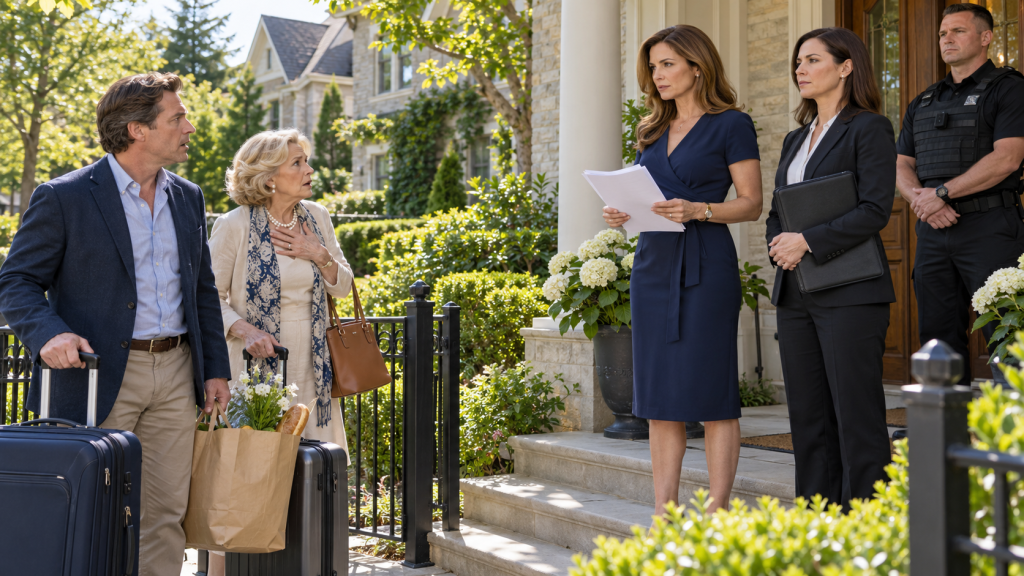
“Yes. That’s why the contents are concerning.” David immediately moved in front of his mother. “This is ridiculous.” One of the officers raised a hand. “Sir, stay where you are.” David looked at me as though I had arranged an ambush.
Maybe I had.
But I had not planted the passport.
I had not forged the deed.
I had not put my name on a transfer document I had never signed.
I had not shoved myself into a wall.
All I had done was stop protecting the people who had done those things from consequences.
David pointed toward Rachel.
“She went through my mother’s private belongings.”
Rachel answered before I could.
“The bag was left in Sarah’s home by you.”
“You gave it to her.”
“And when Sarah noticed documents bearing her name inside, she contacted counsel.”
David’s face reddened.
“You had no right.”
One of the officers interrupted.
“Mr. Vance, we’ll determine what is relevant.”
Eleanor suddenly stepped forward.
“That passport was not stolen.”
My pulse hammered.
Nobody had accused her of stealing it yet.
The officer noticed too.
“How did you obtain Mrs. Vance’s passport?”
Eleanor froze.
David closed his eyes.
Only for a second.
But I saw it.
So did Rachel.
Eleanor recovered quickly.
“Sarah gave it to me.”
I almost laughed.
“When?”
Eleanor turned toward me.
“Months ago.”
“For what?”
“You asked me to keep it safe.”
“No.”
“Yes, you did.”
I shook my head.
“I reported it missing two months ago.”
Her face changed.
Rachel spoke.
“We have the report number from the replacement application.”
Eleanor’s mouth opened.
Then closed.
David snapped:
“This is a misunderstanding.”
The officer looked at him.
“Then help us understand it.”
David pointed toward the forged quitclaim deed.
“My wife had been discussing estate planning.”
“No, I hadn’t.”
“Sarah.”
“No.”
He stared at me.
That stare used to make me question myself.
Did I forget something?
Did I say something differently?
Had I misunderstood?
Not anymore.
I continued.
“My estate plan has been in place for years.”
Rachel nodded.
“I have a copy.”
David’s jaw tightened.
The second officer picked up the fraudulent deed with gloved hands.
“Who prepared this?”
Nobody answered.
He looked at Eleanor.
Then David.
“Who prepared it?”
Eleanor said:
“A document service.”
“What service?”
“I don’t remember.”
Rachel looked at me.
That tiny glance said everything.
People remember the company preparing documents worth more than a million dollars.
The officer turned toward me.
“Mrs. Vance, is this your signature?”
“No.”
“Did you authorize anyone to sign for you?”
“No.”
“Did you intend to transfer the property to the Eleanor Vance Family Trust?”
“No.”
Eleanor snapped:
“That is not what it was for.”
Everybody turned.
Rachel’s eyes sharpened.
“What was it for?”
Eleanor realized too late.
David whispered:
“Mom.”
But she was already speaking.
“It was temporary.”
My skin went cold.
“What?”
She looked at me like I was stupid.
“The house was going into the trust temporarily.”
Rachel stepped closer.
“Why?”
Eleanor’s face hardened.
“Because Sarah has always been unreasonable about the property.”
I stared.
“My refusal to give you my house is unreasonable?”
“You don’t have children.”
The words came so quickly, so naturally, that even one officer blinked.
Eleanor continued.
“You have no one to leave it to.”
I felt something inside me go completely still.
There it was.
Six years of insults.
The little comments.
The invasive questions.
The pitying looks.
The accusation that I had somehow deprived David because we did not have children.
All of it suddenly connected to something uglier.
Not grief.
Not disappointment.
Entitlement.
Eleanor gestured toward the house.
“This property should remain in the family.”
I almost whispered:
“It is in my family.”
She laughed bitterly.
“Your father is dead.”
The porch went silent.
David said:
“Mom.”
Too late.
My father had been dead ten years.
He had worked forty-one years.
Saved carefully.
Drove the same car until the doors rusted.
He left me enough money to buy this house because he wanted me to have security.
Not David.
Not Eleanor.
Me.
I stepped forward.
“My father is dead.”
My voice shook.
“But what he left me does not become yours because you are alive.”
Eleanor’s face tightened.
“You’re twisting my words.”
“No.”
Rachel said quietly.
“She isn’t.”
David rubbed both hands over his face.
“Can we stop doing this in front of police?”
One officer answered:
“You can stop talking at any time.”
David glared at him.
Bad choice.
Then Rachel held up the court order.
“There is also the matter of the emergency order.”
David stared.
“What emergency order?”
“The one granting Sarah temporary exclusive possession of the residence.”
His expression emptied.
“No.”
“Yes.”
“You can’t remove me from my home.”
Rachel’s tone did not change.
“The judge can.”
“This is my marital residence.”
“Temporarily, the court has ordered otherwise based on the sworn allegations and video evidence.”
David turned toward me.
“You did this overnight?”
“You shoved me into a wall overnight.”
His face twisted.
“I didn’t shove you.”
One of the officers looked down at the tablet containing the hallway footage.
He had already watched it.
David noticed.
Then corrected himself.
“I mean…”
He swallowed.
“She lost her balance.”
I almost smiled.
The camera had ended that version of the story before he could properly build it.
Rachel said:
“Mr. Vance, you should stop.”
David ignored her.
He pointed at me.
“You’re destroying our marriage over one argument.”
I looked at him.
“No.”
“You did something last night that made it impossible for me to keep pretending our marriage was safe.”
His voice lowered.
“You’re going to regret humiliating my mother.”
The officer took one step forward.
“Sir.”
David stopped.
Rachel’s expression changed.
Not fear.
Recognition.
Another threat.
Another statement captured by cameras.
Another piece of evidence.
Eleanor looked between all of us.
Then suddenly bent toward the makeup bag.
The officer blocked her.
“Ma’am.”
“I need my medication.”
“What medication?”
“It’s in there.”
“We’ll retrieve it.”
“No.”
Her voice sharpened.
“I need the whole bag.”
Rachel looked at me.
Something else was inside.
I knew it.
The officer unzipped the front compartment.
Lipstick.
Foundation.
Compact mirror.
Medication bottle.
He took it out.
“Is this it?”
Eleanor stared at the bag.
“Yes.”
Her answer came reluctantly.
The officer handed her the bottle after checking the label.
Then his gloved fingers touched something underneath the makeup tray.
An envelope.
Thick.
White.
Eleanor went pale.
“Please don’t.”
The officer stopped.
“What is it?”
“Nothing.”
David said:
“Mom.”
She turned on him.
“You said you took everything out!”
Silence.
My heartbeat pounded in my ears.
David looked as though somebody had struck him.
Rachel whispered:
“Oh.”
The officer removed the envelope.
On the front were three printed words.
LAKESHORE PRIVATE CAPITAL
David closed his eyes.
I looked at Rachel.
“What is that?”
She shook her head.
“I don’t know.”
The officer did not open it on the porch.
He placed it with the other documents.
Then asked:
“Mr. Vance, do you recognize this?”
David’s voice became quiet.
“No.”
Eleanor stared at him.
“You liar.”
The words came out venomous.
David looked at her.
“Mom.”
“You said this was handled.”
That was the moment everything changed.
Until then, David and Eleanor had been standing on the same side.
Mother and son.
United against unreasonable Sarah.
Then fear cracked the partnership.
“What was handled?”
I asked.
Neither answered.
Rachel looked at David.
“What is Lakeshore Private Capital?”
He said nothing.
Eleanor did.
“A lender.”
My stomach dropped.
Rachel’s voice sharpened.
“A lender for what?”
Eleanor began crying.
Not soft tears.
Angry tears.
“I sold my condo because of him.”
She pointed at David.
He snapped:
“Don’t.”
The officer said:
“Ma’am, tell us what you mean.”
Eleanor looked at her son.
“You promised.”
David stepped toward her.
“Stop talking.”
“Sir, step back.”
He did.
Barely.
Eleanor wiped her face.
“My condo wasn’t supposed to be gone.”
I stared.
“You told David you sold it.”
“I did sell it.”
“Why?”
She looked at him again.
David whispered:
“Please.”
That word frightened me more than his anger had.
Eleanor said:
“Because David needed the money.”
My knees weakened.
Rachel moved closer to me.
“How much money?”
I asked.
Eleanor looked down.
“Six hundred and forty thousand dollars after closing costs.”
I stared at her.
“What?”
David said:
“It wasn’t like that.”
I looked at him.
“Like what?”
“It was an investment.”
“What investment?”
No answer.
“David.”
He glanced toward the police.
“Not here.”
I almost laughed.
“You planned to discuss my house with your mother over roast chicken.”
“But this is too private?”
His face hardened.
“It was a real-estate development.”
Rachel asked:
“Where?”
David looked away.
Eleanor answered.
“Lake Geneva.”
My stomach twisted.
David had mentioned Lake Geneva repeatedly over the past year.
Weekend meetings.
Investor dinners.
Property opportunities.
I had assumed it was work.
Apparently, it was.
Just not the kind of work he had described.
“What happened to the six hundred and forty thousand?”
Eleanor whispered:
“Most of it is gone.”
David snapped:
“It’s not gone.”
She rounded on him.
“Then give it back!”
One officer looked at the other.
This had moved far beyond a domestic dispute.
Rachel asked:
“What does any of that have to do with Sarah’s house?”
Nobody answered.
She looked toward the envelope.
Then at the fake deed.
Her expression changed.
“Oh.”
I saw it too.
A lender.
A mortgage-free house.
A forged transfer into a trust.
Eleanor’s condo money gone.
I felt physically sick.
“You were going to borrow against my house.”
David said:
“Sarah.”
I stepped backward.
“You were.”
“It was temporary.”
Same word Eleanor had used.
Temporary.
Such a useful word for people taking things that do not belong to them.
Rachel said:
“How much?”
David shook his head.
“It never happened.”
“How much were you attempting to borrow?”
No answer.
Eleanor whispered:
“Seven hundred and fifty thousand.”
The world narrowed.
I gripped the porch railing.
Seven hundred and fifty thousand dollars.
Against my father’s house.
Against the thing David once smiled and promised he did not care about.
“You planned to take a seven-hundred-and-fifty-thousand-dollar loan against my home?”
David’s face collapsed.
“No.”
Eleanor shouted:
“Yes!”
He turned on her.
“Shut up!”
She recoiled.
The officer moved between them.
“Enough.”
David ran one hand through his hair.
“It was not stealing.”
I stared at him.
“Then what do you call secretly transferring my property into your mother’s trust so you can borrow against it?”
“The trust was protection.”
“For whom?”
“For us.”
“There is no us in a trust named after your mother.”
He looked trapped.
Then said the worst thing possible.
“You would have benefited if the development succeeded.”
I laughed.
A broken, disbelieving laugh.
“I didn’t know the development existed.”
“I was going to tell you.”
“When?”
“When it was safe.”
I stared at him.
“You mean when you had made enough money that you thought I’d forgive how you got it.”
He said nothing.
Correct.
Rachel asked:
“Was the forged deed already recorded?”
Eleanor shook her head.
“No.”
David looked at her sharply.
She continued.
“The lender’s attorney wanted additional verification.”
My heart raced.
“What verification?”
Eleanor looked at the makeup bag.
The email.
The message about calling me unstable.
Rachel understood before I did.
“A competency affidavit.”
Eleanor started crying again.
Rachel looked at me.
“They were preparing two paths.”
My stomach dropped.
“What do you mean?”
“If you cooperated today, they wanted you to sign documents confirming the transfer.”
“And if I didn’t?”
Rachel glanced at the email.
“If you refused, they appear to have been preparing to argue you were not managing your affairs rationally.”
I stared at David.
He had spent years telling me I was dramatic.
Too emotional.
Too rigid.
Too attached to “my house.”
Now those same words had become a financial strategy.
“You were going to call me incompetent?”
“No.”
Eleanor said:
“That was my idea.”
David turned.
“Mom!”
She looked at him with fury.
“You said she’d never sign.”
“I said we’d talk to her!”
“You said she was impossible.”
“I never told you to—”
“You gave me her passport!”
Silence.
That sentence ended the argument.
My missing passport.
David.
Not Eleanor searching through drawers.
Not some accident.
My husband.
Rachel asked quietly:
“David, did you remove Sarah’s passport from the home?”
He stared at the ground.
One officer repeated:
“Sir?”
David’s attorney did not exist yet.
But suddenly David discovered the wisdom of silence.
“I want a lawyer.”
Good.
Finally.
The officer nodded.
“That is your right.”
The rest happened slowly.
Not dramatically.
Nobody was tackled.
Nobody was handcuffed on the porch.
The officers separated us.
Statements were taken.
The makeup bag and documents were photographed and later taken as potential evidence with Eleanor’s consent after her lawyer advised cooperation.
David was formally served with the temporary order.
He was allowed to retrieve clothing, medication, work equipment, and necessary personal items while the security guard and an officer remained present.
He entered the house at 1:08 p.m.
For the first time in six years, David entered my home as someone who needed permission.
He hated it.
I could see that.
I stood in the kitchen while he packed upstairs.
Rachel stayed beside me.
At one point, David came down carrying a suitcase.
He stopped at the counter.
The black makeup bag was gone.
But the coffee mug remained where I had left it that morning.
He stared at it.
Then at me.
“You really planned all this after I left?”
“No.”
“What?”
“I planned safety.”
“The rest came out of your mother’s bag.”
His jaw tightened.
“Do you think you’re innocent in our marriage?”
There it was.
The pivot.
If he could not deny what he had done, he would widen the courtroom until I had to defend everything I had ever done.
I shook my head.
“This isn’t a trial of whether I’ve been a perfect wife.”
“You’re acting like I’m some monster.”
“No.”
I looked at him.
“I’m acting like you shoved me into a wall, stole my passport, helped prepare a forged deed, and tried to use my house as collateral without telling me.”
He flinched.
“Those are actions.”
“I don’t need to decide what kind of person they make you today.”
His eyes filled.
That almost broke me.
Almost.
Then he whispered:
“I love you.”
I felt something inside me ache.
“I know.”
That surprised him.
“You know?”
“Yes.”
“I think you do.”
His face crumpled.
“Then why are you doing this?”
Because love is not the opposite of danger.
Because people can love you and still feel entitled to control you.
Because the existence of affection does not erase the existence of fear.
I said only:
“Because loving me did not stop you.”
He looked away.
Then carried his suitcase outside.
Eleanor did not enter.
She sat in the passenger seat.
Her groceries remained in the trunk.
The roast chicken never happened.
By 2:30, the driveway was empty.
I locked the door.
Then I sat on the kitchen floor.
Not the chair.
Not the sofa.
The floor.
Rachel sat beside me in her expensive suit.
Neither of us spoke.
I started shaking.
Violently.
The body waits.
That is something nobody tells you.
Sometimes you do not shake during the danger.
You shake afterward.
When the police leave.
When the documents are bagged.
When the person who frightened you is gone.
When there is finally enough silence for your nervous system to realize what almost happened.
Rachel wrapped a blanket around me.
“I almost lost the house.”
She shook her head.
“No.”
“They almost took it.”
“They tried.”
I looked at her.
“What if David had grabbed the correct makeup bag?”
Rachel’s face tightened.
“We might have discovered it later.”
“But later could have been after they recorded the deed.”
“Yes.”
“After the loan.”
“Possibly.”
I covered my face.
The difference between safety and disaster had been a mistake.
Two nearly identical cosmetic bags.
David grabbed the wrong one.
A man who had spent six years acting as if my home was partly his had almost delivered the evidence of his own scheme directly into my hands because his mother packed two black bags.
I started laughing.
Rachel looked worried.
“I’m okay.”
“No, you’re not.”
“Fair.”
I laughed harder.
Then cried.
For almost twenty minutes.
The next week changed everything again.
Lakeshore Private Capital had been reviewing an application connected to the Eleanor Vance Family Trust.
The proposed collateral was my Evanston house.
Estimated value:
$1.34 million.
Proposed loan:
$750,000.
Purpose:
“Bridge financing for real-estate development obligations.”
The application described Eleanor as anticipated trustee and beneficial owner after a “pending family transfer.”
My name appeared twice.
Once as grantor.
Once as “occupant to vacate or execute tenancy agreement upon closing.”
I stared at the phrase.
Occupant.
After my father’s money bought the house.
After three years of ownership before meeting David.
After six years of marriage.
In their paperwork, I had become an occupant.
Rachel sat across from me.
“This was never going to survive scrutiny cleanly.”
“But it might have survived long enough.”
She nodded.
“That is the danger.”
The lender had requested confirmation because the preliminary title work showed the house had been my separate property before marriage.
They also found the prenup referenced in disclosures from an earlier estate-planning review.
That saved me too.
David had once complained the prenup was an insult.
Now it was one of the reasons a lender paused.
The proposed deed had not yet been recorded.
Thank God.
But they had gone far enough that the plan was no longer theoretical.
Draft loan documents existed.
Trust paperwork existed.
My passport had been taken.
My signature had been copied.
There were email chains.
And there was a scheduled remote call for Friday afternoon.
The day Eleanor arrived for lunch.
I looked at Rachel.
“They wanted me on a video call.”
“Yes.”
“To confirm the transfer.”
“Yes.”
“And if I refused?”
She hesitated.
“What?”
“There was a draft email from Eleanor to a lawyer.”
My skin went cold.
“What lawyer?”
“Not a lawyer representing the lender.”
“A lawyer she consulted privately.”
“What did it say?”
Rachel turned her laptop toward me.
The email was short.
If Sarah becomes emotional or refuses to discuss the trust rationally, can David document that as evidence she is no longer capable of managing the property?
The reply was cautious.
A disagreement does not establish incapacity. Any guardianship or competency proceeding would require substantial evidence and medical evaluation. Please do not mischaracterize ordinary conflict as incapacity.
I stared.
The lawyer had told her no.
Eleanor had apparently kept going anyway.
Another message from Eleanor to David:
We need her calm in front of the lender. If she refuses, let her get emotional. It may help later.
My stomach turned.
The makeup.
Cover the mark.
Smile.
Sit at lunch.
Perform normal.
Confirm the deed.
And if I refused?
Become evidence against myself.
I closed the laptop.
“I want a divorce.”
Rachel studied me.
“You’re sure?”
“Yes.”
I was.
Not because of one shove.
Not because of the house.
Not because of Eleanor.
Because for the first time I could see the architecture of the marriage.
Every time David told me I was overreacting, he moved the wall.
Every time I compromised, he took the compromise as proof he had authority.
Every time Eleanor crossed a boundary, David asked me to become more understanding instead of asking her to stop.
The forged deed was extreme.
But it had not appeared from nowhere.
It had been built from smaller permissions nobody had permission to take.
I filed.
David responded badly.
Then strategically.
Then badly again.
His first text after being served:
You’ve let Rachel poison you against me.
His second:
Mom is sick over this.
His third:
If Dad were alive, he’d be ashamed of what you’re doing to our family.
That one almost made me throw the phone.
Instead, I saved it.
My father had known David for less than two years before he died.
He liked him.
Mostly.
But once, after David had complained jokingly that I was “too independent,” Dad said something I remembered for the first time only then.
“Independent women are only difficult to men who hoped dependence would do part of the work.”
I had rolled my eyes.
Dad had smiled.
Now I cried.
The criminal investigation moved separately.
The hallway footage was straightforward.
Domestic battery did not require a philosophical debate about our marriage.
David had grabbed my wrist.
I pulled away.
He shoved me.
My shoulder struck the wall.
The video showed it.
His defense initially framed it as mutual conflict.
Then his attorney saw the footage.
The language changed.
David eventually accepted responsibility for a misdemeanor domestic-battery-related charge as part of a plea arrangement.
Probation.
Counseling.
No-contact conditions for a period.
No dramatic prison sentence.
Some relatives thought that meant he “got away with it.”
I did not.
I wanted the record to say what happened.
It did.
The financial investigation was more complicated.
The forged deed had not been recorded.
The lender had not funded the loan.
No $750,000 left anyone’s account.
That mattered.
Attempted fraud is harder to dramatize than completed theft.
But the passport.
Signature samples.
Trust documents.
Emails.
Loan application.
Those mattered too.
Eleanor insisted she believed Sarah—me—would eventually agree.
David insisted he never intended to record anything without my consent.
Then investigators found a message he had sent his mother four days before the shove.
She’ll say no if we ask directly. Get the transfer papers ready first. Once she sees everything is already arranged, she’ll stop fighting.
I read that message at Rachel’s office.
Then read it again.
Once she sees everything is already arranged, she’ll stop fighting.
That was our marriage in one sentence.
He did not think consent meant yes.
He thought consent meant the point at which I stopped resisting an already-made decision.
The house.
Holidays.
His mother.
Money.
Everything.
Rachel watched me.
“You okay?”
“No.”
“Do you want to stop?”
“No.”
I kept reading.
Another message.
Eleanor:
What if she still refuses?
David:
Then we deal with that after.
No detail.
No explicit plan.
Somehow the vagueness frightened me more.
The Lake Geneva development was real.
That surprised me.
David had not invented everything.
He and two business partners had purchased options on several parcels near the lake, planning a boutique residential project.
Then interest rates changed.
One investor withdrew.
Construction estimates rose.
A bridge lender pulled out.
David had personally guaranteed part of the preliminary obligations.
He was facing nearly $410,000 in exposure.
I had no idea.
Not one dollar of those guarantees bore my signature.
Not one document had been shown to me.
When Eleanor sold her condo, she gave David $640,000 because he promised the project would return her money within eighteen months with profit.
He used approximately $380,000 to cover obligations and keep the development alive.
Another $140,000 went toward an earnest-money extension and professional fees.
The rest remained in accounts investigators later traced.
Eleanor had sold her home to save her son’s investment.
Then, when that was not enough, they looked at mine.
The development had become a family emergency.
Except nobody told the family member whose house they intended to use.
When I learned the full amount, I felt almost sorry for David.
Almost.
I understood panic.
I understood shame.
I understood a person making one bad financial decision and then making another because admitting the first felt unbearable.
What I did not understand was the moment he looked at my father’s house and decided the solution belonged to him.
We met once with attorneys present before the divorce mediation.
David looked terrible.
He had lost weight.
His expensive haircut had grown out.
For six years, I had known every version of his face.
Angry.
Amused.
Tired.
Drunk.
Affectionate.
Impatient.
I had never seen this one.
Ashamed.
He looked at me.
“Can I say something?”
My attorney nodded.
His did too.
David swallowed.
“I never meant for Mom to keep the house.”
I stared at him.
That was his opening.
Not:
I’m sorry.
Not:
I hurt you.
“I was going to transfer it back.”
“When?”
“After the financing closed.”
I laughed once.
His attorney looked down.
David continued quickly.
“The Lake Geneva property would have been refinanced.”
“I could have repaid the loan within a year.”
“You don’t know that.”
“I believed it.”
“That is not the same thing.”
He rubbed his forehead.
“I was desperate.”
“I know.”
“My mother had already sold her condo.”
“I know.”
“She would have lost everything.”
“She chose to invest.”
“I asked her.”
“Yes.”
“I felt responsible.”
I leaned forward.
“So you chose me to absorb the risk.”
He went silent.
I continued.
“You thought your mother losing money was unacceptable.”
“You thought you losing money was unacceptable.”
“But me losing control of my home?”
“You decided that was manageable.”
His eyes filled.
“I thought I could fix it before you understood.”
“That sentence is the problem.”
He covered his face.
For a moment, the room was quiet.
Then David whispered:
“I was angry you had the house.”
I froze.
His lawyer turned slightly.
Maybe this part was not rehearsed.
“What?”
David looked at me.
“I hated that every time we argued about money, you had this one thing I could never touch.”
My throat tightened.
“The house?”
“Yes.”
“You mean the thing you signed a prenup agreeing was mine.”
“I know.”
“The thing you said you did not care about.”
“I know.”
His voice broke.
“At first I didn’t.”
“Then?”
He stared at the table.
“Then work got worse.”
“Mom kept saying a husband shouldn’t be a guest in his wife’s house.”
I almost rolled my eyes.
“Eleanor.”
“I know.”
“She kept saying if you really trusted me, you’d put me on the deed.”
“You agreed with her.”
“Eventually.”
“Why?”
“Because I felt…”
He stopped.
“What?”
“Small.”
I stared.
There it was.
Not law.
Not money.
Not practicality.
Small.
My security made him feel small.
My refusal to surrender it made him feel powerless.
Instead of managing that feeling, he treated my ownership as an insult.
“You could have bought another house with me.”
I said.
“I offered twice.”
“I know.”
“You refused.”
“I didn’t want another house.”
“Why?”
His answer came quietly.
“I wanted yours.”
That sentence ended any remaining fantasy in me.
Not because it was cruel.
Because it was finally honest.
I sat back.
“Thank you.”
He looked confused.
“For what?”
“For saying it.”
Tears slid down his face.
“I’m sorry.”
I believed him.
Not enough to return.
But I believed him.
Divorce mediation took two long days.
The prenup held.
He had independent counsel when he signed.
Full disclosure.
Clear terms.
The house remained mine.
The increase in its value remained mine.
David retained his retirement accounts subject to the agreement and later adjustments.
We divided ordinary marital assets.
Joint savings.
Furniture.
Cars.
No courtroom spectacle.
No judge pounding a gavel.
No triumphant speech.
Just signatures.
The last document I signed with David was not a deed giving him part of my house.
It was a divorce judgment confirming he had no claim to it.
There was poetry in that.
I did not mention it.
Eleanor’s consequences were different.
She was sixty-eight.
No home.
Much of her condo money tied up or lost in the development.
Her relationship with David fractured badly during the investigation.
For months, each blamed the other.
He said she pushed the trust idea.
She said he gave her my passport.
Both were true.
Eventually, Eleanor entered an agreement resolving the financial charges against her.
Restitution related to investigative costs and document fraud.
Probation.
No prison.
She moved into a one-bedroom apartment outside Chicago.
Not my house.
Never my house.
I did not speak to her for almost two years.
Then one afternoon, a letter arrived.
Handwritten.
No return address I recognized.
I almost threw it away.
Instead, I opened it.
Sarah,
I am not writing to ask forgiveness.
Good.
I spent most of my life believing that because I loved David more than anyone, I had the right to protect him from consequences.
I now understand that this did not protect him.
It taught him that other people’s boundaries were obstacles.
I stopped.
Read that again.
I treated your house as something you had been lucky enough to receive rather than something your father intentionally left to you.
I told myself David deserved security.
I never asked why your security should be the price.
My eyes filled.
The worst thing I said was that you had no children and therefore no one to leave the house to.
I have thought about that sentence every day.
It was cruel even before everything else.
A woman does not need a child to justify owning a future.
I sat down.
That line hurt.
And healed.
A little.
I also owe you the truth about something else.
My stomach tightened.
There was always something else.
David did not steal your passport alone.
I stared.
I took it from your office while you were upstairs showering after Thanksgiving dinner.
My hands went cold.
I remembered Thanksgiving.
Eleanor had disappeared for almost fifteen minutes.
She later said she had been looking for the guest bathroom.
There were two bathrooms downstairs.
Of course.
David asked me whether I knew where you kept identification.
I knew because I had gone through your desk once before.
He did not tell me to take it that day.
I chose to.
I gave it to him afterward.
I closed my eyes.
She had finally stopped making herself an accessory to David’s choices.
She was naming her own.
I am sorry.
Eleanor.
I did not respond for three months.
Then I wrote:
I believe you understand more now than you did then. I am not ready for a relationship. Please respect that.
She did.
No calls.
No gifts.
No surprise visits.
That mattered.
David wrote too.
Longer.
More often.
At first, I returned them unopened through the attorneys.
Then after the no-contact restrictions ended, one arrived that I kept.
He wrote:
The first time I asked you to put my name on the deed, you said no and I felt embarrassed.
Instead of asking myself why your ownership embarrassed me, I decided your refusal was the problem.
Another letter:
When you said the house came from your father, I heard: this is something I have that you do not.
What you meant was: this is something my father protected for me.
I should have respected that.
And eventually:
The shove was not an accident.
That one mattered most.
I was angry.
You said no.
I wanted the no to stop.
I put my hands on you because I believed my anger mattered more than your safety for those three seconds.
I am ashamed of that.
I will not call it losing control anymore.
I cried when I read that.
People say someone “lost control.”
Sometimes they did.
But David had not lost control equally.
He did not punch the wall.
He did not throw himself down the stairs.
He did not shove Eleanor.
He shoved me.
The person whose no stood between him and what he wanted.
Naming that mattered.
I did not reconcile with David.
I need to say that clearly.
Not because people cannot change.
They can.
David did.
Slowly.
Painfully.
He attended intervention counseling.
Financial therapy.
Individual therapy.
He lost the Lake Geneva investment.
He repaid part of Eleanor’s money over several years.
He moved into a small rental.
He stopped drinking bourbon every night.
He rebuilt his career.
None of that entitled him to me.
Change is not a transaction where the person who caused harm completes enough tasks and receives the relationship back.
He changed because that was his responsibility.
I left because that was mine.
The first year alone in the house was strange.
At night, every sound felt too large.
The furnace.
Branches.
A truck outside.
The refrigerator cycling.
Sometimes I woke convinced David was coming through the garage.
Even though the codes were changed.
The locks were changed.
The order was in place.
The cameras worked.
My body did not care about legal paperwork at two in the morning.
So I worked with a therapist named Dr. Anita Bell.
In our first session, she asked:
“Do you feel safe at home?”
“Yes.”
“Does your body believe that?”
I cried immediately.
Annoying question.
Useful question.
We worked slowly.
I stopped sleeping with my phone under my pillow.
Then on the bedside table.
Then across the room.
I stopped checking every camera alert three times.
I stopped freezing when a car door slammed outside.
Not all at once.
Safety is sometimes physical before it becomes emotional.
I repaired the hallway wall six months after the divorce.
For a while, I left the dent.
I told myself it was evidence.
Rachel said the video was evidence.
The photographs were evidence.
The police report was evidence.
I did not need damage in my own hallway to prove what had happened.
So I hired a contractor.
He patched it.
Painted.
Then asked:
“Want me to hang the picture frame again?”
I looked at the broken frame I had kept in a box.
It had contained a photograph of my father and me.
The glass had shattered when I hit the wall.
The photograph survived.
I bought a new frame.
Larger.
Stronger.
Hung it in the same place.
My father was laughing in the picture.
I was twenty-six.
He had one arm around me.
For years, I thought the house was the thing he had left me.
It wasn’t.
The house was only one thing.
He left me the expectation that love and security were allowed to exist together.
David had taught me to separate them.
I was learning to put them back.
Two years after the divorce, I did something Eleanor would have hated.
I changed my will.
Not because of her.
Because the entire ordeal forced me to think about what I wanted.
I still had no children.
I still did not consider that a tragedy.
I loved my nieces.
Friends.
Community.
Work.
My life was not an unfinished family tree.
I left modest gifts to relatives.
Some money to Rachel, who protested.
The rest of the house, when eventually sold after my death, would fund legal assistance for women trying to secure housing after domestic violence.
I told Rachel:
“Do not name anything after me.”
She laughed.
“Fine.”
“And no plaque.”
“You’re controlling from beyond the grave.”
“Absolutely.”
I also removed David’s right to remain in the house if I died.
That provision had survived from the years when I believed our marriage was safe.
Changing it hurt more than signing the divorce judgment.
That clause once meant:
If I die first, I want you protected.
Removing it meant admitting:
That future no longer exists.
I cried in Rachel’s office.
She waited.
Then I signed.
At forty-three, I started traveling again.
I had always wanted to see Lisbon.
David hated long flights.
Eleanor called Portugal “overrated” despite never having visited.
So I went.
Alone.
The first night, I sat at a tiny restaurant and panicked.
Not because I was unsafe.
Because nobody knew where I was.
Then I realized that was also freedom.
I sent Rachel a photograph.
Still alive. Wine excellent.
She replied:
Please do not make me your emergency contact and then mock me.
Fair.
I traveled more.
Montreal.
Santa Fe.
Barcelona.
Not constantly.
I still loved home.
That was important.
I did not need to reject the house simply because people had tried to take it.
I reclaimed it by living there.
The guest room Eleanor planned to occupy?
I turned it into a studio.
Not an art studio.
I have no talent.
A reading room.
Books.
A deep chair.
A ridiculous lamp shaped like a bird.
Nobody approved it.
Perfect.
The closet that would have held Eleanor’s clothes became storage for winter coats and luggage.
The bathroom she once criticized as “too modern” remained exactly the same.
Petty?
Maybe.
Healing can afford a little pettiness.
At forty-five, I adopted a dog.
A seventy-pound mutt named Arthur.
Yes.
After my father.
Rachel called that psychologically transparent.
I told her to mind her business.
Arthur loved the hallway.
Slept exactly where the old broken frame had fallen.
The first time I noticed, I cried.
He looked annoyed.
Dogs dislike emotional symbolism.
Eleanor contacted me again around that time.
One email.
Would you be willing to meet in a public place? If not, I will not ask again.
That last sentence mattered.
I agreed.
Coffee shop.
Daylight.
My car.
My choice.
Eleanor looked smaller.
Not physically.
The force around her had changed.
She no longer entered rooms assuming everyone else would rearrange themselves.
We sat.
She said:
“Thank you for coming.”
I nodded.
Then silence.
Finally, she said:
“I used to think you stole David from me.”
I almost laughed.
“David was thirty-seven when we married.”
“I know.”
“You say that now.”
She smiled sadly.
“Yes.”
She folded her hands.
“When his father left, David was twelve.”
I knew that.
“He became the man of the house.”
I had heard that phrase too.
“I praised him for taking care of me.”
“For fixing things.”
“For worrying about money.”
“For choosing me.”
She swallowed.
“I think I taught him that love meant responsibility for me.”
“And then I taught myself that anything good in his life belonged partly to me.”
Including my house.
She nodded.
“Including your house.”
I stared at her.
“Do you know what I hated most about you?”
She looked startled.
“No.”
“That you always called me selfish after asking me for something.”
Her face fell.
I continued.
“It made generosity feel like a debt.”
“I know.”
“No.”
I shook my head.
“I don’t think you did then.”
“No.”
She corrected herself.
“I know now.”
Better.
She looked down.
“I was wrong about children too.”
I said nothing.
“I spent years treating your marriage like it was incomplete because you and David didn’t have them.”
“That was cruel.”
“Yes.”
“My body was none of your business.”
“Yes.”
“My reasons were none of your business.”
“Yes.”
“And my house did not become available for inheritance simply because I had no child.”
“Yes.”
I watched her.
She did not defend.
Did not explain.
Did not cry.
Just answered.
Yes.
Eventually, I said:
“Thank you.”
She looked up.
“For what?”
“For not making me comfort you.”
Her eyes filled then.
But she smiled.
“I’m learning.”
We never became close.
That would make a cleaner story.
It would also be false.
We met occasionally.
Birthdays in neutral places.
A few holiday lunches after David and I had built enough distance.
She never came to my house again.
Not because I banned her forever.
Because she never asked.
That may have been her final act of respect.
David and I saw each other for the first time without lawyers at a mutual friend’s funeral four years after the divorce.
He approached slowly.
“Sarah.”
“David.”
“You look well.”
“So do you.”
He did.
Older.
Less polished.
More human somehow.
He glanced at my left hand.
No ring.
His either.
“How’s the house?”
I almost laughed.
“Still mine.”
He winced.
“I deserved that.”
“Yes.”
Then I felt bad.
Not because the joke was wrong.
Because I did not want every future conversation to be a punishment.
“It’s good.”
I said.
“I turned the guest room into a library.”
He smiled.
“Your father would like that.”
My throat tightened.
“Yes.”
David looked down.
“I’m sorry I brought your father into those messages.”
“I know.”
“I was trying to hurt you.”
“I know.”
Silence.
Then he said:
“I paid Mom back.”
“All of it?”
“Not yet.”
“Most.”
“Good.”
“Lake Geneva is gone.”
“I heard.”
“The property was sold.”
“Good.”
He smiled sadly.
“You always hated that project.”
“I didn’t know it existed.”
He laughed.
“Right.”
We stood there.
Two people who once slept beside each other every night.
Now politely discussing the wreckage.
Then David said:
“I used to think the divorce was the worst thing that happened to me.”
I said nothing.
“Now I think the worst thing was becoming someone you needed to divorce.”
That hurt.
In a different way.
I looked at him.
“And?”
“And the divorce was the consequence.”
He nodded.
“Not the tragedy.”
That was growth.
Real growth.
I said:
“I hope you have a good life.”
His eyes filled.
“You too.”
We meant it.
Then walked in opposite directions.
At fifty, I received a package.
No return address.
Inside was the black makeup bag.
I nearly dropped it.
For one second, I was back at the kitchen island.
Coffee.
Bruise.
David’s voice:
Freshen up and smile.
I called Rachel immediately.
“What is this?”
She laughed.
“What?”
“You sent me the bag?”
“Oh.”
“You forgot?”
“Apparently.”
She explained that after the criminal case fully closed, property held as evidence had been released.
Eleanor had declined it.
David declined it.
The bag legally belonged to Eleanor, but she signed permission for it to be destroyed or transferred.
Rachel, for reasons known only to her, had kept it in a file box.
“I thought you might want it.”
“Why?”
“I don’t know.”
“You’re a terrible lawyer.”
“I’m an excellent lawyer.”
“Terrible archivist.”
“Probably.”
I stared at the bag.
“What should I do with it?”
“Whatever you want.”
For several days, it sat on my kitchen counter.
The same place David had dropped it years earlier.
I hated seeing it.
Then realized something.
I did not need to turn every painful object into a sacred symbol.
Sometimes a makeup bag is garbage.
I threw it away.
Not ceremonially.
Tuesday trash pickup.
Black bin.
Done.
That felt wonderful.
Years later, Rachel asked if I regretted it.
“No.”
“Not even a little?”
“No.”
“The passport?”
“Replaced.”
“The deed?”
“Fake.”
“The bag?”
“Ugly.”
She laughed.
Good.
By fifty-three, I had become the person friends called when they were about to make excuses for somebody else’s unacceptable behavior.
I hated this role.
But apparently I was good at it.
A coworker once told me:
“He only checks my phone because his last girlfriend cheated.”
I said:
“That explains fear.”
“It doesn’t create permission.”
Another friend said:
“My sister comes over without asking because family shouldn’t need appointments.”
I said:
“Then stop answering the door.”
Rachel accused me of turning into a boundary slogan machine.
Maybe.
But I tried to remember nuance.
Not every disagreement is abuse.
Not every difficult relative is dangerous.
Not every controlling moment becomes forged deeds and stolen passports.
But patterns matter.
Especially when every compromise flows in one direction.
David once believed our marriage meant my house should eventually become his.
Eleanor believed motherhood gave her influence over David’s marriage.
I believed keeping peace meant I should keep explaining myself until people accepted my reasons.
All three of us were wrong.
The clearest lesson was also the simplest.
No does not require a winning argument.
At fifty-five, I received a call from a young woman named Melissa.
I did not know her.
She sounded nervous.
“Is this Sarah Caldwell?”
I had returned to my maiden name years earlier.
“Yes.”
“My name is Melissa Grant.”
A pause.
“I’m seeing David.”
My stomach tightened.
Not jealousy.
Alarm.
Old muscle memory.
“Okay.”
“I’m sorry to call.”
“How did you get my number?”
“Eleanor.”
Of course.
I almost laughed.
“Is something wrong?”
Melissa hesitated.
“No.”
Then:
“I don’t know.”
My chest tightened.
“What happened?”
“David told me why your marriage ended.”
I stayed silent.
“He said he hurt you.”
“Yes.”
“He said there was a financial situation involving your house.”
“Yes.”
“He told me not to contact you unless I ever felt he was hiding something.”
That surprised me.
Melissa continued.
“He gave me your number himself.”
I sat down.
“What is he hiding?”
“I don’t think anything.”
“Then why call?”
“Because we’re talking about moving in together.”
“And?”
“He asked me to keep my condo in my name.”
I almost laughed.
Melissa sounded embarrassed.
“I know this is strange.”
“No.”
“It’s strange.”
“Did he pressure you to sell it?”
“No.”
“Ask for money?”
“No.”
“Ask to be added to the deed?”
“No.”
“Does he know your passwords?”
“No.”
“Then why are you worried?”
“Because he told me if I ever think he’s making financial decisions for me instead of with me, I should leave.”
I went quiet.
Melissa said:
“I wanted to know if that sounded like something he’d say because he actually changed…”
“Or because he learned the right words?”
“Yes.”
Good question.
I answered carefully.
“I cannot certify David.”
She almost laughed.
“I know.”
“I can tell you that when we were married, he believed marriage gave him rights over things I had never agreed to share.”
“He also responded badly when I said no.”
“Has he done that to you?”
“No.”
“Then pay attention to what he does.”
“Not what he says.”
“If your no remains safe, that matters.”
She was quiet.
“Do you hate him?”
“No.”
That answer surprised her.
“Should I?”
“No.”
I smiled sadly.
“That is your relationship.”
“Make your own decision.”
She thanked me.
Years later, I learned they married.
Small ceremony.
Separate property agreements.
Eleanor did not plan it.
Progress everywhere.
David sent me a short note before the wedding.
I told Melissa the truth before asking her to marry me.
Not because I deserved credit.
Because she deserved information.
I wrote back:
Good.
One word.
Enough.
When I turned sixty, I threw a party at the house.
My house.
Thirty people.
Friends.
Nieces.
Coworkers.
Rachel.
Arthur the dog was long gone by then, but his picture sat on the bookshelf.
There were flowers.
Music.
Too much food.
No roast chicken.
Intentional.
Rachel raised a glass.
“I’ve known Sarah long enough to remember when she apologized before saying no.”
People laughed.
I pointed at her.
“Careful.”
“She does not do that anymore.”
More laughter.
Rachel continued.
“And I’d like to thank everyone for requesting an invitation before entering the property.”
I threw a napkin at her.
Someone asked:
“Is that really a rule?”
“Yes.”
I said.
Everyone laughed.
But it was.
Not the formal kind.
The human kind.
Knock.
Ask.
Wait.
That evening, after everyone left, I walked through the quiet house.
Kitchen lights low.
Glasses on the counter.
Flowers everywhere.
The hallway photograph of Dad still hanging in its new frame.
I stopped beside it.
For years, I had thought the great victory was keeping the house.
It wasn’t.
If I had sold it the next day by choice, that could have been victory too.
Ownership was never the deepest point.
Choice was.
Who gets to decide.
Who gets to say yes.
Who gets to say no.
Who gets to change their mind.
Who gets to keep the door closed.
Who gets to open it.
David and Eleanor had tried to take a legal choice from me.
Before that, more quietly, I had spent years surrendering emotional choices because conflict exhausted me.
The forged deed only made the pattern impossible to ignore.
At sixty-two, I sold the house.
That surprises people.
After everything?
Yes.
After everything.
I sold it because I wanted a smaller place.
The yard was too much.
The stairs annoyed my knees.
Property taxes were absurd.
The neighborhood had changed.
I wanted sunlight, a balcony, and less maintenance.
When I told Rachel, she stared at me.
“You’re sure?”
“Yes.”
“You fought so hard for this place.”
“I fought for the right to decide what happened to it.”
She smiled.
“Fair.”
The buyers were a couple in their thirties with a four-year-old daughter.
During the final walkthrough, the little girl ran down the hallway.
Her mother apologized.
I said:
“Let her run.”
She stopped in front of the photograph of my father.
“Who’s that?”
“My dad.”
“Does he live here?”
I smiled.
“No.”
“But he helped me buy it.”
That was enough.
I took the photograph down last.
Not the deed.
Not the prenup.
The photograph.
At closing, I signed the transfer documents myself.
Every page.
My lawyer beside me.
My identification in my own hand.
I understood exactly what I was signing.
The house sold for far more than my father’s original inheritance had bought it for.
I used part of the proceeds to purchase a condominium outright.
Mine.
Again.
The rest funded my retirement, travel, and the legal-aid organization I had named in my will.
When I received the keys to the condo, Rachel handed me a small makeup bag.
Black.
I stared at her.
She burst out laughing.
“You’re evil.”
“It’s new!”
“Take it away.”
Inside was lipstick.
A tiny bottle of champagne.
And a card.
Freshen up if YOU feel like it. Smile if YOU feel like it.
I laughed until I cried.
Then kept that bag.
Different object.
Different meaning.
At sixty-five, Eleanor died.
David called me.
I had not seen her for two years.
Our relationship had become occasional holiday cards and one annual lunch.
She had never entered my home again.
Her final card arrived three months before she died.
It said:
Thank you for teaching an old woman that being invited feels better than assuming.
I kept it.
David asked if I would attend the funeral.
“Yes.”
I went.
Melissa sat beside him.
At the service, nobody pretended Eleanor had been easy.
Thank God.
People spoke about her strength.
Her fierce love.
Her stubbornness.
Her cooking.
Her ability to remember everybody’s birthday and everybody’s mistake.
I laughed.
So did David.
Afterward, he handed me an envelope.
“She left this for you.”
Inside was a single page.
Sarah,
I once stood outside your door believing motherhood gave me the right to enter.
You taught me that love does not become more legitimate by ignoring a boundary.
I wish I had learned that before I hurt you.
I am glad the house remained yours for as long as you wanted it.
Eleanor.
I cried.
Not because all wounds were healed.
Because some were finally closed without pretending they had never existed.
David found me outside.
“She loved you at the end.”
I smiled sadly.
“She loved me in the beginning.”
He looked surprised.
“I think she did.”
“That was part of the problem.”
He understood.
Love without respect can still become dangerous.
He nodded.
Then said:
“I’m sorry.”
“For what?”
“Everything.”
I looked at him.
He had apologized many times.
But age changes apologies.
Sometimes they stop asking for something.
No forgiveness.
No return.
No relief.
Just truth.
“I know.”
I touched his arm.
“I forgave you a long time ago.”
His eyes filled.
He whispered:
“Why didn’t you tell me?”
“Because forgiveness was mine too.”
He laughed through tears.
“That sounds like you.”
“It is.”
I had forgiven him.
That did not mean what happened became acceptable.
It meant what happened no longer controlled the temperature of every room he entered.
Years later, when people asked why my marriage ended, I stopped telling the entire story.
Not because I was ashamed.
Because I no longer owed everyone the evidence.
I would say:
“My husband stopped treating my no as an answer.”
That was enough.
If they pressed:
“There was violence.”
“There was financial deception.”
“We divorced.”
Enough.
I did not have to display bruises forever to justify leaving.
I did not have to carry the forged deed into every future conversation.
I did not have to explain why a woman with no children deserved to keep a house purchased before marriage.
I had learned something I wish I had known at thirty.
Boundaries do not become more valid after somebody agrees with them.
They are valid before.
My father’s photograph still hangs in my condominium.
Different hallway.
Same frame.
Sometimes I stop beside it.
I think about the night David shoved me.
The morning he put the makeup bag beside my coffee.
The sentence:
Freshen up and smile.
He thought he was telling me to cover the mark.
To make the room comfortable for Eleanor.
To help perform a version of our marriage in which nothing serious had happened.
For years, that was what I had done emotionally.
Freshen up.
Smile.
Smooth it over.
Make sure everyone else could enjoy lunch.
I do not do that anymore.
If something hurts, I say it hurts.
If I do not want something, I say no.
If someone is disappointed, I let disappointment belong to them.
If a person loves me, they do not need unrestricted access to prove it.
And if anyone ever puts a makeup bag beside my coffee and tells me to hide what they did to me—
they should probably check very carefully which bag they picked up first.
Because sometimes a life changes with a slammed door.
Sometimes with a camera.
Sometimes with a lawyer arriving at 7:25 in the morning.
And sometimes with one small black bag containing everything two people thought they had successfully hidden.
I did not lose my marriage because I refused to let Eleanor move into my home.
I discovered what my marriage had become because I finally refused.
That difference took me years to understand.
Now I do.
And every door in my life opens differently because of it.
THE END STORIES! THANK YOU FOR READING GOOD LUCK! ❤️
Related Posts