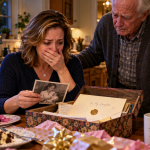
The lawyer did not look away. “Your mother is alive.” For a moment, I honestly thought I had misunderstood him. The room seemed to tilt beneath me. I stared at the trust document.
Then at the photograph. Then back at him. “What did you just say?” “Your mother is alive.” My fingers tightened around the edge of the table. “No.” He said nothing. “No.” My voice rose. “My mother walked out twenty-two years ago.”
“I understand what you were told.” “She abandoned us.” Mr. Carver’s expression softened. “That is not the whole story.” I pushed away from the table. “Then what is?” He glanced toward the grocery bag. “Your father wanted you to discover it in a particular order.”
I almost laughed.
“My father is dead.”
“I know.”
“He doesn’t get to control the order anymore.”
Mr. Carver accepted that without argument.
“You’re right.”
That calmed me more than resistance would have.
I sat again.
“Tell me where she is.”
He opened another folder.
“Grand Rapids.”
I stared.
Michigan.
Not another country.
Not a secret island.
Not somewhere unimaginably far away.
Grand Rapids.
A place I had visited twice for work.
A place with ordinary grocery stores, highways, traffic lights and apartment buildings.
“How long?”
“What do you mean?”
“How long has she been there?”
“Fourteen years.”
My breath caught.
“Fourteen?”
“Yes.”
“She was living three hours away?”
“For much of that time.”
I stood again.
My chair struck the wall.
“And Dad knew?”
“Yes.”
I started laughing.
It came out wrong.
Sharp.
Broken.
“Of course he knew.”
Mr. Carver waited.
I paced toward the window.
Outside, people were crossing the parking lot with umbrellas.
Their lives had not changed.
Mine had changed completely in less than ten minutes.
“What’s her name?”
“Laura Bennett.”
“My mother’s name was Laura Hayes.”
“She returned to her maiden name after the divorce.”
I turned.
“Divorce?”
“Yes.”
I stared at him.
“My parents were divorced?”
“When you were four.”
I pressed both hands against my temples.
I had been told my entire childhood that my mother had simply vanished.
No goodbye.
No explanation.
Nothing.
Dad never dated seriously afterward.
Whenever I asked whether they had technically divorced, he used to say:
“It stopped mattering after she left.”
Apparently it had mattered enough for paperwork.
Mr. Carver said quietly:
“I think you should read your father’s full letter before deciding what you want to do next.”
I looked at him.
“There’s more?”
He reached into the grocery bag.
At the very bottom was another envelope.
Thicker.
My name was written across the front.
For my bug, when there is nowhere left for me to hide.
I almost couldn’t open it.
Dad’s handwriting was the closest thing I had left to his voice.
I slid one finger beneath the flap.
Inside were twelve pages.
The first line destroyed me.
Daddy’s Bug, if you are reading this, then I was a coward longer than I was alive.
I covered my mouth.
Mr. Carver quietly stood.
“I’ll give you some privacy.”
“Stay.”
He paused.
“I don’t want to be alone.”
He sat.
I read.
There is no version of this letter that makes me look entirely good. If I wrote one, it would be another lie, and you have already lived with enough of mine.
My eyes blurred.
Your mother did leave that Tuesday. That part happened exactly the way I told you. She kissed you. She picked up her purse. She said she was buying milk.
I could see it.
Or thought I could.
For years, I had remembered the yellow kitchen light.
Her perfume.
The click of the apartment door.
Maybe memory.
Maybe a story repeated so often it became one.
I kept reading.
She did not go to the grocery store.
My hands started shaking.
She drove herself to St. Vincent’s emergency department because she was afraid she might hurt herself.
I stopped.
The words blurred.
I looked at Mr. Carver.
He said nothing.
I continued.
She had been sick for months. Neither of us understood how sick. After you were born, she struggled with depression. Later came periods when she barely slept, became frightened of ordinary sounds, believed terrible things were going to happen, and then hated herself for frightening you.
I thought she was overwhelmed.
She thought she was failing.
We were both wrong.
She was ill.
I put the pages down.
My mother had not gone out for milk.
She had gone to a hospital.
I whispered:
“Why didn’t he tell me?”
Mr. Carver nodded toward the letter.
I kept going.
She called me from the hospital at 11:17 that night. I know the exact time because I stared at that clock for years afterward.
She told me not to bring you.
She said she was terrified that something inside her mind had become unsafe.
She said the kindest thing she could do was stay away until doctors knew what was happening.
I cried then.
Silently at first.
Then not silently.
Dad had spent my entire life being the parent who stayed.
Mom had spent my entire childhood being the parent who left.
Those identities had held my world together.
Now both were breaking apart.
The doctors eventually diagnosed your mother with bipolar disorder after a severe psychiatric episode. I am not telling you this so you will be frightened of her. She received treatment. She worked hard. She became stable.
But during those first months, everything was chaos.
Her parents blamed me.
I blamed them.
I blamed her.
Mostly, if I am honest, I was terrified.
That sounded like Dad.
Not the heroic version.
The real one.
Afraid and stubborn.
Your grandparents offered to support you financially if I allowed you to live with them while Laura recovered.
I said no.
They threatened court.
I dropped out of engineering school because I needed full-time income and because I was afraid that looking financially unstable would be used against me.
There it was.
The construction job.
The boots.
The orange vest.
Not just sacrifice.
Fear.
I told myself every sore muscle proved I was the parent who stayed.
I stopped breathing.
That sentence hurt because I had repeated a version of it my whole life.
The truth is more complicated.
Your mother recovered enough to ask to see you eleven months later.
My hands froze.
Eleven months.
Not twenty-two years.
Eleven months.
I looked up.
“No.”
Mr. Carver’s eyes were wet.
“She tried to come back?”
“Yes.”
I returned to the letter.
I said no.
Three words.
That was all.
I read them again.
I said no.
Dad continued.
I told myself you were too young. I told myself she had frightened you. I told myself doctors could be wrong. I told myself I needed to protect you.
Some of that was true.
But I was also angry.
She had left me alone with a three-year-old, tuition bills, rent, and terror.
I wanted her to understand what she had done to us.
And because I was hurt, I let protection become punishment.
I could barely see.
The man I had worshiped was admitting that he had weaponized me.
Not entirely.
Not simply.
But enough.
We went through lawyers.
Eventually, your mother agreed to supervised contact.
You saw her twice when you were five.
I stood so suddenly the letter fell.
“No.”
Mr. Carver did not move.
“I would remember.”
“Maybe.”
“I would remember my own mother.”
“You were five.”
I pressed my fists against my eyes.
Then something surfaced.
A woman with red gloves.
A fish tank.
A room with toy blocks.
I had always thought it was daycare.
A woman kneeling.
Crying.
Calling me Bug.
No.
Dad called me Bug.
Or—
I whispered:
“She called me that too?”
Mr. Carver said:
“I don’t know.”
I picked up the pages.
You called her the lady with the red gloves afterward.
My knees nearly gave out.
I sat.
There it was.
Real.
I had not invented it.
She cried after both visits. You were shy. You kept asking when we were going home.
After the second visit, you had nightmares for several nights.
I used that as proof the visits were harmful.
Maybe they were.
Maybe change frightened you.
Maybe I wanted an answer that let me close the door.
The visits stopped.
I covered my face.
I wanted to hate him.
For ten seconds, I did.
Then I pictured him at twenty-three.
College unfinished.
Construction dust in his hair.
A toddler asleep against his chest.
A sick wife.
Her furious parents.
Lawyers.
Rent.
Fear.
Being young does not erase harm.
But it changes its shape.
I continued.
Laura never stopped writing.
I looked at the stack of unopened envelopes from the folder.
Dozens.
Some thick.
Some thin.
Birthdays.
Christmas.
My name.
Year after year.
She wrote every month at first.
Then every birthday.
Then Christmas and your birthday.
Sometimes more.
I kept every letter.
My tears fell onto the page.
I did not give them to you.
My anger returned instantly.
There it was.
No ambiguity.
No medical crisis.
No scared young father deciding whether a five-year-old should attend supervised visits.
Letters.
Years.
Choices.
He had hidden them.
I told myself you were happy.
You stopped asking about her as often.
You started calling us a team.
You drew pictures at school of just you and me.
I was afraid that giving you her letters would reopen something I had worked hard to close.
That was cowardice.
Yes.
My hand tightened around the paper.
When you were twelve, Laura asked me to let you choose.
I whispered:
“Oh, Dad.”
I did not.
I closed my eyes.
Twelve.
Old enough to read.
Old enough to ask questions.
Old enough to form an opinion.
He chose for me.
Again.
That was wrong.
At least he knew.
Too late.
But he knew.
Your mother did not disappear for twenty-two years.
I disappeared her from your life.
That sentence broke me.
I sobbed so hard Mr. Carver came around the desk.
He did not touch me.
Just placed a box of tissues nearby.
I hated Dad.
I loved Dad.
Both things existed so violently inside me that I felt physically ill.
Eventually I forced myself to continue.
Now I need to explain the house.
I looked at the photograph again.
Brick.
Small porch.
Mom beside Dad.
Young.
Happy.
Before you were born, Laura’s grandmother left her money.
Not millions.
Enough for a down payment on a modest home.
We were renting because I was still in school and we were waiting.
After Laura became ill, she wanted you to have something stable regardless of what happened between us.
She transferred $68,000 to me under an agreement that it would be used for a house for your benefit.
There it was.
Her money.
I bought the brick house when you were six.
I stared at the line.
But we never lived there.
I intended to move us in.
Then I became proud.
Of course he did.
That was Dad’s favorite sin.
Pride dressed as principle.
I told myself I would not raise you in a house purchased with money from a woman who had left us.
I actually said out loud:
“You idiot.”
Mr. Carver almost smiled.
So I rented it.
I stopped.
Rented it.
For nineteen years.
Every dollar of net rent, after taxes, repairs and expenses, went into an account for you.
The trust.
My eyes moved toward the paperwork.
Laura contributed when she could.
I contributed when I could.
The account grew.
I never used it for groceries.
I never used it for rent.
I never used it when my truck died.
I never used it when I was laid off for seven weeks.
I wanted to be able to tell myself I raised you.
That hurt differently.
That was pride again.
You went without things you did not need to go without because I was too stubborn to accept that money from your mother could help raise her daughter without taking anything away from me.
I thought about the winters when our apartment barely stayed warm.
The Christmas I got a bicycle and Dad ate canned soup for a week.
The school trip I did not attend because it cost $280.
I had told myself we were poor.
Technically, we were.
Dad had kept an asset completely outside our daily life because he believed using it would somehow make him less of a father.
I whispered:
“You absolute fool.”
I was crying while I said it.
You are probably angry now.
“Very.”
Good.
I laughed through tears.
That sounded like him.
Be angry.
Do not let love make you dishonest about me.
I stopped again.
That line was harder than anything else.
Because Dad had been my hero.
And heroes are easy.
People are difficult.
The trust currently contains approximately $612,000.
My eyes widened.
Mr. Carver slid the account summary toward me.
$617,843.19.
I stared.
My father had died in an apartment with a kitchen table that wobbled because he refused to spend $200 replacing it.
Meanwhile, this account existed.
I was furious.
And devastated.
And strangely proud.
All at once.
The brick house is worth much more than I paid for it.
It is yours through my estate.
The trust is also yours.
But neither is the most important thing I am leaving you.
I knew what came next.
The truth is.
I wiped my face.
Laura lives at 118 Bellweather Lane in Grand Rapids.
She is not in an institution.
That surprised me.
She works three mornings a week at a botanical nursery.
She has been stable for many years.
She knows I am sick.
My heart stopped.
I told her.
I looked at Mr. Carver.
“He contacted her?”
“Yes.”
“When?”
“Five months ago.”
Dad had been dying.
And he called the woman he spent my childhood erasing.
She came to see me.
I stopped reading.
“When?”
Mr. Carver answered.
“About six weeks before he died.”
I stared.
“Where was I?”
“At work, I believe.”
Dad had told me not to come that afternoon.
Said he was tired.
Said hospice had changed medications.
Instead, my mother had been sitting with him.
I returned to the letter.
She walked into my room wearing red gloves.
I covered my mouth.
She still wears red gloves when she is nervous.
The five-year-old memory returned fully.
Fish tank.
Red gloves.
Crying woman.
I apologized.
Not enough.
There is no enough.
She apologized too.
Not for being sick.
For leaving the way she did.
Good.
Even Dad understood that distinction.
We spent three hours talking about you.
She knows what you studied.
She knows where you work.
She knows you broke your wrist at fourteen.
She knows you hated chemistry.
She knows you won the regional writing contest in eleventh grade.
I stopped.
“How?”
Mr. Carver looked at me.
“Your father sent her updates.”
My anger became almost unbearable.
“What?”
“He sent her updates?”
“Yes.”
“How long?”
“I can’t answer that.”
The letter could.
I wrote back more often than I have admitted.
I laughed bitterly.
Of course.
Not every year.
Sometimes I sent school photographs.
Sometimes I told her milestones.
I let her know you were safe.
Then I told myself that was generous enough.
It was not.
My parents had built a secret version of my childhood around me.
Dad sending photographs.
Mom sending letters.
Me believing one of them had vanished completely.
I wanted to scream.
Instead I kept reading.
Laura wanted to contact you when you turned eighteen.
Of course.
I asked her not to.
I whispered:
“Why?”
The letter answered.
Because you had just received your scholarship.
Because you were leaving for college.
Because I was terrified that everything would fall apart at the exact moment your life was opening.
She agreed to wait one year.
Then another.
And then I kept asking.
My anger hardened.
That was not one frightened decision.
That was a pattern.
If you need to hate me for that, do it honestly.
I cried harder.
But please do not hate your mother for agreeing.
She believed I knew you better.
She believed respecting my request was the least damaging choice left after the harm we had already done.
Maybe she was wrong.
Maybe I was.
I know I was.
I stopped.
Dad had never admitted being wrong easily.
Once, when I was nine, he assembled a bookshelf backward and insisted the manufacturer had printed the instructions incorrectly.
This letter contained more humility than I had seen from him in twenty-five years.
Cancer does strange things to pride.
You owe Laura nothing.
That mattered.
Not a meeting.
Not forgiveness.
Not the word Mom.
The trust does not depend on seeing her.
The house does not depend on seeing her.
Nothing I am leaving you has that condition.
I breathed again.
I asked Mr. Carver only to tell you where she is before he completes the estate explanation because I have stolen enough choices from you.
This one must belong to you.
Then the final paragraphs.
Daddy’s Bug, there is something I need you to understand.
Every lunch I skipped was real.
Every overtime shift was real.
Every bedtime story.
Every fever.
Every parent-teacher conference.
Every Christmas morning.
Every sore muscle.
I loved raising you.
I would do it again.
I sobbed.
But sacrifice does not make every decision I made noble.
That line went through me.
I used love to excuse control.
I told myself that because I stayed, I had earned the right to decide who got to come back.
I had not.
I was your father.
I was never the owner of your history.
I had to stop reading.
For several minutes, I could only breathe.
Then I finished.
If you forgive me, let it be because you know all of me.
If you cannot, I understand.
But please live a life where nobody has to disappear so somebody else can feel secure.
You were worth every sore muscle.
You were not worth every lie.
I love you.
Dad.
I put the letter down.
The room went quiet.
Then I asked the question I had been avoiding.
“Does she know he died?”
“Yes.”
“Did she attend the funeral?”
“No.”
“Why?”
“She asked your father what he wanted.”
“What did he say?”
“That the funeral should belong to you.”
That made me angry too.
Another decision.
Another exclusion disguised as protection.
Mr. Carver must have seen it.
“He told her he was leaving the choice of future contact to you.”
I nodded.
“Does she know I’m here?”
“No.”
“Does she know I know?”
“No.”
“Do you have her phone number?”
“Yes.”
I stared at it when he wrote it down.
Ten ordinary digits.
Twenty-two years of absence reduced to ten digits.
I did not call.
Not that day.
I went home.
I put Dad’s grocery bag on my kitchen table.
Then I spread everything across the surface.
Letters.
Photographs.
Trust statements.
Property records.
Medical summaries Mom had given Dad permission to include.
Not detailed therapy notes.
Not private secrets.
Only enough to show that her illness had been real.
Her recovery had been real too.
I picked up the first unopened letter.
My sixth birthday.
The envelope had never been opened.
Dad had respected that much.
My name was printed carefully.
I opened it.
Dear Bug,
I stopped.
Bug.
She had called me that.
Not Dad alone.
Both of them.
I don’t know whether Daddy will give you this now, later, or ever.
My breath caught.
She knew.
Today you are six.
I remember the morning you were born. Your father cried so hard the nurse handed him tissues before she handed me you.
I smiled through tears.
You had a wrinkled forehead and looked offended by everything.
Still accurate.
I am getting better.
That is not the same as being finished getting better.
I hope one day I can explain that to you.
I love you.
Mama.
I cried until midnight.
Then I opened another.
Age seven.
Age eight.
Nine.
Ten.
At twelve, the letter changed.
Your father says you are beginning to ask harder questions.
I stared.
Dad had told her that.
I wish I could answer them.
He believes contact would be confusing for you.
I disagree.
There it was.
Not passive agreement forever.
She had disagreed.
But I am trying to respect that he has raised you every day and knows the shape of your life better than I do.
Sometimes respecting that feels like cowardice.
Sometimes pushing feels selfish.
I do not know which is true.
That sentence sounded painfully adult.
No heroes.
No perfect choice.
At sixteen:
Your father sent me your school photograph.
I threw the letter across the table.
Then immediately picked it up.
I was furious at both of them.
At Dad for sending pictures while hiding her.
At her for accepting pictures while not forcing her way back into my life.
Then I hated myself for being angry at a sick woman who had been told staying away was safer.
Then I became angry again because she had been stable for years by then.
Grief is exhausting when nobody is completely innocent.
At eighteen:
I almost called today.
My heart stopped.
I had your number.
I stared.
She had my number.
I dialed the first six digits three times.
Then I remembered what your father said about college.
I hated him a little.
I laughed while crying.
Finally.
A line I could trust completely.
Then I hated myself because some part of me was relieved to have an excuse to be afraid.
There it was.
Her flaw.
Not just Dad.
What if you answer and hate me?
What if you do not remember me?
What if you love me immediately and I do not know how to carry that either?
I am not proud of my fear.
But it is mine.
I read every letter over three days.
Forty-seven letters.
Some short.
Some ten pages.
She never blamed Dad entirely.
That irritated me at first.
I wanted a clean villain.
Someone to pour all twenty-two years into.
But Laura kept writing sentences like:
Your father was scared.
I was scared.
We both mistook fear for certainty.
And:
He gave you what I could not give you then: daily stability.
And:
I wish he had left more room for me later.
Both.
Always both.
On the fourth morning, I called her.
My hand shook so badly I nearly dropped the phone.
One ring.
Two.
Three.
Then:
“Hello?”
Her voice.
I knew it.
I had no rational reason to know it.
But I knew.
I said nothing.
“Hello?”
My mouth opened.
“Laura?”
Silence.
Then:
“Yes.”
I swallowed.
“This is…”
I could not say my own name.
Did not need to.
She made a sound.
Tiny.
A breath breaking.
“Oh.”
Then:
“Bug?”
I started crying.
So did she.
For nearly a minute, neither of us spoke.
Finally, I said:
“Dad died.”
“I know.”
That hurt.
“You knew.”
“Yes.”
“You saw him.”
“Yes.”
“He told you everything.”
“Not everything.”
“What does that mean?”
“He told me he was finally going to tell you.”
I wiped my face.
“He waited until he was dead.”
“Yes.”
No defense.
I appreciated that.
I asked:
“Why didn’t you come?”
“To the funeral?”
“Yes.”
“He asked me not to.”
“You could have ignored him.”
“Yes.”
“Why didn’t you?”
Silence.
Then:
“Because I had ignored the consequences of one impulsive decision when you were three, and after that I became too afraid of imposing myself where I wasn’t wanted.”
“That isn’t fair.”
“No.”
Her voice cracked.
“It isn’t.”
I paced my kitchen.
“I read the letters.”
“Oh.”
“All of them.”
She cried quietly.
“I’m sorry.”
“For writing them?”
“For not finding another way to get them to you.”
I stopped.
At least she knew.
“Would you have wanted me?”
The question came out before I could control it.
She sobbed.
“Oh, sweetheart.”
I hated the tenderness.
Loved it.
Hated that too.
“Would you?”
“Yes.”
“Then why didn’t you fight harder?”
Silence.
A long one.
Then she gave me the only answer that mattered.
“Because I was afraid.”
Not:
Your father stopped me.
Not:
The lawyers.
Not:
My illness.
Afraid.
“I was afraid you would reject me.”
“I was afraid contact would destabilize the life your father built.”
“I was afraid my illness would return.”
“I was afraid your grandparents would restart the custody fight.”
“I was afraid of everything.”
Her voice shook.
“And while I was being afraid, you grew up.”
I sat down.
That honesty reached somewhere anger could not.
I asked:
“Are you still sick?”
Another silence.
“I still have bipolar disorder.”
“I take medication.”
“I see a psychiatrist.”
“I know my warning signs.”
“I have been hospitalized twice since you were little.”
My stomach tightened.
“When?”
“Once when you were nine.”
“Once when you were fourteen.”
“So Dad was right?”
The question was crueler than I intended.
Laura did not defend herself.
“He was right that I was not always well.”
Then:
“He was wrong if he believed illness meant I could never have any place in your life.”
That was fair.
I whispered:
“I don’t know what I’m supposed to do.”
“You don’t have to do anything.”
“I want to see you.”
She stopped breathing.
“You do?”
“Yes.”
Then quickly:
“I might change my mind.”
“That’s okay.”
“I might get angry.”
“That’s okay.”
“I might leave after five minutes.”
“That’s okay.”
“I don’t want you hugging me without asking.”
Her voice broke.
“I won’t.”
We met four days later.
Not at her home.
My choice.
A café halfway between us.
Neutral.
Public.
Easy to leave.
I arrived twenty minutes early.
She was already there.
Of course.
Red gloves.
It was April.
Too warm for gloves.
But she wore them anyway.
She stood when I entered.
I recognized her from the photograph immediately.
Older.
Silver beginning at her temples.
Thinner.
But the eyes were mine.
Or mine were hers.
She did not move toward me.
“Hi.”
I stopped beside the table.
“Hi.”
Her hands shook inside the red gloves.
“You look like your father.”
I almost laughed.
“He said I looked like you.”
She smiled through tears.
“He lied about that too.”
I laughed.
Then cried.
So did she.
She pointed toward the chair.
“Can I sit?”
That nearly broke me.
She was asking permission to sit in a café chair because I had spent twenty-two years believing she was someone who took without asking.
“Yes.”
We sat.
For the first ten minutes, we discussed coffee.
Literally.
Coffee.
Weather.
Traffic.
Her nursery job.
My work.
The ordinary things people use to build a bridge before walking across it.
Finally, I placed one of her letters on the table.
My twelfth birthday.
“You said Dad told you I asked about you.”
“Yes.”
“What did he say exactly?”
She looked down.
“That you had started wondering whether you did something wrong.”
My throat closed.
I had.
For years.
Children make themselves responsible for unexplained departures.
If Mom left, maybe I had cried too much.
Maybe I had been difficult.
Maybe I had loved Dad more.
I whispered:
“What did you tell him?”
“That he had to tell you it wasn’t your fault.”
“He did.”
Dad had.
Repeatedly.
At least that.
“I asked to write directly.”
“And?”
“He said not yet.”
“Why did you keep listening?”
Laura’s eyes filled.
“Because during the custody fight, I behaved badly.”
I waited.
She took a breath.
“Not violently.”
“Not toward you.”
“But I was erratic.”
“I called him dozens of times some nights.”
“I accused him of things that weren’t true.”
“I once came to the apartment without warning during a period when I had stopped sleeping.”
“He called my parents.”
“They called my doctor.”
“I ended up back in the hospital.”
This was new.
Dad had left it out.
“He didn’t tell me.”
“I’m glad.”
“Why?”
“You didn’t need every worst thing I ever did.”
That was the first moment I understood why a parent might edit history.
The problem was not editing.
It was never reopening the file when the child became old enough to read it.
Laura continued.
“After that, I stopped trusting my own judgment.”
“So when your father said wait, I waited.”
“Too long.”
“Yes.”
The word came quickly.
No excuse.
Then I asked:
“The house.”
Her expression changed.
“He kept it?”
“You didn’t know?”
“No.”
I slid the photograph toward her.
She touched it.
Tears filled her eyes.
“I thought he sold it.”
“Why?”
“He told me he did.”
Of course he did.
“When?”
“When you were seven.”
“He said he didn’t want anything purchased with my money.”
“He told me he returned what remained after expenses.”
“Did he?”
“No.”
I told her about the trust.
$617,843.
She covered her mouth.
“He kept all of it?”
“And rental income.”
She cried.
Not because she wanted the money.
Because she understood Dad.
“That stubborn idiot.”
I laughed.
“You too?”
“He once returned a twenty-dollar bill I slipped into his coat because he said he would rather walk six miles than owe me gas money.”
“That sounds like him.”
For a minute, we laughed together.
It felt wrong.
Then right.
Then wrong again.
Grief kept changing the rules.
Laura asked:
“Did he suffer?”
I swallowed.
“At the end?”
“Yes.”
“No.”
That was partly true.
Hospice had kept him comfortable.
“He was scared.”
She nodded.
“He always hated not being able to fix things.”
“Yes.”
Then she told me about their final meeting.
Dad had looked small.
Not my Dad.
A man reduced by cancer.
She walked in wearing red gloves because her hands would not stop shaking.
He said:
“You still wear those stupid things?”
She replied:
“You still start conversations badly?”
Apparently they both laughed.
Then Dad apologized.
Not beautifully.
Dad never did anything beautifully if plain would work.
He said:
“I kept her because I was scared I would lose her.”
Laura answered:
“You couldn’t keep what wasn’t property.”
Dad cried.
Then said:
“I know.”
They talked for hours.
At the end, he asked whether she still loved him.
I stared across the café table.
“What did you say?”
Laura smiled sadly.
“I said I stopped knowing what that word meant between us years ago.”
“That’s awful.”
“It was true.”
“Did he get upset?”
“No.”
“He said, ‘Fair enough.’”
Dad.
Of course.
Then Laura told him something else.
“I said I was grateful to him.”
I frowned.
“For what?”
“For raising you when I couldn’t.”
My anger rose.
“He also kept you away.”
“Yes.”
“How can you be grateful?”
“Because gratitude and anger can live in the same body.”
I looked down.
Apparently that was hereditary too.
Our first meeting lasted fifty-three minutes.
I know because I watched the clock.
At the end, she stood.
Did not touch me.
“Thank you for coming.”
I nodded.
She turned to leave.
Then I said:
“Laura.”
She stopped.
“Can I hug you?”
She covered her mouth.
Nodded.
I hugged my mother for the first time I could remember.
It was not magical.
The room did not disappear.
No lost childhood rushed back.
She smelled like lavender soap.
Her shoulder shook against mine.
I felt awkward.
Then less awkward.
Then devastated.
When we separated, she whispered:
“I’m sorry.”
I said:
“I know.”
Not forgiveness.
Not yet.
But not nothing.
The estate took months to settle.
The brick house was real.
Two hundred and ten miles from where I had grown up.
Dad bought it for $96,000.
It was worth nearly $340,000 now.
A family had rented it for seven years.
Good tenants.
Two children.
A dog that apparently destroyed one screen door every summer.
Dad had never raised their rent aggressively.
Of course not.
His property manager told me:
“Your father could have charged more.”
I laughed.
“He could have done a lot of things.”
I did not evict them.
I renewed their lease.
At the same rent for another year.
I needed time to decide what the house meant.
The trust bothered me more.
Over six hundred thousand dollars.
I sat in Dad’s apartment one afternoon surrounded by furniture that looked as though it had survived three wars.
I screamed at him.
He was dead.
So screaming was mostly one-sided.
“You went hungry!”
“You wore broken boots!”
“I skipped trips!”
“You could have used some of it!”
Then I heard his letter in my mind.
Pride again.
I sat on the floor and cried.
I eventually met the accountant who had administered the trust.
She showed me the records.
Dad had contributed small amounts.
Fifty dollars.
One hundred.
Sometimes five.
Laura contributed too.
Larger amounts when she could.
There were years with nothing.
Then rental income.
Investment growth.
Time.
Not magic.
Not secret billionaire nonsense.
Just nineteen years.
The accountant handed me a ledger Dad maintained himself.
Next to one $500 contribution, he had written:
Bug got full scholarship. Put graduation gift here instead.
I cried again.
Another entry:
Overtime from bridge project. She thinks I bought fishing gear.
Idiot.
Another:
Laura contribution. Do not touch. Hers for Bug.
He had separated her money in his own mind even when the account did not.
Then I found an entry from the year he got cancer.
Could use this now. Won’t. She waited long enough for her future.
I closed the ledger.
Anger cannot survive unchanged when it meets love.
It does not disappear.
It becomes more complicated.
I used some of the trust.
Carefully.
First, I paid off my student loan balance.
Dad would have approved.
Then I replaced my twelve-year-old car.
Nothing extravagant.
Then I took three months off work.
That would have terrified him.
Good.
I needed to do one thing Dad never allowed himself.
Rest.
Laura and I met once a week.
Then twice a month.
Then whenever it felt natural.
At first, I called her Laura.
Always.
One year later, I accidentally said:
“Mom, can you pass the salt?”
We were eating dinner.
Both of us froze.
She passed the salt.
Did not cry.
At least not until she got home.
She admitted that later.
I appreciated her restraint.
I did not immediately start calling her Mom all the time.
It came in pieces.
Like everything.
She never demanded it.
That is probably why it eventually came.
I also learned things about Dad she remembered differently.
He hated tomatoes.
I knew that.
He secretly liked dancing.
Impossible.
She had photographs.
Terrible dancing.
Proof.
He once wanted to design bridges.
That one hurt.
Engineering school.
He had never gone back.
I asked:
“Did he ever talk about it?”
“All the time when we were young.”
“What kind?”
“Suspension bridges.”
Of course.
The man who spent his life holding things up wanted to build bridges.
The metaphor was so obvious it almost annoyed me.
Two years after his death, I created a scholarship.
Not huge.
Not named only for him.
That mattered.
I called it the Michael and Laura Hayes Second Start Scholarship.
Dad for the education he gave up.
Laura for the life she rebuilt.
It supported parents returning to technical college, engineering programs, apprenticeships or skilled trades after family or health disruptions.
When I showed Laura the paperwork, she cried.
“You put my name next to his.”
“Yes.”
“Why?”
“Because the story belongs to both of you.”
She looked at me for a long time.
Then:
“He would hate sharing top billing.”
“I know.”
“That’s part of the appeal.”
We laughed.
The brick house became part of the scholarship too.
Eventually.
After the tenants moved voluntarily, I had a decision.
Sell it?
Keep renting?
Move in?
For one absurd week, I considered moving there because it felt like living inside an alternate childhood.
Then I realized that was exactly why I should not.
A house cannot give you the years you missed.
So I sold it.
The proceeds went partly into my own future and partly into the scholarship endowment.
Before closing, Laura and I went there together.
The house was empty.
She stood in the living room.
“This was supposed to be yours.”
I looked at her.
“It was.”
She frowned.
“I never lived here.”
“No.”
I touched the wall.
“But it still became mine.”
Not as a childhood home.
As tuition.
Security.
Choice.
A future.
Dad had transformed the house into something else.
Flawed motives.
Useful result.
Again, both.
Laura walked into the kitchen.
She smiled.
“I picked yellow tile.”
“There is no yellow tile.”
“Exactly.”
She laughed.
“Your father hated it.”
We stood in the empty room imagining a kitchen that never existed.
Then she said:
“I used to picture you doing homework at a table right there.”
I looked toward the window.
For a second, I could see it too.
A childhood from another timeline.
Mom cooking.
Dad complaining about yellow tile.
Me doing homework.
Normal.
Then it vanished.
I cried.
Laura did not tell me to be grateful for what I had.
Did not tell me everything happens for a reason.
Good.
She just stood beside me.
At Dad’s grave, I took the full letter.
Three years after his death.
It took me that long.
I sat on the grass.
“Hi, Dad.”
Nothing.
“Still dead?”
Nothing.
“Rude.”
Wind moved through the cemetery.
I unfolded the pages.
“I met her.”
My voice broke.
“She’s annoying.”
I smiled.
“You would enjoy that.”
I told him everything.
The scholarship.
The house.
The trust.
The fact that Laura still wore red gloves.
Then I told him what I had been unable to say.
“I’m angry at you.”
Tears came immediately.
“I think I always will be a little.”
“You stole choices from me.”
“You decided that loving me meant deciding which truth I could survive.”
“You were wrong.”
I pressed my hand against the grass.
“But you also stayed.”
“You worked.”
“You held me when I had nightmares.”
“You learned how to braid hair from a library book.”
“You came to every school concert even though I was terrible.”
“You packed lunches.”
“You worked in freezing rain.”
“You loved me.”
My voice broke.
“I refuse to make one truth erase the other.”
That was my forgiveness.
Not:
It’s okay.
It wasn’t.
Not:
You did your best.
Sometimes he did.
Sometimes he did what was easiest for his fear.
My forgiveness was letting him be a whole person.
Dad.
Coward.
Provider.
Liar.
Protector.
Young man.
Proud fool.
The safest person in my childhood.
The person who kept one of the most important truths from me.
All him.
I left the first grocery-bag note at the grave.
Not the long letter.
That stayed with me.
Daddy’s Bug, I hope you’ll forgive me after you see what’s inside.
The wind lifted one corner.
I put a small stone on it.
“I’m working on it.”
Then I went home.
Laura lived another twenty-seven years.
Long enough to become ordinary to me.
That was the gift.
People think reunion stories end with the hug.
They don’t.
Real relationships begin after the dramatic music should have stopped.
We argued.
She forgot my birthday once.
The irony almost killed me.
She called the next morning crying.
I said:
“You waited twenty-two years. What’s another day?”
She called me horrible.
I agreed.
She had medication adjustments.
Bad winters.
One hospitalization when I was thirty-two.
That frightened me.
But this time, nobody disappeared.
She called me before going in.
“I’m not doing well.”
I said:
“What do you need?”
“Can you feed my cat?”
That was it.
No secrecy.
No vanishing.
No story invented for a child.
I fed the cat.
Visited when she wanted.
She recovered.
The world did not end.
That taught me more about mental illness than all Dad’s silence ever could.
Illness can be serious.
Love does not cure it.
Medication is not shame.
Relapse is not moral failure.
And protecting someone does not require pretending the sick person never existed.
When I had my first child at thirty-three, I panicked.
Not because of labor.
Because I had inherited my mother’s history.
During pregnancy, I worked with doctors.
Made a postpartum plan.
My husband, James, knew everything.
Laura knew everything.
There were no secret rooms in our family story anymore.
After my daughter was born, Laura visited.
She stood at the hospital doorway.
Did not enter.
“Can I?”
I laughed.
“Yes, Mom.”
She cried before she reached the bed.
I handed her the baby.
She whispered:
“Hello, little Bug.”
I said:
“Absolutely not.”
She laughed.
Dad would have loved that.
Or become competitive about nickname rights.
Probably both.
I named my daughter Caroline.
For Carol?
No.
Wrong story.
For nobody, actually.
That mattered.
Not every child has to become a memorial.
Caroline grew up knowing the truth in age-appropriate pieces.
Grandpa Michael raised Mom.
Grandma Laura was sick when Mom was little.
They made mistakes.
They loved her.
More truth came as she grew.
No sudden grocery-bag revelations if I could help it.
When Caroline was fourteen, she asked:
“Do you forgive Grandpa?”
I thought.
“Yes.”
“Do you forgive Grandma?”
“Yes.”
“For leaving?”
I looked at her.
“I forgive Grandma for the choices she made.”
“I don’t forgive her for having an illness because there is nothing to forgive about that.”
Caroline nodded.
Then:
“Do you think Grandpa was a bad dad?”
“No.”
“Even though he lied?”
“Yes.”
She frowned.
I smiled.
“That’s adulthood.”
She rolled her eyes.
“Annoying.”
“Extremely.”
At forty, I finally finished something Dad never did.
I enrolled in an evening engineering course.
One class.
Not a degree.
I was not trying to become him.
I was curious.
The professor asked why I enrolled.
I said:
“My father left engineering school to raise me.”
He nodded.
“That’s a good reason.”
“No.”
I smiled.
“It’s just the reason I became curious.”
I passed.
Barely.
Dad would have teased me mercilessly.
I framed the certificate beside a photograph of his old hard hat.
Not because I completed his dream.
You cannot complete somebody else’s life for them.
I just touched one corner of it.
That was enough.
Laura died at seventy-six.
Peacefully.
At home.
Her red gloves were in a drawer.
I kept one pair.
Not because I needed another symbol.
Because they made me laugh.
At her memorial, I read from one of her letters.
Not the saddest.
The one she wrote when I was seventeen.
Your father says you are stubborn.
I told him you come by that honestly.
Everyone laughed.
Then I said:
“My mother lost twenty-two years with me.”
The room went quiet.
“Some of those years were taken from her.”
“Some she surrendered because she was frightened.”
“Some were shaped by illness.”
“Some by pride.”
“Some by love used badly.”
“But we got twenty-seven years afterward.”
“That was enough to stop counting only what was missing.”
I looked at Caroline.
At my husband.
At people who knew Laura not as the mother who disappeared but as the woman who loved dahlias, burned toast constantly, wore red gloves when nervous, and cheated shamelessly at cards.
“That is the part I am most grateful for.”
After the memorial, I went home.
In my closet, I still had Dad’s plastic grocery bag.
Yes.
The actual bag.
Cheap.
Wrinkled.
Ridiculous.
James had tried to throw it away twice.
Both times I nearly committed murder.
Eventually I understood why I kept it.
The bag had once symbolized everything Dad hid.
Cash.
House.
Trust.
Letters.
Mom.
But over time, it became something else.
Proof that truth can arrive badly and still matter.
Dad should have told me years earlier.
He knew that.
Laura should have found more courage sooner.
She knew that.
I should probably have stopped storing a twenty-year-old plastic grocery bag in a fireproof box.
I knew that too.
Eventually, on my fifty-second birthday, I took it out.
Caroline was visiting.
“What are you doing?”
“Getting rid of something.”
She watched as I folded it.
“Is that the bag?”
“Yes.”
“The bag?”
“Yes.”
“Grandpa’s secret bag?”
“Yes.”
She looked horrified.
“You can’t throw that away.”
I laughed.
“Why?”
“It’s family history.”
I stared at her.
There it was.
The trap.
Objects becoming sacred because we are afraid memory will disappear without them.
I handed her the bag.
“Do you want it?”
She recoiled.
“No.”
“Exactly.”
We laughed.
I threw it away.
Not the letters.
Not Dad’s long confession.
Not Mom’s red gloves.
I kept those.
But the grocery bag went into ordinary trash.
It had done its job.
That night, Caroline asked:
“What was Grandpa’s biggest mistake?”
I thought about it.
Not hiding the trust.
Not refusing Laura’s money.
Not even the letters.
“The biggest?”
“Yes.”
“He thought protecting me and controlling what I knew were the same thing.”
She nodded slowly.
“And Grandma?”
“She thought waiting was less harmful than risking rejection.”
“And you?”
I smiled.
“I spent years believing love meant somebody had to be completely right.”
Caroline leaned back.
“So nobody was?”
“No.”
“That’s disappointing.”
“Very.”
Then she asked:
“Who loved you most?”
That question would once have destroyed me.
Dad?
The man who stayed?
Mom?
The woman who spent decades loving me from a distance?
I looked at my daughter.
“That isn’t measurable.”
She frowned.
“I hate your adult answers.”
“You will understand someday.”
“I hope not.”
I laughed.
Years earlier, I would have answered Dad without hesitation.
Then, after opening the grocery bag, I might have said Mom simply to punish his memory.
Eventually, I understood love is not a competition decided by suffering.
Dad’s construction boots did not prove he loved me more.
Mom’s forty-seven letters did not prove she loved me more.
They loved differently.
They failed differently.
And I was not required to award a winner.
When I think about Dad now, I still see those boots by the door.
The orange vest.
The hands rough as sandpaper.
But I also see a twenty-three-year-old man sitting beside a hospital phone, terrified.
A young father deciding he could build certainty if he worked hard enough.
A proud man refusing money because he confused accepting help with surrender.
An older man saving every letter he was too afraid to deliver.
A dying man finally admitting:
I was never the owner of your history.
When I think about Mom, I no longer picture the woman walking out to buy milk.
I see red gloves.
A café table.
A nervous woman asking permission to sit.
A hospital room decades later when she handed me back my newborn daughter and whispered:
“You’re doing fine.”
I see the life after the absence.
That matters more now.
Dad’s final note began with:
Daddy’s Bug, I hope you’ll forgive me.
For years I believed forgiveness meant choosing whether his good outweighed his wrong.
I don’t believe that anymore.
Forgiveness was not a scale.
It was permission to stop holding court.
To stop retrying the same case.
To let the evidence remain true without demanding one final verdict.
Dad loved me.
Dad lied to me.
Mom left.
Mom was sick.
Mom tried.
Mom waited too long.
Dad protected me.
Dad controlled the story.
All true.
And strangely, when I finally stopped forcing those truths to fight each other, I found the peace both of my parents had spent most of their lives trying to give me.
Too late for them.
Not too late for me.
THE END STORIES! THANK YOU FOR READING GOOD LUCK! ❤️
Related Posts