The social worker placed the red folder on the counter beside Leo’s bassinet. “There is one more signature we need before Leo can go home.” My heart stopped. “Whose?” For one terrible second, I thought she was going to say an adoptive family had already been chosen.
Or a judge. Or someone who had never held Leo but somehow possessed more authority over his future than I did. Instead, she turned the folder toward me. “Yours.” I stared at the blank line. “What is it?” “Revocation of your voluntary surrender.” My mother tightened her arm around my shoulders.
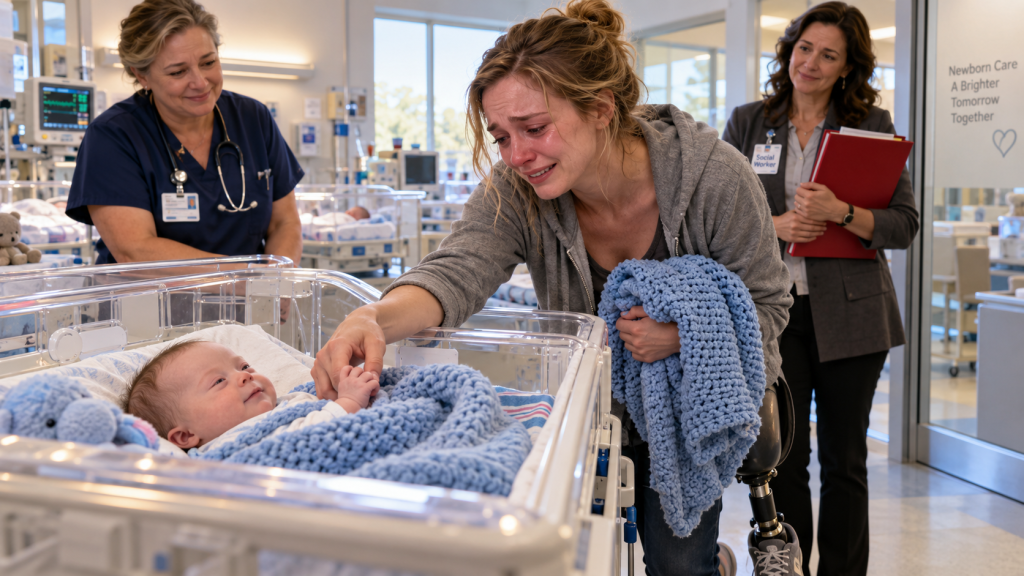
The social worker continued gently. “Signing this does not erase what happened three days ago.” “It confirms that you are withdrawing your surrender within the permitted period and requesting reunification.” I looked down at Leo. He had found my thumb again.
His tiny hand wrapped around it with astonishing seriousness.
“What happens after I sign?”
“We make sure you understand his medical needs.”
“We confirm that you have a safe discharge plan.”
“We arrange follow-up appointments.”
“And we discuss support.”
I looked at my prosthetic leg.
She noticed.
“Support,” she repeated, “does not mean proving you are incapable.”
Something about the way she said it made me wonder how many mothers had sat where I was sitting and heard that word as an accusation.
“What if someone decides I can’t do it?”
“Someone already did.”
I looked up.
She paused.
“You.”
That hurt.
Because she was right.
No court had taken Leo.
No doctor had told me I was unfit.
No social worker had removed him from my arms.
I had looked at my son, looked at my own body, listened to frightened people, and decided for everyone that our life together would be impossible.
I swallowed.
“What’s your name?”
“Monica Reyes.”
I nodded.
“Monica, I want my son.”
She studied my face.
“Say it again.”
“I want my son.”
“Not because he cries for the blanket.”
“No.”
“Not because your mother came.”
“No.”
“Not because you feel guilty.”
That one made my voice shake.
“No.”
She waited.
I leaned over the bassinet.
Leo blinked up at me.
“I want him because he’s my son.”
My mother started crying again.
Monica pushed a pen toward me.
“Then sign.”
I did.
My hand still trembled.
But not like three days earlier.
Three days earlier I had signed because fear was shouting.
This time, fear was still there.
It simply wasn’t holding the pen.
The first thing Monica did afterward surprised me.
She did not hand Leo to me.
She sat down.
“Now we make a real plan.”
My stomach tightened.
“I thought you said he could come home.”
“He can.”
“But going home is not the same as being prepared.”
I nodded.
She opened another section of the file.
“Leo has Down syndrome.”
“Yes.”
“You have a limb difference.”
“I’m an amputee.”
“Yes.”
“Neither fact automatically determines whether you can parent him.”
I stared at her.
She continued.
“What matters is how you will feed him, transport him, attend appointments, respond if he has additional health concerns, rest, and ask for help.”
My mother said immediately:
“She has me.”
Monica looked at her.
“And who do you have?”
My mother blinked.
“What?”
“If Sarah relies entirely on you and you become sick, exhausted, or unavailable, what happens?”
Nobody had asked that.
My mother sat down.
Monica looked back at me.
“We build more than one point of support.”
That sentence would become one of the most important of my life.
Not because I understood it yet.
I still thought strength meant doing everything myself.
I had been practicing that kind of strength since the accident.
When you lose a leg at twenty-one, people congratulate you every time you perform independence.
You walked?
Brave.
You drove?
Amazing.
You went grocery shopping?
Inspirational.
Eventually you begin treating assistance like evidence you have failed.
I had carried that poison directly into motherhood.
Leo needed a mother.
I had believed he needed one who never needed anyone herself.
Monica began writing names.
My mother, Evelyn.
My sister, Natalie.
My neighbor, Mrs. Patel.
Leo’s pediatrician.
A developmental clinic.
An early-intervention program.
A local Down syndrome parents’ organization.
Physical therapy.
Occupational therapy later if needed.
Cardiology follow-up because some babies with Down syndrome have heart conditions.
Hearing screening.
Feeding support.
Each line terrified me.
Each line also made the future less shapeless.
I asked:
“Does he have a heart problem?”
Nurse Brenda answered.
“They heard a murmur after birth.”
My blood went cold.
“No one told me.”
“You left before the follow-up echocardiogram.”
There was no judgment in her voice.
That made it worse.
I closed my eyes.
“Is he okay?”
“The cardiologist found a small ventricular septal defect.”
I looked at her blankly.
“A hole between the lower chambers of his heart.”
My mother gasped.
Brenda continued quickly.
“It’s small.”
“They’re monitoring it.”
“Some close on their own.”
“He is stable.”
Stable.
A tiny word.
A lifeline.
I looked at Leo’s chest rising beneath the blue blanket.
My son had a hole in his heart.
And I had spent three days wondering whether I was strong enough.
I started crying.
“I wasn’t here.”
Brenda stepped closer.
“You’re here now.”
“I should have been here.”
“Yes.”
That answer startled me.
She did not rush to soothe me.
“Yes,” she repeated.
“You should have.”
My mother looked at her sharply.
Brenda met my eyes.
“But shame will not change the last three days.”
“Being present can change the next three thousand.”
I never forgot that.
Not because it absolved me.
Because it didn’t.
It gave me something more useful.
Direction.
We spent the next four hours learning.
How to hold Leo during feeds.
How to watch for signs he was tiring.
Why low muscle tone could make feeding harder.
How to position him safely.
How to use the infant seat with my prosthetic.
A physical therapist met us in the room.
Her name was Kelly.
She watched me stand from the chair while holding a weighted doll.
“Again.”
I did.
“Good.”
“I almost lost balance.”
“But you corrected.”
“That doesn’t sound comforting.”
She smiled.
“You think parents with two biological legs never trip?”
I looked at her.
She continued.
“We adapt.”
“Would a baby carrier help?”
“Yes.”
“Can you set up changing stations upstairs and downstairs so you aren’t carrying supplies?”
“Yes.”
“Can your mother help with laundry early on?”
“I can do laundry.”
My mother said.
“I did not ask you.”
Kelly looked at me.
I sighed.
“Yes.”
My mother grinned.
“Victory.”
“Don’t enjoy it.”
“I absolutely will.”
Then came the first twist I had not expected.
Monica asked to speak with me alone.
My mother took Leo to the nursery window with Brenda.
Monica shut the door.
“There is something in your file I need to clarify.”
My stomach tightened.
“What?”
“Your surrender paperwork says you made the decision without coercion.”
“Yes.”
“Did you?”
I looked away.
She waited.
I whispered:
“I signed it.”
“That isn’t what I asked.”
The room became very quiet.
I thought about the voices.
My sister.
My aunt.
A former boyfriend.
But one voice had been louder than the others.
My mother’s.
Not directly.
Not exactly.
I looked through the window at Evelyn holding Leo.
She was smiling down at him.
Then I remembered the delivery room.
The moment the pediatrician gently said:
“He has several features consistent with Down syndrome.”
My mother had gone white.
She had whispered:
“Sarah, your life is already hard.”
I had never forgotten those six words.
I said:
“My mom was scared.”
Monica nodded.
“What did she say?”
“That my life was already hard.”
“Anything else?”
I swallowed.
“She asked whether I could physically manage.”
“She asked whether I wanted him to grow up taking care of me.”
Monica’s face changed slightly.
“She said that?”
“Yes.”
“Did she tell you to surrender him?”
“No.”
“Did anyone?”
I thought.
Then:
“My sister did.”
Monica waited.
“Natalie said there were families waiting for children like Leo.”
“She said maybe loving him meant giving him someone better equipped.”
My eyes burned.
“She said I should think about what was fair to him.”
“And what did you hear?”
“That keeping him would be selfish.”
Monica leaned back.
“Do you believe Natalie intended to harm you?”
“No.”
“She thought she was helping.”
“That is often how pressure arrives.”
I stared.
She continued.
“I am not investigating your family.”
“I am trying to understand whether you made an informed decision freely.”
“I don’t know.”
I whispered.
“I felt like everyone was terrified, and I borrowed their terror.”
That was the most accurate thing I had said.
I borrowed their terror.
Then called it mine.
Monica wrote something.
“Would you like your mother present when we discuss discharge?”
“Yes.”
“Your sister?”
I froze.
“No.”
The word surprised me.
For years, I had avoided conflict.
After losing my leg, I became grateful for every person who stayed.
Too grateful.
Gratitude can become a leash if you are not careful.
“No,” I repeated.
“Not today.”
Monica nodded.
“No explanation required.”
But eventually there would be.
Natalie arrived at the hospital anyway.
Of course she did.
She came carrying flowers.
Yellow daisies.
My favorite.
When she saw Leo in my arms, she stopped.
Her entire face changed.
“Sarah.”
I tightened my hold on him.
She set the flowers down slowly.
“You brought him back?”
“He was never a sweater I returned.”
She flinched.
Good.
I hated that I wanted her to.
Mom stood.
“Natalie.”
My sister looked between us.
“I didn’t mean it like that.”
I said:
“You told me giving him away might be the loving thing.”
“I said you should think about your future.”
“He is my future.”
“Sarah, I was scared for you.”
“So was I.”
“You nearly died after the accident.”
“That was eleven years ago.”
“You still have pain.”
“Yes.”
“You fall sometimes.”
“So do you.”
“That’s not the same.”
There it was.
The thing beneath everything.
Different body.
Different standard.
I looked at my sister.
“You think because I have one leg, I need to justify becoming a mother more than you would.”
Her face fell.
“No.”
“Yes.”
“I never said—”
“You didn’t have to.”
Leo made a tiny squeaking sound.
I looked down.
His eyes were half closed.
Completely unaware that four adults were trying to decide what his mother’s body meant.
I whispered:
“I almost gave away my son because I thought I needed to be physically perfect before I was allowed to raise a child who isn’t.”
Natalie began crying.
“I’m sorry.”
My anger did not disappear.
Good apologies should not be magic.
“I know you love me.”
“I do.”
“But you hurt me.”
She nodded.
“I know.”
“No.”
I said.
“You’re beginning to know.”
That landed.
She sat down.
“Can I hold him?”
My first instinct was yes.
Automatic.
Keep peace.
Make sister feel better.
Then I looked at Leo.
Then at myself.
“No.”
Natalie stared.
“Not today.”
Her eyes filled.
I continued.
“I need one day where nobody else gets to feel better by holding him.”
Silence.
Then my mother said quietly:
“That’s fair.”
Natalie nodded.
“Okay.”
She left the flowers.
And went home.
Three hours later, the hospital discharged Leo.
There was no applause.
No choir.
No social worker dramatically stamping a paper.
Just instructions.
Medication information.
Appointments.
A car seat check.
A cardiology number.
A packet thick enough to stun a horse.
And my son.
Nurse Brenda carried him to the entrance with us.
The same sliding doors I had walked through three days earlier.
I stopped before crossing them.
Mom looked at me.
“What?”
I stared outside.
Cars.
Sunlight.
People moving.
Ordinary life.
“I left him here.”
Mom squeezed my arm.
“And now?”
I looked at Leo.
“Now he leaves with me.”
Brenda handed him over.
“Then go home.”
I did.
The nursery was exactly as I had left it.
The star mobile.
The teddy bear.
The diaper bag.
The second blue blanket.
I stood in the doorway holding Leo.
For the first time, the room looked less like evidence of a crime I had committed against myself.
It looked like a room.
His room.
I laid him in the crib.
He immediately started crying.
Of course.
After all the dramatic symbolism of the blue blanket, my child apparently still disliked being set down.
I laughed through tears.
“Okay.”
I picked him back up.
“You win.”
That first night was terrible.
Beautiful.
Terrible.
He woke constantly.
Feeding took forever.
I spilled formula.
Then breast milk.
Then cried because breastfeeding was harder than I expected and I had already decided every struggle was proof I deserved punishment.
At 2:14 a.m., Mom found me sitting on the kitchen floor.
Leo against my chest.
My prosthetic off beside me because my residual limb hurt.
I whispered:
“I can’t do this.”
Mom sat down.
“Yes, you can.”
I shook my head violently.
“No.”
“Don’t say that.”
She stopped.
Changed course.
“Okay.”
I looked at her.
She said:
“You can’t do all of it at two-fourteen in the morning.”
“That is different.”
Something in me broke open.
She took Leo.
Not without asking.
She held out her arms first.
“May I?”
I nodded.
That small question mattered.
She rocked him while I adjusted the liner on my leg.
Then she whispered:
“I owe you an apology.”
“Not now.”
“Yes.”
“Mom.”
“When the doctor said Down syndrome, I looked at your prosthetic before I looked at your baby.”
I went still.
She cried quietly.
“I saw your accident.”
“Your surgeries.”
“Your pain.”
“I thought, she has suffered enough.”
I stared at her.
“And I made Leo into more suffering.”
My eyes filled.
“Yes.”
“I’m sorry.”
She looked down at him.
“He was three minutes old and I had already turned his life into something happening to you.”
That was exactly it.
I began crying.
Mom continued.
“When I came home from the hospital, I couldn’t sleep.”
“I kept hearing myself say your life was already hard.”
“So I called the social worker.”
“I asked what would happen if you went through with the surrender.”
“She told me I couldn’t undo your decision for you.”
“So you applied as family placement.”
I looked at her.
“Why?”
“Because if you truly didn’t want to parent him, I was not going to punish you for that.”
“But I needed Leo to know somebody in his family wanted him.”
My chest collapsed.
Mom kissed his forehead.
“And because after I got home, I looked at old photographs of you after the accident.”
“You were twenty-one.”
“Everybody told me to do things for you.”
“You hated it.”
“You taught yourself to drive again.”
“You went back to school.”
“You rebuilt your life.”
“And somehow I still looked at you eleven years later and saw the girl in the hospital bed.”
She looked at me.
“That was my failure.”
Not mine.
Hers.
Separate columns.
I reached for her hand.
“We both got scared.”
“Yes.”
“Don’t do it again.”
She laughed through tears.
“I will try.”
“No.”
I smiled weakly.
“Do better.”
“Bossy.”
“Genetic.”
The next six months humbled me more than the accident ever had.
Leo’s heart defect did not close immediately.
We went to cardiology appointments.
He struggled to gain weight.
Feeding specialists taught me positions that worked better.
Early intervention came to the house.
Physical therapy started when he was still tiny.
I learned words I had never wanted to know.
Hypotonia.
Tummy time.
Modified holds.
Oxygen saturation.
Milestones.
Adjusted expectations.
I also learned that Down syndrome was not one personality.
Not one future.
Not one tragedy.
Leo hated socks.
Loved ceiling fans.
Fell asleep to the sound of the vacuum.
Sneezed three times in a row almost every morning.
Smiled at five weeks.
Not because a developmental chart said it was time.
Because I made a ridiculous chicken noise.
His smile destroyed me.
I called my mother.
“Get over here.”
“What happened?”
“He smiled.”
“Sarah, it’s six in the morning.”
“He smiled.”
“I’m coming.”
She did.
By the time she arrived, he refused to repeat it.
Naturally.
My sister Natalie stayed away for eleven days after the hospital.
Then she texted:
I would like to see Leo when you are ready. No advice. No plans. Just visit.
That mattered.
I invited her over.
She sat on the couch.
Did not reach for him.
Did not say:
Give me that baby.
Did not tell me I looked tired.
She waited.
Eventually I asked:
“Do you want to hold him?”
Her eyes filled.
“Yes.”
She held him.
He immediately spit milk down her shirt.
I laughed so hard my prosthetic nearly slipped.
She stared at the stain.
“Is this forgiveness?”
“No.”
“Feels symbolic.”
“It’s formula.”
We laughed.
Healing did not happen in one conversation.
It happened through changed behavior.
Natalie started attending appointments only when invited.
She learned about Down syndrome from actual specialists instead of terrifying internet searches.
She stopped saying “special needs” in a whisper.
She volunteered with the family support group.
Not to prove she was good.
Because she wanted to understand the world Leo would grow up in.
One day, when Leo was nine months old, she said:
“I think I owe him an apology too.”
I looked at her.
“He’s chewing a remote.”
“I’ll wait until he’s more receptive.”
“Probably wise.”
She became his favorite aunt.
Annoying, but true.
The father question arrived when Leo was ten months old.
His biological father’s name was Ethan Cole.
We had dated for almost two years.
When I became pregnant, he was frightened but stayed.
Then halfway through the pregnancy, he took a job in Portland.
We were already struggling.
We broke up.
Not dramatically.
Not because of Leo.
At least that was what I believed.
After Leo was born, I texted Ethan once.
He’s here. His name is Leo.
No reply.
I did not tell him about the Down syndrome.
Did not tell him I surrendered Leo.
Did not tell him I brought him back.
Part of me believed I had forfeited the right to ask anyone else to step up.
Then Monica called.
“Yes.”
The social worker.
She still checked in occasionally through the early-support program.
“Sarah, did you ever establish paternity?”
“No.”
“Why?”
“He’s not involved.”
“That wasn’t my question.”
I hated when people around me became competent.
Two weeks later, I called Ethan.
He answered on the third ring.
“Sarah?”
“Yes.”
Silence.
Then:
“I got your message.”
“Ten months ago.”
“I know.”
My anger arrived so cleanly that it felt almost peaceful.
“You didn’t reply.”
“I didn’t know what to say.”
“You could’ve tried hello.”
“I’m sorry.”
I closed my eyes.
He continued.
“I heard from Natalie.”
My eyes opened.
“What?”
“She messaged me after Leo was born.”
I went cold.
“What did she say?”
Silence.
“Ethan.”
“She said you had surrendered him.”
My chest tightened.
“And?”
“She said it was probably for the best.”
I nearly dropped the phone.
The room tilted.
“She told you that?”
“Yes.”
“I thought you didn’t want me involved.”
I sat down.
There it was again.
Someone deciding on my behalf.
Someone interpreting fear as instruction.
I said:
“You should have called me.”
“I know.”
“Not Natalie.”
“You.”
“I know.”
“Did she tell you I brought him home?”
“No.”
Ethan sounded genuinely shocked.
“You did?”
“Yes.”
“How long?”
“Ten months.”
Silence.
Then:
“Sarah, I want to see him.”
“No.”
The word came automatically.
Then I paused.
Not because I owed him access.
Because Leo might one day deserve truthful choices too.
“I need time.”
“Okay.”
“And a paternity test.”
“Okay.”
“And if you want involvement, you do not get to appear when it feels sentimental and disappear when it gets hard.”
“I understand.”
“No.”
“You don’t.”
“I’m still learning what that means.”
He was quiet.
“Then teach me.”
That answer irritated me.
But it was not the wrong one.
Paternity confirmed what we expected.
Ethan was Leo’s biological father.
He came to Seattle.
The first meeting lasted forty-five minutes.
He brought no toys.
Smart.
He sat on the floor.
Leo ignored him.
Then crawled directly toward Ethan’s shoe and tried to eat the laces.
Ethan laughed.
Then cried.
Not theatrically.
Quietly.
I watched him.
“You left.”
“Yes.”
“Why?”
He wiped his face.
“I was afraid.”
I almost laughed at the familiar answer.
“Of what?”
“Being trapped.”
“Money.”
“Responsibility.”
“Your health.”
“My leg?”
“Yes.”
I stared.
He looked ashamed.
“Everyone kept telling me how much you already handled.”
“I thought if Leo had medical issues…”
“You didn’t know he had Down syndrome.”
“No.”
“Then what were you afraid of?”
He looked at me.
“Ordinary fatherhood.”
At least it was honest.
He continued.
“Then Natalie messaged me and said you’d placed him.”
“I told myself the decision was made.”
“I used your pain as permission not to show up.”
That sentence mattered.
Not enough to erase ten months.
Enough to begin somewhere.
Ethan started visiting monthly.
Then every two weeks.
Then moved back to Seattle eighteen months later.
We did not reconcile.
Important.
People kept asking.
Maybe because stories make everyone believe parents should reunite once they grow up.
No.
Ethan became a better father.
That did not make him the right partner for me.
We built a co-parenting arrangement slowly.
He paid support.
Attended cardiology.
Learned feeding.
Showed up for physical therapy.
Changed diapers.
Got vomited on.
Missed work once when Leo had RSV.
He became reliable.
Not perfect.
Reliable.
That was enough.
When Leo was fourteen months old, his cardiologist told us the heart defect had become smaller.
No surgery yet.
Maybe never.
I cried in the parking garage.
Ethan stood beside me.
“Good cry?”
“Yes.”
He hugged me.
I let him.
Then we went home separately.
That was healthy too.
The biggest crisis came when Leo was three.
Not medical.
School.
An early preschool program recommended a more segregated classroom across town.
The district representative used careful words.
“Specialized environment.”
“Appropriate support.”
“Individual needs.”
I asked:
“Can he attend the neighborhood preschool with support?”
She hesitated.
“That may be challenging.”
I smiled.
I had learned to fear that phrase.
Challenging for whom?
“For Leo?”
“For the teacher?”
“For the budget?”
Silence.
My old self would have shrunk.
I had spent too many years being grateful anyone accommodated my own body.
I was done confusing access with charity.
I asked for the evaluation.
The data.
The specific reasons.
We visited both classrooms.
I spoke to parents.
Therapists.
Teachers.
In the end, we chose a blended program.
Not because inclusion automatically meant better.
Not because specialized automatically meant worse.
Because this particular classroom suited Leo.
That distinction mattered.
I learned parenting was not proving a philosophy.
It was paying attention to the child in front of you.
Leo entered preschool with a blue backpack.
He cried at drop-off.
I cried in the parking lot.
My mother cried at home even though she was not there.
Natalie sent twelve texts.
Ethan sent one:
Do not go back inside.
I replied:
I hate you.
He wrote:
I know. Coffee?
We got coffee.
When Leo came home, he had paint in his hair and somebody else’s sock in his backpack.
Success.
My prosthetic never became irrelevant.
There were difficult days.
When Leo was four, he darted toward a parking lot.
I moved too quickly, caught my toe, and fell hard.
My residual limb split open against the socket.
I grabbed Leo before he reached the lane.
Then sat on the pavement shaking.
A stranger ran over.
“Are you okay?”
“Yes.”
“Do you need help?”
The old answer rose.
No.
I’m fine.
Always.
Instead I said:
“Yes.”
She carried my bag.
Another person called my mother.
I went to urgent care.
Leo sat beside me eating crackers.
That night I cried.
Not because I fell.
Because the old fear returned.
See?
You cannot keep him safe.
My therapist, whom I had finally started seeing after Leo’s birth, asked:
“Would a mother with two legs who fell conclude she should surrender her child?”
“No.”
“Then why are you?”
I hated therapy.
It was working.
I adjusted my prosthetic.
Changed the way I used the stroller in crowded areas.
Added a wrist strap when needed.
Adaptation.
Not failure.
Leo adapted too.
As he grew, he learned to slow down when we held hands.
Not because my body made him responsible for me.
Because families learn one another.
I learned his pace.
He learned mine.
When he was five, someone at a playground stared at us.
First my leg.
Then his face.
A little boy asked:
“Why does he look like that?”
His mother went red.
“I’m so sorry.”
I almost gave the practiced answer.
Then Leo answered himself.
“Like Leo.”
The boy considered that.
Then pointed at my prosthetic.
“Why is her leg robot?”
Leo grinned.
“My mommy is part robot.”
That was apparently much more interesting.
Within two minutes, they were playing.
I stood there laughing.
For years, I had feared strangers staring at us.
They did.
Sometimes rudely.
Sometimes curiously.
Sometimes kindly.
Then life continued.
No bolt of lightning.
No public trial.
Just people.
My shame had imagined a spotlight that rarely existed as brightly as I feared.
The hardest judgments often came from adults who believed they were being compassionate.
“Oh, you’re so brave.”
“You must have your hands full.”
“God only gives special children to special mothers.”
I hated that one.
No.
God, biology, chance, genetics—whatever a person believes—did not issue Leo because I passed some spiritual exam.
And I was not special because I parented my child.
I was his mother.
Sometimes exhausted.
Sometimes impatient.
Sometimes wonderful.
Sometimes not.
At six, Leo learned to read his name.
L.
E.
O.
He drew the O huge every time.
At seven, he learned to ride a modified bicycle.
I ran beside him badly.
Very badly.
My prosthetic was not designed for graceful jogging.
He shouted:
“Mommy, faster!”
I yelled:
“This is my faster!”
He laughed so hard he nearly crashed.
My mother stood on the sidewalk crying.
She cried often.
Age made her shameless about it.
At eight, Leo had heart surgery.
The small defect had not caused major trouble for years, but another issue developed that his cardiology team believed should be repaired.
The night before surgery, I did not sleep.
I sat beside him in the hospital.
Different hospital room.
Different blue blanket.
Yes.
I still had it.
The original blanket from the bassinet had become thin from washing.
I kept it folded in a drawer.
For surgery night, I brought the matching one.
The one I had clutched during the three days I left him.
Leo touched the edge.
“You made this?”
“Yes.”
“For me?”
“Yes.”
“Before I born?”
“Yes.”
He considered.
“Were you good at knitting?”
“No.”
He examined a crooked row.
“I can tell.”
I laughed.
Then he asked:
“Why you crying?”
I froze.
Because one day I had left him in a hospital.
Because now I was terrified surgery could take him away.
Because motherhood contains impossible contradictions.
I kissed his forehead.
“I’m scared.”
He nodded.
“Me too.”
I almost told him not to be.
Instead:
“We can be scared together.”
He held my hand.
The surgery went well.
Very well.
Recovery was unpleasant.
He hated the hospital food.
He called one nurse “Bossy Linda.”
Her name was Rebecca.
Nobody knew why.
When we finally went home, he walked slowly through the front door.
My mother had decorated the living room.
Too many balloons.
Ethan brought pizza.
Natalie brought cake.
Leo looked around.
Then said:
“I want cereal.”
Of course.
Life after terror often begins with something stupidly ordinary.
At nine, Leo asked the question I had feared for years.
We were sitting at the kitchen table.
He had homework.
I had coffee.
He looked at me.
“Did you leave me at hospital when I baby?”
Everything inside me stopped.
No one had told him.
Not directly.
But families leak stories.
Photographs.
Half-heard conversations.
He was observant.
I said:
“Yes.”
He looked at me.
“Why?”
There are moments when a parent desperately wants a lie because truth might hurt.
I had learned enough about control to resist.
“I was scared.”
“Of me?”
My heart broke.
“No.”
He waited.
I corrected myself.
“Partly.”
That was harder.
“I was scared because you had Down syndrome.”
“I didn’t understand what that would mean.”
“I was scared because I have one leg.”
“I thought maybe I couldn’t take care of you.”
His brow furrowed.
“But you do.”
“Yes.”
“I was wrong.”
He looked down.
“How long you leave me?”
“Three days.”
“Then you come back?”
“Yes.”
“Why?”
I smiled through tears.
“Because a nurse called and told me you cried until they brought you the blue blanket.”
His face brightened.
“My blanket?”
“Yes.”
“And then I realized I wanted you more than I was afraid.”
He thought.
Then:
“Did Grandma come?”
“Yes.”
“Dad?”
“Not then.”
He frowned.
“Dad late.”
I laughed painfully.
“Yes.”
“Dad was very late.”
He looked at me again.
“Was I sad?”
“I think so.”
“Were you sad?”
“Yes.”
“Very.”
He reached across the table.
His fingers were larger now.
No longer the tiny newborn hand that had once gripped my thumb.
He squeezed my hand.
“You came back.”
I cried.
“Yes.”
Then he said:
“Okay.”
That was not the end of it.
Children revisit truth at different ages.
At twelve, he asked again with more complicated anger.
“You signed papers?”
“Yes.”
“You gave me away?”
“For three days, yes.”
“That’s messed up.”
“Yes.”
No defense.
No:
But I was scared.
No:
You don’t understand.
He was allowed to be angry.
He went to his room.
Slammed the door.
My mother wanted to talk to him.
I stopped her.
“He gets to feel it.”
That was hard.
For three days, he barely spoke to me.
The symbolism was brutal.
Three days.
Then he came into my room holding the old blue blanket.
He had found it in the hall closet.
“You kept it?”
“Yes.”
“Why?”
“Because it reminded me of the worst mistake I ever made.”
He looked at me.
“That’s sad.”
“Yes.”
“You should keep it because I liked it.”
I stared.
He continued.
“Not because you bad.”
I cried.
He rolled his eyes.
“Mom.”
“Sorry.”
“You cry too much.”
“Grandma’s fault.”
“True.”
He sat beside me.
“I’m still mad.”
“You can be.”
“But I know you came back.”
“Yes.”
He leaned into my shoulder.
Both truths.
Again.
He was hurt.
He loved me.
I had failed him.
I had also raised him.
One truth did not cancel the other.
When Leo was fourteen, he wanted more independence.
Bus training.
After-school club.
Walking into stores without me hovering.
I hated all of it.
Not because of Down syndrome.
Well.
Not only because.
Because parents are hypocrites.
We spend childhood teaching children independence and then panic when they use it.
A transition specialist helped.
We practiced bus routes.
Money.
Phone calls.
Emergency contacts.
He learned to say:
“I need help.”
I learned to let him.
My mother laughed.
“Family lesson.”
“Shut up.”
At sixteen, Leo got a part-time job shelving books at the public library.
First paycheck: $87.14.
He held it up.
“I rich.”
“Absolutely.”
“What I buy?”
I said:
“Save some.”
He rolled his eyes.
Ethan said:
“Welcome to adulthood.”
Natalie said:
“Buy something fun.”
Mom said:
“Give Grandma twenty.”
We all ignored her.
Leo bought a pair of red sneakers.
Ugly.
He loved them.
At eighteen, he graduated high school.
Not alone.
With supports.
With an individualized transition plan.
With friends.
With a certificate program waiting at community college focused on hospitality and independent living skills.
No fairy tale.
No:
Down syndrome never mattered.
It did.
It shaped his schooling.
Healthcare.
Communication.
Support.
Future planning.
But it did not erase joy.
Or personality.
Or ambition.
Or frustration.
Or love.
My disability mattered too.
My leg hurt.
I replaced prosthetic components.
I planned around stairs.
I adapted.
Neither of us became inspiring because our bodies differed from someone else’s.
We became specific.
Human.
That was enough.
At graduation, Leo walked across the stage wearing the ugliest red sneakers under his gown.
I cried before his name was called.
My mother elbowed me.
“Pull yourself together.”
“You cried when he smiled at five weeks.”
“That was different.”
“You cried at preschool.”
“Also different.”
“You cried because he ate broccoli.”
“It was a difficult year.”
When Leo’s name was called, the entire family stood.
Ethan.
Natalie.
Mom.
Me.
Leo looked embarrassed.
Then grinned.
Afterward, he hugged me.
“You loud.”
“I learned from Grandma.”
Mom said:
“Accurate.”
That night, after everyone left, Leo sat beside me on the porch.
“Mom?”
“Yes?”
“What happens if you die?”
I looked at him.
Dark question.
Not unusual at eighteen.
Especially for us.
“We have a plan.”
“What plan?”
I had spent years making one.
Supported decision-making.
Financial trust.
Housing options.
People he knew.
People who knew him.
No secret arrangements.
No family member receiving total control by default.
I explained.
He listened.
“Do I live with Aunt Natalie?”
“Only if you want and it makes sense.”
“Dad?”
“Possibly.”
“Grandma old.”
“Do not tell her that.”
“She know.”
I laughed.
He became serious.
“I don’t want people decide without me.”
My chest tightened.
Neither had I.
“Then we make sure they don’t.”
The documents were designed around that.
Not because I believed independence meant doing everything alone.
I had finally learned better.
Autonomy can include support.
The difference is voice.
Choice.
Respect.
At twenty-one, Leo moved into a supported apartment with a roommate named Marcus.
Three blocks from a bus line.
Ten minutes from the library.
Twenty-two minutes from me.
I timed it.
Of course.
The first night, I called three times.
He answered the third.
“Mom.”
“What?”
“Stop.”
“Just checking.”
“I alive.”
“Good.”
“Bye.”
Click.
I laughed so hard I cried.
My mother, now in her eighties, said:
“That boy finally has boundaries.”
“Where did he learn them?”
She looked at me.
“Certainly not from this family.”
Fair.
Leo eventually worked four days a week at a hotel.
Guest services assistant.
He loved name tags.
Hated early shifts.
Made friends with everyone.
Had a girlfriend for eleven months.
Her name was Jasmine.
They broke up because she wanted to move to Arizona.
He was devastated.
I wanted to fix it.
Could not.
That was another lesson.
Disability does not protect anyone from ordinary heartbreak.
Neither should family.
He recovered.
Eventually.
Lots of ice cream.
When I turned sixty, Leo gave a speech.
Unrequested.
Dangerous.
We were at my birthday dinner.
He stood.
“I say something.”
Everyone looked terrified.
He held his glass of soda.
“My mom got one leg.”
I covered my face.
Here we go.
“And I got Down syndrome.”
The room went quiet.
He continued.
“She think when I baby we too hard together.”
My throat closed.
He looked at me.
“She wrong.”
Everybody laughed softly.
He smiled.
“We not easy.”
More laughter.
“But we good.”
That finished me.
I cried.
He rolled his eyes.
“See?”
“Always cry.”
My mother, from the end of the table, shouted:
“Genetic!”
Somewhere along the way, the worst moment of my life stopped being the only story we told about Leo’s birth.
That mattered.
For years, I had been afraid that abandoning him for three days would define me forever.
Then I learned something.
Accountability is not the same as identity.
I did something terrible.
I made a frightened decision that could have changed both our lives permanently.
I never minimized that.
But I also came back.
Stayed.
Learned.
Apologized.
Changed.
And when Leo became old enough to judge the story himself, I let him.
That was important.
He did not owe me forgiveness because I became a good mother later.
Love is not a receipt.
Sometimes he was angry.
Sometimes he teased me.
Sometimes he hugged me.
His relationship to those three days belonged to him too.
The blue blanket eventually fell apart.
Truly.
At twenty-four, Leo found it while helping me move to a smaller house.
The edges were frayed.
There were holes.
He held it up.
“This garbage.”
I gasped.
“That blanket saved our family.”
He examined it.
“This saved?”
“According to Nurse Brenda.”
He smiled.
“Where Brenda now?”
I knew.
We had stayed in touch.
She retired years earlier.
We visited her once.
Leo was nineteen.
She cried when she saw him.
Of course.
Everyone in my life cried too much.
She had kept one photograph from the nursery.
Not of Leo.
Hospital policy did not allow that.
A photo of the bassinet with the blue blanket folded inside after we left.
She gave it to me.
On the back:
He stopped crying when he knew something familiar was near.
I framed it.
Not because blankets are magic.
Because familiarity matters.
Attachment matters.
People matter.
Years later, when Brenda died, her daughter sent me a note.
Mom talked about you sometimes. She said one phone call reminded her why nurses should tell families the thing that feels human, not only the thing that feels medical.
I cried over that too.
One sentence.
That was all Brenda gave me.
The blanket is the only thing that calms him.
She did not say:
You are a bad mother.
Come back.
You will regret this forever.
She told me one true thing.
Then allowed me to decide what to do with it.
That truth brought me back to Leo.
But staying required thousands of later decisions.
At thirty, Leo had a life that no one in that hospital could have predicted accurately.
Not me.
Not my mother.
Not Natalie.
Not the doctors.
Not the social worker.
Not the strangers who would have called his future tragic.
Not the strangers who would have called it inspirational.
He had a job.
Friends.
Support.
Annoying habits.
Bad taste in sneakers.
A complicated relationship with money.
A love of karaoke.
High cholesterol.
A favorite bus driver.
A father he forgave slowly.
An aunt who spoiled him.
A grandmother whose phone calls he sometimes ignored.
And a mother with one leg who still worried too much.
Ordinary.
Specific.
Beautiful.
When my mother died, Leo was thirty-two.
He stood beside me at the funeral.
I had lost my anchor.
The woman who had applied to foster him when I could not yet bring myself to mother him.
The woman who had failed me in the delivery room and then spent the rest of her life learning better.
After the service, Leo handed me a tissue.
“You okay?”
“No.”
He nodded.
“Me too.”
We stood there.
No fixing.
No inspirational speech.
Just grief shared properly.
A week later, while going through Mom’s desk, I found the copy of her emergency foster application.
She had kept it.
On the top she had written:
I hope Sarah never needs this.
Underneath:
But if she does, Leo stays loved.
I sat on the floor and sobbed.
Not because Mom had planned to replace me.
She had planned to catch him if I fell.
There is a difference.
A huge one.
That was the support Monica had tried to teach me on the first day.
More than one point.
No family should depend on one perfect person.
Not one mother.
Not one grandmother.
Not one father.
Not one child.
We catch each other.
That does not make any of us incomplete.
It makes us human.
Eventually, I stopped keeping the surrender papers in my bedside drawer.
For years I had treated them like evidence I needed to punish myself with.
Then, one afternoon, Leo saw them.
“You still got these?”
“Yes.”
“Why?”
I didn’t have a good answer.
He flipped through them.
Then looked at me.
“You want?”
“What?”
“These.”
“Yes.”
He tore nothing.
Burned nothing.
That would have been too dramatic.
He simply handed them back.
“Put somewhere else.”
“Why?”
“Bedside weird.”
I laughed.
He was right.
I moved them into a family document box.
Birth certificate.
Medical records.
School evaluations.
Graduation program.
Surrender papers.
Revocation.
All together.
One chapter.
Not the title.
That became the deepest lesson of my life.
The worst thing you have done may deserve truth.
Repair.
Consequences.
Even another person’s anger.
But it does not automatically deserve to become the only name you answer to forever.
I abandoned my newborn son.
That sentence is true.
I returned three days later.
Also true.
I raised him.
True.
He grew into himself.
True.
We hurt each other.
Loved each other.
Changed.
True.
No single line gets to erase the others.
On my seventieth birthday, Leo gave me one final surprise.
He arrived carrying a gift bag.
Inside was a blue knitted blanket.
Crooked.
Uneven.
Absolutely terrible.
I stared.
“You made this?”
He looked offended.
“Obviously.”
“It’s awful.”
He gasped.
“Mom!”
I laughed until my stomach hurt.
He pointed at one edge.
“Hard.”
“You knit?”
“Class at community center.”
I rubbed the soft yarn between my fingers.
Blue.
Same shade.
Almost.
“For who is this?”
I asked.
He shrugged.
“You.”
I looked at him.
“Why would I need a baby blanket?”
“Not baby.”
“Lap blanket.”
“That’s rude.”
“You old.”
“Get out.”
He laughed.
Then his expression softened.
“Blue blanket bring you back.”
My throat closed.
He touched the new one.
“This one keep you here.”
I could not speak.
He rolled his eyes immediately.
“Cry.”
“Yes.”
“Always.”
“Yes.”
He sat beside me.
I laid the blanket over both our knees.
One flesh leg.
One prosthetic.
His hand resting beside mine.
Years before, I had believed we were two people whose differences would magnify each other into disaster.
Instead, we learned the truth slowly.
Difference does not add up like debt.
Need does not cancel love.
Support does not erase independence.
Fear does not become wisdom simply because many people repeat it.
And being afraid of a life is not the same thing as knowing what that life will be.
I had tried to decide Leo’s future before I had even learned the sound of his laugh.
That was my failure.
Then life gave me three days to change my mind.
Not everybody gets that chance.
I know how close I came to losing mine.
That knowledge stayed with me.
But guilt stopped being the thing that kept me beside Leo.
Love did.
Choice did.
The ordinary work of showing up did.
The same thing that had brought me back into that hospital nursery decades earlier.
Not perfection.
Presence.
Sometimes I still dream about those sliding hospital doors.
In the dream, I am twenty-nine again.
Walking away.
Keys cutting into my palm.
Trying not to look backward.
Then I hear a baby crying.
I stop.
For years, the dream ended there.
Now it continues.
I turn around.
I walk back.
Slowly at first.
Then faster.
One biological leg.
One metal leg.
Neither perfect.
Both enough.
And at the end of the hallway, Leo is waiting with one tiny hand open.
Every time, I reach him.
Every time, he closes his fingers around mine.
And every time, I wake up knowing the same thing I finally learned three days after he was born:
My son did not need a flawless mother.
He needed a mother willing to come back.
And then keep coming back.
For the rest of her life.
THE END STORIES! THANK YOU FOR READING GOOD LUCK! ❤️
Related Posts