Lucy’s words seemed to drain every sound from the backyard. “The one they opened in your name after they took your passport copy.” I looked at Brianna. She had stopped breathing. My mother’s expression changed too, but only for a fraction of a second.
Then Theresa laughed. Too quickly. “What account?” Lucy’s fingers tightened around my shirt. “The bank statements.” “What bank statements?” Brianna snapped. “The ones you kept in the blue folder.” “You were going through my things?”
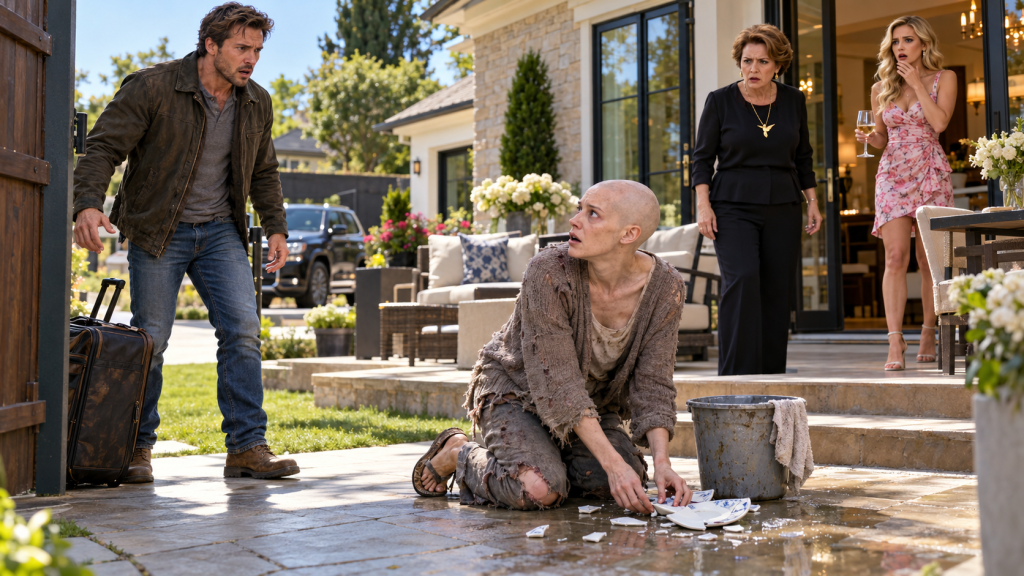
Lucy flinched. And that flinch told me more than any confession could have. I looked at my sister. “Do not raise your voice at my wife again.” Brianna crossed her arms. “She’s lying.”
“Then this should be easy.”
I pulled out my phone.
“Show me the account.”
My mother stepped closer.
“Nathan, your wife is sick.”
“Yes.”
“She gets confused.”
“She remembered the name of an account you apparently opened using my passport.”
Theresa’s mouth tightened.
“Because we were handling your money.”
“What bank?”
Silence.
I stared at them.
“Which bank?”
Brianna looked toward my mother.
Another glance.
Another answer.
I slowly put my phone back into my pocket.
“All right.”
Theresa relaxed slightly.
That was her mistake.
She thought I was backing down.
I turned to Lucy.
“We’re leaving.”
My mother stepped in front of me.
“You cannot take her like this.”
I almost laughed.
“She is my wife.”
“She needs rest.”
“She needs a hospital.”
“We’ve been taking care of her.”
I looked at the bucket of filthy water.
The broken plate.
The storage shed.
The hummingbird necklace around Theresa’s throat.
Then I looked back at her.
“If this is what you call taking care of someone, I’m terrified to hear what you call cruelty.”
My mother’s face hardened.
“You have no idea what happened while you were gone.”
“No.”
I nodded.
“I don’t.”
“That’s why I’m going to find out.”
I lifted Lucy into my arms.
She weighed almost nothing.
That frightened me more than anything else.
Four years earlier, when I left for Calgary, Lucy used to complain that I picked her up too often.
“Put me down, you idiot.”
she would laugh.
“You’re going to wreck your back.”
Now she did not protest.
She simply rested her cheek against my chest.
Her breathing was shallow.
I carried her toward the front door.
My mother followed.
“Nathan.”
I kept walking.
“Nathan!”
I stopped.
Turned.
Theresa looked at me with tears in her eyes.
For one weak second, some old part of me responded.
My mother crying had always been a command.
Fix it.
Comfort her.
Stand down.
Then I remembered Lucy kneeling over broken porcelain.
“What?”
Theresa swallowed.
“The million dollars.”
There it was.
Not:
Is Lucy going to survive?
Not:
Where are you taking her?
Not:
Can I come?
The million dollars.
I looked at my mother.
“What about it?”
“You said there’s paperwork.”
“There is.”
Her shoulders relaxed.
“Then come back after the hospital.”
“We can organize everything.”
I almost smiled.
“I was hoping you’d say that.”
Brianna watched me suspiciously.
“What does that mean?”
“It means I need every financial record connected to my name.”
I looked at both of them.
“Everything.”
“The account Lucy mentioned.”
“Every bank statement.”
“Every transfer.”
“Every receipt showing where the money I sent was spent.”
“Anything with my signature.”
Theresa swallowed.
“Why?”
I made my face tired.
Not angry.
Greed trusts weakness more easily than anger.
“Because the settlement attorney says they won’t release the payment until my financial history is verified.”
That was a lie.
The settlement was real.
The condition was not.
The email I had received on the plane said the insurer had accepted the final agreement after months of negotiations following the plant accident.
My after-tax payment would be slightly more than one million dollars.
The money was already moving through my attorney’s trust account.
Nobody needed Theresa’s bank records.
But she did not know that.
And I needed her frightened enough to make mistakes.
I continued.
“If the lawyer sees unexplained accounts later, they could delay everything.”
Brianna’s expression changed.
“How long?”
“Months.”
That word frightened her more than prison apparently did.
She looked at Mom.
Theresa forced a smile.
“Then of course we’ll help.”
I nodded.
“Good.”
“When?”
“Tomorrow.”
My mother glanced at Lucy.
“What about tonight?”
I looked down at my wife.
Her eyes were closed.
“Tonight I find out whether she’s going to live.”
No one followed us.
At the hospital, everything moved quickly.
Too quickly.
A nurse took one look at Lucy and called for a wheelchair.
Within minutes, they were drawing blood.
Checking oxygen.
Starting fluids.
Asking questions I could barely answer.
“How much weight has she lost?”
“I don’t know.”
“When was her last chemotherapy session?”
I looked at Lucy.
Her eyes filled.
“Ten months ago.”
The doctor paused.
“Ten?”
Lucy nodded.
“One cycle.”
My chest tightened.
“One?”
She looked ashamed.
As though cancer treatment were a bill she had forgotten to pay.
“The doctor wanted me to continue.”
“What happened?”
Her eyes moved toward me.
I understood.
Money.
The emergency physician asked me to step outside while they stabilized her.
I refused at first.
Lucy squeezed my hand.
“Go.”
“I’m staying.”
“Nathan.”
Her voice was weak but familiar.
Still Lucy.
Still capable of bossing me around from a hospital bed.
“Go drink water.”
I kissed her forehead.
“Fine.”
“I love you.”
Her eyes closed.
“I know.”
I stepped into the hallway.
Then collapsed against the wall.
Not physically.
Emotionally.
My legs still held me.
Everything else gave way.
For four years, I had imagined this reunion a thousand times.
Lucy running into my arms.
Her hair longer.
The house finished.
Maybe a little garden behind it.
Maybe we would start talking about children again.
Instead, I was standing outside an emergency room trying to remember how to breathe while doctors investigated how far cancer had progressed because the money I sent for my wife had apparently become granite countertops and acrylic nails.
A nurse brought me water.
I thanked her.
Did not drink it.
Twenty minutes later, my phone rang.
Theresa.
I declined.
Again.
Declined.
Brianna.
Declined.
Then another number.
Canada.
I answered.
“Nathan?”
It was Amelia Ross, the attorney handling the plant settlement.
“I just saw your email.”
“I know.”
“You landed?”
“Yes.”
“Congratulations.”
I almost laughed.
“Bad timing.”
“What happened?”
I looked through the small glass panel in Lucy’s door.
“My wife has cancer.”
Silence.
“Oh, Nathan.”
“My family was supposed to be paying for her treatment.”
I rubbed my face.
“They weren’t.”
Another silence.
Then the lawyer in her woke up.
“How much money did you send them?”
“Almost a hundred thousand.”
“Do you have records?”
“Every Canadian transfer.”
“Good.”
“And apparently they opened an account in my name using a passport copy.”
Her voice sharpened.
“What?”
“I don’t know yet.”
“Do not sign anything.”
“I wasn’t planning to.”
“Do not give anyone your settlement details.”
“Too late.”
I told her what I had said.
One million dollars.
Account verification.
Release condition.
Amelia became very quiet.
Then:
“That condition does not exist.”
“I know.”
“You invented it?”
“Yes.”
“Why?”
“Because my mother likes money.”
I could almost hear Amelia deciding whether to lecture me.
Instead she said:
“Then be careful.”
“I will.”
“No.”
She interrupted.
“Actually be careful.”
“If there is identity theft, you do not know the scope.”
“You need copies of your credit reports.”
“Bank fraud department.”
“Potential police report.”
“And local counsel.”
“I’ll find someone.”
“I already know someone.”
Of course she did.
Lawyers always know another lawyer.
She gave me the number for a financial-crimes attorney named Daniel Cho.
I called him from the hospital waiting room.
He listened.
Asked precise questions.
Passport copy.
Transfers.
Account.
Settlement announcement.
Then he said:
“Do not confront them further tonight.”
“I want records.”
“You may get them.”
“But let greed do the work.”
That phrase made me look up.
“What?”
“You already gave them a reason to produce documents voluntarily.”
“Let them.”
“Do not threaten them.”
“Do not tell them you are calling law enforcement.”
“Do not tell them the settlement condition was invented.”
“Can I ask questions?”
“Yes.”
“Can I copy anything they show me?”
“Yes.”
“If they willingly give it to you.”
“And if they ask me to sign?”
“Don’t.”
He paused.
“Mr. Barnes?”
“Yes?”
“Your wife’s medical safety comes first.”
I closed my eyes.
“I know.”
“Do you?”
That irritated me.
Then I realized why.
Because I had just spent ten minutes talking about accounts while Lucy was behind a hospital door.
“I do now.”
“Good.”
The doctor came out shortly after midnight.
Her name was Dr. Patel.
She looked exhausted.
I liked her immediately because she did not use the soft voice people use when they are preparing you for death.
She gave me facts.
Lucy was severely dehydrated.
Malnourished.
Anemic.
Her immune system was weak.
The cancer had progressed since the original diagnosis.
“How bad?”
I asked.
“We need updated imaging before I can give you a responsible answer.”
“Is she dying?”
Dr. Patel paused.
“She is very sick.”
My knees weakened.
“But sick is not the same as without options.”
I looked at her.
“Can you treat her?”
“Yes.”
“Will she survive?”
“I cannot promise that.”
“Can anybody?”
“No.”
She looked directly at me.
“But I would not be talking to oncology about restarting treatment if I believed there was nothing to do.”
I nodded.
That became enough.
For that night, it had to be enough.
I sat beside Lucy until dawn.
Around three, she woke.
“You’re still here.”
I almost laughed.
“Where would I go?”
Her eyes filled.
“Canada.”
I stared.
“What?”
She looked away.
I leaned closer.
“Lucy.”
Her mouth trembled.
“They said you didn’t want to know.”
My blood went cold.
“Who?”
“You know who.”
I sat very still.
“What exactly did they tell you?”
She closed her eyes.
“That you knew about the cancer.”
I forgot how to breathe.
“They said they called you.”
“That you told Theresa you couldn’t afford for me to become a financial disaster while you were trying to build your future.”
I stood.
Had to.
If I stayed seated, I thought I might break something.
“I never knew.”
Lucy started crying.
“I know now.”
“Lucy, I never knew.”
“I know.”
“Did you believe them?”
Her face crumpled.
“For a while.”
That hurt more than anger would have.
She continued.
“Your mother showed me a message.”
“What message?”
“An email.”
“From you.”
“I never sent an email.”
“I know.”
“Now.”
My skin went cold.
“What did it say?”
She hesitated.
Then whispered:
I’m sorry she’s sick, but I cannot let Lucy’s illness destroy everything I’m building here. Use what you think is reasonable, but do not keep sending money into treatments that may not work.
I stared at her.
“I did not write that.”
“I know.”
“How?”
“Because later I saw the email address.”
My pulse jumped.
“What was wrong with it?”
“One letter.”
She swallowed.
“Your real address has ‘barnesnathan’.”
“The fake one had ‘barnsenathan.’”
I covered my face.
Such a small difference.
One letter between my wife believing I abandoned her and knowing I had no idea.
“Why didn’t you tell me?”
“They took my phone after I tried.”
“Who?”
“Theresa.”
My hands curled.
“She said I was becoming unstable from treatment.”
“Brianna changed the Wi-Fi password.”
“They let me use the old tablet sometimes, but only when one of them was nearby.”
I looked at her.
“You could have left.”
The sentence escaped before I could stop it.
Lucy stared at me.
I hated myself immediately.
She did not shout.
That made it worse.
“I tried.”
My chest tightened.
She continued.
“The first time, I fainted at the bus stop.”
“The second time, your mother told me if I walked out, I could not come back.”
“She said the house was hers.”
“I had eighty-three dollars.”
“No car.”
“No phone plan.”
“No family nearby.”
“And I was vomiting four or five times a day.”
She looked away.
“I was ashamed.”
I sat down.
“Lucy.”
“I’m sorry.”
“No.”
I shook my head.
“No.”
“I am.”
“You do not apologize to me for surviving badly.”
She looked at me.
“I should have found a way.”
“So should I.”
My voice broke.
“I called once a week.”
“Sometimes twice.”
“I accepted ‘I’m fine’ because it was easier than asking why your camera was always off.”
“You were working.”
“That explains it.”
“It does not excuse all of it.”
She started crying again.
I took her hand.
“I trusted the wrong people.”
“And you paid for it with your body.”
She whispered:
“You didn’t do this to me.”
“No.”
“But I made it easy to hide from me.”
Both truths.
I kissed her hand.
“I am sorry.”
She squeezed my fingers.
“Don’t leave again.”
“I won’t.”
Not a dramatic promise.
A practical one.
I called Calgary the next morning.
The plant was still shut down.
My settlement meant I did not need to return to the same job.
I resigned.
Not because money made me noble.
Because four years had already cost too much.
At ten that morning, Theresa texted.
I have the documents you need. Come home alone.
Alone.
Daniel Cho had warned me that one word would matter.
I forwarded the message.
He called immediately.
“Do not bring Lucy.”
“She’s admitted.”
“Good.”
“That sounded terrible.”
“You know what I mean.”
“Yes.”
He continued.
“I can meet you first.”
“Where?”
“Coffee shop across from the hospital.”
Daniel was younger than I expected.
Maybe early forties.
Calm.
Dark suit.
No theatrics.
He brought a folder.
Inside were printed instructions.
“Your credit report shows two accounts you did not disclose when we spoke.”
My stomach dropped.
“You already pulled it?”
“With your authorization.”
He pointed.
“A credit card opened nineteen months ago.”
“Balance: nineteen thousand four hundred.”
I stared.
“And a personal line of credit.”
“Original amount seventy-five thousand.”
“Current balance sixty-two thousand.”
I stopped breathing.
“That’s over eighty thousand dollars.”
“Yes.”
“In my name?”
“Yes.”
I looked at the report.
Address.
My mother’s house.
Phone number.
Brianna’s number.
“Can they do this with a passport copy?”
“They should not have been able to.”
“That does not mean someone didn’t.”
He tapped another page.
“There is also a checking account at Northfield Community Bank associated with the line.”
“Balance?”
“Eleven thousand three hundred.”
“What happened to the rest?”
“We do not know yet.”
I thought about the SUV.
Salon.
Granite.
My stomach turned.
Daniel said:
“I have notified the bank’s fraud department with your permission.”
“The accounts are under review.”
“Do not tell your mother yet.”
I looked at him.
“So I go home.”
“You go home if you feel safe.”
“And ask them for records.”
“Yes.”
“Why not let the police handle everything?”
“Eventually they may.”
“But right now, voluntary documents can tell us what they believe they need to hide.”
I nodded.
“What if they destroy them?”
“We already have some bank data.”
“Your Canadian remittance records are secure.”
“And Lucy’s statement matters.”
“But the more they hand you themselves, the less room they have later to claim you authorized everything.”
I stood.
“Let’s do it.”
Daniel held up a hand.
“One more thing.”
“What?”
“The million-dollar settlement.”
I waited.
“If they ask where it will be deposited, do not provide account numbers.”
“I’m not stupid.”
He looked at me.
“No.”
“You’re angry.”
“Angry people sometimes rent stupidity by the hour.”
I almost smiled.
“Fine.”
I returned to the house at noon.
Alone.
My mother had changed clothes.
Makeup.
Pearls.
The hummingbird necklace was gone.
Interesting.
Brianna wore business clothes.
For a financial confession, apparently.
The kitchen table was covered in folders.
Theresa smiled.
“Sit.”
I did.
She poured coffee.
I did not touch it.
Brianna slid a binder toward me.
“We organized everything.”
That should have been my first clue that panic had been working all morning.
Inside were four years of bank statements.
Not all.
But enough.
I opened the first page.
My transfers.
$2,400.
$2,600.
$3,000.
Month after month.
My own notes appeared in the reference field.
HOUSE + LUCY
MEDICAL/FOOD
SAVE
CHRISTMAS
I felt sick.
The money hit Theresa’s account.
Then disappeared.
Cash withdrawal.
Dealer payment.
Transfer to Brianna.
Furniture store.
Salon supply company.
Contractor.
Another transfer to a second account.
I pointed.
“What is this?”
Theresa leaned over.
“Household reserve.”
“What bank?”
“Northfield.”
I looked up.
Neither woman met my eyes.
“The account in my name?”
Brianna answered.
“It’s technically a family account.”
“Whose name is on it?”
Silence.
“Mine?”
“Yes.”
“Who opened it?”
Mom said:
“We did it for convenience.”
“How?”
“You were overseas.”
“That isn’t an answer.”
Brianna crossed her arms.
“We had your documents.”
“My passport copy.”
“Yes.”
“My signature?”
“You had signed forms before leaving.”
“What forms?”
Theresa opened another folder.
There it was.
A photocopied power of attorney.
My name at the bottom.
My supposed signature.
Dated fourteen months after I moved to Canada.
I stared at it.
The world became remarkably calm.
The way it does when anger passes a certain point and turns into ice.
“I signed this?”
My mother hesitated.
“You authorized me.”
“That’s not what I asked.”
“Nathan—”
“Did I sign this document?”
Brianna stepped in.
“You told us to handle the money.”
I looked at her.
“Did I sign it?”
No answer.
I studied the signature.
It looked enough like mine to fool someone glancing quickly.
But the N was wrong.
I had broken my right wrist at fourteen.
Ever since, my capital N leaned strangely backward.
This one did not.
I asked:
“Who notarized it?”
Brianna’s face changed.
My mother said:
“A friend.”
“What friend?”
“Someone from Brianna’s salon.”
I almost laughed.
“A nail-salon notary?”
“She’s licensed.”
“Did she watch me sign?”
Silence.
I nodded.
“Okay.”
Theresa reached for my hand.
I pulled it away.
“Nathan, please understand.”
“I am trying.”
I turned another page.
The seventy-five-thousand-dollar line of credit.
Purpose:
HOME RENOVATION AND FAMILY BUSINESS DEVELOPMENT
Borrower:
Nathan Barnes
Income:
One hundred twenty-eight thousand dollars annually.
I laughed.
“What?”
Brianna asked.
“I’ve never made one hundred twenty-eight thousand dollars in my life.”
Theresa said:
“Canadian dollars convert differently.”
“This says U.S.”
Silence.
I kept reading.
There was an electronic application.
Employment:
Barnes Industrial Consulting
I stared.
“I don’t own a consulting company.”
My sister said:
“We needed the income to qualify.”
There it was.
The first clear admission.
I looked up slowly.
“We?”
Brianna realized.
Too late.
I continued.
“How much of the line went into your salon?”
She said nothing.
“Thirty-eight thousand?”
Her eyes widened.
I had guessed.
That told me I was close.
Theresa snapped:
“It was an investment.”
“In my name?”
“For the family.”
“What percentage of the salon do I own?”
Silence.
“Show me the agreement.”
“There isn’t one.”
“So I borrowed money without knowing it to invest in a business I don’t own.”
Brianna’s eyes filled.
“I was going to pay it back.”
Of course.
The anthem of every thief.
I turned toward my mother.
“And the SUV?”
“We needed reliable transportation.”
“Using my credit?”
“You would’ve benefited when you came home.”
“Lucy did?”
Theresa looked away.
“How much did you spend on her cancer?”
No answer.
I repeated:
“How much?”
Brianna whispered:
“Maybe five thousand.”
My stomach dropped.
“Out of nearly one hundred thousand I sent?”
“There were other costs.”
“Five thousand?”
Theresa stood.
“You are making this sound worse than it was.”
I stood too.
“My wife was eating scraps.”
“She was difficult!”
“She had cancer!”
“She stole.”
“What?”
My mother froze.
I pointed at her neck.
“Where is Lucy’s hummingbird necklace?”
Silence.
“Did she steal that too?”
Theresa’s eyes filled.
“She offered it.”
“Lucy says you took it when she tried to sell it for a doctor visit.”
“She was confused.”
“Then give it back.”
My mother said nothing.
“Where is it?”
Brianna whispered:
“Pawn shop.”
I looked at her.
“What?”
Mom closed her eyes.
Brianna continued.
“We pawned it.”
“For what?”
“The salon needed payroll.”
I actually laughed.
Not because anything was funny.
Because reality had finally become absurd.
I sank back into the chair.
“So let me understand.”
“You used my money to start the salon.”
“You used credit opened in my name to keep the salon operating.”
“And when my sick wife tried to sell her own necklace to see a doctor, you took it and pawned it for the salon too.”
Brianna started crying.
“It wasn’t like that.”
“That is exactly what you just described.”
My mother slammed her palm onto the table.
“Enough.”
I looked at her.
“You come home with a million dollars and suddenly think you’re better than everyone.”
There it was.
The real Theresa.
Not the wounded mother.
Not the family manager.
The woman who believed access created ownership.
I said:
“That million dollars has nothing to do with what you did.”
“It has everything to do with this.”
She pointed around the house.
“This family sacrificed while you built your life.”
I stared.
“You had my wife sleeping in a storage shed.”
“Because she was disgusting.”
The word left her mouth before she could stop it.
Silence.
Brianna whispered:
“Mom.”
Theresa’s face changed.
But the sentence already existed.
I stood.
Collected the documents.
My mother grabbed the binder.
“You’re not taking that.”
“Yes.”
“No.”
I looked at her hand on the folder.
“Do you want the settlement delayed?”
She froze.
Greed beat caution again.
I continued:
“The attorney needs copies.”
She released it slowly.
“How soon will the money come?”
I almost admired her.
Even now.
“Soon.”
Her eyes sharpened.
“And you’ll still use my account?”
I looked at her.
“Why would I?”
She blinked.
“You said because of residency.”
“I said I needed records connected to my permanent residence.”
“That’s not the same thing.”
She was finally listening.
I picked up the binder.
“I’ll call you.”
Brianna rushed forward.
“Nathan.”
I stopped.
“What?”
She lowered her voice.
“Don’t make this bigger than it needs to be.”
I looked at her.
“My wife may die.”
Her face collapsed.
“You already made it bigger than it ever should have been.”
Then I left.
Daniel Cho was waiting two blocks away.
I handed him the binder.
He turned three pages.
Then looked at me.
“Did they voluntarily give you this?”
“Yes.”
“Did you take anything hidden?”
“No.”
“Good.”
He pulled out the forged power of attorney.
His eyebrows rose.
“Oh.”
“What?”
“This is exceptionally stupid.”
I almost laughed.
“That’s your legal opinion?”
“Not technically.”
He photographed it.
Then the credit application.
Then several transfers.
He pointed at one payment.
“Thirty-one thousand eight hundred.”
“Dealer?”
“Probably SUV.”
Another.
“Twenty-seven thousand.”
“Contractor.”
Another.
“Thirty-nine five.”
“Salon.”
He looked at me.
“This is not just misuse of remittances.”
“If the account and credit were opened without your authorization, we’re dealing with identity theft, bank fraud, forged documents, potentially conspiracy.”
My stomach turned.
“Prison?”
“Possibly.”
I thought about my mother.
For a second, she was not the woman in the backyard.
She was the woman who used to pack my school lunch.
Who stayed awake when I had pneumonia at nine.
Who taught me how to drive.
That is the cruel thing about betrayal.
The person does not become a stranger afterward.
They remain the person you loved.
Now carrying something unforgivable.
I whispered:
“She’s my mother.”
Daniel nodded.
“I know.”
“I don’t want to destroy her.”
“Then don’t.”
I looked at him.
“You don’t control criminal charging.”
“But you also do not need to exaggerate or weaponize the process.”
“You tell the truth.”
“That is enough.”
Back at the hospital, Lucy was awake.
I put the hummingbird necklace question aside.
For now.
She looked at the binder.
“You found it.”
“Yes.”
Her face tightened.
“What?”
“Nothing.”
“Lucy.”
She looked toward the window.
“There’s more.”
I sat.
Of course there was.
“What?”
“The messages.”
“What messages?”
She swallowed.
“From your phone.”
My body went cold.
“What about them?”
“Sometimes Brianna answered when you called.”
“That never happened.”
“She didn’t answer the call.”
“She answered texts afterward.”
I frowned.
“With your mother’s phone?”
“No.”
“Yours.”
My stomach dropped.
“I had my phone in Canada.”
“Your old American number.”
I stared.
Before moving to Calgary, I had switched carriers.
My old U.S. number had been disconnected.
Apparently Theresa later reactivated it under a cheap prepaid plan.
Using my identity.
Brianna used it to message Lucy.
Short messages.
Working late.
Can’t talk.
Listen to Mom.
Don’t create problems while I’m gone.
My hands shook.
“I never sent those.”
“I know.”
“But at the time…”
“You thought I did.”
“Yes.”
The room blurred.
She continued.
“When I asked why your Canadian number was different, Theresa said you kept the old number for family.”
“I stopped trusting myself.”
I closed my eyes.
Four years of distance had created enough gaps for impersonation to live in.
I had sent money.
Worked.
Called.
Assumed.
They filled the spaces.
I asked:
“Why did they hate you?”
Lucy’s eyes filled.
“They didn’t at first.”
That surprised me.
“What changed?”
“When they realized how much money you were sending.”
I sat quietly.
“At first, Theresa gave me grocery money.”
“Helped with bills.”
“She was kind.”
“Then Brianna wanted to open the salon.”
“She asked me if I thought you would mind using some savings.”
“I said yes.”
“Meaning I thought you would mind.”
Lucy almost smiled.
“She told Theresa I said they couldn’t touch family money.”
“After that, I became selfish.”
“Ungrateful.”
“Controlling.”
“When I got cancer, I asked for the money directly.”
“That made everything worse.”
My chest tightened.
“You were in the way.”
She nodded.
“I think so.”
There it was.
Not hatred.
Obstacle.
People can become vicious when another human being stands between them and money they have already emotionally spent.
“What about the shed?”
Lucy looked ashamed.
“After the first chemotherapy cycle, I vomited on the bed.”
“Theresa said I ruined the mattress.”
“She moved me into the back room temporarily.”
“Temporary became months.”
My eyes burned.
“And the shaved head?”
“I did it.”
“You?”
“My hair started falling out after treatment.”
“Brianna said it looked disgusting around the house.”
“So I shaved it.”
She touched her bare scalp.
“I thought I’d be back in chemo soon anyway.”
My chest hurt so badly I pressed a fist against it.
She looked at me.
“Nathan.”
“I’m okay.”
“No.”
She said.
“You’re not.”
I almost laughed.
Still Lucy.
Still refusing lies.
“No.”
I admitted.
“I’m not.”
Neither of us were.
That was finally allowed.
The financial investigation moved quickly after that.
Banks move faster when they realize they may have opened fraudulent accounts.
Northfield froze the remaining funds.
The credit card was blocked.
The line of credit stopped.
My credit files were flagged.
The forged power of attorney was sent for review.
The notary turned out to be a woman named Kayla who rented a chair inside Brianna’s salon.
She had stamped the document without seeing me sign it.
At first, she claimed she thought I had signed by video.
Then investigators showed her travel records.
She changed her statement.
That became Brianna’s first major problem.
Her second was the accounting software.
She had recorded transfers from the secret account as:
OWNER CAPITAL — NATHAN
Owner.
Except I owned nothing.
When investigators asked her why, she said:
“Because eventually he was going to be part of the business.”
Eventually.
Apparently fraud likes the future tense.
Theresa’s banking records were worse.
Over four years, I had sent $107,800.
I had underestimated.
Bonuses made the total higher than I remembered.
The forensic accounting found approximately $13,400 reasonably connected to household costs that benefited Lucy or the property I had expected to live in.
About $4,900 had gone toward Lucy’s medical care.
The rest?
SUV.
Renovations.
Furniture.
Brianna’s salon.
Travel.
Restaurants.
Credit card payments.
Cash withdrawals.
And nearly sixteen thousand dollars moved into a savings account in Theresa’s name.
My mother had not merely spent my money.
She had saved some of it for herself while telling my wife treatment was too expensive.
That was the number I could not forgive.
Not the salon.
Not the car.
Sixteen thousand dollars sitting quietly in savings.
While Lucy begged for oncology appointments.
When Daniel told me, I sat in his office and stared at the wall.
“Sixteen?”
“Yes.”
“She had cash.”
“Yes.”
“While Lucy was eating scraps.”
“Yes.”
He let me sit with it.
No lawyer language.
No legal strategy.
Just truth.
I eventually asked:
“What happens now?”
“The bank has referred the matter.”
“Law enforcement is investigating.”
“We will also file civil claims to recover traceable funds.”
“The SUV?”
“Potential asset.”
“The salon?”
“Potentially.”
“The house?”
“Complicated.”
“Why?”
“Title belongs to your mother.”
“Your remittances paid for improvements, but that does not automatically make you owner.”
That hurt.
Not because I wanted the house anymore.
Because for four years I had thought I was building my own home.
Apparently I had been renovating Theresa’s.
Daniel continued.
“We may pursue restitution and equitable claims.”
“But I am not going to promise you every dollar back.”
“I don’t care about every dollar.”
“I know.”
I looked at him.
“I want Lucy treated.”
“Then spend your energy there.”
So I did.
The million-dollar settlement arrived eleven days after I came home.
I did not announce it.
Did not buy a car.
Did not walk into my mother’s house waving a check.
The funds landed in an account Theresa had never touched.
The first large payment I made was not a revenge purchase.
It was Lucy’s medical insurance deductible and uncovered treatment costs.
Then a nutrition specialist.
Then transportation.
Then a small furnished apartment near the oncology center because I refused to take her back to that house.
The doctors developed a new treatment plan.
It was not easy.
The cancer had progressed.
There were months when Lucy could barely eat.
Days when I sat beside her while medication dripped into her veins and hated every beep in the room.
The first time her hair began growing back, it came in soft and uneven.
She touched the fuzz.
“I look like a peach.”
“A beautiful peach.”
“That’s disgusting.”
“I’m trying.”
“You’re failing.”
That was the moment I knew she was getting stronger.
Lucy’s recovery was not a miracle.
It was work.
Medicine.
Rest.
Nutrition.
Appointments.
Fear.
Scans.
More treatment.
A surgery we both dreaded.
Then radiation.
Then waiting.
The first scan showing significant improvement made me cry in the parking lot.
The second made me afraid to celebrate.
The third, almost a year after I returned, brought the word we had barely allowed ourselves to imagine.
Remission.
Not guarantee.
Not forever.
Remission.
Lucy squeezed my hand.
The oncologist kept explaining follow-up intervals.
I heard almost nothing.
Outside, Lucy leaned against me.
“Say it.”
I looked at her.
“What?”
“The word.”
I swallowed.
“Remission.”
Again.
“Remission.”
She cried.
I did too.
Then she said:
“I want fries.”
I laughed.
“You nearly died and your first plan is fries?”
“Large.”
“With salt.”
That was recovery too.
Wanting ordinary things again.
Theresa and Brianna were charged months before Lucy reached remission.
The prosecutors separated what they could prove from what I emotionally believed.
That mattered.
My mother was not charged because she had been cruel.
Cruelty is not always criminal.
She faced charges tied to identity theft, fraudulent financial documents, and unauthorized use of accounts.
Brianna faced similar charges, plus business records connected to the credit line.
Kayla, the notary, cooperated.
The forged power of attorney became central.
Neither case went to a dramatic jury trial.
Theresa pleaded guilty to several fraud-related charges.
Brianna cooperated earlier and received a lighter sentence.
My mother served time.
Not decades.
Enough.
Brianna received probation with a short custodial component, restitution obligations, and financial restrictions tied to the fraud.
The salon closed.
Its assets were sold.
The SUV was sold.
Theresa’s sixteen-thousand-dollar savings account was seized toward restitution.
When Daniel told me, I felt nothing.
Then guilt because I felt nothing.
Then anger at myself for feeling guilty.
Healing is messy.
The house eventually had to be sold too.
Not solely because of me.
Theresa had legal bills.
Debt.
Restitution.
She could not maintain it.
A negotiated sale resolved several obligations.
I recovered part of the money I had sent for renovations.
Not all.
I did not fight for every dollar.
By then, the place meant nothing to me.
A house is not home because your money bought the granite.
Home is where the sick person is allowed to sleep in the bed.
I never forgot that.
Brianna wrote to me first.
Six months into her sentence arrangement.
I almost threw the letter away.
Lucy said:
“Read it.”
“Why?”
“Because you’ll keep wondering.”
I hated when she was right.
The letter began:
Nathan, I know saying I’m sorry after getting caught is almost worthless.
Better than most apologies.
She continued.
I told myself the salon would eventually make enough to repay everything.
When it started failing, I borrowed more because admitting the first money was gone felt impossible.
Mom kept saying you had plenty coming in.
I kept saying you would be proud once the business succeeded.
We turned your future approval into permission you never gave.
That sentence stopped me.
She wrote about Lucy too.
Harder to read.
I resented her because she kept asking where the money went.
When she got sick, I wish I could tell you I became kinder.
I became worse.
Her treatment became a number competing with the salon.
I had to stop reading.
Lucy put her hand over mine.
“You don’t have to finish.”
“Yes.”
I whispered.
“I do.”
Brianna continued.
I told myself the doctors might be wrong.
I told myself Mom knew better because she was older.
Mostly I told myself whatever let me keep the salon open.
Then:
When Lucy’s hair began falling out, I called it disgusting.
That sentence wakes me up at night.
Good.
I hated thinking that.
But good.
Her final paragraph:
You do not owe me a relationship.
Lucy owes me nothing.
I am sorry I made money more important than whether she lived.
I folded the letter.
For several minutes, I said nothing.
Lucy asked:
“Do you forgive her?”
“No.”
She nodded.
“Okay.”
I looked at her.
“Do you?”
“No.”
That surprised me.
Lucy had always been softer.
She saw my face.
“Forgiveness is not a race.”
I smiled.
“Who taught you that?”
“Therapy.”
“Expensive?”
“Very.”
“Worth it?”
“Unfortunately.”
We both laughed.
Theresa’s letter came later.
Much later.
Almost two years.
It was different.
More defensive.
More complicated.
More honest by the end.
She began by reminding me she had raised me alone after my father left.
True.
She reminded me that I had sent money without detailed restrictions.
Also true.
She reminded me that some money had improved the house I expected to return to.
True again.
For the first page, she seemed to be building a case.
Then something changed.
None of that explains Lucy.
I stopped.
I was angry at her before she got sick.
I believed she looked down on Brianna.
When she questioned the money, I heard disrespect.
When she became ill, I saw expense instead of fear.
My throat tightened.
I told myself that because you sent money to my account, I had earned the right to decide where it went.
There it was.
Then, when treatment became costly, I made a decision no mother should ever make about another woman’s life.
I decided my children’s comfort mattered more than your wife’s survival.
I read that line twice.
Then:
The hardest truth is that I liked being in control while you were gone.
I closed my eyes.
That was the sentence I believed most.
Not because it was the ugliest.
Because it explained everything.
Control.
Money had merely carried it.
She ended:
If Lucy never wants to see me again, I understand.
If you never call me Mom again, I understand that too.
I am sorry.
I did not reply.
Not then.
Lucy and I spent two years rebuilding our marriage.
People assumed reunion automatically fixed us.
It did not.
I had returned.
She survived.
My family was held accountable.
Those facts did not erase four years of distance and eleven months of terror.
Lucy was angry at me.
Eventually.
That was a sign she was healing.
When she was sickest, she protected me from her anger because she was afraid I might leave again.
Once she believed I was staying, the truth came out.
“You should have visited.”
she said one night.
We were in our new apartment.
Her hair had grown to her jaw.
“I know.”
“You had vacation.”
“Not much.”
“But some.”
“Yes.”
“You came home because the plant closed.”
I swallowed.
“Yes.”
“Not because you noticed me disappearing.”
That one hurt.
“Yes.”
She cried.
“I needed you to notice.”
I did not defend myself.
“I know.”
“You kept saying you were doing everything for us.”
“I was.”
“That doesn’t mean it was the right thing.”
“No.”
I looked at her.
“I thought sending money was taking care of you.”
She shook her head.
“Money cannot look at someone.”
That sentence stayed.
Money cannot look at someone.
Cannot notice weight loss through a turned-off camera.
Cannot question a trembling voice.
Cannot ask why a wife suddenly stops laughing.
Cannot get on a plane.
I had sent nearly three thousand dollars a month.
And still failed to see what was happening.
Theresa stole.
Brianna forged.
They abused Lucy.
Those were their choices.
But my lesson belonged to me.
Providing is not the same as being present.
Trust is not the same as never checking.
And sacrifice loses meaning when the people you sacrifice for cannot reach you.
Lucy did not let me turn that lesson into self-destruction either.
Months later, I said:
“If I had come back sooner, none of this—”
“Stop.”
she said.
“It might have been different.”
“Yes.”
“You don’t know how.”
“I should’ve—”
“Nathan.”
She pointed at me.
“You do not get to make yourself responsible for their crimes because guilt makes you feel more powerful.”
I stared.
“What?”
“If everything is your fault, then you get to pretend you could’ve controlled everything.”
That annoyed me because it was true.
She continued.
“You were absent.”
“Yes.”
“You were too trusting.”
“Yes.”
“You ignored signs.”
“Yes.”
“But you did not forge your own signature.”
“You did not steal my necklace.”
“You did not put me in the shed.”
I looked down.
“Separate what belongs to you from what belongs to them.”
Therapy again.
I hated therapy.
It was ruining all my favorite unhealthy habits.
We started couples counseling.
Not because our marriage was ending.
Because we wanted the next version to be deliberate.
Lucy told me she no longer wanted one shared family account controlled by anyone.
Fine.
We created separate personal accounts and a household account.
Both of us had access.
No parent.
No sibling.
No secret manager.
Large transfers required both of us to know.
Not permission like children.
Knowledge like partners.
We wrote down emergency contacts.
Medical preferences.
Account locations.
Passwords stored properly.
Boring things.
Beautiful things.
Transparency became romantic to me.
Years earlier, I thought romance was working overtime in Calgary and sending home a Christmas bonus.
Now it was sitting beside Lucy once a month while we reviewed bills together.
“Electricity.”
“Paid.”
“Insurance.”
“Paid.”
“Groceries.”
“You spent ninety dollars at the fancy market.”
“It was cheese.”
“Ninety-dollar cheese?”
“Don’t police my recovery.”
I laughed.
We argued.
Ordinary arguments.
That felt luxurious.
The million-dollar settlement changed our life, but not the way Theresa and Brianna imagined.
We did not buy a mansion.
I never wanted granite again.
We bought a modest house two years after Lucy entered remission.
Three bedrooms.
Small yard.
Huge windows.
The first thing Lucy checked was the guest room.
I froze.
She saw me.
“What?”
“Nothing.”
“No.”
“What?”
I looked at the clean bed.
“No storage shed.”
Her face changed.
We stood there quietly.
Then she took my hand.
“No.”
she said.
“No one sleeps in a shed here.”
We bought the house.
I invested most of the settlement conservatively.
Kept an emergency fund.
Paid for Lucy’s ongoing medical care.
Took classes in welding inspection and later worked part-time.
Not because we needed every dollar.
Because I liked work better once it stopped owning my life.
Lucy started volunteering with a cancer support organization.
Then trained as a patient navigator.
The first time she came home with an identification badge, I stared.
“What?”
she asked.
“You.”
“What about me?”
“You’re helping people get treatment.”
She smiled.
“Apparently being difficult finally became employable.”
She specialized in patients struggling with transportation, finances, and family support.
People who heard:
Too expensive.
Too complicated.
Maybe later.
She knew what those phrases could hide.
One afternoon, years later, she came home furious.
“A woman missed radiation because her daughter said they couldn’t afford gas.”
I looked up.
“What happened?”
“We arranged rides.”
“Good.”
“She apologized to me for needing help.”
Lucy’s eyes filled.
“She apologized.”
I walked over.
Held her.
She whispered:
“I used to think I deserved what happened because I couldn’t pay.”
“No.”
“I know.”
That was progress.
Not never hearing the old lie again.
Recognizing it faster.
Brianna eventually paid restitution for years.
Slowly.
The salon never reopened.
After probation ended, she worked as a receptionist, then trained as a bookkeeper.
The irony was almost cruel.
She became meticulous.
Maybe fear.
Maybe growth.
Maybe both.
Five years after my return, she asked to meet Lucy.
Not me.
Lucy decided.
“Yes.”
I offered to come.
“No.”
That frightened me.
“Are you sure?”
“Yes.”
They met at a café.
Lucy told me afterward.
Brianna had cried.
Apologized again.
Did not ask forgiveness.
Did not mention family.
Did not explain how hard her life had been.
She brought the hummingbird necklace.
I stared.
“The pawn shop?”
Brianna had redeemed it before sentencing using money from selling personal jewelry.
Then kept it in a bank box because she was ashamed to send it.
Lucy opened the small box at home.
The hummingbird was scratched.
The chain was not original.
She held it in her palm.
“Do you want it?”
I asked.
“I don’t know.”
“It was yours.”
“So was the life I had when you gave it to me.”
I understood.
She did not put it on.
Instead, she placed it in our desk.
Years later, she gave it to our niece when she graduated nursing school.
Brianna cried when she learned.
Not everything stolen needs to return to its exact original place to matter.
Theresa was harder.
After release, she lived in a small rental apartment.
No SUV.
No granite.
No gold chain.
I did not see her for almost seven years.
People judged me for that.
Relatives said:
“She’s your mother.”
Exactly.
That was why the betrayal cut as deeply as it did.
Being family explains why a relationship matters.
It does not guarantee access forever.
Lucy never asked me to reconcile.
That mattered.
One winter, I received a message from Theresa.
I am having surgery next month. I wanted you to know. I am not asking you to come.
I stared at it for a long time.
Then showed Lucy.
“What do you want to do?”
she asked.
“I don’t know.”
“That’s allowed.”
I went.
Alone.
Theresa was smaller.
Older.
Her hair almost entirely gray.
When I entered the hospital room, she looked terrified.
“Nathan.”
“Hi, Mom.”
The word came out automatically.
We both heard it.
She cried.
I did not hug her immediately.
Eventually I sat.
She said:
“You look like your father.”
“Terrible opening.”
She laughed weakly.
Then:
“I’m sorry.”
“I know.”
“No.”
She shook her head.
“I used to think admitting I was sorry meant I had to believe I was a monster.”
I said nothing.
She continued.
“Then prison taught me there are ordinary people who do monstrous things.”
That was uncomfortable.
True.
She looked at me.
“I loved you.”
“I know.”
“I even loved Lucy in the beginning.”
“I believe that.”
“And still…”
Her voice broke.
“I did what I did.”
I nodded.
She whispered:
“How is she?”
“Alive.”
Theresa closed her eyes.
“Thank God.”
I felt anger rise.
Not because she thanked God.
Because she had once denied Lucy medicine.
I stood.
She opened her eyes.
“I shouldn’t have said—”
“No.”
I shook my head.
“You can be grateful.”
“I am too.”
I sat again.
Then said:
“But you don’t get to turn her survival into proof that what you did wasn’t as bad.”
Theresa cried.
“I know.”
That answer kept me there.
We developed a limited relationship after that.
Phone calls.
Occasional lunch.
No access to our finances.
No key to our house.
No automatic holiday invitation.
Trust returned in inches.
Never miles.
Lucy saw her once, years later.
Theresa cried when she entered the room.
Lucy did not hug her.
They sat.
Theresa apologized.
Specifically.
“For the shed.”
“For the food.”
“For the necklace.”
“For the fake messages.”
“For telling you Nathan didn’t want to know.”
“For treating treatment money like mine.”
No excuses.
Lucy listened.
Then said:
“I don’t forgive everything yet.”
Theresa nodded.
“You don’t have to.”
That was the beginning.
Not reunion.
Not family restored to some imaginary perfect version.
Beginning.
Over time, Lucy allowed Theresa into a small part of our lives.
Supervised by reality.
Not nostalgia.
Brianna returned more gradually.
The three women never became close again.
That was okay.
Healing is not rebuilding the exact structure that hurt you.
Sometimes you build something smaller and safer.
Sometimes you leave walls missing.
Years later, on the tenth anniversary of my return from Canada, Lucy and I sat in our backyard.
A good backyard.
No dirty bucket.
No broken plate.
Tomatoes.
Too many tomatoes.
Lucy’s hair was long again.
Silver beginning at the temples.
Her scans had remained clear.
She still attended follow-ups.
Still felt afraid before every one.
We stopped pretending otherwise.
She handed me a glass of iced tea.
“Ten years.”
“I know.”
“You remember what you said?”
“When?”
“In the backyard.”
“I said a lot.”
“The million dollars.”
I laughed.
“My greatest performance.”
“You looked so calm.”
“I was considering homicide.”
“I know.”
She smiled.
“Your eye was twitching.”
“I thought I hid it.”
“No.”
We sat quietly.
Then Lucy said:
“If you hadn’t mentioned the settlement, do you think they would’ve confessed?”
“No.”
“Me neither.”
“Greed made them sloppy.”
She nodded.
“But the money didn’t save me.”
I looked at her.
“No.”
“You came home.”
That hurt beautifully.
“I should have sooner.”
She sighed.
“Nathan.”
“I know.”
“You’re seventy percent healed.”
“Rude.”
“You still say the same thing.”
“I’m allowed regret.”
“Yes.”
“You’re not allowed to build a house in it.”
I looked at our home.
Fair point.
The settlement trap became family legend in a strangely sanitized form.
People told it as though I had planned everything from the moment I opened the fence.
I had not.
I was terrified.
Furious.
Improvising.
The million dollars was simply the brightest object I could put in front of people who had already shown me what money meant to them.
They reached for it.
And while reaching, they opened the drawers they had kept closed.
The account.
The forged power of attorney.
The line of credit.
The salon transfers.
The pawned necklace.
The fake email.
The old phone number.
The savings account.
Greed did not create their behavior that afternoon.
It revealed the structure already underneath.
That distinction mattered.
So did another.
Money had been at the center of everything, but the worst theft was not financial.
Theresa and Brianna stole time.
Eleven months of treatment.
Four years of trust.
My wife’s belief that her husband still wanted her.
My belief that my wife was safe.
Those things could not be seized from a bank account and returned.
We had to build new versions ourselves.
Slower.
Imperfect.
Real.
When I was sixty-three, my old Canadian coworker Miguel visited.
He had known me during those brutal Calgary years.
We sat on the porch.
Lucy brought coffee.
Miguel looked at her.
Then at me.
“This is the wife?”
Lucy laughed.
“I hope so.”
Miguel shook his head.
“Nathan talked about you every day.”
Lucy’s smile faded.
“What did he say?”
Miguel looked embarrassed.
“All kinds of things.”
“That you loved yellow flowers.”
“That you made terrible pancakes.”
“That he was building a house.”
Lucy looked at me.
“He told everybody he was building a house?”
“Every damn day.”
Miguel laughed.
“Man lived in a room with four guys and kept a photo of some ugly kitchen cabinet on the wall.”
Lucy started crying.
Miguel panicked.
“I said something wrong.”
“No.”
She wiped her face.
“You said something I needed.”
After he left, Lucy showed me an old fake message Theresa had preserved in the case file.
I cannot let Lucy’s illness destroy what I’m building here.
She placed it beside Miguel’s story.
Two realities.
Same years.
In Canada, I had been talking about coming home.
At home, she was being told I wanted to escape her.
That was what deception had done.
Not simply created false facts.
It had prevented two people who loved each other from comparing realities.
We never allowed that again.
Whenever something sounded wrong, we asked.
Directly.
“Did you say this?”
“Did you spend this?”
“Do you want this?”
“Are you afraid?”
“Are you angry?”
Simple questions.
They saved us more than grand gestures ever had.
When Lucy eventually wrote about her cancer experience for the patient-support organization, she let me read the draft.
One line stopped me.
The most dangerous thing that happened to me was not that my family hated me. It was that they convinced me the person who loved me most had already agreed with them.
I looked at her.
“That’s the story.”
She nodded.
“Yes.”
Not the SUV.
Not the salon.
Not even the million dollars.
Isolation.
That had been the weapon.
So when younger couples asked us for advice, I never said:
Never trust family.
That would have been the wrong lesson.
I said:
Never outsource your relationship.
Do not make a parent the only person who understands the finances.
Do not let one relative control all access.
Do not assume sending money means knowing what is happening.
Do not let pride stop you from saying:
Show me.
Tell me.
Turn on the camera.
I’m coming home.
Years after everything, I found the old suitcase I had dropped inside the doorway that first day.
Scuffed.
One wheel broken.
Still smelled faintly like metal shop dust.
Inside one pocket was the printed settlement email.
I had forgotten I carried a copy.
At the top:
Gross Settlement Amount: $1,284,000
After fees and deductions, my payment had been just over one million.
I stared at the page.
That number once felt enormous.
Now I barely remembered what we spent where.
Medical care.
House.
Investments.
Life.
The money mattered.
Of course.
But when I thought about that day, the number I remembered most was not one million.
It was two.
Two oncology visits.
Eleven months of cancer.
And only two appointments my family had paid for before deciding Lucy had become too expensive.
That number haunted me.
So Lucy and I created something with part of the remaining settlement.
A small emergency fund through her patient-support organization.
Not for treatment itself.
For the things that make treatment possible.
Gas.
Meals.
Temporary lodging.
Childcare.
Phone bills.
A ride to chemotherapy.
The first grant was $420.
A woman needed two weeks in a motel near a radiation center because driving ninety minutes each way made her too sick.
Four hundred twenty dollars.
Tiny compared with a million.
Life-changing compared with zero.
Lucy came home after approving it.
“Guess what.”
“What?”
“We bought someone ten nights.”
I smiled.
“Better than granite.”
“Much.”
The program eventually helped hundreds of patients.
No Barnes name on it.
No plaque.
Lucy named it the Open Door Fund.
I asked why.
She said:
“Because sick people should never have to earn their way back into the house.”
I could not argue.
Theresa died many years later.
We had reached something like peace by then.
Not innocence.
Not forgetting.
Peace.
At her funeral, Brianna stood beside me.
We were older.
Softer.
Scarred in different places.
She whispered:
“Do you think Mom believed we forgave her?”
I looked at the casket.
“I think she knew forgiveness wasn’t one thing.”
Brianna nodded.
Then:
“Did you forgive me?”
I thought about it.
“Yes.”
She cried.
I continued.
“But I never trusted you the same way again.”
She wiped her face.
“I know.”
“And that is part of forgiveness too.”
She looked at me.
“Thank you for saying it.”
We hugged.
Briefly.
Lucy watched from several feet away.
Not threatened.
Not responsible.
Free.
On the drive home, she took my hand.
“You okay?”
“Yes.”
“Really?”
I smiled.
“See?”
“What?”
“You still check.”
“Always.”
Good.
The last time Lucy had a major cancer follow-up, we were both old enough that the oncologist looked younger than our marriage.
He studied her scans.
Then smiled.
“Everything looks stable.”
Lucy squeezed my hand.
Outside, we sat in the car for a while.
No rush.
No celebration.
Just relief.
She touched the hummingbird pendant around her neck.
She had started wearing it again eventually.
Not every day.
Only for scans.
I noticed.
“You know Brianna pawned that.”
“I’m aware.”
“Strange choice for luck.”
“It isn’t luck.”
“What is it?”
She looked at me.
“Evidence.”
“Of?”
“That people can take something from you and still fail to own what it means.”
I stared.
Then smiled.
“You got annoyingly wise.”
“Cancer.”
“Therapy.”
“Bad in-laws.”
“All expensive teachers.”
I laughed.
Then she added:
“And one stupid husband who finally came home.”
“That too.”
We drove back together.
That was the whole miracle.
Together.
Not perfect.
Not untouched.
Not the family we had imagined before Canada.
Something earned differently.
When I think about the day I returned now, I no longer picture the million-dollar email first.
I picture Lucy’s bare feet on the concrete.
Her hands picking up broken porcelain.
Her shaved head.
My mother wearing the hummingbird necklace.
My sister holding a glass of wine.
And the silence inside me before I opened the gate.
I used to wish I had shouted.
Thrown furniture.
Made them afraid.
Now I am glad I didn’t.
Anger would have given them a fight.
Greed gave me evidence.
I simply placed one million dollars in front of them and watched them decide, in real time, that stealing from me again was more important than hiding what they had already done.
They opened the folders themselves.
They explained the fake account themselves.
They admitted the salon money.
They handed me the forged power of attorney.
They walked into the trap because, after four years of treating my money like theirs, the idea of one final fortune was stronger than caution.
But the real victory did not happen at that kitchen table.
It happened months later when Lucy gained enough strength to walk around the block.
Then a year later when the doctor said remission.
Then later when we bought a home where she chose her own bedroom.
Then when she started helping other patients.
Then when I learned to sit beside her instead of trying to protect her from every hard truth.
Money exposed my family.
It did not rebuild my marriage.
We did that ourselves.
Conversation by conversation.
Scan by scan.
Bill by bill.
Apology by apology.
Boundary by boundary.
And sometimes, when Lucy catches me staring at her across the kitchen, she still says:
“What?”
I tell her:
“Nothing.”
She narrows her eyes.
“No.”
“Tell me.”
So I do.
“I’m looking.”
Her expression softens.
Because now we both understand what that means.
Not watching.
Not controlling.
Not checking whether she is behaving.
Looking.
Actually looking.
At the woman in front of me.
The one I almost lost while I was thousands of miles away believing money could do the looking for me.
It cannot.
Money can pay.
Money can build.
Money can treat.
Money can expose greed.
But it cannot notice.
People have to do that.
So I do now.
Every day I can.
THE END STORIES! THANK YOU FOR READING GOOD LUCK! ❤️
Related Posts