Frank looked through the curtain a second time. “Victoria’s lawyer is standing outside.” Brandon’s chair scraped against the kitchen floor. “I know him.” “Sit down,” I said. “Mom—” “Sit.” He stared at me. For once in his life, my forty-two-year-old son listened immediately.
His ribs were cracked. His chest was wrapped. His face looked like someone had tried to erase him with a fist. Whatever happened next, I was not going to let Victoria’s lawyer see him until we decided exactly what we wanted him to see. The bell rang again. Then came three slow knocks.
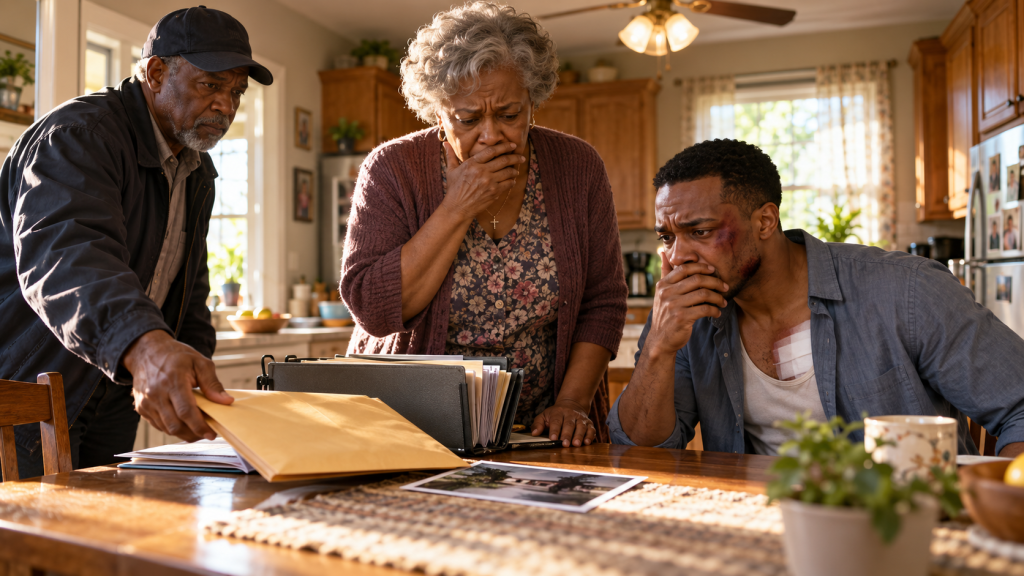
“Mrs. Eleanor Hayes?” A man’s voice. Polite. Measured. Expensive. “My name is Leonard Price. I represent Victoria Hayes.” Frank whispered, “That’s him.” “The attorney from the video?” Brandon nodded. “The one putting papers under my hand.”
My stomach turned.
I motioned toward the hallway.
“Bedroom.”
Brandon shook his head.
“I’m not hiding from him.”
“You’re not hiding.”
I looked directly at him.
“You’re surviving long enough to testify.”
That changed his face.
He stepped away from the table.
Frank helped him toward the back hall.
I took the thumb drive.
The grey accordion folder.
Arthur’s ownership ledger.
And the photograph of Miles Carter’s wrist.
Then I slid everything into the old flour canister above my refrigerator.
Not because it was some brilliant hiding place.
Because Leonard was here looking for documents.
And people looking for important papers rarely check where old women keep baking supplies.
I opened the front door.
Leonard Price stood beneath my porch awning wearing a charcoal suit that probably cost more than my first car.
Behind him sat a black sedan.
Engine running.
He gave me a solemn smile.
“Mrs. Hayes.”
I said nothing.
“I’m terribly sorry for your loss.”
That nearly made me laugh.
Instead, I lowered my eyes.
“Thank you.”
He glanced behind me.
“May I come in?”
“No.”
His smile barely moved.
“I understand this is difficult.”
“It is.”
“Victoria asked me to help make the transition as painless as possible.”
I looked at him.
“The transition?”
“Estate administration.”
He paused.
“Brandon’s death creates certain legal obligations.”
“You work quickly.”
His eyes flickered.
Just once.
“Unfortunately, business cannot always wait for grief.”
There it was.
A polished version of the same hunger Victoria had shown.
He opened a leather portfolio.
“I understand Brandon sent some corporate materials here.”
“Did he?”
“We have reason to believe so.”
“What reason?”
Leonard’s smile tightened.
“Mrs. Hayes, I’m not here to argue.”
“Good.”
“Then don’t.”
For the first time, he looked irritated.
He removed a document.
“This authorizes me to retrieve any corporate files Brandon stored at this property.”
I took the page.
My eyes were not as sharp as they used to be, but Arthur had taught me enough over forty-one years of marriage to recognize one thing immediately.
My son’s signature.
Or something pretending to be it.
I looked up.
“Did Brandon sign this?”
“Yes.”
“When?”
“Three days ago.”
I almost smiled.
Three days ago Brandon had been drugged, beaten, and trying to escape.
Interesting timing.
I handed the document back.
“I’ll need my attorney to review it.”
Leonard’s eyes hardened.
“That won’t be necessary.”
“Then you shouldn’t mind if I do.”
He lowered his voice.
“Mrs. Hayes, Victoria is grieving.”
“And you don’t want to make this harder for her.”
That line nearly took my breath away.
Not because it frightened me.
Because it was so insulting.
A woman had just called me to announce my son’s death.
A corpse had been presented under his name.
My son was bleeding in my guest room.
And her lawyer stood on my porch explaining that I should be considerate of her grief.
I leaned closer.
“Mr. Price.”
“Yes?”
“My son is supposedly dead.”
“Yes.”
“You are standing at his mother’s house less than a day later demanding documents.”
“Yes.”
“And somehow you believe you are the person in this conversation entitled to discuss dignity.”
He stared at me.
Then the smoothness returned.
“I can come back with a court order.”
“Please do.”
That surprised him.
He expected fear.
Old women are useful that way.
People mistake age for surrender.
I began closing the door.
Leonard stopped it with his palm.
A mistake.
I looked at his hand.
Then at his face.
“Take your hand off my door.”
He withdrew it slowly.
“I am trying to help you.”
“No.”
“You’re trying to discover what Brandon left here before the police do.”
His face went still.
Too still.
There.
The first crack.
I smiled.
“Good afternoon, Mr. Price.”
I closed the door.
Locked it.
And stood there listening.
For ten seconds, nothing happened.
Then his shoes moved across the porch.
The black sedan pulled away.
Frank emerged from the hall.
“You just scared him.”
“I hope so.”
Brandon limped behind him.
“You shouldn’t have mentioned police.”
“Why?”
“Now he’ll warn her.”
I turned toward my son.
“Brandon, Victoria already thinks you’re dead.”
“She already presented someone else’s corpse.”
“Her lawyer already came here for evidence.”
“We are not trying to preserve the element of surprise anymore.”
“We are trying to keep them moving.”
He frowned.
“Why?”
I smiled.
“People make mistakes when they believe time is running out.”
Arthur used to say that.
My husband had spent thirty-eight years building Hayes Systems from a two-room repair shop into a regional technology company.
He understood pressure.
He understood greed.
And apparently, far more than I ever knew, he understood Victoria.
Frank’s phone rang.
He looked at the screen.
“Clinic doctor.”
He answered.
We watched his face change.
“Yes.”
“When?”
“Did they identify him?”
Silence.
Then Frank closed his eyes.
“Understood.”
He hung up.
Brandon gripped the edge of the table.
“Who was it?”
Frank sat down slowly.
“Miles Carter.”
The room became silent.
The dead man was exactly who Brandon feared.
Victoria’s brother’s driver.
A man Brandon had known for six years.
A man who had eaten Christmas dinner in their home.
A man with a daughter in college.
A man who had somehow ended up on a cremation table wearing Brandon’s identity.
I whispered,
“How did he die?”
Frank shook his head.
“They don’t know yet.”
“Police froze everything.”
“Autopsy.”
“Toxicology.”
“Dental confirmation.”
“Fingerprints.”
“The whole thing.”
Brandon stared at the photograph.
“Miles wouldn’t have agreed to this.”
“No.”
Frank’s voice was low.
“He was loyal to her brother.”
“But not that loyal.”
My son looked sick.
“Then either they killed him…”
“Or he died some other way and they used it.”
I finished.
Frank nodded.
That distinction mattered.
We did not know.
And I refused to turn suspicion into fact.
That was Victoria’s world.
Not mine.
By noon, two detectives were sitting in my kitchen.
Detective Angela Monroe.
Detective Samuel Reed.
Neither smiled much.
Good.
I didn’t need comforting.
I needed people who knew how to ask ugly questions.
Brandon told them everything.
The suspicious transfers.
The insurance policies.
The medication changes.
The night he overheard Victoria’s brother, Graham, saying:
“Once the certificate is signed, everything moves.”
The coffee that tasted unusually bitter.
The dizziness.
The fall.
The private clinic.
Frank’s intervention.
The escape.
The threats.
Detective Monroe stopped him.
“Who treated your injuries after you left?”
“My mother’s doctor.”
I nodded.
“He came here.”
“Name?”
I gave it.
“Did he collect blood?”
“Yes.”
Brandon frowned.
“Mom?”
I looked at him.
“You arrived here saying your wife poisoned you.”
“I called a doctor before I called the police.”
Detective Reed nodded.
“That was smart.”
I did not feel smart.
I felt terrified.
But fear and intelligence can coexist.
The detectives collected copies.
The video files.
The insurance records.
The photograph.
Arthur’s ownership ledger.
The documents showing forged signatures.
And the scheduled email from Arthur’s attorney.
When Detective Monroe reached the ownership page, she frowned.
“Mrs. Hayes, did you know you controlled sixty-eight percent of Hayes Core Technologies?”
“No.”
She looked at me.
“You’re listed as controlling trustee of the Arthur Hayes Family Holdings Trust.”
“So I see.”
“You signed the original trust documents.”
“I signed a lot of things when Arthur was sick.”
Brandon stared at me.
“Mom.”
I raised one hand.
“Don’t.”
“I am seventy-three.”
“Your father put paper in front of me.”
“I read what I could.”
“I trusted him.”
Detective Reed said,
“Do you have independent counsel?”
“Yes.”
“Call them.”
I did.
By 2:30 that afternoon, Arthur’s longtime attorney, Margaret Sloan, was sitting in my living room.
She was sixty-eight.
Silver hair.
Red glasses.
A voice sharp enough to cut glass.
She read the ledger.
Then looked at me.
“Arthur hoped you would never need this.”
I stared.
“You knew.”
“Yes.”
Brandon leaned forward.
“What exactly did Dad do?”
Margaret folded her hands.
“After Victoria joined the company informally, Arthur became concerned about concentration of control.”
“Informally?”
Brandon laughed bitterly.
“She was my wife.”
“She was also increasingly involved in decisions without being an officer.”
Margaret continued.
“Arthur reorganized the original company.”
“Most public-facing operations were moved under Brandon’s executive control.”
“But the patents, licensing rights, source-code ownership, and key enterprise contracts remained under Hayes Core Technologies.”
“And Hayes Core?”
Margaret turned toward me.
“Held by the family trust.”
I stared at her.
“Why me?”
“Because Arthur trusted you.”
“That simple?”
“No.”
She smiled faintly.
“He also knew Brandon loved recklessly.”
My son looked wounded.
Margaret did not soften it.
“Arthur loved you, Brandon.”
“He respected you.”
“He also thought you confused loyalty with judgment.”
Brandon looked away.
That sounded exactly like Arthur.
Margaret continued.
“He never wanted Victoria to be able to inherit operational control merely by becoming your widow.”
My stomach tightened around that word.
Widow.
Margaret tapped the ledger.
“As trustee, Eleanor controls appointment of voting representatives, authorization of major transfers, and changes involving core intellectual property.”
“So if Victoria’s papers say she inherits everything…”
“They may give her Brandon’s personal shares.”
“His condominium interest.”
“Certain accounts.”
“Perhaps some subsidiary holdings.”
“But not the core company.”
Brandon whispered,
“She thought I owned all of it.”
“Yes.”
Margaret nodded.
“And apparently she thought Eleanor didn’t know the difference.”
I laughed softly.
“She was half right.”
Margaret looked at me.
“You knowing wasn’t the protection.”
“The structure was.”
That sentence changed something in me.
Arthur had not expected me to become a business genius at seventy-three.
He had built a system that required my consent precisely because he knew grief, pressure, fear, and manipulation can compromise anyone.
Good structures do not depend on heroic people.
They make bad decisions harder.
Brandon asked,
“What happens if Victoria tries to transfer control using my death?”
Margaret looked at the scheduled email.
“Then the company freezes major transactions.”
“Arthur built a death-trigger review into the trust.”
“His counsel receives notice if a designated account tries to initiate certain changes after a reported death.”
“That’s why the email came.”
“Yes.”
Detective Monroe looked at Margaret.
“And if Brandon is not dead?”
Margaret’s expression became almost amused.
“Then Victoria’s problem is considerably worse.”
At 4:17 p.m., Brandon’s phone—one Frank had recovered from the clinic—lit up with a message.
Victoria.
Everything is done. Please don’t fail me now.
We stared at it.
Detective Monroe asked,
“Was this phone supposed to be with the deceased?”
Brandon nodded.
“She thought it was destroyed.”
Another message arrived.
Graham says the doctor is becoming a problem. Leonard is handling Eleanor.
Then:
Tomorrow we reset everything.
Detective Reed exhaled slowly.
“Do not reply.”
Nobody did.
The messages kept coming.
I can’t believe we’re this close.
Then:
After all he put us through, we deserve this.
Brandon’s face changed.
He whispered,
“She thinks she’s texting Graham.”
Frank frowned.
“Why?”
Brandon pointed at the contact name.
Graham’s private number had been temporarily routed through Brandon’s backup device during an earlier security issue.
Victoria apparently did not know the route had never been removed.
Whether that routing would become legally useful was for investigators and courts.
But emotionally?
It was brutal.
My son sat there reading his wife’s words as she celebrated his death.
Not grief.
Not shock.
Entitlement.
I touched his hand.
He pulled away.
Not from me.
From everything.
“I married her.”
“I know.”
“I defended her.”
“I know.”
“I told Dad he was controlling.”
“I remember.”
“I told you to stop judging her.”
“I remember.”
His eyes filled.
“How did I miss this?”
I looked at him.
“Because loving someone changes what you are willing to explain away.”
He whispered,
“That sounds like an excuse.”
“It can be.”
“Or it can be a warning.”
That night, Brandon slept for twelve hours.
I didn’t sleep at all.
I sat in Arthur’s old chair with the trust documents on my lap.
At 1:12 a.m., I opened another file from the thumb drive.
Not the videos.
A text file.
Arthur had written it.
Eleanor,
If you are reading this, I was right about something I hoped to be wrong about.
I stopped.
My husband had always loved dramatic openings.
I continued.
Do not make the mistake of thinking the trust exists because I doubted Brandon’s intelligence.
It exists because intelligent people can be manipulated by people they love.
My eyes blurred.
And do not make the opposite mistake of thinking Victoria is powerful because she is evil.
People like her become powerful when everyone around them decides keeping peace matters more than asking why.
I closed my eyes.
That sentence hurt.
Because I had done exactly that.
I had seen the small signs.
Victoria intercepting Brandon’s calls.
Victoria speaking for him.
Victoria changing the subject whenever money came up.
Victoria mocking Arthur’s “old-fashioned” corporate safeguards.
I saw it.
Then told myself:
Their marriage is none of my business.
Arthur continued.
Do not interfere in their marriage because of suspicion.
But if evidence arrives, do not hide behind politeness.
I started crying.
That was precisely what I had done.
I had mistaken noninterference for virtue.
The letter ended:
The company is not the most important thing.
Brandon is.
If saving one requires losing the other, save the boy.
I pressed the paper against my chest.
Arthur had been dead three years.
And somehow he was still telling me how to be brave.
The next morning, police arrested Graham.
Not Victoria.
Not yet.
Graham had been stopped while trying to remove files from a storage unit connected to Miles.
Inside were medical supplies.
A copy of Brandon’s insurance policy.
Blank clinic forms.
Two burner phones.
And financial ledgers that prosecutors later said connected him to unauthorized transfers.
Then the toxicology results began to come back.
Brandon’s blood showed a sedative that was not part of his prescription plan.
The level was dangerous.
His treating physician confirmed he had not prescribed it.
Miles’s preliminary toxicology showed the same substance.
That changed everything.
Detectives returned.
“We have reason to believe the two incidents are connected.”
I asked,
“Did Victoria kill Miles?”
Detective Monroe shook her head.
“We are not saying that.”
“Not yet?”
“We are saying he had the same substance in his system.”
“That is evidence.”
“Cause and intent still need proof.”
I appreciated her restraint.
Truth did not need inflation.
It was already horrible enough.
Victoria was arrested that afternoon.
I was not there.
Brandon wanted to be.
Police said no.
Probably wisely.
She was leaving a bank when detectives approached.
News footage later showed her in a cream-colored coat, sunglasses, and an expression of offended disbelief.
No dramatic chase.
No screaming.
No confession on the sidewalk.
Just a woman who believed the story was still salvageable.
At the station, she initially insisted Brandon had died.
Then police told her he was alive.
Her attorney stopped the interview.
That was the moment, according to Detective Monroe later, when Victoria finally understood how completely the plan had collapsed.
Not when Miles’s body was identified.
Not when the cremation stopped.
Not when Graham was arrested.
When Brandon became alive again.
Because his survival did not simply create a witness.
It destroyed the foundation of every transfer that depended on his death.
The company froze.
The insurance claims froze.
The estate process froze.
The supposed cremation authorization became evidence.
The forged documents became easier to challenge.
The trust remained untouched.
And the old woman Victoria had dismissed as irrelevant suddenly controlled the one asset she had been trying hardest to reach.
My phone rang from county jail three days later.
Victoria.
I almost ignored it.
Then answered.
Recorded line.
“Eleanor.”
No “Mrs. Eleanor” now.
No grieving widow voice.
Just Victoria.
“You’ve made your point.”
I laughed.
“My point?”
“Brandon is alive.”
“So you know.”
Silence.
Then:
“This is not what you think.”
I closed my eyes.
There it was.
The universal prayer of caught people.
“Then tell me what I think.”
“You think I tried to kill him.”
“Yes.”
“I didn’t.”
“What did you do?”
No answer.
“You thought he was sick.”
“You were preparing for the inevitable.”
I said nothing.
“You don’t understand what he was doing to the company.”
“What was he doing?”
“Destroying it.”
“How?”
“He was going to expose transactions that would ruin investor confidence.”
“Transactions you made?”
“Transactions necessary to keep the business alive.”
Interesting.
Not denial.
Reframing.
I asked,
“What about Miles?”
She went silent.
“Victoria.”
“I did not kill Miles.”
“What happened?”
“He panicked.”
“About what?”
Silence.
Then:
“He was supposed to help Graham move Brandon.”
“Move him where?”
“Somewhere he could recover.”
I laughed.
“You presented a corpse as my son.”
“I did not choose that.”
“Who did?”
“Graham.”
That would become her defense.
Graham planned the identity fraud.
Graham arranged the body.
Graham handled the clinic.
Graham brought Miles into it.
Victoria claimed she merely believed Brandon had fled after becoming ill, then later was told he had died.
Unfortunately for her, messages said otherwise.
Prosecutors later showed texts from Victoria sent before Miles’s death.
If B refuses the transfer tomorrow, we cannot wait.
Another:
Make sure the dose doesn’t leave him functional enough to call Eleanor.
Another:
Mother is the only remaining signature problem.
That message made my skin crawl.
Not because of the company.
Because she understood exactly what my role was.
She had known.
The video where she claimed I didn’t understand the company’s ownership was not ignorance.
It was contempt.
She believed knowledge without courage was useless.
And for years, perhaps, she had been right about me.
I had known enough to be uneasy.
I just had not acted.
The case took eighteen months.
Not two weeks.
Not one dramatic courtroom afternoon.
Eighteen months of motions.
Forensic accounting.
Depositions.
Toxicology.
Digital evidence.
Expert testimony.
Corporate audits.
Insurance reviews.
And one very painful truth after another.
The financial scheme was bigger than Brandon knew.
Over four years, Victoria and Graham had redirected roughly $6.4 million through consulting entities they controlled or influenced.
Not all of it stolen in the simple sense.
Some payments were attached to real vendors.
Real services.
Inflated invoices.
Duplicate consulting fees.
Transactions disguised inside legitimate business activity.
That made it harder to see.
Arthur had noticed patterns before his death.
That explained the videos.
He had hired a private investigator.
Not because he believed Victoria was a murderer.
Because he suspected financial manipulation.
His heart attack truly had been natural.
That mattered too.
For a terrible week, Brandon wondered whether his father had been killed.
The medical review found no evidence of that.
Arthur died from heart disease.
No poison.
No conspiracy.
Just tragedy.
I was grateful for one ordinary tragedy.
Imagine that.
Miles’s death became the most contested part of the criminal case.
Prosecutors argued he had been drugged after threatening to expose what Victoria and Graham were planning.
Graham’s attorneys claimed Miles had voluntarily taken sedatives and died accidentally.
Victoria’s lawyers tried to distance her entirely.
But digital records showed she knew Miles was being used in the cover story.
And after he died, she helped authorize documents identifying him as Brandon.
That fact was difficult to explain away.
The murder charge against Victoria did not survive exactly as prosecutors first framed it.
The evidence supported serious conspiracy, fraud, attempted poisoning, identity-related offenses, insurance fraud, and obstruction.
Graham faced additional charges connected to Miles’s death.
His final plea included responsibility for conduct that contributed to Miles’s fatal overdose without the prosecution obtaining a first-degree murder conviction.
That disappointed some people.
It did not disappoint me.
Court is not theater.
Truth does not become stronger because punishment sounds dramatic.
Victoria eventually pleaded to multiple felonies after key motions went against her.
She received a long prison sentence.
Graham received longer.
Leonard Price lost his law license and was convicted on fraud and evidence-related charges after investigators proved he knowingly prepared documents for a supposedly dead man before any legitimate death confirmation existed.
That surprised me least.
The man had blocked my door with his hand.
Never trust a person who believes your threshold belongs to him.
Caroline—no, wrong story. I caught myself doing that years later while talking to a journalist.
Trauma files people in your memory under categories.
Doctors.
Lawyers.
People who lied.
People who knew.
People who should have checked.
You have to keep reminding yourself that each case belongs to itself.
This one belonged to Brandon.
And to Miles.
Miles’s daughter, Tessa, came to see us after the plea.
She was twenty-three.
She stood in my living room holding a photograph of her father.
“I hated Brandon at first.”
My son went pale.
“I understand.”
“I thought if they hadn’t needed your body…”
She stopped.
Brandon nodded.
“If they hadn’t needed someone to replace me, maybe he’d still be alive.”
Tessa started crying.
“I know that isn’t your fault.”
Brandon’s eyes filled.
“It still makes sense that you felt it.”
She looked at him.
That answer mattered.
No defense.
No rush to absolution.
Tessa sat down.
“They used him because he was convenient.”
“Yes.”
Frank spoke from the kitchen doorway.
“He trusted Graham.”
Tessa looked at him.
“Did you know my dad?”
“For years.”
“Was he involved?”
Frank hesitated.
Then answered carefully.
“He knew some shady things were happening.”
“I think he told himself it was just rich people moving money.”
“He did favors.”
“Drove people places.”
“Carried envelopes.”
“I don’t know when he understood it was dangerous.”
Tessa nodded.
“That sounds like him.”
Not saint.
Not villain.
A man.
She asked Brandon,
“Did he help hurt you?”
My son swallowed.
“I don’t know.”
Then:
“But if he did something under pressure, it doesn’t make what happened to him acceptable.”
Tessa cried.
Brandon cried.
I left the room.
Not every reconciliation needs an audience.
Months later, the company held a memorial fund in Miles’s name.
Not a hush payment.
Not a public-relations stunt.
Brandon asked Tessa whether she wanted it.
She said yes only if it funded driver safety training and scholarships for employees’ children.
Done.
No building named after him.
No giant photograph.
Just practical help.
Arthur would have approved.
The corporate consequences were brutal.
Hayes Systems nearly collapsed.
Investors panicked.
Clients left.
Employees feared layoffs.
The scandal was on every business page.
“Dead CEO Appears Alive” was irresistible to television producers.
I hated the headlines.
They made the whole thing sound like a magic trick.
My son nearly died.
A man actually did die.
But the internet loves a hook.
Brandon could not return immediately.
He had trauma symptoms.
Sleep problems.
Panic attacks around coffee.
He flinched when someone touched his medication.
He kept his bedroom door locked.
Sometimes he woke convinced Victoria was in the house.
He was alive.
That did not mean he was fine.
For six months, I ran the trust while an interim executive team handled operations.
At seventy-three, I learned more about licensing revenue, source-code escrow, enterprise renewals, and voting rights than any retired diner waitress should reasonably be expected to know.
I hated most of it.
But something surprising happened.
I was good at asking simple questions.
Not clever questions.
Simple ones.
“Why does this vendor get paid twice?”
“Why is this contract different?”
“Who benefits if we approve this?”
“Why can’t that wait?”
Corporate people sometimes hide uncertainty beneath vocabulary.
Old women do not have time for that.
I made them explain things.
If they could not explain them clearly, we did not sign.
At one board meeting, a man half my age said,
“Eleanor, respectfully, this structure is too complex to summarize.”
I looked at him.
“Then you don’t understand it well enough to ask for my signature.”
Nobody tried that line again.
Brandon eventually returned.
Not as the same CEO.
That mattered.
The board required governance changes.
Independent compliance.
Dual authorization on major transfers.
External audit committee.
Clear separation between family control and day-to-day operations.
Brandon initially resisted.
“This is my company.”
“No.”
I corrected him.
“It’s a company.”
That hurt.
It needed to.
Families ruin businesses when they confuse ownership with exemption.
Arthur understood that before we did.
Brandon stepped down as chief executive for a year.
He became chief product officer first.
Relearned the company from a position with less unilateral authority.
When he later became CEO again, the board—not his mother—approved him.
I was proud of that.
Not because he regained power.
Because he learned to work without assuming he was entitled to it.
One evening, two years after the arrest, Brandon and I sat on my porch.
He held a mug of tea.
Still rarely coffee.
He asked,
“Did Dad know she would try to kill me?”
“No.”
“How do you know?”
“Because he would have done more.”
Brandon nodded.
Then:
“Did he think I was weak?”
I considered lying.
Didn’t.
“He thought you were vulnerable to loyalty.”
“That sounds nicer.”
“It isn’t necessarily.”
He smiled sadly.
“I kept defending her because admitting he was right felt like losing.”
“I know.”
“He was hard on me.”
“I know.”
“He made everything sound like a test.”
“I know.”
“So every warning felt like another chance to prove I could run my own life.”
I looked at him.
“And Victoria benefited from that.”
“Yes.”
He stared at the yard.
“I blamed him for not trusting my judgment.”
“Then I handed my judgment to her.”
I touched his hand.
Not too tightly.
“You got it back.”
“Almost too late.”
“Yes.”
No false comfort.
Then he asked,
“Why didn’t you tell me about the trust?”
“I didn’t know enough to tell you.”
He laughed.
“Fair.”
We sat quietly.
Then he whispered,
“I’m sorry she called you a burden.”
I looked at him.
“That wasn’t the worst thing she did.”
“I know.”
“But it hurt you.”
“Yes.”
He looked down.
“I let her talk about you that way before.”
I froze.
“When?”
“Not that exact word.”
“She said you were dependent.”
“Intrusive.”
“Old-fashioned.”
“That Dad had made you afraid of money.”
“I sometimes agreed.”
That hurt more than I expected.
Brandon’s eyes filled.
“I’m sorry.”
I looked away.
“I was difficult sometimes.”
“That doesn’t matter.”
“It matters.”
I turned back.
“You can apologize for what was yours without rewriting me into a saint.”
“I called too much.”
“I gave advice you didn’t request.”
“I mistrusted her early.”
“Some of that was because she was actually untrustworthy.”
“Some was because I was your mother and hated losing influence.”
Both could be true.
Brandon smiled faintly.
“You really don’t make forgiveness easy.”
“No.”
“I make it accurate.”
He laughed.
That was the first easy laugh we shared after everything.
Victoria sent me one letter from prison.
I almost threw it away.
Then read it.
Not because I cared about reconciliation.
Because curiosity is one of my flaws.
She wrote that Brandon had frozen her out of company decisions in the final year.
That he embarrassed Graham.
That Arthur had always treated her like a threat.
That she felt she had spent years helping build a life she would never truly own.
The letter contained one line that explained more than she intended:
I was tired of living in a family where everything important existed before I arrived.
There it was.
The company.
The trust.
Arthur.
Me.
History.
She had wanted not merely money.
She wanted primacy.
She wanted everything before her to become irrelevant.
That is why she hated old structures.
Old loyalties.
Old documents.
Old women.
We were proof that Brandon’s life did not begin with her.
Near the end of the letter, she wrote:
I never thought it would go this far.
I stared at that sentence for a long time.
Then wrote only one reply.
It went as far as the choices you kept making.
Nothing else.
She never wrote again.
The trust eventually changed.
I did not keep controlling sixty-eight percent forever.
That would have repeated a different kind of mistake.
At seventy-six, I worked with Margaret and an independent fiduciary team to restructure voting control.
Professional trustees.
Independent directors.
Clear family-beneficiary rights.
No single spouse.
No single child.
No single old mother holding the entire lock.
Brandon asked,
“Don’t you trust me?”
I smiled.
“Yes.”
“That’s why I’m fixing the structure.”
He frowned.
I explained.
“Trust is not the same thing as unchecked authority.”
“That was Arthur’s lesson.”
It became mine too.
I kept a limited advisory role.
Enough to protect the family interest.
Not enough to turn my death into another corporate emergency.
The grey accordion folder eventually went into a safe.
Not my pantry.
The thumb drive went to evidence storage, then later to secure archival counsel.
Arthur’s letter stayed with me.
The original.
Folded.
Soft at the creases.
I kept it beside my bed.
Frank retired.
Brandon bought him a truck.
Frank returned it.
“I saved your life.”
he said.
“That does not mean you get to ruin my tax situation.”
Brandon laughed.
They compromised.
The company funded Frank’s retirement healthcare.
Properly documented.
No secret gifts.
No envelopes.
We had all become painfully boring about paperwork.
It was wonderful.
Miles’s daughter Tessa finished graduate school.
The scholarship fund grew.
She later joined a nonprofit working with families affected by financial crime.
Not because every tragedy needs to become a calling.
She told me once:
“I tried accounting first.”
“What happened?”
“I hated accounting.”
“Good reason.”
We laughed.
Brandon eventually dated again.
Years later.
Very slowly.
The first woman he seriously introduced to me was named Claire.
At dinner, she asked:
“Should I be nervous?”
I said,
“Yes.”
Brandon nearly choked.
Then I smiled.
“Kidding.”
Mostly.
Claire had her own career.
Own home.
Own accounts.
Before they married, they signed a prenup.
Not because Brandon expected betrayal.
Because he finally understood clear agreements protect good relationships too.
They disclosed everything.
Debt.
Assets.
Trust interests.
Insurance.
No hidden beneficiary changes.
No mystery powers of attorney.
No spouse signing on behalf of the other without explicit authority.
Romance survived.
Imagine that.
They married in a small ceremony.
No magazine photographs.
No corporate guest list.
No crystal ballroom.
Frank danced badly.
Tessa attended.
Margaret drank two glasses of champagne and insulted the seating chart.
I wore blue.
Before the ceremony, Brandon found me alone.
He looked healthy now.
Scar on his chest.
Small line near his jaw.
Evidence that survival leaves signatures too.
“Mom.”
“Yes?”
“Are you okay?”
“I’m wearing shoes designed by criminals.”
He laughed.
Then became serious.
“I wouldn’t be here without you.”
I shook my head.
“Frank got you out.”
“You kept me alive.”
“The doctor treated you.”
“Dad built the trust.”
“Margaret protected the company.”
“Police built the case.”
He smiled.
“You hate being thanked.”
“I hate inaccurate accounting.”
He hugged me.
Then whispered,
“You believed me.”
I held him tighter.
“That part was mine.”
Years later, after Claire and Brandon had a daughter, they named her Arthur.
I told them Arthur was a terrible name for a girl.
They named her Ava Arthur Hayes legally and called her Ava.
Compromise.
When Ava was five, she asked why her father did not like coffee.
Brandon glanced at me.
I waited.
His story.
His choice.
He said,
“I had a bad cup once.”
Ava frowned.
“That makes no sense.”
“Correct.”
Then he told her a child-safe version.
“Someone I trusted put something in a drink that made me sick.”
Ava’s eyes widened.
“Why?”
“Because grown-ups sometimes make terrible choices.”
“Did Grandma save you?”
Brandon smiled at me.
“Grandma helped.”
Good answer.
Not hero.
Not helpless victim.
A network of people.
That is how survival usually works.
I lived long enough to see Hayes Systems become something Arthur would barely recognize.
Different products.
Different executives.
More employees.
Less family mythology.
A better company.
Arthur’s portrait remained in the boardroom.
I eventually made them remove it.
Brandon protested.
“Mom.”
“What?”
“He founded the company.”
“So put him in the lobby.”
“Why?”
“Boardrooms need people looking forward.”
Arthur would have hated that.
Then loved it.
Probably in that order.
On the tenth anniversary of the morning Victoria called me, Brandon came to my house.
Same kitchen.
Different table.
The old one had finally cracked.
He brought two folders.
One grey.
One blue.
“What is this?”
“Estate planning.”
I groaned.
“Leave.”
He laughed.
“No.”
We reviewed his updated will.
Claire’s protections.
Ava’s trust.
Independent trustees.
No automatic control transfer upon death.
No emergency cremation instructions without family notification.
I stared at him.
“You actually wrote that?”
“Yes.”
“That is dark.”
“I learned from experience.”
I laughed.
Then he pushed the grey folder toward me.
Inside was a copy of the original document he had mailed before the attack.
On top was his note:
Mom, if anything happens to me, do not give this to Victoria.
He looked at it.
“I thought that folder might save me.”
“It helped.”
“No.”
He shook his head.
“I think mailing it was the moment I admitted I was in danger.”
That mattered.
Sometimes evidence is not only for other people.
Sometimes preserving evidence is how we finally tell ourselves the truth.
He asked,
“Do you remember the phone call?”
“Every word.”
“She said I was dead.”
“Yes.”
“She said you would get nothing.”
“Yes.”
He smiled faintly.
“I was sitting right there.”
“Yes.”
“Do you know what I remember most?”
“What?”
“You calling her sweetheart.”
I laughed so hard I had to put down my tea.
“It nearly killed me.”
“I know.”
“You sounded terrifying.”
“Good.”
He became quiet.
Then:
“She said I wouldn’t be in the way anymore.”
I nodded.
“That was when I knew.”
“Knew what?”
“That she had stopped seeing you as a person.”
Brandon stared.
I continued.
“Money did not make her dangerous.”
“Ambition did not make her dangerous.”
“Wanting security did not make her dangerous.”
“What made her dangerous was that she started describing human beings as obstacles.”
“You.”
“Me.”
“Miles.”
“Anyone between her and what she believed she deserved.”
Brandon nodded slowly.
That became the lesson I carried longest.
People rarely wake up one morning and become capable of destroying someone they love.
They practice first.
In language.
He’s in the way.
She’s a burden.
They’re useless.
He’s weak.
She won’t matter.
Reduce a person enough, and eventually harming them begins to feel like administration.
That is why I still remember Victoria’s exact words.
Not the millions.
Not the fake death certificate.
Not the forged succession papers.
Not even the corpse.
He won’t be in the way anymore.
That sentence told me what the evidence later proved.
My son had ceased to be her husband.
He had become a barrier.
And once someone turns a human being into an obstacle, almost anything can begin to sound reasonable inside their own head.
Brandon survived because Frank refused to follow one more instruction.
Because a doctor noticed a tattoo.
Because Arthur had built a structure stronger than our denial.
Because my son mailed a folder before he understood why he was afraid.
And because, when Victoria called to bury him, he was sitting beside me listening.
Alive.
Breathing.
Still here.
She told me I would not receive a penny.
In the end, she was right about one thing.
I did not receive a penny from Brandon’s death.
Because my son never died.
And the thing I almost lost was never the company.
Never the trust.
Never the money.
It was him.
Everything else was paperwork.
THE END STORIES! THANK YOU FOR READING GOOD LUCK! ❤️
Related Posts