The envelope slipped from my fingers and landed across the hospital blanket. For several seconds, I could hear nothing except the soft mechanical pulse from the monitor beside my bed. Celeste’s baby was not Adrian’s.
I looked at Rachel’s message again. Call me before you react. I know whose DNA matched. My daughter stirred beside me. Tiny. Warm. Alive. Adrian’s child. The child he had mocked me for supposedly being unable to give him.
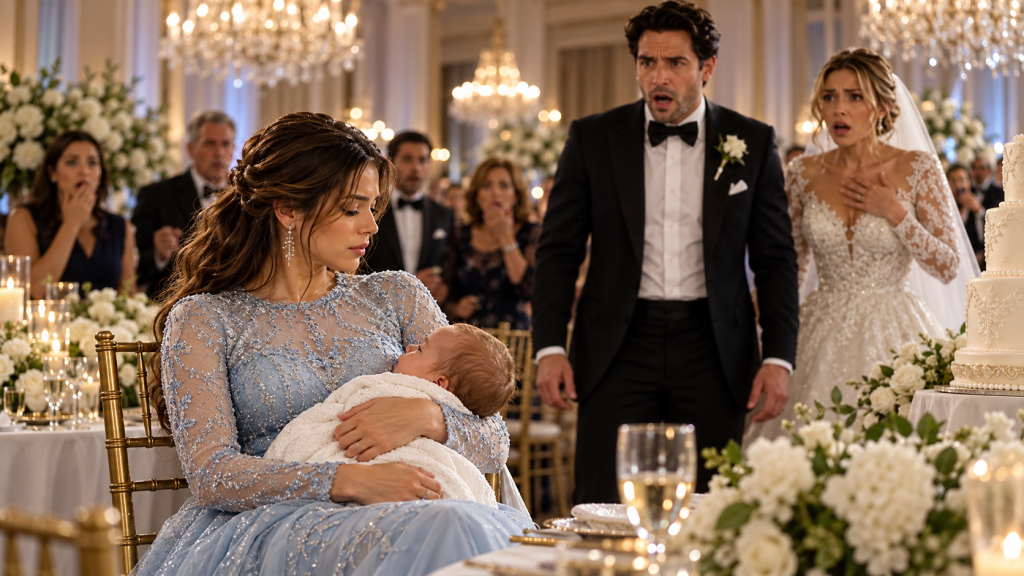
And somewhere across Chicago, Adrian was preparing to marry a woman carrying someone else’s baby while financing the celebration with money stolen from me. I pressed Rachel’s number. She answered immediately. “Mia?” “Who?”
Silence.
Then:
“Are you sitting down?”
“I gave birth yesterday.”
“I’m not going anywhere.”
Rachel exhaled.
“The biological father appears to be Daniel Cross.”
The name meant nothing for half a second.
Then everything aligned.
“Northstar’s CEO?”
“Yes.”
My stomach dropped.
Daniel Cross was the founder of Cross Meridian Holdings, the corporate group listed as Northstar Family Ventures’ principal sponsor.
He was also Adrian’s largest consulting client.
The same man Adrian had been desperate to impress for years.
I whispered:
“You’re telling me Celeste is pregnant by Adrian’s business partner?”
“Not just partner.”
Rachel’s voice hardened.
“Daniel appears to be the source of most of Northstar’s legitimate capital.”
“Legitimate?”
“Yes.”
I looked at my daughter.
“What does that mean?”
“It means Northstar was built with two kinds of money.”
“Daniel’s.”
“And yours.”
I closed my eyes.
Of course.
Rachel continued.
“We traced the $186,000 from your grandmother’s inheritance through Baywood Consulting and a company called MC Administrative Holdings.”
“Who owns those?”
“Baywood belongs to a college friend of Adrian.”
“MC Administrative was dissolved last month.”
“And?”
“The listed manager was Celeste.”
My hand tightened around the phone.
“So she moved the money.”
“She participated.”
“Do we know Adrian knew?”
“We have stronger evidence now.”
“What?”
Rachel paused.
“I obtained the filing attached to Northstar’s loan package.”
“The bank copy.”
“Adrian certified the company’s source of startup funds.”
I stopped breathing.
“What did he say?”
“That Northstar’s initial capital included personal family funds.”
“Whose family?”
“He wrote ‘marital reserve.’”
I laughed once.
Sharp.
Ugly.
“There was no marital reserve.”
“I know.”
“My grandmother left that money to me.”
“I know.”
“And he knew it was separate.”
“Yes.”
“So he labeled my inheritance as joint money and moved it into a company with his mistress.”
“That is what the documents suggest.”
I looked toward the window.
Morning sunlight was beginning to touch the buildings across the street.
People were going to work.
Ordering coffee.
Missing trains.
Living ordinary lives.
Mine had become a courtroom exhibit.
I whispered:
“Why wasn’t this found during the divorce?”
“Because the account was emptied before formal financial disclosures.”
“Adrian provided statements beginning after the transfer.”
“Your prior lawyer apparently did not subpoena the earlier history because Adrian certified there had been no material movement of separate property.”
My throat tightened.
“He lied.”
“It appears so.”
“Under oath?”
“Yes.”
I closed my eyes.
Then Rachel said:
“Mia, there’s something else about Daniel.”
“What?”
“He knows about the money.”
I sat straighter.
“What do you mean?”
“He contacted me.”
I almost dropped the phone.
“When?”
“This morning.”
“How does he know you represent me?”
“Celeste knows.”
My blood went cold.
“She knows?”
“At least enough to be frightened.”
Rachel continued.
“Daniel says he believed Northstar had been funded by Adrian and Celeste personally.”
“He says he transferred legitimate capital after being shown bank records that now appear misleading.”
I stared at the ceiling.
“So Daniel was deceived too.”
“Possibly.”
“Or he’s trying to protect himself.”
“Exactly.”
Rachel’s voice sharpened.
“Which is why I am telling you not to trust anyone’s sudden honesty until we verify it.”
I smiled faintly.
“That sounds like you.”
“It’s why you pay me.”
“I haven’t paid you enough.”
“That will be corrected.”
Despite everything, I laughed.
Then my daughter made a soft sound beside me.
Rachel heard.
“How is she?”
I looked at the sleeping bundle.
“Perfect.”
“What did you name her?”
“Emma.”
There was a pause.
“That was your grandmother’s name.”
“Yes.”
The inheritance.
The woman whose money Adrian had tried to turn into his future.
And now her name belonged to the daughter he did not know he had.
Rachel said quietly:
“Your grandmother would have enjoyed this.”
I smiled through tears.
“She enjoyed evidence.”
“Then she definitely would.”
The wedding was scheduled for three weeks later.
I spent those weeks recovering.
Not plotting revenge.
That was harder than it sounds.
Every part of me wanted to drive straight to Adrian’s apartment and throw the DNA test at him.
But Rachel refused to let emotion destroy strategy.
We gathered records.
The original inheritance documents.
Bank histories.
Divorce disclosures.
Electronic-signature logs.
Corporate filings.
Loan certifications.
Emails.
And the messages Celeste had sent me during and after the divorce.
Some women are chosen.
That note became more interesting when Rachel discovered the flowers had been paid for using Northstar’s card.
Even cruelty had been reimbursed.
Then came the first major break.
Daniel agreed to an interview through counsel.
Not with me.
With Rachel and a forensic accountant.
He produced communications.
Many.
Adrian had introduced Celeste to him eighteen months earlier.
Not as his mistress.
As a “strategic operations consultant.”
Northstar had supposedly been created to coordinate executive retreats, technology conferences, and private client events.
Daniel invested because Adrian had positioned the company as part of a larger partnership opportunity.
Celeste managed operations.
Adrian remained intentionally off public filings to avoid what he called “conflict optics” with his employer.
Conflict optics.
People invent impressive phrases when “hiding” feels too honest.
Then Rachel found the email that changed everything.
From Adrian to Daniel.
Seven months before our divorce.
Mia’s family assets are passive. She doesn’t understand corporate deployment. I can move some dormant capital into Northstar until the next funding round.
My hands shook when I read it.
Dormant capital.
My grandmother had worked forty years running a small pharmacy.
She had skipped vacations.
Drove the same car for fifteen years.
Saved every dollar she could because she wanted me to have security.
Adrian called that dormant.
As though money became ownerless when the woman who inherited it did not spend it quickly enough.
Below Adrian’s message, Daniel had replied:
Does Mia approve?
Adrian:
Yes. I handle our finances.
I stared at those six words.
I handle our finances.
Technically true.
Morally poisonous.
The next email was worse.
Daniel:
Need documentation for the bank.
Adrian:
Celeste will prepare it.
There it was.
The origin of my forged approval.
Rachel looked at me across her office.
“This ties Adrian directly to the transfer.”
I whispered:
“Does Daniel know Celeste is pregnant?”
“Yes.”
I looked up.
“He knows it’s his?”
“He says he believed it was possible.”
“Possible?”
“They had an affair.”
I laughed bitterly.
“So Adrian was sleeping with Celeste while Celeste was sleeping with Daniel.”
Rachel’s expression remained neutral.
“That appears to be the timeline.”
I sat back.
There are moments when betrayal becomes so symmetrical it stops feeling personal and begins to look architectural.
Adrian cheated on me with Celeste.
Celeste cheated on Adrian with Daniel.
Daniel invested in the company Adrian and Celeste funded partly with my money.
And now Adrian was about to marry Celeste because she was carrying the child he believed proved his masculinity.
I wanted to laugh.
Instead, I cried.
Rachel passed me a tissue.
“I thought this would feel better.”
“What?”
“Knowing he was fooled too.”
“It usually doesn’t.”
She was right.
Pain is not arithmetic.
His humiliation did not subtract mine.
I looked at Emma sleeping in her carrier beside the desk.
“He called me broken.”
Rachel said nothing.
“He told his mother I destroyed his chance at fatherhood.”
My voice cracked.
“And all that time I was pregnant.”
“You didn’t know until the end.”
“I know.”
“But I was.”
Rachel leaned forward.
“Mia.”
I looked at her.
“You are allowed to feel angry without making anger your legal strategy.”
That line became our rule.
Then came the question of the wedding.
“Do I go?”
Rachel thought carefully.
“As your attorney?”
“Yes.”
“I would prefer you not turn the ceremony into an ambush.”
I almost smiled.
“As a person?”
“I would pay to see Adrian’s face.”
I laughed.
“Helpful.”
She smiled.
“Here is the real answer.”
“If you attend, do it because there is something you need to say or do that cannot be accomplished more safely elsewhere.”
“Not because you want an audience.”
I looked at the invitation.
Adrian had given me an audience on purpose.
He wanted me there to watch.
He wanted his new life displayed in front of the woman he blamed for his old one.
That mattered.
Then Rachel added:
“And if you bring Emma, understand what that does.”
“What?”
“It introduces a child into a confrontation.”
I looked toward my daughter.
She was not evidence.
She was not a weapon.
That mattered too.
“I won’t use her like that.”
“Good.”
“So what do I do?”
Rachel looked at the documents.
“Tell the truth.”
“Let the adults deal with the consequences.”
That became the plan.
I did go to the wedding.
Emma did not.
My sister Lauren watched her.
I wore navy.
Not white.
Not red.
Nothing dramatic.
Adrian had expected me to arrive looking wounded.
He had always loved visible proof of his superiority.
Instead, I arrived looking exactly like what I was.
A woman three weeks postpartum who had slept four hours and brought an attorney.
Rachel came as my guest.
That alone almost made me laugh.
The venue was a glass-and-steel event space overlooking the Chicago River.
Northstar’s logo appeared on a sponsor display near the entrance.
I stopped in front of it.
My money had helped build the company.
My forged signature had helped finance it.
And yet the name looked so respectable.
That is the problem with fraud.
It photographs beautifully.
The hostess checked my name.
“Mia Carter?”
“Yes.”
She smiled.
“You’re seated at table two.”
Of course.
Right near Adrian’s mother.
Adrian’s mother, Patricia, spotted me before I reached the table.
Her expression tightened.
“Mia.”
“Patricia.”
Her eyes scanned me from head to toe.
“You actually came.”
“Adrian invited me.”
She leaned closer.
“I hope you understand today is not about reopening old wounds.”
I almost smiled.
“Then perhaps Adrian should not have called me from the hospital to discuss my infertility.”
Her face changed.
“What hospital?”
I froze.
She did not know.
Interesting.
I said:
“Nothing.”
Then I sat.
Rachel took the chair beside me.
Patricia looked at her.
“And you are?”
“Rachel Kim.”
“My attorney.”
Patricia’s face went pale.
Only slightly.
Enough.
“You brought a lawyer to a wedding?”
Rachel smiled pleasantly.
“I’ve been invited to stranger things.”
I loved her.
Guests filled the room.
Executives.
Family.
Friends.
Clients.
People Adrian valued because they reflected status back at him.
Daniel Cross arrived alone.
Our eyes met across the room.
He gave the smallest nod.
No friendliness.
No conspiracy.
Good.
We were not allies.
We were people whose interests temporarily overlapped.
That distinction mattered.
Then Adrian entered.
He looked perfect.
Custom tuxedo.
Expensive watch.
Confident smile.
The same man who once sat across from me after my second miscarriage and said:
“I don’t know how long I can live without a real family.”
He saw me.
Stopped.
Then smiled.
Triumph.
He walked over.
“Mia.”
“Adrian.”
His eyes flicked toward Rachel.
“You brought company.”
“My attorney.”
His smile vanished.
“Why?”
I looked at him.
“You’ll find out.”
His jaw tightened.
Then Celeste entered.
Pregnant.
Beautiful.
Radiant.
At least from a distance.
When she saw me, her face changed.
She knew.
Maybe not everything.
Enough.
She looked toward Daniel.
Then toward Rachel.
Then back to me.
Fear.
Adrian noticed none of it.
That was almost poetic.
The ceremony began.
I sat through vows about honesty.
That was difficult.
When Adrian said:
“I promise to build a life rooted in truth,”
Rachel’s hand moved toward mine under the table.
Not holding it.
Just there.
A reminder not to stand up.
I stayed seated.
Because this was still their ceremony.
Their choices.
The vows finished.
Applause.
I clapped once.
Perhaps twice.
Then came dinner.
Then speeches.
Adrian’s best man told embarrassing college stories.
Patricia spoke about Adrian “finally finding a woman capable of giving him the future he deserved.”
That one nearly got me.
Rachel whispered:
“Do not.”
“I’m sitting.”
“Your face is standing.”
I almost laughed.
Then Adrian took the microphone.
He thanked clients.
Friends.
Family.
Northstar.
Daniel.
Then his eyes found me.
Of course.
“And sometimes,” he said, “life teaches you that the ending you feared was actually making room for the beginning you needed.”
People applauded.
He continued.
“I know some people here have seen me through difficult years.”
His eyes remained on mine.
“Years when I thought fatherhood might never happen for me.”
Patricia dabbed her eyes.
My nails pressed into my palm.
Then Celeste stood.
Surprise announcement.
The coordinator moved toward the head table.
A screen lit up.
Pink and gold animation.
BABY BROOKS — ARRIVING FEBRUARY
The room erupted.
Adrian kissed Celeste.
People cheered.
I watched Daniel Cross close his eyes.
Just once.
Then Adrian took the microphone again.
He laughed.
“I hope Mia won’t mind me saying this…”
Rachel whispered:
“Oh no.”
Adrian continued.
“…but sometimes the right partner changes everything.”
There it was.
The public humiliation he had invited me to witness.
Laughter.
Not cruel from everyone.
Some uncomfortable.
Some not understanding.
But enough.
I stood.
The room shifted.
Adrian smiled.
He expected tears.
Maybe a dramatic exit.
Instead I picked up my water glass.
Not the microphone.
I did not need the room yet.
I looked at him.
“Congratulations.”
He blinked.
“Thank you.”
Then I sat back down.
His smile faltered.
The wedding continued.
That confused him more than anger would have.
Good.
Then, fifteen minutes later, the venue manager approached Daniel.
Whispered.
Daniel stood.
His attorney joined him.
Across the room, two additional men entered.
Not police.
Financial investigators accompanied by counsel handling document preservation under lawful authority connected to the ongoing inquiry.
No handcuffs.
No dramatic raid.
Just papers.
Professional voices.
And suddenly Northstar’s representatives stopped smiling.
Adrian stood.
“What’s going on?”
Daniel looked directly at him.
“You need your lawyer.”
Adrian laughed nervously.
“For what?”
Daniel’s expression turned cold.
“The company you said your wife funded.”
The room went quiet.
Not completely.
But enough.
Adrian looked toward me.
His face changed.
“What did you do?”
I stood again.
This time I answered.
“I checked the account you emptied.”
Patricia’s face went white.
Celeste gripped the edge of the table.
Adrian stepped toward me.
“You came here to ruin my wedding?”
I shook my head.
“No.”
“You invited me.”
That shut him up.
Rachel stood beside me.
Then said calmly:
“Mr. Brooks, you should direct further questions about financial matters through counsel.”
Adrian stared at her.
“What financial matters?”
Daniel said:
“The $186,000 you represented as marital capital.”
Adrian’s face emptied.
Celeste whispered:
“Adrian.”
He turned on her.
“You told me that was handled.”
A strange silence passed through the room.
Handled.
Not:
What money?
Handled.
Rachel looked at me.
There it was.
Admission adjacent.
Not enough alone.
But revealing.
Patricia stood.
“What are you talking about?”
I looked at her.
“Your son moved money from my grandmother’s inheritance into Northstar before our divorce.”
“No.”
“He did.”
“Mia, you were always confused about finances.”
That old script.
I smiled faintly.
“Fortunately, banks aren’t.”
Daniel’s attorney said something quietly to him.
Daniel nodded.
Then looked toward Celeste.
“There’s another matter we need to discuss.”
Celeste’s face went completely white.
Adrian noticed.
“What?”
She shook her head.
“Not here.”
Adrian stepped closer.
“What?”
She backed away.
Daniel spoke.
“Celeste.”
She closed her eyes.
Adrian looked between them.
And finally understood there was a secret in the room that did not belong to me.
His voice dropped.
“What happened?”
Nobody answered.
So he turned to me.
Of course.
“What do you know?”
I looked at Celeste.
She was crying now.
I felt no joy.
Just exhaustion.
“This part isn’t mine to tell.”
Adrian stared.
“What part?”
Celeste whispered:
“Adrian, please.”
The room had become painfully quiet.
Patricia said:
“Someone explain.”
Daniel’s jaw tightened.
Then Celeste did something I did not expect.
She reached for Adrian’s hand.
He pulled away.
“Is the baby mine?”
There it was.
No one breathed.
Celeste cried.
“Adrian—”
“Is the baby mine?”
She covered her mouth.
That was the answer.
He stumbled backward.
“No.”
Celeste shook her head.
“I didn’t know at first.”
He looked at Daniel.
Daniel did not move.
Adrian whispered:
“You?”
Daniel answered:
“Yes.”
The room exploded into noise.
Not applause.
Not gasps.
A wave.
Whispers.
Chairs scraping.
Someone dropping a fork.
Patricia actually sat down as though her knees had failed.
Adrian looked at Celeste.
“You told me—”
“I believed it was yours.”
“Until when?”
She said nothing.
“Until when?”
“Two weeks ago.”
Adrian stared.
“You knew before the wedding?”
“Yes.”
“Before you stood up there?”
“Yes.”
His face twisted.
“You were going to let me raise his child?”
Celeste snapped through tears:
“You were going to let me build a company using Mia’s stolen money.”
Silence.
Even I felt that.
Adrian looked at her as if she had become a stranger.
Celeste continued.
“You don’t get to act morally shocked now.”
“That doesn’t make this okay.”
“No.”
She wiped her face.
“It doesn’t.”
Good.
No excuses.
Just mutual betrayal exposed in the same room.
Adrian turned toward Daniel.
“You slept with my fiancée.”
Daniel’s expression hardened.
“You were married when your relationship with her began.”
Adrian’s mouth opened.
Closed.
Daniel continued.
“This room has enough hypocrisy already.”
I almost laughed.
Then stopped myself.
Because this was not funny.
Not really.
It was the collapse of three people’s illusions at once.
Adrian looked toward me again.
And then, for the first time, he noticed something.
My body.
Postpartum changes.
The way I shifted when standing.
Maybe the hospital comment.
Maybe instinct.
He frowned.
“You said you were in the hospital.”
I froze.
Rachel looked at me.
My choice.
My truth.
Adrian said:
“Why?”
Patricia looked between us.
“Mia?”
I took one breath.
Then another.
“I gave birth.”
The room went silent again.
Adrian laughed.
Not because it was funny.
Because his brain rejected it.
“What?”
“Three weeks ago.”
His face drained.
“You were pregnant?”
“Yes.”
His eyes widened.
“During the divorce?”
“Yes.”
“Whose baby?”
I looked at him.
He knew before I answered.
“No.”
I said nothing.
“No.”
His voice cracked.
“Mia.”
“The DNA test is certified.”
His legs seemed to weaken.
Patricia whispered:
“Adrian…”
He ignored her.
“You had my child and didn’t tell me?”
There was genuine pain in his face.
That mattered.
Even after everything.
I did not enjoy it.
I answered carefully.
“I found out days before the divorce was finalized.”
“You should have told me.”
“Maybe.”
He stared.
That was not the answer he expected.
I continued.
“I did not tell you because by then you had spent months calling me barren.”
“You had moved money from my inheritance.”
“You were already living publicly with Celeste.”
“And the last conversation we had ended with you telling me I had failed you as a wife because I could not give you a child.”
His eyes filled.
“That doesn’t mean you can keep my daughter from me.”
“No.”
Rachel glanced toward me.
I continued.
“And I am not saying it does.”
Adrian looked stunned.
I was too angry to make him innocent.
But too clear to make Emma a weapon.
I said:
“Paternity gives you responsibilities and rights that will be handled legally.”
“Not in this room.”
He stared.
“What’s her name?”
My throat tightened.
“Emma.”
His face broke.
“My grandmother’s name.”
“Yes.”
Patricia began crying.
For the first time that day, not elegantly.
Not socially.
Real tears.
Adrian whispered:
“Can I see her?”
“No.”
His face hardened.
I continued.
“Not tonight.”
That mattered.
“Not while you’re angry.”
“Not at a wedding that has just collapsed.”
“But through the proper process, yes.”
He stared at me.
“You planned all this.”
“No.”
He laughed bitterly.
“You expect me to believe that?”
“I planned to come.”
“I planned to tell you Emma existed.”
“I planned to give the financial records to investigators through counsel.”
“I did not plan your fiancée’s paternity result.”
I looked toward Celeste.
“She did that herself.”
Celeste flinched.
Fair.
I continued.
“And I did not make you insult me publicly before your guests.”
“You chose that.”
That landed.
Adrian looked around the room.
For the first time, he seemed to realize everyone had heard him.
Every joke.
Every insinuation.
Every boast about finally becoming a father.
The humiliation he had designed for me had become his.
I should have felt victorious.
I felt sad.
Because once, I had loved this man.
And now he was standing in a beautiful room surrounded by wreckage he had helped build.
The wedding ended without dancing.
No one knew whether Adrian and Celeste were technically married.
They had completed the ceremony.
Signed documents.
The legality was a question for their attorneys depending on what filings had already been made.
I left before finding out.
That was not my problem.
As Rachel and I reached the elevator, Adrian called my name.
I turned.
He stood alone.
No Celeste.
No Patricia.
No crowd.
Just Adrian.
He looked destroyed.
“Mia.”
“What?”
“I’m sorry.”
I stared.
“For what?”
He opened his mouth.
Nothing came.
That was the problem.
Too much.
He did not yet know which apology mattered most.
I said:
“When you figure out the answer, write it down.”
Then I left.
The financial investigation lasted almost two years.
That part never appears in dramatic wedding stories.
Subpoenas are slow.
Banks move slowly.
Forensic accounting moves faster than some things and slower than grief.
The evidence ultimately showed Adrian had knowingly authorized the transfer of my inherited funds through entities controlled by Celeste and others.
Celeste had prepared forged electronic approvals.
Adrian had certified to lenders that the capital was legitimate marital money.
Daniel had invested real funds but had relied on false representations.
He cooperated and returned certain distributions tied to disputed capital after negotiations.
He was not innocent of everything.
His affair with Celeste was personal betrayal, not financial fraud by itself.
But the evidence did not show he knew my inheritance had been stolen when he invested.
That distinction mattered.
Northstar did not collapse overnight.
It was restructured.
Adrian and Celeste were removed from management.
The company survived under new control.
Some legitimate employees kept their jobs.
Good.
I did not need receptionists and event planners losing health insurance so I could call it justice.
Adrian faced civil liability and criminal charges connected to fraudulent transfers and false financial representations.
Celeste faced charges related to forged authorization documents and financial concealment.
Neither received a cartoonishly enormous sentence.
There were plea agreements.
Restitution.
Financial penalties.
Probationary conditions.
Adrian served a custodial term.
Celeste’s outcome differed because her cooperation began earlier and her documented role was different.
People online later argued about whether either punishment was enough.
I stopped reading comments.
Punishment was not my hobby.
Recovery was.
Through settlement and restitution, most of my inherited money was eventually restored.
Not every dollar.
Legal fees existed.
Tracing costs existed.
Some funds were tied up.
But enough came back that I no longer felt as if Grandma Emma’s life savings had been transformed permanently into somebody else’s wedding budget.
I placed part of the recovered money in a trust for my daughter.
Not hidden.
Not controlled secretly.
Structured openly.
When Emma was older, she would know exactly where it came from.
No mythology.
No weaponizing inheritance.
No:
Your father stole this.
Just:
Your great-grandmother built something.
I protected what remained.
Adrian requested paternity confirmation through court.
Of course.
A second independent test confirmed it.
Emma was his daughter.
The custody process was complicated by his legal troubles.
At first, his contact was limited and structured.
He met Emma when she was five months old.
Neutral family center.
I arrived early.
My hands shook.
Not because I thought he would hurt her.
Because I remembered loving him.
There is a special kind of grief in watching someone hold the life you once planned together after the marriage has already died.
Adrian entered.
No expensive suit.
Plain shirt.
Tired face.
He saw Emma in my arms.
Stopped.
Then whispered:
“Oh.”
That single sound broke something in me.
He approached slowly.
“Can I hold her?”
I looked at the supervisor.
Then at Emma.
Then nodded.
He sat.
I handed her over.
She stared at him.
Then grabbed his nose.
He started crying.
I looked away.
Not because I wanted to protect his dignity.
Because his pain was not mine to manage anymore.
After several minutes, he whispered:
“She looks like my mother.”
“She does.”
Then:
“I should have known.”
I frowned.
“What?”
“That you weren’t the problem.”
My entire body stiffened.
I looked at him.
“Do not make Emma proof that I was never infertile.”
He stared.
I continued.
“We had miscarriages.”
“Those were real.”
“My grief was real.”
“Your cruelty during that grief was real.”
“This child does not retroactively turn our losses into a misunderstanding.”
He lowered his head.
“You’re right.”
Good.
Emma deserved to be herself.
Not evidence against my old diagnosis.
Not proof I had “won.”
A child should not carry adult arguments in her birth certificate.
Adrian’s relationship with her grew slowly.
His choices limited access.
Then consistency expanded it.
He learned diapers.
Feeding schedules.
Then toddler tantrums.
He missed things.
Showed up for others.
I did not praise him for basic fatherhood.
I also did not sabotage it when he did well.
That was one of the hardest forms of maturity I have ever practiced.
Celeste’s pregnancy continued.
She and Adrian separated almost immediately after the wedding.
Legally, their marriage was eventually annulled or dissolved through an agreement that became more complicated than anyone wanted.
Her son was born healthy.
Daniel established paternity.
His name was Oliver.
For a while, tabloids tried to frame Emma and Oliver as symbols of some bizarre romantic triangle.
I despised that.
They were babies.
Not metaphors.
Daniel and Celeste never became a traditional couple.
Their relationship had already fractured under secrecy.
But Daniel remained involved with Oliver.
That was their story.
Not mine.
Years later, Emma and Oliver met.
At a children’s museum.
By accident.
Almost.
Daniel and I had become professionally civil after everything.
He sent a message:
The children share adults who created enough chaos. Maybe they should not inherit it.
I agreed.
Emma was four.
Oliver was three.
They spent forty minutes pushing plastic grocery carts into each other.
No tragedy.
No rivalry.
No interest whatsoever in corporate fraud.
Perfect.
Celeste apologized to me.
Not immediately.
Three years later.
By then she was rebuilding her life after legal consequences, therapy, and a career change.
She asked if I would read a letter.
Not meet.
That mattered.
The letter began:
I was cruel to you because I needed you to be inferior for my choices to feel justified.
Specific.
She admitted she knew Adrian was married when their affair became physical.
He had told her the marriage was dead.
She wanted to believe him.
Then she saw how he spoke about my miscarriages.
Instead of being horrified, she let herself feel superior.
That was ugly.
She named it.
The flowers were my idea. The note was mine. I wanted you to know I had been chosen because I was terrified he would eventually choose someone else.
I stared at that sentence.
There was Daniel.
Of course.
Celeste had lived inside the very insecurity she weaponized against me.
Then:
I forged your authorization because Adrian said the money would be replaced before you noticed. I knew that was not consent. I did it anyway.
Good.
No euphemism.
At the end:
I do not ask you to forgive me. I am trying to become someone who would no longer write that note to another woman.
I believed her.
That did not make us friends.
I wrote back one sentence:
Be that woman for your son.
Nothing more.
Adrian’s apology took longer.
Much longer.
The first one blamed pressure.
I returned it.
The second blamed grief.
I ignored it.
The third blamed his mother’s expectations about children and legacy.
I almost threw it away.
Then, four years after the wedding, another arrived.
Short.
He wrote:
Mia, I punished you for miscarriages because I was frightened of grief and ashamed of feeling powerless. I turned our losses into your failure because blaming you was easier than admitting I could not control whether we became parents.
I stopped reading.
Then continued.
I had an affair because I wanted to feel desired instead of grieving. I moved your money because I believed managing the finances entitled me to decide how it should be used. I invited you to the wedding because I wanted you to witness me “winning.” That was cruel.
My eyes filled.
There it was.
No performance.
No excuse.
Then:
Emma is not proof that you succeeded. Our lost pregnancies were not proof that you failed. I understand that now.
I cried.
Not because I wanted him back.
Because the woman I had been during those miscarriages finally heard the sentence she should have heard from him then.
It was years late.
Still mattered.
I wrote:
Thank you for saying it correctly.
That was all.
We never remarried.
Never became close friends.
We became parents.
That was enough.
Patricia took longer.
Much longer.
For years, she insisted she had only repeated what doctors implied.
No doctor had ever called me barren.
That was her word.
Eventually, Emma asked why Grandma Patricia and I were not close.
I answered:
“Because sometimes adults hurt each other and choose a smaller relationship afterward.”
No poison.
No history dump.
When Emma was nine, Patricia apologized to me in person.
She said:
“I thought grandchildren were something owed to me.”
I looked at her.
“That was the problem.”
She nodded.
“I know.”
“Do you?”
“Yes.”
She looked toward Emma playing outside.
“Children are people.”
“Not proof the family continues correctly.”
That was better.
I never gave Patricia a key to my house.
Forgiveness and access are different.
I had learned that.
The recovered inheritance changed my life in a quieter way.
I used part of it to start a small fund for women navigating financial abuse during divorce.
Legal consultations.
Forensic-accounting reviews.
Emergency document retrieval.
Not glamorous.
Not massive.
Practical.
I named it the Emma Carter Financial Independence Fund.
After Grandma Emma.
Not my daughter.
Though people assumed.
I liked that both names now carried forward.
The fund’s first client was a woman whose husband had opened two business loans using her electronic signature.
When the forensic accountant explained the records to her, she started crying.
“I thought I was stupid.”
I knew that sentence.
I sat beside her.
“You were kept uninformed.”
“That is different.”
She looked at me.
“Did this happen to you?”
I smiled faintly.
“Something like that.”
I did not tell her about the wedding.
She did not need my story.
She needed her own facts.
That became one of the best things I built.
Not revenge.
Infrastructure.
Years passed.
The wedding video still existed somewhere.
Guests had recorded Adrian’s speech.
Celeste’s announcement.
The unraveling.
For a while, clips circulated.
I hated them.
People wrote captions like:
Barren Ex-Wife Gets Ultimate Revenge.
I asked Rachel to help remove what we could.
Not because I wanted to protect Adrian.
Because I refused the premise.
I had never been barren in the moral sense those videos meant.
My worth had never depended on producing a baby.
The miscarriages were not humiliation.
Emma’s birth was not victory.
And exposing financial wrongdoing was not revenge because a man insulted my fertility.
It was accountability because money was taken and documents were forged.
Words matter.
Framing matters.
I became stubborn about that.
At thirteen, Emma finally learned the broad truth.
Not every bank record.
Not every affair detail.
Enough.
Her father and I had been married.
We lost pregnancies.
The marriage ended badly.
I discovered I was pregnant near the divorce.
Adrian later learned he was her father.
There were financial crimes.
There were consequences.
She listened.
Then asked:
“Did Dad really invite you to his wedding?”
“Yes.”
“That is so weird.”
I laughed.
“It was.”
“Were you mad?”
“Yes.”
“Did you ruin it?”
I thought.
“No.”
She frowned.
“But didn’t everything come out?”
“Yes.”
“That sounds like ruining it.”
I smiled.
“The truth ruined the version of the wedding that depended on lies.”
She considered that.
Then:
“Did you bring me?”
“No.”
“Why?”
“Because you were a baby.”
“And because you weren’t evidence.”
She looked at me.
“I don’t get it.”
“You will.”
She accepted that.
Good.
Children do not need every adult lesson on the first day.
At sixteen, she asked for more.
I showed her Adrian’s apology letter.
The final one.
Not the ugly earlier versions.
She read it.
Then looked at me.
“Do you forgive him?”
“Yes.”
That surprised her.
“Really?”
“Yes.”
“Then why aren’t you friends?”
I smiled.
“Forgiveness is not a job offer.”
She laughed.
Then became serious.
“Do you still love him?”
That question was harder.
“I love pieces of the life we had.”
“I care whether he is okay.”
“I am grateful he loves you.”
She waited.
“But no.”
“Not the way I once did.”
She nodded.
“Okay.”
Then:
“I love both of you.”
I touched her cheek.
“That was always allowed.”
That sentence mattered more than anything.
Because adults often make children believe loyalty is a limited resource.
It isn’t.
Emma could love Adrian without betraying me.
She could love me without condemning him.
Her heart did not need a courtroom.
Adrian eventually rebuilt a career in a much smaller firm after serving his sentence and completing financial restrictions.
No executive glamour.
No empire.
He worked in operations.
Then compliance.
The irony did not escape anyone.
Once, at Emma’s high school graduation, he sat beside me.
Not because we had reconciled romantically.
Because our daughter had assigned seats.
He looked at the program.
Then whispered:
“You know what I think about sometimes?”
“What?”
“That phone call.”
I knew immediately.
The hospital call.
The invitation.
“Me too.”
“I thought I was hurting you.”
“You were trying to.”
He nodded.
No defense.
“I was proud of Celeste being pregnant.”
“I know.”
“I thought it proved something.”
“I know.”
He looked toward Emma.
“I was so wrong.”
“Yes.”
He almost smiled.
“You could soften it.”
“No.”
He laughed quietly.
Then:
“Thank you for bringing her.”
I looked at him.
“I didn’t bring her for you.”
“I know.”
Good.
Emma crossed the stage.
We both stood.
Cheered.
No complicated symbolism.
Just parents.
Afterward, she took photographs with each of us separately.
Then one together.
Adrian stood on one side.
Me on the other.
Emma in the middle.
Not trapped.
Centered.
That was the difference.
The inheritance money my grandmother left me eventually became less emotionally charged.
For years, every bank statement felt like Adrian.
Eventually it felt like Grandma again.
That was healing.
I bought a small house.
Nothing extravagant.
A garden.
Two bedrooms.
A kitchen with terrible cabinet space.
Emma grew up there.
When she left for college, I cried for three days.
Then converted half her room into an office.
She accused me of erasing her.
I reminded her she had left twelve pairs of shoes.
She said that was different.
Ordinary motherhood.
The greatest luxury.
Rachel remained my attorney for years.
Then my friend.
Eventually she retired.
At her retirement dinner, she raised a glass.
“To clients who listen.”
I nearly spit out my drink.
“I did not listen.”
“Eventually.”
“Under protest.”
“Still counts.”
I laughed.
Then asked:
“Do you think I should have gone to the wedding?”
She considered.
“As your former lawyer?”
“Yes.”
“No.”
“As your friend?”
“Yes.”
“Why?”
“Because it made you stop being afraid of the room where people judged you.”
I thought about that.
She was right.
I had walked into that venue as the woman Adrian expected to pity.
I walked out as someone who no longer needed the room to understand her worth.
Not because I won.
Because I stopped playing.
Adrian’s marriage collapsing did not make me fertile.
Celeste’s lie did not make me pure.
Daniel’s cooperation did not make him noble.
My daughter did not make my miscarriages disappear.
The money coming back did not erase the theft.
Life was not subtraction.
It was accumulation.
Pain.
Truth.
Consequences.
New choices.
One afternoon, years later, Emma found the original wedding invitation in a memory box.
She held it up.
“Mom.”
“Yes?”
“Why did you keep this?”
I looked at the cream paper.
Adrian and Celeste’s names embossed in gold.
The date.
The venue.
The sponsor logo that started everything.
I smiled.
“Because it changed my life.”
She frowned.
“Wasn’t my birth what changed your life?”
I laughed.
“More.”
“Then why keep this?”
I took the invitation from her.
Thought carefully.
“Because your birth made me a mother.”
“This reminded me I was still a person.”
Emma rolled her eyes.
“That sounds like something from a greeting card.”
“Get out of my office.”
She laughed.
Then hugged me.
I eventually threw the invitation away.
Not ceremonially.
No fire.
No speech.
I found it while cleaning a drawer and realized I no longer needed proof that the worst room I entered had once existed.
That was freedom.
The wedding had seemed enormous at the time.
A stage.
An audience.
The perfect place to expose everything.
But the truth is, the most important revelations happened later.
In lawyers’ offices.
In family centers.
In apology letters.
In conversations with Emma.
In the moment Adrian finally admitted miscarriages were not my failure.
In the day I stopped introducing myself in my own mind as the woman he left.
That was the larger betrayal I had to undo.
Not only that Adrian stole money.
Not only that he cheated.
But that for years I had let his judgment become part of the way I measured myself.
He said I had failed to give him a family.
I believed him long after the marriage ended.
Then Emma arrived.
Not as proof he was wrong.
As proof the question had always been wrong.
A woman’s worth is not measured by whether pregnancy obeys her wishes.
A marriage is not valid only if it produces children.
Grief is not failure.
And motherhood is not a prize handed to the woman who “wins.”
I learned all of that too late to save my marriage.
But early enough to raise my daughter differently.
When Emma was twenty, she suffered her first serious heartbreak.
A boy told her she was “too much.”
She came home furious.
Not shattered.
Furious.
“Mom, what does that even mean?”
I smiled.
“It often means someone wants less responsibility for what they feel.”
She stared.
“That was suspiciously specific.”
“I have experience.”
She laughed.
Then asked:
“How did you know Dad was wrong about you?”
I thought.
“For a long time, I didn’t.”
That surprised her.
“You always seem sure.”
“That’s because you met me after.”
“After what?”
“After I learned confidence is often just the scar tissue around a decision.”
She made a face.
“Greeting card again.”
“Rude.”
We laughed.
Then I told her:
“I stopped asking whether he regretted leaving me.”
“What did you ask instead?”
“Whether I regretted becoming myself afterward.”
“And?”
“No.”
Never.
That was the ending.
Not the wedding.
Not the DNA test.
Not Adrian’s face when he learned Celeste’s baby was not his.
Not the investigators.
Not the money.
Those were events.
The ending was quieter.
A life no longer organized around being chosen.
I had spent years believing Adrian leaving meant Celeste had won.
Then Celeste believed pregnancy meant she had won.
Adrian believed fatherhood meant he had won.
Daniel believed investment meant he controlled the company.
Everyone kept trying to win people.
Money.
Narratives.
Children.
Reputation.
Eventually reality corrected us.
People are not prizes.
Children are not proof.
Money is not consent.
Marriage is not ownership.
And truth does not need an audience to become true.
Adrian had invited me to his wedding because he wanted me to watch him prove I was replaceable.
Instead, that invitation led me back to stolen money, forged documents, a hidden company, another affair, two paternity tests, and the collapse of every story he had built around himself.
But the most important truth I carried into that room was sleeping miles away in my sister’s arms.
Emma.
His daughter.
My daughter.
Not revenge.
Not evidence.
Not victory.
A child.
And that is why, when people later asked whether I enjoyed exposing Adrian in front of everyone, my answer surprised them.
“No.”
I did not enjoy watching him break.
I enjoyed walking away without breaking with him.
There is a difference.
THE END STORIES! THANK YOU FOR READING GOOD LUCK! ❤️
Related Posts