The attorney turned the last bank statement toward us. “Mr. Henderson,” he said quietly, “the account receiving the missing royalty payments was opened by your brother Kevin.” My wife, Sarah, made a sound I had never heard from her before. It was not quite a gasp. Not quite a scream.
It was the sound of twenty years of trust breaking in a single breath. Kevin stood beside our fireplace, his expensive shoes planted on the rug where Arthur used to sit and help my youngest son with homework. For a moment, he looked almost amused. Then he saw the document.
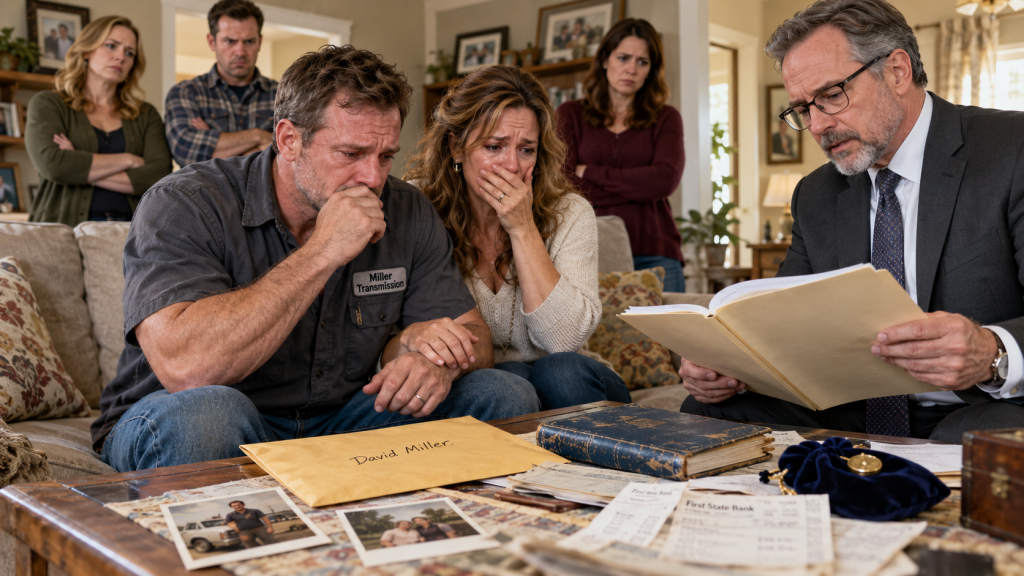
His expression changed. “That’s ridiculous.” The attorney did not move. “My name is Samuel Whitcomb. I represented your father in his estate planning and, more recently, in his efforts to investigate certain missing payments.” Kevin’s jaw tightened. “Then you should know Dad was practically senile.”
Sarah flinched.
“Kevin.”
“What? Someone has to say it.”
The lawyer reached into the folder.
“Your father underwent an independent capacity assessment when he revised his trust eighteen months ago. His medical and legal records do not support your characterization.”
Kevin laughed bitterly.
“Of course they don’t. You people get paid to say whatever the person with money wants to hear.”
Samuel turned another page.
“This account was opened six years ago at a bank in San Antonio.”
He placed a photocopy of an identification document beside the statement.
“Your driver’s license was used during the opening process.”
Kevin stared.
Then his voice rose.
“Anyone could have copied that!”
Samuel nodded.
“That’s possible.”
Kevin blinked.
He had expected an argument.
Instead, the attorney continued.
“But the account-opening records also identify you as the authorized account holder. The bank retained a signed application and supporting verification documents.”
I leaned forward.
“How much money are we talking about?”
Samuel looked at me.
“Approximately four hundred and seventy thousand dollars in royalty payments were redirected over six years.”
The room fell silent.
Four hundred and seventy thousand dollars.
I thought about my cracked hands.
The broken heater I repaired with secondhand parts.
The roof that leaked every spring.
The nights I ate toast for dinner because the grocery money had already been spent.
And Arthur.
Arthur sitting at our table.
Arthur wearing slippers with holes in the soles.
Arthur thanking me for every meal.
I whispered:
“Four hundred and seventy thousand dollars?”
Samuel nodded.
“That is the current estimate of diverted payments. The final amount could change after a complete accounting.”
Kevin snapped:
“You’re acting like I stole it!”
Samuel looked at him.
“I’m telling you what the records show. Whether a crime occurred is a question for the appropriate authorities.”
Kevin pointed toward the folder.
“Dad gave me permission.”
Sarah’s head turned.
“What?”
Kevin hesitated.
Then recovered.
“He wanted me to handle those payments.”
Samuel studied him.
“Do you have written authorization?”
“Yes.”
“Then please provide it to your attorney.”
Kevin’s face darkened.
“Don’t tell me what to do.”
I had listened long enough.
“Kevin.”
He turned toward me.
“What?”
I looked at the man who had spent two decades visiting our house for Christmas, eating our food, and making jokes about how lucky I was to have an elderly father-in-law living with us.
“Did Arthur know?”
Kevin said nothing.
I stepped closer.
“Did he know you were receiving the money?”
His expression hardened.
“Why do you care, David? You’re about to get millions.”
The words struck me harder than any accusation.
Not because they were insulting.
Because they sounded so familiar.
Money.
Always money.
Even with Arthur dead.
Even with Sarah crying beside me.
Even with twenty years of family history spread across our coffee table.
Kevin could see only the amount he might lose.
I looked toward the back hallway.
Arthur’s bedroom door was still closed.
His slippers were still beside his bed.
His half-finished crossword puzzle still lay on the nightstand.
And suddenly I wanted nothing more than to hear the old man shuffle down the hallway one last time.
I wanted him to walk into the living room.
Look at the chaos.
And say, as he always did:
“Anybody make coffee?”
Instead, there was only silence.
Then Samuel lifted the yellow envelope.
“Before anyone makes further accusations, I think Mr. Henderson deserves to finish speaking.”
Kevin folded his arms.
“He’s dead.”
Samuel looked at him.
“Yes.”
Then he opened the letter.
“But he left us his words.”
The first page trembled slightly in Samuel’s hands.
He began reading.
David,
If you are hearing this, then I have finally run out of time to tell you something I should have told you years ago.
You gave me a roof when the rest of my children were deciding whose problem I had become.
You gave me food, medicine, transportation, and more patience than I deserved.
And I gave you silence.
My throat tightened.
I know you thought I contributed nothing.
The painful truth is that for much of those twenty years, you were right.
I stared.
That was not what I expected.
I had imagined the letter would reveal secret kindnesses.
Perhaps Arthur had been paying the mortgage without telling me.
Perhaps the grocery money had somehow come from him.
Perhaps all my resentment had been based on a misunderstanding.
But he was saying something different.
He was admitting he had let us struggle.
Samuel continued.
I was not helpless for all those years.
I was afraid.
I was proud.
And I allowed those two things to make decisions that hurt the very people who loved me.
Sarah began crying.
Samuel paused.
She shook her head.
“Please.”
“Keep reading.”
He nodded.
Before I moved into your home, I had already lost almost everything once.
Not because of gambling.
Not because of illness.
Because I trusted the wrong person with my savings.
Kevin suddenly moved.
“Stop reading.”
Everyone turned.
Samuel lowered the letter.
“Mr. Henderson?”
Kevin pointed at him.
“That is private family history.”
I stared.
“What history?”
Kevin looked toward the door.
“I’m leaving.”
Samuel remained calm.
“You are free to leave.”
Kevin hesitated.
Then Sarah stood.
“No.”
Her voice shook.
“Not this time.”
Kevin turned.
“Sarah, stay out of it.”
She stepped forward.
“This was Dad’s house too. His funeral was three days ago. You came here demanding an inheritance, and now you want to leave because the truth is uncomfortable?”
Kevin stared at her.
Sarah continued.
“I spent twenty years defending Dad to David.”
“I fought with my husband.”
“I watched our children share a bedroom.”
“I watched David sell things he loved.”
Her voice broke.
“And you stood at our dinner table telling me how generous you were for visiting twice a year.”
Kevin said nothing.
She pointed toward the couch.
“Sit down.”
Something in her voice made him obey.
Samuel continued reading.
Twenty-six years ago, Kevin asked me to guarantee a business loan.
He said he was opening an automotive supply company with a friend.
He promised the money would be repaid within eighteen months.
I believed him.
The business failed.
The lender came after me.
I sold my old house to satisfy obligations I had never expected to carry.
I looked at Kevin.
He was staring at the floor.
Arthur had never told us.
Not once.
Samuel continued.
I do not blame Kevin for every decision I made. I signed the documents. I was a grown man.
But the experience changed me.
I became convinced that money attracted people who loved what I owned more than who I was.
Then my sister died and left me eighty-six acres outside Fredericksburg.
The land looked worthless.
The first offers were small.
Then came the mineral lease, the pipeline easement, and eventually a larger agreement involving access and infrastructure.
Over time, the payments became substantial.
I invested most of the proceeds.
I could have told you.
I should have told you.
I closed my eyes.
There it was again.
Should have.
Two words that arrive too late more often than people admit.
Instead, I hid the money.
At first, I told myself I was protecting Sarah from her siblings.
Then I told myself I was protecting my independence.
Then I told myself I was waiting for the right moment.
The truth is, I became comfortable being protected by your kindness while protecting my own money.
The room was completely still.
You sold your truck for my surgery.
My chest tightened.
I knew what that truck meant to you.
I heard you tell Sarah that you would buy another one someday.
I also heard you say you didn’t know how you would pay for groceries that month.
I could have helped.
I didn’t.
Tears blurred my vision.
For years, I had imagined Arthur was unaware of our struggles.
That perhaps old age had made him oblivious.
But he had known.
He had heard everything.
That should have made me angrier.
Instead, I felt something more complicated.
Because the dead man was finally telling the truth.
And I could no longer ask him why.
Samuel continued.
I am not leaving you money because you passed a test.
You never agreed to be tested.
I had no right to make your sacrifices a measurement of your character.
I am leaving it because you carried responsibilities I allowed to become unfair.
And because, even when you resented me, you never made Sarah choose between her husband and her father.
I covered my mouth.
That was not entirely true.
I had made her feel as though she had to choose.
More than once.
I had shouted.
Slammed doors.
Said terrible things in frustration.
But I had never actually told Arthur to leave.
I always told myself that was because Sarah would never forgive me.
Maybe part of it was.
But perhaps another part of me knew I could not put an old man on the street.
Samuel reached the end of the page.
David, I cannot repay twenty years with a check.
Money can repair your roof.
It can replace your truck.
It can give my grandchildren opportunities.
But it cannot give you back the years you spent worried about whether there would be enough.
I am sorry.
Not the kind of sorry I used to whisper while looking at my slippers.
A real one.
I bowed my head.
For twenty years, I had waited for Arthur to acknowledge what his presence cost us.
Now he had.
And somehow the acknowledgment hurt more than his silence.
Samuel set the first page aside.
“There is more.”
Kevin stood abruptly.
“I’ve heard enough.”
Sarah turned toward him.
“Then go.”
He stared.
“What?”
“You heard me.”
For a moment, she looked exactly like her father.
The same stubborn chin.
The same steady eyes.
“You can leave, Kevin.”
“But don’t come back here pretending Dad owed you a fortune.”
Kevin’s face twisted.
“You always were his favorite.”
Sarah laughed through her tears.
“Favorite?”
She pointed toward the hallway.
“His bedroom is next to our laundry room.”
“My husband worked himself sick keeping this family afloat.”
“Our boys grew up sharing a room because Dad needed somewhere to sleep.”
“Where were you?”
Kevin opened his mouth.
She continued.
“You visited at Christmas.”
“You brought expensive wine.”
“You took pictures with Dad.”
“Then you left.”
Her voice broke.
“Don’t stand in my living room and call me his favorite because I stayed.”
Kevin looked away.
For the first time, I saw something beneath his arrogance.
Shame.
Not enough to make him apologize.
But enough to make him uncomfortable.
Samuel folded the letter carefully.
“Mr. Henderson also left separate letters for each of his children. Those will be delivered privately.”
Kevin looked at the lawyer.
“What about the money?”
Samuel sighed.
“The trust documents will be administered according to their terms.”
Kevin pointed toward me.
“And he gets everything?”
“No.”
The answer surprised even me.
Samuel continued.
“The Henderson Family Stewardship Trust holds approximately $2.3 million in assets at the latest valuation, including investments and interests related to the Texas property.”
“David and Sarah are designated income beneficiaries following Arthur’s death.”
“An independent trustee administers the assets.”
“Certain principal distributions may be permitted for specified needs, subject to the trust’s terms.”
“And the remaining trust property is ultimately intended for Jacob and Eli.”
Our sons.
My throat tightened.
Jacob was twenty-two.
Eli was seventeen.
Neither had any idea this conversation was happening.
Samuel looked at Sarah.
“Your father did not intend this to become an unrestricted cash account.”
“He wanted professional oversight.”
“He wanted the funds protected.”
I nodded slowly.
That sounded like Arthur.
Even in death, he was worried someone would make a foolish decision with money.
Kevin laughed bitterly.
“And what do we get?”
Samuel looked at him.
“Your father’s probate estate includes certain personal effects and a modest cash residue to be divided according to his will.”
“His trust is separate from those probate assets.”
Kevin stared.
“Modest?”
“Yes.”
“How modest?”
Samuel hesitated.
“The estimated amount remaining for the other children is substantially smaller than the trust.”
Kevin’s face darkened.
“You people are going to regret this.”
He grabbed his coat.
Then looked at me.
“This isn’t over, David.”
I met his eyes.
“No.”
I said quietly.
“It isn’t.”
He slammed the front door so hard the photographs on the hallway wall rattled.
The house became silent.
Then Sarah collapsed onto the couch.
And cried like a little girl.
I sat beside her.
For a long time, neither of us spoke.
Samuel placed the papers back inside his briefcase.
“I can return tomorrow,” he said gently.
Sarah shook her head.
“No.”
She wiped her eyes.
“Please finish.”
Samuel nodded.
Then he opened the velvet pouch.
Inside lay two old metal keys.
A small brass key ring.
And a photograph.
My breath caught.
The photograph showed a dark blue Chevrolet Silverado.
My truck.
The one I sold eight years earlier.
The one I used to wash every Sunday even when I was too exhausted to stand.
I reached for the picture.
“Where is this?”
Samuel smiled sadly.
“Your father-in-law bought it back.”
I stared.
“What?”
“He located the buyer several years after the sale.”
“He negotiated to purchase it.”
“He arranged for it to be restored.”
My hands began to shake.
“Where?”
“Stored with a mechanic in Cedar Park.”
I looked at Sarah.
She was crying again.
“Dad never said anything.”
Samuel nodded.
“He wanted it to be a surprise.”
I stared at the keys.
Then something bitter rose inside me.
“He could have given me money for the surgery.”
The words escaped before I could stop them.
Samuel did not argue.
“Yes.”
I looked up.
“He could have helped us pay for the cataracts.”
“Yes.”
“Instead he bought my truck back after I’d already spent years without it?”
Samuel lowered his eyes.
“Yes.”
I stared at the photograph.
Then laughed bitterly.
“What was he thinking?”
Samuel answered carefully.
“I don’t know everything he was thinking.”
I pressed a hand over my face.
I wanted to be grateful.
I wanted to feel the enormous joy of getting back something I loved.
But all I could think about was how frightened I had been the day I sold it.
How I had stood in the driveway pretending it didn’t matter.
How Jacob had asked why Dad’s truck was leaving.
How I had answered:
“Sometimes grown-ups have to make choices.”
Arthur had been standing in the doorway that day.
I remembered now.
His cap in his hands.
His eyes lowered.
He had known.
He had always known.
Sarah took my hand.
“David.”
I shook my head.
“I don’t know how to feel.”
She leaned against me.
“Neither do I.”
Samuel closed the pouch.
“You don’t have to decide today.”
That might have been the kindest thing anyone said.
After the attorney left, Sarah and I sat in the living room until the afternoon light faded.
The blue ledger remained on the coffee table.
I opened it.
Page after page.
Date after date.
The first entry was twenty years old.
September 14 — David bought groceries. Estimated household share: $38.
Next:
September 27 — Sarah paid prescription. $62.
Then:
October 4 — Gas for doctor visit. $19.
The handwriting was neat at first.
Small.
Careful.
Over the years, it became shakier.
Some entries were estimates.
Others had receipts attached.
Several were crossed out and corrected.
Then I reached a page from eight years earlier.
March 18 — David sold truck. Cataract surgery. He says it is fine. It is not fine.
I stopped breathing.
Beneath it, Arthur had written:
I should tell him.
I turned the page.
Six months later:
Still haven’t told him.
Another year:
Too late now?
I felt tears rise.
I kept reading.
November 3 — David came home exhausted. Heard him tell Sarah he doesn’t know how much longer he can do this.
Then:
He is right.
I closed the ledger.
Stared at the wall.
Sarah whispered:
“He wrote all that?”
I nodded.
She began crying again.
I looked toward the hallway.
Arthur’s old slippers still sat beside his bedroom door.
I had never liked those slippers.
They were faded brown.
The soles had become smooth.
They made a soft scraping sound on our kitchen floor.
For twenty years, I could identify Arthur’s footsteps without looking.
Now I would never hear them again.
And the silence was not peaceful.
It was terrible.
That evening, Jacob came home from work.
He had recently finished an associate degree and was saving money while deciding whether to pursue engineering.
His younger brother, Eli, arrived from school an hour later.
We sat them down.
I told them about the attorney.
The trust.
The land.
The missing money.
The truck.
They listened in stunned silence.
Then Eli asked:
“Grandpa was rich?”
I looked at him.
“He had more money than we knew.”
Eli stared.
“But he wore the same hat every day.”
I almost smiled.
“Yes.”
Jacob frowned.
“Why didn’t he help?”
That was the question.
The only question.
Sarah took a breath.
“Because he made mistakes.”
Jacob looked at her.
“Big ones.”
“Yes.”
“He let Dad work all those hours?”
I nodded.
“Yes.”
Jacob’s jaw tightened.
“That’s messed up.”
I could not argue.
Eli looked toward Arthur’s bedroom.
“Did he know we were sharing a room because of him?”
Sarah’s eyes filled.
“Yes.”
Eli stared at his hands.
For a moment, I thought he would become angry.
Instead he whispered:
“He helped me build my science project.”
I looked at him.
“What?”
“The bridge.”
Of course.
Eli had built a model suspension bridge for school.
Arthur spent three evenings helping him measure supports.
I remembered being angry because the dining table was covered in glue and wooden sticks.
Eli continued.
“He told me bridges only work when every part carries its share.”
I closed my eyes.
The irony hurt.
Jacob looked at the ledger.
“Grandpa taught me to balance a checkbook.”
Sarah laughed through tears.
“He did?”
Jacob nodded.
“When I was eleven.”
“He said numbers are easier to trust when you write them down.”
I looked at the blue ledger.
Then whispered:
“I wish he’d followed his own advice about talking.”
Jacob nodded.
“Yeah.”
We sat together.
Four people grieving the same man for different reasons.
Sarah had lost her father.
Jacob and Eli had lost their grandfather.
I had lost the old man I resented.
And all of us had lost the chance to ask questions while he could still answer them.
The next morning, Samuel called.
His voice was serious.
“David, there has been a development.”
I sat up.
“What kind?”
“Kevin has retained an attorney.”
I sighed.
“Of course.”
“He is asserting that Arthur lacked capacity when he amended the trust.”
My stomach tightened.
“Can he do that?”
“He can bring a challenge if he has a legally sufficient basis.”
“Will he win?”
“I can’t promise an outcome.”
I rubbed my forehead.
Samuel continued.
“But Arthur anticipated questions about capacity. The trust was established years before his final illness and reviewed periodically. His medical records and independent evaluations will be relevant.”
I stared at the kitchen wall.
“So this could take years.”
“Possibly.”
I closed my eyes.
Arthur was barely in the ground.
And the fight had already begun.
Samuel paused.
“There’s another matter.”
“What?”
“Kevin contacted the bank holding the disputed royalty account.”
My breath caught.
“Why?”
“He attempted to withdraw a substantial balance.”
I stood.
“Was he allowed?”
“The bank has placed restrictions on the account while the dispute is reviewed.”
I leaned against the counter.
“Did he know an investigation was coming?”
Samuel hesitated.
“David, I think we should meet.”
By noon, I was sitting in Samuel’s office.
The building smelled of polished wood and old paper.
A framed photograph of the Texas Hill Country hung behind his desk.
He placed another folder in front of me.
“Arthur came to me eighteen months ago.”
I stared.
“He knew about the missing money then?”
“He suspected.”
“Why didn’t he tell us?”
Samuel lowered his eyes.
“That is a question he struggled with.”
I felt anger rising.
“He lived under my roof.”
“Yes.”
“He watched us struggle.”
“Yes.”
“And even when he knew Kevin might be taking money, he didn’t tell us?”
Samuel nodded.
“He was ashamed.”
I laughed bitterly.
“Ashamed?”
“He believed he had repeated the same mistake he’d made decades earlier.”
“Trusting Kevin?”
“Yes.”
I stared at the folder.
Samuel continued.
“Arthur initially gave Kevin limited access to help with paperwork connected to the Texas property.”
“When?”
“About seven years ago.”
I frowned.
“Arthur gave him access?”
“Yes.”
“Why?”
“Kevin told him there were tax and lease matters requiring assistance.”
I closed my eyes.
Arthur had been independent in some ways and vulnerable in others.
He could remember every baseball score from 1972.
But online banking terrified him.
He hated automated phone menus.
He could not read small print without his glasses.
Kevin had offered to help.
Of course.
Samuel continued.
“Arthur says he never authorized Kevin to redirect royalty payments into an account Kevin controlled.”
“He became suspicious when the statements stopped arriving.”
“Then why didn’t he do something?”
“He tried.”
Samuel opened the folder.
Inside were letters.
Requests for statements.
Copies of canceled checks.
Notes from phone calls.
Several envelopes marked undeliverable.
Then one handwritten note:
Kevin says everything is fine. Ask again next month.
I stared at it.
Another:
Don’t involve Sarah. She has enough trouble.
My throat tightened.
Arthur had been afraid of burdening his daughter with the truth.
While she was already carrying the burden of caring for him.
He had convinced himself silence was kindness.
It had not been.
Samuel continued.
“About eighteen months ago, Arthur finally hired me to review the situation.”
“We engaged a financial investigator.”
“That is how we identified the redirected payments.”
I looked up.
“Then why didn’t you confront Kevin?”
Samuel paused.
“Arthur did not want to proceed immediately with litigation.”
“Why?”
“He was worried about what it would do to the family.”
I stared at him.
“The family was already hurting.”
Samuel nodded.
“Yes.”
“He understood that eventually.”
I looked at the folder.
“Did he ever tell Kevin he knew?”
Samuel considered.
“Not formally.”
“But there is reason to believe Kevin suspected the investigation.”
My stomach tightened.
“Why?”
Samuel opened another envelope.
Inside was a photograph.
Arthur sitting in his lawn chair.
His baseball cap on his knees.
Beside him stood Kevin.
The photograph had been taken about four months before Arthur died.
I remembered that visit.
Kevin had arrived unexpectedly.
He spent forty minutes alone with Arthur on the porch.
When he left, Arthur barely spoke for the rest of the day.
I had assumed they argued about politics.
Samuel tapped the photograph.
“Arthur told me Kevin came to ask about the trust.”
I frowned.
“What did he say?”
Samuel looked at me.
“According to Arthur, Kevin told him that if he left the Texas property to Sarah and you, the other children would consider it a betrayal.”
My stomach twisted.
Samuel continued.
“Kevin also asked Arthur to sign new documents.”
“What documents?”
“We never received copies.”
I stared at the photograph.
The old man.
The expensive son.
The quiet porch.
And suddenly I remembered Arthur’s face that evening.
Pale.
Exhausted.
He had sat at our dinner table and barely touched his soup.
I asked whether he was sick.
He said:
“Just tired, son.”
I had been irritated.
There was always something.
Always another appointment.
Another prescription.
Another reason the old man needed attention.
Now I wondered what he had been carrying.
Not just secrets.
Fear.
Two weeks later, the first real crack appeared in Kevin’s story.
A bank representative provided records through the proper legal process.
The disputed account had been established with documents identifying Kevin as its holder.
The royalty administrator had received instructions to redirect payments.
Those instructions purported to bear Arthur’s authorization.
But the signature was suspicious.
Arthur’s handwriting had deteriorated after severe arthritis affected his right hand.
The signature on the authorization was smooth.
Strong.
Almost identical to one from several years earlier.
When specialists examined the records, they found signs that the signature had been reproduced from an older document.
The evidence did not solve every question.
But it undermined Kevin’s claim that Arthur had personally signed the new instructions.
Then the financial investigator found something else.
A series of transfers.
From the disputed account to a company called Henderson Consulting Services.
Kevin owned it.
The invoices described administrative work.
Lease management.
Financial reporting.
Travel.
Document preparation.
But the investigator could not find corresponding services sufficient to support the amounts charged.
The total exceeded $180,000.
I stared at the report.
“Administrative work?”
Samuel nodded.
“That’s how the payments were described.”
I shook my head.
“He charged his own father for paperwork?”
“The records suggest he charged significant sums.”
My chest tightened.
I remembered Arthur asking me to help him use the printer.
Arthur sitting at the kitchen table, staring at a bank statement upside down.
Arthur asking Jacob to read a number because his glasses were missing.
And Kevin collecting administrative fees.
My anger returned.
Sharper.
Cleaner.
No longer aimed at an old man who could not defend himself.
This time I knew where it belonged.
But Samuel stopped me before I could speak.
“David, there is one more thing you need to understand.”
“What?”
“Arthur made mistakes too.”
I stared.
“I know.”
“No.”
Samuel leaned forward.
“He made a deliberate decision not to disclose his finances to you.”
“Kevin’s conduct does not erase that.”
I looked down.
Samuel continued.
“If you turn Arthur into a saint because he left money behind, you’ll carry a different kind of burden.”
I sat silently.
He was right.
I had spent twenty years resenting Arthur.
Now I was in danger of rewriting him as a secret hero.
But neither version was complete.
He had loved us.
He had harmed us.
He had been afraid.
He had been proud.
He had made choices I still did not understand.
All of that could be true.
I nodded slowly.
“Thank you.”
Samuel looked surprised.
“For what?”
“For not pretending the money fixes everything.”
The following month, I finally went to see the Silverado.
The mechanic’s name was Raymond Foster.
He owned a small restoration shop north of Austin.
When I arrived, he was standing beside a metal garage door.
“You David Miller?”
“Yes.”
He smiled.
“Been expecting you.”
He opened the door.
And there it was.
My truck.
Dark blue.
Chrome polished.
The familiar shape of the hood.
The small dent near the rear bumper was gone, but the truck still had the same worn leather seat.
I stopped walking.
Raymond watched quietly.
“Arthur wanted it kept as close to the original as possible.”
I stepped closer.
Touched the door.
My fingers trembled.
“Is this really the same one?”
Raymond nodded.
“Same vehicle identification number.”
“Same truck.”
I opened the driver’s door.
The smell of old leather rushed toward me.
Suddenly I was forty-five again.
Driving home after a sixteen-hour shift.
Leo hadn’t been born yet.
Jacob was small enough to fall asleep against Sarah’s shoulder.
Life had been difficult.
But it had still felt full of possibility.
I sat behind the wheel.
The keys shook in my hand.
Raymond leaned against the doorway.
“Arthur used to visit.”
I looked up.
“What?”
“About once every couple of months.”
I stared.
“He came here?”
“His daughter drove him sometimes.”
My heart stopped.
“Sarah?”
Raymond shook his head.
“No. A transportation service.”
I exhaled.
Raymond continued.
“He’d sit in that passenger seat and ask whether the engine sounded right.”
“He didn’t know much about transmissions.”
I smiled through tears.
“He never did.”
Raymond laughed.
“He knew plenty about this truck, though.”
“He told me you sold it to pay for his surgery.”
My chest tightened.
Raymond’s expression softened.
“He was ashamed of that.”
I looked down.
“He could have helped us.”
Raymond nodded.
“He told me.”
I stared.
“What?”
Raymond walked toward a shelf.
Pulled down a small envelope.
“He asked me to give you this when you came.”
My name was written across it.
David.
Again.
Arthur’s shaky handwriting.
I opened it.
Inside was one page.
Son,
You once told Jacob that a good machine deserves maintenance before it breaks.
I wish I had understood that people do too.
I waited until you were exhausted before I noticed how much you were carrying.
I thought buying your truck back would make things right.
It won’t.
But perhaps you can use it to go somewhere simply because you want to go, not because somebody needs you to drive them.
I covered my mouth.
The final line read:
Take Sarah somewhere beautiful. Leave the grocery list at home.
I began crying.
Not quietly.
Not politely.
I bent forward over the steering wheel and sobbed.
Raymond stepped away.
Gave me privacy.
I sat there a long time.
Then I turned the key.
The engine started.
Deep.
Familiar.
Alive.
For one irrational second, I expected Arthur to appear at the garage door.
Cap in hand.
Smiling.
Asking if he could ride along.
But he was gone.
And some things cannot be restored, no matter how carefully someone repairs them.
That night, I drove home in the Silverado.
Sarah was standing on the porch.
When she saw the truck, she covered her mouth.
I parked.
Stepped out.
She stared.
“Oh, David.”
I nodded.
She walked toward me slowly.
Touched the hood.
Then began crying.
We stood beside the truck holding each other.
After a while, she whispered:
“I wish Dad could see you.”
I closed my eyes.
“So do I.”
Then I said something I had been afraid to say.
“Sarah, I was angry at him.”
She looked at me.
“I know.”
“No.”
“I mean really angry.”
“I know.”
“There were nights I wished he’d leave.”
Her eyes filled.
I continued.
“There were times I hated coming home because I knew he’d be sitting in my chair.”
She nodded.
“I know.”
“I said things I regret.”
Sarah took my hands.
“So did I.”
I stared.
She wiped her eyes.
“You think I never resented him?”
“He was your father.”
“Yes.”
“And I loved him.”
She swallowed.
“But there were nights I wanted my own house back.”
“I wanted our boys to have separate bedrooms.”
“I wanted to stop choosing between Dad’s appointments and things the children needed.”
I stared at her.
She continued.
“I defended him because I was afraid you’d make me choose.”
My chest tightened.
“Sarah—”
“And I resented you because sometimes I felt alone in making the choice to care for him.”
I lowered my eyes.
She squeezed my hands.
“We both carried things we didn’t say properly.”
I nodded.
“I’m sorry.”
She smiled sadly.
“Me too.”
We stood beneath the porch light.
Then I whispered:
“What do we do with all this?”
She looked toward Arthur’s bedroom window.
“I don’t know.”
After a moment, she added:
“Maybe we stop pretending we’re only allowed to feel one thing.”
I pulled her close.
That was the beginning of something.
Not forgiveness.
Not yet.
But honesty.
Kevin’s lawsuit arrived in early winter.
He challenged the trust amendments.
Claimed Arthur had been confused.
Claimed I had manipulated him.
Claimed Sarah had isolated him from his other children.
The petition included a statement that made my blood boil.
Arthur Henderson spent his final years financially dependent upon David and Sarah Miller, who exercised undue influence over his testamentary decisions.
I stared at those words.
Financially dependent.
Technically, Arthur had relied on us for day-to-day support.
But he had also held substantial assets.
And Kevin knew it.
Evelyn, a probate-litigation attorney Samuel recommended, explained the process.
“He’s allowed to assert a claim.”
“Doesn’t mean he can prove it.”
I looked at her.
“What will happen?”
“Records.”
“Witnesses.”
“Depositions.”
“Possibly mediation.”
“Possibly trial.”
I rubbed my forehead.
“How long?”
“Longer than anyone wants.”
Of course.
Kevin had spent years benefiting from family silence.
Now he was prepared to make everyone speak.
The irony was not lost on me.
We turned over appropriate records.
Caregiving details.
Medical visits.
Evidence of Arthur’s independence and limitations.
The trust’s history.
The attorney’s notes.
Capacity assessments.
And correspondence showing that Arthur had discussed the beneficiary plan long before his final illness.
Some of the evidence hurt.
Especially the ledger.
Because it documented how much Arthur understood.
How much he knew.
And how long he had remained silent.
Kevin’s attorney tried to portray us as opportunists.
Then came the deposition.
I sat across from Kevin.
He looked older.
The expensive suits remained.
But the confidence was thinning.
His lawyer asked:
“Mr. Miller, did you ever resent Arthur Henderson living with you?”
I answered:
“Yes.”
The attorney seemed pleased.
“Did you complain about the cost?”
“Yes.”
“Did you sometimes speak harshly to him?”
“Yes.”
He leaned forward.
“Would you agree you considered him a burden?”
I swallowed.
Then answered:
“Yes.”
Kevin looked at me triumphantly.
But I continued.
“I did consider him a burden.”
“I was wrong to make him feel worthless.”
“But the financial strain was real.”
“I worked long hours.”
“My wife worked too.”
“We made sacrifices.”
“And we still provided him a home.”
The attorney paused.
“Did you ever threaten to evict him?”
“No.”
“Did you know he had millions?”
“No.”
“Did you ever ask him to make you a beneficiary?”
“No.”
“Did you discuss his trust before his death?”
“No.”
“Did you know he owned the Texas property?”
“I knew there was some old family land. I didn’t know its value.”
Kevin’s expression changed.
His lawyer turned another page.
Then asked:
“Would you agree that resentment can become a motive for financial exploitation?”
I looked directly at him.
“Yes.”
He seemed surprised.
I continued.
“So can greed.”
Evelyn touched my arm.
A reminder.
Stay calm.
I nodded.
The deposition continued.
I did not try to sound like a perfect son-in-law.
I wasn’t one.
I told the truth.
And the truth was enough.
Kevin’s claims weakened as the trust records were examined.
Arthur had established the trust years before his final decline.
He had reviewed the arrangement with independent counsel.
He had confirmed the beneficiaries on several occasions.
The documents reflected a consistent plan.
Sarah and I would receive income and certain permitted support.
Jacob and Eli would eventually receive the remainder under protective terms.
Other children would receive comparatively smaller probate distributions.
Arthur had discussed his reasons privately.
The lawsuit did not disappear immediately.
But the evidence made the undue-influence theory increasingly difficult to sustain.
Then the financial investigation produced a new development.
A former employee of Kevin’s consulting company contacted authorities.
Her name was Marissa Cole.
She had handled bookkeeping.
She said Kevin instructed her to classify personal spending as administrative costs associated with the Texas property.
Some invoices were real.
Others were not.
She produced copies of records showing payments for:
A luxury boat.
Private travel.
Renovations to Kevin’s house.
Credit card balances.
And a down payment on a condominium.
I stared at the summary.
The amount involved was staggering.
But the worst part was not the spending.
It was what Kevin had written in an email to Marissa.
Dad won’t notice the difference.
I read it three times.
Then another:
Sarah and David cover his daily expenses anyway.
I stopped breathing.
There it was.
The truth.
Kevin knew we were supporting Arthur.
He knew the old man lived in our small back bedroom.
He knew we paid for groceries and medication.
And he used that fact as a reason to take more.
My hands began shaking.
I called Sarah.
She answered immediately.
“David?”
I could barely speak.
“He knew.”
“What?”
“Kevin knew.”
She went quiet.
I looked at the email.
“He knew we were covering everything.”
“And he used it.”
Sarah began crying.
I wanted to scream.
But instead I sat down and stared at the wall.
For twenty years, I had been angry at the man sitting in my recliner.
Meanwhile, someone else had been quietly profiting from the arrangement.
That did not excuse Arthur’s silence.
But it changed the shape of the story.
The burden had not fallen on us by accident.
It had been made heavier by secrecy, fear, and another man’s greed.
Kevin eventually withdrew part of his trust challenge.
The remaining dispute resolved through a negotiated agreement after significant legal expense.
He did not gain control of the trust.
The independent trustee continued administering it.
The estate paid legitimate administration expenses.
Kevin received the probate distribution to which he was entitled under the will, subject to the applicable proceedings.
But the missing royalty payments were another matter.
That investigation continued separately.
The authorities examined the redirected funds.
The account opening.
The disputed authorization.
The invoices.
The transfers.
Kevin’s explanations.
And the evidence from Marissa and others.
Some payments could be justified.
Others could not.
The final alleged loss was lower than the initial total of redirected royalties because investigators separated legitimate expenses from unauthorized distributions.
The amount was still substantial.
More than $300,000.
Kevin’s attorney negotiated.
There were restitution discussions.
Eventually, Kevin entered a plea involving financial exploitation and fraudulent documentation.
He did not receive the decades-long sentence people on social media demanded.
The outcome included restitution, supervision, restrictions, and a custodial component based on the charges and his circumstances.
The court also ordered financial disclosures relevant to recovery.
Some money was recovered through asset sales.
Some through negotiated payments.
Some was gone.
We never recovered every dollar.
And that was another lesson.
Money stolen from a family does not automatically return simply because the truth comes out.
There are expenses.
There are legal limits.
There are losses that remain.
The trust was stabilized.
But the family would never be exactly what it had been.
Sarah struggled with Kevin’s conviction more than I expected.
She had been angry with him.
Furious.
But he was still her brother.
They had grown up together.
Shared a bedroom during family vacations.
Argued about toys.
Attended the same schools.
Sat beside each other at their mother’s funeral.
She remembered the boy he had been before he became the man who stole from their father.
One evening, I found her in the kitchen looking at an old photograph.
Arthur stood beside four children.
Sarah.
Kevin.
Monica.
Paul.
All smiling.
Sarah whispered:
“I don’t know where we lost him.”
I sat beside her.
“Maybe he made a lot of small choices.”
She nodded.
“He used to protect me.”
I looked at her.
“When?”
“In school.”
She smiled sadly.
“There was a boy who teased me about my glasses.”
“Kevin punched him.”
I almost laughed.
“That sounds like Kevin.”
She nodded.
“He got suspended.”
“Dad was furious.”
“Mom secretly made him pancakes.”
Then she began crying.
“I wish I could find that boy again.”
I took her hand.
“I know.”
After a while, she whispered:
“Do you think Dad stopped loving him?”
I thought.
“No.”
“Then why did he exclude him from the trust?”
I considered.
“Maybe love wasn’t the same as trust.”
She looked at me.
I continued.
“Arthur could love Kevin and still know he was unsafe with money.”
Sarah nodded slowly.
“Can those both be true?”
“Yes.”
She leaned against me.
We sat together.
Grieving people who were still alive.
That is a peculiar kind of grief.
There is no funeral.
No final goodbye.
Just the slow acceptance that someone you love has become someone you cannot safely depend upon.
The trust began making permitted distributions the following year.
Not all at once.
Not extravagantly.
We worked with the independent trustee and financial advisers to establish a realistic plan.
The investments would remain managed.
Income would support Sarah and me.
Approved principal distributions could address certain needs.
The remainder would be protected for Jacob and Eli according to the trust.
We did not buy a mansion.
We did not suddenly begin driving luxury cars.
The first thing we did was repair the roof.
The same roof I had postponed fixing for years.
A contractor inspected it.
Found more damage than expected.
Water had reached part of the attic insulation.
Some ceiling material needed replacement.
The project took three weeks.
I stood in the driveway watching workers carry away the old shingles.
Sarah came outside with coffee.
She handed me a mug.
“Feels strange, doesn’t it?”
I nodded.
“Very.”
She looked upward.
“Dad used to worry about this roof.”
I laughed bitterly.
“He had a funny way of showing it.”
She smiled sadly.
“He did.”
We watched quietly.
Then I said:
“Sarah, I don’t want to spend the rest of our lives making every repair about him.”
She looked at me.
“What do you mean?”
“I don’t want every good thing to come with a speech about what Dad should have done.”
She considered.
Then nodded.
“Neither do I.”
We had already lost enough years to resentment.
The money would help.
But I did not want it to become another way Arthur controlled the atmosphere of our home.
We needed to let the roof simply be a roof.
Fixed.
Dry.
Ours.
The second thing we did was give the boys separate rooms.
Jacob had already moved into an apartment near his work.
Eli was preparing for college.
Still, we renovated the old back bedroom.
Arthur’s room.
For months, neither Sarah nor I had touched it.
The bed remained neatly made.
His baseball cap hung on the hook.
The radio sat on the windowsill.
His slippers were beside the bed.
One Saturday morning, Sarah stood in the doorway.
“It’s time.”
I nodded.
We began carefully.
Clothes into donation bags.
Important documents into folders.
Photographs into boxes.
Medicine disposed of properly.
Old newspapers recycled.
Every object seemed to carry a memory.
A chipped coffee mug.
A pocketknife.
A photograph of Arthur holding baby Jacob.
A birthday card from Eli.
Then I found a small cardboard box beneath the bed.
Inside were dozens of envelopes.
All addressed to Arthur.
Some from banks.
Some from the royalty company.
Some from family members.
At the bottom lay an old photograph.
Arthur beside a much younger Kevin.
They stood in front of a store.
A sign above the window read:
HENDERSON AUTO SUPPLY.
I stared.
The failed business.
The one that cost Arthur his house.
Behind the photograph was a handwritten note.
We were so happy that day.
My chest tightened.
I showed Sarah.
She covered her mouth.
“Oh, Dad.”
Then she turned the picture over.
Another sentence.
I kept hoping he’d come back to who he was.
We sat on the floor.
For a long time, neither of us spoke.
Arthur had spent years being exploited by Kevin.
Then years hiding wealth from everyone because of it.
He had tried to protect what remained.
But in doing so, he had made himself dependent on the very people he loved most.
Fear can turn a person into a prisoner.
Even when the prison is made of money.
Sarah touched the photograph.
“He never stopped hoping.”
I nodded.
“No.”
Then I whispered:
“Neither did you.”
She began crying.
I held her.
The bedroom was no longer simply the place where an old man slept.
It was where a frightened father had hidden from the consequences of trusting his son.
Where a proud man had failed to ask for help.
Where a loving grandfather had listened to his grandchildren grow.
Where I had spent years resenting someone whose whole story I did not know.
I could never look at it the same way again.
Three months later, Eli moved into that bedroom while finishing his last year of high school.
He painted it pale blue.
Put up shelves.
Built a desk.
Moved his books inside.
On the first night, he came downstairs carrying Arthur’s old radio.
“Mom?”
Sarah looked up.
“Yes?”
“Can I keep this?”
She smiled.
“Of course.”
Eli examined it.
“The antenna is broken.”
I laughed.
“It was broken when Grandpa bought it.”
“I think I can fix it.”
He carried it back upstairs.
A week later, the radio worked.
He placed it on his desk.
Sometimes late at night, I heard talk radio drifting softly through the hallway.
The first time it happened, I stopped walking.
My throat tightened.
For a second, it felt as though Arthur was alive again.
Then I heard Eli laugh at something on his computer.
Life.
Continuing.
Not replacing the dead.
Making room for the living.
Jacob and Eli learned about the trust gradually.
We did not make a dramatic announcement about their future wealth.
There were meetings with the trustee.
Explanations.
Questions.
Financial education.
Discussions about responsibility.
Jacob was fascinated by the investments.
Eli wanted to know whether the trust could help pay for school.
Both were permitted to ask.
Neither was encouraged to treat the money as an identity.
One evening, Jacob said:
“Grandpa could’ve bought us anything.”
I nodded.
“Probably.”
“He didn’t.”
“No.”
Jacob looked at the ledger.
“Sometimes I think that’s awful.”
I considered.
“Sometimes it was.”
He looked surprised.
I continued.
“Your grandfather loved you.”
“He also made choices that hurt this family.”
“You don’t have to pretend those choices were good just because he left money behind.”
Jacob nodded slowly.
Then whispered:
“Can I still miss him?”
My chest tightened.
“Of course.”
He smiled sadly.
“Good.”
Then:
“Because I really do.”
I hugged him.
We stood there a while.
Two men missing someone neither had fully understood.
Kevin wrote to Sarah from custody.
The first letter blamed everyone.
The lawyer.
The bank.
Arthur.
His business partners.
Me.
Sarah read it.
Then folded it.
Put it away.
The second letter was shorter.
He admitted he had taken money.
But insisted he deserved it because Arthur had promised to help him recover from the old business failure.
Sarah stared at that one for a long time.
Then said:
“He still thinks everything is owed to him.”
I nodded.
The third letter arrived months later.
No demands.
No accusations.
He wrote:
Sarah,
I spent years telling myself Dad owed me because he had money I didn’t.
I told myself David was lucky to have free help around the house, even though I knew he was carrying the costs.
I knew Dad trusted me less than he trusted you.
Instead of asking what I’d done to earn that distrust, I decided the unfairness justified taking money.
It didn’t.
Sarah began crying.
He continued.
I hurt Dad.
I hurt you.
I hurt David.
And I made my own children ashamed of me.
I don’t expect you to answer.
But I wanted to say it without asking for anything.
Sarah read the letter twice.
Then placed it beside Arthur’s photograph.
I asked:
“Are you going to write back?”
She shook her head.
“Not yet.”
I nodded.
She looked at me.
“Do you think that makes me cruel?”
“No.”
“Why?”
“Because an apology doesn’t create a deadline for forgiveness.”
She leaned against me.
We sat in silence.
Later, she wrote Kevin a short letter.
She said she believed he understood more now.
She hoped he would continue taking responsibility.
She was not ready to rebuild their relationship.
And she would not discuss money with him again.
It was not a happy ending.
Not exactly.
But it was honest.
The next summer, Sarah and I finally took the trip Arthur had wanted us to take.
We drove the Silverado west.
No strict schedule.
No elaborate itinerary.
Just a few days away.
Hill Country roads.
Small diners.
Old towns.
Blue skies stretching farther than they seemed to back in Austin.
Sarah sat beside me with her shoes off.
A paper map lay on her lap even though we had GPS.
Arthur used to love paper maps.
He said technology had made everyone forget how to get lost properly.
We stopped outside Fredericksburg.
Not far from the land that had changed everything.
Samuel had arranged for us to meet the property manager.
He showed us the boundaries.
The lease areas.
The access road.
The utility infrastructure.
The fields where cattle once grazed.
The property did not look like millions of dollars.
It looked like Texas.
Dry grass.
Fence posts.
Oak trees.
Dust.
Wind.
I stood beside Sarah.
Stared across the land.
“It’s hard to believe all that money came from here.”
She nodded.
“Dad used to call it the dusty inheritance.”
I smiled.
“Really?”
“Yes.”
“He said his sister left him more weeds than grass.”
I laughed.
We walked toward an old oak tree.
Sarah touched its bark.
Then whispered:
“I wish he’d brought us here.”
I looked at her.
“Why didn’t he?”
She shook her head.
“I don’t know.”
Perhaps he feared questions.
Perhaps he wanted to keep the secret.
Perhaps every year made the truth harder to tell.
Or perhaps he was simply a man who had become too accustomed to postponing difficult conversations.
I stood beside the tree.
Then said:
“Arthur, you stubborn old fool.”
Sarah looked at me.
I smiled sadly.
“You could’ve saved us all so much pain.”
The wind moved through the branches.
No answer.
Of course.
But for the first time, I did not expect one.
On the drive home, Sarah asked:
“Do you forgive him?”
I thought about it.
Longer than she expected.
“I don’t know.”
She nodded.
“Me neither.”
I glanced at her.
“Do you?”
She looked out the window.
“I love him.”
“I know.”
“But I still feel angry.”
“I know.”
She turned toward me.
“Is that allowed?”
I almost laughed.
“Sarah.”
“What?”
“You’re asking the man who spent twenty years resenting him.”
She smiled.
Then became serious.
“I thought when Dad died, I’d remember only the good things.”
I nodded.
“Instead, everything got more complicated.”
“Yes.”
I reached across the seat.
Took her hand.
“Maybe that’s what loving someone really is.”
“What?”
“Knowing they were more than one thing.”
She squeezed my fingers.
“He was a good grandfather.”
“Yes.”
“He was stubborn.”
“Very.”
“He made terrible choices.”
“Yes.”
“He loved us.”
I looked at the road.
“Yes.”
Then I added:
“And he should’ve trusted us with the truth.”
Sarah nodded.
“That’s the part I can’t let go of.”
“Me neither.”
We drove quietly.
The truck hummed beneath us.
For the first time, it felt less like a monument to my sacrifice and more like a truck.
Mine again.
Something useful.
Something I could enjoy.
That mattered.
Years passed.
Not quickly.
Not magically.
But steadily.
The trust continued under professional management.
The Texas property produced income, though the payments varied.
Some years were strong.
Other years brought unexpected expenses.
The trustees kept reserves.
Jacob and Eli learned that money was not an endless river.
It required care.
Planning.
Patience.
Our roof no longer leaked.
The house was more comfortable.
Sarah and I finally took care of medical appointments we had postponed.
I reduced my hours at the transmission shop.
Not because I stopped loving the work.
Because I wanted to be home more.
For the first time in decades, I could choose.
Some mornings, I still went to the shop early.
The smell of oil.
The sound of tools.
The familiar weight of a wrench.
Those things were part of me.
I did not want wealth to erase the man I had been.
I only wanted it to give him some rest.
I started teaching younger mechanics on Saturdays.
Some were teenagers.
Some had dropped out of school.
Some simply wanted a skill.
I charged nothing for the informal workshops I could afford to provide.
We learned diagnostics.
Basic maintenance.
How to avoid unnecessary repairs.
How to ask questions without feeling foolish.
I told them:
“Never sign something you don’t understand just because someone is impatient with you.”
They thought I meant repair estimates.
Sometimes I did.
Sometimes I meant life.
When Eli graduated from high school, he asked if he could use part of the money available under the trust to study engineering.
The trustee reviewed the request.
The terms supported educational distributions.
It was approved.
Eli hugged Sarah.
Then me.
“I think Grandpa would’ve liked this.”
I smiled.
“He would’ve.”
Jacob was already working in a technical field.
He had moved into his own apartment.
Bought a used car.
Paid his bills.
He once told me:
“Dad, I don’t want to live on the trust.”
I looked at him.
“Why?”
“Because Grandpa didn’t work all those years so I’d sit around doing nothing.”
I smiled.
“Grandpa didn’t create all that money by working in a conventional job, either.”
Jacob laughed.
“Fair.”
Then he became serious.
“I want to build something.”
I nodded.
“Then build.”
He looked at me.
“Do you think I have to prove I deserve the money?”
That question hurt.
Because I recognized it.
The fear of needing to earn belonging.
I shook my head.
“No.”
“Then what?”
“Use the opportunities responsibly.”
He thought.
“That’s it?”
“That’s enough.”
I had learned something.
Children should not grow up believing love is a debt.
And grandchildren should not inherit guilt along with money.
Arthur had left a complicated legacy.
We could choose not to make it more complicated.
Kevin eventually completed his sentence and supervision.
He was older.
Thinner.
Less certain of himself.
His children had limited contact with him.
His former home was gone.
His business had closed.
He had been required to make restitution over time according to the court’s orders.
Some payments were small.
Some larger when assets were sold.
There was no magical transformation.
No sudden redemption.
But there were changes.
He began working at a small logistics company.
He attended financial counseling.
Then therapy.
He apologized to his children.
One accepted contact.
Another needed more time.
Sarah met him for coffee.
I did not go.
That was her brother.
Her choice.
When she returned home, she looked exhausted.
“How was it?”
She sat down.
“Strange.”
I waited.
“He asked about you.”
“What did he say?”
“He said he hoped you were doing well.”
I nodded.
Then she added:
“He asked whether you still hated him.”
I thought.
“What did you say?”
“I told him I didn’t know.”
Fair.
Sarah continued.
“He didn’t ask for money.”
I smiled faintly.
“That’s progress.”
She laughed.
Then cried.
I held her.
Sometimes healing is not dramatic.
Sometimes it is a person finally leaving a conversation without making a demand.
For Kevin, that was a meaningful beginning.
Not an ending.
On the fifth anniversary of Arthur’s death, I returned to the cemetery alone.
I carried flowers.
Nothing expensive.
Just white carnations.
Arthur had always claimed flowers were a waste of money because they died too quickly.
I placed them beside his stone.
Then sat on the grass.
For a long time, I said nothing.
I looked at his name.
Arthur James Henderson.
Beneath it:
Beloved Father and Grandfather.
I had helped choose those words.
They were true.
They were not the whole truth.
No gravestone ever is.
Finally, I spoke.
“Arthur.”
The name felt strange in my mouth.
For twenty years, I had mostly called him Mr. Henderson.
Even after he began calling me son.
I cleared my throat.
“I brought the truck.”
I smiled faintly.
“She’s running well.”
“The roof’s fixed.”
“Sarah’s doing okay.”
“Jacob has a good job.”
“Eli’s studying engineering.”
I paused.
Then looked down.
“I’ve been trying to figure out what to say to you.”
The wind moved through the cemetery.
I continued.
“For a long time, I thought you were a burden.”
“I was angry about the money.”
“The medicine.”
“The groceries.”
“The space.”
“The years.”
I swallowed.
“And you knew.”
Tears filled my eyes.
“You knew, and you still didn’t tell us.”
I sat quietly.
Then whispered:
“That hurt.”
The words felt important.
I had spent years feeling guilty about my resentment.
Then years feeling guilty about the secret money.
But I had never allowed myself simply to say that Arthur hurt us.
I did now.
“You should’ve helped.”
My voice cracked.
“You should’ve trusted Sarah.”
“You should’ve trusted me.”
I wiped my eyes.
Then continued.
“But I should’ve been kinder.”
I remembered every time I slammed a cupboard.
Every time I sighed when Arthur asked for a ride.
Every time I spoke about him as though he were an expense instead of a person sitting ten feet away.
“I should’ve asked whether you were afraid.”
“I should’ve noticed when you were lonely.”
“I should’ve told you I was angry without making you feel ashamed for getting old.”
I looked at the stone.
“We both got things wrong.”
Then I laughed sadly.
“You more than you admitted.”
Silence.
I took a breath.
“But you loved those boys.”
Tears slid down my face.
“And they loved you.”
I thought about Eli repairing the radio.
Jacob learning to balance a checkbook.
The photographs.
The handmade science projects.
The quiet afternoon conversations I never witnessed.
“You gave them things that weren’t money.”
I nodded slowly.
“That mattered.”
Then I said the words I had been avoiding.
“I miss you.”
The sentence surprised me.
But it was true.
I missed the scrape of his slippers.
His terrible jokes.
The way he insisted the weather forecast was wrong even when it was raining directly outside the window.
The way he stirred coffee for a full minute before drinking it.
The way he said:
“Thank you, son.”
I missed him.
Even now.
Even after everything.
I sat there until the sun began sinking.
Then I stood.
Brushed grass from my jeans.
And whispered:
“I don’t know whether forgiveness means making peace with every part of what happened.”
“But I’m going to stop carrying you as an argument.”
I touched the stone.
“Rest easy, Arthur.”
Then I walked back to the truck.
That evening, I found Sarah sitting at the kitchen table.
In front of her was the blue ledger.
I stopped.
“You okay?”
She nodded.
Then pointed to a page.
“Look.”
I sat.
It was one of the last entries.
Arthur’s handwriting had become almost unreadable.
The date was two weeks before he died.
David fixed the porch step. Again.
Beneath it:
He complained the whole time.
I laughed.
I remembered.
The wood had rotted.
Arthur kept forgetting to warn people.
I spent an entire Saturday replacing the step.
My back hurt for three days.
Then I saw another line.
He still fixed it.
I swallowed.
Below that, Arthur had written:
Maybe love is not always the absence of resentment. Maybe sometimes it is the decision to remain kind while carrying more than you should.
I stopped reading.
Sarah reached for my hand.
Then I looked at the final sentence.
I wish I had helped him carry it.
My eyes filled.
For years, I had wanted Arthur to understand.
He finally had.
Too late to change what happened.
But not too late for me to understand him differently.
I closed the ledger.
Sarah whispered:
“What should we do with it?”
I thought.
“Keep it.”
She nodded.
“But not on the coffee table.”
I smiled faintly.
“No.”
“Let’s put it somewhere safe.”
We placed it in a wooden chest with Arthur’s photograph, his baseball cap, and several letters.
Not hidden.
Not displayed like a shrine.
Just kept.
Part of our history.
No longer the center of every day.
Ten years after Arthur died, I turned seventy.
Sarah organized a birthday dinner.
Nothing extravagant.
Just family.
Jacob came with his wife.
Eli came home from work.
There were grandchildren now.
Little feet running through the hallway.
Laughter.
Dishes clattering.
The smell of roast chicken.
Someone spilled juice.
Someone argued over the last dinner roll.
It was loud.
Messy.
Wonderful.
I sat at the head of the table.
The same table where Arthur had eaten breakfast for twenty years.
We had refinished it.
The old scratches remained.
One corner still carried a faint burn mark from a Christmas candle.
Eli’s little daughter climbed onto my knee.
“Grandpa?”
“Yes, sweetheart?”
“Why is that chair empty?”
She pointed toward the far side of the table.
Arthur’s old chair.
We still used it.
But nobody happened to be sitting there.
I smiled.
“That’s where your great-great-grandpa used to sit.”
She looked interested.
“Was he nice?”
I thought about the question.
Longer than she expected.
Then I answered:
“He could be.”
She giggled.
“Could be?”
“Yes.”
“He was stubborn.”
“Like Daddy?”
I laughed.
“Very much like Daddy.”
Eli protested from across the table.
“Hey!”
Everyone laughed.
The little girl pointed toward Arthur’s photograph on the shelf.
“That him?”
“Yes.”
She stared.
“Why does he look grumpy?”
I laughed so hard my eyes watered.
“Because someone probably told him he couldn’t have another cookie.”
Sarah began laughing too.
The whole table joined in.
And for the first time, the memory of Arthur did not arrive carrying guilt.
It arrived carrying laughter.
That was a gift no trust document could provide.
After dinner, Jacob helped me clear the table.
He looked at the photograph.
Then said:
“Dad, can I ask you something?”
“Always.”
“Do you think Grandpa knew we loved him?”
I stopped.
Looked toward the photograph.
Then thought about the old man sitting on the porch.
The radio buzzing.
The cap on his knees.
The words he whispered whenever he felt he was taking too much.
I’m sorry, son. I’ll be out of your hair soon enough.
I swallowed.
“I hope so.”
Jacob nodded.
Then:
“Do you think he knew you loved him?”
That question was harder.
I stared at my son.
For years, I had insisted I merely tolerated Arthur because he was family.
But tolerance is not always empty.
Sometimes it contains love that has been buried beneath fatigue.
I thought about the doctor visits.
The meals.
The prescriptions.
The nights I helped him into bed when his legs were weak.
The times I complained.
The times I stayed.
Then I said:
“I think I loved him badly.”
Jacob looked at me.
“What does that mean?”
I smiled sadly.
“It means I was tired, and angry, and didn’t always know how to show care without resentment.”
Jacob nodded slowly.
“And him?”
I looked at Arthur’s photograph.
“He loved us badly sometimes too.”
Jacob smiled.
“Sounds like a family.”
I laughed.
“Yes.”
“It does.”
Now, when people hear what happened, they usually focus on the fortune.
Two point three million dollars.
The Texas land.
The royalties.
The missing payments.
The brother who stole money.
The trust.
The restored Silverado.
They want to know whether the money changed my life.
Of course it did.
We repaired the roof.
Secured our future.
Helped our children pursue education and meaningful work.
Stopped living with constant financial panic.
Those things matter.
Poverty and insecurity are not romantic lessons.
They are exhausting.
Money can ease suffering.
It can create safety.
It can give people room to breathe.
I will never pretend otherwise.
But the money did not make Arthur innocent.
It did not make Kevin’s betrayal less painful.
It did not return the years Sarah and I spent frightened about bills.
It did not restore the childhood moments Jacob and Eli lost.
It did not give me back the truck when I needed it most.
And it did not let me say goodbye to Arthur with all the truth between us.
That was the greatest loss.
Not the dollars.
The years of silence.
The conversations we never had.
The anger we swallowed.
The explanations postponed until there was nobody left to answer.
If Arthur had told me five years earlier, I would have been angry.
If he had told me ten years earlier, I might have shouted.
If he had told me twenty years earlier, perhaps we could have made better decisions together.
We might have repaired the roof sooner.
We might have given the boys more space.
We might have argued about how much he should contribute.
We might have disagreed over Kevin.
We might even have damaged our relationship for a while.
But at least we would have been arguing about the truth.
Instead, Arthur chose silence because he feared money would corrupt the family.
And silence did its own damage.
That is what I remember most.
Not the fortune.
The cost of believing that keeping secrets is the same as keeping people safe.
There is something else I rarely tell people.
One night, several years before Arthur died, I came home after a terrible day at the shop.
Two mechanics had called in sick.
A customer refused to pay.
The transmission lift broke.
I had been working since before sunrise.
When I walked into the house, Arthur was sitting in my recliner.
His radio was playing.
A plate of cookies rested beside him.
I stood in the doorway.
He looked up.
“Evening, son.”
Something inside me snapped.
I said:
“Do you ever think about what this costs us?”
His smile disappeared.
I continued.
“Do you ever think about the food?”
“The electricity?”
“The doctor appointments?”
“The room my kids could be using?”
Sarah came into the hallway.
“David.”
I ignored her.
Arthur slowly set down his coffee.
Then looked at his slippers.
And whispered:
“I’m sorry, son. I’ll be out of your hair soon enough.”
I remember answering:
“Maybe that would be easier.”
The room went completely silent.
Sarah began crying.
Arthur stood.
Slowly.
Painfully.
He walked past me.
Without another word.
I did not apologize that night.
Or the next morning.
I told myself I was justified.
I was exhausted.
I had paid for everything.
I deserved to speak honestly.
But honesty without care can become cruelty.
And I had been cruel.
Years later, when the attorney read Arthur’s letter, I thought of that moment before anything else.
Not because he had millions.
Because he had gone to bed believing I wanted him gone.
I would give a great deal to return to that evening.
Not to pretend everything was fine.
Not to swallow my frustration.
I would still tell him we needed help.
I would still explain the cost.
I would still ask him to contribute what he could.
But I would not make him feel that his existence was the problem.
That is a distinction I learned too late.
The problem was not that Arthur was old.
The problem was that we had never built an honest arrangement around caring for him.
He had resources he concealed.
We had limits we refused to discuss clearly.
Sarah had loyalties she felt unable to reconcile.
Kevin had greed he disguised as entitlement.
And everyone kept avoiding the conversation that might have changed our lives.
Until death forced it open.
Last winter, I found Arthur’s old baseball cap in the wooden chest.
The fabric had faded almost gray.
The brim was bent.
Inside, his initials were written in black marker.
A.H.
I held it for a long time.
Then took it outside.
Sat in the aluminum lawn chair on the back porch.
The same chair where we found him.
We had repaired it.
Replaced two screws.
Cleaned the frame.
But kept it.
The afternoon was cool.
A little wind moved through the trees.
From inside the house, I could hear Sarah talking on the phone.
Jacob laughing.
A grandchild asking for cookies.
Life.
The life Arthur had lived beside.
The life he had complicated.
The life he had helped preserve in his own imperfect way.
I placed the cap on my knees.
Just as he used to.
Then I said quietly:
“You know, old man, you were a terrible communicator.”
I smiled.
“Absolutely terrible.”
The wind stirred the leaves.
I continued.
“You should’ve told us.”
I looked toward the yard.
“And I should’ve asked better questions.”
For a while, I sat without speaking.
Then I whispered:
“Thank you for loving those boys.”
My throat tightened.
“Thank you for trusting their future to us.”
A pause.
“And I’m still angry about some things.”
I laughed softly.
“I suspect you know that.”
Then I looked down at the cap.
“But I think I’m finally ready to let you rest.”
I closed my eyes.
For the first time in years, I imagined Arthur sitting beside me.
Not frail.
Not frightened.
Not apologizing.
Just an old man with black coffee and a plate of shortbread cookies.
I imagined him looking at me with that familiar stubborn expression.
And saying:
“Thank you, son.”
I opened my eyes.
The chair beside me was empty.
But the house behind me was full.
Full of people.
Full of voices.
Full of a life that had survived mistakes, secrets, and grief.
I stood.
Carried the cap inside.
And joined my family at the table.
For twenty years, I believed Arthur Henderson gave us nothing.
I was wrong.
He gave us affection, memories, and quiet acts of care that I failed to value.
He also withheld money and truth when we badly needed both.
Those facts do not cancel each other.
Kevin believed his father’s wealth belonged to him because he was a son.
He was wrong too.
Being family does not make another person’s money yours to take.
And Arthur believed that hiding his resources would protect the people he loved.
That was his mistake.
The fortune eventually helped us.
But the secrecy had already hurt us.
If there is one thing I would tell anyone listening to our story, it is this:
Do not wait until someone dies to settle the truth of what you owe each other.
Talk about money.
Talk about resentment.
Talk about care.
Talk about boundaries.
Talk about what you can give and what you cannot.
Do it while the person can still answer.
While apologies can still be spoken face to face.
While a hand can still reach across the table.
Because no inheritance can repay a conversation that never happened.
No restored truck can bring back a lost decade.
No bank account can replace a father’s voice.
And no amount of money can turn silence into love.
Arthur left us a fortune.
But the most valuable thing his death taught me was something he should have understood while he was alive.
Love does not become stronger by hiding the truth.
It becomes stronger when people are trusted enough to hear it.
I still miss him.
I still regret some things.
And I am still grateful.
All three feelings live together now.
Sometimes, when I sit at the table and see the empty chair where Arthur used to eat his oatmeal, I smile.
Because I no longer see only the burden I once believed he was.
I see a complicated man.
A frightened father.
A loving grandfather.
A stubborn old fool who made mistakes.
A man who should have trusted us sooner.
And someone who, despite everything, belonged at our table.
One evening, my youngest grandson asked me:
“Grandpa, why do you always leave that chair at the table?”
I looked at the empty seat.
Then at the boy.
I smiled.
“Because a long time ago, someone sat there who taught me something important.”
“What?”
I pulled out the chair and sat beside him.
“That a person’s worth isn’t measured by how much money they bring into the house.”
He nodded seriously.
Then asked:
“Is that why Grandma says everybody gets dinner?”
I laughed.
“Yes.”
“Even if they don’t have money?”
“Especially then.”
He thought for a moment.
Then smiled.
“Good.”
He reached for another biscuit.
And I watched him eat.
No calculations.
No silent resentment.
No ledger in my head.
Just a child enjoying dinner.
The way it should have been all along.
And when Sarah brought out the coffee, she placed an extra shortbread cookie on a small plate near Arthur’s photograph.
Not because we were waiting for him to return.
But because we were finally able to remember him without demanding that the memory be perfect.
I reached for Sarah’s hand.
She smiled.
Our grandchildren laughed.
The evening sun poured through the kitchen window.
And for the first time in a very long time, I looked around my dining room and felt something I had spent most of my adult life chasing.
Enough.
Not because the trust held millions.
Not because Kevin had faced consequences.
Not because my Silverado was back in the driveway.
But because everyone sitting at that table knew they belonged there.
And nobody had to earn their place by paying for it.
THE END STORIES! THANK YOU FOR READING GOOD LUCK! ❤️
Related Posts



