My uncle didn’t answer immediately. He stood in the garage doorway with the cold night behind him, one hand still wrapped around his phone, and stared at the brass key in my palm. Then his eyes moved toward the hidden compartment beneath the wardrobe.
“Daniel,” he said quietly, “before you do anything else, close that panel.” Something in his voice changed the air. Not fear exactly. Recognition. I slid the papers back inside the envelope, tucked the envelope beneath my jacket, and pushed the wooden panel into place.
My uncle stepped inside and shut the garage door. The overhead bulb buzzed softly above us. For a few seconds, neither of us spoke. Then I asked the question that had been growing inside me ever since I saw my mother’s face on the porch.
“You knew.”
He looked at me.
“I knew your father hid something in that wardrobe.”
My heartbeat quickened.
“What?”
“I didn’t know exactly what.”
“That’s not good enough.”
He winced.
“I know.”
I stood up.
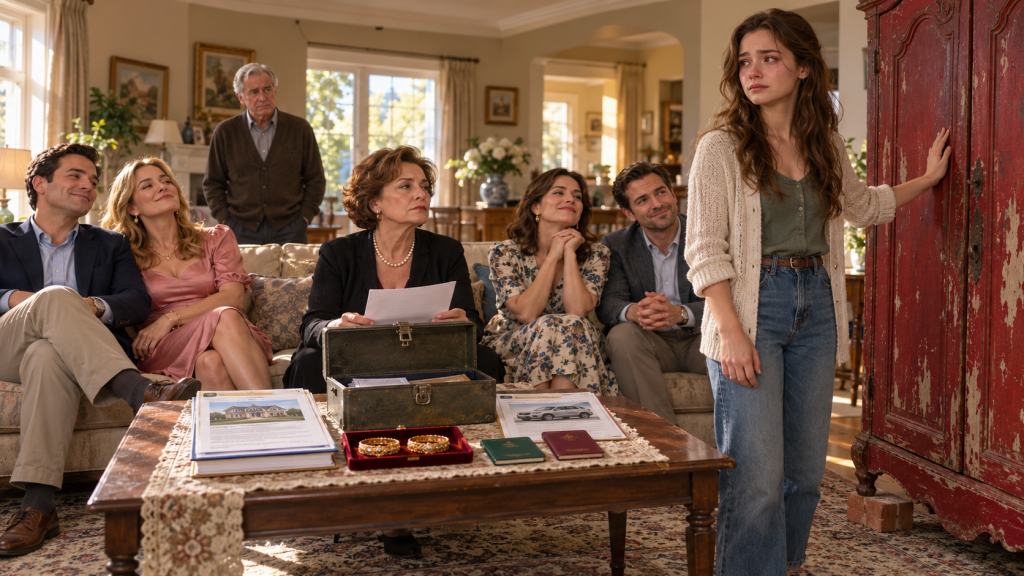
“You sat in that living room while they gave Michael the house.”
“Yes.”
“You watched Sarah take the Tahoe.”
“Yes.”
“You watched Mom hand out the passbooks and Grandma’s bracelets.”
“Yes.”
My voice rose.
“And you said nothing.”
His eyes lowered.
That hurt almost worse than the inheritance.
My uncle Raymond had always been the quiet one in the family.
The one who fixed broken porch steps without being asked.
The one who slipped me twenty dollars when I left for college.
The one who sat beside me at Dad’s funeral when my brother spent most of the reception complaining about traffic.
I had believed that silence meant kindness.
Now I wasn’t so sure.
“Why?”
Raymond rubbed both hands over his face.
“Because your father made me promise.”
I stared at him.
“Promise what?”
“That I would not interfere unless they tried to take the wardrobe away from you.”
The garage became silent.
I looked toward the red cabinet.
“That doesn’t make any sense.”
“It didn’t to me either.”
He walked closer.
“About eight months before he got sick, your father called me over here. Your mother was visiting Sarah. Michael was out of town.”
He touched the wardrobe gently.
“He showed me the false bottom.”
My pulse hammered.
“What was inside?”
“Not the documents you found.”
I frowned.
“What, then?”
“A small notebook.”
I remembered the brass key.
“Where is it?”
Raymond nodded toward my hand.
“I think that key will tell you.”
I stared at him.
“Tell me everything.”
He sighed.
“Your father knew something was wrong in the family long before the hospital.”
“What kind of wrong?”
“He knew your mother intended to divide things differently than he wanted.”
I almost laughed.
“Differently?”
“He wanted everything divided equally.”
I looked away.
Of course.
That sentence should have comforted me.
Instead, it made seventy-three nights in a hospital hallway feel even heavier.
Because equal sounded generous until I remembered who had been there.
Who had paid.
Who had carried him to the bathroom.
Who had learned which nurse brought warm blankets without being asked.
Who had slept in a plastic chair because Dad became frightened whenever he woke up alone.
I swallowed.
“Did he know they weren’t visiting?”
Raymond’s eyes filled.
“Yes.”
My chest tightened.
“He knew?”
“He knew.”
I turned away quickly.
The garage blurred.
I had spent those final days protecting Dad from the truth.
Whenever he looked toward the door, I lied.
“Michael’s working.”
“Sarah’s kids are sick.”
“They’ll come tomorrow.”
Tomorrow.
Tomorrow.
Tomorrow.
Until there were no tomorrows left.
I had convinced myself that he believed me because I needed him to.
Raymond’s voice softened.
“He knew you were covering for them.”
I closed my eyes.
“How?”
“He asked me.”
“When?”
“Three weeks before he lost his speech.”
I turned.
Raymond’s eyes were wet.
“He said, ‘Ray, don’t let Danny keep lying to make me feel better.’”
Something broke inside me.
Not loudly.
Just a quiet crack somewhere behind the ribs.
I sat on an overturned paint bucket.
For several seconds, I couldn’t speak.
Then I whispered,
“He knew.”
“Yes.”
“And he never said anything.”
“He didn’t want to make you feel like your effort wasn’t enough.”
Tears came.
I wiped them angrily.
“He was waiting for them.”
“I know.”
“So do I.”
Raymond stepped closer.
“He also knew who stayed.”
I looked up.
“Daniel, your father wasn’t confused.”
He pointed toward the wardrobe.
“He was preparing for something.”
I looked at the brass key again.
“What does this open?”
Raymond hesitated.
Then said,
“Your father had a safe-deposit box.”
I froze.
“At which bank?”
“First County.”
The same bank where my parents had kept their savings for thirty years.
“Mom knows?”
Raymond shook his head.
“I don’t think she knows which box.”
“How do you know about it?”
“I drove him there.”
“When?”
“Eleven months ago.”
My mind raced.
Dad had still been healthy then.
Before the hospital.
Before the estate meeting.
Before everything.
“What did he put inside?”
“He wouldn’t tell me.”
I stared at the key.
Then my phone buzzed.
Mom.
Again.
I let it ring.
Thirty seconds later, she called again.
Raymond looked at the screen.
“You should not go back there tonight.”
“I wasn’t planning to.”
The phone stopped.
Then a text appeared.
Daniel, I made a mistake. The wardrobe should stay with the house. Bring it back tomorrow.
I stared at the message.
A mistake.
Thirty minutes earlier, that wardrobe had been worthless firewood.
Now suddenly it belonged with the house.
I showed Raymond.
His expression darkened.
“Your father was right.”
“About what?”
“She knows.”
At 8:03 the next morning, I was sitting outside First County Bank before the doors opened.
I had barely slept.
The envelope stayed beneath my pillow all night.
The brass key stayed in my closed fist until my fingers hurt.
Raymond sat beside me in the truck.
Neither of us had eaten.
At exactly nine, we walked inside.
The bank manager, a woman named Patricia Wells, looked at the key and then at me.
“May I see identification?”
I handed it over.
She checked the computer.
Then looked back at me with an expression I couldn’t read.
“Mr. Daniel Carter?”
“Yes.”
“There is a box registered jointly to your father and to you.”
I stared at her.
“To me?”
“Yes.”
“I didn’t know.”
“That’s not unusual if someone establishes access in advance.”
She typed something.
“There is also a note attached to the account.”
My throat tightened.
“What note?”
She looked at the screen.
“Access upon presentation of the physical key after the death certificate is filed.”
Raymond and I exchanged a look.
Dad had arranged this.
Not randomly.
Not emotionally.
Carefully.
Patricia led us into the vault.
The room smelled metallic and cold.
Rows of narrow doors lined the walls.
She inserted the bank’s control key into one lock.
I inserted mine beside it.
Together, we turned.
The box slid free.
It was heavier than I expected.
She carried it to a private viewing room.
Then left.
For several seconds, I just stared at it.
Raymond stood behind me.
“You don’t have to open it right away.”
“Yes, I do.”
My fingers shook as I lifted the lid.
Inside were four things.
A thick blue folder.
A sealed flash drive.
A small velvet jewelry box.
And a handwritten letter with my name across the front.
Daniel.
I reached for the letter first.
Then stopped.
Something beneath the blue folder caught my eye.
A photograph.
Dad and me.
Hospital cafeteria.
Three years earlier.
He had gone in for a minor procedure, and I had driven him home.
In the picture, we were both laughing.
I didn’t remember anyone taking it.
I turned it over.
Dad had written on the back.
The one who stays matters more than the one who talks.
My throat closed.
Raymond turned away.
I opened the letter.
Dad’s handwriting became shakier toward the bottom.
Danny,
If you are reading this, then I am gone, and something I hoped would not happen probably happened anyway.
I stopped.
My vision blurred.
I wiped my eyes and kept reading.
Your mother loves all three of you, but she has spent too many years convincing herself that Michael needs more because he is the oldest, and Sarah deserves more because she has children. You have always been the one she believes can survive with less.
I laughed bitterly.
Dad knew.
Every birthday.
Every tuition payment.
Every excuse.
He knew.
I allowed it too often. That is one of my failures as your father.
I pressed my lips together.
Strength is not a debt you owe weaker people. I should have told your mother that years ago. Instead, I let you become the child who was expected to understand everything.
My hands began shaking.
I am sorry.
I stopped reading.
Those three words undid me.
Not because I had never heard Dad apologize.
Because I had never heard him apologize for that.
For making resilience into an obligation.
For assuming the child who complained least needed least.
I lowered the letter.
Raymond put a hand on my shoulder.
I kept reading.
The estate documents in the wardrobe are valid. They were prepared with attorney Susan Bell. The originals are in this box. The copies in the wardrobe were meant to ensure you found them even if access to the box became difficult.
I immediately opened the blue folder.
Inside was an estate plan.
Notarized.
Witnessed.
Signed eleven months before Dad’s hospitalization.
Equal division among all three children.
House.
Vehicle.
Savings.
Personal property.
But that was not all.
There was a separate reimbursement clause.
Funeral and final medical expenses personally advanced by Daniel Carter shall be reimbursed before distribution.
My breath caught.
Dad had anticipated it.
There was even a handwritten note attached.
Daniel keeps receipts. He always has. Pay him back.
I laughed through tears.
Of course he knew about my notebook.
Dad used to tease me because I documented everything.
Then I turned another page.
There was a ledger.
Michael’s name appeared several times.
Loan for apartment down payment.
Loan for business equipment.
Loan for overdue taxes.
Total outstanding balance:
$37,800.
My mouth fell open.
I knew about the apartment.
Not the rest.
Dad had written beside the total:
If not repaid by my death, deduct from Michael’s share.
Raymond whistled softly.
Then came Sarah.
Childcare support.
Car repairs.
Credit cards paid directly.
Private school deposit.
Total advances:
$28,200.
Beside hers:
Deduct from Sarah’s share if unpaid.
I stared at the numbers.
My siblings hadn’t merely been given more throughout adulthood.
Dad had documented it.
Carefully.
Silently.
Then I reached the final schedule.
My name.
It contained exactly one entry.
Tuition loan, Daniel — repaid in full.
That was all.
I sat back.
For years, Mom had told me we didn’t keep score in a family.
Dad apparently had.
Not because he was petty.
Because fairness sometimes requires remembering what generosity has already cost.
I turned another page.
And found something I did not expect.
A beneficiary statement.
Dad had a small life-insurance policy.
Not enormous.
$60,000.
The beneficiary was me.
Only me.
I stared.
Raymond leaned closer.
“Daniel.”
I couldn’t speak.
A note was clipped to the form.
This is not inheritance. This is for the son who looked after me when I was sick. Do not let anyone convince you that care has no value simply because it was given from love.
I covered my face.
For seventy-three nights, I had never expected payment.
Not once.
I would have done it again.
I would have spent every dollar again.
But somehow Dad had understood the thing I had never admitted.
Care cost something.
Not just money.
Sleep.
Work.
Relationships.
Strength.
Pieces of yourself.
And love did not erase those costs.
It only made you willing to pay them.
Raymond sat beside me.
“Open the flash drive.”
I looked at it.
“Not yet.”
There was still the velvet box.
I opened it.
Inside was Dad’s old wristwatch.
The cheap stainless-steel one he wore to work for twenty-six years.
Not gold.
Not expensive.
The glass had a scratch across the face.
I remembered that scratch.
I caused it.
I was eleven, trying to fix a bicycle chain, and Dad reached in to help me.
The wrench slipped.
I had cried because I thought I ruined his watch.
He laughed and said,
“Now I’ll always remember you.”
Dad had kept it.
There was another note.
For Danny. He knows why.
That was the moment I stopped caring about the SUV.
Or the bracelets.
Or the passbooks.
Not because the unfairness didn’t matter.
It did.
But the watch felt heavier than all of it.
I fastened it around my wrist.
It still fit.
Then I inserted the flash drive into Raymond’s laptop.
One video file appeared.
FOR MY FAMILY.
We looked at each other.
Then I pressed play.
Dad appeared on the screen.
He was sitting in the old garage.
Healthy.
Flannel shirt.
Hands folded.
The red wardrobe stood behind him.
For three seconds, he said nothing.
Then he sighed.
“If you’re watching this, I assume I’m dead.”
Even Raymond laughed through tears.
That was Dad.
No drama.
No ceremony.
Just facts.
Then his expression changed.
“I’m making this because I know my family.”
He looked directly at the camera.
“I know how arguments begin after someone dies. People remember promises that were never made. They remember conversations differently. They decide fairness means whatever helps them most.”
My stomach tightened.
Dad continued.
“So I am going to be clear.”
He leaned forward.
“My property is to be divided equally among Michael, Sarah, and Daniel after the documented loans and expenses are accounted for.”
There it was.
His voice.
His face.
No ambiguity.
Then he paused.
“I also want it understood that Daniel is not to be punished for being the responsible one.”
I froze.
Dad’s eyes softened.
“For years, we expected him to give way because he usually did.”
My throat closed.
“His mother and I told ourselves he was easier.”
Dad looked down.
“That was another way of saying we asked more from the child who complained less.”
I could barely breathe.
Raymond was crying openly now.
Dad continued.
“If you are watching this, Margaret, I hope you hear me.”
My mother.
He spoke directly to her.
“Do not give Michael the house simply because he is the oldest.”
I stared at the screen.
“Do not give Sarah more because she has children.”
Dad’s voice became firmer.
“And do not hand Daniel whatever nobody else wants and tell him not to be greedy.”
I felt physically cold.
Those exact words.
Mom had said them.
Dad had predicted them.
Not approximately.
Exactly.
Raymond whispered,
“Jesus.”
Dad continued.
“If you do that, you will be proving every fear I had when I made these documents.”
He looked tired.
Not sick.
Tired.
The kind of tired that comes from knowing the people you love may disappoint you even after you are gone.
Then he said,
“There is one exception.”
I leaned forward.
“The red wardrobe goes to Daniel.”
Despite everything, I laughed.
Dad smiled on the video.
“He is probably the only one foolish enough to keep it.”
Raymond laughed too.
Then Dad’s face became serious again.
“My father built that wardrobe.”
I stopped.
I had never known.
“He made it the year I was born.”
Dad reached behind him and touched the peeling wood.
“It is ugly now.”
He smiled.
“But it held my clothes when I was a boy.”
“My tools when I became a man.”
“And the papers I needed when I realized I had not always protected my youngest son the way I should have.”
My eyes filled again.
“So that belongs to Daniel.”
He paused.
“Not because it is valuable.”
Another small smile.
“Because he understands things do not have to be expensive to matter.”
The video ended several minutes later.
Dad talked about Mom.
About forgiveness.
About not letting property turn grief into war.
His final words were simple.
“Whatever happens, remember that I loved all three of you.”
Then he looked directly at the camera.
“But love without fairness creates wounds that outlive people.”
The screen went black.
Neither Raymond nor I moved for a long time.
Finally, he whispered,
“What are you going to do?”
I looked at the folder.
The ledger.
The reimbursement clause.
The insurance policy.
Dad’s watch.
Then I thought about Mom’s text.
Bring the wardrobe back.
I picked up my phone.
“I’m calling the attorney.”
Susan Bell answered on the second ring.
When I told her my name, she became very quiet.
“I’ve been expecting you.”
That sentence chilled me.
“You knew?”
“I drafted your father’s estate plan.”
“Why didn’t you contact us?”
“I tried.”
My pulse quickened.
“Who did you call?”
“Your mother.”
I looked at Raymond.
“When?”
“Three days after your father died.”
“What did she say?”
Susan paused.
“She told me the family had already handled everything privately.”
I closed my eyes.
“Did she tell you about the distribution?”
“No.”
“Did you send copies of the estate documents?”
“Yes.”
“To where?”
“Your father’s home.”
I stared at the wall.
Mom had received them.
She knew.
That was worse than ignorance.
Much worse.
“She knew there was a will.”
“Yes.”
“And she distributed everything anyway.”
“I can only tell you what I sent and when.”
Susan’s voice became careful.
“But Daniel, I strongly suggest you do not dispose of the documents and do not sign anything.”
“I won’t.”
“Has anyone transferred title yet?”
“The house?”
“Yes.”
“I don’t know.”
“Find out immediately.”
My stomach tightened.
“Why?”
“Because if your mother executed transfers inconsistent with the estate plan, the sooner we act, the easier it is to preserve the assets.”
Raymond was already grabbing his coat.
Susan continued.
“I will prepare emergency filings if necessary.”
“Do it.”
There was silence.
Then she said gently,
“Your father worried this might happen.”
“I know.”
“He spoke very highly of you.”
My throat tightened.
I looked at the scratched watch on my wrist.
“Thank you.”
Michael tried to sell the house four days later.
That was the first real explosion.
Susan discovered that Mom had signed a transfer deed placing the property into Michael’s name only two days after the family meeting.
Michael had already contacted a real estate agent.
He wasn’t planning to live there.
He wanted to sell it.
The house he supposedly needed because of his mortgage struggles.
He wanted cash.
When Susan filed for an emergency injunction, Michael called me.
Not Mom.
Not the lawyer.
Me.
I answered while sitting at my kitchen table.
His voice exploded before I could say hello.
“What the hell are you doing?”
I looked at the papers in front of me.
“Protecting Dad’s estate.”
“Don’t give me that.”
“Okay.”
“You filed something against my house.”
“It isn’t your house.”
“It was given to me.”
“By Mom.”
“Yes.”
“Dad left different instructions.”
Silence.
Then he laughed.
A cruel little sound.
“Come on, Daniel.”
I said nothing.
“You’re really doing this over that stupid wardrobe?”
“No.”
“Then what?”
I looked at Dad’s letter.
“Thirty-seven thousand eight hundred dollars.”
Silence.
“What?”
“That’s what you owed Dad when he died.”
His breathing changed.
“I don’t know what you’re talking about.”
“Apartment down payment.”
Nothing.
“Business equipment.”
Nothing.
“Taxes.”
Then anger.
“Those were gifts.”
“Dad’s ledger says loans.”
“Dad told me—”
“We have video.”
Silence.
Long silence.
I leaned back.
Michael’s voice became lower.
“What video?”
“Dad.”
“What did he say?”
“Enough.”
He swore.
Then he said something I expected.
“Mom had the right to decide.”
“No.”
“She was his wife.”
“He had an estate plan.”
“You were always Dad’s favorite.”
I laughed.
That was so absurd I couldn’t help it.
“His favorite?”
“You stayed at the hospital because you wanted to look good.”
My hand tightened around the phone.
There it was.
The wound beneath his anger.
He could not admit he had failed Dad.
So my presence had to become performance.
“You really believe that?”
“You love being the martyr.”
My voice became very quiet.
“I called you twenty-three times.”
Silence.
“I have the phone records.”
He said nothing.
“I asked you to sit with him one night.”
Still nothing.
“You said you had a project.”
“I did.”
“He died six days later.”
Michael’s breathing became harsh.
“Don’t do this.”
“I’m not doing anything.”
My voice cracked.
“I’m telling you what happened.”
He shouted,
“I had a life!”
The sentence hung between us.
I closed my eyes.
“So did I.”
He went quiet.
I continued.
“I had a job.”
“A mortgage.”
“Friends.”
“I had a life too.”
My throat tightened.
“I just decided Dad was part of it.”
Michael hung up.
Sarah arrived at my apartment that evening.
She didn’t knock politely.
She pounded on the door.
I opened it but kept the chain secured.
Her face was red.
“Give me the documents.”
“No.”
“Daniel.”
“No.”
Her eyes narrowed.
“Mom says Dad wasn’t in his right mind.”
I stared at her.
“When he signed the will?”
“Yes.”
“Eleven months before he was hospitalized?”
She hesitated.
That detail clearly hadn’t been included in Mom’s version.
I continued.
“The attorney documented capacity.”
Sarah folded her arms.
“So now you’re going to steal from everybody?”
I almost laughed.
“You have the SUV.”
“It was given to me.”
“You have Grandma’s bracelets.”
“Mom gave them to me.”
“You got $2,500 from the savings.”
She glared.
“Yes.”
“And Dad’s estate plan says those distributions weren’t authorized.”
Her voice rose.
“You always do this.”
“Do what?”
“Keep track.”
I stared.
She pointed toward my table.
“Receipts. Notes. Numbers.”
“You make everything transactional.”
I looked at her for a long moment.
Then said,
“Dad spent seventy-three days in the hospital.”
Her expression changed.
I continued.
“How many times did you visit?”
She looked away.
“Sarah.”
“I had kids.”
“How many times?”
Her jaw tightened.
“Not everybody can drop everything like you.”
“One hour.”
She looked at me.
“I’m asking how many times you found one hour.”
Her eyes filled.
“You don’t understand.”
“No.”
I shook my head.
“I understand exactly.”
“You believed I would do it.”
She flinched.
“You knew Dad wouldn’t be alone because I was there.”
Her mouth opened.
Then closed.
“And that made it easier to stay home.”
Tears gathered in her eyes.
“That’s not fair.”
“No.”
My voice softened.
“It isn’t.”
For a second, we were children again.
Sarah in her pink bedroom.
Me wearing Michael’s hand-me-down coat.
Mom telling me to let Sarah have the larger slice because she was younger then.
Later, she told me Sarah needed more because she was a girl.
There was always a reason.
Always a story explaining why fairness had to bend away from me.
Sarah wiped her face angrily.
“Do you want the bracelets?”
“No.”
“The money?”
“I want Dad’s wishes followed.”
“You’re going to tear the family apart.”
That sentence made me tired.
Not angry.
Tired.
“The family was already divided.”
She stared at me.
“I’m just the first person who stopped pretending it wasn’t.”
I closed the door.
Mom waited two more days before coming to see me.
She arrived alone.
No Michael.
No Sarah.
No lockbox.
Just Mom.
She looked smaller than she had at the estate meeting.
Her hair wasn’t done.
She wore Dad’s old gray coat.
For a second, grief softened everything.
I almost forgot.
Then she saw the red wardrobe behind me.
Her face tightened.
“Why couldn’t you leave well enough alone?”
There it was.
Not hello.
Not I’m sorry.
That.
I stepped aside.
She came in.
Her eyes moved around my apartment.
Then to the wardrobe again.
“Your father filled your head with nonsense.”
I stared at her.
“Dad made a legal estate plan.”
“He was angry.”
“At who?”
She said nothing.
“At Michael?”
Silence.
“At Sarah?”
Still nothing.
“At you?”
Her jaw tightened.
“He was angry at everyone near the end.”
“The documents were signed before he got sick.”
She looked away.
I knew then.
She knew everything.
I sat down.
“Why?”
Mom remained standing.
“Why what?”
“Why did you do it?”
She crossed her arms.
“I did what I thought was best.”
“For who?”
“For the family.”
I almost laughed.
“Which family?”
Her face hardened.
“Don’t start.”
“No.”
I leaned forward.
“You don’t get to say that anymore.”
Her eyes flashed.
“I am still your mother.”
“And I am still your son.”
Silence.
“For once, answer me.”
My voice trembled.
“Why did you give Michael the house?”
“He needs stability.”
“He already owns a home.”
“He has a mortgage.”
“So do I.”
“You manage.”
There it was.
The sentence that had shaped my entire life.
You manage.
I stared at her.
“And Sarah?”
“She has children.”
“So because I don’t have children, I count less?”
“I didn’t say that.”
“You never had to.”
Her expression broke slightly.
I continued.
“Michael needed tutors.”
“Sarah needed dresses.”
“Michael needed a down payment.”
“Sarah needed help with childcare.”
“And I always needed to understand.”
Mom’s eyes filled.
“You were different.”
I laughed bitterly.
“Yes.”
“You were independent.”
“No.”
My voice cracked.
“I became independent because nobody was coming.”
That landed.
She looked at me.
I could see the words hurting her.
Good.
Not because I wanted revenge.
Because truth should sometimes hurt.
It hurts when you have spent years avoiding it.
Mom sat down slowly.
“I thought you didn’t care about money.”
“I don’t care about the bracelets.”
“Then stop this.”
I stared at her.
“You still don’t understand.”
“What?”
“This isn’t about wanting more.”
My throat tightened.
“It’s about being told I deserve less.”
Mom looked away.
For several seconds, neither of us spoke.
Then I asked,
“Did you know Dad had a will?”
She was silent.
“Mom.”
“Yes.”
The word was almost inaudible.
I closed my eyes.
There it was.
No misunderstanding.
No lost document.
No confusion.
She knew.
“Did Susan Bell send it to you?”
“Yes.”
“And you ignored it.”
Her mouth trembled.
“I thought he made it because he was upset.”
“With you?”
“Yes.”
“What happened?”
She stared at her hands.
For the first time, anger disappeared from her face.
What remained was exhaustion.
“Your father and I argued.”
“About what?”
“You.”
I froze.
“Me?”
She nodded.
“He said I had always expected too much from you.”
I said nothing.
“He said Michael had become entitled.”
“He said Sarah had learned to expect rescuing.”
Tears filled Mom’s eyes.
“And he said I had helped create both.”
My chest tightened.
“What did you say?”
“That he was being cruel.”
She laughed softly through tears.
“But maybe he was just tired of being polite.”
I leaned back.
Mom continued.
“He wanted to talk to all of you.”
“Then he got sick.”
She nodded.
“After the hospital, everything happened so quickly.”
I stared at her.
“No.”
She looked up.
“You had forty days after he died.”
Her face crumpled.
“You had the attorney’s letter.”
“You had the will.”
“You had the video?”
She shook her head.
“No.”
I believed her.
“You still knew.”
“Yes.”
“Why did you ignore it?”
Her answer came slowly.
“Because I was angry.”
That surprised me.
“At Dad?”
“Yes.”
“Why?”
She wiped her face.
“Because he changed everything without asking me.”
I stared.
“It was his estate too.”
“I know.”
“No.”
My voice hardened.
“You know now.”
She flinched.
“He made me feel like a bad mother.”
I looked at her.
“Were you?”
Silence.
That question changed the room.
Mom looked toward the window.
Then she whispered,
“Sometimes.”
I did not expect the honesty.
My anger softened, but it didn’t disappear.
She continued.
“I loved you.”
“I know.”
“I loved all three of you.”
“I know.”
“But I worried about Michael.”
“Why?”
“He was always insecure.”
I almost laughed.
Michael?
The golden son?
The one given every advantage?
Mom saw my expression.
“He acted confident. That isn’t the same thing.”
I thought about his phone call.
Dad’s favorite.
Maybe Dad’s comparisons had wounded him too.
Mom continued.
“And Sarah was sensitive.”
I smiled sadly.
“So I became the one you could disappoint.”
Mom started crying.
I did not comfort her.
Not yet.
She needed to finish.
“You never made trouble.”
“I learned not to.”
“I thought that meant you were okay.”
“It meant I stopped expecting fairness.”
Her face folded.
For several minutes, Mom cried.
Not theatrically.
Not to manipulate.
She looked seventy years old.
Widowed.
Tired.
Full of mistakes she could no longer explain away.
Finally, she whispered,
“I’m sorry.”
I stared at her.
“For the estate?”
“For more than that.”
My throat tightened.
She looked at the red wardrobe.
“Your father loved that thing.”
I smiled faintly.
“Apparently.”
“He knew you would take it.”
That surprised me.
“He told you?”
“Years ago.”
She laughed through tears.
“He said, ‘When I die, the other two will fight over anything shiny. Danny will take the ugly thing because he’ll remember where it came from.’”
I looked down.
Dad knew us too well.
Mom wiped her eyes.
“I didn’t know about the hidden compartment.”
“But you guessed.”
“Yes.”
“Why?”
“Because of the attorney’s letter.”
I frowned.
“What did it say?”
“That originals were stored separately and that a duplicate instruction had been placed among your father’s personal effects.”
My pulse quickened.
“So when I chose the wardrobe—”
“I panicked.”
She nodded.
“I thought maybe that was where he hid it.”
I leaned back.
“So you called.”
“Yes.”
“And if I had brought it back?”
Mom closed her eyes.
“I don’t know.”
I did.
We both did.
She might have destroyed the evidence.
Maybe not.
But enough uncertainty remained that trust was impossible.
I looked at her.
“You have to tell Susan everything.”
Mom’s eyes opened.
“Daniel.”
“Everything.”
“I could get in trouble.”
“Yes.”
She stared.
The old version of me would have softened.
Would have said we could work something out privately.
Would have protected her from consequences because she was grieving.
Because she was Mom.
Because family.
Instead, I heard Dad’s video.
Love without fairness creates wounds that outlive people.
“You ignored Dad’s estate plan.”
My voice was quiet.
“You transferred property.”
“You distributed money.”
“You need to correct it.”
Mom looked terrified.
“Will you help me?”
I thought carefully.
“Yes.”
Her face lifted slightly.
“But not by hiding what happened.”
Her expression fell again.
“I’ll help you tell the truth.”
The next six months were the ugliest and most honest our family had ever lived through.
Michael fought first.
His attorney argued that the house transfer had been a valid lifetime gift from Mom’s share.
Susan Bell produced Dad’s ownership documents.
The house had been titled jointly in a manner that made Mom’s unilateral post-death transfer far more complicated than Michael wanted to admit.
The court froze the sale.
Eventually, the deed transfer was set aside pending proper estate administration.
Michael was furious.
Then the loan ledger became evidence.
He denied everything.
Until Susan produced canceled checks.
Notes.
Emails.
One message from Michael himself read:
Dad, I swear I’ll pay the tax money back when the contract closes.
He stopped calling them gifts after that.
Sarah resisted returning the Tahoe.
Then it turned out Mom had never properly transferred title from the estate.
The vehicle returned to the estate inventory.
The gold bracelets came back too.
Sarah cried when she handed them over.
“I thought Grandma wanted me to have these.”
I looked at the bracelets.
“Maybe one day they still should be yours.”
She stared.
“What?”
“After the estate is settled fairly, we can decide sentimental things together.”
She began crying harder.
That was the first moment she understood I wasn’t trying to take everything.
I was trying to stop being the only one expected to surrender.
The passbook money was restored.
Dad’s funeral expenses were reimbursed to me.
$4,500.
Exactly.
I deposited the check and stared at the balance for a long time.
Not because I needed the money.
Because seeing the reimbursement felt like Dad saying,
I saw what you carried.
The outstanding advances to Michael and Sarah were deducted according to the estate documents.
Then the remaining estate was divided equally.
The house was eventually sold.
Not to Michael.
Not to me.
Not to Sarah.
A young couple bought it.
Teachers.
Two small children.
I stood across the street the day they moved in.
A little boy ran through the backyard where Michael and I used to throw baseballs.
For one moment, I expected grief.
Instead, I felt relief.
The house had survived us.
Maybe that was enough.
Sarah used part of her share to replace the Tahoe after the estate sold it.
Michael used some of his to reduce his mortgage.
Neither received what they had expected.
Neither was ruined.
That mattered to me.
Fairness was not punishment.
It was simply the end of special treatment.
Mom faced legal scrutiny over the transfers.
Because she cooperated, restored the assets, and followed counsel’s instructions, the matter was resolved without the catastrophe she feared.
But there were costs.
Attorney fees.
Embarrassment.
Trust lost.
Consequences.
Real ones.
For the first time in my life, Mom could not ask me to absorb those costs so everyone else could remain comfortable.
She had to carry them herself.
And strangely, that changed her.
Not immediately.
But gradually.
She stopped saying,
“Michael needs…”
“Sarah deserves…”
“You understand…”
Those phrases disappeared.
At first, the silence felt strange.
Then peaceful.
The biggest surprise came from Michael.
Nine months after Dad died, he asked to meet me at a diner.
I almost said no.
Then curiosity won.
He was already sitting in a booth when I arrived.
No wife.
No lawyer.
No anger.
Just Michael.
He looked older.
He pushed a coffee toward me.
“Black.”
I sat down.
“You remembered.”
“Dad always drank it black.”
“I don’t.”
He frowned.
Then laughed.
“Right.”
I added cream.
For a while, neither of us spoke.
Finally, Michael said,
“I went to Dad’s grave.”
I looked up.
“Okay.”
“I apologized.”
My expression remained neutral.
He looked down.
“I don’t know if that matters.”
“It probably mattered to you.”
He nodded.
Then his eyes filled.
“I was scared to see him sick.”
That stopped me.
“What?”
“I kept telling myself I was busy.”
He rubbed his hands together.
“But I was scared.”
I said nothing.
“Dad was always… Dad.”
He laughed weakly.
“The guy who fixed furnaces.”
“Changed tires.”
“Carried refrigerators.”
“The idea of seeing him in a hospital bed…”
His voice broke.
“I kept postponing it.”
“Until?”
He nodded.
“Until there wasn’t another chance.”
I looked out the window.
That was not forgiveness.
But it was truth.
And truth mattered.
Michael continued.
“I hated you for going.”
I turned back.
“Because every time Mom said you were at the hospital, I knew what I wasn’t doing.”
My throat tightened.
“So you told yourself I was showing off.”
“Yes.”
He swallowed.
“Because if you were showing off, I didn’t have to admit I was hiding.”
For the first time in years, I saw my brother clearly.
Not as the favored child.
Not as the selfish man who took the house.
As someone who had spent his life being told he was the strong one, then discovered he wasn’t strong enough when it mattered most.
I didn’t excuse him.
But I understood him.
He looked at me.
“I’m sorry.”
“For the house?”
“For everything.”
His eyes filled.
“For making you pay for the funeral.”
“You didn’t make me.”
“No.”
He shook his head.
“I let you.”
That was better.
More honest.
I nodded.
“Thank you.”
He looked surprised.
“That’s it?”
“What do you want?”
“I don’t know.”
“Forgiveness?”
He looked down.
“Maybe.”
I stirred my coffee.
“I’m not ready to tell you everything is okay.”
He nodded.
“But I’m willing to have coffee.”
A small smile appeared.
“I’ll take coffee.”
We stayed for an hour.
It wasn’t reconciliation.
Not fully.
But it was a beginning.
Sarah took longer.
She was angrier.
Not about the SUV.
About Dad’s ledger.
She felt humiliated that he had documented money spent on her.
“He made me look irresponsible.”
She said that during one argument.
I answered,
“Were you?”
She hung up.
Three weeks later, she called back.
“Yes.”
That was our beginning.
She admitted that Dad had paid bills more often than I knew.
She admitted she had avoided the hospital partly because she couldn’t handle seeing him deteriorate.
And partly because she assumed I would handle it.
“I’m sorry,” she whispered.
“I treated your reliability like a family utility.”
I almost laughed.
“That is disturbingly accurate.”
She laughed too.
Then cried.
A year after Dad died, Sarah invited me to her daughter’s birthday.
Normally, those gatherings had been places where I carried chairs, picked up food, and cleaned afterward while everyone else talked.
This time, when I walked into the kitchen after cake, Sarah took a plate from my hand.
“What?”
“I’ve got it.”
I stared.
She smiled awkwardly.
“You don’t have to clean.”
It was such a small thing.
Ridiculously small.
But I had to look away because my eyes filled.
Sometimes healing does not arrive through speeches.
Sometimes somebody simply takes the dish out of your hand.
Mom changed most slowly.
For nearly a year, our conversations remained careful.
She apologized.
Then defended herself.
Then apologized for defending herself.
Grief did that.
Habit did too.
One afternoon, we were sorting Dad’s remaining tools when she found an old wooden box.
Inside were three childhood photographs.
Michael holding a baseball trophy.
Sarah in a ballet costume.
Me standing beside a science-fair project made from cardboard.
Mom smiled.
“You built that yourself.”
“Yes.”
“Your father wanted to help.”
“I know.”
“You wouldn’t let him.”
I laughed.
“He cut cardboard crooked.”
Mom smiled.
Then her expression faded.
“You always did things yourself.”
I looked at her.
“Yes.”
She touched the photograph.
“I used to be proud of that.”
“You should have been.”
“I was.”
Her voice cracked.
“But I think I also used it as an excuse.”
I said nothing.
She continued.
“If Michael struggled, I helped.”
“If Sarah cried, I helped.”
“If you struggled quietly…”
She closed her eyes.
“I assumed you wanted privacy.”
My throat tightened.
“Sometimes.”
“But not always.”
“No.”
Tears filled her eyes.
She looked at me.
“I’m sorry I made independence feel like abandonment.”
That sentence stayed with me.
Because it named something I had never been able to explain.
I hugged her.
Not because everything was fixed.
Because for once, she understood the wound instead of arguing with the scar.
The wardrobe remained in my garage for almost eighteen months.
I told myself I was going to restore it.
I bought sandpaper.
Wood filler.
Cherry stain.
New hinges.
Then life kept happening.
One Saturday morning, Raymond showed up carrying coffee.
He looked at the wardrobe.
“You ever going to fix that thing?”
“I’m emotionally preparing.”
“For woodworking?”
“Yes.”
“That explains why it’s taking two years.”
We laughed.
Then we began.
Layer by layer, we stripped away the old red paint.
Underneath was dark cherry wood.
Scarred.
Beautiful.
Dad had been right.
His father had built it well.
One broken leg needed replacing.
Raymond shaped a new one by hand.
I repaired the drawer runners.
We polished the old brass handles instead of replacing them.
By sunset, the wardrobe stood upright without the brick.
I stepped back.
It looked completely different.
Still old.
Still imperfect.
But strong.
Raymond handed me the brick.
“Souvenir?”
I laughed.
“I’m keeping it.”
“Why?”
I looked at the wardrobe.
“Because it held the whole thing up longer than anyone gave it credit for.”
Raymond smiled.
“That metaphor was painful.”
“Dad would’ve liked it.”
“He would’ve hated it.”
We laughed.
I placed the brick inside the bottom drawer.
Beside Dad’s watch box.
Not because it was valuable.
Because it reminded me of something.
People had looked at that wardrobe and seen broken furniture.
They had laughed.
They had measured its worth by chipped paint and a damaged leg.
They had done something similar to me.
They assumed because I asked for less, I deserved less.
Because I stayed quiet, I knew less.
Because I managed, I needed less.
But hidden things still have weight.
History has weight.
Love has weight.
So does resentment.
So does truth.
And eventually, even a crooked piece of furniture can force a family to stand straight.
Two years after Dad’s death, we gathered at Mom’s house for Thanksgiving.
Not the old house.
A smaller condo.
She had downsized after the estate closed.
Michael brought mashed potatoes.
Sarah brought two pies.
I brought Dad’s wardrobe.
Mom stared when Raymond and I carried it inside.
“You restored it.”
“Yes.”
She ran her hand over the wood.
For a long moment, no one spoke.
Then Michael smiled.
“That’s the ugly thing?”
Sarah elbowed him.
“It was always ugly.”
I laughed.
“Careful. This is my inheritance.”
Michael raised both hands.
“Worth every penny.”
Mom looked at us.
Then she started laughing.
Really laughing.
Not the nervous kind.
Not the fake family-photo laugh.
The sound filled the room.
For one moment, Dad felt close.
Not magically.
Not spiritually.
Just present in the way memory sometimes becomes almost physical.
We put the wardrobe against the dining-room wall.
Inside, I had placed copies of Dad’s letter and the photograph from the safe-deposit box.
Not the legal documents.
Those were safely stored elsewhere.
Just the things that mattered.
The watch stayed on my wrist.
Mom noticed.
“You wear it every day?”
“Almost.”
She touched the scratched glass.
“You did that.”
“I know.”
“Your father refused to replace it.”
“I know.”
“He said the scratch gave it character.”
I smiled.
“That sounds like Dad.”
During dinner, nobody discussed inheritance.
Nobody compared what anyone received.
The children ran through the hallway.
Sarah’s youngest spilled juice.
Michael cleaned it.
I almost took a photograph.
After dessert, Mom disappeared into her bedroom.
She returned with a small velvet pouch.
My stomach tightened.
She placed it on the table.
Sarah recognized it immediately.
“Grandma’s bracelets?”
Mom nodded.
The estate had ultimately treated them as personal property subject to equal distribution.
Sarah had voluntarily returned them.
We had never decided what to do with them.
Mom looked at all three of us.
“I want to ask something.”
We waited.
“These were my mother’s.”
Her eyes filled.
“One day, they would have gone to Sarah.”
Sarah looked surprised.
Mom continued.
“But I don’t want to decide alone anymore.”
That mattered more than the bracelets.
She opened the pouch.
Three gold bangles.
I had remembered four.
Then Mom lifted a smaller one.
“I had one altered.”
I frowned.
“What?”
She smiled.
“The jeweler divided one of the heavier bracelets.”
She placed three smaller bands on the table.
One in front of Michael.
One before Sarah.
One before me.
“For each of you.”
Michael stared.
“Mom, I don’t wear bracelets.”
“Then put it in a drawer.”
We laughed.
Sarah picked hers up.
Tears filled her eyes.
I looked at mine.
Small.
Simple.
Gold warmed by decades of hands.
Mom swallowed.
“I spent too many years trying to decide who needed what.”
She looked at me.
“I should have spent more time making sure none of you felt forgotten.”
I closed my fingers around the bracelet.
Nobody spoke.
Then Michael raised his coffee.
“To Dad.”
Sarah lifted hers.
Mom did too.
I looked at Dad’s old watch.
Then raised my cup.
“To Dad.”
No one said anything about the house.
Or the SUV.
Or passbooks.
Or loans.
We had learned that possessions were often just the stage where deeper wounds performed.
The real inheritance was what we chose to do after the fight.
Years passed.
The red wardrobe eventually moved into my home office.
Not because it matched anything.
It didn’t.
Modern desk.
White walls.
Old cherry wardrobe.
It looked ridiculous.
I loved it.
Inside, I kept Dad’s flannel shirts.
His notebook.
The safe-deposit letter.
The photograph.
The brick.
And the notebook where I had written every funeral expense.
I could have thrown that notebook away after reimbursement.
I didn’t.
Not because I still wanted to keep score.
Because it reminded me of who I had been.
A son sitting at a kitchen table after midnight.
Calculating funeral catering.
Writing down the cost of flowers.
Trying to keep grief organized because numbers were easier than sorrow.
Sometimes I opened it and looked at the final total.
$4,500.
Then I remembered Dad’s handwriting.
Daniel keeps receipts. He always has. Pay him back.
And I smiled.
The money had never been the point.
Being seen was.
On the fifth anniversary of Dad’s death, the four of us went to the cemetery.
Mom.
Michael.
Sarah.
Me.
No spouses.
No children.
Just us.
The grass was damp.
Dad’s headstone looked smaller than I remembered.
Michael placed flowers down.
Sarah wiped dirt from the lettering.
Mom stood quietly.
I touched the watch beneath my sleeve.
For several minutes, nobody spoke.
Then Michael said,
“Dad would be annoyed we’re standing around getting sentimental.”
Sarah laughed.
“He’d ask if anybody checked the tire pressure.”
Mom smiled.
I looked at the stone.
“You were right, Dad.”
They turned toward me.
I smiled.
“The wardrobe was worth keeping.”
Mom laughed softly.
Then her eyes filled.
“I wish he were here.”
“So do I.”
We stood together.
Not healed perfectly.
Families rarely heal perfectly.
Some memories still hurt.
Michael still becomes defensive when the hospital is mentioned.
Sarah still overexplains when money comes up.
Mom still sometimes starts a sentence with,
“You understand…”
Then catches herself.
And I still have moments when I assume being easy to overlook is simply part of being me.
But those habits no longer control us.
We notice them.
We name them.
We choose differently.
That is what repair looks like most of the time.
Not one dramatic apology.
A thousand small corrections.
After the cemetery, we went back to Mom’s condo.
She made Dad’s favorite pot roast.
Michael complained it needed salt.
Mom threw a napkin at him.
Sarah laughed so hard she nearly knocked over her glass.
I sat at the table watching them.
And something occurred to me.
The day Dad’s estate was distributed, I thought the red wardrobe represented exactly how my family saw me.
Whatever was left.
Whatever nobody else wanted.
The thing propped up by a brick.
The thing people laughed at.
The thing expected to accept its corner quietly.
But Dad had seen something different.
He knew the wardrobe’s history.
He knew what it held.
He knew what had been built into it long before the paint peeled.
And maybe that was what he had been trying to tell me too.
Other people’s appraisal is not the same thing as value.
My mother’s favoritism did not determine my worth.
My siblings’ entitlement did not determine my place.
The fact that I could survive with less did not mean I should always receive less.
And being the one who stayed did not make me foolish.
It made me present.
There is a difference.
Dad understood that before he died.
It took the rest of us longer.
That evening, before I left, Mom walked me to the door.
“Daniel?”
“Yeah?”
She hesitated.
“Are you happy?”
The question surprised me.
Not because she had never cared.
Because she had rarely asked without already deciding what my answer should be.
I thought about it.
My job.
My small house.
Dad’s wardrobe.
Coffee with Michael every few weeks.
Sarah sending me ridiculous photos of her kids.
Mom finally learning to ask rather than assume.
“Yes.”
I smiled.
“I think I am.”
She nodded.
Then hugged me.
When she let go, she looked at me carefully.
“I’m proud of you.”
For a second, I became twelve again.
Standing in a living room while Michael held a trophy.
Waiting.
Then I smiled.
“Thanks, Mom.”
No bitterness.
No score.
Just thanks.
I stepped outside.
The evening air smelled like rain.
I walked toward my car.
Dad’s watch caught the porch light.
For a moment, I looked down at the scratch across the glass.
The one I had made as a child.
The flaw Dad refused to remove.
The flaw he said gave the watch character.
I finally understood.
Not everything broken needs to be made invisible.
Some scars become part of the story.
The wardrobe still had marks too.
Little dents.
Uneven grain.
One replaced leg.
I had not sanded every imperfection away.
I didn’t want to.
Restoration is not pretending damage never happened.
It is making something strong enough to stand again without hiding where it was hurt.
That was true of furniture.
It was true of families.
And, eventually, it became true of me.
The day they divided my father’s estate, Michael got the house.
Sarah got the SUV.
They received savings, jewelry, and smiles.
I received the broken wardrobe everyone mocked.
At the time, it looked like the smallest inheritance in the room.
In the end, it contained my father’s real wishes.
His apology.
His evidence.
His voice.
His watch.
His protection.
And one final lesson I have carried ever since:
Never confuse what people give you with what you are worth.
Sometimes the person handed the least is simply the person everyone assumes will survive without asking questions.
Sometimes the thing everyone laughs at is the one thing holding the truth.
And sometimes an old red wardrobe, propped crookedly on a brick, contains more justice than an entire room full of people willing to look away.
Dad had known exactly what he was doing when he left it to me.
He did not leave me the leftovers.
He left me the truth.
And for the first time in my life, the truth was enough to make everyone else finally see me.
THE END STORIES! THANK YOU FOR READING GOOD LUCK !❤️
Related Posts