Robert’s hand tightened around mine. For several seconds, I could hear nothing except my own breathing. The carriage house was dim. Rain tapped against the old windows. William stood near the door with his shoulders rigid, watching the road as though he expected headlights to appear at any moment.
And my husband—the man whose funeral I had attended that morning—lay bruised and pale beneath a wool blanket. Alive. My husband was alive. Yet somehow, the sentence that terrified me most was not that miracle. It was the one he had just spoken. “One of them isn’t actually our son.”
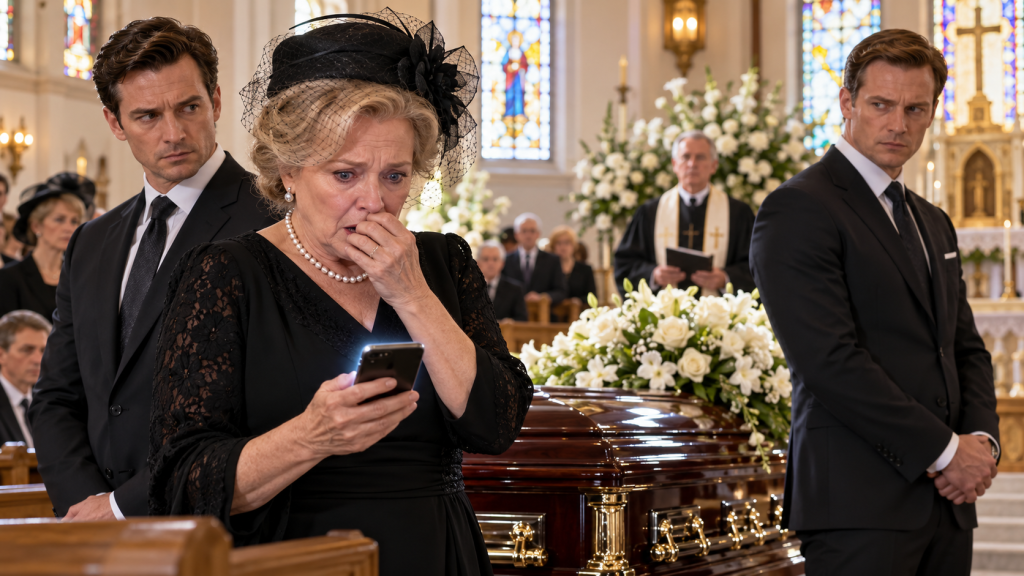
I stared at him. “What are you talking about?” Robert closed his eyes. He looked exhausted. “Biologically.” My fingers went cold. “Which one?” He opened his eyes again. “Harrison.” I pulled my hand away.
“No.”
“Terry—”
“No.”
I stood so quickly the chair nearly tipped over.
“That is impossible.”
“I thought so too.”
“You were there when he was born.”
“So were you.”
“I held him.”
“I know.”
“He has your mother’s eyes.”
Robert’s face twisted with pain.
“He has brown eyes, Terry.”
I hated him for saying it.
For one irrational second, I hated him more for being alive than I had ever hated death for taking him.
Because death had been simple.
Cruel, but simple.
This was not.
“What did you do?”
He stared at me.
“What do you mean?”
“How do you know?”
Robert slowly pushed himself higher against the pillows.
“Six months ago, Richard suggested we all do ancestry testing.”
I remembered.
He had joked about wanting to know whether the Callahan family was really as Irish as Robert always claimed.
I had refused because I thought it was silly.
Robert and both boys had done it.
Robert continued.
“The results came back strange.”
“How strange?”
“Richard matched exactly as expected.”
I could barely breathe.
“Harrison didn’t match me.”
“That could mean anything.”
“I thought so.”
“So I retested privately.”
My anger sharpened.
“You tested our son behind his back?”
Robert looked ashamed.
“Yes.”
“And?”
“No paternal match.”
I covered my mouth.
“No.”
“I tested again through a physician.”
“No.”
“Terry.”
“Stop saying my name like that.”
My voice broke.
“Forty years.”
Robert’s eyes filled.
“He is forty years old.”
“I know.”
“And you’re telling me somebody made a mistake at the hospital?”
Robert swallowed.
“That’s what I believe.”
I stared.
“You believe?”
“There’s more.”
Of course there was.
There was always more now.
He continued.
“My investigator found another family.”
I sat down slowly.
“What family?”
“The Daltons.”
The name meant nothing.
Robert’s voice weakened.
“They had a son born the same night, in the same hospital.”
My stomach turned.
“No.”
“He died three years ago.”
I stared.
“Robert…”
“The family had preserved genetic records because he had undergone treatment for a hereditary condition.”
I closed my eyes.
“And?”
Robert’s voice broke.
“He matched me.”
I stopped breathing.
The room seemed to tilt.
Somewhere far away, William moved toward us, then stopped.
My husband whispered,
“I believe their son was ours.”
My hand went instinctively to my chest.
A child.
My child.
A boy I had never held.
A boy who had grown into a man somewhere else.
A man who had died without knowing me.
And Harrison—
My Harrison—
the baby whose fever kept me awake for three nights when he was six months old.
The toddler who called spaghetti “getti.”
The boy who broke his wrist falling out of the maple tree because Richard dared him to jump.
The teenager who played piano badly but loudly.
The man who had kissed me on the forehead at my seventieth birthday dinner.
The son standing beside Robert’s coffin that morning.
Not biologically mine.
My body began shaking.
Robert tried to sit up.
“Terry.”
I backed away.
“No.”
“Please.”
“No.”
I pressed my palms against my face.
“What does this have to do with what they did to you?”
Robert said nothing.
I lowered my hands.
His silence frightened me more than the answer.
“Robert.”
“Harrison knows.”
I froze.
“What?”
“He found out before I did.”
“How?”
“Richard.”
My stomach dropped.
Robert’s expression darkened.
“Richard got the ancestry results first.”
I stared.
“They had all agreed he’d manage the family account.”
Of course.
Richard always managed things.
Passwords.
Reservations.
Business accounts.
Other people.
Robert continued.
“He realized Harrison wasn’t genetically related to me.”
“Then he started digging.”
“Why?”
“He thought it might affect the estate.”
My blood turned cold.
There it was.
Not curiosity.
Not identity.
Money.
“Richard told Harrison?”
“Yes.”
“How did Harrison take it?”
Robert looked away.
“Badly.”
I laughed bitterly.
“Badly?”
“Terry, imagine being forty years old and learning—”
“I don’t need you to explain shock to me tonight.”
He closed his mouth.
I continued.
“He thought you would disinherit him.”
“Yes.”
“Would you?”
Robert’s head snapped toward me.
“Never.”
“Did he know that?”
“I tried to tell him.”
“When?”
“Three months ago.”
My heart pounded.
“He confronted you?”
“Yes.”
“What did he say?”
Robert stared at the ceiling for several seconds.
Then quietly:
“He asked whether I still considered him my son.”
My throat tightened.
“And what did you say?”
“I told him biology had nothing to do with it.”
Tears filled my eyes.
Robert continued.
“I told him I had changed his diapers, coached his baseball team, sat beside his hospital bed after appendicitis, taught him to drive, fought with him, loved him, wanted to strangle him twice a week when he was seventeen…”
Despite everything, a broken laugh escaped me.
Robert smiled weakly.
Then the smile vanished.
“I told him there was nothing a laboratory could say that would change who he was to me.”
My eyes burned.
“Then why did he help Richard?”
Robert looked toward the floor.
“Because Richard told him I was lying.”
My stomach turned.
“He convinced Harrison I had already rewritten the will to cut him out.”
“But you hadn’t.”
“No.”
“The real will?”
Robert pointed toward my purse.
“The copy on that USB proves it.”
I stared at him.
“What does it say?”
“That everything passes first into the marital trust for you.”
“And after me?”
“Equal shares.”
“For both boys?”
“Yes.”
I sat completely still.
Robert’s eyes filled.
“I even added language stating that all children legally recognized by us would be treated equally regardless of genetics.”
I stared at him.
“You knew he was afraid.”
“Yes.”
“And you protected him.”
“Yes.”
“He still helped them try to kill you.”
Robert said nothing.
That silence hurt more than any explanation.
William finally moved from the door.
“We can’t stay here much longer.”
I looked at him.
“Why?”
“Because Richard knows this property exists.”
Robert frowned.
“How?”
“He handled insurance records for years.”
William glanced through the window.
“He may not know we’re here, but I don’t want to bet your lives on maybes.”
I turned back to Robert.
“You need a hospital.”
“No.”
“You were poisoned.”
“Terry—”
“You are pale, bruised, and barely sitting upright.”
“I’ve already been seen.”
“By whom?”
“A private physician.”
I stared.
Robert sighed.
“Someone William trusts.”
“How long have you been hiding?”
“Three days.”
My mouth fell open.
“Three days?”
“Yes.”
“You let me think you were dead for three days?”
“Terry.”
“You let me choose a casket.”
My voice cracked.
“You let me stand in a funeral home greeting people.”
“I know.”
“You let me sleep in our bed alone believing forty-three years had ended without goodbye.”
Robert began crying.
“I know.”
I stood.
“You do not get to say I know.”
William looked away.
Robert whispered,
“I didn’t have a choice.”
I laughed bitterly.
“Everybody who lies says that eventually.”
He flinched.
Good.
I needed him to understand.
I could be grateful he was alive and furious at what he had done.
Both were true.
“What body did I bury?”
Robert’s face changed.
William answered.
“We don’t know yet.”
I turned toward him.
“You don’t know?”
“We know the death certificate was false.”
My skin crawled.
“Dr. Mercer signed it.”
“Yes.”
“And the funeral home?”
William hesitated.
“Robert’s casket was never opened after it arrived.”
“I know.”
I had asked.
Richard said the damage from the heart attack and resuscitation attempts made viewing difficult.
I had believed him.
I whispered,
“Was there a body inside?”
William nodded.
“Yes.”
“Whose?”
“We believe it was an unclaimed man transferred through a county contractor.”
I nearly vomited.
Robert closed his eyes.
William continued.
“There is already an attorney working with investigators.”
I stared.
“Investigators?”
Robert said quietly,
“I contacted Margaret Shaw.”
Our longtime attorney.
The woman who had helped us create the estate plan twenty years ago.
“Margaret knows you’re alive?”
“Yes.”
“And I didn’t?”
Robert looked destroyed.
“I needed you to behave naturally.”
I slapped him.
The sound cracked through the carriage house.
William froze.
Robert did not move.
Neither did I.
My hand burned.
Tears poured down my face.
“That was for making me bury you.”
Robert’s eyes filled.
“I deserved that.”
“No.”
I shook my head.
“Nobody deserves to be hit.”
The irony tasted bitter.
“I shouldn’t have done it.”
I stepped back.
“But do not ever tell me you lied to me for my own good.”
Robert lowered his eyes.
“I won’t.”
“Good.”
William cleared his throat.
“We need to leave.”
This time, neither of us argued.
Margaret Shaw met us in a private room above a closed law office in Stamford.
She was seventy-two, silver-haired, sharp-eyed, and still wore heels that made me feel underdressed even at midnight.
The moment she saw me, she crossed the room and wrapped her arms around me.
“I am so sorry.”
I held on for three seconds.
Then pulled back.
“How much did you know?”
Her face tightened.
“Enough to know Robert was in danger.”
“Not enough to tell me?”
She glanced at him.
“I argued that point.”
I looked at Robert.
He looked away.
Good.
At least somebody had.
Margaret opened a leather folder.
“We need to go through this carefully.”
I sat.
William remained near the door.
Robert lowered himself into the chair beside me.
I did not touch him.
Not yet.
Margaret slid papers toward us.
“Richard and Harrison presented a new will two days ago.”
I stared.
“At whose office?”
“Not mine.”
“Of course.”
“It was drafted through an attorney who had never previously represented Robert.”
“What does it say?”
Margaret’s expression hardened.
“It leaves the company voting shares equally to Richard and Harrison.”
I laughed without humor.
“And me?”
“A lifetime allowance.”
I stared.
“A what?”
“Twenty thousand dollars a month.”
I almost smiled.
“How generous.”
Robert’s jaw tightened.
Margaret continued.
“The Greenwich house would be transferred into a family holding company controlled by the sons.”
My blood chilled.
“So I could live there.”
“Yes.”
“But not own it.”
“Correct.”
“And if I were declared incompetent?”
Margaret looked at me.
“The trustee could move you to supervised residential care.”
There it was.
The doctor.
The pastries.
The coffee.
My sons had not simply wanted money.
They wanted me legally erased.
I looked at Robert.
“And the real will?”
Margaret placed another document in front of me.
My name appeared first.
Theresa Callahan Family Trust.
I read slowly.
The house remained mine outright.
Investment income.
Voting control over Robert’s business shares during my lifetime.
The sons’ inheritance placed into separate trusts after my death, with independent trustees.
No son could force sale of the house.
No son could alter my medical care.
No son could become my guardian without independent court review.
I looked at Robert.
“You changed this recently.”
“Yes.”
“When?”
“Five months ago.”
“Before the DNA result?”
“Just before.”
“Why?”
He exhaled.
“Because Richard kept asking about control.”
My skin prickled.
“What kind of questions?”
“If I died first.”
“If you developed dementia.”
“If one of us became medically incapacitated.”
Margaret added,
“He was unusually interested in guardianship structures.”
I covered my mouth.
I remembered dinner.
Richard pouring wine.
Richard saying casually:
“Mom, you should really let me handle the bills someday. You don’t want to deal with all that when you’re older.”
I had laughed.
Older.
As though seventy-one were a cliff edge.
Harrison had said nothing.
He rarely did when Richard took control.
I whispered,
“Were they stealing before this?”
Robert nodded.
“How much?”
Margaret answered.
“Preliminary forensic review suggests at least 2.4 million dollars was moved or pledged improperly.”
I stared.
“Two million?”
“Potentially more.”
My breath left me.
Robert said,
“It happened through the business.”
Richard worked as chief operations officer.
Harrison managed property holdings.
Both had legitimate access.
Both apparently believed access meant ownership.
Margaret continued.
“Some money went into failed real-estate ventures.”
“Some covered personal debt.”
“Some appears to have funded an acquisition Richard was attempting independently.”
“And Harrison?”
She hesitated.
“He signed several authorizations.”
My throat tightened.
“Did he take money?”
“Yes.”
“How much?”
“We’re still tracing it.”
I looked toward the window.
My sons.
My boys.
One biological.
One not.
Both raised at the same table.
Both taught the same prayers.
Both given college.
Homes.
Jobs.
Trust.
How had greed become the language they spoke best?
Robert whispered,
“I confronted them.”
“When?”
“The night they tried to kill you?”
“No.”
He shook his head.
“Two weeks before.”
“What happened?”
“Richard denied everything.”
“Harrison cried.”
That hurt.
“He said?”
“He said he thought I planned to leave him with nothing.”
I closed my eyes.
Robert continued.
“I told him the truth about the will.”
“So he knew?”
“Yes.”
My eyes opened.
“He knew he wasn’t disinherited?”
“Yes.”
“And he still helped Richard.”
Robert’s face broke.
“Yes.”
There was no excuse left.
Richard had manipulated him at first.
But Harrison had eventually known.
And he still chose money over us.
Margaret played the first audio recording from the USB.
Richard’s voice filled the room.
Clear.
Cold.
“We don’t need him dead immediately.”
My stomach turned.
Harrison answered.
“You said Mercer could make it look natural.”
“I said he could make it look like something nobody questions at seventy-six.”
I reached for Robert’s hand without thinking.
He held mine tightly.
Richard again:
“Once Dad is gone, Mom is easy.”
My entire body went cold.
Harrison said,
“Don’t call her easy.”
A tiny piece of me broke open.
Then Richard laughed.
“You know what I mean.”
Harrison replied,
“She won’t sign.”
“She will if Mercer says she’s confused.”
“And if she fights?”
“Then we show the court she’s grieving, paranoid, and unstable.”
I pressed my fingers to my mouth.
Harrison whispered,
“She’s still our mother.”
Richard’s answer came instantly.
“Then maybe she should have raised us to lose better.”
The recording ended.
Silence.
Nobody moved.
I stared at nothing.
That sentence.
Raised us to lose better.
As if parenthood were preparation for surrendering everything to your children.
As if our property was a prize they had already earned by surviving us.
Margaret clicked another file.
Dr. Mercer’s voice.
“I am not signing a permanent incapacity finding without examination.”
Richard:
“You’ll examine her.”
Mercer:
“And if she’s oriented?”
Richard:
“Grief changes quickly.”
Mercer:
“That sounds like you expect something.”
A pause.
Then Richard:
“You’re being paid not to ask what you don’t need to know.”
The recording ended.
I felt sick.
Margaret said,
“There are bank transfers to Mercer.”
“How much?”
“Eighty thousand.”
Robert whispered,
“Consulting fees.”
I laughed bitterly.
“Of course.”
William finally spoke.
“There’s more.”
I looked at him.
He placed a flash drive beside Margaret’s laptop.
“Security footage.”
“From the house?”
“Yes.”
The night Robert collapsed.
I did not want to watch.
Then I did.
The video showed Robert entering his study at 10:12.
Richard arrived seventeen minutes later.
Harrison twenty minutes after that.
Dr. Mercer at 10:51.
At 11:06, Harrison left the study carrying Robert’s coffee mug.
At 11:17, Robert staggered into the hallway.
Collapsed.
My fingers dug into Robert’s hand.
At 11:21, Mercer knelt beside him.
Checked something.
Richard paced.
Harrison stood frozen against the wall.
Then Mercer looked up.
No sound on that camera.
But the next recording from Robert’s hidden desk microphone captured it.
“His pulse is weak.”
Richard said,
“You said the dose would work.”
Harrison whispered,
“Oh God.”
Mercer:
“I said sedate him. Not this.”
My eyes snapped toward Robert.
He was crying.
The recording continued.
Harrison:
“Call an ambulance.”
Richard:
“No.”
Harrison:
“He’s alive.”
Richard:
“If he wakes up, we’re finished.”
The room disappeared.
I heard only my son.
My firstborn.
Richard.
No.
If he wakes up, we’re finished.
Harrison began shouting.
“You said nobody was going to die.”
Then there was a crash.
Mercer said,
“Everybody calm down.”
Richard:
“Can you declare him?”
Mercer:
“Not yet.”
Harrison:
“I’m calling 911.”
Richard:
“And tell them what? That you helped dose your father?”
Silence.
Long.
Terrible.
Then Harrison began crying.
The recording ended.
I stood.
I could not breathe.
Robert tried to hold me.
I pulled away.
Not from him.
From everything.
“My son watched you dying.”
Robert said nothing.
I looked at him.
“Harrison wanted to call.”
“Yes.”
“But he didn’t.”
“No.”
I closed my eyes.
Cowardice.
Complicity.
Fear.
Different from Richard.
Not innocent.
But different.
That mattered legally.
Emotionally?
I did not know yet.
William told us what happened next.
He had been outside.
Fired two months earlier by Richard.
But Robert had quietly rehired him as private security after becoming suspicious.
William watched the house remotely.
When Robert collapsed, an alert from the study camera reached him.
He arrived through the service entrance after Richard and Harrison left to coordinate what they thought would become an emergency response.
Dr. Mercer remained.
William confronted him.
Mercer panicked.
He confessed Robert was not dead.
Just deeply unconscious.
William got Robert out through the back in an old maintenance vehicle before the ambulance arranged by Richard arrived.
“How did they not notice?”
I asked.
“They thought Mercer had transferred him.”
William’s face hardened.
“Mercer then told them Robert died during transport.”
“Why?”
“He realized Richard intended to make him disposable too.”
I stared.
“So Mercer helped Robert disappear?”
Robert nodded.
“For twenty-four hours.”
“And then?”
“He ran.”
“Where?”
Margaret answered.
“Authorities have him.”
My heart jumped.
“Already?”
“Yes.”
“He surrendered through counsel yesterday.”
I laughed.
Not joy.
Relief so sharp it felt cruel.
“And the funeral?”
Margaret looked grim.
“Richard arranged it through a funeral director tied financially to one of his shell companies.”
I closed my eyes.
Of course.
The closed casket.
The rush.
The paperwork.
The stranger I had mourned.
Margaret continued.
“The body has been secured for identification.”
I whispered,
“That man had a family too.”
Nobody answered.
Because he did.
Whoever he was.
Unclaimed did not mean unloved.
Unknown did not mean disposable.
My sons had treated a dead stranger the way they treated the living around them.
As a tool.
The plan was simple.
Which usually meant it was not.
Robert would remain hidden another forty-eight hours.
State investigators and federal financial agents would secure records first.
The forged death certificate would be challenged.
The fake will would be preserved as evidence.
The sons would be asked to attend what they believed was an emergency probate conference.
I hated every part of it.
Especially the pretending.
I had already pretended to be a widow.
Now I had to pretend to be confused.
Weak.
Exactly what they expected.
Margaret looked at me.
“Can you do that?”
I stared.
“I spent forty-three years raising children.”
She blinked.
I continued.
“I know how to let someone underestimate me.”
The next morning, Richard called.
I answered.
My voice trembled without acting.
“Mom?”
“Yes.”
“Where are you?”
“With a friend.”
“Which friend?”
I almost smiled.
Control.
Always control.
“I’m tired.”
He softened instantly.
“Mom, you scared us.”
Interesting.
“I’m sorry.”
“No, no.”
He lowered his voice.
“We just want you safe.”
I closed my eyes.
Behind me, Margaret listened through the conference-room speaker.
“Safe.”
“Yes.”
“Harrison and I have been worried sick.”
I pictured Harrison crying on the recording.
Richard asking a doctor to let my husband die.
I whispered,
“I don’t know what’s real anymore.”
His voice became gentle.
Perfect.
“You’re grieving.”
“I know.”
“Dr. Mercer told us this can happen.”
I almost laughed.
“Where is Dr. Mercer?”
Silence.
Then:
“He had to leave town.”
Of course.
Richard continued.
“We need you to meet us tomorrow.”
“Why?”
“Dad’s estate.”
My chest tightened.
“What about it?”
“There are papers.”
“I don’t want papers.”
“I know.”
His patience sounded rehearsed.
“Harrison and I can handle everything.”
There.
Everything.
“All you need to do is sign a few things.”
Margaret wrote on a legal pad:
ASK WHAT.
I whispered,
“What things?”
“A temporary management authorization.”
“For what?”
“The company.”
“The house.”
“Some bank accounts.”
My throat tightened.
“And the doctor?”
“What?”
“You brought a doctor to my house.”
Richard exhaled.
“You were confused.”
“You broke my window.”
Silence.
Margaret looked sharply at me.
I had deviated.
Good.
I wanted him uncomfortable.
Richard said,
“We thought you were in danger.”
“From whom?”
Long pause.
Then:
“Yourself.”
I felt something die inside me.
He was willing to turn my terror into self-harm.
Anything to make the story fit.
I whispered,
“I’ll come tomorrow.”
His relief was immediate.
“Good.”
Then he added:
“And Mom?”
“Yes?”
“Don’t bring anyone.”
I stared at Margaret.
She smiled without humor.
“I won’t.”
The probate conference took place at a private law office in Manhattan.
Not Margaret’s.
Richard’s chosen attorney, a nervous man named Leonard Price.
I arrived wearing black.
The same dress from the funeral.
I chose it deliberately.
Richard stood when I entered.
He hugged me.
I let him.
That was one of the hardest things I have ever done.
My son’s arms around me.
His cheek against my hair.
His voice soft.
“Mom.”
For one dangerous second, I remembered him at five.
Running toward me after kindergarten.
Hands sticky with glue.
Saying:
“I made you something.”
Then he released me.
The man returned.
Harrison stood behind him.
He looked terrible.
Gray.
Unshaven.
Eyes swollen.
When he saw me, his face crumpled.
“Mom.”
He moved toward me.
Richard touched his arm.
A warning.
I saw it.
So did Harrison.
I sat.
Leonard Price arranged documents.
“We know this is difficult, Mrs. Callahan.”
I lowered my eyes.
“Yes.”
Richard sat beside me.
Too close.
“We’re going to make this easy.”
I whispered,
“Thank you.”
I hated the words.
Price slid the fake will across the table.
“This appears to be Robert’s most recent testament.”
I looked at it.
The signature was good.
Very good.
But Robert’s R curved too sharply.
After forty-three years, I knew every version of his name.
“This leaves the company to the boys?”
“Yes.”
“And the house?”
Richard leaned forward.
“You’ll still live there, Mom.”
I turned toward him.
“Still?”
He smiled.
“Of course.”
“Until when?”
His smile faltered.
“What do you mean?”
“Until I’m too confused?”
Silence.
Harrison closed his eyes.
Richard stared at me.
“You’re tired.”
I sat straighter.
“No.”
Something changed in the room.
My sons felt it.
I removed my veil.
“I’m finished being tired.”
Richard’s expression hardened.
“Mom.”
The door opened.
Margaret Shaw entered first.
Two investigators behind her.
Then William.
Harrison stood.
Richard froze.
And finally—
Robert walked in.
Alive.
His face still bruised.
His steps slow.
But alive.
Harrison made a sound I had never heard from a human being.
Not a word.
Not a cry.
Something between.
Richard went completely white.
Robert stopped across the room.
Nobody breathed.
Harrison whispered,
“Dad?”
Robert looked at him.
“Yes.”
Harrison collapsed into the chair.
Richard backed away.
“No.”
Robert’s eyes turned toward him.
My firstborn.
His namesake in everything except name.
The child who had once sat on Robert’s shoulders during Fourth of July fireworks.
“No?”
Richard shook his head.
“You’re dead.”
Robert’s face hardened.
“You tried.”
Leonard Price stood abruptly.
“I was not informed—”
Margaret cut him off.
“You should contact counsel.”
He did not need telling twice.
He stepped away.
One investigator addressed Richard and Harrison.
They were not arrested immediately in some dramatic rush.
Reality was colder.
Questions.
Rights.
Instructions.
Preservation notices.
But Richard began talking anyway.
Badly.
Fast.
“This is insane.”
“Mercer said you were dead.”
“I never touched you.”
“Harrison handled the coffee.”
Harrison’s head snapped up.
There it was.
Richard’s first instinct.
Sacrifice someone else.
Harrison stared.
“You told me—”
“Shut up.”
“No.”
Harrison stood.
For the first time in my life, I heard strength in his voice that did not belong to Richard.
“You told me it would only make him sleep.”
Richard glared.
“You signed everything too.”
“I know.”
Harrison began crying.
“I know.”
He looked at Robert.
Then me.
“I’m sorry.”
Richard laughed.
“Don’t start performing now.”
Harrison spun toward him.
“You told me Dad was cutting me out because I wasn’t his.”
Silence.
The investigators glanced toward Robert.
I watched Richard.
His face changed.
He had not expected the secret to become public yet.
Harrison continued.
“You told me I wasn’t family.”
My heart broke.
Richard said,
“You aren’t.”
Robert moved so quickly William had to steady him.
“Don’t.”
His voice filled the room.
Richard looked at him.
Robert’s eyes burned.
“You do not ever say that again.”
Richard laughed bitterly.
“He’s not your son.”
Robert walked forward.
“Harrison is my son.”
My throat tightened.
“He has been my son every day since the nurse put him in Theresa’s arms.”
Harrison began sobbing.
Robert continued.
“A laboratory result did not raise him.”
“I did.”
“Your mother did.”
Richard’s face twisted.
“Then why hide it?”
“Because I was trying to confirm what happened.”
“And because it was his truth to learn carefully.”
Robert looked at Harrison.
“I should have told you sooner.”
Harrison covered his face.
Richard scoffed.
“This is sentimental nonsense.”
I looked at him.
“No.”
He turned toward me.
“You don’t understand.”
I laughed softly.
“I understand more than you think.”
“You were going to give everything to him.”
“No.”
Robert’s voice cut through the room.
“The estate was equal.”
Richard froze.
Robert continued.
“It was always equal.”
I watched comprehension arrive.
All of it.
The poison.
The forged will.
The fake funeral.
The attempt to erase me.
All built partly on a lie Richard told Harrison.
Not because Harrison’s share was threatened.
Because Richard needed him afraid.
Harrison looked at his brother.
“You said he changed it.”
Richard said nothing.
“You showed me papers.”
“Drafts.”
“You said—”
“I said what I needed to say.”
There.
The sentence condemned him more than any evidence.
Harrison stared.
“You used me.”
Richard laughed.
“You wanted to believe it.”
That was cruel.
Because it was partly true.
And Harrison knew it.
He sank into the chair.
“Yes.”
He whispered.
“I did.”
No excuse.
Just guilt.
The arrests came later that afternoon.
Richard resisted verbally.
Not physically.
He demanded lawyers.
Threatened lawsuits.
Insisted Robert had staged everything.
Harrison said almost nothing.
As investigators escorted him out, he turned toward me.
“Mom.”
I did not move.
“I love you.”
My eyes filled.
I whispered,
“I love you too.”
His face broke.
“But that does not make this disappear.”
He nodded.
“I know.”
Then he left.
Richard never looked back.
That hurt in a different way.
The next year changed our family forever.
Dr. Mercer cooperated.
The funeral director cooperated.
Financial records were recovered.
The forged will was proven false.
The attempt to establish me as incompetent collapsed under its own paperwork.
Investigators uncovered shell companies, false invoices, diverted corporate funds, and payments made to facilitate the staged death.
Robert’s legal status was corrected.
The stranger in the casket was eventually identified.
His name was Samuel Ortega.
Sixty-eight.
Estranged from his family.
Not unloved.
His daughter had been searching for him for months.
When I learned that, I cried harder than I expected.
Robert and I paid for a proper funeral.
Not secretly.
Not from guilt alone.
Because Samuel deserved his own name over his own grave.
His daughter attended.
She asked why we were there.
I told her enough.
Not everything.
She looked at Robert for a long time.
Then said,
“My father spent his life feeling invisible.”
My heart cracked.
“I’m sorry.”
She nodded.
“At least he isn’t invisible anymore.”
That sentence stayed with me.
Richard went to trial.
Harrison entered a cooperation agreement after admitting his role.
I attended both proceedings.
Not every day.
Enough.
The evidence was devastating.
Richard had initiated the asset diversion.
Richard hired Mercer.
Richard coordinated the false will.
Richard arranged the funeral-home connection.
Richard pressured Harrison using the paternity secret.
But Harrison had signed documents.
Carried the mug.
Stayed silent.
Helped break into my house.
Helped attempt to have me declared incompetent.
Manipulation did not erase choice.
The judge made that clear.
So did I.
At Harrison’s sentencing, he looked directly at us.
He said:
“I spent my whole life afraid of being less loved than Richard.”
My throat tightened.
“I didn’t know why.”
“Then I found out I wasn’t biologically my parents’ child, and instead of asking them who I was, I let fear tell me who they must be.”
Robert closed his eyes.
Harrison continued.
“My brother told me Dad would throw me away.”
“I believed him because some part of me had always thought love could disappear if I stopped earning it.”
He looked at me.
“Mom never taught me that.”
Tears slid down my face.
“Dad never taught me that.”
Robert cried.
“I taught myself.”
Harrison swallowed.
“And then I did terrible things because I was afraid of losing something that had never been taken from me.”
His voice broke.
“I’m sorry.”
There was no applause.
No magical forgiveness.
Just truth.
For once.
Richard’s sentencing was different.
He showed little remorse.
His attorney spoke of pressure.
Responsibility.
Family conflict.
Richard finally stood and said,
“I made mistakes.”
Robert’s hand tightened around mine.
Mistakes.
As if he had missed a turn driving home.
The judge did not accept the language.
Neither did I.
The consequences were severe.
Long prison time.
Restitution.
Asset forfeiture.
Corporate bans.
Harrison’s sentence was lighter because of cooperation, lesser role, and acceptance of responsibility, though still serious.
I did not celebrate either sentence.
People assume justice feels like victory.
Sometimes it feels like standing in a burned house while someone confirms who started the fire.
You are glad the truth is known.
You are still homeless inside it.
Robert and I had our own reckoning.
That surprised him.
I think some part of him believed surviving the murder attempt would exempt him from criticism.
It did not.
Three months after he returned home, I packed a suitcase.
He stared.
“Where are you going?”
“My sister’s.”
“For how long?”
“I don’t know.”
His face fell.
“Terry.”
“I love you.”
He looked terrified.
“That sounds like goodbye.”
“It isn’t.”
I zipped the suitcase.
“But you let me bury you.”
He closed his eyes.
“I know.”
“You made decisions for me because you thought I couldn’t handle the truth.”
“I was protecting you.”
I stared.
“No.”
He looked up.
“You were controlling the risk.”
“That is different.”
He sat down.
“I thought if they believed you knew something—”
“I understand the strategy.”
I put my hand on the suitcase.
“I don’t accept the marriage part.”
He said nothing.
“I am not evidence.”
“I am not bait.”
“I am not a person you keep ignorant so my grief looks convincing.”
Tears filled his eyes.
“I’m sorry.”
“I know.”
“Will you come back?”
I looked at the man I had loved for nearly half a century.
Alive.
Flawed.
Terrified.
Still mine.
“I think so.”
He nodded.
“That’s fair.”
It took me six weeks.
Not because I stopped loving him.
Because love also needed consequences.
Not legal ones.
Emotional ones.
Robert began therapy.
So did I.
We learned something strange at seventy.
Honesty is not only telling the truth.
It is allowing another person to participate in decisions that affect their life.
Robert had always been a planner.
A protector.
A man who thought carrying everything alone was noble.
It had nearly broken us.
When I returned home, there were no dramatic vows.
No flowers.
Just Robert standing in the kitchen.
Two mugs of coffee.
He looked at me.
“Can I hug you?”
I smiled through tears.
“Yes.”
He did.
And this time, neither of us disappeared inside the other.
The truth about Harrison’s birth took longer.
We found the Dalton family.
The woman who had raised our biological son was named Judith.
Her husband had died years earlier.
Their son—our biological son—had been named Michael.
Michael Dalton.
I stared at his photographs for hours.
He had Robert’s chin.
My smile.
The same crease between his eyebrows that Richard had when concentrating.
He had been a teacher.
Married.
No children.
He died of complications from a chronic illness at thirty-seven.
I grieved a man I had never met.
That grief was bizarre.
Violent.
Unfair.
How do you mourn memories you never had?
No first steps.
No school plays.
No wedding.
Only photographs.
A life lived parallel to mine.
Judith and I met.
We sat across from each other in a quiet restaurant.
Two mothers.
Each had raised the other’s child.
Neither had known.
She cried first.
“I loved him.”
I reached across the table.
“I know.”
She held my hand.
“I’m sorry.”
“For what?”
“I got your boy.”
I shook my head.
“No.”
Tears filled my eyes.
“You got Michael.”
“And I got Harrison.”
She smiled through grief.
“Yes.”
That mattered.
We refused to reduce either man to a mistake.
A hospital error might have changed biology.
It did not erase parenthood.
Judith gave me a box of Michael’s things.
Photographs.
A college essay.
A scarf.
A recording of him laughing at a family picnic.
That laugh destroyed me.
Robert listened once.
Then walked outside and cried where he thought I couldn’t see.
I saw.
I let him.
We told Harrison about Michael during one supervised prison visit.
He stared through the glass.
“So there really was another baby.”
“Yes.”
“What was his name?”
“Michael.”
Harrison looked down.
“Was he happy?”
My throat tightened.
“Mostly, I think.”
“Did they love him?”
“Yes.”
He nodded.
“Good.”
Then he asked the question I knew would come.
“Do you wish you had gotten him instead?”
My entire body went still.
Robert leaned toward the glass.
“No.”
Harrison looked up.
Robert continued.
“I wish nobody had been switched.”
“I wish Michael had grown up with us and you with Judith if that was how it should have been.”
“But I do not wish away forty years of being your father.”
Harrison began crying.
I pressed my hand against the glass.
“So don’t ask me to choose between a son I lost and the son I raised.”
He placed his hand against mine from the other side.
“I’m sorry.”
“For what?”
“For making you prove it.”
I shook my head.
“You were afraid.”
His face tightened.
“I still chose what I chose.”
“Yes.”
I did not rescue him.
His eyes filled.
“Thank you.”
That surprised me.
“For what?”
“For not saying it wasn’t my fault.”
I almost broke.
Because that was growth.
Richard wrote letters.
At first, I did not open them.
Then I did.
The first blamed Harrison.
The second blamed Robert.
The third blamed business pressure.
The fourth blamed childhood expectations.
I stopped reading.
Two years passed.
Then a different letter came.
No justification.
It began:
Mom, I spent my whole life thinking inheritance was proof of love.
I kept reading.
When Dad trusted me with the company, I heard ownership. When you trusted me with accounts, I heard entitlement. When Harrison’s DNA result came back, I saw leverage instead of a brother in pain.
My hands shook.
I told myself I was protecting what was mine. The truth is I was trying to own what was never mine.
Tears blurred the page.
I don’t expect you to forgive me.
Good.
I am sorry I turned your age into a weapon.
That line hurt most.
I am sorry I planned to make strangers doubt your mind because I knew your mind was the one thing I could not control.
I stopped reading.
Then continued.
I am sorry I chose Dad’s death over exposure.
There it was.
Finally.
Not “mistakes.”
Not “pressure.”
Death.
His father’s death.
And I am sorry I made Harrison believe blood mattered when I knew Dad never treated him differently.
I folded the letter.
Robert watched me.
“Do you believe him?”
I thought.
“Some of it.”
“Will you answer?”
“Not yet.”
He nodded.
Years earlier, Robert would have pushed.
Suggested.
Managed.
Now he simply sat beside me.
That was healing too.
Five years after the funeral that wasn’t Robert’s, we returned to Greenwich for a family dinner.
Not the old mansion.
We sold it.
Neither of us wanted to live inside rooms that had become evidence.
We bought a smaller house overlooking the water.
Fewer rooms.
More windows.
William visited often.
Margaret retired and somehow became more intimidating.
Harrison had been released under supervision and worked at a nonprofit warehouse that helped people leaving incarceration.
He lived modestly.
Paid restitution.
Went to therapy.
Never asked us for money.
The first time he came to dinner, he stood on the porch for almost a full minute.
I opened the door.
“Are you coming in?”
He looked terrified.
“Am I allowed?”
My heart cracked.
“Yes.”
He stepped inside.
No dramatic hug.
Not yet.
We ate.
He washed dishes.
Robert watched him.
At one point Harrison dropped a plate.
It shattered.
He froze.
Literally froze.
As if waiting for punishment.
Robert stood.
Then said,
“It was ugly anyway.”
Harrison started laughing.
Then crying.
So did I.
Healing is strange.
Sometimes it arrives disguised as broken china.
Richard remained incarcerated.
Our relationship with him became letters.
Then carefully monitored calls.
I never told him everything was fine.
It wasn’t.
I never told him I hated him.
I didn’t.
One Christmas, he said:
“Mom?”
“Yes?”
“Do you still call me your son?”
I stared at the wall.
The irony almost took my breath.
Harrison had once feared that biology could erase sonship.
Richard, fully biological, had nearly erased ours through betrayal.
I answered carefully.
“Yes.”
He began crying.
“But being my son does not erase what you did.”
“I know.”
“And loving you does not mean trusting you.”
“I know.”
“And if you ever come back into my life outside prison, it will be slowly.”
“I know.”
I smiled sadly.
“You finally say that a lot.”
He laughed through tears.
“I’m learning.”
Robert turned eighty-two.
We celebrated quietly.
Harrison came.
Judith Dalton came too.
Yes.
The woman who raised Michael became part of our strange, broken, reconstructed family.
She brought Michael’s favorite chocolate cake.
Harrison asked her questions.
What was he like?
Did he snore?
Was he good at sports?
Judith laughed.
“Terrible.”
Harrison smiled.
“Thank God. I’m not being replaced by an athlete.”
We laughed.
Then Judith looked at him.
“You look nothing like Michael.”
Harrison’s smile faded.
She continued.
“But you tilt your head exactly the way Theresa does when you’re skeptical.”
I stared.
Harrison did.
He had learned it from me.
Not inherited.
Learned.
Forty years of family written into posture.
That was when I fully understood.
Blood can explain resemblance.
Life creates echoes.
After dinner, Robert and I sat outside.
He took my hand.
“Do you remember the funeral?”
I looked at him.
“Which one?”
He winced.
“Fair.”
I smiled.
“Yes.”
“I remember.”
“I still feel guilty.”
“Good.”
He looked offended.
I laughed.
Then softened.
“Not forever.”
He squeezed my hand.
“I thought surviving meant I could fix everything.”
“I know.”
“I didn’t understand that coming back from the dead wouldn’t restore what happened while I was gone.”
“No.”
He looked toward the water.
“Do you trust me now?”
I thought about it.
“Yes.”
His eyes filled.
“Completely?”
“No.”
He laughed.
I smiled.
“Completely is for children and fairy tales.”
He kissed my hand.
“Fair.”
Trust at our age was not innocence.
It was knowledge plus choice.
I knew Robert could make terrible decisions while trying to protect me.
He knew I could forgive without pretending.
That was stronger than what we had before.
Less romantic.
More real.
Ten years after that impossible funeral, Robert died.
For real.
This time, I was there.
His hand in mine.
No secret messages.
No hidden rooms.
No fake doctor.
No sons whispering behind doors.
Harrison sat on the other side of the bed.
Richard was allowed a monitored video call near the end.
Robert looked at the screen.
His voice was weak.
“Richard.”
“Dad.”
Both cried.
Robert whispered,
“I love you.”
Richard broke.
“I love you too.”
Robert continued.
“What you did was terrible.”
“I know.”
“But terrible things are not the only things you have ever done.”
Richard covered his face.
Robert breathed carefully.
“Spend whatever years you have left proving that.”
Richard nodded.
“I will.”
Then Robert turned to Harrison.
“Son.”
That one word destroyed all of us.
Harrison held his hand.
“Dad.”
“You never needed my blood.”
“I know.”
“Do you?”
Harrison cried.
“Yes.”
Robert smiled.
“Good.”
Then he looked at me.
“Terry.”
I leaned closer.
“Yes?”
“No surprises this time.”
I laughed through tears.
“You’d better not.”
He smiled.
“I left the will where Margaret has it.”
“Good.”
“No secret compartments.”
“Good.”
“No drivers.”
“Good.”
“No fake funeral.”
I cried harder.
“Robert.”
He squeezed my hand one last time.
“I’m sorry about that.”
I kissed his forehead.
“I know.”
Then he whispered,
“I had a good life.”
“So did I.”
“With you.”
“With you.”
He closed his eyes.
And this time, when Robert left me, he truly left.
No phone vibration.
No unknown number.
No hidden message.
Just silence.
But it was a different silence.
Painful.
Honest.
I could survive honest grief.
I had already survived the other kind.
At his funeral, Harrison stood beside me.
Older.
Grayer.
Humbled.
Richard attended through secure remote arrangements, under the rules available to him.
Judith sat behind us.
William beside Margaret.
Samuel Ortega’s daughter sent flowers.
The card read:
For a man whose second chance helped give my father back his name.
I cried when I read it.
The casket was open.
I needed that.
Some people thought it strange.
I did not care.
I walked toward Robert.
Touched his hand.
Cold.
Real.
Gone.
Then I whispered:
“Now I believe you.”
Harrison heard.
He began crying.
I took his hand.
We stood there together.
Not pretending.
Not performing.
Just grieving.
People sometimes ask what happened to the real will.
Nothing dramatic.
It did what Robert intended.
I remained secure.
Harrison’s eventual inheritance stayed protected in trust.
Richard’s share was substantially affected by legal judgments, restitution, and Robert’s later lawful estate planning.
No one was rewarded for crimes.
No one was erased because of biology.
That mattered to Robert.
It mattered to me.
The final version contained one paragraph he added years after everything happened:
My children are defined in this document not by genetic relationship, but by the lives we shared and the legal relationships we chose. Blood may identify ancestry. It does not alone determine family.
Below that he wrote:
Inheritance is not proof of love.
I stared at those words for a long time.
How much pain might we have avoided if our sons had understood them sooner?
But perhaps some lessons arrive only after the cost has already been paid.
I am eighty-three now.
The red-circled photograph of Robert’s desk still exists on my old phone.
I kept it.
Not because I enjoy remembering fear.
Because that photograph divided my life into before and after.
Before, I thought family loyalty meant trust without question.
After, I learned loyalty without truth becomes permission.
Before, I thought motherhood meant defending my children from every consequence.
After, I learned sometimes consequences are the only honest thing left to give.
Before, I thought forty-three years of marriage meant Robert and I could no longer surprise each other.
He proved me spectacularly wrong.
The man managed to attend his own funeral without being there.
I still get angry when I think about it.
Then sometimes I laugh.
Age gives certain horrors a strange edge.
Not because they become funny.
Because survival gives you permission to reclaim the story.
The funeral that was supposed to make me powerless became the beginning of the truth.
The fake will failed.
The guardianship failed.
The theft was exposed.
Robert lived another decade.
Harrison discovered that biology could not take away a father’s love—but betrayal could damage trust.
Richard discovered that blood could not guarantee forgiveness.
I discovered a son I never met.
Michael.
His photograph sits beside Harrison’s now.
Not instead of.
Beside.
That distinction matters.
One son grew up elsewhere because of an error none of us chose.
Another grew up in my house and later made choices that nearly destroyed us.
Both stories are mine.
Neither cancels the other.
And Robert?
Robert taught me something even he did not understand until late in life.
Love cannot survive indefinitely inside secrets.
Not because every secret is cruel.
Sometimes people hide the truth because they are afraid.
Because they think they are protecting someone.
Because they believe tomorrow will be safer.
But secrets have a cost.
My sons paid one.
Robert paid one.
I paid one.
So now, when my grandchildren ask about the strange Callahan family history, I tell them the truth in age-appropriate pieces.
I tell them about courage.
Greed.
Fear.
Forgiveness.
DNA.
Choice.
I tell them Harrison is their uncle because family is lived, not merely measured.
I tell them Richard is also their uncle, though he spent years rebuilding a relationship he once tried to trade for money.
I tell them Michael existed.
That his life mattered even though ours never crossed.
And eventually, when they are old enough, I will tell them about the morning I buried a stranger while my husband hid in a carriage house sending me text messages.
They will probably think I am senile.
I will show them the photograph.
Then they will believe me.
But the most important part will not be the fake death.
Or the secret will.
Or the poisoned coffee.
Or the body in the casket.
It will be what happened after.
Because families are rarely destroyed by one revelation.
They are destroyed by what people choose when the truth arrives.
Richard chose denial for years before beginning to change.
Harrison chose confession.
Robert chose, eventually, partnership instead of protection through secrecy.
And I chose not to let love turn me into a fool twice.
That is the part I am proud of.
Not that I outsmarted my sons.
Not that the real will survived.
Not that Robert came back from the dead.
I am proud that when everyone around me tried to tell me what I could handle—
my sons,
my husband,
a doctor,
lawyers,
fear itself—
I finally decided for myself.
And I handled the truth.
All of it.
Painfully.
Imperfectly.
But standing.
The last message Robert ever sent me from that unknown phone remained saved until the device finally stopped working.
It arrived the night William drove me away from the house.
I had asked:
Where are you?
Robert eventually replied:
Closer than you think. I’m sorry. Keep going.
For years, I thought the important part was:
I’m alive.
It wasn’t.
The important part was:
Keep going.
So I did.
Through betrayal.
Through courtrooms.
Through discovering one son had not come from my body and another son had nearly destroyed the family his blood gave him.
Through anger at a husband I loved.
Through forgiveness that arrived slowly enough to mean something.
Through a second, real funeral.
Through old age.
I kept going.
And if there is anything I have learned after more than eight decades, it is this:
Family is not the people who can prove they belong to you.
Family is the people who learn that belonging never gives them the right to own you.
Love is not inheritance.
Love is not blood.
Love is not obedience.
Love is the truth told before it is too late.
And when truth does arrive late—
as it so often does—
love is what we choose to do with it next.
THE END STORIES! THANK YOU FOR READING GOOD LUCK !❤️
Related Posts



