For several seconds, nobody moved. The photograph trembled in the officer’s hand. Danielle was still wrapped around me, crying against my shoulder. Evan was face-down on my dining-room floor with two officers restraining him.
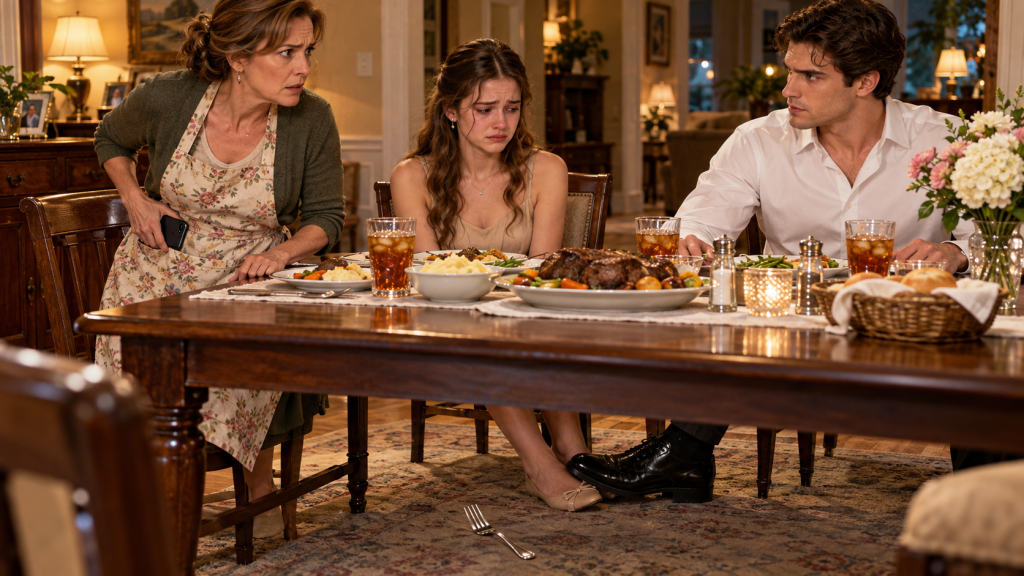
The gun he had pressed against my daughter was sealed inside an evidence bag. My pot roast sat cooling on the table. The mashed potatoes had hardened around the edges. And on the back of a faded photograph was handwriting I had spent eleven years trying not to remember too clearly.
Rachel’s. My sister. My little sister. The woman who had vanished when Danielle was eleven years old. I reached for the photograph. “May I?” The officer hesitated before carefully holding it where I could see. I turned it over again. The woman beside Evan had long dark hair.
A scarf partly covered her face.
She looked younger.
Thinner.
Different.
But then I saw the silver locket around her neck.
My mother’s locket.
The one Rachel had worn every day after Mom died.
My knees nearly gave way.
“Oh my God.”
Danielle grabbed my arm.
“Mom?”
I pointed.
“That’s Rachel.”
Danielle stared at the picture.
“Aunt Rachel?”
I nodded.
Her face emptied.
She had been eleven the last time she saw her.
I still remembered that day.
Rachel sitting at this very kitchen table.
Danielle doing homework beside her.
Rachel drawing little stars in the margin of Danielle’s notebook.
Then she left.
Three days later, her apartment was empty.
Her phone disconnected.
Her checking account nearly drained.
A suitcase missing.
Police said there was no obvious evidence of violence.
She was twenty-eight.
An adult.
They told us sometimes adults disappear because they want to.
I hated that sentence for eleven years.
Because Rachel loved us.
She was impulsive.
Complicated.
Sometimes reckless.
But she loved us.
She would not simply erase herself without a word.
At least that was what I had told myself.
Then the months became years.
People stopped asking.
Eventually even I stopped saying:
“When Rachel comes back.”
I started saying:
“If we ever find Rachel.”
The officer looked at Evan.
Then at the photo.
“Did your sister know this man?”
“I don’t know.”
Evan raised his head.
“Mary, don’t.”
My blood went cold.
He knew her name.
Not Mrs. Davis.
Mary.
I stepped backward.
The officer immediately pushed him down again.
“Do not speak to her.”
But it was too late.
I had heard it.
Not the word.
The familiarity.
I looked at him.
“How do you know my sister?”
He smiled.
Even with his cheek pressed against my floor, he smiled.
“Ask Rachel.”
My heart stopped.
Danielle made a small sound.
“Mom.”
I turned toward the officers.
“Get him out of my house.”
One officer nodded.
They pulled him upright.
His shirt was wrinkled.
His expensive cologne had mixed with sweat.
The polished boyfriend was gone.
But as they walked him past me, he looked toward the hallway.
Toward the staircase.
Toward my house.
Not like a guest.
Like someone memorizing an unfinished task.
That frightened me more than the gun.
Detective Angela Ruiz arrived before midnight.
She had dark hair tied back, tired eyes, and the calm voice of someone who had learned not to make frightened people repeat themselves more than necessary.
She separated Danielle and me gently.
Not because she distrusted us.
Because memories deserve to belong to the person who experienced them.
That mattered.
A paramedic examined Danielle first.
The bruises on her calf were not the only ones.
There were marks around her upper arm.
A healing cut near her ribs.
Swelling on her foot where Evan had been pressing down during dinner.
I sat in the kitchen while she was examined in the living room.
Every small sound made me want to go to her.
Detective Ruiz noticed.
“She’s safe.”
I nodded.
Then immediately stood when Danielle cried.
Ruiz touched my elbow.
“Mary.”
I froze.
“She gets to decide whether she wants you in there.”
That stopped me.
I looked toward the living room.
Danielle had spent four months with a man who answered questions for her.
Controlled what she ate.
Controlled when she spoke.
Controlled where she stepped.
The last thing she needed was another adult deciding what she wanted because we loved her.
I sat down.
A minute later, Danielle called,
“Mom?”
I went immediately.
She reached for my hand.
That was different.
Invitation.
Not assumption.
I stayed beside her while the paramedic documented everything.
When he finished, Danielle pulled the blanket tighter around herself.
Detective Ruiz sat across from us.
“Danielle, I need to ask you something.”
She nodded.
“Did you know Evan by any other name?”
“No.”
“Did you ever see identification?”
“His driver’s license once.”
“What name?”
“Evan Carter.”
Ruiz nodded.
“We have reason to believe that identity is false.”
Danielle’s face changed.
“What is his real name?”
“We’re still confirming.”
She started shaking again.
“He said he grew up in Austin.”
“We’ll verify that.”
“He said his parents died.”
“We’ll verify that too.”
“He said…”
Her voice broke.
“He said he owned a company.”
Ruiz did not react.
“What kind?”
“Commercial property.”
I closed my eyes.
Every story he had told us was beginning to sound like a costume.
Danielle looked at me.
“Mom, I’m so stupid.”
I turned sharply.
“No.”
“Yes.”
“No.”
“I moved in with him.”
“You trusted someone you loved.”
“I let him control my phone.”
“You were afraid.”
“I lied to you.”
“You were afraid.”
“He told me you wouldn’t believe me.”
My throat tightened.
Danielle started crying.
“I believed that part.”
That hurt.
Not because she doubted me.
Because he had found one little crack between us and pushed on it.
“What did he tell you?”
“That you already thought I made bad choices.”
I closed my eyes.
There it was.
The argument we had six months earlier.
Danielle had quit a graduate program.
I was angry.
I said:
“You keep starting things and walking away when they get hard.”
I remembered every word.
At the time, I thought I was motivating her.
Apparently Evan had collected those words later.
Polished them.
Sharpened them.
Handed them back as a weapon.
Danielle continued.
“He said if I told you what was happening, you’d say I had done it to myself.”
I took her face in my hands.
“I would never say that.”
“I know now.”
“No.”
I shook my head.
“I need to say something too.”
She looked confused.
“I was too harsh with you before you met him.”
“Mom—”
“No.”
I swallowed.
“What I said about you always walking away was unfair.”
“I thought I was pushing you.”
“I was making you feel like disappointing me was more dangerous than telling me the truth.”
Her eyes filled.
“That doesn’t make what he did your fault.”
“I know.”
That surprised her.
I continued.
“Two things can be true.”
“I can own my part without touching his.”
She leaned into me.
We cried together.
Detective Ruiz waited.
Then asked quietly,
“When did he first hurt you?”
Danielle stared at her hands.
“He didn’t hit me at first.”
Ruiz nodded.
“I understand.”
“He would take my phone.”
“Stand in front of doors.”
“Tell me my friends hated him because they were jealous.”
“He made me quit my job because a coworker hugged me.”
“He said he would pay the rent.”
“Then everything was his.”
The apartment.
The groceries.
The car.
Her phone plan.
Her time.
I wanted to interrupt.
I didn’t.
Danielle deserved to tell it in her own order.
“He started pressing my foot under tables when I said something he didn’t like.”
My stomach twisted.
“That was the signal.”
She nodded.
“If I kept talking, it got worse when we got home.”
My hands went cold.
“Tonight?”
“He told me before we came that I had to convince you I was happy.”
“Why?”
She hesitated.
Then looked toward Detective Ruiz.
“He wanted to get inside the attic.”
I stared.
“What?”
“He kept asking whether Aunt Rachel left anything here.”
The room changed.
Detective Ruiz sat straighter.
“What exactly did he ask?”
Danielle’s face crumpled.
“I didn’t know why it mattered.”
“What did he say?”
“He said Rachel had borrowed money from someone before she disappeared.”
“That maybe she hid documents here.”
I could barely breathe.
“How long has he been asking about Rachel?”
Danielle whispered,
“Since our second month together.”
Second month.
Before the first bruise.
Before the threats.
Before she moved in.
He had not discovered Rachel accidentally.
He had known.
I looked at Ruiz.
“He targeted her.”
“We don’t know that yet.”
Good.
Facts.
But my body already knew what the possibility felt like.
Ruiz asked Danielle,
“How did you meet him?”
“At a coffee shop near my office.”
“Did he approach you?”
“Yes.”
“What did he say?”
Danielle thought.
“He said I looked familiar.”
My blood ran cold.
Ruiz noticed.
“Why does that matter?”
I whispered,
“Danielle looks like Rachel.”
My daughter stared at me.
She did.
I had said it her whole life.
Same eyes.
Same chin.
Same way of lifting one eyebrow when skeptical.
Suddenly, every compliment Evan ever gave her felt contaminated.
Ruiz asked,
“Did he ever mention your mother before Danielle introduced you?”
Danielle shook her head.
“Not directly.”
Then she stopped.
“What?”
“He asked whether Davis was my father’s name.”
My stomach tightened.
“What did you say?”
“That it was Mom’s name.”
“And?”
“He asked if she had sisters.”
I closed my eyes.
He had not fallen in love with my daughter and later discovered our family.
He had built a map.
Detective Ruiz stood.
“I need to make some calls.”
I looked at her.
“What about Rachel?”
Her expression softened.
“We’re reopening everything we can access tonight.”
“Was he involved?”
“We don’t know.”
“Is she alive?”
“I don’t know.”
The answer hurt.
But it was honest.
“Please don’t let him disappear again.”
Ruiz looked toward the door where officers had taken him.
“He’s not going anywhere tonight.”
I barely slept.
Danielle stayed in my bed.
Not because she was a child.
Because she asked.
At 4:18 a.m., I woke and found her sitting upright.
“What?”
She whispered,
“I forgot to give them the other note.”
My heart stopped.
“What other note?”
She reached beneath the hem of her dress.
Another tiny folded piece of paper was taped higher near the seam.
I stared.
She peeled it away.
“Why didn’t you give it to police?”
“I forgot.”
Her hands shook.
I opened it.
This one had only three words.
Attic. Red box.
I looked at her.
“What is this?”
She whispered,
“He kept saying those words in his sleep.”
A chill moved through me.
“Evan?”
“Yes.”
“Attic.”
“Red box.”
She nodded.
“I thought maybe Aunt Rachel left something.”
I stood immediately.
Then stopped.
No.
I remembered Detective Ruiz.
Evidence.
Not curiosity.
I called her.
At 5:03 a.m., two officers and Ruiz were back in my house.
We climbed into the attic together.
I had not been up there in years.
Christmas decorations.
Old school projects.
My late husband’s camping gear.
A broken lamp I kept promising to throw out.
Dust.
Boxes.
Nothing red.
Then Danielle pointed.
“Mom.”
Behind an old trunk sat a small metal cash box.
Dark burgundy.
Not bright red.
But close enough.
My stomach dropped.
I recognized it.
“Rachel’s.”
Ruiz looked at me.
“You’re sure?”
“Yes.”
Rachel gave me that box eleven years ago.
Two weeks before she disappeared.
I had forgotten.
She came over carrying it.
I was making dinner.
Danielle was doing homework.
Rachel said,
“Can I leave this here?”
I asked what was inside.
She smiled.
“Old tax stuff.”
I joked,
“You own nothing worth taxing.”
She threw a dish towel at me.
I placed the box in the attic.
Then life happened.
Then she disappeared.
I searched her apartment.
Called hospitals.
Put up flyers.
Cried for years.
And somehow the box became part of the attic.
Something my eyes stopped seeing.
Ruiz wore gloves.
“Did she give you a key?”
“No.”
They did not force it open in front of me.
Ruiz photographed everything.
Logged it.
Then had it taken for proper examination.
I hated waiting.
But waiting preserved the truth.
By noon, investigators identified Evan’s real name.
Detective Ruiz came to my house personally.
Danielle sat beside me.
Ruiz placed a photograph on the table.
Same man.
Shorter hair.
Eleven years younger.
“His name is Adrian Cole.”
My stomach tightened.
“Does that name mean anything?”
“No.”
“He used James Reed eleven years ago.”
My heart stopped.
James.
Rachel had mentioned a James.
Once.
Maybe twice.
I had forgotten.
Not because he was unimportant.
Because Rachel had been secretive.
I remembered teasing her.
“So when do we meet mysterious James?”
She had rolled her eyes.
“Never if you keep calling him mysterious James.”
I gripped the table.
“She dated him.”
Ruiz nodded.
“We believe so.”
Danielle covered her mouth.
I whispered,
“That photograph…”
Ruiz slid another copy across the table.
This time, enlarged.
Rachel.
No doubt.
The locket.
The tiny scar through her left eyebrow.
Adrian’s arm around her waist.
His expression looked almost identical to the one he had worn at my dinner table.
Calm.
Possessive.
Certain.
Ruiz continued.
“Adrian Cole has a criminal history.”
“What kind?”
“Financial fraud.”
“Identity theft.”
“Stalking.”
My skin crawled.
“He served several years and was released a little over two years ago.”
There.
That explained part of the eleven-year gap.
“What happened before prison?”
“He used several aliases.”
“James Reed was one.”
“Evan Carter was another more recent identity.”
Danielle whispered,
“So everything was fake.”
Ruiz shook her head gently.
“His name was fake.”
“What he did to you was real.”
My daughter began crying.
I understood what Ruiz meant.
Victims sometimes hear “fake relationship” and think they imagined everything.
But Danielle’s fear had been real.
Her bruises.
Her choices under pressure.
Her love too, perhaps.
He had lied.
She had felt.
Those were not the same thing.
I asked,
“Was Adrian investigated when Rachel disappeared?”
Ruiz nodded slowly.
“Not under that name.”
My chest tightened.
“What happened?”
“Rachel gave police the name James Reed.”
“Officers could not verify much.”
“She described him as someone she had recently stopped seeing.”
“Why was that not in the file I saw?”
“It was.”
She hesitated.
“In a supplemental interview.”
I stared.
“I was never told.”
“I’m sorry.”
Anger burned through me.
Eleven years.
“Did they look for him?”
“They tried to locate James Reed.”
“Which was not real.”
“Correct.”
I stood.
“So he disappeared too.”
“Yes.”
I walked to the sink.
For years, people implied Rachel had run away.
That maybe she wanted a new life.
That perhaps family pressure had become too much.
All while a man with a fake name existed in the background of her file.
I wanted to break something.
Instead, I held the edge of the counter.
“Was she afraid of him?”
Ruiz answered.
“Yes.”
That word changed eleven years of memory.
The detective continued.
“Rachel reported that James had been opening accounts using information from women he dated.”
My heartbeat climbed.
“She suspected he was copying identity documents.”
“She said he had threatened her when she confronted him.”
“Threatened how?”
Ruiz paused.
“He told her that if she went to police, he knew where you lived.”
My eyes closed.
Danielle whispered,
“Mom.”
Ruiz continued.
“He specifically mentioned you had a young daughter.”
My knees weakened.
Eleven-year-old Danielle.
Rachel had not simply disappeared.
She had been afraid he would come toward us.
I sat again.
“Did she file charges?”
“She provided information.”
“But there wasn’t enough at that stage for the case she wanted.”
“Then she disappeared.”
“Yes.”
I almost could not ask.
“Do you think he killed her?”
Ruiz’s answer came carefully.
“We do not have evidence to make that conclusion.”
Facts.
Always facts.
“Then what was in the red box?”
Ruiz looked at me.
“A journal.”
“Financial records.”
“Photocopies of identification belonging to several women.”
“A flash drive.”
Danielle gripped my hand.
“And?”
“There is a video.”
My throat tightened.
“Rachel?”
“Yes.”
I stopped breathing.
“When can I see it?”
“Soon.”
“Not now?”
“We’re copying the evidence first.”
I almost argued.
Then stopped.
Rachel waited eleven years.
I could wait another hour without damaging the one thing she had left.
Detective Ruiz returned that afternoon with a copy.
I sat alone first.
Danielle offered to stay.
I said no.
Not because I wanted to exclude her.
Because Rachel was my sister before she became Danielle’s missing aunt.
I needed one moment where that grief belonged only to me.
The video began with darkness.
Then Rachel’s face appeared.
Twenty-eight years old.
Alive.
My sister.
I made a sound I had never heard from myself.
She looked exhausted.
There was a bruise near her jaw.
But she was Rachel.
She tucked hair behind her ear.
Then looked into the camera.
“Mary.”
I covered my mouth.
“If you’re watching this, I either got brave or something went very wrong.”
I cried immediately.
She smiled faintly.
“Knowing me, probably both.”
That was her.
Exactly.
I whispered,
“You idiot.”
Tears poured down my face.
Rachel continued.
“His name is not James Reed.”
My heart pounded.
“I think his first name might be Adrian.”
“He keeps different IDs.”
“He dates women, learns everything, gets copies of documents, then opens things.”
“Credit.”
“Loans.”
“Leases.”
“I found pictures of women I don’t know.”
She held several photocopies toward the camera.
“I copied what I could.”
Then her expression changed.
“He knows about Mary.”
My stomach tightened.
“He knows she has a daughter.”
“He showed me a photo of Danielle outside school.”
I stopped breathing.
Eleven-year-old Danielle.
Rachel’s eyes filled.
“That is why I am not going home.”
I sobbed.
“I know Mary will hate me.”
“No.”
I whispered.
“No.”
Rachel continued.
“But if I go to her, he’ll follow.”
“If I call, he checks numbers.”
“I am going somewhere he doesn’t know.”
My hands shook.
Then she said something that altered everything again.
“Nora is helping me.”
I sat forward.
Nora.
Nora Hale.
Rachel’s college roommate.
I had not heard that name in years.
“We have a plan.”
“If I can get away, Nora will know how to reach me.”
“Mary, if you find this before I contact you, find Nora.”
I stared at the screen.
Why had no one found Nora?
Then Rachel answered.
“Do not call her old number.”
“She moved.”
“She’s in Oregon.”
The video displayed an address.
A post-office box.
I looked toward the door.
Detective Ruiz was waiting outside.
I paused the video.
Ran to her.
“Nora.”
Ruiz nodded.
“We saw it.”
“Did you find her?”
“We’re working on it.”
“She might know where Rachel is.”
“Yes.”
For the first time in eleven years, hope frightened me more than grief.
Because grief was familiar.
Hope could still break.
We found Nora the next morning.
Not personally.
Police did.
She was sixty now.
A nurse practitioner outside Eugene.
She agreed to speak with Detective Ruiz.
Then she asked to speak with me.
My phone rang at 10:22 a.m.
Unknown number.
I answered.
“Hello?”
A woman breathed on the other end.
“Mary?”
My knees weakened.
“Nora?”
She started crying.
So did I.
“Is Rachel alive?”
No greeting.
No history.
Just that.
Silence.
My heart stopped.
Then Nora said,
“Yes.”
I dropped the phone.
Literally.
It struck the kitchen floor.
Danielle ran toward me.
“Mom?”
I picked it up with shaking hands.
“What did you say?”
Nora was crying harder.
“She’s alive.”
I screamed.
There is no elegant description.
I screamed so loudly that Danielle started crying before she even understood.
Then I laughed.
Then collapsed into a chair.
“My sister is alive.”
Danielle covered her mouth.
“Aunt Rachel?”
I nodded.
“Alive.”
For eleven years, I had trained myself not to imagine this moment.
Because imagination became cruelty after enough time.
Birthdays.
Christmases.
Every unknown caller.
Every woman across a grocery store with Rachel’s walk.
Eventually, I stopped hoping publicly.
Apparently hope had stayed somewhere underneath.
Nora explained slowly.
Rachel escaped Adrian eleven years earlier.
She went first to a domestic violence shelter outside Portland.
Then relocated.
Adrian had threatened not only me but Danielle.
He had shown Rachel photographs proving he knew our routines.
Rachel became convinced that contact with us would lead him back.
Nora was the only person who knew where she went.
“Why didn’t Nora tell me?”
I asked.
Her voice broke.
“Because Rachel begged me not to.”
Anger burst through the relief.
“For eleven years?”
“I know.”
“No, you don’t.”
“Mary—”
“I buried my sister in my head a thousand times.”
Nora cried.
“I know.”
“You let me think she might be dead.”
“I know.”
I stood and paced.
Danielle watched silently.
“Why?”
“Because every time Rachel considered calling, she panicked.”
“Then Adrian was arrested under another identity.”
I stopped.
“When?”
“About eight years ago.”
My heart pounded.
“And she still didn’t call.”
“No.”
The anger changed shape.
Nora spoke softly.
“By then fear was not the only reason.”
“What was?”
“Shame.”
I closed my eyes.
Of course.
The poison that keeps working after the abuser leaves.
Nora continued.
“She thought you would ask why she waited.”
“She thought Danielle would hate her.”
“She had built a life under another surname.”
“She kept telling herself next Christmas.”
“Next birthday.”
“Next year.”
My jaw tightened.
“And next year became eleven.”
“Yes.”
I sat.
I was furious.
And grateful.
And heartbroken.
And almost sick with relief.
“Does she know Adrian found Danielle?”
“Yes.”
“What does she want?”
Nora hesitated.
“To speak with you.”
I closed my eyes.
Not yet.
That surprised me.
For eleven years I wanted one thing.
Rachel.
Now that I could have her voice, I needed five minutes where I was allowed to be angry that she had been alive.
I said,
“Tell her I will call.”
Nora whispered,
“I understand.”
I hung up.
Danielle sat beside me.
“You’re mad.”
“Yes.”
“She was scared.”
“Yes.”
“You’re still mad.”
“Yes.”
My daughter nodded.
“Okay.”
That helped.
No one asking me to turn relief into instant forgiveness.
No one making fear erase consequence.
I called Rachel forty-seven minutes later.
Video.
Her face appeared.
Older.
Of course.
Lines around her eyes.
Hair shorter.
Still Rachel.
We stared at each other.
Neither spoke.
Then she whispered,
“Hi, Mare.”
Nobody had called me Mare since she disappeared.
I started crying.
She did too.
Then I said the first thing that came into my head.
“You absolute jerk.”
Rachel laughed through tears.
“I know.”
“You are alive.”
“I know.”
“Eleven years.”
“I know.”
“I thought you were dead.”
Her face crumpled.
“I know.”
“No.”
My voice sharpened.
“You don’t get to say that like it covers it.”
She nodded immediately.
“You’re right.”
That stopped me.
No defense.
Good.
Rachel wiped her face.
“I was terrified at first.”
“I believe you.”
“Then I was ashamed.”
“I believe that too.”
“Then the longer I waited, the harder it became.”
“I understand.”
She looked hopeful.
I added,
“I am still angry.”
Her hope softened.
“I understand that too.”
We cried.
Then Danielle stepped into the frame.
Rachel froze.
My daughter whispered,
“Hi, Aunt Rachel.”
Rachel made a sound somewhere between a sob and a laugh.
“Oh my God.”
Danielle smiled weakly.
“You look like Grandma.”
Rachel covered her face.
“I was going to say you look like me.”
Danielle laughed.
For ten minutes, nobody discussed Adrian.
That mattered.
Rachel asked about college.
Danielle asked where Rachel lived.
Rachel had become a veterinary technician.
Married once.
Divorced peacefully.
No children.
Two dogs.
One terrible cat.
A life.
She had a life.
That truth was painful and beautiful.
Then Rachel asked,
“Did he hurt you?”
Danielle became still.
“Yes.”
Rachel closed her eyes.
“I’m sorry.”
“It wasn’t your fault.”
Rachel opened them.
“I know.”
Then:
“But I think he found you because of me.”
Detective Ruiz later confirmed the likely chain.
Adrian was released from prison.
He began searching people connected to old unresolved evidence.
He knew Rachel had left the red box with me.
How?
Rachel had mentioned it during one of their last arguments.
She told him:
“If anything happens to me, Mary has everything.”
It had been a bluff.
At the time, I had only a locked box I did not even remember.
But Adrian believed her.
For years, prison prevented him from acting directly.
After release, he searched public records and social media.
He found Danielle.
My daughter.
Rachel’s niece.
A young woman whose face looked like the person he had never managed to silence completely.
He approached her deliberately.
The coffee shop meeting was not chance.
He had followed her online for weeks.
That revelation nearly destroyed Danielle.
She sat in therapy repeating:
“So none of it was real.”
Dr. Patel, her therapist, corrected her gently.
“His intentions may have been deceptive.”
“Your feelings were real.”
Danielle cried.
That distinction took time.
Adrian did not initially date her solely to retrieve the box, investigators believed.
Control is rarely so tidy.
He became obsessed with the relationship itself.
He isolated her.
Monitored her.
Used her resemblance to Rachel in ways that made even detectives uncomfortable.
And he repeatedly asked about my attic.
By the time he came to dinner, Danielle had found photographs of my house on his laptop.
She had also discovered three IDs.
That was when she understood Evan was not Evan.
She tried to leave.
He showed her the gun.
Then told her they were going to dinner at my house.
“He said if I acted normal, nobody got hurt.”
Danielle told me later.
“How did you make the note?”
“Bathroom.”
“With eyeliner.”
“I remembered you always bend down to pick up anything near your chair.”
I cried when she told me.
My daughter had been thinking under terror.
Not because she should have had to.
Because she refused to surrender completely.
“What about the fork?”
I asked.
Danielle looked embarrassed.
“I kicked his shoe the first time.”
I stared.
“He dropped it because I kicked him.”
“And the second?”
“I did it again.”
A tear slid down her face.
“I was trying to make someone look under the table.”
I covered my mouth.
The third time, he dropped it himself because he had realized she was doing something.
That was why he bent down so fast.
Why his eyes ordered me not to interfere.
Why he pressed her foot harder.
Danielle had not simply waited for me to notice.
She had built the moment.
Three forks.
A note.
A mother who finally looked.
I hugged her.
“You saved yourself.”
She immediately said,
“You called 911.”
“Yes.”
“And you created the chance.”
She cried.
We stopped using the word rescued as though only one person owned it.
The criminal case against Adrian grew.
The fake identifications.
The firearm.
The coercion.
The assaults against Danielle.
The stalking.
The identity fraud connected to other women.
The attempt to enter my home under false pretenses.
The evidence from Rachel’s old box.
Most importantly, Rachel was alive and willing to testify.
That changed the old case completely.
She had records.
Names.
Dates.
She had spent eleven years preserving what she remembered because some part of her always knew Adrian might return.
Two other women were located from the documents Rachel had copied.
One had lost nearly seventy thousand dollars through accounts opened in her name.
Another had moved across the country after Adrian threatened her family.
Neither had known his real name.
They knew Michael.
James.
Eric.
Evan.
Different versions of the same man.
Detective Ruiz told me once,
“False names made each woman think she was alone.”
That sentence haunted me.
Isolation was not only emotional.
It was administrative.
Separate aliases.
Separate cities.
Separate stories.
No one realized the same man connected them.
Until evidence did.
Adrian’s defense initially claimed Danielle had invited him to carry the firearm because she was afraid of crime in the neighborhood.
Then the 911 call was played.
My whisper.
My daughter is in danger. There is an armed man.
Then body-camera footage.
Then Danielle’s note.
Then medical records.
Then his false IDs.
The story collapsed.
Later, his attorneys stopped making claims that could not survive his own records.
The case took almost two years.
I hated that.
Television teaches people that truth produces immediate consequences.
Real life produces continuances.
Hearings.
Motions.
Waiting rooms.
Forms.
Danielle hated seeing his name.
So eventually she stopped attending proceedings that did not require her.
That was healing too.
Not proving courage by watching every consequence.
Letting lawyers carry what lawyers were for.
Rachel came to Texas three months after the dinner.
She did not come straight to my house.
That was her idea.
We met at a small park.
Neutral place.
No history in the walls.
When she walked toward me, I recognized her gait before her face.
My sister.
Older.
Alive.
I stood.
For one second, neither of us moved.
Then she whispered,
“Mare.”
I crossed the distance.
We held each other.
I wanted to hit her.
I wanted to never let go.
Both feelings were honest.
I sobbed against her shoulder.
She kept saying,
“I’m sorry.”
Eventually I pulled back.
“You missed everything.”
Her face crumpled.
“I know.”
“Danielle’s graduation.”
“I know.”
“Mom’s tenth death anniversary.”
“I know.”
“My surgery.”
She blinked.
“What surgery?”
I laughed through tears.
“Exactly.”
That hurt both of us.
Good.
Not because I wanted pain.
Because reunion built on pretending would have been another kind of lie.
Rachel sat beside me.
“I told myself staying away protected you.”
“At first, maybe it did.”
She nodded.
“Later?”
“You were hiding.”
“Yes.”
“From Adrian?”
She looked down.
“From you.”
That honesty saved us.
Not immediately.
But eventually.
She continued.
“I thought if I came back, you would ask why I waited.”
“I am asking.”
“I didn’t have a good answer.”
“So you waited longer.”
“Yes.”
I looked away.
“That was cruel.”
Tears filled her eyes.
“Yes.”
No excuse.
I breathed.
Then said,
“You were also terrified.”
“Yes.”
“Both are true.”
She nodded.
That became the foundation.
Not instant forgiveness.
Truth large enough to hold contradiction.
Rachel stayed at a hotel.
Not my house.
Her choice.
We had breakfast.
Then dinner.
Then skipped a day because I was emotionally exhausted.
Then she met Danielle properly.
My daughter looked at her for a long time.
Rachel finally smiled nervously.
“What?”
Danielle said,
“You really do look like me.”
Rachel laughed.
“I was here first.”
That broke the tension.
Danielle hugged her.
Rachel cried.
Then Danielle pulled back.
“I’m glad you’re alive.”
Rachel whispered,
“Me too.”
No speech about forgiveness.
No demand that Danielle feel close to an aunt who had become a story.
They built something slowly.
Photos.
Texts.
Holiday visits.
Rachel never tried to become eleven missing years overnight.
I respected that.
My own guilt took longer.
I kept asking:
How did I not see Danielle’s fear earlier?
She had stopped calling as much.
Changed clothes.
Quit work.
Moved quickly with Evan.
I had noticed.
I had complained.
I had not understood.
One night I told Danielle,
“I should have known.”
She shook her head.
“No.”
“I’m your mother.”
“You’re not a psychic.”
“I saw you becoming different.”
“So did I.”
She looked at me.
“I still couldn’t name what was happening.”
That stopped me.
Then she said,
“Please don’t make my abuse into your failure.”
I cried.
Because she was right.
Guilt can become selfish if it makes the victim comfort everyone else.
I stopped asking Danielle to reassure me.
I took those feelings to therapy instead.
That gave her room to have her own.
Anger.
Shame.
Grief.
Even missing him.
That one surprised her most.
“I miss Evan.”
She whispered once.
Then immediately corrected herself.
“Not Adrian.”
“I miss who I thought Evan was.”
Her therapist told her that was normal.
You can grieve a person who never existed exactly as you believed.
The nervous system does not care that a name was fake.
Memories still happened.
Coffee.
Movies.
Inside jokes.
The first months when he was kind.
Danielle did not need to pretend every moment had felt terrible in order to justify leaving.
That complexity helped her heal.
A year after the dinner, she bought a new pair of shoes.
That sounds insignificant.
It was not.
For months, anything pressing across the top of her foot made her panic.
She wore loose sneakers.
Then one afternoon she came home in red heels.
I stared.
She raised an eyebrow.
“What?”
“Nothing.”
“You’re staring.”
“They’re beautiful.”
She smiled.
Then said,
“I bought them because I wanted them.”
My throat tightened.
Choice.
That was what abuse steals before anything else.
She wore them to dinner.
Halfway through, she kicked them off under the table because they hurt.
We laughed.
For the first time, a foot under a dinner table was just a foot.
I almost cried.
Danielle groaned.
“Mom, please don’t make shoes emotional.”
“Too late.”
Rachel visited more often.
She and Danielle became unexpectedly close.
Not in a replacement-mother way.
More like two women who understood what it meant to have Adrian rewrite reality around them.
Rachel never told Danielle:
“I know exactly how you feel.”
She said:
“I know some of it.”
That distinction mattered.
Adrian eventually entered a plea agreement covering the strongest charges after prosecutors consolidated evidence from multiple jurisdictions.
He received a substantial prison sentence.
Long enough that Danielle did not need to organize her twenties around the question of his release.
There were also financial judgments and restrictions connected to identity fraud.
I expected relief at sentencing.
Instead, I felt tired.
He stood in court.
No expensive cologne.
No flowers.
No polished smile.
Just a man.
That surprised me.
Fear had enlarged him in my memory.
Court shrank him back to human dimensions.
He made a statement.
I did not expect accountability.
But parts of it came.
“I used different names because names gave me fresh chances to become whoever someone needed.”
I listened.
“I chose women whose trust I could use.”
Rachel’s jaw tightened beside me.
Danielle sat on my other side.
Adrian continued.
“I told myself I was surviving.”
A pause.
“I was controlling people.”
Better.
Then he looked toward us.
“I hurt Danielle.”
My daughter stared forward.
“I frightened Mary in her own home.”
My hands tightened.
“I harmed Rachel years before.”
Rachel’s eyes filled but she did not look away.
Then:
“I do not ask them to forgive me.”
Good.
He did not explain everything.
Did not become enlightened because a judge watched.
But he named enough.
The judge imposed sentence.
The gavel fell.
No applause.
No cinematic triumph.
Outside, reporters waited.
We walked past them.
A journalist asked Danielle,
“Do you feel justice was served?”
She stopped.
I worried.
Then she answered,
“I feel the case is over.”
That was all.
I was proud of her.
Justice was not required to become her identity.
We went for tacos.
Rachel complained the salsa was weak.
Danielle said she had lost all credibility by living in Oregon.
I laughed until I cried.
Life returned through ordinary things.
Three years later, Danielle went back to graduate school.
Not the same program.
Social work.
She said she wanted to work with young adults experiencing coercive relationships.
I asked carefully,
“Are you sure this is what you want?”
She smiled.
“Yes.”
“Not because you feel like you have to turn what happened into a career?”
Her expression softened.
“No.”
Then:
“But what happened taught me what people miss.”
“What?”
“That fear doesn’t always look like screaming.”
I remembered dinner.
Beige dress.
Lipstick.
Fake smile.
She continued.
“Sometimes it looks like letting someone answer for you.”
“Sometimes it looks like changing what you drink because they say you don’t like soda anymore.”
“Sometimes it looks like a foot under a table.”
I nodded.
She added,
“And sometimes the person in danger still laughs.”
That became part of her thesis years later.
Not our story specifically.
A broader study on coercive control and how friends and family interpret subtle behavioral changes.
I attended her graduation.
Rachel did too.
When Danielle crossed the stage, she wore red heels.
Of course.
Afterward, she handed me an envelope.
“What’s this?”
“Open it.”
Inside was the original six-word sentence copied neatly onto thick paper.
Mom, don’t argue. He’s armed.
I looked at her.
My stomach tightened.
Then I saw another card behind it.
Six more words.
Mom, I’m safe. You can breathe.
I counted automatically.
Mom.
I’m.
Safe.
You.
Can.
Breathe.
Six.
I started crying.
Danielle groaned.
“I knew you’d do that.”
I hugged her.
“I’m allowed.”
“Yes.”
“Graduation rule.”
“No such rule.”
“There is now.”
She laughed against my shoulder.
I framed only the second note.
Not the first.
That decision mattered to me.
We did not build our home around the warning.
We built it around what came after.
Safe.
You can breathe.
Rachel eventually moved closer.
Not next door.
We were sisters, not teenagers.
Distance remained healthy.
She bought a little house forty minutes away with a terrible roof and a beautiful porch.
The first Christmas there, she handed me a box.
Inside was Mom’s silver locket.
The one from the photograph.
I stared.
“I thought police had that.”
“They returned it.”
“Why are you giving it to me?”
Rachel smiled.
“Because I’m tired of letting that photograph own it.”
I touched the silver.
“You should keep it.”
She shook her head.
“Danielle should.”
My daughter looked shocked.
“Aunt Rachel…”
Rachel held it out.
“Grandma wore it.”
“Then I did.”
“You wear it next.”
Danielle took it carefully.
No speech.
No symbolic orchestra.
Just three women in a kitchen.
An object changing hands without threat.
That was enough.
The photograph of Rachel and Adrian remained in evidence for years.
Eventually, I received a digital copy.
I almost deleted it.
Then I noticed something I had missed.
Rachel’s hand.
Adrian had his arm around her.
But Rachel’s left hand was curled against her own stomach.
Fingers closed.
A posture I remembered from childhood.
Whenever Rachel was anxious, she hid her thumb inside her fist.
I stared.
Even in that photo, before she disappeared, her body was saying something her face was hiding.
That frightened me.
Then I stopped myself.
I would not turn every old photograph into an accusation against myself.
I could not go backward and become omniscient.
I could only become more attentive now.
There is a difference between learning and punishing yourself.
I chose learning.
I learned to ask better questions.
Not:
“Are you okay?”
Everyone knows how to say yes.
Instead:
“You seem quieter lately. Want to tell me anything?”
“Do you feel safe disagreeing with him?”
“Is there anything you’ve stopped doing because someone gets angry?”
And most important:
“If you tell me something difficult, I will listen before I react.”
I said that to Danielle often.
Then, years later, to my nieces.
Then to a neighbor’s daughter who came to me crying.
Listening is not complicated.
But it requires surrendering the desire to immediately explain.
That is harder than people think.
Rachel and I took almost five years to become sisters again in a way that felt natural.
For the first year, every conversation carried eleven missing years between us.
Then one day she called me furious because her washing machine flooded the laundry room.
She talked for twenty minutes about hoses.
Not Adrian.
Not disappearance.
Not guilt.
Just water everywhere.
When we hung up, I started crying.
Why?
Because she had called me about something stupid.
Sisters get to do that.
For years, every contact between us had to carry history.
That phone call carried laundry.
It was one of the happiest days of my life.
Danielle noticed too.
“Mom, you’re crying because Aunt Rachel has bad plumbing?”
“Yes.”
“You need hobbies.”
“Probably.”
We laughed.
I eventually replaced the dining table.
Not immediately.
At first, I could not imagine sitting there again.
Then I refused to let Adrian own furniture.
So we kept it for two years.
Birthdays.
Coffee.
Bills.
Normal life.
One Thanksgiving, Rachel dropped a fork.
Completely by accident.
The entire table froze.
Then Rachel looked down.
“Oh no.”
Danielle burst out laughing.
I laughed next.
Rachel followed.
Within seconds, all three of us were crying and laughing so hard that nobody could breathe.
My brother-in-law, who had joined our family later, looked terrified.
Danielle waved him off.
“Long story.”
I picked up the fork.
No gun.
No bruises.
No note.
Just silverware.
That is what reclaiming looks like sometimes.
Not forgetting what happened.
Letting ordinary objects become ordinary again.
I am sixty-seven now.
Danielle is thirty-four.
Rachel is seventy.
She hates when I mention that.
She claims she is “sixty-ten.”
We still argue.
She still forgets birthdays.
I still lecture.
Danielle still says both of us are exhausting.
Healthy family is not peaceful all the time.
It is safe during conflict.
That is the difference.
No one presses a foot beneath the table to punish a wrong answer.
No one confiscates a phone.
No one stands in front of a door.
No one says:
“If you loved me, you would be afraid to disagree.”
That standard sounds painfully obvious now.
It did not always.
Danielle eventually married.
His name is Marcus.
The first time she brought him to dinner, I almost laughed at the symmetry.
He was nervous.
Very nervous.
Dropped nothing.
Answered only the questions directed at him.
At one point, I asked Danielle whether she wanted more potatoes.
Marcus opened his mouth.
Then immediately closed it.
I noticed.
So did Danielle.
She smiled.
“Yes, Mom.”
After dinner, I pulled her aside.
“You okay?”
She rolled her eyes.
“Yes.”
“Do you feel safe?”
“Yes.”
“Does he—”
“Mom.”
I stopped.
She smiled.
“Thank you.”
That was enough.
Later, Marcus learned the full story.
He never tried to prove he was different.
That impressed me.
People who loudly insist they are safe sometimes want credit too early.
Marcus just behaved safely.
Year after year.
Asked.
Listened.
Apologized.
Changed when wrong.
Danielle married him because she wanted to.
Not because surviving Adrian meant she owed the world a happy romantic ending.
If she had remained single forever, that would have been a complete life too.
I was careful never to treat Marcus as proof she healed.
Danielle was proof.
Her choices.
Her laughter.
Her work.
Her red shoes.
Her boundaries.
Her ability to say:
“No, I don’t want to talk about that.”
Healing belonged to her before it belonged to any relationship.
She and Marcus had a daughter.
They named her Elena Rachel.
Rachel pretended not to cry.
She failed magnificently.
When Elena was four, she came to my house for dinner.
She sat under the table halfway through the meal.
My heart jumped automatically.
Then she shouted,
“Grandma Mary! I’m a puppy!”
I started laughing.
She barked.
Danielle looked at me.
“You okay?”
I nodded.
“Yes.”
And I meant it.
A child under a dining table no longer meant danger.
Sometimes it meant puppy.
That felt like victory.
Years after Adrian’s conviction, an envelope came through Detective Ruiz.
Adrian had written a letter.
Ruiz asked whether Danielle wanted it.
Danielle said no.
Rachel said no.
I surprised myself.
I said no too.
We had heard enough.
Accountability did not require unlimited access to our attention.
The letter remained unread.
That was not avoidance.
It was choice.
I had once spent eleven years wanting answers from a missing sister.
Then months wanting explanations from Adrian.
Eventually I learned something.
Answers matter until they stop serving the life in front of you.
Then you are allowed to close the file.
Detective Ruiz retired a few years later.
We took her to lunch.
Danielle brought flowers.
Ruiz looked embarrassed.
“I just did my job.”
Rachel laughed.
“So did I when I was a veterinary tech. Nobody bought me roses for neutering a poodle.”
Ruiz almost spit out her coffee.
That was the first time I saw her laugh that hard.
Before we left, she gave me a copy of one final document from Rachel’s old case.
Not evidence.
A note from the original detective.
Eleven years earlier.
It said:
Sister Mary Davis remains convinced Rachel would not abandon family voluntarily. Continue attempts to locate James Reed.
I stared.
All those years, I had believed no one believed me.
At least one person had.
The case failed for many reasons.
False identities.
Limited evidence.
Jurisdiction.
Time.
Human error.
But my voice had been written down.
That mattered more than I expected.
Rachel read the note.
Then looked at me.
“You never gave up.”
I shook my head.
“I did.”
“No.”
“You lived.”
“That isn’t giving up.”
My eyes filled.
She took my hand.
“You kept a place for me without stopping your life.”
That felt truer.
Maybe that is what love should do.
Keep a place.
Not become a prison.
Adrian had confused love with possession.
Rachel had once confused protection with disappearance.
I had sometimes confused motherhood with knowing everything.
Danielle had confused gratitude with obligation because Adrian told her he had “saved her life.”
We all had to relearn the word.
Love does not answer for you.
Love does not threaten your family.
Love does not require you to surrender your phone, your money, your work, your voice, or your fear.
Love does not become more real because someone says they cannot live without you.
Sometimes love sounds much simpler.
“Do you want me here?”
“Can I hug you?”
“Do you feel safe?”
“I believe you.”
“Take your time.”
And sometimes, written in eyeliner beneath a dinner table:
Mom, don’t argue. He’s armed.
That note terrified me.
But I no longer think of it as a symbol of helplessness.
Danielle wrote it while a dangerous man believed he had controlled every option she had.
He had her phone.
Her keys.
Her job.
Her routines.
Her fear.
But he did not have her mind.
She found six words.
She found a table.
She found me.
And I looked down.
That is the part I hold closest now.
Not that mothers always know.
We don’t.
Not that daughters always speak clearly.
Sometimes they can’t.
The lesson is smaller.
Look down.
Look twice.
Notice what does not match the smile.
Listen when the words say “fine” but the body says something else.
And when someone you love finally gives you six frightened words, do not make them spend another six proving they deserve to be believed.
Call for help.
Stay calm if you can.
Stay close if they ask.
Then let the rest of their life belong to them again.
The framed note still hangs in my hallway.
Not the warning.
The second one.
Mom, I’m safe. You can breathe.
Sometimes I read it when Danielle leaves after Sunday dinner.
Sometimes Rachel reads it and rolls her eyes because she says I have turned sentimentality into interior decorating.
Sometimes little Elena asks why Grandma cries at a piece of paper.
I tell her:
“Because someone I love wrote me very good news.”
That is enough for now.
One day, when she is older, maybe Danielle will tell her everything.
Or maybe she will tell only what helps.
That is her story.
Her choice.
I spent too many years surrounded by people who believed love gave them ownership of another person’s story.
I know better now.
The worst night of my life began with pot roast, mashed potatoes, sweet tea, and a man who answered questions my daughter had been asked.
It ended with police lights in my windows and an eleven-year-old mystery reopening in my hands.
For a long time, I thought the miracle was that the police arrived before Adrian fired the gun.
Then I thought the miracle was discovering Rachel alive.
Both mattered.
But now, after all these years, I think the miracle was quieter.
Danielle did not stop thinking.
Rachel eventually stopped hiding.
I learned to listen without taking control.
And three women who had once been separated by one man’s fear finally sat at the same table without anyone being afraid to speak.
The first time that happened, Rachel raised her glass.
“To forks.”
Danielle laughed.
I groaned.
“Absolutely not.”
Rachel grinned.
“To looking under tables, then.”
Danielle raised hers.
I looked at both of them.
Alive.
Safe.
Loud.
Imperfect.
Mine to love.
Never mine to control.
I lifted my glass.
“To being believed.”
They both went quiet.
Then Rachel whispered,
“Yes.”
Danielle touched her glass to mine.
“To being believed.”
And that was the toast we kept.
Not to revenge.
Not to surviving him.
Not even to finding Rachel.
To the moment fear finally met someone willing to listen.
Because sometimes that is where freedom begins.
THE END STORIES! THANK YOU FOR READING GOOD LUCK !❤️
Related Posts