Daniel stared at the security photograph. For several seconds, nobody moved. The children were in the living room, laughing at something on television. A cartoon theme song floated through the doorway. It was such an ordinary sound that it made everything at the table feel worse.
My son was sitting three feet away from me, pale, one hand still wrapped around his wineglass. Lucia looked from the photograph to Daniel. Then to me. “Daniel?” He did not answer. She touched his arm. “Why were you in the shop that late?”
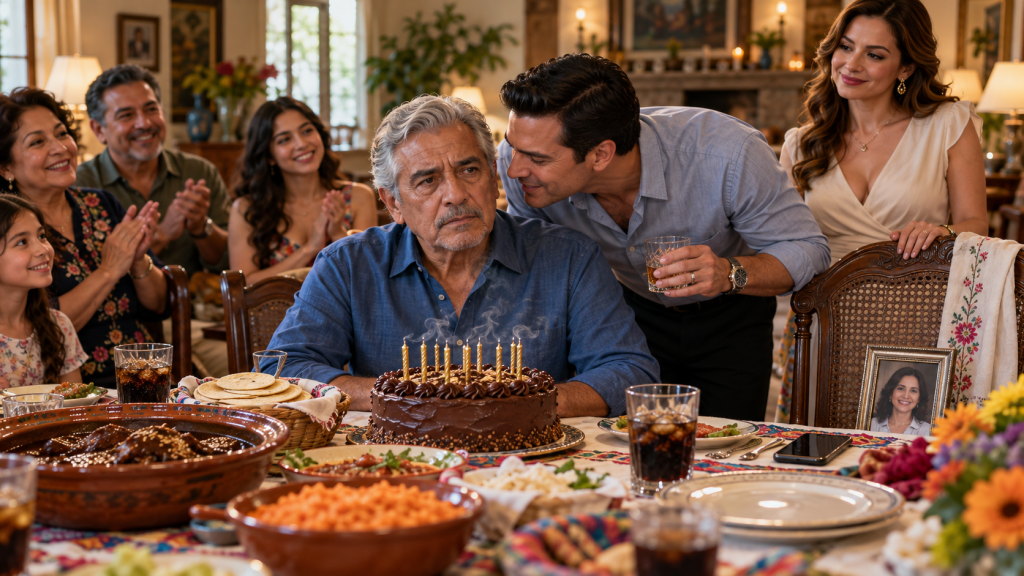
He pulled away. “Dad gave me access.” “No,” I said. His eyes snapped toward me. “I gave you a key years ago for emergencies.” “You told me I could check paperwork. “When?” He opened his mouth. Nothing came out. Robert leaned back in his chair.
He had spent forty years practicing law.
He knew silence was often more useful than questions.
Daniel finally pushed the photograph away.
“This is ridiculous.”
I looked at him.
“Which part?”
“You’ve decided I’m some kind of criminal because I looked through a filing cabinet.”
“You didn’t just look.”
Robert opened his briefcase again.
Daniel stiffened.
That reaction told me there was more he feared.
Robert removed a photocopy.
A loan application.
Not completed.
Not filed.
But drafted.
At the top was the name of my shop.
SALAZAR AUTO & MACHINE, LLC.
Requested credit facility:
$650,000.
Collateral:
The commercial property where my shop had operated for twenty-eight years.
Personal guarantor:
Ernest Salazar.
My signature appeared at the bottom.
Again.
It was not mine.
Lucia gasped.
Daniel’s face changed.
Not fear this time.
Anger.
He looked at Robert.
“Where did you get that?”
Robert answered calmly.
“From a commercial lender who called Ernest yesterday morning after receiving a preliminary inquiry requesting underwriting terms.”
I stared at my son.
“You used my shop as collateral.”
“No.”
“That’s a draft.”
“A draft with my signature.”
“It wasn’t submitted.”
Robert said:
“The inquiry was.”
Daniel shot him a look.
“I didn’t authorize you to discuss my finances.”
Robert almost smiled.
“Good thing we aren’t discussing your finances.”
“We’re discussing Ernest’s.”
Daniel pushed his chair back.
“This is insane.”
Lucia grabbed his sleeve.
“Sit down.”
He looked at her.
For the first time, she did not look beautiful.
She looked frightened.
“Did you forge his name?”
Daniel said nothing.
“Daniel.”
“It wasn’t like that.”
Her hand fell from his arm.
I asked:
“Then tell us what it was like.”
He stared at me.
“You were going to leave everything to us anyway.”
The room became very quiet.
Even Robert looked at him differently.
I felt something inside me go still.
Not break.
That had already happened.
Go still.
I said:
“So you believed future inheritance gave you present ownership.”
“No.”
“That’s what you just said.”
“I’m saying none of this was supposed to hurt you.”
I almost laughed.
There are sentences so cowardly they become insulting.
“You forged my signature on a power of attorney.”
“I prepared it.”
“You forged my signature on a loan draft.”
“I was exploring options.”
“You entered my locked office at midnight.”
“You gave me a key.”
“You wished me dead at my birthday cake.”
His face reddened.
“That was a joke.”
I leaned forward.
“Stop calling cruelty humor because the truth embarrasses you.”
Lucia covered her mouth.
Daniel stared at the table.
Then whispered:
“I was desperate.”
There.
Finally.
Not confused.
Not misunderstood.
Desperate.
Robert looked at me.
I nodded.
Let him talk.
Daniel rubbed both hands over his face.
“My company is in trouble.”
I frowned.
“What company?”
“The development partnership.”
I knew Daniel had invested in two commercial projects with friends.
He talked about them constantly when they were going well.
Luxury townhomes.
Mixed-use offices.
Words that sounded expensive enough to make him straighten his shoulders.
“What kind of trouble?”
“Debt.”
“How much?”
He didn’t answer.
Lucia whispered:
“How much, Daniel?”
He looked at her.
“About nine hundred.”
Her face went blank.
“Thousand?”
He nodded.
She stood so quickly the chair fell backward.
“Are you serious?”
“Lucia.”
“You told me it was one-fifty.”
“I was going to fix it.”
“With his shop?”
She pointed at me.
“Were you going to borrow against your father’s shop?”
Daniel looked away.
Lucia began laughing.
Not because anything was funny.
I recognized that laugh.
The sound people make when reality becomes too large for crying.
She said:
“You told me the investor problem was temporary.”
“It is.”
“You told me your father had agreed to restructure the shop.”
“I was going to talk to him.”
“When?”
He said nothing.
She looked at me.
“Ernest, I swear I didn’t know about this.”
I believed she did not know all of it.
That did not mean she knew nothing.
I picked up the napkin from my birthday.
House.
Shop.
Insurance.
Investment account.
Pending signature.
I placed it in front of her.
“You wrote this.”
Her face changed.
“Yes.”
“What was the pending signature?”
She looked at Daniel.
Then at me.
“He told me you had agreed to transfer management rights in the shop.”
“I had not.”
“I know that now.”
“What did you think the insurance was?”
“He said you wanted us to review beneficiary designations.”
“Us?”
“Daniel and me.”
“And the house?”
Her voice became smaller.
“He said you were planning to place it in a family trust.”
I looked at Robert.
He said nothing.
I looked back at Lucia.
“He told you everything was already approved by me.”
“Yes.”
“Did you ever ask me?”
“No.”
“Why?”
She swallowed.
“Because I wanted it to be true.”
That was the first honest thing she had said all day.
Daniel glared at her.
“Don’t do this.”
She turned.
“Do what?”
“Throw me under the bus.”
Lucia laughed again.
“You drove the bus into a wall.”
The children in the next room laughed at the television.
Then one of my grandsons called:
“Mom, can we have more cake?”
Every adult at the table froze.
Lucia wiped her face.
“I’ll get it.”
I stood.
“No.”
She looked at me.
“I’ll do it.”
I walked into the living room.
My youngest grandson, Mateo, was sitting cross-legged on the carpet.
He smiled.
“Grandpa, can I have another piece?”
I looked at his face.
Daniel’s face at eight years old.
Same eyebrows.
Same gap between his front teeth.
For one second, I nearly fell apart.
Instead, I cut him a slice.
Not too large.
Teresa would have complained.
I cut another for his sister.
Then I returned to the dining room.
And understood something.
Whatever happened next, the children would not become weapons.
I would not make them hate their father to prove he had hurt me.
That line mattered.
I did not yet know how much.
Daniel wanted to leave.
Robert stopped him with words, not force.
“You are free to go.”
Daniel looked toward the front door.
“However, I strongly recommend you preserve all electronic and paper records related to the documents we discussed.”
Daniel turned.
“Is that a threat?”
“No.”
“It is advice.”
Robert put his glasses back on.
“If anyone later destroys records after learning they may be relevant, that creates additional problems.”
Daniel stared at him.
Then at me.
“You’re going to the police.”
I said:
“I don’t know yet.”
That was true.
His face twisted.
“You’d do that to your own son?”
I felt the old reflex.
The guilt.
The invisible hook hidden inside the word son.
Then Teresa’s voice returned in my memory.
When someone pushes you to the edge, you don’t need their permission to step aside.
I said:
“You did something to your own father.”
Daniel flinched.
“That comes first.”
Lucia whispered:
“Ernest…”
I looked at her.
“If you know about any documents bearing my signature that I did not sign, you need your own lawyer.”
Her eyes widened.
“I don’t need a lawyer.”
Robert spoke.
“Do not assume that.”
She stared at him.
Then at Daniel.
Something changed in her face.
She finally understood she did not know which parts of her life had been real.
That feeling would become important later.
Daniel stood.
“Kids.”
I stopped him.
“No.”
His eyes narrowed.
“What?”
“You and Lucia decide together what happens with the children today.”
“You do not order them out of my house because you’re angry at me.”
“I’m their father.”
“Yes.”
“And she is their mother.”
He looked at Lucia.
She shook her head.
“I’m staying here for now.”
His face changed.
“What?”
“I need to talk to you without the kids around.”
“You’re coming home.”
“No.”
That one word seemed to shock him more than anything Robert had shown.
Lucia had probably spent years decorating Daniel’s confidence.
Now she was removing the curtains.
Daniel whispered:
“Don’t embarrass me.”
She stared at him.
Then:
“You forged your father’s signature and hid nine hundred thousand dollars in debt.”
“I think embarrassment is already here.”
He left alone.
The front door closed.
And I sat back down.
For a long time, none of us spoke.
Then Lucia said:
“I need to know what else he did.”
Robert looked at her.
“So do we.”
The first real shock came the next morning.
Not from the bank.
Not from the insurance company.
From Luis Mendoza.
Luis had worked at my shop for nineteen years.
Started sweeping floors.
Eventually became operations manager.
He knew every lift, every technician, every customer who still called me “Mr. Salazar” even though I had told them a hundred times to call me Ernest.
Luis called at 6:18 a.m.
“Boss.”
“You sound terrible.”
“So do you.”
“Thank you.”
“I need to tell you something.”
I sat up.
“What?”
“Daniel came by last week.”
“I know.”
“No.”
Luis hesitated.
“I mean during business hours.”
“What did he want?”
“He asked me how much cash flow the shop generates.”
My stomach tightened.
“What did you tell him?”
“Nothing exact.”
“He said you were reorganizing ownership.”
“Of course he did.”
“He asked about equipment values.”
“Property insurance.”
“Whether the lien on the alignment machine had been cleared.”
I closed my eyes.
“How long?”
“About two months.”
That was before my birthday.
Before the midnight file cabinet.
Before the draft loan.
Planning.
Not panic.
“What else?”
“He brought a man.”
My eyes opened.
“What man?”
“Said he was a business consultant.”
“Name?”
“Marcus Vale.”
I wrote it down.
“What did they do?”
“Walked the property.”
“Looked at the rear lot.”
“Asked about expansion.”
“Daniel said you wanted to sell the commercial parcel and lease back the building.”
I almost laughed.
“He said that.”
“Yes.”
“Did you believe him?”
Luis went quiet.
“At first.”
“And then?”
“He asked me not to mention it because you were ‘sensitive about losing control.’”
There it was.
The aging angle.
A useful lie because everybody expects old men to become defensive about control.
Luis continued.
“That bothered me.”
“So I checked with you indirectly.”
“When?”
“Remember when I asked if we were repainting the bay numbers because of an appraisal?”
I remembered.
I had said:
What appraisal?
Luis laughed and changed the subject.
At the time I thought nothing of it.
He said:
“When you looked confused, I knew something was wrong.”
“Why didn’t you tell me?”
“I should have.”
“Yes.”
“I thought maybe Daniel was planning something as a surprise.”
“A surprise sale of my shop.”
“I know.”
He sounded ashamed.
I softened.
“Keep going.”
“Marcus came back two days later without Daniel.”
“What?”
“Asked for utility records.”
“Tax bills.”
“Environmental inspection.”
“Did you give him anything?”
“Only public stuff.”
“No internal financials.”
“Good.”
“Boss?”
“Yes?”
“I took a picture of his business card.”
“Send it.”
Thirty seconds later, the image arrived.
MARCUS VALE — VANTAGE CAPITAL RESTRUCTURING.
Robert had heard of them.
Not criminals.
Not mobsters.
A distressed-debt advisory company.
The kind hired when businesses were already bleeding.
Daniel had not been casually exploring options.
He was preparing a rescue package.
With my property as collateral.
I looked at the shop through my bedroom window in my mind.
The old brick building.
Teresa bringing lunch to me there when we were young.
Daniel doing homework at a desk near the parts counter.
Thirty years of mornings.
He was not trying to inherit it.
He was trying to spend it before I died.
That difference cut deeper.
Robert and I spent the next week shutting doors.
Lawfully.
Quietly.
We notified the insurance company in writing that no authority existed for Daniel to change beneficiaries or borrow against policies.
We notified the shop’s bank that Daniel had no borrowing authority.
We reviewed every signature card.
Every account permission.
Every old power of attorney.
Every “just in case” form I had signed over the years.
Daniel had never actually possessed broad control.
But I had left enough small permissions scattered around my life to make me uncomfortable.
Emergency check-signing authority on one operating account.
Access to copies of tax records.
A spare shop key.
Listed contact on one insurance policy.
A backup contact with the storage company.
Nothing alone would have handed him my world.
Together, they created the appearance of involvement.
Appearances can become dangerous when combined with forged paper.
I revoked everything that did not need to exist.
Not because age had made me paranoid.
Because documentation had made me informed.
Robert told me something I did not like.
“You also need to consider an independent evaluation.”
“For what?”
“Capacity.”
I stared at him.
“I just hired you to reorganize half my estate.”
“I know.”
“Do I seem incompetent?”
“No.”
“Then why?”
“Because if Daniel’s documents were designed to activate upon incapacity, and if anyone later argues that you are acting irrationally because you are angry, contemporaneous evidence of your decision-making capacity helps.”
My pride rose immediately.
Then I killed it.
“Fine.”
A geriatric physician and neuropsychologist assessed me.
Four hours.
Memory tests.
Reasoning.
Financial hypotheticals.
Names.
Dates.
Patterns.
The report was almost insulting in its ordinariness.
Normal age-related slowing.
No evidence of dementia.
No impairment affecting independent financial or legal decision-making.
I read the summary twice.
Then asked:
“Can I frame this?”
Robert said:
“Please don’t.”
I framed it anyway.
Not in the living room.
I still had dignity.
Lucia moved into her sister’s house with the children.
Daniel stayed in their home alone for three weeks.
Then the bank called.
Not my bank.
His.
Lucia called me sobbing.
“There’s a second mortgage.”
I closed my eyes.
“How much?”
“Four hundred twenty thousand.”
Their home was worth maybe seven-fifty.
They had purchased it for much less years earlier.
Daniel had apparently refinanced while rates were favorable, then borrowed again later.
Lucia knew about the first refinance.
Not the home-equity line that followed.
“How did he do it without you?”
“The house is titled in both names.”
“Then you would normally have signed relevant documents.”
“I know.”
Silence.
I felt cold.
“Lucia.”
“I didn’t sign it.”
There it was again.
Another signature.
This one not mine.
Hers.
That changed everything.
She got her own attorney that afternoon.
Not Robert.
Not someone Daniel knew.
Her attorney, Camille Ford, specialized in family law and financial fraud.
Good.
Within days, the lender produced copies.
Lucia’s signature appeared on a consent and acknowledgment.
The notary block was complete.
The notary existed.
But when contacted through counsel, the notary said she had never met Lucia.
That no longer looked like one forged document created in desperation.
It looked like a pattern.
Lucia stopped defending Daniel after that.
Not because she suddenly loved me.
Because the fraud had entered her name.
People often understand betrayal more clearly when it stops happening nearby and starts happening to them.
I did not judge her for that.
I had spent years doing something similar.
The children noticed everything.
Of course they did.
Adults think children are protected by not being told facts.
Usually they are only forced to invent explanations.
My granddaughter Sofia was twelve.
Mateo was nine.
One evening, Sofia asked me:
“Is Dad stealing?”
I nearly choked on coffee.
Lucia said:
“Sofia.”
“What?”
“You said we don’t lie.”
The girl looked at all of us.
“So?”
Lucia closed her eyes.
Then she did something I respected.
She answered carefully.
“Your dad made financial choices that may have been dishonest.”
“Did he steal from Grandpa?”
“We don’t know how every legal issue will be described.”
Sofia rolled her eyes.
She was twelve.
Legal nuance was not her priority.
I said:
“He used my name on papers I did not sign.”
Her face changed.
“That’s stealing.”
“It may be fraud.”
“What’s the difference?”
“Adults pay lawyers to argue about that.”
She almost smiled.
Then asked:
“Is he going to jail?”
I looked at Lucia.
She looked at me.
I answered:
“I don’t know.”
“Are you sending him?”
“No.”
“Then who does?”
“If there are criminal charges, prosecutors and judges make those decisions.”
Sofia became quiet.
Then:
“Do you still love Dad?”
That question hurt more than the financial ones.
“Yes.”
She looked confused.
“But you’re mad.”
“Yes.”
“Can both happen?”
“Unfortunately.”
She nodded.
Then said:
“I’m really mad too.”
“That’s allowed.”
Mateo, who had been silent, whispered:
“I don’t want Dad to go to jail.”
I reached across the table.
“Come here.”
He climbed into my lap even though he was getting too big.
I held him.
“You do not have to want anyone punished.”
“Okay?”
He nodded.
“You can love your father.”
“You can be angry.”
“You can be scared.”
“You do not have to pick a team.”
That became our rule.
No teams.
Facts.
Boundaries.
Consequences.
But no teams.
Daniel disappeared for three days.
Not literally.
He answered his attorney.
Ignored family.
Stayed in a hotel.
On the fourth day, he asked to meet me.
Public place.
Robert insisted on joining.
Daniel brought his attorney, a man named Samuel Price.
He looked exhausted.
No expensive watch.
No polished smile.
He sat across from me.
“Dad.”
“Daniel.”
He took a breath.
“I want to tell you everything.”
Samuel placed one hand on his folder.
“Within limits.”
Daniel nodded.
Good.
Lawyers.
Reality.
I waited.
He began with the development partnership.
Three years earlier, Daniel had invested $180,000.
Part savings.
Part borrowed.
The project went well at first.
Then construction costs increased.
One investor withdrew.
Another project needed cash.
Daniel guaranteed a bridge loan.
Then another.
He concealed losses from Lucia.
Refinanced their house.
Moved money.
Used credit cards.
Borrowed from friends.
By the time he finally admitted the scale to himself, personal exposure was close to $900,000.
“How much exactly?”
“Eight hundred seventy-three thousand, depending on guarantees.”
Lucia’s earlier nine hundred was close.
I asked:
“Why didn’t you come to me?”
He laughed once.
“Because you would have said no.”
“Did you ask?”
“No.”
“Then you don’t know.”
“I knew.”
“No.”
“You knew I would ask questions.”
His eyes filled.
Maybe that distinction mattered.
Daniel continued.
“I thought if I could secure one large facility, I could consolidate everything.”
“Using my shop.”
“Yes.”
“You prepared the loan draft.”
“Yes.”
“Did you submit my forged signature?”
He looked at Samuel.
Samuel said:
“You may answer as we discussed.”
Daniel swallowed.
“No.”
“The unsigned lender inquiry went out.”
“The draft with the forged signature stayed on my laptop.”
Robert asked:
“Who created the signature?”
Daniel looked down.
“I did.”
There.
Direct.
No euphemism.
I felt sick.
“And the power of attorney?”
“I used an old scanned signature from tax paperwork.”
Lucia had not joined the meeting.
I was glad.
I asked:
“Why?”
He cried.
“I needed a document that looked like you had already agreed.”
“To whom?”
“Marcus.”
“The lenders.”
“Eventually the insurance company.”
I stared.
“So the plan was larger than borrowing against the shop.”
“Yes.”
“What else?”
He rubbed his face.
“The life insurance.”
“How?”
“You had cash-value policies.”
“Yes.”
“I thought if I had authority, I could borrow against them.”
My stomach turned.
“How much?”
“About two hundred thousand available.”
Robert already knew.
He had confirmed.
Still, hearing Daniel say it felt different.
I asked:
“And the house?”
He looked at me.
“I thought you could take a reverse mortgage.”
I laughed.
A loud, ugly laugh.
“My birthday napkin.”
He looked confused.
I continued.
“Lucia wrote house, shop, insurance, investment account.”
“She thought I had agreed.”
Daniel nodded.
“Yes.”
“So you built an entire rescue plan around every asset I owned.”
Silence.
“Yes.”
“And what happened to me in this plan?”
“You would still have income.”
I stared.
“That’s your answer?”
“I wasn’t trying to leave you with nothing.”
“Only less.”
He cried.
“Yes.”
I leaned back.
For a moment, I saw him as a boy again.
Not because he looked innocent.
Because I remembered teaching him to ride a bicycle.
Running behind him.
One hand on the seat.
Then letting go.
He had screamed:
“Don’t let go!”
Maybe somewhere along the way I had never truly stopped holding the seat.
Paid college.
Helped with his first house.
Rescued business mistakes.
Introduced him to people.
Gave him keys.
Authorized him for emergencies.
Then wondered why he believed my life was the final safety net.
That did not make forgery my fault.
But it forced me to examine the pattern.
I asked:
“Why did you say what you said at my birthday?”
Daniel’s face collapsed.
“I was drunk.”
“No.”
“I had been drinking.”
“That explains volume.”
“Not content.”
He cried silently.
Then:
“I was angry.”
“At me?”
“Yes.”
“For being alive?”
He closed his eyes.
“That sounds horrible.”
“It was horrible.”
“I know.”
“Say it anyway.”
He whispered:
“Part of me thought if you died, everything would become easier.”
There it was.
The sentence beneath the candle.
He continued:
“The insurance.”
“The estate.”
“The shop.”
“I could resolve everything.”
“I didn’t want you dead like…”
He struggled.
“Like I wanted to hurt you.”
“I just…”
He stopped.
I waited.
“I wanted the problem solved.”
I felt tears rise.
“And I was the problem.”
Daniel looked at me.
“Yes.”
My son said yes.
That truth hurt more than every forged signature.
Because paper can be voided.
A sentence can live forever.
I did not forgive him that day.
I also did not disown him.
Both surprised people.
My brother called from Arizona.
“If my kid did that, he’d never hear my voice again.”
I said:
“That would make your life simpler.”
He became quiet.
I continued.
“I am not looking for simple.”
Daniel had harmed me.
He was also my son.
Those facts did not cancel each other.
The legal process moved separately from my emotions.
That mattered.
The insurance company referred the forged power-of-attorney document to investigators.
The lender preserved the forged loan draft after Daniel voluntarily disclosed it through counsel.
Lucia’s mortgage documents created additional exposure.
Law enforcement became involved.
Interviews.
Document subpoenas.
Digital forensic review.
Slow.
Nothing like television.
No detective slammed Daniel against my birthday table.
No one shouted:
You’re going away for twenty years.
There were appointments.
Letters.
Lawyers.
Months.
The most dramatic thing most weeks was certified mail.
Eventually, evidence showed Daniel had created multiple falsified authorization documents.
Some had never been used successfully.
Others had been used to support financial representations.
The home-equity transaction involving Lucia’s forged acknowledgment had actually closed.
That was serious.
Daniel’s defense counsel negotiated.
Prosecutors narrowed counts.
The lender’s losses were complicated because the loan was secured by property and payments had been made for months.
But falsified execution remained.
Daniel eventually pleaded guilty to felony-level fraud and forgery-related charges connected to the home-equity transaction and attempted use of falsified documents.
He received a sentence that included a period of incarceration, supervised release, restitution, financial restrictions, and community-service obligations after release.
Not twenty years.
Not nothing.
Eighteen months.
He served a substantial portion.
Some relatives called it too lenient.
Lucia thought it was too harsh the first week.
Then she found another hidden account.
After that, she stopped discussing fairness with me.
Yes.
Another account.
That was the twist none of us expected.
Not because it contained millions.
It didn’t.
Because of where the money came from.
During divorce discovery, Lucia’s attorney found an account holding approximately $118,000.
Opened eighteen months earlier.
Transfers came from Daniel’s consulting fees.
Some legitimate.
Some not disclosed to Lucia.
But one recurring source caught the accountant’s attention.
Monthly payments from:
SALAZAR FLEET SERVICES.
My shop did not have a company by that name.
I called Luis.
“Have you ever heard of Salazar Fleet Services?”
Silence.
Then:
“No.”
Robert searched business records.
The company had been formed by Daniel two years earlier.
Registered to a mailbox.
Its purpose:
Automotive fleet consulting.
My last name.
My industry.
My customers.
Daniel had been invoicing two fleet clients who believed they were purchasing a subcontracted service affiliated with my shop.
He did perform some consulting.
But the branding implied a connection that did not exist.
Worse, the clients had originally been introduced through my business.
Daniel had quietly converted relationships that came from my shop into his private revenue stream.
I sat in Robert’s office holding the incorporation papers.
“This isn’t stealing from the shop exactly.”
Robert shook his head.
“Not automatically.”
“The facts matter.”
“Did your business have exclusive customer agreements?”
“Some.”
“Did Daniel owe the business duties?”
“He was never an employee.”
“Then the legal claims require care.”
Again.
Reality.
No instant theft label.
But the moral picture was clear.
Daniel had not only seen my assets as future rescue.
He had been using my reputation as current capital.
That hurt almost more than the loan.
My name.
Salazar.
I had spent thirty years making that name mean:
Fair work.
No unnecessary repairs.
Call the customer before adding labor.
Fix mistakes without excuses.
Daniel had turned it into a brand he could borrow.
I did something then that I had resisted all year.
I cried in Robert’s office.
Not polite tears.
I put my face in both hands and sobbed.
Robert waited.
Good friend.
No speech.
No hand on my shoulder too early.
When I finally stopped, I said:
“I raised him.”
Robert replied:
“Yes.”
“That’s all?”
“What do you want me to say?”
“That you did everything right?”
“You didn’t.”
I looked at him.
Damn lawyers.
He continued:
“You rescued him too often.”
“You confused providing with protecting.”
“You ignored behavior Teresa would have challenged.”
“You liked that he looked successful because it made your sacrifices feel successful.”
Every word hurt.
Then he said:
“And none of that forged your signature.”
I stared.
“That part belongs to Daniel.”
I nodded.
That became important.
Owning my mistakes without adopting his.
Lucia filed for divorce six months after my birthday.
Not immediately.
She tried counseling.
Mostly because of the children.
Daniel, before sentencing, attended.
For a while she considered staying.
People judged her.
I refused.
It is easy to make decisions about betrayal from outside someone else’s marriage.
Then she discovered Salazar Fleet Services.
And the hidden account.
That ended it.
She told me:
“I don’t know which version of my life is real anymore.”
I understood.
She continued:
“If he cheated, I think I would know how to hate him.”
“This is worse.”
“What is?”
“He made me participate in plans I didn’t understand.”
I thought of the napkin.
House.
Shop.
Insurance.
Investment account.
Pending signature.
Lucia had been greedy.
Yes.
She had looked around my house and imagined remodeling.
She had wanted the shop “in the family.”
She had talked about inheritance while I was healthy.
Those things were real.
But Daniel had also fed that greed with lies.
He told her I had agreed.
Told her transfers were planned.
Told her my estate documents were changing.
She wanted to believe him.
That was her responsibility.
The forged signatures were his.
Again.
Different parts.
I changed my estate plan.
Of course I did.
But not the way everyone expected.
I did not leave Daniel one dollar with a note saying:
You wished me dead, so now you get nothing.
That would have been satisfying for ten minutes.
Maybe a week.
Then what?
I met with Robert and an estate-planning specialist.
We built a plan based on actual goals.
The house.
The shop.
My retirement.
Grandchildren.
Charity.
Long-term management.
Daniel’s inheritance became a restricted trust.
Not zero.
Restricted.
Why?
Because I was done pretending love required blind access.
His trust had an independent trustee.
No ability to pledge future distributions.
No power over the shop.
No unilateral control over investment accounts.
His children had separate education and support trusts.
Lucia had no direct claim through my estate, though certain funds for grandchildren could support needs while they were minors.
My shop management passed to Luis under a structured purchase arrangement over time.
That surprised Daniel.
When he heard after his release, he asked:
“You sold the shop to Luis?”
“Yes.”
“You always said it was for family.”
I stared at him.
“Luis has been family in every way that mattered to the shop for nineteen years.”
Daniel looked hurt.
I let him.
Then:
“Did I ever promise you ownership?”
He thought.
“No.”
“Exactly.”
That was the end of that conversation.
Luis did not get the shop free.
Important.
I was not replacing one entitled son with one favored employee.
We had it valued.
He bought a meaningful stake with financing.
I retained income and protections during transition.
Over years, ownership shifted.
His employees received a profit-sharing plan.
The company stayed open.
My name stayed on the sign for a while.
Then one morning, five years later, Luis asked:
“You want to keep Salazar?”
I looked up at the sign.
SALAZAR AUTO & MACHINE
My name.
My reputation.
My pain.
My pride.
I said:
“Change it.”
He stared.
“You sure?”
“Yes.”
“What to?”
“Mendoza & Crew.”
He laughed.
“That sounds like a landscaping company.”
“Then come up with something better.”
Eventually it became:
MENDOZA MOTOR WORKS.
First week after the sign changed, I sat in my truck across the street.
Cried.
Then went inside and criticized everyone’s coffee.
Life continued.
Daniel’s incarceration changed the children.
Not in the dramatic ways adults predicted.
Sofia became quieter.
Mateo became angry at school.
Lucia got both into counseling.
Good.
Sofia refused prison visits for months.
Mateo wanted to go immediately.
Again, no teams.
Lucia allowed each child to make age-appropriate choices with the therapist’s guidance.
I went once.
Not at first.
Nine months in.
Daniel sat across from me wearing prison clothes.
No watch.
No expensive shirt.
No authority.
I hated seeing him there.
That surprised me.
I had spent months telling myself consequences were necessary.
They were.
Necessary things can still hurt.
He sat down.
“Dad.”
I nodded.
“You look old.”
I almost laughed.
“I am sixty-four.”
He smiled.
“Still mean.”
“Still employed.”
He looked down.
Then:
“I got your letter.”
I had written only once.
Three pages.
No sermon.
Mostly family updates.
Mateo scored a goal.
Sofia got an A in science.
Lucia moved apartments.
Shop busy.
At the bottom I wrote:
I love you. That does not erase what happened.
Daniel said:
“I read that line every day.”
“Good.”
“I hated it.”
“Better.”
He laughed.
Then cried.
After a minute, he said:
“I keep thinking about the birthday.”
“So do I.”
“I wish I could take it back.”
“You can’t.”
“I know.”
He looked at me.
“Did you really mean your wish had already come true?”
“Yes.”
“What was it?”
I thought about that night.
The candles.
Teresa’s chair.
His whisper.
My answer.
“My wish was that I would stop being afraid of losing my children if I said no.”
Daniel’s face changed.
I continued.
“For years, every time you asked for something, I thought saying no might push you away.”
“So I said yes.”
“Money.”
“Introductions.”
“Keys.”
“Access.”
“Second chances.”
“I told myself it was love.”
He cried.
“It was fear.”
I nodded.
“Your sentence killed that fear.”
He whispered:
“I’m sorry.”
“I know.”
“That’s why the wish came true?”
“Yes.”
He looked away.
Then said:
“I’m glad.”
I almost got angry.
He continued quickly.
“I mean—I hate how it happened.”
“But I’m glad you stopped being afraid of me leaving.”
He wiped his eyes.
“You should have been able to tell me no.”
That was the first moment I saw something new in him.
Not remorse because punishment hurt.
Understanding.
Small.
Fragile.
Real.
Daniel came home after serving his sentence.
Not to my house.
That mattered.
He moved into a small apartment.
Worked initially in a warehouse because no development firm wanted him.
He hated it.
Then something unexpected happened.
He became good at inventory management.
Not glamorous.
Useful.
Within two years, he became operations supervisor.
He called me one night.
“They promoted me.”
“Good.”
“Do you want to know the salary?”
“No.”
Silence.
Then he laughed.
“Wow.”
“What?”
“Old me would have told you anyway.”
“Old me would have pretended to care.”
We both laughed.
Progress.
Lucia did not reconcile with him.
She dated eventually.
A nurse named Adrian.
Quiet man.
Good with the children.
Daniel hated him.
Of course.
Then Sofia said:
“Dad, you don’t get to be mad Mom moved on.”
That shut him up faster than any attorney.
Daniel later told me.
“I wanted to say something awful.”
“What stopped you?”
“She was right.”
Growth often looks unimpressive from the outside.
A man not saying something cruel.
That was enormous for Daniel.
Lucia apologized to me three years after the birthday.
Not for Daniel.
For herself.
We were sitting at a school concert.
She leaned toward me.
“I owe you something.”
“I hope not money.”
She smiled.
“No.”
Then:
“I did look at your house like it was already ours.”
“I know.”
“I did talk about your shop like Daniel deserved it.”
“I know.”
“I liked imagining what we’d have after you were gone.”
That hurt.
But not like before.
She continued.
“I never wanted you dead.”
“I know.”
“But I treated your death like a future financial event.”
I turned toward her.
She had tears in her eyes.
“I’m sorry.”
I thought of Teresa’s chair.
The napkin.
Lucia’s smile.
Then I said:
“Thank you.”
Not:
It’s okay.
It wasn’t.
Thank you was enough.
At sixty-eight, I had a heart attack.
Minor.
If a heart attack can be called minor.
I woke in the hospital with Daniel on one side of the bed and Lucia on the other.
That made me laugh.
“Did I die and become your marriage counselor?”
Daniel smiled.
Lucia rolled her eyes.
The children, teenagers by then, waited outside.
Robert came later.
Still wearing a suit because I believe lawyers are born dressed for probate.
Daniel looked nervous.
I noticed.
“What?”
He hesitated.
“The doctors asked about your medical power of attorney.”
“Yes.”
“I told them to call Robert.”
Good.
“You didn’t try signing anything?”
His face fell.
Then I laughed.
“Too soon?”
“Dad.”
“Definitely too soon.”
But then he smiled.
That joke would have been impossible five years earlier.
Trust does not always return as solemnity.
Sometimes it returns when pain becomes history sturdy enough to touch.
My medical agent was my sister Elena and then a professional fiduciary.
Not Daniel.
He knew.
Accepted it.
Did not pout.
That acceptance mattered more than being named.
After the heart attack, I downsized.
Sold the big house.
The one where Teresa painted the flowerpots red.
That was harder than selling part of the shop.
Daniel asked:
“Do you want me to help?”
I thought.
Then:
“Yes.”
He packed boxes.
Carefully.
No hidden documents.
No safe.
No inheritance conversation.
We found Teresa’s recipe cards.
Old photographs.
Daniel’s kindergarten drawing.
A Father’s Day card:
MY DAD CAN FIX EVERYTHING.
I sat on the floor holding it.
Daniel sat beside me.
Neither of us spoke.
Finally, he whispered:
“You couldn’t.”
“No.”
“You tried.”
“Yes.”
“I think that messed me up.”
I looked at him.
He smiled faintly.
“Not blaming you.”
“Just saying.”
I nodded.
“What should I have done?”
“Let me fail earlier.”
That hurt because it was probably true.
He continued.
“You always fixed the bill.”
“The business.”
“The car.”
“The college mistake.”
“I think I learned consequences were delays.”
I stared at him.
“And then you forged my name.”
“That part was mine.”
Good.
He knew the boundary.
I squeezed his shoulder.
“You were a good little boy.”
He started crying.
“I know.”
“That’s the hardest part.”
Yes.
It was.
People want villains to have been villains from birth.
Easier.
My son had once slept on my chest watching cartoons.
Then became a man who used my signature.
Both were real.
I moved into a two-bedroom condo.
No stairs.
Less maintenance.
A balcony.
One red flowerpot from Teresa.
The rest I gave away.
On my sixty-ninth birthday, Daniel brought a cake.
I stared at the candles.
He noticed.
“Too weird?”
“Little.”
“I can throw it away.”
“No.”
We lit them.
Family gathered.
Sofia.
Mateo.
Lucia and Adrian.
Daniel.
Robert, somehow still alive and billable.
Luis.
My sister.
No one made inheritance jokes.
Before I blew out the candles, Daniel leaned close.
My body tensed automatically.
Seven years and the nervous system remembered.
He noticed.
His face broke.
He stepped back.
Then said loudly enough for everyone:
“I hope you blow out a lot more.”
People laughed.
I did too.
Then I made a wish.
A real one.
Nobody asked what.
Good.
Some things belong only to the person making them.
Daniel eventually remarried.
Her name was Maria.
Teacher.
Divorced.
No interest in property development.
Before the wedding, he told her everything.
Not because I told him to.
Because he had learned what secrecy costs.
She asked to meet me alone.
I was suspicious.
Of course.
We had coffee.
Maria said:
“I know about the forged documents.”
“Good.”
“I know about prison.”
“Good.”
“I know about Lucia.”
“Good.”
“I know about the shop.”
“Good.”
She smiled.
“Do you say anything else?”
“Sometimes.”
She laughed.
Then:
“Do you think he changed?”
I considered.
“Yes.”
She relaxed.
Then I continued.
“That does not mean he became incapable of doing wrong.”
Her face changed.
I leaned forward.
“Do not date his redemption story.”
“Date the man in front of you.”
“If he starts hiding things, do not tell yourself his past means he learned every lesson forever.”
She nodded slowly.
“That’s good advice.”
“It cost me a house-sized amount of therapy to learn.”
She laughed.
They married.
It lasted.
At least so far.
Robert died when I was seventy-four.
That one hurt.
Not sudden.
Cancer.
Near the end, I visited him.
He looked tiny in the hospital bed.
The man who had walked into my dining room at seven in the morning with black coffee and a briefcase.
He whispered:
“You finally updated your estate plan?”
“Yes.”
“Properly?”
“Yes.”
“Independent trustee?”
“Yes.”
“Shop succession complete?”
“Yes.”
“Good.”
I smiled.
“You charging me for this conversation?”
“Estate work.”
“Obviously.”
We laughed.
Then he became serious.
“Ernest.”
“Yes?”
“You know you didn’t save Daniel.”
I frowned.
“What?”
“You stopped saving him.”
“Different thing.”
I stared.
He continued.
“That may be the best thing you ever did for him.”
I looked away.
“I wish Teresa had been here.”
“So do I.”
“She would have handled him better.”
Robert smiled.
“She would have hit him with a wooden spoon.”
I laughed until I cried.
He died three weeks later.
I inherited nothing from him.
A perfect lawyer.
Years later, Daniel and I drove past the old shop.
Mendoza Motor Works was busy.
Cars in every bay.
New sign.
Different paint.
Daniel looked out the window.
“Do you ever regret not leaving it to me?”
I thought.
“No.”
He nodded.
Then smiled.
“Good.”
“That easy?”
“No.”
He looked at the building.
“I used to think inheritance meant Dad believed in me.”
“And now?”
“I think you selling it to Luis was one of the first times you treated me like an adult.”
I looked at him.
“By not giving you something?”
“Yes.”
He laughed.
“Annoying, isn’t it?”
“Extremely.”
He continued.
“You stopped planning around my feelings.”
That was true.
I stopped making assets say what I should have said directly.
I love you.
Did not need to mean:
You get the shop.
I forgive you.
Did not need to mean:
You get control.
You are my son.
Did not mean:
You are entitled.
Those distinctions arrived late.
Still useful.
At seventy-six, I finally told Daniel the entire truth about his mother’s last year.
Not because I had hidden some affair.
Nothing dramatic.
Teresa had known he was becoming entitled long before I admitted it.
During her cancer treatment, Daniel once pressured us to co-sign a business loan.
I wanted to.
Teresa refused.
She told me:
“Ernest, if you keep cushioning every fall, someday he’ll jump from somewhere too high.”
I got angry.
Told her she was being harsh.
We co-signed a smaller amount anyway.
Daniel paid it back.
I used that as proof Teresa had been wrong.
She wasn’t.
The lesson Daniel learned was not:
I honored a debt.
It was:
My parents will put themselves at risk when I ask convincingly enough.
I told him this while sitting on my balcony.
He cried.
“She saw me like that?”
“She loved you.”
“That wasn’t my question.”
No.
He had learned that from me too.
I answered:
“Yes.”
“She was worried.”
He looked away.
“Did she stop loving me?”
“Never.”
He closed his eyes.
“Did she think I was bad?”
“No.”
“She thought you were becoming dangerous to yourself because you were getting too comfortable with rescue.”
He cried silently.
Then:
“I wish she had told me.”
“So do I.”
There it was.
Another family failure.
Silence framed as protection.
Even Teresa.
Even me.
We were all less wise than memory makes the dead.
Sofia became a lawyer.
Of course she did.
Family suffering is apparently excellent recruitment.
At her law-school graduation, she hugged me.
“Grandpa, you know why I picked this?”
“Because you enjoy billing?”
She laughed.
“No.”
“Because of Dad.”
I became careful.
“What about him?”
“I saw how paper could hurt people.”
“Then I saw how paper could protect them.”
“Your trust.”
“Mom’s divorce agreement.”
“The shop transfer.”
“Dad’s restitution plan.”
“I realized documents aren’t cold.”
“They’re promises people can enforce.”
That made me cry.
I told her:
“Just remember people matter more than paper.”
She smiled.
“And paper matters when people forget that.”
Teresa would have loved her.
Mateo went the other direction.
Mechanical engineering.
Loved engines.
Spent summers at Mendoza Motor Works.
Luis treated him like any other intern.
Minimum wage.
Dirty uniforms.
No grandfather privilege.
One afternoon Mateo complained:
“Luis made me clean the parts washer.”
I said:
“Good.”
“I’m an engineering student.”
“You’re also nineteen.”
He glared.
Then laughed.
Daniel, standing nearby, said:
“Listen to your grandfather.”
We both stared at him.
He smiled.
“I heard it.”
Progress again.
Years later, Mateo asked whether he might buy into the shop someday.
Luis said:
“Maybe.”
Not:
It belongs to your family.
Maybe.
Earned uncertainty.
Healthy.
At eighty, I updated my estate one last time.
Sofia came with me.
Not as my lawyer.
As my granddaughter.
My new attorney, Rachel Kim, reviewed everything.
House sold.
Shop transition completed.
Investments healthy.
Restricted trust for Daniel.
Separate shares for grandchildren.
Charitable gifts.
No surprise clauses.
No traps.
No punishment triggered by funerals.
I called the family together.
Everyone complained.
“Is this necessary?”
“Yes.”
“Are you dying?”
“Eventually.”
We sat around a table.
Different house.
Same family.
I explained the broad plan.
Not every dollar.
Enough.
Daniel listened.
No argument.
Then asked:
“Why do I still have a restricted trust?”
The room went quiet.
Good question.
I answered:
“Because forgiveness changed our relationship.”
“It did not change history.”
He nodded.
“That’s fair.”
I continued.
“If you disagree, say so now.”
He smiled.
“Old me would.”
“What would old you say?”
“That it proves you don’t trust me.”
“And new you?”
“It proves you trust yourself.”
That sentence stayed with me.
Maybe that was the whole story.
I had spent years demanding proof other people were trustworthy when the real thing I lacked was trust in my own ability to set boundaries if they were not.
On my eighty-second birthday, the family gathered again.
Fewer people.
More gray hair.
Sofia had a baby.
Mateo was engaged.
Daniel stood beside me at the cake.
Before candles, he tapped his glass.
I groaned.
“No speeches.”
“Too late.”
Everyone laughed.
He looked at me.
Then at the family.
“Most of you know what happened on Dad’s sixty-third birthday.”
Sofia whispered:
“Oh God.”
Daniel smiled.
“I said something cruel.”
“Cruel” was small.
Still accurate.
“I told him I hoped it was his last candle.”
The room became quiet.
He continued.
“I used to think the worst thing I did was say it.”
“It wasn’t.”
“The worst thing was that I had begun treating his life like an obstacle between me and things I wanted.”
My throat tightened.
Daniel continued.
“I told myself I deserved the shop because I was his son.”
“The house because I was family.”
“The insurance because he would leave it to us someday.”
“Access because I was helping.”
“I turned love into a claim.”
He looked at me.
“And when Dad finally said no, I acted like he had betrayed me.”
I felt tears.
He continued.
“I lost a lot because of what I did.”
“Some of it I should have lost.”
“Some hurt anyway.”
“But the thing I got back was a father I learned to visit without asking what he could give me.”
Nobody moved.
Then Daniel said:
“Dad, I hope you blow out every candle they sell.”
I laughed.
“Inflation is going to make that expensive.”
Everyone laughed.
Then I blew out eighty-two candles represented by a single large number-shaped candle because the fire department has standards.
I made no dramatic wish.
I already had enough.
If you ask what happened to the old forged power of attorney, I still have a copy.
Not the original.
That became part of the case file.
My copy is inside a folder in my desk.
On the front I wrote:
THE DAY I STOPPED CONFUSING LOVE WITH ACCESS.
Next to it is the photograph from the shop camera.
Daniel opening my file cabinet at 11:43 p.m.
For years, I kept that photograph because I thought it protected me from forgetting what he had done.
Eventually, I realized I no longer needed protection from memory.
So I moved it into storage.
Not destroyed.
Not displayed.
History.
That is what consequences should eventually become if we are lucky.
History.
Not a shrine.
Not a weapon.
A record.
People often expect me to say the best thing I did was changing the trust.
Or calling Robert.
Or securing the shop.
Those things mattered.
But the best thing I did happened much earlier.
At the birthday table.
When Daniel whispered:
“I hope this is the last candle you ever blow out.”
Something in me stopped begging to be treated well.
That was the shift.
Before that night, I believed boundaries were risks.
What if he gets angry?
What if Lucia keeps the grandchildren away?
What if Daniel says I don’t love him?
What if the family thinks I’m selfish?
What if I die and my children remember me as difficult?
Fear.
Fear dressed as generosity.
Fear dressed as peace.
Fear dressed as family loyalty.
After that sentence, I understood:
If someone only experiences your love as real when you surrender, then surrender is what they love.
Not you.
That realization saved years of my life.
I also learned something more uncomfortable.
Daniel did not become entitled alone.
Lucia encouraged some of it.
His business friends encouraged it.
Our culture encouraged some of it.
Success.
Inheritance.
Family property.
But I helped too.
Every time I said:
Don’t worry, I’ll cover it.
Every time I rescued him before failure became instructive.
Every time I ignored a disrespectful comment because “he’s under stress.”
Every time I let him talk about my shop as if it were already his.
Every time I laughed instead of saying:
No.
I helped build the environment.
Not the forgery.
That was his.
But the environment.
There is a difference between responsibility and blame.
Older age taught me that distinction better than youth ever did.
Lucia once asked me whether I thought Daniel would have actually taken everything if the forged documents had worked.
I answered:
“I don’t know.”
She looked surprised.
“You don’t?”
“No.”
“Maybe he would have stopped after the first loan.”
“Maybe success would have made him bolder.”
“Maybe he would have convinced himself he was protecting me.”
“Maybe he would have paid everything back.”
“Maybe not.”
She frowned.
“That uncertainty doesn’t bother you?”
“It used to.”
“What changed?”
“I realized I don’t need to know the worst thing someone might have done to take seriously what they actually did.”
That sentence freed me too.
We waste a lot of life prosecuting imaginary futures.
The real evidence was enough.
When I finally became physically dependent in my late eighties, Daniel was the one who drove me to appointments most often.
Funny.
The man I once removed from every financial authorization became excellent at carrying my walker.
But he never touched my bank accounts.
Never asked.
He would bring groceries.
Set them on the counter.
Hand me receipts.
Every penny.
One afternoon I said:
“Keep the change.”
He looked horrified.
“Absolutely not.”
I laughed so hard I had to sit down.
“Daniel.”
“No.”
“It’s nineteen dollars.”
“I have a history.”
That made me laugh harder.
Maybe redemption is sometimes absurdly practical.
Receipts.
Exact change.
Knocking.
Asking.
Small behaviors repeated long enough to become a new character.
When I needed help bathing after surgery, I hired a caregiver.
Daniel offered.
I said no.
He did not take offense.
That mattered.
When I needed someone to attend a medical appointment, I asked him.
He came.
That mattered too.
Choice.
Not punishment.
Not blanket distrust.
Specific trust for specific things.
I wish I had understood that at sixty-three.
I thought trust was either open door or locked gate.
It isn’t.
A healthy life has many doors.
Some people get keys to some rooms.
Very few need keys to all of them.
Teresa’s red flowerpot still sits on my balcony.
The paint is chipped.
Daniel offered to repaint it once.
I nearly said yes.
Then stopped.
“No.”
He smiled.
“Sentimental?”
“Yes.”
He touched the rim.
“Mom would say it looks terrible.”
“She painted it terribly.”
We laughed.
Then he asked:
“Do you think she would forgive me?”
I looked at him.
“She would probably forgive you faster than I did.”
He smiled sadly.
“Really?”
“Yes.”
“Then she’d spend the next twenty years reminding you.”
He laughed.
“That sounds right.”
I continued:
“She loved you.”
“I know.”
“And she would hate what you did.”
“I know.”
“Those can coexist.”
He nodded.
That may be the most important lesson any family can learn.
Love does not require false history.
Now, when I think about my sixty-third birthday, I do not remember the cake first.
I remember Teresa’s empty chair.
That empty chair had controlled me for eight years.
After she died, I became afraid of losing more family.
So I tolerated.
Excused.
Paid.
Signed.
Opened doors.
I thought loneliness was the worst possible future.
It wasn’t.
Being surrounded by people who only liked you when you gave them access can be lonelier than an empty house.
Once I understood that, solitude stopped frightening me.
And strangely, when I stopped being afraid of losing Daniel, I finally created the conditions under which we could have a real relationship.
One he could not purchase.
One I could not subsidize.
I am older now.
There are fewer candles each year because nobody trusts my lungs.
Daniel still brings cake.
He always asks what flavor.
Never assumes.
That small question tells me more about his growth than any apology.
Chocolate?
Tres leches?
Carrot?
Choice.
He asks.
I answer.
Simple.
At sixty-three, my son thought love meant knowing what belonged to him eventually.
At eighty-something, he knows love means asking what another person wants now.
That is a better inheritance than the shop.
Better than the house.
Better than the insurance.
Better than every account he once tried to reach.
If I could speak to the man sitting beside Teresa’s empty chair that birthday night, I would tell him this:
Do not wait for cruelty to become unbearable before you call it cruelty.
Do not give authority just because someone shares your blood.
Do not make adult children dependent on rescue and then call yourself generous.
Do not confuse inheritance with love.
Do not use money to avoid difficult conversations.
And when someone shows you that your continued existence has become inconvenient to their plans, believe the information.
Not because they can never change.
Because you cannot build their change for them.
You can only protect the life that is still yours.
That is what I did.
At five in the morning.
Safe open.
Papers everywhere.
Hands steady.
I thought I was changing documents.
I was actually changing roles.
I stopped being the father who absorbed everything.
I became Ernest again.
A man with a house.
A business.
A past.
A future.
And the right to decide what happened to all of them while he was still alive.
That was my birthday wish.
Not that Daniel suffer.
Not that he lose.
Not that I punish him from beyond the grave.
My wish was simpler.
I wanted my life back before anyone divided it.
And by sunrise, for the first time in years, it belonged to me again.
THE END STORIES! THANK YOU FOR READING GOOD LUCK !❤️
Related Posts