The first person to move was Chloe. Not toward the staircase. Away from it. She slowly removed her sunglasses and stared at Evelyn Hart as if the attorney had begun speaking another language. “What do you mean the house is Clara’s?” Mom recovered first.
She always did. Her shock lasted exactly long enough to become anger. “This is ridiculous.” She turned toward me. “You’re twenty-two.” I said nothing. Evelyn closed the leather folder. “Clara’s age is irrelevant.” Dad stepped forward. “My father would never cut me out of his own property.”
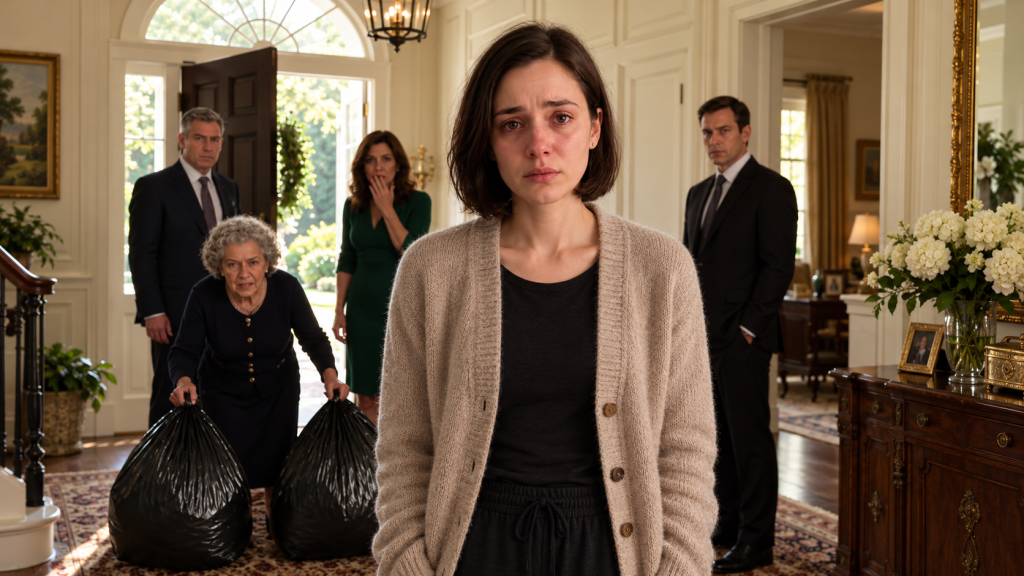
Evelyn’s expression did not change. “He did not ‘cut you out’ yesterday, Mark.” My father froze. “The residence was transferred into the Walter Mercer Residence Trust six years ago.” She tapped the folder. “The deed was properly recorded.” “Walter remained entitled to live here for the rest of his life. “Upon his death, beneficial ownership passed to Clara.” Mom laughed sharply.
“No.”
It was almost fascinating.
Not an argument.
Not evidence.
Just no.
As if reality had misunderstood her position in the family.
“That old man wasn’t thinking clearly for years.”
My hands tightened.
Sheriff Cole glanced toward her.
Evelyn noticed too.
“When exactly do you believe Walter lost capacity?”
Mom hesitated.
“What?”
“You just alleged incapacity.”
“I’m asking when.”
Mom looked toward Dad.
He looked away.
Evelyn continued calmly.
“The trust was executed six years ago.”
“Walter was examined by his physician four days beforehand.”
“He also met with independent counsel twice without Clara present.”
“There is a recorded memorandum documenting that he understood the property, his family relationships, and the effect of the trust.”
She paused.
“If you intend to challenge it, you are entitled to speak with your own attorney.”
Mom’s mouth opened.
Closed.
Then Dad said:
“We’re not discussing legal technicalities in a hallway.”
Sheriff Cole finally spoke.
“You probably should.”
Dad turned.
“This is private.”
The sheriff nodded.
“Yes.”
“And right now, I’m here because Ms. Hart requested a civil standby after receiving information that people might arrive this morning and attempt to remove property from the residence.”
He looked toward the staircase.
Two movers were standing there holding one end of Grandpa’s antique dresser.
Both looked like men who desperately wished they had chosen a different job that morning.
Sheriff Cole said:
“Put it back.”
They did.
Immediately.
Chloe stared at me.
“You knew?”
I swallowed.
“I knew Grandpa told me not to argue.”
“That’s not what I asked.”
“I knew something had been arranged.”
“I didn’t know exactly what Evelyn was going to say.”
That was true.
Grandpa had never shown me the trust.
He had only said:
Let them in.
Let them talk.
Then open my study.
He had trusted the rest to people who understood the paperwork better than I did.
Maybe because he knew grief would already be taking everything else out of me.
Mom turned back to Evelyn.
“This still doesn’t explain why you mentioned an education account.”
The room changed.
Dad had gone pale again.
Not angry.
Afraid.
I noticed.
So did Evelyn.
She nodded toward Grandpa’s accountant.
“Samuel?”
Samuel Price had handled Grandpa’s taxes for almost twenty-five years.
Small man.
Silver hair.
Always wore bow ties at Christmas.
He had cried harder than anyone at the funeral except me.
Now he placed a thick envelope on Grandpa’s desk.
“Walter established a custodial investment account for Clara when she was born.”
I stared.
“What?”
Samuel looked at me gently.
“He made deposits every year.”
“Birthday.”
“Christmas.”
“Sometimes when investments performed well.”
“By the time you were five, the account held $47,300.”
My throat tightened.
Forty-seven thousand dollars.
To Grandpa, that had been enormous money.
He had clipped coupons.
Repaired his own lawn mower.
Drove the same truck until the passenger door needed a rope to keep it shut.
I whispered:
“He never told me.”
“No.”
Samuel’s eyes softened.
“He intended it for university.”
Then he looked at Dad.
“Your father was named custodian because Clara was a minor.”
Dad said nothing.
Samuel continued.
“Three days after Clara was brought here, the account was liquidated.”
Chloe turned toward Dad.
“What does that mean?”
Nobody answered.
She repeated louder:
“What does that mean?”
I looked at my father.
“Dad?”
The word felt strange.
I almost never used it.
Mark would have been more accurate.
But some wounds preserve old names.
Dad finally said:
“We used some family funds during a difficult period.”
Samuel’s jaw tightened.
“Some?”
He opened the envelope.
“Forty-six thousand eight hundred and twelve dollars was withdrawn in one transaction.”
My mother snapped:
“That money belonged to the family.”
Samuel looked at her.
“No.”
“It legally belonged to Clara.”
“She was five!”
Mom shouted.
“She didn’t need forty-seven thousand dollars!”
Something cold moved through me.
There are moments when a person explains themselves so completely you almost feel grateful.
Mom had just done that.
I whispered:
“What did you spend it on?”
She looked at me.
“You have no idea what our situation was.”
“What did you spend it on?”
Dad rubbed his forehead.
“Clara.”
“No.”
I stepped closer.
“You left me here.”
“Three days later, you emptied an account Grandpa built for me.”
“What did you buy?”
Silence.
Then Chloe whispered:
“Our house.”
Nobody moved.
Mom turned sharply.
“Chloe.”
But my sister was staring at her.
“The Phoenix house.”
Dad closed his eyes.
Chloe continued.
“You always said Grandpa helped with the down payment.”
Mom snapped:
“This does not concern you.”
Chloe actually laughed.
A thin, frightened sound.
“You used her money?”
“Chloe—”
“You bought our house with Clara’s money?”
Mom’s expression hardened.
“We used money available to the family while your father was rebuilding his career.”
There it was again.
Family.
That magical word.
Used whenever something belonged to someone else.
I remembered the single photograph I had seen of their Phoenix house.
Christmas card.
I was eight.
Grandpa had found it tucked inside an envelope addressed to him.
Mom.
Dad.
Chloe.
Standing in front of a stucco house with palm trees.
All three wearing red sweaters.
I had asked:
“Why am I not in the picture?”
Grandpa had gone quiet.
Then said:
“Because sometimes photographs tell you more about the photographer than the people missing from them.”
I did not understand then.
I did now.
They had financed part of that fresh start with money saved for the child they left behind.
Dad suddenly pointed at Samuel.
“If you knew about this, why wasn’t there a lawsuit seventeen years ago?”
Good question.
I looked at Samuel too.
Evelyn answered.
“There nearly was.”
Dad’s face changed.
Mom’s did too.
Evelyn opened another section of her folder.
“In 2010, Walter obtained the old account records.”
“I represented him.”
My parents stared.
I was ten in 2010.
I remembered that year.
Grandpa had seemed angrier than usual for several weeks.
He burned dinner twice.
Forgot to pick me up from Girl Scouts once and cried harder than I did.
I thought he was getting old.
He had been fighting them.
Evelyn continued.
“Walter threatened a civil action.”
“Your attorney at the time proposed settlement.”
Dad said quickly:
“That matter was resolved.”
Evelyn nodded.
“It was documented.”
She removed three pages.
“Both of you signed a notarized debt acknowledgment.”
Mom’s mouth went dry.
I could see it.
“What debt?”
I asked.
Evelyn turned the paper toward me.
The signatures were unmistakable.
MARK MERCER
DENISE MERCER
My parents.
Underneath:
Acknowledgment of obligation to Clara Mercer arising from withdrawal of custodial funds.
My name.
My childhood.
Reduced to a paragraph adults had signed without ever telling me.
Evelyn said:
“You acknowledged the $47,300 principal.”
“Agreed to modest interest.”
“And agreed repayment would be made no later than Clara’s eighteenth birthday unless Walter agreed otherwise in writing.”
I looked at my parents.
“I’m twenty-two.”
No one answered.
Samuel said quietly:
“No repayment was made.”
Chloe sat down on the bottom stair.
Her face had gone completely blank.
I asked:
“How much?”
Samuel handed me a page.
“With interest under the agreement and credit for one small payment Walter received years ago, the amount documented today is approximately $69,400.”
I almost laughed.
Not because money was funny.
Because yesterday I thought my entire inheritance was a box of Grandpa’s shirts and a lifetime of memories.
This morning my parents arrived to throw me out.
And now I was discovering they had owed me money since kindergarten.
Dad finally exploded.
“This is enough.”
He turned toward the movers.
“Go.”
Mom grabbed his arm.
“No.”
He looked at her.
“What?”
She lowered her voice.
“We are not leaving her with the whole house.”
Evelyn heard.
So did Sheriff Cole.
So did I.
My mother looked directly at me.
“Clara, you need to be reasonable.”
I almost smiled.
That word.
Reasonable.
The word adults use when they want your surrender to feel like maturity.
“You have a house now.”
Mom continued.
“You have no husband.”
“No children.”
“No major responsibilities.”
“Your father and I are approaching retirement.”
“Chloe is still establishing herself.”
Chloe looked up.
“Don’t include me.”
Mom stared at her.
“What?”
“I said don’t include me.”
That was the first time I saw my sister push back.
Mom’s face hardened.
“You were picking a bedroom five minutes ago.”
Chloe stood.
“I thought Grandpa left Dad the house.”
“You told me that.”
Dad said:
“He should have.”
Chloe looked at him.
“That’s not the same thing.”
Something in the room shifted.
Not forgiveness.
Not alliance.
Just the first crack in a family story Chloe had apparently been living inside as confidently as I had lived outside it.
Sheriff Cole spoke to the movers.
“Nothing leaves.”
The supervisor nodded.
“We’re done.”
Dad reached for his wallet.
The man shook his head.
“Sir, we’ll bill you.”
Even in the worst moment of my life, I almost laughed.
The moving truck pulled away twenty minutes later.
Empty.
Chloe’s imaginary master bedroom remained Grandpa’s.
For now.
Mom refused to leave.
Not physically.
Emotionally.
She sat at Grandpa’s dining table like she was waiting for someone to correct the misunderstanding.
Evelyn suggested we continue in the study.
I said no.
Grandpa had hated closed-door family arguments.
He used to say:
“If people are willing to say something cruel, they should be willing to hear how it sounds in daylight.”
So we stayed in the dining room.
Evelyn opened the next envelope.
“Walter also left letters.”
Mom laughed bitterly.
“Of course he did.”
“One for Mark.”
“One for Denise.”
“One for Chloe.”
“One for Clara.”
She looked at me.
“Yours is private.”
I nodded.
Then Evelyn added:
“There is also a recorded statement Walter asked me to play only if Mark and Denise came to the house attempting to claim possession.”
My heart stopped.
Dad looked up.
“What recording?”
Evelyn placed her laptop on the table.
Clicked a file.
And Grandpa appeared.
Not in a hospital bed.
In his study.
Wearing the blue cardigan I had given him for Christmas.
Alive.
Sharp-eyed.
Slightly annoyed at technology.
My breath disappeared.
“Hi, kiddo,” he said.
Even though the message was recorded, I answered.
“Hi, Grandpa.”
Mom rolled her eyes.
I saw it.
So did Chloe.
Grandpa continued:
“If you’re watching this, I’m dead, which is inconvenient because I’d rather be there to enjoy the expressions in the room.”
A small laugh broke out of me.
That was him.
Entirely.
Then his face became serious.
“Mark.”
Dad stared at the screen.
“You are my son.”
“I loved you before you knew what love was.”
“I need that said first because everything after it will sound harder.”
Dad’s face tightened.
“I spent years asking myself what I did wrong.”
“I asked whether I worked too much.”
“Whether I gave you too little.”
“Whether I gave you too much.”
“Eventually I realized a parent can examine his mistakes without accepting ownership of every choice an adult child makes.”
I looked down.
Grandpa had been teaching me even while talking to my father.
He continued.
“When you brought Clara to my door, you told me it was for a weekend.”
“You left a pink backpack.”
“Four dresses.”
“One stuffed rabbit.”
“And an inhaler with six doses left.”
My mother closed her eyes.
My entire childhood sat inside those details.
Pink backpack.
Rabbit.
Inhaler.
Grandpa continued.
“Monday came.”
“You didn’t.”
“I called.”
“You said two more days.”
“Then a week.”
“Then your phone changed.”
Dad whispered:
“Dad…”
The recording did not care.
“I obtained guardianship because somebody had to sign Clara’s school papers.”
“I took her to the dentist because nobody had for nearly two years.”
“I sat beside her bed while she asked what she had done wrong.”
My throat closed.
I remembered.
Not the exact nights.
Just the feeling.
The certainty that abandonment must have been evidence against me.
Children assume adults are logical.
So if adults leave, children search themselves for the reason.
Grandpa looked straight into the camera.
“Clara was never my burden.”
“She was the privilege you walked away from.”
Mom flinched.
Good.
I hated that I thought that.
I thought it anyway.
Then Grandpa said something I did not expect.
“Chloe.”
My sister looked up.
“You were seven.”
She began crying instantly.
“You were a child too.”
Mom turned toward her.
“Don’t.”
Chloe covered her mouth.
Grandpa continued:
“I do not know exactly what your parents told you.”
“But whatever happened between the adults was not your fault.”
“I wish I had found a way to keep you and Clara closer.”
“I tried.”
My head snapped toward the screen.
Tried?
Grandpa continued.
“I sent birthday cards.”
“Christmas gifts.”
“Letters.”
“Some were returned.”
“Some disappeared.”
“I eventually stopped because every attempt made Clara wait at the window.”
Chloe whispered:
“What?”
Dad stared at the table.
Mom had stopped moving entirely.
I looked at Chloe.
“What is he talking about?”
She looked as confused as I felt.
Grandpa continued:
“I kept copies.”
Of course he did.
Grandpa kept copies of grocery receipts.
Naturally he kept copies of heartbreak.
“You girls should decide what to do with them.”
“Not your parents.”
“You.”
The recording ended with Grandpa talking to me.
“Clara.”
I could barely breathe.
“You may be tempted to think the house is proof I chose you over them.”
“It isn’t.”
“It is proof I chose responsibility after they abandoned theirs.”
My eyes filled.
“Do not turn property into love.”
“A house is wood.”
“Stone.”
“Taxes.”
“Repairs.”
“Love is who stays when the roof leaks.”
That was Grandpa.
Always ruining beautiful sentiments with maintenance.
I laughed through tears.
He smiled from the screen as though he heard me.
“The house is yours because it is your home.”
“Not because Mark deserves punishment.”
“Not because Denise deserves less.”
“And not because Chloe deserves nothing.”
“It is yours because you lived there.”
“Cared for me there.”
“Built your life there.”
“And because I want you to begin whatever comes next without wondering whether someone can walk through the door and tell you to pack yourself into garbage bags.”
Mom stood suddenly.
“I’m not listening to this.”
Sheriff Cole did not stop her.
Neither did I.
Grandpa had already said enough.
She grabbed her purse and walked toward the door.
Dad followed.
Then stopped.
He looked at me.
For one second I saw something almost human beneath the anger.
Shame, maybe.
Or just defeat.
“Clara.”
I waited.
He said:
“This isn’t what it looks like.”
I nearly laughed.
“Which part?”
He had no answer.
Then he left.
Chloe stayed.
That was the first surprise.
She sat alone at Grandpa’s dining table after everyone else left except Evelyn and Samuel.
Her designer sunglasses sat upside down beside her.
She looked younger without them.
Not twenty-four.
Seven.
I sat across from her.
Neither of us knew how sisters were supposed to begin after seventeen years.
Finally Chloe said:
“They told me you chose to stay.”
My chest tightened.
“What?”
“They said Grandpa wanted one of us.”
“That he couldn’t manage both.”
“That you liked it here.”
“That you were always his favorite.”
I stared at her.
“I was five.”
“I know.”
“Now.”
She wiped her face.
“I know now.”
Then:
“I thought you didn’t want us.”
The sentence shocked me.
“You thought I abandoned you?”
She laughed bitterly.
“Kind of.”
“Not like that.”
“But Mom said you cried whenever they tried to bring you home.”
“They never tried.”
“I know.”
“No.”
I leaned forward.
“They never came.”
“Not once.”
Chloe stared.
Then covered her mouth.
I continued because seventeen years had earned words.
“I waited on the porch the first Christmas.”
“I thought maybe your car would come.”
“Grandpa eventually carried me inside because I fell asleep.”
Chloe started sobbing.
“I wrote you cards.”
I froze.
“What?”
“When I was little.”
“I made Mom mail them.”
“At least I thought she did.”
My throat tightened.
“What kind of cards?”
“Birthday.”
“Christmas.”
“I drew stupid pictures.”
“How many?”
“I don’t know.”
“A lot at first.”
“Then Mom told me Grandpa said they were upsetting you.”
I closed my eyes.
Of course.
Two children.
Two stories.
One silence.
Evelyn returned from Grandpa’s study carrying a plastic storage box.
She set it on the table.
“Walter told me you might need this.”
Inside were copies of letters he had sent to my parents.
Certified mail receipts.
Returned envelopes.
Birthday cards addressed to Chloe.
Photographs.
One envelope made my hands shake.
For Chloe — from Clara — age 6
I looked at my sister.
“I don’t remember this.”
She opened it carefully.
Inside was a crayon drawing.
Two girls holding hands beside a huge brown rectangle that was probably Grandpa’s house.
Above us I had written:
COME PLAY MY ROOM HAS TWO WINDOWS
Chloe cried so hard she had to leave the table.
I sat there staring at six-year-old handwriting.
I had invited my sister into my life.
Someone had decided she did not need to know.
We did not become sisters that day.
That would have been too easy.
Too dishonest.
Chloe left three hours later.
Before she went, she stood in the foyer.
The same place where she had announced:
I call the master bedroom.
She looked upstairs.
Then at me.
“I’m sorry about that.”
I nodded.
“It was awful.”
“I know.”
“You sounded exactly like Mom.”
She flinched.
I regretted it.
Then decided not to take it back.
Truth did not need decoration.
Chloe whispered:
“I know.”
Then she left.
The legal challenge arrived eleven days later.
Of course.
My parents hired an attorney.
They argued:
Grandpa had been elderly.
I had exerted undue influence.
The trust had unfairly excluded Dad.
The residence had supposedly always been intended to pass through the family line.
Evelyn read the complaint in her office while I stared at the wall.
“Can they take the house?”
“They can challenge.”
“That’s not what I asked.”
She removed her glasses.
“No attorney can promise an outcome.”
My stomach dropped.
Then she continued.
“But Walter planned well.”
The trust had been created six years before his death.
Before his cancer diagnosis.
Before he needed help dressing.
Before I managed any of his finances.
He had independent counsel.
A capacity assessment.
A recorded explanation.
Records showing he continued paying his own expenses and controlling his own assets for years afterward.
The house had been properly transferred into trust.
I had not even known the exact arrangement.
That mattered.
Evelyn said:
“Litigation can still cost time and money.”
I swallowed.
“I don’t want to spend Grandpa’s estate fighting them forever.”
“Then we’ll look for efficient resolution.”
That was legal language for:
Do not let anger write checks.
Grandpa would have approved.
Then my parents made a mistake.
Not a criminal mistake.
A human one.
During discovery, their lawyer requested all communications relating to Grandpa’s reasons for creating the trust.
Evelyn produced them.
That included letters my father had written.
One from nine years earlier.
I was thirteen.
Dad wrote:
Clara is settled with you. Moving her now would be disruptive. Denise and I agree you should continue handling her expenses and upbringing.
Another:
We cannot contribute financially at this time.
Another, three years later:
Since you chose to keep Clara, you should consider her your responsibility.
I stared at that sentence.
Since you chose to keep Clara.
As if Grandpa had found me on clearance at a store.
Then Evelyn showed me her favorite.
A letter written by Dad five years before Grandpa died.
After learning Grandpa planned to leave me the house.
If you give the property to Clara, consider our relationship finished.
Grandpa’s handwritten response was one sentence:
You finished your relationship with your daughter first.
I laughed.
Then cried.
Then laughed again.
God, I missed him.
My parents withdrew most of their challenge four months later.
Not because a judge dramatically humiliated them.
Because their attorney apparently explained the evidence and the likely cost of continuing.
They negotiated narrow issues involving personal property.
Dad wanted Grandpa’s military medals.
I agreed.
They were father and son.
Whatever Dad had done to me did not erase Grandpa’s entire life with him.
Mom wanted Grandma’s china.
Grandma had died before I was born.
Grandpa had once said Mom loved that set.
I let it go.
Chloe asked for nothing.
That mattered.
The house remained in trust for me.
No courtroom applause.
Just signatures.
Dismissal.
Legal bills.
Relief.
Real endings are often less cinematic than the truth they settle.
The education account was different.
The old withdrawal itself was seventeen years old.
There were limitation questions.
Record questions.
Technical questions I barely understood.
But the later signed debt acknowledgment changed the conversation.
My parents had expressly acknowledged the obligation.
Evelyn referred me to another attorney who handled financial disputes.
His name was David Chen.
He said:
“We negotiate before litigating.”
I almost laughed.
“Everyone keeps telling me not to enjoy revenge.”
He smiled.
“That’s because revenge is expensive.”
Grandpa would have liked him.
Dad initially claimed the debt acknowledgment had been signed under pressure.
David responded with copies of correspondence from Dad’s own former lawyer negotiating the terms.
That argument disappeared.
Mom claimed some of the withdrawn money had been spent “for Clara’s benefit.”
David asked for documentation.
They produced none.
Then came the final accounting twist.
The $46,812 withdrawal had been deposited into my parents’ joint account.
Within twelve days:
$31,500 went toward the down payment and closing costs on the Phoenix house.
$6,800 paid credit-card debt.
$4,200 went toward moving expenses and furniture.
The remainder covered general household spending.
I asked David:
“Did any of it go to Chloe?”
He looked at me.
“Indirectly, probably.”
“Household spending benefits household members.”
“But legally, she was a child.”
“Yes.”
“None of that is her responsibility.”
“No.”
I needed to hear that.
Because anger is greedy.
It looks for places to spread.
Chloe did not open the account.
She did not sign the withdrawal.
She was seven.
She got a bedroom in a house purchased partly with my money.
That did not make the bedroom her crime.
Settlement took almost a year.
My parents did not have $69,400 sitting in cash.
They had retirement savings.
Equity in their current home.
Income.
Obligations.
Eventually we agreed to a structured repayment substantially below the full claimed balance in exchange for certainty and avoiding prolonged litigation.
They paid $48,000 over time.
Not the dramatic $69,400.
Not every dollar.
Enough.
I did something with the first payment Grandpa would have understood.
I paid off my remaining student loan.
He had covered most of college.
I had taken a small loan because I wanted to pay for something myself.
When the final balance disappeared, I sat at the kitchen table and cried.
Not because my parents had finally funded my education.
Because Grandpa had tried to do it when I was five.
Seventeen years later, part of that promise finally arrived.
Late.
Damaged.
Still mine.
Mom called me after the settlement.
First direct call in seventeen years.
I stared at the number.
Almost let it ring.
Then answered.
“Hello.”
Silence.
Then:
“Clara.”
Her voice sounded older than I remembered.
“Hi.”
Another silence.
Then:
“You got what you wanted.”
I closed my eyes.
Wrong beginning.
“Did I?”
“You got the house.”
“The money.”
“Your grandfather made sure of everything.”
I looked around the kitchen.
Grandpa’s coffee mug still hung beside the sink.
“What do you think I wanted?”
Mom said nothing.
I answered for her.
“I wanted you to come back when I was five.”
Silence.
“I wanted you to call when I was six.”
“I wanted you at my school play when I was nine.”
“I wanted Dad to teach me to drive.”
“I wanted Chloe at my graduation.”
“I wanted to stop lying when people asked where my parents lived.”
My voice cracked.
“I never wanted your house.”
“Your money.”
“Grandpa’s trust.”
“I wanted you.”
Mom began crying.
I hated that it still hurt to hear.
Then she said:
“We were young.”
“You were thirty.”
Silence.
“We were struggling.”
“So was Grandpa.”
“You don’t understand.”
“No.”
I swallowed.
“I don’t understand how you leave a five-year-old for a weekend and never come back.”
There was a long pause.
Then, finally:
“We thought we would come back.”
I stopped breathing.
“When?”
“After we got settled.”
“How long?”
“A month.”
“Maybe two.”
“What changed?”
Mom sobbed.
“Life.”
I laughed bitterly.
“That is not an answer.”
“No.”
She took a breath.
“Your father’s job started.”
“Chloe’s school.”
“The house.”
“You were doing well with Walter.”
“Every month made coming back harder.”
“Then every year.”
“And after a while…”
Her voice became barely audible.
“We had built a life that didn’t have room for the explanation.”
There it was.
Not no room for me.
No room for the explanation.
Shame became architecture.
They stayed away because returning would require admitting they had stayed away.
I whispered:
“So you chose the easier child.”
Mom went silent.
I regretted it immediately.
Chloe was not easier.
She had simply been taken with them.
Mom said:
“No.”
Then:
“Maybe.”
That honesty hurt more than denial.
“Why me?”
I asked.
It was the question five-year-old Clara had been carrying for seventeen years.
Mom cried.
“You were closer to Walter.”
“Chloe had trouble adjusting.”
“Your father thought one child with Grandpa temporarily would give us room.”
I stared at nothing.
“I was five.”
“I know.”
“Did I cry?”
“Yes.”
“Did I ask to go home?”
“Yes.”
My chest caved in.
“Then why didn’t you take me?”
Mom’s answer came slowly.
“Because Walter was better at comforting you than I was.”
I closed my eyes.
That was not the whole answer.
But maybe it was the ugliest true piece.
Sometimes people abandon the place where they feel most inadequate.
Not because the child deserves less.
Because the child reminds them of what they are failing to be.
Explanation.
Not absolution.
Again.
Always.
I asked one final question.
“Did Grandpa stop you from contacting me?”
“No.”
Immediate.
Clear.
I appreciated that.
“Did he ever tell you not to come?”
“No.”
“Did he ever refuse a visit?”
“No.”
“Then all those years…”
Mom cried.
“Yes.”
I whispered:
“Thank you.”
She sounded confused.
“For what?”
“For finally not lying.”
Then I ended the call.
Dad took another six months.
His apology arrived by letter.
Not because he was wiser.
Because I refused his calls after the settlement.
The envelope sat unopened for nine days.
Finally I read it.
Clara,
I have spent most of my life explaining myself.
Bad start.
I almost stopped.
Then:
That is probably one reason you stopped listening.
Better.
He wrote about losing his job.
Debt.
Humiliation.
Phoenix.
His belief that Grandpa judged him.
His resentment that I bonded so deeply with Walter.
Then came the sentence that mattered.
None of those things made me leave you. I left you because I made leaving easier than returning.
I read it twice.
Then:
I told myself you were safe.
You were.
I used your safety as permission for my absence.
My eyes filled.
That was exactly it.
They knew Grandpa would catch me.
So they jumped.
Dad continued.
The education money is worse because I knew it was yours.
No euphemism.
Good.
I told myself we would replace it.
Then replacing it became financially inconvenient.
Then admitting it became morally inconvenient.
So I stopped thinking about the distinction.
That is theft dressed as family necessity.
I had not expected that sentence.
At the end:
You do not owe me a relationship because I finally learned the vocabulary for what I did.
Dad
I cried.
Not because I forgave him.
Because for the first time, he had written something that did not ask me to take care of his feelings afterward.
Chloe came back to the house that spring.
She stood on the porch holding a cardboard box.
“No moving truck.”
I almost smiled.
“Good start.”
She looked nervous.
“Can I come in?”
That question mattered more than she knew.
“Yeah.”
She stepped inside.
Then handed me the box.
Inside were photographs.
Her childhood.
Phoenix.
School.
Birthdays.
There were gaps where I should have been.
She sat on Grandpa’s sofa.
“I found something.”
She pulled out a notebook.
Pink cover.
A child’s handwriting.
Her diary.
Age eight.
One page read:
MOM SAYS CLARA LIKES GRANDPA MORE NOW. MAYBE SHE DOESN’T MISS ME.
I swallowed.
Another:
I MADE CLARA A CARD BUT MOM SAID SHE GETS SAD WHEN SHE HEARS FROM US.
Another:
DAD SAID GRANDPA IS TURNING CLARA AGAINST US.
I closed the notebook.
“Chloe.”
She was crying.
“I was mad at you for years.”
“I know.”
“I made jokes.”
“With friends.”
“I said you were Grandpa’s weird favorite.”
I listened.
“I thought you rejected us.”
“I know.”
She wiped her face.
“Then I showed up after his funeral and tried to take his bedroom.”
“Yes.”
She laughed through tears.
“I’m awful.”
“No.”
I surprised both of us.
“You were awful that morning.”
“That’s different.”
She looked at me.
“Why?”
“Because I’m trying not to make people permanent versions of their worst day.”
Grandpa would have liked that.
Maybe I stole it from him.
Most of my best thoughts were his.
Chloe and I rebuilt slowly.
Painfully.
We did not become matching-bracelet sisters.
We had different memories.
Different loyalties.
Different wounds.
Sometimes she defended Mom.
Sometimes I hated that.
Sometimes I told stories about Grandpa that made her jealous.
Sometimes she hated that.
Once, during an argument, she shouted:
“At least you got Grandpa!”
The second the words left her mouth, she covered her face.
I went silent.
She whispered:
“I’m sorry.”
I was furious.
But beneath the anger, I heard the child she had been.
I answered:
“You’re right about one thing.”
She looked up.
“You lost him too.”
Her face crumpled.
Because while Grandpa had raised me, my parents had effectively taken him away from her.
Not in the same way.
Not equal.
But real.
She had been seven.
She had been told he chose me.
That lie stole a grandfather from her.
Our parents’ choices had divided two girls and then handed each of us a different explanation for the empty chair.
We cried together that night.
For the first time.
Not as children.
As women old enough to understand we could both have been hurt without competing over who deserved the word more.
I stayed in Grandpa’s house.
At first.
Everyone assumed I would.
It was mine.
Home.
History.
But ownership changes a place.
Suddenly I noticed taxes.
The old roof.
Boiler noises.
A cracked foundation wall.
Grandpa had warned me.
A house is wood.
Stone.
Taxes.
Repairs.
He had left a reserve account of about $74,000 for maintenance and carrying costs.
Not enough to make me rich.
Enough to keep his gift from becoming a trap.
Smart man.
I used some for the roof.
Some for electrical work.
Then I spent a whole Saturday cursing a leaking kitchen faucet and finally understood why Grandpa’s last recorded message included plumbing.
I found my letter from him three months after his funeral.
I had been afraid to open it.
Grief makes strange objects dangerous.
Evelyn had placed it in Grandpa’s desk drawer.
One rainy Sunday, I finally sat in his chair.
Opened it.
Kiddo,
I cried immediately.
Not fair.
If you are reading this, you have survived several things you should never have had to survive.
Do not add my death to the list of things you think you must survive gracefully.
I laughed.
Then cried harder.
Be angry.
Be tired.
Eat cereal for dinner.
Forget to answer people.
But do not confuse grief with instruction.
I paused.
Then:
The house is not a command to stay.
That sentence shocked me.
If you love it, keep it.
If it becomes a museum, sell it.
If one day you want to paint my study yellow, I will be dead and therefore powerless to stop your terrible taste.
I laughed aloud.
Grandpa continued.
Home is not loyalty to a building.
Home is the place where you are not required to audition for belonging.
I pressed the letter against my chest.
That was what he had given me for seventeen years.
Not a house.
Certainty.
I belonged.
Mom tried to visit once.
Two years after Grandpa died.
She called first.
That was progress.
“I’ll be in town.”
“Can I see you?”
I said yes.
Public place.
Coffee shop.
She looked older.
Smaller.
Not because I had grown.
Because childhood enlarges parents.
At five, my mother had been the weather.
At twenty-four, she was a woman holding a handbag too tightly.
We sat.
She said:
“I’m sorry.”
I waited.
“For leaving.”
“For the money.”
“For the letters.”
“For letting you believe Walter kept us apart.”
I looked at her.
“Did you love me?”
Her face collapsed.
“Yes.”
I believed her.
That surprised me.
Maybe because I had spent years assuming abandonment proved absence of love.
It did not.
Love can exist inside weak people.
That does not make the weakness harmless.
I asked:
“Then why wasn’t love enough?”
Mom cried.
“I don’t know.”
I did.
But I wanted her answer.
Finally she said:
“Because love is a feeling.”
“And parenting is work.”
“I kept thinking feeling guilty meant I was still being your mother somehow.”
That sentence hurt.
And healed.
A little.
She continued.
“But guilt did nothing for you.”
“No.”
“I know.”
We did not hug when we left.
She asked.
I said:
“Not today.”
She nodded.
Then walked away.
That was another thing Grandpa taught me late.
A boundary does not become cruel because the person on the other side is sad.
Dad took longer.
Years.
He and Mom remained married.
Apparently nearly losing everything they thought they were entitled to forced them to examine other things too.
They downsized.
Partly because of the settlement.
Partly because retirement.
Dad sold his boat.
Mom complained about it for months.
Chloe told me.
I felt nothing.
That was progress.
Not every consequence required my emotional attendance.
At twenty-seven, I made the decision Grandpa had given me permission to make.
I sold the house.
People were shocked.
Chloe cried.
Mom called it “another betrayal of family history.”
That almost changed my mind out of spite.
Then I remembered Grandpa’s letter.
The house is not a command to stay.
The property had appreciated.
After costs, trust administration, taxes where applicable, and repairs, I had enough equity to buy a smaller home outright and invest the remainder carefully.
Nothing glamorous.
No mansion.
No private island.
A two-bedroom bungalow fifteen minutes from my work.
White kitchen.
Tiny garden.
No master bedroom worth fighting over.
Perfect.
Before closing day, I spent one final night alone in Grandpa’s house.
I slept in my old bedroom.
Not the master.
Mine.
Two windows.
The room from my six-year-old drawing.
I lay awake remembering:
Grandpa reading beside the lamp.
Burnt pancakes.
Middle-school tears.
College applications.
The first time he let me drive his truck.
The night my boyfriend broke up with me and Grandpa said:
“Good. Now we can stop pretending I liked him.”
His hospital bed.
His hand.
When they come, don’t argue.
I cried until dawn.
Then made coffee.
Walked through every room.
And said goodbye.
I took very little furniture.
Grandpa’s desk.
His reading chair.
A kitchen table scarred by years of homework.
The ugly green lamp he loved.
His flannel shirts.
One box of letters.
That was enough.
The new owners were a young couple with two children.
On closing day, their little girl ran upstairs.
I heard her shout:
“This room has two windows!”
I almost stopped breathing.
Her mother apologized.
“She’s excited.”
I smiled.
“Let her be.”
Then I walked out of the house without looking back.
Not because it meant nothing.
Because it had meant enough.
The money from my parents’ repayment did not become revenge money.
Grandpa would have hated that.
I used part to finish a graduate program in counseling and family services.
I had spent years wondering why adults left.
I became interested in helping children understand a truth I learned too late:
Adults’ failures are not proof of a child’s unworthiness.
I eventually worked with children in kinship care.
Grandparents raising grandchildren.
Aunts raising nephews.
Older siblings doing impossible work.
I never told them:
“I know exactly how you feel.”
I didn’t.
No two abandonments are identical.
Instead I told them what Grandpa told me:
“Someone else failing to stay does not mean you were hard to love.”
That sentence became my work.
Chloe married at thirty.
I was maid of honor.
That would have sounded impossible the morning she claimed Grandpa’s master bedroom.
Before the ceremony, she handed me a small box.
Inside was the crayon drawing.
The two girls.
Brown house.
COME PLAY MY ROOM HAS TWO WINDOWS
She had framed a copy.
“I kept the original safe.”
I started crying.
“Why give me this now?”
She smiled.
“Because apparently I finally made it to your room.”
I hugged her.
That was the first time.
Five years after Grandpa died.
Some relationships should not be rushed just because biology already named them.
Mom and Dad attended the wedding.
Of course.
The seating chart placed me several tables away.
That was fine.
At one point Dad approached.
He looked at the drawing in my hand.
His face changed.
“I remember that.”
I stared.
“What?”
“You made it.”
“How?”
“I was at Grandpa’s when you drew it.”
My stomach tightened.
“When?”
“About a year after we left.”
The room seemed to narrow.
“You came back?”
Dad looked down.
“Once.”
My heart started pounding.
“You came back?”
“Yes.”
“Did I see you?”
“No.”
“Why?”
He swallowed.
“You were asleep.”
“Grandpa and I argued.”
“About the account.”
Of course.
“What happened?”
“He told me if I wasn’t there to take responsibility, I should leave before you woke.”
I stared at him.
“Did he stop you from seeing me?”
Dad closed his eyes.
“No.”
“Then why didn’t you wait?”
He whispered:
“Cowardice.”
One word.
At least he had learned not to decorate it.
I walked away.
Not because I hated him.
Because Chloe was getting married, and I refused to let another revelation steal another day.
That could wait.
Everything did not need resolution immediately.
Months later, Dad told me the whole story.
He had returned intending to ask Grandpa not to sue over the education account.
He saw me asleep on the sofa.
Six years old.
Holding the stuffed rabbit they had left behind.
He almost woke me.
Then Grandpa asked:
“If she opens her eyes and asks whether you’re taking her home, what are you going to say?”
Dad had no answer.
So he left.
Again.
For years, I imagined abandonment as one clean act.
A car pulling away.
Parents never returning.
The truth was worse.
Dad had returned to the edge of my life.
Looked directly at what he had done.
And chosen not to step back in because he was not ready to answer a six-year-old’s question.
That hurt.
It also freed me from another lie.
My parents had not disappeared because of forces larger than them.
They made choices.
Repeatedly.
So had Grandpa.
He chose to stay.
Repeatedly.
That was why I loved him.
Not because he was perfect.
Because love became verbs around him.
Breakfast.
Medicine.
Permission slips.
Driving lessons.
Tuition.
Waiting outside fitting rooms.
Sitting through terrible school concerts.
Staying.
My relationship with Mom became occasional.
Birthday calls.
Holiday cards.
Coffee once or twice a year.
Not mother-daughter in the way either of us might have imagined.
Something else.
Smaller.
Honest.
Dad and I rebuilt even less.
For a while that bothered me.
Then I understood healing does not need symmetry.
I could forgive parts of Mom and not Dad.
I could understand Dad and still not want closeness.
Relationships are not court sentences where equal wrongdoing requires equal outcomes.
My nervous system had its own evidence.
I listened to it.
When I was thirty-two, Dad had a heart attack.
Chloe called.
I went to the hospital.
Not because abandonment disappeared.
Because I wanted to.
That distinction mattered.
He survived.
After surgery, he opened his eyes and saw me.
He whispered:
“You came.”
I almost laughed at the irony.
“Yes.”
Tears ran toward his ears.
“I didn’t.”
No defense.
No explanation.
Just:
“I didn’t.”
I took his hand.
“I know.”
We sat with that.
I did not tell him it was okay.
It wasn’t.
I did not tell him I forgave everything.
I didn’t.
I stayed for two hours.
Then left.
That was enough.
Mom died first.
Stroke at seventy-one.
Unexpected.
Chloe and I handled the funeral together.
I stood beside Mom’s casket feeling grief that did not match any movie.
Not devastation.
Not relief.
A strange ache for a relationship that had existed mostly in possibility.
People told me:
“She loved you.”
I said:
“I know.”
That was all.
Love had never been the disputed fact.
What she did with it was.
In her personal effects, Chloe found a shoebox.
My name.
Inside were photographs clipped from social media.
My college graduation.
A work award.
A photograph of me outside Grandpa’s house after repainting the porch.
Mom had followed my life from a distance.
Again, I felt two things.
Tenderness.
Anger.
Watching is not showing up.
But watching meant something.
I allowed it to mean exactly that.
No more.
No less.
Dad lived another nine years.
He became quieter.
Sold the last expensive things.
Volunteered at a food pantry.
Chloe said he never talked about the education money unless asked.
Good.
Some guilt should stop demanding witnesses.
When he died, he left Chloe and me equal shares of what remained.
Nothing enormous.
About $52,000 each after expenses.
His will included one sentence:
This gift is not repayment. Clara was owed repayment long before this. It is simply what remains of a father’s estate to his daughters.
I appreciated that.
He did not try to turn inheritance into apology.
I donated part of mine to a kinship-care legal clinic.
Used the rest to replace my bungalow’s roof.
Grandpa would have approved of the roof more.
Evelyn Hart came to the dedication when the clinic opened a new family-support room years later.
She was retired.
Still terrifying.
I hugged her.
She looked around.
“You did something useful with all that trouble.”
I smiled.
“Grandpa would say the trouble did not deserve credit.”
She raised an eyebrow.
“He would.”
“Then who gets credit?”
“I do.”
Evelyn smiled.
“Good.”
Pain is not fertilizer by virtue of happening.
People create meaning afterward.
That distinction saved me from being grateful for things that should never have happened.
Sheriff Cole retired too.
At a community event, he reminded me about the movers.
“You should’ve seen their faces.”
“I did.”
“No.”
“When your mother said she wasn’t leaving without furniture, one of those men whispered, ‘Lady, I get paid by the hour.’”
I laughed for ten minutes.
Some memories deserve to become funny.
Not because the cruelty disappears.
Because it no longer owns the scene.
The two black garbage bags became important in an unexpected way.
I had forgotten them after that morning.
Years later, while cleaning Grandpa’s storage closet before selling the house, I found one crumpled behind a shelf.
Black plastic.
Cheap drawstring.
I held it for a long time.
Mom had shoved it into my hands and said:
“Pack your things.”
Everything I supposedly deserved from seventeen years of life reduced to what fit inside a garbage bag.
I almost threw it away.
Instead, I took it to work.
One of the teenagers in our kinship program was moving into her aunt’s house carrying clothes in trash bags.
That sight hit me harder than I expected.
I asked our director:
“Why do kids still move this way?”
She sighed.
“Because emergency placements happen fast.”
So we started a small program.
Duffel bags.
Backpacks.
Toiletry kits.
Nothing revolutionary.
Just dignity with zippers.
We called it The Two Windows Project.
Chloe designed the logo.
Two square windows beneath a simple roof.
No one outside our family knew why.
Within three years, we had distributed hundreds of bags to children entering kinship care.
Not because Grandpa’s story needed to become inspirational.
Because a child’s belongings should not be introduced to a new home as garbage.
That was enough reason.
On the tenth anniversary of Grandpa’s death, Chloe and I went to his grave.
She brought sunflowers.
I brought coffee.
“For him?” she asked.
“For me.”
“Selfish.”
“Learned from the family.”
She laughed.
We sat on the grass.
For a while, neither of us spoke.
Then Chloe said:
“Do you ever wish he had sued them immediately?”
“The education account?”
“Yes.”
I thought.
“Sometimes.”
“Do you wish he had forced them to take you back?”
“No.”
Immediate.
She looked at me.
“Why?”
“Because forcing someone to parent you is not the same as being wanted.”
She nodded.
Then:
“Do you wish he had fought harder to keep us together?”
That took longer.
“Yes.”
“So do I.”
We let that be true without blaming a dead man for failing to solve what two living parents created.
Grandpa had protected me.
He had not been omnipotent.
No one is.
Chloe touched his headstone.
“He loved you more.”
I looked at her.
“No.”
She frowned.
“He raised you.”
“That’s not the same sentence.”
She started crying.
I took her hand.
“He knew me more.”
“He had more time with me.”
“He chose responsibility for me.”
“But love isn’t a pie.”
“I thought you hated that kind of phrase.”
“I do.”
“It’s still true.”
She laughed.
Then leaned against my shoulder.
For the first time, Grandpa’s grave felt like something we shared.
At thirty-eight, I became a foster parent.
Not because every abandoned child grows up wanting to parent abandoned children.
That would be too neat.
I had built a stable life.
A spare room.
Two windows.
That part was accidental enough to make me cry the first time I noticed.
My first placement was a nine-year-old girl named Mia.
Temporary.
Complicated family situation.
She arrived with one duffel bag from our program.
On her second night, she asked:
“Are you going to keep me?”
My heart stopped.
I did not promise what I could not control.
“I’m going to take care of you while you’re here.”
“For how long?”
“I don’t know yet.”
She frowned.
“Adults always say that.”
“Yes.”
I nodded.
“But I will tell you what I know when I know it.”
That became our rule.
No pretending certainty was kindness.
Mia eventually reunified safely with her mother.
I cried after she left.
Happy.
Sad.
Both.
Again.
Always both.
Years later, I adopted a boy named Eli after reunification was no longer possible.
He was eleven.
Angry.
Funny.
Suspicious of pancakes.
The first time he accidentally broke Grandpa’s green lamp, he froze.
Completely.
The lamp shattered.
He whispered:
“I’m sorry.”
I looked at the pieces.
Grandpa had loved that ugly thing.
For one second grief flashed.
Then I saw Eli’s face.
A child waiting to learn whether an object mattered more than he did.
I crouched.
“Are you cut?”
“No.”
“Then we’re okay.”
He stared.
“But the lamp.”
“Objects break.”
“You’re not mad?”
“I’m annoyed.”
His eyes widened.
I laughed.
“I’m allowed to be annoyed.”
“But I’m not going to hurt you or send you away over a lamp.”
He started crying.
I hugged him.
Later Chloe found an identical ugly green lamp online.
She bought it.
I called her.
“This is hideous.”
“You’re welcome.”
Grandpa would have laughed himself sick.
When Eli was sixteen, he asked about my parents.
I told him.
Not every detail.
Enough.
He said:
“They came with a moving truck the day after the funeral?”
“Yes.”
“That’s villain behavior.”
I laughed.
“They were complicated people.”
“They sound awful.”
“They did awful things.”
“Did you forgive them?”
I thought.
“Some of it.”
“What does that mean?”
“It means forgiveness is not a button.”
“Sometimes anger leaves one room before another.”
He nodded like he understood.
Maybe he did.
Then he asked:
“Did you keep the house?”
“No.”
He looked shocked.
“Why not?”
“Because Grandpa left me a home, not a prison.”
Eli smiled.
“That sounds like something you rehearsed.”
“It is.”
At sixty, older than Grandpa had been when he first took me in, I found the pink stuffed rabbit in a storage box.
One ear nearly gone.
Button eye loose.
The rabbit my parents left with me at five.
I sat on the floor holding it.
Seventeen years of childhood.
Decades of adulthood.
All inside a toy small enough to fit beneath one arm.
Eli, grown by then, came into the room.
“What’s that?”
“An old witness.”
He laughed.
Then sat beside me.
I told him about the first night.
The weekend bag.
Mom saying:
“Be good for Grandpa.”
Dad promising:
“Sunday.”
Sunday came.
Then Monday.
Then seventeen years.
Eli listened.
At the end, he said:
“Grandpa Walter sounds cool.”
“He was.”
“Wish I met him.”
I smiled.
“You did.”
He frowned.
“How?”
I looked around my house.
At the green replacement lamp.
The framed Two Windows logo.
The kitchen table I had carried from Grandpa’s house decades earlier.
Then at the way Eli had grown into a man who asked permission before borrowing things and apologized without collapsing into shame.
“Everywhere.”
He understood.
That night, I read Grandpa’s letter again.
The paper had softened along the folds.
One line had become almost transparent from my fingers.
Home is the place where you are not required to audition for belonging.
I finally understood how radical that was.
My parents had made belonging conditional.
On convenience.
On money.
On shame.
On whose version of family required less explanation.
Grandpa did not.
I could be angry in his house.
Messy.
Quiet.
Successful.
Failing.
Five.
Fifteen.
Twenty-two.
Grieving.
I never once had to prove I deserved the bed I slept in.
That was the inheritance.
Everything else was real estate.
People who hear the story usually love the morning after the funeral.
The moving truck.
Chloe claiming the master bedroom.
Mom handing me garbage bags.
The study door opening.
The lawyer.
The sheriff.
The trust.
The missing education account.
They call that the satisfying part.
Maybe it is.
But the moment that changed my life had happened years earlier in a hospital room.
Grandpa’s hand in mine.
His voice weak.
“When they come, don’t argue.”
At the time, I thought he was planning revenge.
He wasn’t.
He was teaching me something.
People reveal themselves when you stop doing their explaining for them.
My parents walked into his house certain that ownership belonged to whoever spoke with the most confidence.
Grandpa did not need me to defeat them.
He needed me to stop shrinking long enough to see them clearly.
Mom called me a burden.
Dad called the house family property.
Chloe called the master bedroom.
All before anyone asked how I had slept the night after burying the man who raised me.
That hurt.
It will always hurt.
Healing did not erase that morning.
It changed what the morning meant.
For years, abandonment meant:
I was not worth staying for.
Later, it meant:
They did not know how to stay.
Those are not the same sentence.
One condemns a child.
The other describes adults.
I spent half my life confusing them.
Grandpa spent his teaching me the difference.
I keep one photograph on my desk now.
Not the trust documents.
Not the debt acknowledgment.
Not the picture of the moving truck Sheriff Cole’s report happened to capture.
It is a photograph from my eighth birthday.
Grandpa and me at the kitchen table.
Cheap chocolate cake.
Eight crooked candles.
My front tooth missing.
His hand resting on my shoulder.
On the back, in his handwriting:
CLARA — 8
Then underneath:
Still here.
I don’t know whether he meant me.
Himself.
Both of us.
Maybe it doesn’t matter.
Because that is what family finally came to mean to me.
Not blood.
Not wills.
Not houses.
Not accounts.
Not the people who arrive when something becomes valuable.
Family is the person who can leave—
and chooses, again and again, to remain.
Grandpa remained.
Eventually, I learned how to remain for myself.
And that was the only inheritance no one could ever contest.
THE END STORIES! THANK YOU FOR READING GOOD LUCK !❤️
Related Posts



