Danny’s hand trembled inside mine. Not dramatically. Not like the movies. Just a small, stubborn shake that made me painfully aware of how many years had passed while I was somewhere else believing he was under the ground.
Cancer. The word sat between us. I looked at Selena. “What kind?” She glanced at her father before answering. “Pancreatic.” Danny sighed. “You could’ve waited five minutes before telling her the worst part.” Selena folded her arms. •“You sent flowers to a woman you loved in 1969 and expected her not to come.”
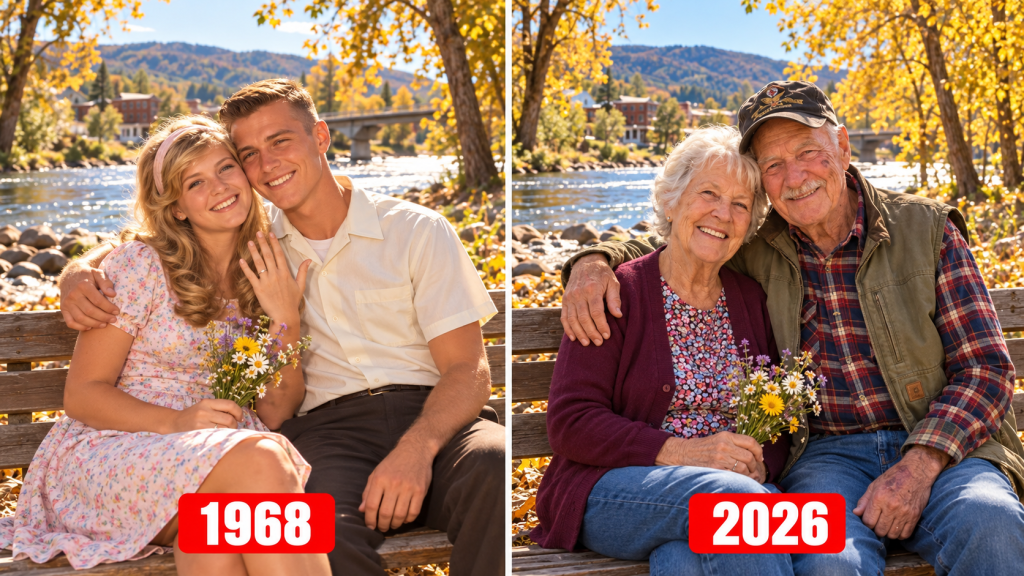
He gave her a tired smile. “I expected her to have better judgment at seventy-seven.” I laughed. It came out wet and broken. “You didn’t know me very well at eighteen, either.” His eyes lifted to mine. “Oh, I knew you.” There it was. The same look. Older. Clouded by pain and medication. But still Danny.
Still the boy who once drove thirty miles in a borrowed pickup because I told him over the phone that I had never seen snow fall in the desert.
Still the boy who wrote:
Dandylion, if I get home before the river freezes, I’m making you dance with me even if you marry somebody ugly while I’m gone.
I had laughed at that letter in 1968.
Then cried over it in 1969.
Now I was holding the hand that wrote it.
I whispered:
“How long?”
Selena answered.
“Doctors think maybe a few months.”
Danny frowned.
“Doctors also told me in 1969 I might never walk.”
He nodded toward the wheelchair.
“Eventually they were half right.”
I smiled despite myself.
Then my eyes returned to the Whitman’s box.
My Whitman’s box had lived with me for fifty-eight years.
His was sitting three feet away.
The same faded red lid.
The same gold script.
I pointed.
“Can I?”
Danny nodded.
I lifted it.
Inside were envelopes.
So many.
Some had yellowed.
Some had been opened.
Some had not.
But something was wrong.
I pulled out the top one.
My old name was written across the front:
Susan Mercer
The letters curved exactly like mine.
The S.
The way I tucked the tail of the r beneath the next letter.
I stared.
“I don’t understand.”
Danny looked toward Selena.
She took the envelope gently.
“Grandma made these.”
I frowned.
“What?”
“She copied your handwriting.”
A cold feeling moved through me.
Selena opened a folder on the table.
Inside were old tracing sheets.
Carbon paper.
Pieces of envelopes.
My handwriting.
Danny said quietly:
“She didn’t just intercept your letters.”
“She manufactured returns.”
I looked at him.
“She wanted me to believe the post office had sent them back?”
“Some.”
“She wanted me to believe you’d stopped writing?”
“Yes.”
“And she wanted you to believe I didn’t want you?”
Danny’s eyes filled.
“Yes.”
I sat down.
My knees simply stopped cooperating.
Selena moved a chair behind me.
For a while, nobody spoke.
Then I asked:
“What was her name again?”
Danny looked surprised.
“You remember.”
“I want you to say it.”
He swallowed.
“Margaret.”
Margaret Wirth.
The woman who wrote to a nineteen-year-old girl in Nevada and told her the man she loved had died.
The woman who had then spent decades making sure the dead stayed dead.
I whispered:
“Why?”
Danny stared at the floor.
“That took me a long time to understand.”
“Try me.”
He breathed carefully.
“Mom lost my father young.”
“I remember.”
“He was killed at the mill.”
“You were twelve.”
Danny nodded.
“After that, she decided losing people was something you prevented.”
I stared.
“How exactly does lying about your son’s death prevent losing him?”
“It makes more sense inside her head.”
“Apparently.”
Selena sat on the arm of the sofa.
“Grandma believed Dad came home from Vietnam broken.”
Danny looked at her.
“I did come home broken.”
Selena’s expression softened.
“I know.”
Then she looked at me.
“He had burns over his shoulder and back.”
“His left leg was badly injured.”
“Hearing damage.”
“Nightmares.”
“Panic attacks.”
“They called it other things then.”
“Combat fatigue.”
“Nerves.”
“Adjustment.”
Danny added:
“Mostly they told us to stop talking about it.”
I looked at his hand.
The fingers curled partly inward.
“Your mother thought I wouldn’t want you.”
He laughed once.
“No.”
“She was afraid you would.”
That hit differently.
“What?”
Danny looked straight at me.
“She thought if you saw me, you’d marry me out of pity.”
I stared.
“That woman didn’t know me at all.”
“She knew enough to be scared.”
“Of what?”
“That I’d choose you instead of staying with her.”
There it was.
Not protection.
Possession.
A mother who had already lost a husband and decided her wounded son would not leave her too.
Danny continued.
“She told me you wrote once.”
“She said you were engaged.”
“To Ted?”
“I didn’t know his name then.”
“She said you told her you couldn’t handle hospitals and injuries.”
“I never wrote that.”
“I know.”
“She said you wanted your letters back.”
“I never asked.”
“I know.”
I looked at the candy box.
“How did you find out?”
“After she died.”
“When?”
“1998.”
I blinked.
Almost thirty years ago.
“You’ve known since 1998?”
“Yes.”
The word hurt more than I expected.
I pulled my hand away.
Danny closed his eyes.
There.
The reunion cracked.
Good.
It needed to.
I stood.
“You knew for almost thirty years.”
“Sukey—”
“Don’t call me that.”
He stopped.
Only my family called me Sukey.
Danny had always called me Dandylion.
He knew exactly what my correction meant.
I looked at him.
“You found out I didn’t abandon you.”
“Yes.”
“You found my letters.”
“Yes.”
“And you still stayed gone?”
“Yes.”
My voice rose.
“Why?”
Selena stood.
“Please don’t—”
Danny lifted one hand.
“Let her.”
I stared at him.
“Why?”
He breathed slowly.
“Because you were married.”
“So?”
The answer came too fast.
I heard myself.
Danny did too.
He looked at me gently.
“So you were married.”
I sat again.
He continued.
“I found your address.”
“I found Ted’s insurance office.”
“I found a newspaper photograph from some Rotary Club dinner.”
“You were standing beside him.”
“You had two children.”
He swallowed.
“I learned his name before I learned theirs.”
“Michael and Anne.”
“Yes.”
“You knew?”
“I knew enough.”
His voice cracked.
“I had already spent half my life believing you chose someone else.”
“Then I learned you hadn’t.”
“I was angry.”
“At me?”
“At my mother.”
“At myself.”
“At the Army.”
“At anybody I could blame for being fifty years old instead of twenty.”
He rubbed his face.
“And then I looked at that picture.”
“You looked happy.”
I whispered:
“I was.”
“I know.”
That hurt.
Not because happiness with Ted was wrong.
Because Danny believed it.
He continued.
“What was I supposed to do?”
“Call your house and say, ‘Hello, Susan, surprise, the dead boy you mourned is alive. Would you like to explain me to your husband over dinner?’”
I wiped my face.
“You could’ve given me the truth.”
“Yes.”
His voice dropped.
“I could have.”
“And I didn’t.”
Good.
No noble excuse.
No pretending his silence was a gift.
Danny said:
“I told myself not contacting you was respect.”
“Some of it was.”
“Some of it was cowardice.”
I nodded.
“That sounds more honest.”
He nodded too.
Selena moved quietly toward the kitchen.
Danny stopped her.
“Stay.”
She looked uncomfortable.
“This is between you two.”
“No.”
Danny shook his head.
“You lived inside part of it.”
“She deserves to know that too.”
I looked at Selena.
“What does that mean?”
She folded her arms.
“My mother knew about you.”
I stared.
Danny’s wife.
Of course.
I had not asked.
“Your mother?”
“Carol.”
Danny closed his eyes.
“Carol Wirth.”
“Is she…”
“Dead.”
Selena answered softly.
“Eight years ago.”
I sat back down.
Danny said:
“She knew everything.”
“When?”
“Not at first.”
He looked ashamed.
“I didn’t tell her about you before we married.”
I frowned.
“Why?”
“Because I thought you were gone.”
“Dead?”
“No.”
He smiled sadly.
“Apparently we all had different definitions of gone in this family.”
Fair.
Danny met Carol in 1973.
She was a physical therapy aide.
He had been in and out of rehabilitation for years.
He still walked then with a brace and cane.
Carol was twenty-four.
Funny.
Practical.
From Sacramento.
“She used to insult my hair,” Danny said.
Selena smiled.
“It deserved it.”
He looked at her.
“Traitor.”
I found myself smiling too.
I did not want to.
But there was something comforting about hearing that Danny had been loved.
Real love.
Not fifty-eight years of preserved loneliness.
He married Carol in 1975.
Selena came two years later.
Then a son.
“Your brother?” I asked.
Selena’s face changed.
“Matthew.”
Danny looked at the window.
“He died when he was twenty-two.”
My heart sank.
“I’m sorry.”
“Car accident.”
Danny’s jaw tightened.
“Drunk driver.”
There it was.
Another grave.
Another life altering everything after it.
Carol and Danny stayed married forty-one years.
Not perfectly.
Not sadly.
Not as some substitute for me.
Danny made that very clear.
“Carol was not second place.”
“I didn’t ask.”
“You were going to wonder.”
I probably was.
He continued:
“I loved her.”
“I loved our life.”
“She put up with more than she should have.”
“Nightmares.”
“Temper.”
“Years when I couldn’t keep steady work.”
“She also made me laugh until my ribs hurt.”
His eyes softened.
“She deserved the truth sooner than I gave it.”
“When did she find out about me?”
“1998.”
“When I found the letters.”
All at once.
Margaret died after a stroke.
Danny and Selena cleaned out her house.
In a locked cedar trunk beneath winter blankets, they found letters.
Mine.
His.
Copies of the fake ones.
The death notice Margaret sent me.
Hospital records.
Even the original engagement photograph Danny had mailed his mother before he shipped out.
Me in my yellow dress.
Danny in uniform.
His arm around me.
I had thought that photograph disappeared decades ago.
Selena went into the hall.
Returned holding a frame.
She handed it to me.
There we were.
Eighteen.
Stupid.
Beautiful.
Alive in a way only young people can be when they think all suffering happens to somebody else.
I touched the glass.
“My God.”
Danny looked at the photograph.
“I almost burned the whole box.”
“Carol stopped me.”
I looked up.
“What did she say?”
Danny smiled.
“She said, ‘You don’t get to destroy evidence because it hurts.’”
I liked Carol immediately.
Danny continued.
“I told her everything.”
“She was furious.”
“At you?”
“Yes.”
“At Mom.”
“Yes.”
“At you.”
I blinked.
“Me?”
“She said you deserved to know.”
I stared.
“What did you say?”
“I said no.”
“Why?”
“Because you were married.”
Again.
Always that.
I asked:
“What did Carol think?”
“That I was using your marriage as an excuse because I was scared you’d reject me after knowing the truth.”
I laughed through tears.
“I really like Carol.”
Selena smiled.
“Everybody did.”
Danny’s voice softened.
“She was right more often than was healthy for a marriage.”
Apparently Carol pushed him to write.
Not to ask me for anything.
Just tell me he was alive.
Danny wrote nine versions.
Never mailed one.
He showed me the drafts.
One began:
Dear Susan, this is the strangest letter a dead man has ever written.
Another:
Dandylion, I don’t know whether I have the right to use that name anymore.
Another:
I am alive. My mother lied. I am sorry that my first sentence after twenty-nine years has to be that ugly.
I had to stop reading.
“Why keep them?”
“Carol.”
Of course.
“She said one day I might grow a spine.”
Selena laughed.
“Mom said that a lot.”
I folded the letter.
“Ted died three years ago.”
“I know.”
That stopped me.
“How?”
Danny looked guilty.
“Obituary.”
“You were checking?”
“Every once in a while.”
“For fifty-eight years?”
“No.”
Pause.
“Yes.”
I stared.
“That’s creepy.”
“I know.”
Selena laughed for the first time since I arrived.
“Thank you.”
“I’ve been telling him that for years.”
Danny looked wounded.
“I read public records.”
“You memorized her granddaughter’s wedding announcement.”
“That was one time.”
I looked at him.
“You know my grandchildren?”
He sighed.
“A little.”
“How little?”
He began counting with his fingers.
“Four.”
I stared.
He knew their names.
All four.
I laughed so hard I had to wipe tears away.
“You are completely insane.”
“Probably.”
“And still you didn’t call.”
“No.”
That laughter faded.
Danny became serious.
“After Ted died, I thought about it.”
“Then Carol had already been gone five years.”
“I was alone.”
“You were alone.”
“And that made contacting you feel even more selfish.”
I shook my head.
“You decided for me again.”
“Yes.”
Good.
He understood.
Then came the diagnosis.
Pancreatic cancer.
Late.
No surgical option.
Treatment might buy time.
Might not.
Danny started putting papers in order.
His will.
Veterans records.
Life insurance.
Then he found the old Whitman’s box again.
He told Selena:
“If I die with that woman thinking I died in 1969, then Mom’s lie wins forever.”
Selena told him to call.
He refused.
Email.
Refused.
Letter.
Too much.
Eventually he chose flowers.
“Coward,” I said.
“Absolutely.”
“With a florist.”
“Modern cowardice.”
I almost smiled.
Then remembered the phone call.
I looked at Selena.
“Why did you hang up on me?”
Her face changed.
There it was.
Another piece.
“I panicked.”
“Why?”
She looked at Danny.
He looked away.
Selena sat across from me.
“Because Dad made me promise not to give you the address.”
I stared at him.
“Again?”
Danny groaned.
“I know.”
“No, you apparently do not know.”
“I told her I didn’t want you seeing me sick.”
“And everybody gets to decide what Susan can handle except Susan.”
“Yes.”
He sounded tired.
Not defensive.
That made it harder to stay angry.
Selena said:
“There was another reason.”
I looked at her.
“What?”
She hesitated.
Then said:
“I thought you might hurt him.”
I blinked.
“Me?”
“Not physically.”
She looked embarrassed.
“I knew the story.”
“The ring.”
“The letters.”
“The flowers.”
“Dad talks about you like you’re eighteen.”
“I was afraid you’d arrive and tell him he was a fool.”
I looked at Danny.
“He is a fool.”
“Thank you,” Selena muttered.
“But not because he loved me.”
Danny’s eyes filled.
Selena nodded slowly.
“I know that now.”
Then she added:
“And I was angry.”
“At me?”
“At what you represented.”
I waited.
Selena took a breath.
“When Mom died, Dad disappeared into grief.”
“Not drinking.”
“Not dangerous.”
“He just became smaller.”
“I took care of him.”
“Doctors.”
“Groceries.”
“Appointments.”
“Then the cancer.”
“And suddenly I find out there’s some woman in Nevada he’s been carrying around in a candy box since before Mom even met him.”
I listened.
“I loved my mother.”
“I know.”
“You don’t.”
Her voice broke.
“You can’t.”
Fair.
“She spent forty-one years with him.”
“She sat through surgeries.”
“She woke him from nightmares.”
“She buried their son.”
“And now when Dad thinks he’s dying, he sends flowers to you.”
There was no cruelty in it.
Only grief.
I understood.
I said:
“Your mother is not less important because I existed first.”
Selena’s face crumpled.
“That’s what Mom said.”
I froze.
“What?”
Selena looked toward her father.
Danny was crying.
“She wrote you something.”
Of course she did.
Apparently every person in this family had been writing letters for half a century instead of making telephone calls.
Selena brought me an envelope.
My name across the front.
Not copied.
Not forged.
A woman’s careful handwriting.
Susan Haldane
I held it.
“When?”
“Seven years ago.”
Carol had written it while undergoing treatment for ovarian cancer.
She never mailed it.
Because she told Danny it was his truth to send, not hers to force.
That irritated me.
Another decision around me.
But then I opened it.
Dear Susan,
You do not know me, but I know you.
I stopped.
Danny looked toward the floor.
I continued.
I know your yellow dress.
I know about the bench by the river.
I know you hate canned peas, or at least you did in 1968.
I laughed.
Still do.
I know Danny spelled Dandelion wrong because he thought the y made it look prettier.
I looked at him.
“You told me you didn’t know how to spell it.”
Danny shrugged.
“I was flirting.”
Liar.
I continued.
I am his wife.
I need you to know I had a good marriage.
Not perfect.
Not a consolation prize.
Good.
My eyes blurred.
Danny loved me.
I never doubted it after I learned to stop asking whether one love erases another.
I stopped breathing.
When we found your letters, I was angry with Margaret.
Then angry with Danny for not finding you.
Then, if I am honest, afraid he would.
That honesty touched me more than nobility would have.
I pictured him seeing you and realizing his whole life had been the wrong turn.
Then I understood something.
A road can be stolen from you without making the road you actually traveled worthless.
I covered my mouth.
Ted.
Carol.
Children.
Grandchildren.
Every year we had lived after nineteen.
Carol continued.
If you ever read this, please do not let anyone turn our marriages into evidence that you and Danny should not have mattered to each other.
And do not turn what happened to you into evidence that our marriages were mistakes.
Both would be dishonest.
I cried openly.
Selena cried too.
Danny stared at his hands.
The last paragraph said:
If I go before him, and if you are free someday, I hope he has the courage to tell you he lived.
You owe him nothing.
Not forgiveness.
Not romance.
Not even a cup of coffee.
But you deserve your own history back.
Love,
Carol Wirth
I folded the letter.
Then unfolded it.
Read the final line again.
You deserve your own history back.
I whispered:
“She was something.”
Danny smiled.
“Yes.”
“Better than you.”
“By a humiliating margin.”
Selena laughed through tears.
I handed the letter back.
“No.”
Selena shook her head.
“Mom wrote it for you.”
I looked at her.
“Are you sure?”
“Yes.”
I kept it.
Not because Carol gave me permission to love Danny.
She did not.
Because one dead woman had somehow understood the cruelty of denying another woman the right to know her own life.
We talked for four hours.
I learned Danny had become a diesel mechanic.
Then a shop supervisor.
Retired at sixty-seven.
He and Carol lived mostly in Sacramento before moving to Susanville after Matthew died because Selena was there.
He had two grandchildren.
One studying nursing.
One perpetually changing majors.
I told him about Ted.
Really told him.
Not the obituary version.
How he whistled through his teeth when nervous.
How he could sell insurance to a brick wall.
How he once drove home eleven miles because he thought he had left the oven on, only to discover we did not own an oven with knobs.
Danny laughed.
I showed him photographs.
Michael.
Anne.
Grandchildren.
Ted holding our first grandchild with terror on his face.
Danny touched the photograph.
“He looks kind.”
“He was.”
“You loved him.”
“Yes.”
The word came without guilt.
I looked at Danny.
“I loved him very much.”
Danny nodded.
“I’m glad.”
And I believed him.
That was when I knew this was not a story about choosing between two men.
One was dead.
One was dying.
And I was seventy-seven years old.
The only thing left to choose was honesty.
I drove home that evening.
Danny did not ask me to stay.
That mattered.
Selena walked me to my car.
At the door, she said:
“I’m sorry I tried to send you away.”
I smiled.
“You were protecting your father.”
She shook her head.
“Maybe.”
“Or controlling him because I was scared.”
I looked at her.
“You’re very much his daughter.”
She laughed.
“I know.”
Then she became serious.
“Will you come back?”
I thought about Danny inside.
The wheelchair.
The flowers.
The cancer.
Fifty-eight years.
“Yes.”
I drove home in darkness.
My daughter Anne was waiting in my kitchen.
She stood the second I came through the door.
“Well?”
I set my purse down.
“He’s alive.”
Her face went blank.
“Actually alive?”
“I did not drive two hours to identify a ghost.”
“Mom.”
Then she saw my face.
“Oh my God.”
She sat.
I told her everything.
Not all fifty-eight years.
Just enough.
Margaret.
The forged letters.
Carol.
Cancer.
Anne cried.
Then got angry.
“His mother did what?”
“Pretty much what you’re doing right now.”
“What?”
“Being angry on my behalf.”
“That woman told you he was dead!”
“Yes.”
“That’s insane.”
“Yes.”
“And he knew since 1998?”
“Yes.”
“He should’ve called you.”
“Yes.”
Anne stopped.
She looked at me.
“You’re going back.”
“Yes.”
Her face tightened.
“Mom.”
There it was.
The same tone she had used before I left.
“You’re seventy-seven.”
“I am aware.”
“He’s dying.”
“Also aware.”
“What do you think this is going to become?”
That question hurt.
Because underneath it was fear.
Not ridicule.
Anne had already lost her father three years earlier.
She was watching her mother drive toward another grief.
I sat beside her.
“I don’t know.”
“Exactly.”
She started crying.
“I don’t want you getting destroyed.”
I took her hand.
“You cannot protect me from every ending.”
She looked down.
“I know.”
“Apparently no one in my life knows.”
That made her laugh.
Good.
Then I said:
“I loved your father.”
“I know.”
“I’m not undoing him.”
“I know.”
“I’m going to see someone I loved before I knew what marriage was.”
Anne nodded.
Then whispered:
“Does he still love you?”
I looked toward the cedar chest.
“Yes.”
“Do you?”
I thought.
Not the eighteen-year-old answer.
Not nostalgia.
Not the shock of resurrection.
“I don’t know what the word means after fifty-eight years.”
Anne smiled sadly.
“That sounds like yes.”
Maybe.
I visited Danny the following Saturday.
And the Saturday after that.
Then Wednesday.
Then Sunday.
Eventually I stopped pretending there was a schedule.
Sometimes I stayed an hour.
Sometimes all day.
We talked.
Mostly.
People imagine reunions after decades as one endless conversation about the past.
It isn’t.
Eventually you run out of 1969.
Then somebody needs lunch.
Danny hated the soup Selena bought.
I hated his television volume.
He accused me of cheating at gin rummy.
I absolutely cheated.
Once he fell asleep while I was telling him about Michael’s second divorce.
I smacked his knee.
“You waited fifty-eight years and now you’re sleeping through the good parts?”
He opened one eye.
“Michael’s always been boring.”
“You’ve never met him.”
“I can tell.”
Normal.
That was what surprised me.
Not romance.
Normality.
We did revisit the river.
Not physically at first.
Through memory.
The bench where he proposed was long gone.
The city had rebuilt the area.
But one afternoon Danny said:
“I still owe you a dance.”
“You owe me several things.”
“I was hoping cancer canceled the debt.”
“Absolutely not.”
He could stand briefly with help.
Selena hated the idea.
So did his physical therapist.
We compromised.
In his living room, Selena played an old song from 1968.
Danny stood holding the walker.
I stood in front of him.
He put one hand at my waist.
I put mine on his shoulder.
We barely moved.
Maybe six inches.
Not a dance.
A sway.
His forehead touched mine.
He whispered:
“Dandylion.”
I closed my eyes.
“Still spelling it wrong?”
“Always.”
I started crying.
He said:
“You’re ruining my shirt.”
“You’ve survived worse.”
“Barely.”
When the song ended, we sat down immediately because both of us had knees older than democracy.
Selena stood in the kitchen crying into a dish towel.
I pretended not to notice.
Danny’s treatment bought time.
Not a miracle.
Chemotherapy reduced some symptoms.
Then stopped working.
Doctors discussed another regimen.
He tried it.
The side effects were worse.
After two cycles, Danny said:
“No more.”
Selena struggled.
“So that’s it?”
“That’s not what I said.”
“It sounds like it.”
“I said I don’t want to spend every remaining Tuesday vomiting because everybody else is afraid of Thursday.”
That silenced her.
Later she asked me:
“Do you think he’s giving up?”
I said:
“No.”
“How do you know?”
“I don’t.”
She looked frustrated.
I continued.
“But stopping treatment is not the same as wanting to die.”
Selena looked away.
“Mom would know what to say.”
“No.”
“What?”
“Carol would probably be scared too.”
Selena stared.
Then cried.
We sat together.
The woman who had tried to close the door on me slowly became my friend.
Not daughter.
Not replacement.
Friend.
That mattered.
Then came the twist I never expected.
Ted knew Danny was alive.
Not for fifty-eight years.
Not even close.
But for fourteen.
I found out because of a folder in Ted’s desk.
I was searching for an old Medicare statement.
At the back of the bottom drawer was an envelope.
On the front:
SUSAN — IF IT EVER MATTERS
Ted’s handwriting.
My hands began shaking before I opened it.
Inside were three pages.
The first was a printed letter.
From Danny.
Dated 2009.
I stopped breathing.
Danny had written to Ted.
Not me.
Mr. Haldane,
You don’t know me. My name is Daniel Wirth. Susan knew me before Vietnam.
I sat down on the floor.
Danny explained Margaret’s lie.
The letters.
His survival.
Carol.
He wrote:
I am not contacting Susan because I do not want to intrude on your marriage.
Then:
But after forty years I have begun to wonder whether leaving her ignorant is respectful or merely cowardly.
My eyes burned.
I am writing because you know her life better than I do.
If you believe telling her would harm her or your family, I will stay gone.
I whispered:
“Oh, Ted.”
The second page was Ted’s reply.
He had kept a copy.
Mr. Wirth,
I believe you.
My heart cracked.
Susan has never told me your full story, but I know there was someone before me.
I found the Whitman’s box by accident early in our marriage. I never opened the letters.
I started sobbing.
Ted knew about the box.
All those years.
Never asked me to throw it away.
Never made me explain.
His letter continued.
I will not decide for my wife whether she can handle the truth.
I stopped.
Good.
Ted.
Good man.
Then:
But I am asking you to give me one week to tell her first.
I looked for the next page.
There wasn’t one from Danny.
Instead there was Ted’s handwritten note.
Dated four days later.
Couldn’t do it.
Then another line.
Coward.
I covered my mouth.
Below it, written two days later:
Anne called. Susan’s biopsy benign. She has been frightened enough this month. Wait until after Thanksgiving.
My biopsy.
I remembered.
A breast lump.
Benign.
Terrifying week.
Then another note.
Christmas. Not now.
Then:
Michael drinking again. Susan worried.
My son’s terrible year.
Then:
Will tell her after our anniversary.
Then months later:
Didn’t.
Then:
Danny wrote again. Returned unopened.
My chest hurt.
Ted had begun exactly where Danny had.
A week.
Then a season.
Then years.
Protecting me.
Always protecting Susan from Susan’s own life.
At the bottom of the page:
If I die before telling her, this goes to Susan. I am ashamed it took me this long.
Ted died fourteen years after Danny’s first letter.
He never told me.
I sat on the carpet for nearly an hour.
Angry.
Heartbroken.
Then furious again.
My daughter found me.
“Mom?”
I handed her the papers.
She read.
Her face changed.
“Dad knew?”
“Yes.”
“Oh God.”
I called Danny that evening.
No hello.
“You wrote Ted.”
Silence.
Then:
“Yes.”
My voice shook.
“You didn’t tell me.”
“I assumed he did.”
“He didn’t.”
Danny went quiet.
“What?”
“He never told me.”
“Susan…”
“He kept your letter.”
Danny whispered something I could not hear.
Then:
“I’m sorry.”
“Stop apologizing for everybody.”
Silence.
I continued:
“Did you ever write again?”
“Twice.”
“He returned the second one.”
“Yes.”
“What about the third?”
“No answer.”
“Why didn’t you contact me directly?”
Danny sighed.
“Because then I would be choosing to go around your husband.”
“There you go again.”
“I know.”
“No, Danny.”
“You keep saying you know, but every man in my life apparently believed my emotional stability was a committee decision.”
He didn’t argue.
Good.
I was angry for two days.
Then drove to Susanville.
Danny was in bed.
I stood in the doorway.
He looked terrible.
Thin.
Yellowish.
Too tired even to pretend.
He said:
“Still mad?”
“Yes.”
“Good.”
“What?”
“I was afraid you’d stop coming because you thought anger wasn’t allowed near dying people.”
I stared.
Then laughed.
“Carol really did train you.”
“Forty-one years.”
I sat beside him.
“Ted loved me.”
“I’m sure.”
“He was wrong.”
“Yes.”
“I can love him and still be angry.”
“Yes.”
“You loved Carol.”
“Yes.”
“She was right about you.”
“Frequently.”
I took his hand.
“We were surrounded by people who confused love with deciding.”
Danny looked at me.
“Us included.”
That stopped me.
Because he was right.
At nineteen, I had spent years imagining I would have waited forever.
Would I?
I did not know.
If Danny had returned burned, traumatized, angry, unable to sleep, could nineteen-year-old Susan have carried that?
Maybe.
Maybe not.
The cruelty was that Margaret had stolen the chance to find out.
Not necessarily a guaranteed marriage.
Choice.
That was what had been stolen.
Choice.
Ted later stole a piece of it too.
Danny.
Carol, in smaller ways.
Everybody had loved me enough to make decisions around me.
I said:
“That’s the part I’m grieving.”
“What?”
“Not the marriage we definitely would’ve had.”
“Because we don’t know.”
“No.”
“The life where I got to know the truth.”
Danny squeezed my hand.
“I’m sorry.”
This time I let him say it.
Ted’s letter changed something in my children too.
Anne was angry at her father.
Michael less so.
“He probably panicked.”
“He had fourteen years.”
“Yeah.”
Michael rubbed his face.
“Still sounds like Dad.”
“What does that mean?”
“He hated hurting you.”
Anne snapped:
“So he lied?”
Michael looked at her.
“Sometimes Dad’s nicest qualities had bad sides.”
That was unexpectedly wise.
Ted had been gentle.
Conflict-avoidant.
Patient.
Sometimes too patient.
He could let an unpaid bill sit six months because calling someone made him uncomfortable.
Maybe telling me a dead fiancé was alive simply became the largest uncomfortable call he never made.
Not noble.
Not malicious.
Ted.
The whole man.
I put Danny’s letters back in my Whitman’s box.
Then added Ted’s pages.
Then Carol’s letter.
At seventy-seven, my romantic history finally required two candy boxes.
Danny declined quickly that winter.
Hospice came.
A nurse named Miriam who treated death like a household fact rather than a failure.
She taught Selena medication schedules.
Taught me not to panic at every change in breathing.
One afternoon Danny asked everyone to leave except me.
Selena looked suspicious.
“Why?”
“I’m proposing.”
She nearly dropped a medication cup.
“Dad.”
I stared.
“Don’t be ridiculous.”
Danny smiled.
“See?”
“Already married.”
Selena laughed.
Then left.
When we were alone, Danny reached into the drawer.
My ring.
The original.
Tiny diamond.
Cheap metal.
The one that had turned my finger green.
I stared.
“You kept it?”
“My mother mailed it back to me after she told you I died.”
My eyes widened.
“What?”
“She said you returned it.”
“I didn’t.”
“I know.”
He held it between two fingers.
“I almost threw it away.”
“Why didn’t you?”
“Bad judgment.”
I laughed through tears.
He placed it in my palm.
“I’m not asking you to marry me.”
“Good.”
“I’d say no.”
“I know.”
“What are you asking?”
Danny thought.
“Nothing.”
That surprised me.
“I spent a lifetime turning this into a question.”
“Will she wait?”
“Will she love me?”
“Would she have stayed?”
“Should I call?”
“Should I leave her alone?”
He closed my fingers around the ring.
“It doesn’t have to ask anything anymore.”
I cried.
“Then what is it?”
“Something that happened.”
That may have been the most peaceful sentence of my life.
Something that happened.
Not destiny.
Not tragedy.
Not proof that every later love was wrong.
A ring.
A proposal.
Two teenagers by a river.
Real.
And over.
And still meaningful.
I put the ring on a chain.
Not my finger.
Danny approved.
“Your skin always hated cheap jewelry.”
“It hated you.”
“Understandable.”
The last good day came in March.
Cold but bright.
Selena bundled Danny into the car.
We drove to Reno.
Four hours with stops.
Everyone told us it was too much.
Danny insisted.
I did too.
We found the river.
Not the old bench.
But nearby.
Selena pushed his wheelchair along the path.
Wild grass grew beside the water.
No dandelions yet.
Too early.
Danny looked disappointed.
I said:
“You’re dying in the wrong season.”
“Story of my life.”
We sat beside the river.
Selena walked away to give us privacy.
Danny asked:
“If Mom hadn’t done it, do you think we would’ve married?”
There it was.
The question waiting fifty-eight years.
I looked at the water.
At the city.
At our old ghosts.
Then answered:
“Maybe.”
He laughed.
“That’s all?”
“What do you want, a Hallmark card?”
“I survived Vietnam for ‘maybe’?”
“You also married Carol.”
“Good point.”
I continued.
“We might’ve married.”
“We might’ve divorced.”
“We might’ve had kids.”
“We might’ve resented each other.”
“You might’ve hated Reno.”
“I already hated Reno.”
“Exactly.”
He smiled.
I took his hand.
“What I know is I loved you.”
His face softened.
“I know.”
“You loved me.”
“Yes.”
“We lost something real.”
“Yes.”
“And we also had real lives afterward.”
“Yes.”
“That has to be enough.”
Danny stared at the water.
Then:
“It is.”
We sat there until the wind got too cold.
Before leaving, Selena found one tiny yellow weed pushing through a crack near the parking lot.
Not a dandelion.
Some other flower.
She picked it.
Handed it to Danny.
He handed it to me.
“Close enough.”
“Your spelling always was.”
Danny died nineteen days later.
I was there.
So was Selena.
His granddaughter.
His son-in-law.
The room smelled faintly of lavender lotion and coffee.
Nothing cinematic.
No sudden final speech.
Hospice deaths are often slower and quieter than stories deserve.
For most of the afternoon he slept.
At one point he opened his eyes.
Looked at Selena.
“Love you.”
She kissed his forehead.
“Love you too, Dad.”
Then he looked at me.
His lips moved.
I leaned closer.
“What?”
“Dandylion.”
Barely air.
I laughed and cried at once.
“Still wrong.”
His mouth moved.
Maybe smile.
Maybe reflex.
Then later, after sunset, he stopped breathing.
That was it.
No thunder.
No music.
Just one breath.
Then none.
Selena put her head against his chest and sobbed.
I held her.
The daughter of another woman.
The child of a marriage that had been real.
I held her because grief does not care about neat categories.
At the funeral, Carol’s photograph stood beside Danny’s.
I insisted.
Selena had already planned it.
Good.
One photograph showed Danny and Carol on their wedding day.
Another showed Matthew.
One showed all three of them camping.
Then one small photograph showed Danny at eighteen beside a girl in a yellow dress.
Me.
I almost asked Selena to remove it.
She said:
“No.”
“Why?”
“Because it happened.”
Danny’s final lesson.
Something that happened.
At the service, the pastor talked about Vietnam.
Family.
Work.
Carol.
Matthew.
Selena.
Grandchildren.
Then he said:
“And late in life, Daniel received the unexpected gift of being able to tell an old truth.”
No romance novel.
No soulmate speech.
I was grateful.
Afterward, one of Danny’s old friends approached.
“You’re Susan?”
“Yes.”
He smiled.
“I’ve heard about you for forty years.”
I groaned.
“How embarrassing.”
“He talked about Carol more.”
That made me laugh.
“Good.”
“He loved her.”
“I know.”
The man paused.
“But whenever he saw dandelions…”
I raised a hand.
“Please don’t.”
He laughed.
“Fair.”
Selena gave me Danny’s Whitman’s box.
I protested.
“It belongs with you.”
“No.”
“It belongs with the person whose handwriting is inside.”
I looked at the strange forged envelopes.
Margaret’s tracing.
My letters.
Danny’s drafts.
Carol’s copies.
A whole family archive built from people writing things they were afraid to say aloud.
I took it.
At home, I placed the two boxes side by side in my cedar chest.
Then changed my mind.
I took them back out.
For fifty-eight years, I had hidden Danny under blankets and winter sweaters.
Enough hiding.
I put the boxes on a bookshelf in my bedroom.
Not shrine.
History.
My daughter Anne visited a week later.
She noticed immediately.
“You’re displaying them?”
“Apparently.”
“What would Dad think?”
I looked at Ted’s photograph on the dresser.
Then at the boxes.
“He knew.”
Anne winced.
“Right.”
I sat.
“I’m angry at him.”
“I know.”
“And I still miss him.”
“I know.”
“Those can happen together.”
Anne nodded.
Then asked:
“Do you wish you married Danny instead?”
There it was.
The question everyone eventually wants.
A clean alternate life.
I said:
“No.”
She looked surprised.
“No?”
“I wish I had known he was alive.”
“That’s different.”
“But if you knew…”
“Anne.”
I smiled.
“If I change one thing in 1969, maybe you don’t exist.”
She went quiet.
I continued.
“I am not going to wish away my daughter to rescue a nineteen-year-old version of myself.”
Her eyes filled.
“What about Danny?”
“Same.”
“Selena exists because of his life.”
“Carol existed.”
“Matthew existed.”
“Our lost future is unknowable.”
“The stolen truth is what I mourn.”
Anne hugged me.
That answer became clearer with time.
People who heard the story wanted tragedy.
You waited fifty-eight years for your true love.
No.
I did not wait.
I lived.
I married.
Raised children.
Worked.
Fought with Ted about money.
Took vacations.
Buried parents.
Became a grandmother.
Lost friends.
Had surgery.
Burned Thanksgiving rolls seventeen years in a row.
Danny lived too.
There is something almost insulting about calling all those decades “waiting.”
We were not empty rooms until each other returned.
We were whole people whose lives once touched, were violently separated, and then touched again near the end.
That was enough.
A year after Danny died, Selena came to Reno.
She brought a cardboard box.
“Found more trouble.”
“Oh no.”
Inside were Margaret’s journals.
I almost told her to burn them.
Then didn’t.
Choice.
Always choice.
We read them together.
Margaret’s early entries after Danny’s return were frantic.
He asks for Susan every day.
He thinks she will come.
Then:
Doctor says familiar faces could help. I cannot let that girl see him like this.
Anger rose.
Then another:
Daniel says he still wants to marry her. He cannot even stand without two men helping him. He is not thinking clearly.
Then:
I wrote her.
No remorse.
Not yet.
I told her he died. May God forgive me, but perhaps one clean grief is better than a lifetime chained to a broken man.
Selena whispered:
“Oh, Grandma.”
I felt sick.
A broken man.
That was how Margaret had seen her own son.
Not just selfishness.
Shame.
Disability.
A belief that Danny’s life had lost value.
She had decided I deserved a whole man.
And Danny deserved dependence.
Her protection had contained cruelty toward both of us.
Later journal entries changed.
Daniel asked again why Susan stopped writing.
Then:
He cried today.
Then, months later:
He has begun to believe me. I should be relieved. I am not.
Years passed.
He met a girl named Carol. She is good for him. Perhaps what I did was right.
Then later:
Carol asked why Daniel never talks about Nevada. I lied.
The lie kept requiring maintenance.
Like mold behind a wall.
Then one entry from 1997.
The year before Margaret died.
I dreamed of Susan. She was old. I realized in the dream that I had made her old without giving her the truth.
I stopped reading.
Selena did too.
The final relevant entry:
If Daniel finds the letters, he will hate me.
Then underneath:
Perhaps that is part of the debt.
Margaret knew.
Eventually.
Too late.
I closed the journal.
Selena asked:
“Does this make you hate her less?”
I thought.
“No.”
Then:
“Maybe more accurately.”
That mattered.
I no longer saw Margaret as a witch in a dark room inventing pain for pleasure.
She was a frightened widow who believed disability destroyed her son’s right to choose and grief gave her authority over everyone.
Understanding did not excuse.
It simply put edges around the monster.
Selena took the journals home.
I kept one photocopied page.
The dream.
I had made her old without giving her the truth.
Because that was exactly what happened.
Nobody can return fifty-eight years.
Not even love.
Especially not love.
Two years after Danny died, I went back to the river alone.
I brought the cheap ring.
Not to throw it away.
Too dramatic.
I sat on a new bench.
Watched people pass.
Teenagers on bicycles.
A woman jogging.
A father pushing a stroller.
I held the ring in my palm.
For decades, I thought the tragedy was that Danny never came home.
Then I learned he did.
Then I thought the tragedy was Margaret.
Then Ted.
Then Danny’s silence.
Eventually I understood the deeper thing.
Everyone had treated love like ownership of the ending.
Margaret thought loving Danny allowed her to choose his future.
Danny thought loving me required staying away.
Ted thought loving me justified postponing painful truth.
Carol, kinder than all of them, still struggled with deciding when truth should arrive.
And I had spent years imagining loving Danny meant I already knew exactly what life with him would have been.
We all did it.
We wrote futures for people because uncertainty frightened us.
But love is not certainty.
Love is not predicting correctly.
Love is not possession.
Sometimes love is giving someone information and trusting them to choose badly if they want to.
That sounds less romantic.
I think it is more respectful.
I put the ring back on its chain.
Kept it.
At eighty-one, my granddaughter asked about it.
I told her.
Not every detail.
Enough.
She said:
“So Grandpa Ted wasn’t your first love?”
“No.”
“Was Danny your biggest?”
I laughed.
“Love isn’t luggage.”
“What does that mean?”
“I don’t know.”
“You said it.”
“Old people get away with that.”
She rolled her eyes.
Then asked:
“Who did you love more?”
I looked at her.
“Ted was my husband for fifty-three years.”
“Danny was Danny.”
“That doesn’t answer.”
“It does when you’re older.”
She hated that answer.
Good.
One day she may understand.
Selena and I remained close.
We exchanged Christmas cards.
Phone calls.
She came down every spring.
I went north once each summer until driving became annoying.
We talked about Danny.
And Carol.
And Ted.
Never as teams.
Just people.
At eighty-three, Selena brought me a small mason jar of wildflowers.
“No florist this time.”
“Good.”
“Too expensive.”
In the middle was a dandelion.
She had picked it from a roadside.
There was a card.
I stared at the handwriting.
Not Danny’s.
Selena’s.
It said:
Still your Dandylion. Still spelled wrong.
I started crying.
She panicked.
“I thought it was sweet.”
“It is.”
“Then why are you crying?”
“I’m eighty-three.”
“I cry when toast comes out evenly.”
She laughed.
We put the flowers on the kitchen table.
The same table where I once read thirty-one letters after midnight because I thought I was chasing a ghost.
Sometimes I still read them.
Not often.
Enough.
Danny’s capital D still leans over like it is tired.
Mine does too now.
Hands age.
Words survive.
Ted’s handwriting has faded.
Carol’s letter is soft at the folds.
Margaret’s death notice remains the hardest object to touch.
One lie on one page.
So much life bent around it.
I do not burn it.
Not because I forgive what it did.
Because evidence matters.
Even private evidence.
Proof that memory was not imagination.
Proof that a nineteen-year-old girl was not foolish for believing what an adult told her.
Proof that Danny did not abandon me.
Proof that I did not abandon him.
We were lied to.
Then, later, we made our own mistakes.
Both are true.
That distinction gave me peace.
The last time I drove to Susanville, years after Danny was gone, Selena took me to his grave.
Carol was beside him.
Their son Matthew nearby.
The stone read:
DANIEL J. WIRTH
1949–2027
HUSBAND. FATHER. GRANDFATHER.
Nothing about me.
Exactly right.
I placed one dandelion near the edge.
Selena asked:
“Does that bother you?”
“What?”
“That the stone says husband.”
“No.”
“He was Carol’s husband.”
She nodded.
Then:
“You were important too.”
“I know.”
That was enough.
I did not need engraving.
I had history.
On the drive home, I stopped near the Nevada line.
Got coffee.
Sat in my car.
The sun was dropping behind the hills.
For one second, the light turned everything yellow.
And I thought of an eighteen-year-old girl in a yellow dress.
A boy with crooked handwriting.
A cheap ring.
A dance.
I wanted to reach backward and tell her:
He lives.
You will live too.
You will not get the future you imagined.
Neither will he.
You will love other people.
That will not betray this.
You will lose other people.
That will not erase them.
And someday, when you are old enough to understand that love is not measured only by who stayed longest or arrived first, a jar of wildflowers will appear at your door.
You will drive two hours.
You will be angry.
You will laugh.
You will learn truths that should have been yours decades earlier.
You will hold the hand of the boy you buried without a body.
And you will not get your youth back.
But you will get something.
The right ending?
No.
There is no right ending to fifty-eight stolen years.
You will get the truth.
You will get goodbye.
And sometimes, when time has already taken everything else it intends to take, those two things are not small.
I started the car.
The ring rested warm against my chest.
Not a promise anymore.
Not a question.
Just something that happened.
Something beautiful.
Something painful.
Something true.
And at my age, truth has become the closest thing I know to peace.
THE END STORIES! THANK YOU FOR READING GOOD LUCK !❤️
Related Posts