At 7:12 the next morning, my phone began ringing so violently against the nightstand that it sounded like someone knocking from inside the wood. Rebecca. I watched her name flash across the screen. Then disappear. Then return. Six seconds later, it rang again.
I was lying beneath a thick white comforter in a quiet adobe guesthouse outside Santa Fe, staring at a ceiling crossed by dark wooden beams. For the first time in years, nobody needed breakfast from me. Nobody needed school pickup. Nobody needed me to cover a bill. Nobody needed me to solve anything.
And yet my first instinct was still to answer. Forty-five years of motherhood had trained my body faster than my mind. When Rebecca called, I answered. When she panicked, I steadied her. When she needed money, I found it. When she was angry, I searched myself for whatever I must have done wrong. My thumb hovered over the screen.
The phone stopped.
A voicemail appeared.
Then another.
Then David called.
Then Rebecca again.
I turned the phone facedown.
My heart was pounding so hard I could feel it beneath my ribs.
I whispered to the empty room:
“You are allowed not to answer.”
The sentence sounded unnatural.
Almost selfish.
So I repeated it.
“You are allowed not to answer.”
That morning, I made coffee in a tiny blue ceramic pot the owner of the guesthouse had left beside the stove.
I carried it outside.
The desert air was cool.
The mountains beyond Santa Fe were pale beneath the morning light, and the sky looked too large for grief.
For almost an hour, I sat beneath a cottonwood tree and listened to birds I could not name.
My phone vibrated six more times inside.
At 8:31, I finally checked it.
Rebecca had left four voicemails.
The first was angry.
“Mom, what did you do? The mortgage transfer didn’t happen. David says the bank rejected it. Call me immediately.”
The second was louder.
“I don’t know what kind of stunt this is, but this isn’t funny. Our payment is due Friday. You cannot just disappear and shut things off without warning.”
The third was different.
Her voice had lost some of its anger.
“Mom, I found your letter.”
Silence.
Then:
“Please call me.”
The fourth came twenty minutes later.
She sounded like the little girl she had once been.
“Mom… are you really gone?”
I sat very still.
That was the sentence that nearly broke me.
Not because she sounded frightened.
Because for the first time, she seemed to understand that disappearance was not the same thing as death.
Death ends choice.
Disappearance can be chosen.
I could be alive somewhere she could not summon me simply by needing something.
My phone rang again.
This time it was my attorney, Helen Park.
I answered immediately.
“Good morning.”
“Good morning, Evelyn.”
That was my name.
Evelyn Harper.
Sixty-nine years old.
Retired nurse.
Widow.
Mother.
Grandmother.
And apparently, until twenty-four hours earlier, the private emergency department for an entire family.
Helen asked:
“Are you safely in Santa Fe?”
“Yes.”
“Did you tell anyone where you are staying?”
“No.”
“Good.”
I smiled.
“You sound as though I’m in witness protection.”
“You are not.”
“Though based on the number of calls I received from your daughter before eight this morning, I understand the comparison.”
I sat straighter.
“Rebecca called you?”
“Three times.”
“What did she say?”
“That you were confused.”
My stomach tightened.
“What?”
Helen’s voice stayed calm.
“She said this behavior was unlike you and asked whether I had advised you to close an account they relied on.”
I closed my eyes.
There it was.
The first crack in the story Rebecca needed.
Not:
Mom finally said no.
Instead:
Mom must be confused.
Helen continued.
“I told her I could not discuss our conversations.”
“What else?”
“She asked if you had changed your will.”
I opened my eyes.
“She asked that?”
“Yes.”
“How did she know?”
“She didn’t.”
“She guessed.”
I laughed once.
Not because it was funny.
Because the question was almost too revealing.
My daughter had learned that her mortgage money had stopped at seven in the morning.
By eight, she was asking whether I had changed my will.
Helen allowed the silence to sit.
Then said:
“Evelyn, I want to remind you of something we discussed yesterday.”
“What?”
“Do not turn this into an accounting of what Rebecca owes you for being born.”
I looked down at the coffee.
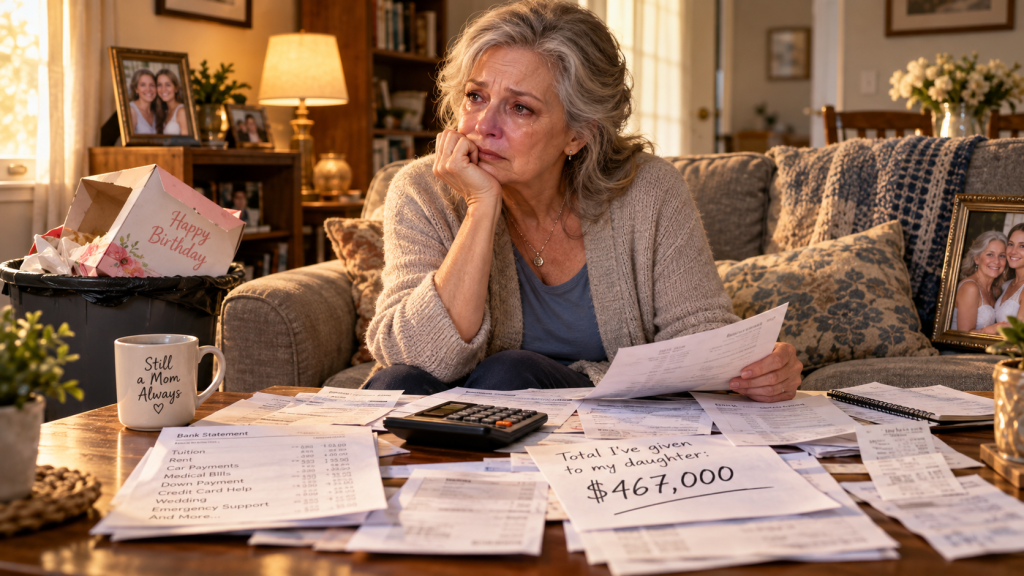
The papers spread across my apartment floor came back to me.
Childhood medical bills.
School clothes.
College.
Prom.
Food.
The number I had written.
$467,000.
Helen had seen the list.
And she had immediately crossed out the largest line.
Raising Rebecca: approximately $200,000.
I had stared at her.
“What are you doing?”
“You do not get to invoice a child for childhood.”
I had been offended.
Then ashamed.
She continued:
“You chose to raise her.”
“That money was parenting, not lending.”
“The college may also have been a gift.”
“The wedding was a gift.”
“The down payment was documented as a gift.”
“Those things can hurt to remember, but they are not debts merely because your relationship has changed.”
At first, I hated hearing it.
I wanted the number.
I wanted proof.
I wanted to see every dollar I had sacrificed stacked in a tower tall enough that Rebecca could never again say I had done everything for myself.
But Helen was right.
Love cannot become a loan retroactively simply because gratitude disappears.
So we made a second list.
Current voluntary support.
Eight months of mortgage payments: $16,000.
Emergency savings account I had funded: $20,000 originally, $18,740 remaining.
Authorized-user credit card.
Insurance beneficiary.
Automatic transfers for the twins’ activities.
Those were things I could change now.
Not as revenge.
As boundaries.
Helen said:
“You are allowed to stop future giving without rewriting every past gift as theft.”
That sentence had probably saved me from becoming cruel in the opposite direction.
I asked:
“What did you tell Rebecca about the mortgage?”
“That you had no contractual obligation to make those payments.”
“And the account?”
“That it was legally yours.”
“She must be furious.”
“She seemed more frightened than furious by the third call.”
I looked toward the mountains.
“Helen?”
“Yes?”
“Did I do something terrible?”
“No.”
The answer came too fast.
I almost rejected it.
She added:
“You did something significant.”
“That may feel terrible to everyone accustomed to your compliance.”
I breathed out.
Then she said:
“One more thing.”
My hand tightened around the cup.
“What?”
“Your financial adviser called after we updated the beneficiary security instructions.”
“Martin?”
“Yes.”
“He remembered something he thought you should know.”
My stomach sank.
“What?”
“Rebecca contacted his office six weeks ago.”
I stopped breathing.
“For what?”
“She asked generally how beneficiary designations work when a parent dies.”
The desert disappeared.
I heard Rebecca’s voice again.
The greatest gift would be if you just died.
Helen continued carefully.
“She did not have authority to obtain your account values, and Martin says none were disclosed.”
“Did she ask for values?”
“According to his notes, she asked whether retirement accounts pass through probate, whether beneficiary forms override a will, and whether a primary beneficiary receives funds quickly.”
I put the coffee down.
My hands were trembling.
“That could be ordinary planning.”
“Yes.”
“People ask those questions.”
“Yes.”
“Her father died.”
“Yes.”
“She could have been thinking about estate administration.”
“Yes.”
Helen did not let me turn a fact into a conviction.
That was one reason I trusted her.
I whispered:
“But six weeks before she wished me dead.”
“Yes.”
“Do you think she was waiting for me to die?”
“I do not know.”
The answer hurt.
But it was honest.
Helen continued.
“What I do know is that you should not confront her with assumptions.”
“Let her explain if you choose to discuss it.”
“And do not make financial decisions this week solely because you are hurt.”
“I already changed the will.”
“You changed a draft.”
“It can change again.”
I looked at the sunrise stretching gold across the desert.
For most of my life, I had believed legal documents were monuments.
Once signed, they represented final truth.
Helen had taught me they were tools.
I could change my mind.
My daughter could change.
I could change.
Nothing required me to turn one terrible birthday conversation into a permanent sentence written in ink.
But neither did love require me to keep everything as it had been.
I asked:
“What do you think I should do today?”
“Eat breakfast.”
I almost laughed.
“I’m serious.”
“So am I.”
“You worked in medicine forty years.”
“You should know not every crisis is improved by immediate intervention.”
“Do nothing financial today.”
“Walk.”
“Rest.”
“Let everybody experience twenty-four hours without you managing their panic.”
That was how I spent the first day.
Doing almost nothing.
I walked through Santa Fe Plaza.
I entered a gallery where a woman painted enormous desert skies.
I bought a turquoise scarf for thirty-eight dollars, then almost returned it because thirty-eight dollars felt indulgent.
I stood outside the shop arguing with myself.
I had given Rebecca one hundred fifty thousand dollars for a house down payment.
Yet spending thirty-eight dollars on myself required a committee meeting inside my head.
I kept the scarf.
At lunch, I ordered enchiladas and did not photograph them for anybody.
I did not text Rebecca.
I did not send pictures of the mountains to the twins.
I simply ate.
That evening, another voicemail arrived.
This one was from David.
“Evelyn, this has gone far enough.”
I nearly deleted it.
Instead I listened.
“We appreciate everything you’ve done, but you can’t make financial commitments and then pull them without reasonable notice. The mortgage company doesn’t care about family arguments. We have expenses. Rebecca’s upset. The twins are confused. Please act like an adult and call us.”
Please act like an adult.
I replayed that line.
Then laughed.
Not bitterly.
Almost joyfully.
There are insults that lose power once you see the person throwing them clearly.
David was forty-seven years old.
He lived in a house whose down payment his mother-in-law had funded.
He had accepted eight months of mortgage help.
And now he was explaining adulthood to me.
I deleted the voicemail.
The next morning, I took a pottery class.
I was terrible.
My bowl collapsed twice.
The instructor, a woman named Maribel with gray braids and clay beneath every fingernail, looked at the ruined lump spinning beneath my hands.
“You’re fighting it.”
“I’m trying to keep it from falling.”
“That’s why it keeps falling.”
I frowned.
“That sounds suspiciously philosophical.”
She smiled.
“I charge extra for therapy.”
I laughed.
She showed me how to hold the clay without strangling it.
Pressure, but not too much.
Support, but not control.
I nearly told her she had accidentally summarized my entire motherhood.
Instead, I made a crooked bowl.
I kept that too.
On the third day, Rebecca texted me.
The twins want to know why Grandma left.
My heart reacted before my brain.
I typed:
Put them on the phone.
Then deleted it.
I called Helen.
“She’s using the children.”
“Maybe.”
“What do I do?”
“Do you want contact with the twins?”
“Yes.”
“Then tell Rebecca that directly.”
So I wrote:
I love Noah and Grace. I am available to speak to them anytime, but I will not discuss adult financial issues with them or use them as messengers. You may give them my number if they don’t already have it.
Rebecca replied within a minute.
They have your number. They’re afraid to call because they think you’re mad at them.
I closed my eyes.
That part was my responsibility.
I called them.
Fourteen-year-old Grace answered.
“Grandma?”
“Hi, sweetheart.”
“Are you okay?”
“I’m fine.”
“Mom said you went away.”
“I took a trip.”
Noah’s voice appeared in the background.
“Ask if she’s coming back.”
I smiled despite myself.
“I’m coming back.”
“When?”
“In a few weeks.”
Grace lowered her voice.
“Are you mad at us?”
“No.”
“Not even a little.”
“Did we do something?”
“No.”
I heard her exhale.
Then Noah took the phone.
“Mom and Dad are fighting.”
“I’m sorry.”
“It’s about money.”
“I know.”
“Are we poor now?”
My heart broke.
“No.”
“And even if grown-ups need to change how they spend money, that is not something you need to solve.”
“Did you stop paying the house?”
There are moments when children accidentally walk into adult conflicts because somebody left the door open.
I refused to pull him farther inside.
“That is between me and your parents.”
He was quiet.
Then:
“Mom cried on her birthday.”
I closed my eyes.
Her birthday had been the day before.
I had sent one message at eight in the morning.
Happy birthday, Rebecca. I hope forty-five brings you clarity, peace, and the courage to build a life that does not require either of us to disappear. I love you.
She had not answered.
Now Noah said:
“She said you hate her.”
“I do not hate your mother.”
“Then why won’t you come home?”
“Because sometimes people who love each other need space to learn how to treat each other better.”
He seemed to consider this.
“Is that like when Coach separates us after we fight?”
I smiled.
“Something like that.”
“Okay.”
Then:
“Grandma?”
“Yes?”
“Can I still send you my science project?”
My throat closed.
“Please.”
That conversation taught me something important.
I could remove money without removing love.
I had confused those things for years.
No wonder Rebecca had too.
My gifts came with no written conditions, but they often carried emotional expectations I never admitted.
Call me.
Need me.
Include me.
Let me help.
Tell me I matter.
I had not bought Rebecca’s affection deliberately.
But money had become the language I spoke whenever I feared losing it.
That did not excuse her cruelty.
It did explain part of our pattern.
Three days later, Helen called again.
“You’re going to dislike this.”
“I’m becoming familiar with that opening.”
“David has been working.”
I sat down.
“What?”
“He has had consulting income for at least five months.”
The room went silent around me.
“How do you know?”
“He disclosed it through counsel.”
“Counsel?”
“Rebecca and David consulted an attorney about whether they could compel continuation of your promised support.”
I stared at the wall.
“Can they?”
“No.”
I almost laughed.
Helen continued.
“The attorney apparently advised them there is no enforceable agreement requiring you to pay their mortgage.”
“During that discussion, David disclosed he began consulting for Sterling Municipal Systems in January.”
“How much?”
“His lawyer says approximately seventy-eight hundred dollars a month before taxes.”
I stood so abruptly my chair scraped the floor.
“January?”
“Yes.”
It was May.
For five months, I had transferred two thousand dollars on the first of every month because I believed David was unemployed.
Every month Rebecca had accepted it.
Every month she had said:
“Just until David gets back on his feet.”
He had been on his feet.
I had been holding him up anyway.
“Did Rebecca know?”
“Helen paused.”
“Apparently.”
The word cut deeper than shouting.
I walked to the window.
Below me, tourists moved through the street carrying shopping bags and laughing.
Five months.
Ten thousand dollars.
Not enough to destroy me financially.
Enough to show intent.
“What were they doing with the extra money?”
“I don’t know.”
“Do they?”
“I assume so.”
I thought of Rebecca’s kitchen.
The expensive candles.
Her perfect nails.
The house.
The birthday plans.
Then I hated myself for the thought.
Nails were not evidence.
Candles were not guilt.
Luxury did not prove exploitation.
The evidence was simpler.
They had known the emergency had ended.
They had continued accepting emergency help.
I whispered:
“She told me he still had nothing.”
“Yes.”
“I asked in March.”
“Yes.”
“She lied.”
“It appears so.”
I sat.
My first impulse was to add ten thousand dollars to the old ledger.
Helen seemed to hear the thought.
“Do not invoice her.”
“I wasn’t going to.”
“You were.”
I almost smiled.
“How do you know?”
“Because you were a nurse.”
“You people document everything.”
Fair.
I asked:
“What happens now?”
“Nothing has to happen.”
“That is the part you keep forgetting.”
“You are not required to prosecute every disappointment.”
“You may simply use the information to decide your boundaries.”
The next call came from Rebecca that night.
I answered.
Not because she had earned access.
Because I was finally calm enough to speak without trying to win.
“Mom.”
“Hello, Rebecca.”
She went quiet.
“Where are you?”
“Santa Fe.”
“Why Santa Fe?”
“Because I always wanted to come.”
“You could have told me.”
“I did tell you I was taking space.”
“You left a letter on my table.”
“Yes.”
“That isn’t normal.”
“No.”
“Neither was telling your mother the greatest gift would be her death.”
Silence.
I heard her breathing.
Then:
“I didn’t mean literally.”
“I know.”
“You’re acting like I threatened you.”
“I’m not.”
“You said you wanted me gone.”
“I went.”
“That’s manipulative.”
I closed my eyes.
Maybe part of it was.
The dramatic letter.
The sudden trip.
A piece of me had wanted the silence to frighten her.
I could admit that.
“I probably could have handled leaving more gently.”
She jumped on the opening.
“Exactly.”
“But that does not change what you said.”
Silence again.
I continued.
“And it does not explain why you accepted five months of mortgage payments after David started earning seventy-eight hundred dollars a month.”
Her breathing stopped.
There.
No denial.
I whispered:
“You knew.”
She began crying.
“Mom—”
“You knew.”
“Yes.”
The truth was almost quieter than the lie.
“Why?”
She sobbed once.
“We still needed help.”
“For what?”
“Everything.”
“That is not an answer.”
“The house.”
“The twins.”
“Insurance.”
“David’s debts.”
“My credit cards.”
“We were behind.”
“Why didn’t you tell me he was working?”
“Because I knew you’d stop.”
The honesty hurt more than an excuse.
I looked at the darkening Santa Fe sky.
“You were right.”
Rebecca started crying harder.
“I was going to tell you.”
“When?”
“I don’t know.”
“When you no longer needed money?”
“Mom, please.”
Then she said something unexpected.
“I was angry at you before the birthday.”
“I know.”
“No.”
“You don’t.”
I waited.
“You think this is about money.”
“Isn’t it?”
“Partly.”
“Then tell me the rest.”
Rebecca was quiet for almost a minute.
Finally:
“You don’t knock emotionally.”
I frowned.
“What does that mean?”
“You show up.”
“With food.”
“With money.”
“With suggestions.”
“With fixes.”
“If I complain about something, you solve it before I even decide whether I want it solved.”
“If I say the twins need braces, you call three orthodontists.”
“If David loses work, you start paying the mortgage.”
“If I say I’m tired, you come over and reorganize the kitchen.”
“I was helping.”
“I know.”
The words came out almost desperately.
“That is the problem.”
I stared at the floor.
Rebecca continued.
“You make it impossible to say no because then I feel ungrateful.”
“You have given me so much that every boundary feels like betrayal.”
I felt anger rise.
“So wishing me dead was your boundary?”
“No.”
Her voice cracked.
“No.”
“That was horrible.”
“But I had been building resentment for years.”
I wanted to dismiss it.
To say:
After everything I did for you?
Instead, I listened.
Rebecca said:
“When Dad died, you made me your whole world.”
“I was grieving.”
“I know.”
“Then you started calling every morning.”
“Coming over constantly.”
“Offering money every time I had a problem.”
“And I took it.”
Her voice broke.
“That’s the part I hate admitting.”
“I took everything while resenting you for giving it.”
I closed my eyes.
There it was.
The knot between us.
My overgiving.
Her overaccepting.
My need to be needed.
Her desire to receive without obligation.
Both of us pretending money had no emotional price.
Rebecca whispered:
“I should have said, Mom, I need space.”
“I should have stopped taking money if I hated what came with it.”
“I didn’t.”
“I said the cruelest thing I could think of because I wanted you to feel rejected enough to stop coming.”
Tears ran down my face.
“You succeeded.”
“I know.”
Then:
“I’m sorry.”
The apology did not heal me.
But it sounded different from the ones I had imagined.
I asked:
“Did you call Martin about my beneficiary accounts?”
Silence.
“Yes.”
My stomach tightened again.
“Why?”
“Because David and I were doing long-term planning.”
“For my death.”
“That sounds awful.”
“It is what happened.”
Rebecca exhaled.
“We were trying to understand what Dad’s remaining assets and yours might eventually mean.”
“You mean how much you might inherit.”
“Yes.”
I stared into the darkness.
“Do you know what your father left me?”
“Not exactly.”
“Do you know what I have?”
“No.”
“Yet you planned around it.”
“I know.”
“Why?”
“Because we were scared.”
“Of what?”
“Of never catching up.”
The sentence was so ordinary it made me ache.
Not greed on a throne.
Fear wearing expensive shoes.
Rebecca continued.
“We bought too much house.”
“David’s job disappeared.”
“We had credit-card debt.”
“The twins will need college.”
“And I kept thinking, someday things will get easier.”
“Dad’s estate.”
“Your estate.”
“I started treating future money like it already belonged to us.”
I whispered:
“It doesn’t.”
“I know that now.”
“No.”
“You know because I changed the rules.”
She did not argue.
Good.
I said:
“I love you.”
Rebecca began crying again.
“I love you too.”
“But I am not resuming the mortgage payments.”
“I understand.”
“The emergency account is closed.”
“I know.”
“You are no longer beneficiary of my life insurance.”
She gasped.
That hurt.
I continued before guilt could stop me.
“My will has changed.”
“Are you disinheriting me?”
“I have not decided my final estate plan.”
“That’s not an answer.”
“It is the only answer you get.”
“Mom—”
“This is exactly what I mean.”
I heard my own voice becoming sharp.
I softened it.
“My death cannot be your financial strategy.”
Silence.
Then Rebecca whispered:
“I understand.”
I did not know if she did.
But the conversation ended without screaming.
That was enough for one night.
The rest of my month in Santa Fe changed me in ways far less dramatic than closing an account.
I learned to walk slowly.
That sounds ridiculous until you have spent four decades moving at the speed of other people’s needs.
Nurses do not stroll.
Mothers rarely do.
Caregivers move toward alarms.
Toward crying.
Toward ringing phones.
Toward whatever is wrong.
In Santa Fe, I walked nowhere urgent.
I went to museums.
I sat in a church even though I had not prayed properly in years.
I took three pottery classes.
My bowls improved only slightly.
I met a retired school principal named Diane Mercer at a café when she asked if the empty chair across from me was taken.
We ended up talking for two hours.
She had two sons.
One lived in Oregon.
The other in Maryland.
“Do they call?” I asked.
She smiled.
“Enough.”
“What’s enough?”
“When neither side counts.”
That answer stayed with me.
I told her a shortened version of what happened with Rebecca.
Not the amounts.
Not the letter.
Just:
“My daughter said something terrible, and I realized I had built too much of my life around her.”
Diane stirred her tea.
“Children grow up.”
“Yes.”
“Parents are supposed to grow sideways.”
I laughed.
“What does that mean?”
“Build other rooms in your life.”
“Friends.”
“Hobbies.”
“Places.”
“Purpose.”
“So if one room becomes difficult, the whole house doesn’t collapse.”
I thought of my one-bedroom apartment.
Literally and otherwise.
I had made Rebecca almost every room.
That was not fair to either of us.
When I returned home five weeks later, my apartment looked smaller.
Not sadder.
Just smaller.
I unpacked the turquoise scarf.
Placed my crooked ceramic bowl on the kitchen table.
And looked around.
The sofa.
The old television.
Rebecca’s childhood photographs.
My husband’s framed portrait.
I realized I had spent years preserving the apartment as a waiting room.
Waiting for Rebecca to visit.
Waiting for the twins to sleep over.
Waiting for someone to need me.
I called a real estate agent.
Not to sell immediately.
To ask questions.
Choice before action.
That became another habit.
Three days later, Rebecca asked to meet.
I suggested a coffee shop halfway between us.
She said:
“Can’t I come over?”
“Not yet.”
A pause.
“Okay.”
That one word told me more than a speech.
She arrived ten minutes early.
No perfect hair.
No expensive bag.
Just jeans and a navy sweater.
She looked tired.
Older.
Forty-five instead of the frozen image of my little girl I kept carrying into every argument.
We ordered coffee.
Then sat.
Rebecca placed an envelope on the table.
I almost laughed.
Our family had become very fond of envelopes.
“What is that?”
“A repayment plan.”
I frowned.
“For what?”
“The mortgage money after David started working.”
I did not touch it.
“How much?”
“Ten thousand.”
“You don’t have ten thousand.”
“Not at once.”
“What is the plan?”
“Five hundred a month.”
“For twenty months.”
“Yes.”
I stared at her.
“Why?”
Her eyes filled.
“Because that part was wrong.”
I waited.
“You helped us when David had nothing.”
“Once he had income, I should have told you.”
“I didn’t.”
“I let you keep paying because I wanted breathing room.”
“That wasn’t yours to take without telling you.”
I touched the envelope.
For a moment, I wanted to say:
Keep it.
Old Evelyn.
Immediate rescue.
Then I thought of what accepting repayment might teach both of us.
Not that love is a bill.
That adult agreements matter.
I opened the envelope.
“Five hundred might be too much.”
Rebecca smiled sadly.
“You’re doing it again.”
I stopped.
She was right.
Trying to renegotiate her consequence before she experienced it.
I nodded.
“Then if you need to adjust the plan, you tell me before missing a payment.”
Her face softened.
“Okay.”
I put the envelope in my purse.
Then she said:
“David and I sold the SUV.”
I blinked.
“The black one?”
“Yes.”
“You loved that thing.”
“I loved the idea that people thought we were doing well.”
That sounded painfully familiar.
“What else?”
“We canceled the cleaning service.”
“Rebecca—”
She raised a hand.
“Do not congratulate me for cleaning my own house.”
I laughed before I could stop myself.
She smiled.
It was our first real laugh since the porch.
Then she became serious.
“We may sell the house.”
My chest tightened.
The house.
My one hundred fifty thousand dollars.
The place I had treated like evidence of everything I had accomplished for my daughter.
“Do you have to?”
“Maybe not.”
“But we bought too much.”
I almost said:
I told you.
I swallowed it.
Rebecca noticed.
“Thank you.”
“For what?”
“Not saying it.”
“I was thinking it very loudly.”
She laughed.
Then:
“David and I started financial counseling.”
“Together?”
“Yes.”
“We’re also seeing a marriage counselor.”
I nodded.
“Good.”
“Mom?”
“Yes?”
“I need to tell you something you’re not going to like.”
I leaned back.
“Apparently that sentence runs in the family.”
She smiled weakly.
“When David got the consulting job, he wanted to tell you.”
I went still.
“I said no.”
The confession landed differently than I expected.
Not because David was innocent.
He had accepted the money too.
But Rebecca was owning the specific choice.
“Why?”
“Because I was angry at you.”
“For helping?”
“For always being able to help.”
I stared.
She looked ashamed.
“You had money when we didn’t.”
“You had stability.”
“You had no mortgage.”
“Your pension arrived.”
“Your savings grew.”
“I know how horrible this sounds.”
“Keep going.”
“I felt like I was forty-four years old and still failing next to my mother.”
I almost interrupted.
She continued.
“Every time you paid something, I felt relieved and ashamed.”
“Then I turned the shame into resentment.”
“If I could convince myself you needed to give, then I didn’t have to admit I needed to receive.”
There are truths you recognize because you have committed their mirror image.
I had convinced myself I gave only because Rebecca needed it.
Not because I needed to give.
We had both hidden dependence inside generosity.
I said:
“I think I understand.”
Rebecca looked surprised.
“I liked being the solution.”
“You were good at it.”
“I was a nurse.”
“That was my whole career.”
“And after your father died, I lost the person who needed me most.”
“So I made sure someone always did.”
Rebecca wiped her eyes.
“I did need you, Mom.”
“I still do.”
“But not like that.”
I nodded.
“Then we have to learn a different way.”
That was the beginning.
Not the ending.
Beginnings are less satisfying because nobody knows whether they will work.
For the next year, Rebecca repaid five hundred dollars every month.
Except once.
In November, Grace needed an unexpected dental procedure not fully covered by insurance.
Rebecca called three days before the payment was due.
Not after.
“Mom, I need to reduce this month’s repayment to two hundred.”
My old instincts leaped.
“I can pay for Grace’s—”
I stopped.
Rebecca heard it.
We both laughed.
She said:
“We can handle the dental bill.”
“Good.”
“I just need to adjust the payment.”
“Then two hundred is fine.”
“Thank you.”
No guilt.
No rescue.
No emergency.
A conversation.
It felt almost embarrassingly healthy.
The twins’ relationship with me changed too.
I stopped being default childcare.
Not because I did not love having them.
Because “default” had become dangerous.
Rebecca began asking.
“Are you available Friday?”
Sometimes I said yes.
Sometimes no.
The first time I said no because I had dinner plans with Diane, who had come to visit me, Rebecca went silent for a second.
Then:
“Okay. I’ll find someone else.”
I nearly cried after we hung up.
Not because she rejected me.
Because the world had continued.
She found someone else.
I went to dinner.
Nobody died.
That became a private joke in my own head.
At seventy, I joined a volunteer program at the hospital where I had worked.
Not nursing.
No medication charts.
No emergencies.
I sat with families in surgical waiting rooms.
Sometimes I fetched coffee.
Sometimes I simply listened.
The coordinator told me:
“You are very good at knowing when not to talk.”
I smiled.
“It took me seventy years.”
My estate plan evolved too.
The first angry version had directed almost everything away from Rebecca.
Helen had warned me not to confuse a will with a weapon.
So we revisited it after a year.
I kept the nursing scholarship.
That mattered independently of Rebecca.
I kept the caregiver assistance fund.
That mattered because of who I had been.
The twins received education trusts.
Rebecca received a fixed percentage of the remaining estate rather than everything.
Not nothing.
Not a fortune designed to rescue her from every future decision.
Enough to say:
You are my daughter.
Not:
You are the owner of my death.
When Helen asked whether I wanted to tell Rebecca, I said no.
“Why?”
“Because I want our relationship to exist without a countdown.”
Helen smiled.
“Good.”
Then came the twist I never expected.
David left.
Not immediately.
Two years after my Santa Fe trip.
He and Rebecca had worked through debt, sold the house, bought a smaller place, completed counseling, and seemed steadier.
Then David received an offer in Denver.
Rebecca did not want to move.
He did.
For months they fought.
Finally he left alone.
At first I was furious on Rebecca’s behalf.
My daughter called me crying.
The old rescue machinery roared awake.
I wanted to drive over.
Make food.
Call lawyers.
Offer money.
Tell her what to do.
Instead I asked:
“Do you want comfort, advice, or practical help?”
Silence.
Then Rebecca laughed through tears.
“Who are you?”
“I’m serious.”
“Comfort.”
“Okay.”
So I listened.
Forty minutes.
No solutions.
When she finished, she said:
“That was weird.”
“For both of us.”
Then:
“Thank you.”
David and Rebecca separated for eight months.
Eventually they chose divorce.
Not because of me.
Not because of the money.
Because some marriages reveal their cracks slowly.
David remained involved with the twins.
I stayed out of their legal negotiations.
The old Evelyn would have paid Rebecca’s attorney.
New Evelyn waited until she asked.
She never did.
She handled it.
I was proud.
I did not say:
See? You never needed my money.
Because sometimes love is knowing when a correct sentence would still be unkind.
Rebecca rented a townhouse.
Smaller than the old house.
No giant island.
No expensive candles.
One evening she invited me for dinner.
She cooked pasta.
Burned the garlic bread.
Grace complained.
Noah arrived late from soccer.
It was noisy and ordinary.
After dinner, Rebecca handed me a plate.
Chocolate cake.
Strawberries around the edge.
My throat closed.
“The bakery?”
“No.”
“I made it.”
I looked at the uneven frosting.
“I can tell.”
She laughed.
Then she placed one candle in the center.
“I know your birthday isn’t for three months.”
“What is this?”
She swallowed.
“A replacement.”
“For what?”
“For the cake you brought me.”
The room went quiet.
The twins knew some version of the story by then.
Not the exact death sentence.
Rebecca had told them she had said something cruel to me and we had needed time apart.
She did not make me carry the explanation alone.
She looked at the cake.
“I never thanked you for bringing it.”
“You didn’t want it.”
“I know.”
“I want you to know something.”
“What?”
“If I could go back to that porch, I would not take the cake.”
That surprised me.
She continued.
“I would say, Mom, I love you, but I need you to call before you come.”
“I would say I appreciate your help, but I need us to stop using money instead of talking.”
“I would say I’m overwhelmed.”
“I would not take the cake because taking something while resenting the person giving it was part of the problem.”
Tears filled my eyes.
Then Rebecca whispered:
“And I would never tell you to die.”
My hands trembled.
She reached toward me.
Stopped.
Waited.
I nodded.
She took my hand.
“I am sorry.”
Not:
I’m sorry you were hurt.
Not:
I’m sorry but you suffocated me.
Just:
I am sorry.
I squeezed her fingers.
“I forgive you.”
She started crying.
I continued.
“Forgiveness does not mean that sentence disappeared.”
“I know.”
“It changed me.”
“I know.”
“But not every change was bad.”
Rebecca looked at me.
“I wish I hadn’t been the reason.”
“So do I.”
Then I smiled.
“But I like who I found.”
Grace groaned from the kitchen.
“Are we going to eat the cake or have feelings all night?”
Rebecca laughed.
I laughed too.
We ate the cake.
It was too dry.
I had two slices.
At seventy-two, I did something Rebecca never expected.
I sold my apartment.
Not because I needed money.
Because I no longer loved the life it represented.
I bought a two-bedroom condo in a retirement-friendly community twenty minutes away.
Not assisted living.
Not exile.
My decision.
There was a walking path.
A small pool.
A library.
A community garden where everyone pretended not to judge each other’s tomatoes.
Rebecca hated the idea at first.
“You’re moving farther from me.”
“Twenty minutes is not exile.”
“What if you need something?”
“I’ll ask.”
That answer made her quiet.
The second bedroom became a real guest room.
Not Rebecca’s room.
Not the twins’ room.
A room for whoever I invited.
Diane visited.
A former nurse named Carol stayed twice.
Grace slept there during college applications because her house was chaotic.
One Christmas, Rebecca stayed overnight after a snowstorm.
The room belonged to my life.
Not one person.
Parents are supposed to grow sideways.
I finally understood Diane.
I also traveled.
Not constantly.
Enough.
Santa Fe again.
Charleston.
Vancouver.
A river cruise in Europe at seventy-four, during which I spent three days seasick despite everyone insisting rivers were gentle.
Rebecca laughed so hard on video call that she nearly dropped her phone.
“You spent forty years treating nausea, and now a river defeated you.”
“Respect your mother.”
“I do.”
The words passed easily between us.
I noticed.
Neither flinched.
One afternoon after I returned, Helen asked me to speak at a small event for a local caregiver nonprofit.
I refused.
“I’m not inspirational.”
“Good.”
“That is why I’m asking.”
Eventually I agreed.
I stood in front of thirty people and talked about money.
Not Rebecca.
Not specifically.
About what happens when caregiving becomes identity.
When retired parents keep rescuing adult children because usefulness feels safer than loneliness.
I said:
“Giving is generous only when you are free to stop.”
The room went quiet.
I continued.
“If you believe saying no will cost you the relationship, then the money is doing more than paying a bill.”
Afterward, a woman my age approached me.
She whispered:
“My son gets angry when I don’t pay his rent.”
I looked at her.
“Are you safe?”
“Yes.”
“Can you afford the rent?”
“Barely.”
“Then you need professional financial advice, not permission from me.”
I gave her Helen’s office number.
Not money.
That felt like growth.
Rebecca eventually learned about the caregiver fund because she attended one of the nonprofit’s events with me.
On the drive home, she said:
“Is this where part of your estate is going?”
I glanced at her.
“Bold question.”
She smiled.
“I’m practicing honesty.”
“Yes.”
“Part of it.”
She nodded.
“That makes sense.”
No hurt.
No panic.
Then:
“What about the twins?”
“They’re fine.”
“What about me?”
I looked at her.
“You are alive.”
She burst out laughing.
“Okay, I deserved that.”
I smiled.
Then became serious.
“You will receive something.”
Rebecca shook her head.
“You don’t have to tell me.”
“I know.”
“I’m telling you because I want to.”
She looked out the window.
“I used to think inheritance was proof.”
“Proof of what?”
“That I mattered.”
I felt a quiet ache.
“I helped teach you that.”
She turned.
“How?”
“I gave money when I meant love.”
“I solved problems when I meant I’m afraid you won’t need me.”
“I made generosity carry messages it should not have had to carry.”
Rebecca reached over and squeezed my arm.
“We were both bad at talking.”
“Yes.”
“You were better at checks.”
“Much.”
She laughed.
Then said:
“I don’t want to know the amount.”
I believed her.
By the time the twins graduated high school, our family looked nothing like it had on Rebecca’s forty-fifth birthday.
Noah studied environmental engineering.
Grace considered nursing, changed her mind twice, then chose occupational therapy.
I did not push.
The old nurse inside me wanted to tell her healthcare would always need people.
Instead I asked:
“What do you like?”
She said:
“Helping people get parts of their life back.”
I smiled.
“Then that sounds like a good reason.”
Both had education accounts funded partly by money I had set aside years earlier.
I kept those commitments.
Not because Rebecca deserved or did not deserve anything.
Because the accounts were for the grandchildren and had been planned independently.
Boundaries became easier once I stopped making every financial decision a referendum on love.
Rebecca completed the final repayment of the ten thousand dollars six weeks before Noah’s graduation.
She came to my condo.
Placed the last receipt on the table.
“That’s it.”
I stared at it.
Five hundred dollars.
The final payment.
“How does it feel?”
“Annoying.”
I laughed.
“Good.”
Then she smiled.
“Also good.”
I put the receipt in a folder.
Rebecca looked offended.
“You’re keeping those?”
“I kept forty years of medical receipts.”
“Of course I’m keeping these.”
She shook her head.
Then:
“Mom?”
“Yes?”
“Thank you for accepting the money.”
That surprised me.
“Why?”
“Because if you had refused, I would have learned the wrong lesson.”
My eyes filled.
“What lesson?”
“That all I had to do was apologize and you would rescue me from even the consequence I chose.”
I looked at my daughter.
Forty-nine now.
Different.
Still herself.
“I almost did.”
“I know.”
We laughed.
Then she said:
“I don’t think you ever wanted to control me.”
I stayed silent.
She continued.
“I think sometimes you were scared.”
“Yes.”
“Of being unnecessary.”
“Yes.”
“I’m sorry I used that fear against you.”
My throat tightened.
“And I’m sorry I made being needed the price of feeling close to me.”
She looked at me.
We had both finally learned how to apologize without erasing ourselves.
That was rarer than I once understood.
At seventy-six, I had knee replacement surgery.
Nothing dramatic.
Planned.
Routine.
But it became the first true test of the relationship Rebecca and I had rebuilt.
She wanted to stay with me after discharge.
My first instinct was to refuse.
I had become so protective of independence that sometimes I confused accepting help with surrendering it.
Helen, who had become more friend than attorney by then, laughed when I told her.
“Your daughter offers appropriate help, and now you’re offended by that too?”
“I’m consistent.”
“You’re impossible.”
I asked Rebecca:
“How long were you thinking?”
“Three nights.”
“Not three weeks?”
“No.”
“You won’t reorganize my cabinets?”
“No.”
“Throw away my old towels?”
“They deserve it, but no.”
“Check my mail without asking?”
“No.”
“Ask about my will while I’m on pain medication?”
She stared at me.
Then began laughing so hard she had to sit down.
“No.”
“Fine.”
“You may stay.”
She did.
The first night, I woke at two in the morning in pain.
Rebecca came into the room.
“Do you need medication?”
“I think so.”
She checked the written schedule.
Brought water.
Waited while I took the prescribed dose.
Then asked:
“Anything else?”
I looked at her.
For one moment, she was five years old again.
Hair tangled.
Nightgown.
Standing beside my bed after a nightmare.
Then the image changed.
She was fifty-one.
My daughter.
Not my child in the sense of helplessness.
My adult daughter helping me because she chose to.
“No.”
“I’m okay.”
She started toward the door.
“Rebecca?”
She turned.
“Thank you.”
She smiled.
“You’re welcome.”
That was caregiving without debt.
I had spent decades believing care always created an invisible account.
It did not have to.
The person giving could choose.
The person receiving could be grateful without becoming owned.
How different my marriage to motherhood might have felt if I had understood that sooner.
A year later, David died.
Heart attack.
Unexpected.
He was fifty-five.
Rebecca called me crying.
Despite the divorce, he had been part of her life for almost three decades.
Father of her children.
A difficult husband.
A flawed man.
A person she had once loved.
I went to her house.
Not with a check.
Not with a solution.
With soup.
I rang the bell.
Waited.
Rebecca opened the door.
Her face collapsed.
I held up the container.
“May I come in?”
She nodded.
That question mattered.
May I come in?
So simple.
So late in our relationship.
I held her while she cried.
The twins arrived later.
We ate soup.
Nobody discussed David’s debts.
Nobody discussed property.
Nobody discussed what Rebecca would inherit.
Death had finally entered our family without immediately turning into arithmetic.
At the funeral, Rebecca gave a complicated eulogy.
She did not pretend David had been perfect.
She spoke about the father he became after the divorce.
How he attended Noah’s engineering presentations.
How he learned to cook because Grace complained about eating takeout at his apartment.
How he apologized for leaving.
How some wounds healed and others simply stopped bleeding.
I listened.
Then thought about my own eventual funeral.
Who would Rebecca say I had been?
For years, that question would have terrified me.
Now it did not.
Because I no longer needed my funeral to prove my life.
When I turned eighty, Rebecca asked what I wanted for my birthday.
I said:
“Nothing.”
She narrowed her eyes.
“That answer got us into trouble once.”
I laughed.
“Fair.”
Then I thought.
“I want dinner.”
“Where?”
“My place.”
“Who?”
“You.”
“The twins if they can come.”
“Diane.”
“Helen.”
“A few friends.”
“No rented ballroom.”
“No expensive cake.”
Rebecca smiled.
“I know a bakery.”
I pointed at her.
“Do not.”
She laughed.
My eightieth birthday cake cost sixty-eight dollars.
Chocolate.
Strawberries.
No jewels.
No gold leaf.
No elaborate decoration.
Just one message written in white icing:
STILL HERE.
Rebecca had chosen it.
When she carried it into the room, I stopped breathing.
Everyone laughed.
I did too.
Then tears filled my eyes.
Rebecca set down the cake.
“I asked first.”
“You asked whom?”
“The bakery if this counted as morbid.”
“What did they say?”
“They’ve written worse.”
I pulled her into a hug.
She whispered:
“Happy birthday, Mom.”
“Thank you.”
Then:
“I’m glad you didn’t disappear forever.”
I closed my eyes.
“So am I.”
The grandchildren made speeches.
I threatened to leave if anyone used the phrase inspirational woman.
Helen ignored me and used it twice.
Diane told everyone my pottery remained terrible.
That was true.
After the guests left, Rebecca stayed to help clean.
We stood in my kitchen wrapping cake.
She said:
“Do you still have the letter?”
I knew exactly which one.
“The one I left on your table?”
“Yes.”
“No.”
Her face changed.
“You threw it away?”
“Years ago.”
“When?”
“After my knee surgery.”
“Why then?”
I thought about it.
“Because I no longer needed proof that I had once left.”
Rebecca leaned against the counter.
“I kept it.”
I looked at her.
“What?”
“The original.”
“You left it on my table.”
“Yes.”
“I put it in a drawer.”
“Why?”
Her eyes filled.
“Because I need proof that words can cost something.”
I stayed quiet.
She continued.
“For a long time, I thought the worst part was that you stopped paying.”
“Then I thought the worst part was that you changed your will.”
“Then I thought the worst part was that you went to Santa Fe without telling me where you were.”
She wiped her eyes.
“But eventually I realized the worst part was that I had made my mother feel like her absence was a gift.”
My throat closed.
Rebecca whispered:
“I never want to become that person again.”
I took her hand.
“You’re not.”
“How do you know?”
“Because becoming is something we keep doing.”
She smiled through tears.
“That sounds like one of Diane’s sayings.”
“I stole it.”
“Good.”
We finished wrapping the cake.
At eighty-two, I updated my estate plan one final time.
Not because I expected to die soon.
Because lawyers like Helen apparently believe birthdays should come with paperwork.
My assets were nowhere near the fantasy Rebecca and David had once imagined.
I had lived.
Traveled.
Donated.
Paid for care.
Bought my condo.
Helped fund the caregiver program.
That was the point.
An inheritance is what remains after a life.
A life should not become what remains for an inheritance.
Rebecca would receive thirty percent of my remaining estate.
The twins would share twenty-five percent through individual trusts.
The nursing scholarship received twenty percent.
The caregiver-support fund received twenty percent.
Five percent went to the hospital volunteer program.
My personal belongings were distributed by a simple memorandum.
Rebecca got my wedding ring.
Not because jewelry equals love.
Because she had once watched me wear it while her father was alive.
Grace wanted my nursing pin.
Noah asked for my husband’s old tool chest.
Diane, who was still alive and complaining, got my turquoise scarf if I died first.
She told me:
“That thing is ugly.”
“Then stay alive.”
Helen reviewed the documents.
“Are you comfortable with Rebecca’s share?”
“Yes.”
“No lingering urge to punish?”
“No.”
“No urge to overcompensate because you repaired things?”
I thought.
“No.”
“Good.”
“That means we finally made an estate plan instead of an emotional hostage note.”
I laughed.
Rebecca never knew the percentages.
She did not ask.
That mattered more than the numbers.
At eighty-three, I fell.
Not dramatically.
I tripped over the edge of a rug while carrying laundry.
I fractured my wrist.
The emergency room where I had once worked looked completely different.
Younger nurses.
Different monitors.
Same terrible coffee.
Rebecca arrived before the X-ray results.
She came into the room breathless.
“Mom.”
“I’m fine.”
“You fractured something.”
“Probably.”
“You said you were fine.”
“In nursing, fine means not actively dying.”
She glared at me.
Then kissed my forehead.
The doctor recommended someone stay with me that night because of medication and balance.
Rebecca asked:
“Do you want me?”
Not:
I’m staying.
Not:
You can’t be alone.
Do you want me?
“Yes.”
I said.
“I do.”
On the drive home, she did not mention assisted living.
Did not mention selling my condo.
Did not mention control of accounts.
She helped me change clothes because the cast made buttons difficult.
Then she placed my phone, water, and medication on the nightstand.
“Anything else?”
I looked at her.
There was something deeply beautiful about being helped by someone who did not mistake help for ownership.
“Stay for tea.”
“It’s eleven at night.”
“So?”
She smiled.
“Fine.”
We drank tea in the kitchen.
My cast rested awkwardly on the table.
Rebecca said:
“Can I ask you something?”
“Yes.”
“Do you ever worry I’ll become controlling if you get sick?”
The honesty startled me.
“Yes.”
She nodded.
“Thank you.”
“For what?”
“Not lying.”
Then:
“I worry too.”
I stared.
“That I’ll become the version of myself I was at forty-five.”
I reached across the table.
“Then we plan.”
So we did.
Advance directive.
Health proxy.
Backup proxy.
Financial power of attorney with professional co-agent safeguards.
Clear instructions.
Rebecca had defined authority if I became unable to make decisions.
Not because she was entitled.
Because I trusted her differently now.
And because trust with structure is not weaker than blind trust.
It is often kinder.
I told her:
“If I’m difficult, you still have to respect me.”
She laughed.
“You’re difficult now.”
“Practice.”
We both smiled.
At eighty-five, Diane died.
Her sons called me.
I flew to Oregon for the memorial.
Before she died, she had mailed me a small package.
Inside was one of her own ceramic bowls.
Perfect.
Blue.
Smooth.
A note read:
For the woman who finally learned not every bowl has to hold somebody else’s soup.
I laughed and cried for an hour.
I put her bowl beside my crooked Santa Fe bowl.
Two lives.
Two kinds of beauty.
Rebecca came over and stared at them.
“Yours is still worse.”
“I’m revising the will.”
She laughed.
That joke became safe because money was no longer the nervous system of our relationship.
At eighty-six, I stopped driving at night.
My decision.
At eighty-seven, I stopped driving highways.
At eighty-eight, I gave the car to Grace.
Not because she needed it desperately.
Because I wanted to.
Before handing her the keys, I said:
“This is a gift.”
She smiled.
“I know.”
“You owe me nothing.”
“I know.”
“You do not have to call more often.”
“I already call you three times a week.”
“Good.”
“You do not have to name a child after me.”
“Definitely not.”
I gasped.
She laughed and hugged me.
That was giving without hooks.
I wish I had learned it when I was forty.
But learning late is still learning.
Rebecca turned sixty-four the year I turned eighty-eight.
On her birthday, I went to her house.
I called first.
Always.
She opened the door.
Her hair was silver at the temples.
Her hands looked more like mine.
For one strange second, I saw time folding between us.
“Happy birthday, sweetheart.”
I held a bakery box.
She laughed.
“No.”
“Yes.”
“Chocolate?”
“With strawberries.”
“How much?”
“None of your business.”
She took the cake.
Not because she owed me.
Because she wanted it.
We sat on her porch.
No mansion now.
A comfortable townhouse.
Plants everywhere.
Photographs of the twins.
Rebecca had built a good life after divorce.
Not rich.
Not desperate.
Hers.
After cake, she became quiet.
“Mom.”
“Yes?”
“I have thought about that birthday every year.”
“I know.”
“Do you?”
“I’m your mother.”
She smiled.
Then:
“I used to wish I could erase the sentence.”
I shook my head.
“I don’t.”
She looked shocked.
“Why not?”
“Because then I would also erase everything we learned after.”
Rebecca’s eyes filled.
“I would still rather have learned it another way.”
“So would I.”
She rested her head against my shoulder.
We sat like that until the sun went down.
I thought about the original ledger.
$467,000.
What a foolish number.
Not because the money had not been real.
Because it tried to place a price on things that should never have been counted.
Rebecca’s pneumonia at three was not a debt.
Her braces were not a debt.
College was a choice her father and I made.
Her wedding was a gift.
The house down payment was a gift.
Those were done.
Given.
Gone.
Love cannot keep receipts forever and remain love.
But the mortgage support after David found work?
That had been an agreement kept alive through dishonesty.
The emergency account?
Mine.
My future income?
Mine.
My estate?
Mine until death transformed it according to documents I chose.
The distinction freed me.
I did not need Rebecca indebted for childhood in order to stop being exploited in adulthood.
That might be the most important thing I learned.
People sometimes tell older parents:
“You gave them everything. They owe you.”
I no longer believe that.
Children do not owe payment for being raised.
They do not owe obedience because tuition was paid.
They do not owe lifelong access because you changed diapers.
But adult children do owe the same basic decency every adult owes another.
Honesty.
Respect.
Boundaries.
Consent.
Keeping agreements.
Not treating another person’s money as future property.
Not using love as an excuse to exploit.
And parents owe the same.
No guilt as currency.
No money as leash.
No sacrifice weaponized decades later.
No uninvited control disguised as help.
Rebecca and I had violated different sides of the same principle.
We both changed.
Slowly.
Imperfectly.
Enough.
I am ninety now.
Yes.
Ninety.
I live in the same condo.
There is a walker beside the door now.
I dislike it.
Grace says disliking assistive devices does not make them disappear.
Occupational therapists are irritating that way.
Noah has two children.
Grace has one.
They call me Great-Grandma Evie.
I tried to object to Evie.
Nobody listened.
Rebecca comes every Sunday.
Not every day.
Sunday.
She calls before arriving.
Even now.
Sometimes I answer:
“Who is it?”
She says:
“Your least favorite daughter.”
“You’re my only daughter.”
“Exactly.”
Then she brings lunch.
Not because I cannot afford food.
Because she likes bringing lunch.
Sometimes I pay.
Sometimes she does.
Nobody keeps track.
Last winter, we sat beside my window while rain touched the glass.
Rebecca was reading.
I was pretending to read and actually sleeping.
When I woke, she was looking at me.
“What?”
“Nothing.”
“That is never true.”
She closed the book.
“I was thinking about how frightened I used to be of you dying.”
I raised an eyebrow.
“That is quite a reversal.”
She laughed softly.
“I deserve that.”
Then she became serious.
“When I was forty-five, I thought your death would simplify things.”
My chest tightened, even after all these years.
She continued.
“I thought I would stop feeling guilty.”
“Stop feeling watched.”
“Stop feeling dependent.”
“And yes, I thought money would solve things.”
Tears filled her eyes.
“I did not understand that a person can become so focused on what death leaves behind that she forgets what death takes.”
I reached for her hand.
She held mine.
“Now,” she whispered, “I would give every dollar back for more Sundays.”
My eyes filled too.
“Careful.”
“What?”
“That sounds like the beginning of overgiving.”
She laughed through tears.
“Fine.”
“I would give some dollars.”
“Better.”
We sat quietly.
Then I said:
“You know what hurt most?”
“The sentence?”
“No.”
She looked at me.
“The fact that I almost believed you.”
Her face crumpled.
I squeezed her hand.
“I thought maybe I really was a burden.”
“Mom—”
“I know better now.”
“That is the point.”
“I know my worth does not come from being needed.”
“It does not come from my bank accounts.”
“It does not come from how much inheritance anybody gets.”
“It does not come from forty years of nursing.”
“It does not even come from being your mother.”
Rebecca whispered:
“Then where does it come from?”
I smiled.
“Being here.”
She cried.
So did I.
That night, after Rebecca left, I opened the drawer beside my bed.
Inside were three objects.
My husband’s wedding ring.
The crooked Santa Fe bowl.
And the final five-hundred-dollar repayment receipt Rebecca had given me decades ago.
I kept that receipt not because I wanted proof she owed me.
She owed me nothing now.
I kept it because it marked the moment our relationship stopped being funded by confusion.
I touched the paper.
Then the bowl.
Then the ring.
A marriage.
A boundary.
A repaired relationship.
Not perfect.
Real.
My original birthday letter is gone.
Rebecca still has her copy.
She told me recently she plans to destroy it before I die.
“Why?”
I asked.
“Because I don’t want it becoming some family artifact.”
“Good.”
“I don’t want my grandchildren finding it and deciding I was a monster.”
“You weren’t.”
“I was cruel.”
“Yes.”
She nodded.
“Both can be true.”
That may be the sentence that best explains us.
Rebecca loved me.
Rebecca hurt me.
I loved Rebecca.
I smothered parts of her independence with help she did not always know how to refuse.
She used my generosity.
I used generosity to remain central.
She wished me gone.
I left.
She panicked.
I learned to live.
She learned to stand.
We came back together as two people who no longer needed one another to remain financially helpless.
That is not the ending I would have written at sixty-nine.
Back then, I wanted justice to look dramatic.
Rebecca losing the house.
David begging.
Everyone discovering how much I had done.
A rewritten will that shocked them after my funeral.
Maybe applause from beyond the grave.
Age made me less interested in applause.
The best revenge would have been making Rebecca feel what she made me feel.
The better ending was neither of us needing revenge.
I did not die before her forty-fifth birthday.
But something did.
The version of me who believed motherhood required endless availability.
The woman who picked up every phone call.
Paid every emergency.
Confused being useful with being loved.
Walked into houses without asking because she believed family meant access.
Made herself smaller so her daughter could keep expanding.
That woman disappeared in Santa Fe.
I am grateful to her.
She carried me a long way.
She raised a daughter.
Worked forty years.
Buried a husband.
Helped grandchildren.
Survived nights on hospital floors.
She was not weak.
She was simply exhausted from believing love required self-erasure.
I did not destroy her.
I retired her.
In her place came someone I had neglected for decades.
Evelyn.
Not Mom.
Not Grandma.
Not Nurse Harper.
Not widow.
Not emergency contact.
Just Evelyn.
She liked turquoise scarves.
Bad pottery.
Travel.
Quiet mornings.
Chocolate cake.
People who called before visiting.
She liked helping when asked.
She liked saying no when needed.
She liked her daughter very much once they learned how to be in the same room without money sitting between them like a third person.
On Rebecca’s forty-fifth birthday, she thought the greatest gift would be my disappearance.
She was wrong.
The greatest gift was that I stopped disappearing from my own life.
And, many years later, that gift turned out to be hers too.
Because once I stopped rescuing Rebecca, she discovered she could rescue herself.
Once I stopped paying for every problem, she learned which problems were actually worth solving.
Once I stopped forcing closeness through usefulness, she learned how to come near me freely.
And once she stopped waiting to inherit my life, she finally began appreciating that I was still living it.
If I die tonight, my daughter will receive a phone call.
Not an automatic transfer alert.
Not a windfall large enough to solve her future.
A phone call.
She will cry.
She will come here.
She will probably open the drawer beside my bed even though I have told her not to snoop.
She will find the bowl.
The ring.
The receipt.
Eventually, Helen’s successor will explain the estate.
Rebecca will receive something.
The grandchildren will receive something.
Nurses will receive scholarships.
Caregivers will receive rent assistance, grocery support, respite care, and maybe the chance to sleep one full night without calculating medicine costs.
I like that.
But none of them will receive the most important thing at my death.
Because I already gave it while alive.
The chance to know me without purchasing me.
The chance to love me without owing me.
The chance to hear no and stay.
The chance to say no and remain loved.
That was the inheritance Rebecca and I had to build ourselves.
No lawyer could draft it.
No bank could transfer it.
No will could guarantee it.
It took years.
Tears.
Distance.
Repayment.
Boundaries.
Apologies.
Humor.
A terrible birthday.
A one-month trip that changed the rest of my life.
And one crooked bowl.
Sometimes the greatest changes do not enter your life dressed as wisdom.
Sometimes they arrive as the cruelest sentence someone has ever said to you.
You can let that sentence destroy you.
Or you can ask why it found a place to land.
Rebecca’s words landed because I had already been afraid that without my money, my usefulness, and my constant presence, I might not matter.
Santa Fe taught me I was wrong.
Rebecca eventually learned it too.
The last time she left my condo, she stood at the door and said:
“Same time Sunday?”
I smiled.
“If I’m free.”
She rolled her eyes.
“At ninety?”
“I have a very busy social calendar.”
“You have bingo Wednesday.”
“Exactly.”
She laughed.
Then kissed my cheek.
“Love you, Mom.”
“I love you too.”
No check changed hands.
No emergency needed solving.
No one asked about the will.
The door closed.
And I stood alone in my quiet home.
Not abandoned.
Not useless.
Not waiting.
Alive.
For the first time in my life, being alive felt like enough.
That was the gift Rebecca accidentally gave me when she told me to disappear.
And that was the gift I eventually returned to both of us.
I did not die.
I simply stopped financing the version of my family that required me to disappear in order for everyone else to feel comfortable.
Then I built a life they could visit but no longer own.
And when my daughter finally came back, she did not bring a bill, a request, or a question about inheritance.
She knocked.
She waited.
And I chose to open the door.
THE END STORIES! THANK YOU FOR READING GOOD LUCK !❤️
Related Posts



