I stared at the photograph until the faces began to blur. My daughter was standing on the upstairs landing. Seven years old. Barefoot. Wearing the pale yellow nightgown I’d bought her for her birthday. Her little hand was pressed against her mouth, and her eyes were wide with a fear no child should ever have to experience.
Behind her stood my husband, Preston Whitcomb. Beside him was his mother, Eleanor. And at the bottom of those stairs, only minutes after the photograph was taken, I had been lying on cold marble, struggling to breathe while they discussed what to do with me.
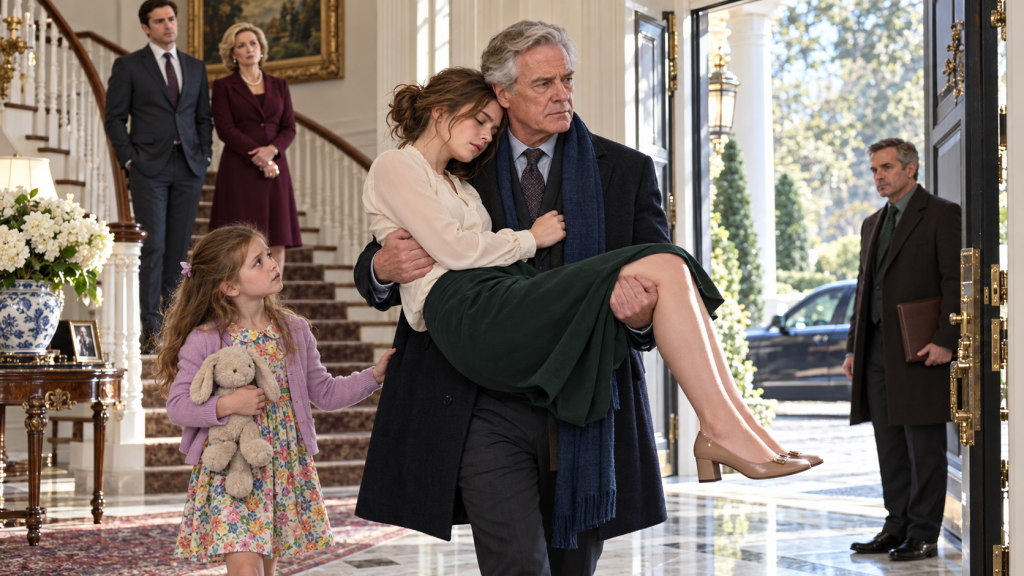
I reached for the photograph. My injured shoulder protested. A sharp pain shot beneath my ribs. But I barely noticed. “Lily saw everything?” My father didn’t answer immediately. Jonathan Hale closed the folder. Then spoke carefully. “We know she was present. We need to establish exactly what she witnessed.”
I looked at him.
“What did she tell you?”
He glanced toward Dad.
My father took my hand.
“Claire, Lily is safe.”
Tears filled my eyes.
“That isn’t what I asked.”
Dad’s expression softened.
“I know.”
I stared at him.
“Did my daughter watch someone hurt me?”
The silence was answer enough.
I covered my mouth.
And began crying.
Not because of my ribs.
Not because of my shoulder.
Not because my husband had allowed his family to describe me as unstable while I lay injured in a hospital bed.
I cried because my little girl had stood at the top of those stairs, frightened and alone, watching the people she trusted turn against her mother.
And I hadn’t been able to protect her.
“Where is she?” I whispered.
Dad squeezed my hand.
“With Susan.”
Susan was my father’s longtime neighbor, a retired elementary school principal who had known me since childhood.
She was the kind of woman who carried peppermints in her handbag and remembered every child’s birthday.
She had helped raise half the children on our street.
If Lily was with Susan, she was being cared for.
But I still needed to see her.
“Please,” I said. “I need my daughter.”
Dad nodded.
“We’re arranging that, sweetheart.”
Jonathan leaned forward.
“Claire, the Whitcombs have already filed documents alleging you’re incapable of making decisions for Lily. We need to respond carefully and promptly.”
I looked at him.
“Then respond.”
My voice shook.
“Do whatever we need to do.”
He nodded.
“We will.”
I stared at the photograph again.
Lily’s frightened face seemed to look directly at me.
Then I noticed something strange.
Her other hand was holding an object.
Something small.
Dark.
Rectangular.
I leaned closer.
“What’s that?”
Jonathan followed my gaze.
“The image isn’t clear enough to establish.”
I studied it.
Then my heart began pounding.
“Her tablet.”
Dad looked up.
“What?”
“Lily carries a little purple tablet everywhere.”
My throat tightened.
“She uses it to record videos of her dolls.”
Jonathan’s expression changed.
I touched the photograph.
“If she was holding it…”
I couldn’t finish.
Because suddenly, one terrible possibility filled my mind.
My daughter might have recorded what happened on those stairs.
Dad reached for his phone.
But before he could call Susan, the hospital room door opened.
A nurse entered.
She looked uncomfortable.
“Mrs. Whitcomb?”
I nodded.
“There’s someone asking to see you.”
Jonathan immediately stood.
“Who?”
The nurse hesitated.
“Your mother-in-law.”
My stomach dropped.
Eleanor.
The woman who’d stood above me while I struggled to breathe.
The woman who called my father and told him to come collect his troublesome daughter.
The woman whose attorneys had apparently begun preparing to take Lily away from me.
I stared toward the hallway.
Then whispered, “No.”
The nurse nodded.
“Of course.”
But before she could leave, Eleanor’s voice carried through the partially opened door.
“Claire, don’t be ridiculous. We need to settle this.”
My father rose.
Slowly.
He was sixty-eight.
Tall.
Broad-shouldered.
Wearing the same brown cardigan he’d owned for years.
To anyone passing the room, he probably looked like an ordinary grandfather visiting his injured daughter.
But I saw something change in him.
His back straightened.
His expression became unreadable.
And his voice, when he spoke, was quiet enough to be almost frightening.
“Eleanor, you are not entering this room.”
She laughed from the hallway.
“Arthur, this is a family matter.”
Dad moved toward the door.
“No.”
He paused.
“This is a matter concerning my daughter’s safety.”
Eleanor’s laughter faded.
Then she said, “You seem to have forgotten that the Whitcombs have friends in this city.”
Dad opened the door just enough to look at her.
“I haven’t forgotten anything.”
His voice remained calm.
“But I suggest you stop confusing influential acquaintances with immunity.”
For several seconds, Eleanor said nothing.
Then I heard her heels clicking against the hospital floor.
“Your daughter is destroying my son’s marriage.”
Dad didn’t move.
“Your son can discuss his marriage through his attorney.”
“She fell down the stairs, Arthur. People fall.”
I closed my eyes.
People fall.
As though I were a vase knocked from a shelf.
As though there had been no argument.
No threats.
No frightened child.
No husband standing silently while his wife lay injured.
Dad’s voice grew colder.
“Then you should have no objection to an independent investigation.”
Eleanor gave a short laugh.
“You really believe you can frighten us?”
“No.”
Dad paused.
“I believe the evidence deserves to be examined.”
Then he closed the door.
And Eleanor was gone.
When Dad returned to my bedside, his expression softened immediately.
He sat down.
Took my hand.
And asked, “Are you all right?”
I shook my head.
“No.”
He nodded.
“That’s a fair answer.”
Tears filled my eyes.
“Dad…”
“Yes?”
“Why didn’t you tell me what you used to do?”
He glanced toward Jonathan.
Then smiled faintly.
“Because I wanted to be your father.”
I stared at him.
He continued.
“My work involved difficult people and difficult decisions. When I came home, I wanted to leave those things outside.”
I swallowed.
“But you weren’t just doing administrative legal work.”
He smiled sadly.
“No.”
“What did you actually do?”
Dad leaned back.
“For many years, I supervised investigations involving financial misconduct and public corruption. I worked with attorneys, forensic accountants, auditors, and law-enforcement agencies.”
My eyes widened.
He continued.
“Some cases involved people who believed wealth could protect them from accountability.”
I looked down.
“The Whitcombs.”
Dad paused.
“Claire, I haven’t investigated the Whitcombs. I’m retired.”
I raised my eyes.
“Then how did you know who to call?”
He smiled gently.
“Because experience teaches you to recognize when someone is trying to control the story before the facts are established.”
He squeezed my hand.
“And because I know how to find people who can help.”
I stared at him.
My father.
The man who wore old sweaters.
Clipped grocery coupons.
Fixed his own plumbing.
And insisted that expensive coffee tasted no better than the kind he brewed at home.
He had spent decades examining the kind of people my in-laws believed themselves to be.
And none of them knew.
For years, Eleanor had mocked him.
Called him provincial.
Described him as a retired office worker.
Once, during Thanksgiving dinner, she laughed when Dad arrived carrying a homemade apple pie.
“How charming,” she’d said. “Some people never outgrow their little traditions.”
Dad had only smiled.
Now I understood why.
He didn’t need to explain himself to impress her.
His confidence had never depended on her approval.
At four that afternoon, Susan brought Lily to the hospital.
I heard her before I saw her.
Little footsteps.
A familiar voice.
Then the door opened.
“Mommy?”
My heart broke.
Lily stood in the doorway holding her stuffed rabbit.
Her dark hair was tangled.
Her eyes were swollen.
And when she saw me lying in the hospital bed, her face crumpled.
“Mommy!”
She started running.
Susan gently stopped her.
“Careful, sweetheart. Mommy’s hurt.”
I held out my uninjured arm.
“Come here, baby.”
Lily approached slowly.
Then climbed onto the edge of the bed with help.
She wrapped her little arms around me.
And began sobbing.
I held her as carefully as I could.
“Oh, Lily.”
Her voice shook.
“I thought you died.”
The words struck me harder than the fall.
I kissed her hair.
“No, sweetheart.”
She clung to me.
“Grandma said you were going away.”
My chest tightened.
I looked toward Dad.
His face had become very still.
I stroked Lily’s hair.
“I’m here.”
She sobbed harder.
“Daddy said I shouldn’t make things worse.”
I closed my eyes.
And something inside me broke.
I wanted to demand answers.
To ask what Preston had said.
What Eleanor had threatened.
What Lily had seen.
But I knew she was frightened.
And I wasn’t going to turn her into another person responsible for explaining the adults’ behavior.
I kissed her forehead.
“You didn’t do anything wrong.”
She shook against me.
“Mommy…”
“Yes?”
“Are they mad at me?”
I looked at her.
“No, sweetheart.”
Her eyes filled.
“Because I saw.”
My heart stopped.
Dad leaned forward.
But he remained silent.
I stroked Lily’s cheek.
“You’re safe with me.”
She stared into my eyes.
Then whispered, “Grandma pushed you.”
The room went still.
I felt the blood leave my face.
Lily began crying harder.
“She grabbed your arm, Mommy.”
I swallowed.
“It’s okay, baby.”
“She said you weren’t taking me.”
I closed my eyes.
“And Daddy…”
Her voice disappeared.
I waited.
Then she whispered something that hurt more than my fractured ribs.
“Daddy watched.”
I held my daughter.
And cried.
Not loudly.
Not dramatically.
Just quiet tears that slipped into her hair while she trembled against my chest.
The man I’d married had watched his mother hurt me.
My little girl had seen it.
And afterward, the Whitcombs had tried to turn the story into one where I was the problem.
I thought about Preston standing near the staircase.
Straightening his cuffs.
Avoiding my eyes.
I thought about the years I’d spent defending him.
Explaining his coldness.
Excusing his silence.
Telling myself he was simply uncomfortable confronting his mother.
Now I understood.
His silence wasn’t neutrality.
It was a decision.
And I was beginning to see how often he’d made it.
After Lily calmed down, Susan took her to the hospital cafeteria for juice.
Dad stepped into the hallway with Jonathan.
I stayed in bed.
Staring at the ceiling.
My mind kept returning to one memory.
The moment before I fell.
Eleanor standing at the top of the staircase.
Her fingers digging into my wrist.
The folder she demanded I return.
Preston behind her.
And my daughter calling out from the landing.
I’d tried to pull away.
Eleanor stepped closer.
Then came the sudden movement.
The loss of balance.
The terrible sensation of falling backward.
I remembered reaching for the banister.
Missing.
And the marble rushing toward me.
For hours, I’d wondered whether it had been an accident.
Now I knew at least that Eleanor had deliberately grabbed me during the argument.
The fall itself needed to be examined carefully.
But the story they’d told—that I’d simply been careless—was already falling apart.
At six, Jonathan returned.
He carried a small evidence envelope.
My pulse quickened.
“What’s that?”
He sat beside the bed.
“Lily’s tablet.”
I stopped breathing.
“Did she record anything?”
Jonathan nodded slowly.
“We’ve arranged for the device to be preserved and examined appropriately. We don’t want anyone altering the original files.”
I looked at him.
“But there’s a video?”
He hesitated.
“There’s footage from that morning.”
My throat tightened.
“Can I see it?”
Jonathan looked toward Dad.
Dad took my hand.
“Claire, you don’t have to watch it tonight.”
I stared at him.
“Dad.”
His eyes softened.
“Sweetheart…”
“I’ve spent nine years being told what I should and shouldn’t know.”
My voice trembled.
“I want the truth.”
He nodded.
Then Jonathan explained what had already been reviewed by the appropriate people.
And the truth was worse than I feared.
Lily had been recording her stuffed animals near the top of the stairs.
Her tablet captured Eleanor approaching me.
It captured the argument.
The raised voices.
Eleanor demanding the folder.
Preston telling me to stop being difficult.
And then Eleanor seized my wrist.
I remembered that part.
But the recording showed something I’d been too frightened to notice.
Preston had moved toward the staircase just before I fell.
Not to help.
To take the folder from my hand.
He reached across me.
Eleanor pulled.
I stumbled.
And neither of them released their grip in time to prevent me from falling.
The investigators would determine what the evidence established about responsibility.
But the footage showed something unmistakable.
I hadn’t simply lost my footing.
Two people had physically confronted me at the top of a staircase.
And after I fell, Preston didn’t rush to my side.
He looked at the folder.
Then picked it up.
I stared at Jonathan.
“What?”
He swallowed.
“Preston collected the folder before attending to you.”
The room seemed to tilt.
I looked toward Dad.
His face was pale with anger.
My throat tightened.
I whispered, “He cared more about those papers.”
Nobody answered.
I covered my face.
And began sobbing.
Because the man who had promised to love and protect me had watched me tumble down a staircase.
Then chosen documents over his injured wife.
For a long time, I couldn’t speak.
Then I lowered my hands.
“What was in the folder?”
Jonathan opened his portfolio.
“That brings us to the financial issue.”
My chest tightened.
He placed a document on the blanket.
It was a copy of a charitable foundation statement.
WHITCOMB COMMUNITY INITIATIVE.
I recognized the name.
Of course I did.
For years, Eleanor had hosted elegant fundraisers in its honor.
Champagne receptions.
Charity auctions.
Black-tie dinners.
Magazine photographs.
Speeches about responsibility and community leadership.
Preston always insisted I attend.
Sometimes I helped organize seating.
Sometimes I greeted donors.
Sometimes I baked desserts for smaller events.
And every year, Eleanor made a speech about how privileged families had a duty to help others.
I looked at the statement.
Then at Jonathan.
“What about it?”
He pointed toward a transfer.
Two million dollars.
Moved through an account associated with Lily’s name.
My heart began pounding.
“But Lily is seven.”
He nodded.
“Yes.”
“And she never received that money.”
“Correct.”
I stared at the page.
“Then why put it in her name?”
Jonathan took a slow breath.
“That’s one of the central questions. The records suggest someone attempted to use a trust connected to Lily as part of a series of questionable transactions.”
My stomach twisted.
I remembered the emergency custody petition.
The allegations that I was incapable.
The claim that Preston should control Lily’s affairs.
Then everything clicked.
“They wanted authority over the trust.”
Jonathan nodded.
“That appears to be part of the plan.”
I looked down.
“My daughter was seven years old, and they were already using her name.”
Dad squeezed my hand.
I whispered, “They were willing to take my child to protect their money.”
And the room went silent.
The next morning, a woman named Detective Rachel Morgan visited my hospital room.
She was calm.
Professional.
And careful not to promise things she couldn’t guarantee.
She explained that the circumstances of my fall were being investigated.
The surveillance footage had been secured.
Witnesses were being interviewed.
Medical records were being reviewed.
And the financial allegations would be addressed through the appropriate agencies and processes.
I listened.
Then asked, “Will Preston be arrested?”
She didn’t pretend to know.
“That depends on what the evidence establishes and the decisions made by the responsible authorities.”
I nodded.
“And Eleanor?”
“The same.”
I looked down.
Part of me wanted immediate punishment.
I wanted them to feel the fear they’d caused.
I wanted Eleanor to stop smiling.
Preston to stop pretending.
And everyone who’d called me unstable to finally acknowledge what happened.
But I’d learned something from my father.
Real accountability doesn’t begin with a satisfying speech.
It begins with evidence.
So I answered every question honestly.
Even when it hurt.
Detective Morgan asked about the argument before the fall.
I took a breath.
“Eleanor wanted me to sign estate documents.”
“What documents?”
“A power of attorney.”
I swallowed.
“She said it was routine family planning.”
The detective nodded.
“Did you sign?”
“No.”
“What happened after you refused?”
I looked toward Dad.
Then back at the detective.
“Preston became angry.”
I closed my eyes.
“He told me I was embarrassing him.”
The words sounded painfully familiar.
I continued.
“His mother said I was too emotional to manage serious matters.”
A tear slipped down my cheek.
“Then she said Lily would be better off with people who understood responsibility.”
The detective took notes.
I swallowed.
“And I told her she had no right to make decisions about my daughter.”
My voice broke.
“That’s when she grabbed my wrist.”
The detective asked whether there had been previous incidents.
I hesitated.
Because for nine years, I’d told myself the Whitcombs were merely difficult.
Controlling.
Demanding.
Proud.
But not dangerous.
Now, with the benefit of distance, I began remembering things differently.
The time Eleanor took my car keys because she said I was too upset to drive.
The time Preston blocked the bedroom door during an argument.
The time his family insisted I stop seeing certain friends because they were supposedly a bad influence.
The holidays when I was told which relatives I could invite.
The constant suggestions that my job was unnecessary.
The way Preston controlled large financial decisions while criticizing my spending.
And the way every disagreement ended with someone telling me I was ungrateful.
I looked at Detective Morgan.
Then whispered, “There were things I explained away.”
She waited.
And for the first time, I began telling the whole story.
Preston had been charming when we met.
I was twenty-five.
Working toward my qualifications in speech therapy.
He was a confident young executive from one of Richmond’s most prominent families.
He took me to beautiful restaurants.
Sent flowers.
Remembered small details.
Made me feel chosen.
When he proposed, I thought I’d found someone who believed in me.
Then came the wedding.
Eleanor controlled everything.
The venue.
The guest list.
The flowers.
The menu.
She even criticized my dress.
“Beautiful, of course,” she’d said. “Though perhaps a little simple for a Whitcomb wedding.”
I laughed it off.
At the time, I wanted to be gracious.
I wanted Preston’s family to love me.
I didn’t realize how expensive that desire would become.
After the wedding, the expectations grew.
Eleanor wanted us at Sunday dinners.
Then weekday lunches.
Then fundraising events.
Then holiday gatherings.
When Lily was born, she began making decisions about the nursery.
The pediatrician.
The nanny.
The preschool.
And eventually, the school Lily attended.
Every time I objected, Preston said the same thing.
“Mother only wants what’s best.”
I believed him.
Or perhaps I wanted to.
Because admitting the truth would have meant acknowledging that my husband was allowing someone else to control our family.
And I wasn’t ready.
When Lily turned five, Eleanor began suggesting boarding school.
I laughed the first time.
“She isn’t even six.”
Eleanor smiled.
“It’s never too early to think about proper education.”
I shook my head.
“She stays with us.”
Preston looked annoyed.
Later that evening, he accused me of humiliating his mother.
I stared at him.
“Because I won’t send our daughter away?”
He sighed.
“You always make everything dramatic.”
That was how it happened.
One conversation at a time.
One small dismissal after another.
Until I began questioning my own judgment.
At the hospital, I told Detective Morgan everything I could remember.
Not because every incident was criminal.
But because context mattered.
Patterns mattered.
And I was finished helping the Whitcombs present a polished story while hiding what happened behind closed doors.
Three days later, I was discharged.
Dad brought me to his house outside Charlottesville.
The familiar brick home looked smaller than I remembered.
Its porch railing had recently been painted.
A row of yellow flowers grew beside the steps.
And a wind chime moved gently near the front door.
I stood in the driveway.
My ribs ached.
My shoulder was supported.
And I felt suddenly overwhelmed.
For years, I’d lived in a mansion with chandeliers and marble floors.
Now I was standing before a modest house with peeling paint on the garage.
And somehow, it felt safer than anywhere I’d been in years.
Dad opened the door.
“Welcome home, sweetheart.”
I began crying.
He wrapped his arms around me carefully.
And whispered, “You’re safe here.”
Lily had decorated the guest bedroom.
Paper hearts covered the window.
A handmade sign hung above the bed.
WELCOME HOME, MOMMY.
There were flowers.
Drawings.
And a little stuffed bear beside the pillow.
I stared.
Then began crying again.
Lily ran toward me.
“Do you like it?”
I knelt as carefully as I could.
“Oh, sweetheart.”
She smiled nervously.
“I made everything yellow because you like sunshine.”
I pulled her close.
“I love it.”
Her arms wrapped around my neck.
Then she whispered, “Can we stay here?”
My throat tightened.
I looked toward Dad.
He stood in the doorway.
Quiet.
Waiting.
I turned back to Lily.
“We’re going to make decisions that keep us safe.”
She nodded.
Then asked, “Can Grandpa stay with us?”
Dad laughed softly.
“Considering it’s my house, I hope so.”
Lily giggled.
And for the first time since the fall, I laughed too.
The custody proceedings began quickly.
Preston’s attorneys had filed allegations about my emotional stability and financial judgment.
Jonathan responded with medical records.
School records.
Evidence of my involvement in Lily’s daily care.
The relevant financial documents.
And the footage concerning the staircase incident.
He also sought appropriate temporary arrangements to protect Lily during the dispute.
Nothing was automatic.
The court had to examine the evidence and consider Lily’s welfare.
But the Whitcombs’ claim that I’d simply become unreliable was increasingly difficult to reconcile with the records.
At the first hearing, I saw Eleanor.
She wore a cream-colored suit.
Pearls.
A perfectly arranged hairstyle.
And the same expression of composed superiority I’d known for nine years.
Preston sat beside her.
He looked handsome.
Calm.
Almost bored.
For a moment, seeing him made my chest ache.
Because part of me still remembered the man who brought me flowers.
The man who held Lily moments after she was born.
The man who once promised we’d always protect each other.
Then I remembered him picking up the folder while I lay injured.
And the ache changed into something colder.
Clarity.
Eleanor looked toward me.
Her eyes narrowed.
Then she smiled faintly.
As though she still believed this was a social contest.
A disagreement she could win by appearing more respectable.
I looked away.
Jonathan leaned toward me.
“Claire?”
I nodded.
“Yes?”
“Remember, answer the questions truthfully. Don’t worry about Eleanor.”
I swallowed.
Then whispered, “She thinks Dad will embarrass himself.”
Jonathan glanced toward the back of the courtroom.
My father sat quietly in the last row.
Brown cardigan.
Reading glasses.
A folder on his lap.
Jonathan smiled faintly.
“Your father isn’t here to impress anyone.”
I looked toward Dad.
He met my eyes.
Then nodded once.
And somehow, I felt stronger.
The hearing was difficult.
Preston’s attorney argued that my injuries had made me temporarily unable to care for Lily.
He questioned my income.
My emotional state.
And my decision to stay with my father.
He described the Whitcombs’ house as stable.
Comfortable.
Well-equipped.
And staffed with people who could provide constant support.
I listened.
Then answered calmly when it was my turn.
I described my work.
My relationship with Lily.
Our daily routines.
Her school.
Her medical appointments.
Her reading difficulties.
The exercises we practiced together.
And the way she liked me to sing quietly while brushing her hair.
I didn’t pretend I was perfect.
I admitted I was recovering.
That I needed help.
That the fall had frightened me.
But I also explained something important.
Being injured didn’t make me incapable of loving or caring for my child.
And wealth did not automatically make a household safe.
Then Jonathan introduced evidence that changed the atmosphere.
The surveillance footage.
The medical records.
The contemporaneous reports.
And the questions surrounding the Whitcombs’ financial dealings.
The judge reviewed the materials according to the court’s procedures.
Preston’s attorney objected to some evidence.
Certain issues were reserved for later hearings.
But the essential facts could no longer be treated as a simple disagreement about my emotional stability.
There had been a serious incident.
A frightened child.
And an attempt to obtain emergency custody almost immediately afterward.
During a break, Eleanor approached me in the hallway.
I was sitting beside Susan, who had accompanied me for support.
Eleanor stopped a few feet away.
“Claire.”
I looked up.
“Eleanor.”
Her expression was hard.
“You’re making a terrible mistake.”
I said nothing.
She stepped closer.
“Do you understand what you’re doing to Preston’s reputation?”
I stared at her.
Then asked quietly, “Do you understand what happened to my ribs?”
Her face tightened.
“Must you be so theatrical?”
I looked at her.
For nine years, that tone had made me shrink.
Now I felt something different.
Not confidence exactly.
But the absence of fear.
“Eleanor.”
She raised an eyebrow.
“Yes?”
“I’m not discussing this with you outside the legal process.”
She laughed.
“You sound just like your father.”
I smiled faintly.
“Thank you.”
Her expression changed.
And I realized she’d intended it as an insult.
Then Dad appeared.
He walked toward us carrying two cups of coffee.
One for me.
One for Susan.
He looked at Eleanor.
“Good afternoon.”
She folded her arms.
“Arthur.”
Dad nodded.
Then handed me my coffee.
“Careful. It’s hot.”
I smiled.
“Thanks, Dad.”
Eleanor gave a short laugh.
“Still playing the devoted father?”
Dad looked at her.
“No.”
He paused.
“Just being one.”
Her smile disappeared.
Then she leaned closer.
“You have no idea how much influence this family has.”
Dad remained calm.
“Eleanor, influence isn’t evidence.”
She stared.
He continued.
“And whatever happens here should be decided on the facts.”
For a moment, she looked almost uncertain.
Then she turned and walked away.
Dad sat beside me.
Took a sip of coffee.
And asked whether I needed anything.
As though nothing unusual had happened.
The judge issued temporary arrangements focused on Lily’s safety and welfare while the case continued.
I was able to remain with her at Dad’s house.
Further evaluations and hearings were scheduled.
Preston’s contact with Lily was addressed through structured conditions.
I didn’t receive everything I wanted immediately.
There were still questions.
Still proceedings.
Still uncertainty.
But Lily wasn’t simply handed over to Eleanor because the Whitcombs had a mansion and expensive lawyers.
That mattered.
More than I could explain.
That evening, I tucked Lily into bed.
She was wearing pink pajamas.
Her stuffed rabbit rested beside her.
The bedroom smelled of clean sheets and lavender soap.
I kissed her forehead.
“Good night, sweetheart.”
She reached for my hand.
“Mommy?”
“Yes?”
“Are we going back to Grandma’s house?”
My heart tightened.
I sat beside her.
“I don’t know exactly what the future will look like yet.”
Her eyes filled.
“Do we have to?”
I swallowed.
“We’re working with people whose job is to help keep children safe.”
She nodded slowly.
Then whispered, “I don’t like the stairs there.”
A tear slipped down my cheek.
I stroked her hair.
“I know.”
She looked at me.
“Grandpa’s house has little stairs.”
I laughed softly.
“Yes.”
She smiled.
“And the carpet is squishy.”
I smiled through tears.
“It is.”
Then she whispered, “I like it here.”
I kissed her forehead.
“So do I.”
The financial investigation unfolded over the following months.
The charitable foundation’s records raised serious questions about how funds had been managed.
Investigators examined transfers.
Contracts.
Trust arrangements.
And documents associated with Preston and Eleanor.
The two-million-dollar transaction involving Lily’s name became a central issue.
I learned that several people had raised concerns before the fall.
An accountant.
A foundation employee.
A former board member.
But their questions had been dismissed.
Some were told the matter was administrative.
Others were pressured not to discuss it.
And one employee had been removed from her position after asking to review records.
I stared at the summaries.
The polished charity events.
The speeches.
The beautiful photographs.
All while serious financial questions were gathering beneath the surface.
Then Jonathan called one afternoon.
“Claire, we need to discuss a witness.”
I was sitting at Dad’s kitchen table helping Lily with homework.
I stepped into the hallway.
“What witness?”
Jonathan paused.
“A former foundation accountant named Evelyn Marsh.”
My stomach tightened.
“Did she work for Eleanor?”
“Yes.”
“Does she know about the trust?”
“She may have information relevant to it.”
I swallowed.
Then Jonathan added something unexpected.
“Claire, she says she tried to warn you.”
I stopped breathing.
“What?”
“She claims she sent correspondence to your attention several months ago.”
My mind raced.
I remembered a thick envelope arriving at the Whitcomb house.
Addressed to me.
Preston had taken it from the entry table.
When I asked about it, he said it was foundation paperwork.
I never saw it again.
My heartbeat quickened.
I whispered, “Preston opened my mail.”
Jonathan was quiet.
Then said, “Tell me everything you remember.”
Evelyn Marsh eventually provided a detailed account.
She had noticed discrepancies in the foundation’s financial reports.
Some expenses lacked documentation.
Certain transfers appeared unrelated to the foundation’s charitable purposes.
And the trust linked to Lily raised questions she couldn’t resolve.
Evelyn attempted to raise the issues internally.
She said her concerns were dismissed.
Then she tried to contact me.
Not because she believed I was involved.
But because my daughter’s name appeared on the account.
She worried that I might not know.
Her letter never reached me.
I stared at the record of her statement.
And realized Preston hadn’t simply been hiding money.
He had been preventing me from learning information that could protect Lily.
One evening, Dad found me sitting alone on the back porch.
The sun was setting.
Lily was inside with Susan.
I held a cup of tea that had gone cold.
Dad sat beside me.
For a while, neither of us spoke.
Then I whispered, “How did I miss everything?”
He looked at me.
“Claire.”
I shook my head.
“I was right there.”
My voice broke.
“Living in that house.”
“Seeing those people every day.”
“Helping at their charity events.”
“And I didn’t know.”
Dad waited.
I covered my face.
“I feel foolish.”
He took my hand.
“Sweetheart, trusting your spouse isn’t foolish.”
I looked at him.
He continued.
“The responsibility for deception belongs to the person choosing to deceive.”
Tears filled my eyes.
“But I ignored things.”
“Yes,” Dad said gently.
I stared.
He squeezed my hand.
“And now you’re learning from them.”
My voice broke.
“I should have protected Lily sooner.”
Dad looked toward the house.
“She has a mother who’s protecting her now.”
I began crying.
He put an arm around me carefully.
And we sat together until the sky turned dark.
The hardest night came three months later.
Lily woke screaming.
I hurried into her room.
She was sitting upright.
Her face wet with tears.
“Mommy!”
I sat beside her.
“I’m here.”
She clung to me.
“Don’t fall.”
My heart broke.
“Oh, sweetheart.”
She began shaking.
“I tried to tell Grandma to stop.”
I held her.
“I know.”
“She didn’t listen.”
Tears filled my eyes.
Lily sobbed.
“And Daddy didn’t help.”
I kissed her forehead.
“You’re safe now.”
She clung tighter.
“Why didn’t Daddy help you?”
I closed my eyes.
There was no answer simple enough to make that understandable.
I took a breath.
Then said carefully, “Daddy made choices that hurt us.”
Lily looked up.
“Bad choices?”
“Yes.”
She began crying again.
I stroked her hair.
“And grown-ups are responsible for their choices.”
She nodded.
Then whispered, “Was it my fault?”
My heart shattered.
“No.”
I held her face gently.
“Lily, listen to me.”
Her eyes met mine.
“Nothing that happened on those stairs was your fault.”
She swallowed.
“Nothing?”
“Nothing.”
She began sobbing.
I pulled her close.
And held her until she fell asleep.
After that night, I arranged additional support for Lily.
A child therapist helped her process what she’d witnessed.
The sessions were gentle.
Age-appropriate.
Focused on helping her feel safe.
She wasn’t treated as a witness whose only purpose was to help adults win a case.
She was a child who needed care.
And slowly, the nightmares became less frequent.
She began laughing more.
Sleeping better.
Asking questions without fear.
And one afternoon, she told me something that made my heart ache.
“Mommy, I like when grown-ups tell the truth.”
I smiled through tears.
“Me too, sweetheart.”
The legal proceedings continued.
The financial allegations were examined separately from the custody matter.
Eleanor’s social connections did not prevent scrutiny.
Neither did Preston’s reputation.
But the process was careful and sometimes frustrating.
Evidence had to be authenticated.
Witnesses interviewed.
Records obtained.
Claims challenged.
And decisions made according to the law.
I learned that justice rarely resembles the dramatic moments people imagine.
It often looks like paperwork.
Patience.
Uncomfortable questions.
And people willing to tell the truth even when doing so costs them something.
Preston called me one evening.
I was sitting at Dad’s kitchen table.
Lily was asleep.
Dad was reading in the next room.
When I saw Preston’s name, my chest tightened.
I answered with the call documented as advised.
“Hello?”
“Claire.”
His voice sounded strained.
I said nothing.
He continued.
“I need to see you.”
I took a breath.
“Speak with Jonathan.”
“Please.”
I closed my eyes.
“Preston, what do you want?”
He began crying.
“I’ve lost everything.”
I stared at the wall.
For a moment, I remembered his confidence.
His expensive suits.
His dismissive laughter.
The way he stood beside his mother while she insulted my family.
Now his voice was shaking.
“I can’t sleep.”
I swallowed.
“Have you spoken with your attorney?”
He ignored the question.
“Claire, Mother made everything worse.”
My stomach tightened.
There it was.
The blame.
Even now.
I took a slow breath.
“Preston, you were standing there.”
Silence.
“You saw what happened.”
His breathing changed.
I continued.
“You picked up the folder.”
He began crying harder.
“Claire…”
“You left me on the floor.”
The words finally came out.
Simple.
Terrible.
True.
He whispered, “I know.”
And for the first time, he didn’t deny it.
“Why?”
The question escaped before I could stop it.
For nine years, I’d wanted to understand why Preston always chose his mother’s approval over our marriage.
Why he allowed her to belittle me.
Why he treated my concerns as inconveniences.
And why, on the worst morning of my life, he cared more about documents than whether I could breathe.
Preston was quiet.
Then whispered, “I was afraid.”
I closed my eyes.
“Of what?”
“Mother.”
I stared at the wall.
He continued.
“Of losing everything.”
A tear slipped down my cheek.
“And you were willing to lose me?”
He began sobbing.
I swallowed.
“Preston, fear doesn’t make what you did acceptable.”
“I know.”
“And blaming Eleanor won’t undo it.”
He was quiet.
Then whispered, “I’m sorry.”
For a long time, I didn’t speak.
I had dreamed of hearing those words.
But now they felt strangely small.
Not meaningless.
Just insufficient.
“I hear you,” I said finally.
Then I ended the call.
That night, I sat beside Dad on the porch.
The air smelled of freshly cut grass.
Crickets sang in the garden.
Dad looked at me.
“Difficult call?”
I nodded.
“Preston apologized.”
Dad remained quiet.
I looked toward the stars.
“I thought I’d feel better.”
He smiled sadly.
“Sometimes an apology confirms what you already know without repairing what happened.”
I swallowed.
“Yes.”
He took a sip of tea.
Then asked, “What do you want now?”
I considered.
For years, my wishes had been measured against what Preston or Eleanor would approve.
Now, suddenly, the question felt unfamiliar.
What did I want?
I looked toward the house.
Lily’s bedroom light was glowing.
Susan’s car was parked in the driveway.
My father’s garden stretched beneath the moonlight.
Then I whispered, “I want peace.”
Dad nodded.
“Good place to start.”
I filed for divorce.
Not impulsively.
Not as revenge.
But because the foundation of my marriage had been destroyed.
Preston had allowed me to be harmed.
Participated in concealment.
Supported legal claims that misrepresented my ability to care for Lily.
And failed to protect our daughter from frightening circumstances.
I could not build a safe future around those choices.
When I told Lily that Preston and I would no longer live together, she looked confused.
We sat at Dad’s kitchen table.
A child therapist had helped me prepare.
I spoke gently.
Simply.
Honestly.
“Mommy and Daddy won’t be married anymore.”
Lily looked down.
“Because of the stairs?”
My heart tightened.
I took a breath.
“Because of important problems between grown-ups.”
She frowned.
“Did I make them happen?”
I shook my head.
“No, sweetheart.”
I touched her cheek.
“You didn’t cause this.”
She nodded slowly.
Then asked, “Do I still have a daddy?”
Tears filled my eyes.
“Yes.”
I swallowed.
“And the adults and the court will work out how to keep you safe while you have a relationship with him.”
She considered that.
Then whispered, “Can I still love him?”
My heart broke.
“Of course.”
I pulled her close.
“You never have to stop loving someone just because they’ve made serious mistakes.”
She began crying.
And I held her.
The divorce and custody proceedings took time.
There were evaluations.
Legal arguments.
Financial disclosures.
Questions about Preston’s conduct.
And difficult discussions concerning Lily’s needs.
I won’t pretend every day was easy.
Some days, I felt strong.
Other days, I cried in the shower.
Sometimes I missed the man I thought Preston had been.
The early dates.
The laughter.
The way he held my hand when Lily was born.
And sometimes I was angry at myself for missing any part of a marriage that had hurt me.
But Dad reminded me that grief isn’t a verdict.
Missing good memories doesn’t mean the harmful ones disappear.
And leaving a marriage doesn’t require pretending there was never anything worth loving.
Eventually, the court established arrangements focused on Lily’s welfare.
Her primary home remained with me.
Preston’s contact was addressed through conditions intended to protect her safety and emotional needs.
Professional guidance remained part of the process.
The precise arrangements changed over time as circumstances developed.
But one thing was no longer in doubt.
Lily wasn’t a bargaining chip.
She wasn’t a convenient name on a financial account.
And she wasn’t property the Whitcombs could claim because they had more money.
She was a child.
My child.
And her well-being mattered more than their reputation.
The financial investigation also reached significant conclusions.
The trust transaction involving Lily was examined.
Records were corrected or restricted through appropriate procedures where necessary.
The foundation’s management became subject to formal scrutiny.
Several transactions were found to have serious irregularities.
And the evidence concerning Preston and Eleanor was evaluated by the responsible authorities.
Some allegations led to legal consequences.
Others were contested or resolved through different proceedings.
There were no instant confessions.
No dramatic moment when everyone in a courtroom stood and applauded.
But the documents told a story Eleanor could no longer control with charm.
Her public influence began fading.
People who once praised her charitable work started asking questions.
Board members resigned.
Donors requested information.
Auditors reviewed records.
And the foundation she had used to build her reputation faced an uncertain future.
I didn’t celebrate.
Not because I believed she deserved protection.
But because charitable work was supposed to help real people.
And I hated knowing that anyone’s trust in giving might have been damaged.
One afternoon, Jonathan called.
“Claire, I wanted you to hear something directly.”
I sat down.
“What?”
“The relevant proceedings concerning Eleanor have reached an important stage.”
My heartbeat quickened.
He explained what had been decided.
Carefully.
Without exaggeration.
Without promising more than the record supported.
I listened.
Then whispered, “So the truth is finally on paper.”
Jonathan paused.
“Yes.”
My eyes filled.
For nine years, Eleanor had controlled every room she entered.
Her words became the official version.
Her opinions were treated as facts.
Her connections made others hesitate.
But now, official records reflected findings she hadn’t been able to simply dismiss.
And somehow, that mattered more than seeing her embarrassed.
The most unexpected part came from Preston.
Months after the divorce was finalized, he requested a meeting through our attorneys.
I was cautious.
But the request concerned documents relevant to Lily.
So I agreed to a structured discussion.
We met in a conference room.
Preston looked older.
His face was thinner.
His confidence had faded.
He wore a plain gray suit.
No expensive watch.
No carefully polished appearance.
When he saw me, he stood.
“Claire.”
I nodded.
“Preston.”
He looked down.
Then placed a folder on the table.
“I wanted you to have these.”
My chest tightened.
“What are they?”
He swallowed.
“Records I should have given you a long time ago.”
Inside were documents concerning Lily’s trust.
Correspondence.
Notes.
Financial statements.
And copies of communications between Preston and Eleanor.
I looked at the folder.
Then at him.
“Why now?”
His eyes filled.
He took a breath.
“Because I finally understand that keeping them hidden was wrong.”
I stared.
He continued.
“I spent years doing whatever Mother wanted.”
His voice broke.
“I told myself I was protecting the family.”
I looked down.
“But I was protecting myself.”
For several seconds, neither of us spoke.
Then Preston whispered, “I hurt you.”
Tears filled my eyes.
He continued.
“And I frightened Lily.”
I swallowed.
He looked at me.
“I can’t change that.”
“No,” I whispered.
He nodded.
“I know.”
Then he said something I hadn’t expected.
“I don’t want her to grow up believing she caused any of this.”
My heart tightened.
I looked at him carefully.
“Then make sure your actions support that.”
He nodded.
“I will.”
I didn’t forgive Preston that day.
Not in the simple way people imagine.
I didn’t embrace him.
Didn’t tell him everything was fine.
Didn’t promise we could be friends.
But I acknowledged that he had finally spoken more honestly than he’d spoken in years.
And I hoped he’d continue.
Not because I wanted him back.
But because Lily deserved a father who could take responsibility for his choices.
Life at Dad’s house changed gradually.
At first, Lily and I slept in the guest room.
Then Dad suggested renovating the small apartment above the garage.
It had once been used for storage.
Now he wanted to make it comfortable for us.
I protested.
“Dad, that’s too much.”
He laughed.
“Claire, I’ve been looking for an excuse to renovate that space for fifteen years.”
I smiled.
“Really?”
He raised an eyebrow.
“Do you think I enjoy storing broken chairs forever?”
I burst out laughing.
And for a moment, the heaviness lifted.
We worked with contractors.
Chose paint colors.
Replaced old flooring.
Added bookshelves.
Created a little reading corner for Lily.
And built a small kitchenette.
I chose pale blue walls.
Lily chose yellow curtains.
Dad insisted on installing a sturdy handrail along the stairs.
He smiled when he said it.
But I saw the tenderness beneath the joke.
He wanted us safe.
And I loved him for it.
When the apartment was finished, Lily stood in the doorway.
Her eyes widened.
“Mommy!”
I smiled.
“What?”
“It’s ours?”
I nodded.
“Yes.”
She ran toward her room.
Then stopped.
Looked back.
And whispered, “We don’t have to leave?”
My throat tightened.
I knelt.
“We have a home here, sweetheart.”
She smiled.
Then threw her arms around me.
I held her.
And began crying.
Because for years, the Whitcomb mansion had been presented as the greatest gift Preston could give us.
But this small apartment above a garage felt richer than every chandelier in that enormous house.
It had something the mansion never offered.
Peace.
I returned to work gradually.
My recovery took time.
The fractured ribs healed.
My shoulder improved with treatment.
And my strength returned.
At first, I worried about whether I could continue as a speech therapist.
I loved my students.
Loved helping children find confidence in communication.
Loved seeing a child’s face light up when a difficult word finally became easier.
But after the fall, I was frightened.
What if I couldn’t manage?
What if the Whitcombs were right about me being weak?
Then I returned to the elementary school one Monday morning.
And everything changed.
The children had made a welcome sign.
WE MISSED YOU, MRS. DAWSON.
I had resumed using my maiden name professionally.
Seeing it printed in colorful letters made tears rise immediately.
A little boy named Noah ran toward me.
“Mrs. Dawson!”
I smiled.
“Hi, Noah.”
He stopped.
Looked worried.
“Are you better?”
I nodded.
“Getting there.”
He smiled.
Then held up a worksheet.
“I practiced my sounds.”
My heart warmed.
“Did you?”
He nodded enthusiastically.
“Every day.”
I knelt carefully.
“Then let’s hear them.”
And as he began speaking, slowly and proudly, I realized something.
My work mattered.
Not because it impressed the Whitcombs.
Not because it brought prestige.
But because it helped people.
And I had spent too many years allowing Eleanor to make me feel ashamed of it.
The following spring, Lily turned eight.
We celebrated in Dad’s backyard.
Nothing extravagant.
No hired entertainers.
No enormous floral arrangements.
No formal dinner.
Just balloons.
Cupcakes.
A homemade cake.
And the people who loved her.
Susan brought lemonade.
Jonathan stopped by with a card.
Daniel sent a book about detectives.
And Dad grilled hamburgers while insisting he was the greatest cook in Virginia.
Lily laughed until she nearly fell out of her chair.
I watched from the porch.
My heart felt full.
Not because our lives had become perfect.
They hadn’t.
But because my daughter was laughing without fear.
And that was worth more than any luxury Eleanor had ever offered.
During the party, Lily brought me a folded piece of paper.
“Mommy?”
I smiled.
“Yes?”
“Present.”
I laughed.
“For me?”
She nodded.
I opened it.
Inside was a drawing.
Three people standing outside a little brick house.
One tall man with gray hair.
One woman with brown hair.
One little girl in a yellow dress.
Above them, Lily had written:
GRANDPA, MOMMY, AND ME.
At the bottom were five carefully printed words.
THIS HOUSE FEELS LIKE LOVE.
My breath caught.
Tears filled my eyes.
Lily looked worried.
“Bad?”
I shook my head.
“No, sweetheart.”
I pulled her close.
“It’s beautiful.”
Dad came over.
“What is it?”
I showed him.
His eyes filled.
He looked at Lily.
Then whispered, “Well, that’s the finest picture I’ve ever seen.”
Lily grinned.
And we stood together beneath the spring sunshine.
That evening, after the party, Dad found me cleaning up.
He took a stack of plates from my hands.
“Go sit down.”
I laughed.
“Dad…”
He raised an eyebrow.
“Claire.”
I smiled.
“Yes?”
“You’ve spent enough years being told your job is to make everyone else’s life easier.”
I stared at him.
His expression softened.
“Let someone take care of you sometimes.”
My eyes filled.
I swallowed.
Then nodded.
“Okay.”
And I went to sit on the porch.
For a long time, I thought healing meant becoming the person I was before Preston.
The young woman who laughed easily.
Trusted freely.
And believed love meant safety.
But over the years, I learned that healing wasn’t about returning to who I’d been.
It was about becoming someone who understood her own boundaries.
Someone who could love deeply without disappearing.
Someone who could ask questions.
Say no.
And recognize the difference between a beautiful house and a safe home.
I also learned something about my father.
For years, I thought his quietness meant he was ordinary.
Not impressive.
Not influential.
Not someone who belonged in Eleanor’s world.
But the truth was that he had never needed to perform importance.
His life was built on principles.
Patience.
Evidence.
And the kind of integrity that remains the same whether someone is watching or not.
One evening, I asked him something.
We were sitting on the back porch.
Lily was asleep.
The garden smelled of fresh rain.
“Dad?”
“Yes?”
“Did Eleanor ever know who you really were?”
He smiled faintly.
“She knew enough by the time the proceedings were underway.”
I laughed softly.
“She always thought you were just a retired office worker.”
Dad shrugged.
“I was retired.”
I smiled.
“You know what I mean.”
He looked toward the garden.
Then said, “Claire, people who judge others by their clothes or bank accounts often miss the things that matter.”
My eyes filled.
He continued.
“Your mother taught me that.”
I looked down.
Mom had died when I was nineteen.
She’d been gentle.
Practical.
And quietly determined.
Dad smiled sadly.
“She used to say that character is what remains when nobody is impressed.”
I laughed through tears.
“That sounds like her.”
He nodded.
“Yes.”
Then he reached for my hand.
“And you have more of her in you than you realize.”
I began crying.
Years passed.
Lily grew taller.
Her hair grew longer.
Her questions became more complicated.
She started playing piano.
Joined the school art club.
And developed a fierce love of mystery novels.
Sometimes she asked about the Whitcombs.
Sometimes she didn’t.
Preston’s relationship with her continued under arrangements shaped by her needs and the relevant court decisions.
There were good moments.
Difficult moments.
And boundaries that remained important.
I didn’t try to erase her father from her life.
But I also refused to pretend his choices had been harmless.
We spoke honestly.
Carefully.
With support when needed.
And slowly, Lily learned that she could love her father without carrying responsibility for his mistakes.
When Lily turned twelve, she asked me something unexpected.
We were making cookies.
Flour covered the counter.
A little dough stuck to her sleeve.
“Mom?”
“Yes?”
“Why didn’t you leave Daddy sooner?”
My hands stopped moving.
For a moment, I didn’t know what to say.
She looked worried.
“Sorry.”
I shook my head.
“No, sweetheart.”
I took a breath.
“It’s okay to ask.”
She waited.
I considered carefully.
“Because I kept hoping things would get better.”
She nodded.
“And because I loved him.”
Her expression softened.
I continued.
“Sometimes people stay in situations longer than they should because they remember the good parts and hope those parts will return.”
Lily looked down.
“Did Grandma make you scared?”
I swallowed.
“Yes.”
She nodded slowly.
Then asked, “Are you scared now?”
I looked around.
The little kitchen.
The cookies.
The sunlight.
Dad humming downstairs.
I smiled.
“Not like I used to be.”
Lily smiled.
“Good.”
Then she returned to cutting cookies.
And I stood there with tears in my eyes.
By the time Lily turned fifteen, Dad had become the center of her world.
They read history books together.
Played chess.
Worked in the garden.
And argued affectionately about whether pineapple belonged on pizza.
Dad insisted it didn’t.
Lily insisted it did.
Neither ever changed their mind.
I loved watching them.
Because it reminded me that family wasn’t simply about wealth or reputation.
It was about showing up.
Listening.
Making time.
And being safe enough to disagree without fear.
One afternoon, Dad taught Lily how to examine old family photographs.
They spread albums across the dining table.
Lily laughed at my childhood hairstyles.
Dad laughed harder.
Then she found a photograph of him standing beside several people in formal clothes.
He looked younger.
Serious.
A badge clipped to his belt.
Lily stared.
“Grandpa?”
“Yes?”
“Were you a detective?”
He smiled.
“Something like that.”
Her eyes widened.
“Really?”
He laughed.
“Yes.”
She looked at the photograph.
Then at him.
“Did you catch bad guys?”
Dad considered.
“I helped investigate people who were accused of doing harmful or dishonest things.”
Lily nodded thoughtfully.
“Did you always know who was lying?”
He shook his head.
“No.”
She frowned.
“Then how did you find out?”
Dad smiled.
“By asking questions and checking the evidence.”
Lily considered that.
Then whispered, “Like when Mommy fell?”
Dad’s face softened.
“Yes.”
He took her hand.
“Like then.”
Lily looked at him.
Then said something that made both of us cry.
“I’m glad you believed me.”
Dad’s eyes filled.
He squeezed her hand.
“Always tell the truth as best you can, sweetheart.”
She nodded.
“And know that grown-ups should listen.”
I stood in the doorway.
Unable to speak.
Because the little girl who once stood frightened on a staircase was now learning that her voice mattered.
And that was one of the greatest gifts we could give her.
When Lily turned eighteen, she received a scholarship to study child psychology.
I cried when the acceptance letter arrived.
Dad pretended not to.
But I saw him wiping his eyes beside the window.
Lily laughed.
“Grandpa!”
He cleared his throat.
“Dust.”
She grinned.
“There’s no dust.”
He nodded seriously.
“Very aggressive dust.”
We all burst out laughing.
That evening, we celebrated with dinner.
Lily chose spaghetti.
Dad insisted on garlic bread.
Susan brought chocolate cake.
And we sat around the kitchen table talking about the future.
At one point, Lily looked at me.
“Mom?”
“Yes?”
“Do you think I can help children who are scared?”
My heart tightened.
I smiled.
“Yes, sweetheart.”
She nodded.
“I want to.”
I looked at her.
The little girl I’d once held in a hospital room.
The child who’d asked whether the fall was her fault.
Now a young woman who wanted to help other children feel safe.
My eyes filled.
“You already understand something important.”
She smiled.
“What?”
“That children deserve to be heard.”
Her expression softened.
Then she reached for my hand.
And whispered, “You taught me that.”
Dad grew older.
His steps slowed.
His hair became completely white.
And eventually, he needed more help with the things he’d once insisted on doing himself.
At first, he resisted.
Of course.
He’d always been stubborn.
One afternoon, I found him standing on a ladder trying to repair a gutter.
I nearly fainted.
“Dad!”
He looked down.
“What?”
“Get off that ladder.”
He frowned.
“Claire, I’ve repaired gutters for forty years.”
I folded my arms.
“And I’d like you to survive long enough to complain about hiring someone.”
He stared at me.
Then began laughing.
“All right.”
I smiled.
“Thank you.”
He climbed down slowly.
Then muttered, “Your mother used to boss me around exactly like that.”
I laughed through tears.
“Someone has to.”
As the years passed, I began understanding my father’s love in new ways.
He hadn’t protected me by controlling every decision.
He’d helped me find the resources to protect myself.
He hadn’t demanded that I leave Preston simply because he disliked the Whitcombs.
He’d waited.
Asked questions.
Offered support.
And when I needed help, he’d shown up.
Not with dramatic speeches.
But with facts.
Patience.
A lawyer.
A safe home.
And the steady reassurance that I wouldn’t have to face everything alone.
One autumn evening, Dad and I sat on the porch watching leaves fall.
Lily was away at university.
The house was quiet.
Dad held a cup of tea.
I sat beside him with a blanket across my knees.
For a while, neither of us spoke.
Then he said, “Claire?”
“Yes?”
“Do you remember what Eleanor said to me that morning?”
My chest tightened.
Of course I did.
Come get your daughter. She’s more trouble than she’s worth.
I nodded.
“Yes.”
Dad looked toward the garden.
“I’ve thought about that call many times.”
I swallowed.
“Me too.”
He turned toward me.
“She wanted me to feel ashamed of you.”
My eyes filled.
He continued.
“She wanted me to believe you were a burden.”
I looked down.
Then he took my hand.
“Claire, you’ve never been a burden.”
Tears spilled down my face.
He smiled gently.
“Not when you were a baby.”
“Not when you were a stubborn teenager.”
I laughed through tears.
“Dad…”
“Not when you were hurt.”
His voice broke.
“And not when you needed to come home.”
I covered my face.
He pulled me close.
And whispered, “You were always worth coming for.”
I cried harder than I had in years.
Because I realized something.
For so long, Eleanor’s words had haunted me.
More trouble than she’s worth.
I’d heard them in my dreams.
In quiet moments.
Whenever I struggled with recovery.
Whenever I questioned whether I was asking too much of the people helping me.
But my father had answered that cruelty with something far more powerful than anger.
He’d come.
He’d stayed.
And he’d made sure I never had to face the truth alone.
Dad died peacefully three years later.
Lily had graduated.
I was teaching full-time again.
And we’d settled into a life I once thought impossible.
His death broke my heart.
Not because it was unexpected.
He’d grown older.
His health had gradually declined.
But because he’d been the steady center of my world for so long.
When the house became quiet after his funeral, I wandered through the rooms.
The kitchen.
The living room.
The porch.
The study.
Everywhere I looked, I saw him.
His reading glasses.
His old cardigan.
The coffee mug he refused to replace.
The tools neatly arranged in the garage.
And the little handwritten notes he left reminding himself to buy milk.
I cried for days.
A week after the funeral, Jonathan Hale visited.
He was older now.
His hair had gone completely gray.
But his kindness hadn’t changed.
He carried the same worn leather portfolio he’d brought to my hospital room years earlier.
When I saw it, my throat tightened.
“Jonathan.”
He smiled gently.
“Claire.”
We sat in Dad’s study.
The afternoon sunlight fell across the desk.
Jonathan placed a sealed envelope before me.
“Your father asked me to give you this.”
My hands began shaking.
“What is it?”
“A letter.”
I stared.
He continued.
“He wrote it several years ago.”
My eyes filled.
“Why didn’t he give it to me?”
Jonathan smiled sadly.
“He wanted you to have it when you needed to remember what he believed about you.”
I covered my mouth.
Then slowly opened the envelope.
Dad’s handwriting filled two pages.
Careful.
Familiar.
A little shaky near the bottom.
My dear Claire,
If you’re reading this, I’ve finally found a way to avoid repairing the garage roof.
I laughed through tears.
Of course.
Even in his final letter, Dad was making jokes.
I wiped my eyes.
Then continued.
I want you to know something I should have said more often.
You have always been stronger than you realized.
My face crumpled.
When you were little, you used to cry whenever someone was unkind to another child.
Your mother worried the world would hurt you because you felt everything so deeply.
But I told her that compassion wasn’t weakness.
It was something worth protecting.
I pressed the letter against my chest.
Then continued reading.
Years later, when you married Preston, I worried.
Not because he was wealthy.
Not because his family was different from ours.
But because I saw how often you apologized for simply having an opinion.
Tears streamed down my face.
I wanted to tell you to leave.
I wanted to bring you home.
But I knew you needed to make your own decisions.
So I stayed close enough to help when you asked.
I began sobbing.
The next paragraph nearly broke me.
The day Eleanor called and told me you were more trouble than you were worth, I thought about the first time I held you.
You were only a few minutes old.
Your mother was exhausted.
And you had the loudest cry I’d ever heard.
I laughed through tears.
I remember looking at you and thinking that no amount of trouble could ever make you less precious.
I covered my mouth.
Dad continued.
Claire, people may measure value in money, titles, property, and reputation.
But I hope you never do.
Your worth was never something the Whitcombs could grant or take away.
It existed before they knew your name.
My face crumpled.
Then came the final words.
Never mistake someone’s inability to value you for proof that you have no value.
I stopped reading.
And cried.
Jonathan remained quiet.
He allowed me to grieve.
Then he handed me a second document.
“This concerns your father’s estate.”
I looked up.
He smiled gently.
“He made careful arrangements.”
I nodded.
Of course he had.
Dad organized everything.
Bills.
Receipts.
Photographs.
Old warranties.
Even the batteries in his flashlights.
Jonathan continued.
“He wanted the house to remain available to you and Lily, subject to the terms of his estate plan.”
My eyes filled.
But he was careful to explain the details rather than present them as a dramatic surprise.
There were ordinary legal steps.
Administrative responsibilities.
Documents to review.
And decisions to make.
Dad hadn’t left a magical fortune.
He’d left something more meaningful.
A home.
Security.
And the freedom to decide what came next.
I kept the brick house.
Not because it was grand.
It wasn’t.
The porch needed repairs.
The kitchen cabinets were old.
The garage roof leaked.
And the upstairs bathroom had plumbing that made strange noises.
But it was the place where I had recovered.
Where Lily had learned to feel safe again.
Where Dad taught her to play chess.
Where we celebrated birthdays.
Where we cried.
Laughed.
Argued about pineapple on pizza.
And slowly rebuilt our lives.
It was home.
A year after Dad died, Lily suggested something.
We were sitting at the kitchen table.
She had just returned from work.
Her job involved supporting children and families.
She loved it.
And she was very good at it.
“Mom?”
“Yes?”
“Have you ever thought about turning Grandpa’s study into something useful?”
I smiled.
“Like what?”
She hesitated.
“Maybe a place where families could come for support meetings.”
My heart tightened.
I looked toward the hallway.
Dad’s study.
The room where Jonathan had given me his letter.
The room filled with books and old photographs.
Lily continued.
“We could partner with local professionals.”
“Not turn it into a clinic.”
She smiled.
“Just maybe a small resource space.”
I considered.
Then nodded slowly.
“Grandpa would’ve liked that.”
Lily’s eyes filled.
“Yeah.”
We smiled at each other.
And began making plans.
The project took time.
We worked with appropriate organizations.
Reviewed practical requirements.
Respected privacy.
And made sure families could access qualified support rather than informal advice alone.
Eventually, we created a small community resource program.
Nothing extravagant.
Just a place where people could learn about local services.
Find information.
And feel less alone.
We named it Arthur’s House.
On opening day, I stood beside Lily beneath the front porch.
A small sign hung near the door.
ARTHUR’S HOUSE — A PLACE TO BE HEARD.
My eyes filled.
Lily squeezed my hand.
“Mom?”
“Yes?”
“You okay?”
I laughed through tears.
“Just thinking about Grandpa.”
She smiled.
“Me too.”
I looked around.
At the neighbors.
Friends.
Professionals.
Families.
People who’d come to support the project.
And I felt something extraordinary.
The house Dad had opened to me when I was injured was now becoming a place where other people could find support.
Not because we had suffered.
But because we knew how much it mattered to have somewhere safe to turn.
Preston attended the opening quietly.
Years had changed him.
His hair was gray at the temples.
His expression was softer.
He stood near the back.
When Lily noticed him, she approached.
They spoke for a few minutes.
Then she returned to me.
I didn’t ask what they’d discussed.
Their relationship belonged to them.
Within the boundaries of safety and respect they’d worked to establish.
But later, Preston approached me.
He stopped a few feet away.
“Claire.”
I looked at him.
“Preston.”
He glanced toward the sign.
“Arthur would’ve been proud.”
My throat tightened.
“Yes.”
Preston looked down.
Then whispered, “I wish I’d known him better.”
I studied him.
For years, my husband had dismissed Dad as an unimportant man.
Someone who didn’t belong in the Whitcombs’ world.
Now he stood outside the house Dad had spent a lifetime maintaining.
A house filled with memories.
A place where families could find support.
And finally seemed to understand what he’d failed to see.
I took a breath.
“Dad would’ve welcomed you if you’d treated people with respect.”
Preston’s eyes filled.
He nodded.
“I know.”
Then he stepped away.
That evening, after everyone left, Lily and I sat on the porch.
The sun was setting.
The garden smelled of roses.
A breeze moved through the trees.
Lily looked toward the sign.
“Mom?”
“Yes?”
“Do you think Grandpa knows?”
My eyes filled.
I smiled sadly.
“I don’t know, sweetheart.”
She nodded.
Then whispered, “I hope he would like it.”
I looked toward Dad’s old chair.
The brown cardigan still hanging inside the hallway closet.
The place where he’d sat with tea while helping me through the hardest years of my life.
Then I smiled.
“I think he would.”
Sometimes, late at night, I still remember the staircase.
The marble.
The sudden fall.
The sound of Eleanor speaking into the telephone.
The way Preston stood nearby.
The fear in Lily’s eyes.
Those memories haven’t disappeared.
But they no longer control my life.
I’ve learned to hold them as part of my story.
Not the whole story.
The years after the fall taught me things I never expected.
That a beautiful house can be unsafe.
That ordinary kindness can be more valuable than wealth.
That silence can cause harm.
That love without respect becomes something painful.
And that protecting a child sometimes means making decisions you once believed you would never have the courage to make.
I also learned that my father had been teaching me about integrity long before I knew what he did for a living.
He never boasted about his work.
Never used his past to intimidate people.
Never treated others as less important because they had less money.
He believed in asking questions.
Listening carefully.
And allowing evidence to matter more than reputation.
And when his daughter needed him, he used that experience responsibly.
Not to threaten the Whitcombs.
Not to bend the law.
But to help me find people who would examine the truth.
Eleanor once laughed because she believed my father was powerless.
She saw an aging man in an inexpensive cardigan.
An old sedan.
A modest brick house.
And assumed there was nothing impressive about him.
She didn’t know he’d spent decades examining financial misconduct.
She didn’t know he understood how institutions worked.
She didn’t know he had trusted colleagues who respected his judgment.
But most importantly, she didn’t understand what made him formidable.
It wasn’t his former title.
It wasn’t his professional connections.
It wasn’t the cases he’d handled.
It was his refusal to be intimidated by someone else’s wealth.
And it was his love for me.
A love that didn’t require me to be perfect.
Successful.
Married.
Wealthy.
Or impressive.
A love that existed simply because I was his daughter.
One afternoon, years after opening Arthur’s House, I found Lily sitting in Grandpa’s old study.
She was reading one of his notebooks.
The one containing reminders about household repairs.
She smiled when she saw me.
“Mom.”
“Yes?”
“Grandpa really did keep records of everything.”
I laughed.
“He certainly did.”
She turned a page.
Then stopped.
“Look.”
I leaned closer.
On the page was a handwritten note.
Replace porch railing before Claire and Lily visit.
My throat tightened.
Lily smiled through tears.
“He was thinking about us.”
I nodded.
“Always.”
She looked down.
Then whispered, “He made sure we had somewhere safe to come.”
I placed my hand on her shoulder.
“Yes.”
My voice broke.
“He did.”
We sat together for a long time.
Remembering Dad.
His terrible jokes.
His stubborn refusal to buy expensive coffee.
The way he pretended not to cry at Lily’s school concerts.
The way he always checked the locks before bed.
And the way he made people feel safe without making them feel helpless.
Then Lily asked me something.
“Mom?”
“Yes?”
“Do you remember the day you fell?”
My chest tightened.
I nodded.
“Yes.”
She looked down.
“I remember being so scared.”
I took her hand.
“I know.”
She swallowed.
“I thought I was going to lose you.”
Tears filled my eyes.
I pulled her close.
“Oh, sweetheart.”
She hugged me.
Then whispered, “But Grandpa came.”
I closed my eyes.
“Yes.”
“And you got better.”
I nodded.
“Yes.”
She pulled away.
Looked at me.
Then smiled.
“And now we’re here.”
My face crumpled.
I laughed through tears.
“Yes.”
I looked around the study.
The books.
The photographs.
The little sign near the door.
Then whispered, “Now we’re here.”
If I could speak to the woman I was lying on the marble floor that morning, I would tell her something.
You’re going to be frightened.
You’re going to feel abandoned.
You’re going to wonder whether the people who hurt you will convince everyone you’re the problem.
You’re going to worry about your daughter.
Your home.
Your future.
And your ability to begin again.
But you will.
Not because a powerful person rescues you with one dramatic phone call.
Not because every legal question is resolved overnight.
But because people who love you will help you take one step at a time.
Your father will come.
He’ll sit beside your hospital bed.
Hold your hand.
And remind you that you’re not alone.
Your daughter will find safety.
The evidence will be examined.
The truth will begin emerging.
And slowly, you’ll remember that your voice matters.
You will lose the marriage you believed in.
But you will find peace.
You will leave a mansion.
But discover a home.
You will learn that your husband’s family never had the power to decide your worth.
And one day, you’ll stand beside your grown daughter outside a house named for the father who helped you begin again.
And you’ll understand something.
The worst day of your marriage was not the end of your life.
It was the beginning of the life you finally chose for yourself.
I used to believe that being a good wife meant keeping the peace.
Smiling through insults.
Excusing Preston’s silence.
Accepting Eleanor’s criticism.
And making sure no one felt uncomfortable.
But now I understand.
Peace isn’t the absence of arguments.
It is the presence of safety.
Honesty.
Respect.
And the freedom to speak without fear.
That was the peace I found at Dad’s house.
Not because it was beautiful.
Not because it was expensive.
But because nobody made me apologize for needing help.
Nobody called me a burden.
Nobody made my daughter afraid to tell the truth.
And nobody treated my injuries as an inconvenience.
Today, when families come to Arthur’s House, I often stand near the doorway.
I watch people arrive.
Some nervous.
Some exhausted.
Some unsure whether they belong.
And I remember how I felt walking into Dad’s house after the hospital.
Frightened.
Injured.
Ashamed.
And desperately grateful.
I try to welcome people the way he welcomed me.
With kindness.
Without judgment.
And without making promises nobody can guarantee.
Sometimes, a mother arrives with a child holding her hand.
And my heart tightens.
Because I remember Lily.
Seven years old.
Barefoot on a staircase.
Watching grown-ups behave in ways she couldn’t understand.
I remember the fear in her eyes.
And the relief in her face when she finally saw me at the hospital.
And I remind myself why we built this place.
Children deserve safety.
Parents deserve support.
And nobody should be made to feel worthless for asking for help.
One evening, after the last visitor left, I stood beneath the porch light.
Lily was locking the resource room.
The garden was quiet.
The sky glowed purple.
I looked toward the driveway.
And remembered Dad pulling up in his old sedan after bringing me home from the hospital.
He’d opened the door.
Held out his hand.
And said, “Welcome home, sweetheart.”
My eyes filled.
For years, I’d thought those words meant I was returning to the house where I grew up.
But now I understood.
They meant something more.
I was returning to a place where I didn’t have to earn kindness.
Where my needs mattered.
Where I was safe enough to begin again.
Lily joined me on the porch.
She looked at my face.
“Mom?”
I smiled.
“Yes?”
“Thinking about Grandpa?”
I laughed through tears.
“Always.”
She slipped her arm through mine.
We stood together.
Watching the evening settle over the garden.
Then she whispered, “I’m glad you came home.”
My throat tightened.
I looked at her.
The little girl who’d once been terrified.
Now a thoughtful, compassionate young woman.
I pulled her close.
“Me too.”
And in that quiet moment, I finally understood the greatest truth my father had taught me.
Your worth is not determined by the people who fail to see it.
Your home is not necessarily the grandest building you enter.
And your family is not defined solely by who shares your name.
It is defined by who helps you feel safe.
Who tells the truth.
Who takes responsibility.
And who stays when staying requires compassion rather than control.
Eleanor had once called my father and told him to come take his troublesome daughter home.
She believed those words would humiliate him.
She believed he would feel powerless beside the Whitcombs.
And she laughed when he warned her that anyone responsible for harming me would have to answer for what happened.
But she misunderstood the man on the other end of the telephone.
He wasn’t threatening revenge.
He wasn’t boasting about influence.
He was telling her something he’d spent his career believing.
No one’s reputation should place them above the facts.
And in the end, that quiet belief was stronger than every title, mansion, and expensive attorney Eleanor used to impress the world.
Sometimes I still hear her voice.
Come take your daughter back.
She’s more trouble than she’s worth.
But those words no longer make me feel small.
Because now I hear my father’s answer too.
Not the warning he gave Eleanor.
The promise he gave me.
We’re going to deal with what happened, one fact at a time, and you won’t have to do it alone.
And that’s exactly what we did.
We faced the truth.
Protected Lily.
Built a new home.
And created a future where our family’s story was no longer written by the people who had hurt us.
The last time I visited Dad’s grave, I brought yellow flowers.
His favorite.
Lily came with me.
We stood beneath the trees.
The morning sunlight touched the headstone.
I knelt.
Placed the flowers carefully.
Then traced his name.
ARTHUR DAWSON.
Beloved husband.
Father.
Grandfather.
A man who believed in truth.
My eyes filled.
I whispered, “Thank you, Dad.”
Lily stood beside me.
She took my hand.
Then said softly, “He’d be proud of you.”
I smiled through tears.
I looked toward the sky.
Then whispered, “I hope so.”
As we walked back toward the car, Lily slipped her arm through mine.
“Mom?”
“Yes?”
“Can we stop for apple pie?”
I laughed.
“Grandpa’s favorite?”
She nodded.
“Yeah.”
I smiled.
“Of course.”
And as we drove away, I felt something beautiful.
Not the absence of grief.
Not the erasure of the past.
But the quiet presence of a life built on truth.
Years ago, I fell down a staircase and believed my world had ended.
My mother-in-law called me more trouble than I was worth.
My husband stood aside.
And my daughter watched in terror.
But my father came.
He brought kindness.
Experience.
People who knew how to help.
And a simple promise that I would not have to face the truth alone.
The Whitcombs had money.
Influence.
Lawyers.
And a mansion filled with expensive things.
But they lacked something my father possessed in abundance.
Integrity.
And when the truth was examined, it mattered far more than their polished reputation.
I lost the home I thought I had.
But I found the home I needed.
I lost the marriage I’d tried desperately to preserve.
But I found a life where my daughter could laugh without fear.
And I discovered that the quietest person in the room can sometimes be the one whose strength matters most.
Today, when I stand at the entrance to Arthur’s House, I remember that morning.
The cold marble.
The pain.
The telephone.
Eleanor’s laughter.
Dad’s warning.
And the terrible fear that nobody would believe me.
Then I look around.
At the brick house.
The garden.
The welcoming sign.
The people who come seeking support.
And the daughter who helps me run it.
I smile.
Because the story didn’t end on those stairs.
It began changing the moment someone answered the telephone and refused to let wealth replace the truth.
My father never needed the Whitcombs to know who he was.
He never needed to impress Eleanor.
Never needed to boast about his career.
Never needed to prove that his modest house was more valuable than their mansion.
He simply loved his daughter.
Believed in facts.
And stood beside me when I needed him most.
And that is how I remember him.
Not as the retired federal investigator who understood powerful institutions.
Not as the man Eleanor underestimated.
But as the father who entered my hospital room carrying an old brown cardigan.
Took my hand.
Looked into my frightened eyes.
And said:
“There you are, sweetheart.”
For nine years, I believed belonging to the Whitcomb family was something I had to earn.
Their approval.
Their acceptance.
Their respect.
I tried to be gracious.
Quiet.
Useful.
Easy to love.
But the morning I fell down those stairs, I learned the painful truth.
No amount of obedience would make people respect me if they were determined to treat me as less than themselves.
And I learned something else.
I had never needed to earn my father’s love.
It was already mine.
Always had been.
Always would be.
So when I think about Eleanor’s cruel words now, I don’t remember them as the moment I was rejected.
I remember them as the moment the truth began changing my life.
Because she called my father to tell him I was worthless.
And he answered by showing me, through every action that followed, that I had always been worth protecting.
She thought she was sending a troublesome daughter back to an ordinary old man.
What she didn’t understand was that she was sending me home to someone who knew how to recognize the truth—and loved me enough to help me face it.
And when the Whitcombs’ power finally failed to silence the evidence, I discovered something far more important than revenge.
I discovered my own voice.
My daughter’s safety.
My father’s unwavering love.
And a home where nobody would ever again tell me I was more trouble than I was worth.
Because I wasn’t a burden.
I wasn’t powerless.
And I wasn’t the problem Eleanor wanted the world to believe I was.
I was Claire Dawson.
A mother.
A daughter.
A woman who survived betrayal and rebuilt her life.
And after everything, I finally understood the words my father had lived by.
The truth doesn’t need a mansion to stand tall.
It only needs someone brave enough to let it be heard.
THE END STORIES! THANK YOU FOR READING GOOD LUCK !❤️
Related Posts