“Gladly,” I whispered. I held the ownership documents against my chest and looked directly at the man I had married less than two hours earlier. Ethan Caldwell stood in my parents’ hallway wearing the expensive charcoal-gray suit I’d helped him choose. His wedding ring glittered beneath the chandelier.
Behind him, Vanessa Reed stood in her red silk dress, her arms crossed, a smug little smile playing at the corners of her mouth. Neither of them looked particularly worried. Not yet. My father stepped beside me. “Ethan,” he said quietly, “I think there’s been a misunderstanding.” Ethan gave a sharp laugh. “A misunderstanding? Your daughter just humiliated me in front of two hundred guests because Vanessa needed a ride.”
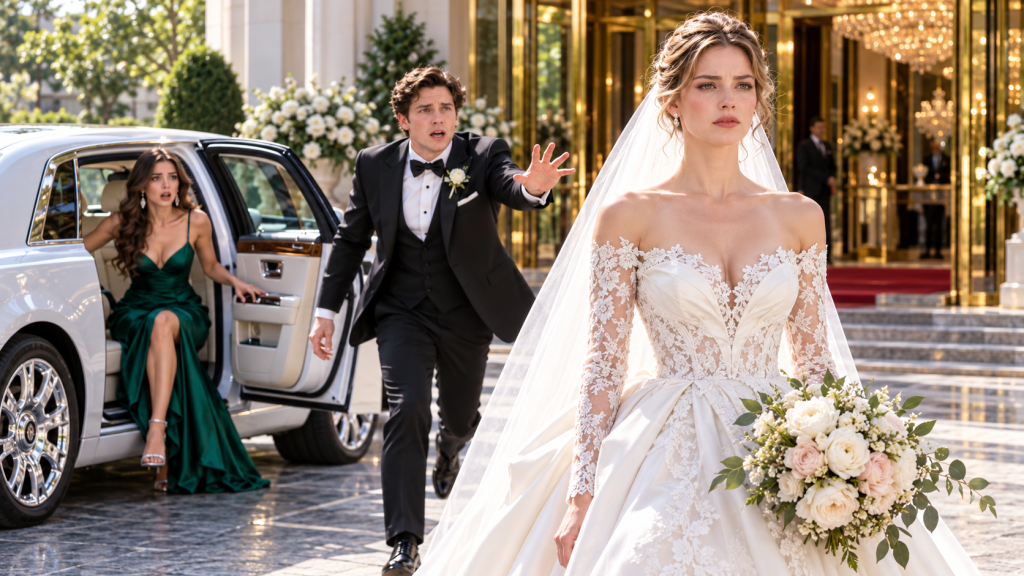
I stared at him. “A ride?” He rolled his eyes. “Here we go again.” I took one step forward. “You told your bride to move aside so your ex-girlfriend could sit beside you in our wedding car.” Vanessa sighed dramatically. “Honestly, Laurel, you’re making yourself look ridiculous.” I turned toward her. “Vanessa, this conversation doesn’t concern you.”
She smiled.
“Considering Ethan and I have known each other since college, I’d say I have every right to be here.”
I nodded slowly.
“Then perhaps you should stay.”
Her smile widened.
“Gladly.”
I looked at my father.
“Dad, would you explain who owns Whitmore Development?”
My father removed his glasses.
For thirty years, he had been one of the most respected property developers in our region.
He had started with a tiny office above a hardware store, one secretary, and a secondhand pickup truck.
By the time I graduated from college, Whitmore Development had become a successful company handling commercial properties, residential developments, and long-term real estate investments.
My father had taught me the business from the ground up.
I had worked summers answering telephones.
Reviewed construction estimates.
Attended planning meetings.
And spent years learning that a beautiful building meant nothing if the foundation beneath it wasn’t strong.
Three years earlier, when Dad began stepping back from daily operations, he transferred controlling ownership to me through a carefully structured arrangement.
He retained a minority interest and remained an adviser.
But the majority voting power belonged to me.
Ethan had never asked to see the ownership records.
He simply assumed that because my father was older, wealthy, and well known, every important decision must still belong to him.
I’d never corrected him.
Not because I wanted to deceive him.
But because I had believed the man who loved me would respect my work regardless of my title.
That belief had just been shattered.
My father looked at Ethan.
“Son, Laurel owns sixty-eight percent of Whitmore Development.”
The room went silent.
Ethan blinked.
Then laughed.
“That’s impossible.”
Dad didn’t smile.
“She has been the controlling shareholder for three years.”
Vanessa straightened.
“Wait. What?”
I opened the folder.
The share register.
The executed transfer agreement.
The corporate resolutions.
Everything properly documented.
I laid the papers on the hall table.
Ethan stared at them.
Then looked at me.
“You’re joking.”
I shook my head.
“No.”
His expression changed.
“But your dad hired me.”
I nodded.
“He recommended you for consideration.”
Ethan swallowed.
“And I approved your appointment after the board’s hiring process.”
Vanessa’s smile disappeared.
For a moment, she stared at Ethan as though she had never seen him before.
Then she turned toward me.
“Fine. You own shares. That doesn’t mean you can fire him because you’re jealous.”
Our attorney, Margaret Sloan, stepped into the hallway.
“No one has said that,” she replied calmly.
Vanessa looked startled.
Margaret continued.
“Employment matters must be handled according to the applicable agreements, company policies, and legal requirements.”
I nodded.
“Which is why I’m requesting an independent review.”
Ethan stared at her.
“What review?”
Margaret looked toward the invoices on my father’s laptop.
“The payments authorized to V.R. Strategic Partners.”
Vanessa went pale.
And that was the first moment I realized the wedding car might be the smallest problem we had.
“V.R. Strategic Partners?” Ethan repeated.
His voice was suddenly too casual.
“What about it?”
I folded my arms.
“Who owns it?”
He glanced at Vanessa.
She looked away.
“It’s a consulting company,” Ethan said.
“I know what it’s described as.”
My voice remained quiet.
“I’m asking who owns it.”
Vanessa lifted her chin.
“I do.”
My stomach tightened.
I nodded.
“And what services did your company provide to Whitmore Development?”
She blinked.
“Business strategy.”
“What kind?”
Her eyes darted toward Ethan.
“Market analysis.”
I looked at her.
“For which projects?”
She hesitated.
“Several.”
“Which ones?”
Her cheeks reddened.
Ethan stepped forward.
“Laurel, enough.”
I turned toward him.
“No.”
He stared.
I continued.
“For months, you’ve told me Vanessa was simply an old friend.”
My voice trembled.
“You never mentioned that you were approving payments to her company.”
He swallowed.
“Because I knew you’d overreact.”
For a moment, I could only stare.
Then I laughed.
Not because anything was funny.
Because the excuse was almost unbelievable.
“You concealed a business relationship because you assumed I wouldn’t approve?”
Ethan’s jaw tightened.
“That’s not what I said.”
I shook my head.
“It’s exactly what you said.”
My mother had been standing beside the kitchen doorway, silent until then.
She stepped forward.
“Ethan, I have one question.”
He looked at her.
She gestured toward my wedding dress.
“Why did you bring Vanessa here?”
He frowned.
“What?”
“You left the reception venue, brought the woman who humiliated my daughter, and walked into our home demanding that my husband explain the company to you.”
Ethan looked uncomfortable.
Mom continued.
“Why?”
He opened his mouth.
Then closed it.
Vanessa answered instead.
“Because Laurel is trying to ruin his reputation.”
My mother looked at her.
“His reputation?”
Vanessa crossed her arms.
“Yes.”
Mom nodded slowly.
“Then perhaps he should have thought about that before he told his bride to make room for another woman.”
For the first time all day, I almost smiled.
My mother was not a dramatic woman.
She preferred quiet dinners, gardening, and finding diplomatic ways to end unpleasant conversations.
But she had spent months helping me prepare for my wedding.
She had watched me choose flowers.
Taste cakes.
Alter my dress.
And talk excitedly about the future I thought Ethan and I were building.
Now she was looking at him with an expression I had never seen before.
Pure disappointment.
Ethan rubbed his forehead.
“This has gotten completely out of control.”
I looked at him.
“Then leave.”
He stared.
“What?”
“I want you and Vanessa to leave my parents’ house.”
His eyes widened.
“Laurel, we’re married.”
I swallowed.
“Yes.”
The word hurt.
More than I wanted him to know.
“We were married today.”
He stepped toward me.
“Then stop acting like this.”
I moved backward.
Margaret stepped slightly closer.
I looked at Ethan.
“Do not tell me how to react to being humiliated at my own wedding.”
He stared.
Then his expression hardened.
“You’re going to regret this.”
My father straightened.
“Ethan.”
But I raised my hand.
“No, Dad.”
I looked directly at my husband.
“Perhaps.”
My voice broke.
“But I will regret staying silent even more.”
Ethan stared at me for several seconds.
Then turned sharply toward Vanessa.
“Let’s go.”
She followed him.
But before reaching the door, she looked back.
“You know, Laurel, Ethan told me you were controlling.”
I felt something cold settle inside me.
I nodded.
“Then perhaps he should have chosen a wedding car with more room for the two of you.”
Vanessa’s face flushed.
She opened her mouth.
But my father opened the front door.
And that was the end of the conversation.
When they left, the house became painfully quiet.
I stood beneath the chandelier.
Still wearing my wedding dress.
Still holding the corporate documents.
Still married to a man who had just threatened me in the hallway where my father used to measure my height when I was little.
My mother approached.
“Laurel?”
I looked at her.
And suddenly, I couldn’t hold myself together anymore.
The papers slipped from my hands.
I covered my face.
And began crying.
Mom wrapped her arms around me.
I sobbed against her shoulder.
Not delicate tears.
Not the kind that slide beautifully down a bride’s cheeks in wedding photographs.
These were ugly, desperate sobs.
The kind that make your body shake.
The kind that rise from a place so deep you didn’t know it existed until something inside you broke.
“I married him,” I whispered.
Mom held me tighter.
“I know.”
“I stood in front of everyone and promised to love him.”
“I know, sweetheart.”
“And he couldn’t even choose me for fifteen minutes.”
My mother began crying too.
For a long time, we held each other.
Then my father knelt beside us.
He took my hand.
And whispered something I would remember for the rest of my life.
“Laurel, leaving a situation that hurts you doesn’t mean the love you offered was foolish.”
I looked at him.
He continued.
“It means you discovered something you could no longer ignore.”
I cried harder.
Because beneath the humiliation, beneath the anger, beneath the embarrassment of two hundred guests waiting at a reception that would never happen, was the terrible realization that I had loved a man who might never have respected me.
Margaret gave us a few minutes.
Then approached gently.
“Laurel, I know you’re overwhelmed.”
I wiped my face.
She continued.
“But there are some practical matters we should address today.”
I nodded.
“The reception?”
“Yes. The vendors, the guests, and your personal belongings.”
I swallowed.
“And the marriage?”
Her expression softened.
“We can discuss your legal options once you’ve had some time. The ceremony occurred, and we shouldn’t assume it can simply be erased. The available procedures depend on the relevant facts and law.”
I nodded.
“Okay.”
Margaret continued.
“And the company?”
I looked toward the folder.
For a moment, my grief turned into something sharper.
Resolve.
“I want every payment Ethan approved reviewed.”
She nodded.
“We’ll preserve the records, avoid interfering with the investigation, and follow the company’s procedures.”
I took a breath.
“Good.”
My father touched my shoulder.
“Sweetheart, we can handle the business later.”
I shook my head.
“No, Dad.”
My voice trembled.
“If Ethan has done something wrong, I need to know.”
I looked toward the front door.
The same door through which my husband had walked out beside Vanessa.
Then whispered, “And if he hasn’t, the review should establish that too.”
That evening, while the guests at our reception venue were being informed that the celebration had been canceled due to a serious personal matter, I sat upstairs in my childhood bedroom.
Still wearing the wedding gown.
The dress felt heavy now.
Not because of the fabric.
Because of everything it represented.
I remembered the day I bought it.
Mom and I had visited a bridal boutique on a sunny Saturday.
I’d tried on six dresses.
The seventh was the one.
Ivory silk.
Delicate lace.
A fitted bodice.
A long train that moved like water when I walked.
When I stepped out of the dressing room, Mom covered her mouth.
“Oh, Laurel.”
Her eyes filled.
“You look beautiful.”
I had smiled.
Then whispered, “Do you think Ethan will love it?”
Mom laughed through tears.
“He’d better.”
Now I sat on the edge of my childhood bed wondering whether Ethan had ever truly loved me.
Or whether he had loved the comfort my family could provide.
The beautiful home.
The company.
The opportunities.
The expensive wedding.
And the version of me who rarely challenged him.
I reached behind my dress.
Tried to undo the buttons.
My hands shook.
I couldn’t manage it.
Then Mom entered quietly.
She saw me struggling.
And approached without a word.
One by one, she undid the tiny buttons.
Just as she’d helped me into the gown that morning.
Only now, instead of preparing me for a wedding, she was helping me out of the dress I’d worn while my marriage began to fall apart.
When the final button came undone, I looked at her reflection in the mirror.
“Mom?”
“Yes, sweetheart?”
“Do you think I overreacted?”
She stopped.
Then gently placed her hands on my shoulders.
“Laurel, I think you reacted to more than a fifteen-minute car ride.”
My eyes filled.
She continued.
“I think you recognized a pattern you had been trying not to see.”
I stared at myself.
My smeared makeup.
My tired eyes.
The veil resting on the dresser.
And suddenly, I remembered things I’d dismissed.
Ethan inviting Vanessa to our engagement party without asking.
Ethan defending her jokes about my appearance.
Ethan telling me I was insecure when I said their private lunches made me uncomfortable.
Ethan insisting I should trust him while keeping details of their relationship vague.
And Ethan repeatedly suggesting I shouldn’t interfere with his work at Whitmore Development because I wouldn’t understand the demands of an executive role.
I had told myself he was simply confident.
Independent.
Protective of his friendships.
I had believed loving someone meant giving him the benefit of the doubt.
But now I understood that trust wasn’t supposed to require me to ignore everything that hurt.
Mom squeezed my shoulders.
“You don’t have to decide your entire future tonight.”
I nodded.
“But you do have to stop blaming yourself for asking to be respected.”
I closed my eyes.
And for the first time that day, I believed I might survive this.
The next morning, my phone contained forty-seven missed calls.
Thirty-one from Ethan.
Nine from Vanessa.
Several from relatives.
And a handful from friends who had attended the ceremony.
The messages were worse.
At first, Ethan sounded angry.
You embarrassed me.
You made a scene.
My colleagues were at that reception.
Do you understand what you’ve done?
Then came accusations.
You always let your father control you.
You think money makes you better than everyone.
Vanessa was trying to help.
And finally, after midnight, the tone changed.
Laurel, please call me.
We need to talk.
I love you.
I stared at that last message.
For months, those three words had been enough to soften almost every argument.
Now they felt painfully incomplete.
I placed the phone down.
Then opened my laptop.
There was an email from Margaret.
Subject:
DOCUMENT PRESERVATION AND IMMEDIATE NEXT STEPS.
I opened it.
She had outlined the processes for reviewing the company’s accounts, protecting records, and ensuring that any employment decisions were made through appropriate governance channels.
I read it carefully.
Then called her.
“Good morning, Laurel.”
Her voice was calm.
“Good morning.”
“How are you?”
I almost laughed.
“Not wonderful.”
She paused.
“I imagine not.”
I looked toward the window.
Then asked, “What did you find?”
Margaret took a breath.
“We’ve identified multiple payments to V.R. Strategic Partners over the past eight months.”
My stomach tightened.
“How many?”
“Twenty-three.”
I stared.
“And the total?”
She told me.
It was far more than I expected.
More than the cost of my wedding gown.
More than the cost of our honeymoon.
Enough to fund a substantial portion of a small development project.
I felt cold.
“Twenty-three payments?”
“Yes.”
“And Ethan approved them?”
“The initial records show he authorized them under his delegated responsibilities.”
I closed my eyes.
“Were they legitimate?”
“We don’t know yet. That’s what the review needs to determine.”
I swallowed.
“Margaret, did anyone question them?”
“Yes. There were internal inquiries about supporting documentation.”
My heart began pounding.
“And?”
“Some requests were not fully resolved before yesterday.”
I stared at the wall.
Then whispered, “Who raised the concerns?”
There was a pause.
“Your chief financial officer, Daniel Mercer.”
Daniel.
A quiet man in his early forties.
Careful.
Methodical.
Not easily impressed by expensive suits or confident presentations.
I had worked with him for years.
He knew our company better than almost anyone.
“Did Ethan know Daniel was asking questions?”
Margaret hesitated.
“Yes.”
My stomach tightened.
I remembered Ethan’s behavior during the final weeks before our wedding.
His irritation whenever I asked about work.
His sudden insistence that we take our honeymoon immediately after the ceremony.
His suggestion that I shouldn’t check company email while we were away.
I had assumed he wanted us to spend uninterrupted time together.
Now I wondered whether there had been another reason.
I took a breath.
“Margaret, I want a full independent review.”
She nodded.
“That is already being arranged.”
I swallowed.
“And I want Ethan’s access assessed promptly, using proper corporate procedures.”
“Understood.”
For a moment, I sat quietly.
Then whispered, “I can’t believe this.”
Margaret’s voice softened.
“Laurel, the findings may establish misconduct, inadequate documentation, or some combination of issues. It’s important not to reach a conclusion before the evidence is examined.”
I nodded.
“You’re right.”
But deep inside, I felt something terrible taking shape.
The wedding car hadn’t simply revealed disrespect.
It had pulled the curtain away from an entire relationship built on things I hadn’t known.
Three days later, Vanessa sent me a message.
It was short.
Cruel.
And so arrogant that I almost wondered whether she understood what was happening.
You can cancel a party, Laurel, but you can’t cancel what Ethan and I have.
I stared at the screen.
For several seconds, my heart felt strangely empty.
Then I took a screenshot.
Sent it to Margaret.
And put the phone down.
I didn’t respond.
Because I was finally learning that silence could be a boundary rather than surrender.
That afternoon, my father came into the study.
He looked tired.
Older than he’d looked on my wedding morning.
I felt a wave of guilt.
“Dad?”
He smiled sadly.
“Yes, sweetheart?”
“I’m sorry.”
He frowned.
“For what?”
I gestured toward the papers.
“The company.”
“The wedding.”
“Everything.”
Dad walked toward me.
Then sat down.
“Laurel, look at me.”
I raised my eyes.
He took my hand.
“You didn’t make Ethan approve questionable payments.”
I swallowed.
“You didn’t force Vanessa into your wedding car.”
My eyes filled.
“And you didn’t make your husband tell you to move aside.”
I began crying.
Dad squeezed my hand.
“Stop taking responsibility for decisions other people made.”
For a long time, we sat quietly.
Then he said something I hadn’t expected.
“There’s another thing you should know.”
My stomach tightened.
“What?”
He looked toward the office door.
“I never trusted Ethan with the company as much as you thought I did.”
I stared.
“Dad?”
He sighed.
“I wanted to give him a fair opportunity because you loved him.”
My heart sank.
“But?”
He looked down.
“He was ambitious.”
“Confident.”
“Smart enough.”
Then he paused.
“But I often felt he cared more about the title than the responsibilities.”
My throat tightened.
I remembered Ethan celebrating when he received the COO position.
The expensive watch he bought himself.
The way he introduced himself at parties.
Chief operating officer of Whitmore Development.
He loved saying it.
I had been proud of him.
I thought he was proud of the work.
Now I wondered whether he was proud of the authority.
Dad continued.
“I didn’t want to interfere with your relationship.”
I nodded.
“But I did insist on controls.”
I looked up.
“What controls?”
He smiled faintly.
“Approval limits.”
“Board oversight.”
“Independent accounting reviews.”
“Policies against undisclosed conflicts.”
I swallowed.
“And Ethan knew?”
“Yes.”
Dad paused.
“He complained about them.”
I stared at my father.
Then whispered, “He told me you were making it impossible for him to do his job.”
Dad nodded.
“I know.”
My eyes filled.
“He told you that too?”
“Yes.”
I covered my face.
For months, Ethan had persuaded me that my father was treating him unfairly.
That the company was too traditional.
That older executives didn’t understand modern business.
I’d encouraged Dad to give him room.
To trust him.
To allow him to prove himself.
Now I realized Dad had been trying to protect the company without putting me in the middle.
I looked up.
“Why didn’t you tell me?”
Dad’s eyes filled.
“Because I hoped I was wrong.”
That answer hurt more than anger would have.
Because my father had wanted my marriage to succeed.
Even when he had doubts.
Even when he disliked Ethan’s attitude.
He had remained careful.
Respectful.
And willing to let me make my own choices.
I squeezed his hand.
“Thank you for protecting the company.”
He smiled sadly.
“It’s your company now, Laurel.”
I nodded.
For the first time, the words felt different.
Not like an honor.
Like a responsibility.
The independent review began the following week.
The board appointed outside financial specialists to examine the transactions.
They reviewed contracts.
Invoices.
Approvals.
Project records.
And the work allegedly performed by V.R. Strategic Partners.
Ethan was informed of the review.
His system access was restricted in accordance with company procedures while concerns were assessed.
He was placed on administrative leave during the initial phase.
No public accusations were made.
No dramatic announcement.
Just a formal process.
But Ethan reacted as though he’d been publicly executed.
He arrived at my parents’ house that evening.
Alone this time.
His expression was furious.
“Laurel!”
I was in the sitting room with Mom.
The sound of his voice made me tense.
My father appeared from the study.
“Ethan, lower your voice.”
Ethan pointed toward me.
“She had me suspended!”
I stood slowly.
“The board approved temporary measures during the review.”
He laughed bitterly.
“Don’t pretend this isn’t personal.”
I looked at him.
“It became personal when you brought Vanessa into our wedding car.”
His cheeks flushed.
“And it became a corporate issue when we found payments to her company that require examination.”
Ethan stared.
Then shook his head.
“You’re really going to destroy my career over a ride?”
I felt something inside me settle.
I looked directly at him.
“Ethan, your career is being examined because of transactions you authorized.”
My voice trembled.
“The wedding car revealed something about our marriage.”
I paused.
“The invoices raised questions about your work.”
For a moment, he looked genuinely frightened.
Then his expression softened.
“Laurel…”
I shook my head.
“No.”
He stepped toward me.
“Please.”
And suddenly, the anger disappeared from his face.
He looked exhausted.
Desperate.
Almost boyish.
The man I had loved.
The man who used to bring me coffee during late meetings.
The man who kissed my forehead when I fell asleep reading.
The man who told me we’d build a family together.
He reached for my hand.
I stepped away.
His face crumpled.
“Laurel, I made a mistake.”
I stared at him.
“Which one?”
He blinked.
I continued.
“Inviting Vanessa to the car?”
“Not defending me?”
“Approving her invoices?”
“Or hiding your financial relationship with her?”
He swallowed.
“All of it.”
For a moment, I couldn’t speak.
Then he whispered, “I thought you would forgive me.”
The honesty stunned me.
I stared at him.
He looked down.
“I thought you’d be angry.”
He swallowed.
“But I thought you’d come back.”
My eyes filled.
And suddenly, I understood.
He had not expected me to leave.
Not really.
He expected tears.
An argument.
Perhaps a dramatic apology.
Then forgiveness.
And eventually, everything returning to the way it had been.
Because that was what I’d always done.
I looked at him.
“Ethan, I loved you.”
His eyes filled.
“I love you too.”
I shook my head.
“But I don’t think you respected me.”
He began crying.
“Laurel…”
I swallowed.
“I kept making myself smaller so you would feel comfortable.”
His face crumpled.
“I didn’t ask you to.”
I looked at him.
“No?”
My voice trembled.
“You asked me not to question Vanessa.”
“Not to challenge your work decisions.”
“Not to embarrass you when something hurt me.”
I took a breath.
“And on our wedding day, you literally asked me to move aside.”
He covered his face.
For a moment, he said nothing.
Then whispered, “I’m sorry.”
I looked toward my parents.
Then back at him.
“I hear you.”
He raised his head hopefully.
I continued.
“But I’m not ready to forgive you.”
His expression changed.
“Laurel, we’re married.”
I nodded.
“Yes.”
“And that deserves to be addressed honestly, through the proper legal process.”
He stared.
Then whispered, “Are you saying you want a divorce?”
My throat tightened.
The word felt enormous.
Divorce.
Not even a week after my wedding.
I had imagined saying it someday only as part of another person’s story.
Never mine.
I looked at him.
Then answered quietly.
“Yes.”
The room went silent.
Ethan stepped backward.
His face turned white.
For several seconds, he couldn’t speak.
Then whispered, “You can’t mean that.”
I felt tears rise.
“I do.”
He shook his head.
“Laurel…”
I swallowed.
“I can’t build a marriage on the assumption that you’ll respect me only when I threaten to leave.”
He stared at the floor.
Then asked something that nearly broke me.
“Did you ever love me?”
I looked at him.
My eyes filled.
“More than I should have.”
He began crying.
And for a moment, I wanted to reach for him.
To comfort him.
To tell him we’d figure everything out.
Because I had spent years believing his pain was something I needed to solve.
But I stayed where I was.
Because love was not enough to make me ignore what had happened.
Ethan left quietly that evening.
No shouting.
No threats.
Just a devastated man walking down my parents’ front steps.
I watched through the window.
Then sat down.
My mother came beside me.
She took my hand.
And I began crying again.
The divorce process was difficult.
Not because our marriage had lasted long.
It hadn’t.
But because we had entered it with shared expectations, expenses, and legal obligations that couldn’t simply be wished away.
Our attorneys reviewed the marriage.
The financial arrangements.
The prenuptial agreement we’d executed before the wedding.
And the applicable legal procedures.
The prenuptial agreement had been prepared with separate legal representation and full disclosure.
It did not make every issue disappear.
But it clarified important financial boundaries.
I was grateful we’d taken those precautions.
Not because I had expected Ethan to betray me.
But because careful planning can protect people when life changes in ways they never imagined.
Meanwhile, the review at Whitmore Development continued.
And what it uncovered was worse than I expected.
Several invoices submitted by V.R. Strategic Partners contained descriptions of services that could not be adequately substantiated.
Some referenced projects the consulting firm had not demonstrably worked on.
Others contained vague claims about strategy sessions, market research, and development coordination.
There were meeting records.
Emails.
Approval logs.
And internal correspondence.
But not enough evidence to support every payment.
The investigators also identified communications suggesting Ethan had bypassed internal review procedures.
Not every transaction was necessarily improper.
Some services may have been performed.
But the discrepancies were serious.
The company asked for explanations.
Supporting records.
And interviews.
Vanessa’s company struggled to provide them.
One afternoon, Daniel Mercer called me.
“Laurel?”
I smiled faintly.
“Daniel.”
His voice was careful.
“We’ve located a set of internal messages that may be relevant.”
My stomach tightened.
“About the invoices?”
“Yes.”
I took a breath.
“What do they say?”
He hesitated.
“Margaret should review them with you.”
My heart began pounding.
“Daniel…”
He paused.
Then said gently, “Laurel, I think you should prepare yourself for something painful.”
I stared at the phone.
The room suddenly felt cold.
“What?”
He took a breath.
“Some of the messages concern your marriage.”
I sat down.
For a moment, I couldn’t speak.
Then whispered, “Send them to Margaret.”
That evening, Margaret arrived at my parents’ house.
She carried a folder.
Her expression was serious.
We sat in Dad’s study.
The same room where I’d once done my homework while my father worked late.
Margaret placed the folder between us.
“Laurel, these communications were collected during the company review.”
I nodded.
“Okay.”
She continued.
“Some may be personal. We need to handle them appropriately and consider their relevance to the business issues.”
I swallowed.
“Just tell me.”
She opened the folder.
Inside were printed messages between Ethan and Vanessa.
Some discussed invoices.
Meetings.
Payments.
And deadlines.
Others were personal.
Too personal.
My eyes moved down the page.
Vanessa: Are you really going through with the wedding?
Ethan: Yes. Everything’s already arranged.
Vanessa: And what happens to us?
My heart stopped.
I looked up.
Margaret said nothing.
I continued reading.
Ethan: Nothing has to change.
For a moment, I couldn’t breathe.
Nothing.
Had.
To.
Change.
I stared at those words.
Then slowly turned the page.
There were more messages.
References to private meetings.
Trips.
And the need to keep their relationship away from company scrutiny.
I felt sick.
Not because the messages proved every detail of what happened between them.
But because they made something unmistakable.
Ethan had concealed an ongoing relationship with Vanessa while preparing to marry me.
I pressed my hand against my mouth.
Tears streamed down my cheeks.
Margaret waited quietly.
Then asked, “Would you like a moment?”
I shook my head.
“No.”
My voice broke.
“I want to know.”
I continued reading.
Then found a message dated three days before the wedding.
Vanessa: I don’t want to sit alone watching you marry her.
Ethan: Just come. I’ll make sure you’re included.
I closed my eyes.
The limousine.
The red dress.
The mocking smile.
The way Vanessa opened the door as though she belonged there.
Suddenly, it no longer looked like an unfortunate coincidence.
The car had not simply broken down.
At least, I had no reason to trust that explanation anymore.
I looked toward Margaret.
Then whispered, “He planned for her to be there.”
She nodded carefully.
“The messages indicate he expected her presence.”
I began sobbing.
Not because I wanted Ethan back.
But because I was grieving the version of our relationship I’d believed in.
The dinners.
The laughter.
The plans.
The promises.
How much had been real?
How much had been convenience?
And how much had I ignored because the truth was too painful to consider?
Margaret gently closed the folder.
“Laurel, I’m sorry.”
I wiped my eyes.
Then whispered, “Thank you.”
For a long time, I sat quietly.
Then looked at the company records.
“And the payments?”
Margaret nodded.
“The review will make findings based on the evidence.”
I took a breath.
“Good.”
Because no matter how personal the betrayal felt, I wasn’t going to use my ownership position to bypass fair procedures.
That would only make another kind of wrong.
Several weeks later, the company’s independent review concluded.
The findings identified serious failures to disclose conflicts of interest and substantiate significant consulting expenses.
Ethan had approved payments to a company owned by someone with whom he had an undisclosed personal relationship.
He had also failed to comply with certain internal procedures.
The board reviewed the findings.
Ethan was given the opportunity to respond.
Relevant contracts and policies were considered.
And ultimately, his employment was terminated for documented business reasons.
I did not attend the final employment meeting.
I had recused myself from decisions where my personal circumstances could create an appearance of conflict.
The board acted through its proper procedures.
When Margaret called to tell me the decision had been made, I sat quietly.
I expected to feel victorious.
Instead, I felt sad.
Because the man I’d married had lost a position he’d once been proud of.
And although his own actions had contributed to that outcome, I still remembered the day he first walked into Whitmore Development wearing a new suit.
Nervous.
Excited.
Determined to impress everyone.
I had believed in him.
Perhaps more than he believed in himself.
But believing in someone doesn’t mean protecting them from the consequences of their choices.
The company also pursued appropriate recovery and accountability measures concerning payments the evidence showed were unsupported or otherwise improper.
Some amounts were disputed.
Some were recovered through negotiated resolutions.
Other issues required further legal action.
I learned that business justice rarely arrived in one dramatic moment.
There were months of paperwork.
Professional reviews.
Difficult meetings.
And careful decisions.
It wasn’t satisfying in the way stories sometimes make revenge seem satisfying.
It was necessary.
And exhausting.
One evening, Dad found me sitting alone on the patio.
The garden lights glowed softly.
The air smelled of jasmine.
He brought two cups of tea.
Then sat beside me.
For a long time, neither of us spoke.
Then he asked, “How are you holding up?”
I gave a small laugh.
“I don’t know.”
Dad nodded.
“Fair.”
I looked toward the flowers.
Then whispered, “I thought I’d be happy when the review was finished.”
He glanced at me.
“And you’re not?”
I shook my head.
“I’m relieved.”
I swallowed.
“But mostly I’m sad.”
Dad took a sip of tea.
Then said gently, “Laurel, accountability doesn’t have to feel like celebration.”
I looked at him.
He continued.
“Sometimes it simply means doing what is necessary even when it hurts.”
My eyes filled.
I nodded.
“That’s what this feels like.”
Dad smiled sadly.
“Then you’re taking it seriously.”
The divorce was finalized after the applicable process.
By then, months had passed.
The wedding dress was stored in a garment bag.
The honeymoon had never happened.
The reception photographs had been placed in a box.
And I’d moved into a small apartment closer to the company.
I could have remained with my parents.
They wanted me to.
But I needed somewhere that belonged to me.
A space that didn’t carry the memory of walking home in my wedding gown.
The apartment was modest compared with the house Ethan and I had planned to buy.
Two bedrooms.
Tall windows.
A little balcony overlooking a park.
And a kitchen just large enough for a small table.
The first evening I slept there, I cried.
Not because I regretted leaving.
Because I was finally alone with the silence.
For months, everything had been urgent.
Legal appointments.
Company reviews.
Family questions.
Financial decisions.
Messages from Ethan.
Messages from Vanessa.
And the endless effort of keeping myself composed.
Now the apartment was quiet.
And all the grief I’d postponed arrived at once.
I sat on the floor beside the unpacked boxes.
Held a photograph of myself from the wedding morning.
And cried.
In the picture, I was smiling.
My veil floated over my shoulders.
My eyes were bright.
I looked hopeful.
So hopeful it hurt to see.
I touched the photograph.
Then whispered, “I’m sorry.”
Not to Ethan.
To the woman in the picture.
The woman who believed she’d found someone safe.
The woman who wanted a family.
The woman who trusted a promise.
I cried for her.
Then gently placed the photograph inside a box.
The following morning, I woke to sunlight pouring through the windows.
I made coffee.
Opened the balcony door.
And listened to the city waking.
For the first time in months, I didn’t check my phone immediately.
I simply stood there.
Breathing.
A little later, I called Mom.
“Hi, sweetheart.”
Her voice was warm.
“Hi.”
“How’s the apartment?”
I looked around.
“Quiet.”
She laughed softly.
“That sounds nice.”
I smiled sadly.
“It is.”
There was a pause.
Then she asked, “Did you sleep?”
I nodded.
“Eventually.”
She sighed.
“Good.”
For a moment, neither of us spoke.
Then I whispered, “Mom?”
“Yes?”
“Do you think I’ll ever feel normal again?”
Her voice softened.
“Oh, Laurel.”
My eyes filled.
She continued.
“You won’t be exactly the person you were before.”
I swallowed.
“But that doesn’t mean you won’t be happy.”
I closed my eyes.
She added gently, “Sometimes the life we build after disappointment becomes the one where we finally learn who we are.”
I smiled through tears.
“Thanks, Mom.”
The months passed.
I returned my full attention to Whitmore Development.
Not to prove anything to Ethan.
Not to show Vanessa what she’d lost.
But because I loved the work.
I loved visiting development sites in the early morning.
Seeing empty lots become homes.
Watching architects turn drawings into places where families would build memories.
Hearing contractors explain how problems had been solved.
And working with people who took pride in doing things correctly.
For years, Ethan had implied that my role was largely symbolic.
That my father had handed me a title.
That real business required the kind of confidence he possessed.
Now I began recognizing how much I’d allowed those comments to shrink me.
I started speaking more directly in meetings.
Asking the questions I’d once hesitated to ask.
Reviewing projects carefully.
Listening to people who knew their work.
And making decisions without apologizing for having authority.
One afternoon, Daniel Mercer stayed after a board meeting.
“Laurel?”
I looked up.
“Yes?”
He smiled.
“I wanted to tell you something.”
I nodded.
He hesitated.
“People are noticing the changes.”
I frowned.
“Good changes?”
He laughed.
“Yes.”
I smiled faintly.
He continued.
“You’ve always understood the company.”
My eyes filled.
“But I think you’re finally letting yourself lead it.”
For a moment, I couldn’t speak.
Then whispered, “Thank you, Daniel.”
He nodded.
“And for what it’s worth, your father looks proud.”
I looked toward the conference room window.
Dad was standing outside speaking with one of our project managers.
He glanced toward me.
Then smiled.
My throat tightened.
I smiled back.
That evening, I returned to my apartment feeling something I hadn’t experienced in months.
Peace.
Not complete happiness.
Not yet.
But the beginnings of it.
Then, unexpectedly, Ethan called.
I stared at the screen.
For a moment, I considered ignoring it.
But enough time had passed that I could speak without feeling as though every word might reopen the wound.
I answered.
“Hello?”
“Laurel?”
His voice sounded different.
Quieter.
“Hello, Ethan.”
There was a pause.
Then he whispered, “Thank you for answering.”
I sat down.
“What do you need?”
He took a breath.
“I wanted to apologize.”
I closed my eyes.
“We’ve talked about that.”
“I know.”
His voice broke.
“But I don’t think I ever really understood what I was apologizing for.”
I remained quiet.
He continued.
“I kept telling myself you left because you were jealous.”
My throat tightened.
“And?”
He swallowed.
“I was wrong.”
For a moment, I couldn’t speak.
Ethan continued.
“You left because I humiliated you.”
“Because I dismissed your feelings.”
“Because I kept secrets.”
“And because I treated your trust as something I could rely on no matter how I behaved.”
My eyes filled.
I stared toward the window.
Then whispered, “Yes.”
He began crying.
“I know saying it now doesn’t fix anything.”
“No.”
He took a breath.
“I’ve had a lot of time to think.”
I nodded.
He continued.
“I kept blaming Vanessa.”
My stomach tightened.
“But she didn’t make me say those things to you.”
My eyes filled.
“She didn’t make me approve those payments.”
“And she didn’t make me lie.”
For the first time, I heard him acknowledge his own choices without demanding that I make him feel better.
I took a breath.
“Ethan, I’m glad you understand that.”
He swallowed.
“Do you think you could ever forgive me?”
I looked down.
For a long time, I considered.
Then answered honestly.
“I don’t know.”
His breath trembled.
I continued.
“But I hope you build a better life than the one you were living.”
He began crying harder.
“Thank you.”
I swallowed.
“And Ethan?”
“Yes?”
“I hope you learn that respect isn’t something you offer only when you’re afraid of losing someone.”
Silence.
Then he whispered, “I will.”
We ended the call.
And for the first time, I didn’t spend the rest of the evening wondering whether I should have said something different.
I simply made dinner.
Read a book.
And went to bed.
Over the following year, my life slowly became my own again.
I joined a weekend hiking group.
Started taking pottery classes.
Traveled with Rachel.
And spent more time with friends I’d neglected while planning a future around Ethan.
One evening, Rachel and I were sitting at a restaurant overlooking the river.
The sun was setting.
The water shimmered beneath the lights.
She looked at me.
Then smiled.
“You seem different.”
I laughed.
“Different how?”
She considered.
“Lighter.”
I looked toward the water.
Then smiled sadly.
“I feel different.”
Rachel nodded.
“Good.”
For a moment, we sat quietly.
Then she asked, “Do you miss him?”
The question caught me off guard.
I considered.
Then answered.
“Sometimes.”
Rachel nodded.
I continued.
“But I think I miss who I believed he was.”
My throat tightened.
“And I miss the future I thought we were going to have.”
Rachel reached for my hand.
“That makes sense.”
I smiled sadly.
Then she said something that stayed with me.
“You don’t have to turn every good memory into a lie just because the relationship ended badly.”
I looked at her.
She continued.
“Some moments were probably real.”
“Some feelings were real.”
“But they weren’t enough to build a healthy marriage.”
My eyes filled.
I nodded.
“Thank you.”
That conversation helped me more than Rachel knew.
Because for months, I’d been trying to decide whether every happy memory with Ethan had been false.
Now I understood that people can share genuine happiness and still be wrong for one another.
The existence of good moments doesn’t erase betrayal.
And betrayal doesn’t necessarily mean every smile was fake.
Both can be true.
Two years after the wedding, Whitmore Development celebrated its thirtieth anniversary.
Dad had officially stepped back from daily management.
I remained the controlling owner and chief executive.
The company had expanded into several new projects.
Our financial procedures were stronger.
Our governance more transparent.
And our leadership team more confident.
We held a celebration at the company’s headquarters.
Employees.
Clients.
Community partners.
And family members attended.
I wore a simple navy dress.
Not because it was particularly expensive.
But because it made me feel like myself.
When it was time to speak, I stepped onto the small stage.
I looked toward Dad.
Mom sat beside him.
Both were smiling.
I took a breath.
“Thirty years ago, my father started this company with an idea.”
The room grew quiet.
“He believed buildings mattered because people mattered.”
I smiled.
“He believed that a company should be measured not only by what it earns, but by the trust it earns.”
My throat tightened.
I continued.
“Over the years, we’ve experienced successes.”
“Challenges.”
“And moments that forced us to examine whether we were living up to those values.”
I looked around.
Then smiled.
“But we’re still here.”
The room applauded.
I took a breath.
“And we’re stronger because we’ve learned that trust requires accountability.”
When I finished, Dad stood.
He was the first person to applaud.
I stepped down.
And he opened his arms.
I hugged him.
“Proud of you, sweetheart,” he whispered.
My eyes filled.
“Thanks, Dad.”
He pulled back.
Then smiled.
“Your mother says I should retire completely.”
I laughed.
“She might be right.”
He sighed dramatically.
“Everyone’s against me.”
We both laughed.
For the first time in years, I felt fully comfortable standing in my own success.
Not as someone’s wife.
Not as my father’s little girl.
But as Laurel Whitmore.
A woman who had learned to lead.
And learned that love should never require her to become smaller.
After the celebration, Mom approached.
She was holding a small box.
“Laurel?”
I smiled.
“Yes?”
“I have something for you.”
I opened it.
Inside was a delicate gold necklace.
A tiny pendant shaped like a star.
I stared.
“Mom…”
She smiled.
“It belonged to your grandmother.”
My eyes filled.
“She wanted you to have it when you were ready.”
I looked up.
“Ready for what?”
Mom smiled through tears.
“To understand your own worth.”
I began crying.
She gently fastened the necklace around my neck.
Then kissed my cheek.
For a moment, I remembered my wedding morning.
Mom helping me into the gown.
The veil.
The excitement.
The hope.
Now she stood behind me again.
Helping me put on something beautiful.
But this time, it wasn’t for a man.
It was for me.
I looked into the mirror.
Touched the pendant.
And smiled.
Several months later, I received a letter from Ethan.
A real letter.
Handwritten.
Not a text.
Not an email.
I hesitated before opening it.
Then sat at my kitchen table.
The same table where I’d begun rebuilding my life after the divorce.
The letter was brief.
He wrote that he’d found new work outside our company.
That he was receiving counseling.
That he had been forced to examine his entitlement, dishonesty, and need for approval.
He acknowledged the consequences of his business decisions.
And thanked me for insisting that the company investigate properly instead of turning everything into a personal battle.
Then he wrote something that made me cry.
Laurel, I used to think success meant having a beautiful woman beside me, an important title, and people who admired me.
Now I understand that none of those things mean much if I cannot be trusted.
I stared at the words.
Then continued.
You deserved a husband who celebrated your strength instead of feeling threatened by it.
I wasn’t that man.
I’m sorry.
I folded the letter.
Held it for a moment.
Then placed it in a drawer.
I didn’t respond.
Not out of cruelty.
Not to punish him.
But because some chapters can be acknowledged without reopening them.
I wished Ethan well.
Genuinely.
But I no longer needed to be part of his life.
Years passed.
I continued working.
Traveling.
Learning.
And building a life filled with people who respected me.
Eventually, I met someone.
His name was Adrian.
He was an architect.
Quiet.
Thoughtful.
And almost comically terrible at remembering where he left his keys.
We met during a community redevelopment project.
He was consulting on a historic building restoration.
I was reviewing the financial plan.
He disagreed with my assessment of one design proposal.
I disagreed with his cost assumptions.
We argued politely for twenty minutes.
Then he smiled.
“Well, Ms. Whitmore, I suppose we’ll have to find a better solution.”
I raised an eyebrow.
“That’s generally how projects work.”
He laughed.
I wasn’t immediately attracted to him.
Not in the dramatic way I’d been drawn to Ethan.
There were no grand promises.
No extravagant gifts.
No breathtaking declarations.
Just conversations.
Coffee.
Walks.
And the gradual discovery that I could disagree with someone without being treated as difficult.
One afternoon, we were having lunch when Adrian asked about my past.
I told him I’d been married briefly.
He nodded.
“I’m sorry it didn’t work out.”
I smiled sadly.
“Thank you.”
He didn’t ask for every painful detail.
Didn’t demand to know who was at fault.
Didn’t try to turn the conversation into an opportunity to tell me how much better he was.
He simply listened.
Later, when I told him more, he asked one question.
“What did you learn about what you need?”
I stared.
Then smiled.
“Respect.”
He nodded.
“Sounds reasonable.”
I laughed.
And realized how strange it felt to have a boundary treated as ordinary rather than offensive.
Our relationship developed slowly.
I kept my independence.
My work.
My friends.
My home.
And my sense of self.
Adrian respected those things.
He never suggested I hide my achievements.
Never acted embarrassed when I spoke confidently in meetings.
Never made me feel guilty for having opinions.
And when we disagreed, he listened.
Sometimes stubbornly.
Sometimes imperfectly.
But honestly.
One evening, after we’d been seeing each other for a year, he invited me to dinner.
We arrived at a small restaurant overlooking the city.
The host led us toward a table.
Then Adrian stopped.
He looked at me.
And smiled.
“Laurel, would you prefer the window seat?”
I froze.
Such a small question.
So ordinary.
Yet somehow, it touched a place inside me that had once been wounded.
The wedding car.
Ethan’s voice.
Just shift over a little so she can fit.
I looked at Adrian.
He was waiting patiently.
Not demanding.
Not assuming.
Simply asking what I preferred.
My eyes filled unexpectedly.
He noticed.
“Are you all right?”
I laughed softly.
“Yes.”
Then smiled.
“I’d love the window seat.”
He pulled out the chair.
And sat across from me.
For a moment, I looked through the glass at the lights below.
Then I smiled.
Because something that once seemed impossible had become wonderfully simple.
I could occupy a place without apologizing for it.
Adrian and I eventually married in a small ceremony.
Not two hundred guests.
Not a spectacular reception.
Not a dress that cost more than a used car.
Just family.
Close friends.
A garden.
And a quiet promise.
Mom helped me choose a simple ivory dress.
Dad walked beside me.
Rachel carried flowers.
And Adrian stood beneath an arch covered in white roses.
When I reached him, he took my hands.
His eyes filled.
Then whispered, “You look beautiful.”
I smiled through tears.
“Thank you.”
During our vows, he said something I would never forget.
“I promise never to make you smaller so I can feel bigger.”
My throat tightened.
He continued.
“I promise to celebrate who you are, not simply who you are to me.”
I began crying.
And this time, the tears were different.
Not humiliation.
Not betrayal.
Not grief.
Relief.
Joy.
And the quiet happiness of being loved without having to disappear.
After the ceremony, we walked toward our car.
A simple black sedan decorated with white ribbons.
Adrian opened the passenger door.
Then smiled.
“Ready?”
I laughed.
“Yes.”
I stepped inside.
He closed the door gently.
Then walked around to the driver’s side.
No one appeared in a red dress.
No one demanded my seat.
No one told me to move aside.
And for a moment, I almost laughed at how much peace there was in something so ordinary.
Adrian started the engine.
Then looked toward me.
“Comfortable?”
I smiled.
“Very.”
He reached for my hand.
And we drove away.
Years later, I sometimes thought about my first wedding.
The beautiful gown.
The garden ceremony.
The two hundred guests.
The limousine.
The red dress.
The humiliation.
And the long walk back to my parents’ house.
For a long time, I’d remembered that day with pain.
Then embarrassment.
Then anger.
But eventually, the memory changed.
I began seeing something else.
A young woman standing beside a car.
Wearing the most expensive dress she’d ever owned.
Realizing that the man beside her did not respect her.
And instead of arguing for a place she’d already been promised, she stepped out.
She walked away.
At the time, she didn’t know what would happen.
She didn’t know about the invoices.
The company review.
The messages.
The divorce.
Or the years of rebuilding ahead.
She simply knew something was wrong.
And she refused to ignore it.
That was the beginning of everything.
One afternoon, many years later, my daughter, Eleanor, asked about the photograph in our family album.
She was seven.
Curious.
Bright.
And fascinated by old pictures.
She pointed toward a photograph of me in my first wedding gown.
“Mommy?”
I smiled.
“Yes?”
“Why are you wearing a different wedding dress?”
My heart tightened.
I looked at the picture.
Then at her.
I took a breath.
“Because Mommy was married before she met Daddy.”
Eleanor frowned.
“Really?”
I nodded.
“Yes.”
She looked at the photograph.
“Were you happy?”
The question made my throat tighten.
I considered.
Then answered honestly.
“I thought I was.”
Eleanor looked confused.
“What happened?”
I smiled gently.
“I learned that the person I married wasn’t someone I could build a healthy life with.”
She thought about that.
Then asked, “Did he hurt your feelings?”
I nodded.
“Yes.”
Her little face grew serious.
“That’s mean.”
I laughed softly.
“Yes.”
“It was.”
She looked toward the window.
Then back at me.
“What did you do?”
I smiled.
“I left.”
Eleanor’s eyes widened.
“In your wedding dress?”
I laughed.
“Yes.”
She stared at the picture again.
Then smiled.
“Good.”
I raised an eyebrow.
“Good?”
She nodded solemnly.
“Because Daddy is nice.”
I began laughing through tears.
“Yes, sweetheart.”
“He is.”
She hugged me.
Then ran off to find Adrian.
I sat quietly with the album.
Looking at the young bride in the photograph.
For years, I’d wanted to hide that picture.
Erase it.
Pretend the day had never happened.
But now I understood that the photograph represented something important.
Not simply a failed marriage.
But the moment I began choosing myself.
I placed the photograph back in the album.
Then closed it.
That evening, Adrian found me sitting in the garden.
He approached carrying two cups of tea.
“Thought you might want one.”
I smiled.
“Thank you.”
He sat beside me.
For a while, we listened to the breeze moving through the flowers.
Then he asked, “Everything okay?”
I nodded.
“Yes.”
He looked toward me.
“You seem thoughtful.”
I laughed softly.
“Eleanor found an old wedding photograph.”
His expression softened.
“Oh.”
I nodded.
For a moment, we sat quietly.
Then Adrian said gently, “Do you ever regret leaving?”
I looked at him.
And knew exactly what he meant.
I considered.
Then shook my head.
“No.”
He smiled.
Then asked, “Do you regret marrying him?”
That question was harder.
I looked toward the garden.
Then answered slowly.
“I regret ignoring things that hurt me.”
“I regret making excuses.”
“And I regret believing love required me to tolerate disrespect.”
I paused.
“But I don’t regret learning to leave.”
Adrian took my hand.
I smiled.
“And I certainly don’t regret where my life went afterward.”
He kissed my fingers.
Then laughed softly.
“Good answer.”
I grinned.
“I thought so.”
We sat together until the sky turned dark.
Years passed.
Whitmore Development continued growing.
Dad eventually retired fully.
Mom enjoyed gardening and spoiling Eleanor.
Rachel remained my closest friend and loudest supporter.
And Adrian became the partner I had once hoped Ethan would be.
Not because he was perfect.
He wasn’t.
He forgot appointments occasionally.
Left dishes in the sink.
And once accidentally washed my favorite wool sweater in hot water.
But when he made a mistake, he apologized.
When something hurt me, he listened.
And when life became difficult, he stayed.
Those things mattered more than grand gestures ever had.
One evening, after a long day at work, I returned home exhausted.
Adrian was in the kitchen making dinner.
Eleanor sat at the table doing homework.
I entered quietly.
Adrian looked up.
“Hey.”
I smiled weakly.
“Hey.”
He studied my face.
“Long day?”
I nodded.
“Very.”
He walked toward me.
Kissed my forehead.
Then gently took my bag.
“Dinner’s almost ready.”
I smiled.
“Thank you.”
He glanced toward the table.
“Eleanor wants to show you her drawing.”
I laughed softly.
“Of course she does.”
Eleanor ran toward me.
“Mommy!”
I opened my arms.
She hugged me.
Then pulled me toward the kitchen table.
There was a drawing.
Three people.
A house.
A garden.
And a car.
I smiled.
“What’s this?”
Eleanor grinned.
“Our family.”
I looked at the picture.
Then noticed the car.
Three seats.
Three people.
Everyone smiling.
For a moment, my throat tightened.
Then I smiled through tears.
“It’s beautiful, sweetheart.”
She beamed.
“That’s you.”
She pointed to a figure wearing a blue dress.
“That’s Daddy.”
Another figure holding a briefcase.
“And that’s me!”
I laughed.
“Wonderful.”
Then Eleanor pointed to the car.
“And everyone has a seat.”
My breath caught.
I looked at her.
She was smiling innocently.
Completely unaware of the memory those words awakened.
Everyone has a seat.
Such a simple sentence.
Yet it carried the meaning of everything I’d lived through.
I kissed her forehead.
“Yes, sweetheart.”
My voice broke.
“Everyone does.”
Later that evening, after Eleanor went to bed, I stood by the window.
Adrian approached.
He wrapped his arms gently around me.
“What are you thinking about?”
I smiled sadly.
“Seats.”
He laughed.
“Seats?”
I nodded.
Then I told him what Eleanor had said.
He listened.
And when I finished, he kissed my temple.
“Laurel?”
I turned.
“Yes?”
“You never have to move aside to make room for someone who disrespects you.”
My eyes filled.
I leaned against him.
Then whispered, “I know.”
And I did.
I had learned that lesson the hard way.
In a wedding gown.
Beside a limousine.
With the man I thought would be my husband for the rest of my life.
I had learned it through humiliation.
Grief.
Legal battles.
And the painful discovery that the person I trusted had been keeping secrets.
But I had also learned something beautiful.
Walking away from disrespect doesn’t mean walking away from love.
Sometimes it means making room for love that doesn’t require you to disappear.
I looked toward the family photograph on the mantel.
Adrian.
Eleanor.
Me.
We were laughing.
Not posing.
Not trying to look perfect.
Just happy.
I smiled.
Because years earlier, Vanessa had told me:
She’ll come back. Girls like her always do.
But she was wrong.
I didn’t come back.
I went forward.
Toward a life where my work was respected.
My voice mattered.
My family loved me without making me compete for a place.
And I no longer confused endurance with devotion.
I had stepped out of that car thinking my marriage was over.
And it was.
But my life wasn’t.
In many ways, it had only just begun.
One day, after my father passed away peacefully in old age, I found a letter among his papers.
It was addressed to me.
I recognized his handwriting immediately.
My beautiful Laurel,
There may come a day when you question whether you did the right thing by walking away from someone you loved.
If that day comes, remember that love cannot survive without respect.
My eyes filled.
I continued reading.
I was proud of you on your wedding morning.
I was proud of the woman you had become.
But I was even prouder when you walked back into our house and refused to pretend that humiliation was something you deserved.
I began sobbing.
The letter trembled in my hands.
You did not ruin that day.
You revealed the truth about it.
I covered my mouth.
Then continued.
And no matter what happens afterward, never let anyone convince you that knowing your worth is something to apologize for.
The final line made me cry harder.
Your mother and I never raised you to be someone’s decoration.
We raised you to stand on your own feet.
Love, Dad.
I pressed the letter against my chest.
And whispered, “Thank you.”
For years, I’d thought my father had simply protected me during the worst day of my life.
Now I understood he’d done something greater.
He had trusted me to make a painful decision.
And respected it.
I placed his letter beside the photograph from my first wedding.
Not to reopen old wounds.
But to remember how far I’d come.
Then I looked toward the window.
Adrian was outside with Eleanor.
They were planting flowers.
My daughter laughed as soil spilled onto her shoes.
Adrian pretended not to notice.
I smiled.
Then walked outside.
Eleanor looked up.
“Mommy!”
I smiled.
“Yes, sweetheart?”
“Come help!”
I laughed.
“I’m coming.”
I knelt beside them.
Picked up a small flower.
And pressed its roots gently into the earth.
Adrian smiled.
“Perfect.”
I looked at him.
Then at Eleanor.
And thought about everything.
The wedding.
The limousine.
The red dress.
The words that broke my heart.
The financial review.
The divorce.
The years of healing.
The life I’d built.
All of it had led me here.
Not because betrayal was necessary.
Not because pain was a gift.
But because I refused to let someone else’s choices define the rest of my life.
I had been hurt.
But I hadn’t been destroyed.
I had lost a marriage.
But I hadn’t lost myself.
And when the time came to love again, I didn’t have to become smaller to make someone stay.
Eleanor patted the soil.
Then looked at me.
“Mommy?”
I smiled.
“Yes?”
“Will the flowers grow?”
I looked at the little plant.
Then smiled.
“If we take good care of them.”
She nodded.
Then asked, “Even if the old flowers died?”
My throat tightened.
I looked toward the garden.
Then gently brushed a strand of hair from her face.
“Yes, sweetheart.”
I smiled through tears.
“Even then.”
Adrian reached for my hand.
Eleanor laughed.
The afternoon sunlight warmed the garden.
And for the first time in a long time, the memory of that wedding car no longer hurt.
Because I understood the truth.
The day I stepped out of that limousine, I wasn’t losing my place.
I was refusing to give it away.
And I would spend the rest of my life grateful to the woman in the white dress who found the courage to walk home.
She didn’t know what was waiting.
She didn’t know whether she’d ever love again.
She didn’t know how many difficult days were ahead.
But she knew she deserved respect.
And that was enough to take the first step.
I smiled toward the sky.
Then whispered the words I wished I could have said to my younger self.
“You were right to keep walking.”
The breeze moved through the flowers.
Eleanor reached for my hand.
Adrian smiled.
And I walked with them toward our home.
A home where nobody had to earn a seat.
Where love was not a competition.
Where respect was not conditional.
And where the promises we made were honored through the ordinary choices of everyday life.
That was the life I had wanted.
And I finally had it.
Sometimes the most expensive mistake a person can make is assuming that someone who loves them will tolerate anything.
And sometimes the most powerful thing a woman can do is step away from a place where she is no longer respected.
I didn’t destroy my marriage by getting out of that car.
I protected the person I still had to live with for the rest of my life.
Myself.
THE END STORIES! THANK YOU FOR READING GOOD LUCK !❤️
Related Posts