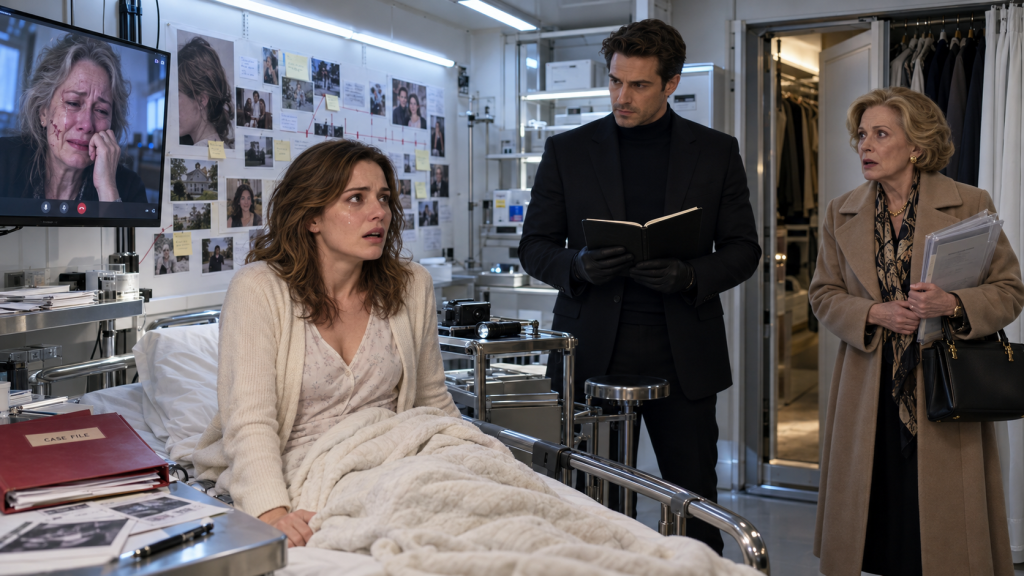
“Don’t run, Lucy. I’ve been waiting twelve years to tell you the truth.” I stopped in the narrow hallway. My bare feet were freezing against the tiles. The red folder trembled in my hands. Behind me, Marcus was shouting. Somewhere inside that hidden medical room, my mother was crying through a video monitor.
And directly ahead stood a man whose face made my entire world turn upside down. “Professor Rowan?” My voice sounded like it belonged to someone else. Dr. Daniel Rowan stood beneath a flickering ceiling light, wearing a dark overcoat and holding a leather briefcase. For eighteen months, he had been my academic adviser at Columbia University.
He had reviewed my research. Encouraged me to apply for a fellowship. Told me I possessed an extraordinary understanding of human memory. I trusted him. Almost as much as I’d trusted Marcus. Now he was standing inside a secret passage in my husband’s house. At three in the morning. Waiting for me. I stepped backward. “What are you doing here?”
He looked older than he had in his office.
Tired.
Terrified.
And deeply ashamed.
“Lucy,” he whispered, “please listen.”
“Don’t call me that!”
I pressed the folder against my chest.
“My name is Valerie.”
He closed his eyes.
Then said something that made my knees weaken.
“No. Valerie Reed is the name they gave you after the last time you tried to escape.”
My breath caught.
Behind me, footsteps echoed.
Marcus was coming.
I glanced over my shoulder.
Professor Rowan stepped toward me.
“There’s another exit.”
I backed away.
“Don’t touch me.”
He stopped immediately.
“I’m not going to.”
“Why should I believe you?”
His face crumpled.
“You shouldn’t. Not without proof.”
He opened his briefcase slowly.
I raised the red folder as if paper could somehow protect me.
He took out a photograph.
Then held it toward me.
Four people stood in front of a white farmhouse.
A woman with dark hair.
A teenage girl wearing a blue jacket.
A younger boy holding a soccer ball.
And a tall man with his arm around the woman.
The teenage girl was me.
The woman was the scarred face on the video monitor.
The boy was someone I didn’t recognize.
And the man—
I stared.
My entire body went cold.
He looked like Professor Rowan.
Not exactly.
His hair was darker.
His face younger.
But there was no mistaking the eyes.
I looked up.
“Who are you?”
Tears filled his eyes.
“My real name is Jonathan Archer.”
The hallway seemed to tilt.
He swallowed.
“Lucy, I’m your father.”
I couldn’t breathe.
My father.
For years, Marcus had told me I was an only child whose parents had died when I was small.
He’d said my memories were unreliable because of childhood trauma.
Whenever I asked about family photographs, he told me they had been lost.
Whenever I dreamed of a woman singing beside a kitchen window, he said dreams weren’t evidence.
And whenever I woke crying after seeing headlights in my sleep, he told me to take another pill.
I stared at Professor Rowan.
“You’re lying.”
He nodded slowly.
“I understand why you’d think that.”
“Then why have you been teaching me at Columbia?”
His face collapsed.
“Because it was the only way I could get close enough to you.”
I shook my head.
“No.”
He stepped back.
“Lucy—”
“Don’t!”
My voice cracked.
“You’ve sat across from me for eighteen months. You knew my name. You knew my face. You watched me tell you I had memory problems.”
Tears burned behind my eyes.
“And you never said anything?”
He lowered his head.
“I was afraid.”
I stared.
“Of Marcus?”
He shook his head.
“Of what would happen if I told you before I could prove who you were.”
His voice trembled.
“And of the people who’d helped him keep you hidden.”
Before I could answer, Marcus appeared at the far end of the hallway.
His face was pale.
His gloves were still on.
“Daniel.”
Professor Rowan turned.
Marcus stopped.
For a moment, the two men stared at each other.
Then Marcus smiled.
A terrible, empty smile.
“So that’s why you kept asking about her dissertation.”
My heart hammered.
Professor Rowan moved slightly to the side, leaving a clear path toward a narrow metal door.
“Lucy, go.”
Marcus laughed.
“Do you really think she’ll trust you?”
He looked at me.
“Valerie, sweetheart, come back into the room.”
I felt sick hearing that word.
Sweetheart.
The same word he’d used while handing me the capsule.
While brushing my hair.
While telling me I was imagining things.
“Don’t call me that.”
My voice was barely audible.
Marcus took a step forward.
“Your thoughts are disorganized. You need your medication.”
I shook my head.
“No.”
He softened his voice.
“You’ve had episodes like this before.”
I clutched the folder harder.
“Then why did you hide a camera in our bedroom?”
He stopped.
For one brief moment, the mask slipped.
“Valerie,” he said quietly, “you’re making this harder than it needs to be.”
Professor Rowan reached toward the metal door.
Marcus’s expression changed.
“Don’t.”
The professor ignored him.
He pulled the door open.
Beyond it, I saw a set of narrow concrete stairs.
And at the bottom, a sliver of night.
“Go!” he shouted.
I ran.
My feet struck the steps.
Pain shot through my heel.
I almost fell.
Behind me, Marcus shouted something.
Then came a crash.
A struggle.
And Professor Rowan’s voice.
“Don’t let him near her!”
I didn’t look back.
For twelve years, someone had been deciding where I could go.
What I could remember.
What name I answered to.
What medicine I took.
And whom I was allowed to trust.
For the first time, I was running toward a door no one had given me permission to open.
At the bottom of the stairs, I found myself in a storage room.
Boxes lined the walls.
A washing machine hummed.
And beyond a half-open door, I saw the backyard.
I stumbled outside.
Cold October air struck my face.
I gasped.
Then ran toward the street.
The house looked different from the outside.
An elegant Manhattan brownstone.
Warm yellow lights.
Black iron railings.
A polished front door.
To anyone passing by, it was the home of a successful neurologist and his graduate-student wife.
No one would have guessed there was a medical room behind a closet.
No one would have guessed that a woman inside had been losing pieces of herself every night.
I ran barefoot along the sidewalk.
The red folder was clutched so tightly to my chest that its corners cut into my skin.
A taxi turned the corner.
I stepped toward the street.
Waved both arms.
The driver braked.
His window lowered.
“Lady, what happened?”
I tried to speak.
Nothing came out.
Then I heard myself whisper:
“Please call the police.”
He looked at my bare feet.
My trembling hands.
The hospital bracelet still around my wrist from the hidden room.
His expression changed immediately.
He called for help.
And when I looked back toward the brownstone, I saw Marcus standing at the top of the front steps.
Watching me.
He didn’t run.
Didn’t shout.
Didn’t wave.
He simply stood beneath the porch light.
Then lifted his phone.
And smiled.
My stomach turned.
Because I understood that smile.
Marcus had never relied only on locked doors.
He relied on people believing him.
A respected physician.
A soft voice.
A beautiful house.
And a wife everyone had been told suffered from memory problems.
I looked toward the taxi driver.
“Please,” I whispered. “Don’t let him take me back.”
The driver stepped outside, keeping his distance but staying nearby.
“Help is coming.”
Within minutes, the street filled with flashing lights.
Police officers approached.
I tried to explain.
The pills.
The cameras.
The room.
The red folder.
The photograph.
The mother I thought had died.
My words came in broken pieces.
But one officer, a woman named Detective Elena Ruiz, crouched beside me.
“Take your time.”
I shook my head.
“He’s a doctor.”
She nodded.
“I understand.”
“He’ll tell you I’m sick.”
She looked directly into my eyes.
“Then we’ll make sure your safety and any medical concerns are assessed independently.”
I began crying.
Because it was the first time in years that someone had responded to my fear without telling me my memory couldn’t be trusted.
Marcus walked toward the officers.
He wore a dark sweater now.
The gloves were gone.
His expression was one of practiced concern.
“Thank goodness you found her.”
I flinched.
He approached.
“Valerie has been experiencing another episode.”
Detective Ruiz stepped between us.
“Sir, please remain where you are.”
Marcus looked surprised.
Then smiled.
“Of course.”
He showed his identification.
“Dr. Marcus Reed. I’m her husband and treating physician.”
The detective’s expression didn’t change.
“Are you currently responsible for her medical treatment?”
Marcus hesitated.
Then said, “I oversee her condition.”
I felt cold.
Her condition.
As though I were a diagnosis.
A collection of symptoms.
Something that belonged in his notebook.
I lifted the red folder.
“He’s lying.”
Marcus sighed.
“Valerie—”
“My name is Lucy!”
My voice tore through the street.
I began trembling.
“My name is Lucy Archer.”
For the first time, Marcus looked genuinely frightened.
Only for a second.
But I saw it.
Detective Ruiz glanced toward the folder.
“Can you tell me why you believe that?”
I opened it.
My hands shook so violently that papers slipped onto the sidewalk.
A photograph.
A missing-person report.
A copy of an old birth certificate.
And a page bearing my childhood handwriting.
I pointed.
“That’s me.”
My voice cracked.
“I was fifteen when I disappeared.”
The detective crouched to examine the documents without taking them from me.
Then she looked up.
“What year?”
I swallowed.
“2014.”
Behind her, Marcus’s expression changed.
The detective noticed.
And something in her face became very still.
“Ms. Archer,” she said carefully, “we’re going to preserve what you’ve brought, arrange an independent medical assessment, and investigate what you’re telling us.”
My eyes filled.
I nodded.
Then I whispered, “My mother is alive.”
The detective looked toward me.
“Where is she?”
I shook my head.
“I don’t know.”
I began crying harder.
“She was on a screen.”
And then, from the open doorway of the brownstone, Eleanor stepped outside.
She had removed her coat.
Her gray hair was carefully arranged.
She looked like a worried elderly woman who’d been awakened by a family emergency.
She saw the police.
Then looked toward me.
And slowly smiled.
“Poor Valerie,” she said. “She’s been having such a difficult time.”
I stared at her.
For twelve years, she’d apparently helped destroy my past.
And now she was trying to erase what had happened only minutes earlier.
I lifted my chin.
Then said something that made her smile disappear.
“Eleanor, tell them what happened to my father.”
She went pale.
Behind her, the brownstone door opened again.
Two officers emerged with Professor Rowan.
His lip was bleeding.
His coat was torn.
But he was alive.
He looked toward me.
Then said quietly:
“Lucy, your mother wasn’t the only one who survived the accident.”
The world seemed to stop.
I stared at him.
“You told me you’re my father.”
He nodded.
Then added:
“But I haven’t told you what happened to your brother.”
My heart stopped.
Brother.
The little boy in the photograph.
The child holding a soccer ball.
The boy whose face had stirred something deep inside me.
I whispered, “What brother?”
Professor Rowan’s eyes filled.
Then he answered:
“His name is Oliver.”
Something broke open inside my mind.
A garden.
A soccer ball.
A little boy laughing.
A voice calling my name.
Lucy! Wait for me!
I staggered.
Detective Ruiz reached toward me without grabbing.
“Are you all right?”
I shook my head.
“No.”
Tears poured down my face.
Because suddenly, I remembered a little boy running through the rain.
His hand wrapped around mine.
And a terrible sound of metal breaking.
Then Professor Rowan said the words that changed everything again.
“Lucy, Oliver is alive.”
“Oliver is alive.”
My father’s words echoed through the cold morning air.
For twelve years, I’d believed I had no family.
No mother.
No father.
No brother.
No one searching for me.
And now, in the space of a single night, I was being told that almost everything I’d believed about myself was false.
I stared at Jonathan Archer.
The man I’d known as Professor Daniel Rowan.
The man who had guided my university research while hiding the fact that he was my father.
“Where is he?”
My voice trembled.
Jonathan looked toward Detective Ruiz.
“I can tell you everything, but we need to make sure Grace is safe first.”
I shook my head.
“No.”
Tears streamed down my face.
“Don’t do that.”
He looked at me.
“Lucy—”
“Don’t decide what I’m allowed to know.”
He fell silent.
I stepped closer.
“For years, Marcus decided what I could remember.”
My voice broke.
“He told me what I was feeling.”
“He told me what was real.”
“He told me whom to trust.”
I stared at Jonathan.
“And you knew who I was.”
His eyes filled.
“So don’t stand there and tell me I have to wait for the truth.”
He lowered his head.
For a moment, he looked nothing like the confident professor who’d once told me I was his most promising graduate student.
He looked frightened.
Ashamed.
And very old.
“Oliver was nine when the car crashed,” he whispered.
A memory flickered.
A boy with freckles.
A yellow soccer ball.
A chipped front tooth.
I covered my mouth.
Jonathan continued.
“He was separated from you after the accident.”
My knees weakened.
“Where did he go?”
Jonathan swallowed.
“He spent years believing you had died.”
I began sobbing.
Jonathan’s voice cracked.
“He was told there had been another medical emergency after the crash, and that you didn’t survive.”
I shook my head.
“No.”
“He didn’t know.”
“No!”
My voice rose.
“He was my little brother.”
Suddenly, I remembered another piece.
A birthday party.
Blue balloons.
A little boy chasing me through the garden.
I was carrying a plate of cupcakes.
He shouted, “Lucy, wait!”
I turned.
He crashed into me.
Cupcakes scattered everywhere.
We laughed until our mother came outside and pretended to be furious.
I bent forward.
The memory hurt.
Not like a headache.
Like grief arriving twelve years late.
Detective Ruiz gently guided me toward the ambulance that had arrived.
“You’ve been through something frightening,” she said. “We need to make sure you’re medically safe.”
I looked toward Marcus.
He was speaking urgently with another officer.
Eleanor stood nearby, her expression hard.
I began trembling.
“Don’t let him treat me.”
The detective’s face softened.
“He won’t be directing your care.”
I climbed into the ambulance.
The red folder remained close by, and the officers documented how it had been recovered.
An independent medical team assessed me.
I was frightened to tell them what Marcus had been giving me because I didn’t know the medication’s name.
All I had was the capsule I’d hidden in a tissue and the photographs I’d taken of the empty packaging.
The medical staff listened.
Arranged appropriate tests.
And made sure I understood what they were doing.
No one demanded that I take another mystery pill.
No one told me my fear was irrational.
And when I said I didn’t want Marcus contacted about my treatment, they respected that.
I had forgotten what it felt like to have someone ask my permission.
As the ambulance doors closed, I looked out at the brownstone.
The house where I’d spent two years calling a stranger my husband.
The house where I studied for exams.
Made coffee.
Watered plants.
Watched movies.
And believed that the man sleeping beside me loved me.
Now I knew there had been a room behind the closet.
A camera above my bed.
A notebook filled with observations.
And a plan to use my identity for money.
I pressed my palms against my face.
Then whispered the name I’d been told to forget.
“Lucy.”
It felt strange.
Almost unfamiliar.
Yet somewhere beneath the terror, the name felt like a door opening.
At the hospital, I was placed in a private room.
I asked for a woman to remain nearby during the examination whenever practical.
I told the staff that unexpected touching frightened me.
They explained each step.
Waited for my permission.
And treated me as an adult who could make decisions.
Those little acts of respect made me cry.
Hours later, Detective Ruiz returned with another investigator.
Her name was Maya Chen.
She specialized in complex missing-person cases.
She sat beside my bed.
“Lucy, I’d like to explain what we’ve confirmed so far.”
I gripped the blanket.
“Please.”
She opened a folder.
“Your name is Lucy Catherine Archer.”
My heart pounded.
“You were born on October seventeenth, 1998.”
I closed my eyes.
Tomorrow.
My twenty-eighth birthday.
Detective Chen continued.
“You were reported missing in October 2014, shortly after a vehicle collision involving your family.”
I stared at her.
“My mother?”
She nodded.
“Grace Archer was seriously injured. She survived, but her whereabouts became difficult to establish after a complicated series of legal and medical records.”
I swallowed.
“And my father?”
The detective paused.
“Jonathan Archer was initially believed to have died in the aftermath of the accident.”
I looked up.
“But he’s alive.”
“Yes.”
Her expression grew serious.
“We’re examining the records surrounding his disappearance, his identity change, and the information he’s provided.”
I stared at her.
“You don’t trust him?”
Detective Chen considered.
“We’re not asking you to trust or distrust him solely because he says he’s your father. We’re checking the evidence.”
For a moment, I felt offended.
Then I remembered everything Marcus had told me.
Everything he’d claimed was true.
Everything he’d made me believe.
I nodded.
“Good.”
Detective Chen’s expression softened.
“You deserve answers that can be verified.”
I stared at the blanket.
Then whispered, “What happened to me after 2014?”
The detective was quiet for a moment.
“We’re still piecing together the full timeline.”
I swallowed.
“I can’t remember all of it.”
She nodded.
“You don’t have to force yourself to remember right now.”
I looked toward the window.
Some memories were there.
A different apartment.
A woman calling me by another name.
A classroom with white walls.
A hospital corridor.
Marcus standing beside a bed.
Other memories were missing entirely.
Years of my life.
As though someone had torn pages from a book.
Detective Chen spoke gently.
“Memory difficulties can have different causes, especially when someone has experienced injuries, psychological trauma, medication exposure, or prolonged stress. Your medical team will assess those possibilities independently.”
I nodded.
She continued.
“And Lucy?”
I looked up.
“You don’t have to recover every memory for what happened to matter.”
I began crying.
Because Marcus had spent years insisting that if I couldn’t remember something, I couldn’t prove it.
Now someone was telling me that evidence could exist outside my own mind.
Documents.
Witnesses.
Records.
People who remembered me.
For the first time, I understood that finding my past wouldn’t depend entirely on forcing my brain to reveal what it had lost.
Detective Ruiz entered a short while later.
Her expression was serious.
“Lucy, we located the private room.”
My heart stopped.
I stared.
“The one behind the closet?”
She nodded.
“Investigators are documenting it.”
I began trembling.
“The cameras?”
“We’re examining the equipment and available records.”
I swallowed.
“And the notebook?”
She nodded.
“That too.”
My eyes filled.
For two years, Marcus had told me I was imagining things.
Now strangers were walking through the room where he’d treated my body and memory as if they belonged to him.
I took a breath.
“Where is he?”
Detective Ruiz paused.
“Marcus is being questioned, and the investigation is ongoing. I can’t promise you an outcome before the evidence has been reviewed.”
I nodded.
“And Eleanor?”
She exchanged a glance with Detective Chen.
Then said, “We’re working to establish the full extent of her involvement.”
I stared at the wall.
Then whispered, “She knows where my mother is.”
The detective nodded.
“That’s one of the things we’re pursuing.”
That afternoon, an unfamiliar woman knocked on my hospital-room door.
She wore a navy coat and carried a small handbag.
Her dark hair was tied back.
She looked nervous.
“Lucy?”
I gripped the blanket.
“Who are you?”
She stopped immediately.
“My name is Nina Patel.”
My heart jumped.
Nina.
My friend from Columbia.
My study partner.
The woman who always brought extra coffee to our late-night library sessions.
“Nina?”
She rushed toward me, then stopped beside the bed.
“Can I hug you?”
I burst into tears.
I nodded.
She wrapped her arms around me.
And I cried harder than I had all morning.
Nina held me carefully.
“Oh, Valerie.”
She froze.
Then pulled back.
“I’m sorry.”
I wiped my cheeks.
“It’s okay.”
Her eyes filled.
“I don’t know what to call you.”
I looked down.
For a moment, I didn’t know either.
Then whispered, “Lucy.”
Nina nodded.
“Lucy.”
Hearing my real name in a friend’s voice made something in my chest loosen.
She sat beside me.
Then took my hand.
“I’m so sorry.”
I frowned.
“For what?”
Her eyes filled.
“I knew something was wrong.”
I stared.
She continued.
“You missed classes.”
“You forgot conversations we’d had the previous day.”
“You came to the library with bruises and said you couldn’t remember getting them.”
My throat tightened.
Nina began crying.
“And whenever I asked about Marcus, you got frightened.”
I closed my eyes.
She continued.
“I thought you were ill.”
I looked up.
“You couldn’t have known.”
She wiped her cheeks.
“But I should have asked more questions.”
I squeezed her hand.
“Nina, he was a neurologist.”
Her face crumpled.
“He kept telling everyone you were receiving excellent care.”
I swallowed.
Then asked, “Did I ever tell you something strange?”
She hesitated.
“Yes.”
My heart pounded.
“What?”
Nina looked toward the door.
Then back at me.
“Three weeks ago, you asked me to keep a notebook for you.”
I went cold.
“A notebook?”
She nodded.
“You said Marcus was checking your things.”
My breath caught.
“What did I give you?”
Nina reached into her handbag.
Then pulled out a small blue journal.
I recognized it immediately.
It was the notebook I used for my research notes.
The one I’d been searching for.
The one Marcus said I’d lost.
Nina placed it in my hands.
“You told me not to give it back unless you asked for it when Marcus wasn’t there.”
I stared.
Then whispered, “I did?”
She nodded.
“And yesterday, when you didn’t answer my messages, I tried calling your house.”
My heart tightened.
“What happened?”
“Marcus said you were resting.”
She began crying.
“I almost believed him.”
I looked down at the journal.
Then opened it.
The first pages contained my university notes.
Research questions.
Library references.
Half-finished ideas.
Then, halfway through, the handwriting changed.
Not because it belonged to someone else.
Because the person writing had been afraid.
The letters were crowded together.
The lines uneven.
And across one page, in thick black ink, were the words:
MY NAME IS NOT VALERIE.
I stopped breathing.
Beneath the sentence, I had written:
He changes my medication whenever I ask about the accident.
I found the camera.
There is a locked door behind the closet.
The woman in my dreams calls me Lucy.
My hands trembled.
I turned another page.
And saw something that made my heart nearly stop.
Professor Rowan recognized the song.
I stared.
Nina leaned forward.
“What song?”
I swallowed.
At the bottom of the page were four lines.
A little lullaby.
The words were uneven.
But I knew them.
Not because I’d learned them at Columbia.
Because someone had sung them to me when I was little.
I whispered the first line.
A melody rose in my mind.
Soft.
Familiar.
A woman’s voice.
And suddenly, I remembered a kitchen filled with sunlight.
A woman standing beside a sink.
Her hands covered in flour.
A little boy sitting on the floor.
And me, fifteen years old, pretending to complain because my mother was singing the same song again.
I covered my mouth.
“Mom.”
Nina began crying.
I continued turning the pages.
Then I saw one final note.
Dated the week before.
If Marcus says I’m confused, ask him why the hospital bill lists my name as L. Archer.
I stared.
Then looked toward Nina.
“He knew.”
She frowned.
“Who?”
“Professor Rowan.”
My voice broke.
“He knew who I was.”
Nina squeezed my hand.
For a moment, we sat silently.
Then she whispered, “Lucy, whoever you were before Columbia, the person I know is still real.”
I looked at her.
She smiled through tears.
“You studied harder than anyone in our program.”
“You helped me pass statistics.”
“You stayed up with me when my father was sick.”
“You made terrible jokes during seminars.”
I began crying.
Nina continued.
“Marcus may have lied about your past.”
Her voice trembled.
“But he didn’t create every good thing about you.”
I pressed the journal against my chest.
And for the first time, I felt something I hadn’t expected.
Not just grief for Lucy Archer.
But tenderness toward Valerie Reed.
The woman I’d believed myself to be.
The woman who’d worked so hard to earn a graduate degree.
The woman who’d written warnings to herself.
The woman who’d hidden a capsule beneath her tongue because some part of her knew the truth mattered.
Marcus had tried to erase Lucy.
But the woman he’d called Valerie had fought back.
I looked toward Nina.
Then whispered, “I don’t know who I am anymore.”
She squeezed my hand.
“Then you don’t have to figure it out today.”
I nodded.
And held the blue journal tightly.
That evening, Detective Ruiz returned.
Her face was grave.
“Lucy, we found a possible lead concerning your mother.”
My heart began pounding.
“Where?”
She sat beside me.
“A private long-term care facility in northern New Jersey.”
I stared.
“Is she there?”
“We’re verifying her identity and condition.”
My eyes filled.
“Please.”
My voice broke.
“Please don’t let her disappear again.”
Detective Ruiz looked directly at me.
“We’re treating this urgently.”
I closed my eyes.
Then whispered, “She said she never stopped looking for me.”
The detective’s expression softened.
I looked toward the window.
The city lights were coming on.
Thousands of people walking home.
Making dinner.
Calling their parents.
Living ordinary lives.
And somewhere beyond those lights, a woman with a scarred face might be waiting for the daughter she’d lost twelve years earlier.
I pressed my mother’s photograph against my heart.
And whispered:
“I’m looking for you too.”
My mother was found the next morning.
Detective Ruiz called shortly after seven.
I was sitting upright in my hospital bed, staring at the untouched breakfast tray.
When her name appeared on the screen, my entire body went cold.
I answered immediately.
“Did you find her?”
There was a pause.
Then she said, “Lucy, we believe we have.”
I pressed my hand against my mouth.
“Is she alive?”
“Yes.”
I began sobbing.
The detective waited.
Then continued gently.
“She is receiving an independent medical assessment, and we’re working to verify the circumstances under which she was kept at the facility.”
My voice shook.
“Can I see her?”
“We’re arranging that.”
I closed my eyes.
For twelve years, I’d believed my mother was dead.
Now she was alive.
Breathing.
Somewhere close enough that I might finally touch her hand.
Then I remembered the woman on the monitor.
The scars.
The tears.
The way she’d called me Lucy.
I whispered, “Is she frightened?”
Detective Ruiz paused.
“She’s been through a great deal.”
My heart tightened.
“But she’s been asking about you.”
I began crying again.
I couldn’t stop.
I cried for the girl I’d been at fifteen.
For the woman who’d spent twelve years calling herself Valerie.
And for the mother who had apparently been looking for a daughter everyone told her was gone.
That afternoon, I met with a trauma-informed psychologist named Dr. Sarah Bennett.
She was calm.
Patient.
And careful not to promise that all my memories would suddenly return.
I told her about the crash.
The white medical room.
The hidden camera.
The voice recording.
And the strange sensation of knowing a name before remembering why it mattered.
She listened.
Then said something that stayed with me.
“Lucy, the brain doesn’t always store frightening experiences in a neat sequence.”
I nodded.
She continued.
“Some memories may become clearer. Others may remain incomplete. And because you’ve also been exposed to unknown medications, we need to be especially careful about separating recollections from information you’ve learned afterward.”
I looked down.
“Does that mean I can’t trust myself?”
Her expression softened.
“No.”
I looked up.
“It means you deserve to approach your memories with patience rather than pressure.”
I began crying.
For so long, Marcus had made every uncertainty feel like proof that I was incompetent.
Now this woman was telling me I didn’t need perfect recall to deserve respect.
Afterward, I asked whether I would ever feel normal again.
Dr. Bennett considered.
“Recovery may take time.”
I swallowed.
“Will I ever know who I really am?”
She smiled gently.
“I think you already know some important things about yourself.”
I frowned.
“Like what?”
She leaned forward.
“You’re someone who noticed inconsistencies.”
“Someone who documented what frightened her.”
“Someone who reached for help.”
“And someone who kept asking questions, even when another person tried to convince her those questions were wrong.”
My eyes filled.
She continued.
“Those are parts of you too.”
That evening, Jonathan Archer came to the hospital.
He wasn’t allowed to simply walk into my room.
I had to agree to see him.
When the nurse asked whether I wanted the visit, I almost said no.
Part of me hated him.
Another part desperately wanted to ask what my favorite food had been as a child.
Whether I had liked school.
Whether I’d been good at sports.
Whether I used to laugh loudly.
I finally agreed to a short conversation with appropriate safeguards.
When Jonathan entered, he looked exhausted.
There was a small bandage near his lip.
His eyes were red.
He stood near the door.
“Lucy.”
I stared at him.
Then whispered, “Sit down.”
He sat.
For several seconds, neither of us spoke.
Then I asked, “Why did you change your name?”
His expression tightened.
“I was trying to survive.”
I swallowed.
“Tell me everything.”
He looked toward his hands.
“Your grandfather, Arthur Archer, built an investment company and later created a trust for you.”
I remembered the inheritance documents.
“My twenty-eighth birthday.”
Jonathan nodded.
“He was very particular about how the assets would be managed.”
I frowned.
“Why me?”
He gave a sad smile.
“Because you were the oldest grandchild, and because you loved working with him.”
Something flickered in my mind.
A desk covered in papers.
An elderly man showing me how to calculate percentages.
Me laughing because he called a calculator his most stubborn employee.
I covered my mouth.
“Grandpa Arthur?”
Jonathan’s eyes filled.
“Yes.”
I stared at him.
“He taught me about numbers.”
My father’s expression changed.
“He did.”
The memory disappeared as quickly as it came.
I felt disappointed.
Jonathan leaned forward.
“Lucy, don’t force it.”
I stared at him.
“You don’t get to tell me what to do with my memories.”
He lowered his head immediately.
“I’m sorry.”
For a long moment, neither of us spoke.
Then he continued.
“Your grandfather discovered irregularities in accounts managed by a financial company connected to Eleanor’s family.”
I frowned.
“Eleanor?”
He nodded.
“Her late husband had been involved in several property ventures. Marcus later became connected to people managing related holdings.”
My stomach tightened.
“Why would a neurologist be involved?”
Jonathan’s expression darkened.
“Because he was trusted by people who needed medical opinions to support legal and financial decisions.”
I felt cold.
Jonathan continued.
“Your grandfather believed someone was trying to gain control of assets that were meant to remain independently managed until you reached twenty-eight.”
I swallowed.
“And my mother?”
“Grace was helping him investigate.”
I stared.
The woman on the monitor.
Her scars.
Her voice.
Her desperate warning.
Jonathan took a breath.
“Then Arthur died.”
My heart tightened.
“How?”
“He had been ill.”
Jonathan paused.
“His death was initially treated as natural, and I can’t tell you otherwise without evidence.”
I nodded.
He continued.
“But shortly afterward, Grace discovered documents she believed were false.”
I gripped the blanket.
“What documents?”
“Authorities. Transfers. Attempts to establish control over parts of the trust.”
He lowered his head.
“Grace wanted to bring the records to an independent lawyer.”
My heart pounded.
“And then we had the accident?”
Jonathan nodded.
For a moment, I felt a cold pressure behind my eyes.
Rain.
Headlights.
A woman’s scream.
A car sliding sideways.
“Was it really an accident?” I whispered.
Jonathan looked at me.
Then said, “That’s one of the things investigators are examining.”
I swallowed.
“Don’t avoid the question.”
His eyes filled.
“Lucy, I suspect someone interfered with that trip.”
I stared.
“But I won’t tell you a suspicion is proof.”
For the first time, I appreciated his restraint.
Because I had spent years living with a man who presented every claim as undeniable truth.
Then I asked, “What happened to you?”
Jonathan’s face collapsed.
He stared at the floor.
“When the car crashed, I was badly injured.”
I swallowed.
He continued.
“Grace and Oliver were taken to one hospital. You were taken somewhere else.”
My breath caught.
“I remember a white room.”
He nodded.
“We found records that suggest you were transferred soon afterward, but the paperwork was incomplete and misleading.”
I gripped the blanket.
“And you?”
Jonathan took a shaking breath.
“I woke up in a medical facility under a different name.”
I stared.
“What?”
He nodded.
“Someone claimed I was receiving treatment after a serious neurological injury.”
His voice broke.
“And for months, I wasn’t able to contact my family freely.”
I felt cold.
“Who arranged it?”
Jonathan looked toward me.
“Records connect the arrangements to people working with Eleanor.”
My stomach tightened.
He continued.
“Eventually, I left.”
I stared.
“Then why didn’t you find us?”
For a long moment, he said nothing.
Then he whispered, “I tried.”
I felt tears rise.
“That’s not an answer.”
He nodded.
“I know.”
He rubbed his hands together.
“By then, I was being investigated over alleged financial misconduct connected to Arthur’s estate.”
I frowned.
“Were the allegations true?”
His expression became painful.
“I’d signed documents without understanding how they would be used.”
I stared.
“What documents?”
He swallowed.
“Temporary authorizations and financial acknowledgments that I was told would help protect the family during the aftermath of the crash.”
My stomach tightened.
“And they didn’t?”
He shook his head.
“Some were used to justify transactions I never intended to approve.”
I studied him.
“Did you know anyone was planning to take me?”
His eyes filled.
“No.”
I waited.
He continued.
“But I should have been more careful.”
My voice broke.
“And when you realized what had happened?”
He looked away.
“I became afraid.”
I felt anger rise.
“Afraid of what?”
He swallowed.
“Of losing Oliver.”
My heart stopped.
Jonathan continued.
“Oliver was still a child. I was told that if I tried to challenge the arrangements too aggressively, I might never see him again.”
I stared.
“So you disappeared.”
He nodded slowly.
“Yes.”
I looked toward the window.
I wanted to scream.
I wanted to shake him.
I wanted to ask how he could have stayed away when his daughter was missing.
But I also knew I didn’t yet have the full history.
Jonathan continued.
“I lived under another name. I rebuilt my career. I tried to find information without alerting the people I believed were involved.”
I turned toward him.
“And Columbia?”
He swallowed.
“Two years ago, I saw your face in an academic program photograph.”
My heart pounded.
“Valerie Reed.”
He nodded.
“I recognized you immediately.”
I stared at him.
“Two years ago.”
His eyes filled.
“Yes.”
My voice rose.
“You recognized me two years ago?”
He nodded.
“And you let me stay married to Marcus?”
His face crumpled.
“Lucy—”
“You let him give me pills?”
“I didn’t know what he was doing inside the house.”
“But you knew who I was!”
I began crying.
Jonathan lowered his head.
“I know.”
“You watched me tell you I couldn’t remember things.”
His shoulders shook.
“I know.”
“You watched me apologize because I was tired.”
Tears streamed down my cheeks.
“And you never told me I had a mother.”
Jonathan covered his face.
For a long moment, he couldn’t speak.
Then he whispered, “I failed you.”
The words hung in the air.
I stared at him.
He continued.
“I was trying to gather evidence before confronting anyone. I was terrified they’d move you again.”
His voice broke.
“But I waited too long.”
I wiped my cheeks.
Then said quietly, “You don’t get twelve years back by telling me you were afraid.”
He nodded.
“No.”
I looked down at the blanket.
For a long time, neither of us spoke.
Then I asked, “Does Oliver know I’m alive?”
Jonathan shook his head.
“Not yet.”
I stared.
“Why?”
He swallowed.
“Because I wanted to tell you first and make sure you were safe.”
I took a breath.
“Where is he?”
Jonathan hesitated.
“He lives in Vermont.”
My heart tightened.
“With whom?”
He smiled sadly.
“He’s twenty-one now. He works at an outdoor education center and is studying to become a teacher.”
I covered my mouth.
My little brother.
Twenty-one.
A grown man.
I remembered him at nine.
With muddy sneakers.
A soccer ball.
And a laugh that sounded like a bird chirping.
I whispered, “Does he still have freckles?”
Jonathan began crying.
“Yes.”
I smiled through tears.
“Does he still hate broccoli?”
Jonathan gave a broken laugh.
“Yes.”
For the first time, something gentle passed between us.
Then I looked at him.
And the hurt returned.
“You should have told me sooner.”
He nodded.
“I know.”
I took a breath.
“I don’t know whether I can trust you.”
His eyes filled.
“I understand.”
“And I don’t know whether I’ll ever forgive you for waiting.”
He lowered his head.
“I understand that too.”
I looked toward the door.
“I need time.”
Jonathan stood immediately.
“Of course.”
Before leaving, he turned back.
“Lucy?”
I stared at him.
He swallowed.
“You used to have a little silver bracelet.”
My heart tightened.
“What?”
He smiled sadly.
“It had three tiny stars.”
Something flickered.
A small wrist.
Silver charms.
A boy asking why he didn’t get one.
Jonathan continued.
“Grace gave it to you on your fifteenth birthday.”
My eyes filled.
“And you told Oliver the stars stood for the three of you.”
I swallowed.
“Me, Mom, and Oliver?”
Jonathan shook his head gently.
“You told him they stood for courage, kindness, and coming home.”
I covered my mouth.
Tears spilled down my cheeks.
Jonathan’s voice broke.
“You said if you ever got lost, the bracelet would remind you where you belonged.”
I began sobbing.
Because suddenly, I remembered the bracelet.
Not clearly.
Just the sound of three tiny silver stars touching one another.
Jonathan stepped toward the door.
Then whispered, “I’m sorry I couldn’t bring you home sooner.”
I looked at him.
And answered through my tears.
“So am I.”
After he left, I sat quietly.
For the first time, I understood something painful.
Finding my real family did not mean every wound would disappear.
Some people had suffered.
Some had been deceived.
Some had been frightened.
And some had made choices that hurt me while believing they were protecting me.
I could love the idea of my father.
Miss the man I remembered from childhood.
And still be angry at the person he’d become.
That night, I took out the photograph of my family.
I looked at Oliver.
His freckled face.
His soccer ball.
His crooked smile.
And whispered:
“Little brother, I’m coming back.”
Three days later, I saw my mother for the first time in twelve years.
I had imagined that moment so many times during the preceding seventy-two hours.
I thought I would run into her arms.
That I would immediately recognize her scent.
That every missing memory would return the instant I touched her hand.
But when the hospital-room door opened, I froze.
A woman stood beside a nurse.
Her hair was gray at the temples.
One side of her face carried scars that ran from her cheek toward her jaw.
She leaned slightly on a walking stick.
And her hands trembled so badly that she had to steady herself against the doorframe.
She looked at me.
For a moment, neither of us moved.
Then she whispered:
“Lucy?”
I began crying.
Not graceful tears.
Not the quiet kind that slip down your face while you remain composed.
I made a sound I’d never heard come from my own throat.
A sound of grief.
Relief.
Anger.
And longing.
My mother covered her mouth.
“Oh, my baby.”
I stood.
My knees almost buckled.
She opened her arms.
And I went to her.
The instant she held me, something in me recognized her.
Not a clear memory.
Not a magical recovery.
Something quieter.
The familiar way she rested one hand at the back of my head.
The way she whispered words into my hair.
The little humming sound she made when she cried.
I wrapped my arms around her.
And sobbed.
“Mom.”
She held me tighter.
“My Lucy.”
I pressed my face against her shoulder.
“I thought you were dead.”
Her entire body shook.
“Oh, sweetheart.”
She began crying harder.
“I never stopped looking for you.”
For a long time, we couldn’t speak.
We simply held each other.
Twelve years of birthdays.
Holidays.
Ordinary breakfasts.
School graduations.
Little arguments.
Shared jokes.
All the things that should have filled our lives together.
Gone.
But she was here.
Alive.
Warm.
Breathing against my cheek.
Finally, she pulled back enough to look at me.
Her hands touched my face.
Gently.
As though she were afraid I’d disappear.
“You have my mother’s eyes,” she whispered.
I laughed through tears.
“Everyone keeps telling me who I look like.”
She smiled.
The scars pulled slightly at one side of her mouth.
“I used to tell you that when you were little.”
I stared at her face.
Then raised my hand.
Stopped.
“Can I?”
Her eyes filled.
She nodded.
I touched the edge of the scar on her cheek.
My fingers trembled.
“Does it hurt?”
She smiled sadly.
“Not anymore.”
My throat tightened.
I shook my head.
“I wish I’d been there.”
She caught my hand.
“No.”
Her voice became firm.
“Lucy, none of this was your responsibility.”
I began crying again.
She continued.
“You were fifteen.”
I closed my eyes.
“You were my child.”
For a moment, I felt an overwhelming wave of grief for the girl I’d been.
A fifteen-year-old who should have been worrying about exams.
Friends.
Clothes.
And whether a boy at school liked her.
Instead, she’d vanished into a system of lies.
My mother took my hands.
Then whispered, “Do you remember the blue kitchen?”
I blinked.
“The what?”
She smiled through tears.
“Our old kitchen.”
Something flickered.
Sunlight.
White curtains.
Blue cupboards.
The smell of cinnamon.
I covered my mouth.
“You sang.”
Her face crumpled.
“Yes.”
I swallowed.
“You sang while you cooked.”
My mother began sobbing.
“Oh, Lucy.”
I closed my eyes.
And for one brief moment, I was standing in our old kitchen again.
I could hear Oliver laughing.
My mother humming.
My father’s footsteps in the hallway.
Then the memory faded.
I opened my eyes.
My mother was holding both my hands.
I smiled through tears.
“I remember a little.”
She kissed my forehead.
“That’s enough for today.”
We sat together for hours.
Sometimes talking.
Sometimes crying.
Sometimes simply looking at each other.
She told me about the years after the crash.
About the surgeries she endured.
The confusion caused by false information.
The changing facilities.
And her repeated attempts to get answers about her daughter.
She didn’t pretend she had spent twelve years heroically overcoming every obstacle.
She told me she’d become exhausted.
Frightened.
And sometimes hopeless.
“People kept telling me to accept that you were gone,” she whispered.
I looked at her.
“Did you?”
She shook her head.
“No.”
Her eyes filled.
“But there were days when I was afraid I would never see you again.”
I took her hand.
She continued.
“Last year, I saw a photograph of a graduate student in a university publication.”
My heart stopped.
“Me?”
She nodded.
“Valerie Reed.”
Tears spilled down her cheeks.
“Your hair was different.”
“You looked older.”
“But I knew those eyes.”
I stared.
“What did you do?”
She smiled sadly.
“I started asking questions.”
My stomach tightened.
“And?”
“People at the facility said I was upsetting myself.”
She looked down.
“Then Eleanor came to see me.”
My blood ran cold.
“What did she say?”
My mother closed her eyes.
“She told me the girl in the photograph wasn’t you.”
I swallowed.
“She lied.”
Mom nodded.
“Yes.”
Then she looked toward me.
“But a few months later, Eleanor returned.”
Her expression darkened.
“She said she could arrange for me to see you.”
I felt cold.
“On the video?”
She nodded.
“She told me Marcus needed to assess whether you recognized my voice.”
My stomach twisted.
I remembered the hidden room.
The monitor.
Marcus lifting my eyelid.
The voice recording.
The woman on the screen begging me to wake up.
Mom continued.
“She said if I cooperated, she would help us reunite.”
Tears filled her eyes.
“I knew she wasn’t telling me everything.”
I swallowed.
“But you wanted to see me.”
Her voice broke.
“More than anything.”
I took her hand.
She continued.
“The first time they played my voice to you, you didn’t move.”
My eyes filled.
“The second time, your hand twitched.”
I stared.
Then she whispered:
“And the third time, you said a word.”
My heart pounded.
“What word?”
My mother began crying.
She squeezed my hand.
“Home.”
I covered my mouth.
My entire body trembled.
Because somewhere beneath the medication.
Beneath the fear.
Beneath years of lies.
A part of me had still known where I belonged.
I began sobbing.
Mom pulled me close.
And whispered:
“I heard you, Lucy.”
Her voice broke.
“I heard you trying to come back.”
For a long time, we held each other.
Then I remembered the question that had haunted me since the hidden room.
“Mom?”
She pulled back.
“Yes?”
“Do you know what happened to Dad?”
Her expression changed.
I felt her hands tighten around mine.
She took a slow breath.
“Your father was injured in the crash.”
I nodded.
“He told me.”
My mother stared.
“You’ve seen him?”
“Yes.”
Her face went pale.
For a moment, she couldn’t speak.
Then she whispered, “Jonathan?”
I nodded.
“He’s been living under another name.”
Mom turned toward the window.
Tears filled her eyes.
I couldn’t tell whether they were tears of relief or pain.
Finally, she said quietly:
“I knew he survived.”
I stared.
“You knew?”
She nodded.
“For a while.”
My stomach tightened.
“What do you mean?”
My mother took a long breath.
“After the accident, he came to see me at the first facility.”
I frowned.
“He said he couldn’t contact you.”
She nodded.
“Perhaps he couldn’t later.”
Her eyes filled.
“But he could then.”
I went cold.
“What happened?”
She looked down.
“Jonathan brought me papers.”
My heart hammered.
“What papers?”
She swallowed.
“He said signing them would allow someone to manage your grandfather’s property while you were missing.”
I stared.
“Did you sign?”
She shook her head.
“No.”
I exhaled.
Mom’s voice trembled.
“I told him I wanted to see an independent lawyer.”
Then she whispered, “He became frightened.”
My stomach twisted.
“Of what?”
She looked toward me.
“Eleanor had threatened to make sure Oliver was taken away from us.”
I closed my eyes.
My little brother.
Nine years old.
Used as leverage against two frightened parents.
Mom continued.
“Jonathan said he was trying to protect us.”
Her voice broke.
“But I told him protection didn’t mean surrendering control to people we didn’t trust.”
I stared at her.
Then whispered, “Did you ever see him again?”
She shook her head.
“Not for years.”
I sat quietly.
My father had told me he’d signed documents without understanding how they would be used.
My mother remembered him bringing documents she refused to sign.
Both things might be true.
But there were questions he hadn’t answered.
Mom touched my hand.
“Lucy, don’t decide what happened solely from what either of us remembers. Let the records be examined.”
I nodded.
She continued.
“We were all frightened.”
Her eyes filled.
“But that doesn’t mean every choice was harmless.”
I looked at her.
Then whispered, “I’m angry at him.”
Mom squeezed my hand.
“You’re allowed to be.”
I began crying.
For years, Marcus had told me how to feel.
If I was angry, I was unstable.
If I was frightened, I was irrational.
If I asked questions, I was confused.
Now my mother was telling me anger could belong to me without making me wrong.
I wiped my cheeks.
Then asked, “Mom, do you think I’ll remember everything?”
She looked at me.
Her eyes softened.
“I don’t know.”
My throat tightened.
She continued.
“But you don’t need to recover every lost day for us to build new ones.”
I smiled through tears.
She took my hand.
“And Lucy?”
“Yes?”
“Whatever name you’ve answered to, whatever you’ve forgotten, whatever has happened…”
Her voice broke.
“You have never stopped being my daughter.”
I leaned into her arms.
And cried.
The next morning, I received a call from an unfamiliar number.
I almost ignored it.
Then I answered.
“Hello?”
A young man’s voice said, “Is this Lucy Archer?”
My heart stopped.
I sat upright.
“Yes.”
He inhaled sharply.
For a moment, neither of us spoke.
Then he whispered:
“Lucy, it’s Oliver.”
I covered my mouth.
“Oliver?”
His voice broke.
“Yeah.”
I began crying.
“Oh, my God.”
He laughed through tears.
“I know.”
I tried to speak.
Nothing came out.
Then he whispered, “I don’t know what to say.”
I laughed and sobbed at the same time.
“Neither do I.”
He took a shaky breath.
“I have a picture of you in my apartment.”
My heart tightened.
“What?”
He laughed weakly.
“It’s from when I was little.”
I closed my eyes.
He continued.
“You’re standing beside me at the beach.”
I swallowed.
“Was I holding a red bucket?”
Silence.
Then Oliver began sobbing.
“Yes,” he whispered.
My heart nearly stopped.
Because I remembered.
Not the whole day.
Not every detail.
But a beach.
A little boy.
A red plastic bucket.
And me pretending to be angry because he’d filled my shoes with sand.
I laughed through tears.
“You put sand in my shoes.”
Oliver began laughing and crying at the same time.
“I did.”
For a long moment, neither of us spoke.
Then he whispered, “I’ve missed you.”
I pressed the phone against my ear.
My voice broke.
“I’ve missed you too.”
A week later, my brother came to see me.
He walked through the hospital doorway carrying a small red plastic bucket.
I stared.
Then laughed.
And cried.
And laughed again.
He was tall.
Broad-shouldered.
His hair darker than I remembered.
But the freckles were still there.
And when he smiled, I saw the little boy who used to chase me through our garden.
He stopped just inside the room.
“Hey, Lucy.”
I stood.
“Hey, Ollie.”
His face collapsed.
“Nobody’s called me that in years.”
I opened my arms.
He rushed toward me.
And we held each other.
I felt his shoulders shaking.
He felt mine.
For a long time, we couldn’t speak.
Finally, he whispered against my hair:
“I thought you died.”
I closed my eyes.
“I know.”
His voice broke.
“I used to ask why nobody would take me to your grave.”
I began sobbing.
Oliver held me tighter.
“They said it would be too upsetting.”
I pulled back.
Looked into his eyes.
Then whispered, “I’m here.”
He nodded.
Tears streamed down his face.
“I know.”
He looked down at the bucket.
Then gave a shaky laugh.
“I found this in a box of old things.”
I stared.
“You kept it?”
He nodded.
“I don’t know why.”
Then he smiled sadly.
“Maybe because it reminded me of you.”
I took the little bucket.
Ran my fingers along the scratched plastic.
And remembered a summer afternoon.
A little boy building a crooked sandcastle.
Me pretending to be its queen.
And our mother laughing beneath a beach umbrella.
I began crying again.
Oliver sat beside me.
Then whispered, “Lucy?”
“Yes?”
“Do you still hate broccoli?”
I stared at him.
Then burst out laughing.
He grinned.
“Because I do.”
For the first time in twelve years, I laughed with my little brother.
And it felt as though someone had returned a small piece of the world to its proper place.
The day before my twenty-eighth birthday, Detective Ruiz asked to see me.
She arrived carrying a folder.
Her expression was more serious than usual.
“Lucy, the trust administrators have been notified that there is a dispute concerning your identity, the proposed transfers, and the documents Marcus and Eleanor prepared.”
I nodded.
“Good.”
She continued.
“Your legal representatives are working to make sure no disputed transfer is completed on the basis of false or coerced paperwork.”
I swallowed.
“So Marcus can’t just take everything tomorrow?”
She shook her head.
“Turning twenty-eight doesn’t make an unauthorized transfer valid. There are legal processes for establishing your identity, confirming your rights, and challenging any improper documents.”
I closed my eyes.
Relief washed over me.
For days, I’d imagined a clock counting down to midnight.
As though my inheritance were a bomb that would explode unless someone stopped it in time.
But there were rules.
Documents.
Courts.
People who could examine evidence.
And for the first time, Marcus wasn’t the person explaining those rules to me.
Detective Ruiz continued.
“There’s another development.”
My heart tightened.
“What?”
She opened the folder.
“Investigators recovered digital records from the hidden room.”
I went cold.
“The videos?”
She nodded.
“And the notebook.”
I stared at her.
Then whispered, “What did they find?”
She took a breath.
“Records indicating that your medication was being administered without the informed consent you were entitled to give.”
I covered my mouth.
She continued.
“Documentation of your responses to certain recordings and questions.”
My stomach twisted.
“And attempts to measure what you remembered.”
For a moment, I was back on that gurney.
The hospital lights.
The cold air.
Marcus checking my pulse.
Eleanor standing nearby.
The red folder.
I began shaking.
Detective Ruiz noticed.
“Lucy, we don’t have to discuss the details right now.”
I swallowed.
“No.”
My voice broke.
“I want to know.”
She nodded.
“The records include notes about how you reacted when shown photographs of your family.”
I stared.
“My family?”
“Yes.”
I began crying.
Marcus had shown me photographs.
Played voices.
Watched my face.
Recorded my reactions.
Then returned upstairs and kissed me goodnight.
I thought about the times I’d woken with swollen eyes.
The mornings I’d found strange sentences in my notebook.
The dreams he’d dismissed.
The bruises.
The missing hours.
And I understood something terrible.
He hadn’t simply been hiding my past.
He’d been searching for signs that I might find it myself.
I looked toward Detective Ruiz.
“Did he know I was writing things down?”
She hesitated.
“Some notes suggest he suspected you were retaining information despite his efforts.”
My eyes filled.
I remembered the sentence in my notebook.
Don’t let Marcus know you remember.
I pressed my hands together.
The woman who wrote that sentence had been frightened.
But she had also been thinking.
Planning.
Trying to leave herself a trail.
Detective Ruiz gently turned another page.
“Lucy, there’s something else.”
I looked up.
“Marcus made several references to a previous attempt to leave.”
My heart stopped.
“What?”
She nodded.
“Approximately three years ago.”
I stared.
“Before we were married?”
“Yes.”
I felt the room spinning.
For two years, I’d believed Marcus had been the man who saved me after a frightening health crisis.
He’d told me he found me disoriented and alone.
That he’d helped me recover.
That we’d fallen in love.
Now the dates were telling another story.
“Did I try to leave him?” I whispered.
Detective Ruiz paused.
“We’re investigating what those entries mean.”
I swallowed.
“But it says I tried to leave?”
“There are references to an attempt to contact outside help.”
My eyes filled.
Suddenly, I remembered a train station.
A blue coat.
A ticket clutched in my hand.
And someone calling my name.
Not Valerie.
Lucy.
I grabbed the edge of the blanket.
“I remember a train.”
The detective leaned forward.
“Take your time.”
I closed my eyes.
“A station.”
“A man.”
“A loudspeaker.”
Then I saw a woman’s face.
Not my mother.
Someone younger.
Wearing a red scarf.
She was standing beside a vending machine.
Looking at me with concern.
I opened my eyes.
“There was a woman.”
Detective Ruiz nodded.
“Okay.”
I swallowed.
“She helped me.”
The memory vanished.
I began crying.
“It’s gone.”
The detective’s expression softened.
“That’s all right.”
I shook my head.
“But she might know what happened.”
She nodded.
“Then we’ll document what you’ve recalled and look for independent evidence.”
That evening, I told Nina about the train station.
She listened carefully.
Then frowned.
“Lucy, you once mentioned a woman in a red scarf.”
I stared.
“What?”
Nina nodded.
“We were studying in the library. You said you’d dreamed about someone holding a train ticket.”
My heart pounded.
“What else did I say?”
She considered.
“You said the woman told you not to go home.”
I went cold.
“Did I tell you her name?”
Nina shook her head.
“I don’t remember.”
I opened my blue journal.
Turned through the pages.
Then found a sentence scribbled in the margin of an old lecture outline.
RED SCARF. PENN STATION. ASK FOR REBECCA.
I stopped breathing.
Nina leaned forward.
“What is it?”
I held up the page.
Her eyes widened.
“Oh, my God.”
Rebecca.
A name I’d left for myself.
A person who might have seen me before Marcus convinced me I was someone else.
Detective Ruiz followed the lead.
Investigators searched records where appropriate.
Reviewed the available timeline.
And eventually located a woman named Rebecca Morales.
She worked for a community organization helping vulnerable adults obtain emergency housing and legal assistance.
Three years earlier, she’d encountered a frightened young woman at Penn Station.
The woman carried no reliable identification.
She appeared confused about her name.
And she said someone was trying to stop her from leaving.
Rebecca had tried to help.
She’d given the woman a card.
Offered to contact a legal aid service.
And asked whether there was someone safe she could call.
But before they could leave the station, a man arrived.
He claimed to be the woman’s physician.
He spoke calmly.
Showed medical-looking documentation.
And insisted she was experiencing a dangerous episode.
Rebecca had been suspicious.
She’d asked more questions.
Then the young woman became increasingly distressed.
And eventually left with the man.
I stared at the investigator.
“Marcus?”
She nodded.
“The description and other evidence are consistent with him.”
My entire body went cold.
Three years earlier.
Before the supposed beginning of our love story.
I’d tried to escape.
I began crying.
Because suddenly, my marriage didn’t look like the start of my captivity.
It looked like the method Marcus used to make an existing captivity appear normal.
Later, I met Rebecca in a carefully arranged conversation.
She had dark eyes and a gentle smile.
When she saw me, tears filled her eyes.
“Lucy?”
I nodded.
She covered her mouth.
“Oh, thank goodness.”
I sat across from her.
For a moment, I didn’t know what to say.
Then I whispered, “You tried to help me.”
She nodded.
“I did.”
My throat tightened.
“I’m sorry I left.”
Rebecca shook her head.
“Don’t apologize.”
She leaned forward.
“You were frightened.”
I began crying.
She continued.
“I’ve wondered about you for years.”
I stared.
“Really?”
Rebecca nodded.
“I filed what I knew with the appropriate services and kept records of the encounter. I never forgot your face.”
My eyes filled.
She smiled sadly.
“I hoped you had found somewhere safe.”
I looked down.
Then whispered, “I didn’t.”
Rebecca’s expression crumpled.
I swallowed.
“But I have now.”
She reached for my hand.
And I felt another small piece of my story return.
Not through a miracle.
Not through a sudden flood of memory.
But because someone else had remembered me when I couldn’t remember myself.
The night before my birthday, I sat with my mother and Oliver in a quiet room.
We had ordered soup and sandwiches.
Someone had brought flowers.
Nina was planning to visit the next day.
And my brother had somehow convinced the nurses that a red plastic bucket was an acceptable decoration.
I laughed when I saw it.
“Ollie, seriously?”
He grinned.
“It’s sentimental.”
Mom shook her head.
“He was always a menace.”
Oliver looked offended.
“Excuse me?”
I smiled.
“She’s right.”
For a moment, we laughed.
All three of us.
Then Mom began crying.
I looked at her.
“Mom?”
She wiped her cheeks.
“I’m sorry.”
I reached for her hand.
“Don’t apologize.”
She smiled through tears.
“It’s just…”
Her voice broke.
“I haven’t had both my children in the same room for twelve years.”
Oliver moved closer.
Put his arm around her.
I took her other hand.
And for a long time, we sat together.
Then Oliver asked, “Lucy, what do you remember about our old house?”
I considered.
“The blue kitchen.”
He smiled.
“Good.”
“Grandpa Arthur’s desk.”
Mom nodded.
“And your soccer ball.”
Oliver laughed.
“Of course.”
I looked toward my mother.
“Did we have a dog?”
She blinked.
Then smiled.
“Yes.”
My heart pounded.
“A golden retriever?”
She nodded.
“His name was Biscuit.”
I gasped.
“Biscuit!”
Oliver burst out laughing.
“You remember?”
I began crying.
A dog running through a garden.
Mud on his paws.
A little boy chasing him.
Me shouting because Biscuit had stolen my sandwich.
I laughed through tears.
“He stole my food.”
Oliver grinned.
“Constantly.”
Mom covered her mouth.
For a moment, the three of us were no longer sitting in a hospital.
We were back in our old kitchen.
With a dog at our feet.
A boy laughing.
A girl complaining.
And a mother trying to keep everyone from making a mess.
Then midnight approached.
My twenty-eighth birthday.
The date Marcus had treated as the final step in his plan.
The date Eleanor had waited for.
The date my grandfather’s trust was supposed to become mine to manage under its terms.
I looked toward my mother.
Then Oliver.
My heart pounded.
“I’m scared.”
Mom squeezed my hand.
“I know.”
I swallowed.
“What if something else happens?”
Oliver leaned forward.
“Then we deal with it.”
I looked at him.
He smiled gently.
“Together.”
For a moment, I couldn’t speak.
Then Mom began humming.
The little lullaby.
The one I’d written in my journal.
The one Professor Rowan recognized.
I closed my eyes.
Listened.
And felt tears slip down my cheeks.
At midnight, Oliver looked at his phone.
Then grinned.
“Happy birthday, old lady.”
I laughed.
“I’m twenty-eight.”
He raised an eyebrow.
“Exactly. Ancient.”
Mom laughed through tears.
Then she pulled a small box from her handbag.
“Lucy, I have something for you.”
My heart tightened.
She placed it in my palm.
Inside was a silver bracelet.
Three tiny stars hung from its chain.
I stopped breathing.
My hands trembled.
“Mom…”
Her eyes filled.
“It was yours.”
I stared.
“The bracelet.”
She nodded.
“Some of your belongings were recovered after the crash. I kept the pieces I could.”
I lifted it.
Three tiny stars.
Courage.
Kindness.
Coming home.
I began sobbing.
Mom reached for me.
I held the bracelet against my chest.
And for a moment, I saw myself at fifteen.
Standing beside a birthday cake.
My mother fastening the chain around my wrist.
Oliver complaining that I got the nicer present.
Dad laughing.
Grandpa Arthur clapping.
The memory was brief.
Incomplete.
But real enough to make me cry.
Mom whispered, “Happy birthday, my darling.”
I looked toward her.
Then said something I’d been afraid to believe.
“I’m home.”
She held me.
Oliver wrapped his arms around us both.
And we stayed that way as the new day began.
For Marcus, my birthday had been a deadline.
For me, it became the first birthday I could spend with my mother and brother after twelve stolen years.
And no inheritance in the world could have made that moment more valuable.
I thought turning twenty-eight would bring the nightmare to an end.
Instead, three days later, my attorney called with news that made my hands go cold.
Her name was Alexandra Hayes.
She had been recommended by an independent victims’ assistance organization and had experience with complicated trust disputes.
“Lucy,” she said, “there has been a filing.”
I sat upright.
“What kind of filing?”
She paused.
“An application asserting that you lack the capacity to manage the inherited assets.”
My stomach twisted.
I closed my eyes.
“Marcus.”
“The petition is connected to people acting on the records he prepared.”
For a moment, I couldn’t speak.
Then I whispered, “He knew.”
Alexandra was quiet.
I continued.
“He knew I might not sign the transfer.”
My voice shook.
“So he prepared another way to take control.”
Alexandra answered carefully.
“The application relies on medical assessments and other documents that are being challenged. The court will examine the evidence, and we’re pursuing the appropriate protections.”
I nodded.
My hands trembled.
“What happens if they believe him?”
She paused.
“Then the court would need to consider the legal standard and the evidence. But no one gets to control your property simply by filing a claim.”
I looked toward the silver bracelet on my wrist.
Three tiny stars.
Courage.
Kindness.
Coming home.
I swallowed.
“Alexandra, I’m not going back into a situation where Marcus gets to decide whether I’m capable of making choices.”
Her voice softened.
“Then we’ll make sure your own independent evaluations and evidence are presented.”
The following weeks were filled with legal appointments.
Independent doctors reviewed my health.
Specialists evaluated my decision-making ability without Marcus directing them.
My attorneys examined the purported signature documents.
And the evidence from the hidden medical room became part of the broader proceedings.
I wasn’t perfectly well.
I had trouble sleeping.
I experienced nightmares.
My concentration came and went.
Some memories were incomplete.
And there were days when my fear made it difficult to enter an unfamiliar room.
But needing care did not mean I was incapable of making every decision.
That distinction mattered.
More than I could explain.
Marcus had used my uncertainty as a weapon.
Whenever I doubted a memory, he told me I couldn’t trust myself.
Whenever I became upset, he treated the emotion as evidence of illness.
Whenever I disagreed with him, he described me as confused.
Now the professionals examining me were asking a different question.
Not whether I had suffered.
Not whether I needed support.
But whether I understood the choices before me and could make informed decisions.
I could.
And I intended to keep doing so.
Then came another discovery.
One I hadn’t expected.
Alexandra called me into her office.
When I arrived, she had several documents spread across the table.
Her expression was serious.
“Lucy, I need you to look at these.”
I sat.
“What are they?”
She took a breath.
“Records concerning Professor Rowan.”
My heart tightened.
My father.
I looked toward the papers.
His academic appointment.
His identity records.
His communications with people connected to Marcus’s work.
Then I saw a payment entry.
A substantial consulting fee.
From a company associated with Eleanor.
I went cold.
“What is that?”
Alexandra looked directly at me.
“Your father received payments connected to an evaluation project.”
My stomach twisted.
“What project?”
She paused.
“The records indicate that he provided information about your academic performance and certain observations concerning your memory.”
For a moment, I couldn’t breathe.
I stared at her.
Then whispered, “No.”
Alexandra said nothing.
I looked down again.
Dates.
Reports.
Payment authorizations.
My father had told me he joined Columbia to get close enough to rescue me.
He’d told me he was gathering evidence.
He’d told me he was afraid Marcus would move me if he revealed the truth.
But now there were reports.
Submitted to people connected to Eleanor.
About me.
I shook my head.
“He was helping them?”
Alexandra answered carefully.
“The full purpose and context of these payments require investigation. We shouldn’t assume more than the records establish.”
I nodded.
But my heart was breaking.
I reached for one report.
At the top was my assigned name.
Valerie Reed.
Beneath it were observations about my academic work.
My concentration.
My responses to questions involving autobiographical memory.
And one note that made me feel sick.
Subject demonstrates increasing curiosity about pre-2014 events.
I dropped the paper.
Tears streamed down my face.
For eighteen months, I had sat in Professor Rowan’s office believing he cared about my academic progress.
And somewhere, my questions about my past had become part of a report.
I looked toward Alexandra.
“I want to talk to him.”
She nodded.
“We can arrange an appropriate setting, and you don’t have to do it alone.”
Two days later, I met Jonathan at my attorney’s office.
He looked frightened the moment he saw me.
“Lucy.”
I sat across from him.
Placed the report on the table.
And said, “Explain this.”
He stared.
His face went pale.
For a long moment, he said nothing.
Then whispered, “I was afraid you’d find out that way.”
I felt my chest tighten.
“So it’s true.”
He lowered his head.
“I submitted reports.”
My eyes filled.
“To Eleanor?”
He nodded.
“Through the project administrator.”
I stared.
My voice broke.
“You told me you were trying to save me.”
He looked up.
“I was.”
I shook my head.
“You watched me.”
Tears streamed down my face.
“You took notes about me.”
“You were paid.”
Jonathan covered his face.
For several seconds, he couldn’t speak.
Then he whispered, “I thought it would give me access to information they were hiding.”
I stared.
“What information?”
He swallowed.
“The records about Grace.”
My stomach twisted.
He continued.
“And the information about where you’d been kept before Marcus brought you to the house.”
I shook my head.
“You could have told the police.”
His eyes filled.
“I was afraid they’d move your mother.”
I looked directly at him.
“And while you were afraid, I was being drugged.”
He began crying.
“I know.”
My voice rose.
“No, Dad.”
The word slipped out before I could stop it.
We both froze.
I hadn’t called him Dad since seeing him in the hallway.
I swallowed.
“You don’t know.”
My voice broke.
“You went home after our meetings.”
“You slept in your own bed.”
“You remembered your name.”
“You knew where you came from.”
I stared at him.
“And I went home to Marcus.”
Jonathan lowered his head.
Tears fell onto the table.
I continued.
“I trusted you.”
My chest ached.
“You were the first person who told me I was capable of doing something important.”
I wiped my face.
“And all that time, you were sending reports about my memory to people who wanted to keep me from knowing who I was.”
He whispered, “I’m sorry.”
I shook my head.
“Sorry doesn’t give me those years back.”
He nodded.
“No.”
For a long time, we sat silently.
Then Jonathan took a breath.
“Lucy, I want to provide a complete account to the investigators.”
I looked up.
He continued.
“Everything.”
My throat tightened.
“The payments?”
He nodded.
“The reports?”
“Yes.”
“The documents you signed after the accident?”
His eyes filled.
“Yes.”
I stared at him.
Then asked quietly, “Even if it means you face consequences?”
He swallowed.
Then nodded.
“Even then.”
For the first time, his apology felt like something more than grief.
Not enough.
Not forgiveness.
But responsibility.
I took a breath.
“Then tell the truth.”
He nodded.
“I will.”
I stood.
My hands trembled.
Before leaving, I looked back.
Jonathan was sitting with his head bowed.
The man I remembered from childhood.
The professor who’d encouraged me.
The father who’d failed me.
All of them somehow existed in the same person.
I whispered, “I don’t know what we’ll be to each other.”
He looked up.
His eyes filled.
“I understand.”
I nodded.
“Then give me time.”
He didn’t try to stop me.
And for that, at least, I was grateful.
The legal proceedings continued.
Jonathan provided records and testimony concerning his role.
His disclosures helped investigators reconstruct portions of the timeline, while also raising questions about his own conduct.
The evidence established that several people had contributed to the deception in different ways.
Eleanor had participated in arrangements that kept family members separated and their rights obscured.
Marcus had used his medical authority to control and monitor me without proper consent.
Financial professionals connected to the trust had submitted or prepared documents that did not accurately reflect my authorization.
And Jonathan had withheld information and provided observations that contributed to the system keeping me under surveillance, even while claiming to be searching for a way to free us.
None of it was simple.
Not every person’s responsibility was identical.
Not every accusation was immediately proven.
But the records were finally being examined by people who weren’t working for Marcus.
The biggest surprise came from the black notebook.
Detective Ruiz contacted me after investigators finished reviewing another portion of the recovered material.
She explained that Marcus had maintained records over several years.
Not just two.
Not just since our purported marriage.
Long before that.
I sat quietly.
Then asked, “How far back?”
She paused.
“Some documents refer to you when you were still a teenager.”
My stomach dropped.
I covered my mouth.
The detective’s voice softened.
“Lucy, we can discuss this in stages.”
I nodded.
But tears were already falling.
For so long, I’d believed Marcus entered my life when I was a vulnerable young adult.
Now the evidence suggested he’d known about me much earlier.
I whispered, “Was he there after the crash?”
Detective Ruiz paused.
“The records establish that he was involved in aspects of your care during the years following your disappearance.”
My chest tightened.
I stared at the wall.
A young girl.
Fifteen.
Injured.
Frightened.
Separated from her family.
And a doctor who later called himself her husband.
For a moment, I felt sick.
Then angry.
So angry that my hands shook.
I asked, “Did he ever intend to help me?”
Detective Ruiz was silent.
Then answered gently.
“Lucy, I can’t tell you what he felt. I can tell you we’re investigating what he did.”
I closed my eyes.
And realized the question I’d been asking was no longer the most important one.
I didn’t need to know whether Marcus had ever felt affection for me.
I needed to know that he no longer had power over me.
And gradually, through lawful protections, independent care, and the evidence being gathered, that became possible.
Almost eleven months after the night I escaped, I saw Marcus again.
Not in our bedroom.
Not across the breakfast table.
Not standing beside my nightstand with a glass of water.
But in a courtroom.
He wore a dark suit.
His hair was neatly combed.
And when he entered, he carried himself with the same calm confidence I’d once mistaken for wisdom.
For a moment, my body reacted before my mind did.
My hands trembled.
My breathing shortened.
I remembered the white capsule.
The glass of water.
His voice.
Take it in front of me.
My mother reached for my hand.
Oliver sat on my other side.
Nina was behind us.
And Detective Ruiz was seated nearby.
I looked around.
People who believed me.
People who had listened.
People who knew my name.
I took a slow breath.
Then another.
And remained in my seat.
There were multiple proceedings arising from the investigation, and the legal cases did not all happen at once.
Some involved the trust.
Others the disputed identity and authorization documents.
Others concerned the conduct in the hidden room and the treatment I’d received.
I had legal representation and support throughout.
The details were difficult.
There were days when I couldn’t bear to review another page.
Days when the sound of Marcus’s recorded voice made me physically sick.
And days when I wanted nothing more than to stop answering questions.
But I was no longer alone.
During the proceedings concerning my financial rights, the disputed documents were carefully examined.
The signatures.
The supposed authorizations.
The medical assessments Marcus had prepared.
The transactions involving the Archer trust.
Independent evidence contradicted central claims that I had knowingly approved the arrangements.
The attempt to place control of my inheritance in the hands of people associated with Marcus and Eleanor was defeated through the legal process.
My rights under my grandfather’s trust were confirmed, and the trust’s administration was placed under appropriate independent oversight while remaining financial matters were resolved.
I didn’t walk out carrying a suitcase full of money.
There were accounts to reconstruct.
Improper transactions to unwind.
Claims to resolve.
And people whose actions required further investigation.
But I walked out knowing something more important.
Marcus had not succeeded in taking my future.
The criminal proceedings also led to serious consequences for substantiated wrongdoing.
Marcus faced accountability for his conduct.
Eleanor’s role was examined separately.
Other individuals involved in falsified records and financial arrangements came under scrutiny.
The courts did not restore my lost childhood.
No judgment could give me back the years I spent frightened and confused.
No legal order could erase my nightmares.
But the proceedings established that what happened to me was not an acceptable form of care.
It was not love.
And it was not something I had imagined.
One afternoon, during testimony, I was asked about the first night I remembered refusing Marcus’s capsule.
I took a breath.
Then described it.
The hidden pill.
The dark bedroom.
The clock.
2:47 AM.
The gloves.
The notebook.
The way he’d lifted my eyelid.
And the words he’d whispered.
“Her memory still hasn’t returned.”
When I finished, the room was silent.
My hands were shaking.
Then I looked toward Marcus.
For years, he’d made me afraid to meet his eyes.
Now I looked directly at him.
And said something I’d spent months trying to find the courage to say.
“You told me I couldn’t trust my own mind.”
My voice trembled.
“But you were the one I couldn’t trust.”
Marcus looked down.
I continued.
“You took away my choices.”
“My family.”
“My name.”
“And years of my life.”
Tears filled my eyes.
I swallowed.
“But you didn’t take away my ability to recognize that something was wrong.”
I thought about the blue journal.
The hidden capsule.
The photographs.
The messages I’d left for myself.
Then I whispered:
“And that’s why I’m here.”
When I stepped down, my mother stood.
She opened her arms.
I walked toward her.
And she held me.
Not like a patient.
Not like a fragile piece of evidence.
Like her daughter.
Later, Eleanor made a statement through the legal process.
She tried to explain her actions as a misguided effort to protect the family’s financial interests.
She said she’d been frightened of losing everything.
She said she’d believed she was maintaining control of a difficult situation.
When I heard those explanations, I felt something cold settle inside me.
Because Eleanor spoke about the inheritance as though money had been the only thing at risk.
She didn’t speak about my fifteenth birthday.
Or the first year I spent without my mother.
Or Oliver growing up believing his sister was dead.
Or Grace waking every morning in a medical facility wondering whether her daughter was alive.
So when I was given an appropriate opportunity to address the harm, I spoke plainly.
“Eleanor, you were afraid of losing money.”
I swallowed.
“I was afraid because I didn’t know who I was.”
Her eyes filled.
I continued.
“You could see your family.”
“You knew your name.”
“You knew where you lived.”
My voice broke.
“I spent twelve years wondering why every memory felt like a locked door.”
I looked at her.
“And when I finally found the key, you tried to take it away.”
For a long moment, she said nothing.
Then she lowered her head.
I didn’t feel victorious.
I felt exhausted.
But I also felt free to stop trying to make her understand.
She would have to live with the consequences of her own choices.
The hardest decision concerned my father.
Jonathan cooperated with the investigations and faced examination of his role in the deception.
He didn’t escape scrutiny simply because he was my father or because he had eventually helped me leave the house.
For months, I refused private visits.
I wasn’t ready.
I needed time to understand what he’d done.
What he’d failed to do.
And whether I wanted him in my life at all.
Then one afternoon, a letter arrived.
It was written in his handwriting.
The same handwriting I’d seen on old birthday cards in our family album.
I opened it.
Lucy,
I spent years telling myself that fear explained my decisions.
Sometimes I believed I was protecting you.
Sometimes I was protecting Oliver.
And sometimes I was protecting myself from the consequences of mistakes I’d already made.
I stopped reading.
My throat tightened.
Then continued.
I have no right to ask you to call those decisions love.
Love should have made me braver.
I should have sought help sooner.
I should have told the truth.
And when I recognized you at Columbia, I should not have allowed my fear to become another reason you remained in danger.
Tears spilled down my cheeks.
I cannot give you back the years.
I cannot ask you to forgive me.
But I can stop hiding behind excuses.
Whatever relationship we have in the future will be your choice.
Love, Jonathan.
For a long time, I sat holding the letter.
Then I called my mother.
She answered immediately.
“Lucy?”
I swallowed.
“Mom?”
“Yes, sweetheart?”
“I got a letter from Dad.”
She was quiet.
Then asked, “How do you feel?”
I considered.
“Angry.”
She nodded.
“That’s understandable.”
“Sad.”
“I know.”
“And part of me still misses him.”
Her voice softened.
“Of course you do.”
I looked at the letter.
Then whispered, “Does that make me foolish?”
Mom answered immediately.
“No.”
My eyes filled.
She continued.
“You can miss the father you knew and still need distance from the man who hurt you.”
I closed my eyes.
She added:
“And you don’t have to settle those feelings tonight.”
So I didn’t.
I put the letter away.
And let myself continue healing.
The first time I went back to Columbia after the investigation began, I stood outside the library for almost twenty minutes.
Students hurried past me.
Some carried coffee.
Others talked on their phones.
A group of graduate students sat on the steps discussing an assignment.
Everything looked ordinary.
And that was what frightened me.
Because for two years, Columbia had been part of the life I believed was mine.
I remembered studying there.
Laughing with Nina.
Walking through the library with books pressed against my chest.
I remembered being proud of my research.
But I also remembered Marcus picking me up after evening seminars.
Checking my phone.
Asking whom I’d spoken to.
And telling me I looked tired whenever I mentioned Professor Rowan.
I stood outside the library.
My hands trembled.
Then Nina appeared.
She was carrying two coffees.
“Lucy!”
I looked up.
She smiled.
“Ready?”
I swallowed.
“I don’t know.”
Nina handed me a cup.
Then sat beside me on the steps.
“Okay.”
I frowned.
“Okay?”
She grinned.
“Then we sit here for a minute.”
I began laughing.
Not because anything was funny.
Because she wasn’t trying to rush me.
We sat quietly.
Then I looked toward the library entrance.
“Do you think I still belong here?”
Nina turned toward me.
“Why wouldn’t you?”
I swallowed.
“My records were under Valerie Reed.”
She nodded.
“I know.”
“My academic history before Columbia was complicated.”
“I know.”
“And people keep asking questions.”
Nina looked directly at me.
“Lucy, you earned your grades.”
My eyes filled.
She continued.
“You wrote your papers.”
“You passed your exams.”
“You did the work.”
I stared.
She smiled gently.
“The administrative records may need correcting, but your mind didn’t belong to Marcus.”
I began crying.
She took my hand.
“And neither does your future.”
The university worked through the necessary identity and academic-record questions.
Some of the documents that had been supplied about my earlier life required verification.
There were bureaucratic difficulties.
Forms.
Meetings.
And moments when I wanted to give up.
But I received support from people who understood that my circumstances were extraordinary.
I was allowed to continue working toward completing my graduate program through appropriate arrangements.
I returned slowly.
One class.
One meeting.
One assignment at a time.
Sometimes I had trouble concentrating.
Sometimes I needed breaks.
And sometimes a familiar hallway made my chest tighten because it reminded me of Marcus.
But each time I walked through those doors by choice, something inside me grew stronger.
One afternoon, I sat in the library with Nina.
We were reviewing my thesis outline.
She looked at the title.
Then smiled.
“You changed it.”
I nodded.
Originally, my research had focused on memory recall and cognitive performance.
I couldn’t bear the old title anymore.
It reminded me too much of the reports Marcus and my father had written.
So I worked with an independent adviser to revise the project within the program’s academic requirements.
My new work examined patient autonomy, informed consent, and the importance of recognizing power imbalances in medical relationships.
Not as an experiment on people who had suffered.
But as a carefully supervised academic study of the literature, ethical standards, and institutional protections.
Nina read the new title.
Then looked toward me.
“Lucy, this matters.”
My eyes filled.
I nodded.
“It does.”
She smiled.
“And you’re going to finish it.”
For a moment, I looked at the books spread across the table.
My notes.
My laptop.
The little silver bracelet resting against my wrist.
Then I smiled.
“Yes.”
My voice trembled.
“I am.”
That summer, I visited the Archer family farmhouse with my mother and Oliver.
It was the same house in the photograph Professor Rowan had shown me.
White walls.
Blue shutters.
A long porch overlooking an apple orchard.
The property had remained tied up in family arrangements for years.
But with the legal issues being resolved, we were finally able to visit and begin making decisions about its future.
When we arrived, I stood beside the gate.
My heart pounded.
The gravel driveway.
The trees.
The porch.
Something about them felt familiar.
Oliver looked toward me.
“Remember anything?”
I shook my head.
“Not much.”
He smiled gently.
“That’s okay.”
Mom came beside us.
She was wearing a blue cardigan.
Her walking had improved, though she still needed her cane on uneven ground.
She looked toward the house.
Then whispered, “I never thought I’d see us standing here together again.”
I took her hand.
Oliver took the other.
And together, we walked toward the porch.
Inside, the house smelled of wood and old books.
There were photographs on the walls.
A grandfather clock.
And a faded rug beside the fireplace.
Mom guided us into the kitchen.
The cupboards were still blue.
I stopped walking.
My breath caught.
The sunlight fell across the sink.
The curtains moved gently.
And for one extraordinary moment, I felt as though I were fifteen again.
I saw my mother standing at the counter.
Oliver sitting on the floor.
Biscuit asleep beneath the table.
And Grandpa Arthur walking through the doorway with a stack of papers.
I closed my eyes.
The image faded.
But the feeling remained.
Mom touched my arm.
“Lucy?”
I began crying.
“The kitchen.”
Her eyes filled.
“You remember?”
I nodded.
“A little.”
She hugged me.
And whispered, “That’s wonderful.”
We spent the afternoon exploring the house.
Oliver found his old soccer trophies.
Mom discovered a box of family recipes.
And I found a photograph album beneath a stack of books.
I sat on the floor.
Opened it.
And stared.
There I was.
A baby.
A toddler.
A little girl with missing front teeth.
A teenager holding a school certificate.
Page after page.
Proof of a childhood I’d spent years believing never existed.
I touched one photograph.
It showed me at thirteen, standing beside Grandpa Arthur.
He was smiling proudly.
I held a small trophy.
Underneath, someone had written:
Lucy’s first mathematics competition.
I began crying.
Because Marcus had told me my interest in numbers came from him.
He said he’d taught me how to study.
How to organize my thoughts.
How to become academically capable.
Now I was looking at a photograph of myself winning a competition before I’d ever met him.
I laughed through tears.
“He didn’t give me this.”
Mom sat beside me.
“What, sweetheart?”
I pointed toward the photograph.
“My love of studying.”
Her eyes filled.
She smiled.
“No.”
Her voice broke.
“You’ve always had that.”
I covered my mouth.
And cried.
For years, I’d felt grateful to Marcus for every accomplishment.
Every exam.
Every good grade.
Every encouraging comment.
He’d made me believe that without his guidance, I couldn’t function.
But the photographs told another story.
Before Marcus, I had been curious.
Intelligent.
Ambitious.
Loved.
And full of dreams.
I hadn’t become those things because of him.
I’d simply spent years trying to keep them alive despite him.
That evening, we sat on the farmhouse porch.
The apple trees moved in the breeze.
Oliver was telling Mom about his work.
I listened.
Smiled.
And occasionally asked questions.
For a moment, I looked toward the empty chair beside us.
Then thought of Jonathan.
My father.
Mom noticed.
“Thinking about him?”
I nodded.
She squeezed my hand.
“Do you want to talk?”
I considered.
Then whispered, “I wish he were the dad I remember.”
Her eyes filled.
“I know.”
I looked toward the orchard.
“Sometimes I remember him teaching me to ride a bicycle.”
Mom smiled sadly.
“He did.”
“He ran behind me.”
“Yes.”
I swallowed.
“And he let go without telling me.”
She laughed softly.
“You were furious.”
I smiled through tears.
Then whispered, “How can somebody be that father and still make the choices he made?”
Mom was quiet for a long time.
Then answered.
“People can be capable of love and still fail the people they love.”
I looked toward her.
She continued gently.
“That doesn’t excuse the failure.”
I nodded.
“And it doesn’t erase the good memories.”
I closed my eyes.
For a long time, I sat quietly.
Then whispered, “I don’t know if I want him in my life.”
Mom squeezed my hand.
“You don’t have to decide today.”
I smiled sadly.
It was becoming one of my favorite sentences.
You don’t have to decide today.
After so many years of being told what to do, how to think, and when to comply, the freedom to take my time felt extraordinary.
Two years later, I completed my graduate degree.
I was thirty.
Older than many of the students walking across the stage.
But when my name was called, I felt something rise inside me.
“Lucy Catherine Archer.”
I stood.
For a moment, my legs trembled.
Then I walked forward.
In the audience, my mother began crying.
Oliver stood up and cheered so loudly that people turned around.
Nina was beside them, waving both arms.
Rebecca Morales had come too.
And Dr. Bennett, who had supported my recovery, sat quietly a few rows behind.
I looked toward them.
My family.
My friends.
People who had chosen to believe me.
People who’d helped me rebuild a life without demanding that I become the person I had been before.
I accepted my diploma.
And began crying.
Because Marcus had once told me I couldn’t trust my own mind.
Yet here I was.
Standing in front of hundreds of people.
Receiving a degree I’d earned through my own work.
For a brief moment, I wished I could go back to that bedroom.
To the terrified woman lying perfectly still at 2:47 AM.
I wished I could reach beneath the blanket.
Take her hand.
And tell her what happened next.
I would tell her that someone would believe her.
That the secret room would be found.
That her mother was alive.
That her little brother still remembered her.
That the photographs were real.
That her name was Lucy.
And most of all, I would tell her she was not the broken person Marcus had made her believe she was.
After the ceremony, Mom approached me.
She was crying.
“Oh, sweetheart.”
I hugged her.
She held me tightly.
Then whispered, “I’m so proud of you.”
I smiled through tears.
“Even though it took me longer?”
She pulled back.
Looked at me.
And shook her head.
“Lucy, you have survived more than anyone should have to survive.”
Her voice broke.
“And you still came back to the things you love.”
I began crying harder.
Mom kissed my forehead.
“That’s something to be proud of.”
Oliver appeared beside us.
“Excuse me.”
I laughed.
“What?”
He held up his phone.
“I need a photograph with my genius sister.”
I rolled my eyes.
“Ollie.”
He grinned.
“Come on. Mom’s already crying.”
We stood together.
Mom in the middle.
Oliver on one side.
Me on the other.
As Nina took the photograph, I felt my mother’s hand tighten around mine.
I looked toward her.
She was smiling.
Not because everything that happened had been undone.
But because we were together.
The photograph captured three people who had lost twelve years.
And found a way to begin again.
Later that evening, I went home.
Not to Marcus’s brownstone.
Not to the bedroom with the hidden camera.
Not to the house where every glass of water had once made me nervous.
I went to a little apartment I’d chosen myself.
It wasn’t luxurious.
The kitchen was small.
The furniture mismatched.
And the living-room window looked onto a noisy street.
But I loved it.
Because I had chosen the curtains.
Chosen the bookshelves.
Chosen the blue blanket on the sofa.
And chosen the photographs on the walls.
My mother’s smile.
Oliver holding the red bucket.
Nina laughing beside me at graduation.
Grandpa Arthur standing beside thirteen-year-old me with a mathematics trophy.
I looked around.
And smiled.
On my desk sat the blue journal.
The one I’d given Nina when I was frightened.
Beside it was the old red folder.
Its contents had been copied and preserved through the proper processes.
The originals were no longer mine to carry everywhere.
But I’d kept a record of what had happened, because I wanted to remember how the truth began to emerge.
I opened the journal.
Turned to the page with the bold handwriting.
MY NAME IS NOT VALERIE.
For a long time, I stared.
Then I picked up a pen.
Beneath the sentence, I wrote something new.
My name is Lucy Catherine Archer.
I paused.
Then added:
Valerie Reed was the name I lived under while I was trying to survive.
The woman who answered to that name was frightened, but she was also brave.
I won’t let Marcus define either part of my life.
I closed the journal.
And cried.
A few months later, I received another letter from Jonathan.
This one was shorter.
He didn’t ask me to visit.
Didn’t beg for forgiveness.
Didn’t tell me how much he’d suffered.
He simply wrote that he was continuing to cooperate with the legal process and that he understood my need for distance.
At the bottom, he added:
I hope you have a beautiful life, Lucy.
I stared at those words.
For a long time, I didn’t know what to feel.
Then I folded the letter.
Placed it in a drawer.
And decided that perhaps, someday, I would write back.
Not because I owed him forgiveness.
But because I wanted the freedom to decide what our relationship might become.
That choice belonged to me.
The inheritance eventually became something I could manage with independent financial and legal guidance.
I took time to understand it.
The obligations.
The assets.
The history.
And the complicated work of repairing what had been mishandled.
I didn’t want my grandfather’s legacy to be another source of control.
I wanted it to become something useful.
With careful planning, I helped support an organization providing legal assistance and recovery resources to people who had experienced coercive control and financial exploitation.
I made sure the work was handled by qualified professionals, rather than treating my own experience as a substitute for training.
I also established an education fund honoring my grandfather.
Not because money could heal every wound.
But because education had been one of the few things I’d managed to keep reaching for even when I doubted myself.
When Mom heard about the fund, she began crying.
“Your grandfather would be so proud.”
I smiled.
“Do you think so?”
She nodded.
“He always believed education should help people become more independent.”
I thought about Grandpa Arthur.
His calculator.
His patient explanations.
The way he’d celebrated my first competition.
And felt warmth rise inside me.
One October afternoon, on my thirty-second birthday, I returned to the family farmhouse.
Mom was waiting on the porch.
Oliver stood beside her.
He was married now, and his little daughter was playing in the garden.
She was three.
With dark curls.
Bright eyes.
And an unstoppable laugh.
When she saw me, she ran across the grass.
“Aunt Lucy!”
I crouched.
She threw herself into my arms.
I lifted her.
Spun her around.
And laughed.
For a moment, I saw the girl I’d once been.
Running through the same garden.
Chasing Oliver.
Calling for Mom.
My niece pressed her hands against my cheeks.
“Aunt Lucy, why are you crying?”
I laughed through tears.
“Because I’m happy.”
She frowned.
“Happy people cry?”
I smiled.
“Sometimes.”
She considered.
Then hugged me.
“Okay.”
I held her close.
And felt something inside me settle peacefully.
That evening, we gathered around the farmhouse table.
Mom had baked a birthday cake.
Oliver had decorated it terribly.
There were too many candles.
The frosting was uneven.
And somebody had placed a tiny red plastic bucket beside the cake.
I burst out laughing.
“Ollie!”
He grinned.
“Tradition.”
Mom shook her head.
“You two never change.”
I smiled.
Because in some ways, we had changed enormously.
But in others, we were still the family who’d once laughed in a blue kitchen.
After dinner, my mother and I walked onto the porch.
The sky was turning pink.
The orchard stretched toward the hills.
And the evening air smelled of grass and ripe apples.
Mom looked toward me.
“Lucy?”
I smiled.
“Yes?”
“Do you ever wish things had been different?”
I considered.
Then nodded.
“Every day, sometimes.”
Her eyes filled.
I continued.
“I wish we’d had those twelve years.”
“I wish Oliver hadn’t grown up thinking I was dead.”
“I wish you hadn’t spent so much time searching for me.”
My voice broke.
“And I wish Dad had made different choices.”
Mom nodded slowly.
“So do I.”
We stood silently.
Then I looked toward the orchard.
“But I don’t want the years we lost to become the only story we tell about our family.”
Mom turned toward me.
I smiled through tears.
“We have today.”
Her eyes filled.
“And tomorrow.”
She reached for my hand.
I squeezed it.
For a moment, I remembered the woman on the monitor.
Scarred.
Crying.
Begging me to wake up.
Then I looked at my mother.
Standing beside me.
Her hand warm in mine.
Her face peaceful.
She wasn’t trapped behind a screen anymore.
And I wasn’t trapped inside someone else’s version of my life.
Mom smiled.
“Happy birthday, Lucy.”
I leaned against her shoulder.
“Thank you, Mom.”
Inside the house, Oliver called us.
“Are you two coming back? Somebody has to eat this cake!”
I laughed.
Mom laughed too.
And we turned toward the kitchen.
But before stepping inside, I stopped.
Looked toward the darkening sky.
And thought about that night at 2:47 AM.
Marcus entering the bedroom.
Checking my pulse.
Lifting my eyelid.
Writing in his black notebook.
Believing I was helpless.
Believing the woman lying beneath the blanket had no power left.
He had spent years trying to control what I remembered.
But he had made one terrible mistake.
He thought memory was the only thing that could lead me to the truth.
He forgot that I could still observe.
Still question.
Still notice.
Still write.
Still find people who would listen.
I didn’t need every missing memory to understand that I deserved freedom.
I didn’t need a perfect explanation of the past to know that my body belonged to me.
And I didn’t need Marcus’s permission to discover who I was.
I touched the three silver stars on my bracelet.
Courage.
Kindness.
Coming home.
Then I whispered:
“You didn’t erase me, Marcus.”
For a moment, I imagined the frightened woman lying motionless in that dark bedroom.
The woman who had hidden a white capsule beneath her tongue.
Who didn’t know whether she’d survive the night.
Who opened her eyes despite being terrified.
I wished I could tell her one final thing.
One day, you will wake up in a home you chose.
You will hear your mother’s laughter.
You will hold your brother’s child.
You will see your own name on a diploma.
And the sound of footsteps at night will no longer mean someone is coming to take your choices away.
I smiled through tears.
Then walked back into the farmhouse.
My niece ran toward me.
Oliver was laughing.
Mom was cutting the birthday cake.
And the little blue kitchen was filled with the sounds of a family making new memories.
For twelve years, someone had tried to convince me that my past was gone forever.
But the greatest truth I discovered was that even when parts of my memory were missing, my life had never stopped belonging to me.
I had been Lucy Archer.
I had lived as Valerie Reed.
I had been frightened.
Deceived.
And terribly alone.
But I had also been determined.
Curious.
Courageous.
And capable of beginning again.
I sat beside my mother.
Oliver placed a slice of cake in front of me.
My niece climbed onto my lap.
And as the candles flickered across the table, I looked at the people around me.
The family I had lost.
The family I had found.
The people who had waited.
The people who had helped.
And the life that was finally mine to live.
I closed my eyes.
Made a wish.
Then blew out the candles.
For the first time in many years, I wasn’t wishing for my memories to return all at once.
I wasn’t wishing for revenge.
And I wasn’t wishing for someone to tell me who I was.
I was wishing for something simpler.
More birthdays like this.
More ordinary afternoons.
More laughter in the kitchen.
More mornings when I could wake up and decide what I wanted to do.
When I opened my eyes, my mother was smiling.
“Make a good wish?”
I smiled back.
“The best.”
She kissed my cheek.
And I realized I didn’t need to explain it.
Because the little girl who had disappeared in 2014 had finally found her way home.
Not unchanged.
Not untouched by what she’d survived.
But alive.
Loved.
And free.
And no one would ever again have the right to tell me that my own life belonged to them.
THE END STORIES! THANK YOU FOR READING GOOD LUCK !❤️
Related Posts