The second message from my daughter contained only seven words. Dad, Shawn knows where I am. I stared at the screen while the wind moved through the pine trees surrounding Cooper Lake. For a moment, I couldn’t breathe. My daughter was somewhere out there, frightened enough to send messages instead of calling.
Her husband had apparently forged documents involving my dead wife, tried to take control of our family cabin, and prepared to borrow six hundred thousand dollars against property he didn’t own. And now Hannah was afraid of him. I looked toward Deputy Brian Miller.
“Deputy, I need your help.” He turned immediately. “What’s happened?” I showed him the messages. His expression changed. “Where is your daughter?” “I don’t know.” “Have you tried calling her?” I pressed her name. The telephone rang. Once. Twice. Then went to voicemail.
My heart began hammering.
“Hannah,” I whispered into the recording, “it’s Dad. Please call me. Whatever’s happened, we’ll work it out. Just let me know you’re safe.”
I ended the call.
Then I tried again.
Nothing.
Across the road, the unfamiliar gray truck remained motionless.
Its engine was running.
Its headlights shone through the trees.
And I suddenly had the horrible feeling that whoever sat inside wasn’t watching the cabin.
He was watching me.
Deputy Miller followed my gaze.
“Is that vehicle connected to the people here?”
Greg Lawson immediately looked away.
I noticed.
So did the deputy.
“Mr. Lawson?” Miller asked.
Greg lifted both hands.
“How would I know?”
But his face had turned pale.
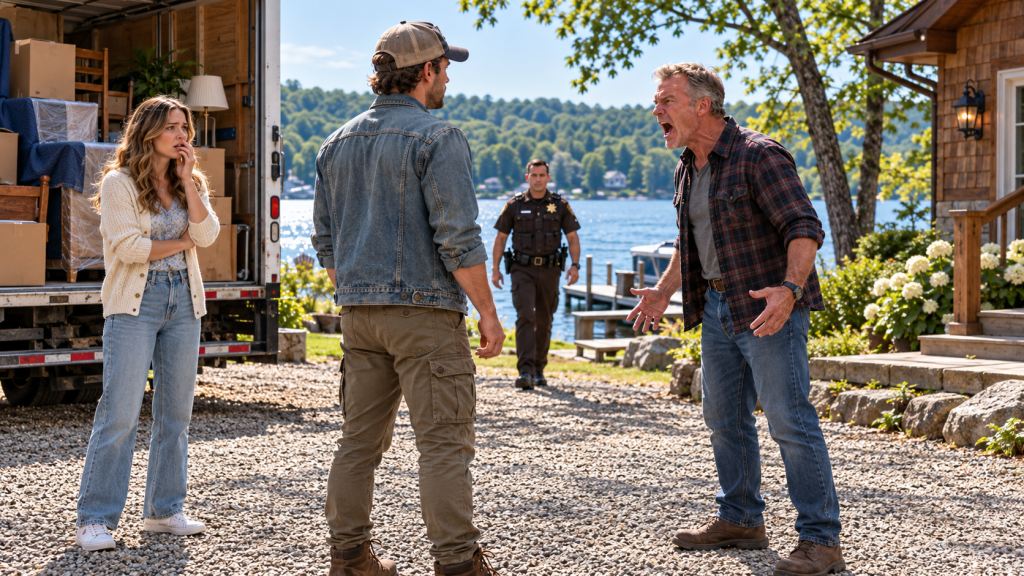
Brenda stood beside the U-Haul, clutching her handbag.
She looked from the truck to her husband.
“Greg?”
He ignored her.
I stepped closer.
“Who is that?”
Greg took another drink from his beer.
“Probably somebody fishing.”
I stared at him.
“Fishing?”
He shrugged.
“It’s a lake, Walter.”
Deputy Miller took down the truck’s plate number and contacted dispatch.
Then he turned toward me.
“Mr. Miller, I want you to stay here while we check on this.”
I nodded.
My hands were shaking.
Not because I was afraid of Greg.
Not because of the forged documents.
Because every minute that passed without hearing Hannah’s voice seemed longer than the three years I’d lived without Susan.
I remembered my daughter at six years old.
She’d been standing on the cabin dock in a yellow raincoat, holding a fishing rod almost as tall as she was.
Susan was beside her.
“Daddy!” Hannah shouted. “I caught something!”
I ran down from the porch.
She pulled her line out of the water.
A dripping clump of lakeweed dangled from the hook.
Susan burst out laughing.
Hannah frowned.
“It’s not a fish.”
I crouched beside her.
“No, sweetheart.”
She looked disappointed.
Then Susan put an arm around her shoulders.
“But you caught something.”
“What?”
“A memory.”
Hannah giggled.
And Susan whispered something I never forgot.
“Someday, when we’re old, these will be the things we wish we could have again.”
Now my daughter was a grown woman.
Married.
Living twenty miles away.
And sending me messages that sounded like goodbye.
I pressed my palms together.
“Please, Hannah.”
A few minutes later, Deputy Miller returned from speaking with the driver of the gray truck.
He looked serious.
“Mr. Miller, the driver identifies himself as a private investigator.”
My stomach tightened.
“A private investigator?”
“He says he was hired to observe activity at this address and document interactions involving you.”
I stared at him.
“Who hired him?”
The deputy paused.
“He provided a client’s business contact. We’re documenting it and checking the circumstances.”
Greg shifted his feet.
I turned toward him.
“Shawn.”
Greg looked away.
I felt cold.
My son-in-law hadn’t merely wanted to take the cabin.
He’d wanted someone to record how I reacted when I discovered strangers moving into it.
An angry elderly man.
Shouting.
Threatening.
Confused about ownership.
All preserved on camera.
All ready to be shown to someone who might know nothing about the forged deed.
I thought about the purported power of attorney Hannah had photographed.
The signature I hadn’t written.
The claim that I’d surrendered control of the trust.
And suddenly, something fell into place.
“They wanted me to lose my temper,” I whispered.
Deputy Miller looked at me.
“What do you mean?”
I pointed toward the U-Haul.
“They broke into the place my wife loved.”
My voice shook.
“They changed the door code.”
“They brought a truck full of furniture.”
“And somebody was parked over there waiting to record what happened when I found them.”
Greg interrupted.
“Now you’re making things up.”
I turned toward him.
He smiled thinly.
“See? That’s exactly what Shawn warned us about. You’ve been forgetting things lately.”
For a second, I couldn’t speak.
Then a strange calm settled over me.
Greg had just told me more than he realized.
Shawn had been preparing a story about my mental condition.
And his parents had come to the cabin expecting to play a part in it.
Deputy Miller held up one hand.
“Mr. Lawson, please stop.”
Greg opened his mouth.
The deputy continued firmly.
“Ownership and authority are disputed here. The documents need proper examination, and nobody is helping by making personal accusations.”
I looked toward the porch.
Susan’s green raincoat was still hanging inside.
I could see it through the open door.
A faded sleeve.
One crooked button.
The raincoat she’d worn every spring when she planted flowers along the shore.
Greg had walked through that doorway believing it was merely an address.
A building.
A future retirement home.
He didn’t understand what it had meant to us.
And I suddenly knew I wasn’t going to let him reduce it to a shouting match.
“Deputy,” I said quietly, “I’ll cooperate with whatever you need.”
Miller nodded.
“We’ll document the situation. The deed and claimed authority need to be reviewed through the proper process.”
He glanced toward the open doorway.
“And until the right to occupy the property is resolved, nobody should be moving more belongings in or removing anything.”
Brenda looked at him.
“But where are we supposed to go?”
I turned toward her.
She looked genuinely frightened.
Greg looked furious.
For the first time, I wondered whether Brenda had been told the same lies Shawn had told Hannah.
I took a breath.
“Brenda, did you know Susan’s name was on that deed?”
She hesitated.
Then shook her head.
“No.”
“Did you know it was supposedly signed six months ago?”
Her eyes widened.
“What?”
I swallowed.
“Susan died three years ago.”
Brenda slowly turned toward her husband.
“Greg?”
He wouldn’t look at her.
She whispered:
“Tell me that’s not true.”
Greg said nothing.
The silence answered her.
And for the first time that morning, Brenda Lawson looked as though she understood she hadn’t moved into a retirement cabin.
She’d walked into a fraud investigation.
My telephone rang again.
Evelyn Vance.
I answered immediately.
“Evelyn.”
“Walter, I’ve spoken with the title company and the lender’s fraud department. They’re preserving the application and reviewing the disputed deed. I’ve also contacted the relevant recorder’s office about the suspected forgery.”
I closed my eyes.
“Can the loan be stopped?”
“The lender has flagged the transaction and told us no funds will be released while the authenticity and authority issues are examined.”
My knees weakened.
Six hundred thousand dollars.
My wife’s cabin.
One forged signature away from disaster—at least, that was what Shawn had apparently been counting on.
But Evelyn wasn’t finished.
“Walter, there’s something else.”
My stomach tightened.
“What?”
“Hannah brought me more than a photograph of Susan.”
I stopped breathing.
“What did she bring?”
“A copy of a document Shawn had been trying to get her to sign.”
I swallowed.
“What document?”
Evelyn paused.
Then said:
“A declaration stating that you can no longer manage your own financial affairs.”
I felt as though someone had struck me.
“What?”
“She refused to sign it.”
I covered my mouth.
For a moment, I couldn’t speak.
Then Evelyn continued.
“Walter, your daughter told me Shawn had been pressuring her for weeks. He said the cabin was only the beginning.”
The beginning.
Those words frightened me more than the forged deed.
“What else does he want?”
Evelyn took a breath.
“He’s been asking questions about the trust’s other assets.”
My heart began pounding.
Susan and I had worked our entire lives.
I’d owned a small heating and plumbing business.
Susan taught elementary school for thirty-one years.
We weren’t billionaires.
But we’d saved.
Invested carefully.
Paid off our home.
And eventually placed our property and certain investments into a trust as part of our estate planning.
It wasn’t a fortune by the standards of the people on television.
But it was everything we’d built together.
I whispered:
“Evelyn, please tell me Hannah is safe.”
Her voice softened.
“I’m trying to reach her too.”
Then she added:
“Walter, there’s something you should know about Shawn.”
I closed my eyes.
“What now?”
“He met with a developer last month.”
I frowned.
“A developer?”
“Yes.”
I stared toward Cooper Lake.
The water stretched beyond the pine trees, gray beneath the clouds.
“What developer?”
Evelyn answered:
“Blue Heron Properties.”
The name was familiar.
I’d seen their signs along the highway.
Luxury vacation homes.
Private waterfront communities.
Golf resorts.
My stomach tightened.
“Why would Shawn be meeting with them?”
Evelyn was silent for a moment.
Then she said:
“Because the developer believes your cabin property may be the key to a larger lakeshore project.”
I looked toward the shore.
The old dock.
The oak tree Susan loved.
The little stretch of land we’d walked together every summer.
For years, I’d thought the cabin was valuable only because of its memories.
Now someone seemed to believe it was valuable for a very different reason.
“Evelyn,” I whispered, “what aren’t you telling me?”
She took a breath.
“Walter, Susan knew that land had unusual value.”
I went still.
“She asked me to keep certain estate records separate from the cabin itself.”
My heart tightened.
“Why?”
Evelyn answered softly.
“Because she didn’t want Hannah—or anyone who married Hannah—to be pressured into selling it.”
I stared at the lake.
Then whispered:
“Susan knew?”
“Yes.”
My throat tightened.
My wife had been gone three years.
Yet somehow, the careful choices she’d made while alive were still trying to protect us.
Then Deputy Miller approached.
“Mr. Miller.”
I looked up.
“We’ve received information about a possible location for your daughter.”
Everything inside me stopped.
“Where?”
He checked his notes.
“A roadside service station near the north highway. Officers are being sent to check on her welfare.”
I covered my mouth.
Then my phone vibrated.
A message from an unknown number.
Walter, if you want to see Hannah again, stop involving the police.
I stared at the screen.
My heart hammered.
Below the message was a photograph.
Hannah.
Standing beside her car.
Looking over her shoulder.
Taken only minutes earlier.
And suddenly, I understood something terrible.
Shawn wasn’t just trying to steal the cabin.
He was trying to frighten my daughter into helping him steal it.
I showed Deputy Miller the photograph.
He studied the screen.
Then his expression hardened.
“Don’t respond to that message yet, Mr. Miller.”
I swallowed.
“That’s my daughter.”
“I understand.”
“No, Deputy.”
My voice cracked.
“That’s my little girl.”
He looked at me for a moment.
Then nodded.
“We’re going to do everything we lawfully can to locate her and make sure she’s safe.”
He radioed the officers checking the service station.
I stood beside the sheriff’s SUV, listening to fragments of conversation I couldn’t quite understand.
The wind had grown colder.
The U-Haul remained parked against Susan’s porch.
And Greg Lawson stood beside it with his arms crossed, pretending not to listen.
I turned toward him.
“Greg.”
He looked up.
“What?”
“Did Shawn tell you where Hannah is?”
He hesitated.
Then shook his head.
“No.”
I stared at him.
“Don’t lie to me.”
Greg’s expression hardened.
“I don’t know where your daughter is, Walter.”
Brenda stepped forward.
“Greg, why would he be asking that?”
Her husband ignored her.
She looked toward me.
“What happened to Hannah?”
I held up my telephone.
Her eyes widened when she saw the photograph.
“Oh, my God.”
For a moment, she looked genuinely horrified.
Then she turned toward Greg.
“Did Shawn send that?”
“How should I know?”
“Greg!”
His face reddened.
“Brenda, stop making a scene.”
She stared at him.
Then whispered:
“You told me Hannah agreed to all of this.”
Greg said nothing.
“You told me Walter wanted us to have the cabin.”
His jaw tightened.
“You told me Susan promised it to the family.”
I looked toward Brenda.
My throat burned.
“Susan never promised this cabin to anybody.”
Brenda covered her mouth.
I continued quietly.
“She wanted Hannah to have it someday.”
I swallowed.
“But not because Shawn could use it to pay his debts.”
Greg’s head snapped toward me.
“What debts?”
I looked directly into his eyes.
“You tell me.”
For the first time, his face lost all color.
And that was when I knew there was something about Shawn’s financial situation his parents understood far better than they’d admitted.
Twenty minutes later, my telephone rang.
An unfamiliar number.
I answered immediately.
“Hello?”
There was breathing.
Then a small, frightened voice.
“Dad?”
My knees nearly gave way.
“Hannah?”
“Dad, I’m sorry.”
I closed my eyes.
There she was.
Alive.
My daughter’s voice.
The same voice that used to call from her bedroom when she was little.
“Daddy, can you check under the bed?”
The same voice that used to sing badly with Susan while washing dishes.
The same voice I’d heard laughing at her wedding.
“Hannah, sweetheart, where are you?”
She began crying.
“I’m at the service station.”
I looked toward Deputy Miller.
He immediately moved closer.
“Are you alone?” I asked.
“I’m with a woman who works here. She let me sit in the office.”
“Is Shawn there?”
A pause.
Then Hannah whispered:
“He was.”
My heart stopped.
“What happened?”
“He came looking for me.”
I heard her breathing quicken.
“He said I was embarrassing him.”
I closed my eyes.
“Baby, listen to me.”
She began crying harder.
“Dad, I didn’t know about the deed.”
“I know.”
“I swear I didn’t know he used Mom’s signature.”
My throat tightened.
“Hannah, right now I only need you to stay somewhere safe and tell the officers what’s happened.”
She swallowed.
“Dad?”
“Yes, sweetheart?”
“Please don’t let him make you think I’m against you.”
The words shattered me.
I leaned against the sheriff’s SUV.
“Oh, Hannah.”
She sobbed.
“He keeps saying you’ll hate me when you find out everything.”
I closed my eyes.
Then spoke as gently as I could.
“Whatever you’ve done, whatever you’ve signed, whatever mistakes you’ve made, we are going to face the truth together.”
She cried harder.
“But you are my daughter.”
My voice broke.
“And there is nothing about a cabin that could ever make me stop loving you.”
For a moment, there was only the sound of her crying.
Then she whispered:
“I miss Mom.”
That was what finally undid me.
I covered my mouth.
Three years of trying to be strong.
Three years of pretending the house didn’t feel empty.
Three years of carefully avoiding the coffee mug Susan had left hanging beside the kitchen sink.
And suddenly, all I wanted was to hold my daughter.
“I miss her too, baby.”
Hannah took a shaky breath.
Then said:
“Dad, Mom left something for us.”
I went still.
“What?”
“The picture I showed Evelyn.”
I swallowed.
“What about it?”
Hannah’s voice trembled.
“Shawn thought it was only a photograph.”
She paused.
“But Mom wrote something on the back.”
I closed my eyes.
Susan had always written on photographs.
Dates.
Places.
Small memories she didn’t want forgotten.
“What did she write?”
Hannah answered:
“When the lake stops feeling safe, remember who first taught you how to find your way home.”
My throat tightened.
Then she whispered:
“Dad, I think she was trying to tell me something.”
Before I could answer, another voice came through the telephone.
“Sir, this is Officer Daniels with the county sheriff’s office. We’re with Hannah now.”
I exhaled so sharply that it hurt.
“Is she safe?”
“She is with us. We’re arranging to speak with her privately and address the safety concerns she’s reported.”
I closed my eyes.
For the first time that morning, I felt my heart begin beating normally again.
Then the officer said:
“Mr. Miller, your daughter is asking whether she can come to you.”
I looked toward Susan’s cabin.
The leaking porch roof.
The U-Haul.
The open door.
“Yes,” I whispered.
Then louder:
“Yes. Tell her I’m right here.”
After I ended the call, I stood quietly.
Deputy Miller approached.
“She’s safe?”
I nodded.
Tears ran down my cheeks.
He placed a hand on my shoulder.
“Good.”
For a moment, I couldn’t speak.
Then I whispered:
“Thank you.”
The deputy nodded.
And went back to documenting the scene.
An hour later, Hannah arrived.
She stepped out of a sheriff’s vehicle wearing jeans, a gray sweater, and the frightened expression of someone who hadn’t slept properly in days.
For a moment, we simply stared at each other.
She looked so much like Susan.
The same brown eyes.
The same small crease between her eyebrows when she was worried.
The same way she held her hands together when she didn’t know what to say.
“Dad?”
I walked toward her.
Slowly at first.
Then faster.
She began crying.
And I wrapped my arms around my daughter.
“Daddy, I’m sorry.”
I held her tighter.
“Oh, sweetheart.”
She buried her face in my shoulder.
“I didn’t know what to do.”
I stroked her hair.
“It’s all right. You’re here.”
She was trembling.
Her shoulders shook with sobs.
“I thought he loved me.”
My eyes filled.
I wanted to say a hundred things.
That Shawn didn’t deserve her.
That she’d been foolish to trust him.
That I wished she’d told me sooner.
But none of those things mattered more than the fact that she was standing in my arms.
So I whispered:
“I know, baby.”
And held her until she stopped shaking.
Eventually, Hannah pulled back.
She looked toward the cabin.
Then her face crumpled.
“Mom’s house.”
I nodded.
She stared at the U-Haul.
At the boxes on the porch.
At Greg and Brenda standing near the driveway.
Then she whispered:
“He told me you wanted to sell it.”
I felt something tighten in my chest.
“What?”
Hannah wiped her face.
“Shawn said you’d been talking about moving into assisted living.”
I stared.
“He said you were forgetting things.”
My stomach dropped.
“And he said Mom had always wanted us to use the cabin as our family home.”
I closed my eyes.
Hannah continued.
“He told me you were embarrassed to admit you couldn’t keep up with the maintenance.”
I looked toward the roof.
The leak I’d come to repair.
A simple job.
Something I’d done a hundred times.
Then I looked at my daughter.
“Hannah, why didn’t you ask me?”
Her face crumpled.
“Because he said you’d deny it.”
I went still.
“He said people with memory problems often don’t know they’re having them.”
Tears filled her eyes.
“And every time I tried to bring it up, you changed the subject because you didn’t want to worry me.”
I stared at her.
Because there was a painful piece of truth buried inside the lie.
Since Susan died, I had changed the subject whenever Hannah asked if I was lonely.
I’d insisted I was fine.
Even when I wasn’t.
I’d refused help with the yard.
Refused invitations to spend holidays with her and Shawn.
Refused to talk about what life felt like without her mother.
Shawn had taken my silence and turned it into evidence of something entirely different.
I looked at Hannah.
“Sweetheart, I haven’t handled grief as well as I pretended.”
She began crying.
“But I have not given Shawn authority to make decisions for me.”
I took her hand.
“And I’m not planning to move into assisted living.”
She nodded.
I swallowed.
“I’m still your father.”
Her lips trembled.
“And when something concerns you, I want you to ask me.”
She stepped closer.
“I will.”
Then she whispered:
“I should have known.”
I shook my head.
“Shawn lied to you.”
She looked down.
“That doesn’t mean we ignore the mistakes that followed,” I continued gently.
“But it does mean we start by being honest about what happened.”
Hannah nodded.
Deputy Miller approached.
“Miss Lawson, when you’re ready, investigators will need a fuller account of the documents and threats you’ve described.”
Hannah took a breath.
Then nodded.
“I’ll tell them everything.”
She looked toward Greg.
Her expression changed.
“Even the part about his father.”
I went still.
Greg’s face turned pale.
Brenda looked sharply at her husband.
“Greg?”
Hannah swallowed.
Then said:
“Shawn wasn’t the one who first suggested taking the cabin.”
The driveway went silent.
Hannah looked directly at Greg Lawson.
“His father did.”
And just like that, the man who’d laughed at me for calling the sheriff stopped smiling.
Greg opened his mouth.
But Hannah continued.
“He told Shawn the cabin was wasted on an old man.”
My heart tightened.
“He said if they could convince everyone Dad wasn’t capable of managing the trust, it would only be a matter of time before somebody else controlled the property.”
Brenda stepped away from her husband.
“Greg,” she whispered, “tell me that’s not true.”
He stared at the gravel.
Hannah’s voice shook.
“And he said they should start by moving in.”
I looked at the boxes stacked beside Susan’s porch.
The furniture.
The coolers.
The neatly labeled dishes.
All of it arranged like a family holiday.
But it wasn’t a holiday.
It had been a performance.
One designed to make me angry enough to appear unstable.
I stared at Greg.
Then asked quietly:
“Is that why you opened the beer?”
He looked up sharply.
“Because you wanted to laugh at me until I lost my temper?”
For a moment, he said nothing.
Then his jaw tightened.
“You’re twisting things.”
I shook my head.
“No, Greg.”
My voice was strangely calm.
“I’m finally seeing them clearly.”
But the worst part of Hannah’s story was still waiting.
Because she had brought something from Shawn’s office.
A small folder.
Inside were copies of correspondence between Shawn and Blue Heron Properties.
And the first page contained a number I couldn’t believe.
$3,800,000.
I stared.
Hannah whispered:
“Dad, that’s what they thought they could make from the cabin.”
My hands began shaking.
The property Susan and I bought for forty-seven thousand dollars, nearly thirty years earlier.
The cabin where Hannah learned to swim.
The little dock where Susan used to drink her morning coffee.
Someone had looked at it and seen almost four million dollars.
Not because they loved it.
Because they believed they could take it.
I read the figure three times.
Three million.
Eight hundred thousand.
Dollars.
For a moment, the sound of the wind in the trees disappeared.
I looked at Hannah.
“Where did you get this?”
She swallowed.
“Shawn left a folder in his office.”
I looked down at the papers.
She continued.
“I’d been looking for our property-tax records because he kept telling me there was something wrong with Dad’s trust.”
Her voice trembled.
“Then I saw Mom’s name on a document.”
I looked at her.
“And you knew something was wrong.”
She nodded.
“She was supposed to have signed it this year.”
I felt my chest tighten.
Hannah began crying again.
“Dad, he knew Mom was dead.”
I nodded slowly.
“Yes.”
She looked toward the cabin.
“And he used her name anyway.”
For a moment, I couldn’t speak.
It was the part I kept returning to.
Not the money.
Not the attempted loan.
Not even the man who’d been sitting across from me at Thanksgiving dinner for seven years while apparently planning to exploit our family.
Susan’s name.
Her signature had been copied onto a piece of paper to make it look as though she’d willingly surrendered the place she loved.
That hurt in a way no dollar amount could explain.
I looked down at the document again.
The $3.8 million wasn’t a completed sale.
It was a proposed purchase price under an arrangement involving Blue Heron Properties.
Several conditions had to be met.
Valid title.
Approved access.
Environmental review.
And the right to use a narrow strip of lakeshore land.
Evelyn had been right.
Our cabin wasn’t merely a cabin to the developer.
It occupied a crucial piece of shoreline connecting two larger properties the company hoped to develop.
Without proper access rights, the proposed marina and vacation-home community would be much harder to build.
I stared at the map.
A red line crossed our driveway.
Another followed the old path beside Susan’s flower garden.
The proposed road would run within yards of our porch.
I whispered:
“They would have torn up her garden.”
Hannah looked at the plans.
Her face crumpled.
“Dad…”
I held up one hand.
“It’s all right.”
But it wasn’t.
Not yet.
I remembered Susan kneeling beside that garden the summer before she became ill.
She wore an old straw hat.
Dirt stained her knees.
And she’d spent an entire afternoon arguing with a stubborn rosebush.
“Walter,” she called, “come hold this.”
I walked over.
“Hold what?”
“This branch.”
“It has thorns.”
She gave me a look.
“Then be careful.”
I’d laughed.
“After thirty-six years of marriage, that’s your advice?”
She smiled.
“After thirty-six years, I assumed you’d learned.”
Now I stood beside the same garden, looking at a proposed roadway drawn directly across the place where she’d once laughed.
My eyes burned.
Then Hannah touched my arm.
“Dad?”
I turned.
“I won’t let Shawn take it.”
I looked at my daughter.
Her face was pale.
Her eyes swollen from crying.
And I realized she wasn’t simply afraid of losing a property.
She was afraid she’d helped destroy the last place where she still felt close to her mother.
I took her hand.
“Sweetheart, listen to me.”
She looked up.
“We’re going to protect what we legally own.”
I swallowed.
“But I don’t want you believing you have to spend the rest of your life guarding this cabin as punishment for trusting the wrong man.”
Hannah began crying.
I continued.
“Your mother loved you more than she loved this place.”
I looked toward the water.
“She would’ve wanted you safe before she wanted one more rosebush to survive.”
Hannah stepped forward.
And held me.
For a long time, we stood there together.
Behind us, Deputy Miller continued working with the people at the driveway.
The private investigator remained nearby while his account and recordings were documented.
Greg was speaking to someone on his telephone.
Brenda stood beside the U-Haul, looking as though her life had just fallen apart.
And somewhere beyond the trees, Shawn was still missing.
That was what frightened me.
Because I knew him well enough to understand he wouldn’t give up simply because the first plan had failed.
I had met Shawn Lawson eight years earlier.
Hannah was twenty-six.
He was thirty.
Tall.
Handsome.
Charming in the way some men become charming when they realize people mistake confidence for character.
He worked in commercial real estate.
Drove an expensive truck.
And never seemed to worry about money.
At first, Susan liked him.
He brought flowers.
Helped carry groceries.
Complimented her cooking.
And told me he wanted to learn how to repair things around the house.
I remembered one Saturday afternoon when he came to the cabin.
Susan was painting the porch railing.
Shawn stood beside her, looking out over the lake.
“This place is worth something,” he said.
Susan laughed.
“Everything is worth something.”
He pointed toward the water.
“No, I mean serious money.”
Susan stopped painting.
She looked at him.
“Shawn, a place doesn’t have to be expensive to be valuable.”
He smiled.
“Of course.”
But I remembered his eyes.
The way he kept studying the shore.
The driveway.
The neighboring lots.
Back then, I thought he was simply interested in real estate.
Now I wondered how long he’d been imagining what he could do with land that didn’t belong to him.
A vehicle turned into the driveway.
I looked up.
A dark blue SUV.
Shawn.
Hannah went rigid.
Her hand tightened around mine.
“Dad,” she whispered.
I looked toward Deputy Miller.
He was already watching the approaching vehicle.
Shawn parked near the gate.
Stepped out.
And straightened his jacket.
He looked immaculate.
Of course he did.
Pressed trousers.
Polished shoes.
An expensive watch.
He walked toward us wearing the expression of a man who believed he could still explain everything away.
“Walter.”
I said nothing.
He turned toward Hannah.
“Baby.”
She stepped behind me.
Something changed in Shawn’s face.
Only for a moment.
Then he smiled.
“Hannah, you’ve had everybody worried.”
My daughter stared at him.
He continued.
“You left the house without telling me where you were going.”
Hannah swallowed.
“Because you told me I couldn’t speak to my father.”
Shawn sighed.
“That’s not what I said.”
I watched him carefully.
He continued.
“I told you Walter needed rest.”
Hannah’s eyes filled.
“And that you were making his situation worse by upsetting him.”
I took a slow breath.
“Shawn,” I said.
He turned.
“Walter, I think we should have a private family conversation.”
I shook my head.
“No.”
His smile tightened.
“There are too many people here who don’t understand the situation.”
I looked at him.
“The deputy understands there is a disputed deed.”
Shawn’s expression hardened.
“My attorney understands someone has claimed I signed documents I did not sign.”
I continued.
“And Hannah understands she can choose whether she wants to speak with you.”
Shawn glanced toward his wife.
“Hannah, are you really going to let your father turn you against me?”
She began trembling.
I wanted to answer for her.
Wanted to tell him to leave.
Wanted to make every decision because I couldn’t bear to see my daughter frightened.
But then I remembered Susan.
How she’d always insisted Hannah be allowed to speak for herself.
So I stayed quiet.
Hannah took a breath.
Then looked at Shawn.
“I saw the deed.”
His expression flickered.
She continued.
“Mom’s signature.”
Shawn looked away.
“My mother died three years ago.”
Her voice broke.
“Why does that paper say she signed it six months ago?”
For several seconds, Shawn said nothing.
Then he looked toward Greg.
His father stared at the ground.
Finally, Shawn answered:
“There’s been a misunderstanding with the documentation.”
Hannah’s face crumpled.
“A misunderstanding?”
He held up his hands.
“Baby, real estate deals are complicated.”
She stared.
“My dead mother’s signature is on a deed.”
Shawn’s jaw tightened.
“And you’re calling that complicated?”
For the first time, he stopped smiling.
“Hannah, lower your voice.”
The command came so quickly, so naturally, that I wondered how often he’d said it when I wasn’t there.
Hannah stepped backward.
Deputy Miller approached.
“Mr. Lawson, we’ll need to speak with you about the documents and reported conduct. You’re not to interfere with anyone giving an account.”
Shawn looked at him.
“Deputy, this is a private family dispute.”
Miller’s expression remained steady.
“Allegations of forged documents and threats are not resolved by calling them a family dispute.”
Shawn glanced toward the U-Haul.
Then toward me.
“You’re making a mistake, Walter.”
I felt a familiar flash of anger.
But I kept my voice calm.
“Then the investigation will establish that.”
He stared at me.
I continued.
“I’m not going to threaten you.”
Hannah looked up.
“I’m not going to fight you in the driveway.”
I swallowed.
“And I’m not going to give you a story about a confused old man losing his temper.”
Shawn’s face turned pale.
I looked directly into his eyes.
“If you’ve done nothing wrong, you can explain the documents through the proper process.”
For several seconds, neither of us moved.
Then Hannah spoke.
“Shawn.”
He turned toward her immediately.
“Baby, thank God. Please tell your father—”
“I’m not coming home with you.”
The words landed like thunder.
Shawn froze.
“What?”
Hannah took another breath.
“I’m staying with Dad while I get independent legal advice and decide what to do.”
Shawn’s expression darkened.
“You don’t understand what you’re doing.”
Her voice trembled.
“I understand that you lied to me.”
His jaw tightened.
“I understand that you used Mom’s name.”
Tears slid down her cheeks.
“And I understand that every time I asked you a question, you made me feel stupid for asking.”
For the first time, Shawn had nothing to say.
Hannah looked at him.
“I trusted you.”
Her voice broke.
“I would’ve helped you if you were in trouble.”
Shawn swallowed.
“But you didn’t ask for help.”
She wiped her face.
“You tried to steal from my father.”
Then she turned away.
I put an arm around her shoulders.
And together, we walked toward Susan’s porch.
Behind us, Shawn called her name.
She didn’t turn around.
And I knew that whatever happened with the property, the marriage my daughter had believed in was already breaking apart.
But one question remained.
Why had Shawn become so desperate?
The answer arrived two days later.
Evelyn came to my house carrying a thick folder.
Hannah was sitting at the kitchen table.
I’d made coffee.
Neither of us had slept much.
Evelyn sat across from us.
“Walter, Hannah, we need to discuss Shawn’s finances.”
Hannah looked down.
I took a breath.
“Tell us.”
Evelyn opened the folder.
“Shawn has personal guarantees connected to several failed real estate investments.”
I frowned.
“How much?”
She paused.
“The documented obligations we’re aware of total several hundred thousand dollars, and there may be more.”
Hannah closed her eyes.
“He told me the business was doing fine.”
Evelyn’s expression softened.
“There are also indications that he and Greg expected a substantial payment from a sale involving the cabin.”
I leaned back.
“What about Brenda?”
Evelyn turned another page.
“Her role isn’t clear yet. We should distinguish what she knew from what Greg and Shawn may have done.”
I nodded.
Then Hannah whispered:
“Dad, I signed something.”
I turned toward her.
She looked terrified.
“What did you sign, sweetheart?”
Her lips trembled.
“Shawn gave me papers last month. He said they were preliminary forms for helping you maintain the cabin.”
I swallowed.
“He said you wanted us involved.”
Tears filled her eyes.
“I didn’t understand everything.”
Evelyn leaned forward.
“Do you have copies?”
Hannah nodded.
“I emailed them to myself.”
Evelyn’s expression sharpened.
“Good. We’ll examine exactly what they are.”
Hannah began crying.
“I should’ve read them.”
I reached for her hand.
“Yes,” I said gently. “In the future, you should never sign financial documents you don’t understand.”
She nodded miserably.
“But that doesn’t make you responsible for signatures somebody else forged.”
Her eyes filled.
“And it doesn’t mean Shawn was entitled to lie to you.”
She covered her face.
For a long time, I sat beside her.
Then Evelyn cleared her throat.
“There’s one more thing.”
My stomach tightened.
She reached into her folder.
And removed a sealed yellow envelope.
Across the front was Susan’s handwriting.
For Walter and Hannah, when the lake becomes a burden.
I stopped breathing.
For a moment, nobody moved.
Then Evelyn whispered:
“Susan asked me to keep this with the estate documents.”
My hands began shaking.
“She said you’d know when it was time to read it.”
I stared at my wife’s handwriting.
Three years after her death.
After the forged deed.
After the threats.
After the betrayal.
Susan was about to speak to us one more time.
I knew that handwriting.
Even after three years, I would have recognized it anywhere.
Susan’s letters leaned slightly to the right.
Her capital W looked almost like two little waves.
And whenever she wrote our daughter’s name, she made the final h with a ridiculous flourish.
I used to tease her about it.
She’d laugh and say, “Walter, some of us believe ordinary things deserve a little beauty.”
Now that same handwriting was staring back at me from a yellow envelope.
My hands shook as I reached for it.
Hannah sat beside me.
“Dad?”
I looked toward her.
Her eyes were already filled with tears.
“Will you read it?”
I nodded.
Then carefully opened the envelope.
Inside were two pages.
A photograph.
And a small packet of forget-me-not seeds.
The sight of those seeds nearly brought me to my knees.
Susan planted them every spring.
Tiny blue flowers along the cabin’s north wall.
She said they were the most appropriately named flowers in the world.
I unfolded the letter.
And began reading.
My dear Walter,
If Evelyn has given you this envelope, I imagine the cabin has become more trouble than you ever expected.
Knowing you, you’ve probably been climbing ladders you shouldn’t climb and telling everybody you’re perfectly capable of fixing a roof during a thunderstorm.
Hannah let out a broken laugh.
I closed my eyes.
Susan knew me.
Of course she did.
I continued.
First, put down the ladder.
Second, remember that I love you.
Third, please don’t turn our little cabin into a monument you’re afraid to change.
My throat tightened.
That cabin was never beautiful because of its walls.
It was beautiful because we were happy there.
Because Hannah learned to swim there.
Because you made terrible pancakes and pretended the burnt edges were intentional.
Because we watched storms cross the water while holding hands.
Tears blurred the page.
I know developers have asked about the land.
I know the location may become valuable.
And I know you will be tempted to refuse every offer because you think selling the cabin would mean letting go of me.
I couldn’t breathe.
Walter, listen carefully.
You have already loved me enough for a lifetime.
You don’t need to prove it by keeping every nail exactly where I left it.
Hannah reached for my hand.
Keep the cabin if it brings you joy.
Repair it if it needs repairing.
Sell it someday if that is truly what you and Hannah decide, after understanding your choices and protecting your interests.
But never allow guilt, fear, or someone else’s greed to make the decision for you.
My voice broke.
And Hannah, sweetheart, if you’re reading this, I want you to know something.
That cabin may become yours one day.
But you were never born to protect an inheritance.
You were born to live.
Hannah covered her mouth.
I hope you find love.
I hope you laugh often.
I hope you build a home where you can be yourself.
And if someone ever makes you feel that love must be earned by surrendering your voice, remember this: you are allowed to say no.
My daughter began sobbing.
I stopped reading.
Put one arm around her.
And held her until she could breathe again.
Then she whispered:
“Keep going, Dad.”
I wiped my eyes.
And continued.
Walter, I put the trust records, survey, and correspondence concerning earlier purchase offers with Evelyn because important papers deserve proper safekeeping.
If you ever need advice about the property, please ask someone independent of whoever wants to buy it.
I nodded through tears.
Even while dying, Susan had been thinking about how to protect the family.
Not with mysterious wealth.
Not with hidden treasure.
With careful records.
A trustworthy attorney.
And a lifetime of practical common sense.
I reached the final paragraph.
Most of all, my loves, don’t let a house become more important than the people who once filled it.
The coffee mug doesn’t need to stay on the hook forever.
The raincoat can go to someone who will wear it.
And the garden can grow new flowers.
Nothing you change will erase me.
I began crying so hard I could barely see.
I will always be in the ordinary things.
In Hannah’s laugh.
In your terrible singing.
In the smell of coffee on a cold morning.
And in every time you choose kindness when anger would be easier.
I swallowed.
Love each other.
Tell the truth.
And when life gets difficult, come home to one another.
All my love,
Susan.
I lowered the letter.
For a long time, neither Hannah nor I spoke.
The clock ticked above the kitchen door.
Rain moved gently against the window.
Then Hannah whispered:
“Mom knew.”
I shook my head softly.
“She knew people might want the land.”
I looked toward her.
“But she couldn’t have known what Shawn would do.”
Hannah nodded.
I continued.
“She was trying to leave us something more useful than instructions for every possible disaster.”
“What?”
I looked down at the letter.
Then whispered:
“Permission to live.”
Hannah began crying again.
I held her.
For three years, I’d kept Susan’s coffee mug exactly where she’d left it.
I’d refused to replace the curtains.
Hadn’t moved her books.
Hadn’t painted the porch.
I told myself I was protecting her memory.
But somewhere along the way, the cabin had become a room filled with things I was afraid to touch.
Now Susan was telling me what she’d always tried to teach me while she was alive.
Love isn’t something you can lock inside a house.
And grief isn’t a debt you spend the rest of your life repaying.
I took the packet of seeds.
Turned it over.
Susan had written two more words.
Plant something.
I laughed through tears.
“Well, Sue.”
My voice broke.
“I suppose we will.”
Over the following weeks, the investigation moved forward.
Not as quickly as I wanted.
And not always in a straight line.
There were interviews.
Requests for records.
Document examinations.
And the slow work of reconstructing how a false deed had reached the public records.
Evelyn explained something important.
Recording a document didn’t necessarily make it valid.
A forged signature didn’t become genuine because a clerk accepted a filing.
But untangling the fraud and clearing any resulting cloud on the title would still require formal legal steps.
So we took them.
She worked with the relevant authorities, the title insurer, and the court to challenge the fraudulent deed and protect the trust’s property interests.
The lender continued withholding funds while investigating the attempted loan.
An independent examination of the documents identified serious problems.
Susan’s purported signature had been copied from an older estate-planning document.
The supposed notarization could not be supported by the notary’s records.
And the authority Shawn claimed did not match the trust’s requirements.
The notary whose information appeared on the papers cooperated with investigators.
She denied witnessing the signatures or performing the transaction.
Her credentials appeared to have been misused.
I remember sitting beside Evelyn when she explained the findings.
For a moment, I stared at the papers.
“Someone took Susan’s signature from a document she signed while she was alive.”
Evelyn nodded.
“That appears to be what happened.”
I looked down.
“And placed it on a deed dated years after her death.”
“Yes.”
My throat tightened.
“Evelyn, how could he do that?”
She was silent.
Then said gently:
“Walter, I can’t explain what made him willing to do it.”
I nodded.
“But we can work to prove what happened.”
I looked toward Susan’s photograph on her desk.
Then whispered:
“That’s enough.”
Another breakthrough came from the private investigator who had been parked across from the cabin.
His name was Grant Barlow.
He’d been hired to document my behavior during what he was told would be a disagreement about family property management.
When investigators interviewed him, they discovered Shawn had provided specific instructions.
Record Walter arriving.
Record his reaction to the new occupants.
Pay particular attention to shouting, confusion, threats, and statements about ownership.
Grant had believed he was documenting concerns about an older man’s ability to manage a dispute.
But after seeing the forged deed and learning about Susan’s death, he recognized that the circumstances he’d been hired to observe were not what he’d been told.
He preserved his communications.
Provided relevant recordings.
And cooperated with the investigation.
One message from Shawn became particularly important.
It read:
Dad and Mom will be there before Walter arrives. He won’t stay calm when he sees them. We need the reaction documented.
I stared at that sentence.
Then asked Evelyn:
“Do you think he was trying to prove I was incompetent?”
She considered.
“The communications support concern that he was trying to manufacture evidence of instability. A court will determine how much weight to give that evidence alongside everything else.”
I nodded.
But privately, I thought about how close I’d come to losing my temper.
If I’d shouted at Greg.
Threatened Shawn.
Or tried to physically remove the furniture while everyone watched—
That recording might have looked very different.
I thought about Susan.
Her voice.
The way she’d squeeze my arm when I was angry and whisper:
“Walter, don’t give somebody the satisfaction of watching you become foolish.”
I smiled sadly.
Even now, she’d been right.
One afternoon, Brenda Lawson came to see me.
She arrived alone.
No Greg.
No Shawn.
Just Brenda, standing on my front porch with her handbag clutched against her chest.
I opened the door.
For a moment, neither of us spoke.
Then she whispered:
“Walter, may I come in?”
I hesitated.
I didn’t owe her that.
But she looked frightened.
And I remembered how pale she’d become when she discovered Susan’s forged signature.
I stepped aside.
“Come in.”
We sat at the kitchen table.
I offered coffee.
She accepted.
For a while, she stared at her cup.
Then whispered:
“I owe you an apology.”
I said nothing.
She continued.
“I believed Greg when he said Hannah and Shawn had arranged everything.”
Her eyes filled.
“He told me you were ready to let the cabin go.”
I looked at her.
“And he told me Susan always wanted family living there.”
I nodded slowly.
“She did want family there.”
Brenda looked up hopefully.
Then I continued.
“But she never said that meant people could move in without my permission.”
Brenda lowered her eyes.
“I know.”
She took a breath.
“I didn’t know about the forged deed until that morning.”
I studied her.
“And I didn’t know they were trying to borrow money against the property.”
Her voice broke.
“Greg told me we’d finally be able to retire without worrying.”
I looked down.
Brenda continued.
“We sold our house last month.”
I stared.
“What?”
She nodded.
“Greg said we’d have the cabin.”
Her eyes filled.
“He told me we’d use the money from the sale to pay off our debts.”
I felt a quiet ache.
“Where are you living now?”
“With my sister.”
She began crying.
“Greg keeps saying it’s all a misunderstanding.”
I looked toward the window.
“But I found bank statements.”
My stomach tightened.
“What statements?”
Brenda swallowed.
“Payments to Shawn.”
She removed several copies from her handbag.
“Greg transferred money from our retirement savings to help Shawn cover what he called temporary business problems.”
I stared.
Brenda continued.
“Then there were more withdrawals.”
Her hands trembled.
“And now Greg says we can’t get the money back unless Shawn completes the property transaction.”
The truth was becoming painfully clear.
Shawn had been desperate.
Greg had been desperate.
And somewhere along the way, the cabin had become their imagined escape from consequences.
I looked at Brenda.
“Have you shown these records to the investigators?”
She shook her head.
“I came here first.”
I took a breath.
“Brenda, I appreciate you telling me.”
Her eyes filled.
“But you need independent legal advice. And if the investigators request relevant records, you should provide a truthful account.”
She nodded.
For a moment, she stared at her coffee.
Then whispered:
“Walter, I don’t expect you to forgive me.”
I looked toward Susan’s photograph on the refrigerator.
“You didn’t forge the deed, as far as I know.”
Brenda began crying.
“But you walked into my wife’s cabin without asking me.”
She nodded.
“And you stayed while Greg laughed at me.”
Her shoulders shook.
“That hurt.”
“I know.”
I took a breath.
“Whatever happens next, Brenda, I want the truth.”
She wiped her eyes.
“Me too.”
Before she left, she paused at the door.
“Walter?”
I looked up.
“Greg told me something last night.”
My stomach tightened.
“What?”
Her voice dropped.
“He said Shawn had one final way to make you cooperate.”
I stared.
“What way?”
Brenda looked frightened.
“He said Shawn had already spoken to a doctor who would testify that you couldn’t manage your affairs.”
For a moment, I couldn’t speak.
Then I reached for my telephone.
Because the attempted deed transfer had failed.
The loan had been flagged.
Hannah had refused to help.
And Shawn was apparently moving to the next part of his plan.
He wasn’t trying to prove the cabin belonged to him anymore.
He was trying to prove that I couldn’t be trusted to own it.
The letter arrived four days later.
It was delivered by a process server just after breakfast.
I was standing at the kitchen counter, trying to make pancakes.
Susan had always said mine tasted like roofing shingles.
Hannah used to defend me when she was little.
Now, at thirty-four, she took one bite and said:
“Dad, these are terrible.”
I grinned.
“Your mother taught you bad manners.”
Hannah laughed.
For a moment, the kitchen felt like it had years ago.
Then the doorbell rang.
I opened the envelope after the process server left.
By the time I finished reading the first page, my appetite was gone.
Shawn was supporting a petition seeking a determination that I lacked sufficient capacity to manage my property and financial affairs.
The petition relied on statements from Greg, allegations about my forgetfulness, and references to supposed medical concerns.
I read the pages twice.
Then placed them on the table.
Hannah looked at me.
“Dad?”
I swallowed.
“He did it.”
Her eyes filled.
“He actually did it.”
I handed her the papers.
She read them.
Her face turned white.
Then she whispered:
“He says you’ve been confused since Mom died.”
I nodded.
“He says you forget what day it is.”
I looked toward the calendar.
Tuesday.
October.
The date circled because the plumber was coming to check the water heater.
Hannah continued reading.
“He says you tried to give him the cabin and then forgot.”
I laughed.
Not because it was funny.
Because the lie was so outrageous I couldn’t find another response.
My daughter began crying.
“He’s using Mom’s death against you.”
I sat down.
Suddenly, I felt very tired.
Then Hannah took my hand.
“Dad, I won’t let him do this.”
I looked toward her.
Her face was determined.
The same expression Susan used to wear when the school board tried to cut funding for the library.
I squeezed her fingers.
“Sweetheart, we’re going to answer it properly.”
She nodded.
“Not with shouting.”
She smiled through tears.
“Not with threats.”
I picked up the telephone.
“With Evelyn.”
My attorney didn’t sound surprised.
“Walter, we anticipated something like this.”
I swallowed.
“What do we do?”
“First, preserve everything. Second, respond through the court. Third, don’t let the allegations make you feel ashamed of getting older.”
I closed my eyes.
“Evelyn, I’m seventy-two.”
“I know.”
“I do forget things sometimes.”
“Walter, so do I.”
I gave a tired laugh.
She continued.
“An occasional forgotten appointment doesn’t establish an inability to manage your affairs. The legal question requires actual evidence and proper procedures.”
I nodded.
“And if you want an independent medical evaluation, we can discuss how it may help address the specific allegations.”
I considered.
Then answered:
“I do.”
Hannah looked at me.
I squeezed her hand.
“Not because Shawn gets to decide whether my mind works.”
My voice shook.
“Because I want the court to hear facts, not a story somebody invented.”
Over the next several weeks, the petition was examined.
The supposed medical declaration turned out to be far less impressive than Shawn had hoped.
The physician named in the documents had not conducted the evaluation described in the petition.
He confirmed that certain statements attributed to him were inaccurate.
The records showed routine medical visits, not the broad conclusions Shawn wanted the court to draw.
An independent assessment found no support for the sweeping claim that I lacked the capacity to manage my affairs.
I won’t pretend the examination was pleasant.
It made me think about aging.
About the fact that someday I might need more help.
About Susan, who’d been the person I trusted to tell me when I was pushing myself too hard.
But I also learned that planning for future needs was different from surrendering my rights because someone else wanted my property.
When the petition came before the court, Evelyn presented the relevant evidence.
The trust documents.
The discrepancies in the alleged authorizations.
The absence of reliable support for the claims against me.
And the suspicious circumstances surrounding the attempted property transfer.
Shawn’s attorney argued that the family had merely been concerned about my well-being.
Evelyn didn’t become angry.
She simply asked whether any genuine concern justified using a dead woman’s signature on a recently dated deed.
The room went very quiet.
I watched Shawn.
His face reddened.
For the first time, he didn’t look like the confident businessman who’d come to our house wearing a thousand-dollar suit.
He looked like a man who’d run out of explanations.
The court denied the attempt to place my affairs under the proposed control.
Related allegations of document falsification remained subject to investigation.
The outcome didn’t mean I would never grow older.
Never forget anything.
Never need help.
It meant Shawn hadn’t proved the right to take control of my life.
Outside the courthouse, Hannah hugged me.
“Dad, we did it.”
I held her.
“We got through this part.”
She smiled through tears.
Then she whispered:
“Mom would be proud.”
I looked toward the sky.
“I hope so.”
But the court’s decision wasn’t the end of Shawn’s troubles.
The investigation into the recorded deed and attempted loan continued.
The financial records were reviewed.
The disputed signatures examined.
The communications collected.
The private investigator’s recordings helped establish how the confrontation at the cabin had been staged.
Hannah’s documents showed how Shawn had pressured her to sign papers she didn’t understand.
And the lender’s records showed what he had represented about his authority over the trust property.
Eventually, criminal charges were brought concerning the falsified documents and attempted financial fraud.
Greg also faced accountability for the conduct the evidence connected to him.
No amount of arrogance could make the dates on the deed fit Susan’s death certificate.
No clever explanation could turn my signature into one I’d actually written.
And no photograph of me standing angrily in my own driveway could prove I had given away a cabin I still legally controlled.
The legal process took months.
There were hearings.
Negotiations.
And difficult days when I wondered whether we’d ever be finished with it.
But the facts remained.
The purported deed was ultimately declared invalid through the appropriate legal proceedings, and the title records were corrected.
The six-hundred-thousand-dollar loan never funded.
The cloud over the trust’s ownership was removed.
Shawn eventually entered guilty pleas to offenses arising from the fraudulent documentation and attempted financial scheme.
Greg’s case was resolved separately, based on his own established conduct.
They faced criminal penalties and financial consequences determined through the legal process.
Some restitution obligations remained outstanding.
I didn’t receive a suitcase full of money.
I didn’t suddenly become a millionaire because a judge felt sorry for me.
I simply got something far more important.
The law recognized that the cabin had not been theirs to take.
And my daughter was free to build a life without Shawn controlling her choices.
Her divorce was painful.
Not because she wanted the marriage back.
Because she had loved him once.
She’d spent years believing they were building a future together.
They’d chosen a house.
Planned vacations.
Talked about children.
Now she had to face the possibility that some of those memories were entangled with lies.
One evening, I found her sitting at the kitchen table with her wedding album.
She looked up.
“Dad?”
I sat beside her.
She touched a photograph.
Susan was standing next to her in the garden, adjusting the lace on her wedding dress.
My throat tightened.
“Mom loved him,” Hannah whispered.
I nodded.
“She tried to.”
Hannah’s eyes filled.
“Do you think she’d be disappointed in me?”
I looked at the photograph.
Susan’s face.
Her gentle smile.
Her hands resting on our daughter’s shoulders.
Then I took Hannah’s hand.
“No, sweetheart.”
Her lips trembled.
“Your mother wouldn’t be disappointed because you trusted someone you loved.”
She began crying.
“She would want you to learn from what happened.”
I swallowed.
“And she’d want you to know that leaving a harmful relationship isn’t failure.”
Hannah covered her face.
For a long time, I held her.
Then she whispered:
“I feel stupid.”
I shook my head.
“You were deceived.”
She looked at me.
“That’s something to understand, not a reason to stop believing in yourself.”
Her eyes filled.
I continued.
“And if you made mistakes along the way, you can learn from them without letting Shawn’s behavior define your entire life.”
Hannah leaned against my shoulder.
Then whispered:
“I miss being happy.”
I closed my eyes.
“So do I sometimes.”
She looked up.
I smiled sadly.
“Maybe we should start practicing.”
A small laugh escaped her.
“Practicing?”
I nodded.
“Your mother used to say happiness was something you had to make room for.”
Hannah wiped her cheeks.
“She did.”
I smiled.
“And she’d be furious if she knew we’d spent three years letting the cabin gather dust.”
Hannah laughed through tears.
“She’d say the spiders had taken over.”
I nodded.
“Then I think we’d better do something about those spiders.”
That spring, we returned to Cooper Lake.
Not because we had another legal problem.
Not because somebody was threatening us.
Because we wanted to be there.
The first thing we did was repair the leaking porch roof.
I hired a contractor for the steep part, despite Hannah insisting I’d spent forty years climbing ladders.
I told her I was perfectly capable.
She gave me Susan’s exact expression.
One raised eyebrow.
I sighed.
“All right, all right.”
Hannah smiled.
“Mom would be proud.”
I grumbled.
“She’d also tell you to stop being so bossy.”
Hannah burst out laughing.
We cleaned the cabin.
Opened the windows.
Washed the curtains.
And finally took Susan’s green raincoat off the hook.
For a moment, I held it against my chest.
The fabric smelled faintly of cedar.
Or perhaps I only imagined that it did.
Hannah stood beside me.
“Dad, you don’t have to put it away.”
I looked toward the hook.
For three years, I’d been afraid that moving the coat would mean admitting Susan wasn’t coming back.
But the truth had never depended on the coat.
I took a breath.
“Your mother wanted us to use this place.”
Hannah nodded.
“So let’s use it.”
We folded the raincoat carefully and placed it in a memory chest with Susan’s letters and photographs.
Then we hung our own jackets beside the door.
Mine was an old brown work coat.
Hannah’s was bright yellow.
I stared at them.
And smiled.
For the first time in three years, the cabin looked less like a shrine.
And more like a home.
By early summer, the cabin was alive again.
Hannah planted flowers along the north wall.
I repaired the old wooden steps.
We replaced the broken screen door.
And one Saturday, we carried Susan’s coffee mug down to the dock.
Hannah looked at me.
“Dad, are you sure?”
I smiled.
“Your mother loved drinking coffee out here.”
She glanced toward the mug.
“We could leave it on the hook.”
I shook my head.
“It wasn’t made to hang on a wall forever.”
I filled it with coffee.
Carried it carefully to the end of the dock.
And sat in the chair Susan had always used.
For a moment, my heart hurt so much I couldn’t speak.
Then Hannah sat beside me.
The water moved softly against the posts.
A heron stood near the reeds.
Somewhere in the distance, a boat engine hummed.
I lifted the mug.
“To your mother.”
Hannah smiled through tears.
“To Mom.”
We sat there until the coffee grew cold.
And for the first time in three years, I could remember Susan without feeling as though the memory would break me.
Later that summer, I met with Evelyn again.
This time, there were no emergency telephone calls.
No forged papers.
No frightened daughter waiting in a parking lot.
We sat in her office and reviewed the trust.
I wanted Hannah to understand exactly what Susan and I had arranged.
What the cabin meant legally.
What authority I held.
What she would inherit.
And what decisions might become hers someday.
We also reviewed sensible safeguards against future fraud.
Updated contact procedures.
Clearer communication with financial institutions.
And properly documented estate-planning arrangements.
Hannah attended every meeting.
Asked questions.
Took notes.
And didn’t sign anything she hadn’t read and understood.
At one point, Evelyn smiled.
“Your mother would have liked how thorough you’re being.”
Hannah laughed.
“She would’ve asked for copies in three different folders.”
I grinned.
“Four.”
We all laughed.
Blue Heron Properties eventually approached me through appropriate channels with an offer to discuss purchasing the land.
The initial proposal still involved a substantial amount of money.
More than Susan and I had ever imagined the cabin could be worth.
I didn’t tear up the letter.
Didn’t shout at the representative.
Didn’t threaten to throw him into the lake.
I asked for details.
Read the proposed terms.
Obtained independent advice.
And discussed the alternatives with Hannah.
Then we declined the offer.
Not because selling would have betrayed Susan.
Her letter had made it clear that it wouldn’t.
We declined because we wanted to keep the cabin for the time being.
We liked the quiet mornings.
The old dock.
The garden.
And the possibility of bringing future generations there.
The decision was ours.
That was what mattered.
We also began exploring a voluntary conservation arrangement for a portion of the shoreline, with professional advice about its legal and financial implications.
Susan had loved the birds that nested among the reeds.
Hannah wanted to protect that habitat.
And I liked the thought that some part of the lake might remain peaceful long after I was gone.
Nothing was decided overnight.
But we were making plans again.
For years, I’d avoided planning too far ahead.
Planning meant admitting Susan wouldn’t be part of the future in the way I’d imagined.
Now I understood she could still be part of what we chose to build.
One autumn afternoon, I received a letter from Shawn.
It arrived in an ordinary envelope.
I recognized his handwriting.
For a moment, I considered throwing it away.
Then I placed it on the kitchen table.
Hannah was visiting that weekend.
When she saw the envelope, her expression changed.
“Is that from Shawn?”
I nodded.
She stared at it for a long time.
Then asked:
“Have you read it?”
“No.”
She swallowed.
“Do you want to?”
I looked at her.
“It’s your decision whether you want any contact with him.”
Hannah nodded.
She sat down.
Then looked at the envelope.
For several seconds, neither of us moved.
Finally, she whispered:
“I don’t think I need to read it.”
I nodded.
She continued.
“Maybe he’s sorry.”
Her voice trembled.
“Maybe he isn’t.”
She looked toward the window.
“But I spent years trying to understand why he did what he did.”
Tears filled her eyes.
“And I’m tired of letting that question take up so much space in my life.”
I reached for her hand.
She smiled sadly.
“I want to know who I am without him.”
My throat tightened.
“Then let’s find out.”
Hannah laughed softly.
“Dad, I’m thirty-five.”
I grinned.
“Still plenty of time.”
She leaned against my shoulder.
And we sat together while the unopened letter remained on the table.
Eventually, I gave it to Evelyn to handle in whatever manner was appropriate in light of the remaining legal matters.
I didn’t need another confrontation.
Neither did Hannah.
There were still consequences to deal with.
Financial records to preserve.
Restitution proceedings.
Questions about what could be recovered from Shawn and Greg.
But our lives no longer revolved around waiting for the next accusation.
Brenda eventually separated from Greg.
She found a smaller apartment near her sister.
Started working part-time at a garden center.
And began rebuilding the retirement she’d thought was secure.
I didn’t become close friends with her.
There was too much history.
But when I saw her at the grocery store one afternoon, she approached me.
“Walter.”
I nodded.
“Brenda.”
She smiled nervously.
“How’s Hannah?”
“Better.”
Her eyes filled.
“I’m glad.”
For a moment, she looked down.
Then whispered:
“I think about that day at the cabin all the time.”
I nodded.
She continued.
“I keep remembering how Greg laughed when you asked what we were doing there.”
My throat tightened.
“I’m sorry I didn’t tell him to stop.”
I looked at her.
For a moment, I thought about all the things I might say.
How she’d carried boxes into Susan’s home.
How she’d watched while Greg mocked me.
How she’d believed whatever version of the story suited her new retirement.
Then I took a breath.
“Brenda, I appreciate the apology.”
Her eyes filled.
“I can’t pretend it didn’t happen.”
She nodded.
“But I hope you build a peaceful life.”
She began crying.
“Thank you, Walter.”
We said goodbye.
And went our separate ways.
I learned something from that encounter.
Forgiveness didn’t have to mean pretending.
And kindness didn’t require giving people permission to hurt you again.
Two years after the morning I found the U-Haul in Susan’s driveway, Hannah invited me to Cooper Lake for a weekend.
She’d started a new job.
Moved into a little house of her own.
And seemed happier than I’d seen her in years.
She still missed Susan.
Still had difficult days.
And sometimes struggled with the memories of her marriage.
But she laughed more often.
Made plans with friends.
Took pottery classes.
And had begun talking about traveling somewhere she’d always wanted to see.
I was proud of her.
Not because she’d become rich.
Not because she’d defeated Shawn.
Because she’d begun trusting herself again.
That Saturday morning, I arrived at the cabin carrying a toolbox and a bag of groceries.
Hannah stood on the porch.
“Dad!”
I smiled.
“Morning, sweetheart.”
She came down the steps and hugged me.
I looked toward the roof.
“No leaks?”
She laughed.
“Not one.”
I grinned.
“Then my work here is done.”
She raised an eyebrow.
“Actually, I need help with the dock.”
I sighed dramatically.
“That’s how it starts.”
Hannah laughed.
We spent the morning making small repairs.
The afternoon clearing leaves.
And the evening sitting beside the water.
As the sun began setting, Hannah brought out an old photo album.
“Dad, look what I found.”
I opened it.
There was Susan.
Twenty-five years younger.
Standing in front of the cabin with a paintbrush in her hand.
Then Hannah at six, holding a fishing rod.
Then the three of us standing beside the water on a sunny afternoon.
I stared at that photograph.
Susan had her arm around me.
Hannah was grinning.
My hair was still dark.
I remembered the day.
We’d finished repairing the dock.
Susan insisted on taking a photograph before dinner.
I’d complained.
“I’m filthy.”
She laughed.
“Walter, nobody cares.”
Hannah had jumped between us.
And Susan shouted:
“Smile!”
I stared at the picture.
Then whispered:
“We were so happy.”
Hannah leaned against me.
“We still can be, Dad.”
My eyes filled.
I looked toward her.
She smiled.
“Different happy.”
I laughed through tears.
“Your mother would’ve liked that.”
Hannah nodded.
“Yeah.”
For a long time, we sat in silence.
Then she took something from her pocket.
A small brass key ring.
I recognized it immediately.
Susan’s old cabin keys.
The ones she’d carried for years before we installed the keypad.
Hannah placed them in my hand.
“I found these in her sewing basket.”
My throat tightened.
She continued.
“I thought you might want them.”
I stared at the keys.
Worn brass.
A little wooden fish attached to the ring.
Susan had bought that ridiculous fish at a lakeside gift shop.
She said it would help me remember which keys belonged to the cabin.
I laughed softly.
“Your mother knew I’d lose everything if it wasn’t attached to something bright.”
Hannah grinned.
“She was right.”
I closed my fingers around the keys.
Then looked toward the house.
The porch lights glowed.
The windows were open.
Hannah’s jacket hung near the door.
And fresh flowers filled the old vase beside the sink.
For the first time in years, I didn’t see a house frozen at the moment Susan died.
I saw a place where people were living.
A home.
Hannah looked toward the dock.
“Dad?”
“Yes?”
“Do you remember when I caught that clump of lakeweed?”
I laughed.
“Of course.”
She smiled.
“Mom said I’d caught a memory.”
I nodded.
“She did.”
Hannah looked toward the darkening water.
“Do you think she knew how much we’d need those memories someday?”
My eyes filled.
“I think she knew life wouldn’t always be easy.”
I swallowed.
“And she wanted us to have something beautiful to return to.”
Hannah rested her head against my shoulder.
For a long time, we watched the water.
Then she whispered:
“I’m glad you called the sheriff that day.”
I smiled sadly.
“Me too.”
She laughed softly.
“Greg must’ve thought you were bluffing.”
I shook my head.
“He did.”
I thought about the U-Haul.
The beer.
The smug grin.
The forged deed.
The lies.
The attempted loan.
The frightening messages.
The months of court proceedings.
And how close we’d come to losing not merely a cabin, but the trust between a father and daughter.
Then I looked toward Hannah.
“Sweetheart, do you know what frightened me most that day?”
She looked up.
“Losing the cabin?”
I shook my head.
“Losing you.”
Her eyes filled.
I continued.
“When you sent that message saying Shawn knew where you were, I would’ve traded every piece of property I own just to know you were safe.”
Tears ran down her cheeks.
“Dad…”
I took her hand.
“This place is special.”
I glanced toward the cabin.
“But it’s only special because of the people who loved each other here.”
Hannah began crying.
I squeezed her fingers.
“Your mother knew that.”
She nodded.
“And now I do too.”
For a moment, neither of us spoke.
Then Hannah leaned against me.
“I love you, Dad.”
I kissed the top of her head.
“I love you too, sweetheart.”
The wind moved gently through the pine trees.
A heron lifted from the reeds.
And somewhere behind us, the porch light flickered on.
It was almost time to go inside.
But I wasn’t ready yet.
I took Susan’s keys from my pocket.
Held them in my palm.
And thought about the day we’d bought the property.
Susan had been standing beside me in the real estate office.
The seller handed us the keys.
She looked at me with tears in her eyes.
“Walter,” she whispered, “we have a cabin.”
I’d laughed.
“We have a mortgage.”
She kissed my cheek.
“We have a place to make memories.”
For thirty years, that’s exactly what we’d done.
And now, after everything, there were still memories waiting to be made.
I looked toward Hannah.
“Come on, sweetheart.”
She smiled.
“Where are we going?”
I stood.
“Inside.”
She raised an eyebrow.
“Why?”
I grinned.
“Because I’m making pancakes tomorrow morning.”
Hannah burst out laughing.
“Dad, please don’t.”
I smiled.
“Your mother loved my pancakes.”
She shook her head.
“Mom loved you. There’s a difference.”
I laughed so hard that tears filled my eyes.
And together, we walked toward the cabin.
Not as a frightened old man and a daughter ashamed of trusting the wrong person.
But as a father and daughter who’d finally learned that the people we love are worth more than anything we could inherit.
I opened the door.
The house smelled of cedar and coffee.
Fresh flowers stood on the table.
And beside the sink hung Susan’s old mug.
Not because we were afraid to move it.
But because we still liked using it.
I picked it up.
Smiled.
And whispered:
“Welcome home, Sue.”
Then Hannah called from the porch.
“Dad, are you coming?”
I put down the mug.
“Coming, sweetheart!”
And as I stepped toward her voice, I thought about how everything had begun.
A U-Haul in my driveway.
A stranger’s furniture in my wife’s cabin.
A smug man opening a beer and telling me the place would belong to him anyway.
Eleven minutes after I called the sheriff, a patrol car had arrived.
But the most important thing that happened that day wasn’t the arrival of the police.
It was that my daughter eventually came back into my arms.
The property was protected.
The forged documents exposed.
The people responsible faced consequences.
But the greatest victory wasn’t written in a court order.
It was written in the small ordinary moments that came afterward.
A repaired roof.
A garden full of flowers.
A daughter laughing beside her father.
And a cabin that no longer felt like a place where happiness had ended.
Because I had finally learned three things.
Never mistake an older person’s patience for weakness.
Never assume a family’s inheritance is yours simply because you married into it.
And never forget that the most precious thing a parent can leave behind is not property, but love.
I looked toward the lake one final time.
The water shimmered beneath the moon.
Then I closed the door.
Turned off the porch light.
And went inside to make another memory.
THE END STORIES! THANK YOU FOR READING GOOD LUCK !❤️
Related Posts