The flight attendant looked from Daniel to Mrs. Bennett. Then she looked at me. For several seconds, the only sound was the steady hum of the airplane engines. Daniel stood in the aisle, clutching the two pink sticky notes as though someone had handed him evidence of a terrible crime.
His cheeks were crimson. His expensive watch flashed beneath the overhead lights. And his mouth was twisted into an expression of pure outrage. “Are you going to do something about this?” he demanded. The flight attendant, whose name tag read ELENA, kept her voice perfectly calm. “Sir, I’m going to ask everyone involved what happened.” Daniel pointed at me.
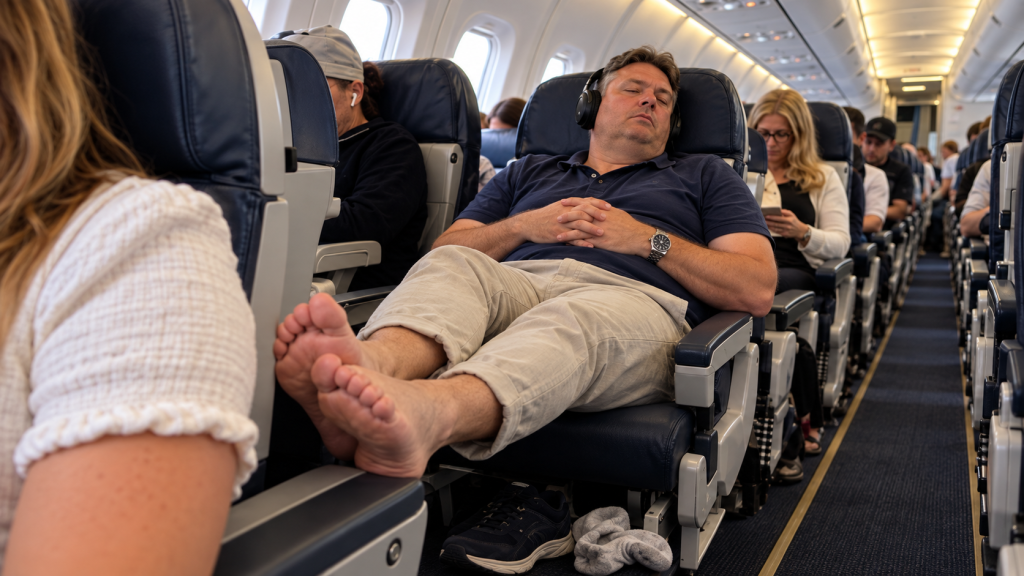
“She touched me while I was sleeping!” I felt the blood drain from my face. “No,” I said immediately. “I didn’t.” He laughed bitterly. “Oh, really? Then explain these!” He waved the sticky notes. The woman beside me folded her hands in her lap. “Perhaps,” she said quietly, “we should begin by establishing exactly where those notes were placed.” Daniel turned toward her.
“You stay out of this.”
She raised one eyebrow.
“I was sitting here.”
“I don’t care!”
Her expression didn’t change.
“Apparently.”
A few passengers snickered.
Daniel’s face grew even redder.
Elena lifted a hand.
“Ladies and gentlemen, please allow us to handle this.”
Then she turned to me.
“Ma’am, may I have your account?”
I took a slow breath.
“My name is Claire Morgan. This gentleman repeatedly put his bare foot on my armrest despite being asked to remove it. Another passenger also objected.”
Elena nodded.
“I understand.”
“When he fell asleep, I placed two removable sticky notes on the tops of his shoes, which he’d left under the seat. I didn’t touch his body.”
Daniel interrupted.
“She’s admitting it!”
I looked directly at him.
“Yes, Daniel. I’m admitting what I actually did.”
His expression hardened.
Elena looked toward Mrs. Bennett.
“And you witnessed this?”
She nodded.
“I did.”
“All of it?”
“The notes being placed on his shoes, yes. And the earlier requests for him to move his feet.”
Daniel scoffed.
“You two planned this together!”
Mrs. Bennett considered.
“Claire asked me to watch in case you woke. I agreed. That’s not something I’m concealing.”
I turned toward her.
She gave me a small, reassuring nod.
Then looked back at Elena.
“Neither of us touched him.”
The flight attendant wrote something down.
“Thank you.”
Daniel leaned forward.
“I want her arrested when we land.”
My stomach tightened.
The laughter stopped.
For the first time, I realized the situation might become more serious than an unpleasant argument about an armrest.
And Daniel knew it.
He smiled at me.
Slowly.
Smugly.
As though he’d found a way to punish me for embarrassing him.
“Sir,” Elena said firmly, “you’re entitled to report what you believe happened. I also need you to remain respectful while I document the accounts.”
Daniel snorted.
“Respectful?”
His voice rose.
“This woman humiliated me in front of half the airplane!”
I stared at him.
Then something slipped out before I could stop it.
“And you spent nearly an hour treating my armrest like your personal footstool.”
A few passengers laughed.
Elena glanced at me.
Not unkindly.
But with a look that reminded me she was trying to keep a crowded cabin calm.
I nodded.
“I’m sorry. I’ll let you finish.”
Daniel folded his arms.
“See? She thinks this is funny.”
I looked down at my hands.
The truth was more complicated.
Yes, I’d wanted him to feel embarrassed.
After repeatedly asking him to move his feet, I’d wanted him to experience a small fraction of the discomfort he’d inflicted on me.
But I’d never imagined he would accuse me of touching him.
Or demand that police meet the airplane.
Suddenly, my little joke felt much less clever.
Elena turned toward Daniel.
“Sir, did you see Mrs. Morgan touch your body?”
He hesitated.
“I was asleep.”
“So you didn’t witness that?”
“I woke up and everybody was laughing!”
“I understand. I’m asking whether you know she touched you.”
His jaw tightened.
“Well, how else did the notes get there?”
Mrs. Bennett answered gently.
“They were attached to your shoes.”
Daniel turned toward her.
“You again.”
She smiled politely.
“Yes. Still here.”
Elena kept writing.
“Sir, please return to your seat while we finish documenting this.”
Daniel stared at her.
“I haven’t finished.”
“You may provide a written statement when we’ve explained the reporting process.”
He looked around.
Several passengers were watching.
Nobody seemed eager to defend him.
His expression hardened.
Then he pointed at me.
“This isn’t over.”
He returned to his seat.
For the first time in nearly an hour, both his feet remained on the floor.
I should have felt victorious.
Instead, my hands were trembling.
Mrs. Bennett noticed.
“Claire?”
I turned toward her.
“I’m fine.”
She gave me a sympathetic look.
“Are you?”
I tried to smile.
“Not particularly.”
She nodded.
“That’s understandable.”
I leaned back.
Then whispered, “I didn’t mean for this to become such a spectacle.”
Mrs. Bennett looked toward the aisle.
“Sometimes people become angrier about being embarrassed than about the behavior that embarrassed them.”
I swallowed.
“Maybe I shouldn’t have put those notes on his shoes.”
She considered.
“Perhaps asking the crew for assistance sooner would’ve been wiser.”
I looked at her.
She continued gently.
“But you can acknowledge that without accepting an accusation that you touched him.”
I let out a shaky breath.
“Thank you.”
She smiled.
“You’re welcome.”
Then she added something I wouldn’t forget.
“You don’t have to be perfect to deserve basic respect.”
I turned toward the window.
Clouds stretched beneath the airplane like an endless white ocean.
We were somewhere over the western United States, heading toward San Francisco.
I’d been traveling for nearly five hours.
And in another ninety minutes, I was supposed to land, collect my suitcase, and take a taxi to my mother’s apartment.
My mother, Rose Morgan, was seventy-four.
She’d spent twenty-eight years cleaning hotel rooms.
Twenty-eight years making beds for strangers.
Scrubbing bathrooms.
Carrying heavy carts through long corridors.
And smiling at guests who sometimes treated her as though she were part of the furniture.
The next morning, she was scheduled for surgery.
Nothing the doctors had described as an emergency.
But serious enough that she’d finally admitted she was frightened.
Three nights earlier, she’d called me.
“Claire, sweetheart?”
“Hi, Mom.”
There had been a pause.
Then she’d said:
“Do you think you could come a little earlier than we planned?”
My heart had tightened.
“Of course. Why?”
She’d laughed.
The familiar laugh she used whenever she was trying not to cry.
“Oh, I suppose I’m becoming a silly old woman.”
“Mom.”
Another pause.
Then she’d whispered:
“I just don’t want to walk into that hospital alone.”
I booked the flight the same night.
I hadn’t hesitated.
My mother had spent my entire childhood showing up for me.
She came to every school recital wearing the same blue work uniform because she didn’t have time to change.
She sat through terrible orchestra performances.
Cheered when I graduated.
And once rode three buses in a snowstorm because I called her crying after my first boyfriend broke my heart.
I wasn’t going to let her face a frightening morning without someone holding her hand.
Now I stared at Daniel’s seat.
And wondered whether his accusation might delay me long enough that I’d miss the night before her operation.
My stomach twisted.
Mrs. Bennett followed my gaze.
“Something’s worrying you.”
I swallowed.
“My mother.”
Her expression softened.
“Is she all right?”
“She’s having surgery tomorrow.”
“Oh, Claire.”
I looked down.
“She’s expecting me tonight.”
Mrs. Bennett touched my hand lightly.
“I’m sorry.”
I tried to laugh.
“Mom would be furious if she knew I was spending the flight arguing about somebody’s feet.”
Mrs. Bennett smiled.
“What would she say?”
I thought about Rose Morgan.
Her sensible shoes.
The silver earrings she wore every Sunday.
The way she always seemed to know when I was pretending not to be upset.
Then I smiled through tears.
“She’d say, ‘Claire, some people are only happy when everybody else is uncomfortable. Don’t help them.’”
Mrs. Bennett laughed softly.
“Your mother sounds like a wise woman.”
I nodded.
“She is.”
Then my voice broke.
“She deserves better than me arriving late because of some ridiculous argument.”
Mrs. Bennett squeezed my hand.
“Then we’ll focus on telling the truth and letting the crew do their jobs.”
I looked at her.
“Do you really think everything will be all right?”
She didn’t give me a grand promise.
Instead, she said:
“I think the facts matter. And I’m willing to give my account.”
For some reason, that comforted me more than being told nothing could possibly go wrong.
A few minutes later, Elena returned.
She crouched beside our row.
“Mrs. Morgan, may I speak with you privately for a moment?”
My stomach dropped.
“Of course.”
Mrs. Bennett looked up.
“Would you like me to come?”
Elena nodded.
“After I speak with Mrs. Morgan, I’ll take your statement too.”
I stood.
My knees felt unsteady.
As I passed Daniel’s seat, he pulled one headphone away from his ear.
Then whispered:
“Hope you’re enjoying your vacation.”
I stopped.
For a second, I couldn’t believe he’d said it.
He smiled.
“Airport security has a way of ruining people’s plans.”
I looked at him.
The same smug expression.
The same expensive watch.
The same belief that he could make another person miserable simply because he’d decided to.
But I didn’t answer.
I continued toward the galley.
Elena waited beside the service cart.
Another crew member stood nearby.
“I want to make sure we understand exactly what happened,” Elena said.
I nodded.
She asked me to describe the incident from the beginning.
So I did.
The foot.
The smell.
The repeated requests.
The turbulence.
The sticky notes.
I didn’t omit the part where I’d asked Mrs. Bennett to block Daniel’s view.
And I didn’t pretend my intention had been purely innocent.
“I wanted him to be embarrassed,” I admitted.
Elena nodded.
“I appreciate your honesty.”
I looked down.
“But I didn’t touch him. I didn’t put anything on his skin, clothing, or body.”
“Understood.”
I swallowed.
“Is he really going to have me arrested?”
Elena’s expression softened.
“We’re documenting the complaint and the available witness accounts. We can’t determine legal outcomes here.”
I nodded.
She continued.
“Our priority is keeping everyone safe and completing the flight.”
Then she looked at me carefully.
“Has he threatened you?”
I hesitated.
“He just made a comment about airport security ruining my plans.”
Elena wrote it down.
“Thank you for telling me.”
I looked toward the curtain separating the galley from the cabin.
“Can I ask you something?”
“Of course.”
“Has he complained about me before this?”
Elena hesitated.
“We’ve received his account. I can’t discuss another passenger’s private report beyond what’s necessary.”
I nodded.
That was fair.
Then I asked:
“Would it help if the woman beside me wrote down what she saw?”
“Yes. We’ll ask her to provide her account.”
I took a breath.
“Thank you.”
As I returned to my row, I noticed a young man seated across the aisle.
He was perhaps twenty.
He wore a university sweatshirt and held his phone loosely in one hand.
When I passed, he looked up.
“Ma’am?”
I stopped.
“Yes?”
He lowered his voice.
“I heard what happened.”
My stomach tightened.
He hesitated.
“Actually, I saw some of it.”
I stared.
“You did?”
He nodded.
“I’m Leo.”
“Claire.”
He glanced toward Daniel’s seat.
Then back at me.
“I was going to say something earlier, but I didn’t want him turning on me.”
I understood that feeling.
Too well.
Then he whispered:
“I think there’s something the flight attendant needs to know.”
My heart began pounding.
“What?”
Leo looked down at his phone.
“Before the sticky notes, I saw him doing something weird.”
I frowned.
“What kind of weird?”
He swallowed.
“He was recording you.”
For a moment, the airplane seemed to stop moving.
“Recording me?”
Leo nodded.
“With his phone. When you turned around to ask him to move his foot.”
I stared.
“But why?”
Leo shook his head.
“I don’t know.”
Then he added:
“He angled his camera toward you when you were upset. When you stopped talking, he stopped recording.”
I felt cold.
The expensive watch.
The smirk.
The repeated refusal.
The way he’d seemed almost pleased when I became frustrated.
Was he simply enjoying provoking me?
Or had he been planning to use my reaction for something else?
Leo continued.
“I noticed because I thought it was creepy.”
I swallowed.
“Did you tell the crew?”
“Not yet.”
“Would you?”
He looked nervous.
Then nodded.
“Yeah. I think I should.”
I thanked him.
Then returned to my seat.
Mrs. Bennett looked up immediately.
“Claire?”
I sat down.
My hands trembled.
“There’s something you need to hear.”
I explained what Leo had said.
Mrs. Bennett’s expression changed.
Not dramatically.
But enough that I noticed.
She looked toward Daniel.
Then whispered:
“That’s interesting.”
I frowned.
“Why?”
She hesitated.
Then answered:
“Because Daniel told our hiring panel on Monday that he had been unfairly targeted by another employer after a disagreement about customer behavior.”
I stared.
“What?”
She took a slow breath.
“He described himself as someone who stands up for employees when powerful customers mistreat them.”
I looked toward Daniel’s seat.
My stomach twisted.
“He said that?”
Mrs. Bennett nodded.
“He presented a very polished story.”
I leaned closer.
“What happened?”
She shook her head.
“I can’t share confidential hiring information.”
I nodded immediately.
“Of course.”
Then she continued:
“But this afternoon, I’ve seen him disregard an ordinary request, insult you, and threaten consequences after being embarrassed.”
Her expression grew serious.
“Those are behaviors I can describe from firsthand observation.”
I looked at her.
“Will he lose the job?”
She considered.
“That isn’t a decision I should make in this cabin.”
I nodded.
“But his conduct has given me reason to ask important questions through the proper hiring process.”
I looked toward Daniel again.
He was sitting with his arms crossed.
His shoes were on.
His feet were on the floor.
And for the first time, he looked genuinely uneasy.
Then my phone vibrated.
A message from my mother.
Sweetheart, is your flight all right? I’ve made up the spare bed. Don’t worry about rushing. I love you.
I stared at the words.
And tears filled my eyes.
I typed back:
I’m all right, Mom. A little airplane drama. I’ll explain when I see you.
Her reply arrived almost immediately.
Is somebody being rude?
Despite everything, I laughed.
She knew me too well.
I answered:
You could say that.
Then she wrote:
Remember what I taught you. Be kind, but don’t let people put their feet all over your life.
I covered my mouth.
Mrs. Bennett looked at me.
“What is it?”
I showed her the message.
She burst out laughing.
For a moment, the tension disappeared.
Then Daniel stood again.
And what happened next made both of us stop smiling.
He walked toward the front galley carrying his phone.
His expression was no longer smug.
It was determined.
As he passed, I heard him say into the phone:
“I have the video. I can make it look like she’s the one who started everything.”
My blood turned cold.
Mrs. Bennett slowly turned toward me.
And I realized the sticky notes hadn’t simply embarrassed a rude passenger.
They had interrupted a story he was already trying to create.
For one terrible moment, I wondered whether I’d misheard him.
The aircraft was noisy.
Passengers were talking.
Someone across the aisle was opening a packet of pretzels.
Perhaps Daniel had said something entirely different.
But Mrs. Bennett’s expression told me she had heard it too.
Her lips pressed together.
She looked toward the galley.
Then back at me.
“Claire,” she said quietly, “we should tell Elena exactly what we heard.”
I nodded.
My hands were cold.
“What if he denies it?”
“He may.”
“Then it’s his word against ours.”
Mrs. Bennett shook her head.
“That’s why we give separate, truthful accounts. We don’t need to make the evidence stronger than it is.”
I stared at her.
“Are you always this calm?”
She considered.
“No.”
That surprised me.
Then she smiled faintly.
“I simply learned a long time ago that when someone wants a public fight, calmness makes it harder for them to choose the terms.”
We waited until Elena finished assisting another passenger.
Then Mrs. Bennett explained what we’d overheard.
She didn’t accuse Daniel of plotting some elaborate crime.
She stated his words.
I did the same.
And Leo independently told the crew what he’d observed about Daniel using his phone.
Elena thanked each of us.
“I’ll make sure your accounts are documented.”
Then she looked toward Daniel’s seat.
For the first time, her professional composure seemed strained.
But she didn’t confront him dramatically.
She returned to her duties and consulted the lead flight attendant.
I sat back.
The airplane lights had dimmed.
Most passengers were trying to sleep.
But my mind refused to settle.
I kept imagining Daniel uploading a short, misleading video.
A stranger on the internet identifying my face.
A headline.
An accusation.
Thousands of people laughing, judging, inventing stories.
I had no desire to become famous.
I worked as an administrator at a community health clinic outside Boston.
I paid my bills.
Visited my mother when I could.
Watered my neighbor’s plants when she traveled.
My greatest recent public embarrassment had been accidentally sending a photograph of my cat to a workplace scheduling group.
And now I was sitting thirty thousand feet above the ground wondering whether a man with dirty feet could somehow turn me into a villain.
Mrs. Bennett noticed me rubbing my hands.
“Claire?”
“Yes?”
“Would you like some water?”
I nodded.
“Please.”
She passed me the bottle she’d purchased earlier.
I took a sip.
Then whispered:
“Do you know what’s ridiculous?”
She waited.
“I was actually nervous about asking him to move his foot the first time.”
“Why?”
I looked away.
“Because I didn’t want to seem difficult.”
Mrs. Bennett studied me.
Then said something unexpected.
“Who taught you that being uncomfortable was preferable to inconveniencing someone else?”
I almost laughed.
“That’s a very expensive therapy question.”
She smiled.
“Occupational hazard. I ask a lot of questions.”
I looked down.
Then thought about my childhood.
My mother cleaning hotel rooms.
The times she’d come home exhausted.
The managers who praised her for never complaining.
The customers who left enormous messes and tiny tips.
“My mother worked in hotels,” I said softly.
Mrs. Bennett’s expression changed.
“Really?”
“Twenty-eight years.”
I smiled sadly.
“She used to tell me that guests weren’t always right, but they were still people. She believed you could disagree without humiliating someone.”
Mrs. Bennett nodded.
“That sounds wise.”
I looked toward Daniel.
“I suppose I didn’t quite follow that part.”
She considered.
“Your notes embarrassed him.”
I nodded.
“Yes.”
“But he still had choices about how to respond.”
I looked at her.
“He could have apologized.”
“Yes.”
“Or moved his feet earlier.”
“Exactly.”
I exhaled.
“And I could have asked the crew for help instead of trying to teach him a lesson.”
Mrs. Bennett smiled gently.
“There may be enough lessons for everybody on this airplane.”
I laughed.
For a few seconds, I felt better.
Then my phone vibrated.
A message had arrived through the aircraft’s Wi-Fi.
It was from my coworker, Tanya.
Claire, are you on a flight to San Francisco?
My stomach tightened.
I typed:
Yes. Why?
Three dots appeared.
Then disappeared.
Then appeared again.
Her next message made my blood run cold.
Please tell me this isn’t you.
Below it was a link.
I opened it.
A video appeared.
The title read:
WOMAN CAUGHT HARASSING SLEEPING PASSENGER ON CROSS-COUNTRY FLIGHT.
My hands began shaking.
There I was.
Sitting in my airplane seat.
Turning around.
Gesturing toward Daniel.
The clip showed me speaking firmly.
Then it cut to a blurred shot of his shoes.
Two pink sticky notes were visible.
The caption claimed I’d approached a sleeping man and interfered with his belongings.
It didn’t mention his bare foot.
It didn’t include my repeated requests.
It didn’t include the woman beside me objecting.
It didn’t show how Daniel had behaved when confronted.
The video ended with his voice.
“Can you believe the kind of people they let fly these days?”
I stared at the screen.
My stomach turned.
He’d uploaded it.
Before we even landed.
Below the video, comments were appearing.
People have no manners anymore.
She looks crazy.
I’d have her removed from the flight.
Someone needs to teach her a lesson.
I put the phone facedown.
I couldn’t look anymore.
Mrs. Bennett turned.
“What happened?”
I showed her.
She watched the video without speaking.
Then looked at me.
“That’s a very selective account.”
I swallowed.
“He’s making me look like I attacked him.”
She nodded.
“I can see why you’re concerned.”
My phone vibrated again.
Tanya.
Are you okay? Should I call someone?
I stared at the message.
Then typed:
I’m safe. It’s misleading. I’ve reported the actual incident to the flight crew.
My fingers were trembling so badly I mistyped three words.
Mrs. Bennett watched quietly.
Then said:
“Claire, before you do anything publicly, consider preserving what you’ve seen.”
I looked up.
“What do you mean?”
“The link. The wording. The date. The context. You may need it to explain what was published.”
I nodded.
She continued.
“And don’t feel obligated to argue with strangers who know only a few seconds of what happened.”
I took a shaky breath.
“But people are believing him.”
Her expression softened.
“I know.”
I looked toward Daniel’s seat.
He was staring at his phone.
Smiling.
A small part of me wanted to march down the aisle, grab the device, and force him to show everyone the truth.
But that would only give him another video.
Another angry reaction.
Another reason to call me unstable.
So I stayed where I was.
And tried to breathe.
A moment later, Leo leaned across the aisle.
“Claire?”
I turned.
His face looked pale.
“I saw the video.”
I nodded.
“Everybody seems to be seeing it.”
He shook his head.
“It’s missing the beginning.”
“I know.”
He hesitated.
Then held up his phone.
“I took a picture earlier.”
My heart began pounding.
“A picture of what?”
He looked embarrassed.
“His feet.”
I stared.
Leo shrugged.
“I was going to send it to my roommate with a caption about terrible airplane etiquette.”
He showed me.
There was Daniel’s bare foot.
Resting unmistakably on my armrest.
His heel protruded over the top.
His toes extended toward my elbow.
My sleeve was visible beside them.
The photo was clear.
And it had been taken before the sticky notes.
I covered my mouth.
“Leo…”
He nodded.
“I know.”
I looked toward Mrs. Bennett.
Her expression softened.
Then Leo said:
“I also heard you ask him to move it.”
I began crying.
Not because the picture solved everything.
But because for the first time since Daniel started threatening me, I felt less alone.
“Would you be willing to give that to the crew as part of your statement?” I asked.
Leo nodded.
“Of course.”
I wiped my cheeks.
“Thank you.”
He smiled awkwardly.
“My mom would kill me if I watched somebody getting bullied and didn’t speak up.”
Mrs. Bennett laughed softly.
“Your mother sounds excellent.”
Leo grinned.
“She really is.”
We passed the information to Elena.
She documented it and directed Leo on how to preserve the original file rather than changing or cropping it.
Daniel saw the exchange.
I knew because when I looked back, he was staring directly at us.
His smile had disappeared.
A few minutes later, he called Elena to his seat.
We couldn’t hear everything he said.
But we heard enough.
“I want to know what they’re doing with their phones.”
Elena responded calmly.
“Sir, we’re gathering relevant accounts.”
Daniel pointed across the aisle.
“That kid is conspiring with them.”
Leo stiffened.
The flight attendant’s voice became firmer.
“Please don’t make accusations toward other passengers.”
Daniel leaned back.
“You’ll regret taking their side.”
Elena paused.
“Sir, I’m not taking sides. I’m asking you to follow the crew’s instructions.”
He glared at her.
Then said:
“Do you know how much influence I have in the hospitality industry?”
For a moment, nobody spoke.
Then Mrs. Bennett answered from beside me.
“Daniel, I think we’ve all learned quite a lot about that today.”
Several passengers laughed.
His face turned crimson.
And he finally looked away.
But I should have known it wouldn’t end there.
Because ten minutes later, Elena approached our row again.
This time, she looked troubled.
“Mrs. Morgan,” she said, “I need to inform you that the passenger has made an additional allegation.”
My stomach dropped.
“What allegation?”
She hesitated.
“He says you’ve been threatening his professional future.”
I stared.
“What?”
Mrs. Bennett slowly straightened.
Elena continued.
“He claims you and Mrs. Bennett have coordinated an effort to damage his employment prospects.”
For a moment, I couldn’t speak.
Then I looked at Mrs. Bennett.
Her expression had gone very still.
I whispered:
“How could I threaten a job I didn’t even know he’d applied for?”
Elena nodded.
“That’s the kind of information we’ll need to record.”
Then Mrs. Bennett took a slow breath.
And said something that made even Elena look surprised.
“In that case, I think you should know I was not merely a member of his interview panel.”
Daniel looked up from the row behind us.
Mrs. Bennett turned toward him.
“I am the person who authorized the search for the company’s next senior hospitality director.”
The cabin went quiet.
Then she added:
“And Daniel, your greatest problem isn’t that Claire knows who I am. It’s that I’ve now seen how you treat people when you think they have no power over you.”
Daniel stared at Mrs. Bennett.
For the first time since I’d met him, he seemed to have forgotten how to speak.
His mouth opened.
Closed.
Then opened again.
“Margaret…”
Mrs. Bennett looked at him.
“Please don’t make this more uncomfortable than it already is.”
He swallowed.
“I didn’t know you were sitting there when—”
He stopped.
Too late.
Mrs. Bennett raised an eyebrow.
“When what, Daniel?”
His face reddened.
He looked at me.
Then toward the flight attendant.
“I meant I didn’t recognize you at first.”
Mrs. Bennett nodded slowly.
“I see.”
But her expression suggested she understood exactly what he’d nearly admitted.
Elena stepped forward.
“Mrs. Bennett, I appreciate your explanation, but I need everyone to remain seated. We’ll handle the passenger complaint through the established process.”
Mrs. Bennett nodded immediately.
“Of course. You’re right.”
Then she looked toward Daniel.
“And I shouldn’t be discussing your application publicly. Any employment decision will go through our formal process.”
His shoulders relaxed slightly.
But she wasn’t finished.
“I will, however, give a truthful witness statement about what I saw.”
Daniel looked away.
I sat beside her, astonished.
For the past hour, he’d treated me as though I was beneath him.
He’d assumed Mrs. Bennett was simply another woman who could be ordered into silence.
And now he seemed terrified because the same woman occupied a position he wanted to impress.
I leaned toward her.
“Can I ask you something?”
She nodded.
“Of course.”
“Why didn’t you tell him who you were earlier?”
She smiled faintly.
“Claire, I shouldn’t need to announce my position for a stranger to treat me respectfully.”
I thought about that.
Then nodded.
“You’re right.”
She looked toward the row behind us.
“And I certainly shouldn’t need an expensive title to be able to ask someone to move a bare foot.”
A laugh escaped me.
Then my phone vibrated again.
Tanya.
Claire, the video is spreading. Someone recognized the clinic logo on your bag.
I froze.
I opened the message.
My heart sank.
There was a screenshot from a public discussion.
A stranger had identified the community health clinic where I worked.
Below it, another person had written:
Call her employer. People who harass strangers shouldn’t work around patients.
My hands began shaking so badly that I nearly dropped the phone.
“Oh, no.”
Mrs. Bennett turned.
“Claire?”
I showed her.
She read it.
Her expression hardened.
For a moment, I couldn’t speak.
Then I whispered:
“They’re calling my workplace.”
Mrs. Bennett took a slow breath.
“Have you contacted your supervisor?”
I shook my head.
“Not yet.”
“Then I think you should.”
I stared.
“What if they fire me?”
She looked directly into my eyes.
“Tell them what happened before someone else’s edited version becomes the only version they hear.”
I swallowed.
She continued gently.
“And make sure you tell them the whole truth, including the sticky notes.”
I nodded.
The hardest part of honesty wasn’t admitting what another person had done.
It was admitting the parts of your own behavior you wished you’d handled differently.
I opened my work contacts.
Found my supervisor’s name.
And sent a message.
Linda, I’m on a flight to San Francisco. A passenger has posted a misleading video of a dispute involving me. I want you to hear the full circumstances directly from me. I’m safe, and I’ve given the crew an accurate account.
Then I attached a short explanation.
The foot.
The requests.
The notes.
The accusation.
The witnesses.
I read it twice before sending.
Not because I wanted to make myself look innocent.
Because I wanted the account to be accurate.
When I pressed send, my stomach twisted.
For twelve years, I’d worked at that clinic.
I’d helped frightened patients fill out forms.
Found interpreters for families who didn’t understand medical paperwork.
Stayed late with elderly people whose transportation never arrived.
My job wasn’t glamorous.
But it mattered.
And now strangers who’d watched thirty seconds of video were discussing whether I deserved to keep it.
I looked toward Daniel.
He was typing furiously.
His face glowed blue from the phone screen.
For a moment, I wondered how many people he’d already told that I was dangerous.
Then I stopped looking.
Because staring at him wouldn’t change what I’d done.
And it wouldn’t change what he was doing.
Elena announced that the cabin crew would soon begin preparing for descent.
The overhead lights brightened.
Passengers began gathering their belongings.
A little girl across the aisle asked her father whether they were almost home.
Someone complained about the temperature.
A baby cried near the back.
Ordinary airplane sounds.
But for me, nothing felt ordinary anymore.
My phone vibrated.
Linda.
I held my breath.
Claire, thank you for telling me. We’ve received two calls. Don’t engage with strangers online. We’ll preserve the messages, and we’ll talk when you’ve landed. Take care of your mother.
I read it three times.
Then began crying.
Mrs. Bennett looked at me.
“Good news?”
I nodded.
“My supervisor believes I deserve to explain.”
She smiled.
“That’s a good beginning.”
I wiped my cheeks.
Then Leo leaned toward us.
“Hey.”
I looked up.
He smiled awkwardly.
“My roommate just texted.”
My stomach tightened.
“What did he say?”
Leo hesitated.
“People are starting to notice something about Daniel’s video.”
I frowned.
“What?”
He turned his phone toward me.
Someone had paused Daniel’s recording at a frame near the beginning.
There, partly visible beside my elbow, was a bare foot.
His bare foot.
Resting over my armrest.
A commenter had circled it.
The caption read:
Why is this guy filming himself putting his foot in someone else’s seat space?
Another person replied:
He left that part in?
I stared.
Then I started laughing.
Not loudly.
Not triumphantly.
Just a tired, disbelieving laugh.
Daniel had worked so hard to control the story that he’d overlooked something sitting in the corner of his own video.
His foot.
The beginning of the entire argument.
Mrs. Bennett smiled.
“Interesting.”
Leo nodded.
“Apparently people are asking for the full clip.”
I looked toward Daniel.
He was staring at his phone.
His face had gone pale.
Then the video disappeared from the link Tanya had sent me.
I refreshed the page.
It was unavailable.
My heart pounded.
“He deleted it.”
Mrs. Bennett nodded.
“Perhaps.”
I looked toward Leo.
“Does that mean it’s gone?”
He shook his head.
“Not necessarily. People may have saved copies, and we still have the link information and screenshots.”
I exhaled.
For a moment, I felt relieved.
Then I remembered something.
The internet doesn’t always forget when the truth catches up.
I looked at Mrs. Bennett.
“What if people keep sharing the edited version?”
She considered.
“Some probably will.”
I stared.
She continued.
“But that doesn’t mean you have to spend the rest of your life chasing every stranger’s opinion.”
I looked down.
“Claire, your job is to tell the truth, keep your evidence, and protect yourself.”
Her voice softened.
“You cannot make every person on the internet fair.”
I nodded.
Then she added:
“Fortunately, fairness isn’t determined by a comment section.”
I smiled weakly.
“No.”
“It’s determined by what actually happened and the processes available to examine it.”
For the first time in nearly two hours, I felt my shoulders relax.
Then the airplane began descending.
The captain’s voice came over the speakers.
“Ladies and gentlemen, we’ll be landing in San Francisco shortly. Please return your seatbacks to the upright position and secure your belongings.”
I looked out at the darkening sky.
Below us, the California coastline emerged from the clouds.
Home for my mother.
A place I’d been trying to reach since sunrise.
I closed my eyes.
“Almost there, Mom.”
Beside me, Mrs. Bennett quietly fastened her seat belt.
And behind us, Daniel finally put his phone away.
For a few minutes, I believed the worst was over.
Then the aircraft touched down.
The tires struck the runway.
Passengers clapped.
Someone cheered.
The engines roared as we slowed.
I breathed out.
We had landed.
All I wanted was to get off that airplane and go to my mother.
But as we taxied toward the gate, Elena made an announcement.
“Ladies and gentlemen, please remain seated until the seat belt sign is switched off. We also ask passengers involved in the earlier cabin incident to remain available briefly after arrival so we can complete the necessary reports.”
My stomach dropped.
Daniel leaned forward.
“Good,” he said loudly. “I’d like to see her explain herself now.”
I looked straight ahead.
Mrs. Bennett reached over.
Squeezed my hand.
“Claire.”
I turned.
“Remember what actually happened.”
I nodded.
The seat belt sign went off.
Passengers stood.
Overhead compartments opened.
But before I could reach for my bag, Daniel stepped into the aisle.
He pointed at me.
“Don’t even think about leaving.”
Several passengers turned.
My heart hammered.
Then a deep voice came from behind him.
“Sir, please move out of the aisle.”
A uniformed airline ground supervisor had boarded with a member of the airport security team.
Daniel turned.
“Finally!”
He lifted his phone.
“I’m the victim here.”
The supervisor remained calm.
“Sir, we’ll speak with everyone involved. Please step aside so other passengers can disembark safely.”
Daniel’s smile faded.
“But I have evidence.”
“Then we’ll document what you wish to provide.”
He pointed at me again.
“She assaulted me while I was sleeping!”
Mrs. Bennett stood.
“And I witnessed what happened.”
Leo rose across the aisle.
“So did I.”
The woman who’d been sitting directly in front of Daniel turned around.
She was perhaps sixty.
She wore glasses and carried a knitted cardigan.
“I heard her ask him to remove his foot,” she said.
Daniel stared.
Then another passenger spoke.
“I saw his foot on the armrest before any notes appeared.”
My eyes filled.
I hadn’t known anyone else was paying attention.
For most of the flight, I’d felt like one woman arguing with one powerful, arrogant man.
Now several people were quietly describing what they’d actually seen.
Not shouting.
Not mocking.
Just telling the truth.
Daniel looked around.
His face changed.
And for the first time, I could see something in his expression that hadn’t been there before.
Fear.
But he still wasn’t ready to stop.
He stepped toward the supervisor.
“If you take her side, my attorney will hear about it.”
The supervisor nodded.
“Your attorney is welcome to contact the airline through the appropriate channels.”
Daniel stared.
Then the man continued:
“But right now, you’re required to follow instructions and let us speak with the parties separately.”
I watched Daniel’s shoulders sag.
There was no dramatic arrest.
No applause.
No instant verdict.
Just a process he could no longer control by raising his voice.
And somehow, that seemed to frighten him more than anything else.
After most passengers disembarked, I was invited to explain my account again.
A ground supervisor recorded the relevant details.
Elena submitted her notes.
Mrs. Bennett provided her statement.
Leo offered the original photograph.
The other witnesses gave their observations.
I admitted what I’d done with the sticky notes.
I acknowledged that involving the crew sooner would’ve been the better choice.
And I firmly denied touching Daniel or threatening him.
The supervisor listened.
Then said:
“Thank you for cooperating, Mrs. Morgan. We’ll review the reports under our procedures.”
I swallowed.
“Am I being detained?”
“No. At this point, we’re asking for your cooperation with the report. If additional follow-up is required, we’ll contact you.”
My knees nearly gave way.
“May I go?”
“Yes.”
I closed my eyes.
For the first time all evening, I could breathe.
Then my phone rang.
Mom.
I answered immediately.
“Claire?”
Her voice sounded small.
“Sweetheart, are you all right?”
My eyes filled.
“Yes, Mom.”
“Why do you sound like you’ve been crying?”
I laughed weakly.
“It’s a long story.”
She was silent for a moment.
Then whispered:
“Well, I’m still here.”
My throat tightened.
“And the spare bed is ready.”
I covered my mouth.
“I’m coming, Mom.”
Her voice softened.
“I know you are, sweetheart.”
I closed my eyes.
Then she said something that made me cry all over again.
“You don’t have to explain everything tonight. Just come home.”
I collected my suitcase almost an hour later.
By then, the airport had become quieter.
The crowds from our flight had scattered.
The luggage carousel had stopped moving.
And all I wanted was to climb into a warm car and forget the smell of Daniel’s feet forever.
Mrs. Bennett walked beside me.
Leo had already said goodbye after sharing his contact details with the airline.
Before leaving, he’d turned toward me and smiled.
“Hey, Claire?”
“Yes?”
“Don’t let him convince you everybody was laughing at you.”
I looked at him.
He shrugged.
“Most of us just wanted him to put his shoes on.”
I burst out laughing.
Then hugged him.
“Thank you, Leo.”
He grinned.
“Tell your mom I said good luck tomorrow.”
My eyes filled again.
“I will.”
Now, beside baggage claim, Mrs. Bennett checked her phone.
A black car was waiting outside for her.
She turned toward me.
“Claire, how are you getting to your mother’s?”
“Taxi.”
She nodded.
“Would you be comfortable if my driver took you?”
I hesitated.
She smiled.
“It’s not a business proposal.”
I laughed weakly.
“I know.”
She continued.
“I’m going toward the city anyway, and I would rather know you got to your mother safely.”
I looked down.
Normally, I hated accepting favors from strangers.
I had spent years being proud of taking care of myself.
But I was exhausted.
And somewhere across the city, my mother was waiting with the spare bedroom prepared.
I nodded.
“That would be kind.”
Mrs. Bennett smiled.
“Then it’s settled.”
Outside, the San Francisco air was cool.
A light rain had begun falling.
The driver placed our suitcases in the trunk.
We climbed into the back seat.
For several minutes, neither of us spoke.
Then Mrs. Bennett looked toward me.
“Claire, may I ask something?”
I smiled tiredly.
“After the day we’ve had, I think we’re past formalities.”
She laughed.
“Fair enough.”
She considered.
“Would you do it again?”
I frowned.
“Do what?”
“The sticky notes.”
I looked through the rain-streaked window.
For a moment, I saw Daniel’s foot resting on my armrest.
The smirk.
The headphones.
The way he’d refused to move.
Then I remembered his red face.
The laughter.
The allegations.
The internet comments.
I took a breath.
“No.”
Mrs. Bennett looked surprised.
“Really?”
I nodded.
“I’d ask the crew for help much sooner.”
I smiled faintly.
“And I’d still insist that he remove his foot.”
She nodded.
“But I don’t think I’d try to embarrass him again.”
Her expression softened.
“Why not?”
I considered.
“Because I didn’t actually want revenge.”
I swallowed.
“I just wanted my armrest back.”
Mrs. Bennett began smiling.
“And that’s perfectly reasonable.”
I laughed.
Then she asked:
“Do you regret standing up for yourself?”
I shook my head immediately.
“No.”
She nodded.
“Good.”
Then she said something I carried with me long after that flight.
“The lesson isn’t that you must become cruel to stop someone being cruel to you. It’s that you can draw a boundary without apologizing for having one.”
I stared at her.
For a moment, I thought about my mother.
Twenty-eight years cleaning hotel rooms.
The guests who left cigarette burns on curtains.
The people who spilled drinks and blamed housekeeping.
The managers who told her not to make trouble.
My throat tightened.
“I wish somebody had said that to Mom years ago.”
Mrs. Bennett looked toward me.
“Perhaps someone should say it to the people working in hotels now.”
I smiled sadly.
“Maybe you should.”
She nodded slowly.
“Maybe I should.”
The car turned onto a quieter residential street.
Small houses lined the sidewalks.
Porch lights glowed behind curtains.
Then I saw it.
My mother’s little yellow house.
The one she’d rented for eleven years.
The one with the blue flowerpots beside the steps.
A light was on in the front window.
My chest tightened.
“That’s it,” I whispered.
The driver pulled over.
Mrs. Bennett smiled.
“Go see your mother.”
I turned toward her.
“Margaret?”
“Yes?”
“Thank you.”
She reached for my hand.
“I was glad to sit beside you, Claire.”
For a moment, we looked at each other.
Two women who’d been strangers only a few hours earlier.
Then she smiled.
“And I hope your mother’s surgery goes well.”
I nodded.
“Me too.”
I stepped out of the car.
The driver brought my suitcase to the curb.
I thanked him.
Then I walked up the steps.
Before I could knock, the door opened.
Mom.
She stood wearing a lavender robe and slippers.
Her silver hair was tied back.
She looked smaller than I’d remembered.
But her smile was the same.
“Claire!”
I dropped my suitcase.
And hugged her.
For several seconds, neither of us spoke.
Then she pulled back.
Studied my face.
And frowned.
“Sweetheart, you look terrible.”
I burst out laughing.
“Thanks, Mom.”
She touched my cheek.
“Have you been crying?”
I nodded.
She sighed.
“Oh, honey.”
Then she pulled me close again.
“Come inside.”
I followed her into the kitchen.
The familiar smell of cinnamon and coffee filled the air.
A small vase of daisies sat on the table.
Mom had made chicken soup.
She always made chicken soup when she was frightened.
I sat down.
She placed a bowl in front of me.
Then sat opposite.
“All right.”
I looked up.
She folded her hands.
“Tell me about the airplane.”
I laughed weakly.
“Mom, you’re not going to believe this.”
She raised an eyebrow.
“Claire Morgan, I worked in hotels for nearly three decades.”
I smiled.
“Try me.”
So I told her.
Every ridiculous detail.
The bare foot.
The smell.
The armrest.
The repeated requests.
The sticky notes.
The laughter.
The accusations.
The flight attendant.
Mrs. Bennett.
Leo.
The viral video.
By the time I finished, Mom was staring at me.
For several seconds, she said nothing.
Then she asked:
“Did he really say his feet needed to breathe?”
I nodded.
Mom closed her eyes.
Then burst out laughing.
I stared.
“Mom!”
She laughed harder.
“Oh, Claire.”
Tears rolled down her cheeks.
“Twenty-eight years in hotels, and I’ve never heard somebody give that excuse for putting his feet on another person’s furniture.”
I began laughing too.
For the first time that evening, the story seemed absurd instead of frightening.
Then Mom became serious.
“Sweetheart, did he threaten you?”
I nodded.
Her expression hardened.
“And he told people you attacked him?”
“Yes.”
Mom shook her head.
“That isn’t right.”
I looked down.
“But I shouldn’t have put the notes on his shoes.”
She considered.
“No. That wasn’t your finest moment.”
I smiled weakly.
“Thanks.”
Mom reached across the table.
“But listen to me.”
I looked up.
“Making a foolish little choice doesn’t mean someone else gets to invent a terrible story about you.”
My eyes filled.
“And it certainly doesn’t mean you were wrong to ask for a little space.”
I swallowed.
Mom continued.
“When I worked at the Grand Pacific Hotel, I had a manager who told us the customer was always right.”
I nodded.
I’d heard this story before.
But that night, she told it differently.
“One afternoon, a guest deliberately spilled a drink and ordered me to clean it while he laughed with his friends.”
My chest tightened.
“I was young. I needed the job.”
Her voice softened.
“So I cleaned it.”
I looked down.
“Then he poured another.”
My head snapped up.
“What?”
Mom nodded.
“And that’s when I stood up.”
I stared.
She smiled sadly.
“I told him I would clean an accident, but I wouldn’t stand there while he made another mess just to laugh at me.”
My eyes filled.
“What happened?”
“The manager was furious.”
She laughed softly.
“But another guest heard what happened and spoke up.”
Mom squeezed my hand.
“The point isn’t that I won some grand battle.”
She looked directly into my eyes.
“The point is that I remember the day I finally said no.”
Tears rolled down my cheeks.
Mom smiled.
“Claire, you come from a long line of stubborn women.”
I laughed through tears.
“Yes, I do.”
She squeezed my hand.
“And we make mistakes.”
I nodded.
“But we don’t have to accept every ugly thing somebody says about us.”
I leaned forward.
And hugged her.
For a long time, we sat there.
Mother and daughter.
In a warm kitchen.
With chicken soup cooling on the table.
At last, Mom pulled back.
“Now.”
I looked up.
She smiled.
“Would you please tell me the exact words on those sticky notes?”
I groaned.
“Mom!”
She laughed.
“Claire, I survived twenty-eight years in housekeeping. I deserve a good joke.”
So I told her.
And she laughed until she had to wipe tears from her cheeks.
The next morning, I accompanied her to the hospital.
Her surgery was scheduled for nine.
I held her hand while the nurses completed the preparations.
She seemed calm.
Until the moment they began moving her toward the operating room.
Then she gripped my fingers.
“Claire?”
I leaned closer.
“Yes, Mom?”
Her eyes filled.
“Will you still be here when I wake up?”
My throat tightened.
I kissed her forehead.
“Yes.”
She swallowed.
“Promise?”
I thought about everything that had happened on the airplane.
The argument.
The video.
The threats.
The fear of arriving too late.
Then I looked into my mother’s eyes.
“I promise to be here, Mom.”
She smiled.
And for the first time since the flight, nothing else mattered.
Not Daniel.
Not the internet.
Not the hiring process.
Just my mother’s hand in mine.
I stayed in the hospital waiting area through the morning.
Read the same magazine three times.
Drank terrible coffee.
And checked my phone more often than I wanted to admit.
Around noon, Linda called from the clinic.
“Claire?”
I answered immediately.
“Hi.”
“How’s your mother?”
“Still in surgery.”
Linda’s voice softened.
“I hope everything goes well.”
“Thank you.”
Then she took a breath.
“I wanted to discuss the video.”
My stomach tightened.
“Okay.”
“We’ve received some unpleasant calls.”
I closed my eyes.
“I’m sorry.”
Linda interrupted gently.
“Claire, you don’t need to apologize for strangers calling our office.”
Tears filled my eyes.
She continued.
“We’ve reviewed what you’ve provided so far. When you’re back, we’ll complete a fair internal discussion about your role in the incident and any lessons about managing conflict.”
I nodded.
“I understand.”
“But there is no reason for you to leave your mother’s side today because of internet speculation.”
I covered my mouth.
“Linda…”
Her voice softened.
“You’ve worked here for twelve years.”
Tears rolled down my cheeks.
“I know how you treat frightened people.”
For a moment, I couldn’t speak.
Then I whispered:
“Thank you.”
She paused.
“And Claire?”
“Yes?”
“Don’t read the comments.”
I laughed through tears.
“I’ll try.”
When I ended the call, I looked toward the operating-room doors.
And realized that sometimes the kindness of an ordinary supervisor could mean more than the praise of a thousand strangers.
A little later, the surgeon came to speak with me.
My heart stopped.
I rose so quickly that my chair scraped the floor.
“How is she?”
The doctor smiled.
“The procedure went as planned. Your mother is in recovery.”
My knees weakened.
“She’s okay?”
“She’ll need monitoring and recovery care, but things have gone well so far.”
I covered my mouth.
“Thank you.”
Then I began crying.
Not because of the airplane.
Not because of Daniel.
Because the woman who’d spent my whole life taking care of everybody else had come through the operation.
And I was there.
When Mom finally opened her eyes, she looked toward me.
I smiled through tears.
“Hi.”
Her lips moved.
I leaned closer.
“What was that?”
She whispered:
“Did you get him to move his feet?”
I burst out laughing.
“Mom!”
She smiled faintly.
Then closed her eyes again.
And I knew she was going to be just fine.
But the story of the airplane wasn’t finished.
Three days later, while Mom rested at home, I received an email from the airline’s customer relations department.
The subject line read:
FOLLOW-UP REGARDING FLIGHT INCIDENT.
My stomach tightened.
I opened it.
The airline requested a brief follow-up conversation concerning the reports and video material it had received.
I stared at the screen.
Then read the final paragraph.
We have also received additional footage from the passenger who initially submitted the complaint.
My heart began pounding.
Additional footage?
What footage?
Then the next sentence made me go still.
The submitted recording contains material that was not included in the version circulated publicly.
I sat at my mother’s kitchen table staring at the email.
Additional footage.
The words seemed to glow on the screen.
For a moment, I thought about everything Daniel had done.
The dirty foot.
The smirk.
The accusation.
The edited video.
The strangers calling my workplace.
I had spent days wondering whether one foolish choice with two sticky notes might become something I’d have to defend forever.
Now the airline was telling me there was more evidence.
I forwarded the email to the attorney I’d consulted after the video began circulating.
Her name was Nora Feldman.
She specialized in civil disputes involving reputational harm and online publications.
She called me that afternoon.
“Claire?”
“Yes?”
“I’ve spoken with the airline’s representative about the scope of the follow-up.”
My heart tightened.
“Am I in trouble?”
Nora paused.
“They’re reviewing the complaint. Let’s hear precisely what they have before drawing conclusions.”
I nodded.
Then she added:
“And remember, you’ve consistently acknowledged placing removable notes on his shoes. There’s no need to change that account.”
I swallowed.
“I know.”
“Your position has always been that you did not touch or assault him.”
“Yes.”
“Then we stay with the truth.”
The call with the airline was scheduled for the next morning.
I sat at Mom’s kitchen table while Nora joined by telephone.
The airline representative introduced himself as Michael Harris, a member of its customer relations and incident review team.
He thanked me for cooperating.
Then asked whether my account had changed.
“No,” I answered.
I described the events again.
Calmly.
Carefully.
The repeated requests.
The bare foot.
The sticky notes.
The accusation.
Michael took notes.
Then he said:
“Mrs. Morgan, the passenger who filed the complaint provided a longer recording than the version he published.”
My heart pounded.
“And?”
“The audio includes portions of your earlier exchange.”
I closed my eyes.
His voice continued.
“We can hear you asking him to remove his foot.”
My hands began trembling.
“We can also hear him declining.”
I covered my mouth.
“And the video?”
Michael paused.
“The material submitted to us does not show you making physical contact with the passenger. It supports that the notes were placed on his shoes.”
For several seconds, I couldn’t speak.
Then I whispered:
“He gave you that recording himself?”
“Yes.”
I stared at the wall.
After everything Daniel had said, after the accusations and the threats, the longer recording he’d provided to support his complaint corroborated the central parts of my account.
Michael continued.
“We also have corroborating statements from the other passengers and crew.”
I closed my eyes.
“So what happens now?”
“We’re closing our internal review of the allegation that you physically assaulted him. We have not found evidence supporting that claim in the material reviewed.”
My shoulders sagged.
“Thank you.”
He continued.
“We’ve also addressed the passengers’ conduct under our policies. We recognize that placing notes on another passenger’s belongings wasn’t the best way to resolve the dispute, and we appreciate your acknowledgment of that.”
I nodded.
“I understand.”
“We also recognize the concern caused by another passenger repeatedly placing his bare foot in your space and refusing your requests to stop.”
Tears filled my eyes.
“For what it’s worth,” Michael said, “our crews are available to help resolve these situations. We’d encourage you to involve them sooner if something similar happens again.”
I laughed weakly.
“Believe me, I will.”
When the call ended, I sat motionless.
Then my mother appeared in the doorway.
She was recovering steadily, though still moving slowly.
“Claire?”
I looked up.
“Mom?”
She studied my face.
“What happened?”
I swallowed.
“The airline reviewed everything.”
She waited.
“They didn’t find evidence I assaulted him.”
Mom closed her eyes.
Then whispered:
“Good.”
I began crying.
She crossed the kitchen and sat beside me.
For a moment, she simply held my hand.
Then she said:
“Do you feel better?”
I considered.
“Yes.”
Then I looked down.
“But I still hate that I let somebody make me so angry.”
Mom smiled sadly.
“Claire, being angry when somebody disrespects you doesn’t make you a bad person.”
I nodded.
“What matters is what you do with the anger.”
Her voice softened.
“And whether you learn anything afterward.”
I leaned against her shoulder.
“I learned to call the flight attendant.”
Mom laughed.
“That would be an excellent start.”
I smiled through tears.
Then she added:
“And perhaps not to put sticky notes on strange men’s shoes.”
I groaned.
“Mom!”
She laughed harder.
“I had to say it.”
And despite everything, I laughed with her.
The airline’s finding didn’t instantly repair my online reputation.
The misleading video had already been copied.
Some people continued sharing it without context.
Others insisted that placing notes on Daniel’s shoes was enough to make me the villain.
I couldn’t control them.
But I could control what I said.
With Nora’s advice, I published one calm statement on my own account.
Not a rant.
Not a demand that strangers attack Daniel.
Simply an accurate explanation.
I acknowledged the notes.
Explained the repeated requests for him to remove his foot.
And stated that I had never touched him.
With Leo’s permission, I included the photograph showing Daniel’s bare foot resting on my armrest.
I also explained that the airline had completed an internal review and found no evidence supporting the allegation of physical assault in the material it examined.
I didn’t publish Daniel’s address.
Didn’t contact his family.
Didn’t ask people to call his employer.
I knew firsthand how frightening it felt to have strangers threaten your livelihood over a few seconds of video.
I wasn’t going to do that to somebody else.
The response surprised me.
Some people apologized.
One woman wrote:
I saw the first video and believed it. I’m sorry I judged you without asking what happened.
A man commented:
Putting notes on his shoes wasn’t ideal, but his behavior and false accusations were much worse.
Another person wrote:
Everybody deserves personal space, especially on an airplane.
I read the comments carefully.
Then stopped.
Because I realized I didn’t need an internet audience to vote on my dignity.
The facts were enough.
Two weeks later, Mrs. Bennett called.
I was back in Boston by then.
Mom was recovering at home with help from a neighbor, and I was settling back into work.
When Margaret’s name appeared on my phone, I smiled.
“Hello, fellow survivor.”
She burst out laughing.
“Claire, I was hoping you’d answer.”
“Of course.”
“How’s your mother?”
“Much better. She’s already complaining that everybody treats her like she’s made of glass.”
Margaret laughed.
“Wonderful. That’s a good sign.”
I smiled.
“How are you?”
She paused.
“Busy.”
I looked toward my desk.
“Is it because of Daniel?”
Margaret took a breath.
“Partly.”
My stomach tightened.
“What happened?”
She considered her words.
“Our hiring team completed its review of the candidates and relevant professional references.”
I swallowed.
“And?”
“Daniel will not be joining our company.”
For a moment, I couldn’t speak.
Then I whispered:
“Because of the airplane?”
Margaret answered carefully.
“The events on the flight raised concerns about his judgment and how he responds when someone establishes a boundary.”
She paused.
“The formal hiring process also identified other matters that needed to be considered. We evaluated the available information through our ordinary procedures.”
I nodded.
“So he didn’t get the job.”
“No.”
I looked down.
Part of me felt satisfied.
After all his arrogance, the position he’d wanted had slipped away.
But another part of me felt unexpectedly sad.
Not because I thought he deserved the position.
Because the whole thing had been unnecessary.
If he’d simply moved his foot, we’d all have arrived without incident.
He could have attended his interviews.
I could have seen my mother without spending the evening answering accusations.
One selfish, foolish choice had become a chain of escalating ones.
I whispered:
“Margaret, it’s incredible how far a person can go just to avoid saying sorry.”
She was silent for a moment.
Then answered:
“It is.”
I looked toward the window.
“Can I ask you something?”
“Of course.”
“Are you glad he didn’t get the job?”
She considered.
“I’m glad we made a careful decision.”
I smiled faintly.
Then she continued.
“Claire, there are hundreds of people in our hotels whose daily work depends on being treated with dignity.”
I nodded.
“Housekeepers.”
“Front desk employees.”
“Restaurant servers.”
“Maintenance workers.”
Her voice grew serious.
“I can’t guarantee that every manager will be kind. But I can make sure we don’t overlook credible concerns because someone gives an impressive interview.”
I thought about my mother.
Her blue work uniform.
Her tired feet.
The guests who barely looked at her.
My throat tightened.
“Margaret?”
“Yes?”
“I think Mom would like to hear that.”
Margaret smiled.
“Then perhaps I’d better meet her someday.”
I laughed.
“Be careful what you wish for. She’ll have opinions.”
Margaret chuckled.
“I’ve enjoyed yours.”
Before we ended the call, she mentioned something else.
“Our company has been reviewing how employees can report customer mistreatment without feeling they must simply tolerate it.”
I sat upright.
“Really?”
“Yes. We had initiatives already underway, but that flight reminded me how easily people can be made to feel they have no right to object.”
My eyes filled.
Margaret continued.
“We’re strengthening training for managers and supporting clearer escalation procedures.”
I thought about my mother standing in a hotel room while a guest deliberately spilled a drink.
Then I smiled.
“That matters.”
Margaret’s voice softened.
“I know.”
We said goodbye.
I sat quietly for a long time afterward.
For days, I’d imagined the perfect ending would be Daniel humiliated in public.
His face red.
Everybody laughing.
His career destroyed.
But now that the consequences were becoming real, I understood something else.
I didn’t need him to suffer forever.
I needed him to stop treating strangers as though their comfort and dignity were worthless.
And I needed to stop believing I had to turn every rude person into a personal battle.
The real victory was quieter than I expected.
The accusation had been examined.
The truth had been documented.
My job was safe.
My mother was recovering.
And I was home.
I thought that was the end.
Then a month later, an envelope arrived at the clinic.
It was addressed to me.
The handwriting was unfamiliar.
I opened it during my lunch break.
Inside was a single sheet of paper.
At the top was a name I recognized immediately.
Daniel Whitcomb.
My stomach tightened.
He had written me a letter.
And the first sentence made me stop breathing.
Mrs. Morgan, I owe you an apology, but I need to tell you something you probably don’t know about what happened on that flight.
I read the sentence three times.
Then I put the letter down.
For a moment, I considered tearing it in half.
Daniel had already taken enough of my time.
Enough of my energy.
Enough of my peace.
Why should I give him another afternoon?
But something stopped me.
Not forgiveness.
Curiosity.
I picked up the paper again.
And continued reading.
Mrs. Morgan,
I know you have no reason to believe anything I say.
I behaved badly on that airplane.
I knew you wanted me to remove my foot.
I understood your request perfectly well.
I simply didn’t like being told what to do.
My eyebrows rose.
At least that much was honest.
When the woman beside you objected, I felt embarrassed.
Instead of moving my foot, I decided to prove that neither of you could make me.
I swallowed.
I started recording because I thought you might become angry. I wanted evidence that would make me look reasonable and you look unreasonable.
My stomach tightened.
There it was.
The reason Leo had noticed his phone.
The reason Daniel had kept refusing an ordinary request.
When you placed the notes on my shoes, I saw an opportunity to turn the situation against you.
I knew the notes were on my shoes.
I did not see or feel you touch my body.
I sat motionless.
I still accused you of assault because I was angry about being humiliated.
My hand flew to my mouth.
For weeks, I’d wondered whether he’d genuinely convinced himself I had attacked him.
Now he was admitting he’d known the allegation was false.
I kept reading.
I edited the video because the full version made my behavior obvious.
I thought that if enough strangers took my side, nobody would question me.
My eyes filled.
I was wrong.
For a long moment, I stared at those three words.
Then I read the final paragraphs.
Losing the position I applied for forced me to think about how often I have reacted badly when someone challenges me.
I have treated colleagues and service workers as though their purpose was to accommodate my wishes.
That wasn’t confidence. It was arrogance.
I also understand that my public accusation affected your workplace and your reputation.
I have posted a correction and given the airline an accurate account.
You do not owe me a response.
I’m sorry.
Daniel Whitcomb.
I lowered the letter.
For several minutes, I didn’t move.
An apology.
An actual apology.
Not I’m sorry you were offended.
Not I’m sorry people misunderstood.
Not I’m sorry I lost my job.
He’d finally admitted what he’d done.
But I didn’t feel triumphant.
I felt tired.
I remembered the panic when Tanya sent me the video.
The strangers discussing my employer.
My fear of missing Mom before her surgery.
The way my hands shook when Daniel threatened to have me arrested.
An apology couldn’t erase those moments.
But it could mark the end of someone insisting that my experience was imaginary.
I folded the letter.
Placed it in my bag.
And finished my lunch.
That evening, I called Mom.
“Hi, sweetheart,” she answered.
“Hi.”
She hesitated.
“Something happened?”
I laughed softly.
“How do you always know?”
“Because I’m your mother.”
I smiled.
“Daniel wrote to me.”
There was a pause.
“The foot man?”
I burst out laughing.
“Mom!”
“What? That’s how I remember him.”
I shook my head.
“Yes. The foot man.”
“What did he say?”
I told her.
About the recording.
The false accusation.
The apology.
She listened quietly.
When I finished, she asked:
“How do you feel?”
I considered.
“I don’t know.”
She hummed thoughtfully.
“Do you believe he’s sorry?”
I looked toward the window.
“Maybe.”
Mom waited.
“He did post a correction. And he admitted he lied.”
She nodded.
“That’s something.”
I took a breath.
“But I’m still angry.”
Her voice softened.
“Then you’re still angry.”
I smiled sadly.
“You make everything sound so simple.”
Mom chuckled.
“Claire, I’m seventy-four. I’ve learned a few things.”
I laughed.
Then she continued.
“You can accept that someone has apologized without pretending the harm didn’t happen.”
I looked down.
“And you can move forward without deciding they deserve a place in your life.”
My eyes filled.
For a moment, I thought about all the times I’d been taught to be nice.
Smile.
Don’t complain.
Let things go.
Keep everybody comfortable.
But my mother wasn’t telling me to be nice.
She was telling me I could choose peace without surrendering the truth.
I took a breath.
“I think I’m going to keep the letter.”
Mom smiled through the phone.
“Then keep it.”
“And I don’t think I’m going to answer.”
“Then don’t.”
I laughed softly.
“That’s it?”
She chuckled.
“What did you expect, sweetheart? A twelve-page instruction manual?”
I burst out laughing.
Then she said:
“Claire, remember something.”
I waited.
“You didn’t need his apology to become worthy of respect.”
My throat tightened.
“You already were.”
For a moment, I couldn’t speak.
Then I whispered:
“I love you, Mom.”
Her voice softened.
“I love you too, sweetheart.”
And somehow, that was enough.
Life slowly returned to normal.
At the clinic, I helped patients complete their paperwork.
Answered telephones.
Explained appointments.
Made sure elderly visitors understood where they needed to go.
Linda and I reviewed the incident when I returned to work.
We discussed how to respond to public complaints and preserve accurate records, and how I could handle future conflicts without turning to a prank.
I accepted the feedback.
Not because Daniel’s accusations had been justified.
Because learning from my own choices didn’t require pretending his behavior was acceptable.
The clinic supported me through the remaining unwanted calls.
Eventually, the calls stopped.
The internet found another controversy.
Another video.
Another stranger to judge.
And my life became ordinary again.
I was grateful for ordinary.
One Saturday morning, Mom called and announced she had decided to visit Boston.
“Mom, are you sure you’re ready to travel?”
She sighed dramatically.
“Claire, the doctor cleared me, and I’m not made of glass.”
I laughed.
“I know.”
She paused.
“Also, I want to meet this famous Margaret Bennett.”
I nearly dropped my phone.
“Mom!”
“What?”
“She’s the head of a hotel company, not a character in one of your mystery novels.”
Mom chuckled.
“Even better. I have twenty-eight years of opinions to share.”
I covered my face.
“Oh, no.”
She laughed.
“Oh, yes.”
A few months later, after Mom was comfortably recovered, Mrs. Bennett invited us to a small gathering organized by her company.
It wasn’t a press conference about the airplane.
There were no cameras waiting for a triumphant reunion.
It was a discussion with hotel employees and managers about customer conduct, dignity at work, and how staff could report inappropriate behavior without fear of being dismissed.
Margaret asked Mom whether she’d be comfortable sharing some of her experiences.
Mom agreed immediately.
“Provided nobody makes me wear uncomfortable shoes.”
Margaret burst out laughing.
“Agreed, Mrs. Morgan.”
I sat beside Mom during the gathering.
She wore a blue cardigan.
Her favorite silver earrings.
And the sensible shoes she’d worn for most of her working life.
When it was her turn to speak, she stood slowly.
“My name is Rose Morgan.”
The room became quiet.
“I cleaned hotel rooms for twenty-eight years.”
She smiled.
“And I learned that a good hotel is built by people whose names guests often never remember.”
Several employees nodded.
Mom continued.
“I’ve cleaned rooms after weddings, birthdays, business meetings, and family vacations.”
She looked around.
“I’ve seen people at their happiest.”
Her expression softened.
“And at their worst.”
A few people laughed.
Then she became serious.
“But I want every person here to remember something.”
She paused.
“A clean room is important.”
“Good service is important.”
“Making guests feel welcome is important.”
Her voice grew firmer.
“But none of those things should require an employee to accept humiliation.”
The room became completely still.
Mom looked toward a young housekeeper sitting in the front row.
“You deserve to go home with your dignity intact.”
My eyes filled.
“And if a guest treats you badly, I hope you have a manager who helps you instead of telling you to smile harder.”
For a moment, nobody moved.
Then several employees began applauding.
The applause grew.
Mom looked surprised.
Then embarrassed.
I stood.
Clapping through tears.
Margaret stood too.
And for the first time in my life, I saw my mother receiving public recognition for something she’d spent decades being told was merely part of her job.
After the gathering, Margaret approached her.
“Rose, that was wonderful.”
Mom smiled.
“Thank you.”
Then she leaned closer.
“And Margaret?”
“Yes?”
“If somebody puts their bare feet on your armrest, please call the flight attendant.”
Margaret burst out laughing.
I covered my face.
“Mom!”
She winked at me.
“What? I’m giving professional advice.”
We all laughed.
And standing there beside two women who understood dignity more deeply than many powerful people ever would, I realized the airplane incident had changed my life in a way I hadn’t expected.
Not because I’d become famous.
Not because Daniel lost a job opportunity.
Not because thousands of strangers finally agreed I hadn’t assaulted him.
It changed me because I stopped confusing silence with kindness.
I learned that I could be polite and firm.
Gentle and courageous.
Forgiving without being forgetful.
And that when someone tried to make me feel small, I didn’t have to become smaller or crueler in response.
I only had to remember where my boundaries were.
A year later, Mom and I boarded a flight together.
We were traveling to visit my cousin in Seattle.
Mom had recovered beautifully.
She was excited.
And she had packed enough snacks to feed every passenger in our row.
We settled into our seats.
Buckled our seat belts.
And waited for takeoff.
Mom looked around suspiciously.
“Claire?”
I smiled.
“Yes?”
“Any bare feet?”
I burst out laughing.
“Not yet.”
She nodded solemnly.
“Good.”
Then she reached into her handbag.
And pulled out a little packet of pink sticky notes.
I stared.
“Mom!”
She grinned.
“Just in case.”
I laughed so hard I had tears in my eyes.
“Put those away!”
She chuckled.
“Relax, sweetheart. I’m teasing.”
Then she slipped them back into her bag.
A few minutes later, the passenger behind us accidentally nudged my seat while trying to adjust his carry-on.
“Sorry,” he said immediately.
I turned and smiled.
“No problem.”
He adjusted his bag.
And that was the end of it.
No argument.
No revenge.
No public embarrassment.
Just two strangers respecting each other.
Mom looked at me.
“See?”
I raised an eyebrow.
“What?”
She smiled.
“Life gets much easier when people remember they’re sharing the world.”
I looked toward the window.
The runway stretched into the distance.
Sunlight shimmered against the wing.
I thought about Daniel.
How furious he’d become over such a simple request.
How much trouble he’d caused trying to avoid a small apology.
I hoped he’d learned something.
But whether he had or not, I no longer needed to know.
Then I looked toward my mother.
She was fastening her seat belt, smiling to herself.
The woman who’d taught me to be kind.
Who’d shown me how to work hard.
Who’d spent years serving people who sometimes forgot she was a human being.
I took her hand.
“Mom?”
She turned.
“Yes, sweetheart?”
“Thank you.”
She frowned.
“For what?”
I smiled.
“For teaching me that being kind doesn’t mean letting people walk all over me.”
Her eyes filled.
She squeezed my hand.
“Oh, Claire.”
Then she smiled.
“Especially not with dirty feet.”
We burst out laughing.
And as the airplane lifted into the sky, I finally understood the real lesson of that ridiculous afternoon.
It had never been about two pink sticky notes.
It had never been about embarrassing a rude man.
And it certainly hadn’t been about whether an expensive watch or impressive job title made someone more important than the person sitting beside them.
It had been about something much simpler.
Everyone deserves personal space.
Everyone deserves to be treated with dignity.
And nobody should have to become cruel just to prove they deserve respect.
Sometimes the strongest response isn’t shouting.
Sometimes it isn’t revenge.
Sometimes it’s simply looking someone in the eye and saying:
“No. You don’t get to treat me that way.”
And meaning it.
As for Daniel Whitcomb?
I never saw him again.
I kept his apology in a folder with the airline’s final correspondence.
Not as a trophy.
Not as proof that I’d won.
As a reminder.
That a person’s character is revealed not only by how they treat people who can help their careers, but also by how they treat strangers who can offer them nothing.
And if I ever forget that lesson, I know exactly who will remind me.
My seventy-four-year-old mother.
Probably with a packet of pink sticky notes in her handbag.
And a smile that says she knows far more about life than I ever will.
THE END STORIES! THANK YOU FOR READING GOOD LUCK !❤️
Related Posts