The moving van was parked in front of my son’s house. On Christmas morning. And beside the driveway, where Daniel had planted a little blue spruce with my grandchildren three summers earlier, stood a white sign with two words that made my stomach turn. FOR SALE.
I stood behind the steering wheel of my car, staring through the windshield. Snow covered the lawn. The Christmas lights were still glowing around the front porch. Through the upstairs window, I could see the paper snowflakes my granddaughter Lily had made with her own hands.
And two men were carrying furniture out through the front door. For a moment, I couldn’t understand what I was seeing. Less than twelve hours earlier, Daniel had laughed at me for thinking my money could buy a seat at his table. Now his family appeared to be moving out of the very house I’d helped them keep for fourteen years.
But something was terribly wrong.
Because nobody sells a family home overnight simply because one woman stops making automatic payments.
The trouble had started long before Christmas.
And I was beginning to understand that my son had been hiding far more than his contempt for me.
“Margaret?”
Ruth’s voice came through my car speaker.
“Are you there?”
I swallowed.
“Yes.”
“I told you about the van, but I didn’t know if you should come. Daniel looks furious.”
I stared at the house.
“Is Claire there?”
“Yes. Her father too.”
My fingers tightened around the steering wheel.
“Robert?”
“Yes. He’s directing the movers like he owns the place.”
I closed my eyes.
Of course he was.
Robert Bennett.
Claire’s father.
A man who wore expensive watches, spoke loudly about financial independence, and never missed an opportunity to remind people that he’d built his property investment company from nothing.
For fourteen years, I’d listened to him lecture Daniel about the importance of standing on his own two feet.
Meanwhile, I had quietly helped my son make mortgage payments, keep his business afloat, and provide for his children.
Robert knew about some of that assistance.
I’d never imagined he might be receiving part of it himself.
Until that morning.
“Margaret,” Ruth said, “what are you going to do?”
I looked at the moving van.
Then at the bank records lying on the passenger seat.
The ones I’d printed after discovering that six payments had been redirected to Robert.
Beneath them was the authorization bearing my signature.
Except I hadn’t signed it.
I took a breath.
“I’m going to ask a few questions.”
Ruth sounded concerned.
“Please don’t let them bully you.”
I looked toward Daniel’s front door.
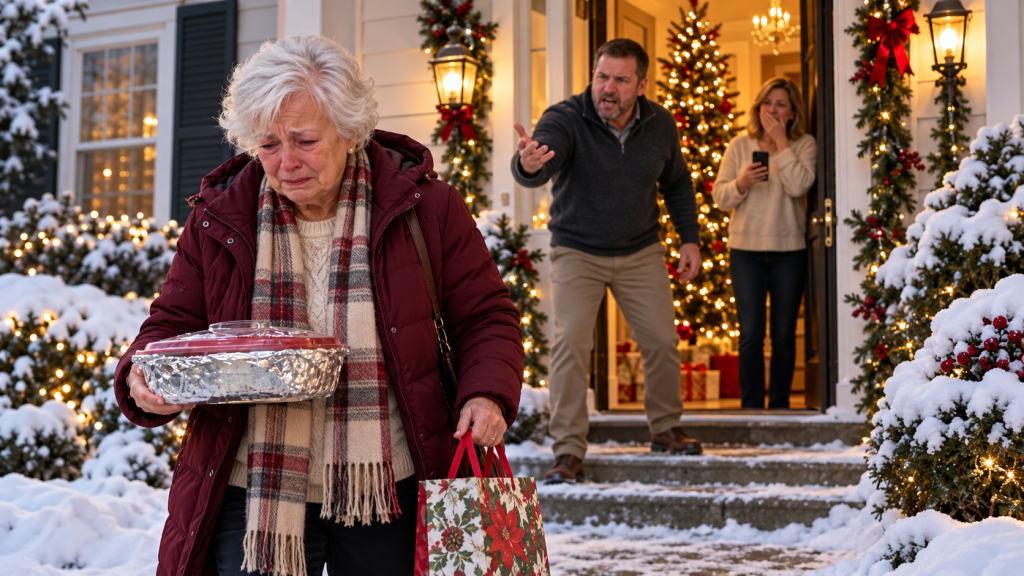
Last night, I’d stood on that porch holding a homemade turkey dish and presents.
My son had called me nobody.
Wrong house.
And shut the door.
Something inside me settled.
“They won’t.”
I stepped out of the car.
The cold hit my face immediately.
Snow crunched beneath my boots.
A mover came down the front steps carrying a floor lamp.
He glanced toward me.
“Ma’am, you’ll need to keep the driveway clear.”
I nodded.
“Of course.”
Then I looked toward the house.
“What are you moving?”
He hesitated.
“Furniture. Personal effects.”
“Where?”
He glanced at his coworker.
“Storage facility, ma’am.”
I frowned.
Not another house.
Storage.
Then Daniel appeared.
He stood in the doorway wearing yesterday’s wrinkled sweater.
His hair was disheveled.
His face pale.
When he saw me, he stopped.
“Mom?”
I looked at him.
“Merry Christmas, Daniel.”
He stared at me.
For one terrible second, I remembered the little boy who used to race downstairs on Christmas morning.
He would come running into the kitchen in his pajamas, shouting that Santa had arrived.
I’d scoop him into my arms.
His cheeks would be warm.
His eyes bright.
Arthur would be laughing behind us, pretending he hadn’t stayed awake until two in the morning assembling toys.
Now my son stood before me at forty-three, looking as though he hadn’t slept.
“Mom, what are you doing here?”
I looked toward the moving van.
“I might ask you the same thing.”
He swallowed.
“It’s complicated.”
I glanced at the sign.
“Are you selling your house?”
He didn’t answer.
“Daniel?”
His jaw tightened.
“We’re trying to sort something out.”
I nodded slowly.
“Does it have anything to do with Robert?”
My son’s face changed.
And in that instant, I knew I’d touched the center of whatever was happening.
“Why would you ask that?” he demanded.
I reached into my handbag.
Pulled out one sheet of paper.
And held it toward him.
“Because six payments from my account were redirected to your father-in-law.”
He stared at the page.
“What?”
“Payments I believed were helping your household.”
His eyes moved across the figures.
Then he shook his head.
“No.”
I watched him.
“No what?”
“Robert wouldn’t—”
He stopped.
His expression changed.
I saw something flicker behind his eyes.
Recognition.
Fear.
Perhaps even guilt.
“Daniel,” I asked quietly, “where has my money been going?”
He looked toward the house.
Before he could answer, Claire appeared behind him.
She was wearing a cream-colored cashmere coat.
Her hair was pulled into a perfect ponytail.
Even on Christmas morning, with movers carrying furniture from her home, she looked ready for a photograph.
Until she saw me.
Then her face hardened.
“You’ve got some nerve showing up here.”
I stared at her.
“Good morning, Claire.”
She crossed her arms.
“After what you did last night?”
I almost laughed.
What I’d done.
I’d stopped giving money to people who’d publicly humiliated me.
And somehow, in Claire’s mind, that made me the villain.
“I’m not here to argue,” I said.
“Then why are you here?”
I lifted the bank statement.
“To ask why payments meant for your household went into your father’s account.”
The color drained from her face.
It happened so quickly that I almost missed it.
Her mouth opened.
Then closed.
Daniel turned toward her.
“Claire?”
She didn’t answer.
I looked between them.
And suddenly, the Christmas lights around the front porch seemed painfully bright.
Then a man’s voice came from inside.
“What’s all this noise?”
Robert Bennett stepped into the doorway.
Gray hair.
Expensive wool coat.
Gold watch.
The unmistakable confidence of a man who’d spent most of his life expecting people to move aside when he entered a room.
His eyes settled on me.
“Well,” he said, smiling thinly. “Margaret Whitmore.”
I looked at him.
“Robert.”
He glanced at Daniel.
“I thought you said your mother was staying away.”
I felt my chest tighten.
Daniel lowered his eyes.
Before I could speak, Robert continued.
“I’m afraid this isn’t a good time for visitors.”
I raised an eyebrow.
“I’m not here to visit.”
I held up the document.
“I’m here because somebody submitted a payment authorization to my bank.”
Robert’s expression barely changed.
But his eyes sharpened.
“And?”
“It bears my signature.”
He shrugged.
“Then I imagine you signed it.”
I met his gaze.
“I didn’t.”
For the first time, his smile disappeared.
Behind him, Claire shifted.
Robert noticed.
He looked toward her.
Then back at me.
“Margaret, this is a private family matter.”
I felt heat rise inside me.
For fourteen years, I’d been part of this family’s financial matters whenever a bill needed paying.
But when questions became uncomfortable, suddenly I was an outsider.
I looked toward the moving van.
“Are you buying this house, Robert?”
Daniel turned sharply.
“What?”
Robert’s expression hardened.
“Don’t be ridiculous.”
I nodded toward the sign.
“Then whose company is listing it?”
He didn’t answer.
I continued.
“And why are movers taking Daniel’s furniture into storage on Christmas morning?”
Robert folded his arms.
“Daniel has made some unfortunate business decisions.”
My stomach tightened.
I turned toward my son.
“What decisions?”
Daniel’s face crumpled.
He looked as though he might cry.
Then Robert spoke over him.
“He borrowed money he couldn’t repay.”
I went still.
For a moment, the snow seemed to stop falling.
I stared at Daniel.
“From whom?”
He swallowed.
Robert answered.
“From me.”
I looked back toward the older man.
He spoke calmly.
Too calmly.
“I stepped in when your son was about to lose everything. This property needs to be sold to settle his obligations.”
My chest tightened.
“How much does he owe you?”
Robert hesitated.
Then answered.
“One hundred and eighty thousand dollars.”
I stopped breathing.
One hundred and eighty thousand.
My mind raced.
For fourteen years, Daniel had called me whenever money was tight.
Mortgage contributions.
Tuition.
Insurance.
Business emergencies.
And now Robert claimed my son owed him another fortune.
I turned toward Daniel.
“Is that true?”
He covered his face.
For a moment, he couldn’t speak.
Then he whispered:
“Mom, I was going to tell you.”
I felt something break inside me.
When?
After the house was sold?
After the children were uprooted?
After Robert received everything he’d demanded?
I looked at the moving van again.
Then at the For Sale sign.
And finally at Claire.
She had gone very still.
I remembered the bank authorization.
The six redirected payments.
The unfamiliar beneficiary.
My forged signature.
Suddenly, I understood why my son had called me twenty-five times that morning.
He hadn’t called because he missed me.
He hadn’t called because he regretted shutting the door.
He’d called because his family was already standing on the edge of financial disaster.
And I’d just stopped the money that kept flowing into it.
I took a breath.
“Daniel, how much have I given you over fourteen years?”
He looked up.
“Mom—”
“Answer me.”
His face tightened.
“I don’t know exactly.”
“I do.”
Robert shifted.
I continued.
“Because I’ve kept every statement.”
Daniel stared.
I swallowed.
“Mortgage support. School expenses. Insurance. Business funding. Emergency transfers.”
My voice trembled.
“Fourteen years of helping you because I thought I was making life easier for you and the children.”
Claire looked away.
I met my son’s eyes.
“And yesterday, you told your daughter I was nobody.”
His face collapsed.
For a moment, I thought he might step toward me.
Apologize.
Beg me to understand.
Instead, he whispered:
“Mom, please. Not here.”
I looked toward the house.
The curtains were drawn.
The Christmas tree glowed in the living-room window.
Somewhere inside were my grandchildren.
And I realized I couldn’t let this scene continue on the front lawn.
Not for their sake.
Not for mine.
I turned toward Robert.
“I’m not discussing this outside.”
He lifted his chin.
“You aren’t part of this transaction.”
I smiled sadly.
“Then you won’t mind explaining why you’ve been receiving money from my account.”
For the first time, Robert said nothing.
And I knew.
Whatever was happening inside that house, he had not expected me to arrive with paperwork.
A small face appeared at the living-room window.
Lily.
My seven-year-old granddaughter.
Her dark hair was tied with a red ribbon.
She pressed both hands against the glass.
When she saw me, her eyes widened.
Then she smiled.
“Grandma!”
I couldn’t hear her through the window.
But I could read her lips.
My heart broke.
She disappeared from view.
A moment later, I heard footsteps inside.
Then the front door opened wider.
Lily came running toward me.
“GRANDMA!”
Claire gasped.
“Lily, get back inside!”
But my granddaughter was already in my arms.
I bent carefully.
Held her.
And felt the warmth of her little body against mine.
“Grandma,” she whispered, “you came back.”
Tears filled my eyes.
“Yes, sweetheart.”
She pulled away.
Her expression was serious.
“Daddy said you went to the wrong house.”
I closed my eyes.
Then she asked:
“But you know where we live. Why did he say that?”
For a moment, nobody spoke.
Daniel stared at his daughter.
Claire turned away.
Robert looked annoyed.
And I held the little girl who had just asked the simplest question anyone could ask.
I brushed snow from her hair.
“Sweetheart, sometimes grown-ups say hurtful things when they’re upset.”
She frowned.
“Did you do something bad?”
My throat tightened.
“No, Lily.”
“Then why couldn’t you come to Christmas?”
I swallowed.
I wanted to tell her the truth.
But she was seven.
She didn’t need adult cruelty poured into her Christmas morning.
So I kissed her forehead.
“That’s something the grown-ups need to sort out.”
She nodded slowly.
Then whispered:
“I made you a card.”
My eyes filled.
“Did you?”
She smiled.
“Yes. But Mommy said we should put it away.”
I looked toward Claire.
She stared at the driveway.
I hugged Lily again.
“I’d love to see it someday.”
She smiled.
“Really?”
“Really.”
Then another child appeared in the doorway.
Oliver.
Ten years old.
Tall for his age.
Serious.
So much like Daniel at that age that my heart ached.
He looked at the moving van.
Then at me.
“Grandma?”
“Yes, sweetheart?”
His voice trembled.
“Are we losing our house?”
The question hung in the cold air.
Daniel stepped forward.
“Oliver, go inside.”
But Oliver didn’t move.
His eyes were wet.
“Dad, nobody will tell me what’s happening.”
Claire reached for him.
“Honey, please.”
He shook his head.
“Why are they taking my bed?”
I looked toward the movers.
They had stopped working.
One man held a cardboard box.
Another stood beside the truck, looking uncomfortable.
Robert sighed impatiently.
“We really don’t have time for this.”
Something inside me hardened.
I turned toward him.
“These are children, Robert.”
He blinked.
I continued.
“They deserve to know they won’t be forgotten while the adults argue about money.”
Daniel’s face crumpled.
I looked toward Oliver.
“Sweetheart, I can’t promise what will happen with this house.”
His lower lip trembled.
“But I can promise that I love you and Lily, and I’m going to make sure we stay in touch.”
He stepped toward me.
I wrapped my arms around both children.
And as I held them, I made a decision.
I would not allow my grandchildren to become bargaining chips.
Not for Daniel.
Not for Claire.
And certainly not for Robert.
I looked toward my son.
“Daniel, the children need somewhere warm and quiet while you sort this out.”
He nodded miserably.
“I know.”
I swallowed.
“Ruth is parked nearby. If you and Claire agree, I can take them to my house for the afternoon.”
Claire opened her mouth.
Then closed it.
Robert looked irritated.
Daniel glanced toward the moving van.
Then at his children.
Finally, he nodded.
“Please.”
Lily squeezed my hand.
“Can we have Christmas at your house?”
Tears filled my eyes.
I smiled.
“If your parents agree, we can have a lovely afternoon.”
Oliver looked toward the van.
“Can Bunny come?”
I almost laughed.
“Of course.”
He blushed.
“It’s Lily’s bunny.”
Lily giggled.
“It’s Mr. Buttons!”
For one brief moment, the adults stopped arguing.
The children smiled.
And Christmas felt like Christmas again.
Then Robert’s phone rang.
He looked at the screen.
His expression changed.
He stepped away toward the driveway.
I watched him.
He answered in a low voice.
“Yes?”
A pause.
Then:
“Not today.”
Another pause.
His jaw tightened.
“I said the property will be ready.”
I felt cold.
Whoever was calling him, they were expecting something.
Something involving my son’s home.
Robert glanced toward me.
Then turned his back.
But I caught one sentence before he moved farther away.
“The buyer doesn’t need to know about Margaret’s bank dispute.”
My heart began pounding.
The buyer.
The bank dispute.
Why would the sale of Daniel’s house have anything to do with my unauthorized payments?
Unless the money hadn’t simply been stolen.
Unless Robert had been using those transfers to support something connected to the property.
I looked toward the For Sale sign.
Then at the moving van.
And I knew the next thing I needed to do.
Not argue.
Not threaten.
Not offer another cent.
I needed a lawyer.
Because Robert Bennett was suddenly acting like a man who feared more than an unpaid debt.
He feared somebody looking closely at the paperwork.
I didn’t follow Robert down the driveway.
I didn’t demand to see the person on the other end of his telephone.
And I didn’t announce that I intended to challenge every suspicious document bearing my name.
For years, I’d watched Daniel argue with Robert.
Robert always knew how to turn an argument into a performance.
He raised his voice.
Questioned people’s intelligence.
Made them feel foolish for asking reasonable questions.
I wasn’t going to give him another opportunity.
Instead, I turned toward my grandchildren.
“Oliver, Lily, would you like to help me make Christmas dinner?”
Lily’s face brightened.
“Are we really allowed?”
I glanced toward Daniel.
He nodded.
“Yes, sweetheart.”
Oliver looked toward the moving van.
“What about our stuff?”
Daniel crouched in front of him.
“Your things are going into storage for now. We’re going to figure out what happens next.”
It was the first honest answer I’d heard my son give that morning.
Oliver swallowed.
“Can we keep our Christmas presents?”
“Of course,” Daniel said.
I wished I could believe that simple promise was enough to reassure him.
Claire disappeared inside to gather the children’s coats and overnight bags.
Daniel stood beside me while we waited.
For a moment, neither of us spoke.
Then he whispered:
“Mom, I’m sorry about last night.”
I looked at him.
He looked exhausted.
Ashamed.
And frightened.
I wanted to hold him.
The same way I’d held him when he was little and woke from a nightmare.
But then I remembered his laughter over the phone.
The way he’d told Claire that money couldn’t buy me a place at his table.
The way he’d pretended not to know who I was when Lily asked about the doorbell.
Some words leave marks that an apology cannot immediately erase.
“Daniel,” I said quietly, “why didn’t you invite me?”
He looked down.
I waited.
Finally, he whispered:
“Claire didn’t want you there.”
My chest tightened.
“Why?”
He swallowed.
“Her parents were coming.”
I stared at him.
“Her parents come every Christmas.”
“I know.”
“Then what changed?”
He looked toward Robert.
Something moved behind his eyes.
Fear.
I had seen that expression on Daniel before.
When he was fifteen and broke the neighbor’s window.
When he was nineteen and wrecked my old car.
When he was twenty-six and told Arthur he’d quit his first job without finding another.
But those had been ordinary mistakes.
This was different.
“Daniel,” I asked, “did Robert tell you not to invite me?”
He closed his eyes.
Then nodded.
My heart sank.
“Why?”
My son swallowed.
“Because he said you’d start asking questions about the house.”
I stared.
“So you knew there were questions I should be asking.”
He didn’t answer.
“Daniel?”
Finally, he whispered:
“Yes.”
I looked away.
The snow was falling more heavily now.
Somewhere down the street, a dog barked.
A neighbor had hung a wreath on the garage door.
The ordinary beauty of Christmas morning seemed almost cruel beside what was happening.
“Why would Robert worry about me asking questions?”
Daniel rubbed his face.
“Mom, it’s complicated.”
I turned toward him.
“Stop saying that.”
He looked startled.
I continued.
“Complicated doesn’t mean impossible to explain.”
He lowered his head.
I took a breath.
“Tell me what happened.”
Daniel looked toward the house.
Then toward the moving van.
“About eighteen months ago, my business started losing money.”
My heart tightened.
He owned a small commercial renovation company.
Not enormous.
But successful enough, I’d believed.
He employed twelve people.
Handled office refurbishments.
Retail renovations.
Restaurant interiors.
And occasionally subcontracted for larger construction firms.
Arthur would’ve been proud of him.
He’d always loved building things.
“What happened to the business?” I asked.
Daniel swallowed.
“Two major clients delayed payment. Then one project went over budget.”
I nodded.
“Why didn’t you tell me?”
He laughed bitterly.
“Because you’d already helped us so much.”
I stared.
“And somehow that became a reason to hide the truth?”
He looked away.
“Robert offered to help,” Daniel continued.
My stomach tightened.
“How?”
“He said he could arrange private financing.”
I nodded slowly.
“And you accepted?”
“Yes.”
“How much?”
Daniel hesitated.
“Seventy-five thousand at first.”
My chest tightened.
“Then?”
“He said the interest and fees had increased. We refinanced the obligation through one of his companies.”
I swallowed.
“And now he says you owe him one hundred and eighty thousand?”
Daniel nodded.
“Yes.”
I stared at him.
“Did you have an independent lawyer review the papers?”
He looked down.
“No.”
“Did you have an accountant examine the figures?”
“No.”
I closed my eyes.
“Daniel…”
His voice broke.
“I know.”
He wiped his face.
“Every time I tried to pay it down, he said there were new charges.”
My stomach tightened.
“What kind of charges?”
“Arrangement fees. Extensions. Consulting costs.”
I stared.
“Consulting?”
He nodded miserably.
“His company billed mine for restructuring advice.”
I took a long breath.
Robert had built his reputation by describing himself as a man who helped struggling businesses.
Now I wondered how often his help came with a price that kept growing.
“Daniel,” I said quietly, “do you have copies of the original agreements?”
“Yes.”
“Then get them to your own attorney.”
He looked at me.
“Mom, I don’t have the money for another lawyer.”
For a moment, I felt the old familiar pull.
The reflex I’d developed over fourteen years.
How much do you need, sweetheart?
I’ll transfer it tonight.
Don’t worry. We’ll figure it out.
That reflex had kept me paying bills long after Daniel stopped explaining them.
But I forced myself to be still.
“You need independent advice,” I said.
He stared.
“Not from Robert.”
His eyes filled.
“And not from me acting as an emergency bank.”
For a moment, his face hardened.
I recognized the look.
He wasn’t used to hearing no.
Especially from me.
Then he looked toward the moving van.
And something seemed to drain from him.
He whispered:
“Okay.”
Claire returned with two overnight bags.
She looked at Daniel.
“What did you tell her?”
He stiffened.
“Claire—”
“What did you tell your mother?”
Her voice rose.
Robert glanced toward us.
I stepped forward.
“Claire, the children are right here.”
She looked down.
Lily was holding Oliver’s hand.
Both children were watching us.
Claire closed her eyes.
Then forced a smile.
“Of course.”
I reached for the bags.
“We can discuss everything else another time.”
Claire hesitated.
Then handed them over.
Her fingers were trembling.
For a moment, our eyes met.
She looked frightened.
Not merely angry.
And I wondered whether she was starting to understand that her father’s promises could no longer protect her.
I drove the children to my house.
Ruth followed in her own car.
The turkey dish I’d prepared the night before was still in the refrigerator.
The presents were still wrapped beneath my tree.
And for the first time since Daniel closed his door on me, I felt something warm stir inside my chest.
Lily ran into the living room.
“Grandma!”
I followed.
She stopped beside the tree.
Her eyes widened.
“You kept our presents?”
I smiled.
“Of course.”
Oliver looked toward me.
“Even though Dad was mean to you?”
My throat tightened.
I crouched beside him.
“Oliver, what happened between your father and me doesn’t change how much I love you.”
He swallowed.
“Really?”
I nodded.
“Really.”
His face crumpled.
Then he wrapped his arms around my neck.
I held him.
And suddenly, I was crying too.
We ate our Christmas dinner at three in the afternoon.
Not a grand feast.
The turkey dish.
Roasted potatoes.
Green beans.
And the apple pie Ruth had brought.
Lily insisted on putting paper napkins beneath every fork.
Oliver helped pour sparkling apple juice.
Ruth lit two candles.
And when we sat down, the house felt fuller than it had in years.
I looked around the table.
Two grandchildren.
My oldest friend.
A meal I’d prepared with love.
No expensive centerpiece.
No perfect matching Christmas pajamas.
No relatives evaluating the quality of the wine.
Just people who were glad to be together.
Lily lifted her glass.
“I want to make a toast!”
Ruth smiled.
“Go ahead, sweetheart.”
Lily considered.
Then announced:
“To Grandma, because she always remembers us!”
My heart broke.
I smiled through tears.
“To all of us remembering each other.”
Oliver raised his glass.
Ruth did too.
And for one beautiful moment, Christmas belonged to us again.
After dinner, the children opened their presents.
Lily squealed over a doll she’d been asking for since October.
Oliver hugged me after unwrapping a model train set.
Ruth took photographs.
I laughed.
And for several hours, I didn’t think about Robert Bennett.
But just before sunset, Oliver came into the kitchen.
I was washing dishes.
He stood in the doorway looking unusually serious.
“Grandma?”
“Yes, sweetheart?”
“Can I ask you something?”
I dried my hands.
“Of course.”
He looked toward the living room.
Lily was playing with her doll.
Ruth was helping her arrange the little accessories.
Oliver moved closer.
Then whispered:
“Are we poor?”
I went still.
I crouched in front of him.
“Why do you ask?”
His eyes filled.
“Grandpa Robert says Dad ruined everything.”
My heart tightened.
“Did he say that to you?”
Oliver nodded.
“He was shouting last week.”
I swallowed.
“What did he say?”
Oliver looked down.
“He said the house belonged to him now.”
A cold feeling spread through me.
I knew Robert had loaned Daniel money.
But lending money and owning a house were not the same thing.
“Did he say anything else?” I asked gently.
Oliver hesitated.
Then nodded.
“He said Dad had to sign the papers before you found out.”
My breath caught.
“What papers?”
Oliver shook his head.
“I don’t know.”
I forced myself to remain calm.
He was ten years old.
He hadn’t been responsible for understanding adults’ financial decisions.
I wasn’t going to question him as though he were a witness on trial.
I smoothed his hair.
“Oliver, you don’t need to worry about the papers. The grown-ups will handle that.”
His eyes filled.
“Are Mom and Dad going to divorce?”
My chest tightened.
“I don’t know, sweetheart.”
He swallowed.
“Will we have to change schools?”
“I don’t know that either.”
He looked frightened.
I took his hands.
“But I do know that you and Lily are loved, and there are adults who will help your parents work through these problems.”
A tear rolled down his cheek.
Then he whispered:
“Grandma, why does everybody keep saying we have to pretend?”
I stared.
“Pretend what?”
He lowered his voice.
“That everything’s fine.”
I had no answer.
Because for fourteen years, that was exactly what I’d been doing too.
Pretending the transfers were temporary.
Pretending Daniel would eventually become financially independent.
Pretending Claire’s coldness was simply a personality difference.
Pretending Robert’s grand speeches about self-reliance were harmless.
And pretending that a family could remain healthy when everyone agreed not to ask uncomfortable questions.
I pulled Oliver into my arms.
“You don’t have to pretend with me.”
He began crying.
I held him until his breathing settled.
Then he whispered:
“Can I tell you something else?”
I kissed his forehead.
“Of course.”
He looked toward the hallway.
“Grandpa Robert was in Dad’s office yesterday.”
My stomach tightened.
Oliver continued.
“He had a blue folder.”
I went still.
“He told Mom they couldn’t let you see it.”
For a moment, I couldn’t breathe.
Then Oliver added:
“Dad got really angry.”
I swallowed.
“What did he do?”
“He said, ‘That’s not her signature.’”
I felt cold all over.
Oliver looked up at me.
“Grandma, whose signature?”
I forced a gentle smile.
“That’s something the adults will need to explain.”
But inside, my thoughts were racing.
My son’s words.
That’s not her signature.
Robert’s blue folder.
And the bank authorization bearing my name.
If Daniel had already challenged a signature before Christmas Eve, then he’d known something was wrong before he shut his door on me.
And he hadn’t said a word.
When the children finally fell asleep that night, I sat with Ruth at the kitchen table.
The house was quiet.
Outside, snow covered the street.
I poured two cups of tea.
Then opened the folder containing my financial records.
Ruth watched me.
“Margaret, what are you thinking?”
I stared at the bank authorization.
The signature.
My printed name.
The six diverted transfers.
Then whispered:
“Daniel knew.”
Ruth frowned.
“Knew what?”
I looked up.
“That someone was using my name on documents I hadn’t signed.”
Her expression changed.
“Are you sure?”
I shook my head.
“Not completely.”
Then I told her what Oliver had overheard.
Ruth sat back.
For a moment, neither of us spoke.
Finally, she whispered:
“Margaret, you need to find out how much your son knew before you help him with anything else.”
I stared at the table.
Tears filled my eyes.
Because I was beginning to fear that Robert wasn’t the only person who’d betrayed my trust.
At nine the next morning, I called my attorney.
Her name was Helen Brooks.
She’d helped Arthur and me update our wills years earlier.
We’d trusted her ever since.
She answered from her home.
“Margaret?”
“Merry Christmas, Helen. I’m sorry to bother you during the holiday.”
Her voice warmed.
“Margaret, what is it?”
I swallowed.
“I think someone forged my signature.”
There was a pause.
Then Helen asked:
“On what document?”
I took a breath.
“A bank payment authorization. Possibly something else.”
Her voice became serious.
“Do you have copies?”
“Yes.”
“Good. Preserve everything exactly as you received it. Don’t alter the files or confront anyone about the details until we understand them.”
I nodded.
Then asked:
“Helen, what if my son knew?”
She was quiet.
Then answered:
“Then we’ll need to establish what he knew, when he knew it, and what he did.”
I closed my eyes.
I wished she’d told me Daniel couldn’t possibly be involved.
That there had to be an innocent explanation.
But Helen had always been careful with the truth.
And I needed that now.
Before we ended the call, she said something that made my stomach tighten.
“Margaret, I want you to check whether you ever signed any agreement guaranteeing Daniel’s business debts.”
I frowned.
“No.”
“Are you certain?”
“Yes.”
A pause.
“Then we’re going to ask for any documents Robert or his lenders claim give them rights against you or your assets.”
My heart began pounding.
“Why?”
Helen’s voice was calm.
“Because the diverted transfers may not be the only reason somebody wanted your signature.”
The blue folder arrived at Helen’s office three days after Christmas.
Not because Robert decided to cooperate.
Because Daniel finally stopped answering his father-in-law’s demands and hired an independent attorney.
His lawyer requested the financing records.
Helen requested any documents bearing my name.
And suddenly, the people who’d spent months insisting everything was perfectly ordinary had to explain what they’d been putting on paper.
I met Helen in her office on a cold Thursday morning.
Ruth drove me.
The children were back with their parents, and Daniel had promised they would remain away from the moving activity until the adults had settled arrangements for the house.
I hadn’t offered him another dollar.
That was important.
I loved him.
I worried about him.
And seeing my grandchildren frightened had almost persuaded me to open my bank account again.
But Helen had been firm.
“Margaret, you can help children without automatically taking responsibility for every debt their parents have accumulated.”
I’d thought about that sentence all night.
Because perhaps that was the lesson I’d spent fourteen years refusing to learn.
Helen greeted me with a cup of coffee.
“Sit down, Margaret.”
I looked at the thick folder on her desk.
“Is that it?”
She nodded.
“Copies of the financing agreement and supporting documents.”
I sat.
My heart was pounding.
The first document was a promissory note.
Daniel’s renovation company had borrowed seventy-five thousand dollars from a business controlled by Robert.
The note had been signed eighteen months earlier.
The interest rate was high.
There were extension fees.
Administrative charges.
And provisions that could trigger immediate repayment if certain conditions were breached.
I stared at the pages.
“Daniel really signed this?”
Helen nodded.
“His attorney confirms the signature appears genuine, and Daniel acknowledges entering into the loan.”
I closed my eyes.
“Was he desperate?”
“Apparently. His business had cash-flow problems.”
I looked down.
Arthur used to tell Daniel that borrowing money wasn’t always wrong.
But he also warned him never to accept terms he didn’t understand simply because the lender happened to be family.
Now I wished my husband were sitting beside me.
Not because he’d solve everything.
Because he’d know how to look at our son and say:
Daniel, you must take responsibility for your own signature.
Helen turned the page.
“Now look at this.”
It was a schedule of payments.
Interest.
Fees.
Additional charges.
And a running balance that had grown to approximately one hundred and eighty thousand dollars.
I stared at the figure.
“From seventy-five thousand?”
She nodded.
“The amounts and enforceability of these charges need close review.”
I swallowed.
Then noticed something.
The schedule contained six recent entries labeled:
FAMILY SUPPORT CREDIT.
I frowned.
“Helen?”
“Yes?”
“Those dates match the money redirected from my account.”
She looked up.
“I noticed.”
My heart began pounding.
The amounts matched.
Dollar for dollar.
Every month my bank account had sent money to Robert, a corresponding line appeared on his company’s books.
I looked at Helen.
“So he received my payments?”
“Yes, according to these records.”
“And credited them toward Daniel’s debt?”
“That’s what the entries suggest.”
I swallowed.
“Then why is he demanding the full one hundred and eighty thousand?”
Helen leaned forward.
“That’s one of the questions we’ve asked.”
I stared at the ledger.
The six payments totaled thirty-six thousand dollars.
Money I hadn’t authorized Robert to receive.
Money that should have gone toward the household support I’d intended.
Now it appeared inside his private lending records.
But the demand he’d presented to Daniel did not clearly reflect those credits.
“Helen,” I whispered, “is he collecting the same money twice?”
She folded her hands.
“There’s a serious inconsistency. The underlying records need to be reconciled before we can conclude exactly what he did.”
I nodded.
For thirty-two years, I’d worked as an administrative manager for a medical-supply company.
I knew how complicated records could become.
But I also knew that money couldn’t vanish from one account and magically become somebody else’s entitlement.
Then Helen turned another page.
“Margaret, this is the document I was most concerned about.”
I stared at the heading.
PERSONAL GUARANTY AND FINANCIAL SUPPORT UNDERTAKING.
My name appeared underneath.
Margaret Whitmore.
I stopped breathing.
“What is that?”
Helen’s expression was serious.
“It purports to show that you agreed to guarantee certain obligations connected to Daniel’s financing.”
I stared.
“No.”
She nodded.
“I understand.”
“I never signed anything like this.”
“I know that’s your position, and we’ve formally disputed it.”
I looked down.
My signature appeared at the bottom.
The familiar curve of the M.
The long stroke beneath my surname.
Except something was wrong.
It looked too neat.
Too perfect.
I leaned closer.
Then remembered a Christmas card I’d sent Robert and Denise three years earlier.
I’d enclosed a check to help with a family charity event.
I’d signed the card.
And the check.
In my usual handwriting.
“Helen?”
“Yes?”
“Can I see the bank authorization?”
She placed it beside the guaranty.
I looked between the two signatures.
Then felt cold.
“They’re identical.”
Helen nodded slowly.
“Very similar.”
“No.”
I pointed.
“Look at the little mark after the final letter.”
She leaned closer.
I continued.
“That’s not something I make every time I sign my name.”
My voice shook.
“It’s the same mark on both documents.”
Helen studied them.
“The original electronic files and any associated authentication records should tell us more.”
I sat back.
For a moment, I couldn’t speak.
Then whispered:
“Someone copied my signature.”
Helen didn’t rush to reassure me.
She simply said:
“We have grounds to investigate that possibility.”
I looked at the guaranty again.
It claimed I’d agreed to support Daniel’s borrowing up to a stated amount.
It did not make Robert the owner of my home.
It did not automatically give him access to my bank accounts.
And it certainly didn’t turn my son’s debt into mine merely because my name appeared on a disputed page.
But I understood why Helen was concerned.
Robert had apparently been presenting my financial support as something much more formal than the help I’d freely chosen to give.
I pointed toward the guaranty.
“Would this have allowed him to take money from me?”
Helen shook her head.
“A guaranty and authorization to withdraw funds are different things. Their validity and effects depend on the actual documents and applicable law. But someone could attempt to use a purported guaranty to demand payment or persuade a lender that another person stood behind the debt.”
I swallowed.
“So if I hadn’t stopped the transfers…”
“We don’t know how far this would have gone.”
She paused.
“But stopping them and asking questions was important.”
I looked down at my hands.
The hands that had held Daniel as a baby.
The hands that had signed tuition checks.
Written birthday cards.
Prepared Christmas dinners.
Now someone had apparently turned my signature into a tool for borrowing money.
And I was furious.
Helen closed the folder.
“Margaret, there’s something else you need to know.”
I looked up.
My stomach tightened.
“What?”
“Daniel knew there was a document bearing your signature.”
I closed my eyes.
I had expected it.
But hearing the words still hurt.
“When?” I whispered.
“His attorney says Daniel saw a copy in Robert’s office two days before Christmas.”
I stared.
Two days before Christmas.
Before the party.
Before I stood outside his house.
Before he told Lily I was nobody.
“He knew before he shut the door on me.”
Helen was quiet.
“Yes.”
A tear slipped down my cheek.
“Did he know it was false?”
“We need his direct account. He says he questioned the signature and was assured it was a routine confirmation of support you had already agreed to provide.”
I stared.
“And he believed Robert?”
“He says he was uncertain.”
I looked away.
Uncertain.
Such a small word.
And yet Daniel had been certain enough that I shouldn’t attend Christmas dinner.
For a long time, I sat quietly.
Then I whispered:
“Helen, I don’t know which betrayal hurts more.”
She waited.
“The person who used my name.”
My voice broke.
“Or the son who knew enough to ask questions and decided it was easier not to invite me.”
Helen handed me a tissue.
“Margaret, you don’t have to decide how you feel about Daniel today.”
I wiped my cheeks.
“You can protect your financial position while giving yourself time to understand what happened.”
I nodded.
That sounded sensible.
And for once, I intended to take sensible advice instead of rushing to rescue everyone else.
The next revelation came from the real-estate agent.
Her name was Vivian Shaw.
She worked for a brokerage in Essex County.
Helen had contacted her because the For Sale sign on Daniel’s lawn didn’t match any completed sale she’d been able to verify.
Vivian agreed to meet with Daniel’s attorney and provide the brokerage’s records.
What she revealed surprised all of us.
The house had never been placed on the public market through her office.
Not properly.
Robert had contacted Vivian’s brokerage claiming Daniel and Claire urgently needed to sell.
Claire had signed a preliminary listing form.
Daniel had not.
The brokerage had requested his authorization before proceeding.
But Robert arranged for a sign to be placed on the lawn through a separate marketing contractor.
He also scheduled movers.
All before the listing was complete.
I stared at the explanation.
“Why?”
Helen considered.
“Possibly to put pressure on Daniel and Claire to proceed with a sale. We’ll need more evidence before assigning motives.”
I shook my head.
“He was making it look inevitable.”
Helen looked at me.
“That’s a reasonable concern.”
The moving company confirmed it had been hired to remove furniture and store it temporarily.
The order had come from an assistant in Robert’s office.
Daniel’s name had been provided as the homeowner.
But the company had no reason to believe it was involved in a family dispute until the argument on Christmas morning.
Once Daniel raised objections, the remaining move was stopped pending clarification.
I sat back.
The van.
The sign.
The children frightened in the doorway.
All designed, or at least arranged, to move the household toward a sale that Daniel hadn’t fully authorized.
Robert’s pressure was becoming visible.
And yet there was something else that troubled me.
“Why sell the house so quickly?” I asked Helen.
She looked toward me.
“What do you mean?”
“Robert already knew Daniel owed him money. Why demand a sale on Christmas morning?”
Helen nodded.
“Good question.”
I leaned forward.
“Why now?”
The answer emerged from an email Daniel’s attorney obtained.
Robert had been negotiating with a potential buyer connected to one of his property companies.
The buyer intended to acquire the house below its estimated market value.
Renovate it.
And resell it.
The proposed transaction included an arrangement under which Robert’s company would receive money from the proceeds, ostensibly to satisfy the debt.
I stared at the figures.
Daniel’s home had recently been estimated to be worth approximately six hundred and twenty thousand dollars.
The proposed private sale price was four hundred and sixty thousand.
I stopped breathing.
“They’d lose one hundred and sixty thousand dollars of value?”
Helen raised a hand.
“That’s the difference between the estimate and proposed price, not necessarily the exact net loss. There would be transaction costs, the mortgage balance, and other factors.”
I nodded.
“But it would still be a terrible offer.”
“On the information we have, it appears substantially below the stated estimate.”
My hands began trembling.
Robert had loaned Daniel money.
Charged fees.
Received unauthorized transfers from my account.
And then pushed for a distressed sale that could benefit a buyer connected to him.
I looked toward Helen.
“Robert isn’t simply collecting a debt.”
She nodded cautiously.
“The relationships and proposed financial benefits warrant scrutiny.”
For the first time, I stopped wondering whether Robert genuinely believed he was helping his son-in-law.
Whatever his intentions had been at the beginning, the documents now showed interests far beyond Daniel’s well-being.
Then Helen turned to one final page.
“This is an internal email from Robert’s office.”
I looked down.
It had been written by his assistant.
The subject line read:
HOLIDAY CLOSING — WHITMORE SUPPORT.
My stomach tightened.
Helen pointed toward a sentence.
I read it.
Then went completely still.
Confirm Margaret Whitmore remains committed to recurring support until the property is transferred.
I stared.
My bank account.
The one I’d spent fourteen years using to help my son’s family.
Robert’s office had apparently been treating it as a source of money expected to remain available throughout the proposed sale.
Then I reached the final sentence.
Daniel says his mother may ask questions. Claire will handle her.
For several seconds, I couldn’t breathe.
Claire.
My daughter-in-law.
The woman who’d laughed when Daniel told me money couldn’t buy a seat at their Christmas table.
The woman who’d stood behind him while he shut the door.
She hadn’t merely been uncomfortable having me at dinner.
According to that email, she’d been given the job of keeping me from interfering.
I looked toward Helen.
My voice was barely audible.
“Claire knew.”
Helen nodded.
“The email suggests she was involved in managing communication with you.”
I closed my eyes.
“And Daniel knew I might ask questions.”
“Yes.”
A tear rolled down my cheek.
For fourteen years, I’d thought I was helping my son build a better life.
But somewhere along the way, my financial support had become something his family expected.
Something they budgeted around.
Something Robert tried to incorporate into his own arrangements.
And something Claire seemed determined to protect from scrutiny.
I looked at the papers spread across Helen’s desk.
Then whispered:
“I need to speak to Daniel.”
Helen studied me.
“Are you certain?”
I nodded.
“Yes.”
I took a breath.
“But this time, we’re not meeting at his kitchen table.”
I looked directly at her.
“And we’re not meeting at mine.”
Helen nodded.
“Where would you like to meet?”
I swallowed.
“Here.”
She smiled faintly.
“That’s a good idea.”
Because I finally understood something important.
My son had spent fourteen years coming to me whenever he needed money.
But the next time he sat across from me, I wasn’t going to ask how much he needed.
I was going to ask how much he knew.
Daniel arrived at Helen’s office the following Monday.
He was ten minutes early.
That surprised me.
For years, he’d been late to family dinners.
Late to birthdays.
Late to the little celebrations I’d arranged for the grandchildren.
He was always rushing from one business appointment to another.
But that morning, he was sitting in the waiting room when I arrived.
His hands were clasped together.
His eyes looked tired.
And when he saw me, he stood.
“Mom.”
I stopped.
For a moment, I remembered the last Christmas we spent with Arthur.
Daniel had stood beside his father carving the turkey.
The children were much younger.
Lily was still a baby.
Oliver had fallen asleep beneath the Christmas tree.
Arthur had looked around the dining room and whispered:
“This is what all the hard work was for.”
I hadn’t understood how quickly family could become something people took for granted.
“Good morning, Daniel,” I said.
He nodded.
“Good morning.”
Then he looked toward Helen’s office.
“Are you sure you want to do this here?”
I met his eyes.
“Yes.”
He swallowed.
“All right.”
His attorney, Michael Ross, joined us.
Helen closed the office door.
We sat around a conference table.
No Christmas decorations.
No children listening.
No Robert standing in the doorway.
Just four adults and a folder full of documents.
Helen began calmly.
“Daniel, your mother wants clarity about several matters before discussing any future assistance or family arrangements.”
He nodded.
“I understand.”
I looked toward him.
“Do you?”
His face tightened.
“Mom—”
“Daniel, I don’t want another apology before you’ve answered my questions.”
He lowered his eyes.
Then nodded.
“All right.”
I opened my folder.
“Fourteen years ago, when you and Claire bought the house, how much did I give you toward the down payment?”
He looked surprised.
“Mom…”
“How much?”
He swallowed.
“Thirty thousand dollars.”
I nodded.
“And how much did I agree to contribute monthly after you told me the mortgage was difficult?”
He looked down.
“Eight hundred.”
“For how long?”
He hesitated.
“Until we were stable.”
I swallowed.
“Was that what we agreed?”
He nodded.
“Yes.”
I turned another page.
“Six years later, when you started the renovation business, what did you ask me for?”
His face tightened.
“Help with the first equipment purchase.”
“And how much did I contribute?”
“Twenty-five thousand.”
I nodded.
“Then came insurance.”
He swallowed.
“School expenses.”
“Vehicle payments.”
“Business emergencies.”
I looked at him.
“Daniel, over the years, my records show more than three hundred thousand dollars in financial assistance.”
His eyes widened.
For a moment, he seemed genuinely shocked.
I continued.
“Some months I gave more. Some less.”
My voice trembled.
“Some money went directly to schools and insurers. Some went into your accounts. Some was meant for temporary emergencies.”
He lowered his head.
“And not once did I ask you to choose between loving me and paying me back.”
His eyes filled.
“I know.”
I swallowed.
“Then why did you tell me money couldn’t buy a place at your table?”
He covered his face.
For a long moment, he couldn’t answer.
Finally, he whispered:
“Because I was ashamed.”
I stared.
“Ashamed of what?”
He looked up.
“That you still had to help me.”
I sat back.
His voice shook.
“Robert kept saying I was forty-three and still living off my mother.”
My heart tightened.
“Did he?”
Daniel nodded.
“He said Claire was embarrassed.”
I looked toward Helen.
Then back at my son.
“And instead of telling Robert to mind his own business, you took your shame out on me.”
Daniel began crying.
“Yes.”
The honesty hurt.
But it was still better than another excuse.
“Why didn’t you simply tell me you didn’t want the assistance anymore?”
He laughed bitterly.
“Because I needed it.”
My eyes filled.
There it was.
The contradiction.
My son resented receiving help.
But wouldn’t give it up.
He was embarrassed by my generosity.
But had come to depend on it.
And when Robert offered him a way to feel important, Daniel had accepted debt he couldn’t manage rather than admit he was struggling.
I looked toward him.
“Daniel, I never asked you to pretend to be successful.”
He lowered his head.
“I know.”
“I wanted you to be safe.”
His shoulders shook.
“I know.”
I swallowed.
“Your father and I weren’t wealthy. You remember that.”
He nodded.
“Yes.”
“We worked.”
“Saved.”
“Made sacrifices.”
My voice broke.
“And when we helped you, it was because we loved you.”
Daniel wiped his cheeks.
I continued.
“But somewhere along the way, you stopped seeing that help as a choice I was making.”
I looked him directly in the eyes.
“You started treating it like a payment that would always arrive.”
He didn’t argue.
Helen waited until I was ready.
Then she placed the disputed authorization on the table.
“Daniel, let’s discuss this.”
My son went pale.
“Did you know this document existed before Christmas?”
He swallowed.
“Yes.”
“When did you first see it?”
“December twenty-second.”
I closed my eyes.
Two days before he shut the door on me.
“Did you believe your mother signed it?”
Daniel hesitated.
Then answered:
“No.”
I felt the air leave my chest.
For several seconds, nobody spoke.
I stared at my son.
“You knew it wasn’t my signature?”
He began crying.
“I suspected.”
I shook my head.
“You just said no.”
He looked down.
“Mom, it looked wrong.”
My voice trembled.
“You’ve seen me sign birthday cards for forty-three years.”
His shoulders shook.
“I know.”
I gripped the edge of the table.
“Did you ask me?”
He shook his head.
“No.”
“Why?”
He began sobbing.
“Because Robert said if I started questioning the paperwork, he’d demand immediate repayment.”
My heart tightened.
He continued.
“He said the house would be sold.”
I swallowed.
“And you believed him.”
“Yes.”
“So you decided not to tell me.”
His voice broke.
“Yes.”
I sat back.
For a moment, I couldn’t look at him.
I had feared Robert forged the signature.
I had feared Claire helped him.
But my son had stood beside the document, recognized something was wrong, and chosen silence because speaking might threaten his own financial arrangements.
Daniel tried to speak.
“Mom, I didn’t create it.”
I looked up.
“I understand that.”
His eyes filled.
“But you allowed me to remain ignorant.”
He nodded.
“Yes.”
My voice broke.
“And then you shut the door on me.”
He covered his face.
I continued.
“While you knew someone might have used my name without permission.”
The room was silent.
Then Daniel whispered:
“I don’t have an excuse.”
For a moment, I wanted to yell.
I wanted to ask whether he’d thought about what could happen if Robert tried to collect money from me.
Whether he’d imagined me receiving demands for debt I’d never agreed to guarantee.
Whether he’d considered how frightened I might be.
But my son looked so defeated that anger suddenly felt exhausting.
I took a breath.
“Daniel, I need to know one more thing.”
He looked up.
“Did you help anyone forge my signature?”
His eyes widened.
“No.”
I watched him carefully.
He continued.
“I didn’t submit the form. I didn’t create the guaranty. I didn’t authorize anyone to use your name.”
His attorney nodded.
“Daniel has provided that account consistently and is cooperating with the document review.”
I sat quietly.
Then said:
“All right.”
I believed he was telling me the truth about that part.
But belief wasn’t the same as certainty.
And I was no longer willing to substitute family loyalty for evidence.
Then Helen asked:
“Daniel, who prepared the documents?”
He swallowed.
“Robert’s office.”
“Who provided your mother’s financial details?”
A long silence followed.
My stomach tightened.
Finally, Daniel whispered:
“Claire.”
I closed my eyes.
Of course.
My daughter-in-law had spent fourteen years accepting the benefits of my financial support.
She knew my banking habits.
My monthly transfer dates.
The amounts I’d sent for school.
The accounts I used.
And the signature I’d written on cards and checks.
“Did Claire tell Robert she had my permission?” I asked.
Daniel looked down.
“Yes.”
My chest tightened.
“And you didn’t ask me?”
He began crying again.
“No.”
I stared toward the window.
The winter sky was pale gray.
For a moment, I felt older than I had the day before.
Not because of my age.
Because the people I loved had made me carry the weight of truths they should have told me themselves.
Finally, I looked toward Daniel.
“Your father used to say something.”
He raised his eyes.
I swallowed.
“He said a man becomes trustworthy not when he stops making mistakes, but when he stops hiding them.”
Daniel’s face crumpled.
“He did say that.”
I nodded.
“He believed you could become a good man even after you made bad decisions.”
My voice shook.
“So do I.”
For a moment, hope flickered across Daniel’s face.
Then I continued.
“But that doesn’t mean I’m going to pay to make your mistakes disappear.”
He lowered his head.
“I understand.”
Helen asked whether I wanted to discuss future assistance.
I shook my head.
“Not today.”
Then I looked toward my son.
“Daniel, I’m going to continue loving you.”
He began crying.
“And I’m going to continue being a grandmother to Oliver and Lily.”
He nodded.
“But the automatic payments will not resume.”
His expression tightened.
I continued.
“You and Claire need a realistic budget.”
“You need to review your business.”
“You need independent financial advice.”
“And you need to stop making promises based on money that belongs to someone else.”
For a long moment, Daniel stared at the table.
Then whispered:
“What about the children?”
My chest tightened.
That was the question I’d been dreading.
I thought about Lily hugging me beside the Christmas tree.
Oliver asking whether his family was poor.
The little paper card that Claire had put away.
I swallowed.
“I won’t let you use my grandchildren to pressure me.”
Daniel flinched.
I continued.
“If I choose to help with a particular school expense, I’ll speak directly with the school and decide what I can responsibly afford.”
He nodded slowly.
“But I won’t hand over unrestricted money because you say there’s an emergency.”
My son began crying.
Then whispered:
“That’s fair.”
I sat back.
For the first time in fourteen years, I had told Daniel exactly where the boundary was.
And he hadn’t tried to argue.
When the meeting ended, he stood.
For a moment, he looked as though he wanted to hug me.
Then stopped.
“Mom?”
I looked up.
“Yes?”
“Can I ask you something?”
“Of course.”
His voice broke.
“Do you still want me in your life?”
My heart ached.
I stood slowly.
Walked toward him.
And placed my hand against his cheek.
“Daniel, you’re my son.”
Tears rolled down his face.
“That doesn’t stop because you disappointed me.”
He began sobbing.
I swallowed.
“But being my son doesn’t give you the right to treat me as though my love is a bill you can collect.”
He nodded.
“I know.”
I stepped back.
Then whispered:
“Show me you’ve learned that.”
After Daniel left, I sat quietly with Helen.
For a long time, neither of us spoke.
Then she asked:
“How do you feel?”
I stared at the empty chair.
“Heartbroken.”
She nodded.
“And relieved.”
Because I’d finally stopped pretending I didn’t know why my son behaved the way he did.
He hadn’t become cruel because I helped him.
He’d become resentful because he was ashamed of needing help.
And instead of taking responsibility for that shame, he’d allowed Robert and Claire to turn it against me.
But there was still one person we hadn’t heard from.
Claire.
And I was beginning to suspect that the truth about the forged signature would be found not in Daniel’s company records.
But in the Bennett family itself.
Three days later, Helen received a telephone call.
It came from Denise Bennett.
Claire’s mother.
Robert’s wife of thirty-eight years.
A woman I’d always considered polite but distant.
Denise rarely contradicted her husband.
At family gatherings, she’d smile when Robert spoke.
Nod when he explained some investment.
And gently change the subject whenever his temper rose.
I had assumed she agreed with him.
Now I wasn’t so certain.
Denise asked to meet privately.
Not at her home.
Not at Daniel’s house.
At Helen’s office.
When she arrived, she carried a blue folder.
I recognized it immediately from Oliver’s description.
Denise placed it on the conference table.
Her hands were trembling.
Then she looked at me.
“Margaret, before I say anything else, I owe you an apology.”
I stared.
She swallowed.
“I knew Robert was pressuring Daniel about the house.”
My chest tightened.
“And I knew Claire wanted to keep you away at Christmas.”
I sat very still.
Denise continued.
“But I didn’t know they’d used your signature.”
Tears filled her eyes.
“Not until I found this.”
She opened the blue folder.
Inside were printed emails.
Bank statements.
Invoices.
And one page covered with handwritten calculations.
Helen leaned forward.
“What are these?”
Denise swallowed.
“Robert’s private accounting records.”
I stared.
She continued.
“He kept a second set of figures at home.”
My stomach tightened.
“Why?”
Denise’s voice broke.
“Because the amount he says Daniel owes doesn’t match the money that actually went out.”
For a moment, the room was silent.
Then Helen asked:
“Denise, can you explain?”
She nodded shakily.
“Robert told everyone he advanced Daniel one hundred and eighty thousand dollars.”
I felt cold.
“But according to these records, the actual funds advanced were much lower.”
My heart began pounding.
“How much lower?” I whispered.
Denise looked toward me.
Then answered:
“Seventy-five thousand dollars originally. Some additional advances later. But the rest includes charges that don’t appear to represent money he actually lent.”
I looked toward Helen.
She was already examining the pages.
Denise continued.
“And Robert didn’t apply all the payments he received toward reducing Daniel’s balance.”
I stopped breathing.
“The money from my account?” I asked.
Denise nodded.
“Yes.”
My chest tightened.
“Where did it go?”
She lowered her eyes.
“Some of it paid his company’s expenses.”
I stared.
“What company expenses?”
Her lips trembled.
Then she whispered:
“Robert’s business has been losing money for almost two years.”
The room went silent.
I looked at her.
The man who lectured Daniel about financial independence.
The man who wore expensive watches and spoke about his successful investments.
The man who treated me as though I’d been foolish to help my son.
His own business was struggling.
Denise wiped her cheeks.
“He didn’t want anyone to know.”
I swallowed.
“Did Claire know?”
A long pause followed.
Then Denise nodded.
“Yes.”
I closed my eyes.
Denise continued.
“Claire knew her father was in trouble. She thought that if Daniel’s house sold quickly, Robert could recover enough money to settle some of his obligations.”
My stomach tightened.
“And my payments?”
Denise began crying.
“She believed the family would eventually make everything right.”
I stared at her.
“By taking money I never authorized?”
Denise lowered her head.
“I know.”
For a moment, I couldn’t speak.
Then whispered:
“Denise, I spent fourteen years supporting that household.”
Her eyes filled.
“I know.”
“I did it because I loved my son and grandchildren.”
She nodded.
“And your family used that generosity to cover debts I didn’t even know existed.”
Denise began sobbing.
Helen gently brought the conversation back to the records.
“Denise, do you know who prepared the disputed authorization?”
She swallowed.
“Yes.”
My heart stopped.
“Who?” Helen asked.
Denise looked toward me.
Tears spilled down her cheeks.
Then she whispered:
“Claire sent Robert the signature image. He had his office put it on the forms.”
For several seconds, I couldn’t breathe.
The room seemed to tilt.
Claire.
My daughter-in-law.
The mother of my grandchildren.
The woman I’d welcomed into our family with open arms.
She had supplied the image of my signature.
And Robert’s office had used it.
I looked toward Denise.
“How do you know?”
She opened the folder.
Removed a printed email.
And placed it in front of me.
Across the top was Claire’s address.
Beneath it, one sentence.
Dad, here’s the scan from Margaret’s old gift check. Use it for the forms we discussed.
My hands began shaking.
I stared at the page.
Then at the attachment description.
An image file.
Named after my surname.
I looked toward Helen.
She was reading carefully.
Then she said:
“We’ll need to authenticate the email and original records.”
I nodded.
Of course.
But the words on the page were enough to make my heart break.
I remembered the Christmas before last.
Claire had called me.
Asked whether I could send a little extra money for the children’s holiday activities.
I’d written a check.
Included a handwritten note.
Merry Christmas. Love, Grandma Margaret.
I had imagined the money would help Oliver and Lily enjoy a wonderful holiday.
Now that old act of generosity appeared to have provided the signature someone used to create false documents.
I covered my mouth.
Then began crying.
Denise leaned forward.
“Margaret, I’m sorry.”
I looked at her through tears.
She continued.
“I should have asked more questions.”
Her voice broke.
“I spent years believing Robert knew what he was doing.”
I stared.
She lowered her head.
“And when things started going wrong, I was so frightened of losing everything that I let him make decisions I didn’t understand.”
For a moment, I felt a strange sympathy for her.
Then I looked at the folder.
I couldn’t forget what she’d just brought me.
Evidence that might finally expose the truth.
“Why are you telling me now?” I asked.
Denise wiped her cheeks.
She took a long breath.
“Because Oliver called me on Christmas night.”
My chest tightened.
“What?”
She began crying.
“He asked why his grandmother wasn’t allowed to come to dinner.”
I stared.
Denise continued.
“He said he thought Christmas was supposed to be about family.”
Her voice shook.
“And then he asked whether you were the reason they were losing the house.”
My eyes filled.
Denise covered her face.
“For years, I let Robert tell me that his financial arrangements were too complicated for me to understand.”
She looked up.
“But I understood that little boy.”
A tear rolled down her cheek.
“I understood that children shouldn’t be taught to blame their grandmother for an adult’s financial mistakes.”
I swallowed.
Then Denise whispered:
“That’s when I decided to look in Robert’s safe.”
Helen gently reminded her that the records would need to be reviewed for authenticity and how they’d been obtained.
Denise nodded.
“I understand.”
She looked toward me.
“Margaret, I’m willing to give a truthful account to whoever needs it.”
For a long moment, I stared at her.
Then I nodded.
“Thank you.”
Because the truth had finally begun to emerge.
Robert was not the wealthy rescuer he’d pretended to be.
Claire was not merely a daughter obeying her father.
And Daniel was not simply an unlucky businessman.
Each had made choices.
Different choices.
With different levels of responsibility.
But all of them had helped create the disaster unfolding around my grandchildren.
And I was no longer going to be the person who quietly paid for those choices.
The evidence did not make everything simple.
In some ways, it made everything harder.
Because once the records were reviewed, nobody could pretend that the financial trouble had appeared overnight.
There were years of decisions.
Months of concealed losses.
Questionable invoices.
Unauthorized transactions.
And people who’d recognized problems but chosen silence because speaking might cost them comfort.
Helen submitted the evidence through the appropriate legal and financial channels.
My bank continued investigating the disputed authorizations.
Daniel’s lawyer challenged the accounting behind Robert’s demands.
The proposed property sale remained on hold while the owners and their attorneys reviewed the agreements.
And the records Denise supplied were examined alongside the original electronic files and financial statements.
It took time.
There were no dramatic arrests on my front porch.
No judge appeared on Christmas morning to declare that all debts had disappeared.
Real life was slower than that.
But slower didn’t mean nothing was happening.
The bank confirmed that I had not authorized the six redirected transfers.
After reviewing the account access and supporting documentation, it began reversing and recovering the unauthorized amounts under its applicable processes.
My accounts were secured.
The compromised payment instructions were revoked.
And Helen formally disputed the alleged guaranty.
The investigation into the false documents expanded.
Claire and Robert were required to answer questions about the signature image and the submissions.
Some of their explanations changed as additional records emerged.
That didn’t surprise me anymore.
I’d learned that when people build a story around keeping money hidden, the story becomes difficult to maintain once the numbers are examined.
Robert’s private lending account was also reviewed.
The stated balance was challenged.
Payments he’d received were compared against the amounts credited.
Fees were examined.
And invoices for supposed consulting services were checked against the work his company had actually performed.
One discovery was almost unbelievable.
Robert had billed Daniel’s business for an entire month of financial consulting.
But travel records showed he’d spent much of that month vacationing overseas.
When Helen told me, I stared.
“He charged Daniel for consulting while he was on a cruise?”
She smiled faintly.
“That appears to be one of the billing disputes.”
I shook my head.
Arthur would have said Robert had found a very expensive way to send postcards.
For the first time in weeks, I laughed.
Then I stopped.
Because underneath the absurdity was something sad.
Daniel had trusted a man who treated family loyalty as an opportunity to extract money.
And I’d trusted Daniel to tell me when he needed help.
We’d both confused trust with the absence of questions.
As the financial review progressed, Daniel’s lawyer established that the debt Robert was claiming required substantial correction.
There were genuine advances that Daniel remained responsible for.
Borrowing money had consequences.
But the inflated charges and disputed accounting could not simply be treated as unquestionable facts.
The property sale Robert had tried to force did not go ahead.
The For Sale sign disappeared.
The furniture was returned from storage.
And the house remained in Daniel and Claire’s names while they worked through their financial decisions.
But that did not mean they could afford to keep living there indefinitely.
Their mortgage remained a real obligation.
The private-school tuition was expensive.
Daniel’s business still needed restructuring.
And the comfortable lifestyle he and Claire had maintained for years had depended on money they couldn’t reliably generate themselves.
One afternoon, Daniel called me.
“Mom?”
“Yes?”
“I wanted to tell you something.”
His voice sounded nervous.
I sat at my kitchen table.
“What is it?”
“We’re selling one of the cars.”
I blinked.
“Which one?”
“Claire’s SUV.”
I stared.
It was an expensive vehicle.
One I’d helped insure for years.
I swallowed.
“Was that Claire’s decision?”
Daniel hesitated.
“We discussed it.”
I nodded.
He continued.
“We’re also reducing some business expenses.”
I listened.
“And I’m considering selling the house later, through a normal listing, if the numbers show we can’t afford it.”
For a moment, I couldn’t speak.
Then I asked:
“Have you talked to an independent adviser?”
“Yes.”
“And reviewed what you owe?”
“Yes.”
I nodded slowly.
“Good.”
Daniel was quiet.
Then he whispered:
“Mom, I know you probably think I’m a failure.”
My heart tightened.
“No, Daniel.”
He swallowed.
“I think you made some serious mistakes.”
Tears filled my eyes.
“But losing an expensive house wouldn’t make you a failure.”
He was silent.
“And keeping an expensive house at the cost of everyone else’s security wouldn’t make you successful.”
For a moment, I heard him crying softly.
Then he whispered:
“Dad would’ve said something like that.”
I smiled sadly.
“Yes.”
Over the following months, Daniel made decisions I’d wanted him to make years earlier.
He hired an accountant independent of his family.
Reviewed every major project in his business.
Stopped accepting work that looked profitable only because he wasn’t calculating the real costs.
Sold equipment he wasn’t using.
Negotiated payment schedules where appropriate.
And began separating personal spending from business expenses.
Not every decision worked.
Some clients left.
He had to reduce his own salary.
He lost the ability to drive whatever new vehicle he wanted.
He stopped taking expensive vacations.
But the business began becoming smaller and more understandable.
And for the first time, Daniel could explain exactly where his money was going.
That mattered more to me than the size of his house.
Claire’s situation was harder.
At first, she denied knowing that Robert intended to use my signature improperly.
Then the authenticated communications contradicted important parts of her account.
Her cooperation became more serious as the investigation proceeded.
She had to obtain independent legal advice.
Face the consequences of her role.
And explain to Daniel why she’d allowed her father’s financial problems to become entangled with their household.
One afternoon, she asked whether she could speak with me.
I declined a private meeting.
Instead, I agreed to a conversation with Helen present.
Claire arrived wearing a simple gray sweater.
No designer handbag.
No polished smile.
No glass of wine in her hand.
For a moment, I barely recognized the woman who’d laughed at me on Christmas Eve.
She sat across from me.
Her eyes were red.
“Margaret.”
I nodded.
“Claire.”
For several seconds, she stared at her hands.
Then whispered:
“I don’t know where to begin.”
I waited.
She looked up.
“I’m sorry.”
I took a breath.
“For what?”
Her face crumpled.
She began crying.
“For the money.”
I nodded.
“For the documents.”
I swallowed.
“For letting my father involve me.”
I watched her.
She continued.
“And for the way I treated you at Christmas.”
For a moment, I couldn’t speak.
Then I asked:
“Why didn’t you want me there?”
She wiped her cheeks.
Her answer surprised me.
“Because I was afraid you’d see what was happening.”
I stared.
She swallowed.
“Dad had told Daniel the sale might be necessary.”
Her voice broke.
“I knew you would ask why there were documents in your name.”
I closed my eyes.
“And instead of telling me the truth, you kept me outside.”
Claire nodded.
“Yes.”
I took a breath.
“Claire, I brought dinner.”
Her eyes filled.
“I know.”
“I’d spent the morning cooking.”
A tear rolled down my cheek.
“I’d wrapped presents for Oliver and Lily.”
Claire began crying harder.
I continued.
“And Daniel told your daughter I was nobody.”
For a long moment, neither of us spoke.
Then Claire whispered:
“I laughed.”
I nodded.
“Yes.”
She covered her face.
“I know.”
I looked toward Helen.
Then back at my daughter-in-law.
“Claire, I don’t think you understand what hurt most.”
She lowered her hands.
I swallowed.
“It wasn’t missing a dinner.”
My voice broke.
“It was realizing that after fourteen years of trying to help your family, you were willing to make me feel as though I didn’t belong.”
Tears streamed down her face.
I continued.
“Your parents were welcome.”
“Your other relatives were welcome.”
“Your friends were welcome.”
“And the grandmother who paid for schoolbooks, insurance, and more than a few emergency bills wasn’t allowed through the door.”
Claire whispered:
“I’m so sorry.”
I took a long breath.
“I’m listening.”
She looked up.
“But I need more than an apology.”
She nodded.
“I know.”
I leaned forward.
“I need you to stop involving my grandchildren in adult arguments.”
Her expression tightened.
“Daniel said you’d been upset about that.”
“Yes.”
I swallowed.
“And I need you to stop treating my financial support as something your household is entitled to receive.”
Claire lowered her eyes.
Finally, I said:
“If we ever have a relationship again, it needs to exist without money being the reason you call me.”
She began crying.
Then whispered:
“I don’t know whether you’ll ever forgive me.”
I sat quietly.
For a moment, I thought about saying yes.
Not because I felt ready.
Because I wanted the conversation to end peacefully.
But I’d spent too much of my life using politeness to avoid difficult truths.
“Claire,” I answered, “I don’t know either.”
She closed her eyes.
I continued.
“But if you want your children to learn how families repair harm, you can begin by being honest about what happened.”
She nodded.
And for the first time, I believed she understood that the conversation wasn’t going to end with me writing another check.
The financial and legal matters continued into the following summer.
Robert’s business faced serious scrutiny over the accounting and document submissions.
The forged authorizations became part of formal proceedings.
He and Claire faced consequences determined through the evidence and applicable legal processes, including obligations connected with the unauthorized transactions.
Some matters were resolved through repayment and negotiated agreements.
Other issues required further formal action.
I didn’t attend every meeting.
I wasn’t interested in watching Robert suffer.
I wanted my money protected.
My name cleared from obligations I’d never accepted.
And the records corrected.
Eventually, Helen called with the news I’d been hoping to hear.
“Margaret, the purported guaranty is no longer being asserted against you.”
I closed my eyes.
For several seconds, I couldn’t speak.
Then whispered:
“So Robert can’t demand payment from me under that document?”
“The claim has been withdrawn, and the disputed authorization has been addressed through the relevant process.”
I put my hand over my heart.
Relief washed through me.
Helen continued.
“The bank’s review and related recovery arrangements have also substantially resolved the unauthorized transfers.”
Tears filled my eyes.
“Thank you.”
She smiled through the telephone.
“You did the right thing by preserving your records.”
I laughed weakly.
“Arthur always said I kept too much paperwork.”
Helen chuckled.
“On this occasion, he would’ve been glad you did.”
After ending the call, I walked into my bedroom.
Opened the top drawer.
And removed Arthur’s photograph.
He was smiling.
Wearing the brown sweater I bought him for our thirtieth wedding anniversary.
I sat on the edge of the bed.
And whispered:
“We kept it safe, Arthur.”
My voice broke.
“Our little nest egg.”
For a moment, I imagined him beside me.
His arm around my shoulders.
His familiar voice telling me everything would be all right.
Then I looked toward the hallway.
The house was quiet.
The Christmas presents were long gone.
The turkey dish washed and stored.
And my grandchildren’s drawings were hanging on the refrigerator.
I smiled through tears.
Because something had changed.
For fourteen years, my savings had been quietly flowing outward.
Every month.
Every emergency.
Every request.
Now I was finally making decisions about my money based on what I wanted and could responsibly afford.
I increased my own emergency savings.
Reviewed my estate plan with Helen.
And arranged that any future gifts to my grandchildren would be made deliberately, with appropriate safeguards, rather than through unlimited access to my accounts.
Then I did something that felt wonderfully selfish.
I booked a trip to Vermont with Ruth.
Three days.
A little inn.
A lake.
And absolutely no business emergencies.
When I told Ruth, she laughed.
“Margaret Whitmore, are you finally learning to spend money on yourself?”
I grinned.
“Apparently.”
She smiled.
“Arthur would be proud.”
My throat tightened.
“Yes.”
I looked toward his photograph.
“He would.”
By October, Daniel and Claire had moved into a smaller house.
Not because Robert had forced a sale.
Not because somebody had arrived with a moving van and a folder full of suspicious documents.
They’d decided, after reviewing their finances with independent professionals, that their old mortgage was simply too expensive for the life they could afford.
They listed the property properly.
Both signed the required paperwork.
They considered several offers.
And eventually sold it through an ordinary transaction.
Their new house was modest.
Three bedrooms.
A small backyard.
A kitchen that needed painting.
Oliver had to share the upstairs bathroom with Lily.
And Claire no longer had a room devoted entirely to handbags and shoes.
But something was different.
Daniel could pay the monthly bills without waiting for my automatic transfers.
He knew what the mortgage cost.
What the insurance cost.
What the groceries cost.
And how much money his business could realistically provide.
One afternoon, he called me.
“Mom?”
“Yes, sweetheart?”
“We made the mortgage payment today.”
I smiled.
“Good.”
He hesitated.
“Without any help.”
My eyes filled.
“I’m glad, Daniel.”
For a moment, he was quiet.
Then he whispered:
“I think this might be the first time in years I haven’t been afraid of opening the bank app.”
I smiled sadly.
“That’s worth more than a big house.”
He laughed softly.
“I’m starting to understand that.”
The grandchildren adjusted more easily than the adults expected.
Oliver missed his old bedroom at first.
Lily complained that her new closet was too small.
But within weeks, they’d made friends with the children next door.
Oliver began riding his bicycle around the neighborhood.
Lily planted sunflowers beside the back fence.
And the smaller house gradually became home.
One Saturday, I visited for the first time.
Daniel met me at the front door.
He looked nervous.
“Mom.”
I smiled.
“Hello.”
He stepped aside.
“Come in.”
Such ordinary words.
Two words that people say without thinking.
Yet when I heard them, my throat tightened.
Because I remembered standing outside his old house in the snow.
Holding Christmas dinner.
Being told I wasn’t welcome.
Daniel noticed my expression.
His smile faded.
“Mom?”
I looked at him.
He swallowed.
“I know.”
For a moment, neither of us spoke.
Then he whispered:
“I’m never shutting that door on you again.”
I wanted to believe him.
I also knew trust wasn’t rebuilt with one promise.
So I smiled gently.
“Then keep showing me.”
He nodded.
“I will.”
Inside, Lily came running toward me.
“GRANDMA!”
I laughed.
Caught her in my arms.
And kissed her forehead.
Oliver appeared a moment later.
He was holding the model train I’d given him the previous Christmas.
“Grandma, come see my room!”
I smiled.
“Of course.”
He led me upstairs.
His room was small but cheerful.
A blue blanket covered the bed.
Books lined the shelf.
The model train stood on a little table beneath the window.
And taped beside his desk was a photograph Ruth had taken the previous Christmas.
Oliver.
Lily.
Ruth.
And me.
Sitting around my dining table.
Smiling.
I stopped.
“Oliver, you kept that?”
He grinned.
“Of course.”
My eyes filled.
Then he said something that nearly broke my heart.
“That’s when Christmas got good again.”
I looked at him.
He continued.
“Before that, everybody was fighting.”
I nodded slowly.
He pointed toward the photograph.
“But at your house, we had dinner and opened presents.”
I swallowed.
“Yes, sweetheart.”
He smiled.
“And nobody told us to pretend everything was fine.”
I pulled him into my arms.
Because my grandson had remembered something I hadn’t even realized I’d given him.
Not presents.
Not money.
Not a fancy meal.
A place where he could feel safe enough to be honest.
Later, Claire joined me in the kitchen.
She was preparing lunch.
For a moment, we stood awkwardly beside the counter.
Our relationship was still fragile.
There were things we’d never be able to pretend hadn’t happened.
But she was trying.
And I could acknowledge the effort without erasing the past.
“Margaret,” she said quietly, “would you like some tea?”
I smiled.
“Yes, please.”
She poured it.
Then sat across from me.
For a few moments, neither spoke.
Finally, she whispered:
“I’m learning how to manage the household budget.”
I looked up.
“Are you?”
She nodded.
“Daniel and I review everything together now.”
I smiled faintly.
“That sounds sensible.”
Claire looked down.
“It’s embarrassing.”
I waited.
She continued.
“I used to think budgeting was something people did when they couldn’t afford the life they wanted.”
I raised an eyebrow.
“And now?”
She gave a sad little laugh.
“Now I think it’s how people find out which life they can actually afford.”
For a moment, I studied her.
Then nodded.
“That sounds like progress.”
Her eyes filled.
“I’m trying.”
I took a sip of tea.
Then said:
“Claire, I hope you understand something.”
She looked up.
“I want you and Daniel to be happy.”
Her expression softened.
“And I want the children to have a stable home.”
Tears filled her eyes.
“But I cannot be responsible for making that happen by paying every bill.”
Claire nodded.
“I know.”
I swallowed.
“And I need you to remember that I deserve respect whether I give you money or not.”
Her eyes filled.
“I understand.”
For a moment, neither of us spoke.
Then Claire whispered:
“I was cruel to you.”
I looked at her.
She continued.
“Not only on Christmas Eve.”
A tear rolled down her cheek.
“For years, I treated your generosity like something I was entitled to.”
I sat quietly.
Claire swallowed.
“And when I was frightened about losing the house, I let my father convince me that the financial arrangements mattered more than telling you the truth.”
Her voice broke.
“I don’t expect you to forget that.”
I nodded.
“Good.”
She looked startled.
Then I smiled gently.
“Because I’m not going to.”
Tears slipped down her cheeks.
I continued.
“But I can recognize when someone is making a real effort to change.”
Claire wiped her face.
Then whispered:
“Thank you.”
I didn’t hug her that day.
I wasn’t ready.
But I stayed for lunch.
And when I left, she walked me to the door.
Not because Daniel told her to.
Not because she wanted another favor.
Because she wanted to say goodbye.
That mattered.
As December approached, the memories of the previous Christmas returned.
The cold porch.
The narrow opening in the door.
Daniel’s words.
Nobody. Wrong house.
For a long time, I’d believed I would never want to celebrate Christmas with him again.
But people were changing.
Not all at once.
Not perfectly.
And not because I resumed paying their bills.
They were changing because the consequences of their choices had finally become impossible to ignore.
One evening, Daniel called.
“Mom?”
“Yes?”
“Can I ask you something?”
I smiled.
“Of course.”
He sounded nervous.
“Would you come for Christmas dinner?”
For a moment, I couldn’t speak.
The words hung between us.
The same question that had gone unanswered the year before.
I closed my eyes.
Then asked:
“Who will be there?”
Daniel swallowed.
“Claire. The kids. Denise.”
I nodded.
“And Robert?”
“No.”
His voice became firm.
“Robert isn’t invited.”
Denise had begun making her own financial arrangements and seeking independent advice after everything that happened.
Her marriage was under enormous strain.
I didn’t know what its future would look like.
That was something she had to decide for herself.
But she had made one important choice.
She’d stopped allowing Robert to speak for her about matters she had every right to understand.
I took a breath.
“Daniel, I appreciate the invitation.”
He waited.
Then I continued.
“But I’d like to host Christmas at my house this year.”
He was quiet.
For a moment, I wondered whether he’d be offended.
Then he said:
“That sounds wonderful.”
My eyes filled.
“Really?”
“Yes.”
He laughed softly.
“Mom, I’d be happy to celebrate Christmas anywhere you’d like.”
I smiled.
Then asked:
“Are you bringing anything?”
He chuckled.
“Absolutely.”
“What?”
“Dinner.”
I burst out laughing.
“Daniel, you’re going to cook Christmas dinner?”
He groaned.
“I’ve been practicing.”
I grinned.
“Should I warn Ruth?”
He laughed.
“Please don’t.”
Then he grew quiet.
“Mom?”
“Yes?”
“There’s one thing I want you to know.”
I waited.
He swallowed.
“I don’t want you bringing your checkbook.”
My breath caught.
Daniel continued.
“I don’t want you paying for anything.”
His voice broke.
“I just want you there.”
For several seconds, I couldn’t speak.
Then tears began rolling down my cheeks.
Because those were the words I’d waited fourteen years to hear.
Not How much can you help?
Not Can you cover this one last bill?
Not We need another transfer.
Just:
I want you there.
Christmas Eve arrived beneath a sky full of snow.
The same soft white snow that had fallen the year before.
But this time, I wasn’t standing outside Daniel’s door holding a dish nobody wanted.
I was in my own kitchen.
Wearing my favorite red sweater.
Lighting candles.
And arranging the gifts beneath my Christmas tree.
At five o’clock, Ruth arrived.
She carried flowers and a tin of homemade cookies.
“Margaret!”
I laughed.
“Come in.”
She looked around the house.
The dining table was set.
The tree glowed in the corner.
And my grandchildren’s drawings decorated the refrigerator.
Ruth smiled.
“You look happy.”
I considered.
Then nodded.
“I am.”
A few minutes later, another car pulled into the driveway.
I heard the doors open.
Then Lily’s excited voice.
“GRANDMA!”
I opened the front door.
And there they were.
Oliver.
Lily.
Claire.
Daniel.
And Denise.
For a moment, I couldn’t move.
My son stood on the porch holding a roasting pan.
Claire carried a salad.
Denise held a box of pastries.
Oliver had a wrapped present tucked beneath one arm.
And Lily was bouncing up and down with excitement.
Daniel smiled nervously.
“Merry Christmas, Mom.”
My throat tightened.
“Merry Christmas.”
He looked toward the doorway.
Then stopped.
His eyes filled.
For a moment, he seemed unable to speak.
I knew what he was remembering.
So did I.
A year earlier, he’d stood on his own porch and told me I wasn’t welcome.
Now he stood on mine.
Waiting to be invited inside.
I smiled gently.
“Come in, sweetheart.”
Daniel began crying.
He put the roasting pan down carefully.
Then stepped forward and hugged me.
“I’m sorry, Mom.”
I held him.
“I know.”
His shoulders shook.
“I wish I could take back that night.”
My eyes filled.
“So do I.”
Then I whispered:
“But we can’t change it.”
He nodded.
“No.”
I pulled back.
“We can decide what kind of family we’re going to be from now on.”
Daniel wiped his cheeks.
Then smiled.
“I’d like that.”
Lily tugged my sleeve.
“Grandma, can we come in now? It’s freezing!”
Everyone burst out laughing.
I opened the door wider.
“Of course, sweetheart.”
And just like that, Christmas began.
Daniel’s turkey was slightly overcooked.
Claire’s salad was excellent.
Denise’s pastries disappeared before dessert.
Ruth kept everyone laughing.
And the children insisted on playing Christmas music while we finished preparing the table.
At six thirty, we sat down.
No grand chandelier.
No expensive silverware.
No guests who needed to be impressed.
Just family.
People who had hurt one another.
People who were trying to do better.
And a grandmother who no longer had to pay for the privilege of belonging.
Before dinner, Oliver stood.
“Can I say something?”
Daniel smiled.
“Of course, buddy.”
Oliver looked around.
Then cleared his throat.
“I made something.”
He held up a folded sheet of paper.
My heart tightened.
It was decorated with red and green crayons.
He opened it.
Across the top, in large letters, he’d written:
OUR FAMILY TABLE.
Beneath the words was a drawing.
A long dining table.
Seven people sitting around it.
Everyone smiling.
At one end, he’d drawn me.
With enormous gray hair.
And an even larger smile.
I began laughing through tears.
“Oliver, is that supposed to be me?”
He grinned.
“Yes!”
I pointed toward the picture.
“Why is my hair so big?”
He shrugged.
“Because you’re the grandma.”
Everyone laughed.
Then Oliver’s expression grew serious.
He looked toward Daniel.
“Dad helped me write something on the back.”
My son swallowed.
Oliver turned the paper around.
And read slowly.
Nobody in this family should ever have to wonder whether they belong.
The room became silent.
My eyes filled.
Oliver continued.
“Dad said Christmas isn’t about how much money you have.”
He looked toward me.
“It’s about who you make room for.”
I covered my mouth.
Lily climbed into my lap.
“Grandma, don’t cry.”
I laughed through tears.
“These are happy tears, sweetheart.”
She wrapped her arms around my neck.
Then whispered:
“We saved you the biggest chair.”
I held her close.
For a moment, I couldn’t speak.
Daniel stood.
He looked toward everyone.
Then at me.
His face was pale.
But his voice was steady.
“Mom, I want to say something.”
I nodded.
He took a breath.
“Last Christmas, I treated you in a way no mother should be treated.”
His eyes filled.
“I was ashamed of needing help.”
He swallowed.
“And I turned that shame into cruelty.”
The room was silent.
Daniel continued.
“You’d spent years supporting us.”
“Helping with the children.”
“Being there whenever we asked.”
His voice broke.
“And instead of being grateful, I made you feel unwelcome.”
Tears ran down my face.
Daniel wiped his cheeks.
“I can’t undo that.”
He looked at his children.
“But I can make sure they never learn that behavior from me again.”
He turned toward me.
“Mom, you didn’t owe us your money.”
His voice trembled.
“And you never had to earn your place in our family.”
For a moment, I couldn’t speak.
Then I stood.
Walked toward him.
And wrapped my arms around my son.
I didn’t forget the pain.
I didn’t pretend every problem had disappeared.
But I felt something soften inside me.
Not because Daniel had finally found the perfect words.
Because over the previous year, he’d begun supporting those words with different choices.
He was paying his own bills.
Facing his mistakes.
Keeping the children away from adult financial arguments.
And allowing our relationship to exist without money standing between us.
That was the beginning of something worth rebuilding.
Later that evening, after the children opened their presents, Oliver came and sat beside me.
He held his model train.
The same one I’d given him the previous Christmas.
“Grandma?”
“Yes, sweetheart?”
“Can I ask you something?”
I smiled.
“Of course.”
He looked thoughtful.
“Were you really sad last Christmas?”
My throat tightened.
“Yes.”
He nodded slowly.
“Because Dad didn’t let you come in?”
I swallowed.
“Yes, sweetheart.”
Oliver looked down.
Then whispered:
“I’m glad you came back.”
My eyes filled.
I placed my arm around him.
“I’m glad too.”
He leaned against me.
Then said something I’ll never forget.
“Grandma, next time somebody comes to our door on Christmas, I’m going to ask who it is myself.”
I smiled through tears.
“That sounds like a good idea.”
He nodded seriously.
“Because it might be somebody we love.”
I held him closer.
Outside, snow drifted gently past the windows.
Inside, Lily was laughing with Ruth.
Claire and Denise were washing dishes.
And Daniel was carrying the roasting pan back into the kitchen.
For a moment, I looked around my home.
The candles.
The Christmas tree.
The table where we had eaten together.
And the paper drawing Oliver had placed beside my plate.
I remembered the night everything changed.
The cold porch.
The turkey dish.
The presents.
The door closing in my face.
The phone call full of laughter.
The twenty-five missed calls.
The six redirected transfers.
The forged documents.
The moving van.
The frightening revelations.
The months of difficult conversations.
I had lost many illusions that year.
About money.
About generosity.
About the people who claimed to love me.
But I’d gained something too.
The understanding that I could love my family without allowing them to mistreat me.
I didn’t have to fund Daniel’s lifestyle.
I didn’t have to rescue Claire from every consequence.
I didn’t have to argue with Robert until he admitted what he’d done.
And I didn’t have to sacrifice my financial future to prove I was a good mother.
I could offer love.
Time.
Guidance.
A warm meal.
A listening ear.
And help when I freely chose to give it.
But I could also say no.
And the people who genuinely wanted a relationship with me would have to respect that.
That was the real change.
Not the canceled payments.
Not the bank investigation.
Not the For Sale sign disappearing from Daniel’s lawn.
The real change was that I had stopped confusing being needed with being loved.
Near midnight, the family began gathering their coats.
Lily hugged me three times.
Oliver promised to visit the following weekend.
Denise kissed my cheek.
Claire thanked me for dinner.
And Daniel remained in the doorway after everyone else had stepped outside.
He looked at me.
Then smiled sadly.
“Mom?”
“Yes?”
“Thank you for letting us come.”
My eyes filled.
I smiled.
“Thank you for coming because you wanted to be here.”
He swallowed.
Then whispered:
“I love you.”
I touched his cheek.
“I love you too, Daniel.”
After they left, I closed the door.
Not in anger.
Not to shut anyone out.
Simply because Christmas Eve was ending and my warm house was quiet.
I walked into the dining room.
The table was messy.
A few crumbs remained beside the dessert plates.
One candle had burned almost to the bottom.
Oliver’s drawing lay beside my chair.
I picked it up.
Looked at the seven smiling figures.
And laughed softly at my enormous gray hair.
Then tears filled my eyes.
Fourteen years of financial support had never guaranteed me a place at my son’s Christmas table.
And stopping that support hadn’t magically repaired my family.
What changed things was the truth.
The boundaries.
The consequences.
And the difficult work of learning to treat one another with respect.
I placed Oliver’s drawing on the mantel beside Arthur’s photograph.
Then whispered:
“You would’ve loved this Christmas, darling.”
For a moment, I imagined Arthur standing beside me.
Smiling.
Holding his old coffee mug.
Looking around at the empty plates and scattered wrapping paper.
I could almost hear him saying:
Margaret, a good Christmas isn’t the one with the most expensive gifts.
It’s the one where everyone knows they’re welcome.
I smiled through tears.
Then turned off the dining-room light.
My son once told me money couldn’t buy a seat at his table.
He was right about one thing.
Money couldn’t buy genuine love.
It couldn’t force gratitude.
It couldn’t make people kind.
And it couldn’t turn disrespect into family loyalty.
But he had forgotten something far more important.
I wasn’t asking to buy a seat.
I was asking to be treated like his mother.
And the moment I stopped paying for a place in his life was the moment he finally had to decide whether he wanted me there at all.
That Christmas, the answer was different.
I had come to his door carrying dinner and presents, only to be called nobody.
One year later, he came to mine carrying a turkey, an apology, and something fourteen years of money had never purchased.
Respect.
And that was the Christmas gift I had needed all along.
THE END STORIES! THANK YOU FOR READING GOOD LUCK !❤️
Related Posts