David stood beside his car, holding the thick folder against his chest. For a moment, nobody moved. The two men from Maplewood Senior Living’s transportation service stood beside their van, looking increasingly uncomfortable. Martha remained near the sidewalk, her telephone pressed against her ear.
Chloe stood in the driveway beside her SUV, one hand resting on the half-open tailgate. And I sat on the porch of the house where I had lived for fifty-one years, holding a coffee cup that had suddenly become much too heavy. “David,” Chloe called sharply. “Thank goodness. Your mother has completely lost her mind.”
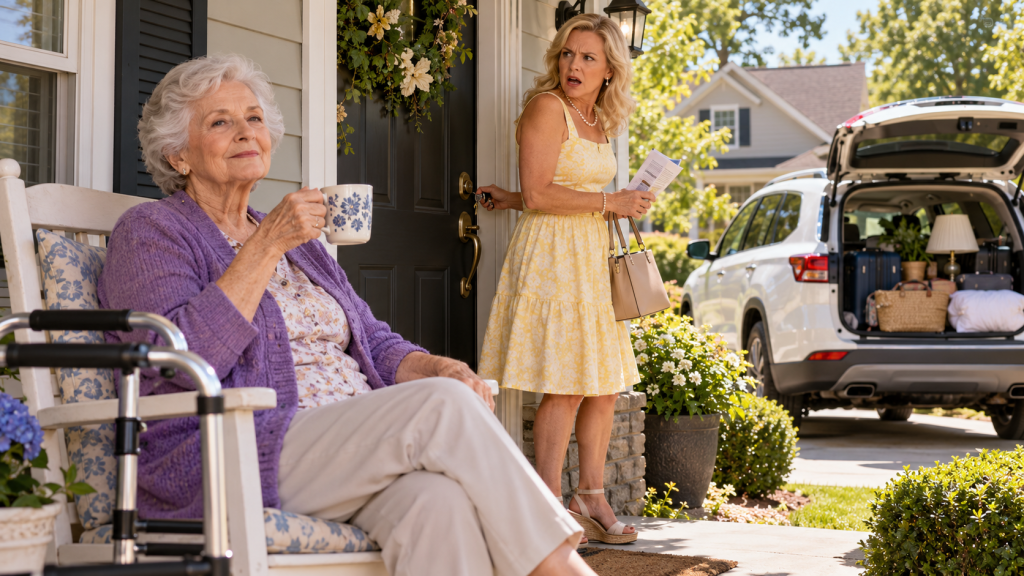
My son looked at her. Then at me. He didn’t answer immediately. That frightened me more than if he’d shouted. Because David had always answered immediately when Chloe accused me of something. Mom’s confused. Mom’s tired. Mom doesn’t understand.
He had repeated those phrases so often over the last four years that sometimes I heard them in my sleep.
But this time, he simply stood there.
“David,” Chloe repeated, “tell her she cannot legally lock us out.”
I placed my cup carefully on the porch railing.
“Good morning, son.”
His eyes met mine.
“Mom.”
He sounded exhausted.
I noticed his shirt was wrinkled beneath his jacket. He hadn’t shaved. There were dark circles beneath his eyes.
He looked nothing like the confident middle-aged man who usually returned from business trips carrying expensive luggage and promises that he’d visit more often.
“David,” I said quietly, “have you read the court order?”
He swallowed.
“Yes.”
Chloe turned.
“What court order?”
I watched her face.
For four years, she had worn a pleasant smile while taking little pieces of my independence.
Now that smile had completely disappeared.
David opened his folder.
“Chloe, we need to talk.”
She laughed sharply.
“Not here. Your mother’s having an episode, and these gentlemen are waiting to take her somewhere safe.”
The taller transportation worker stepped forward.
“Ma’am, we’re not proceeding with any transport without confirming proper authorization. Mrs. Whitaker has clearly declined.”
Chloe wheeled toward him.
“I already explained that she isn’t capable of making these decisions.”
He looked uncomfortable.
“That’s something we’ll need verified through the appropriate procedures.”
I raised my hand.
“Gentlemen, my attorney is aware of this attempted transfer. I have a recent independent medical assessment confirming my decision-making capacity, and there’s a court order concerning access to this property.”
The shorter man lowered his clipboard.
“Understood, Mrs. Whitaker.”
Chloe stared at me.
Then at David.
“Are you seriously going to let her embarrass us like this?”
My son closed his eyes.
And said something I had waited four years to hear.
“Chloe, stop.”
The silence that followed seemed to stretch across the entire neighborhood.
A bird called from the magnolia tree near my driveway.
Somewhere down the street, a lawn mower started.
I remember noticing those ordinary sounds because everything else felt so terribly unnatural.
Chloe folded her arms.
“Excuse me?”
David looked at her.
“I said stop.”
She gave a disbelieving laugh.
“David, your mother has changed the locks. She’s confused. She’s probably forgotten she asked us to arrange this.”
“I didn’t ask anybody to arrange anything,” I said.
Chloe ignored me.
“She’s eighty-one years old.”
David looked toward the porch.
“I know how old she is.”
“Then act like it.”
He took a breath.
“Chloe, did you tell Maplewood that a doctor ordered Mom into their facility?”
Her expression shifted.
Only slightly.
But I saw it.
“What?”
“It’s a simple question.”
“Of course I discussed her medical needs.”
“Which doctor?”
Chloe glanced toward the transportation workers.
Then looked back at David.
“Why are you doing this in front of strangers?”
“Which doctor, Chloe?”
She lifted her chin.
“Dr. Voss.”
David slowly opened his folder.
I felt my heart begin to pound.
“Funny,” he said, “because Dr. Voss told Sarah Bennett’s office he hasn’t treated Mom in years.”
Chloe went pale.
The transportation worker looked at his clipboard again.
I stared at my son.
Then at the folder.
Had he finally read something?
Had he finally asked a question?
Or was this another performance intended to persuade me that everything would be fine if I simply opened the door?
I had learned not to confuse a promising sentence with proof of change.
Chloe took a step toward David.
“You called her attorney?”
“She called me.”
“Without asking me?”
David stared at his wife.
“Why would I need your permission to speak to my mother’s lawyer?”
For one brief moment, I saw the boy he’d once been.
The child who’d stood beside Arthur in the garage and insisted he could fix anything if somebody would just hand him the right wrench.
But then Chloe said:
“David, think carefully about what you’re doing.”
And my son’s face tightened.
He looked suddenly frightened.
That was when I realized something.
Chloe wasn’t simply angry.
She believed she had something to hold over him.
Martha approached the porch.
“Eleanor.”
I turned.
She looked at Chloe’s SUV.
Then at me.
“Sarah is on her way. She also wants you to know an estate-removal company was scheduled to come here this afternoon.”
My stomach tightened.
“Estate removal?”
Martha nodded.
“At two o’clock. The appointment was arranged using your name.”
I stared.
Chloe made a sound of disgust.
“Oh, for heaven’s sake.”
Martha continued calmly.
“They were told the homeowner was moving permanently into assisted living and wanted the property cleared for sale.”
I looked toward Chloe’s SUV.
The boxes.
Arthur’s medals.
The deed.
My wedding photographs.
And suddenly I understood why the tailgate had been open.
She wasn’t simply packing her own belongings.
She was preparing to empty my house.
I turned toward my daughter-in-law.
“You scheduled people to remove my furniture?”
Chloe sighed.
“Eleanor, we were organizing things so you wouldn’t have to worry.”
“Without asking me?”
“Because every time we ask you anything, you become difficult.”
My mouth went dry.
For four years, that had been her favorite word.
Difficult.
I was difficult when I wanted to read my bank statement.
Difficult when I asked why my mail had been opened.
Difficult when I wanted to speak to my own doctor.
Difficult when I said I preferred sleeping in the bedroom Arthur and I had shared for forty-six years.
I looked at her.
“No, Chloe.”
My voice was surprisingly steady.
“I became difficult when I stopped saying yes.”
David lowered his head.
For several seconds, nobody spoke.
Then the taller transportation worker cleared his throat.
“Mrs. Whitaker, we’re going to leave. Our office will need to review this referral before any further arrangements are considered.”
I nodded.
“Thank you.”
He turned toward Chloe.
“Someone from our admissions department may contact you about the discrepancies.”
She glared at him.
Neither man said anything else.
They returned to their van.
And drove away.
Chloe watched the vehicle disappear.
Then turned toward me.
“This is going to cost you.”
I stared.
“Is that a threat?”
She laughed bitterly.
“I’m talking about the money we spent arranging your care.”
“Then you should have asked whether I wanted it.”
David stepped forward.
“Chloe, we need to leave.”
She turned sharply.
“No.”
“The order says we cannot enter the property.”
“This is our home.”
My chest tightened.
I looked at the house behind me.
The brick steps Arthur had repaired.
The porch swing he’d built.
The azalea bushes we’d planted the year David entered kindergarten.
“It was your home because I welcomed you,” I said.
Chloe looked at me with pure contempt.
“And now you’re throwing out your own son.”
I swallowed.
“I’m protecting myself.”
For the first time, David looked directly at me.
His eyes filled.
“Mom.”
I wanted to go down those steps.
Take him into my arms.
Tell him we could fix everything.
But my attorney had been very clear about the danger of confusing forgiveness with access.
So I remained on the porch.
“David,” I said, “you need to speak with Sarah.”
He nodded.
“I know.”
Chloe whirled toward him.
“Sarah Bennett is turning you against me.”
David closed his folder.
“No, Chloe.”
His voice broke.
“The documents are doing that.”
That was when she lunged for the folder.
David stepped back.
“Give it to me,” she snapped.
“No.”
“David, those are private family papers.”
“They involve my mother’s legal rights.”
Chloe’s face contorted.
“After everything I’ve done for her?”
I felt my throat tighten.
Because there it was.
The sentence she’d been storing for years.
Every grocery trip.
Every ride to the pharmacy.
Every time she’d helped me upstairs when my hip was painful.
In her mind, those things had become debts.
And the payment she expected was control over my life.
A dark sedan pulled into the driveway.
Sarah Bennett stepped out.
She was wearing a navy blazer and carrying a leather briefcase.
Behind her came a younger woman I recognized as an investigator from her office.
Sarah surveyed the scene.
Then walked toward the porch.
“Eleanor.”
I felt an almost unbearable rush of relief.
“Sarah.”
She touched my arm.
“Are you all right?”
“Yes.”
“Has anyone attempted to enter the house?”
“No.”
“Has anyone threatened you?”
I hesitated.
Then looked toward Chloe.
“She said this was going to cost me.”
Sarah nodded.
“We’ll document the exact words.”
Then she turned toward David and Chloe.
“Mr. and Mrs. Whitaker, you’ve both received the temporary order concerning possession and access.”
David nodded.
“Yes.”
Chloe folded her arms.
“This is ridiculous.”
Sarah remained calm.
“The order provides a process for supervised retrieval of your personal property. It does not authorize removing Eleanor’s possessions.”
Chloe laughed sharply.
“How are we supposed to know what’s hers?”
I stared at her.
Then quietly answered:
“The military medals in your SUV were awarded to my husband.”
She went still.
“The photographs are from my wedding.”
Silence.
“And the deed bears the names of Arthur and Eleanor Whitaker.”
Sarah looked toward the open tailgate.
Then back at Chloe.
“Those items need to be inventoried and preserved. We’ll follow the appropriate process for returning anything belonging to Eleanor.”
Chloe’s face drained.
For several seconds, she said nothing.
Then she whispered:
“You have no idea what you’re doing.”
Sarah looked directly at her.
“I know exactly what my client has authorized me to do.”
David suddenly spoke.
“Sarah, I need to show you something.”
He held out the folder.
Chloe caught his wrist.
“David.”
He pulled away.
It wasn’t violent.
It was simply final.
“Let go.”
He opened the folder.
Removed a stapled packet.
And passed it to Sarah.
She examined the first page.
Then the second.
Her expression changed.
I gripped the porch railing.
“What is it?”
David looked at me.
His eyes were shining.
“Mom, I think Chloe has been trying to borrow money against your house.”
For a moment, I couldn’t breathe.
Chloe made a sharp sound.
“That’s a lie.”
David didn’t look at her.
He continued.
“There’s an application for a home-equity loan.”
My hands went cold.
“How much?”
He swallowed.
Then looked down at the paper.
“Two hundred and sixty thousand dollars.”
The porch seemed to tilt beneath me.
Two hundred and sixty thousand dollars.
Against the home Arthur and I had paid off eighteen years earlier.
The house we’d worked so hard to keep.
The place where every room held part of our marriage.
I looked toward Sarah.
“Can she do that?”
Sarah’s voice was steady.
“Not lawfully merely by submitting documents or claiming authority she doesn’t possess. We need to determine what was submitted, whether any lender relied on it, and whether funds were disbursed.”
I swallowed.
“And the deed?”
“We’re checking the recorded title and any pending instruments.”
Chloe started laughing.
A brittle, ugly sound.
“All this over money.”
I stared at her.
Then asked the question that had been growing inside me for months.
“Chloe, what did you need two hundred and sixty thousand dollars for?”
For one brief second, she looked frightened.
Then she turned toward David.
“Don’t you dare.”
My son closed his eyes.
I watched him.
“David?”
His shoulders slumped.
Then he whispered:
“Mom, there’s something about our finances we haven’t told you.”
I felt a deep, terrible heaviness settle over me.
Because the house wasn’t simply something Chloe wanted to control.
It was something they needed.
And suddenly, I understood why David had been so willing to sign papers without reading them.
Somewhere along the way, my son had allowed his financial desperation to become an excuse for sacrificing my independence.
I looked at him.
“Then it’s time you told me the truth.”
David didn’t answer immediately.
He stood beside his wife in the driveway, looking more like a frightened boy than a man of fifty-three.
For a moment, I remembered teaching him how to balance on his first bicycle.
Arthur had run beside him, holding the back of the seat.
David kept shouting, “Don’t let go, Dad.”
And Arthur had promised he wouldn’t let go until David could ride on his own.
Now I wondered when my son had stopped trying to balance his own life and begun reaching for mine.
“David,” I said, “I’m listening.”
He looked toward Chloe.
She shook her head sharply.
“Don’t.”
He swallowed.
Then looked back at me.
“About eighteen months ago, we invested in a commercial property project.”
I frowned.
“You told me you were saving for your own house.”
“We were.”
“And?”
“The project went badly.”
Chloe folded her arms.
“It didn’t go badly. Our partners backed out.”
David shook his head.
“We took on debt we couldn’t repay.”
My stomach tightened.
“How much?”
He hesitated.
“Approximately one hundred and eighty thousand dollars, including what we still owe on personal loans and credit cards.”
I stared.
Eighteen months earlier, I’d given them ten thousand dollars toward what Chloe described as a down payment.
She’d hugged me.
Called me generous.
Promised it would help them finally move into a home of their own.
“What happened to the money I gave you?” I asked.
David looked away.
“Mom…”
“David.”
He swallowed.
“It went into the project.”
I closed my eyes.
Ten thousand dollars.
Money from Arthur’s life-insurance savings.
Money I’d given because I believed I was helping my son build a future.
Chloe stepped forward.
“And you would have helped if you’d known. You always said you wanted David secure.”
I looked at her.
“I wanted him secure in a home he could afford.”
Her cheeks flushed.
“Eleanor, nobody could have predicted the market.”
“Perhaps not.”
I took a breath.
“But you could have told me the truth.”
David suddenly looked at Chloe.
“That’s what I kept asking you to do.”
She went still.
I watched him.
He continued.
“You said Mom wanted to help us.”
Chloe shook her head.
“She does.”
“You said she agreed to restructure the house.”
My chest tightened.
David’s voice cracked.
“You told me she signed the paperwork herself.”
Sarah stepped closer.
“David, don’t try to resolve disputed financial facts by arguing on the driveway. Your attorney can help you provide any information you have.”
He nodded.
“I understand.”
Then he turned toward me.
“Mom, I know I should have asked you.”
I swallowed.
“Yes.”
He looked down.
“I should have read everything.”
“Yes.”
“And I shouldn’t have let Chloe speak for you.”
I felt tears gather.
“No, David. You shouldn’t.”
For a moment, he seemed ready to collapse beneath the weight of those simple answers.
But then Chloe spoke.
“Fine.”
Her voice was icy.
“Everybody wants to blame me.”
She pointed toward the house.
“Do you have any idea how much work I did for this woman?”
I stared at her.
She continued.
“Doctor appointments. Prescriptions. Groceries. Cleaning. Cooking. Four years of my life.”
My throat tightened.
I remembered those first months.
Chloe bringing me soup when my hip hurt.
Helping me choose a new winter coat.
Driving me to the pharmacy.
I had been grateful.
Truly grateful.
“Chloe,” I said gently, “I thanked you for that help.”
She laughed bitterly.
“Words don’t pay bills.”
Something inside me went still.
There it was.
The truth she’d been holding beneath every favor.
I looked at her.
“So that was the arrangement?”
She frowned.
“What?”
“You helped me when I needed it.”
I swallowed.
“And in return, you believed you deserved my house.”
She opened her mouth.
Nothing came out.
Sarah placed a hand lightly on my forearm.
“Eleanor, you’ve said enough for now. Let’s preserve what we have and let the proper processes move forward.”
I nodded.
But before I could turn toward the front door, Chloe hurried to her SUV.
She reached into the cargo area and grabbed a cardboard box.
The one containing Arthur’s medals.
“I’m taking my things,” she snapped.
Sarah stepped down the porch.
“Chloe, the contents are disputed. Please don’t remove that box.”
Chloe stopped.
For a moment, she looked ready to throw it.
Then she placed it back inside.
Hard.
I heard the faint sound of something metallic shifting.
My heart clenched.
Arthur’s medals.
The little pieces of ribbon and metal he’d never worn to boast.
He had served in the Army long before David was born.
He kept them in a drawer.
And sometimes, on quiet evenings, he’d tell our son stories about the men he’d served beside.
He hadn’t talked much about heroism.
Mostly, he talked about friendship.
About coming home.
About the responsibility of looking after people who trusted you.
I looked at David.
“Your father wouldn’t recognize what this family has become.”
His face crumpled.
For a moment, he couldn’t speak.
Then whispered:
“I know.”
Two sheriff’s deputies arrived after Sarah’s office requested assistance with the immediate dispute and the existing order.
They reviewed the relevant paperwork, spoke with the parties, and helped ensure the confrontation did not escalate.
Chloe was told again that she could not enter the property contrary to the order.
Arrangements for her and David to collect their personal belongings would have to be made through the authorized process.
No one was dragged away in handcuffs.
No one made a dramatic announcement about a crime being solved.
The questions about the forged documents and attempted financial transactions remained under investigation.
But that morning, the immediate boundary held.
My front door remained locked.
And Chloe did not get inside.
By noon, the driveway was empty.
David had left in his own car.
Chloe had driven away separately.
The boxes in her SUV were documented for follow-up and return of my belongings.
And the estate-removal appointment had been canceled after the company was informed that I had not authorized any work.
I sat on the porch again.
My coffee was cold.
My hands were trembling.
Martha lowered herself into the chair beside me.
For a long moment, we said nothing.
Then she whispered:
“Eleanor, are you all right?”
I looked at the house.
The white columns.
The porch swing.
The windows Arthur had installed himself.
“No,” I answered.
My voice broke.
“But I’m still here.”
Martha reached for my hand.
And I began to cry.
That afternoon, Sarah sat with me at my dining-room table.
Arthur’s handmade hutch stood against the wall.
My blue-and-white china was arranged behind its glass doors.
A framed photograph of our wedding sat on the top shelf.
I stared at it while Sarah reviewed the financial documents.
“Eleanor,” she said, “I want to separate what we know from what we suspect.”
I nodded.
She placed three folders on the table.
“The attempted wire transfer of forty-two thousand dollars was stopped.”
Relief washed through me.
“Yes.”
“The purported power of attorney was disputed, and the bank has preserved the materials it received.”
I nodded.
“And the house?”
She opened the second folder.
“The county records still show you as the owner. We have not found a completed, valid transfer.”
My eyes filled.
I hadn’t realized how frightened I was of hearing anything else.
Sarah continued.
“The proposed home-equity loan has not closed, and we’re notifying the lender of the disputed authority and documents.”
I let out a shaky breath.
“So nobody can just take my house?”
“Not lawfully based on false paperwork. But we need to continue monitoring for attempted filings and respond to any claims properly.”
I nodded.
Then she opened the third folder.
“This is where things become more concerning.”
My stomach tightened.
“What?”
“The lender’s application includes an appraisal summary.”
I frowned.
“Who arranged an appraisal?”
“That’s what we’re investigating. There was a valuation prepared using publicly available information and photographs supplied by the applicant.”
I stared.
“How much did they say my house was worth?”
Sarah turned the page.
$410,000.
I blinked.
“That can’t be right.”
Martha leaned forward.
“Eleanor, your neighbor’s house sold for considerably more, and his property is smaller.”
Sarah nodded.
“We’ve obtained preliminary market information suggesting the appraisal figure may be substantially below fair market value. An independent valuation will be needed.”
I swallowed.
Then she pointed toward another document.
“This is the proposed sale agreement.”
My heart stopped.
“Sale?”
Sarah nodded.
“Separate from the attempted loan, somebody prepared a contract offering your house to a private buyer.”
I stared.
“Who?”
She turned the page.
Oakbridge Residential Investments, LLC.
I had never heard of it.
“What’s that?” I whispered.
“A recently organized company.”
I swallowed.
“Who owns it?”
Sarah hesitated.
“We’re still tracing its ownership and any beneficial interests.”
Martha looked at her.
“Is there a connection to Chloe?”
Sarah met my eyes.
“There are enough connections to warrant investigating.”
I looked toward the dining-room window.
For a moment, I saw Arthur standing in the yard.
His sleeves rolled up.
A tape measure clipped to his belt.
The day we first bought the house, he’d told me it wasn’t fancy.
But it was ours.
Nobody can take away the work we put into making it a home, Ellie.
I pressed one hand against the table.
“Sarah, why would Chloe try to sell my house for less than it’s worth?”
Sarah paused.
“Possibly to complete a quick transaction. Possibly because someone connected to the buyer expected to benefit. We shouldn’t assume until the records are verified.”
I nodded.
Then I looked at her.
“Could it be both?”
She was quiet.
“Yes,” she answered.
“It could.”
Two days later, Dr. Kenneth Voss called.
He had been my primary physician years earlier, before he retired.
His voice sounded exactly as I remembered.
Warm.
Patient.
Slightly amused by the world.
“Eleanor.”
“Doctor.”
“I understand there’s a document bearing my name.”
My chest tightened.
“Yes.”
He sighed.
“Sarah’s office sent me a copy.”
I swallowed.
“Did you sign it?”
“No.”
The word was immediate.
Firm.
“I haven’t examined you in years,” he continued.
“And I certainly didn’t issue a recent certification that you’re unable to make decisions or required to enter a facility.”
Tears filled my eyes.
“Thank you.”
He paused.
“Eleanor, I remember you very well.”
I smiled weakly.
“Oh?”
“You used to bring your husband to appointments and argue with me about whether he was taking his blood-pressure medication.”
I laughed through tears.
“That sounds like us.”
Dr. Voss chuckled.
Then grew serious.
“I’ve provided a statement to the appropriate parties about the document.”
I swallowed.
“I’m sorry somebody used your name.”
He sighed.
“I’m more concerned about what they were trying to do to you.”
For a moment, I couldn’t speak.
Then whispered:
“I’m still trying to understand it myself.”
That evening, Sarah received another important piece of information.
The forty-two-thousand-dollar wire transfer had been directed toward an account associated with Carolina Transition Planning Services.
A company described as providing placement and relocation assistance for older adults.
I stared at the name.
It sounded perfectly respectable.
Exactly the kind of organization Chloe would mention while telling me she was making my life easier.
“Who runs it?” I asked.
Sarah looked down at the preliminary records.
“The company appears connected to a woman named Rachel Prescott.”
My chest tightened.
“Chloe’s sister.”
Sarah nodded.
I remembered the kitchen conversation.
Rachel asking whether I knew about the guardianship documents.
Asking whether David understood.
Questioning the plan to move me into assisted living.
For a moment, I felt an unexpected surge of anger.
Rachel had sounded concerned.
But her name now appeared connected to the destination of my money.
“Did she know?” I whispered.
Sarah looked at me.
“That’s what we need to establish.”
That night, I couldn’t sleep.
I walked slowly through the house with my walker.
The hallway floor creaked beneath me.
Arthur had always promised to fix that board.
He never did.
I used to tease him about it.
Now I was glad.
The sound reminded me of him.
I stopped outside David’s old bedroom.
For years, I’d kept it almost exactly as it was when he left for college.
Then Chloe moved in.
She turned it into a guest room.
Changed the curtains.
Removed the old bookshelf.
Packed away his childhood photographs.
I had allowed it because I told myself the house needed to change.
But somewhere during those changes, I had begun allowing Chloe to decide things that were never hers to decide.
Which mail I read.
Which bills I paid.
Which doctors I spoke to.
Whether I was tired.
Whether I was confused.
Whether I was capable.
I looked toward the dark living room.
Then whispered:
“Arthur, I think I finally understand.”
He’d always told me that kindness mattered.
But he had also told me something else.
Ellie, never let somebody make your choices for you simply because they’re louder.
I smiled through tears.
“I’m listening now.”
At nine the next morning, Rachel Prescott called my attorney.
And what she brought to Sarah’s office changed the direction of the entire investigation.
Rachel Prescott arrived at Sarah’s office carrying a shopping bag.
Not a briefcase.
Not a neat folder.
An ordinary green shopping bag from a grocery store.
Inside were bank statements, printed emails, appointment confirmations, and a small spiral notebook.
She looked terrible.
Her eyes were swollen.
Her hands trembled as she placed the bag on the conference table.
I sat beside Martha, watching her.
For years, Rachel had been the quieter of the two sisters.
She never interrupted Chloe.
Rarely disagreed in public.
And at family dinners, she always seemed to be watching everyone else’s expressions before deciding what to say.
Now she looked directly at me.
“Eleanor,” she whispered, “I’m sorry.”
I folded my hands.
“What are you sorry for?”
Her eyes filled.
“For not stopping this sooner.”
Sarah spoke gently.
“Rachel, we’re going to take this carefully. You’ve agreed to provide information voluntarily. It’s important that you distinguish what you personally know from what Chloe told you.”
Rachel nodded.
“I understand.”
She opened the notebook.
Then took a shaking breath.
“Carolina Transition Planning Services is a legitimate company I started six years ago.”
I listened.
“We help older adults and their families research housing and moving options. We don’t make medical decisions. We don’t have authority to move people against their wishes.”
I nodded slowly.
“Then why was my money going there?”
Rachel looked down.
“Chloe asked me to handle a placement referral for you.”
I swallowed.
“Without asking me?”
She nodded miserably.
“Yes.”
For a moment, nobody spoke.
Rachel continued.
“She told me you’d agreed to move into Maplewood after rehabilitation.”
I stared.
“She said your eyesight was getting worse and that David was handling your financial arrangements.”
I swallowed.
“And you believed her?”
“At first.”
Rachel began crying.
“But then she sent me a copy of the medical certification.”
My chest tightened.
“The one with Dr. Voss’s name?”
She nodded.
“I recognized the doctor’s office address. I used to work nearby.”
I leaned forward.
“And?”
“The practice closed years ago.”
Sarah made a note.
Rachel continued.
“I asked Chloe whether she’d verified the doctor was still practicing.”
Her voice trembled.
“She told me it wasn’t my concern.”
I closed my eyes.
I could hear Chloe saying it.
That cool, patient voice.
The one she used whenever someone asked a question she didn’t want to answer.
Rachel wiped her cheeks.
“Then she asked whether I could process a forty-two-thousand-dollar care-planning fee.”
My stomach tightened.
“For what services?”
“That was my question.”
Rachel looked at me.
“She said the money was needed for intake, transportation, housing coordination, and temporary placement.”
I stared.
“Forty-two thousand dollars?”
Rachel nodded.
“I told her the amount was far beyond anything my business would charge for those services.”
Martha leaned forward.
“What happened next?”
Rachel’s face crumpled.
“She got angry.”
I waited.
“She said David had already approved it and that the bank would send the money directly.”
My hands began shaking.
“And?”
Rachel opened a statement.
“I found out she’d created a payment instruction that used my company’s name but listed an account I didn’t recognize.”
Sarah took the paper.
“Whose account was it?”
Rachel swallowed.
“That is what I couldn’t understand.”
For a moment, she stared at her hands.
Then whispered:
“Yesterday, I learned Chloe had registered another company.”
My chest tightened.
“What company?”
Rachel looked up.
“Oakbridge Residential Investments.”
The room went silent.
Martha slowly set down her pen.
I stared at Rachel.
“The company trying to buy my house?”
Rachel nodded.
“Yes.”
My throat went dry.
Sarah remained composed.
“Rachel, what records connect Chloe to Oakbridge?”
Rachel removed several printed pages.
“Emails from the person who helped organize the company. A draft operating agreement. And a message Chloe sent me by mistake.”
She slid the message across the table.
I leaned forward.
The text was short.
Once Eleanor is in Maplewood, the buyer can close without her making trouble. David thinks the sale proceeds will solve the debt problem. Keep the investment structure separate until everything is finished.
I stared at the words.
For a long moment, I couldn’t breathe.
Then I looked up.
“What investment structure?”
Rachel swallowed.
“She was planning to acquire the house through Oakbridge.”
My hands went cold.
“Acquire it?”
“Yes.”
“For four hundred and ten thousand dollars?”
Rachel nodded.
“And then what?”
Her voice broke.
“The plan was to renovate it and resell it.”
I sat back.
The living room.
Arthur’s hutch.
The porch.
The magnolia tree.
The garden where I’d buried our first dog.
To Chloe, these weren’t memories.
They were improvements to be marketed.
Features to be photographed.
A property to be acquired cheaply, renovated, and sold at a profit.
I looked at Rachel.
“Did David know?”
She shook her head.
“Not the part about Chloe’s ownership interest, as far as I know.”
My chest tightened.
“She told him the sale was necessary to pay off their debts.”
I swallowed.
“And what was her plan afterward?”
Rachel hesitated.
Then reached into the shopping bag again.
She removed a rental agreement.
For a furnished townhouse outside Asheville.
The tenant’s name was Chloe Whitaker.
The lease began the following month.
Only Chloe was named.
Not David.
For several seconds, I stared at the page.
Then whispered:
“She was leaving him.”
Rachel’s eyes filled.
“She told me she needed somewhere to go if the marriage fell apart.”
I closed my eyes.
Four years.
Four years in my house.
Four years opening my mail.
Four years telling me I was losing my mind.
And all the while, my daughter-in-law had been preparing not just to take control of my property, but to use it as a way to finance her own escape.
I looked toward Sarah.
“What does this mean legally?”
She answered carefully.
“It means the proposed buyer’s ownership and the surrounding communications need further investigation. A hidden beneficial interest can raise serious questions, especially alongside disputed signatures and misrepresentations.”
I nodded.
“But it doesn’t make any transfer valid?”
“Correct. It doesn’t give anyone ownership of your house.”
For the first time that morning, I smiled.
Not because the situation was funny.
Because Chloe had built an elaborate plan around one assumption.
That I wouldn’t notice.
Rachel began crying again.
“Eleanor, I should have called you.”
I looked at her.
“Yes.”
She nodded.
“I know.”
“You heard your sister say I hadn’t agreed to move.”
“Yes.”
“You knew she was using a questionable medical document.”
Rachel lowered her head.
“Yes.”
I took a long breath.
“Then why didn’t you come to me?”
She wiped her cheeks.
“Because I didn’t want to believe my sister was doing something this terrible.”
For a moment, I felt unexpectedly sad.
I understood that mistake.
I had made it myself.
For years.
I looked at Rachel.
“I’m glad you’ve come forward.”
She began crying harder.
“But that doesn’t erase the time you stayed silent.”
She nodded.
“I understand.”
Sarah arranged for the records to be preserved and assessed through the appropriate investigative channels.
Rachel agreed to provide her original communications.
And I went home with a truth heavier than anything I’d expected to learn.
Chloe wasn’t merely trying to manage me.
She had been trying to turn my home into the capital for a new life.
That evening, David called.
I almost didn’t answer.
Then I remembered something Arthur used to say.
Ellie, hearing somebody out doesn’t mean surrendering your judgment.
So I picked up.
“David.”
His voice trembled.
“Mom.”
For a moment, neither of us spoke.
Then he said:
“I know about Oakbridge.”
I closed my eyes.
“Rachel told you?”
“Sarah’s office told my attorney about the documents, and Chloe admitted part of it when I confronted her.”
I swallowed.
“I’m sorry.”
He gave a broken laugh.
“Why are you apologizing?”
“Because I know it must hurt.”
He was quiet.
Then whispered:
“She was going to leave me.”
My throat tightened.
“Yes.”
“And she wanted the house.”
I swallowed.
“Yes.”
For a long moment, I heard nothing but his breathing.
Then he said:
“Mom, I need to tell you something.”
My chest tightened.
“What?”
“I knew things were wrong before last Sunday.”
I sat very still.
“Go on.”
He swallowed.
“Chloe kept asking me to sign forms. Sometimes I asked what they were. Sometimes I didn’t.”
I closed my eyes.
He continued.
“I knew she was talking about assisted living. I knew you didn’t want it.”
My chest tightened.
“Then why didn’t you stop her?”
He began crying.
“Because it was easier to believe her.”
I stared toward the window.
He continued.
“She told me you were getting confused.”
I swallowed.
“And?”
“I didn’t want to argue with her.”
I closed my eyes.
There it was.
The admission I needed more than any excuse.
My son hadn’t been unaware.
He’d been unwilling.
Unwilling to ask questions.
Unwilling to confront his wife.
Unwilling to believe his mother when doing so would make his own life more difficult.
“David,” I whispered, “you let her make me afraid in my own house.”
He sobbed.
“I know.”
“You watched me stop opening my mail.”
“Yes.”
“You heard her tell me I couldn’t speak to my own doctor.”
His breathing shook.
“Yes.”
I wiped my cheeks.
“And when I told you I was uncomfortable, you said she was helping.”
He began crying harder.
“I’m sorry, Mom.”
For a long moment, I couldn’t speak.
Then I said:
“I’m glad you’re telling me the truth.”
He swallowed.
“But I need you to understand something.”
“Anything.”
My voice trembled.
“An apology doesn’t give you a key.”
Silence.
Then David whispered:
“I know.”
I looked toward the hall.
Arthur’s photograph hung beside the staircase.
He was standing with David at his college graduation.
Both smiling.
Both looking toward a future they believed would be kind.
“I love you, son,” I whispered.
His voice broke.
“I love you too, Mom.”
“But right now, I don’t trust you to protect my interests.”
He sobbed quietly.
“I understand.”
I took a breath.
“Work with your attorney. Tell the truth. Deal with your debts. And don’t ask me to rescue you by surrendering my home.”
David was silent.
Then whispered:
“I won’t.”
When the call ended, I sat quietly for a long time.
For years, I’d imagined that making boundaries would mean losing my son.
Now I understood something different.
I might lose the version of our relationship that depended on me never saying no.
But perhaps there was still a chance to build something more honest.
The next morning, a local investigator called Sarah.
New evidence had been received concerning the attempted property transaction and the false medical certification.
And for the first time, Chloe’s carefully organized paperwork was being examined by people who had no reason to accept her explanations at face value.
The investigation did not end with one shocking revelation.
It unfolded the way most difficult truths do.
One record at a time.
One conversation at a time.
One person finally deciding that silence had become too expensive.
The bank preserved the attempted power-of-attorney submission, including the electronic records associated with it.
The county property records were monitored for unauthorized filings.
The proposed lender was notified that I disputed the documents bearing my signature and that no valid authorization had been given for a loan secured by my home.
The institution handling the proposed sale was also informed of the contested circumstances.
Sarah explained every step to me in plain language.
Not once did she speak as though I were a child.
If I needed a document read aloud, she read it.
If I asked a question twice, she answered it twice.
If I wanted time to think, she gave me time.
One afternoon, I told her how grateful I was for that.
She smiled.
“Eleanor, you’re the client.”
I laughed.
“Chloe spent four years making me forget that.”
Sarah’s expression softened.
“Then we’re going to make sure you remember.”
The questionable medical certification became especially important.
Dr. Voss provided a written statement confirming that he had not examined me recently, had not issued the certification, and had not authorized anyone to use his signature.
My current independent medical assessment remained consistent with what I knew about myself.
My vision needed accommodation.
My hip required care.
But I understood my finances, my property, my choices, and the consequences of those choices.
The documents Chloe had submitted didn’t become legitimate merely because they looked official.
Nor did my age transform her claims into facts.
The authorities reviewing the submissions examined the records, interviewed witnesses, and considered the technical evidence.
The manipulated statement involving David’s signature received similar scrutiny.
David admitted he’d signed a brief statement without carefully reading it.
That was his responsibility.
The later attachment of his signature page to a materially different affidavit was a separate issue.
He could not excuse his carelessness.
And Chloe could not turn his carelessness into authority over me.
When the first contested court hearing approached, I was frightened.
I had lived eighty-one years without ever imagining I’d need to defend my right to remain in my own house.
The thought seemed absurd.
Arthur and I had paid the mortgage.
We had repaired the roof.
Replaced the plumbing.
Survived hurricanes, recessions, illnesses, and all the ordinary disappointments that arrive during a long marriage.
Yet now, because I was old and my eyesight had weakened, I was being asked to prove that I could still make decisions.
Martha came over the night before.
She found me standing beside Arthur’s hutch.
“Eleanor?”
I turned.
“Do you think they’ll believe me?”
She looked surprised.
“Who?”
“The judge.”
Martha walked toward me.
“Eleanor, Sarah has the medical assessment, the bank records, the disputed documents, and the court papers.”
I nodded.
“But Chloe can be very convincing.”
Martha took my hand.
“I know.”
For a moment, we stood quietly.
Then she said:
“Do you remember what you told me when my husband died?”
I frowned.
“No.”
She smiled sadly.
“You said I didn’t have to be brave every minute just because everyone kept calling me strong.”
My eyes filled.
“I said that?”
“You did.”
She squeezed my hand.
“Now I’m telling you the same thing.”
I began crying.
Martha wrapped her arms around me.
And I let myself be frightened for a little while.
The hearing took place the following morning.
Chloe sat beside her lawyer.
She wore a conservative blue dress.
Her hair was neatly arranged.
She looked composed.
Almost gentle.
If you had seen her in the grocery store, you might have thought she was a devoted daughter-in-law exhausted by caring for an elderly relative.
I understood why people believed her.
I’d believed her myself.
David sat separately.
He looked toward me when I entered.
I nodded once.
Nothing more.
Sarah presented the relevant evidence supporting the protections I had sought.
The independent medical assessment.
The suspicious documents.
The bank’s intervention.
The disputed property transaction.
The statements concerning Chloe’s plans to move me without my consent.
And the existing temporary order.
Chloe’s lawyer argued that she had acted out of concern for an aging family member.
That she had arranged assistance because she feared I was becoming vulnerable.
That a family disagreement had escalated unnecessarily.
For a moment, I almost felt sorry for her.
Because she sounded exactly like the woman who’d brought me soup four years earlier.
But then Sarah asked about the proposed sale through Oakbridge.
And Chloe’s expression changed.
The judge addressed several questions about whether the contested arrangements were authorized, whether the documents were reliable, and what protections were warranted while the underlying disputes continued.
Nobody declared an entire criminal case solved that morning.
That wasn’t the purpose of the hearing.
But the court considered whether I needed continuing protection regarding my home and my personal decision-making.
Eventually, I was asked to speak.
Sarah helped ensure that the documents were accessible to me.
I stood carefully, using my walker for support.
The courtroom was quiet.
I looked toward the judge.
Then said:
“Your Honor, my name is Eleanor Whitaker.”
My voice trembled.
“I am eighty-one years old.”
I paused.
“My eyesight isn’t what it used to be.”
A few people shifted in their seats.
“My hip hurts when it rains.”
I smiled faintly.
“And sometimes I forget why I walked into the pantry.”
There was a small ripple of restrained amusement.
Then I continued.
“But I remember the day my husband and I bought our house.”
My throat tightened.
“I remember the first payment.”
“The winter our heating broke.”
“The summer my son learned to ride his bicycle.”
“And every year we worked to pay that mortgage.”
My eyes filled.
“I know the difference between accepting help and giving away my independence.”
The room became very still.
“I welcomed my son and daughter-in-law because I loved them.”
My voice broke.
“I never agreed to make Chloe my guardian.”
“I never agreed to give her power over my money.”
“And I never agreed to sell my house.”
I looked toward Chloe.
Her face was pale.
Then I turned back to the judge.
“I understand that someday I may need more help than I do now.”
My voice grew stronger.
“When that day comes, I want to make those choices with accurate information and the assistance I trust.”
I took a breath.
“But I don’t want someone deciding I’m incapable simply because it makes my property easier to obtain.”
For a moment, silence filled the courtroom.
Then I said the words I’d been carrying for months.
“Getting older has changed what I can see clearly on paper. It hasn’t taken away my right to decide who holds the pen.”
When I sat down, my hands were shaking.
Sarah squeezed my arm.
Martha was crying quietly in the gallery.
And David had lowered his face into his hands.
The court continued appropriate protective measures concerning my property and access while the related legal issues were addressed.
The unsubstantiated claims about my incapacity did not justify taking away my decision-making rights.
The disputed documents remained subject to investigation and any necessary legal proceedings.
Outside the courthouse, Sarah looked at me.
“Eleanor, how do you feel?”
I took a slow breath.
“Tired.”
She smiled.
“Understandable.”
Then I looked toward the courthouse steps.
“And hungry.”
Martha laughed.
“That’s my Eleanor.”
We went to a little diner.
I ordered chicken salad.
A cup of coffee.
And a slice of lemon pie.
Arthur used to say lemon pie made everything better.
He was wrong about a lot of things.
But not that.
Several weeks later, Chloe’s carefully managed public image began to unravel.
It wasn’t because I circulated accusations around the neighborhood.
I didn’t.
I declined the people who called wanting gossip.
I refused to discuss private financial records with church acquaintances.
And when someone suggested I tell my story at a community meeting to embarrass Chloe, I said no.
I wanted justice.
Not a spectacle.
The change came because the official records and witnesses were increasingly difficult to contradict.
Rachel supplied her communications.
David provided the original statement he’d signed and acknowledged his role in permitting Chloe to act without asking me.
Dr. Voss confirmed that the medical certification wasn’t his.
The bank preserved the attempted transfer documents.
And the property-related records raised serious questions about the proposed loan and insider purchase.
Investigators referred evidence to the appropriate authorities.
The suspected forged documents, attempted fraudulent financial transactions, and other conduct were handled through the legal process.
Chloe retained an attorney.
She had the opportunity to challenge the allegations and present her own account.
Months passed before significant matters were resolved.
Some aspects resulted in formal admissions, financial remedies, and restrictions.
Other questions continued through their separate processes.
There was no magical sentence that returned four years of my life.
No judge could give me back every Sunday I’d spent afraid to open my own mail.
But the false arrangements did not take control of my home.
The attempted wire transfer remained stopped.
The proposed loan did not close.
And Oakbridge never acquired my house.
My money was still mine.
My house was still mine.
And so were my choices.
The day Sarah confirmed the title remained secure, I sat alone in the living room for a long time.
The late-afternoon sun fell across the hardwood floor.
The same floor where David had taken his first steps.
I closed my eyes.
And remembered Arthur teaching him to walk.
Our son wobbling between us.
His little arms stretched out.
Arthur laughing.
Me kneeling with both hands open.
I began crying.
Not because I’d lost the house.
Because I’d almost lost the feeling that I belonged in it.
Then the doorbell rang.
I checked the camera.
David stood outside.
Alone.
Holding a small wooden box.
I took a long breath.
Then opened the door, keeping the screen door between us.
“Hello, David.”
His eyes filled.
“Hi, Mom.”
He looked down at the box.
“I brought something.”
My chest tightened.
“What?”
He opened the lid.
Inside were Arthur’s medals.
Carefully wrapped in a soft cloth.
Beside them lay our wedding photographs and the original property deed that had been taken from my filing cabinet.
For a moment, I couldn’t speak.
Then I whispered:
“Your father’s medals.”
David nodded.
“I wanted to return them myself.”
I looked up.
My son’s face was wet with tears.
“Mom,” he whispered, “I can’t tell you how sorry I am.”
I swallowed.
“Then don’t try to tell me all at once.”
He stared.
I continued.
“Show me.”
David nodded.
Slowly.
And for the first time, I believed he understood that rebuilding trust would take more than one good morning.
David didn’t come inside that day.
I asked him to place the box on the porch table.
He did.
Then he stepped back.
For several seconds, we looked at one another through the screen door.
He had Arthur’s eyes.
The same gray-blue color.
The same expression when he was frightened and trying not to show it.
“Mom,” he said softly, “I’ve moved into an apartment.”
I nodded.
“Have you?”
“Yes.”
“Are you and Chloe still living together?”
He shook his head.
“No.”
I swallowed.
“I’m sorry your marriage is in trouble.”
David gave a sad smile.
“I think it’s been in trouble for a long time.”
He looked toward the garden.
Then continued.
“I’m working with someone to review the debts and decide what I can realistically repay.”
I nodded.
“Good.”
“And I’ve started counseling.”
My eyes filled.
“Also good.”
He swallowed.
“I want to pay back the ten thousand dollars you gave us.”
I looked at him.
“That money was a gift, David.”
“I know.”
He wiped his cheeks.
“But I accepted it while letting you believe something that wasn’t true.”
For a moment, I couldn’t speak.
Then I said:
“Talk to your adviser about what you can afford. I’m not going to let you make another reckless financial promise out of guilt.”
He nodded.
“I understand.”
He glanced toward the door.
“Can I come inside sometime?”
My heart tightened.
For years, he’d walked through that door without knocking.
He’d known the location of every light switch.
Every cupboard.
Every loose floorboard.
Yet now he was asking permission.
“Not today,” I answered.
His eyes filled.
But he nodded.
“Okay.”
I took a breath.
“David, I do want a relationship with you.”
He looked up.
“But it must be different.”
“Yes, Mom.”
“No more allowing somebody else to make my decisions.”
“I understand.”
“No more signing papers you haven’t read.”
He gave a miserable little laugh.
“Definitely not.”
I smiled faintly.
“And when I say I’m worried about something, I need you to listen.”
David’s face crumpled.
“I will.”
I looked at him.
“I hope so.”
He stood for another moment.
Then whispered:
“I love you, Mom.”
Tears slipped down my cheeks.
“I love you too.”
He turned and walked toward his car.
I watched until he drove away.
Then I picked up the wooden box.
Carried it inside.
And placed Arthur’s medals in the drawer where they belonged.
The next few months were quieter.
Not perfectly peaceful.
There were still legal letters.
Financial records.
Telephone calls.
And moments when I woke in the night wondering whether I’d missed something important.
But the house no longer felt like a place where I had to guard every word.
I hired a part-time helper for transportation and certain household tasks.
Her name was Grace Miller.
She was practical, funny, and wonderfully uninterested in making decisions for me.
The first time she arrived, she asked:
“Mrs. Whitaker, what would you like help with today?”
I nearly cried.
Such a simple question.
What would I like?
I told her I wanted to go to the garden center.
She smiled.
“Then the garden center it is.”
We bought roses.
Yellow ones.
Arthur’s favorite.
And two pots of rosemary for the kitchen window.
I also made changes to the house.
Better lighting.
Large-print labels.
A magnifier for important documents.
A secure way to receive and review my mail.
And a medical-alert system I selected for myself.
I reviewed my legal and financial arrangements with Sarah and the relevant professionals.
Not because Chloe had been right about my incapacity.
Because planning responsibly was something I wanted to do.
I had spent so much energy defending my independence that I’d almost forgotten independence could include accepting help on my own terms.
One afternoon, Grace found me struggling with a heavy flowerpot.
“Would you like a hand?”
I laughed.
“Yes, please.”
She helped move it.
Then stepped back.
“Where do you want it?”
I pointed toward the sunny corner of the porch.
“There.”
She smiled.
“Beautiful.”
For a moment, I looked at the roses.
Then thought about Chloe.
About the way she’d take a flowerpot from my hands and decide where it belonged.
About how she’d announce she was only helping while moving everything to suit herself.
Grace had asked.
That was the difference.
A small difference.
An enormous one.
Six months after the lock change, David came over for Sunday lunch.
It was our first meal together alone in nearly a year.
I had invited him.
That mattered to me.
He didn’t have a key.
He didn’t let himself in.
He rang the doorbell and waited.
When I opened the door, he held out a bag of groceries.
“I brought the ingredients for your favorite soup.”
I raised an eyebrow.
“Are you planning to cook?”
He smiled nervously.
“I thought I’d try.”
“Do you know how?”
“Not particularly.”
I laughed.
“Well, this should be entertaining.”
We cooked together.
Slowly.
Awkwardly.
At one point, he added too much salt.
At another, he forgot the carrots.
Arthur would have loved it.
When the soup was finally ready, we sat at the dining table.
David looked around.
“Mom, the house looks nice.”
“Thank you.”
He nodded toward the windows.
“The new lights help?”
“Very much.”
For a moment, he seemed uncertain.
Then asked:
“Are you happy here?”
The question surprised me.
I looked toward Arthur’s hutch.
The photographs.
The yellow roses visible through the window.
“Yes,” I answered.
“Very.”
David’s eyes filled.
“I’m glad.”
We ate quietly for a while.
Then he put down his spoon.
“Mom?”
“Yes?”
“I used to tell myself you were getting old and needed us.”
I looked at him.
He swallowed.
“I think part of me liked believing that.”
My chest tightened.
“Why?”
He stared at the table.
“Because it meant I didn’t have to admit I was the one who needed help.”
For a long moment, I couldn’t speak.
Then David looked up.
His eyes were shining.
“You were managing your own life.”
He swallowed.
“And I was letting mine fall apart.”
I reached across the table.
Not to erase everything.
Not to tell him he had done nothing wrong.
But to acknowledge that he had finally said something true.
I placed my hand over his.
“David, asking for help is not shameful.”
He nodded.
“But taking control of someone else’s life to solve your problems is.”
A tear rolled down his cheek.
“I know.”
We sat quietly.
Then I smiled faintly.
“Now, please tell me you didn’t forget dessert.”
He laughed through tears.
“I bought a pie.”
“What kind?”
“Lemon.”
My heart tightened.
Arthur’s favorite.
I smiled.
“Your father would approve.”
As the first anniversary of the lock change approached, Martha came over one bright Sunday morning.
She found me sitting on the porch with my coffee.
The same chair.
The same little table.
The same view of the driveway.
She lowered herself beside me.
“Thinking about last year?”
I nodded.
“Yes.”
She smiled.
“Quite a morning.”
I laughed softly.
“That’s one way of putting it.”
For a moment, we watched the birds gather near the garden.
Then Martha asked:
“Do you regret changing the locks?”
I looked toward the front door.
Its brass deadbolt shone in the sunlight.
The locksmith had installed it carefully.
I’d chosen the keys myself.
“No,” I answered.
“Not for one second.”
Martha smiled.
“Good.”
I took a sip of coffee.
Then whispered:
“I regret that I needed to.”
Her expression softened.
“I know.”
For a while, neither of us spoke.
Then I looked toward the yellow roses.
The sunlight.
The house Arthur and I had built into a home.
And felt something settle inside me.
I was eighty-one.
I couldn’t read fine print without assistance.
My hip sometimes hurt.
I moved more slowly than I used to.
And there were days when I missed Arthur so much that the quiet felt unbearable.
But I was still Eleanor Whitaker.
Still the woman who’d raised a son.
Loved a husband.
Paid her bills.
Buried people she adored.
Made mistakes.
Learned lessons.
And survived more difficult days than Chloe could ever imagine.
Getting older hadn’t erased any of that.
I looked at Martha.
“Would you like some more coffee?”
She smiled.
“Only if you have the good kind.”
I laughed.
“After what happened last year, I decided life was too short for cheap coffee.”
She threw back her head and laughed.
And I laughed with her.
Because the real victory wasn’t the court order.
Or the frozen wire transfer.
Or the fact that Chloe’s plan had failed.
Those things mattered.
They protected my rights.
They protected my savings.
And they helped preserve the house Arthur and I had worked so hard to own.
But my greatest victory was simpler.
I could open my own mail.
Speak to my own doctors.
Spend my own money.
Invite people into my home.
And decide who received a key.
I had been kind enough to welcome my son and daughter-in-law beneath my roof.
They had mistaken that kindness for permission to take over my life.
For four years, I allowed their voices to become louder than mine.
Then one Sunday morning, I changed the locks.
And when Chloe’s key failed, something else changed too.
I stopped waiting for her permission to live.
My daughter-in-law wanted to move me out, take control of my money, and turn the house I’d owned since 1975 into her financial escape.
She thought being eighty-one meant I was too old to fight back.
She forgot that the woman who helped build that house was still living inside it.
And I wasn’t going anywhere unless I decided to.
I took another sip of coffee.
Looked toward my front door.
And smiled.
Because the most important thing I changed that Sunday wasn’t the lock.
It was who had the authority to decide when that door would open.
THE END STORIES! THANK YOU FOR READING GOOD LUCK !❤️
Related Posts



