The signature looked exactly like mine. Every curve, every delicate stroke, even the tiny loop I always made beneath the last letter of my name. But there was one terrible problem. I had never signed that document. And as Margaret Sloan held it beneath the ballroom lights, I realized Carter hadn’t merely planned to humiliate me on our wedding day. He and his family had been preparing to steal my future long before he ever touched my hair.
The ballroom fell into a silence so complete that I could hear the gentle hum of the projector behind me. Two hundred guests stared at the document in Margaret’s hand. Carter stood beside the altar, his face drained of color. Diane clutched his arm, her perfectly manicured fingers digging into his expensive jacket.
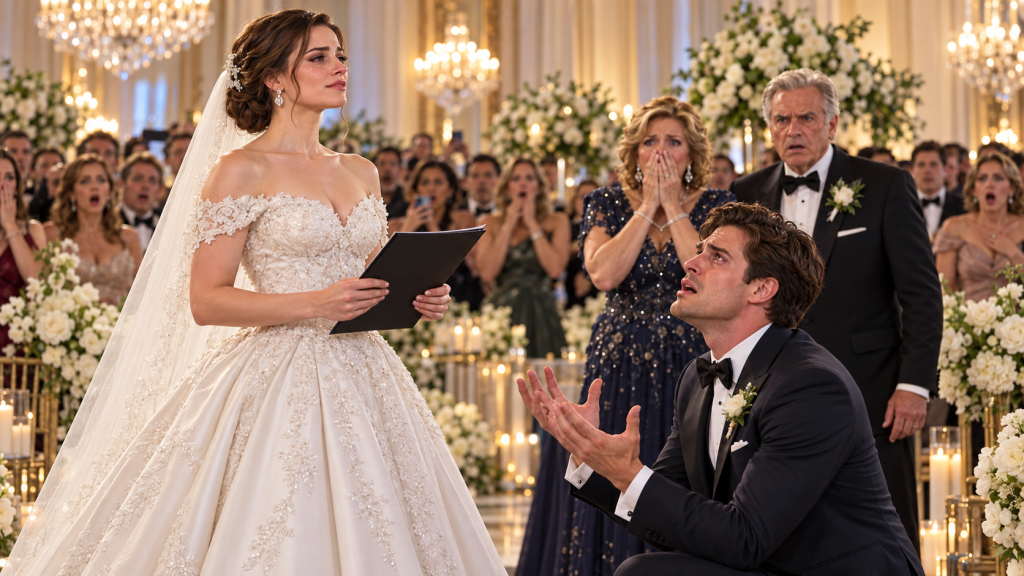
I looked from the signature to Margaret. “Where did you get that?” “Your fiancé’s attorney emailed this copy to my office at five forty-six this morning,” she answered. “It was presented as the fully executed amendment.” I blinked. “Fully executed?” “Signed by both parties and supposedly witnessed before a notary.” A nervous murmur passed through the crowd.
Carter took one step forward.
“Rachel, sweetheart, this is getting ridiculous. We can discuss paperwork after the ceremony.”
I turned toward him.
“Did I sign that document?”
He hesitated.
It was barely a second, but I knew him well enough to recognize the tiny movement of his jaw whenever he was searching for a lie.
“You were tired yesterday,” he finally said. “You probably don’t remember.”
I stared at him.
“Yesterday?”
“Yes, Rachel. We went through the papers.”
I looked toward Margaret.
“What time was it supposedly signed?”
She examined the document.
“Four twelve yesterday afternoon.”
Something cold settled in my stomach.
At four twelve yesterday afternoon, I hadn’t been anywhere near Carter.
I’d been sitting in a conference room at the Eleanor Foundation, attending the annual scholarship review in my grandfather’s memory.
There were twelve people in that meeting.
And the entire session had been recorded for the trustees who couldn’t attend.
I felt a strange calm settle over me.
“Margaret,” I said softly, “would you mind telling everyone where I was yesterday afternoon?”
Her expression didn’t change.
“At the foundation’s annual scholarship meeting. I was there with you.”
Carter’s mouth opened.
No words came out.
“And since we reviewed the minutes afterward,” Margaret continued, “I can confirm that Rachel remained in that meeting from three until nearly six.”
A woman near the front gasped.
Diane suddenly found her voice.
“This is outrageous! You’re embarrassing my son in front of everyone!”
I turned toward her.
“Your son shaved my head while I was unconscious, forged my signature, and planned to marry me before I discovered what he had done.”
Diane’s eyes flashed.
“You have absolutely no proof he forged anything.”
I looked at Carter.
“Then perhaps the police can help us find out.”
His expression changed instantly.
“Police?”
“Yes, Carter. Police.”
He gave a sharp, humorless laugh.
“Over a haircut?”
The words struck me harder than I expected.
For three years, he’d minimized everything that hurt me.
When he criticized my clothes, I was too sensitive.
When he mocked my friends, I couldn’t take a joke.
When he demanded access to my bank statements, I was hiding things.
And now, standing before two hundred people, with my scalp burning beneath the ballroom lights, he was calling what he’d done a haircut.
I stepped closer.
“Did you ask my permission?”
He glanced around.
“Rachel, don’t.”
“Did you?”
“No, but—”
“Did you give me something to make me sleep?”
He looked at his mother.
That was answer enough to make my hands tremble.
But I needed more than an expression.
I needed evidence.
Margaret placed a steadying hand on my shoulder.
“Rachel, we’ve said enough publicly. Let the proper authorities handle the rest.”
I nodded.
Then I turned to the wedding guests.
“I’m sorry you came here expecting a celebration. I truly believed I was marrying someone who loved me. This morning, I learned how wrong I was.”
A woman in the second row began crying.
It was my college roommate, Leah.
She had warned me about Carter more than once.
I’d always defended him.
Now she was looking at me with such sorrow that I could barely meet her eyes.
I took a breath.
“There won’t be a wedding today. The hotel staff will make arrangements for the reception food, and I hope nobody feels their trip was wasted. But I will not marry this man.”
Carter lunged forward.
“Rachel, you cannot do this to me!”
I looked at him.
“Watch me.”
Then I handed the microphone to the officiant, took Margaret’s arm, and walked away from the altar.
I had made it halfway down the aisle when Carter shouted something that stopped me cold.
“You think you’re so clever because your grandfather left you money?”
I turned.
His face was twisted with anger.
“You wouldn’t be anything without that inheritance!”
For one awful moment, I heard my grandfather’s voice in my head.
Money doesn’t tell you what a person’s worth, Rachel. It only gives certain people an excuse to show you what they think.
I looked at Carter one last time.
“You’re right about one thing,” I said. “My grandfather left me something valuable.”
I touched my bare scalp.
“But it wasn’t the money.”
Then I walked out.
Behind me, the ballroom erupted.
I heard Diane yelling for the wedding coordinator.
I heard chairs scraping across the floor.
And I heard Carter calling my name.
But I didn’t turn around again.
Not that morning.
Not for him.
Margaret led me into a private conference room near the hotel’s executive offices.
Leah followed us, carrying my handbag and a glass of water.
The moment the door closed, my knees gave way.
I collapsed into a chair.
For the first time since waking up, I began to shake uncontrollably.
Leah knelt in front of me.
“Oh, Rachel.”
That was all she said.
Two words.
But they broke something open inside me.
I covered my face.
“I was going to give him fifteen million dollars.”
She took my hands.
“I know.”
“I thought he loved me.”
Her eyes filled.
“I know, sweetheart.”
“I was going to spend the rest of my life with him.”
And then I finally cried.
Not elegant tears.
Not the graceful kind actresses shed in movies.
I sobbed until my chest hurt and my throat burned.
I cried for the woman I’d been yesterday, carefully hanging her wedding dress beside the window.
I cried for all the times I’d apologized to Carter just to keep the peace.
And I cried because I had almost placed my grandfather’s legacy into the hands of someone who seemed to enjoy hurting me.
Margaret waited until I could breathe again.
Then she sat across from me and opened her folder.
“Rachel, I need you to understand something.”
I wiped my eyes.
“What?”
“The forged amendment is serious. But I don’t believe it’s the only thing they’ve attempted.”
My stomach tightened.
“Why?”
She slid another document across the table.
It was a letter bearing the logo of Whitmore Capital Group, Carter’s family’s investment company.
I’d heard him talk about the company for years.
He always described it as successful.
His father had established it, and Diane had taken control after her husband died. Carter supposedly managed acquisitions.
The letter was addressed to a private lender.
It referenced an upcoming capital contribution of fifteen million dollars.
From me.
I stared at the page.
“How did they know the amount?”
Margaret’s expression darkened.
“That’s exactly what I want to find out.”
I looked at the date.
Six weeks earlier.
Six weeks before the wedding.
Six weeks before I’d told Margaret to prepare the transfer documents.
A chill ran down my spine.
“Carter wasn’t supposed to know.”
“I understand.”
“How could he?”
Margaret looked toward the closed door.
“Someone may have seen confidential financial records. Or someone with access to your private information may have disclosed them.”
Leah squeezed my shoulder.
“What does that letter mean?”
Margaret folded her hands.
“It appears the Whitmores were representing Rachel’s expected contribution as part of their company’s financing. We don’t yet know whether any lender relied on it.”
I could barely comprehend what she was saying.
“They were using money they didn’t have?”
“Possibly.”
“But I never agreed to invest in their company.”
“I know.”
I stared at the document.
My wedding suddenly felt less like a celebration gone wrong and more like the final step of a plan.
Carter hadn’t simply wanted a wealthy wife.
He’d wanted an investment.
And I’d been foolish enough to believe that our future was something we were building together.
A knock sounded at the conference room door.
All three of us froze.
“Ms. Bennett?” a man’s voice called. “This is Daniel Mercer, hotel security director.”
Margaret stood and opened the door just enough to speak.
A tall, gray-haired man waited outside.
Beside him stood a woman wearing a hotel management badge.
Mr. Mercer glanced toward me.
“Ms. Bennett, I’m very sorry about what happened. We have information concerning the incident in your suite.”
I sat straighter.
“What information?”
He stepped inside.
“Our overnight security supervisor reviewed the hallway footage after receiving a complaint about unusual activity on your floor.”
My heart began pounding.
“Did you see Carter?”
“Yes.”
He hesitated.
“And we believe you should see what was recorded.”
Margaret exchanged a glance with Leah.
We followed Mr. Mercer into a small security office.
A wall of monitors showed different parts of the hotel.
He pulled up footage from the previous evening.
The timestamp read 10:37 p.m.
I watched myself walk down the corridor toward my suite.
Carter had one arm around my waist.
My steps were unsteady.
I remembered that part.
I’d felt terribly dizzy after the champagne.
At the time, Carter had laughed and said I was simply nervous about the wedding.
On the recording, he guided me inside.
Then he came out again fourteen minutes later.
He was carrying a small black bag.
I leaned closer.
“What’s that?”
Mr. Mercer shook his head.
“The camera doesn’t show what was inside.”
At 11:06, Carter returned with the same bag.
He remained in the suite until 12:18.
When he emerged, he was smiling at his phone.
And in his hand was something I recognized immediately.
A pink satin ribbon.
The ribbon I’d tied around my hair that evening so it wouldn’t tangle while I slept.
I made a sound I didn’t recognize.
Leah placed her arm around me.
“Oh, God.”
Mr. Mercer stopped the recording.
“I’m sorry, Ms. Bennett.”
I stared at the frozen image.
My fiancé.
The man who had kissed me goodnight.
The man who was supposed to promise to love and protect me.
Walking away from our suite with the ribbon he’d removed from my hair.
Suddenly, the laughter I’d managed that morning seemed impossibly far away.
“What do I do now?” I whispered.
Margaret answered immediately.
“First, we preserve every piece of evidence. Then we get you medical care.”
An hour later, I was sitting in a private examination room at a hospital.
A physician carefully inspected my scalp.
There were several small abrasions.
Some patches were nearly smooth.
Others had uneven stubble.
The doctor examined my pupils, asked about my memory, and arranged testing because I described unusual dizziness and prolonged sleep after drinking Carter’s champagne.
She didn’t promise that a test would identify anything.
Some substances leave the body quickly, she explained, and the timing mattered.
But she documented my injuries, collected samples, and told me I had done the right thing by coming in promptly.
When she asked whether I wanted to speak to a police officer, I looked at Margaret.
Then I answered for myself.
“Yes.”
The officer who came to my room was a woman named Detective Lena Ortiz.
She had kind eyes and a voice that made it easier to describe things I could barely bring myself to remember.
She listened to everything.
The champagne.
The dizziness.
The missing hours.
The shaved head.
The note.
The text messages.
The forged document.
When I finished, she didn’t ask why I’d stayed with Carter so long.
She didn’t ask whether I’d done something to anger him.
She simply said, “Rachel, I want you to know we’re taking your report seriously. We’ll investigate what happened, and we’ll need to verify the evidence you’ve described.”
I nodded.
My throat was too tight to speak.
She asked whether I had the original note.
“Yes. It’s in my handbag.”
Margaret produced an envelope.
“I advised Rachel not to handle it further once she understood its importance.”
Detective Ortiz accepted it carefully.
Then she looked at me.
“Is there somewhere safe you can stay?”
I thought of the apartment Carter and I shared.
The wedding gifts stacked in the living room.
The photograph of us on the mantel.
The toothbrush beside mine.
I felt sick.
“Not at home,” I whispered.
Leah spoke before anyone else.
“She’s coming with me.”
I looked at her.
“You have three children and a husband who works nights.”
She gave me a look.
“Then the children will learn to share a bathroom.”
For the first time that day, I smiled.
A real smile.
Small, but real.
I went home with Leah that evening.
Her youngest daughter, Sophie, met us at the door.
She was six years old and wearing pajamas covered in yellow stars.
She stared at my head.
Then she asked the question everyone else had been too embarrassed to ask.
“Aunt Rachel, where’s your hair?”
I knelt in front of her.
“Somebody cut it off without asking me.”
Her little face grew serious.
“That wasn’t nice.”
“No, sweetheart. It wasn’t.”
She considered this.
Then she took off her favorite purple headband and placed it gently in my hand.
“You can have this until it grows back.”
I burst into tears again.
Sophie looked frightened.
Leah knelt beside us.
“Those are happy tears, baby.”
Sophie hugged my neck.
And for the first time since waking up, I felt safe enough to stop pretending I was strong.
That night, Leah made up the guest room.
There was a quilt on the bed, a vase of daisies on the windowsill, and a little handwritten sign from the children.
WE LOVE YOU, AUNT RACHEL.
I sat on the mattress and stared at the words.
Then my phone vibrated.
Carter.
Thirty-seven missed calls.
Twenty-two messages.
The latest read:
You’ve gone too far. Mom says we can still fix this if you stop talking to people.
I stared at the screen.
A second message appeared.
You know I love you. I wouldn’t have done any of this if you hadn’t kept shutting me out.
There it was again.
The same old trick.
Make me responsible for the harm he’d chosen to cause.
I took screenshots and forwarded them to Margaret.
Then I blocked his number.
But before I could put the phone down, another message arrived.
From Vanessa.
Rachel, I need to talk to you. What Carter and Mom did was worse than you know.
I read it twice.
Vanessa had laughed about my shaved head.
She’d told me I deserved it.
Why would she suddenly want to help?
I set the phone aside.
Ten minutes later, she messaged again.
Please. They’re blaming everything on you. I have something you need to see.
I thought about ignoring her.
Then a photograph appeared.
It showed Carter and Diane sitting at a dining table covered in documents.
The picture had been taken from the doorway.
At the center of the table lay a folder.
On its cover were the words:
BENNETT TRUST — PRIVATE FINANCIAL SUMMARY.
My blood went cold.
That was the exact title of the confidential report Margaret had prepared for me the previous year.
Only a handful of people had ever seen it.
And somehow, Carter’s mother had a copy.
I called Vanessa.
She answered on the first ring.
“Rachel?”
“Where did you get that photograph?”
A pause.
“I took it at Mom’s house.”
“When?”
“Three weeks ago.”
I closed my eyes.
“How did she get my financial records?”
Vanessa began crying.
“I don’t know everything.”
“Then tell me what you do know.”
She drew an uneven breath.
“Carter found a folder in your desk last spring. He brought it to Mom because he wanted to know whether you were hiding assets.”
I felt as though the room had shifted beneath me.
Last spring.
I remembered Carter asking to use my home office while his computer was being repaired.
He’d spent three afternoons there.
I’d even brought him coffee.
Vanessa continued.
“Mom started talking about what the money could do for the company. She said if you married Carter, it would solve everything.”
“Everything?”
“Rachel, Whitmore Capital is in trouble.”
I gripped the telephone.
“How much trouble?”
Vanessa was silent.
“Vanessa?”
She whispered, “They could lose the house. The offices. Almost everything.”
I thought about Diane’s beautiful home, the expensive parties, the luxury cars.
All the things she’d used to make me feel inferior.
“Why didn’t anyone tell me?”
“Because Mom said you’d look down on us.”
I almost laughed.
They had spent three years treating me like a charity case while secretly counting the money they hoped to take from me.
Vanessa began speaking faster.
“After Carter told Mom you wouldn’t sign the new agreement, she was furious. She said you were trying to humiliate him. She told him he needed to remind you who was in charge before the wedding.”
My mouth went dry.
“Was shaving my head her idea?”
Vanessa hesitated.
“I heard her say you wouldn’t feel so superior without all that beautiful hair.”
I closed my eyes.
There it was.
The cruelty behind the cruelty.
They hadn’t simply wanted my money.
They’d wanted me frightened, ashamed, and obedient.
“Did you know he was going to drug me?”
“No!” she cried. “Rachel, I swear I didn’t. I thought he was going to cut a little of your hair as some sick prank. Then he sent a picture last night, and I realized what he’d done.”
My stomach turned.
“He sent pictures?”
She began crying harder.
“To our family group chat.”
I pressed my hand over my mouth.
A photograph of me unconscious.
Bald.
Helpless.
Shared among people who were supposed to become my family.
Vanessa whispered, “I laughed in the chat because I was afraid to stand up to them. I sent that awful message this morning. I’m ashamed of it.”
I couldn’t speak.
“I’m not asking you to forgive me,” she continued. “I just need you to know what happened.”
I looked toward the bedroom door.
Leah stood there, listening with a worried expression.
I turned back to the phone.
“Vanessa, do you still have those messages?”
“Yes.”
“Don’t delete them.”
“I won’t.”
“And don’t warn Carter that you’re speaking to me.”
There was a long silence.
Then she whispered, “Mom will never forgive me.”
I thought about Sophie’s purple headband sitting on the nightstand.
“Vanessa, your mother had a chance to stop this before somebody got hurt.”
“I know.”
“Now you have a choice to make.”
She began crying again.
“I’ll send everything.”
When the call ended, Leah came into the room.
“What happened?”
I looked up at her.
“My wedding wasn’t a disaster that happened by accident.”
I held up the photograph.
“It was a plan.”
The next morning, Margaret came to Leah’s house with coffee, a fresh change of clothes, and a grim expression.
“I have news,” she said.
I followed her into the kitchen.
She opened her laptop.
“Yesterday afternoon, I contacted the institution holding your grandfather’s trust assets. All transfers and new instructions remain frozen pending verification.”
I exhaled.
“Thank God.”
“There’s more.”
She turned the screen toward me.
A series of emails appeared.
One was from a lender’s compliance officer to Whitmore Capital Group.
It referenced an anticipated marital asset transfer.
Another requested proof that the fifteen-million-dollar contribution would become available immediately after the wedding.
The most recent email carried a sentence that made my stomach twist.
Final approval remains contingent upon verification of Mrs. Whitmore’s signed authorization and satisfactory confirmation of transferred assets.
I stared at the words.
“Mrs. Whitmore?”
Margaret nodded.
“They were counting on the marriage taking place.”
“But we weren’t even married.”
“Exactly. And they were describing a financial arrangement that didn’t yet exist.”
I sank into a chair.
“So if I had married him…”
“We still would have had protections and questions to resolve. Marriage alone would not magically transfer your grandfather’s trust. But signing the fifteen-million-dollar transfer would have exposed those funds to serious risk.”
I looked at the window.
A bluebird had landed on Leah’s fence.
The world outside seemed offensively ordinary.
Cars passed.
Neighbors watered flowers.
Children waited for school buses.
And I sat at a kitchen table realizing that the man I’d planned to marry had treated my entire future like collateral.
Margaret spoke gently.
“Rachel, I need to ask you something difficult.”
I turned.
“Anything.”
“Did Carter ever pressure you to change the beneficiaries of your trust?”
I thought for a moment.
Then I remembered an argument from six months earlier.
We’d been having dinner at a restaurant downtown.
Carter had asked whether my grandfather’s money would automatically go to him if something happened to me.
I’d laughed and told him I had an estate plan.
He hadn’t laughed.
He’d become quiet.
Then he’d accused me of not trusting him.
I told Margaret.
Her expression sharpened.
“Did you make any changes?”
“No.”
“Good.”
She closed the laptop.
“I also want to review every document you’ve signed during the engagement.”
My heart sank.
“All of them?”
“All of them.”
I thought about the forms Carter had occasionally placed in front of me.
A hotel booking.
An insurance application.
A membership renewal.
A business dinner invitation.
I had trusted him.
So many times, I’d signed without reading every word.
Margaret must have seen the fear on my face.
“Rachel, whatever we discover, we’re going to handle it one step at a time.”
I nodded.
But an awful thought had begun forming.
What if the forged prenuptial amendment wasn’t the first false document Carter had prepared?
What if it was simply the first one we’d caught?
At noon, Detective Ortiz called.
She asked whether I could come to the station to review additional information.
Margaret accompanied me.
The detective met us in a small interview room.
She looked tired.
But there was something different in her expression.
Something focused.
“We’ve obtained copies of the messages Ms. Whitmore provided,” she said.
I nodded.
“She sent them?”
“Yes. She also gave a recorded statement.”
My chest loosened slightly.
For all her cruelty, Vanessa had kept her promise.
Detective Ortiz opened a folder.
“We’re reviewing the photographs and the hotel security footage. We’ve also received preliminary information from the hospital.”
My hands tightened.
“What did they find?”
She spoke carefully.
“The initial screening raised concerns about a sedating substance that wasn’t part of your reported medication history. Additional laboratory confirmation is needed, and we can’t yet say exactly how it entered your system.”
I stared at her.
The room grew very quiet.
I’d suspected it.
I’d said it aloud.
But hearing that medical testing supported the possibility made the betrayal feel newly real.
Somebody had deliberately made me helpless.
The night before my wedding.
Detective Ortiz leaned forward.
“Rachel, do you need a moment?”
I shook my head.
“Please continue.”
She showed me a photograph recovered from the messages Vanessa had provided.
It was a picture of my severed hair lying across a white hotel towel.
Beside it sat a pair of electric clippers.
A message from Carter appeared beneath the photograph.
She won’t be telling me no so easily tomorrow.
I felt the blood drain from my face.
Margaret reached for my hand.
I gripped it.
Hard.
The detective let me look away.
Then she said, “That message matters. We’re also working to establish the full sequence of events.”
I stared at the table.
For three years, Carter had told me he admired strong women.
But he’d never meant women who disagreed with him.
He’d meant women who were strong enough to make his life easier and quiet enough never to challenge him.
I looked up.
“Can I ask you something?”
“Of course.”
“Do people like Carter ever really believe they love the people they hurt?”
Detective Ortiz took a moment before answering.
“I can’t tell you what’s in his mind. But I can tell you that love doesn’t excuse taking away another person’s choices.”
I swallowed.
Then I nodded.
Because for the first time, I understood that I didn’t need to solve the mystery of whether Carter had ever loved me.
I needed to face what he’d done.
And protect myself from what he might do next.
That afternoon, Margaret received a call from one of the attorneys who had previously represented Whitmore Capital Group.
He had learned about the cancelled wedding and wanted to discuss documents bearing my signature.
Margaret arranged a meeting.
The attorney’s name was Andrew Vale.
He arrived at her office carrying a thick brown envelope and looking like a man who hadn’t slept in days.
I sat beside Margaret while he explained that Diane had instructed him to prepare financing materials for Whitmore Capital’s proposed expansion.
He’d been told I intended to contribute fifteen million dollars after marrying Carter.
“I never spoke with Ms. Bennett directly,” he admitted.
Margaret’s voice was sharp.
“Did you verify her authorization?”
“No. I understood the transaction was still prospective.”
“Then why did the lender receive documents representing that she was committed?”
His face reddened.
“Those representations were supplied by the Whitmores.”
I leaned forward.
“Mr. Vale, did you prepare the prenuptial amendment?”
He nodded.
“A draft. Yes.”
“Did you see me sign it?”
“No.”
“Did you witness Carter sign it?”
“No.”
“Then who returned the completed version?”
He looked down.
“Diane Whitmore.”
My stomach tightened.
Margaret opened her folder.
“The document contains a notarial certificate. Have you contacted the notary?”
He swallowed.
“That’s part of why I’m here.”
For a moment, he seemed unable to continue.
Then he said, “The notary named in that certificate contacted me this morning. She says she never witnessed the signatures.”
I stared at him.
“Then who did?”
He looked miserable.
“That’s what investigators will need to determine.”
Margaret’s expression became cold.
“Have you preserved your correspondence with Mrs. Whitmore?”
“Yes.”
“All of it?”
“Yes.”
“Good.”
Mr. Vale pushed the brown envelope toward us.
“These are copies of the communications I can provide. I’ve also consulted my own counsel about cooperating with the investigation.”
I studied him.
“Why are you coming forward now?”
He looked at me for the first time.
“Because I was told the paperwork reflected an agreement between two people who wanted to get married. I didn’t know anyone was going to wake up injured and humiliated.”
His eyes flickered toward my bare head.
Then he looked away.
I thought about all the people who had accepted Carter’s explanations because he spoke confidently and wore expensive suits.
The business partners.
The attorneys.
The hotel staff.
Even me.
For years, I’d mistaken his confidence for character.
But confidence without conscience was simply another way to frighten people into believing you.
When Mr. Vale left, Margaret closed the door.
“Rachel,” she said, “there may be additional legal consequences for the people involved.”
I nodded.
“Will that make everything better?”
Her expression softened.
“No.”
I looked down at my hands.
“Then why do I feel like I should be happy?”
“Because you’re beginning to see that they may not get away with it.”
I swallowed.
“And why do I feel guilty?”
Margaret sat beside me.
“Because you’re used to protecting other people from the consequences of their decisions.”
I looked at her.
She was right.
I’d done it with Carter.
With Diane.
With Vanessa.
Every cruel remark, every demand, every uncomfortable dinner had been followed by my efforts to smooth things over.
I’d spent three years making their behavior easier to live with.
Now I was learning that protecting myself might make their lives much harder.
And that was not the same thing as doing something wrong.
Two days later, Carter came to Leah’s house.
It was almost nine at night.
Leah’s children were asleep upstairs.
Her husband, Daniel, was washing dishes when the doorbell rang.
Through the frosted glass, I recognized Carter’s silhouette immediately.
My heart began hammering.
Leah looked at me.
“Do you want me to call the police?”
I nodded.
Daniel went to the front door but kept it locked.
“Carter, you need to leave.”
Carter’s voice came through the glass.
“I just need five minutes with Rachel.”
“She doesn’t want to speak to you.”
“Daniel, don’t get involved in something you don’t understand.”
Daniel’s voice remained calm.
“I’m standing in my own house. I’d say that makes me involved.”
Carter struck the door with his palm.
“Rachel! I know you’re in there!”
I froze.
He sounded like the man who used to come home angry after a difficult day at work.
The man who would slam cabinets, blame me for not anticipating his needs, then apologize with flowers the next morning.
A familiar part of me wanted to step outside.
Calm him down.
Keep him from making a scene.
Then Sophie appeared at the top of the stairs.
She was holding her stuffed rabbit.
“Aunt Rachel?” she whispered. “Why is that man yelling?”
Something inside me hardened.
I stood.
Leah caught my arm.
“Rachel, you don’t have to talk to him.”
“I know.”
I walked toward the door but stayed several feet away.
“Carter,” I called.
The pounding stopped.
“Rachel! Baby, thank God. Open the door.”
“No.”
A pause.
“Please. I’ve been going crazy.”
“Then go home.”
“Mom’s not sleeping. Vanessa’s turned against us. Our business partners are calling. You have no idea what this is doing to my family.”
I closed my eyes.
Still.
After everything.
He was talking about what I had done to them.
I looked toward Sophie, who was now standing beside her mother.
Then I said, “Carter, you shaved my head while I was unconscious.”
He was quiet.
“You made me afraid inside my own body.”
“Rachel—”
“And you tried to use my money without my permission.”
“We were going to be married!”
“That didn’t make me your property.”
His voice rose.
“I gave you three years of my life!”
I felt tears sting my eyes.
“So did I.”
For a moment, neither of us spoke.
Then Carter said something that finally showed me how he saw our relationship.
“I could have married someone who respected me.”
I looked at Leah.
At Daniel.
At Sophie clutching her stuffed rabbit.
Then I answered, “And I could have married someone who respected me too.”
Outside, Carter began cursing.
Daniel moved toward the door.
I shook my head.
“Don’t open it.”
A patrol car arrived a few minutes later.
Carter left after officers instructed him to go and documented what had happened.
Leah locked the door.
I went upstairs and sat on the edge of the guest bed.
For several minutes, I couldn’t move.
Then Sophie appeared in the doorway again.
She climbed onto the bed beside me.
“Is the mean man gone?”
“Yes, sweetheart.”
She studied my face.
“Are you still sad?”
“A little.”
She wrapped her arms around me.
“Mommy says hair grows back.”
I smiled through my tears.
“Your mommy’s right.”
Sophie considered that.
Then she said, “But even if it didn’t, you’d still be Aunt Rachel.”
I pulled her close.
And in that quiet bedroom, holding a little girl who didn’t care whether I had hair, money, or a beautiful wedding dress, I realized something devastating.
A six-year-old child understood love better than the man I’d almost married.
Over the next several weeks, I discovered that leaving Carter was not one decision.
It was a hundred decisions.
It was deciding not to answer when an unfamiliar number called.
It was waking from nightmares and reminding myself that I was in Leah’s guest room, not the hotel suite.
It was learning to look in mirrors again.
It was walking through a grocery store and refusing to hide beneath a hat when strangers stared at my uneven scalp.
And most difficult of all, it was accepting that the man I had loved had never been the man I thought he was.
There were mornings when I remembered the good moments.
Carter bringing soup when I had the flu.
Carter dancing with me in the kitchen.
Carter holding my hand during my grandfather’s funeral.
Those memories didn’t vanish simply because I knew what he’d done.
Sometimes they made everything worse.
One afternoon, I found myself staring at an old photograph of us standing beside my grandfather’s hospital bed.
Grandpa had been smiling.
Carter had his arm around my shoulders.
I remembered how grateful I’d been that Carter stayed through those long, exhausting weeks.
Then I remembered something else.
The final evening of Grandpa’s life, Carter had asked whether I knew the exact structure of the inheritance.
I’d thought he was trying to help me prepare.
Now I wondered whether he’d already been calculating.
I turned the photograph facedown.
The next morning, Margaret called and asked me to visit her office.
When I arrived, she was standing beside the window with a sealed envelope.
“Your grandfather asked me to give you this when you were preparing to make a major decision about the trust.”
I stared at the envelope.
My name was written across it in his familiar handwriting.
“Why didn’t you give it to me before the wedding?”
“I intended to. But you asked me to bring the transfer documents to the hotel, and events moved faster than either of us expected.”
I took the envelope carefully.
Grandpa had been gone almost two years.
His name was Arthur Bennett, and he had raised me after my parents died in a car accident when I was seventeen.
He’d made his fortune building a manufacturing company from a small workshop behind his father’s house.
But he still clipped grocery coupons.
Still repaired broken appliances rather than replacing them.
Still wore the same brown leather shoes until the soles wore through.
He used to tell me that money could purchase comfort, but it couldn’t purchase character.
I’d heard those words so often that eventually I stopped listening.
Now I opened his letter.
My darling Rachel,
If you’re reading this, you’re probably standing at the edge of some great new chapter. Perhaps you’re starting a business. Perhaps you’re buying a home. Perhaps you’ve found someone you want to build a life with.
I hope you are happy.
But before you share the fortune I’ve left you, I want you to remember something.
You are not required to prove your love by surrendering your freedom.
My vision blurred.
I kept reading.
I worked hard to leave you choices, Rachel. The money was never meant to become a chain around your neck. It was meant to give you room to breathe, to build, to help others, and to walk away when someone asks you to become smaller so they can feel larger.
If the person beside you loves you, your boundaries won’t offend them. Your success won’t frighten them. Your independence won’t insult them.
And if they demand everything you have before they’ll treat you with tenderness, then they aren’t asking for partnership.
They’re asking for possession.
I pressed the letter against my chest.
For a moment, I could smell Grandpa’s peppermint candies.
I could hear his gravelly laugh.
I could see him sitting in his old armchair, reading the newspaper while I curled up at his feet.
At the bottom of the letter, he’d written one final sentence.
Never mistake being chosen for being cherished.
I began crying.
Margaret came around her desk and held me.
“He worried about you,” she whispered.
I pulled away.
“Because of Carter?”
She hesitated.
“Your grandfather noticed how often you apologized for things that weren’t your fault. He noticed how Carter interrupted you.”
I looked down.
“Why didn’t he say anything?”
“He did, Rachel. A few times. You thought he was being overprotective.”
I remembered.
Of course I remembered.
Grandpa had once told me Carter seemed more interested in the price of my engagement ring than the happiness on my face.
I’d become furious.
I’d accused him of judging the man I loved.
He had sighed and said, “I hope I’m wrong, sweetheart.”
I stared at the letter.
“He wasn’t wrong.”
Margaret touched my shoulder.
“He didn’t leave this to make you regret anything. He wanted you to remember that your life belonged to you.”
I folded the pages carefully.
For the first time since the wedding, I didn’t feel as though I’d lost everything.
I felt as though I had almost lost myself.
And somehow, I’d found my way back.
That afternoon, I made a decision.
I called Margaret from the parking lot.
“I don’t want to transfer the fifteen million dollars into a joint investment account anymore.”
She gave a quiet laugh.
“I was hoping you’d say that.”
“But I still want to do something meaningful with it.”
“What are you thinking?”
I looked at Grandpa’s letter.
“I don’t know yet. Something that would make him proud.”
“Then we’ll build it carefully.”
I smiled.
“Together?”
“Together.”
A week later, Diane Whitmore appeared at Margaret’s office.
She arrived without an appointment, wearing a cream-colored suit and carrying a handbag that probably cost more than Leah’s monthly mortgage.
The receptionist called Margaret immediately.
I happened to be there reviewing financial documents.
Margaret looked at me.
“You don’t have to see her.”
For a moment, I considered leaving through the back door.
Then I thought of my wedding morning.
The note.
The bald patches.
The humiliation Diane had expected me to endure.
I stood.
“No. I’ll see her.”
Margaret arranged for us to speak in a conference room.
Diane entered with her chin raised.
Her perfume reached me before she did.
She looked at my head.
My hair had begun growing into a short, uneven fuzz.
Diane’s mouth tightened.
“Well,” she said, “at least it’s growing back.”
I stared at her.
No apology.
Not even hello.
I sat down.
“What do you want, Diane?”
She placed her handbag on the table.
“To resolve this unfortunate situation.”
Margaret remained beside me.
Diane glanced at her.
“This is a family matter.”
“No,” I replied. “It stopped being a family matter when you tried to use forged documents to interfere with my finances.”
Her face hardened.
“You don’t understand what you’re accusing people of.”
“I understand more than you think.”
Diane took a slow breath.
“Rachel, Carter made a stupid mistake.”
I said nothing.
“He was upset. You were being difficult about the agreement. He wanted to teach you that marriage requires compromise.”
My hands curled beneath the table.
“Compromise?”
“Yes.”
“You mean allowing him to control my money?”
“You were going to be his wife!”
I leaned forward.
“And I was still going to be a person.”
She looked away.
Then she opened her handbag and removed a folder.
“Whitmore Capital is prepared to offer a private settlement.”
Margaret straightened.
“Mrs. Whitmore, if this concerns the legal investigation, it needs to be discussed through the appropriate attorneys.”
Diane ignored her.
“Two million dollars, Rachel.”
I stared at her.
“Two million?”
“To resolve your civil claims, withdraw your accusations where legally permissible, and stop discussing this matter publicly.”
I felt a bitter laugh rise in my throat.
“You think you can buy my silence?”
She pressed her lips together.
“I’m offering you a way to avoid years of unpleasantness.”
I looked at the folder.
Then at the woman who had spent three years telling me I wasn’t good enough for her son.
“Diane, your family is facing serious financial difficulties. Where would two million dollars come from?”
For the first time, she looked uncertain.
“We have resources.”
“Resources you didn’t have when you were counting on my inheritance?”
Her face flushed.
“That money would have benefited both of you.”
“Without my consent?”
“You were getting married!”
I stood.
“Marriage isn’t permission to steal.”
Diane rose too.
“You’re destroying my family!”
I looked straight at her.
“No. You’re watching the consequences of decisions your family made.”
For a moment, something dangerous flashed in her eyes.
Then her expression crumpled.
“Do you know what it’s like to have everything slipping away?”
I thought about my parents’ funeral.
Grandpa’s final illness.
The wedding dress hanging unworn in my closet.
The fear of waking up and discovering part of my body had been changed without my permission.
“Yes,” I answered quietly. “I do.”
Diane stared at me.
“But I’ve never believed that gave me the right to hurt someone else.”
She looked down.
For a moment, I thought she might finally apologize.
Instead, she gathered her handbag.
“Carter loved you.”
I felt a strange sadness settle over me.
“Maybe he believed he did. But he didn’t know how to love me without trying to own me.”
Diane said nothing.
I opened the conference room door.
“Our attorneys can discuss any legitimate settlement proposal. I won’t negotiate my silence with you.”
She walked past me without another word.
When she reached the hallway, she stopped.
Then, without looking back, she said, “You could have had everything.”
I watched her disappear around the corner.
“No, Diane,” I whispered. “I almost lost everything.”
For several months, the investigation continued.
Detective Ortiz and the financial investigators worked through the evidence.
The hotel recordings.
Carter’s messages.
Vanessa’s statement.
The disputed signatures.
The notary’s denial.
The financial documents submitted to the lender.
Later, a confirming laboratory report identified a sedating drug in the sample collected after the wedding. Investigators also found evidence linking Carter to its purchase.
I couldn’t bear to hear every detail.
But I made myself cooperate.
Not because I wanted revenge.
Because every time I thought about remaining silent, I remembered the message Carter had sent to Vanessa.
She won’t be telling me no so easily tomorrow.
He had wanted to teach me that resistance came with punishment.
If I stayed silent, that lesson would remain the only one he learned.
There were difficult days.
Carter’s attorney suggested I’d exaggerated what happened.
A commentator on a local radio program wondered whether the incident was merely a wedding prank that had become a public scandal.
Strangers online debated whether I’d humiliated Carter by displaying his messages before the guests.
Some even claimed that because I was wealthy, I had used my resources to destroy an ordinary man.
I stopped reading the comments.
Leah helped with that.
One evening, she caught me scrolling through another cruel discussion.
She gently took the phone from my hand.
“Rachel, why are you letting strangers vote on what happened to your own body?”
I stared at her.
“They think I’m cruel.”
“Some of them don’t know anything about you.”
“But what if everybody believes him?”
Leah sat beside me.
“Then the truth is still the truth.”
I leaned against her shoulder.
“I hate that I still care.”
“Of course you care. You’ve spent years trying to be liked by people who weren’t kind to you.”
I looked toward the kitchen, where Sophie was coloring at the table.
“How do I stop?”
Leah smiled.
“Maybe you start by deciding whose opinion actually deserves a place in your life.”
I thought about that for a long time.
The next day, I deleted the social media apps from my phone.
Then I went outside without a hat.
My hair was barely an inch long.
A little girl at the bakery stared at me.
Her mother looked embarrassed.
I smiled and said, “I have a new hairstyle.”
The little girl grinned.
“My daddy doesn’t have any hair either!”
I laughed.
And for the first time, being seen didn’t feel like being judged.
It felt like simply being alive.
By late summer, the criminal proceedings had begun.
Carter faced charges connected to the unauthorized drugging and cutting of my hair, along with alleged financial-document offenses.
The charges against Diane involved her role in the false paperwork and the attempted financial scheme.
They denied several allegations at first.
Then investigators obtained additional correspondence from the company’s records.
The messages showed that Diane had instructed Carter to secure my financial agreement before the wedding.
One message, sent three days before the ceremony, was especially revealing.
Once the funds are in the account, the lender will release the financing. Do not let Rachel delay this again.
Carter had replied:
She keeps saying she needs time to read everything.
Diane’s response was short.
Then stop giving her time.
When Margaret showed me those words, I sat absolutely still.
I’d spent months wondering what I could have done differently.
What I might have said.
What sign I should have recognized.
But that message reminded me of something important.
I’d tried to read the agreement.
I’d asked questions.
I’d refused to sign until I understood.
And instead of respecting that, they had looked for a way around me.
The problem had never been that I asked too many questions.
The problem was that they didn’t want me asking any.
Vanessa became an important witness.
I saw her for the first time since the wedding at a pretrial meeting arranged through the attorneys.
She looked different.
Her expensive blonde extensions were gone.
She wore a plain navy blouse and no jewelry.
When she entered the room, she stopped several feet away.
“Rachel.”
“Vanessa.”
Her eyes filled.
“I don’t expect you to be glad to see me.”
I didn’t answer.
She took a breath.
“I wanted to tell you something before we go inside.”
I waited.
She looked down at her hands.
“I was horrible to you.”
I felt my chest tighten.
“You were.”
“I laughed when Mom insulted you. I told Carter you were arrogant. I acted like your money made you less deserving of kindness.”
She swallowed.
“And when I knew he’d hurt you, I sent you that awful message.”
I nodded slowly.
“Why?”
She looked at me.
“Because in our family, if Mom decided someone was wrong, the rest of us were expected to agree.”
I watched her struggle to find the next words.
“That doesn’t excuse it,” she added quickly. “I was old enough to know better.”
I appreciated that more than any elaborate apology she could have offered.
She wasn’t asking me to comfort her.
She was acknowledging what she’d done.
“Why did you finally come forward?” I asked.
Tears slid down her cheeks.
“Because I saw the photograph of you unconscious. And for one second, I imagined somebody doing that to me.”
She covered her mouth.
“Then I realized I’d been laughing at someone else’s pain because it was easier than standing up to my family.”
I felt an ache in my chest.
Vanessa whispered, “I’m sorry.”
For a long time, I said nothing.
Then I answered, “I believe you’re sorry.”
She looked up hopefully.
“But I can’t pretend we’re friends.”
Her expression fell.
“I understand.”
“Maybe someday we can have a different relationship. Maybe we can’t. But telling the truth was the right thing to do.”
She wiped her face.
“Thank you.”
I nodded.
Then we went inside.
The process was long.
Much longer than I expected.
There were delays, motions, document reviews, and meetings where attorneys argued over details that felt painfully obvious to me.
Sometimes I wanted to walk away.
Sometimes I wished I had never looked inside that second folder.
But I kept remembering the woman I’d been on the morning of my wedding.
She had laughed because she realized, at the last possible moment, that the man she’d trusted did not deserve the gift she was about to give him.
Now she deserved something more than laughter.
She deserved a life where she wasn’t afraid.
Nearly a year after the cancelled wedding, Carter agreed to plead guilty to offenses arising from the assault and the fraudulent documents.
Diane also entered a plea to charges relating to the falsified financial paperwork.
The agreements did not erase everything they’d done.
And they did not answer every question I still carried.
But they meant I would not have to endure a prolonged criminal trial in which every moment of my humiliation became a spectacle.
The day of Carter’s sentencing, I wore a dark green dress and left my hair uncovered.
It had grown into a short, soft bob.
Leah sat beside me.
Margaret sat on my other side.
Carter entered the courtroom wearing a gray suit.
For the first time since the wedding, I looked at him without feeling the familiar urge to explain myself.
He seemed smaller than I remembered.
Not physically.
But the confidence that had once filled every room had disappeared.
When it was time for my statement, I stood.
My hands trembled.
I let them.
“Your Honor, on the morning of my wedding, I woke up and discovered that the man I trusted most had changed my body while I was unable to consent.”
I looked toward Carter.
He kept his eyes lowered.
“I’ve spent many months learning that what happened wasn’t simply about my hair. It was about someone deciding that my right to say no was an inconvenience.”
My voice shook.
“For years, I thought love meant being patient. Understanding. Forgiving. And those things can be beautiful. But somewhere along the way, I began using them as excuses to ignore what was happening to me.”
I paused.
“I had planned to give Carter fifteen million dollars. I thought I was helping us build a future.”
A murmur passed through the courtroom.
“I didn’t understand that he was already building a future in which my choices didn’t matter.”
I looked down at the paper in my hands.
Then I folded it.
I’d written four pages.
Suddenly, I didn’t need them.
“I don’t want to spend the rest of my life defined by what Carter did to me. I want to be remembered for what I did afterward.”
My eyes filled.
“I told the truth. I protected what belonged to me. And I began learning how to live without asking permission to be myself.”
I turned toward the judge.
“I hope the consequences of this case make clear that humiliation is not affection, control is not protection, and marriage does not give anyone ownership of another person.”
Then I sat down.
Leah squeezed my hand.
I didn’t look at Carter again while the sentence was announced.
He received a custodial sentence and additional financial penalties, with the final terms reflecting the charges to which he’d pleaded guilty.
Diane faced separate consequences, including supervision, financial penalties, and restrictions associated with the document offenses.
Whitmore Capital’s financing arrangements unraveled, and the company entered a restructuring process.
The authorities continued resolving the financial claims independently of my trust.
None of it gave me back the morning I’d imagined.
But as I walked out of the courthouse, I realized I no longer wanted that morning back.
I wanted the life I hadn’t yet lived.
Outside, reporters waited on the steps.
Several microphones were pushed toward me.
“Rachel, do you feel vindicated?”
“Do you believe Carter regrets what happened?”
“Are you planning a civil lawsuit?”
I stopped.
For a moment, I thought about answering all their questions.
Then I remembered Grandpa’s letter.
Your life belongs to you.
I looked directly into the nearest camera.
“I hope anyone who hears my story remembers that love should never require surrendering your dignity. That’s all I want to say today.”
Then I walked down the courthouse steps with the two women who had stood beside me when everything fell apart.
And for the first time in almost a year, I felt free.
The following spring, I began putting my grandfather’s inheritance to work in a way I had never imagined.
Margaret and I established a new charitable initiative within the Eleanor Foundation, named in honor of my grandmother.
Grandma Eleanor had died before I was born.
Grandpa used to tell me she was the bravest person he’d ever known.
When his first business failed, she worked nights at a hospital while he rebuilt.
When a bank refused to lend him money, she sold her wedding jewelry to keep the workshop open.
And when he finally became successful, she reminded him that wealth meant little if the doors behind him remained closed to everyone else.
I wanted those doors opened.
We developed a fifteen-million-dollar commitment, to be released responsibly over time under independent oversight, supporting education, employment training, emergency housing, and legal assistance for people facing financial coercion and controlling relationships.
I didn’t want the program to carry my name.
I didn’t want a statue.
I wanted practical help.
A safe place for someone who had nowhere to go.
A scholarship for a young person who’d been told they weren’t smart enough.
Training for a parent trying to rebuild after losing financial independence.
Legal guidance for someone too frightened to question a document placed in front of them.
I knew money couldn’t solve every problem.
But it could remove barriers that made people feel trapped.
And that mattered.
The first project was a renovated community center in an old brick building near downtown.
It had classrooms, meeting rooms, a small library, and private offices where people could receive support without feeling exposed.
We called it Open Door House.
On the morning of the opening ceremony, I stood outside the building watching workers carry in fresh flowers.
It reminded me of the Grand Bellmont Hotel.
White roses.
Busy staff.
People arriving in formal clothes.
But this time, there was no groom waiting to make promises he didn’t intend to keep.
There were teachers.
Counselors.
Volunteers.
Families.
Students.
And people who were simply looking for somewhere to begin again.
Leah arrived carrying a dress bag.
“I brought you something.”
I smiled.
“Please tell me it isn’t a wedding gown.”
She laughed.
“Absolutely not.”
Inside was a beautiful blue dress.
Simple.
Elegant.
The exact shade Grandpa had always said made my eyes look brighter.
I touched the fabric.
“Leah, it’s lovely.”
“Then put it on. You’ve got a ribbon to cut.”
I looked toward the building.
“Do you think Grandpa would be proud?”
Leah gave me a gentle smile.
“Rachel, I think he’d be insufferably proud.”
We both laughed.
Then I changed into the dress.
Before leaving the dressing room, I stood before the mirror.
My hair had grown past my ears.
There were a few uneven sections, and the texture wasn’t quite the same as before.
But it was mine.
I ran my fingers through it.
For months, I’d measured my recovery in inches.
How much hair had returned.
How much of my old appearance I could reclaim.
Now I understood that the most important things I’d regained couldn’t be measured in a mirror.
My confidence.
My peace.
My ability to trust my own judgment.
My right to say no without explaining it for twenty minutes.
I looked at my reflection.
Then I smiled.
Not because everything had healed.
But because I no longer needed to look exactly as I had before to recognize myself.
At the opening ceremony, more than three hundred people gathered in front of Open Door House.
Margaret introduced me.
She spoke about Grandpa’s legacy, the foundation’s purpose, and the people whose generosity had made the building possible.
Then she invited me to the podium.
I looked at the crowd.
For a brief moment, I remembered the two hundred guests who had watched me walk down the aisle with a shaved head.
I remembered their shocked faces.
The whispers.
Carter’s anger.
Diane’s horror.
I had once believed that morning was the most humiliating moment of my life.
Now, standing before a crowd gathered for an entirely different reason, I realized something.
The humiliation had never belonged to me.
I had simply been the person someone tried to humiliate.
There was a difference.
I stepped toward the microphone.
“One year ago,” I began, “I learned that life can change in a single morning.”
The crowd grew quiet.
“I had planned a beautiful celebration. Instead, I found myself facing a truth I’d spent years avoiding.”
I paused.
“Sometimes the people who promise to protect us are the people we need protection from.”
Several people nodded.
“But I also learned something wonderful. I learned how much kindness can change a person’s life.”
I looked toward Leah.
She was standing beside Daniel and the children.
Sophie waved enthusiastically.
I smiled.
“A friend opened her home when I didn’t know where to go. A lawyer protected my future when I couldn’t think clearly. A detective treated my experience seriously. And a little girl reminded me that I was still myself, even when I barely recognized the person in the mirror.”
Tears filled my eyes.
“This building exists because I believe everyone deserves that kind of support.”
I looked at the words above the entrance.
OPEN DOOR HOUSE.
“No one should have to prove they’re worthy of safety. No one should have to purchase respect with obedience. And no one should believe that having little money makes them less deserving of dignity.”
I took a breath.
“My grandfather left me a fortune. I almost handed a large part of it to someone who cared more about controlling me than loving me.”
The crowd remained silent.
“But today, that same money is helping create opportunities for people who deserve the freedom to make their own choices.”
I smiled.
“And I think that’s the best wedding gift I never gave.”
Laughter rose through the crowd.
Then applause.
Warm, genuine applause.
I stepped away from the microphone and accepted a pair of oversized scissors.
Sophie hurried forward to help me cut the blue ribbon.
Her little hands closed around mine.
“Ready, Aunt Rachel?”
I looked down at her.
“Ready, sweetheart.”
Together, we cut the ribbon.
The crowd cheered.
And the doors opened.
Over the following months, Open Door House became busier than I ever expected.
The library filled with children after school.
The training rooms hosted classes in financial literacy, bookkeeping, computer skills, and small-business development.
People arrived carrying stories that were sometimes painful to hear.
Some had lost jobs.
Some had escaped controlling relationships.
Some were simply trying to find a way forward after years of being told they couldn’t succeed.
I never asked them to tell me more than they wanted.
I knew how hard it could be to speak.
One afternoon, a woman named Nora came to my office.
She was in her early thirties, with tired eyes and a toddler asleep against her shoulder.
She’d come to ask about employment training.
After we talked for a while, she noticed the photograph of my grandfather on the desk.
“Is that your father?”
“My grandfather.”
“He looks kind.”
“He was.”
She smiled faintly.
Then she noticed another photograph.
It showed me at the opening ceremony, standing beside Sophie.
My hair was short.
Nora studied it.
“You’re the woman from the wedding story.”
I nodded.
Her expression changed.
“I saw that online.”
I waited.
She looked down at her sleeping child.
“My husband controls our bank account.”
I felt my chest tighten.
“He says I don’t need money of my own because he takes care of everything.”
I leaned forward.
“How does that make you feel?”
She swallowed.
“Like I can’t leave, even when I’m frightened.”
For a moment, I remembered Carter standing outside Leah’s front door.
His voice.
His anger.
The fear that had settled into my bones.
I looked at Nora.
“You’re not required to explain everything today,” I said gently. “We can help you understand your options, and you can decide what feels safe.”
Her eyes filled with tears.
“Really?”
“Really.”
She looked around the room.
“I thought I was being stupid.”
I shook my head.
“You’re asking questions. That’s a good place to start.”
She cried quietly.
I offered her a tissue.
And as I watched one of our counselors walk beside her toward a private meeting room, I understood something I hadn’t fully grasped before.
The money I’d almost given Carter had become something he never would have imagined.
A way for other people to reclaim the choices someone had tried to take from them.
That evening, I returned home exhausted.
I had finally moved back into the house Grandpa left me.
I’d changed the locks, replaced the furniture Carter had chosen, and painted the bedroom a soft green.
The wedding gifts had been returned where possible.
The photographs had been packed away.
I didn’t burn them.
I didn’t smash the frames.
I simply decided they no longer belonged on my walls.
The house felt different now.
Quieter.
Lighter.
Mine.
As I entered the kitchen, I noticed a small package resting on the counter.
Margaret had dropped it off earlier.
A note on top read:
Rachel, I thought you should have this. It was returned to my office after the financial case concluded.
Inside was a velvet jewelry box.
My engagement ring.
I stared at it.
For a moment, memories rushed back.
Carter kneeling beside a fountain.
My surprised laughter.
His promise that he would spend his life making me happy.
The ring had sparkled under the restaurant lights.
I’d believed every word.
Now the diamond looked strangely ordinary.
A beautiful stone.
Nothing more.
I closed the box.
Then I noticed a second envelope beneath it.
It contained a short handwritten letter from Vanessa.
Rachel,
I know you don’t owe me a reply. I just wanted you to know that I’ve started rebuilding my life away from the family business. I’m working, going to counseling, and learning how to be responsible for my own choices.
I think often about the courage it took for you to stand in front of everyone that morning.
I was there when they hurt you, and I helped make you feel alone. I’m sorry for that.
I hope you have a beautiful life.
Vanessa.
I read the letter twice.
Then I placed it beside Grandpa’s photograph.
I didn’t feel the need to call her.
I didn’t feel the need to tell her she’d been forgiven.
But I hoped she meant what she’d written.
Because perhaps the greatest thing that could come out of all this was not merely that people faced consequences.
Perhaps it was that some of them would finally change.
That night, I put the engagement ring in a drawer.
I made tea.
Then I sat on the back porch, listening to the wind move through the trees.
My phone buzzed.
A message from Leah.
Don’t forget dinner tomorrow. Sophie insists you sit beside her.
I smiled.
Another message arrived.
And she says you have to bring your famous chocolate cake.
I laughed.
For the first time in years, my weekend plans involved people who wanted my company, not my money.
People who didn’t expect me to apologize for having opinions.
People who were happy when I was happy.
It was such a simple thing.
And I had nearly given it up for the illusion of a perfect marriage.
The anniversary of my cancelled wedding came and went.
I didn’t spend it crying.
I didn’t visit the Grand Bellmont Hotel.
I didn’t look at old photographs.
Instead, I took the day off.
Leah and I drove to the lake where Grandpa used to take me fishing.
We packed sandwiches and lemonade.
We sat on a wooden dock, dangling our feet above the water.
For a long time, we said nothing.
Then Leah asked, “Do you ever think you’ll get married someday?”
I watched the sunlight ripple across the lake.
“Maybe.”
She smiled.
“Really?”
“Maybe I’ll meet someone wonderful. Maybe I won’t.”
I leaned back on my hands.
“But I don’t want marriage to be proof that my life turned out well.”
Leah nodded.
“That’s fair.”
I looked at her.
“I used to think being chosen by someone meant I was special.”
“And now?”
I smiled.
“Now I think choosing myself matters too.”
She reached over and squeezed my hand.
We sat there until the sun began sinking behind the trees.
Then she asked another question.
“Do you ever regret what happened that morning?”
I thought carefully.
“Of course I regret what Carter did.”
I touched my hair.
“I regret the fear, the humiliation, the months I spent putting myself back together.”
I looked toward the water.
“But do I regret discovering the truth before I married him?”
I shook my head.
“No.”
I remembered standing in front of the hotel mirror.
My scalp raw.
My heart racing.
The note lying beside the pillow.
Now you look as ridiculous as you really are.
I had stared at my reflection.
Then laughed.
At the time, even I hadn’t fully understood why.
Now I did.
Some part of me had recognized the truth before the rest of me could bear to face it.
Carter believed that shaving my head would make me feel powerless.
He believed humiliation would force me into obedience.
He believed I’d be too frightened to walk down the aisle without hiding what he’d done.
Instead, I showed the world exactly what he had chosen to do.
And in doing so, I finally saw him clearly.
Leah leaned her head against my shoulder.
“What are you thinking about?”
I smiled.
“Something Grandpa used to say.”
“What?”
“Sometimes losing the future you planned is how you make room for the future you deserve.”
Leah squeezed my hand.
“I like that.”
“So do I.”
We watched the sun disappear.
And for the first time, I wasn’t afraid of the years ahead.
I had no wedding to plan.
No husband to impress.
No mother-in-law to please.
No one demanding that I surrender my independence to prove I was worthy of love.
I had work that mattered.
Friends who loved me.
A home where I felt safe.
And a life that was finally my own.
The next morning, I stood in front of my bathroom mirror.
My hair had grown thick enough to tuck behind my ears.
I brushed it slowly.
Then I stopped.
For a moment, I imagined the woman who’d stood in that hotel bathroom the year before.
The woman who had discovered that her fiancé had shaved her head.
The woman who had laughed through shock and heartbreak because she refused to let him see her collapse.
I wished I could reach through time and hold her hand.
I wished I could tell her that she would cry, and struggle, and sometimes feel terribly alone.
But I also wished I could tell her what would happen afterward.
That she would find courage in places she never expected.
That she would discover the difference between someone wanting her and someone respecting her.
That the fifteen million dollars she’d almost handed to Carter would help open doors for people who’d spent their lives being told they had none.
And that one day, she would look in the mirror without searching for the woman she’d been before.
Because she’d become someone stronger.
Not because she’d stopped being vulnerable.
But because she’d finally learned that vulnerability didn’t make her weak.
I leaned closer to my reflection.
I remembered Carter’s note one last time.
Then I smiled.
“Oh, sweetheart,” I whispered, “you really did pick the perfect day.”
I switched off the bathroom light.
And walked into the rest of my life.
Because Carter Whitmore thought the greatest thing he could take from me was my beauty.
Then he tried to take my money.
Then my dignity.
But in the end, he lost the one thing he had never truly valued.
My trust.
And I gained something worth far more than fifteen million dollars.
The freedom to belong to myself.
THE END STORIES! THANK YOU FOR READING GOOD LUCK !❤️
Related Posts