Derek lunged across the kitchen table so suddenly that my mother stepped backward, clutching one of our sleeping twins against her chest. His own mother didn’t flinch. Linda simply pulled the envelope out of his reach and looked at him with an expression I had never seen before. It wasn’t anger. It was something far worse. It was the look of a mother discovering that the son she had raised had become a man she barely recognized.
“Don’t you dare touch this,” Linda said quietly. Derek froze. “Mom, you have no right to interfere in my marriage.” Linda’s eyes filled with tears. “Funny. That’s exactly what you told me three months ago.” I stared between them. “What happened three months ago?” Neither answered immediately. The kitchen clock ticked.
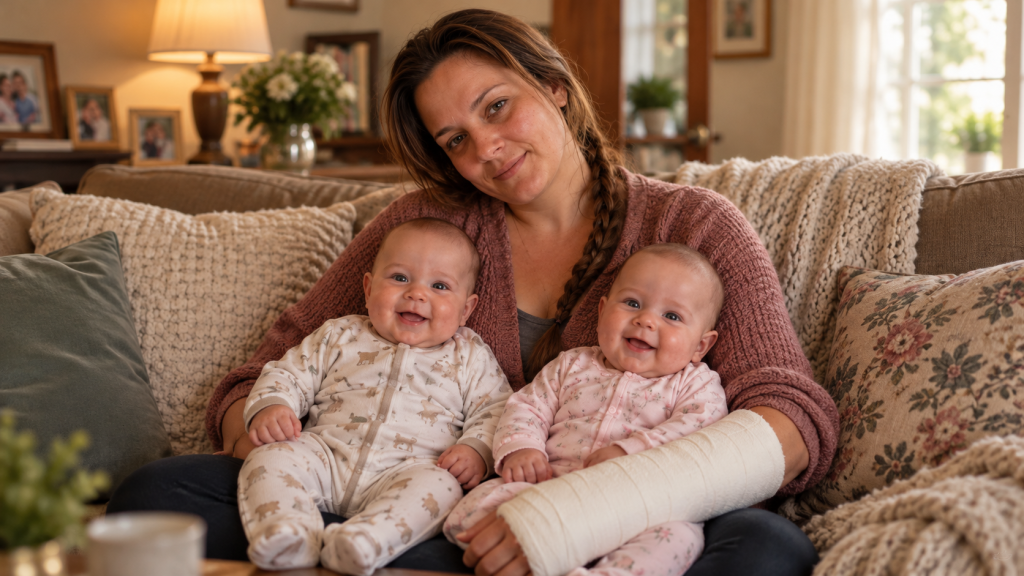
Our five-month-old twins, Noah and Owen, slept peacefully in their portable bassinets, unaware that the life we’d built around them was beginning to come apart. My broken arm throbbed inside its cast. I’d barely slept in four nights. But suddenly, I wasn’t tired anymore. I wanted to know what was inside that envelope. Linda sat down.
Then she placed it in front of me.
“Emily,” she said, “before you read this, I want you to know something. I love you and those babies. Whatever happens with Derek, that will never change.”
My throat tightened.
“Linda, you’re frightening me.”
She nodded.
“I know.”
Then she opened the envelope.
Inside were several printed screenshots of text messages.
At first, I didn’t understand what I was looking at.
The messages were between Linda and Derek.
The first was dated three weeks before our twins were born.
Linda had written:
Son, I’ve cleared my schedule for the first month after the babies arrive. I can stay with you and Emily, cook meals, help with laundry, or take the night shift whenever you need sleep. Just tell me what would make things easier.
Derek’s reply came fifteen minutes later.
Emily doesn’t want you involved. She thinks you’ll criticize everything she does. Better stay away.
I stared at the words.
I remembered that month.
I’d been enormously pregnant, barely able to walk without back pain.
I’d asked Derek whether his mother might come help after the birth.
He’d told me she’d already made other plans.
“Mom wants to enjoy her retirement,” he’d said. “Don’t expect everyone to rearrange their lives because we had kids.”
I’d believed him.
I’d even felt guilty for asking.
I turned to the next screenshot.
Linda had written after the boys came home from the hospital:
I know Emily is exhausted. Please tell her I can come tomorrow. I don’t want her feeling alone.
Derek had replied:
She says she needs privacy. Stop pushing.
My hands began trembling.
Another message.
Another offer.
Another lie.
When Noah had been hospitalized overnight with a respiratory infection, Linda had asked whether she could bring food and sit with Owen.
Derek had written:
Emily doesn’t trust you to watch him.
I covered my mouth.
“That’s not true.”
Linda wiped her eyes.
“I know that now.”
I looked at Derek.
“You told your mother I didn’t trust her?”
He crossed his arms.
“I didn’t want her interfering.”
“Interfering with what?”
“Our parenting.”
I laughed.
It came out sharp and painful.
“Our parenting? Derek, I haven’t had the luxury of using the word our since those babies were born.”
His face darkened.
“Here we go.”
“No,” I said. “You don’t get to dismiss me this time.”
I held up the papers.
“Your mother offered to help us. You told her I didn’t want her here. Then you told me she wouldn’t come.”
He said nothing.
“Why?”
He looked toward the window.
“Because I didn’t want two women in my house constantly telling me what to do.”
Linda closed her eyes.
For a moment, she looked physically ill.
I stared at my husband.
All those lonely nights.
All the times I’d sat crying on the nursery floor because both babies were screaming and I couldn’t soothe them simultaneously.
All the times I’d wondered why his mother, who’d been so excited during my pregnancy, suddenly seemed uninterested.
I had blamed myself.
I’d wondered whether I’d offended her.
I’d wondered whether I was failing so badly that even my family didn’t want to help.
And Derek had watched.
He’d watched me struggle while knowing help was waiting just one telephone call away.
My mother spoke from beside the bassinets.
“Emily asked me whether she’d upset Linda. I told her she should call and find out.”
I remembered.
I’d almost done it.
But Derek had said his mother was sensitive about being pressured.
I’d decided to leave her alone.
Now I looked at Linda.
“I’m so sorry.”
She shook her head fiercely.
“No, sweetheart. You have nothing to apologize for.”
Derek threw up his hands.
“Oh, come on! You’re all acting like I committed some terrible crime.”
Linda turned toward him.
“You deliberately kept two mothers apart while your wife was recovering from childbirth.”
“I was managing boundaries.”
“You were managing everyone else’s access to the truth,” she answered.
For the first time, Derek seemed uncertain.
Then his expression hardened again.
“Fine. I should’ve told Emily Mom offered to help. Happy now?”
I stared at him.
“Do you think that’s all this is?”
“What else do you want?”
I glanced at the suitcases beside the stroller.
What did I want?
I wanted the last five months back.
I wanted the peaceful newborn days I’d imagined during pregnancy.
I wanted to remember my sons’ first smiles without also remembering how exhausted I’d been.
I wanted the man I’d married to understand that those babies were his children too.
And most of all, I wanted to stop being treated like a household appliance that had no right to break down.
“I wanted a partner,” I whispered.
Derek rolled his eyes.
“I work fifty hours a week.”
Linda looked at him.
“Do you?”
He turned sharply.
“What?”
“I said, do you work fifty hours a week?”
“Of course I do.”
Linda’s voice became very quiet.
“Then perhaps you’d like to explain why you told me your manager approved your request to work from home on Wednesdays and Fridays.”
The room went silent.
I looked at Derek.
“What?”
He glared at his mother.
“That was months ago.”
“Three weeks ago,” Linda corrected.
I felt my heartbeat in my throat.
Three weeks ago.
I’d broken my arm four days earlier.
For months, I’d asked whether he could occasionally work from home.
Every time, he’d told me his company absolutely forbade it.
He’d said his boss would fire him if he even mentioned changing his schedule.
I’d believed that too.
“Derek,” I said slowly, “did your manager say you could work from home?”
He rubbed his forehead.
“That wasn’t a guarantee.”
“Was it an option?”
He hesitated.
“Yes, but—”
“And you told me it was impossible.”
He looked away.
“I didn’t want the distraction.”
The distraction.
Our sons.
My broken arm.
Our family.
All reduced to a distraction.
Something inside me finally went quiet.
Not the exhausted quiet I’d felt during sleepless nights.
This was different.
It was the quiet that comes when a person has asked the same question so many times that the answer no longer matters.
I stood.
“Mom, can you help me get the boys into the car?”
Derek stepped toward me.
“Emily, don’t be ridiculous.”
I looked at him.
“I’m following my doctor’s instructions. I need reliable help with the babies while my arm heals.”
“You can’t just take my sons.”
“They’re going to Grandma’s with me. You’ll know where they are, and we can arrange for you to see them safely. I’m not cutting you out of their lives.”
His face twisted.
“You’ve planned all this.”
I nodded.
“Yes.”
He stared.
“You admit it?”
“I called my mother. I packed what we’d need. I arranged transportation because I can’t lift the car seats. And I scheduled an appointment with a lawyer so we can understand our responsibilities.”
He looked genuinely stunned.
I wondered whether he’d expected me to cry, apologize, and unpack the suitcases the moment he became angry.
That’s what I usually did.
Whenever Derek raised his voice, I lowered mine.
Whenever he complained, I explained.
Whenever he withdrew affection, I tried harder.
But I had finally run out of ways to make myself smaller.
He pointed at the suitcases.
“What are you trying to prove?”
I looked toward the bassinets.
“Nothing. I’m trying to heal.”
Derek’s eyes flashed.
“You’re going to destroy our marriage over a broken arm?”
I looked at him.
“No, Derek. My arm will heal. I’m leaving because I finally understand how little my pain matters to you.”
Linda stood.
“I’ll help them get settled.”
Derek turned on her.
“You’re choosing her over your own son?”
Linda’s face crumpled.
For a moment, I thought she might back down.
Instead, she said something I’ll never forget.
“Derek, being your mother doesn’t mean I have to defend you when you’re wrong.”
His mouth opened.
Nothing came out.
Then she added, “And being their grandmother means I have responsibilities too.”
My mother gently lifted Noah.
Linda picked up Owen.
I took the diaper bag with my uninjured hand.
As we walked toward the door, Derek called after me.
“Emily!”
I stopped.
He stood beside the kitchen table, looking around as though he couldn’t understand why everyone was leaving.
“Who’s going to make dinner?” he demanded.
I stared at him.
There it was.
The question that explained everything.
His wife was leaving with a broken arm and two infant sons.
His marriage was falling apart.
And he was worried about dinner.
I looked at him for a long moment.
Then I answered, “You’re thirty-four years old, Derek. I’m sure you’ll figure it out.”
And I walked out.
I expected to feel victorious.
Instead, I cried almost the entire drive to my mother’s house.
My marriage had not always been like this.
At least, that was what I kept telling myself.
When Derek and I first met, he was charming.
He brought me flowers for no reason.
He remembered how I liked my coffee.
He planned little weekend trips and made me laugh until my stomach hurt.
When we decided to have children, he was more excited than I was.
He bought tiny baseball caps before we even knew whether we were having boys.
He painted the nursery himself.
He told everyone he’d been waiting his whole life to become a father.
But somewhere between the pregnancy announcement and the twins’ first month, his excitement had turned into resentment.
When the boys cried, he put on headphones.
When they needed changing, he handed them to me.
When I asked him to take a night feeding, he reminded me he had to work in the morning.
I’d told myself he was adjusting.
I’d told myself new parenthood was difficult for everyone.
I’d told myself things would get better.
Then I fell down the stairs.
And instead of seeing a woman in pain, he saw an interruption to the comfortable life I’d built around him.
My mother lived in a small yellow house twenty minutes away.
She had one spare bedroom and a living room barely large enough for two bassinets.
But the moment we arrived, the entire place seemed warmer than the home I’d left.
Mom had changed the sheets.
She’d stocked the refrigerator with easy meals.
She’d borrowed a second portable crib from a neighbor and set up a diaper-changing station at a safe height so I could help without lifting.
On the kitchen table sat a vase of daisies.
Beside it was a handwritten note.
You don’t have to earn rest here.
I stood in front of those words and began crying again.
Mom came up behind me.
“Oh, Emily.”
I turned.
“I’m thirty-one years old, Mom. I shouldn’t need you to rescue me.”
She took my good hand.
“Baby, needing help isn’t a failure.”
I looked down.
“I feel like I’ve ruined everything.”
She shook her head.
“You didn’t ruin anything by asking for help after breaking your arm.”
I glanced toward the bedroom where Linda was settling the boys.
“What if Derek never forgives me?”
Mom looked at me carefully.
“Emily, I think you’ve spent so much time worrying about whether Derek forgives you that you’ve forgotten to ask whether his behavior is something you’re willing to accept.”
I stared at her.
For a long moment, I couldn’t answer.
Then I whispered, “I don’t know.”
She nodded.
“Then you don’t have to decide tonight.”
That evening, Linda stayed until the twins had been bathed and fed.
She moved around the kitchen with the quiet competence of someone who had raised children before.
She didn’t criticize me.
She didn’t rearrange my mother’s cabinets.
She didn’t tell me I was doing anything wrong.
She simply helped.
When Owen began crying while I was trying to eat, Linda picked him up without making me ask.
When Noah needed changing, Mom handled it.
And for the first time in five months, I finished a meal while it was still warm.
I hadn’t realized how extraordinary that would feel.
At eight thirty, the boys were asleep.
At nine, Linda hugged me goodbye.
“I’m sorry I believed him,” she whispered.
I pulled back.
“You thought you were respecting my wishes.”
She nodded.
“But I should’ve asked you myself.”
I squeezed her hand.
“We both should’ve talked.”
She wiped her eyes.
“Well, we’re talking now.”
After she left, Mom helped me get comfortable on the couch.
She brought a pillow for my arm and a cup of tea.
Then she sat beside me.
For several minutes, neither of us spoke.
Finally, she asked, “What do you miss most?”
I looked at her.
“About what?”
“Before the babies.”
I thought carefully.
Then tears slid down my cheeks.
“I miss being a person.”
Mom’s face changed.
I continued before I lost my courage.
“I love Noah and Owen more than anything. But I feel like I’ve disappeared. I don’t read anymore. I don’t see my friends. I don’t remember the last time I showered without rushing.”
My voice broke.
“And whenever I try to tell Derek I’m exhausted, he acts like loving our babies means I shouldn’t ever be tired.”
Mom took my hand.
“Emily, you can love your children with your whole heart and still need sleep.”
I began sobbing.
She held me carefully, avoiding my cast.
And for the first time since the twins were born, I allowed someone else to comfort me.
That night, I slept for five uninterrupted hours.
Five hours.
It felt like waking in another country.
When I opened my eyes, sunlight was slipping through the curtains.
For one frightening moment, I panicked.
The babies.
Their bottles.
Their diapers.
Then I heard Mom singing softly in the kitchen.
Noah answered with a happy little squeal.
Owen was making the breathy sounds he always made when someone kissed his belly.
I lay there listening.
Nobody was angry.
Nobody was demanding breakfast.
Nobody was reminding me that mothers didn’t get sick days.
My boys were safe.
And I was allowed to rest.
I covered my face and cried quietly into the pillow.
Not because I was sad.
Because I had forgotten what relief felt like.
The peace lasted until noon.
Then my phone began ringing.
Derek.
I ignored the first call.
Then the second.
Then the third.
Finally, a message arrived.
This is insane. You embarrassed me in front of my mother. Come home and stop acting like a child.
I stared at the screen.
Another message followed.
I told my coworkers you walked out because you couldn’t handle motherhood.
My stomach twisted.
A third message appeared.
Everybody agrees you’re overreacting.
I almost replied.
I wanted to defend myself.
Explain my broken arm.
Describe the sleepless nights.
Remind him how many times I’d begged for help.
Then I looked toward the kitchen.
Mom was sitting at the table with Noah on her lap.
He was smiling at her.
And something stopped me.
Why was I still trying to convince Derek that my pain existed?
I took screenshots.
Then I put down the phone.
An hour later, Linda called.
Her voice sounded strained.
“Emily, has Derek contacted you?”
“Several times.”
She sighed.
“He called me too.”
“What did he say?”
“That I ruined his marriage.”
I closed my eyes.
“I’m sorry.”
“Don’t you apologize for him.”
There was a pause.
Then Linda said, “I need to tell you something else.”
My stomach tightened.
“What?”
“When Derek was here last month, he asked me whether I’d help pay for a trip he was planning with his friend Paul.”
I frowned.
“What trip?”
“A week at a lakeside resort. Fishing, boating, that sort of thing.”
I sat straighter.
“Derek never mentioned a trip.”
Linda was quiet.
“Emily, he told me you’d agreed he deserved some time away after the babies were born.”
I stared at the wall.
“When was he supposed to go?”
“Next month.”
Next month.
When my arm would still be healing.
When I would still be struggling to lift two babies.
When he’d refused to come home an hour earlier.
I swallowed.
“Did you give him money?”
“No. I told him he should discuss it with you.”
I looked at my phone.
“I’ll call you back, Linda.”
I opened our joint banking app.
Then I froze.
Three weeks earlier, a payment of six thousand eight hundred dollars had left our emergency savings account.
The description read:
HARBORVIEW RESORT AND MARINA — RESERVATION.
For a moment, I couldn’t move.
That emergency account was supposed to protect our family.
We’d built it slowly.
I’d contributed money from my job as a dental office coordinator before taking maternity leave.
I’d skipped holidays.
Bought secondhand furniture.
Put away birthday money.
And I’d protected that account because twins meant unexpected expenses.
Derek knew that.
He also knew I had been worrying about how we could afford temporary childcare while my arm healed.
Yet somehow, six thousand eight hundred dollars had been available for a vacation.
I looked at the transaction again.
Then I called him.
He answered immediately.
“Finally.”
I ignored his tone.
“Derek, did you spend sixty-eight hundred dollars from our emergency savings on a resort?”
Silence.
Then he said, “What?”
“The Harborview reservation. Did you make it?”
He exhaled sharply.
“That was supposed to be a surprise.”
I stared at the phone.
“A surprise for whom?”
“Me. I was going to tell you after everything settled down.”
I closed my eyes.
“You used our emergency fund for a vacation?”
“It’s a deposit. Most of it’s refundable.”
“Most?”
“Emily, stop making everything dramatic.”
My voice shook.
“You told me we couldn’t afford a part-time nanny.”
“We can’t.”
“But you can afford six thousand eight hundred dollars for a fishing trip?”
He went silent.
I waited.
Then he said, “I work hard. I deserve something for myself.”
I felt the last of my hope break.
Not because he’d wanted a vacation.
Because he couldn’t see the difference between his desire to rest and my desperate need for help.
I spoke quietly.
“Derek, cancel the reservation.”
“You don’t get to order me around.”
“That money belongs to our household. We need it for the babies, medical expenses, and childcare.”
He laughed bitterly.
“There it is. You think staying home with the kids makes you entitled to control everything I earn.”
I stared at the wall.
Then I said something I’d never said before.
“I earned part of that money too.”
He snorted.
“Past tense, Emily. Past tense.”
I hung up.
My hands were shaking so badly I could barely place the phone on the table.
Mom found me sitting there.
I showed her the transaction.
She looked at it for a long time.
Then she said, “Tomorrow, you need to tell that lawyer everything.”
I nodded.
And for the first time, I wasn’t worried about whether Derek would be angry.
I was worried about how much of our family’s future he was willing to sacrifice to avoid being a father.
The following morning, I met a family-law attorney named Priya Shah.
Her office was on the second floor of a small brick building downtown.
I arrived with my arm in a sling, dark circles beneath my eyes, and a folder containing bank statements, medical instructions, and screenshots of Derek’s messages.
Mom stayed home with the boys.
Linda had promised to relieve her after lunch.
For once, I didn’t have to rush through an appointment because nobody else was willing to watch my children.
Priya greeted me warmly.
She was perhaps forty, with dark hair pulled into a neat bun and a way of listening that made me feel my words were actually reaching someone.
I told her everything.
The broken arm.
Derek’s refusal to help.
The hidden offers from Linda.
The resort reservation.
The threats and accusations.
When I finished, Priya sat quietly for a moment.
Then she asked, “Emily, what do you want to happen?”
I opened my mouth.
Nothing came out.
I’d spent so much time reacting to Derek that I hadn’t really considered what I wanted.
Finally, I whispered, “I want my babies to be safe.”
She nodded.
“And?”
“I want my arm to heal.”
“And?”
I swallowed.
“I want to stop feeling like I’m doing something wrong every time I need help.”
Priya folded her hands.
“Those are reasonable things to want.”
Tears filled my eyes.
It was such a simple sentence.
But after months of hearing that I was selfish, lazy, demanding, or ungrateful, it felt like someone had opened a window in a room without air.
Priya explained that leaving temporarily to obtain safe childcare while I recovered did not mean I was abandoning my responsibilities.
She also explained that Derek remained the boys’ father, with rights and obligations we would need to address properly.
We discussed temporary parenting arrangements, finances, access to our home, and the importance of documenting communications without turning every disagreement into a fight.
When I showed her the resort payment, her expression grew serious.
“Do you know whether he’s cancelled it?”
“No.”
“Have you asked the bank about the transaction?”
“Not yet.”
“We should determine what happened to the funds and whether any portion can be recovered. I also want you to keep records of ordinary household expenses and childcare costs.”
I nodded.
Then I asked the question that had been keeping me awake.
“What if he says I’m an unfit mother because I can’t lift the babies?”
Priya looked at my cast.
“Emily, you have a temporary injury and you’re arranging appropriate care. That’s responsible parenting. We should document the medical restrictions and your support arrangements.”
My throat tightened.
“He told people I couldn’t handle motherhood.”
“His statements are not the same thing as evidence.”
I looked down at my hands.
“Sometimes I wonder whether he’s right.”
Priya’s expression softened.
“About what?”
“Maybe other mothers would manage better.”
She leaned forward.
“Would you expect a father with a broken arm to lift two five-month-old babies against medical advice without asking for help?”
“No.”
“Then why are you holding yourself to that standard?”
I couldn’t answer.
She let the silence settle.
Then she said, “You’ve been trying to provide care while injured, exhausted, and unsupported. Needing assistance doesn’t mean you’re inadequate. It means the current arrangement isn’t meeting your family’s needs.”
I wiped my eyes.
For the first time, I began to understand that Derek’s cruelty had changed the way I saw myself.
He didn’t need to say I was worthless outright.
He only needed to tell me often enough that nothing I did counted.
And eventually, I’d begun believing him.
Before I left, Priya handed me a written summary of our next steps.
She suggested that we communicate with Derek in writing where practical, discuss a temporary parenting plan, and avoid making major financial decisions without reviewing the consequences.
She also recommended that I speak with a counselor.
Not because I was doing anything wrong.
But because the last few months had been overwhelming.
I sat in my car afterward for nearly twenty minutes.
Then I called Mom.
“How are the boys?”
“Wonderful. Noah just finished his bottle, and Owen has decided my kitchen curtains are the funniest things he’s ever seen.”
I smiled.
“Is Linda there?”
“She just arrived.”
I closed my eyes.
For the first time, I realized how different motherhood could feel when help wasn’t treated like a favor I had to earn.
“Mom?”
“Yes, sweetheart?”
“Thank you.”
She was quiet for a moment.
Then she said, “Come home when you’re ready. We’ve got everything covered.”
I sat there with tears running down my face.
Everything covered.
Two words I’d waited five months to hear.
That evening, Derek sent another message.
I spoke to a lawyer. You can’t keep my children from me.
I read it carefully.
Then I replied:
I’m not refusing your involvement. The boys are safe with me at Mom’s while my arm heals. Let’s arrange a temporary schedule through our attorneys that meets their needs and allows you to participate in their care.
He answered almost immediately.
I don’t need permission to see my own sons.
I waited before responding.
I’m not asking you to get permission to love them. I’m asking us to make safe, practical arrangements.
Three dots appeared.
Disappeared.
Then appeared again.
Finally, his message arrived.
You think you’re so smart now because you hired a lawyer.
I placed the phone down.
I didn’t answer.
I’d spent enough years arguing with someone who treated every boundary as an insult.
Two days later, I received a message from a woman named Hannah.
She was married to one of Derek’s coworkers.
We’d met at the company’s Christmas party and exchanged numbers when I was pregnant.
Her message was brief.
Emily, I hope it’s okay that I’m reaching out. I heard you’ve been having a difficult time. There’s something I think you should know.
I stared at the screen.
Part of me wanted to ignore it.
I couldn’t bear another accusation.
But curiosity won.
I called her.
“Emily,” she said, “I’m sorry to bother you.”
“You’re not bothering me.”
She hesitated.
“I heard about your arm.”
I glanced at my cast.
“Yes. It’s broken.”
“Oh, honey.”
Her genuine concern nearly made me cry.
Then she continued.
“Paul came home from work yesterday upset about something Derek said.”
Paul was Hannah’s husband.
He worked in the same department as Derek.
“What did he say?”
Hannah sighed.
“Derek told everyone you’d taken the twins to your mother’s because you wanted a vacation from being a parent.”
My stomach twisted.
“Of course he did.”
“But that’s not why I’m calling.”
I sat straighter.
“What is?”
Hannah lowered her voice.
“Paul said Derek was offered caregiver leave when you broke your arm.”
For a moment, I forgot how to breathe.
“What?”
“His manager offered to help him rearrange his schedule and explained the company’s paid family-care days. Paul was there when they discussed it.”
I stared at the wall.
“Are you sure?”
“Paul doesn’t want to get involved in your marriage, but he said he heard Derek turn it down.”
My hand tightened around the phone.
“Why?”
Hannah hesitated.
Then she said, “According to Paul, Derek told the manager his wife had everything under control and he didn’t want to waste his leave.”
I closed my eyes.
Everything under control.
I remembered sitting on the nursery floor with my broken arm propped on a pillow.
Both babies crying.
My hair unwashed.
My body trembling with exhaustion.
I remembered asking Derek whether he could come home early.
And I remembered him looking straight at me and saying there was absolutely nothing he could do.
“Hannah,” I whispered, “thank you for telling me.”
She paused.
“Emily, can I say something?”
“Of course.”
“Paul and I have three children. There were months when I thought I’d lose my mind from exhaustion. If Paul had treated me the way Derek described treating you, I would have needed help too.”
Tears slid down my cheeks.
She continued.
“You aren’t lazy. And you aren’t failing.”
I covered my mouth.
“Thank you.”
After we hung up, I sat quietly for a long time.
Then I opened my phone and looked at Derek’s latest message.
You have no idea how much pressure I’m under.
I stared at those words.
He had access to leave.
He had options to work from home.
He had a mother willing to help.
He had money available for a fishing vacation.
And he’d hidden every one of those possibilities while telling me I was asking for too much.
For the first time, I understood that Derek’s refusal wasn’t simply about exhaustion.
He believed the work of caring for our children belonged to me.
And whenever reality demanded that he do some of it, he responded as though someone were stealing something from him.
The following afternoon, Linda called Derek and asked him to come to her house.
I wasn’t there.
She told me afterward what happened.
He arrived expecting her to apologize.
Instead, she asked him to sit at the dining table.
On it, she’d placed an old photograph.
Derek at five years old, wearing blue pajamas, asleep against his father’s chest.
Linda pointed to it.
“Do you remember this?”
Derek shrugged.
“Not really.”
“Your father took that picture after he’d been awake all night with you. You had pneumonia.”
Derek looked away.
Linda continued.
“He worked long hours. He got tired. Sometimes he was frightened and didn’t know what to do. But he didn’t tell me the children were my problem.”
Derek crossed his arms.
“Dad didn’t have twins.”
“No,” Linda answered. “But he understood they were his children.”
For a while, Derek said nothing.
Then he muttered, “Emily acts like I never do anything.”
Linda studied him.
“What time do Noah and Owen usually have their first bottles?”
He blinked.
“What?”
“Their first bottles. What time?”
He frowned.
“Seven? Eight?”
“What formula do they drink?”
“Mom, come on.”
“Do you know how much they take at each feeding?”
He stared at her.
“Emily handles that.”
Linda nodded slowly.
“Do you know when their next pediatric appointment is?”
Silence.
“Which twin gets the rash when you use the scented wipes?”
Derek rubbed his forehead.
“Why are you interrogating me?”
Linda’s voice broke.
“Because you keep saying you’re their father as though saying it is the same thing as being present.”
He stood.
“I’m not doing this.”
Linda looked at him.
“Then that’s your choice. But don’t blame Emily for the distance you’re creating between yourself and your sons.”
Derek left without answering.
That night, he called me.
For the first time, he didn’t begin by shouting.
“Emily.”
I hesitated.
“Yes?”
“Mom told me what she said.”
I waited.
“She made me feel like I’m some kind of monster.”
I took a slow breath.
“You’re their father, Derek. Nobody is asking you to be perfect. I’m asking you to be involved.”
He was quiet.
Then he said, “I don’t know how to do everything you do.”
The words surprised me.
For a moment, I heard something beneath his anger.
Fear.
But it didn’t erase the months of contempt.
“Neither did I when the boys were born,” I answered. “I learned.”
He sighed.
“You make it sound so easy.”
“It’s not easy. That’s what I’ve been trying to tell you.”
A long silence followed.
Then he whispered, “I don’t know where to start.”
I closed my eyes.
Five months ago, that admission would have filled me with relief.
I would have rushed to reassure him.
Written instructions.
Taken over the difficult parts.
Praised him for changing a diaper.
But now I knew that if I became the manager of his efforts, I’d simply be doing another kind of work for him.
“Start by showing up,” I said. “And by learning without expecting me to carry you through every step.”
He breathed out slowly.
“Can I see the boys this weekend?”
I thought about his recent anger.
The messages.
The financial deception.
The fact that he hadn’t yet cared for both babies independently.
“We can arrange a visit at your mom’s. She can be there while you get familiar with their routine.”
He was silent.
Then he asked, “You don’t trust me alone with them?”
“I don’t trust that you know everything they need yet.”
He inhaled sharply.
“That’s insulting.”
“It may feel that way. But Noah and Owen need you to know their routine, not just resent the fact that you haven’t learned it.”
He didn’t answer.
Finally, he said, “Fine. Saturday.”
When we hung up, I sat in silence.
I didn’t feel hopeful.
Not exactly.
But I felt clear.
Derek could either begin acting like a father or continue insisting the world was unfair because someone expected him to.
What he did next would tell me more than any apology.
Saturday arrived with cold rain.
Mom drove me and the twins to Linda’s house.
Derek was already there when we arrived.
He stood awkwardly beside the couch, wearing jeans and an expensive sweatshirt.
He looked at the boys.
“Hey, little guys.”
Noah smiled.
Owen stared at him.
Derek reached toward Noah, then hesitated.
“Can I pick him up?”
Linda smiled gently.
“Of course. Support his head and body.”
Derek lifted him carefully.
For a moment, Noah rested quietly against his chest.
Then Owen began crying.
Derek looked toward me.
“What’s wrong with him?”
“I don’t know yet,” I said.
He stared.
“You don’t know?”
“Not every cry comes with an explanation, Derek.”
Linda approached Owen.
“Why don’t you check his diaper?”
Derek frowned.
“Can’t you do it?”
Linda remained still.
“You asked to spend time with your sons.”
He sighed.
Then he handed Noah back to me before remembering I couldn’t safely lift him.
I didn’t reach out.
Linda took Noah instead.
Derek carried Owen to the changing table.
For the next several minutes, I watched him struggle with an ordinary diaper change.
He couldn’t find the wipes.
He opened the diaper backward.
He forgot to place the clean diaper underneath before removing the dirty one.
Then Owen kicked his legs and knocked the wipes onto the floor.
Derek muttered something under his breath.
Linda said nothing.
She simply pointed toward the supplies.
When he finished, Owen began crying again.
Derek looked exhausted.
“It’s like nothing makes him happy.”
I almost laughed.
He’d been caring for a baby for eleven minutes.
Eleven.
I had been doing this around the clock for five months.
But I didn’t say that.
Instead, I watched Linda show him how to check whether Owen was hungry, tired, or uncomfortable.
By lunchtime, Derek had learned to prepare a bottle, change both boys, and settle Noah for a nap.
He was sweating.
His hair was disheveled.
There was formula on his shirt.
At one point, Owen spit up down the front of his sweatshirt.
Derek stared at the stain.
“Oh, come on!”
Linda handed him a towel.
“Welcome to parenthood.”
I looked away to hide a smile.
But it wasn’t enough to make me forget everything.
One difficult afternoon couldn’t teach him what five months had cost me.
And a diaper change wasn’t an apology.
At three o’clock, Noah began crying again.
Derek looked toward me.
“Can you take him for a minute?”
I held up my cast.
“I can’t lift him, remember?”
He stared at it.
For a long moment, his face was unreadable.
Then he looked at Noah.
Slowly, he stood.
He picked up his son.
He walked around the room, rocking him gently.
And when Noah finally settled against his shoulder, Derek sat down without speaking.
I watched him stare at our baby’s face.
Something softened in his expression.
For the first time in months, he wasn’t looking at Noah as another task waiting to be assigned.
He was simply looking at his son.
Then he whispered, so quietly I almost missed it, “He’s gotten so big.”
My chest tightened.
Yes, I thought.
He had.
And Derek had missed so much of it.
After the visit, Mom drove me home.
I sat beside the twins in the back seat, watching them sleep.
For the first time, I allowed myself to feel the sadness beneath my anger.
I had never wanted to raise my sons apart from their father.
I’d imagined family vacations.
Birthday parties.
Saturday mornings with pancakes.
Derek teaching the boys to ride bicycles.
All the ordinary little moments I’d thought we would share.
Now I didn’t know whether any of that would happen.
When Mom asked how the visit had gone, I looked out the window.
“He finally held them without asking me to do it for him.”
She smiled faintly.
“That’s a beginning.”
I nodded.
“But it’s not the same as a change.”
Mom reached over and squeezed my knee.
“No, sweetheart. It’s not.”
And that night, as I lay in bed listening to the twins breathe, I realized I was finally learning something just as important as Derek needed to learn.
I could acknowledge his small steps without lowering the standards that protected me.
The next two weeks tested that lesson in ways I hadn’t expected.
Derek began asking to see the boys more regularly.
At first, his messages were stiff and awkward.
Can I come by Thursday?
What time are their bottles?
Does Owen still need that cream for his skin?
I answered the questions that concerned the boys, and we arranged visits with Linda present.
Then one evening, he sent a message that stopped me.
I called the pediatrician’s office today to confirm their next appointment. I wanted to put it on my calendar.
I stared at the words.
For five months, I had been the only person who knew the boys’ appointments without looking them up.
The only person who ordered diapers before we ran out.
The only person who noticed when a bottle nipple needed replacing or a rash wasn’t improving.
Now Derek was beginning to learn those details.
Part of me felt relieved.
Another part felt angry.
Why had it taken my broken arm, two packed suitcases, and the possibility of losing his marriage for him to do something so basic?
That was the hardest part of watching Derek change.
I wanted him to become a good father.
But I resented having to suffer so much before he took fatherhood seriously.
When I told Priya about those feelings, she nodded.
“Both can be true, Emily. You can welcome healthier behavior and still be angry about what made it necessary.”
I looked down at my cast.
“Sometimes I feel guilty for not being more encouraging.”
“Encouragement is one thing. Pretending the past didn’t happen is another.”
I thought about that all the way home.
Then came another surprise.
Derek cancelled the resort trip.
I learned about it when a partial refund appeared in our joint account.
Four thousand nine hundred dollars.
The remaining nineteen hundred had been charged under the resort’s cancellation terms.
I stared at the figures.
A few days later, Derek called.
“I cancelled Harborview.”
“I saw.”
He hesitated.
“They kept part of the deposit.”
“I saw that too.”
He sighed.
“I know you’re angry.”
I looked toward the living room, where Mom was rocking Owen.
“Derek, that money could have paid for the help I needed.”
“I know.”
I waited.
Then he said something that surprised me.
“I thought if I went away for a week, I’d finally feel like myself again.”
I closed my eyes.
There it was.
The first honest explanation I’d heard.
“I understand wanting a break,” I said. “I wanted one too.”
“I know.”
“No, Derek. I don’t think you did. You planned to spend thousands of dollars escaping a life you expected me to handle without any rest at all.”
He was quiet.
I continued.
“I didn’t get to make plans for a vacation. I was trying to figure out how to wash my hair with one hand.”
His breathing changed.
“I’m sorry, Emily.”
I sat very still.
It was the first time he’d apologized without immediately explaining why I was partly responsible.
But a word, even a sincere one, couldn’t replace the help he’d refused to give.
“Thank you for saying that,” I answered.
He hesitated.
“Does that mean you’ll come home?”
I looked at the boys.
Noah was laughing at something my mother had done.
Owen was reaching toward her glasses.
I felt a familiar ache.
“I don’t know, Derek.”
He exhaled sharply.
“What else do I have to do?”
I swallowed.
“Stop asking me for a list that guarantees you’ll get your old life back.”
He was silent.
Then I said, “You have to decide what kind of father you’re going to be, whether or not we’re married.”
I ended the call before I began crying.
A week later, the doctor examined my arm.
The news wasn’t what I’d hoped.
The fracture was healing, but more slowly than expected.
My doctor studied the new images and asked whether I’d been using the injured arm.
I hesitated.
“A little.”
“For lifting?”
“Before I left home, yes. Sometimes I caught myself trying to pick up one of the babies.”
She gave me a concerned look.
“Emily, I understand how difficult that must have been, but you need to protect the healing bone. We don’t want complications.”
I nodded.
She adjusted my recovery plan and referred me for further follow-up.
For several more weeks, I’d need help with the boys.
I sat in my car afterward and cried.
I was tired of being injured.
Tired of depending on others.
Tired of watching my mother rearrange her life around my needs.
Most of all, I was frightened that my body might never feel completely strong again.
When I returned home, Mom met me at the door.
“How did it go?”
I showed her the doctor’s instructions.
Her face softened.
“Oh, sweetheart.”
“I’m so sorry.”
She frowned.
“Sorry for what?”
“For being here so long. For making you do all this.”
Mom looked at me for a long moment.
Then she took the paper from my hand.
“Emily, when you were eight years old, you broke your ankle falling off your bicycle.”
I blinked.
“What?”
“I carried you from the driveway. Your father took you to the hospital. For six weeks, we helped you get dressed and carried things you couldn’t manage.”
I smiled faintly.
“I remember the purple cast.”
Mom nodded.
“Did you think you were a burden then?”
“No.”
“Then why do you think you’re a burden now?”
Tears filled my eyes.
She stepped closer.
“You’re still my daughter. You don’t stop deserving care because you’re grown.”
I leaned into her shoulder.
And for the first time, I began to understand how deeply Derek’s words had wounded me.
Moms don’t get sick days.
He’d said it as though becoming a mother meant surrendering the right to be human.
But my mother was showing me something entirely different.
Love wasn’t measured by how much suffering a person could endure without complaint.
Sometimes love looked like someone carrying the baby so you could heal.
That weekend, Mom developed a terrible migraine.
She’d struggled with them for years, and stress made them worse.
By Saturday morning, she needed to lie in a dark room.
Linda was available to help, but she had a medical appointment later that afternoon.
For the first time since leaving Derek, I faced a stretch of hours when our usual support arrangements wouldn’t be enough.
I called Linda.
“We can find another helper,” I told her. “I don’t want you cancelling your appointment.”
She paused.
“Emily, what about Derek?”
I looked toward the twins.
“He has been learning.”
“And he asked for more time with them.”
I swallowed.
“You’re right.”
We discussed a plan that would let him care for the boys at Linda’s house, where all their supplies were available and another trusted adult could be reached if he needed help.
Derek agreed.
He’d already practiced the feeding and bedtime routines during several longer visits.
He’d attended the boys’ latest pediatric appointment.
And he’d begun taking turns with the practical work instead of expecting his mother to do everything.
Still, I was nervous.
I packed the diaper bag with my good hand while Linda handled the car seats.
Then I wrote down the medication instructions for Owen’s skin and the number for the pediatrician.
Derek looked at the paper.
“Emily, I’ve got it.”
I almost snapped.
Then I took a breath.
“I know you’re learning. These are the details anyone caring for them needs.”
He nodded.
“Okay.”
Linda drove the boys to her house.
I stayed with Mom.
For the first hour, I paced.
For the second, I checked my phone every five minutes.
By the third, I realized something uncomfortable.
I’d spent so long being responsible for everything that allowing someone else to do the work felt almost as difficult as doing it myself.
At four fifteen, Derek sent a photograph.
Noah and Owen were lying on their play mat, wearing matching yellow pajamas.
Both were smiling.
Underneath, Derek had written:
They’ve eaten. Diapers changed. Linda’s heading to her appointment. We’re doing tummy time.
I stared at the photograph.
Then I sat down.
For the first time, I allowed myself to believe the boys could be cared for properly without me directing every moment.
That evening, Derek called.
His voice sounded exhausted.
“Emily?”
“Are they okay?”
“Yes. Linda’s back now. Both are asleep.”
I exhaled.
“Good.”
He was quiet.
Then he said, “Can I tell you something?”
I hesitated.
“Yes.”
“I don’t know how you did this every day.”
My throat tightened.
“What happened?”
He gave a tired laugh.
“Nothing terrible. That’s the thing. It was just everything.”
I sat very still.
He continued.
“Noah was hungry while Owen needed changing. Then Owen cried because he was tired, and Noah spit up all over his clothes. I cleaned one thing, and something else needed doing.”
He paused.
“I didn’t even eat the sandwich Mom left me until almost four.”
I closed my eyes.
That had been my life.
Every day.
For five months.
Derek’s voice grew quiet.
“I kept thinking there would be a point when everything was finished.”
I swallowed.
“There isn’t.”
“I know that now.”
A long silence followed.
Then he whispered, “Emily, I was cruel to you.”
Tears filled my eyes.
I said nothing.
He continued.
“I told you that you did nothing all day. But I don’t think I’ve ever worked as hard at home as I did today, and I only handled a few hours.”
My chest tightened.
He took a breath.
“I was wrong.”
The words landed somewhere deep inside me.
I’d waited so long to hear them.
But instead of feeling triumphant, I felt exhausted.
“Derek,” I whispered, “I needed you to believe me when I told you it was hard.”
“I know.”
“I shouldn’t have had to break my arm and leave our marriage for you to see that.”
His voice cracked.
“You’re right.”
I covered my eyes.
For the first time, he wasn’t arguing.
He wasn’t defending himself.
He wasn’t telling me to be grateful.
He was listening.
And somehow, that hurt almost as much as the cruelty had.
Because it proved he’d been capable of listening all along.
He’d simply chosen not to.
Over the following month, Derek began taking his responsibilities more seriously.
He used some of the leave available through his employer.
He arranged regular parenting time.
He learned the boys’ routines.
He bought supplies for them to keep at Linda’s house.
And he stopped describing the care he gave them as “helping Emily.”
One afternoon, I heard him tell Paul over the phone, “I’m taking care of my sons this weekend.”
Such an ordinary sentence.
Yet it meant more than all the flowers he’d ever bought me.
He wasn’t saying he was babysitting.
He wasn’t saying he was doing me a favor.
He was finally calling fatherhood what it was.
His responsibility.
But the improvements raised a question I hadn’t expected.
What happened to our marriage now?
Derek wanted me to come home.
He told me he’d changed.
He asked for another chance.
And part of me wanted desperately to believe we could begin again.
I missed the good years.
I missed the man who used to dance with me in our kitchen.
I missed the feeling that our future was something we were building together.
But whenever I imagined returning to that house, I remembered the night he’d stood over me with his arms crossed.
You stay home and do nothing all day.
I remembered the false messages to Linda.
The hidden resort payment.
The way he’d watched me struggle and insisted I was asking too much.
I couldn’t simply fold those memories away because he’d learned to change a diaper.
One evening, we agreed to meet with a marriage counselor.
Her name was Dr. Elaine Foster.
She was gentle but direct.
During our first session, Derek described feeling overwhelmed after the twins arrived.
He said he’d been frightened of failing as a father.
He said work was the only place where he still felt competent.
And he admitted that he’d begun avoiding the babies because he didn’t know how to soothe them.
Dr. Foster listened.
Then she asked, “Derek, when you felt overwhelmed, what did you do?”
He looked down.
“I stayed at work longer.”
“And what happened to the responsibilities you avoided?”
He glanced toward me.
“Emily handled them.”
“Even after she was injured?”
His face flushed.
“Yes.”
Dr. Foster nodded.
“So the method you used to cope with feeling inadequate transferred the entire burden onto your wife.”
He was silent.
Then she asked, “Why did you tell your mother that Emily didn’t want her help?”
Derek stared at his hands.
For several seconds, I thought he wouldn’t answer.
Then he whispered, “I didn’t want Mom to see how little I was doing.”
The room went still.
I looked at him.
“What?”
He covered his face.
“I knew she’d be disappointed.”
My breath caught.
“So you let me think she didn’t want to come?”
He nodded without looking up.
“And you let her think I didn’t trust her?”
His shoulders shook.
“I’m sorry.”
I stared at him.
I’d wondered for months why he’d worked so hard to keep us apart.
I’d thought perhaps he resented his mother’s opinions.
Perhaps he wanted control.
Perhaps he simply didn’t care.
But the truth was uglier in a quieter way.
He had protected his reputation as a good husband and father by making the two women who loved him misunderstand each other.
And I’d paid the price.
Dr. Foster turned toward me.
“Emily, what are you feeling?”
I looked at Derek.
“Angry.”
She nodded.
“Can you say more?”
I swallowed.
“I’m angry that he knew.”
Tears filled my eyes.
“He knew he wasn’t doing his share. He knew Linda would be disappointed. He knew I needed help.”
My voice broke.
“But instead of changing, he made sure nobody could see what was happening.”
Derek began crying.
I had rarely seen him cry.
A year earlier, I would have rushed to comfort him.
This time, I stayed in my chair.
Not because I wanted him to suffer.
But because I needed space for my own feelings.
Dr. Foster waited until we were both calmer.
Then she asked the question that changed everything.
“Emily, if Derek becomes a consistently responsible father, does that automatically mean you want to remain married to him?”
I stared at her.
“No.”
The answer came so quickly it surprised me.
Derek looked up.
“What?”
I turned toward him.
“I want you to be a good father, Derek. I want Noah and Owen to know you. I want you to be someone they can rely on.”
My voice shook.
“But I don’t know whether I can trust you as my husband again.”
He stared.
“After everything I’ve been doing?”
I closed my eyes.
There it was.
The temptation to turn improvement into something I owed him repayment for.
Then he caught himself.
His face changed.
“I’m sorry,” he said quietly. “That came out wrong.”
I looked at him.
“That’s exactly what scares me. Sometimes it still feels like you’re doing the right things because you expect them to bring me home.”
He lowered his eyes.
Dr. Foster leaned forward.
“Derek, can you continue being a present father even if Emily doesn’t return to the marriage?”
He was silent for a long time.
Then he whispered, “I don’t know.”
I felt my heart sink.
But at least he was being honest.
Dr. Foster nodded.
“Then that’s something important for you to work on. Your sons deserve a relationship with you that isn’t dependent on what happens between their parents.”
Derek wiped his face.
“I know.”
For the first time, I wasn’t trying to predict whether he would improve.
I was simply watching.
And allowing his actions, over time, to speak for themselves.
Spring arrived slowly.
The trees outside Mom’s house turned green.
The twins began sitting up.
Noah discovered that banging wooden blocks together was the funniest activity in the world.
Owen learned to clap whenever somebody sang.
And one beautiful Tuesday morning, my doctor finally told me the fracture had healed enough to begin rebuilding strength through physical therapy.
I sat in the examination room staring at the new images.
“Really?” I whispered.
The doctor smiled.
“Really. You’ll still need to regain strength and movement, and you should follow the lifting guidance carefully. But the bone is healing well.”
I looked at my arm.
For weeks, I’d felt trapped inside the injury.
Every ordinary task had reminded me of what I couldn’t do.
Now, for the first time, I could imagine using both hands without pain again.
I drove home with tears in my eyes.
But this time, they were happy tears.
When I told Mom, she hugged me.
Then she said, “You know what this means?”
I laughed.
“That I can finally wash my hair without help?”
“That too.”
She smiled.
“But it also means you get to decide what happens next.”
I looked toward the living room.
The twins were playing beside their grandmother.
And suddenly, I understood.
My broken arm had forced me to stop.
But during that pause, I’d begun noticing all the things I’d accepted simply because I was too exhausted to question them.
I had learned how to ask for help.
How to rest without apologizing.
How to tell someone no.
And how to recognize that love should never require pretending my needs didn’t exist.
I wasn’t ready to return to my old life.
Not because I still hated Derek.
I didn’t.
But because I no longer wanted to live in a marriage where I had to break down before my husband noticed I needed care.
After several more counseling sessions, I told him I wanted a divorce.
We met at Linda’s house.
The boys were napping upstairs.
Derek sat across from me at the dining table.
When I told him, his eyes filled with tears.
“Emily, please.”
My chest tightened.
“I’ve thought about this for a long time.”
“I can change.”
“I know you can.”
“Then why won’t you let me prove it?”
I took a breath.
“Derek, you don’t need to prove it to me anymore. Prove it to Noah and Owen by being their father for the rest of their lives.”
He looked down.
“You’re really leaving.”
I swallowed.
“Yes.”
For a long time, neither of us spoke.
Then he whispered, “I thought if I did everything right, you’d forgive me.”
I felt tears slide down my cheeks.
“I can forgive you without returning to a marriage that no longer feels right for me.”
He covered his face.
And I cried too.
Not because I doubted my decision.
Because ending something you once believed in can hurt even when it’s the healthiest choice.
The divorce process wasn’t easy.
There were disagreements about finances, parenting time, and the house.
Priya helped me work toward a fair arrangement.
We used the childcare records, our financial statements, and the progress Derek had made as a parent to develop a schedule focused on the boys’ needs.
We sold our house.
After accounting for the mortgage and our obligations, we divided the remaining equity as agreed through the legal process.
Derek accepted responsibility for the unrecovered portion of the resort expense in our financial settlement.
I moved into a small townhouse a few streets away from Mom.
It wasn’t fancy.
The kitchen was narrow.
The garden was tiny.
And I had to assemble half the furniture myself once my arm was strong enough.
But when I stood in the doorway on moving day, I felt something I hadn’t felt in years.
Peace.
Linda arrived carrying a casserole.
Mom brought fresh flowers.
Derek came to help set up the twins’ cribs.
For a moment, watching all three of them move around my little house, I felt a strange sadness.
This wasn’t the family arrangement I’d imagined.
But it was a family learning how to care for two little boys without making their mother carry everything.
And that mattered.
Derek surprised me once more that summer.
His company offered him a promotion.
It required relocating several hours away.
The salary was excellent.
The position was something he’d wanted for years.
A few days after receiving the offer, he called me.
“I turned it down.”
I stared at the phone.
“Why?”
He was quiet.
Then he said, “Because I don’t want to be a father my kids only see on holidays.”
My throat tightened.
“Derek, that’s a big decision.”
“I know.”
“Are you sure?”
“Yes.”
He paused.
“I spent the first five months of their lives acting like being home was a burden. I don’t want to spend the next eighteen years wishing I’d been there.”
For a moment, I couldn’t speak.
Then I said, “I’m glad you’re thinking about what matters to you.”
And I meant it.
I wasn’t waiting for him to become the husband I’d needed.
But I was grateful our sons were beginning to have the father they deserved.
On their first birthday, we held a small party in my backyard.
There were balloons, cupcakes, and two little birthday cakes.
Noah smashed his hand straight into the frosting.
Owen stared at his cake suspiciously before deciding to eat it with both fists.
Everyone laughed.
Mom took photographs.
Linda cried.
And Derek sat on the grass helping the boys open their presents.
At one point, Owen crawled toward me and lifted his arms.
Without thinking, I reached down and picked him up.
Both arms.
No pain.
No cast.
No fear.
I held him against my chest and felt tears rise.
For months, I’d dreamed of being able to lift my babies whenever they needed me.
Now I could.
Derek noticed.
He walked over slowly.
“Your arm?”
I smiled.
“It’s good.”
He looked at Owen.
Then at me.
For a moment, his eyes filled.
“I’m glad, Emily.”
I nodded.
“Me too.”
He hesitated.
Then he said quietly, “I’m sorry you had to go through all that.”
I looked at him.
This time, I believed he understood at least part of what he’d done.
“Thank you,” I said.
We stood there a moment longer.
Then Noah began demanding attention from across the yard.
Derek laughed.
“That’s my cue.”
He went to pick up his son.
And I watched him go without feeling responsible for telling him what to do next.
That evening, after everyone had left, Mom helped me clean up the party.
I carried the empty plates into the kitchen.
She took them from my hands.
“Go sit down, sweetheart.”
I laughed.
“Mom, my arm’s healed.”
“I know.”
“Then why are you making me rest?”
She looked at me over her shoulder.
“Because you worked hard today. And because mothers are allowed to sit down.”
I stared at her.
Then I began laughing.
A real laugh.
The kind that starts deep in your stomach and makes your eyes water.
Mom laughed too.
And for a moment, the whole kitchen felt filled with light.
Later, when the boys were asleep, I sat on the couch holding an old photograph.
It showed me in the hospital shortly after their birth.
I looked exhausted.
My hair was tangled.
My face was pale.
But I was smiling down at two tiny babies wrapped in blue blankets.
I remembered that day.
The excitement.
The fear.
The overwhelming love.
I had believed becoming a mother meant giving every piece of myself away.
Now I knew better.
My sons didn’t need a mother who never rested.
They needed a mother who was healthy enough to love them, patient enough to guide them, and secure enough to show them that every person deserves care.
Including her.
I placed the photograph on the mantel.
Then I walked into the nursery.
Noah was asleep with one little hand curled beside his cheek.
Owen had kicked off his blanket.
I gently settled him and stood between their cribs, watching them breathe.
One day, I thought, these boys will become men.
They’ll fall in love.
They may marry.
They may have children of their own.
And when that day comes, I hope they remember what our family learned.
That earning a paycheck doesn’t excuse neglecting the people who depend on you.
That caring for children is not a favor one parent does for the other.
That a person can be strong and still need help.
And that nobody should have to break an arm before someone believes they deserve a little rest.
I bent down and kissed each boy goodnight.
Then I whispered, “I love you more than anything.”
I paused.
“And I’m going to teach you how to love people properly.”
I switched off the nursery light.
As I walked down the hallway, I remembered the evening Derek had come home and found our suitcases waiting.
His disbelief.
His anger.
His demand to know how I dared.
At the time, he’d thought I was teaching him a lesson about losing his family.
But that wasn’t what happened.
The lesson was much bigger.
Derek learned that fatherhood required more than claiming the title.
My mother reminded me that needing care never made me less worthy of love.
Linda learned that protecting her son didn’t mean protecting him from accountability.
And I learned something I’d needed to understand long before my arm broke.
A good mother doesn’t have to sacrifice her health, dignity, and happiness to prove she loves her children.
Sometimes being a good mother means showing her children what self-respect looks like.
And sometimes the most important words a woman can say aren’t “I can handle everything.”
They’re simply:
“I need help, and I deserve to receive it.”
That night, for the first time in a very long time, I went to bed without worrying about whether I had done enough.
My children were safe.
My body was healing.
My home was peaceful.
And my future finally belonged to me.
Derek once told me mothers didn’t get sick days.
He was wrong.
Mothers get sick. Mothers get tired. Mothers need rest. And mothers deserve love that doesn’t disappear the moment they can no longer do everything for everyone else.
It took a broken arm to help me understand that.
But it gave me the strength to build a life where I would never have to beg for basic kindness again.
THE END STORIES! THANK YOU FOR READING GOOD LUCK !❤️
Related Posts



