The kitchen doorknob turned slowly. “Maria, what did you find?” My husband, Thomas, stood in the doorway, his face half-hidden in the dim hallway. For twelve years, I had known every expression on that man’s face. I knew the way his forehead creased when he was tired, how his mouth tightened when money was running short, and how he looked away whenever his brothers asked about their father’s care.
But the expression he wore that night was different. He wasn’t grieving. He was watching my hands. I had barely managed to slip the little brass key into my apron pocket before he entered. “Nothing,” I whispered. “Just some old feathers.” Thomas glanced at the torn pillow resting on the kitchen table.
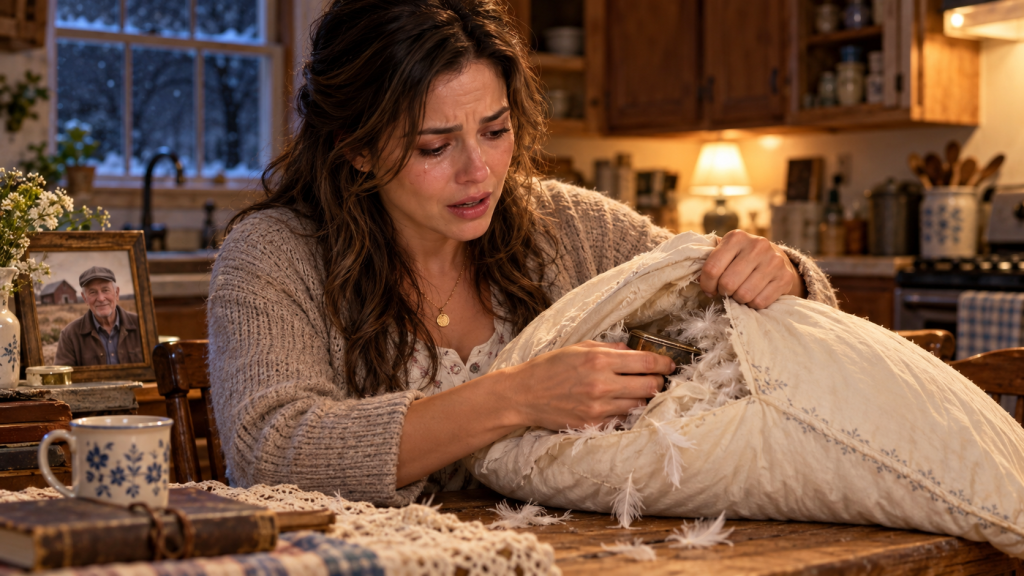
“Warren said you practically fought him for that thing.” I lowered my eyes. “It was Dad’s last gift to me.” My husband sighed. “Maria, he’s gone. You don’t need to keep every piece of rubbish from his room.” The words struck me harder than I expected. Ernest had died only hours earlier. The warmth of his hand still seemed to linger in mine. And already his son was talking about throwing away the pillow that had supported his head through years of illness.
“It matters to me,” I answered quietly.
Thomas walked toward the table.
“Let me see it.”
Something cold moved through my stomach.
“Why?”
He stopped.
“What do you mean, why?”
I looked at the pillow.
“Because I want to put it away.”
He gave a short, humorless laugh.
“Maria, I’m not going to steal an old pillow.”
I said nothing.
He reached toward it.
For one terrible moment, I thought he would notice the torn seam.
Then his phone rang.
He glanced at the screen.
WARREN.
Thomas turned away.
“Yeah?”
I heard his brother’s voice, loud enough to reach me.
“Did she find anything?”
My heart stopped.
Thomas glanced over his shoulder.
“I’m handling it.”
Warren said something else.
My husband lowered his voice.
“Not now. Lucas is asleep.”
I stood perfectly still.
Lucas was our eleven-year-old son, sleeping upstairs after crying himself to exhaustion.
He adored Grandpa Ernest.
Every evening after dinner, he used to sit beside the old man’s bed and tell him about school, baseball, and the little things children believe are too important to forget.
Ernest listened as though every word were a treasure.
And now, while our son mourned the only grandfather he’d ever really known, his father and uncle were whispering about something hidden in a pillow.
Thomas ended the call.
Then he looked at me.
“Warren’s upset.”
“About Dad?”
“About everything.”
I nodded.
He stepped closer.
“Maria, Dad didn’t say anything strange to you before he died, did he?”
I felt the little brass key pressing against my hip.
“Strange?”
“About the farm. His papers. Anything he might have put away.”
I stared at him.
“Why would he?”
Thomas shrugged.
“He’d been confused lately.”
That was not true.
Ernest had grown weak.
His hands trembled.
Some mornings, he struggled to remember what he’d eaten for breakfast.
But he still recognized every visitor, knew exactly where his land boundaries lay, and could recount stories from fifty years of farming with astonishing precision.
Only a week earlier, he’d told Lucas which corner of the lower field flooded first after heavy rain.
He had not been confused.
He had been dying.
Those were two very different things.
I looked at Thomas.
“Dad knew what he was saying.”
My husband sighed.
“I’m not arguing with you tonight.”
Then he pointed toward the pillow.
“Just don’t make a scene tomorrow. Patricia and Evelyn are already upset about how attached you were to his things.”
I swallowed.
“I wasn’t attached to his things, Thomas. I was attached to him.”
For a moment, something flickered in his eyes.
Shame, perhaps.
Or irritation.
Then he turned toward the hallway.
“Get some sleep.”
He left without kissing my forehead.
Without asking whether I needed anything.
Without mentioning that the man who had raised him was gone.
I stood alone in the kitchen until his footsteps disappeared upstairs.
Then I took the key from my pocket.
The metal felt cold against my palm.
HOLLOW CREEK BANK.
I unfolded Ernest’s little note again.
Now let the truth carry you.
For twelve years, I had carried his body when his legs were too weak.
Carried meals upstairs.
Carried medicine bottles.
Carried worry that nobody else wanted.
And in the end, the old man had found a way to leave me something heavier than all of it.
A secret.
I wrapped the key in a clean handkerchief, slipped it inside my purse, and hid the note beneath the lining.
Then I folded the torn pillow against my chest and whispered into the empty kitchen:
“What were you trying to tell me, Dad?”
Outside, the winter wind rattled the windows.
Somewhere upstairs, my son cried out in his sleep.
And I realized that my grief would have to wait.
Because whatever Ernest had hidden, his sons were already looking for it.
At six the next morning, I heard Thomas moving through the bedroom.
I had barely slept.
Every time I closed my eyes, I heard Ernest’s last breath.
Every time I opened them, I pictured Warren standing on our porch, talking about selling the farm before his father had even been buried.
Thomas was fastening his watch when I sat up.
“Where are you going?”
“To meet Warren.”
“About the funeral?”
He hesitated.
“Among other things.”
I looked at him.
“Thomas, your father died yesterday.”
“I know that, Maria.”
“Then why are you rushing into meetings about the property?”
His jaw tightened.
“Because somebody has to handle the practical side of things.”
I almost laughed.
For twelve years, apparently, the practical side of things had included everything except feeding Ernest, bathing him, lifting him after falls, taking him to doctors, and paying for supplies when his money ran short.
Those responsibilities had belonged to me.
But now that there might be land to sell, suddenly his children were ready to become practical.
“Does that include me?” I asked.
Thomas frowned.
“What?”
“Am I part of the discussion?”
He looked away.
“The property belongs to Dad’s family.”
I stared at him.
“I thought I was family.”
He said nothing.
Then he picked up his car keys.
“We’ll talk later.”
The bedroom door closed.
I sat very still.
For years, I’d made excuses for Thomas.
He worked long hours.
He was tired.
He wasn’t good with illness.
Watching his father decline reminded him of things he didn’t want to face.
I had repeated those explanations so many times that they sounded like facts.
But now, with Ernest gone, the excuses were beginning to crumble.
Thomas wasn’t too exhausted to discuss selling the farm.
He hadn’t been too busy to speak with Warren last night.
And he certainly hadn’t been too distracted to ask whether I’d found something in the pillow.
I reached for my phone.
The unfamiliar number from the previous evening was still in my call history.
Samuel Bell.
My hands trembled as I pressed it.
He answered on the second ring.
“Maria?”
“Yes.”
“Are you alone?”
I glanced toward the hallway.
“Thomas has gone out.”
“Good.”
I swallowed.
“Mr. Bell, I found the key.”
“I hoped you would.”
My throat tightened.
“Why did Dad hide it inside a pillow?”
There was a long silence.
Then Samuel said, “Because he was afraid somebody would search his drawers.”
I closed my eyes.
“His own children?”
“Maria, I’d prefer to explain in person.”
“Is this about the farm?”
“Yes.”
My heart pounded.
“And about some things Ernest discovered before he died.”
I looked toward the window.
Snowflakes drifted past the glass.
“Can I come today?”
“Yes. But don’t come to the branch without calling me first. I’ll arrange a private appointment.”
I swallowed.
“Mr. Bell, Thomas and Warren are planning to sell the property.”
Silence.
Then Samuel asked, “When?”
“Monday.”
He exhaled sharply.
“Did they say they’d already found a buyer?”
“Yes.”
Another silence.
Then he spoke slowly.
“Maria, whatever they tell you, don’t sign anything.”
My stomach dropped.
“Why?”
“Because the farm may not belong to the people who think they’re selling it.”
I gripped the phone.
Before I could answer, footsteps sounded upstairs.
Lucas.
“Mom?”
I turned.
My son stood at the bottom of the staircase in his blue pajamas, holding a little wooden horse Ernest had carved for him.
His eyes were swollen from crying.
“Mom, where’s Grandpa’s pillow?”
My throat tightened.
I looked at the torn pillow lying beside me.
“Right here, sweetheart.”
He approached slowly.
“Grandpa told me you were supposed to have it.”
I froze.
“What?”
Lucas nodded.
“He said you always helped him sleep when his back hurt.”
I stared at my son.
Then he added something that made my heart pound.
“He said if anybody tried to take it, I should tell them he already gave it away.”
I covered my mouth.
“Lucas, when did he tell you that?”
“Last week.”
My eyes filled.
“And did he say anything else?”
Lucas looked thoughtful.
Then he whispered, “He said there was a place he wanted you to see. A place where Grandma used to keep her promises.”
I stared at him.
My mother-in-law had died long before Lucas was born.
“What place?”
He shrugged.
“The old orchard, I think.”
Then he looked at me with his grandfather’s gentle brown eyes.
“Mom, are we going to lose Grandpa’s house?”
My heart broke.
I knelt in front of him.
“I don’t know everything yet, sweetheart.”
His face crumpled.
“But we’re going to find out.”
Lucas nodded.
Then he held the wooden horse against his chest.
“Grandpa said you were the bravest person he knew.”
Tears rolled down my cheeks.
I pulled my son into my arms.
And for the first time since Ernest died, I let myself cry.
Not because I was afraid of what I’d find.
Because the old man had apparently spent his final days making sure somebody understood what I had done for him.
Someone had seen me.
Even when I thought nobody was looking.
Hollow Creek Bank stood on the main street of our small Pennsylvania town, between a hardware store and an old-fashioned pharmacy.
I’d driven past it hundreds of times.
Ernest used to point toward the building whenever we came into town.
“That’s where your mother-in-law kept her Christmas money,” he’d say.
I’d assumed he meant a small savings account.
Now, as I parked outside, I wondered how many things I’d misunderstood because nobody had thought they were important enough to tell me.
Samuel Bell met me in the lobby.
He was a tall man in his late seventies, with a narrow face, white hair, and the careful movements of someone whose knees had begun arguing with him.
He wore a brown suit and carried a leather briefcase.
“Maria Bennett?”
I nodded.
He took my hand.
“I’m sorry about Ernest.”
My eyes filled.
“Thank you.”
Samuel looked at me for a long moment.
Then he said quietly, “He spoke of you often.”
I swallowed.
“Did he?”
“Very often.”
He guided me into a private meeting room.
There was a small table, two chairs, and a window overlooking the snow-covered street.
I sat down.
Samuel placed his briefcase beside him.
For several seconds, he seemed to be choosing his words.
Then he asked, “Did Ernest ever tell you about the land his wife inherited?”
I frowned.
“Only that some of the farm came from her family.”
He nodded.
“Her name was Lillian Mercer before she married Ernest.”
I smiled sadly.
“I know.”
“Her father owned land along Hollow Creek. When he died, Lillian inherited the western fields and the old orchard.”
Samuel opened his briefcase.
“Ernest and Lillian spent years buying adjoining parcels. By the time she passed away, they had assembled a sixty-two-acre farm.”
I nodded.
That sounded right.
Ernest had worked those fields his entire adult life.
Samuel continued.
“Several years ago, a company began exploring land purchases in this region for a large distribution and transport project.”
My stomach tightened.
“I heard Warren mention developers.”
Samuel nodded.
“Your brothers-in-law were approached because they had been telling people they expected to inherit the farm.”
I looked down.
“Did Dad know?”
“He learned about it.”
Samuel paused.
“And what he discovered troubled him.”
I stared at him.
“What did he discover?”
Samuel opened a folder.
Inside were copies of letters, dated bank statements, and several documents bearing Ernest’s name.
He slid one toward me.
It was an authorization apparently giving Thomas and Warren permission to negotiate a sale of the entire farm.
At the bottom was Ernest’s signature.
I stared at it.
Something was wrong.
Ernest’s handwriting had grown shaky in his final years.
But this signature was unusually smooth.
Almost too perfect.
I looked up.
“He didn’t sign this.”
Samuel nodded slowly.
“That’s what Ernest told me.”
My stomach turned.
“Thomas?”
Samuel raised a hand gently.
“We need to be careful about assigning responsibility before all the facts are established. But Ernest insisted he hadn’t authorized a sale.”
I stared at the page.
The document was dated three months earlier.
During those months, I’d been giving Ernest medication, helping him sit upright, and turning him gently in bed because movement had become painful.
He could barely hold a pen for more than a few seconds.
Yet someone had produced a beautiful signature in his name.
My hands began shaking.
“Why didn’t he tell me?”
Samuel’s face softened.
“Because he knew how much you were already carrying.”
I looked down.
He continued.
“And because he wanted to protect you from a confrontation until he had arranged things properly.”
My eyes filled.
“What did he arrange?”
Samuel reached into his briefcase and removed another folder.
This one was thick.
He placed it carefully between us.
“Maria, Ernest established a trust with the help of an estate attorney several years ago.”
I stared at him.
“A trust?”
“Yes.”
“He never told me.”
“He wanted to keep his plans private until the time came.”
I swallowed.
Samuel continued.
“The farm was transferred into that trust through a properly executed deed. The trust documents name you as successor trustee after his death.”
For a moment, the words meant nothing.
I simply stared at the folder.
Then I whispered, “Me?”
Samuel nodded.
“Ernest believed you were the person most likely to protect the property.”
I shook my head.
“But Thomas is his son.”
“He knew.”
“And Warren, Patricia, and Evelyn—”
“He knew that too.”
My voice trembled.
“Why me?”
Samuel looked at me with an expression I would remember forever.
“Because he spent twelve years watching who came through his bedroom door when he called for help.”
I covered my mouth.
Tears spilled down my cheeks.
Samuel waited.
Then he added gently, “The trust contains more than a management appointment. Ernest made specific decisions about who should receive the property.”
My heart began pounding.
“Am I supposed to open the box?”
“Yes, when the bank’s access requirements are met. Your key works with the bank’s guard key, and the necessary trust and death records are being verified.”
I stared at him.
“So I can’t open it yet?”
“Not until the proper documentation is complete. But I can show you public records confirming the trust’s ownership of the land, and Ernest left a separate letter with his attorney that you are authorized to receive.”
He handed me an envelope.
My name was written across it.
MARIA BENNETT.
Ernest’s handwriting.
Crooked.
Slow.
Familiar.
I held it with both hands.
“May I?”
Samuel nodded.
“Of course.”
I opened it carefully.
Inside was a single sheet of paper.
My dear Maria,
I could hardly see through my tears.
If you are reading this, my tired old body has finally stopped troubling you.
A sob escaped my throat.
Samuel lowered his eyes.
I continued reading.
For twelve years, you woke when I called. You fed me when I couldn’t lift a spoon. You washed clothes I was ashamed to ask you to wash. You kept me company when the house became so quiet I could hear my own loneliness.
I have heard people call you patient. That is true, but it is not enough.
You were faithful.
You did not treat me like a burden, even when I became one.
I pressed a hand against my mouth.
I cannot give you back the years you spent caring for me. I cannot return the nights you lost or the opportunities you postponed.
But I can make certain that after I am gone, nobody throws you out of the home where you gave me dignity.
The words blurred.
I bowed my head and cried.
When I finally managed to continue, I found one more paragraph.
The pillow is not the gift, Maria. It is the door to it. And when you discover what I have done, please remember that love does not require you to let others rob you of your future.
At the bottom, he’d written:
Your father in every way that mattered,
Ernest.
I held the letter against my chest.
For twelve years, I’d believed I was giving something nobody noticed.
Now I realized Ernest had noticed every single day.
And he had spent his final strength trying to protect me.
But as I wiped my tears, Samuel pushed another paper across the table.
A copy of a letter addressed to a regional land-development company.
It referred to a proposed purchase price.
I stared at the number.
$2,180,000.
For a moment, I couldn’t breathe.
More than two million dollars.
I looked at Samuel.
“Is that what they’re offering for the farm?”
“It was an expression of interest, not a completed sale.”
I stared at the page.
Then I remembered Warren’s voice on the porch.
The farm goes on the market Monday.
My hands went cold.
“They weren’t just trying to sell Dad’s land.”
Samuel waited.
I swallowed.
“They were trying to get more than two million dollars.”
His expression darkened.
“And they were planning to do it without telling the person Ernest appointed to protect it.”
Samuel allowed me a few minutes to gather myself.
Then he slid a glass of water across the table.
“Maria, I don’t want you to make decisions while you’re frightened. There’s something important you need to understand.”
I looked at him.
“The proposed sale hasn’t gone through. The company has expressed interest, but that doesn’t give Thomas or Warren the right to sell the land.”
I swallowed.
“Then why are they rushing?”
Samuel glanced at the authorization with Ernest’s questionable signature.
“I believe they’re trying to secure an agreement before anybody examines who owns the property.”
My stomach tightened.
“Can they do that?”
“They can attempt things they shouldn’t. That doesn’t mean those things will be legally effective.”
He leaned forward.
“Ernest’s estate attorney, Helen Mercer, is aware of the situation. She’s preparing notices to the prospective buyer and the people involved in the proposed transaction.”
I looked down at my hands.
“Why didn’t Ernest simply tell his sons what he wanted?”
Samuel sighed.
“He tried talking to them about the farm more than once.”
“And?”
“They didn’t listen.”
For a moment, I thought of every time I’d tried to tell Thomas I needed help.
Every time he’d answered, You know how Dad is.
Every time Warren had promised to visit and cancelled.
Every time Patricia and Evelyn had praised my patience before leaving me to spend another night beside an old man’s bed.
Perhaps Ernest had grown tired of asking them to listen too.
Samuel glanced toward my purse.
“Keep the key somewhere safe. We’ll contact you when the documentation for the box is complete.”
I nodded.
Then he added, “Maria, Ernest told me something during our last meeting.”
My eyes filled.
“What?”
“He said you’d spent twelve years treating him like a father.”
I swallowed.
Samuel’s voice softened.
“And that when his own children finally noticed what he’d left behind, he wanted them to understand the difference between inheriting property and earning someone’s gratitude.”
I bowed my head.
Because I had never wanted the farm.
I wanted Ernest to be comfortable.
I wanted him to feel loved.
I wanted him to know that he wasn’t forgotten.
Yet somehow, while I was busy doing those things, his children had decided the only important question was what they could take after he died.
When I left the bank, the snow had stopped.
The main street shone beneath a weak winter sun.
I sat inside my car for several minutes with Ernest’s letter in my lap.
Then I called my friend Ruth.
Ruth had been our neighbor for fifteen years. She was a retired school librarian who brought homemade soup whenever Ernest had a difficult week.
She knew more about those twelve years than almost anyone.
“Maria?” she answered. “How are you holding up?”
I tried to speak.
Instead, I began crying.
She didn’t interrupt.
When I finally managed to explain enough, she said, “Come over. I’ll put the kettle on.”
I drove straight to her house.
Ruth opened the door before I reached the porch.
She hugged me.
Then she guided me into her kitchen.
I showed her Ernest’s letter.
She read it slowly.
When she finished, tears were running down her cheeks.
“That old man,” she whispered.
I smiled through my tears.
“He planned all this.”
Ruth nodded.
“He was quieter than people realized, Maria. But he wasn’t foolish.”
I stared into my tea.
“Thomas thinks Dad had nothing.”
Ruth looked up sharply.
“Thomas always knew his father had land.”
“I mean money. He kept saying Ernest couldn’t afford proper help.”
Her expression changed.
“Maria, I need to tell you something.”
My stomach tightened.
“What?”
She hesitated.
“About two years ago, Ernest asked me to drive him into town while Thomas was in Philadelphia.”
I stared at her.
“Where?”
“To see an accountant.”
I frowned.
“Dad never mentioned that.”
“He asked me not to discuss it until he was ready.”
Ruth opened a kitchen drawer.
Inside was a small envelope.
She handed it to me.
“Ernest left this with me in case somebody tried to claim he didn’t know what he was doing.”
My hands trembled.
Inside was a note explaining that Ernest had met privately with professional advisers, reviewed his property, and made his estate arrangements freely.
There were dates.
Names.
And a list of people who could confirm his wishes and his ability to understand the decisions he’d made.
I looked at Ruth.
“You knew?”
“I knew he was putting something in order. I didn’t know every detail.”
My eyes filled.
“Why didn’t you tell me?”
She took my hand.
“Because he wanted you to care for him without feeling that anything depended on a future gift.”
I began crying again.
Ruth squeezed my fingers.
“He said you would never ask for anything, and that was exactly why he wanted to make certain nobody left you with nothing.”
I sat quietly for a long time.
Then Ruth asked, “Maria, does Thomas know you went to the bank?”
I shook my head.
“Not yet.”
She looked toward the window.
“Then be careful. Grief and money can bring out ugly things in people.”
I thought of Warren’s voice outside my kitchen.
Maria doesn’t need to know until everything’s signed.
I nodded.
“I know.”
But I didn’t yet understand how ugly those things could become.
By four that afternoon, all four of Ernest’s children were sitting in my living room.
Thomas had called a family meeting.
He hadn’t asked whether I wanted one.
When I returned from Ruth’s house, Warren’s black pickup was already in the driveway.
Patricia had brought a casserole.
Evelyn sat on the sofa, scrolling through her phone.
And Thomas stood beside the fireplace holding a stack of papers.
Lucas was upstairs in his bedroom.
I could hear the little wooden horse tapping against his desk as he played.
I stopped in the doorway.
“What’s going on?”
Thomas looked up.
“We’re discussing Dad’s arrangements.”
I glanced at the papers.
“Without me?”
Warren leaned back in his chair.
“Maria, this is between his children.”
I looked at him.
For twelve years, he’d called me whenever Ernest needed something he couldn’t be bothered to do.
Whenever the old man fell ill, he told me to handle it.
Whenever bills needed sorting, he told me I was better with details.
But suddenly, when property was involved, I was no longer family.
I set down my purse.
“Then why are you meeting in my living room?”
Warren’s expression hardened.
“Don’t start.”
Thomas stepped forward.
“Maria, everybody’s upset. Let’s keep this civil.”
I nearly laughed.
I’d barely said two sentences.
Warren had already dismissed me.
Yet somehow I was the one being warned to behave.
Patricia cleared her throat.
“Maria, nobody wants trouble. We just need the farm sold so everything can be divided fairly.”
I looked at her.
“Has anyone seen Dad’s will?”
Silence.
Evelyn glanced at Thomas.
Warren stared at the fireplace.
Finally, my husband said, “We’re handling the paperwork.”
“What paperwork?”
“Estate matters.”
I folded my arms.
“Who’s the executor?”
Thomas hesitated.
Then Warren answered.
“Dad always wanted Thomas to handle things.”
I stared at them.
“That’s not what I asked.”
Warren’s face reddened.
“Why are you suddenly acting like a lawyer?”
I took a slow breath.
“Because you’re discussing selling the home where Lucas and I live.”
Patricia sighed.
“Maria, nobody’s going to leave you homeless. You’ll get enough time to find somewhere.”
The words landed like a blow.
I stared at her.
“Find somewhere?”
She looked confused.
“Once the property sells.”
I felt cold.
“You’ve already decided I’m leaving?”
Evelyn put down her phone.
“Maria, the farm is worth a lot of money. It doesn’t make sense for one household to keep living there while the rest of us get nothing.”
I looked around the room.
These were the people who’d watched me carry Ernest through the final twelve years of his life.
They knew I’d given up my small catering business when his health became too unpredictable.
They knew I’d spent my savings on household expenses.
They knew I hadn’t taken a proper vacation in almost a decade.
And now they were discussing the amount of time they’d generously allow me to remain in my own home.
I swallowed.
“What about Lucas?”
Patricia looked away.
“He’ll adjust.”
Something inside me changed.
Not when Warren dismissed me.
Not when Evelyn spoke about money.
But when Patricia said my eleven-year-old son would simply adjust to losing the only home he’d ever known.
I looked at Thomas.
“Is that what you think too?”
His face tightened.
“Maria, don’t make this about Lucas.”
“He lives here.”
“We’ll find somewhere else.”
I stared at my husband.
“You’ve already planned where we’ll go?”
He hesitated.
“There’s a townhouse near Philadelphia. We could move there once everything is settled.”
I felt my stomach drop.
Thomas worked in Philadelphia during the week.
I’d begged him for years to find something closer to home so he could help with Ernest and spend more time with Lucas.
He always said moving was impossible.
Now, barely a day after his father’s death, he had a townhouse in mind.
I took a slow breath.
“How long have you been discussing this?”
Nobody answered.
Finally, Warren slapped a document onto the coffee table.
“Look, we’re wasting time. Maria, we just need you to sign one form.”
I stared at it.
“What is it?”
“A statement confirming Ernest was too ill to manage his own affairs during the last few months.”
My heart pounded.
I picked up the paper.
It described Ernest as confused, disoriented, and unable to understand financial decisions.
It claimed I’d personally observed these problems throughout the previous year.
At the bottom was a blank line.
Maria Bennett — Primary Caregiver.
I stared at the document.
Then slowly looked up.
“You want me to say Dad didn’t know what he was doing?”
Thomas cleared his throat.
“It’s just a formality.”
I felt sick.
“No.”
Warren leaned forward.
“Maria—”
“I said no.”
He stared at me.
“Don’t be unreasonable.”
I held up the paper.
“Ernest knew who he was. He knew where he was. He knew what he wanted.”
Patricia frowned.
“He sometimes forgot things.”
“So do I,” I answered. “That doesn’t mean I can’t make decisions.”
Evelyn glanced at Thomas.
“Why does she have to sign it?”
My husband looked away.
And suddenly, I understood.
They weren’t simply trying to sell the farm.
They were preparing to challenge whatever Ernest had arranged before his death.
And they wanted me, the person who had cared for him every day, to provide the statement that would make their argument stronger.
I set the paper down.
“I won’t sign a lie.”
Warren stood.
His chair scraped against the floor.
“You think you’re better than us because you changed a few diapers?”
The room went silent.
For a moment, I couldn’t breathe.
Twelve years.
Twelve years of feeding Ernest.
Helping him bathe.
Listening to his stories.
Holding his hand through pain.
And his oldest son had reduced all of it to a few diapers.
I felt tears burning behind my eyes.
But I didn’t lower my head.
“No, Warren.”
My voice shook.
“I don’t think I’m better than you.”
I looked around the room.
“I just know I was there.”
Nobody answered.
Then Warren pointed at me.
“Dad was soft on you. You made him dependent on you.”
Thomas said nothing.
That hurt most of all.
My husband sat beside the fireplace while his brother accused me of manipulating the dying man I’d spent twelve years caring for.
I looked directly at him.
“Thomas, do you believe that?”
He stared at the floor.
“Maria, just sign the form so we can move forward.”
My heart broke.
Not loudly.
Not dramatically.
It was quieter than that.
Something inside me simply stopped reaching toward him.
I set the paper on the table.
“No.”
Then I picked up my purse.
“I’m going upstairs to my son.”
Warren took a step toward me.
“We’re not finished.”
I looked at him.
“Yes,” I whispered. “We are.”
I climbed the stairs without turning around.
Behind me, the voices began again.
Angry.
Urgent.
Afraid.
But for the first time, I no longer felt responsible for calming them.
I went into Lucas’s room and closed the door.
He was sitting on the rug with his wooden horse.
“Mom?”
I knelt beside him.
“Yes, sweetheart?”
“Is Uncle Warren mad?”
I smiled sadly.
“He’s upset about some grown-up things.”
Lucas looked at the horse.
Then he whispered, “Grandpa wouldn’t like everybody fighting.”
I pulled him into my arms.
“No, honey. He wouldn’t.”
He rested his head against my shoulder.
Then he said something that made me freeze.
“Mom, Grandpa told me to look under the apple tree if people started fighting.”
I pulled back.
“What?”
Lucas nodded.
“The crooked one behind the barn.”
I stared at him.
“He said if they tried to take the farm, you’d need to remember what Grandma Lillian planted there.”
My heart began pounding.
I remembered the orchard.
The old twisted apple tree that had somehow survived every winter.
The tree Ernest always insisted we leave standing, even after it stopped producing much fruit.
“Did he tell you why?”
Lucas shook his head.
“He said you’d understand when you saw it.”
I looked toward the bedroom window.
Beyond the darkened fields stood the old orchard.
Bare branches reaching into the winter sky.
For twelve years, I’d believed Ernest kept that crooked tree because it reminded him of his wife.
Now I wondered whether he’d left another message somewhere beneath its roots.
And I was beginning to understand why he hadn’t trusted his children to hear it.
I didn’t go to the orchard that night.
I wanted to.
Every instinct urged me to pull on my boots, take a flashlight, and walk through the frozen fields until I reached the crooked apple tree.
But I could still hear Warren arguing downstairs.
And Lucas was watching me with the worried eyes of a child who had already lost too much.
So I stayed.
I tucked him into bed.
I sat beside him until he fell asleep.
Then I called Ruth and told her everything.
She listened quietly.
When I finished, she said, “Don’t go out there alone, Maria. I’ll come in the morning.”
I agreed.
Then I called Samuel Bell.
He answered despite the late hour.
When I explained the statement Warren wanted me to sign, his voice sharpened.
“Don’t sign it.”
“I didn’t.”
“Good. I’ll tell Helen Mercer. Your father-in-law’s ability to make his estate plans was documented, and we need to preserve that information.”
I looked toward the bedroom door.
“Samuel, I’m frightened.”
His tone softened.
“I know.”
“What if they challenge everything?”
“They may. But you aren’t alone, and a disagreement doesn’t make a valid document disappear.”
My eyes filled.
“I don’t want Lucas hurt by all this.”
“Then let the adults responsible for the dispute answer for their choices.”
I swallowed.
“Thank you.”
Before hanging up, Samuel added, “Ernest told Helen something that might help you understand why he made these arrangements.”
“What?”
“He said he’d spent his life believing that providing land for his children would make them secure.”
I closed my eyes.
“Then he realized some of them had mistaken security for entitlement.”
I stared at the dark hallway.
Those words followed me into sleep.
The following morning, Ruth arrived shortly after sunrise.
She brought coffee, two shovels, and a thick wool blanket.
“Good morning,” she said briskly. “Where’s our tree?”
Despite everything, I laughed.
“Behind the barn.”
Lucas insisted on coming.
He wore Ernest’s old knitted cap, which slipped over his ears.
The three of us walked across the yard, through the thin layer of snow, and toward the orchard.
The morning was cold enough to sting my cheeks.
The fields lay pale and silent beneath the winter sky.
For a moment, I remembered Ernest walking beside me years earlier, before illness stole his strength.
He used to carry a bucket and stop every few steps to point out something growing.
A weed worth pulling.
A branch that needed pruning.
A patch of soil that held too much water.
He had taught me that farming was less about commanding the land than learning to listen to it.
Now I wondered whether he’d been teaching me something else all along.
Lucas ran ahead.
“There!”
He pointed toward the crooked apple tree.
Its trunk bent sharply to the left, almost as though the wind had tried to push it over and failed.
I approached slowly.
Beneath the lowest branch was a flat stone.
I knew that stone.
Ernest used to sit on it when his legs were tired.
Lucas pointed.
“Grandpa said Grandma Lillian put something under there when the tree was little.”
Ruth and I exchanged a glance.
We carefully moved the stone.
The ground beneath it was hard, but not completely frozen.
After a little work, the shovel struck metal.
My heart began pounding.
We cleared away the soil.
Buried beneath the stone was a small rectangular tin wrapped in layers of old waterproof cloth.
The tin was badly rusted.
But when Ruth helped me lift the lid, we found a packet of letters inside a sealed plastic sleeve.
On top lay a photograph.
Ernest and Lillian.
Young.
Smiling.
Standing beside the apple tree when it was barely taller than they were.
I covered my mouth.
Beneath the photograph was a folded note.
Lillian’s handwriting was elegant and delicate.
We planted this tree the year we finished paying for the western field.
Ernest says apple trees need patience, and I say marriages do too.
Someday our children will grow up and have families of their own. I hope they remember that the purpose of this land is not to make anyone rich.
It is to make sure there is always a place where somebody can come home.
My eyes filled.
I looked toward Lucas.
He was staring at his grandparents’ photograph with enormous eyes.
“Is that Grandma?”
I nodded.
“Yes, sweetheart.”
He smiled.
“She looks nice.”
“She was.”
I had known Lillian only through photographs and Ernest’s stories.
Yet standing there beneath her tree, holding words she’d written decades earlier, I felt strangely close to her.
There were more letters.
Some about harvests.
Some about the children’s birthdays.
One contained a list of trees the couple had planted when each child was born.
Thomas’s was a maple near the creek.
Warren’s, an oak at the far fence.
Patricia’s, a pear tree beside the barn.
Evelyn’s, a small cherry tree near the kitchen garden.
Ernest had remembered those trees all his life.
Then, tucked beneath the letters, I found one written much later.
The handwriting was his.
Maria,
If Lucas brings you here, he has done exactly what I asked.
I pressed the page against my chest.
Ruth looked away to give me a moment.
I continued.
Lillian and I planted this orchard before any of our children were born. We wanted them to have somewhere to return when life became difficult.
Somewhere along the way, I let them believe the land would always be waiting for them without any responsibility attached.
That was my mistake.
My tears fell onto the page.
You understood what I tried to teach them.
You gave without keeping count.
But I do not want you to spend the rest of your life giving until you have nothing left.
Keep the orchard alive, Maria. Let Lucas climb the trees when he is older. Let there be laughter here again.
And remember that the farm was never meant to be a prize for whoever shouted the loudest.
I couldn’t continue reading.
Ruth slipped an arm around my shoulders.
Lucas stood beside me, holding Ernest’s wooden horse.
“Mom?”
I wiped my cheeks.
“Yes, sweetheart?”
“Is it a sad letter?”
I smiled through my tears.
“A little.”
He looked at the photograph.
“Is it a happy one too?”
I pulled him close.
“Yes, Lucas.”
I kissed his forehead.
“It’s a happy one too.”
We stood beneath the crooked apple tree for a long time.
Then we carefully repacked the letters and carried them home.
They weren’t legal documents.
They didn’t determine who owned the farm.
But they helped me understand why Ernest had protected the orchard.
And why he had trusted me to protect it after him.
The bank called two days later.
The necessary records had been verified, and I was permitted to access box seventeen under the trust arrangement.
Samuel met me in the private room again.
This time, an authorized bank employee accompanied us to the secure area.
The brass key slid into the lock.
The employee used the bank’s guard key.
Both locks turned.
Then the box opened.
Inside was a heavy envelope, a small leather notebook, and a sealed package wrapped in brown paper.
My hands trembled.
Samuel looked at me.
“Take your time.”
I opened the envelope first.
It contained a copy of Ernest’s trust and a letter from Helen Mercer confirming the legal arrangements.
I read the distribution provisions slowly.
Then I stopped.
I read them again.
The farmhouse.
The barn.
The orchard.
The western fields.
All were to pass for my benefit under the trust after Ernest’s death, with arrangements that also protected an educational fund for Lucas.
Other provisions addressed smaller gifts to his children from the remaining financial assets, subject to the terms of the trust and any valid claims involving money owed.
But the land itself—the place where Ernest and Lillian had spent their lives—had been entrusted to me.
I stared at the pages.
“Samuel.”
He looked up.
“Yes?”
“I don’t understand.”
His expression softened.
“Which part?”
“Why would he leave me the farm?”
Samuel took a breath.
“Because he wanted you and Lucas to have a secure home.”
I shook my head.
“But it’s worth so much.”
“Ernest understood its value.”
“He could have sold it and divided the money.”
“Yes.”
Tears filled my eyes.
“Then why didn’t he?”
Samuel looked at me for a long moment.
“Because he believed selling it would be the end of the family home his wife had helped create.”
I stared at the document.
Then I whispered, “I never asked him for anything.”
Samuel nodded.
“He knew.”
I cried quietly.
Not because of the money.
Not because I suddenly owned land worth millions on paper.
But because the old man had been planning to give me peace.
A home.
Security.
The chance to stop wondering what would happen to Lucas and me when the caregiving ended.
Samuel handed me a tissue.
Then he pointed toward the leather notebook.
“There’s more.”
I opened it.
The pages contained dates, figures, and names.
Farm lease payments.
Crop proceeds.
Property taxes.
Equipment sales.
I recognized some of the entries.
Years earlier, Ernest had leased portions of the fields to a neighboring farmer after he became too weak to work them himself.
Thomas always told me the payments barely covered the taxes.
But the numbers in Ernest’s notebook suggested otherwise.
I looked at Samuel.
“These payments…”
He nodded.
“Ernest began keeping track after discovering inconsistencies in the accounts his sons were managing.”
My heart pounded.
I turned another page.
There were copies of deposit notices.
Bank statements.
Transfers to an agricultural services company.
Then I saw the name.
BENNETT FIELD OPERATIONS LLC.
Warren’s company.
Below it was another account.
One I recognized immediately.
Thomas’s business account.
My hands began shaking.
For years, income from the fields had been redirected into accounts controlled by Thomas and Warren.
Some expenses had been paid on Ernest’s behalf.
But the records showed unexplained transfers far beyond what those expenses appeared to require.
Samuel spoke carefully.
“Ernest asked a professional to review the accounts. The work wasn’t finished when he became ill again. The documents in this box preserve what he had gathered.”
I stared at the amounts.
Thousands of dollars.
Repeated over several years.
During those same years, I’d bought Ernest’s medicine when we were short.
I’d taken extra sewing jobs after Lucas went to bed.
I’d postponed dental work.
I’d worn the same winter boots until the soles cracked.
And whenever I asked Thomas whether the farm could help pay for professional caregiving, he told me there was nothing left after taxes.
I covered my mouth.
“Thomas knew.”
Samuel didn’t answer immediately.
Then he said, “The records show he received payments. Whether each transfer was authorized is something the attorneys will need to determine.”
I stared at the page.
It was enough.
Not enough to settle every legal question.
Enough to understand why my husband had never wanted me asking about the farm’s income.
My throat tightened.
“He watched me struggle.”
Tears fell onto the notebook.
“He knew how tired I was.”
Samuel looked away.
I continued, almost whispering.
“He watched me skip meals because I was too exhausted to cook for myself. He watched me cry because I couldn’t afford to hire help.”
I shook my head.
“And he let me believe we had no choice.”
The room seemed to tilt.
For twelve years, I’d thought Thomas was simply a son who didn’t know how to cope with his father’s illness.
Now I was staring at evidence that he had benefited financially while I carried most of the care.
Something inside me shattered.
I set down the notebook.
Then I opened the brown paper package.
Inside was an old-fashioned digital voice recorder.
A note was taped to it.
FOR MARIA — PLAY WHEN YOU ARE READY.
I looked at Samuel.
He nodded.
“Ernest recorded this himself during one of our visits. He wanted you to hear his voice.”
I pressed the button.
A little hiss filled the room.
Then came a familiar cough.
My heart stopped.
“Is this thing working, Samuel?”
I began crying before Ernest said another word.
A distant voice answered, “Yes, Ernest. It’s recording.”
Then my father-in-law chuckled.
“Well, that’s something. Never thought I’d spend my last years talking into a little plastic box.”
I covered my mouth.
His voice was weaker than I remembered from earlier years.
But it was unmistakably his.
Then he said:
“Maria, honey, if you’re hearing this, I suppose I’ve finally gone to see Lillian.”
A sob escaped me.
“I hope she isn’t too angry that I kept her waiting.”
Even through my tears, I laughed.
Samuel smiled sadly.
Ernest continued.
“I need you to know I made these arrangements because I wanted to. Nobody talked me into anything.”
His voice trembled.
“I know the land is valuable. I know my children may be angry.”
There was a pause.
Then he spoke more firmly.
“But the last twelve years taught me what my life was worth to the people around me.”
I bowed my head.
“Some visited. Some called. Some remembered me when there was business to discuss.”
His voice softened.
“And one woman came every morning, whether I was pleasant or miserable, clean or ashamed, grateful or too tired to speak.”
Tears streamed down my cheeks.
“That was you, Maria.”
I could barely breathe.
“You never asked what I’d leave you. You just asked whether I needed water.”
Then he said something I would carry for the rest of my life.
“The house is not payment for your kindness, sweetheart. Kindness like yours can’t be bought.”
He paused to catch his breath.
“It’s my way of making sure the person who gave me a home never has to fear losing hers.”
I pressed the recorder against my chest.
Ernest’s voice crackled softly.
“And Lucas… tell that boy his grandpa loved him more than all the corn in Pennsylvania.”
I laughed through my tears.
Then came the final words.
“Don’t let them frighten you, Maria.”
A long pause.
“Lillian and I planted roots here. Now it’s your turn to let them grow.”
The recording ended.
I sat in silence.
For a long time, I couldn’t move.
Then Samuel quietly placed a hand over mine.
“Maria, Ernest was a good man.”
I nodded.
“Yes.”
I looked at the notebook.
The trust papers.
The little recorder.
Then I whispered, “And I won’t let them erase what he wanted.”
For the first time since his death, I wasn’t simply grieving.
I was ready to protect the gift he’d entrusted to me.
But the hardest conversation of my marriage was still waiting at home.
When I returned home, Warren’s pickup was parked beside the barn.
Two unfamiliar men stood near the front gate, examining a large folded map.
Thomas was pointing toward the lower field.
I stopped my car at the end of the driveway.
For a moment, I watched.
One of the men gestured toward the orchard.
Warren shook his head, then made a broad motion with his hand, as though sweeping away everything between the barn and the creek.
My stomach tightened.
They weren’t grieving.
They were measuring.
Calculating.
Planning what could be torn down, divided, and sold.
I stepped out of the car.
Thomas spotted me first.
“Maria.”
I walked toward the group.
“What’s happening?”
One of the strangers smiled politely.
“Good afternoon. We’re discussing a potential real-estate transaction.”
I looked at Thomas.
“On whose authority?”
He stiffened.
“Maria, please.”
I turned toward the stranger.
“I’m Maria Bennett. I’m the successor trustee of the trust that owns this property.”
The man’s smile disappeared.
He looked toward Warren.
“I was told Mr. Bennett’s sons were handling the sale.”
Warren’s face reddened.
“They are.”
I shook my head.
“No, Warren. Not without proper authority.”
He stared at me.
“Where did you hear that nonsense?”
I reached into my purse and removed a copy of the trust certification Helen Mercer had prepared.
The stranger accepted it cautiously.
He read the first page.
Then looked at Thomas.
“Gentlemen, I think we should pause this discussion until the ownership and authority issues are clarified.”
Warren exploded.
“This is our father’s farm!”
The man stepped backward.
“I understand there’s a family disagreement. I’m not taking a position.”
He folded the map.
“We’ll contact the attorney whose information is listed here before proceeding.”
Then he and his colleague returned to their vehicle.
Warren watched them leave.
His face turned purple.
The moment their car disappeared down the road, he spun toward me.
“You had no right.”
I stared at him.
“No right to what?”
“To interfere.”
I almost laughed.
“With a sale of property you don’t own?”
He took a step closer.
“Dad couldn’t possibly have understood what he was signing.”
I looked him directly in the eyes.
“Then why did you try to sell it using his signature?”
He froze.
Thomas went pale.
I continued.
“Dad knew about the proposed sale. He knew about the documents. He knew about the payments from the fields.”
Warren’s jaw tightened.
“Careful, Maria.”
I felt fear rise.
Then I remembered Ernest’s voice.
Don’t let them frighten you.
I lifted my chin.
“No. You be careful.”
Warren stared at me.
Then he turned toward Thomas.
“You said she didn’t know anything.”
The words hung in the cold air.
My husband looked away.
I felt something inside me go still.
Thomas hadn’t merely failed to protect me from his brother.
He’d been part of keeping me uninformed.
Warren cursed beneath his breath and marched toward his truck.
Before climbing inside, he shouted, “We’ll see what a judge thinks of this.”
I didn’t answer.
The truck roared down the driveway.
Leaving me alone with my husband.
For several seconds, neither of us spoke.
Then Thomas said, “Maria, we need to talk.”
I nodded.
“Yes.”
He exhaled.
“Inside?”
I looked toward the farmhouse.
The house where I’d raised our son.
Where I’d cooked thousands of meals.
Where I’d spent twelve years caring for his father.
Where Ernest had taken his last breath.
I shook my head.
“Here.”
Thomas rubbed his forehead.
“Maria, Warren’s upset because Dad changed things without telling us.”
I stared at him.
“Did you know?”
He hesitated.
“About the trust?”
I nodded.
His silence answered before his words did.
“I knew Dad had been talking to people.”
My heart tightened.
“Did you know he wanted me to have the farm?”
Thomas looked down.
“I suspected.”
I swallowed.
“And you let Warren try to sell it anyway?”
He said nothing.
The wind moved through the dry stalks along the fence.
Then I asked the question that had been tearing me apart since the bank.
“Thomas, what happened to the money from the field leases?”
His face changed.
“Maria—”
“Please don’t lie to me.”
He stared at the ground.
I continued.
“For years, you told me there wasn’t enough money to hire someone to help with Dad.”
His shoulders sagged.
“You don’t understand the expenses.”
“Then explain them.”
He rubbed his face.
“Warren’s company was struggling. We used some of the lease income to keep things going.”
My throat tightened.
“We?”
He looked at me.
“I helped him.”
“How much?”
“I don’t know exactly.”
I felt anger rise.
“Thomas.”
He exhaled.
“More than we should have.”
I stared at him.
Then whispered, “You watched me give up my work.”
His eyes filled.
“I know.”
“You watched me cry because I couldn’t keep up.”
“I know.”
“You told me we couldn’t afford a caregiver.”
His face crumpled.
“I didn’t think Dad would live as long as he did.”
The words struck like a slap.
For a moment, I couldn’t speak.
Then I whispered, “What did you say?”
Thomas closed his eyes.
“Maria, I didn’t mean it like that.”
But I had heard him.
And I understood.
His father’s suffering had become something he measured in time and money.
Something he expected to end.
Something I was supposed to carry until it did.
I stepped backward.
“Your father wasn’t a bill waiting to disappear.”
Tears rolled down his face.
“I know.”
“No. You don’t.”
My voice broke.
“He was a man. He was the man who raised you. He deserved help, comfort, and dignity.”
Thomas began crying.
“I couldn’t handle watching him decline.”
I shook my head.
“So you left me to watch it alone.”
For a long time, neither of us spoke.
Then he whispered, “I’m sorry.”
I looked toward the orchard.
The crooked apple tree stood against the pale sky.
For twelve years, I’d imagined that one day Thomas would understand what those years had cost me.
I’d imagined him holding my hands and saying he’d seen my sacrifices.
That he wished he’d helped.
That he was grateful.
Now, standing beside the barn, I realized an apology couldn’t give me back the years.
And even more painfully, it couldn’t restore the trust he’d broken.
I took a breath.
“Thomas, I need you to stay somewhere else while we work through this.”
He looked stunned.
“Maria.”
“I need space.”
He shook his head.
“This is my home too.”
I nodded.
“We’ll get legal advice about the practical arrangements. I’m not going to argue about them in the driveway.”
His face crumpled.
“What about Lucas?”
“He needs both parents to act responsibly.”
Tears ran down my cheeks.
“And he needs us to stop treating his grandfather’s death like a contest over money.”
Thomas looked toward the farmhouse.
Then back at me.
“Can we fix this?”
I closed my eyes.
“I don’t know.”
For once, that was the only honest answer I had.
The weeks that followed were exhausting.
Helen Mercer worked with the trust records, the recorded deed, and the attorneys involved in the proposed sale.
The attempted transaction did not proceed.
Warren and Thomas challenged Ernest’s estate arrangements, arguing that their father hadn’t understood what he was doing.
But Ernest had taken precautions.
His legal documents had been prepared through appropriate professional channels.
His decisions had been discussed over time.
Witnesses could describe his understanding of the arrangements.
And there were written records explaining his reasons.
The challenge became harder to maintain once those records were examined.
There was also the question of the farm income.
The review of financial accounts uncovered unauthorized transfers and discrepancies that required further investigation.
Thomas and Warren faced demands for records, repayment, and explanations of how money had been handled.
The process was neither quick nor simple.
But the most important thing was settled.
The farm was not theirs to sell.
And Ernest’s properly established trust remained in force.
Patricia and Evelyn were furious at first.
Then they learned more.
They saw the financial records.
They learned about the statement Warren had wanted me to sign.
And they listened to Ernest’s recorded message through the arrangements made by the attorneys.
Patricia cried.
Evelyn sat silently for nearly an hour.
Later, they came to see me.
Not with casserole dishes.
Not with excuses.
With apologies.
Patricia stood in my kitchen holding a photograph of Ernest.
“I didn’t know about the lease money.”
I nodded.
“I know.”
Her voice broke.
“But I did know you were doing everything for Dad.”
I looked at her.
She swallowed.
“I kept telling myself I couldn’t help because I lived too far away.”
Tears filled her eyes.
“Then I found time to come when we thought there was money to divide.”
I didn’t answer.
She began crying.
“I’m ashamed.”
Evelyn sat beside her.
“So am I.”
I looked at both women.
For years, I’d wished they would help.
Now they were finally acknowledging what I’d carried.
I wanted to forgive everything at once.
But I also wanted to respect the woman I’d become.
So I said quietly, “Thank you for telling me.”
Patricia reached for my hand.
“Can we start over?”
I thought of Ernest.
Of his last breath.
Of the years I’d spent feeling invisible.
Then I answered.
“Maybe. But slowly.”
She nodded.
“Slowly.”
That was enough for the moment.
Thomas and I began living separately.
We attended counseling at first, hoping to understand whether our marriage could survive.
He admitted more about the money.
About avoiding the house when Ernest was ill.
About allowing Warren to pressure him.
About feeling ashamed of how much I had done.
But understanding wasn’t the same as rebuilding trust.
And eventually, after months of difficult conversations, I accepted that I could not remain married to a man who had watched me exhaust myself while concealing resources that could have helped.
We began the process of divorce.
It was painful.
Lucas cried.
I cried.
Thomas cried.
But we worked through appropriate arrangements so Lucas could maintain a relationship with his father without being dragged into the financial dispute.
I made certain my son heard something clearly.
“Your father made mistakes, sweetheart. Those are his responsibility, not yours.”
Lucas looked at me.
“Do you still love Dad?”
I swallowed.
“I care about him. But sometimes people can no longer live together in a healthy way.”
He nodded slowly.
Then he asked, “Are we leaving Grandpa’s farm?”
I looked through the window.
The orchard stood beyond the yard.
The barn.
The fields.
The little porch where Ernest used to sit.
I smiled through my tears.
“No, honey.”
Lucas’s face brightened.
“We’re staying?”
I pulled him close.
“Yes.”
Then I whispered, “Grandpa made sure we had a home.”
Lucas hugged me tightly.
And for the first time in months, I felt the future opening instead of closing.
Two years later, the orchard bloomed more beautifully than I had ever seen it.
The apple trees were covered in white and pale pink blossoms.
The grass beneath them shimmered in the morning light.
And the crooked old tree behind the barn, the one Ernest and Lillian had planted so many years ago, had somehow produced more blossoms than any of the others.
Lucas was thirteen now.
Tall.
Restless.
Always hungry.
And beginning to look so much like his grandfather that sometimes I had to stop myself from crying when he smiled.
One Saturday morning, I found him standing beside the old apple tree with a measuring tape.
“What are you doing, sweetheart?”
He turned toward me.
“Building something.”
I smiled.
“What?”
He looked embarrassed.
“It’s supposed to be a surprise.”
I raised an eyebrow.
“Then why are you doing it where I can see you?”
He grinned.
“Because you always find everything anyway.”
I laughed.
Then I noticed a stack of wooden boards beside the barn.
They were old but carefully sanded.
“Lucas?”
He shrugged.
“I asked Aunt Patricia to help me.”
My heart warmed.
Patricia and Evelyn had become more involved in our lives.
Not perfectly.
Not overnight.
But consistently.
They visited without expecting me to cook elaborate meals.
They helped with repairs.
They remembered Lucas’s school events.
And when I needed help with the orchard, they sometimes appeared in work clothes carrying tools instead of fruit baskets.
It was a small but meaningful change.
Warren, meanwhile, had been required to address the financial consequences of the unauthorized transactions.
The disputes over the farm income had eventually resulted in a settlement that recovered part of the money taken or improperly handled.
His relationship with the family remained strained.
Thomas had also faced consequences connected to his involvement.
He was working to repay money through the arrangements made during the financial proceedings.
Our divorce had been finalized.
He lived near Philadelphia and saw Lucas according to their parenting arrangements.
We were not friends in the easy way some divorced couples eventually become.
Too much had happened.
But we had learned to speak respectfully when it concerned our son.
And I no longer allowed myself to become responsible for solving Thomas’s problems.
That was an important part of my healing.
For twelve years, my days had been organized around everybody else’s needs.
Now, at forty, I was learning to ask a question I’d almost forgotten.
What do I want?
At first, I didn’t know how to answer.
I spent the first few months after the divorce simply getting used to the quiet.
No medication alarm waking me at midnight.
No anxious footsteps toward Ernest’s bedroom.
No waiting for Thomas to return from Philadelphia.
No bracing myself for another unexpected expense.
I missed Ernest terribly.
But slowly, I began enjoying ordinary mornings again.
I planted herbs beside the kitchen door.
Started a small catering business with a few local clients.
Took Lucas on a weekend trip to a lake where Ernest used to fish.
And hired help when the farm work became more than I could manage.
That last decision took practice.
For years, I’d believed asking for help meant I had failed.
Now I understood that even the most loving caregiver needs rest.
Especially the most loving caregiver.
One afternoon, Ruth came by while I was preparing meals for a local community gathering.
She watched me stirring a large pot of soup.
Then she smiled.
“Your father-in-law would be pleased.”
I laughed.
“Because I’m cooking?”
“No.”
She looked around the kitchen.
“Because you’re finally cooking something you want to cook.”
I stopped stirring.
For a moment, I couldn’t speak.
Then I smiled.
“Yes,” I whispered. “I think he would.”
The surprise Lucas was building appeared on the anniversary of Ernest’s death.
That morning, my son woke me before sunrise.
“Mom, come outside.”
I groaned.
“Lucas, it’s barely six.”
“Please.”
I pulled on my robe and followed him through the kitchen.
The air smelled of wet earth and apple blossoms.
Birds were singing.
Somewhere near the barn, a tractor started in the distance.
Lucas took my hand.
“Close your eyes.”
I laughed.
“I’m going to trip.”
“I won’t let you.”
I trusted him.
He guided me carefully across the yard.
Then stopped.
“Okay.”
I opened my eyes.
And my breath caught.
Beneath the crooked apple tree stood a wooden bench.
Simple.
Beautiful.
Made from carefully restored boards Ernest had kept in the barn.
Along the backrest, Lucas had carved two names.
ERNEST & LILLIAN.
Beneath them were the words:
LOVE IS WHAT WE GIVE WHEN NOBODY IS WATCHING.
I covered my mouth.
“Oh, Lucas.”
He shifted nervously.
“Do you like it?”
Tears rolled down my cheeks.
I knelt and hugged him so tightly that he laughed.
“I love it.”
He pulled back.
“Grandpa used to say the orchard needed somewhere people could sit and rest.”
I nodded through my tears.
“He did.”
Lucas smiled.
“So I made one.”
I ran my fingers over the names.
Every letter was slightly crooked.
Every edge had been sanded carefully.
It was perfect.
I sat down.
Lucas settled beside me.
For a long time, we watched the sunlight move across the fields.
Then he whispered, “Mom?”
“Yes, sweetheart?”
“Do you think Grandpa knows we stayed?”
I looked toward the farmhouse.
The white porch.
The old barn.
The rows of trees stretching toward Hollow Creek.
I smiled.
“I like to think he does.”
Lucas rested his head against my shoulder.
Then he said, “I’m glad he gave us the farm.”
I took his hand.
“Me too.”
He looked thoughtful.
“But I think the best thing he gave us wasn’t the land.”
I turned toward him.
“What was it?”
Lucas smiled.
“He taught us how to take care of people.”
My eyes filled.
“And you taught me something too, Mom.”
I swallowed.
“What?”
He looked at me.
“That people who take care of everybody else deserve someone taking care of them.”
I began crying.
Because my thirteen-year-old son had somehow understood what I’d spent most of my adult life forgetting.
I pulled him close.
And together, we watched the orchard come alive.
That summer, I repaired Ernest’s old pillow.
I hadn’t touched it much since the night I discovered the key.
For months, it remained carefully folded inside a cedar chest in my bedroom.
Its faded fabric still smelled faintly of mothballs and the soap I used to wash his bedding.
One afternoon, I carried it downstairs.
I sat beside the kitchen window with a needle, thread, and a clean piece of cotton.
Slowly, I repaired the torn seam.
Not because the pillow was valuable.
Not because anyone would pay money for it.
But because I remembered the old man’s trembling hand pointing toward it.
For you, Maria. Only for you.
At the time, I had thought it was a strange gift.
Something worn out.
Something nobody else wanted.
Now I understood.
Ernest had chosen an object that reminded him of the years I’d spent beside his bed.
A pillow I’d adjusted hundreds of times.
A pillow I’d washed, fluffed, and gently tucked beneath his head.
Something ordinary.
Something that had held his pain.
And his last secret.
When I finished sewing, I placed it on the rocking chair in the living room.
Beside it, I framed his final letter.
Not the trust documents.
Not the property valuation.
Not the amount the developers had offered.
The letter.
Because when people visited, I didn’t want them to remember Ernest as the old man who left his daughter-in-law a valuable farm.
I wanted them to remember the farmer who recognized kindness.
The man who understood that love wasn’t measured by blood alone.
And who made certain that the woman caring for him would not be left without security when his own strength was gone.
I also kept the little brass key.
It hung inside a small wooden frame beside Ernest’s photograph.
The worn lettering was still visible.
HOLLOW CREEK BANK.
Sometimes visitors asked why I’d framed an old key.
I’d smile.
Then answer, “Because it opened more than a box.”
And that was true.
It opened the truth about my marriage.
The truth about the farm.
The truth about Ernest’s gratitude.
And perhaps most importantly, the truth about my own worth.
For twelve years, I’d believed caring for someone meant putting myself last.
Ernest’s gift taught me that love should never require a person to disappear.
I could be generous.
I could be devoted.
I could be a good mother, neighbor, and friend.
And I could still protect my future.
One evening, after Lucas had gone upstairs, I sat alone on the porch.
The fields stretched beneath a purple sunset.
The air smelled of cut grass and summer rain.
I closed my eyes.
For a moment, I could almost hear Ernest’s footsteps.
The slow shuffle of his slippers.
The soft cough he’d make before asking for another cup of tea.
And his familiar voice calling from the bedroom.
“Maria, honey?”
I smiled through my tears.
“I’m right here, Dad.”
Then I remembered something he’d told me years earlier, on a night when exhaustion had reduced me to tears.
That’s exactly why, honey… that’s why God is going to look at you differently.
Back then, I hadn’t understood.
I thought he was simply trying to comfort a tired daughter-in-law.
Now, I believed he had been telling me something I desperately needed to hear.
That my sacrifices mattered.
That kindness wasn’t weakness.
And that a person could give from the heart without allowing others to take everything.
I looked toward the orchard.
The bench beneath the crooked apple tree was glowing in the last light.
And I whispered, “Thank you, Dad.”
Not for the money.
Not for the land.
But for seeing me when I had begun to feel invisible.
For loving me as a daughter when others reminded me I was only related by marriage.
And for leaving me something far more important than an inheritance.
The courage to begin again.
The farm was his final gift. But the lesson he left inside that torn pillow was the one I would carry forever: true family is not defined only by the blood we share, but by the love we give, the promises we keep, and the people who remain when caring becomes difficult.
And on the quiet farm where Ernest had spent his life working the soil, the roots he and Lillian planted continued to grow.
Not through greed.
Not through arguments about who deserved the most.
But through kindness.
Through gratitude.
Through a mother and son who finally felt secure.
And through the memory of an old farmer who had very little money, no pension, and a worn-out pillow—but enough love and foresight to change our lives forever.
THE END STORIES! THANK YOU FOR READING GOOD LUCK !❤️
Related Posts



