For a moment, I thought Detective Ruiz had made a mistake. The twelve thousand dollars couldn’t have come from our emergency savings account. That was the money Ethan had spent three years putting aside, little by little, because he’d always worried about what would happen if one of us became too sick to work.
It was the money he jokingly called our rainy-day umbrella. And after spending weeks in a hospital bed, I had finally understood why he’d insisted on keeping it. I looked at the detective standing on our porch. “You’re telling me Rachel took our money?” Detective Elena Ruiz glanced toward her younger colleague, Officer Collins.
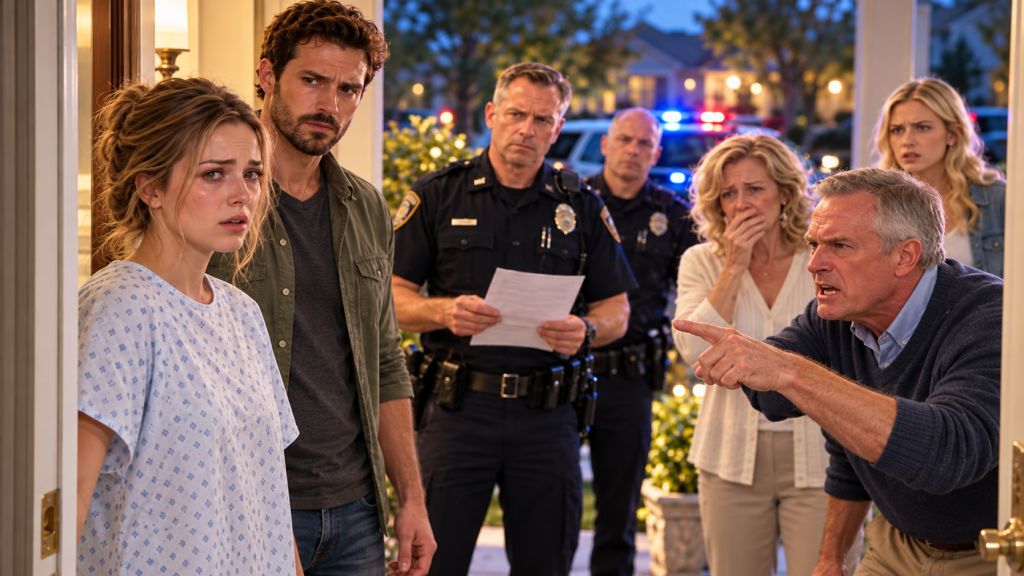
“Mrs. Hayes, we’re still establishing the full circumstances. But the footage shows your sister presenting identification in your name and completing a withdrawal at Harbor Community Credit Union.” My husband gripped the edge of the door. “That’s impossible. Mallory was in intensive care.”
“I understand,” Ruiz said. “That’s why we need to speak with both of you.”
She didn’t step forward until Ethan invited the officers inside.
I appreciated that small courtesy.
After weeks of nurses entering my room to check monitors, change dressings, and administer medication, I’d developed an uncomfortable feeling that my body and my life no longer belonged entirely to me.
Now two police officers were sitting in our living room because my father had accused me of stealing money that had apparently been stolen from me.
I sat on the couch, one hand pressed against my ribs.
The doctors had warned me that recovery from the severe infection and complications that followed my collapse would be slow. Some days, even showering exhausted me.
Tonight, my heart was hammering as if I’d run five miles.
Ruiz noticed.
“Would you like some water?”
I shook my head.
“I’d like to know what my father told you.”
She opened the complaint.
“Gregory Hayes claims you withdrew twelve thousand dollars from an account intended to pay for your mother’s surgery. He alleges that you had access to the money and refused to return it.”
I stared at her.
“Did he provide bank records?”
“He provided a document he described as an authorization.”
“With my signature?”
“Yes.”
I looked at Ethan.
He looked just as bewildered as I felt.
“Detective,” he said, “I opened that account for our emergencies. My wife is a joint owner. Her parents have never contributed a cent.”
Ruiz nodded.
“That’s consistent with the bank’s preliminary information.”
“Then why did you come here?”
“Because your father filed a complaint containing your name and identifying information, and because the document he supplied raised questions. We need to establish who actually authorized the withdrawal.”
I looked at the date again.
September seventeenth.
My sixth day in intensive care.
That afternoon, according to my hospital records, I had been receiving treatment while Ethan sat outside my room, waiting for permission to see me.
I couldn’t remember that day.
I couldn’t remember most of that week.
But I knew one thing with absolute certainty.
I hadn’t walked into a bank.
“I want to see the footage,” I whispered.
Ruiz hesitated.
“Not tonight. The bank is preserving it as evidence. But I can tell you what we’ve confirmed.”
I swallowed.
She continued.
“The woman appears to have presented your driver’s license. She also carried paperwork containing your account details. The teller processed the transaction after a series of identity checks that are now under review.”
“Rachel looks like me,” I said slowly.
Ethan turned toward me.
“We’ve always looked alike.”
My sister was four years younger.
We had the same dark hair, the same brown eyes, and the same small scar near our left eyebrows from childhood accidents.
In family photographs, people sometimes mistook us for each other.
That resemblance had always amused Rachel.
When we were teenagers, she’d borrow my clothes and pretend to be me when answering calls from boys.
I’d laugh.
Mom would call us her matching girls.
Now I felt sick remembering it.
Ruiz closed the folder.
“We’ll need copies of the medical records establishing your condition and whereabouts on September seventeenth. We’ll also need to speak with your husband about the account.”
I nodded.
“Take whatever you need.”
Ethan placed his hand over mine.
Then I remembered something.
“My father still has copies of some of my old financial paperwork.”
Ruiz looked up.
“Why?”
I gave a bitter little laugh.
“Because I’m the person everyone in my family calls whenever something needs fixing.”
“Can you explain?”
I looked toward the kitchen.
For years, I had carried my parents’ problems as though they were extra bags of groceries.
Their overdue electricity bills.
My father’s truck repairs.
My mother’s dental work.
Rachel’s apartment deposits.
Emergency after emergency, always arriving with the same message.
You’re the responsible one, Mallory.
At thirty-three, I’d finally begun to understand that responsibility had become the name they gave me whenever they wanted something.
“I’ve been helping them financially since I was twenty-two,” I said. “My father has copies of old account statements because I once helped him refinance. My mother had a key to our home. Rachel borrowed my license years ago, though I thought she’d returned it.”
Ruiz wrote something down.
“Do you still have that spare key arrangement?”
I shook my head.
“Mom returned one key. I don’t know whether she ever copied it.”
Ethan looked at me.
“We’re changing the locks tomorrow.”
For the first time that evening, I didn’t argue.
The detective stood.
“Mrs. Hayes, I recommend preserving every message your father sent you today. Don’t confront your family about the investigation. Let us verify the evidence.”
I nodded.
Then she looked at me with an expression that was almost painfully gentle.
“One more thing.”
My stomach tightened.
“What?”
“The authorization your father submitted appears to contain a signature dated September seventeenth.”
I stared at her.
“The same day as the withdrawal?”
“Yes.”
My throat went dry.
“Then he didn’t just accuse me.”
Ruiz waited.
“He gave you a document pretending I was conscious, healthy, and present at a bank while I was fighting for my life.”
The detective said nothing.
She didn’t have to.
When the officers finally left, Ethan closed the front door and rested his forehead against it.
For several seconds, neither of us moved.
Then he turned toward me.
“I’m so sorry.”
I felt the tears arrive before I could stop them.
“Why are you apologizing?”
He crossed the room and knelt in front of me.
“Because I should’ve noticed the money was gone.”
I touched his face.
“Ethan, you were sleeping in a hospital chair while I was unconscious.”
His eyes filled.
“I thought I was going to lose you.”
I pulled him toward me.
And we cried together on our living room floor, not yet knowing that the missing twelve thousand dollars was only the beginning.
The next morning, I received a text from my mother.
For a second, my heart lifted automatically.
Some part of me still hoped she’d finally ask how I was feeling.
Instead, the message read:
Your father says you’ve involved the police. This is unnecessary. Please stop embarrassing the family.
I stared at the screen.
Then another message arrived.
Your sister is very upset. You need to call her.
I read those words three times.
My sister was upset.
Not the daughter who had almost died.
Not the daughter whose emergency savings had disappeared.
Rachel.
I placed the phone facedown.
Ethan was standing beside the stove making scrambled eggs.
“What did she say?”
I told him.
His expression tightened.
“Don’t answer.”
“I wasn’t planning to.”
He looked at me for a moment.
Then said something I didn’t expect.
“Mallory, can I ask you a question?”
I nodded.
“When was the last time your mother asked how you were doing without needing something from you?”
I opened my mouth.
Then closed it.
I tried to remember.
My birthday in March?
No. She’d called to complain that Dad was arguing with a contractor.
Christmas?
She’d asked whether I could cover the family dinner because Rachel was short on money.
The anniversary of our wedding?
She hadn’t remembered.
I looked toward the window.
And the absence of an answer felt worse than any insult my father had sent.
By noon, Jenna was sitting at our kitchen table with a folder thick enough to make me nervous.
She’d brought chicken soup, fresh bread, and the kind of expression I recognized from payroll audits.
It meant somebody had been lying, and she intended to find out who.
“First,” she said, placing the soup in front of me, “eat.”
I gave her a weak smile.
“You’re becoming Ethan.”
“Good. He seems to be the only person around here who can make you listen.”
Ethan laughed from the counter.
Then Jenna opened her folder.
“I spoke with our office administrator this morning. She found the visitor log from the day after your collapse.”
I stopped lifting my spoon.
“What visitor?”
“Your mother.”
My stomach tightened.
Jenna slid a copy of the log across the table.
September thirteenth.
11:26 a.m.
Diane Hayes — collecting personal belongings for Mallory Hayes.
I stared at my mother’s signature.
“She came to my office?”
Jenna nodded.
“She told reception that Ethan needed your purse, wallet, and phone charger.”
I looked toward my husband.
“Did you ask her to collect those things?”
His expression darkened.
“No.”
Jenna continued.
“I was helping Human Resources document your medical leave. When your mother arrived, I offered to take the bag directly to the hospital.”
“What did she say?”
“She told me she’d see you herself.”
I stared at her.
“She never came.”
Jenna’s eyes filled.
“I know that now.”
The room fell silent.
I thought about my mother driving into the city.
Parking outside my office.
Taking my wallet.
And then driving home instead of coming to the hospital where her daughter lay unconscious.
It was difficult to comprehend.
At first, I had believed she simply couldn’t face seeing me so ill.
I’d told myself grief and fear made people behave strangely.
But she had found time to retrieve my belongings.
She simply hadn’t found time to see me.
Jenna reached for my hand.
“There’s another detail.”
I looked at her.
“The office cameras recorded her leaving with your handbag. Your phone charger was still sitting in your desk when I checked afterward.”
Ethan stood very still.
“Then what did she want?”
I already knew.
“My wallet.”
Jenna nodded.
“We’re preserving the footage and the log for the investigators.”
I looked down at the paper.
For years, I’d been proud that my family trusted me.
I was beginning to realize they’d also trusted themselves to take things from me without asking.
The bank investigation moved quickly once Detective Ruiz obtained the hospital records.
Three days later, Ethan and I met with a credit union fraud investigator named Andrea Brooks.
She spoke gently, perhaps because I’d arrived holding Ethan’s arm, still unable to walk long distances without resting.
Andrea explained that the disputed transaction had emptied the recovery savings account.
The twelve thousand dollars hadn’t gone directly to my father.
It had been converted into an official bank check made payable to R. Hayes Home Services.
I stared at the name.
“That’s Rachel’s company.”
Ethan looked at me.
“I thought she closed that business.”
“She said she did.”
Rachel had started a home-organizing business two years earlier.
Her social media pages showed immaculate closets, color-coded pantries, and photographs of expensive homes she claimed to have transformed.
But she constantly complained that clients didn’t pay on time.
I’d lent her three thousand dollars for equipment.
Then another fifteen hundred when her van needed repairs.
She’d promised to repay both.
She never had.
Andrea turned the screen toward us.
“This is a still photograph from the branch security footage.”
My breath caught.
There was Rachel.
My sister.
She was wearing a beige cardigan and dark sunglasses pushed onto her head.
Her hair was pulled back in a low ponytail.
In her right hand was my driver’s license.
In her left was my old blue handbag.
The one Mom had collected from my office.
I stared at the image.
For an instant, I could barely recognize the woman on the screen.
Not because she looked different.
Because she looked so ordinary.
She was standing beneath fluorescent lights, smiling politely at a bank employee, while I lay connected to machines in intensive care.
“She came in pretending to be you,” Andrea said.
I nodded slowly.
“Yes.”
“We’re reviewing the verification failures that allowed this to happen.”
Ethan leaned forward.
“Will the money be returned?”
“The investigation is ongoing. Once the unauthorized transaction is confirmed, we’ll explain the resolution process and any reimbursement available.”
I was grateful she didn’t make promises she couldn’t yet keep.
Then Andrea showed us another document.
It was a deposit receipt.
The funds had entered Rachel’s business account.
Within forty-eight hours, nine thousand dollars had been transferred to a man named Gregory Hayes.
My father.
The remaining three thousand had been used for payments connected to Rachel’s business.
I stared at the screen.
“So they split it.”
Andrea didn’t speculate.
But the figures were unmistakable.
My mother had collected my wallet.
My sister had used my identification.
And my father had received most of the money.
No one could tell me yet exactly what each person had known.
But this was no longer a misunderstanding over a twelve-thousand-dollar surgery bill.
It was a trail of decisions.
And every trail led back to the people who hadn’t visited me once.
That evening, Rachel called.
I watched her name flash across my phone.
Once.
Twice.
Three times.
Finally, I answered and put the call on speaker with Ethan beside me.
“Hello?”
“Mallory!”
Her voice sounded strained.
“Oh, thank God. I’ve been trying to reach you.”
I said nothing.
She rushed on.
“Mom says you’re telling people I stole from you.”
I looked at Ethan.
“Did you use my driver’s license to withdraw money from my account on September seventeenth?”
Silence.
Then Rachel laughed nervously.
“Where did you hear that?”
“The bank.”
Another silence.
“Mal, you don’t understand.”
I closed my eyes.
“Then explain.”
She began crying.
“Dad said you weren’t going to make it.”
The room seemed to tilt.
“What?”
Her words came faster.
“He said the doctors weren’t hopeful. Mom was crying. Nobody knew what was going to happen.”
I stared at the wall.
“And?”
“Dad said you would’ve wanted us to have access to your money if something happened.”
My chest went cold.
“But nothing had happened to me yet.”
“I know.”
“Rachel, I was alive.”
She sobbed.
“I know!”
“Then why were you using my identification at a bank?”
“Dad said you wouldn’t mind.”
I looked toward Ethan.
He was gripping the edge of the table.
I asked quietly, “Why did Dad need nine thousand dollars?”
Rachel stopped crying.
For several seconds, all I heard was her breathing.
Then she whispered, “The house.”
“What about the house?”
“The property taxes. He was behind. There were collection notices. He said if he didn’t pay, eventually they’d take the house.”
I felt a familiar sickening pressure behind my eyes.
Another family emergency.
Another crisis that would somehow become my responsibility.
“And your three thousand?”
Rachel sniffed.
“Business expenses.”
I almost laughed.
I had been unconscious.
And they’d divided my money between Dad’s financial problems and Rachel’s company.
I waited until I could trust my voice.
“Who decided to file a police complaint accusing me?”
Rachel went quiet again.
Then she whispered, “Dad.”
“Why?”
“Because he thought if you believed the police were involved, you’d give him the money he asked for.”
I stared at the phone.
“He wanted another twelve thousand dollars?”
“He said you always helped when you were scared something bad would happen.”
For a moment, I couldn’t breathe.
There it was.
The truth I’d spent most of my life avoiding.
My father hadn’t merely counted on my generosity.
He had learned how to frighten me into giving.
And when I finally said no, he reached for the same weapon again.
I took a slow breath.
“Rachel, I’m not going to discuss this further without an investigator or attorney involved.”
“Mal, please. Don’t ruin our lives.”
My eyes filled.
“You came into a bank with my identification while I was fighting to stay alive.”
She began sobbing.
“We’re your family.”
I whispered, “So was I.”
Then I ended the call.
For a long time, Ethan and I sat together in silence.
Finally, he asked, “Are you okay?”
I shook my head.
“No.”
He moved closer.
I leaned against him.
“But I think I’m finally seeing them clearly.”
Two weeks later, I learned that the twelve thousand dollars wasn’t the only amount my family had tried to take.
Detective Ruiz called on a Tuesday morning.
Ethan was helping me walk around the block, something my physical therapist had recommended as part of rebuilding my strength.
I stopped beside our neighbor’s rosebush when I saw the detective’s name.
“Mrs. Hayes, do you have a moment?”
“Yes.”
“We’ve been reviewing the paperwork submitted by your father and the records from the credit union.”
I leaned against Ethan.
“Did you find something?”
“There appears to have been an attempt to establish broader financial authority over your accounts.”
I closed my eyes.
“What kind of authority?”
“A document purporting to grant your father power of attorney.”
My knees weakened.
Ethan guided me toward a bench.
“That’s impossible,” I whispered. “I’ve never given him power of attorney.”
“Did you ever discuss appointing him to manage your finances?”
“No. Ethan is my emergency contact. We handle everything together.”
Ruiz paused.
“The document bears a signature resembling yours.”
I looked at my husband.
His face had gone pale.
“And a second signature,” she added, “belongs to someone who appears to have witnessed the document.”
“Who?”
There was a brief silence.
“Your mother.”
I felt something inside me give way.
My mother.
The woman who taught me how to ride a bicycle.
The woman who used to brush my hair before school.
The woman who hadn’t visited me when I was critically ill.
She hadn’t merely collected my wallet.
She’d apparently helped create paperwork that could have given my father access to far more than one savings account.
“Is the document valid?” Ethan asked.
“That is being investigated. The institution reviewing it flagged irregularities and did not accept it as sufficient authority.”
I covered my face.
For the first time, I was grateful for a bank employee who had refused to accept a document simply because it looked official.
Ruiz continued.
“Your mother may have information that is important to understanding how it was prepared. We’re arranging to speak with her.”
I nodded.
Then the detective said something that made my stomach drop again.
“Mrs. Hayes, the document is dated September fifteenth.”
Two days before the withdrawal.
Four days after my collapse.
While Ethan was sitting beside my hospital bed, waiting for me to wake up, my family had apparently been arranging a way to control my money.
I ended the call.
For a long time, I sat on the bench watching people walk their dogs, children ride bicycles, and cars pass along the quiet street.
The world continued moving.
My world had stopped.
Ethan sat beside me.
“Mal?”
I looked at him.
“Do you know what the worst part is?”
He shook his head.
“I don’t even know whether they wanted me to get better.”
His expression crumpled.
He wrapped both arms around me.
I cried against his shoulder until I felt too exhausted to cry anymore.
That evening, I opened an old spreadsheet on my laptop.
I’d created it years earlier because I liked keeping track of expenses.
At first, it had been a simple list of money I lent my family.
Then it became a record of bills I paid because someone else couldn’t.
Eventually, it turned into a document I stopped looking at because the numbers made me uncomfortable.
I scrolled back through the entries.
A thousand dollars for Dad’s overdue mortgage payment.
Eight hundred for Rachel’s car repairs.
Two thousand for Mom’s dental treatment.
Three hundred for an emergency utility bill.
Fourteen hundred for property taxes.
Six hundred for a medical deductible.
Year after year.
I’d never added everything together.
Now I did.
The total came to more than seventy-three thousand dollars.
Ethan was standing behind me when the number appeared.
He went quiet.
“Is that right?”
I checked the formula.
Then checked it again.
“Yes.”
He sat beside me.
“Mal, you never told me it was that much.”
“I didn’t realize.”
He looked at the screen.
“Did they repay any of it?”
I swallowed.
“A few hundred dollars.”
He reached for my hand.
I stared at the spreadsheet.
For years, every family emergency had arrived disguised as proof that I mattered.
Dad needed me.
Mom trusted me.
Rachel couldn’t manage without me.
I’d mistaken their dependence for affection.
And now, seeing the numbers, I realized how much of my adult life I’d spent paying to remain important to people who rarely asked whether I was happy.
Ethan closed the laptop gently.
“That money is gone,” he said.
I nodded.
“But we don’t have to keep sending more.”
I leaned against him.
“No,” I whispered.
“We don’t.”
My mother’s first genuine apology arrived twenty-three days after the police came to our house.
It wasn’t a text.
It was a voicemail.
I listened to it with Ethan beside me.
“Mal, it’s Mom.”
Her voice sounded smaller than I remembered.
“I know you’re angry. You have every right to be.”
She paused.
“I need to tell you something about the paperwork.”
My stomach tightened.
“Your father told me he needed a witness signature so he could help with your bills while you were in the hospital. He said Ethan was overwhelmed and that you would’ve wanted us to make sure everything was handled.”
A long silence followed.
“I signed because I trusted him.”
I looked at Ethan.
He shook his head.
Then Mom continued.
“But that doesn’t excuse it. I didn’t read everything. And when Rachel came home with your money, I knew something was wrong.”
My eyes filled.
“I should’ve told you. I should’ve come to the hospital. I should’ve stopped pretending I didn’t understand what was happening.”
She began crying.
Then she said the words I’d waited months to hear.
“How are you feeling, sweetheart?”
I stared at the phone.
After everything, that simple question almost broke me.
But it also hurt.
Because now it sounded like something she’d remembered to say after being told what consequences she might face.
I didn’t call back.
Not immediately.
I sat with the message for two days.
Then I texted:
I am still recovering. I heard your apology. I need space, and I need you to tell the investigators the complete truth. Please don’t contact me again until I’ve had time to decide what I want.
She replied:
I understand.
For once, I didn’t send a reassuring message.
I didn’t tell her everything would be fine.
I let her sit with the discomfort of what she’d done.
I was learning that compassion didn’t require me to make consequences disappear.
The next unexpected revelation came from my mother’s medical records.
Not because I accessed them.
Because she chose to provide information about the surgery Dad had used to demand money.
She sent the details through our attorney after she was interviewed by investigators.
She did have a medical procedure scheduled.
That part was true.
She needed surgery to address a painful but nonemergency condition that had been troubling her for months.
Her surgeon had already explained the treatment options, and the operation was scheduled for the following season.
But there was no twelve-thousand-dollar payment due.
Her insurance covered most of the procedure.
The estimated amount she might owe was a fraction of what Dad had demanded.
I stared at the paperwork.
Ethan read it beside me.
“So the surgery was real.”
“Yes.”
“But the twelve thousand wasn’t.”
I shook my head.
Dad had chosen the one subject most likely to make me feel guilty.
Mom’s health.
He knew I would remember all the times she’d been sick when I was little.
He knew I would imagine her frightened in a hospital bed.
He knew I would feel cruel turning away from someone who might need surgery.
And after I’d spent weeks fighting for my own life, he had tried to use illness as a weapon against me.
I looked toward Ethan.
“Remember when I sent him that dollar?”
He nodded.
“I thought I was finally saying no to another request.”
I swallowed.
“I didn’t realize I was refusing to pay him twice for money he’d already stolen.”
Ethan took my hand.
“Now you know.”
I stared out the window.
The truth didn’t make me feel victorious.
It made me feel terribly tired.
But beneath that exhaustion, something stronger was beginning to grow.
For the first time, I wasn’t trying to find an explanation that would make my family’s behavior understandable enough to forgive.
I was allowing it to be wrong.
And I was allowing myself to walk away from it.
The case took almost nine months to move through the legal system.
During that time, my father never once apologized.
He sent messages through relatives, claiming I had turned against the family.
He told my aunt I’d become obsessed with money.
He told an uncle that Ethan was controlling me.
He even told my grandmother that I’d been confused by the medication I received in the hospital and that the accusations against him were a misunderstanding.
For years, I would have rushed to defend myself.
I would have called everybody, explained what happened, and begged them to understand.
This time, I didn’t.
Our attorney advised us to preserve the messages and allow the evidence to speak through the proper process.
So I did.
It wasn’t easy.
Some nights I lay awake wondering whether the rest of my family thought I was cruel.
Then Ethan would remind me of September seventeenth.
The day I couldn’t speak for myself.
The day Rachel walked into the bank with my license.
The day my father received nine thousand dollars of money meant to protect my recovery.
And eventually, I stopped trying to win an argument with people who preferred his version because it demanded less courage from them.
The investigation established that my father had participated in the scheme to obtain money from our savings account and had knowingly submitted a false complaint against me.
Rachel admitted impersonating me at the credit union.
The disputed power-of-attorney document was never accepted as valid, and investigators examined how my father had tried to use it to gain access to my finances.
My mother acknowledged witnessing the document without my knowledge and later cooperating in concealing the withdrawal.
Her cooperation helped establish the timeline.
She provided messages showing Dad directing Rachel to go to the bank and instructing her on what to say if anyone questioned the transaction.
She also surrendered an old folder containing copies of my account statements, identification documents, and financial records I’d once shared while helping my father.
I recognized every page.
I remembered sitting at his kitchen table years earlier, explaining interest rates and monthly payments while he called me his clever girl.
I’d handed him those records because I trusted him.
He’d kept them.
Not as mementos of a daughter helping her father.
As tools he could use later.
When our attorney showed me the inventory of documents, I felt the last remaining illusion of my childhood disappear.
I wasn’t looking at a single desperate mistake.
I was looking at years of entitlement that had finally crossed into theft.
At a court hearing, my father looked smaller than I remembered.
He wore a gray suit I’d helped him buy for my sister’s graduation.
That detail almost made me laugh.
Even standing there to answer for stealing from me, he was wearing something I’d paid for.
He avoided my eyes until it was time for me to speak.
By then, he had entered a guilty plea to charges arising from the unauthorized taking of funds and the false report, with the consequences determined through the legal process.
Rachel had also accepted responsibility for her part.
The court considered their conduct, their cooperation or lack of it, and the restitution arrangements.
I hadn’t come to demand the harshest possible punishment.
I had come because, for once, I wanted my father to hear what he’d done without interrupting me.
I stood carefully.
My legs were stronger than they’d been months earlier, but I still had days when fatigue struck without warning.
Ethan sat behind me.
Jenna was beside him.
And in the back row, my mother sat with her hands clasped in her lap.
I took a breath.
“When I woke up in the hospital,” I began, “the first thing I did was look for my family.”
The courtroom was quiet.
“I had been unconscious for days. My husband told me I’d nearly died. I remember asking whether my parents knew.”
My throat tightened.
“They knew.”
I looked toward my father.
“They knew I was critically ill. They knew where I was. But they didn’t come.”
He shifted in his chair.
I continued.
“For years, whenever my family called, I came. When my father couldn’t pay a bill, I helped. When my sister needed money, I found it. When my mother was frightened, I made time.”
Tears burned behind my eyes.
“I thought that’s what love meant.”
I paused.
“But when I needed them, they weren’t there.”
My father lowered his head.
“And while my husband was waiting to learn whether I would survive, people I trusted used my identification to take the money we’d saved for an emergency.”
My voice broke.
“Then, after I came home, still weak enough that walking across a room exhausted me, my father demanded more.”
I looked directly at him.
“When I refused, he accused me of stealing.”
The room was silent.
I swallowed.
“That accusation frightened me. But what hurt more was realizing that he believed he could still control me by making me afraid.”
My father finally looked up.
His eyes were wet.
For one foolish second, I hoped he might be feeling remorse.
Then he muttered, “I was trying to save our house.”
I stared at him.
“And you were willing to sacrifice mine.”
He looked away.
I turned back toward the judge.
“I am not asking the court to fix my family. I know that isn’t possible.”
My voice steadied.
“I’m asking that what happened be recognized for what it was.”
I took one final breath.
“I nearly lost my life in September. I will not spend the life I was given afterward apologizing for protecting myself.”
When I sat down, Ethan reached for my hand.
I held it tightly.
And for the first time in my life, my father had been required to listen without being able to turn my pain into an argument about what I owed him.
After the hearing, my mother approached me in the courthouse hallway.
I saw her coming and instinctively reached for Ethan’s hand.
She stopped several feet away.
“Mal?”
I looked at her.
She seemed older.
Her hair had more gray than I remembered, and the familiar confidence in her face had been replaced by uncertainty.
For a moment, I remembered being six years old, crying over a scraped knee while she wrapped me in a towel after my bath.
I remembered how safe her arms had once felt.
Then I remembered the hospital call log.
The empty chairs.
My missing wallet.
Both memories belonged to the same woman.
“I’m sorry,” she whispered.
I nodded.
“I know.”
She began crying.
“I should’ve been there.”
“Yes.”
“I kept telling myself your father would handle everything. That once things calmed down, I’d come see you.”
My eyes filled.
“Mom, I wasn’t asking you to handle anything.”
She looked up.
“I know.”
“I didn’t need money. I didn’t need a plan. I didn’t need you to solve my medical problems.”
My voice shook.
“I just needed my mother.”
She covered her mouth.
I continued.
“When I woke up, I asked for you. I thought maybe you were downstairs getting coffee. Or talking to a doctor. I kept making excuses because believing you were busy hurt less than believing you chose not to come.”
She sobbed.
“And you were forty minutes away.”
“I know, sweetheart.”
I wiped my cheeks.
“You don’t get to make that choice disappear by crying about it now.”
She nodded slowly.
Then she asked, “Will you ever let me be your mother again?”
I looked at her for a long time.
“That depends on whether you can learn to be someone I feel safe with.”
She closed her eyes.
“I’ll try.”
I wanted to hug her.
I wanted to be a little girl again, before money and obligation had become tangled with every family conversation.
But wanting something didn’t make it safe.
So I simply said, “I hope you do.”
Then I walked away with Ethan.
For once, I didn’t turn back to comfort the person I’d disappointed.
The credit union eventually completed its investigation and restored the disputed funds to our account through its resolution process, while the legal proceedings addressed recovery and restitution from those responsible.
Ethan and I changed our banking arrangements.
We secured our credit records, replaced identification documents, changed passwords, and made sure my family could no longer access our financial information.
Our attorney helped us review the old paperwork my father had retained.
We changed the house locks.
We removed my parents from every account, emergency contact list, and financial arrangement where their access was no longer appropriate.
At first, those changes felt cruel.
I kept hearing my father’s voice.
You owe this family.
Then I remembered the empty hospital chairs.
And I understood that protecting my home wasn’t an act of revenge.
It was something I should have allowed myself to do years earlier.
Rachel sent a letter a few months later.
She apologized for impersonating me and admitted she’d been terrified of losing her business.
She wrote that Dad had convinced her I would forgive them once I recovered.
That sentence made me stare at the page for a long time.
Once I recovered.
They had behaved as though my survival came with an automatic obligation to absorb whatever harm they’d done while I was helpless.
I wrote back once.
I hope you rebuild your life honestly. But I cannot rebuild our relationship until I know you understand why what you did was wrong.
I didn’t promise forgiveness.
I didn’t threaten her.
I simply told the truth.
And for the first time, that felt sufficient.
One year after my collapse, Ethan took me back to the hospital.
Not because I was sick.
Because I wanted to see Carla.
We found her at the nurses’ station, wearing bright purple scrubs with tiny white flowers.
She recognized me immediately.
“Well, look who’s walking in here on her own two feet!”
I laughed.
Then she came around the counter and hugged me.
I held on longer than I expected.
When she pulled back, her eyes were wet.
“How are you feeling, sweetheart?”
The question was so simple.
So ordinary.
And yet it made my throat close.
“I’m getting stronger.”
She smiled.
“That’s what I like to hear.”
I reached into my bag and handed her a small card.
Inside, I’d written:
Thank you for treating me like a person when I was too sick to feel like one.
Carla read it.
Then she hugged me again.
“You did the hard part, honey.”
I shook my head.
“No. We all did different parts.”
Ethan was standing beside me, smiling.
Carla looked toward him.
“And this one?”
I laughed.
“Still making sure I eat.”
“Good,” she said. “Keep him.”
I took Ethan’s hand.
“I intend to.”
Before we left, I glanced toward the corridor leading to the intensive care unit.
I could still remember the fluorescent lights.
The smell of disinfectant.
The terrible weakness of trying to lift my head from a pillow.
And the sound of a machine counting seconds I almost hadn’t lived to see.
But that day, I wasn’t afraid of the memory.
I was grateful I’d come far enough to stand there and remember it.
That evening, Jenna came over for dinner.
We ordered takeout because I still wasn’t much of a cook when I was tired, and Ethan had decided he’d done enough emergency meal preparation for one lifetime.
The three of us ate around the kitchen table.
At one point, Jenna reached for the last dumpling.
I slapped her hand gently.
“That’s mine.”
She grinned.
“Funny. I remember a time when you gave everybody whatever they asked for.”
I looked at her.
Then at Ethan.
Then at the little plate between us.
“Not anymore.”
We all laughed.
But later, after Jenna left, I stood in the kitchen looking at that same table.
It was where Dad’s message had arrived.
Where I’d sent him one dollar.
Where Ethan had held my wrist while I wondered whether saying no made me a terrible daughter.
I opened my banking app.
I found the transaction history.
There it was.
$1.00 — Gregory Hayes.
For a moment, I considered deleting the record from my saved list.
Then I smiled.
I didn’t need to.
That dollar was no longer the symbol of my anger.
It was the first boundary I’d drawn without immediately apologizing for it.
Ethan walked into the kitchen and wrapped his arms around my waist.
“What are you thinking about?”
I leaned back against him.
“How strange it is that one dollar changed everything.”
He kissed the top of my head.
“The dollar didn’t change everything, Mal.”
I turned toward him.
“What did?”
He smiled gently.
“You finally decided your life mattered as much as everybody else’s.”
My eyes filled.
I looked toward the window, where the evening light was fading over our little garden.
For thirty-three years, I’d tried to earn love by being useful.
I paid bills.
Solved crises.
Made excuses.
Forgave things nobody had apologized for.
Then I nearly died.
And when I woke up, the people I’d spent my life rescuing hadn’t come.
But someone had.
My husband, who slept in an uncomfortable chair for weeks.
My friend, who brought books I was too tired to read.
A nurse, who remembered how I liked my ice water.
They hadn’t needed twelve thousand dollars from me.
They hadn’t asked me to prove my loyalty.
They had simply stayed.
My father thought sending him one dollar was the cruelest thing I’d ever done.
But the truth was that I’d spent years giving my family everything I could, while asking almost nothing in return.
That dollar was the first time I stopped.
And when the police arrived at my door because my father wanted to punish me for refusing him, I discovered just how much he’d already taken.
He could steal my money.
He could misuse my trust.
He could tell lies about me.
But he couldn’t take back the life I’d fought so hard to keep.
And I wasn’t going to hand it to him.
I had survived the hospital. Now I intended to survive the family that had abandoned me—and finally learn how to live for myself.
THE END STORIES! THANK YOU FOR READING GOOD LUCK !❤️
Related Posts



