The photograph slipped from my trembling fingers. A child’s grave. My name carved into stone. And beneath it, a sentence written by the man who had kissed me goodnight for two years. TOMORROW, LUCY JOINS HER. I stared at Marcus. For one terrible second, I forgot how to breathe. He was still holding the syringe. His black gloves reflected the cold light of the laboratory, and his expression had changed from irritation to something almost unrecognizable.
Not anger. Calculation. “Valerie,” he said softly, “put the notebook down.” I shook my head. “Who is she?” He took a step toward me. “You’re confused.” “Who is Valerie Reed? “Eleanor stood beside the monitor, her face suddenly drained of color. “Marcus,” she whispered, “what does that sentence mean?”
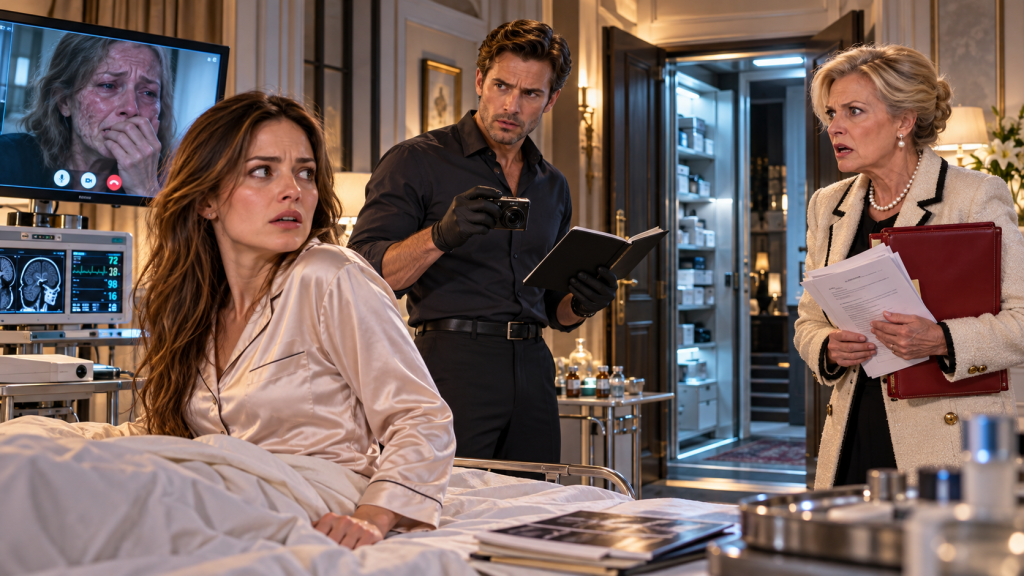
He didn’t look at her. “Mother, please.” “You told me she would be relocated after the transfer.” My heart hammered. Relocated. What an extraordinary word for making a human being disappear. On the monitor, Marianne began shouting. “Lucy! Listen to me! He’s been lying to Eleanor too!”
Marcus reached for the computer controls.
“Enough.”
But my mother screamed something that stopped him.
“I have people listening, Marcus. This call is being recorded. They know where you are.”
His hand froze.
Then he laughed.
“You’re bluffing.”
Marianne leaned closer to the camera.
Her scarred face filled the screen.
“Try me.”
I looked at her.
The woman I’d been told was dead.
The woman whose voice I’d heard only minutes earlier.
Something inside me wanted to run toward the monitor, to climb through the glass and disappear into her arms.
But Marcus was standing between me and the only door.
And he was holding a syringe.
“Lucy,” Marianne said, her voice breaking, “keep your eyes on him.”
Marcus turned back toward me.
“We’re going to calm you down.”
“No.”
My voice sounded unfamiliar.
Firm.
“You’re going to put that syringe away.”
He smiled the way he did when I questioned his medical advice.
“Sweetheart, your nervous system is overstimulated. You don’t understand what’s happening.”
I thought about every night he’d made me swallow a capsule.
Every morning I’d awakened dizzy.
Every bruised wrist.
Every time I’d apologized for forgetting something he insisted we’d discussed.
“You’ve been drugging me.”
His smile disappeared.
“You’re ill.”
“No.”
I held the notebook against my chest.
“You made me believe I was ill.”
He moved suddenly.
I swung the metal tray with everything I had.
It struck his forearm.
The syringe flew across the room and shattered against the tiled floor.
Marcus shouted.
I stumbled backward into the examination table.
Eleanor screamed, “Stop!”
For a moment, Marcus looked as though he might strike me.
Then he lunged toward the fallen notebook.
I grabbed it first.
He caught my wrist.
Pain shot through my arm.
“Give it to me!”
I pulled away, but he was stronger.
The old terror rose inside me.
A familiar feeling.
Not from our marriage.
From somewhere much further back.
Rain.
Headlights.
A man’s voice saying, She knows too much.
I gasped.
Marcus saw the change in my face.
“What did you remember?”
I stared at him.
He tightened his grip.
“Lucy. What did you remember?”
It was the first time he’d used my real name directly.
Not as a test.
Not as a whisper beside my sleeping body.
As an accusation.
Eleanor stepped forward.
“Marcus, let her go.”
He ignored her.
“Tell me.”
I looked into his eyes.
And suddenly, another memory flashed through me.
A hospital corridor.
A blue blanket.
A woman crying.
Marcus, younger, wearing a white coat.
I heard myself whisper, “You were there.”
His fingers loosened.
I pulled free.
“You were at the hospital after the accident.”
He stared at me.
Then Eleanor made a sound I will never forget.
A small, broken moan.
“Marcus,” she whispered, “she remembers.”
He turned toward his mother.
And in that second, I ran.
Not toward the concealed door.
Toward the large stainless-steel cabinet beside the wall.
I’d noticed a narrow emergency exit sign reflected in its polished surface.
Behind the cabinet was another doorway.
Marcus had used the hidden hallway because it connected directly to our bedroom.
But the laboratory had a second way out.
I seized the handle.
Locked.
I pulled again.
Nothing.
Marcus was behind me.
“Valerie!”
Then the monitor emitted a sharp electronic tone.
Marianne’s face disappeared.
A different image appeared.
A map.
And beneath it, a single message.
EMERGENCY SERVICES NOTIFIED. ADDRESS CONFIRMED.
Marcus stopped.
His eyes darted toward Eleanor.
“What have you done?”
She stared at the screen.
“Nothing.”
He backed away.
Then he understood.
The video call hadn’t been the private conversation he believed it was.
Someone on Marianne’s side had connected it to an emergency response already underway.
Marcus ran toward the concealed hallway.
But before he reached it, a heavy banging echoed through the house above us.
“POLICE! OPEN THE DOOR!”
For the first time that night, my husband looked afraid.
And I realized something I would remember for the rest of my life.
The man who had controlled my sleep, my memories, my education, and nearly every decision I’d made for two years was terrified of the one thing he couldn’t control anymore.
The truth.
I remember the next few minutes in fragments.
Marcus trying to flee through the hidden hallway.
Eleanor crying.
The sound of someone forcing open a locked interior door.
A flashlight sweeping across the white walls.
Then a police officer standing in front of me.
“Ma’am, you’re safe. Can you tell me your name?”
I opened my mouth.
For two years, that question had been simple.
Valerie Reed.
Graduate student.
Married to Marcus Reed.
Twenty-seven years old.
A woman who had supposedly lost her mother when she was five.
Now every piece of that life seemed to be floating around me like broken glass.
“My name is…”
I looked down at the notebook.
Then at the photograph of the grave.
Tears spilled down my face.
“I think my name is Lucy Archer.”
The officer’s expression softened.
“All right, Lucy.”
I began shaking.
He gently guided me toward a chair.
“Can you tell me whether you’ve been given any medication tonight?”
I shook my head.
“Not tonight. But every other night.”
I started crying harder.
“He made me take something. He said it helped me study.”
The officer spoke quietly into his radio.
Another officer entered with a medical response team.
Someone wrapped a blanket around my shoulders.
I watched as Marcus was escorted from the hidden room, protesting that I was his patient and that the police were interfering with necessary treatment.
“She’s experiencing a psychiatric emergency!” he shouted.
I flinched.
The officer beside me looked at him.
“Sir, stop speaking to her.”
Marcus stared at me.
And for one final moment, he tried the expression that had always worked before.
Concern.
“Valerie, sweetheart, please. You know I’d never hurt you.”
I looked at him.
Really looked.
At the husband who had been checking whether I remembered the life he’d stolen.
At the doctor who had turned my trust into a laboratory experiment.
At the stranger who’d slept beside me while planning my disappearance.
Then I whispered, “Don’t call me sweetheart.”
He stopped walking.
I took a breath.
“And don’t call me Valerie.”
His face hardened.
The officers led him away.
Eleanor was taken into a separate room for questioning.
Before she disappeared, she turned toward me.
“Lucy…”
I stared at her.
She looked old.
Not powerful.
Not elegant.
Just frightened.
“You don’t understand what happened twelve years ago.”
My hands trembled.
“Then tell the truth.”
She covered her mouth.
I waited.
But she said nothing.
And that silence told me she was still choosing herself.
The hospital smelled of antiseptic and freshly washed sheets.
I knew the smell.
It had followed me through dreams I couldn’t explain.
Now I lay in a private examination room with a blanket pulled to my chin, listening to a doctor explain that she wanted to evaluate my health independently of anything Marcus had recorded.
Her name was Dr. Helen Park.
She had kind eyes and a voice that didn’t change when I asked frightened questions.
“Will I remember everything?” I whispered.
She paused.
“I can’t promise that, Lucy.”
I stared at the ceiling.
“Your memories may have been affected by several things,” she continued. “The original injury, the medications you’ve been receiving, and the psychological stress you’ve experienced. We’re going to investigate carefully.”
I swallowed.
“Did he erase me?”
She pulled her chair closer.
“No one can determine that from what we’ve found tonight. But medications can interfere with memory and awareness, and trauma can complicate how memories are stored and recalled. What happened to you needs proper investigation.”
I looked at my hands.
Small bruises marked my wrists.
The skin near my elbow showed another puncture site.
For years, Marcus had explained such marks as evidence that I scratched myself while sleeping.
Sometimes I’d believed him.
Sometimes I’d thought I was losing my mind.
Now I knew those fears hadn’t come from nowhere.
Dr. Park gently touched my shoulder.
“You don’t have to answer every question tonight.”
I looked at her.
“Marcus always said I had to.”
She was quiet.
Then said, “He isn’t in charge of your care anymore.”
Those words made me cry.
Not because they were dramatic.
Because they were ordinary.
And after two years of asking permission to sleep, eat, study, and visit friends, ordinary freedom felt almost impossible to understand.
A little later, a nurse entered.
“Lucy, there’s someone here asking to see you.”
My heart began pounding.
“Who?”
The nurse smiled gently.
“Marianne Archer.”
I sat up so quickly the blanket slipped from my shoulders.
“She’s here?”
“Yes.”
I looked toward the door.
Suddenly, I was terrified.
What if she didn’t look like the woman in the video?
What if I didn’t recognize her?
What if my mind had accepted another lie?
The nurse noticed my expression.
“You can decide whether you want to see her.”
I took a trembling breath.
Then whispered, “Please.”
The door opened.
And my mother walked inside.
She was smaller than I expected.
Her dark hair was streaked with silver, and one side of her face bore scars that extended from her temple down toward her jaw.
She held a cane in her right hand.
For a moment, we simply stared at each other.
Then she whispered, “Lucy.”
Something inside me broke.
Not a clear memory.
Not an explanation.
A feeling.
A warmth so old and familiar that it seemed to exist beneath everything Marcus had done to me.
I began crying.
She took one step toward me.
Then stopped.
“May I hug you?”
That question nearly destroyed me.
For years, Marcus had touched me whenever he wanted.
Checked my eyes.
Lifted my arms.
Held pills against my lips until I swallowed.
Now this woman, who had spent twelve years searching for me, was asking permission.
I nodded.
She crossed the room.
And when she wrapped her arms around me, I began sobbing against her shoulder.
“Mom?”
She held me tighter.
“Oh, my baby.”
I didn’t know how long we stayed like that.
I only remember her whispering my name over and over.
Lucy.
Lucy.
Lucy.
As though saying it enough times might return the missing years.
Finally, I pulled back.
“I thought you were dead.”
Her eyes filled.
“I know.”
“He told me you died when I was five.”
She shook her head.
“I was there, sweetheart. I was alive. I never stopped looking.”
I studied her face.
A scar curved beneath her left eye.
I touched it gently.
“Was this from the accident?”
She nodded.
I swallowed.
“Did they hurt you?”
Her expression changed.
“Yes.”
I began crying again.
She took my hands.
“But I’m here.”
I looked at her.
“And so are you.”
For the first time in twelve years, those two things were true in the same room.
My mother told me the story slowly over the next several days.
She didn’t force me to remember.
She didn’t demand that I recognize photographs or finish sentences.
She answered my questions, even when the answers hurt.
My father, Oliver Archer, had owned a medical research company that developed specialized technology for neurological rehabilitation.
He died when I was twelve.
After his death, much of his estate was placed in a trust intended to provide for me when I reached twenty-eight.
My mother administered portions of the estate under the trust’s rules until I was older.
Eleanor had been one of the family’s legal advisers.
Marcus had been a promising young physician with connections to the medical organizations that licensed my father’s research.
“Your father trusted Eleanor,” my mother said quietly.
I stared at her.
“Like I trusted Marcus.”
She nodded sadly.
For years, Eleanor helped manage contracts connected to the Archer patents.
Then my mother began noticing payments that didn’t match the agreements she’d approved.
Money was moving through consulting companies she didn’t recognize.
Some payments went to a foundation connected with Eleanor.
Others appeared to benefit Marcus’s professional ventures.
My mother asked questions.
Eleanor assured her the arrangements were routine.
But eventually, an accountant found discrepancies large enough to demand a formal investigation.
“That’s when everything changed,” Marianne whispered.
I looked at her.
“What happened?”
She took a breath.
“We were driving home from meeting the accountant. It was raining.”
My chest tightened.
Rain.
Headlights.
A windshield shining beneath streetlights.
The same fragments that had returned in the hidden room.
“I remember a car,” I whispered.
My mother nodded.
“A dark SUV followed us for several miles.”
I closed my eyes.
“Someone was yelling.”
“I was telling you to hold on.”
Her voice broke.
“The SUV moved alongside us. Then it forced us toward the shoulder.”
A terrible image flashed through me.
Metal grinding.
Glass exploding.
The world turning upside down.
I gasped.
Marianne caught my hand.
“Lucy, look at me.”
I opened my eyes.
“You’re here. The accident is over.”
I struggled to breathe.
She waited until I was calmer.
Then continued.
“Our car went down an embankment. I was badly injured. You were conscious when the emergency workers arrived, but you were frightened and disoriented.”
“What happened to me?”
Marianne swallowed.
“You were taken to a hospital. I was transferred for surgery.”
I stared at her.
“And then?”
“When I woke up, they told me you had been discharged to a family representative.”
My skin turned cold.
“Eleanor?”
My mother nodded.
“She had paperwork naming her as someone authorized to assist with your care.”
I stared at the hospital wall.
“And Marcus?”
“He had access through his medical connections. The records we eventually recovered suggest he helped arrange your transfer to a private rehabilitation facility.”
I covered my mouth.
For twelve years, I’d imagined that my mother had died and somehow abandoned me to loneliness.
In reality, she’d been lying in a hospital bed, badly injured, while people she trusted took her daughter away.
“Why didn’t anyone find me?” I whispered.
Her face crumpled.
“Because the people who knew where you were helped conceal it.”
She took a trembling breath.
“And because I was repeatedly told that you were dead.”
I stared at her.
“Dead?”
She nodded.
“At first, they said you were missing. Then someone sent me documents suggesting you’d died after being transferred.”
I felt nauseated.
“I believed them for a few weeks.”
Tears rolled down her cheeks.
“Then I found inconsistencies. Dates that didn’t match. A hospital employee who remembered you leaving alive.”
She squeezed my hand.
“And I started looking.”
Twelve years.
I stared at the woman beside me.
Her injured leg.
The scars on her face.
The deep lines around her eyes.
She had spent twelve years searching for a daughter the world kept telling her was gone.
“Did you ever give up?” I whispered.
She shook her head.
“Some days I stopped searching long enough to survive.”
Her voice broke.
“But I never stopped being your mother.”
On the fourth day in the hospital, a man named Daniel Shaw came to visit.
He was a former police detective who now worked as a licensed private investigator.
My mother introduced him quietly.
“Daniel helped me find you.”
He was tall, with graying hair and the tired eyes of someone who had spent too many years seeing what people could do to one another.
He didn’t shake my hand until I offered mine.
That small courtesy mattered more than he probably realized.
“I’ve wanted to meet you for a long time, Lucy,” he said.
I studied him.
“How did you find me?”
He pulled out a folder.
“Your mother never accepted the reports about your death. We investigated the rehabilitation facilities that might have received you, but the paper trail repeatedly disappeared.”
He opened the folder.
Inside were photographs of buildings, old patient records, and copies of identity documents.
“Six months ago, we found a financial connection between one of those facilities and a company associated with Marcus.”
My stomach tightened.
“He’d been involved the entire time?”
Daniel nodded.
“That’s what the records suggest.”
He turned another page.
It was a photograph from a Columbia University student event.
I recognized myself immediately.
I was standing beside two classmates, holding a certificate for an academic research presentation.
I’d been proud of that day.
Marcus had told me the award was impressive but that I shouldn’t become distracted from my studies by social events.
Now I stared at the photograph with tears in my eyes.
“That’s me.”
Daniel smiled gently.
“Your mother saw this picture in a university publication. It was the first clear image of you she’d found in twelve years.”
I looked toward Marianne.
She was crying.
“I knew your eyes,” she whispered.
Daniel continued.
“At first, we couldn’t establish whether Valerie Reed and Lucy Archer were the same person. The available records gave conflicting birth dates and family histories.”
He paused.
“Then we uncovered a connection between the identity you were using and a girl named Valerie Reed who died in 2013.”
My hands began trembling.
“The grave.”
He nodded.
“Valerie was a fourteen-year-old girl who had received services through a charitable program connected with Eleanor.”
I stared at him.
“Was she related to Marcus?”
“No. Her family lived several states away. We have no evidence that Marcus caused her death. But we believe records associated with her identity were later misused.”
My stomach turned.
A real girl.
A real family.
A life that had ended.
And someone had taken her name and wrapped it around mine like a disguise.
“Did her family know?”
Daniel shook his head.
“Not until the investigation began.”
I looked at the photograph of the grave.
I’d been frightened because I thought it showed what Marcus planned to do to me.
But it also represented someone whose life deserved more than becoming a convenient piece of paperwork.
“What was she like?” I asked.
Daniel looked surprised.
Then he reached for another page.
“Her mother said Valerie loved drawing animals and wanted to become a veterinarian.”
I closed my eyes.
“She had a life.”
“Yes.”
“And Marcus used her name.”
Daniel nodded.
I looked toward Marianne.
“I don’t want to forget her.”
My mother squeezed my hand.
“Then we won’t.”
Daniel also explained the video call.
Eleanor had contacted Marianne two days before my escape.
For years, she’d resisted every attempt to verify my whereabouts.
Now, suddenly, she offered what she described as one final opportunity.
Marianne could see me alive.
She could speak to me briefly.
And afterward, she would be expected to stop challenging the Archer estate’s financial arrangements.
Eleanor presented the meeting as a chance to settle the family dispute.
Daniel believed it was intended to pressure my mother into withdrawing her objections while giving Marcus a way to test my response to her voice.
“They thought seeing Marianne might convince you to cooperate if you recognized her,” he said. “And if you didn’t, they could use your lack of recognition to support their claims about your mental condition.”
I remembered Marcus playing the recording beside my ear.
Her memory still hasn’t returned.
The words sickened me.
Daniel continued.
“But your mother refused to attend the call alone.”
He explained that, with legal assistance, they had preserved the communications and arranged for authorities to be alerted if the threatened meeting became dangerous.
When I awakened on the gurney, Marianne signaled for help.
The emergency message I’d seen on the monitor had been sent through the shared screen by someone assisting her.
“She knew the address?” I asked.
Daniel nodded.
“We had confirmed it during the investigation. Your mother had been told she’d be speaking to you from that location.”
I looked toward Marianne.
“You were coming for me.”
She took my hand.
“I was trying, sweetheart.”
I stared at her.
“Even if I didn’t remember you?”
Her face crumpled.
“Lucy, I would have come for you if you’d forgotten every moment of our life together.”
I began crying.
For twelve years, Marcus and Eleanor had controlled the story of who I was.
Now I was discovering that someone had kept searching for me even when I couldn’t search for myself.
That afternoon, the investigators returned several personal belongings seized from the house after they had been documented and cleared for release.
Among them was my university notebook.
The same notebook in which I’d once found the mysterious sentence:
Don’t let Marcus know you remember.
I opened it carefully.
The handwriting looked like mine.
But I couldn’t remember writing it.
Dr. Park had warned me that memories might return unevenly.
Some might never return in full.
And that was something I would have to learn to accept.
Still, I began turning the pages.
Between notes on neuroscience and a shopping list, I found another sentence.
The blue house. The river. Mom singing.
My breath caught.
Blue house.
River.
I closed my eyes.
A memory flickered.
A little girl standing on a wooden dock.
A woman behind her, singing softly.
Sunlight on moving water.
I opened my eyes.
“Mom?”
Marianne looked up.
“Did we have a blue house near a river?”
Her hands flew to her mouth.
“Oh, Lucy.”
Tears rolled down her cheeks.
“Your grandparents had a blue cottage beside the Hudson. We spent every summer there.”
I looked at the notebook.
“I wrote this.”
She nodded.
“Yes.”
“Maybe I was starting to remember.”
My mother took my hand.
“Maybe.”
I turned another page.
There, written beneath a paragraph about learning and recall, was a sentence I didn’t remember composing.
If I wake up afraid, ask why.
I stared at it.
For years, Marcus had told me my confusion was proof that I couldn’t trust myself.
But somewhere beneath the medication and fear, I’d kept noticing that the world around me didn’t fit the explanations I was given.
I’d been trying to leave myself a trail.
Not because I remembered everything.
Because some part of me had refused to stop asking questions.
I pressed the notebook against my chest.
And I began crying for the woman I’d been.
The one who had written those warnings.
The one who had hidden them inside ordinary schoolwork.
The one who had kept trying to wake up, even when the man beside her insisted she should sleep.
Three weeks after my rescue, I learned what was inside the red folder.
It contained transfer agreements, forged identity declarations, a purported power of attorney, and documents intended to give Marcus control over my inheritance.
There was also a marriage certificate bearing my real name.
Lucy Archer.
The signature beneath it wasn’t mine.
I’d married Marcus two years earlier believing I was Valerie Reed, a woman with a history he’d carefully constructed around me.
Now he had apparently tried to create a second paper trail, one claiming he’d married Lucy Archer herself.
The purpose was clear.
He wanted a way to connect the assets of the missing heiress to the wife whose decisions he believed he could control.
My mother’s attorney explained that marriage did not automatically give him ownership of my trust, and the disputed documents were being challenged before they could be used to claim any authority over it.
The trustees had suspended the proposed distribution while the fraud allegations were investigated.
For the first time, I learned the size of the inheritance.
More than sixty million dollars in investments, licensing interests, and other assets.
I sat in the attorney’s office, staring at the figures.
Sixty million.
Marcus had spent years shaping my identity around money I hadn’t even known existed.
But what hurt most wasn’t the amount.
It was remembering how carefully he’d controlled our household expenses.
He’d insisted I request permission for purchases above fifty dollars.
He’d questioned why I needed new textbooks.
He’d once scolded me for buying flowers because, according to him, I was too impulsive with money.
All while preparing to take control of a fortune.
My mother’s attorney folded his hands.
“Lucy, recovering your legal identity and protecting your interests will take time. But we have substantial documentation to begin correcting the records.”
I looked at him.
“What about my degree?”
He seemed surprised.
“What about it?”
“I worked for that education. I studied. I passed examinations. I wrote my research papers.”
My voice broke.
“I don’t want everything I’ve accomplished to disappear because my name was false.”
He smiled gently.
“Your academic work is still yours. The university can help determine the appropriate process for correcting your identity records.”
I began crying.
For years, I’d measured my worth by how well I performed in school.
Marcus encouraged that because it kept me isolated and dependent on his approval.
Now I was beginning to understand that the work I’d done belonged to me.
Not to the false name on the transcript.
Not to the husband who monitored my grades.
To me.
Eleanor eventually agreed to give a detailed statement through her attorney.
I didn’t attend the interview.
But later, investigators shared the information relevant to my case through the proper channels.
She acknowledged that she had helped arrange my transfer after the 2014 accident and had concealed my whereabouts.
She also admitted involvement in the financial arrangements that had triggered my mother’s questions.
The full responsibility for the crash remained under investigation, but investigators uncovered communications suggesting the vehicle that followed us had been arranged to frighten my mother into abandoning the financial inquiry.
The person behind the wheel had lost control of what was supposed to be intimidation.
My mother and I had paid for that decision with twelve stolen years.
Eleanor claimed she’d initially believed I would receive legitimate rehabilitation care and eventually be returned to my family.
But when my condition improved, she agreed to keep me hidden because exposing the truth would also expose the financial misconduct.
She had made one dishonest decision.
Then another.
Then spent years constructing new lies to protect the old ones.
I thought about her standing beside the gurney, telling Marcus not to underestimate me.
I’d wondered whether she’d ever cared about my survival.
Then I remembered the look on her face when she saw his final entry.
TOMORROW, LUCY JOINS HER.
According to her statement, she hadn’t known Marcus intended to kill me after the attempted transfer.
She’d believed he would keep me in another facility.
That didn’t make her innocent.
It merely meant she had wanted the money without acknowledging how much violence might be required to take it.
When I heard that, I felt no comfort.
Eleanor had spent twelve years helping destroy my freedom.
Her surprise at the final cruelty didn’t undo the thousand smaller cruelties that came before it.
Marcus faced a wide-ranging investigation into his medical conduct, the medications he’d administered, the records he’d falsified, and his role in my disappearance and confinement.
His medical privileges were suspended while licensing authorities conducted their own review.
Additional patients and former staff came forward with concerns that required independent examination.
There were hearings, forensic examinations, and months of difficult legal work.
I gave statements.
I identified the rooms where he’d taken me.
I described the nightly capsules, the hidden camera, the bruises, and the frightening things I’d heard him say.
I didn’t remember every date.
Sometimes my account contained gaps.
The investigators didn’t demand that I invent details to fill them.
They worked with the evidence they could verify.
For the first time in my adult life, uncertainty wasn’t treated as proof that something was wrong with me.
It was treated as part of the truth.
And that changed me.
The morning after my rescue had been my twenty-eighth birthday.
I hadn’t known.
Marcus had always told me I was born in March.
My real birthday was in October.
That morning, while I lay in a hospital bed frightened of everything I couldn’t remember, Marianne brought me a tiny chocolate cupcake.
A single candle stood in the frosting.
She placed it on the bedside table.
“Happy birthday, Lucy.”
I stared at it.
“Twenty-eight?”
She nodded.
I started crying.
“I missed so many.”
She took my hand.
“So did I.”
For a moment, grief filled the room.
Then my mother smiled through her tears.
“But we didn’t miss this one.”
She lit the candle.
I closed my eyes.
I didn’t wish for the inheritance.
I didn’t wish for revenge.
I wished for something much smaller.
A morning when I could wake up and know that nobody had secretly put anything in my body.
A room where I could lock my own door.
A life where I could make a mistake without someone using it as evidence that I was incapable of choosing for myself.
Then I opened my eyes and blew out the candle.
My mother applauded.
We both began laughing.
And after a moment, we cried again.
A year later, I stood in front of a blue cottage beside the Hudson River.
The paint was faded.
The wooden steps creaked.
Wildflowers grew beside the fence.
My mother stood next to me, holding a set of keys.
“Recognize anything?” she asked.
I studied the cottage.
Not every memory had returned.
Some childhood years remained scattered and incomplete. The accident itself was still difficult to think about, and the years afterward contained gaps I might never fully understand.
But sometimes a scent, a song, or a particular stretch of sunlight brought back something beautiful.
I looked toward the porch.
“There used to be a wind chime.”
Marianne covered her mouth.
“Yes.”
I smiled.
“Little silver birds?”
She nodded, crying.
I walked slowly up the steps.
Inside, the cottage smelled of wood polish and old books.
There were photographs on the walls.
My father holding me as a baby.
My mother laughing beside a birthday cake.
A little girl sitting on a dock with her feet dangling above the water.
Me.
Lucy Archer.
I touched the photograph.
“I remember this day.”
My mother stood beside me.
“What do you remember?”
I smiled.
“Dad said I couldn’t catch fish because I talked too much.”
She laughed through tears.
“He absolutely did.”
I looked at her.
“And I told him fish liked stories.”
My mother began sobbing.
I wrapped my arms around her.
For so long, I’d imagined that recovering my memory would be like opening a locked door and finding every missing year waiting neatly inside.
It wasn’t.
Some memories returned.
Some didn’t.
Sometimes I grieved the years I’d lost.
Other times I felt almost guilty for enjoying an ordinary day when so much of my past remained unresolved.
But my mother taught me something important.
“Lucy,” she said one evening, “you don’t have to remember every day we spent together to be my daughter.”
I looked at her.
“And you don’t have to become exactly who you were at fifteen.”
She squeezed my hand.
“You are allowed to become whoever you want to be now.”
Those words stayed with me.
I continued my education with support from people who understood what I’d survived.
My legal records were gradually corrected.
I separated myself from the marriage Marcus had used to control me, with the courts addressing its complicated legal circumstances.
The financial proceedings continued, and the trust was protected while the remaining disputes were resolved.
I began working with an independent therapist who never told me what I was supposed to remember.
She listened.
She helped me understand that healing wasn’t an examination I could pass or fail.
And slowly, I stopped treating every missing memory as an enemy.
One autumn evening, Marianne and I sat on the cottage porch watching the river turn gold beneath the setting sun.
She was knitting a scarf.
I was reading a book.
There was a cup of tea beside me.
No white capsule.
No glass of water waiting under Marcus’s watchful eyes.
No camera hidden above my bed.
Just the sound of wind moving through the trees.
My mother looked up.
“What are you thinking about?”
I closed my book.
“The notebook.”
She nodded.
“The black one?”
“Yes.”
I thought of page forty-two.
The grave.
The terrible sentence Marcus had written beneath it.
TOMORROW, LUCY JOINS HER.
Once, those words had seemed like the ending of my life.
Now they reminded me of the night I finally learned that the life I was living had been built around a lie.
I looked toward the river.
“He thought he could decide who I was.”
Marianne set down her knitting.
“He tried.”
I smiled faintly.
“He thought if I forgot enough, I’d become whatever he wanted.”
My mother reached for my hand.
“And what do you think now?”
I considered the question.
For twelve years, other people had controlled the details of my existence.
My name.
My history.
My medical care.
My relationships.
Even the story of whether my mother was alive.
But they hadn’t taken everything.
Some part of me had kept asking questions.
Some part had hidden warnings in notebooks.
And when the moment came, that part of me had refused to swallow another pill.
I squeezed my mother’s hand.
“I think I’m still becoming myself.”
She smiled.
“That sounds wonderful.”
I leaned against her shoulder.
For the first time, I didn’t need to know exactly what tomorrow would bring.
I didn’t need every memory to return before I could begin living.
And I no longer needed someone else to tell me whether my thoughts were real.
Marcus spent years trying to erase Lucy Archer and replace her with the obedient woman he called Valerie Reed.
But he made one mistake.
He believed a stolen name, a hidden room, and a nightly capsule could destroy the human being beneath them.
He was wrong.
Because identity is more than a document.
Love is more than a memory.
And freedom begins when someone who has been silenced finally discovers that her voice still belongs to her.
I had once gone to sleep believing my husband was protecting me.
I awakened to discover he’d been protecting his secrets.
But the night he expected me to disappear became the night I began finding my way home.
I closed my eyes and listened to the river.
Then my mother whispered, “Goodnight, Lucy.”
I smiled.
“Goodnight, Mom.”
And this time, when I fell asleep, I knew exactly where I was.
I was home.
THE END STORIES! THANK YOU FOR READING GOOD LUCK !❤️
Related Posts