The pickup truck outside the bank belonged to my father. I recognized the dent in its tailgate immediately. He’d backed into Grandpa’s grain wagon three summers earlier and refused to repair the damage because he said dents were proof a truck had earned its keep.
Now he sat behind the wheel, staring through the windshield at the bank where his eighty-four-year-old father was standing. My stomach tightened. “Grandpa,” I whispered, “that’s Dad.” Earl Doyle didn’t answer. He was holding his worn feed-store cap between both hands.
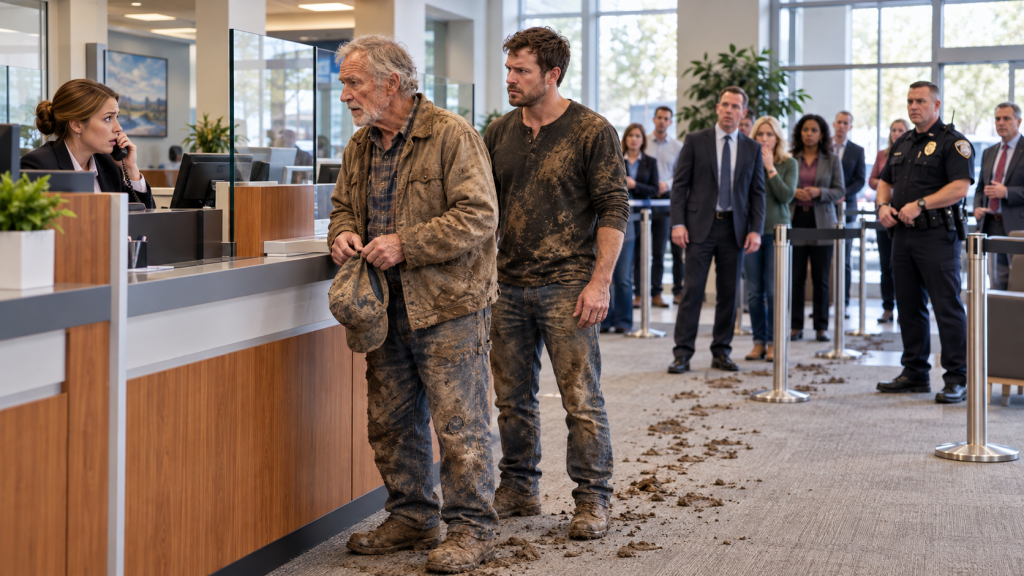
For the first time in my life, I noticed how old those hands looked. The fingers were swollen from arthritis. The knuckles carried white scars from sixty years of farming. One fingernail was permanently crooked from a machinery accident that happened before I was born. Those hands had planted thousands of acres. Repaired machinery in freezing weather.
Carried my grandmother, Mabel, across the threshold of their first home.
And now they were trembling over a document suggesting someone had tried to steal nearly half a million dollars from a fund created to help desperate families.
Tom Callahan followed Grandpa’s gaze.
“Daniel?” he asked quietly.
Grandpa nodded.
Tom’s face changed.
He moved toward the front windows and reached for his phone.
“Rick, please note the vehicle’s description and plate number. Don’t confront the driver. I’m calling the sheriff.”
The security guard immediately moved toward the entrance.
I turned to Grandpa.
“Maybe Dad came because he knew something was wrong.”
Grandpa looked at me.
His blue eyes were full of something that frightened me more than anger.
Disappointment.
“Maybe, Grace,” he said.
My name sounded strangely small in his voice.
“Let’s hear what he has to say.”
But before anyone could go outside, Dad started the truck.
I hurried toward the window.
He looked straight at me.
Our eyes met.
Then he drove away.
I felt the floor tilt beneath my feet.
Tom placed a hand on Grandpa’s shoulder.
“Earl, come into my office.”
Grandpa shook his head.
“First, I need my two thousand dollars.”
I stared at him.
“Grandpa!”
He looked at me.
“That combine belt isn’t going to replace itself.”
Under any other circumstances, I would have laughed.
Instead, I nearly cried.
Even with his world collapsing around him, Grandpa was still thinking about the harvest.
Tom’s face softened.
“We’ll take care of your withdrawal once the account restrictions are checked. In the meantime, you and Grace come sit down.”
Grandpa looked toward the teller.
She was still standing behind window three, her cheeks red.
For a moment, I thought he might say something sharp.
He didn’t.
He simply put his cap back on.
“Thank you, miss,” he said.
Then he followed Tom down the hallway.
That was my grandfather.
He could forgive somebody for embarrassing him.
But I was beginning to understand that he might not be able to forgive someone for betraying the people who trusted him.
Tom’s corner office overlooked the town square.
There were photographs of local farms on the walls and a framed newspaper clipping from thirty-seven years earlier.
The headline read:
LOCAL FARMERS SAVE COMMUNITY BANK FROM CLOSURE.
Beneath it was a photograph of a younger Earl Doyle, standing beside a much younger Tom Callahan.
Grandpa had one arm around Tom’s shoulders.
Both men were smiling.
I remembered seeing the picture when I was little, but I had never understood its importance.
Tom noticed me looking.
“Your grandfather was one of the people who kept this bank alive during the farm crisis,” he said.
Grandpa waved a hand.
“Wasn’t just me.”
“No,” Tom agreed. “But you were the first man to put his own money on the table.”
I turned toward Grandpa.
“You never told me that.”
He shrugged.
“Wasn’t much to tell.”
Tom gave a quiet laugh.
“Earl, you and Mabel persuaded twenty-three families to keep their deposits here when the bank was losing confidence. You helped organize emergency loans. You even postponed buying a new tractor to provide liquidity to the cooperative.”
Grandpa looked down.
“We all needed a bank. Didn’t seem right to let it disappear.”
I studied the photograph.
My grandfather had spent his entire life doing things that other people might have used to make themselves famous.
He’d done them quietly.
Without demanding recognition.
Without expecting gratitude.
And that morning, a young employee had looked at his muddy boots and assumed he was someone who didn’t belong.
Tom noticed my expression.
“Grace, I’ll address what happened in the lobby. It was unacceptable.”
I nodded.
Then Grandpa spoke.
“She can ask for identification. She can follow the rules. That’s her job.”
Tom agreed.
“But she shouldn’t have spoken to you that way.”
Grandpa rubbed his hands together.
“Then teach her better. Don’t make a show of it just because she found out my name.”
That was another thing about him.
He didn’t want special treatment because he had money.
He wanted ordinary decency because everyone deserved it.
Tom opened the folder containing the attempted wire transfer.
“Now, Earl, we have a different problem.”
He turned the document toward us.
The requested transfer was for $480,000.
The destination was a business account registered to an agricultural investment company called Cedar Ridge Holdings.
I’d never heard of it.
But Grandpa recognized the name.
His face went pale.
“Daniel’s been talking about Cedar Ridge for months.”
I leaned forward.
“What is it?”
Tom glanced at Grandpa.
“A company that purchases distressed farmland.”
I felt sick.
“Why would Dad send the relief fund’s money to a company like that?”
Grandpa didn’t answer.
Tom continued.
“Our fraud monitoring team flagged the request because of its size, destination, and unusual authorization pattern. No money has been released.”
I exhaled so hard my chest hurt.
“Then the money’s still there?”
“Yes. The funds are secure while we investigate.”
Grandpa closed his eyes.
For a moment, his shoulders sagged.
Then he whispered, “Thank God.”
I reached for his hand.
But Tom wasn’t finished.
“The request was accompanied by a signed authorization bearing your name and another signature from the fund’s financial administrator.”
Grandpa slowly opened his eyes.
“Daniel.”
Tom nodded.
“Yes.”
I stared at the document.
Dad had managed much of the fund’s paperwork since Grandma died.
He was supposed to help Grandpa keep the records organized.
He wasn’t supposed to treat the money as his own.
“Did he have authority to move it?” I asked.
“Not by himself,” Tom answered. “The fund’s documents require additional approval for a transfer of this size. That’s part of what stopped the transaction.”
Grandpa studied the signature.
Then he said quietly, “That isn’t how I sign my name.”
Tom looked up.
“What do you mean?”
Grandpa pointed toward the bottom of the page.
“That last letter. Whoever wrote it copied the way I used to sign before my hand got stiff.”
I leaned closer.
He was right.
The signature resembled the one on old checks Grandma had saved in her kitchen drawer.
Not the shakier version Grandpa had used for the past few years.
A chill moved through me.
Someone hadn’t merely written his name.
They had copied him from the past.
And whoever had done it knew exactly where to find the old records.
The sheriff arrived twenty minutes later.
Her name was Rebecca Hayes.
She was in her forties, with dark hair pulled into a neat bun and the serious expression of someone who had spent years listening to stories that sounded impossible until the evidence made them real.
She knew Grandpa.
Everyone in our county knew Grandpa.
But she didn’t greet him like a celebrity.
She sat across from him, opened her notebook, and asked what had happened.
He answered every question.
Calmly.
Precisely.
When she asked whether he suspected anyone, his jaw tightened.
“My son had access to the paperwork.”
I watched him.
It cost him something to say those words.
Rebecca nodded.
“We’ll need to speak with him.”
Grandpa looked toward the window.
“I’d like to talk to him first.”
She paused.
“Earl, I understand, but we need to preserve the evidence and avoid giving anyone an opportunity to destroy records.”
He lowered his eyes.
For a moment, I thought he would argue.
Then he nodded.
“All right.”
Rebecca continued.
“Has anyone else had access to the fund’s records?”
Grandpa thought carefully.
“The accountant. Our attorney. Daniel. Maybe some volunteers handling applications.”
I swallowed.
“What about Grandma’s old notebooks?”
He looked at me.
“What notebooks?”
“The blue ones in the office. Dad was going through them last week.”
Grandpa went very still.
“Mabel’s ledgers?”
I nodded.
He closed his eyes.
Then whispered, “Lord help us.”
And suddenly I knew there was much more hidden inside those old blue books than a list of donations.
The blue ledgers had lived in Grandpa’s farm office for as long as I could remember.
Grandma Mabel used to sit beside the window every Sunday afternoon, wearing her reading glasses on the end of her nose, writing in them with a fountain pen that leaked blue ink onto her fingers.
When I was little, I thought they contained ordinary household expenses.
Feed.
Fuel.
Seed.
Repairs.
Sometimes she’d let me sit beside her and draw little flowers in the margins of a separate notebook.
But I remembered one afternoon when I asked why she always locked the blue books away.
She’d smiled.
“Because some people would rather go hungry than let the neighbors know they’re struggling.”
I hadn’t understood.
Now I did.
Grandpa leaned toward Sheriff Hayes.
“Those books contain the names of families who received help. Mabel kept everything confidential.”
Rebecca nodded.
“Did Daniel have access?”
“After she died, he helped with the bookkeeping.”
Grandpa looked at me.
“Grace, do you remember him taking any of the ledgers away?”
I thought back.
A week earlier, Dad had spent an entire evening in Grandpa’s office while we repaired the irrigation pump.
When I asked what he was doing, he’d said he was catching up on paperwork.
He’d left with a cardboard box.
I remembered it clearly because he’d asked me to carry it to his truck.
My stomach tightened.
“Yes,” I whispered. “I helped him.”
Grandpa squeezed my hand.
“You didn’t know.”
But guilt had already begun spreading through me.
Those records weren’t only financial documents.
They contained the most vulnerable moments of people’s lives.
A widow who couldn’t afford seed after losing her husband.
A father whose medical bills nearly cost his family their land.
A young couple trying to keep a dairy operation alive after a barn fire.
People Grandma had helped without ever asking them to tell their neighbors.
And Dad had carried their names away.
Rebecca stood.
“We’ll speak with Daniel and determine what records he has.”
Then Tom’s office phone rang.
He answered, listened, and slowly straightened.
“Rebecca,” he said, “our security team found something on the lobby footage.”
We followed him into a small conference room.
On the screen was the woman who had stood behind us in line.
The same woman who’d laughed when the teller suggested Grandpa use the ATM.
She wore a camel-colored coat and carried a red leather handbag.
At first, she appeared to be just another customer.
Then Tom paused the recording.
“Look at her phone.”
The woman’s hand was partly concealed behind her handbag.
But the camera angle showed her photographing the document on the teller’s counter.
My grandfather’s identification was visible beside the withdrawal slip.
Rebecca leaned closer.
“Can you identify her?”
Tom nodded grimly.
“Her name is Celia Brock. She represents Cedar Ridge Holdings.”
My mouth fell open.
“The company receiving the wire?”
“Yes.”
Grandpa sat back.
He looked utterly exhausted.
The woman hadn’t merely been laughing at him.
She had been standing behind him while the bank tried to handle a suspicious transaction involving her company.
And when Tom rushed from his office, she’d walked out.
Rebecca asked for the footage to be preserved.
Then she looked at Grandpa.
“Earl, there’s enough here to justify taking this very seriously.”
Grandpa nodded.
But his eyes remained on the frozen image.
Finally, he whispered, “Mabel always said the people who smile while someone else is being embarrassed are the ones you ought to watch.”
We went back to the farm shortly after noon.
Tom had arranged for the ordinary withdrawal to be completed after the bank verified the source account and confirmed it wasn’t subject to the hold.
Grandpa accepted the envelope containing his two thousand dollars.
He counted the bills carefully.
Then thanked the employee who assisted him.
I drove us home.
Neither of us said much.
The fields stretched yellow beneath the autumn sun.
Cornstalks rustled in the wind.
A line of blackbirds lifted from the fence as we turned onto the gravel road.
This was the land Grandpa knew better than his own reflection.
He could tell whether rain was coming by the smell of the air.
He remembered where every fence post had been replaced.
He knew which fields flooded in spring and which patches of soil needed extra care.
But he had never learned how to protect himself from someone he loved.
When we reached the farmhouse, Dad’s truck was already parked outside the barn.
I stopped the car.
Grandpa stared through the windshield.
Dad stood beside the open workshop door.
He looked as if he hadn’t slept.
His face was pale.
His hands were shaking.
For a moment, none of us moved.
Then Grandpa opened his door.
I followed him.
Dad took a step forward.
“Dad.”
Grandpa stopped several feet away.
“Daniel.”
Dad swallowed.
“Can we talk?”
Grandpa studied him.
“That’s what I’ve been waiting for.”
We moved into the workshop.
I stayed near the door.
The smell of grease and old hay surrounded us.
Above the workbench hung a photograph of Grandma Mabel, smiling while holding a basket of peaches.
Dad glanced at it.
Then looked away.
Grandpa spoke first.
“Did you submit that wire request?”
Dad closed his eyes.
“Yes.”
The word seemed to empty the room of air.
I gripped the doorframe.
Grandpa nodded slowly.
“Did you sign my name?”
Dad’s voice broke.
“Yes.”
I heard myself whisper, “Dad.”
He looked at me.
“Grace, please.”
Grandpa raised a hand.
“Don’t ask her to excuse you.”
Dad lowered his head.
For a moment, all I could hear was the wind outside.
Then Grandpa asked, “Why?”
Dad rubbed his face.
“The north acreage is in trouble.”
I frowned.
“What?”
Dad looked at me.
“The land I bought six years ago. The bank note is coming due. The last two harvests weren’t enough. I borrowed to replace equipment, then the interest went up.”
Grandpa’s expression changed.
“Why didn’t you tell me?”
Dad gave a bitter laugh.
“Because every time I ask for help, I feel like I’m twelve years old again.”
Grandpa looked wounded.
“You’re my son.”
“Exactly.”
Dad’s eyes filled.
“You’re Earl Doyle. Everybody in this county thinks you can fix anything. I spent my whole life trying to prove I could do something without you.”
I stared at him.
“So you tried to steal from the fund?”
He flinched.
“I was going to replace it.”
Grandpa’s face hardened.
“With what?”
Dad went silent.
Grandpa took one step closer.
“Daniel. With what money?”
Tears rolled down my father’s cheeks.
“Cedar Ridge offered me a deal.”
My stomach tightened.
“What kind of deal?”
Dad looked toward the window.
“They’d refinance my debt if I helped them acquire distressed properties through their recovery program.”
Grandpa’s jaw tightened.
“And the four hundred and eighty thousand?”
Dad swallowed.
“They said it would be held temporarily as capital for the transactions. They promised it would be repaid from the first sales.”
Grandpa stared at him.
“You intended to gamble Mabel’s relief money on land purchases?”
Dad shook his head desperately.
“I thought I could protect my farm and make the fund whole.”
Grandpa’s voice dropped to a whisper.
“That money was meant to keep farmers from losing their land.”
Dad began sobbing.
“I know.”
Grandpa pointed toward the photograph above the workbench.
“Your mother spent forty years building that fund, Daniel.”
His voice broke.
“She sold pies at the church fair. She worked extra hours at the grain office. She put aside money we could barely spare.”
He swallowed.
“And you tried to use it to help a company buy farms from people who couldn’t afford to keep them.”
Dad lowered his head.
For the first time in my life, I saw Grandpa turn away from his own son because he couldn’t bear to look at him.
Dad sat down on an overturned bucket.
For several minutes, he cried without speaking.
I had never seen him like that.
Growing up, my father was the man who could lift a broken engine with a chain hoist, repair a fence during a thunderstorm, and carry a hundred-pound feed sack as though it weighed nothing.
He hated admitting when something was difficult.
He hated asking for directions.
And most of all, he hated feeling that Grandpa had achieved more than he ever could.
Now he sat in the workshop surrounded by tools that three generations of Doyles had used, admitting he had risked the legacy his parents had built.
Grandpa lowered himself onto a wooden stool.
“Daniel,” he said quietly, “did you give Cedar Ridge the names from your mother’s ledgers?”
Dad looked up.
His expression told us the answer before he spoke.
“Yes.”
I closed my eyes.
Grandpa’s voice trembled.
“All of them?”
“Copies of the recent applications and the old assistance records.”
Grandpa pressed a hand against his chest.
I moved toward him immediately.
“Grandpa?”
He shook his head.
“I’m all right.”
But he wasn’t.
I knew that.
He stared at Dad.
“Those people trusted us.”
Dad wiped his face.
“Celia said they needed the records to identify struggling farms that qualified for a recovery package.”
Grandpa looked devastated.
“Recovery?”
His voice grew stronger.
“You mean buying their land for less than it’s worth because they don’t have enough money to wait for a better offer?”
Dad didn’t answer.
Grandpa shook his head.
“Your mother would have been heartbroken.”
That hurt Dad more than anything else.
He bent forward and covered his face.
Then I remembered something from the previous week.
A farmer named Mrs. Kessler had stopped by our house after receiving an unexpected offer for her land.
She’d said a development company somehow knew she was behind on repairs to her dairy barn.
She’d been frightened because those details weren’t public.
I’d thought it was an aggressive sales tactic.
Now I understood.
“Dad,” I whispered, “they’re already contacting people.”
He looked up.
“What?”
“Mrs. Kessler. She got a letter mentioning her financial problems.”
Dad went pale.
Grandpa’s expression hardened.
He reached for the telephone hanging beside the workshop door.
“I’m calling Rebecca.”
Dad stared.
“Dad, please.”
Grandpa looked at him.
For a moment, his eyes filled.
Then he said, “When you were little, I told you that being a Doyle meant keeping your word.”
Dad nodded.
“I remember.”
“You broke yours.”
His voice cracked.
“And now we have to make sure no other family suffers because of it.”
He called the sheriff.
Dad stayed.
He didn’t try to run.
When Rebecca arrived, he agreed to provide the records in his possession and arrange legal representation.
He explained the proposed transfer, his dealings with Celia Brock, and the copies he’d given her.
I watched him leave with the sheriff to give a formal statement.
He looked back at Grandpa.
“Dad, I’m sorry.”
Grandpa nodded.
“I know you are.”
Dad began crying again.
“But sorry doesn’t put the money back or take those letters out of people’s mailboxes.”
My father lowered his head.
Then he walked away.
Over the following weeks, the investigation uncovered more than we’d expected.
The $480,000 wire had never gone through.
That was the first piece of good news.
The second was that Cedar Ridge hadn’t acquired legal control of the fund simply by receiving copied records or a forged authorization.
But there were other problems.
Smaller transfers had been made from an administrative account over the previous year.
Those payments, totaling more than forty thousand dollars, were being reviewed because supporting invoices couldn’t be verified.
Dad admitted approving some of them improperly.
Celia Brock’s company had also received confidential information about families who had applied for financial assistance.
The fund’s trustees notified affected applicants and worked with their attorney to protect the records and determine what remedies were available.
It was a humiliating experience for Grandpa.
Not because anyone knew how much money he’d helped manage.
Because people who had trusted him with their fears were now learning that their information had been passed to a company that wanted to profit from their desperation.
He took every call personally.
I sat beside him one afternoon when Mrs. Kessler phoned.
She was seventy-three and had lived on her dairy farm since she married.
Her voice trembled.
“Earl, I thought you promised nobody would ever know.”
Grandpa closed his eyes.
“I did, Ruth.”
“That company sent me three letters. They knew about my barn repairs.”
His hand tightened around the receiver.
“I’m so sorry.”
She began crying.
“I was ashamed enough asking for help in the first place.”
Grandpa wiped his eyes.
“Ruth, asking for help isn’t something to be ashamed of.”
There was silence.
Then she whispered, “I trusted Mabel.”
Grandpa’s voice broke.
“So did I.”
He looked down.
“And I failed to protect what she left.”
I wanted to tell him he wasn’t responsible.
That Dad had betrayed him.
That nobody could have predicted what happened.
But it would have been too simple.
Grandpa had trusted his son with access that should have been more carefully limited.
And although he hadn’t caused the wrongdoing, he was willing to acknowledge that the fund needed better safeguards.
For the first time, I understood that responsibility wasn’t always the same as blame.
Sometimes it meant recognizing what had gone wrong and helping repair it.
The bank conducted its own review.
Tom called Grandpa personally.
“The fraud controls did what they were supposed to do,” he said. “But we’re changing some internal procedures to make sure alerts are communicated more clearly.”
Grandpa nodded.
“And the young teller?”
Tom sighed.
“Her name is Marissa Lane. We’ve addressed her conduct and required additional training. She asked whether she could apologize to you.”
I looked at Grandpa.
He thought for a moment.
“Does she want to apologize because she knows who I am?”
Tom was quiet.
Then he answered, “That’s something she needs to explain.”
A few days later, Marissa visited the farm.
She arrived in a clean sweater and jeans, carrying a small paper bag from the bakery.
When Grandpa opened the door, she looked nervous.
“Mr. Doyle?”
He smiled.
“Morning, Miss Lane.”
Her eyes filled.
“I’m sorry about the way I treated you.”
Grandpa invited her inside.
We sat around the kitchen table.
She twisted her hands.
“I saw your clothes, and I made assumptions. Then when the computer showed restrictions on the account, I treated you like you were doing something wrong.”
Grandpa nodded.
“Sometimes accounts need checking.”
“I know.”
She wiped her eyes.
“But I didn’t have to embarrass you.”
“No,” he agreed. “You didn’t.”
Marissa lowered her head.
“I was wrong.”
Grandpa was quiet for a moment.
Then he asked, “Would you have been just as wrong if I hadn’t known Tom Callahan?”
She looked up.
Her eyes filled again.
“Yes.”
Grandpa nodded.
“Good. That’s what I wanted you to understand.”
She pushed the bakery bag toward him.
“I brought cinnamon rolls.”
He grinned.
“Well, now you’re speaking my language.”
I laughed.
For the first time in weeks, the kitchen felt warm again.
But then Marissa noticed a photograph beside the window.
It showed Grandma Mabel standing beside a young couple and their baby in front of a small farmhouse.
Marissa went still.
“Where did you get that photograph?”
Grandpa looked toward it.
“That’s your mother and father, isn’t it?”
Marissa stared at him.
“What?”
He smiled sadly.
“Your parents almost lost their farm when you were a baby. Mabel helped them arrange an emergency loan.”
Marissa’s hand flew to her mouth.
“My mother told me about a woman named Mabel who helped our family.”
Grandpa nodded.
“She was a good woman.”
Tears streamed down Marissa’s face.
“That was your wife?”
“Yes.”
She looked at him.
Then at the muddy boots beside the back door.
The same kind of boots she’d treated as evidence that he didn’t belong in her bank.
Her voice broke.
“I didn’t know.”
Grandpa reached across the table.
“Miss Lane, you shouldn’t have needed to know.”
And I knew she would never forget those words.
By November, the harvest was running late.
We’d lost several days to rain, and the ground was getting colder.
Grandpa’s combine still needed attention, but the new belt had finally arrived.
I found him one morning sitting on the workshop steps, examining the part as though it contained a complicated answer to a much bigger question.
“Grandpa?”
He looked up.
“Morning, Grace.”
I sat beside him.
“Want me to help?”
He smiled faintly.
“Thought you’d never ask.”
We worked for nearly two hours.
His hands weren’t as steady as they used to be.
Mine weren’t nearly as skilled.
But between us, we managed.
At one point, I dropped a wrench.
It landed in a bucket with a tremendous crash.
Grandpa laughed.
Not his polite chuckle.
His real laugh.
The one that started deep in his chest and made his shoulders shake.
I stared at him.
He noticed.
“What?”
I smiled.
“I haven’t heard you laugh like that in a while.”
His expression softened.
“Been a hard season.”
I nodded.
Then he looked toward the fields.
“But hard seasons don’t last forever.”
We sat quietly.
Finally, I asked the question I’d been carrying for weeks.
“Do you think you’ll ever forgive Dad?”
Grandpa looked down.
He rubbed his thumb over a scar on his hand.
“I already love him, Grace. That part isn’t up for discussion.”
I waited.
“But trusting him with other people’s livelihoods again? That’s different.”
He took a breath.
“Your father needs to make things right because they’re right, not because he wants me to stop being disappointed.”
I thought about Dad.
He had resigned from his role administering the relief fund.
He was cooperating with investigators, and his attorney was working through the legal consequences of the unauthorized transactions.
Cedar Ridge had withdrawn its refinancing offer after the attempted wire came under scrutiny.
Dad was now negotiating the sale of part of the acreage he’d purchased years earlier to address his legitimate debts and any restitution obligations established through the investigation.
It would cost him.
Perhaps everything he’d spent years trying to prove he could build on his own.
And he had no guarantee that Grandpa would ever trust him the way he once had.
I looked at the old man beside me.
“Doesn’t that make you sad?”
Grandpa smiled sadly.
“More than I can tell you.”
He looked toward the workshop wall.
A faded photograph of Grandma still hung above the workbench.
Then he whispered, “Mabel and I used to argue about Daniel.”
I turned.
“Really?”
He nodded.
“She thought I expected too much from him.”
I stared.
Grandpa continued.
“I wanted him to be careful. Reliable. Proud of honest work.”
He swallowed.
“Sometimes I forgot to tell him I was already proud of him.”
A tear slid down his cheek.
“Maybe he spent his whole life trying to become someone he thought I’d admire.”
I reached for his hand.
“But that doesn’t mean what he did was your fault.”
Grandpa squeezed my fingers.
“No. It doesn’t.”
He looked at me.
“And that’s another thing I had to learn.”
He stood slowly.
“Come on, Grace. We’ve got corn waiting.”
The relief fund survived.
Its board appointed independent administrators, strengthened its approval procedures, and separated confidential applicant records from ordinary administrative work.
The questionable transactions were examined through the appropriate legal channels.
Celia Brock and Cedar Ridge Holdings faced investigations concerning their dealings with Dad, the proposed wire, and the use of private financial information.
There was no magical courtroom moment when every problem disappeared.
Some records took months to examine.
Some losses remained disputed.
And some families who had received unwanted approaches from Cedar Ridge were understandably hesitant to trust the fund again.
Grandpa didn’t blame them.
He visited people who wanted to speak with him.
He answered their questions.
And when someone told him the fund had let them down, he listened without making excuses.
Gradually, applications began arriving again.
A young farmer needed help replacing a damaged irrigation system.
A couple raising three children needed time to recover after a barn fire.
An elderly widow needed assistance with overdue property taxes.
Each request was reviewed under the new procedures.
The fund helped where it responsibly could.
That was how Grandma had wanted it.
Not as a monument to the Doyle family.
As a quiet promise that nobody struggling to keep a farm should have to face disaster entirely alone.
Dad came to the farmhouse shortly before Christmas.
He didn’t drive his old pickup.
He arrived in a borrowed sedan and stood on the porch holding an envelope.
I opened the door.
For a moment, we simply looked at each other.
He seemed older.
There were new lines around his eyes.
“Hi, Grace.”
“Hi, Dad.”
He glanced past me.
“Is Grandpa here?”
I nodded.
“Kitchen.”
He hesitated.
“Would he want to see me?”
I thought about that.
Then I stepped aside.
“Ask him.”
Grandpa was sitting at the table with a cup of coffee.
When Dad entered, he looked up.
“Daniel.”
Dad swallowed.
“Dad.”
For a moment, neither moved.
Then Dad placed the envelope on the table.
“These are copies of the documents my attorney has submitted. I’ve provided the records I had, and I’m making arrangements to address the money I’m responsible for.”
Grandpa didn’t touch the envelope.
Dad continued.
“I know I can’t fix everything.”
His voice cracked.
“I know some people won’t ever trust me again.”
He looked at his father.
“But I want you to know I’m not hiding anymore.”
Grandpa nodded slowly.
“That’s a start.”
Dad began crying.
Then he whispered, “I thought if I lost that land, I’d be a failure.”
Grandpa looked at him.
“Son, every farmer loses something eventually.”
Dad lowered his head.
“A crop. A field. A good machine.”
Grandpa’s voice trembled.
“Sometimes the weather takes it. Sometimes we make a bad decision.”
He paused.
“But losing land doesn’t make you worthless.”
Dad covered his face.
Grandpa continued.
“Trying to save yourself by taking from people who trusted you—that’s what you have to answer for.”
Dad nodded through tears.
“I know.”
For a moment, silence settled over the kitchen.
Then Grandpa pushed the empty chair beside him away from the table.
“Sit down, Daniel.”
Dad stared.
“Are you sure?”
Grandpa’s eyes filled.
“I’m your father. I can hold you accountable without pretending you’re a stranger.”
Dad sat.
I watched Grandpa pour him a cup of coffee.
No dramatic embrace followed.
No promise that everything was forgiven.
Just two men sitting across from each other, finally beginning a conversation they’d avoided for years.
And somehow, that felt more meaningful than a perfect ending.
On Christmas Eve, I found Grandpa in the old farm office.
He was holding one of Grandma Mabel’s blue ledgers.
The investigation had required the records to be secured and reviewed, and the original books were now back in their locked cabinet under the fund’s revised procedures.
He had been looking at a page from its earliest years.
“Come here, Grace.”
I stood beside him.
He pointed toward a handwritten entry.
December 24 — Emergency furnace repair for the Millers. Paid anonymously.
Below it, Grandma had written:
Everyone deserves to be warm on Christmas.
I smiled.
“That sounds like Grandma.”
Grandpa nodded.
Then he turned to the final page.
There, in faded blue ink, was a note addressed to him.
Earl,
One day we’ll be gone, and somebody else will have to decide what happens to all this.
I hope they remember that money is only useful when it helps somebody live.
Don’t let our name become more important than the people we promised to help.
Grandpa’s hands began trembling.
He read the note twice.
Then he closed the ledger and pressed it against his chest.
For a long moment, he cried.
I wrapped my arms around him.
And there, surrounded by old farm records and the smell of Christmas cookies drifting from the kitchen, I understood that Grandma’s greatest legacy wasn’t the fund’s bank balance.
It was the way she had taught people to look at one another.
Not as rich or poor.
Not as important or insignificant.
But as human beings whose struggles deserved compassion.
The following spring, I returned to college.
Before leaving, I accompanied Grandpa to the bank.
The same glass doors.
The same gray carpet.
The same fancy coffee machine.
But this time, Marissa greeted us with a genuine smile.
“Good morning, Mr. Doyle. Grace.”
Grandpa removed his cap.
“Morning, Marissa.”
She looked at his boots.
They were muddy again.
He’d been checking a fence before breakfast.
“Busy morning?” she asked.
Grandpa grinned.
“Every morning’s busy when you’re eighty-four.”
She laughed.
Then she asked, “What can I help you with?”
Grandpa handed her a deposit slip.
It was a donation to the relief fund, accompanied by updated authorization documents.
Marissa checked the paperwork carefully.
She explained what she was doing.
She verified the transaction.
And she treated Grandpa with exactly the same respect she gave the customers in expensive suits standing behind us.
When she finished, Grandpa thanked her.
Then he looked toward Tom’s office.
“Tell that old rascal I’ll stop by next week.”
Marissa smiled.
“I will.”
As we turned to leave, she called after us.
“Mr. Doyle?”
Grandpa stopped.
“Yes, miss?”
She hesitated.
Then said, “My parents wanted me to tell you they still remember what your wife did for our family.”
Grandpa’s expression softened.
“Tell them Mabel would be glad they’re doing well.”
Marissa nodded.
“I will.”
We walked outside together.
The morning sunlight spilled across the parking lot.
Grandpa paused beside his old Ford.
I looked at him.
“Ready to go home?”
He smiled.
“Almost.”
Then he placed a hand on my shoulder.
“Grace, I want you to remember something.”
I waited.
“People will judge you by your clothes, your work, your bank account, and all sorts of things that don’t tell them much about who you are.”
He glanced toward the bank.
“Some will make mistakes. Some will learn. And some will keep making the same mistakes because they think they’re too important to change.”
He squeezed my shoulder.
“But don’t spend your life trying to look rich.”
I smiled.
“What should I do instead?”
He looked toward the fields beyond town.
“Try to be someone people can trust when they’re having their worst day.”
My throat tightened.
Then he opened the truck door.
“Now let’s get going. That tractor isn’t going to fix itself.”
I laughed and climbed in.
As we drove away, I looked back at the bank where this extraordinary chapter of our lives had begun.
My grandfather had walked through those doors wearing muddy overalls, asking for two thousand dollars to repair a machine.
A young teller had looked at him and assumed he was someone who didn’t belong.
But behind those muddy clothes stood a man who had spent sixty-one years trusting the same bank, decades helping neighbors save their farms, and a lifetime choosing kindness when nobody was watching.
The teller thought my grandfather’s muddy boots meant he had nothing worth respecting.
But the greatest thing he carried into that bank wasn’t money. It was a lifetime of promises he’d kept to people who had nowhere else to turn.
And when everything he believed in was tested by the betrayal of his own son, he taught me one final lesson.
Real wealth isn’t what you can withdraw from a bank. It’s what remains of your character when trusting someone has cost you dearly.
I looked at Grandpa driving beside me, his weathered hands resting on the steering wheel.
He began humming Grandma’s favorite hymn.
And I knew that long after the crops were harvested, the investigations finished, and the old farm changed hands, the things he and Mabel had given our community would continue growing.
Not in bank accounts.
But in the lives of people who had been helped—and who might someday help somebody else.
THE END STORIES! THANK YOU FOR READING GOOD LUCK !❤️
Related Posts