I stared at the name beneath the notary’s seal until the letters seemed to blur together. Margaret Ellis. Diane’s younger sister. The woman who had sat beside me in the hospital while my wife took her final breaths. The woman who had helped me choose the flowers for the funeral because I couldn’t bring myself to look at anything beautiful.
The woman who had promised, with tears running down her face, that she would always look after the people Diane loved. I had trusted Margaret for forty-two years. And now her name appeared on a document authorizing my son to borrow eighty thousand dollars against my house. A document I had never signed.
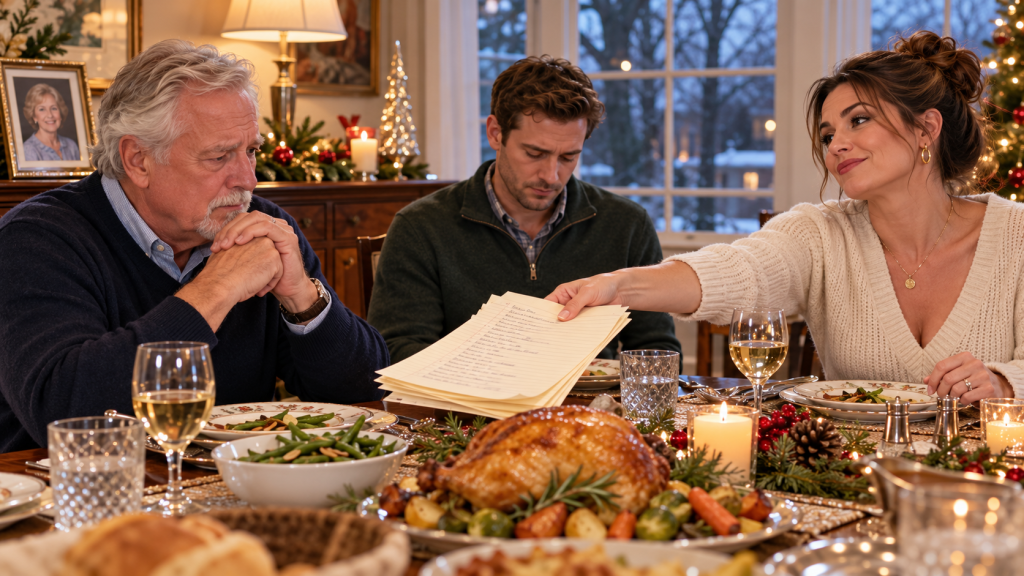
“Stanley,” I whispered, “are you absolutely certain?” My attorney was quiet for a moment. “The seal and commission information belong to Margaret. Whether she actually notarized this document, and under what circumstances, is something we need to establish.” I sat heavily in Diane’s old reading chair.
It was the only piece of furniture I hadn’t sent to storage yet.
The blue upholstery was faded where the afternoon sun used to fall across her shoulder.
For five years, I’d refused to let anyone sit there during Christmas.
Now Vanessa had casually assigned the entire room to her parents, as though the years Diane and I had spent together were nothing more than an inconvenience.
“Does Margaret know about the loan?” I asked.
“We haven’t spoken to her yet.”
“And did the bank give Colin the money?”
“Some funds appear to have been released. We’re requesting the complete disbursement records.”
I closed my eyes.
Some funds.
It was a phrase that could mean anything from a few thousand dollars to our entire family home being placed in jeopardy.
“Will this stop the sale?”
“It may delay closing while the title company resolves the issue. The buyer has been informed, and we’re working to preserve your options.”
I looked around the bedroom.
At the empty walls where Diane’s paintings once hung.
At the boxes stacked beneath the window.
At the life I had spent forty years building.
For the first time, selling the house no longer felt like a choice I was making.
It felt like something I needed to fight for.
“Stanley,” I said, “I want every document. Every application. Every signature. Every bank record.”
“You’ll have them.”
“And if my son used a forged authorization?”
His voice softened.
“Then we’ll address it based on the evidence, regardless of who was involved.”
I swallowed.
“Good.”
When we ended the call, I sat in silence.
Then my phone vibrated again.
Vanessa.
I let it ring.
A message followed.
Your card got declined in front of everyone at the store. You humiliated me. Fix it before tomorrow.
I read it once.
Then I turned off notifications.
There were bigger things at stake than an expensive Christmas dinner.
And I was finally beginning to understand just how much bigger.
Margaret answered my call on the third ring.
“Hello, dear.”
Her voice was warm.
Familiar.
The voice I’d heard at birthdays, anniversaries, and hundreds of ordinary family dinners.
“Margaret, it’s me.”
“Oh! Are you getting ready for Christmas?”
I looked down at the notary certificate Stanley had sent.
“Not exactly.”
She laughed gently.
“Well, I heard Vanessa is planning quite the celebration.”
“Did she tell you she’s moving me into the basement?”
Silence.
Then Margaret sighed.
“Oh, you know how Vanessa gets when she has a project.”
I felt a chill.
“Do I?”
“Now, don’t sound like that. Diane wouldn’t want everyone fighting during the holidays.”
There it was.
My wife’s name.
Whenever somebody wanted me to surrender something, they reached for Diane.
Her generosity.
Her kindness.
Her insistence on keeping family close.
But Diane had also been a woman who refused to pay a contractor until every unfinished detail was corrected.
She knew the difference between being generous and being taken advantage of.
“Margaret, I need to ask you something.”
“Of course.”
“Did you notarize a power of attorney giving Colin control over my property?”
The silence lasted so long I thought the call had disconnected.
Then Margaret said, very quietly, “Who told you about that?”
My heart sank.
It wasn’t a denial.
“Stanley found it during a title search.”
I heard Margaret inhale sharply.
“Listen to me. Whatever they’ve told you, it wasn’t supposed to be used that way.”
I stood.
“What way?”
She began speaking quickly.
“Vanessa said it was only for emergency maintenance. She told me there was a contractor waiting and that you were recovering from surgery.”
I pressed my free hand against the wall.
“Margaret. Did I sign anything in front of you?”
She didn’t answer.
“Did you see me sign that paper?”
Her voice broke.
“No.”
The room seemed to move around me.
I closed my eyes.
For several seconds, I couldn’t speak.
Then I asked, “Why did you notarize it?”
She began crying.
“Colin said you had agreed. He said you were too exhausted to deal with the paperwork. I thought I was helping.”
I stared at Diane’s reading chair.
“You knew better.”
“I know.”
“You worked in a law office for twenty-five years, Margaret.”
She sobbed.
“I know.”
I swallowed hard.
“You knew that being my son didn’t give Colin the right to sign for me.”
“I know.”
I looked down at the document.
“And you did it anyway.”
Her voice became so small I could barely hear it.
“Yes.”
For a moment, I remembered Margaret standing beside Diane’s hospital bed.
Her hand resting over her sister’s.
The quiet promise she’d made.
I’ll help look after them, Di.
I had assumed she meant protecting us.
Apparently, she’d decided protecting Colin meant keeping me in the dark.
“I need you to tell Stanley everything,” I said.
“Will I get into trouble?”
The question hurt more than I expected.
Not because I wanted Margaret punished.
Because once again, someone was asking me to protect them from consequences they had created.
“I don’t know,” I answered.
She began crying harder.
“Please don’t hate me.”
I closed my eyes.
“Margaret, right now I don’t even know what to feel.”
Then I ended the call.
I went into my study and opened the wall safe.
Inside were the documents I’d been collecting for three years.
Bank statements.
Receipts.
Insurance renewals.
The prenuptial agreement Colin and Vanessa had once mocked me for keeping.
And the paperwork relating to the luxury SUV Colin had purchased while telling me he and Vanessa couldn’t afford to contribute toward groceries.
I spread everything across the desk.
For forty years, I’d earned my living as a structural engineer.
My job had been to find the loads hidden beneath finished walls.
To understand where pressure collected.
To determine whether a building could keep standing when the forces acting upon it changed.
I’d missed the same warning signs inside my own family.
Colin had moved in because he needed help.
Then he’d stopped looking for his own place.
Vanessa had offered to organize holidays.
Then she’d stopped asking whether the holidays were happening in her home.
I had paid the heating bill, the water, the property taxes, and the insurance.
Then they’d begun treating those payments as proof that I could afford anything they wanted.
What began as a favor had become a permanent expectation.
And somewhere along the way, my son had apparently decided that access to my finances meant access to my property.
My phone rang.
Colin.
I answered.
“Dad, what did you do to Vanessa’s card?”
I stared at the papers.
“I ended the authorized-user arrangement.”
He exhaled angrily.
“She’s at the grocery store with two full carts.”
“Then she’ll need to pay for what she wants to buy.”
“Dad, these are Christmas groceries.”
“Yes.”
“We’ve already invited everyone!”
“You did.”
A long silence followed.
Then he said, “You’ve been acting strange lately.”
I leaned back.
“Colin, did you sign a power of attorney in my name?”
He stopped breathing.
I could hear it.
That sharp, involuntary silence when somebody realizes the conversation has moved beyond the excuse they’d rehearsed.
“Dad—”
“Did you?”
“Vanessa handled the paperwork.”
My chest tightened.
“That wasn’t my question.”
He lowered his voice.
“We were going to tell you.”
“When?”
Silence.
“After the loan funded? After Christmas? After the house was sold out from under me?”
“Dad, nobody’s selling your house!”
I looked at the signed sales contract on my desk.
“Actually, I am.”
He laughed.
For one terrible second, he genuinely thought I was joking.
Then I said, “The property is under contract.”
The line went silent.
“Colin?”
His voice returned, barely audible.
“What do you mean, under contract?”
“I mean I have agreed to sell it.”
“To who?”
“That’s between me and the buyer.”
He began shouting.
“You can’t do that! We live here!”
I closed my eyes.
For three years, I’d given him a place to rebuild his life.
Now he was claiming the right to prevent me from changing mine.
“Colin, you and Vanessa were told this arrangement was temporary.”
“Three years ago!”
“Exactly.”
He had no answer.
Then his voice changed.
Not angry anymore.
Frightened.
“Dad, you don’t understand. You can’t sell the house right now.”
I straightened.
“Why?”
He hesitated.
Then whispered, “Because the loan payment is due in January.”
My fingers tightened around the phone.
“What loan payment?”
And my son began to cry.
Colin had never sounded like that before.
Not when he failed his driving test.
Not when he lost his first job.
Not even when Diane died and he stood beside me in the funeral home, gripping my shoulder as though he were the one holding me upright.
Now he was crying so hard I could barely understand him.
“Dad, the lender thinks we’re renovating the house.”
I closed my eyes.
“Why?”
“Because that’s what we told them.”
My stomach tightened.
“Who is we?”
“Vanessa and me.”
I pressed the phone against my ear.
“And where did the money go?”
He didn’t answer immediately.
I waited.
Then he said, “Vanessa started a business.”
I stared at the wall.
“A business?”
“Holiday planning. Private events. Luxury decorating. She thought if she could show people what she was capable of, she’d get enough contracts to make it successful.”
I remembered the professional photographer on the Christmas grocery list.
The imported cheeses.
The fresh seafood.
The extravagant bedroom assignments.
Suddenly, those details looked different.
“Colin, are you telling me this Christmas party is a business presentation?”
He swallowed.
“Partly.”
I couldn’t speak.
He continued.
“Her uncle Jack knows people who invest in hospitality companies. The family is coming because she wanted to show them what she could do with a beautiful property.”
I looked toward Diane’s empty dining room.
The place where my wife had hosted birthdays, anniversaries, and quiet Sunday dinners.
The place where our son had learned to read at the kitchen table.
Vanessa wasn’t simply inviting thirty relatives.
She was using my home as a showroom for a business I’d never agreed to support.
“Did you tell these people the house belonged to you?”
Colin began crying again.
“Dad, we thought you’d eventually leave it to us.”
The words settled heavily.
Eventually.
As though my death were simply a delayed real-estate transaction.
I took a breath.
“Colin, I’m still alive.”
“I know.”
“Then why are you making plans with my property as though I’m not?”
He didn’t answer.
I could hear Vanessa speaking somewhere behind him.
Then the line went quiet.
A moment later, her voice appeared.
“Your father needs to stop acting like this is the end of the world.”
I looked down at the mortgage papers.
“Vanessa, did you authorize a loan against my house?”
There was a pause.
“Colin said you were helping us get started.”
“No. He didn’t have my permission.”
She sighed.
“You weren’t using your equity for anything. It was just sitting there.”
For a moment, I couldn’t believe what I’d heard.
My house.
My lifetime of work.
My wife’s favorite place in the world.
And to Vanessa, it was unused equity.
A number.
An opportunity.
Something that existed for her convenience.
“Vanessa,” I said quietly, “equity isn’t spare change someone else gets to spend.”
She laughed.
“You make everything sound so dramatic.”
I looked toward the stack of financial records.
Then I answered.
“No. You turned a family favor into a financial arrangement without the property owner’s consent. That’s not drama. That’s a serious problem.”
She went silent.
I continued.
“From now on, Stanley handles all discussion of the loan.”
Then I ended the call.
I sat at my desk for a long time.
Finally, I reached for Diane’s photograph.
It showed her standing beside the Christmas tree in the year Colin turned twenty-one.
She was laughing because the lights had failed just as we’d finished decorating.
I remembered her saying, Well, at least nobody can accuse us of trying to impress anyone.
I began to cry.
Not because I wanted the old house back exactly as it had been.
But because I’d spent three years allowing people to behave as though the love inside it had belonged to them all along.
On Friday afternoon, Margaret arrived.
She had called Stanley first.
He’d advised her that, because her conduct was involved, she needed independent legal advice before making formal statements or attempting to alter any records.
She came anyway, carrying a small envelope.
I met her in my study.
For several minutes, she simply stared at Diane’s photograph on the desk.
Then she whispered, “I failed her.”
I sat down.
“What did you bring?”
Margaret placed the envelope between us.
Inside were copies of her notary journal entries.
She explained that Vanessa had arrived at her house three months earlier carrying a packet of papers.
I was recovering from surgery at the time.
Colin had been helping with errands, and I’d given him limited practical instructions for paying a few household bills while I recovered.
Nothing involving the sale or financing of property.
“Vanessa said you’d signed the authorization that morning,” Margaret explained. “She told me Colin was afraid the contractor wouldn’t begin emergency work without it.”
I frowned.
“Emergency work?”
“She said the heating system was failing.”
I stared at her.
Our heating system was four years old.
I’d selected it myself.
Margaret began crying.
“I asked where you were. She said you were resting and couldn’t travel.”
“And you notarized it without me present.”
She nodded.
“Yes.”
I felt anger rise.
“Margaret, I gave you a key to this house.”
Her face crumpled.
“You could have come here and asked me.”
“I know.”
“Instead, you trusted a story from Vanessa.”
Tears ran down her cheeks.
“Yes.”
I looked toward the envelope.
“What does your journal say?”
Margaret swallowed.
“It records the document, but I didn’t properly verify the signing. I wrote down what Vanessa told me.”
I closed my eyes.
The record didn’t magically become valid because Margaret had entered something in a journal.
And her willingness to explain it now didn’t erase what she’d done.
But it mattered that she was finally admitting the truth.
She slid another paper toward me.
A copy of an email she’d received from Vanessa.
Thanks again for helping us with Dad’s emergency house authorization. Colin says he’ll explain everything when his father feels better.
I stared at it.
Vanessa had known exactly how to phrase the request.
The injured father.
The worried son.
The emergency repairs.
She’d built a story around the one weakness nearly everyone in my family shared.
They knew I’d help if someone said they needed me.
They simply didn’t want to give me the choice.
Margaret reached for my hand.
I moved mine away.
Her expression broke.
“I don’t expect you to forgive me today.”
I looked at her.
“I don’t know when I will.”
She nodded.
“I understand.”
I thought of Diane.
How often she’d told me Margaret was too eager to keep everyone happy.
How many times she’d said her sister apologized for things she hadn’t done and avoided confronting things she had.
Then I said quietly, “You need to tell the truth through the proper channels. Whatever consequences follow are yours to face.”
Margaret wiped her eyes.
“I will.”
She stood.
At the doorway, she stopped.
“Your wife loved that house.”
I nodded.
“I know.”
Margaret looked back at me.
“But she loved you more.”
Then she left.
I sat for a long time thinking about those words.
By Saturday, Stanley had confirmed that fifty-eight thousand dollars had been disbursed under the disputed loan arrangement, with the remaining funds not released.
The money trail was complicated.
Some funds had been paid toward business expenses.
Some had moved into an account Vanessa controlled.
Other payments appeared connected to personal debts Colin and Vanessa had accumulated.
The house had never undergone the extensive renovations described in the loan documents.
In fact, the only recent improvements were ones I’d paid for myself.
Stanley was arranging an independent review and communicating with the lender and title insurer.
The sale would not close on the original date.
I expected to feel crushed.
Instead, I felt strangely relieved.
For weeks, I’d been moving through the house like a man trying to escape before anyone noticed.
Now the problem had a name.
Documents.
A claim.
A disputed authorization.
Things that could be investigated, challenged, and resolved.
It wasn’t easy.
But it was no longer invisible.
The developer agreed to extend the transaction while the title matter was addressed.
They still wanted the property.
And I still wanted to sell.
For the first time in my life, I wasn’t willing to abandon a decision simply because my son objected to it.
Then Stanley said something that changed my immediate plans.
“Have you considered whether you want to spend Christmas somewhere else regardless of the delay?”
I looked around the study.
My suitcase was packed.
My tickets and hotel reservations were confirmed.
I’d planned a quiet week on the Carolina coast, somewhere Diane and I used to visit before her health declined.
I’d nearly canceled everything when the loan issue appeared.
Now I realized there was no reason to.
“Yes,” I said.
“I am leaving.”
Stanley paused.
“And Colin and Vanessa?”
“They’ll have to handle the gathering they planned. We can address occupancy and the sale through the lawful process.”
I looked toward Diane’s empty reading chair.
“I’m not going to spend another Christmas working myself sick so other people can pretend they hosted it.”
Stanley chuckled softly.
“That sounds like a decision you’ve thought through.”
I smiled.
“For about three years.”
The first relatives arrived on December twentieth.
I was loading my final suitcase into the car when a silver minivan pulled into the driveway.
Vanessa’s parents stepped out.
Her mother, Patricia, wore a fur-trimmed coat.
Her father, Gerald, carried a large wrapped bottle of wine.
They smiled when they saw me.
“Wonderful!” Patricia said. “You’re here to welcome us!”
I closed the trunk.
“Hello, Patricia.”
She looked toward the house.
“Vanessa says we’ve got the master suite.”
I nodded.
“That’s what she told me too.”
Patricia laughed.
“She’s such a thoughtful girl.”
I felt no urge to argue.
Instead, I asked, “Did Vanessa explain that I own the house and haven’t agreed to host everyone?”
Her smile faltered.
“What?”
“I wasn’t consulted before the invitations went out. I’m leaving for a planned trip, and Colin and Vanessa are responsible for their own arrangements.”
Gerald looked surprised.
“Vanessa said you were delighted.”
I glanced toward the front door.
“Then I suggest you discuss that with her.”
Patricia frowned.
“But she said you’d cleared out the master bedroom for us.”
I felt Diane’s absence settle around me.
“Yes,” I said quietly. “I removed my wife’s belongings because I’m preparing to move.”
Gerald lowered the wine.
“Move?”
“I’m selling the house.”
Patricia stared at me.
Then laughed nervously.
“Surely you mean eventually.”
“No.”
At that moment, Vanessa appeared in the doorway.
Her face turned white when she heard the last word.
“Why are you telling them that?”
I looked at her.
“Because they’re about to spend Christmas in a house you told them was yours to arrange.”
Her lips tightened.
“We’ll discuss this privately.”
I shook my head.
“You made it public when you invited thirty people.”
For the first time, Patricia looked toward her daughter with something other than admiration.
“Vanessa, what exactly is going on?”
Vanessa opened her mouth.
Then closed it.
I picked up my car keys.
“I hope you all work it out.”
And I left.
Not in anger.
Not in triumph.
But with the strange, almost unbelievable feeling of a man who’d finally stepped out from beneath a weight he’d carried too long.
The first morning of my vacation, I woke to the sound of waves.
Not an alarm.
Not Vanessa calling through the hallway.
Not Colin asking where I’d put his car keys.
Waves.
I lay in a hotel bed overlooking the gray Atlantic and listened to the water roll against the shore.
For several minutes, I didn’t move.
I’d forgotten what it felt like to wake up without somebody already expecting something from me.
Then my phone vibrated.
A photograph appeared in the family group chat.
Vanessa’s parents stood in the kitchen surrounded by grocery bags.
Beneath it, Patricia had written:
Change of plans. Everyone is bringing a dish. Please confirm what you can contribute.
I stared at the screen.
Then I laughed.
A proper laugh.
The kind Diane used to tell me could be heard from the other end of the house.
Apparently, once Vanessa discovered she couldn’t buy five thousand dollars of groceries with my credit card, Christmas became a collaborative event.
Imagine that.
People sharing the work.
People sharing the cost.
People understanding that food didn’t appear on a table simply because someone announced a celebration.
I put the phone away and went downstairs for breakfast.
The hotel’s dining room overlooked the beach.
I ordered coffee, eggs, and toast.
Then I walked outside beneath a pale winter sky.
Diane and I had spent our twenty-fifth anniversary near that same stretch of coast.
She’d collected seashells.
I’d complained that the wind was ruining my hair.
She’d laughed and told me a man with so little hair left had nothing to worry about.
I smiled at the memory.
Then I sat on a bench facing the water.
For the first time since her death, I didn’t feel guilty for enjoying something without her.
I missed her terribly.
I always would.
But I was beginning to understand that continuing to live wasn’t a betrayal of the woman I’d loved.
It was one way of honoring the life we’d shared.
On Christmas Eve, Colin called.
I answered after a moment.
“Hello, son.”
“Dad.”
His voice sounded tired.
“How’s the ocean?”
I looked toward the water.
“Cold. Beautiful.”
He was quiet.
Then said, “Things are different here.”
I smiled faintly.
“I imagine.”
“Patricia found out about the loan.”
My expression changed.
“How?”
“Vanessa told her. She couldn’t keep pretending everything was fine.”
I waited.
Colin continued.
“Her parents are furious. Her uncle said he doesn’t want to discuss investing in anything until we sort out our finances.”
I took a breath.
“That sounds sensible.”
He gave a weak laugh.
“Yeah.”
Then he was quiet again.
“Dad, we had no idea how much everything cost.”
I looked toward the sea.
“What do you mean?”
“The groceries. The extra laundry. The hot water. We had to find hotel rooms for some people because the house couldn’t reasonably accommodate everyone.”
I closed my eyes.
The structural engineer in me felt grimly vindicated.
I’d been thinking about plumbing capacity and fire safety from the moment Vanessa announced thirty people were coming.
Apparently, reality had finally joined the conversation.
Colin continued.
“And the cooking. Mom used to make it look so easy.”
My throat tightened.
“Your mother spent weeks preparing Christmas.”
“I know that now.”
“No,” I said gently. “You knew she worked hard. You just never considered how much of that work you’d left to her.”
He didn’t argue.
Then he whispered, “I’m sorry, Dad.”
I looked down at my hands.
“Colin, I love you.”
He began crying.
“But love doesn’t give you permission to make decisions about my house or my finances.”
“I know.”
“And I won’t help you hide what happened with the loan.”
“I know.”
I heard him take a shaky breath.
“Vanessa and I are meeting with a lawyer after Christmas. We’re going to give Stanley everything.”
“Good.”
He hesitated.
“Do you still want me to come over when you get back?”
I thought about the boy who used to fall asleep on my shoulder while Diane read Christmas stories aloud.
The teenager who’d been devastated when his first girlfriend moved away.
The adult man who’d allowed his wife and himself to treat my home as their private safety net.
All three seemed to exist inside the same voice.
“We can talk,” I answered.
“But we’re going to do it honestly.”
He began crying again.
“Okay, Dad.”
Before ending the call, he said something that stayed with me.
“I thought you wanted us there.”
I looked at the waves.
“I wanted you to have somewhere safe while you got back on your feet.”
I paused.
“That isn’t the same as wanting to disappear inside my own home.”
Neither of us spoke for a long time.
Then Colin whispered, “I understand.”
I hoped, this time, that he did.
The legal process stretched well beyond Christmas.
There were document reviews, statements, questions about Margaret’s notarial conduct, and difficult conversations with the lender.
Margaret cooperated with the inquiry into the improper notarization and faced professional consequences. Her explanation of why she had acted did not excuse her failure to verify the signature.
Colin and Vanessa obtained separate legal advice and acknowledged their involvement in arranging the unauthorized financing.
Vanessa could no longer maintain that the money had been borrowed for emergency repairs.
The accounting showed what it had actually funded.
Business expenses.
Debt payments.
And plans built around a property that did not belong to them.
The lender ultimately agreed to release its claim against my house under a documented resolution, while pursuing repayment through arrangements involving Colin and Vanessa.
The title issue was cleared after the necessary formal steps.
Stanley reviewed everything.
The developer remained willing to purchase the property.
And in March, the sale finally closed.
I didn’t celebrate with champagne.
I stood in the empty living room and listened to my footsteps echo across the hardwood floor.
Colin and Vanessa had moved into a rented apartment several weeks earlier, after the required notices and arrangements were completed.
Their apartment was smaller.
Their furniture was ordinary.
And for the first time in three years, they were paying their own rent.
Vanessa’s business plans had been reduced to something more modest. She was taking occasional decorating work instead of pretending she’d already built a luxury hospitality company.
Colin had sold the SUV.
He didn’t tell me until after the sale.
When he did, he looked embarrassed.
“I probably should’ve done that a long time ago.”
I nodded.
“Probably.”
He waited for me to reassure him.
I didn’t.
Then, surprisingly, he smiled.
“You’re not going to tell me it was a good investment?”
I shook my head.
“No, son. It was an expensive car you couldn’t afford.”
He laughed.
And for one brief moment, we sounded like ourselves again.
On my final day in the house, I went upstairs to the master bedroom.
The room was empty except for Diane’s reading chair.
I’d deliberately left it there until the end.
I stood beside the bay window and looked out at the yard.
Diane had planted roses along the fence.
Every spring, she fussed over them.
Every summer, she complained that the deer were eating the buds.
And every autumn, she announced that next year she’d finally learn how to grow something easier.
She never did.
I placed my hand on the back of her chair.
“Well, Di,” I whispered, “we’re really doing it.”
My voice cracked.
For five years, I’d believed leaving the house meant abandoning her.
But as I stood there, I remembered something she’d said during her final winter.
She’d been tired.
The stairs had become difficult.
One afternoon, while I helped her settle into the chair, she’d looked around the enormous bedroom.
“We made some wonderful memories here,” she said.
I nodded.
“We did.”
Then she smiled.
“But promise me you won’t spend the rest of your life keeping a museum.”
I’d laughed at the time.
“Diane, don’t talk like that.”
She’d squeezed my hand.
“I’m serious.”
I remembered her eyes.
Bright, even then.
“Life is for living, sweetheart. Not just remembering.”
I’d promised her without understanding what the promise would demand.
Now I did.
I took one final look around.
Then I called the movers.
“Please be careful with that chair,” I said.
“It belonged to my wife.”
I bought a smaller home thirty minutes away.
One story.
Two bedrooms.
A kitchen with enough room for a proper table.
A little garden.
And a sunny sitting room where Diane’s chair fit perfectly beside the window.
I didn’t need four bedrooms anymore.
I didn’t need a basement.
And I certainly didn’t need a house large enough to accommodate thirty people who expected somebody else to feed them.
What I needed was a place where I could make coffee, read the newspaper, and hear myself think.
I kept Diane’s recipe cards in a wooden box beside the stove.
Her books stood on the living room shelves.
Our photographs filled one wall.
The porcelain figures she loved remained wrapped safely in a cabinet.
Nothing important had vanished because the old house was gone.
In fact, the memories seemed easier to enjoy without strangers deciding how the rooms should be used.
My first Christmas there was quiet.
But I wasn’t lonely.
I invited two old friends for dinner.
We cooked together.
Nobody expected prime rib.
Nobody demanded flowers in the bedroom.
And when the evening ended, everyone helped clean the kitchen.
As they left, one friend looked around and smiled.
“This place suits you.”
I glanced toward Diane’s chair.
“Yes,” I said.
“I think it does.”
My relationship with Colin changed slowly.
He began calling without asking for money.
Sometimes we talked about work.
Sometimes about baseball.
Sometimes about Diane.
He started visiting on Sunday afternoons, always asking first.
The first time he came to the new house, he stood in the doorway looking strangely uncertain.
“Can I come in?”
I smiled.
“Of course.”
He stepped inside.
Then noticed Diane’s reading chair beside the window.
His expression softened.
“You kept it.”
I nodded.
“Naturally.”
He walked toward it, then stopped.
“Can I sit there?”
The question surprised me.
For years, my son had assumed permission was unnecessary.
Now he was asking before sitting in a chair.
I nodded.
“Yes.”
He lowered himself into it.
For a long time, he stared out the window.
Then whispered, “I miss Mom.”
I sat beside him.
“So do I.”
He began crying.
“She would’ve been so disappointed in me.”
I considered that.
“She would have been disappointed by what you did,” I answered.
He lowered his head.
“But she would also have wanted you to become someone better.”
He wiped his eyes.
“I’m trying.”
I nodded.
“I can see that.”
Then I said something I’d been thinking about for months.
“Colin, I don’t need you to pay me back with affection.”
He looked up.
“I need you to handle the obligations you’ve taken on, tell the truth, and respect the boundaries we agree on.”
He nodded.
“I will.”
I looked at him.
“And if you want to spend Christmas together someday, you can invite me.”
His face changed.
A small, genuine smile appeared.
“I’d like that.”
I smiled back.
“So would I.”
I never learned whether Vanessa truly understood what she’d done.
She apologized once, during a meeting with Stanley and the other attorneys.
She admitted that she’d treated the house as a resource she expected Colin to inherit and hadn’t considered how her decisions affected me.
Her words were awkward.
At times, they sounded rehearsed.
But she no longer pretended I had agreed to her plans.
That mattered.
It wasn’t forgiveness.
It wasn’t a return to the way things had been.
But it was the beginning of living in the same family without surrendering control of my own life.
Margaret and I also began speaking again.
Not often.
Not easily.
She had taken responsibility for her notarial misconduct, and I wasn’t interested in comforting her out of the consequences.
But one afternoon, she sent me a photograph.
It showed Diane and me on our wedding day.
I was wearing a suit that was slightly too large.
Diane was laughing at something I’d said.
Behind the photograph, in Margaret’s handwriting, were the words:
She always said you made her feel safe.
I sat for a long time holding it.
Then I placed it beside Diane’s chair.
Because whatever else had happened, that part of our life remained true.
One evening in late December, I stood at my kitchen counter preparing roast chicken.
Rosemary.
Potatoes.
Carrots.
Diane’s old recipe, written on the back of a faded electric bill.
My new home smelled wonderful.
Outside, snow was falling softly across the garden.
Colin was coming for dinner.
Not with thirty guests.
Not with a grocery list for me to finance.
Just himself.
He’d called that morning and asked, “Dad, what can I bring?”
I’d smiled.
“How about dessert?”
He’d laughed.
“I can manage that.”
When the doorbell rang, I opened it to find him standing there with an apple pie.
He held it out.
“I bought this. Don’t get too excited.”
I laughed.
“Your mother would have been proud that you knew the bakery’s address.”
He grinned.
Then he stepped inside.
We ate at the little kitchen table.
We talked.
We listened.
And when the meal was finished, Colin stood and began washing the dishes without being asked.
I watched him for a moment.
Then went to help.
He glanced toward me.
“Dad?”
“Yes?”
“I’m glad you sold the house.”
I stopped.
He looked embarrassed.
“I know that’s strange to say.”
I waited.
He continued.
“If you hadn’t, I don’t think I would’ve understood how much I’d been taking for granted.”
I looked at my son.
Then toward the window, where the snow was settling on the branches.
“I wish we’d learned that lesson differently,” I said.
“So do I.”
We stood together in the quiet kitchen.
And for the first time in years, the silence between us felt comfortable.
That night, after Colin left, I sat in Diane’s chair with a cup of tea.
I thought about the Tuesday evening when Vanessa announced that thirty relatives would spend Christmas in my house.
The way she’d casually assigned away my bedroom.
The way Colin had looked down at his dinner rather than defend me.
And the moment I’d decided to stop arguing and begin changing what I could control.
I’d believed the biggest surprise would be telling them the house was being sold.
I hadn’t imagined discovering a forged authorization, a loan against my property, and Margaret’s part in allowing it to happen.
I hadn’t expected the legal delays.
The painful conversations.
Or the grief of watching my son confront the consequences of his own decisions.
But I had learned something that made the whole experience worthwhile.
A home is not truly yours if everyone else gets to decide how you live inside it.
For three years, I’d been paying the bills in a house where I felt like a guest.
I’d allowed my need to keep family close to become the reason I never felt at peace.
And I’d nearly confused protecting Diane’s memory with preserving every room exactly as she left it.
Now I understood.
Diane wasn’t in the master bedroom Vanessa wanted to give her parents.
She wasn’t trapped in the soaking tub or the rose garden or the hardwood floors.
She was in the recipe card beside my stove.
The photograph on my mantel.
The chair where I sat reading.
And the lessons she had spent forty years teaching me about love and respect.
My daughter-in-law thought she could invite thirty people to my house because I’d always been the one paying for everything.
My son thought the property would eventually belong to him, so he began treating it as though I had already given it away.
But they were wrong about one important thing.
I was still here.
Still capable of making decisions.
Still entitled to a peaceful life.
And still allowed to say no.
I looked around my new home.
There were no suitcases in the hallway.
No relatives assigning themselves bedrooms.
No shopping lists waiting for me to fund them.
Just the warm light of the kitchen, the quiet sound of falling snow, and the knowledge that tomorrow would belong to me.
I smiled toward Diane’s photograph.
“You were right, sweetheart.”
Then I turned off the lamp.
And for the first time since losing her, I walked down the hallway without feeling that I was leaving something precious behind.
I hadn’t abandoned our home. I had finally carried its most important parts with me—and left behind everything that had made me forget I deserved to live there, too.
THE END STORIES! THANK YOU FOR READING GOOD LUCK !❤️
Related Posts



