For several seconds, I forgot how to breathe. The signature at the bottom of that yellowed document belonged to my father. Isaiah Whitsett. I hadn’t seen his handwriting in more than forty years. But I would have recognized it anywhere. The capital I curved backward like the handle of an umbrella. The final two t’s in Whitsett were joined together,
just as they had been in the birthday cards he used to leave beneath my pillow. My father had been dead since I was nineteen. Yet here he was, speaking to me through a piece of paper in a courthouse. Beside his name stood my mother’s signature. Pearl Whitsett.
I pressed my fingers against the page. “Miss Rosella,” I whispered, “what is this?” Rosella pulled out the chair beside me. “Sit down, sweetheart.” I was already sitting, but I understood what she meant. Something important was coming. Something that might change everything I believed about my childhood.
She turned the document toward herself and adjusted her glasses.
“This agreement was signed in 1956. It concerns the twelve acres at the eastern edge of the Lockridge property.”
I looked at her.
“The little white house?”
“That house and the land surrounding it.”
My mouth went dry.
“But Mrs. Lockridge owned all that land.”
Rosella’s expression softened.
“No, Elnora. That’s what everybody thought.”
She pointed toward a paragraph halfway down the page.
“The agreement says your parents contributed the purchase money for those twelve acres. Edward Lockridge agreed to hold the legal title for their benefit until the property could be conveyed into their names.”
I stared.
“Edward Lockridge?”
“Henrietta’s husband.”
I remembered him.
Tall, broad-shouldered, with gray hair he combed straight back.
He’d died many years before his wife.
When I was a little girl, I’d been afraid of his booming voice and the heavy boots he wore through the house.
He was never particularly warm toward me.
But my father had worked for him.
And Mama had spent much of her life cleaning his home.
I looked down at the agreement.
“Why didn’t Papa put the land in his own name?”
Rosella folded her hands.
“That part is explained in Henrietta’s letter. But I think you should first understand what these records establish.”
She took a slow breath.
“Your parents were trying to buy a home. The seller refused to deal with them directly.”
My chest tightened.
Rosella continued quietly.
“Your parents were Black. The seller and the people arranging the transaction made the process far more difficult than it should have been.”
I lowered my eyes.
I’d grown up hearing stories about those years.
Stories about separate waiting rooms.
Jobs that paid less than they should.
Land that certain families could buy easily while others were turned away.
But I’d never imagined those injustices had shaped the very ground beneath my childhood home.
“Your father approached Edward Lockridge,” Rosella continued. “The agreement says Edward would take title temporarily, while your parents would have the beneficial interest and the right to occupy the property.”
I looked at the old document again.
“Temporarily?”
She nodded.
“The understanding was that the paperwork would eventually be corrected.”
I stared at the signatures.
“But it never was.”
“Not then.”
I swallowed.
“And Mama never told me?”
Rosella’s eyes filled.
“She may have had reasons. You’ll have to read what Henrietta left you.”
I turned toward the new deed.
My full name appeared beneath the description of the twelve acres.
ELNORA RUTHANNE WHITSETT.
Grantee.
Owner.
Words I’d never expected to be associated with anything beyond my twelve-year-old Buick and the furniture in my little rented apartment.
“Mrs. Lockridge signed this last spring?”
“Yes.”
“And it was recorded?”
Rosella nodded.
“The recorded instrument shows that the property was conveyed to you. We can provide certified copies. You’ll still need independent legal advice about the older agreement and any claims the sons might make.”
I sat in silence.
Then a question struck me.
“Why did she wait so long?”
Rosella looked toward the window.
Beyond the courthouse, traffic moved through the town square.
“That’s something Henrietta struggled with for a very long time.”
She handed me the small envelope.
“She wanted you to know the truth, even if it made you angry with her.”
I stared at it.
Angry?
I had loved Mrs. Lockridge.
I’d cleaned her house for twenty-six years.
Held her hand during thunderstorms.
Prepared soup when she was ill.
Listened to stories about her grandchildren.
Washed her dishes after her funeral.
How could I be angry with the woman who’d been the closest thing to family I had outside my own daughter?
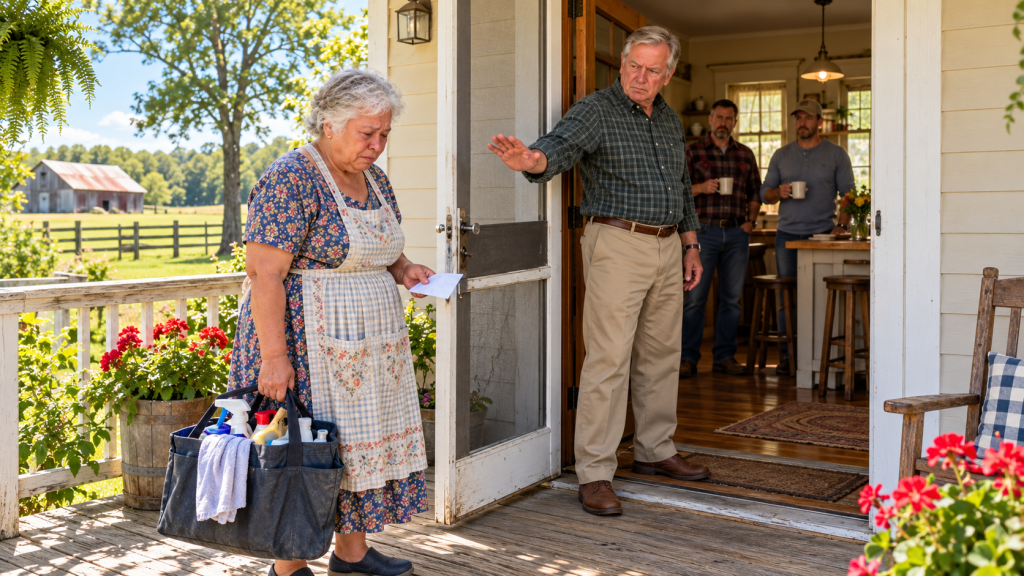
Then I remembered Carlton standing behind the screen door.
The three-hundred-dollar check.
The humiliation of being dismissed like an unwanted piece of furniture.
And I suddenly understood something that frightened me.
Perhaps there were things about that family I had never truly known.
The letter was written on cream-colored paper.
Mrs. Lockridge’s handwriting had grown unsteady with age, but the words were unmistakably hers.
My dear Elnora Ruthanne,
If you are reading this, I have finally done something I should have done many years ago.
My eyes filled.
I have loved you since you were a baby. I remember your mother carrying you through my kitchen while you reached for anything shiny. I remember your father putting up the little porch swing because you refused to sleep unless someone rocked you.
I covered my mouth.
The swing.
I could still remember the creaking chains.
The smell of warm pecan leaves.
Papa sitting beside me after supper, tapping his work boots against the floorboards.
I kept reading.
Your parents were never merely people who worked for my family.
They were the people who helped save it.
I looked up.
Rosella nodded gently.
“Keep going.”
In the winter of 1955, Edward’s farming business was in terrible trouble. A loan had come due, a crop had failed, and he was too proud to admit how close we were to losing everything.
I stared at the page.
Your father had spent years saving money from his work repairing farm equipment. Your mother had saved every spare dollar from sewing, laundry, and helping families during childbirth.
They wanted a home of their own.
When a twelve-acre parcel along our eastern boundary became available, your parents had enough money to purchase it. But the seller refused to negotiate directly with them.
I swallowed.
Edward offered to buy it in his name and hold it for them until a proper transfer could be arranged. Your father agreed only after insisting that the arrangement be put in writing.
I looked again at the agreement.
Papa had always been careful.
I remembered him checking every receipt twice, even when he bought a bag of flour.
What your father did not know was that Edward also hoped to keep the land under the Lockridge name because he believed it improved the value and borrowing prospects of our farm.
I stopped reading.
A terrible feeling moved through me.
Your parents supplied the money. They occupied the house. They planted the pecan trees. They paid for repairs. Yet Edward continued allowing the county records to show him as the owner.
My fingers began trembling.
I asked him many times to make it right.
He always found another reason to wait.
I pressed the paper against the table.
“Miss Rosella,” I whispered, “does this mean Mama and Papa paid for that land?”
Rosella nodded.
“That’s what the agreement and Henrietta’s account say.”
I looked down at the letter.
For years, I’d believed the Lockridge family had generously allowed my parents to live in the little white house.
I’d grown up feeling grateful for a roof I thought someone else had provided.
But my parents had paid for that roof’s ground.
They had earned it.
And someone had allowed them to spend their lives believing they needed permission to remain there.
I began crying.
Not quietly.
Not politely.
The kind of crying that comes from a lifetime of swallowing questions because you don’t expect anyone to answer them.
Rosella reached for my hand.
“Oh, Elnora.”
I shook my head.
“All those years, I thought we were lucky they let us stay.”
She squeezed my fingers.
“Your parents worked hard for what they had.”
I looked at the final page.
There was more.
After your father died, Pearl refused to fight with Edward. She was raising you, working long hours, and afraid that a dispute would leave her without employment or a home while the matter went through court.
I did not have the courage to stand against my husband as I should have.
After Edward died, I told myself I would correct the records. Then years passed. I made excuses. I was ashamed of how long I had allowed the wrong to continue.
Tears blurred the writing.
When your mother died, I should have told you everything.
Instead, I kept quiet.
You returned to work for me years later, and I accepted your kindness while still withholding the truth.
I pressed my hand against my chest.
Mrs. Lockridge had known.
Every Friday, while we shared biscuits.
Every Christmas when she gave me a little bonus.
Every time she told me how much she appreciated me.
She’d known the house where I took my first steps should never have been treated as a favor from her family.
And she’d said nothing.
At the bottom of the page, she’d written:
Elnora, I do not ask you to forgive my silence.
I have finally signed the deed that should have been completed long ago. I have taken the steps my attorney advised to document the transfer and protect your ownership.
The little white house is yours.
It always should have been.
And if you choose to remember me, please remember me truthfully. I loved you, and I also failed you.
I stared at those final words until they disappeared behind my tears.
Then Rosella whispered, “There’s one more thing.”
I looked up.
She glanced toward the courthouse entrance.
“Carlton’s downstairs.”
My stomach tightened.
“He knows?”
Rosella took a breath.
“I think he’s about to find out.”
The courthouse hallway smelled of floor polish and old paper.
I remember that clearly because I remember almost nothing else about the walk downstairs.
Rosella had suggested that I leave through a side entrance and arrange to speak with an attorney before discussing anything with the Lockridge brothers.
I should have listened.
But as we approached the stairwell, I heard Carlton’s voice rising from the lobby.
“I don’t understand why this is taking so long. My mother owned that property for decades.”
Another man replied, “Mr. Lockridge, the title search has identified a recorded conveyance. We can’t ignore it.”
I stopped.
Rosella touched my arm.
“Elnora, you don’t need to speak with them.”
Then Carlton saw me.
His face changed.
For the briefest moment, I saw surprise.
Then suspicion.
“What are you doing here?”
I held the envelope against my chest.
“Good morning, Carlton.”
He looked at Rosella.
“Why is she here?”
Rosella answered calmly.
“Mrs. Whitsett was invited to review documents concerning property recorded in her name.”
The developer standing beside Carlton turned toward me.
He was a middle-aged man wearing a gray suit and carrying a leather portfolio.
He introduced himself as Franklin Mercer, representing the prospective buyer.
Carlton stepped forward.
“Elnora, if Mother gave you something, I’m sure we can sort it out.”
I looked at him.
“Sort what out?”
He glanced at Mercer.
“Some paperwork. The estate owns the farmhouse and the surrounding land. We’re negotiating a sale.”
“The twelve acres at the eastern boundary aren’t part of your mother’s estate anymore,” Rosella said.
Carlton’s expression tightened.
“Excuse me?”
Rosella didn’t raise her voice.
“A deed conveying that parcel to Mrs. Whitsett was recorded last spring.”
He stared.
“That can’t be right.”
She said nothing.
Carlton turned toward me.
“Did you talk Mother into signing something?”
The question struck harder than I expected.
For twenty-six years, I’d washed his mother’s bedding.
Cleaned her bathrooms.
Cooked for her when she was too weak to stand.
Stayed beside her during nights when she was frightened.
And now, within seconds of learning that she had transferred land to me, Carlton had decided I must have tricked her.
“No, Carlton.”
His eyes narrowed.
“Mother was ninety-three last spring.”
“She knew what she was doing.”
“That’s for a court to decide.”
I felt my courage slipping.
He was wealthy.
Educated.
Accustomed to being obeyed.
I was a cleaning woman holding a letter in a courthouse lobby.
Then I remembered the final words Mrs. Lockridge had written.
The little white house is yours.
It always should have been.
I straightened.
“Your mother signed the deed. I didn’t even know about it until today.”
Carlton folded his arms.
“How convenient.”
Mercer cleared his throat.
“Mr. Lockridge, I think the proper next step is to have the attorneys review the records before anyone makes representations about ownership.”
Carlton looked irritated.
“That’s what I’m trying to do.”
Rosella spoke gently.
“Then it’s best to let them.”
Carlton turned toward me again.
“Elnora, don’t make this difficult.”
I stared at him.
He’d used those words when he handed me the three-hundred-dollar check.
His voice was different now.
But the meaning was the same.
He wanted me to make his life easier by accepting whatever he decided.
I took a breath.
“Carlton, your mother spent twenty-six years telling me to sit down and drink my coffee before I started cleaning.”
My voice trembled.
“She never once told me I wasn’t allowed to speak.”
He stared.
I continued.
“So I’m going to find somebody who can explain these papers. And until I do, I’m not signing anything.”
For a moment, nobody moved.
Then Rosella gently took my arm.
“Come on, sweetheart.”
We walked away.
My legs were shaking.
But I kept walking.
And for the first time in seventy-two years, I understood what it felt like to leave a powerful man’s anger behind without apologizing for causing it.
That afternoon, Rosella helped me contact a legal aid office that handled property disputes and elder financial issues.
The attorney assigned to review my situation was a woman named Simone Carter.
She was younger than my daughter, with warm brown eyes and a calm way of speaking that reminded me of my mother.
I arrived at her office carrying the deed copies, the old trust agreement, and Henrietta’s letter.
Simone read everything carefully.
Then she asked about my childhood.
Where I’d lived.
What my parents had told me.
Whether anyone else remembered the arrangement.
I told her about the porch swing.
The pecan trees.
Papa’s work repairing farm machinery.
Mama’s long hours.
And the little house at the end of the Lockridge driveway.
When I finished, Simone laid down her pen.
“Elnora, the most important fact right now is that a deed transferring the twelve-acre parcel into your name has been recorded.”
I nodded.
“Does that mean they can’t take it?”
“It means they cannot simply sell it as though it belongs to the estate. They can challenge the conveyance if they believe they have a legitimate basis, but they would need evidence and a legal process.”
I looked down.
“Carlton says his mother was too old.”
“Age alone doesn’t establish incapacity.”
Simone opened another folder.
“We’ll obtain the deed, the title history, and any available documents from the attorney who prepared the transfer. We’ll also examine the old trust agreement and whether it created obligations that remained unresolved.”
My fingers tightened around my handbag.
“What if I can’t afford to fight them?”
She leaned forward.
“Let’s establish the facts and explore the legal assistance available to you before assuming you cannot protect your rights.”
For a moment, I couldn’t speak.
Then I whispered, “Thank you.”
Simone smiled.
“You’re welcome.”
She asked me one final question.
“What do you want to do with the property?”
I stared.
Nobody had asked me that.
Carlton wanted to sell it.
The developer wanted access to it.
Rosella wanted to make sure I understood the deed.
But no one had asked what I wanted.
I looked toward the window.
“I want to see the house.”
Simone nodded.
“Then we’ll arrange that after checking the boundaries and confirming the practical access arrangements.”
I swallowed.
“And after that?”
She smiled gently.
“You can decide.”
I called Alfreda that evening.
She answered on the third ring.
“Mama?”
“Yes, baby.”
“Are you all right?”
I sat at my kitchen table.
The three-hundred-dollar check was still there, tucked beneath the salt shaker.
I hadn’t cashed it.
It looked smaller than ever.
“Alfreda, I found something out today.”
I told her about the deed.
The twelve acres.
The old house.
And the agreement bearing her grandparents’ signatures.
For a long moment, she didn’t say anything.
Then she whispered, “Mama, are you telling me you own land?”
“That’s what the deed says.”
“Real land?”
I almost laughed.
“Real land, baby.”
Her breathing changed.
“Oh, Mama.”
I closed my eyes.
She began crying.
Then she said something that surprised me.
“Granddaddy always said nobody should have to beg to stay in their own home.”
My heart tightened.
“How do you remember that?”
“Because you used to tell me.”
I covered my mouth.
I’d forgotten.
All those years of telling Alfreda stories about my father, I’d repeated his words without remembering where they came from.
My daughter continued.
“Mama, I know I upset you when I said you couldn’t move in.”
I looked down.
“Alfreda—”
“No. Let me say this.”
I waited.
“Our apartment is crowded. Marcus’s hours have been cut, and we’re trying to get ahead of the bills. I was scared when you called.”
I nodded.
“I know.”
“But I should’ve asked whether you were all right instead of making you feel like you were another problem I couldn’t afford.”
Tears slipped down my cheeks.
“Baby, you have your own troubles.”
“I do.”
Her voice broke.
“But you’re my mama. You’re not a trouble.”
I pressed the telephone against my ear.
For the first time since Carlton dismissed me, I felt the loneliness inside my chest begin to ease.
Then Alfreda asked, “When can we go see the house?”
I smiled through tears.
“As soon as Miss Simone says it’s all right.”
And for the first time in years, I had something to look forward to on a Friday that didn’t involve scrubbing somebody else’s kitchen.
We visited the little white house the following Tuesday.
Simone had obtained a preliminary title review and arranged for a surveyor to help identify the parcel boundaries. She also confirmed that the house was vacant and that I could inspect it as the recorded owner.
Alfreda drove.
I sat beside her, holding Mrs. Lockridge’s letter.
The road looked smaller than I remembered.
The general store where Papa bought tobacco was gone.
The old church had a new roof.
And the field where I used to pick wildflowers had become a row of storage buildings.
But when we turned onto the narrow lane beside the Lockridge property, I saw the pecan trees.
They were taller now.
Their branches stretched over the little white house like enormous protective arms.
I covered my mouth.
“Oh, Lord.”
Alfreda slowed the car.
“Mama?”
“That’s it.”
The house stood behind a rusting wire fence.
Its paint had peeled.
One shutter hung crookedly.
The porch steps sagged.
And the old swing was gone.
But the shape of the place was unmistakable.
The narrow front windows.
The low roof.
The chimney Papa repaired after a storm.
I stared until the past seemed to rise from the ground around me.
Mama standing at the door with flour on her hands.
Papa carrying me on his shoulders.
The smell of cornbread drifting through the kitchen.
I began crying.
Alfreda stopped the car.
Then she reached across the seat and took my hand.
“We’re home, Mama.”
I shook my head.
“I never thought I’d hear anybody say that again.”
We stepped outside.
The air smelled of dry leaves and old wood.
Near the porch, I found a small stone half-hidden beneath weeds.
Papa had placed it there after Mama planted her first rosebush.
He’d scratched three letters into it.
P.I.E.
Pearl.
Isaiah.
Elnora.
I knelt beside the stone.
My fingers trembled as I brushed away the dirt.
For years, I’d remembered the letters as something Papa had carved for fun.
Now I wondered whether they had meant something more.
A declaration.
A little family’s claim to a place they’d struggled to own.
Alfreda knelt beside me.
“Mama, what is that?”
I touched the stone.
“Your granddaddy made it.”
She looked at the letters.
Then she smiled through tears.
“He put all three of you together.”
I nodded.
“He always said a house was only boards and nails until people loved one another inside it.”
We stood there for a long time.
Then Simone arrived with the surveyor.
He showed us the approximate corners of the parcel and the area where a new survey would confirm the exact boundaries.
The twelve acres extended behind the house through the pecan grove and toward a stretch of open ground beside the highway.
It was more land than I had ever imagined owning.
But it wasn’t the acreage that overwhelmed me.
It was the porch.
The little kitchen window.
The place where Mama used to hang the washing.
My whole childhood had been waiting there, quietly, beneath the dust.
Inside, the house needed considerable work.
There was water damage beneath a back window.
The kitchen floor had softened near the sink.
One bedroom ceiling was stained.
And the electrical system would need professional inspection before anyone could safely occupy the property.
I knew it wouldn’t be inexpensive.
I also knew I couldn’t move in the following day.
But I wasn’t discouraged.
For the first time, the repairs were problems I could choose how to solve.
Simone reminded me that ownership brought responsibilities as well as rights.
Insurance.
Property taxes.
Maintenance.
Safety.
I listened carefully.
Then I smiled.
“I’ve spent twenty-six years taking care of a house that wasn’t mine.”
I looked around the room.
“I believe I can learn how to take care of one that is.”
Alfreda laughed through tears.
While she examined the kitchen, I entered the small back bedroom.
It had once been mine.
The wallpaper was faded.
A narrow shelf remained above the window.
And there, tucked behind the shelf bracket, was a photograph.
The edges were curled.
The colors almost gone.
But I recognized the people immediately.
Mama.
Papa.
And me, about five years old.
We stood beneath the pecan trees.
Papa had one arm around Mama.
I was holding a yellow flower.
On the back, in Mama’s handwriting, were seven words.
Our place. Our work. Our children’s tomorrow.
I sat on the floor.
And cried.
Not because the photograph was valuable.
But because it proved my parents had always known something I had never been told.
That little house was not a kindness someone had bestowed upon them.
It was something they’d built their lives around.
Something they’d paid for.
Something they’d wanted their daughter to inherit.
I held the photograph against my chest.
“Mama,” I whispered, “I finally know.”
The Lockridge brothers filed a legal challenge in November.
Their attorney alleged that Henrietta’s age and declining health raised questions about her capacity when she signed the deed.
Carlton also claimed that the transfer had been arranged without adequate explanation to the family.
For several weeks, I barely slept.
Every time the telephone rang, I expected more bad news.
Every envelope frightened me.
Sometimes I wondered whether I should simply sell the land and walk away.
Then I would look at my parents’ photograph.
And remember Mama’s words.
Our children’s tomorrow.
Simone gathered the records.
The lawyer who prepared Henrietta’s deed had kept detailed notes.
Henrietta had met with him independently.
She’d explained why she believed the land belonged to the Whitsett family.
He had reviewed the old agreement, discussed her intentions, and documented that she understood the nature and consequences of the transfer.
Her physician had also examined her around that period, although Simone cautioned that medical records were only one part of any assessment.
There were witnesses.
Dated correspondence.
And a signed acknowledgment of delivery of the deed before its recording.
The evidence was stronger than Carlton had expected.
But the greatest surprise came from the one brother I’d always thought would never speak up.
Bertram.
He called Simone’s office in early December.
He said he had something important.
And he wanted me to hear it directly.
We met at the lawyer’s office.
Bertram arrived wearing a dark coat and carrying an old cardboard folder.
He looked older than I remembered.
His hands shook as he placed the folder on the table.
“Elnora,” he began, “I’m sorry about what happened at the back door.”
I looked at him.
“You were standing in the kitchen.”
He nodded.
“I know.”
I waited.
He swallowed.
“I should have opened the door.”
For a moment, I could see him as a little boy again.
One of the Lockridge children running across the yard while Mama called everyone in for supper.
He’d grown into a man who’d rarely noticed me.
But now he seemed unable to meet my eyes.
He opened the folder.
Inside was a copy of a letter.
It was dated two months before Henrietta died.
Addressed to all three sons.
And signed by their mother.
I felt my heartbeat quicken.
Bertram looked at me.
“Mother told us about the land.”
The room became silent.
“All three of you?” I whispered.
He nodded.
“Carlton, Thurston, and me.”
My hands turned cold.
Bertram continued.
“She told us she’d transferred the twelve acres to you. She said it was the right thing to do and that we weren’t to interfere.”
I stared.
Carlton had known.
Before he handed me the check.
Before he refused to open the back door.
Before he accused me of manipulating his mother.
He had known.
Bertram wiped his forehead.
“She said she’d spent too many years being ashamed of something she could still correct.”
His voice broke.
“And she asked us not to make you feel that you had to earn what was already yours.”
I looked down at the copy.
Beneath the letter was an acknowledgment signed by each son.
Including Carlton.
I closed my eyes.
For a moment, the humiliation of that morning returned so sharply that I could almost hear the screen door rattling.
Carlton’s cold voice.
Your services won’t be needed anymore.
The three-hundred-dollar check.
My drive home in tears.
He hadn’t dismissed me because he knew nothing.
He’d dismissed me while knowing his mother had finally acknowledged that my parents’ home belonged to me.
Bertram’s voice trembled.
“Elnora, I can’t undo what we did.”
I looked up.
He swallowed.
“But I can tell the truth now.”
And for the first time since Mrs. Lockridge died, I began to believe that truth might actually be enough to protect what my parents had left me.
The legal challenge did not disappear overnight.
There were more letters.
More meetings.
More requests for records.
But Bertram’s decision changed the course of the dispute.
His copy of Henrietta’s letter showed that all three sons had been informed of their mother’s wishes before she died.
It didn’t, by itself, determine whether the deed was legally valid.
But it contradicted Carlton’s suggestion that the transfer had appeared unexpectedly after the funeral.
The attorney who prepared the deed also provided his file.
Eventually, after reviewing the evidence and consulting their own lawyers, the Lockridge brothers withdrew their challenge.
The recorded deed remained in my name.
A title examination identified no remaining claim that prevented me from proceeding with repairs and ordinary ownership arrangements.
I was seventy-two years old.
And for the first time in my life, I owned the ground beneath my childhood home.
When Simone called to tell me, I was sitting at my kitchen table.
The three-hundred-dollar check still lay in a drawer.
I hadn’t cashed it.
“Mrs. Whitsett,” she said, “you can begin making plans for your property with greater confidence now.”
I pressed my hand against my mouth.
“Does that mean it’s really mine?”
Her voice softened.
“Yes, Elnora.”
For a moment, I couldn’t answer.
Then I whispered, “Mama, we did it.”
Simone was quiet.
I wiped my cheeks.
“I’m sorry.”
“Don’t apologize,” she said.
And I cried until the light outside my window began fading.
Carlton came to see me in January.
He called first.
That was something he’d never done before.
I agreed to meet him at Simone’s office.
When he entered, he looked exhausted.
His expensive coat seemed too large for him.
He sat across from me.
For several minutes, neither of us spoke.
Then he reached into his briefcase and placed an envelope on the table.
“I brought the original letter Mother sent us.”
I looked at it.
“I’ve already seen Bertram’s copy.”
He nodded.
“I know.”
His eyes moved toward his hands.
Then he whispered, “I was angry with her.”
I waited.
“Mother insisted on transferring that land. I told her she was giving away part of our inheritance.”
My chest tightened.
He continued.
“She said it was never ours to inherit.”
For a moment, I could almost hear Mrs. Lockridge’s voice.
Firm.
Steady.
The same voice that told me every Friday to stop cleaning long enough to drink my coffee.
Carlton swallowed.
“I told her you wouldn’t know what to do with twelve acres.”
I stared at him.
He looked ashamed.
“She said you knew how to care for things better than any of us.”
My eyes filled.
He continued.
“She told me you’d spent your life taking care of her house and that she was ashamed she had waited so long to make yours right.”
I looked down.
Then asked the question I’d been holding since that awful morning.
“If you knew, Carlton, why did you dismiss me that way?”
He closed his eyes.
“Because I was angry.”
“At me?”
“At Mother. At the sale getting complicated. At the fact that she’d made a decision I couldn’t change.”
He looked up.
“And I took it out on you because I thought you wouldn’t fight back.”
The honesty hurt.
But I appreciated that he finally said it without making an excuse.
I took a slow breath.
“Carlton, I spent twenty-six years working in your mother’s house.”
He nodded.
“Yes.”
“I washed her sheets when she was sick. I sat beside her when she was frightened. I helped prepare her funeral meal.”
My voice trembled.
“And the morning after we buried her, you wouldn’t even open the door.”
Tears slipped down his cheeks.
“I know.”
I looked at him.
“You made me feel as though I had never mattered.”
He covered his face.
For a long time, he didn’t speak.
Then he whispered, “I’m sorry, Elnora.”
I nodded slowly.
“Thank you.”
He looked up.
“Can you forgive me?”
I thought about it.
Then answered honestly.
“Maybe someday I won’t hurt so much when I remember that morning.”
His eyes filled.
“But I need you to understand something.”
He nodded.
“I am not returning to clean that farmhouse. I am not going to apologize for owning my parents’ land. And I won’t be pressured into selling it.”
He lowered his head.
“I understand.”
I looked at him for a long moment.
Then said something Mama had told me when I was young.
“Being sorry is a good beginning, Carlton. But it’s what you do afterward that tells people whether you’ve changed.”
He nodded.
And for the first time, he looked at me as though he’d actually heard me.
By spring, the little white house was beginning to look alive again.
Alfreda’s husband, Marcus, helped coordinate the repairs.
We hired licensed workers for the electrical work, plumbing, and structural repairs that required professional attention.
Simone helped me understand the financial decisions before I made them.
The house needed more money than I had available at first.
So I took time.
I arranged a careful budget.
Explored assistance for essential repairs.
And considered several proposals concerning a small portion of the land without agreeing to sell the home or the pecan grove.
Eventually, a modest land-use agreement, reviewed by Simone and the necessary advisers, provided income that helped support the property expenses.
Nothing happened instantly.
There were delays.
Unexpected repair bills.
Rain that stopped work for days.
But every improvement meant something.
A safe electrical system.
A repaired kitchen floor.
Fresh paint.
New porch steps.
And finally, a swing.
Marcus found one that resembled the old swing Papa had built.
When he installed it, I sat down and tested the chains.
They creaked.
Exactly as I remembered.
I closed my eyes.
For one beautiful moment, I was six years old again.
Mama was inside making supper.
Papa was coming home from work.
And the whole world seemed to fit beneath two pecan trees.
Then Alfreda sat beside me.
“Mama?”
I opened my eyes.
“Yes, baby?”
She smiled.
“How does it feel?”
I looked toward the little house.
The white paint glowed in the afternoon sunlight.
The windows were open.
A breeze moved through the curtains.
My voice broke.
“It feels like I finally came home.”
She leaned against my shoulder.
And we sat there together until the sun moved behind the trees.
I didn’t forget Mrs. Lockridge.
That surprised some people.
They assumed that once I learned the truth about the land, I would want nothing more to do with her memory.
But love and disappointment do not always cancel each other.
Henrietta had been kind to me.
She’d remembered my birthday.
Helped me when Alfreda was sick.
Listened when I was lonely.
And shared coffee with me on Friday mornings for twenty-six years.
Those things were real.
So was her silence.
So was the injustice my parents had endured.
So was the fact that she waited far too long to correct something she knew was wrong.
I couldn’t make her into a saint.
I couldn’t make her into a monster.
I could only remember her truthfully.
One Friday morning, I carried a small tray onto my porch.
Two cups.
Coffee.
And biscuits made from Mama’s recipe.
I placed one cup beside me.
Then looked toward the pecan trees.
“Mrs. Lockridge,” I whispered, “I wish you’d told me sooner.”
The wind moved through the branches.
I sat quietly.
Then added, “But I’m glad you finally did.”
I drank my coffee.
And for the first time in twenty-six years, I didn’t have floors waiting to be scrubbed afterward.
That summer, I invited Alfreda, Marcus, and the grandchildren to spend a Sunday at the house.
We made fried chicken.
Cornbread.
Sweet tea.
And peach cobbler.
The children played beneath the pecan trees.
Marcus grilled vegetables near the back porch.
Alfreda arranged flowers in an old glass jar.
And I sat on the swing, watching my family fill the yard with laughter.
My granddaughter, Naomi, came running toward me.
“Grandma Elnora!”
I opened my arms.
She climbed onto my lap.
“Is this really your house?”
I smiled.
“Yes, sweetheart.”
She looked around.
“All of it?”
“Well, the house and the land around it.”
She considered that.
Then asked, “Will somebody make you leave?”
My throat tightened.
I held her closer.
“No, baby.”
She looked relieved.
“Good.”
Then she pointed toward the pecan trees.
“Can we come back next Sunday?”
I laughed through tears.
“Of course.”
She hugged my neck.
And I realized that my parents’ dream hadn’t ended when they died.
It had simply waited.
Through years of silence.
Through grief.
Through injustice.
Through a deed kept unfinished far too long.
Until their daughter finally came back to stand on the land they’d worked so hard to own.
On the first anniversary of Mrs. Lockridge’s death, I drove past the old farmhouse.
The gates were closed.
The garden looked neglected.
The porch where I’d spent so many Friday mornings was quiet.
I thought about the hundreds of floors I’d washed.
The thousands of dishes I’d dried.
The conversations we’d shared.
Then I continued down the lane toward my little white house.
I parked beneath the pecan trees.
Walked up the repaired steps.
And unlocked my own front door.
Inside, afternoon sunlight stretched across the kitchen floor.
A photograph of Mama and Papa stood on the mantel.
Beside it was Mrs. Lockridge’s letter.
Not because I needed to remember the wrong every day.
But because I wanted the next generation to know what had happened.
I wanted them to know that a quiet woman who cleaned houses could also be the daughter of people who had worked, saved, and purchased land.
I wanted them to know that papers and promises mattered.
That silence could allow injustice to survive.
And that the truth remained worth telling, even when telling it came many years too late.
Most of all, I wanted them to know that dignity wasn’t something a wealthy family could grant or withdraw.
I had possessed it all along.
Even on the morning Carlton handed me three hundred dollars through a screen door.
Even when I cried driving home.
Even when I believed the little white house belonged to someone else.
My worth had never been measured by the check in my hand.
Or the work I’d performed.
Or the last name of the people who employed me.
I was Elnora Ruthanne Whitsett.
Daughter of Pearl and Isaiah Whitsett.
Mother of Alfreda.
Grandmother.
Homeowner.
And a woman who had finally learned that she didn’t need anyone’s permission to stand tall.
That evening, I sat on the porch swing as the sun slipped behind the pecan trees.
I looked at the three letters Papa had scratched into the stone.
P.I.E.
Pearl.
Isaiah.
Elnora.
Then I whispered, “You can rest now, Mama. You too, Papa.”
I smiled through tears.
“Your little girl made it home.”
For twenty-six years, I had walked through somebody else’s back door to earn my living.
At seventy-two, after a lifetime of work and one extraordinary discovery, I finally walked through my own front door.
And I understood that the greatest inheritance my parents had left me wasn’t twelve acres of land.
It was the truth that I had belonged somewhere all along.
THE END STORIES! THANK YOU FOR READING GOOD LUCK !❤️
Related Posts