The letter began with seven words that made my whole body go cold. Randy and Scott, my withdrawal notice is official. I stood beneath the porch light with Jeff’s old field notebook shaking between my hands. Luke stood beside the steps, his pickup still running in the driveway.
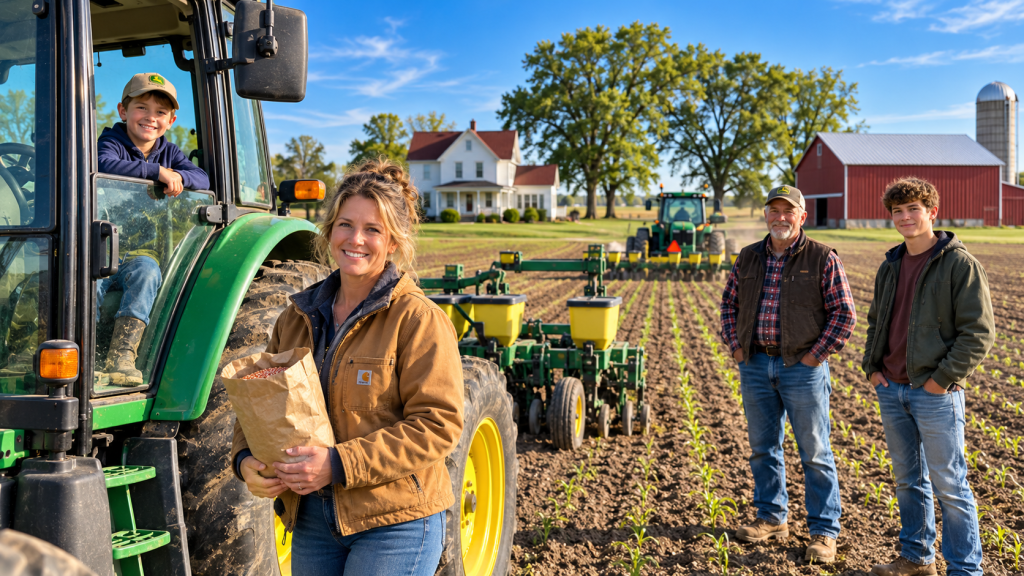
Abby had fallen asleep inside, curled beneath her father’s old hunting blanket after spending nearly fourteen hours watching me struggle through my first day of planting. Across the gravel road, the lights of the farm we’d called home for twenty years glowed through the darkness.
The house where I’d raised my daughter. The house where Jeff and I had celebrated birthdays, anniversaries, and Christmas mornings. The house his brothers had asked me to leave before the soil was even warm enough for spring planting. I read the first sentence again. Then the next.
I delivered my formal notice of withdrawal from the partnership on February 12. The accountant confirmed receipt, and I have copies. I intend to finish my obligations through the agreed transition period, but I will not sign another operating loan or promise another year of my family’s life to decisions I no longer believe are right.
My throat tightened.
Jeff had never told me.
Not one word.
He’d mentioned disagreements with Randy.
Complained about Scott’s habit of purchasing equipment before discussing the numbers.
Sometimes he’d come home quiet after meetings at the bank.
But he’d never said he was leaving the partnership.
I turned the page.
The bank is worried, and it has reason to be. We keep borrowing to make last year’s decisions look better. Every time the numbers tell us to slow down, we buy another thing and call it an investment.
I closed my eyes.
I knew those numbers.
For twenty years, I’d maintained the partnership’s books.
I’d tracked grain sales, fertilizer costs, machinery repairs, fuel, insurance, and operating loans.
I’d spent enough evenings at the kitchen table with a calculator to know that the farm’s troubles hadn’t started in January.
They’d started years earlier, when good harvests convinced three brothers that difficult years were something that happened to other families.
Still, the accounts had been honestly recorded.
The debt wasn’t a secret.
What Jeff had kept from me was his decision to stop carrying it.
I continued reading.
Randy, I know you want Luke to come home and have something worth inheriting. Scott, I know you’re tired of hearing me question every new loan. But neither of those things gives us the right to gamble with our families’ homes.
My hands trembled.
And I need you both to understand something.
My wife has been keeping this farm alive as surely as any of us have.
I stopped.
Tears blurred the page.
She has worked harder than anyone gives her credit for. When the fertilizer bills came due and the grain checks were late, she found a way to make the numbers work. When one of us forgot a payment or misread a contract, she caught it.
But she is not a piece of equipment that belongs to this partnership.
I covered my mouth.
Luke looked away.
If I leave, I want her to have a home that cannot be taken away because three men disagree about a bank loan.
I’ve been looking at the Wiebe place across the road. The soil needs work, but it’s manageable. There’s a house, a little room for Abby, and eighty acres we could build something on.
I stared toward the dark field beyond my porch.
The Wiebe place.
My place.
Jeff had been planning to buy the same ground.
I read the final paragraph.
If something happens before I get the chance to tell her, I am asking you as my brothers to give her time. Don’t make her pack while she’s grieving. Don’t make Abby watch strangers move into her bedroom before she’s ready.
And whatever happens to the partnership, don’t let our last act as brothers be something our father would be ashamed of.
Beneath that was Jeff’s signature.
The same hurried signature he’d used on grain contracts, school permission slips, and the birthday cards he always remembered to buy but never remembered to mail.
I stood motionless.
Then I looked at Luke.
“Did they know?”
He swallowed.
“About the notice?”
I nodded.
“Randy did. Uncle Scott found out later.”
My chest tightened.
“And they still handed me that check six days after Jeff died?”
Luke lowered his eyes.
“Yes.”
I looked across the road.
The farmhouse lights seemed farther away than ever.
“They knew he’d asked them not to rush me.”
Luke nodded.
“I’m sorry.”
I pressed the notebook against my chest.
I wanted to scream.
I wanted to drive across the road, pound on their door, and demand to know how two men who had carried their brother’s casket could forget his last request before the funeral flowers had wilted.
But Abby was asleep inside.
My hands were blistered.
And twenty acres of corn seed lay in the ground, waiting for rain.
I took a slow breath.
“Luke, why did you bring this to me?”
He looked toward the field.
“Because I think Uncle Jeff wanted you to know you weren’t starting from nothing.”
Then he reached into his jacket.
“And because there’s something else.”
He handed me a folded sheet of paper.
It was an invoice from a soil-testing laboratory.
The customer name was Jeff’s.
The property was the Wiebe eighty.
And attached to it was a handwritten note.
West twelve acres: poor organic matter. North ground: promising. House needs roof inspection. Good possibility if we don’t rush.
I stared at the words.
Then at the field I’d planted that morning.
Jeff hadn’t been dreaming of escaping the farm.
He’d been dreaming of building another one.
For us.
After Luke left, I sat at the kitchen table until nearly dawn.
Jeff’s notebook lay open beside a cold cup of coffee.
The little farmhouse was quiet except for the refrigerator and the wind moving against the windows.
I’d bought the place because I couldn’t bear to leave the land where Jeff had spent his life.
I’d told Abby I wanted her to wake up and see her father’s fields across the road.
That was true.
But it wasn’t the whole truth.
I had been frightened.
Frightened of moving into town and becoming just another widow with a small apartment and a box of photographs.
Frightened of discovering that twenty years of work had left me without anything I could call my own.
And frightened that if I drove away from the farm, I would somehow be driving away from Jeff too.
Now I knew he had been planning a future on the same eighty acres.
I should have felt comforted.
Instead, I felt angry.
Not at Randy.
Not at Scott.
At Jeff.
“Why didn’t you tell me?” I whispered into the empty kitchen.
The question hung there.
I’d been his wife for twenty-two years.
We’d discussed everything from the price of diesel to whether Abby needed braces.
We’d survived droughts, failed crops, a mortgage, his mother’s long illness, and more broken machinery than I cared to remember.
Yet he’d made one of the biggest decisions of our marriage without telling me.
I looked at his handwriting.
My wife has been keeping this farm alive.
Tears filled my eyes.
“Then why didn’t you let me help you decide?”
For the first time since his funeral, I allowed myself to feel something besides grief.
I allowed myself to be disappointed in him.
He had loved me.
He’d wanted to protect me.
But he’d also been so accustomed to carrying the heaviest burdens that he hadn’t noticed how often he left me standing outside his decisions.
By sunrise, I’d cried myself empty.
Then I washed my face, put on my work boots, and started making breakfast.
Because grief hadn’t changed the weather.
The seed still needed planting.
And I had sixty acres left.
Abby came downstairs wearing Jeff’s seed cap.
It sat low over her eyebrows.
She’d refused to take it off since we moved.
“Morning, Mom.”
“Morning, sweetheart.”
She climbed onto a chair.
“Are we planting today?”
“If the planter behaves.”
She smiled faintly.
“Can I ride with you again?”
“After school.”
Her face fell.
“Mom, I can stay home.”
I turned toward her.
“No, Abby.”
“But you need help.”
“I need you to finish sixth grade.”
She looked down.
I placed two pieces of toast on her plate.
“Your dad would’ve said the same thing.”
For a moment, her face changed.
Then she whispered, “Dad would’ve finished the field already.”
The words hurt more than she intended.
I sat beside her.
“Yes, he probably would have.”
She looked surprised.
I continued.
“Your dad had been farming since he was younger than you. I’m learning things he spent decades learning.”
Her eyes filled.
“I’m sorry.”
I reached for her hand.
“Don’t be sorry for missing him.”
She wiped her cheeks.
“I just wish he was here.”
I pulled her into my arms.
“So do I, baby.”
She held me tightly.
Then whispered, “Are we going to lose this house too?”
My throat tightened.
I looked around the kitchen.
Peeling wallpaper.
An old stove.
A table with one uneven leg.
And a little girl who had already lost her father and the home where she’d grown up.
I wanted to promise her everything would be fine.
But Jeff had taught me that promises needed more than good intentions.
So I kissed her forehead.
“I’m going to work as hard and as carefully as I know how to keep it. And if something goes wrong, we’ll face it together.”
She nodded.
Then looked up.
“Can I still wear Dad’s cap?”
I smiled through tears.
“Of course.”
She adjusted the brim.
“Good.”
And went back to eating her toast.
By Thursday, I’d finished planting the north forty acres.
Not beautifully.
Not quickly.
But the rows were reasonably straight, the seed depth had improved, and the planter was still working.
Every evening, I came home with dirt in my hair and muscles aching in places I hadn’t known could hurt.
The neighbor who sold me the used tractor had warned me that its transmission was temperamental.
He was right.
Twice, it refused to shift properly.
Once, the planter chain slipped.
And every time something went wrong, my first instinct was to reach for my phone and call Jeff.
I’d take it out.
Look at his name.
Then remember.
There are moments in grief when you can almost convince yourself someone is still alive.
And then there are moments when a broken piece of machinery proves otherwise.
On Friday afternoon, a blue pickup stopped at the edge of my field.
An older woman climbed out.
She wore work boots, faded jeans, and a straw hat with a broken brim.
I recognized her immediately.
Dorothy Wiebe.
The former owner of my eighty acres.
She’d moved into a small place in town after her husband died, leaving the farmhouse vacant until she finally decided to sell.
She stood beside the fence watching me approach.
“Well,” she said, “I see you’ve decided to make that old ground earn its supper.”
I laughed.
“I’m trying.”
She looked at the planter.
“That thing giving you trouble?”
“Every day.”
“Good.”
I stared.
Dorothy smiled.
“Means you’re getting acquainted.”
I climbed down.
She studied my face.
Then said gently, “I’m sorry about Jeff.”
My throat tightened.
“Thank you.”
She looked across the road.
“He was a good man.”
I nodded.
Dorothy reached into her truck and removed a cardboard box.
“I brought you something.”
Inside were old field maps, rainfall records, and notebooks filled with planting dates.
I stared.
“What’s all this?”
“Records from when my husband and I farmed the place.”
She smiled.
“Some of it might be useful. Some of it’s probably just a record of how often we made mistakes.”
I lifted a notebook.
On the first page, her husband had written:
The north field always looks better than the south field. Don’t let it fool you.
I laughed.
Dorothy nodded toward the fields.
“Your Jeff came to see me in February.”
My smile disappeared.
“He did?”
She nodded.
“He asked about the soil, the drainage, and whether the house could be fixed.”
I swallowed.
“Did he say he wanted to buy it?”
“He said he was thinking about making a change.”
Dorothy looked at me.
“And he said the decision wasn’t his alone.”
My chest tightened.
“What did he mean?”
She smiled sadly.
“He said he needed to talk it through with his wife.”
I looked away.
For a moment, I couldn’t speak.
Then Dorothy added, “He said she was the one who’d know whether the numbers worked.”
Tears slid down my face.
Jeff hadn’t planned to keep the secret forever.
He’d been gathering information.
Trying to work out whether leaving the partnership was possible before burdening me with the worry.
He should have told me sooner.
I still believed that.
But for the first time, I understood the shape of what he’d been trying to do.
Dorothy rested a hand on my arm.
“He looked happier talking about this little place than I’d seen him in years.”
I glanced toward the north field.
“Did he?”
She nodded.
“He said he wasn’t sure he wanted to spend the rest of his life managing a farm that had grown too big for the three of them to agree about.”
I looked down.
Dorothy continued.
“He wanted something he could work with his wife and daughter. Something smaller, but theirs.”
I began crying again.
Dorothy didn’t try to stop me.
She simply stood beside me until the tears passed.
Then she said, “Now, are you going to show me what you’ve planted?”
I laughed through my tears.
“Would you?”
She grinned.
“Sweetheart, I farmed this ground for forty-one years. I’m not about to let you ruin my reputation without offering a few suggestions.”
That afternoon, Dorothy rode beside me for three hours.
She showed me where water gathered after heavy rain.
Where the soil turned sandy.
Where my planter might struggle.
And where the previous year’s weeds could become a problem.
She didn’t treat me like a helpless widow.
She treated me like a farmer who had things to learn.
That mattered more than she knew.
The following Monday, I went to the bank.
Not the branch where Jeff’s partnership maintained its accounts.
I visited a smaller agricultural lender recommended by Dorothy.
I brought financial records, my purchase documents, a planting budget, and the soil reports.
The loan officer was a woman named Claire Jensen.
She looked at my paperwork.
Then looked at me.
“You’re farming eighty acres by yourself?”
“With some help.”
She smiled.
“Most people need some help.”
I relaxed a little.
She reviewed the equipment I’d purchased.
The cash remaining after closing.
The projected costs for seed, fertilizer, fuel, repairs, and harvesting.
Then she asked about crop insurance.
I explained the information I’d received from the local agent.
We discussed what coverage might be available, what had to be documented, and how a new producer should approach the program deadlines.
Claire took notes.
“Your biggest problem isn’t necessarily the farm,” she said.
I looked up.
“What is it?”
“Cash flow.”
I nodded.
I knew that word.
For twenty years, cash flow had been the subject of half our dinner conversations.
She continued.
“You’ve purchased the land without a mortgage. That’s a strong position. But you can’t let the operating costs consume every dollar you have.”
I looked down.
“I know.”
She pointed to one figure.
“Your harvesting estimate assumes you’ll have someone with a combine willing to do the work at the rate you’ve listed.”
I swallowed.
“I haven’t arranged that yet.”
“Then don’t treat it as settled.”
She wasn’t unkind.
Just practical.
I appreciated that.
We spent nearly two hours reviewing my budget.
By the time I left, I understood something I’d been too frightened to admit.
Owning land outright didn’t automatically make farming profitable.
The eighty acres could lose money.
I could have a poor crop.
Equipment could break.
Weather could destroy months of work in an afternoon.
And nobody owed me a good harvest because I’d recently buried my husband.
I sat in my truck outside the bank for a long time.
Then I opened Jeff’s notebook.
On one page, beneath an estimate for diesel fuel, he’d written:
Don’t build a plan that only works if everything goes right.
I stared.
Then laughed softly.
“All right, Jeff.”
I closed the notebook.
“We’ll do it properly.”
The first real argument came three days later.
Randy pulled into my driveway just after supper.
Abby was inside doing homework.
I was rinsing dishes when I saw his truck.
For a moment, I considered pretending not to be home.
Then I dried my hands and stepped onto the porch.
Randy stood beside his pickup.
He looked tired.
Older than he had at the funeral.
“Can we talk?”
I folded my arms.
“About what?”
He looked toward the fields.
“Luke says you’ve got Jeff’s notebook.”
I felt my stomach tighten.
“Yes.”
Randy nodded slowly.
“Did you read the letter?”
“Every word.”
He stared at the gravel.
For a long moment, neither of us spoke.
Then I asked the question I’d been holding for weeks.
“Why did you put that check in front of me six days after I buried him?”
He looked up.
“It was what the partnership owed you.”
“I know that.”
I took a breath.
“I kept the books, Randy. I know the agreement. I know the price was fair.”
He nodded.
“Then what—”
“The timing.”
My voice cracked.
“Jeff asked you not to make Abby and me leave while we were still grieving.”
Randy looked away.
I continued.
“You knew he was already planning to withdraw. You knew he wanted us to have time.”
He rubbed his forehead.
“We had planting coming. Luke needed a place to stay. We were trying to keep everything moving.”
I stared at him.
“You had a whole farm to keep moving, so you decided my daughter and I were the easiest things to move out of the way?”
He flinched.
For a moment, I regretted the sharpness of my words.
Then I remembered Abby asking whether we’d lose another house.
And the regret disappeared.
Randy took a breath.
“I wasn’t trying to hurt you.”
I looked at him.
“But you did.”
He nodded.
“I know.”
His eyes moved toward the old farmhouse.
Then he said quietly, “There’s something I need to tell you about Jeff’s notice.”
I waited.
“He didn’t file it because he hated us.”
“I never thought he did.”
Randy swallowed.
“He filed it because we were about to borrow another seven hundred thousand dollars.”
I stared.
I knew about the proposed financing discussions.
But not that the brothers had reached the point of asking Jeff to agree.
“For the new grain storage project?”
Randy nodded.
“Scott thought it would improve our margins. I thought it might keep Luke interested in staying.”
I crossed my arms.
“And Jeff refused?”
“Yes.”
Randy looked toward the sunset.
“He said we’d spent ten years confusing being bigger with being stronger.”
I felt my throat tighten.
That sounded exactly like Jeff.
Randy continued.
“At the last meeting, he said if we signed another note without fixing the operating problems, we’d all end up working for the bank instead of ourselves.”
I nodded slowly.
“And what happened?”
“He walked out.”
Randy’s voice broke.
“The next day, he delivered his withdrawal notice.”
He stared toward the road.
“I thought he was trying to scare us.”
I looked at him.
“He wasn’t.”
Randy shook his head.
“No.”
Then, for the first time since the funeral, he began crying.
“I know that now.”
Randy sat on my porch steps until the sky turned purple.
I brought him a glass of water.
He took it without speaking.
For a while, we listened to the evening insects and watched the first lights appear across the road.
Then he looked at me.
“Do you know how we paid the buyout?”
I nodded.
“The partnership had insurance on Jeff.”
“Yes.”
The brothers had maintained policies intended to fund a buyout if one of the partners died. I’d seen the premiums in the accounts for years.
Randy stared into his glass.
“We had the money to pay you because Jeff had insisted we keep those policies current.”
I looked toward the field.
“He always said we couldn’t risk leaving somebody with a debt they couldn’t pay.”
Randy nodded.
“He was thinking about you even then.”
I swallowed.
Then he said, “Scott wanted to wait before telling you about the house. He thought you should have a few weeks.”
I turned.
“What?”
Randy looked ashamed.
“I was the one who pushed for planting.”
The truth settled between us.
Not a conspiracy.
Not some elaborate plan to steal what belonged to me.
Just a frightened man who’d decided his business problems were more urgent than his brother’s widow.
“I thought if we kept everything on schedule, we’d be all right,” he whispered.
I looked at him.
“Are you?”
He shook his head.
“No.”
A breeze moved across the porch.
Then Randy added, “Luke won’t move into your old house.”
I stared.
“What?”
“He told me he never asked for it.”
I remembered what I’d heard at the co-op.
That the house was meant for Luke.
That his return to farming was the reason Abby and I had to leave so quickly.
Randy lowered his head.
“I made that decision without asking him. I thought if he had his own place on the farm, he’d commit to staying.”
“And?”
Randy’s voice broke.
“He said he didn’t want a home that began with his aunt and cousin being pushed out of theirs.”
My eyes filled.
Across the road, the farmhouse windows glowed.
Somewhere inside was Abby’s old bedroom.
The room Jeff had painted pale yellow when she was born.
The room I’d left without knowing whether I would ever be able to give her another one.
Randy wiped his cheeks.
“I’m sorry.”
I sat beside him.
For a long time, neither of us spoke.
Then I said, “I can’t go back to the way things were.”
He nodded.
“I know.”
“And I won’t use my eighty acres to secure the partnership’s debts.”
He looked at me.
“I wouldn’t ask.”
“Good.”
I took a breath.
“But Jeff loved you. And I know he didn’t want his family destroyed over a business disagreement.”
Randy stared at the gravel.
“What do we do?”
I looked toward the fields.
“For a start, stop pretending the farm will survive just because the three of you always believed it should.”
He gave a tired laugh.
“That’s what Jeff used to say.”
I smiled sadly.
“I know.”
Then I stood.
“Get an independent review of the numbers. Sell equipment you don’t need. Stop planning expansions before you’ve paid for the ones you already made.”
Randy nodded slowly.
“And don’t make Luke responsible for keeping the family together.”
He closed his eyes.
Then whispered, “All right.”
When Randy finally left, I watched his taillights disappear across the road.
I didn’t feel victorious.
I felt tired.
But for the first time since Jeff died, I no longer felt that the gravel road divided us into winners and losers.
It separated two farms.
Two sets of choices.
And two futures that would have to be built honestly if either was going to survive.
June arrived dry.
The first week was hot enough to make the leaves curl.
The second week brought wind.
By the third, I was standing in my cornfield staring at plants that looked smaller than they should have.
Dorothy came over one evening.
She walked down a row, bent to examine the soil, and rubbed a handful between her fingers.
“Needs rain.”
“I know.”
She looked at me.
“Nothing you can do about that.”
I hated the answer.
For twenty years, I’d made problems manageable with spreadsheets.
If a payment was due, I found the money.
If a supplier charged the wrong amount, I called.
If the books didn’t balance, I kept working until they did.
But I couldn’t make rain appear.
Dorothy seemed to know what I was thinking.
“Farming’s the quickest way I know to learn the difference between responsibility and control.”
I looked at her.
“That sounds like something my husband would’ve said.”
She smiled.
“Then maybe he was smarter than he looked.”
I laughed for the first time that week.
We stood watching the field.
Then she added, “You’ve done your part. Now make sure your finances can survive if the weather doesn’t do its part.”
That night, I reviewed every expense again.
I delayed a nonessential equipment repair.
Called the insurance agent to confirm my paperwork.
And arranged a firm quote with a custom harvester for autumn.
None of it made the clouds darker.
But it gave me something solid beneath my feet.
Two days later, it rained.
I stood on the porch with Abby watching water pour off the roof.
She began laughing.
Then she ran into the yard, lifted her face, and let the rain soak through Jeff’s old seed cap.
“Abby!” I called.
She spun around.
“Mom, it’s raining!”
“I can see that!”
She ran back to me.
Then wrapped her wet arms around my waist.
“Dad would’ve been happy.”
I looked toward the field.
“Yes, baby.”
I kissed her forehead.
“He would’ve been.”
The next surprise came in July.
Luke showed up carrying a small metal toolbox.
He looked more serious than usual.
“Can we talk?”
I invited him inside.
He sat at the kitchen table, turning his cap in his hands.
“I told Dad I’m not joining the partnership this year.”
I stared.
“Why?”
He took a breath.
“Because nobody can explain how it’s going to work.”
I nodded.
“That’s a good reason.”
He looked relieved.
“I love farming. I want to come home eventually. But Dad keeps telling me the operation needs another young person, and Uncle Scott keeps telling me we can’t afford more labor.”
He shook his head.
“I don’t want to spend the next ten years arguing over decisions nobody wants to make.”
I thought of Jeff’s letter.
Don’t let our last act as brothers be something our father would be ashamed of.
“What are you going to do?”
Luke looked toward my field.
“There’s an agronomy position opening at the co-op. I applied.”
I smiled.
“That sounds promising.”
He nodded.
“Still close to home. And I can learn a lot.”
He hesitated.
“Would Uncle Jeff think I’m giving up?”
I felt tears gathering.
“No.”
He looked up.
“Are you sure?”
I reached for Jeff’s notebook.
Then found a page I’d marked several weeks earlier.
Across the top, Jeff had written:
Plans for a smaller operation.
Below that were notes about equipment, crop rotation, seasonal labor, and the kind of financial decisions he hoped to make differently.
At the bottom was a sentence.
Abby deserves to know there’s more than one way to love a farm.
I turned the notebook toward Luke.
He read it.
Then read it again.
His eyes filled.
“That sounds like him.”
I nodded.
“He wanted you to have choices too.”
Luke covered his face.
For a moment, I saw the young man who’d carried Jeff’s casket.
The nephew who’d brought me coffee when my hands were too tired to hold a cup.
The boy who’d once followed his uncle through the fields asking questions about tractors.
I reached across the table.
“Luke, you don’t owe your father your whole future just because he wants you to farm.”
He lowered his hands.
“And you don’t owe Jeff your whole future either.”
He smiled through tears.
“Thanks.”
I squeezed his fingers.
“Now, about that toolbox.”
He laughed.
“What?”
“Unless you came here to fix my planter, I’m disappointed.”
He grinned.
“Actually, I did.”
And for the rest of the afternoon, we worked beneath the machine while Abby handed us tools and asked enough questions to keep both of us laughing.
By September, the corn stood taller than Abby.
The fields weren’t perfect.
There were thin patches where the soil was poor.
A few places where weeds had stolen more moisture than they should have.
And some rows that curved enough to make me laugh whenever I drove past.
But the crop was there.
Alive.
Growing.
Mine.
One evening, Abby and I walked to the edge of the north field.
She pulled an ear of corn from a stalk and held it carefully.
“Mom, does this mean we did it?”
I smiled.
“Not yet.”
She frowned.
“Why not?”
“Because we still have to harvest it, sell it, and pay the bills.”
She looked disappointed.
Then she smiled again.
“But we grew it.”
I felt tears gathering.
“Yes, baby.”
I looked across the field.
“We grew it.”
She slipped her hand into mine.
Then asked quietly, “Do you think Dad can see?”
I looked toward the horizon.
I didn’t know what happened after death.
I didn’t know whether Jeff could see our crooked rows, our old tractor, or the little farmhouse we’d bought without knowing he’d once dreamed of buying it himself.
But I knew what he’d taught us.
And I knew how much of him still lived in the choices we made.
“I think he’d be proud of you,” I whispered.
Abby looked down at her father’s cap.
Then smiled.
“Even if I didn’t plant sixty acres in a day?”
I laughed through tears.
“Especially then.”
Harvest arrived in October.
The custom harvester I’d hired pulled into the yard early one cold morning.
I stood beside the field with my notebook.
Abby had taken the morning off from school with permission to watch the first passes.
She wore Jeff’s cap.
I wore his old work jacket.
The combine moved into the corn.
For a moment, I couldn’t breathe.
I’d watched Jeff harvest fields for twenty years.
I’d brought supper in the pickup.
Checked grain tickets.
Calculated yields.
And worried about the weather.
But I’d never stood beside a field knowing every decision that led to that harvest had been mine.
Every seed order.
Every repair.
Every hour on the tractor.
Every night I’d lain awake wondering whether I was making a terrible mistake.
Abby reached for my hand.
“Mom?”
I looked down.
“Yes?”
“You’re crying.”
I laughed.
“I know.”
She leaned against me.
“It’s okay.”
I kissed the top of her head.
The harvest continued.
The yield wasn’t extraordinary.
A little better than I’d feared, but not enough to make anyone rich.
When the grain was sold and the season’s expenses were accounted for, there was a modest surplus before allowing for every future machinery cost and the value of my own labor.
I hadn’t earned a fortune.
I hadn’t proved that eighty acres could support every expense of our lives without careful planning.
But I had made a beginning.
A real one.
I had land without a mortgage, a crop that paid its immediate bills, and enough information to make sensible decisions about the following year.
For the first time since Jeff’s funeral, the future felt like something I could plan instead of something I simply had to survive.
That afternoon, Randy came across the road.
Scott was with him.
They stopped beside the field.
I watched them approach.
Randy looked at the combine moving between the rows.
“Crop looks decent.”
I nodded.
“Better than I expected.”
Scott studied the field.
Then said, “Jeff would’ve liked this.”
I swallowed.
“Yes.”
For a while, we stood quietly.
Then Scott cleared his throat.
“I should’ve come over sooner.”
I looked at him.
He continued.
“After the funeral. After you moved.”
His eyes filled.
“I kept telling myself it was business.”
I nodded slowly.
“But it was family too.”
Scott lowered his head.
“Yes.”
He took a breath.
“I’m sorry.”
I looked toward the combine.
Then back at him.
“Thank you.”
Randy shifted his weight.
“We’ve decided not to go ahead with the new storage project.”
I looked up.
“And?”
“We’ve worked through the accounts with an outside adviser. We’re selling a piece of equipment we don’t need and trying to bring the borrowing back under control.”
I nodded.
“That sounds sensible.”
Randy smiled sadly.
“Jeff would’ve told us to do it three years ago.”
I looked toward the road.
“He probably did.”
For a moment, all three of us laughed.
Not because anything was funny.
Because we’d all known Jeff.
And because sometimes laughter is the only way to speak about someone you miss without falling apart.
Then Randy reached into his coat.
He handed me a photograph.
Jeff stood beside an old red tractor, smiling with his arm around a much younger Randy and Scott.
On the back, in their father’s handwriting, were four words.
Three boys. One beginning.
My eyes filled.
Randy looked down.
“Dad took that when we started farming together.”
I held the photograph.
Then he whispered, “We forgot it was supposed to be about being brothers.”
I stared at the three men.
One was gone.
Two were still trying to find their way.
I looked back at Randy.
“It’s not too late to remember.”
He nodded.
“No.”
Then he looked toward my field.
“You’re doing good work over here.”
The words meant more than he knew.
Not because I needed his approval.
But because he was finally speaking to me as someone who belonged in a field.
Not merely in a farmhouse kitchen.
The following spring, Abby and I planted again.
We’d learned from our mistakes.
We adjusted the planting depth.
Changed part of our crop plan.
Improved the budget.
And made sure the old tractor received its repairs before we needed it.
Dorothy came by with biscuits.
Luke stopped after work to help check the planter.
And Randy waved when he drove past.
Not every hurt had healed.
I still remembered the funeral lunch.
The envelope.
The folding table.
And the relief on Randy’s face when I accepted the check without arguing.
I still remembered packing Abby’s bedroom while she sat on the floor holding her father’s cap.
But I no longer woke each morning feeling that those memories defined the rest of our lives.
One evening, after we’d finished planting, I found Abby sitting on the porch with Jeff’s notebook.
She looked up.
“Mom, can I write something in here?”
I smiled.
“What?”
She held up a pencil.
“Just one thing.”
I sat beside her.
She turned to the last page.
Beneath Jeff’s final calculations, she carefully wrote:
Dad, we planted the eighty acres again. Mom says our rows are straighter this year. I think you’d be proud of her.
My throat tightened.
Then she added:
I’m proud of her too.
I covered my mouth.
Abby looked at me.
“Is that okay?”
I pulled her into my arms.
“That’s more than okay, sweetheart.”
We sat together watching the sunset fall across the fields.
Across the gravel road stood the farm where Jeff had spent his life.
Behind us was the little white house he’d hoped to buy.
And all around us was the ground we’d planted with our own hands.
I finally understood something about the letter he left behind.
Jeff hadn’t been trying to give me a farm that would never fail.
He’d been trying to give me the freedom to make decisions about my own future.
And somehow, even though he never got the chance to finish his plan, he’d helped me find the courage to begin mine.
The half-million-dollar check his brothers handed me at his funeral was supposed to close a chapter.
They thought it meant I would leave.
Move into town.
Disappear from the fields where I’d spent twenty years helping build a life.
Instead, I crossed the road.
Bought eighty acres.
And planted them.
I didn’t do it to defeat Randy or Scott. I did it because my daughter deserved to know that losing her father did not mean losing every dream he’d left behind.
And when the first green shoots pushed through the soil, I realized something I’d forgotten in the darkness after Jeff’s death.
A field doesn’t stop being a field because last year’s harvest is over.
It waits.
It rests.
And when the season is right, it grows again.
So did we.
THE END STORIES! THANK YOU FOR READING GOOD LUCK !❤️
Related Posts