For several seconds, nobody in the police station moved. The woman’s words seemed to hang in the air. “Then why did I hear him screaming downstairs this morning?” Deputy Caleb Price stared at the computer screen. Sheriff Dalton Voss stood beside the booking desk, his jaw tightening.
I was still wearing handcuffs. The metal had rubbed my wrists raw, and my shoulder ached from the way Voss had twisted my arm inside the diner. But none of that mattered at that moment. All I could think about was the woman standing behind the holding-area glass. Her face was pale. Her fingers trembled against the window.
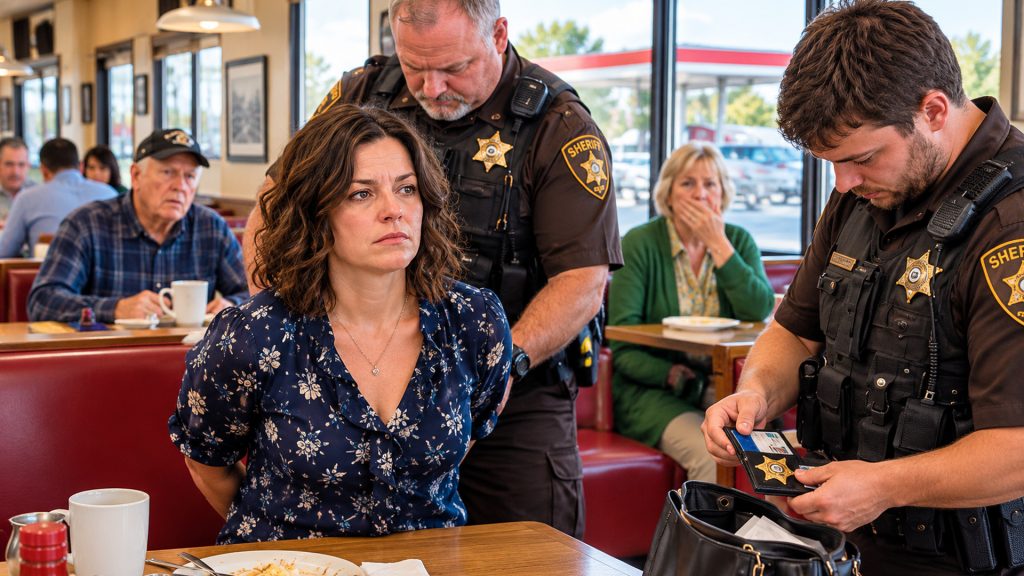
And her eyes carried a kind of terror I had seen before. The terror of a mother who knew something was terribly wrong but couldn’t make anyone listen. “What’s your son’s name?” I asked. Voss stepped forward. “You don’t get to question people in my station.” I turned toward him.
“Then perhaps someone should answer her.”
His face reddened.
“I’m the sheriff here.”
“Yes,” I said quietly. “And that makes his whereabouts your responsibility.”
Caleb looked up from the computer.
“Sheriff, the system says Marcus Bell was released yesterday at 4:18 p.m.”
The woman shook her head violently.
“No. No, that’s impossible.”
She pressed her hand harder against the glass.
“My son called me yesterday morning. He said they were keeping him downstairs because he wouldn’t sign something.”
My stomach tightened.
“What something?”
She began crying.
“A statement saying he stole money from the county.”
Voss slammed his palm against the counter.
“Enough!”
The woman flinched.
Caleb went still.
I held the sheriff’s gaze.
“Sheriff Voss, lower your voice.”
He laughed bitterly.
“You think you’re in charge now?”
“No,” I answered. “I think a detained person may be missing, and that requires immediate attention from the appropriate authorities.”
For the first time, I saw uncertainty move across his face.
Then Caleb spoke.
“Sir?”
Voss turned.
“What?”
Caleb swallowed.
“The release entry says Marcus Bell was discharged through the south entrance.”
“So?”
The deputy looked toward the hallway.
“Sir, the south entrance security system has been out of service for three weeks.”
The sheriff’s expression changed.
And I realized we were no longer dealing with an ordinary arrest gone wrong.
We might be standing inside the beginning of something much worse.
My name is Amara Whitlock.
I was forty-four years old when Sheriff Dalton Voss placed me in handcuffs inside a roadside diner.
I’d served as a United States District Judge for six years.
Before that, I had worked as a federal prosecutor, a civil rights attorney, and a public defender.
I’d seen people abuse authority.
I’d seen innocent people accused of crimes.
I’d seen evidence mishandled, witnesses frightened, and families devastated by decisions made without sufficient care.
But nothing had prepared me for the moment I stood inside a small county police station while a mother begged someone to find her son.
I had traveled to the county after receiving information about repeated complaints involving the sheriff’s department.
Those complaints included allegations of unlawful detentions, missing property, manipulated records, and intimidation.
My intention had been to observe the community and better understand what people were reporting.
Looking back, I should have been more careful about maintaining the boundaries of my judicial role.
A judge isn’t a private investigator.
And personal experience cannot replace properly admitted evidence.
That distinction would become especially important in the weeks ahead.
But on that afternoon, I was also a woman who had been arrested without an apparent lawful basis.
And I was a witness to what happened next.
Caleb stepped toward the holding-area door.
“Mrs. Bell, please come with me.”
The woman hesitated.
Voss moved between them.
“She stays where she is.”
Caleb stopped.
“Sheriff, she’s asking about her son.”
“I heard her.”
“The record doesn’t match what she’s telling us.”
Voss leaned closer.
“Are you questioning me, Deputy?”
Caleb’s face went pale.
He was young.
Maybe twenty-five.
He wore a neatly pressed uniform and had the nervous posture of someone who still believed every decision he made could determine the rest of his career.
He looked toward me.
Then back at Voss.
“Sir, I’m asking that we verify the detention record.”
The sheriff’s expression darkened.
“You’ll do what I tell you.”
For a moment, nobody spoke.
Then Caleb straightened.
“I’m requesting a supervisor outside the immediate chain of command.”
Voss stared.
“What did you say?”
Caleb swallowed.
“I think we need independent assistance.”
Something changed in that room.
Not dramatically.
There was no music.
No applause.
Just a young deputy deciding that following orders did not mean ignoring something he believed was wrong.
Voss stepped toward him.
“You’re finished here, Price.”
Caleb stood his ground.
“Then you can document that decision.”
The sheriff’s face turned crimson.
I watched carefully.
Voss had threatened me because he assumed I lacked protection.
Now he was threatening his own deputy for asking questions.
It was the same pattern.
Different target.
Same arrogance.
I looked toward Caleb.
“Deputy, please ensure the appropriate outside agency is contacted.”
He nodded.
“Yes, Judge.”
Voss barked a laugh.
“Judge? You think that little card makes her special?”
I turned toward him.
“No, Sheriff. It means my identity has been verified. It doesn’t excuse me from the law, and it doesn’t diminish anyone else’s rights.”
His jaw tightened.
I continued.
“The question isn’t whether I’m important.”
I glanced toward Mrs. Bell.
“The question is whether your department has accounted for a person it held in custody.”
Within the next hour, outside law enforcement officials were contacted.
A state investigative supervisor arrived, followed by additional personnel who began coordinating the response.
My handcuffs were removed.
Photographs were taken of the marks on my wrists.
The circumstances of my arrest were documented.
I was permitted to contact counsel.
And the complaints involving the missing detainee were referred to the officials responsible for investigating them.
Voss protested every step.
“This is ridiculous!”
He paced beside the booking counter.
“You’re letting some outsider take over my department?”
The state supervisor, Investigator Helen Carter, remained composed.
“We’re here to determine whether someone is unlawfully detained or otherwise in danger.”
Voss laughed bitterly.
“Marcus Bell was released.”
Carter looked at him.
“Then we’ll verify that.”
He stepped closer.
“I said he was released.”
She met his eyes.
“And I heard you.”
I stepped aside while investigators began their work.
I didn’t direct the search.
Didn’t order anyone arrested.
Didn’t demand that Voss be removed.
My role had changed.
I was a potential witness, an injured party, and a federal judge whose professional obligations required particular care.
The proper authorities had to make decisions based on the evidence.
Not on my title.
But that didn’t mean I was powerless.
I could provide an accurate account.
Preserve what I had observed.
And ensure my own concerns went through appropriate channels.
Mrs. Bell sat in a chair near the station entrance.
Her hands were clasped so tightly that her knuckles had turned white.
I approached slowly.
“Mrs. Bell?”
She looked up.
Her eyes were red.
“Yes?”
“My name is Amara Whitlock.”
She nodded.
“I heard.”
I sat beside her.
“What’s your first name?”
“Denise.”
I smiled gently.
“Denise, I’m sorry you’re going through this.”
Her lips trembled.
“Please.”
She reached for my hand.
“Please don’t let them forget my boy.”
My throat tightened.
“How old is Marcus?”
“Twenty-two.”
She began crying.
“He works at the county maintenance garage.”
I listened.
“He’s a good boy.”
Her voice broke.
“He takes care of his grandmother. He sends money to his little sister when she needs school supplies.”
I squeezed her hand.
“He told me he’d found something wrong with the county’s accounts.”
My stomach tightened.
“And then they arrested him.”
Denise described what had happened.
Marcus had worked for the county for almost three years.
He helped maintain vehicles and track equipment purchases.
Several months earlier, he noticed discrepancies involving money collected through certain county administrative processes and related payments.
He asked questions.
At first, his supervisor told him to leave the matter alone.
Then he began receiving warnings.
One afternoon, deputies arrived at his workplace.
They accused him of taking county property.
He was arrested.
Denise tried repeatedly to find out what had happened.
Eventually, she was told he had been released.
But he never came home.
And when she went to the station, she heard a voice she believed belonged to him coming from a lower level.
I looked at her.
“Denise, did you see him after the arrest?”
She shook her head.
“No.”
“Did you speak with him?”
“Yesterday morning.”
“What did he say?”
Her eyes filled.
“He told me not to believe anything they said about him.”
My chest tightened.
She continued.
“He said he’d kept copies of the records.”
I looked toward the hallway.
“Did he tell you where?”
Denise hesitated.
Then whispered, “He said he’d put them somewhere nobody would think to look.”
Before I could ask another question, Investigator Carter approached.
“Judge Whitlock?”
I stood.
“Yes?”
“May I speak with you?”
I nodded.
We stepped a short distance away.
Carter lowered her voice.
“We appreciate your cooperation. Because you were involved in an arrest here today, we’ll need a formal statement from you.”
“Of course.”
She hesitated.
“And we’d ask that you avoid independently interviewing potential witnesses.”
I nodded immediately.
“Understood.”
Her expression softened.
“Thank you.”
I looked toward Denise.
“Please keep her informed as much as you’re able.”
Carter nodded.
“We will.”
I returned to Denise.
She looked frightened.
“What’s happening?”
I took her hand.
“Investigators are working to verify where Marcus is.”
Her eyes filled.
“Can you make them find him?”
The question pierced me.
I wished I could promise her everything would be fine.
But I couldn’t.
So I told her the truth.
“I can’t promise an outcome.”
She began crying.
“But I can promise that I won’t pretend I didn’t hear you.”
The next development came from an ordinary maintenance worker.
His name was Samuel Ortiz.
He’d worked at the station for eleven years.
He was fifty-eight, quiet, and rarely involved in conversations with officers.
When outside investigators began reviewing access to the lower-level rooms, Samuel approached one of them.
He said he had information.
For months, certain storage areas had been kept locked.
He’d been told not to enter without permission from Voss or one of two senior deputies.
But he had noticed lights on late at night.
He’d heard movement.
And once, while repairing a pipe, he’d heard someone asking for water.
At the time, he’d been told the sound came from a temporary holding area.
He hadn’t questioned it.
Now he was frightened.
Investigators secured the relevant areas and obtained the authority necessary to conduct a thorough search.
I wasn’t present for every step.
I learned much of what happened later through official proceedings and information that became public.
But I remember the moment the station’s atmosphere changed.
An emergency medical team arrived.
Then another.
Officers moved quickly toward the lower level.
Denise stood.
“What’s happening?”
Nobody answered immediately.
She began shaking.
“Is it Marcus?”
I moved beside her.
“Denise, let them work.”
She clutched my arm.
“Oh, God.”
Her breathing became shallow.
I guided her into a chair.
“Stay with me.”
Nearly forty minutes later, Investigator Carter returned.
She approached Denise first.
“Mrs. Bell?”
Denise stood so quickly her chair scraped the floor.
“Yes?”
Carter’s expression softened.
“We’ve located your son.”
Denise covered her mouth.
For a moment, she seemed unable to breathe.
“Alive?”
Carter nodded.
“Yes.”
Denise collapsed into her chair.
A sound came from her that I will never forget.
Half sob.
Half prayer.
Carter continued.
“He’s receiving medical attention. We’ll provide more information as soon as we can.”
Denise began crying uncontrollably.
I knelt beside her.
She grabbed my hands.
“My baby.”
Her voice broke.
“My baby is alive.”
Marcus had been found in a secured lower-level room.
He was conscious but weak.
He appeared dehydrated and had injuries requiring medical evaluation.
The circumstances of his confinement raised immediate questions about the accuracy of the release record and who had authorized his continued detention.
Investigators took steps to preserve evidence.
Medical personnel transported Marcus to a hospital.
The inquiry expanded.
And the officers involved in his detention became the subject of further scrutiny.
Sheriff Voss did not shout when he learned Marcus had been found.
That surprised me.
He simply stood near the booking desk, staring toward the stairs.
For the first time, the confidence seemed to drain out of him.
Investigator Carter approached.
“Sheriff Voss, we’ll need your full cooperation regarding detention records, access logs, and personnel assignments.”
He swallowed.
“I had no idea he was still down there.”
Carter looked at him.
“That will be examined.”
Voss turned toward me.
His eyes were cold.
“This is your fault.”
I looked at him.
“No, Sheriff.”
He stepped closer.
I remained still.
“Whatever happened here must be established through evidence. But I didn’t create your records or order anyone detained.”
His face tightened.
I continued.
“And I didn’t make Marcus Bell disappear.”
That evening, I returned to my hotel.
My wrists hurt.
My shoulder ached.
And I was exhausted.
I sat at the edge of the bed without turning on the television.
For several minutes, I stared at my reflection in the dark window.
I’d spent years listening to people describe frightening encounters with law enforcement.
Some accounts were supported by evidence.
Others involved misunderstandings or disputed facts.
Every case required careful attention.
But that afternoon, I’d experienced what it felt like to have an officer disregard my words and use force while claiming I had resisted.
I’d seen how quickly fear could silence a room.
And I’d watched ordinary people struggle to challenge a sheriff who controlled so much of their community’s daily life.
I called my older sister, Naomi.
She answered immediately.
“Amara?”
“Hi.”
There was a pause.
“You sound tired.”
I closed my eyes.
“I am.”
“What happened?”
I swallowed.
“I was arrested today.”
Silence.
Then Naomi said, “What?”
I explained.
The diner.
The handcuffs.
The station.
My identification.
And the missing young man.
When I finished, she was quiet.
Then whispered, “Are you hurt?”
“Not seriously.”
“Amara.”
My voice broke.
“I know.”
She began crying.
“You could’ve been killed.”
I stared at the carpet.
For the first time all day, I allowed myself to feel how frightened I’d been.
Naomi had always been the person who could make me stop pretending I was invincible.
She was five years older.
A retired school principal.
And the closest thing I’d had to a second mother after our parents died.
She listened while I cried.
Then said gently, “You don’t have to be a judge tonight.”
I covered my face.
“Naomi.”
“You can just be my little sister.”
That was when I finally broke.
The next morning, I documented everything I remembered.
The time of the arrest.
The sheriff’s statements.
How the handcuffs were applied.
The accusation of resisting arrest.
The conditions at the station.
The interaction with Caleb.
And Denise’s request for help.
I separated what I’d personally witnessed from what others had told me.
That distinction mattered.
My recollection could be evidence.
It wasn’t a substitute for someone else’s testimony or an independent investigation.
I also sought medical evaluation for my injuries and preserved the relevant records.
Then I informed the chief judge of the circumstances.
Chief Judge Eleanor Bennett was a woman I’d respected for years.
She was meticulous.
Patient.
And deeply serious about judicial ethics.
When we spoke, she listened without interruption.
Then she asked a question I should have considered before traveling.
“Amara, what were you hoping to accomplish by going there privately?”
I looked down.
“I wanted to understand the complaints.”
She paused.
“As a judge?”
I swallowed.
“As someone concerned they weren’t being heard.”
She sighed gently.
“I understand that motivation.”
I waited.
“But judges have to be careful about becoming investigators or witnesses in matters that might come before their courts.”
I closed my eyes.
“I know.”
She continued.
“And now you’re a witness.”
I nodded.
“Yes.”
We discussed how to protect the integrity of any future proceedings.
I would not hear cases arising from the incident in which I was involved.
Nor would I participate in matters where my personal knowledge, relationships, or conduct required recusal.
The relevant filings and questions would be handled through established procedures.
Independent investigators would examine the allegations.
Prosecutors would make charging decisions based on the evidence and their legal responsibilities.
And any cases brought to court would be assigned appropriately.
Before ending the call, Chief Judge Bennett said something I never forgot.
“Amara, remember why those boundaries exist.”
I looked up.
“Because fairness matters.”
“Yes.”
She paused.
“Even when the person being investigated has treated you unfairly.”
I closed my eyes.
“I understand.”
The following weeks brought revelations that shook the county.
Investigators obtained records relating to the sheriff’s department, county finances, detention practices, and the treatment of people who had filed complaints.
They interviewed employees.
Reviewed financial transactions.
Examined digital records.
And compared official paperwork with witness accounts.
The findings didn’t emerge all at once.
Some allegations were corroborated quickly.
Others required months of work.
Some proved unfounded or were impossible to establish.
But the evidence concerning Marcus Bell’s detention was especially troubling.
Marcus later described being pressured to sign a statement accepting responsibility for missing county money.
He said he’d refused because the statement was false.
He also claimed he’d been threatened with additional charges if he continued insisting on an independent review.
The investigators examined his account alongside medical evidence, records, and witness testimony.
As the case developed, the evidence supported serious findings concerning unlawful detention and false documentation.
The missing-money investigation revealed another painful truth.
For years, certain county funds and property records had been handled through processes with inadequate oversight.
Questions emerged about money associated with fees, seized property, and other transactions.
Some employees had reported discrepancies.
Their concerns were dismissed.
A few described being threatened with disciplinary action.
Others said they had been pressured to change entries.
Investigators worked to determine which transactions were legitimate, which reflected accounting mistakes, and which involved misconduct.
The distinction was important.
A missing figure on a spreadsheet wasn’t automatically evidence of theft.
But a deliberate false entry used to conceal a transaction was something else entirely.
Marcus had noticed irregularities because he cared about doing his job correctly.
He wasn’t trying to embarrass anyone.
He wasn’t looking for power.
He simply believed county money should be accounted for honestly.
When he began asking questions, the response he received raised the very concerns he’d hoped to resolve.
I visited Marcus only after his medical condition had stabilized and the relevant officials confirmed that a personal visit would not interfere with the investigation.
Denise was with him.
When I entered the hospital room, he sat propped against pillows.
He was thin.
Exhausted.
But awake.
Denise stood.
“Judge Whitlock.”
I smiled gently.
“Amara is fine today.”
She approached and hugged me.
“Thank you.”
My throat tightened.
“I’m glad Marcus is recovering.”
She began crying.
“He’s alive.”
I nodded.
“Yes.”
Marcus looked toward me.
“So you’re the judge?”
I smiled.
“I am.”
He studied my face.
“Mom said you got arrested too.”
I laughed softly.
“Apparently, that was a very eventful afternoon.”
He smiled faintly.
Then his expression changed.
“I thought nobody was coming.”
My chest tightened.
He looked down.
“They told me nobody cared.”
Denise covered her mouth.
Marcus continued.
“After a while, you start wondering whether maybe they’re right.”
I moved closer.
“Marcus, people were looking for you.”
His eyes filled.
“Your mother didn’t stop.”
Denise began crying.
I continued.
“And others spoke up when they realized something was wrong.”
Marcus looked at me.
Then whispered, “I was so scared.”
My throat tightened.
“I believe you.”
For a while, we sat quietly.
Then Marcus said something that stayed with me.
“I thought telling the truth was supposed to protect you.”
I considered.
“Truth matters enormously.”
He looked up.
“But sometimes the people who speak it still need protection.”
His eyes filled.
I continued.
“That’s why independent institutions, responsible officials, lawyers, journalists, and ordinary witnesses matter. No single person should have to carry that burden alone.”
He nodded slowly.
Then looked toward his mother.
“She saved me.”
Denise began crying.
I smiled.
“She certainly never stopped trying.”
After leaving the hospital, I sat in my car for a long time.
I thought about Denise standing behind the holding-area glass.
The way she’d begged people to find her son.
The way Voss had treated her as an inconvenience.
And the moment she’d learned Marcus was alive.
I’d spent years wearing a black judicial robe.
I’d issued rulings.
Presided over trials.
And written opinions requiring painstaking attention to the law.
But that afternoon had reminded me that justice also depended on ordinary people being able to reach someone willing to listen.
Deputy Caleb Price became an important witness.
Investigators reviewed his actions during the incident and the steps he’d taken to seek outside assistance.
He provided records and answered questions.
He also faced pressure.
Some people accused him of betraying the department.
Others praised him.
He disliked both reactions.
When we spoke later, he seemed uncomfortable with being called a hero.
“I just did what I thought I was supposed to do,” he told me.
I smiled.
“That isn’t always easy.”
He looked down.
“I was terrified.”
I nodded.
“I could tell.”
He laughed nervously.
“I thought Voss would ruin my career.”
I considered.
“And why did you speak anyway?”
He was quiet.
Then said, “Because that woman kept asking about her son.”
My throat tightened.
He continued.
“And because the computer said he’d been released, but the details didn’t make sense.”
I looked at him.
“Caleb, a badge gives you authority.”
He nodded.
“But it also creates obligations.”
His eyes filled.
“I know.”
I smiled gently.
“The fact that you were afraid doesn’t erase the courage it took to act responsibly.”
He looked down.
Then whispered, “Thank you.”
The criminal and administrative proceedings involving Voss took time.
There were investigations by appropriate outside authorities.
Personnel actions.
Questions about the accuracy of official records.
And formal legal processes concerning the conduct supported by the evidence.
Voss was removed from active law-enforcement duties while the most serious allegations were addressed.
Eventually, proceedings established significant misconduct connected to detention practices and official documentation.
The financial investigation also led to separate accountability measures involving individuals whose conduct was proven.
Not every allegation resulted in charges.
Not every person named in a complaint was found responsible.
But the evidence showed that serious failures had occurred.
And that the consequences had fallen hardest on people who felt least able to challenge them.
I didn’t preside over those cases.
I didn’t issue the warrants.
I didn’t decide the charges.
And I didn’t determine Voss’s sentence or other legal consequences.
Those decisions belonged to officials without my personal involvement.
That mattered more than many people realized.
Because if I had used my position to punish him personally, I would have undermined the very principles I’d spent my career defending.
One evening, a reporter asked me a question outside the courthouse.
“Judge Whitlock, do you feel satisfied seeing Sheriff Voss held accountable?”
I paused.
Cameras pointed toward me.
Microphones crowded the space between us.
I considered carefully.
Then answered.
“I’m grateful that serious concerns have been examined through established procedures.”
The reporter leaned forward.
“But personally, don’t you feel vindicated?”
I looked at her.
“Personal vindication isn’t the purpose of the justice system.”
She hesitated.
I continued.
“What matters is that allegations are investigated fairly, evidence is examined, and the rights of everyone involved are respected.”
Another reporter called out.
“Would any of this have happened if you hadn’t been a federal judge?”
That question followed me long after I left the courthouse.
Because I didn’t know.
And the possibility troubled me deeply.
If Caleb hadn’t examined my identification, would Voss have continued treating me as someone without influence?
Would Denise have been heard?
Would investigators have examined the release record quickly enough?
Would Marcus have survived?
Those questions had no simple answers.
But they revealed something important.
A person’s safety should never depend on whether someone discovers they have a powerful job title.
I had credentials.
A professional reputation.
Colleagues I could contact.
Access to legal advice.
And years of experience understanding how the system worked.
Many people had none of those advantages.
I thought about how frightened I’d felt even with them.
Then I imagined what it might have been like for someone who didn’t know whom to call.
Someone who couldn’t afford an attorney.
Someone who was afraid of losing a job.
Someone whose family had already been warned not to complain.
I began working with colleagues through appropriate professional and community education channels to support broader discussions about procedural fairness, access to counsel, accurate records, and the importance of independent complaint systems.
I didn’t discuss pending cases.
Didn’t use my office to endorse particular outcomes.
And didn’t participate in matters where my involvement could compromise judicial neutrality.
But I could speak generally about the importance of equal treatment under the law.
At one community forum, a young woman stood during the question period.
She looked nervous.
“Judge Whitlock?”
I smiled.
“Yes?”
She swallowed.
“What should someone do if they’re frightened to report misconduct?”
I considered.
“First, think about personal safety.”
She nodded.
“Seek appropriate legal assistance, document what you can lawfully and safely preserve, and use available independent reporting channels.”
Her eyes filled.
I continued.
“You don’t have to confront someone powerful alone.”
She looked down.
“And if the first person doesn’t listen?”
I smiled gently.
“Keep seeking safe, lawful ways to be heard.”
After the forum, an elderly man approached me.
He wore a worn brown jacket and carried a folded newspaper.
“Judge?”
I turned.
“Yes, sir?”
He smiled sadly.
“I was in that diner.”
My chest tightened.
“The day I was arrested?”
He nodded.
“I sat near the window.”
I looked at him.
He continued.
“I saw what the sheriff did.”
For a moment, he stared at his hands.
“I wanted to say something.”
I waited.
“But I was afraid.”
His voice broke.
“My grandson had been stopped by deputies the month before. I thought if I spoke up, they might cause him trouble.”
I felt a heaviness in my chest.
He looked up.
“I’m ashamed.”
I shook my head gently.
“Fear can be powerful.”
His eyes filled.
“I should’ve helped.”
I took a breath.
“What matters now is what we learn and how we act when we have a safe opportunity.”
He nodded.
Then reached into his pocket.
He unfolded the newspaper.
Inside was a photograph of the diner.
I recognized the booth.
The counter.
The little window near the kitchen.
He pointed.
“That’s where I was sitting.”
I looked at the image.
He continued.
“I gave investigators my statement.”
My eyes filled.
“Thank you.”
He swallowed.
“I couldn’t change what happened.”
“No,” I said gently.
He looked up.
“But I could tell the truth afterward.”
I smiled.
“Yes.”
That conversation stayed with me.
Because courage doesn’t always arrive at the moment we wish it would.
Sometimes people are frightened.
Sometimes they hesitate.
Sometimes they remain silent and regret it later.
But when they find a safe opportunity to help establish the truth, their actions can still matter.
Months later, Denise invited me to her home for dinner.
I hesitated.
I didn’t want her to feel obligated.
But she insisted.
“Amara, please.”
I smiled.
“Are you sure?”
She laughed softly.
“My mother taught me that if somebody helps your family, you feed them.”
I laughed.
“Then I suppose I can’t argue with your mother.”
Her home was a small yellow house with white shutters.
Flowers grew beside the porch.
Inside, framed photographs covered the walls.
Marcus as a baby.
Marcus graduating from high school.
Marcus holding his little sister, Tiana, at her eighth birthday party.
There were pictures of family cookouts.
Church events.
And ordinary afternoons that had clearly mattered enough to preserve.
When I arrived, Denise hugged me.
“Welcome.”
I smiled.
“Thank you.”
Marcus appeared from the kitchen.
He was stronger now.
Still recovering emotionally, but physically improving.
“Judge Whitlock.”
I smiled.
“Marcus.”
He laughed.
“Mom said I’m supposed to call you Amara.”
I grinned.
“Your mother is a persuasive woman.”
Denise laughed.
“Don’t you forget it.”
Dinner was wonderful.
Fried chicken.
Mashed potatoes.
Collard greens.
Cornbread.
And sweet tea.
Tiana, Marcus’s younger sister, sat across from me.
She was sixteen.
Bright.
Curious.
And completely unimpressed by my title.
She asked whether judges ever got nervous.
I laughed.
“All the time.”
Her eyes widened.
“Really?”
I nodded.
“Of course.”
She considered.
“Even in court?”
“Yes.”
She smiled.
“That’s kind of nice to know.”
I looked at her.
“Why?”
She shrugged.
“Because I get nervous speaking in class.”
I laughed softly.
“Then we’re both still learning.”
After dinner, Marcus and I sat on the porch.
The evening air was warm.
Crickets chirped in the grass.
For a while, neither of us spoke.
Then he said, “I’m thinking about going back to school.”
I smiled.
“That’s wonderful.”
He nodded.
“I want to study accounting.”
I looked at him.
“Really?”
He laughed.
“I know it sounds boring.”
I smiled.
“Not at all.”
He looked toward the yard.
“I used to hate paperwork.”
I listened.
“But now I keep thinking about how much damage people can do when nobody checks the records.”
My chest tightened.
He continued.
“I want to understand it properly.”
I smiled.
“That sounds like a meaningful goal.”
Marcus was quiet for a moment.
Then whispered, “I still have nightmares.”
My throat tightened.
I looked at him.
He continued.
“Sometimes I wake up thinking I’m back downstairs.”
I nodded slowly.
“Have you been able to get support?”
He nodded.
“Yeah. Mom helped me find a counselor.”
I smiled.
“I’m glad.”
He looked down.
“Some days are hard.”
I took a breath.
“Recovery doesn’t mean pretending the experience never happened.”
He looked at me.
“It means learning how to live while the memories gradually become less overwhelming.”
He nodded.
Then said softly, “I’m trying.”
I smiled.
“That’s enough for today.”
Before I left, Denise walked me to the door.
She held my hands.
“Amara, I need to tell you something.”
I smiled.
“Go ahead.”
Her eyes filled.
“When Marcus disappeared, I thought the world had forgotten us.”
My throat tightened.
She continued.
“I went from office to office.”
“Made phone calls.”
“Asked questions.”
“And people kept telling me to wait.”
I nodded.
She began crying.
“Then you listened.”
I squeezed her hands.
“Denise, you never stopped looking.”
Her face crumpled.
“You were the reason people kept asking questions.”
I smiled through tears.
“And your son is alive because several people acted when the situation demanded it.”
She nodded.
Then hugged me tightly.
As I drove away, I thought about my own mother.
She had raised Naomi and me in a small Georgia town.
She worked as a nurse.
Our father was a mechanic.
Neither had much money.
But they believed education mattered.
They believed kindness mattered.
And they believed nobody should be treated as less human because of where they came from or what they owned.
I remembered Mom coming home exhausted after a double shift.
She would sit at the kitchen table.
Remove her shoes.
And ask us about school.
No matter how tired she was, she listened.
Once, when I was twelve, I complained that a teacher had treated another student unfairly.
Mom looked at me.
“Did you say anything?”
I shook my head.
“I didn’t want to get in trouble.”
She nodded.
Then said something I never forgot.
“Amara, being frightened doesn’t make you wrong.”
I looked up.
“But if something matters, you have to decide what kind of person you want to be.”
That lesson followed me through law school.
Through my early years as an attorney.
Through difficult cases.
And eventually into the federal judiciary.
But the incident with Voss taught me something more.
Courage had to be paired with judgment.
Good intentions didn’t excuse carelessness.
And the desire to expose wrongdoing couldn’t justify stepping outside the responsibilities of my office.
I had gone to the county hoping to understand complaints.
I had witnessed conduct that alarmed me.
But the lasting change came because independent investigators, witnesses, lawyers, medical professionals, and members of the community performed their roles.
No single person created justice.
It required a system willing to examine itself.
Two years after my arrest, Caleb Price visited my chambers with an appointment arranged through the appropriate professional channels.
He was no longer working in Voss’s old department.
After the investigation, he had applied for a position with another law-enforcement agency.
He’d completed additional training.
And he had earned a reputation for careful, respectful work.
When he entered, he looked nervous.
“Judge Whitlock.”
I smiled.
“Deputy Price.”
He laughed.
“Actually, Detective Price now.”
I raised an eyebrow.
“Congratulations.”
He smiled.
“Thank you.”
We sat.
For a moment, he looked around my chambers.
The law books.
The photographs.
The American flag.
Then he said, “It’s strange seeing you here.”
I laughed softly.
“I imagine it is.”
He smiled.
“The first time I met you, you were sitting in handcuffs.”
My expression softened.
“Yes.”
He looked down.
“I’ve thought about that day a lot.”
I nodded.
“So have I.”
He hesitated.
“Can I ask you something?”
“Of course.”
“Were you afraid?”
I looked at him.
Then answered honestly.
“Yes.”
He seemed surprised.
“Really?”
I smiled sadly.
“Caleb, I was handcuffed by a sheriff who wouldn’t listen to anything I said. Of course I was afraid.”
He looked down.
“I thought you seemed calm.”
I considered.
“Sometimes composure is what people see when someone is working very hard not to panic.”
He nodded slowly.
For a while, we sat quietly.
Then he said, “I almost didn’t speak up.”
My chest tightened.
He continued.
“When I saw your identification, I thought maybe I should just tell Voss privately.”
I listened.
“But then I remembered what he’d done at the diner.”
He swallowed.
“And the way he was treating that woman whose son was missing.”
I nodded.
He looked at me.
“I didn’t know what would happen if I challenged him.”
I smiled gently.
“Neither did I.”
Caleb looked down.
“I’m glad I did.”
My eyes filled.
“So am I.”
Then I added something important.
“Caleb, I hope you’ll remember that the next person who needs you may not carry federal credentials.”
He looked up.
I continued.
“They might be frightened, poor, angry, confused, or unable to explain themselves clearly.”
He nodded.
“But they deserve careful treatment too.”
His eyes filled.
“I know.”
I smiled.
“Then you’re learning the right lesson.”
After he left, I sat quietly.
I thought about the young deputy who had once seemed afraid to speak above a whisper.
Now he was helping other officers learn the importance of accurate records and responsible decision-making.
Change wasn’t always dramatic.
Sometimes it began with one person refusing to ignore a discrepancy.
The county also changed.
There were leadership transitions.
Outside reviews.
Changes to detention procedures.
Improved recordkeeping.
New oversight arrangements.
And efforts to make complaint processes more accessible.
Some reforms worked better than others.
There were setbacks.
Budget arguments.
Public disagreements.
And people who believed the investigations had gone too far.
But the community had begun asking questions that had once been discouraged.
That mattered.
Denise became involved in a local organization supporting families navigating detention and legal processes.
She helped connect people with information about legal aid, visitation procedures, and ways to obtain reliable records.
She didn’t claim to know every answer.
But she remembered what it felt like to be frightened and ignored.
And she wanted other families to know where they could seek help.
Marcus completed his recovery slowly.
He attended counseling.
Returned to school.
And began working part-time in an accounting office.
Eventually, he told me he hoped to become a forensic accountant.
I smiled when I heard.
The young man who had once been punished for noticing discrepancies was turning that experience into a future devoted to understanding records and protecting their accuracy.
I continued serving on the federal bench.
My work remained demanding.
Each case required attention.
Each person deserved fairness.
And every decision had to rest on the law and the record properly before me.
Sometimes I was praised.
Sometimes criticized.
Sometimes my rulings were appealed.
That was part of the system.
Judicial authority wasn’t a promise that I would always be right.
It was an obligation to exercise care, explain my decisions, and remain accountable to the governing law.
One afternoon, after a long hearing, I returned to my chambers.
My clerk had left a small envelope on my desk.
Inside was a photograph.
It showed Denise, Marcus, and Tiana standing outside a college building.
Marcus held a certificate.
All three were smiling.
On the back, Denise had written:
We never forgot who listened when we were afraid.
I sat down.
For a long time, I stared at the picture.
Then I placed it beside a photograph of my parents.
That evening, Naomi called.
“Little sister.”
I laughed.
“Hello, big sister.”
“How was your day?”
“Long.”
She chuckled.
“Some things never change.”
I smiled.
Then told her about the photograph.
She listened.
When I finished, she said, “Mama would’ve loved that.”
My throat tightened.
“Yes.”
Naomi paused.
“She’d be proud of you.”
I looked toward the window.
“I hope so.”
She laughed softly.
“Amara, don’t make me come over there and explain our mother to you.”
I laughed through tears.
“Okay.”
After we hung up, I stood beside the window.
The city lights shimmered below.
Cars moved through the streets.
People hurried home.
Families prepared dinner.
Children finished homework.
Ordinary lives continued.
I thought about how many of those people would never need to know the name of a federal judge.
And how deeply I hoped they would never need one to establish that their rights mattered.
I remembered the diner.
The smell of coffee.
The sound of a glass overturning.
The metal tightening around my wrists.
The silence of the customers.
And Sheriff Voss leaning toward me.
Around here, nobody’s going to hear you calling for help.
He’d believed power meant controlling who could speak.
He’d believed authority placed him beyond questions.
And he’d believed a woman he considered unimportant would have no way to challenge him.
He was wrong.
But the greatest lesson wasn’t that he’d accidentally arrested a federal judge.
It was that nobody should have needed judicial credentials to be treated lawfully.
I had been fortunate.
I knew my rights.
I could contact counsel.
I had professional colleagues.
And people willing to verify my identity.
But Denise hadn’t been asking for special treatment.
She’d been asking where her son was.
Marcus hadn’t been demanding influence.
He’d been asking why the records didn’t match.
Caleb hadn’t been seeking glory.
He’d been asking whether the station was telling the truth.
Those questions deserved answers.
The following month, I attended a legal education conference.
During a panel discussion, someone asked me what the experience had taught me about justice.
I considered carefully.
Then answered.
“Justice is not proven by how comfortably powerful people move through a system.”
The room grew quiet.
I continued.
“It’s tested by what happens when someone with little influence asks to be heard.”
For a moment, nobody spoke.
Then a few people nodded.
I went on.
“Legal protections cannot depend on a person’s profession, appearance, wealth, or social connections.”
I paused.
“And people who exercise authority must understand that being questioned is not the same as being disrespected.”
Afterward, a law student approached me.
She was young.
Nervous.
Holding a notebook against her chest.
“Judge Whitlock?”
I smiled.
“Yes?”
She swallowed.
“I’m thinking about becoming a public defender.”
I nodded.
“That’s important work.”
Her eyes filled.
“But people keep telling me it’s too difficult.”
I smiled sadly.
“It can be.”
She looked down.
“Do you think it’s worth it?”
I considered.
Then answered.
“If you care deeply about fairness, there are many ways to serve.”
She nodded.
“But whatever path you choose, remember that every person deserves to be more than the worst accusation made against them.”
Her eyes filled.
“Thank you.”
As she walked away, I thought about my younger self.
The girl from Georgia who wanted to become a lawyer because she’d watched people struggle to make themselves heard.
The young attorney who’d taken on difficult cases.
The woman who’d eventually become a judge.
I had believed the law could make a difference.
I still did.
But I understood more clearly now that the law needed people willing to apply it faithfully.
Three years after my arrest, I returned to the county.
Not secretly.
Not to observe anyone.
I had been invited to speak at a community event about civic education and the importance of fair legal processes.
The visit was arranged transparently, and I maintained the boundaries required by my judicial role.
When I arrived, I saw familiar faces.
Denise.
Marcus.
Tiana.
Caleb.
Samuel Ortiz.
And several people who had provided information during the investigation.
The event was held in a community center.
There were folding chairs.
A small stage.
And a table offering coffee and homemade cookies.
Nothing extravagant.
But the room was full.
People had come to listen.
To ask questions.
And to discuss how their community could continue strengthening public trust.
After my remarks, Denise approached.
She wore a bright yellow dress.
Her smile was radiant.
“Amara!”
I opened my arms.
“Denise.”
She hugged me tightly.
Then stepped back.
“I have somebody you need to meet.”
I smiled.
“Who?”
She turned.
Marcus approached with a young woman beside him.
He looked nervous.
“Judge Whitlock.”
I laughed.
“Marcus, how many times have I told you?”
He grinned.
“Amara.”
I nodded.
“Better.”
Then he took the young woman’s hand.
“This is my fiancée, Leah.”
My eyes widened.
“Oh!”
Leah smiled.
“It’s wonderful to meet you.”
I shook her hand.
“The pleasure is mine.”
Marcus laughed.
“We’re getting married next spring.”
My eyes filled.
“Congratulations.”
Denise watched us.
Then whispered, “There was a time I didn’t know whether I’d ever see him come home.”
My throat tightened.
I looked at Marcus.
He smiled gently.
“Mom.”
She laughed through tears.
“I know. I’m being emotional.”
I took her hand.
“You have every reason to be.”
Later, as the event ended, I walked outside.
The evening air was cool.
The sky was streaked with orange and purple.
Across the street, a diner sign glowed beneath the fading light.
I recognized it.
The same diner.
The same place where Sheriff Voss had arrested me.
For a moment, I stood still.
Then I crossed the street.
Inside, the diner looked almost exactly as I remembered.
Red vinyl booths.
A long counter.
Coffee cups stacked beside the register.
And the familiar smell of grilled onions and fresh bread.
A waitress approached.
“Table for one?”
I smiled.
“Yes, please.”
She led me to a booth near the window.
The same booth.
I sat down.
For a moment, my hands rested on the table.
I remembered the cold metal around my wrists.
The sheriff’s voice.
The way every conversation had stopped.
Then the waitress handed me a menu.
“Can I get you something to drink?”
I looked up.
“Coffee, please.”
She smiled.
“Coming right up.”
A few minutes later, an older man approached my table.
I recognized him from the community forum.
The diner customer who’d once apologized for remaining silent.
He smiled nervously.
“Judge Whitlock?”
I looked up.
“Yes?”
“May I sit?”
I smiled.
“Of course.”
He took the seat opposite me.
For a moment, we looked at each other.
Then he said, “I was hoping you’d come back someday.”
My throat tightened.
“Why?”
He smiled sadly.
“Because I wanted you to see that things changed.”
I looked around.
The diner was busy.
People laughed.
A family sat near the counter.
Two young men discussed a basketball game.
And the waitress moved between tables carrying coffee.
He continued.
“Folks still have disagreements.”
I nodded.
“Of course.”
“But they’re not as afraid to ask questions.”
My eyes filled.
“That matters.”
He nodded.
“It does.”
He looked toward the booth.
Then said softly, “I still remember what happened here.”
I glanced at my hands.
“So do I.”
He swallowed.
“I wish I’d stood up for you.”
I looked at him.
“You’ve told me that before.”
He nodded.
“I know.”
Then he smiled.
“But I also wanted you to know I’ve tried to do better since.”
My expression softened.
He continued.
“I volunteer with a local legal-aid outreach program now.”
My eyes filled.
“I help people find information and connect with professionals who can answer their questions.”
I smiled.
“That’s wonderful.”
He shrugged.
“It’s small.”
I shook my head.
“Small things matter.”
After he left, I remained in the booth.
The waitress returned with my food.
A simple sandwich.
A side of fries.
And another cup of coffee.
She smiled.
“Anything else?”
I looked at her.
“No, thank you.”
She nodded.
Then walked away.
I picked up my fork.
For a moment, I remembered the sound of the handcuff locking around my wrist before I’d finished eating.
Then I looked around the diner.
And slowly took a bite.
Nothing dramatic happened.
No sheriff burst through the door.
No customers fell silent.
No one shouted accusations.
I ate my meal.
Paid the bill.
And thanked the waitress.
It was an ordinary evening.
And after everything that had happened, ordinary felt extraordinary.
As I stepped outside, I looked toward the police station farther down the street.
I thought about Voss.
The man who believed his badge made him untouchable.
He had discovered that authority could be examined.
Records could be checked.
Witnesses could speak.
And the same legal system he had allegedly tried to manipulate could hold him accountable through a proper process.
But I didn’t leave that town thinking about his downfall.
I thought about Denise.
The mother who refused to stop asking where her son was.
Marcus.
The young man who refused to sign a false statement.
Caleb.
The deputy who questioned a suspicious record despite being afraid.
Samuel.
The maintenance worker who shared information even though he worried about the consequences.
And the people who eventually found the courage to speak.
Their actions mattered.
Not because they were powerful.
But because they were willing to take responsibility.
I returned to my car.
The evening sky had darkened.
Streetlights glowed along the sidewalk.
I sat behind the steering wheel for a moment.
Then I looked at my hands.
The marks from the handcuffs had long since healed.
But I still remembered the pressure.
The helplessness.
And the uncertainty of not knowing what would happen next.
I had gone to that county believing I understood how vulnerable people could feel when confronted by someone misusing authority.
I understood more afterward.
Not because my experience was identical to anyone else’s.
It wasn’t.
I had protections many people lacked.
But because I had felt how quickly fear could replace confidence when someone with power refused to listen.
That experience changed me.
It made me more careful.
More reflective.
And more determined to distinguish what I knew from what I merely suspected.
It reminded me that a judge must respect the boundaries of the office even when confronting conduct that feels personally outrageous.
And it strengthened my conviction that every person deserves fair treatment, regardless of who they are.
When people later asked what surprised Sheriff Voss most, some expected me to say it was discovering my federal judicial credentials.
Certainly, his expression changed when Caleb identified me.
But I believed the deeper shock came when he realized the people around him were no longer willing to accept every answer without question.
The deputy looked at the records.
The mother kept asking.
The outside investigators arrived.
Witnesses spoke.
And the truth began emerging from documents and testimony that no one person could simply dismiss.
I had allowed Voss to place me in handcuffs without resisting.
But I hadn’t done so because I believed his conduct was acceptable.
I remained calm because I wanted to avoid escalating a dangerous situation.
And I learned afterward that preserving my safety mattered more than proving a point.
The most important thing I carried away wasn’t the memory of a frightened sheriff.
It was the memory of a mother hearing that her son had been found alive.
Denise’s hands trembling.
Her face collapsing with relief.
And the words she repeated through her tears.
My baby is alive.
That was the moment I remembered most clearly.
Because justice wasn’t a spectacle.
It wasn’t a powerful person embarrassing another powerful person.
It was people being accounted for.
Rights being respected.
Evidence being examined.
And families receiving truthful answers.
I started the engine.
As I drove toward home, my phone rang through the car’s hands-free system.
Naomi.
I smiled.
“Hello, big sister.”
She laughed.
“Did you make it through your visit without getting arrested?”
I burst out laughing.
“Yes, Naomi.”
“Good.”
She paused.
“Because I was prepared to come get you myself.”
I laughed harder.
“I believe you.”
Then her voice softened.
“How was it?”
I looked toward the road.
“Good.”
She waited.
I smiled.
“Really good.”
There was a quiet moment.
Then Naomi asked, “Do you think you’ve found peace with what happened?”
I considered.
“I think I’m still learning.”
She hummed softly.
“That’s fair.”
I looked at the darkening sky.
“But I don’t feel like I need Voss to understand who I am anymore.”
Naomi was quiet.
Then she said, “You never did.”
My eyes filled.
“I know.”
When I reached home, I hung my coat beside the door.
Placed my keys on the table.
And walked into my study.
My judicial robe hung neatly in the closet.
On my desk sat photographs of my parents, Naomi, and the people I loved.
Beside them was the photograph Denise had sent.
Marcus holding his certificate.
Tiana smiling.
And Denise standing between them, proud and relieved.
I picked it up.
For a moment, I smiled.
Then I looked toward the robe.
For years, I’d understood its meaning.
The obligation to be impartial.
The responsibility to listen carefully.
The importance of reasoned decisions.
And the knowledge that no one appearing before the court should be judged by appearance or social status.
But after the incident in Voss’s county, those principles felt even more personal.
I put the photograph down.
Turned off the study light.
And walked toward the living room.
I was no longer thinking about the sheriff’s anger.
Or the sound of handcuffs.
Or the stunned faces inside the police station.
I was thinking about Denise and Marcus.
About Caleb and Samuel.
About the people whose lives had changed because someone finally took their concerns seriously.
And I understood something that would remain with me for the rest of my career.
A badge does not place someone above the law.
A judicial title does not make someone more deserving of dignity.
And justice should never depend on whether the person asking for help happens to be powerful.
Sheriff Dalton Voss thought he was arresting an ordinary woman with nobody to protect her.
He was wrong about my profession.
But his greatest mistake was believing that an ordinary woman would have deserved any less protection.
I was a federal judge.
Yet the most important thing about me that afternoon wasn’t the title printed on my credentials.
It was the same thing that mattered about every person in that station.
I was a human being entitled to fair treatment under the law.
And so was Denise.
So was Marcus.
So was Caleb.
And so was every person who had ever been too frightened to question someone in authority.
That was the lesson I carried home.
Not that power should fear greater power.
But that power should always answer to the law.
And that no one should have to reveal an impressive title before someone finally listens.