For a moment, nobody in Mrs. Fogle’s office spoke. The principal stood in the doorway, holding his phone so tightly that his knuckles had turned white. Dale Heckert slowly raised his head. “What did you say?” Principal Martin Harris looked from Dale to me.
“The labor office has received complaints from four current and former employees at Heckert Auto & Diesel.” Dale stared at him. “Complaints about what?” The principal hesitated. “Unpaid wages, questionable deductions, and retaliation against employees who tried to leave.”
My stomach tightened. Dale’s face drained of color. “That can’t be right.” I folded my arms. “Dale, you dumped ninety-one thousand five hundred oil-covered pennies across my driveway because I accepted another job.” He looked down. “I know.”
“You made my eight-year-old son and five-year-old daughter watch while you laughed at me.”
His shoulders slumped.
“I know, Becky.”
I took a breath.
“Then perhaps you should listen before deciding somebody else’s complaint can’t be true.”
Silence filled the office.
Beside me, Mrs. Fogle carefully folded the thirty-year-old letter written by her mother.
Dale stared at the paper as though it were the only thing keeping him seated.
Then the principal spoke again.
“Mr. Heckert, the agency asked me to pass along a message that its investigator will contact you through the business. You’ll need to respond directly to them.”
Dale nodded faintly.
But his eyes had filled with tears.
“I thought,” he whispered, “that I was coming here to make one thing right.”
He looked toward the coffee can.
Then toward me.
“Now I’m beginning to understand how much I’ve done wrong.”
I studied his face.
For six years, I’d watched this man shout at mechanics, belittle customers, and treat kindness like a weakness.
I’d seen him make younger employees afraid to ask questions about their paychecks.
I’d seen him congratulate himself for every profitable month while acting as though the people who helped earn that money were easily replaceable.
And I’d endured his anger because I needed the job.
Now he was sitting in a school cafeteria manager’s office, crying over a letter written by the woman who had once bought him lunch.
But tears weren’t the same as accountability.
And I wasn’t going to confuse the two.
My name is Becky Lindahl.
I was thirty-four years old when my former boss delivered my final $915 paycheck in ninety-one thousand five hundred pennies covered in motor grease.
I had worked for Dale Heckert for six years.
I managed inventory, ordered parts, assisted customers, and handled dozens of responsibilities that rarely appeared in my job description.
When I accepted a better position with improved health insurance for my family, Dale took my resignation personally.
He told me I was ungrateful.
Accused me of abandoning the shop.
And made my final two weeks miserable.
Then, on my last Friday, he arrived at my home with buckets of dirty pennies.
He poured them across my driveway in front of my children.
“Paid in full,” he sneered.
“Count them yourself.”
My son, Noah, was eight.
My daughter, Lily, was five.
They watched silently as he drove away.
I wanted to scream.
I wanted to collect every filthy coin and dump it outside his business.
But instead, my husband, Aaron, and I chose something different.
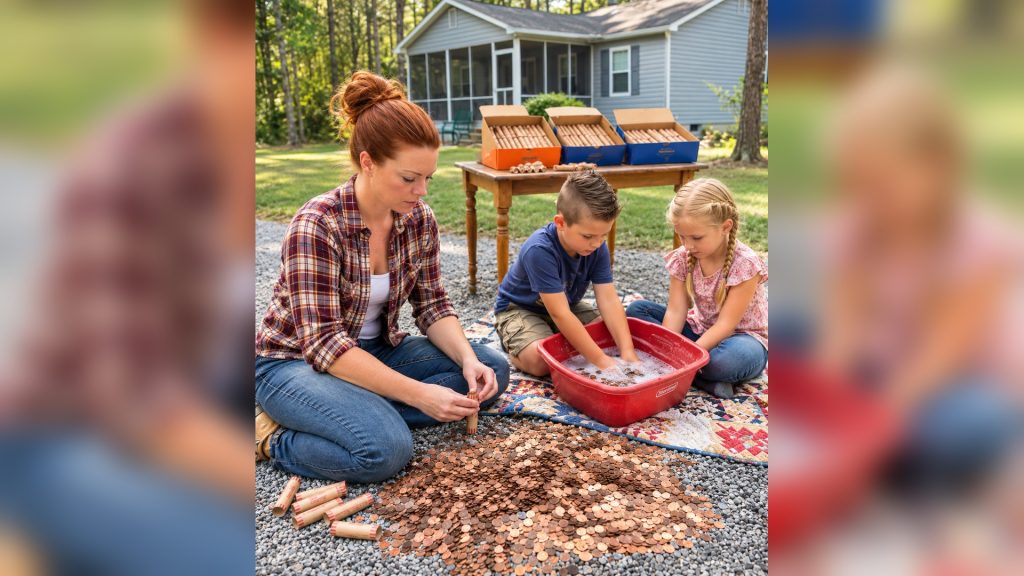
We cleaned the pennies.
Counted them.
And wrapped them into 1,830 rolls.
When Noah suggested using the money to help children whose school lunch accounts were overdue, we donated the full $915 to Washington Elementary.
The school used $908.40 to clear the balances of twenty-three children and applied the remaining $6.60 toward future meal assistance.
I thought that would be the end of the story.
Instead, it was the beginning.
Dale looked toward Mrs. Fogle.
“Your mother’s name was Eleanor?”
She nodded.
“Eleanor Watkins.”
His lips trembled.
“I remember her.”
Mrs. Fogle smiled sadly.
“She worked in the school cafeteria for thirty-seven years.”
Dale stared at the faded photograph.
“I was eleven when my dad walked out.”
He swallowed.
“My mother was working two cleaning jobs. We didn’t have enough for groceries most weeks.”
Mrs. Fogle listened quietly.
Dale continued.
“I used to pretend I wasn’t hungry because I was embarrassed.”
His voice cracked.
“One day Eleanor saw me sitting alone while everybody else ate.”
He rubbed his eyes.
“She brought me a tray.”
I watched him.
“She told me someone had paid for it.”
Mrs. Fogle’s eyes filled.
Dale laughed bitterly.
“I found out later it was her.”
He stared at the letter again.
“She kept helping me until Mom got back on her feet.”
Mrs. Fogle nodded.
“That sounds like her.”
Dale covered his mouth.
“I used to promise myself that when I became successful, nobody would ever make me feel that poor again.”
I looked at him.
“And somewhere along the way, you started making other people feel small instead.”
He closed his eyes.
“Yes.”
For several minutes, nobody spoke.
Then Dale reached for the coffee can.
He pushed it toward Mrs. Fogle.
“There are eighteen hundred nickels in here.”
She looked at him.
“Nine hundred dollars?”
He nodded.
“I counted them last night.”
His face crumpled.
“When I saw what Becky and her kids had done, I couldn’t sleep.”
Mrs. Fogle touched the can.
“Mr. Heckert, we appreciate your intention, but donations must go through the school’s approved procedures.”
He nodded.
“Of course.”
Then he looked at me.
“Becky, I know this doesn’t fix anything.”
I took a breath.
“No, it doesn’t.”
He swallowed.
“But I want to start somewhere.”
I sat down across from him.
“Then start by telling the truth.”
He looked up.
“About what?”
“About why you paid me that way.”
His eyes filled.
For a moment, I thought he’d become defensive again.
Instead, he stared at his hands.
“Because you were leaving.”
I nodded.
“I know that part.”
He swallowed.
“You were good at your job.”
I blinked.
In six years, Dale had almost never said those words.
He continued.
“You knew where everything was. You remembered the customers. You solved problems before I even knew they existed.”
My throat tightened.
He looked down.
“And when you told me you were leaving, I realized how much I depended on you.”
I waited.
“So I got angry.”
His voice cracked.
“I wanted you to feel as powerless as I felt.”
I leaned back.
“Dale, accepting another job wasn’t an attack on you.”
He nodded.
“I know.”
“It was a decision about my family.”
“I know.”
“And you responded by humiliating me in front of my children.”
Tears ran down his cheeks.
“Yes.”
I looked toward the coffee can.
“You remember how it felt to be poor and embarrassed?”
He nodded.
“Every day.”
“Then you should have recognized what you were doing to me.”
He covered his face.
“I should have.”
I didn’t forgive him that morning.
I wasn’t ready.
And I wasn’t going to pretend one emotional conversation erased six years of disrespect.
But I did something I hadn’t expected.
I listened.
Not because Dale deserved special treatment.
But because I remembered how much I had wanted people to listen when I was the one being humiliated.
Before leaving the office, I asked Principal Harris a question.
“What happens with the complaints?”
He answered carefully.
“The labor agency will handle its own investigation. The school isn’t involved in that process.”
I nodded.
“That makes sense.”
Dale looked at me.
“Becky, are you one of the people who complained?”
I shook my head.
“Not yet.”
His expression changed.
I continued.
“But I intend to ask the agency whether my final payment complied with wage requirements.”
He nodded slowly.
“Okay.”
I looked him directly in the eyes.
“And if they ask me what happened, I’ll tell them.”
Dale swallowed.
“You should.”
I left the school feeling strangely exhausted.
The parking lot was quiet.
A cold Wisconsin wind pushed dry leaves across the pavement.
I sat inside my car for several minutes before starting the engine.
My phone buzzed.
Aaron.
I answered.
“Hey.”
His voice sounded concerned.
“Did you see Dale?”
“Yes.”
“What happened?”
I stared through the windshield.
“He cried.”
Aaron was silent.
Then he asked, “About what?”
I took a breath.
“His childhood. A cafeteria worker who used to feed him. The donation.”
Aaron sighed.
“And?”
“The labor office is investigating complaints at the shop.”
Another silence.
Then Aaron said, “Becky, are you okay?”
I closed my eyes.
“I don’t know.”
When I reached home, Noah was sitting at the kitchen table doing homework.
Lily was coloring beside him.
Aaron stood at the stove making grilled cheese sandwiches.
The ordinary warmth of our little kitchen almost made me cry.
Noah looked up.
“Mom!”
I smiled.
“Hi, buddy.”
He pushed his chair back.
“Did Mr. Heckert really go to school?”
I nodded.
“Yes.”
“Was he mad?”
I hesitated.
“No. He was upset about some things he’d done.”
Noah frowned.
“Like the pennies?”
“Yes.”
He looked down.
Then asked, “Did he say sorry?”
I smiled gently.
“He did.”
Noah considered.
“Did you forgive him?”
The question caught me off guard.
I pulled out a chair and sat beside him.
“Not yet.”
He looked surprised.
“But he said sorry.”
I nodded.
“And apologizing is important.”
I took his hand.
“But when someone hurts you, you don’t have to pretend everything is okay immediately.”
He thought about that.
Then asked, “What does he have to do?”
I smiled sadly.
“He has to show that he understands what he did and make better choices.”
Lily looked up from her coloring book.
“Mommy?”
“Yes, sweetheart?”
“Is Mr. Heckert going to throw more pennies?”
Aaron stopped moving at the stove.
My throat tightened.
I reached for her.
“No, honey. We’re making sure that doesn’t happen again.”
She leaned into me.
“Good.”
Then she whispered, “I didn’t like when he yelled.”
I hugged her tightly.
“I know.”
That evening, after the children were asleep, Aaron and I sat together on the couch.
He rubbed his forehead.
“I still want to tell Dale exactly what I think of him.”
I laughed weakly.
“You’ve told me that about twenty times.”
He smiled.
“Probably more.”
Then his expression softened.
“Becky, you worked hard for that paycheck.”
I nodded.
“We could’ve used the money.”
“I know.”
He looked at me.
“But I’m proud of what you and the kids did.”
My eyes filled.
“Thank you.”
He took my hand.
“I just don’t want you thinking you have to turn every cruel thing someone does into something beautiful.”
I stared at him.
He continued.
“Sometimes you’re allowed to be angry.”
I began crying.
Because for days, everyone had praised our generosity.
They called me kind.
Selfless.
Inspirational.
But very few people had acknowledged how humiliating the experience had been.
I had earned those wages.
I had been treated cruelly.
And I had chosen to donate the money.
All three things were true.
Aaron pulled me close.
“You don’t have to be everybody’s hero, Beck.”
I rested my head against his shoulder.
“I know.”
He kissed my forehead.
“You just have to be yourself.”
Two days later, an investigator from the state labor agency contacted me.
Her name was Susan Mercer.
She spoke calmly and explained that she was reviewing complaints involving Heckert Auto & Diesel.
She asked whether I’d be willing to provide a statement about my final wages.
I agreed.
We arranged an interview.
Susan didn’t ask whether Dale was a bad person.
She asked for facts.
My pay rate.
My final working date.
The amount owed.
The pay stub attached to the bucket.
How the pennies were delivered.
Whether I’d been able to use the wages promptly.
And whether Dale had made statements indicating the payment was intended to punish me for resigning.
I answered carefully.
I also provided photographs Aaron had taken after Dale left.
The driveway covered in coins.
The oily residue.
The buckets.
And the pay stub.
Susan examined everything.
Then said, “Thank you, Mrs. Lindahl.”
I nodded.
“Will I have to give the money back?”
She looked at me.
“What do you mean?”
“The pennies. We donated them.”
Susan explained that the agency would evaluate the payment under the applicable wage laws and that my charitable donation was a separate matter.
She didn’t promise an outcome.
She didn’t declare every unusual payment automatically illegal.
But she made one thing clear.
An employer couldn’t simply avoid wage obligations by inventing humiliating conditions and assuming the employee had no recourse.
Before the interview ended, Susan asked another question.
“During your employment, did you ever notice problems with wage records?”
I hesitated.
Because I had.
For years, I had quietly noticed things that bothered me.
Mechanics working through lunch breaks.
Employees staying late to finish repairs.
Younger workers unsure whether all their hours appeared on their paychecks.
Sometimes Dale would tell someone he’d adjust the next check.
Sometimes he did.
Sometimes nobody followed up.
I hadn’t managed payroll.
And I didn’t know every employee’s hours.
But I remembered conversations.
I told Susan what I personally knew.
She listened.
Then asked me to identify any records or witnesses who might help clarify the situation.
When the interview ended, I sat in my car thinking about my six years at the shop.
I remembered the laughter.
The busy Saturdays.
The customers who brought us homemade cookies.
The mechanics who helped one another when a repair became difficult.
But I also remembered the fear.
The way people lowered their voices whenever Dale entered the room.
The way he called employees ungrateful for asking about pay.
And the way some workers apologized for needing time off to care for sick children.
I had spent six years believing that was simply how the shop operated.
Now I wondered how many people had been hurt by things we’d all learned to tolerate.
The first employee to contact me was Marcus Delgado.
Marcus was forty-two and had worked at Heckert Auto for nine years.
He was one of the most experienced diesel mechanics in town.
When he called, his voice sounded nervous.
“Becky?”
“Marcus?”
“Hey.”
I smiled.
“How are you?”
He sighed.
“Been better.”
My stomach tightened.
“What happened?”
There was a pause.
Then he said, “I heard you spoke to the labor investigator.”
I nodded.
“Yes.”
He swallowed.
“I did too.”
Marcus explained that he’d been keeping his own records of hours worked for several months.
He believed certain overtime hours hadn’t been included correctly.
At first, he’d assumed it was a clerical mistake.
But after raising the issue repeatedly, he became concerned.
“I’ve got two kids,” he said.
My chest tightened.
“I know.”
“My wife works at the hospital, but we still have bills.”
I listened.
“And Dale kept saying he’d fix everything next time.”
Marcus sighed.
“After a while, I stopped asking.”
I looked down.
“Why?”
His voice broke.
“Because I thought he’d fire me.”
I closed my eyes.
For years, I’d understood Dale’s temper.
But hearing Marcus explain the fear behind his silence made me realize how much damage that temper had done.
“Marcus, I’m glad you spoke to the investigator.”
He was quiet.
Then said, “Your pennies got everybody talking.”
My throat tightened.
He continued.
“I figured if you could stand up to him, maybe I could too.”
I stared at the wall.
“Marcus, I didn’t know you were dealing with all that.”
He sighed.
“Most people didn’t.”
Over the following weeks, other employees provided information.
Some described pay discrepancies.
Others raised questions about deductions or final checks.
A few said they had been pressured not to record certain hours.
The investigator reviewed payroll records, timesheets, and other evidence.
Not every complaint was substantiated exactly as submitted.
Some discrepancies had innocent explanations.
Others were more serious.
The inquiry wasn’t about proving Dale was evil.
It was about determining what had happened and ensuring employees received what they were legally owed.
Meanwhile, Dale made an unexpected decision.
He hired an independent payroll specialist.
He also retained an attorney experienced in employment matters.
Instead of calling employees to threaten them, he was advised to preserve records and cooperate with the investigation.
That didn’t erase past behavior.
But it was a necessary step.
One morning, he called me.
I almost ignored it.
Then I answered.
“Hello, Dale.”
His voice was quiet.
“Becky.”
“What do you need?”
A pause.
“I wanted you to know I hired someone to review our payroll practices.”
I nodded.
“That’s good.”
He swallowed.
“And I told the employees they could speak honestly to the investigator.”
I looked toward my kitchen window.
“That’s what they should be able to do.”
“I know.”
Then he said, “I didn’t understand how frightened they were of me.”
My throat tightened.
“Dale, they were frightened because of how you treated them.”
He didn’t argue.
“Yes.”
We were quiet for a moment.
Then he asked, “How are the kids?”
I looked toward the living room.
Noah and Lily were building a blanket fort.
“They’re good.”
He swallowed.
“Tell them I’m sorry.”
I took a breath.
“Dale, if you ever apologize to them, it needs to be handled carefully and only if they want that.”
He nodded.
“Of course.”
I continued.
“They shouldn’t have to comfort you because you feel guilty.”
His voice cracked.
“I understand.”
That was the first time I noticed a real change.
Dale wasn’t asking me to reassure him.
He wasn’t demanding forgiveness.
He was beginning to accept that the people he’d hurt had their own feelings, needs, and boundaries.
A month later, Mrs. Fogle invited Noah, Lily, Aaron, and me to a school assembly.
We didn’t know what to expect.
When we arrived, the cafeteria was decorated with paper snowflakes.
A banner hung across the stage.
KINDNESS BEGINS WITH US
Students sat in rows.
Teachers stood near the walls.
Principal Harris stepped to the microphone.
He thanked the community for supporting the school’s meal assistance program.
Then he explained that several families had made additional contributions after hearing about the pennies.
Some gave five dollars.
Others gave twenty.
A retired teacher donated fifty.
A local grocery store contributed food assistance.
And a neighborhood church organized a fundraiser.
Mrs. Fogle stepped forward.
Her eyes were bright.
“Because of the generosity shown by so many people, we’ve been able to provide additional support for families who need it.”
The room applauded.
I held Noah’s hand.
Lily leaned against Aaron.
Mrs. Fogle continued.
“But today, I want to recognize two children whose compassion reminded our community that kindness isn’t measured by age.”
My stomach tightened.
She smiled toward us.
“Noah and Lily Lindahl.”
Noah stared at me.
“Mom?”
I smiled through tears.
“It’s okay, buddy.”
He looked nervous.
Lily whispered, “Do we have to talk?”
Aaron knelt beside her.
“No, sweetheart. You can just wave if you want.”
The children walked onto the stage together.
Noah held Lily’s hand.
Mrs. Fogle gave them each a certificate.
Then she leaned toward the microphone.
“Noah, would you like to say something?”
He looked toward us.
I nodded encouragingly.
He swallowed.
Then whispered, “We just wanted everybody to have lunch.”
The cafeteria went completely quiet.
My eyes filled.
Noah continued.
“Because it’s hard to learn when you’re hungry.”
A teacher covered her mouth.
“And nobody should get laughed at because they don’t have money.”
I began crying.
Lily stepped closer to the microphone.
Then announced, “And pennies are really hard to wash.”
The entire room burst into laughter.
Even Mrs. Fogle laughed through tears.
After the assembly, Principal Harris approached us.
“Becky, I wanted you to know something.”
I smiled.
“What?”
He handed me a folder.
Inside were thank-you notes from several families who had received assistance.
The school had protected the children’s privacy, so no one had been publicly identified as owing lunch money.
But some parents had voluntarily written messages.
I opened the first card.
Thank you for helping my daughter. I was behind after missing work when my mother became sick. Your kindness gave us breathing room.
My throat tightened.
The second note read:
My son came home smiling because he didn’t have to worry about his lunch account. Thank you.
I covered my mouth.
Aaron wrapped an arm around me.
Then I opened the third.
It was written in shaky handwriting.
Dear Noah and Lily, thank you for thinking about kids like me. I hope someday I can help somebody too.
I started crying so hard I couldn’t finish reading.
Because those ninety-one thousand five hundred pennies had once represented humiliation.
Now they represented relief.
Not enough to solve every family’s problems.
Not enough to change the whole world.
But enough to make twenty-three children feel a little less alone.
As we were leaving, Mrs. Fogle touched my arm.
“Becky, there’s something I’d like to show you.”
She led us to a small display near the cafeteria entrance.
Inside a clear case sat one shiny penny.
Beside it was a copy of a quotation from her mother’s letter.
Kindness isn’t a debt to repay once. It’s a choice to make every day.
Mrs. Fogle smiled.
“We wanted to honor Mom.”
My eyes filled.
“It’s beautiful.”
She looked toward Noah.
“Your idea helped us remember something important.”
He smiled shyly.
Then asked, “Did your mom really buy lunch for kids?”
Mrs. Fogle nodded.
“For many years.”
Noah looked at the penny.
Then whispered, “I think she was really nice.”
Mrs. Fogle began crying.
“She was, sweetheart.”
That evening, I received a letter from Dale.
It arrived in a plain white envelope.
His handwriting was unmistakable.
Large.
Uneven.
And pressed so hard into the paper that some letters left marks on the back.
I sat at the kitchen table and opened it.
Becky,
I have spent most of my life believing that nobody respected me unless I made them afraid of me.
When I was young, being poor felt like carrying a sign that told everyone I didn’t matter.
I promised myself I would become successful enough that nobody could humiliate me again.
But somewhere along the way, I became the kind of person I used to fear.
I treated employees as if paying their wages gave me ownership over their lives.
I mistook loyalty for obedience.
And when you left for a better opportunity, I punished you because I couldn’t stand feeling rejected.
What I did to you was cruel.
You earned that paycheck.
You deserved to receive it properly and respectfully.
I am sorry that your children had to see me behave that way.
I have begun addressing the payroll problems, and I intend to follow the required process regardless of what the investigation finds.
I don’t expect you to forgive me.
But I want you to know that the pennies taught me something I should have learned thirty years ago.
Eleanor fed a hungry boy because she believed he mattered.
Your children helped hungry students because they believed those children mattered.
And I used the same kind of coins to tell you that you didn’t matter.
I am ashamed of that.
Thank you for refusing to become cruel in return.
Dale.
I read the letter twice.
Then I placed it beside the school thank-you notes.
For a long time, I sat quietly.
Aaron found me there.
He looked at the letter.
“From Dale?”
I nodded.
He sat beside me.
“Good or bad?”
I considered.
“Different.”
He raised an eyebrow.
“How?”
I handed him the paper.
He read it slowly.
Then leaned back.
“Well.”
I looked at him.
“What?”
He sighed.
“That’s more self-awareness than I ever expected from Dale Heckert.”
I laughed softly.
“Me too.”
Then Aaron’s expression became serious.
“Does it change how you feel?”
I looked down.
“A little.”
He nodded.
“But it doesn’t erase what he did.”
“No.”
“And you don’t owe him anything because he apologized.”
I smiled.
“I know.”
The labor investigation continued.
Eventually, the agency identified wage and recordkeeping issues requiring correction.
Dale’s business entered into the applicable compliance and payment arrangements for the substantiated violations.
Affected employees received amounts determined to be owed through the proper process.
The business also changed its timekeeping procedures.
Employees received clearer pay statements.
Managers were trained on wage requirements.
And payroll responsibilities were separated from Dale’s personal moods.
The agency also addressed the circumstances of my final wage payment.
The fact that Dale had attached a pay stub to buckets of coins did not automatically resolve whether his wage obligations had been satisfied in a lawful and timely manner.
The form of payment, the condition of the coins, and the surrounding circumstances were examined under the relevant rules.
The matter was resolved through the agency’s process, including any amounts and corrective steps determined to be necessary.
My donation to the school remained entirely separate.
The twenty-three children’s lunch balances stayed cleared.
And I never regretted that decision.
Not everyone believed Dale had changed.
Some former employees refused to return.
Others accepted the wage corrections but wanted no further contact.
A few said his apologies were too late.
I understood them.
Change didn’t require everyone he’d hurt to reconcile with him.
And forgiveness wasn’t something employees owed their former boss.
Marcus eventually left Heckert Auto.
He accepted a position at another diesel repair facility.
When he told me, I congratulated him.
He laughed.
“Feels strange.”
“What does?”
“Leaving after nine years.”
I nodded.
“I understand.”
He was quiet.
Then said, “Dale actually shook my hand.”
I smiled faintly.
“Really?”
“Yeah.”
Marcus chuckled.
“He told me he hoped the new place treated me well.”
I considered.
“That sounds like progress.”
Marcus sighed.
“Maybe.”
Then he added something important.
“But I’m still glad I left.”
I smiled.
“You’re allowed to be.”
Meanwhile, Dale began spending time volunteering with a local community meal program.
At first, I wondered whether he was doing it for publicity.
After all, the story had made him look terrible.
His business reputation had suffered.
Customers had asked questions.
People who once admired his wealth now criticized his treatment of employees.
But over time, something unusual happened.
He stopped telling people about his volunteer work.
He simply showed up.
Mrs. Fogle told me about it months later.
We were standing outside the school after a parent meeting.
“Have you heard about Dale?”
I smiled.
“Not recently.”
She nodded toward the community center across town.
“He’s been helping with the Saturday meal service.”
I raised an eyebrow.
“Really?”
“Yes.”
I hesitated.
“Does everybody know?”
Mrs. Fogle smiled.
“Not really. He asked them not to put his name in the newsletter.”
That surprised me.
She continued.
“He washes dishes.”
I stared at her.
“Dale Heckert?”
She laughed.
“Yes.”
“The man who once told me washing dishes was a waste of a skilled employee’s time?”
Mrs. Fogle smiled.
“That man.”
I shook my head.
Then laughed.
Life had a strange way of bringing people back to lessons they’d refused to learn.
One Saturday, several months later, Noah asked whether we could volunteer at the community meal program.
He’d heard about it from a classmate.
“Mom, can we help make sandwiches?”
I smiled.
“Sure.”
Lily jumped up.
“I want to help too!”
Aaron laughed.
“Looks like we’re all going.”
When we arrived, the community center was busy.
Volunteers arranged tables.
Someone stirred soup in a large pot.
A retired couple stacked plates.
And several teenagers filled paper bags with fruit.
Then I saw Dale.
He stood near a sink wearing a faded blue apron.
His sleeves were rolled up.
His hands were covered in soap.
He was washing metal trays.
For a moment, I simply stared.
Six months earlier, this man had driven to my home with buckets of dirty pennies because he wanted to humiliate me.
Now he was quietly washing dishes for people who needed a meal.
He looked up.
Our eyes met.
He froze.
“Becky.”
I nodded.
“Dale.”
He looked toward Aaron.
Then the children.
His face softened.
“Hello, Noah. Hello, Lily.”
Noah stepped closer to me.
Lily hid behind Aaron.
Dale noticed.
He didn’t approach them.
Instead, he said gently, “I’m glad you’re here.”
I nodded.
“We came to help.”
He smiled faintly.
“There’s plenty to do.”
We worked for three hours.
Aaron helped carry supplies.
I assembled meal boxes.
Noah placed fruit into bags.
Lily helped arrange napkins.
Dale continued washing dishes.
He didn’t ask me to praise him.
Didn’t mention his letter.
And didn’t make a speech about how much he’d changed.
When we finished, he approached me carefully.
“Becky?”
I looked up.
“Yes?”
“Can I say something?”
I hesitated.
“Okay.”
He swallowed.
“I don’t want you to think I’m doing this because of the article.”
I studied him.
“Then why are you doing it?”
He looked toward the volunteers.
“Because I should have been doing things like this years ago.”
His eyes filled.
“And because when I was hungry, somebody fed me.”
I nodded slowly.
“That sounds like a good reason.”
He looked relieved.
Then he glanced toward Noah.
“Your boy had a good idea.”
I smiled.
“He did.”
Dale swallowed.
“I hope he keeps that kindness.”
My throat tightened.
“Me too.”
Before we left, Noah approached Dale.
I watched carefully.
Dale crouched slightly so he wasn’t towering over him.
Noah looked nervous.
“Mr. Heckert?”
“Yes?”
“Are you still mad at my mom?”
Dale’s expression crumpled.
“No, Noah.”
My son considered.
“Then why were you mad before?”
Dale looked toward me.
I nodded gently, giving him permission to answer honestly.
He took a breath.
“Because I was selfish.”
Noah frowned.
“What does that mean?”
Dale swallowed.
“It means I was thinking about what I wanted instead of how my actions would hurt other people.”
Noah looked down.
Then asked, “Are you going to do that again?”
Dale’s eyes filled.
“I’m working very hard not to.”
Noah considered.
Then said, “Mom says saying sorry is important, but you have to act better too.”
Dale smiled through tears.
“Your mom is right.”
Noah nodded.
Then walked back to me.
It wasn’t a magical reconciliation.
My son didn’t hug Dale.
Lily didn’t suddenly stop feeling afraid of him.
And I didn’t tell them they had to forgive him.
But they had seen an adult admit he was wrong without making excuses.
That mattered.
Over the next year, our family’s life became quieter.
My new job was going well.
I worked at a regional parts distribution company with organized inventory systems, predictable scheduling, and benefits that made a real difference for us.
My manager, Sharon Collins, treated employees respectfully.
When my children were sick, she didn’t accuse me of lacking commitment.
When I suggested improvements to our ordering process, she listened.
And when I stayed late to solve a problem, my hours were recorded properly.
One afternoon, Sharon called me into her office.
“Becky, do you have a minute?”
I nodded.
“Of course.”
She smiled.
“I’ve been reviewing the inventory system improvements you suggested.”
My stomach tightened.
“Is something wrong?”
She laughed.
“No.”
I relaxed.
She continued.
“You’ve reduced ordering errors and improved turnaround times.”
I blinked.
“Thank you.”
She folded her hands.
“We’d like to promote you to inventory operations supervisor.”
For a moment, I couldn’t speak.
Then I whispered, “Really?”
Sharon smiled.
“Really.”
I went home that evening and told Aaron.
He picked me up and spun me around the kitchen.
I burst out laughing.
“Aaron!”
He grinned.
“That’s my wife!”
Noah came running.
“What’s happening?”
Lily followed.
“Is it somebody’s birthday?”
I laughed.
“No, sweetheart.”
Aaron set me down.
“Mom got a promotion.”
Noah’s eyes widened.
“Does that mean she’s the boss?”
I smiled.
“Not exactly.”
Lily clapped.
“Yay, Mommy!”
We celebrated with homemade pizza and chocolate cake.
Nothing expensive.
Nothing elaborate.
Just our family laughing around the kitchen table.
And I realized how much I had needed a workplace where my efforts were recognized without being used to control me.
The school lunch program continued growing too.
Washington Elementary established a more organized assistance fund supported by voluntary donations and community partnerships.
Mrs. Fogle worked with administrators to make sure families could seek help privately.
The school also reviewed how children were treated when meal balances became overdue.
The goal was simple.
No child should be publicly humiliated because of a financial problem beyond their control.
One afternoon, Mrs. Fogle called with wonderful news.
“Becky, the fund has received enough support to help families through the winter.”
I smiled.
“That’s amazing.”
She laughed.
“And Noah’s little speech is still being quoted around here.”
I grinned.
“Oh, no.”
She chuckled.
“Teachers keep reminding students that it’s hard to learn when you’re hungry.”
My eyes filled.
I looked toward the living room.
Noah was helping Lily with a puzzle.
He had no idea how far his simple suggestion had traveled.
But the biggest surprise came the following spring.
Mrs. Fogle invited us to a special school event honoring the memory of Eleanor Watkins.
Her family had established a small annual community service award in Eleanor’s name.
The award recognized students who showed compassion through practical action.
When we arrived, the gymnasium was decorated with handmade paper flowers.
A photograph of Eleanor stood beside the stage.
She wore a white cafeteria apron and smiled warmly.
Mrs. Fogle stepped to the microphone.
“My mother believed that nobody should feel ashamed for needing help.”
The room grew quiet.
“She didn’t have much money herself.”
Mrs. Fogle’s voice trembled.
“But she believed a meal could make a child feel seen.”
She looked toward Dale, who sat quietly near the back.
“And years ago, she helped a little boy who was embarrassed because his family couldn’t afford lunch.”
Dale lowered his head.
Tears filled his eyes.
Mrs. Fogle continued.
“Decades later, that boy made choices he deeply regretted.”
The room was silent.
“But another family responded to one of those choices with compassion.”
She smiled toward us.
“And that compassion reminded him of something he’d forgotten.”
Then she announced the first recipients of the Eleanor Watkins Kindness Award.
“Noah and Lily Lindahl.”
My children stared at each other.
Noah looked stunned.
Lily whispered, “Again?”
I laughed through tears.
Aaron squeezed my hand.
The children walked onto the stage.
Mrs. Fogle presented them with a framed certificate and a small book about community service.
Then she leaned toward Noah.
“Would you like to say anything?”
He looked out at the crowd.
For a moment, he seemed frightened.
Then he smiled.
“Sometimes people are mean.”
The room grew quiet.
He continued.
“But that doesn’t mean we have to be mean back.”
My throat tightened.
“And if you see somebody who needs help, maybe you should help them.”
The applause lasted a long time.
I cried.
Aaron cried.
Mrs. Fogle cried.
And near the back of the gymnasium, Dale Heckert covered his face with both hands.
After the ceremony, Dale approached us.
He looked older than he had a year earlier.
His hair was grayer.
His expression gentler.
“Becky.”
I smiled faintly.
“Hello, Dale.”
He looked toward the children.
“Congratulations.”
Noah smiled.
“Thank you.”
Lily held up her certificate.
“We got an award.”
Dale laughed softly.
“I see that.”
Then he looked at me.
“Eleanor would’ve loved this.”
My eyes filled.
“I think so too.”
We stood together quietly.
Then Dale said something unexpected.
“I sold the shop.”
I blinked.
“What?”
He nodded.
“Not because the business couldn’t continue. I realized I didn’t want to keep running it the way I had.”
My stomach tightened.
“What happened to the employees?”
He answered carefully.
“A local operator purchased it. The transition included provisions for the staff, though some people chose other jobs.”
I nodded.
He continued.
“I’ve been helping with technical training part-time.”
I raised an eyebrow.
“Teaching mechanics?”
He smiled.
“Mostly younger apprentices.”
I considered.
“How’s that going?”
He laughed sadly.
“I’m learning to be patient.”
I couldn’t help smiling.
“That must be interesting.”
He laughed.
“You have no idea.”
Then his expression became serious.
“Becky, there’s something I need to tell you.”
I waited.
“I’ve spent a lot of time thinking about the day I brought those pennies.”
My throat tightened.
He continued.
“I used to believe that paying someone gave me the right to treat them however I wanted.”
I shook my head gently.
“It never did.”
He nodded.
“I know.”
Then he said, “I thought I was teaching you a lesson.”
I stared at him.
“And instead?”
His eyes filled.
“You and your children taught me one.”
For a moment, I couldn’t speak.
Then I said quietly, “Dale, I hope you keep learning.”
He nodded.
“I will.”
That afternoon, as we drove home, Lily fell asleep in the back seat holding her certificate.
Noah stared out the window.
Then he asked, “Mom?”
I smiled.
“Yes?”
“Do you think Mr. Heckert is nice now?”
I considered.
“I think he’s trying to become kinder.”
Noah nodded.
“Can people really change?”
I looked toward Aaron.
He smiled faintly.
Then I answered.
“Yes, sweetheart. People can change.”
I paused.
“But it takes more than saying they want to.”
Noah thought about that.
Then asked, “Like practicing?”
I smiled.
“Exactly like practicing.”
A few months later, something happened that reminded me how complicated forgiveness could be.
I was shopping at the grocery store when a former employee from Heckert Auto approached me.
Her name was Teresa Miller.
She’d worked at the front counter for nearly four years before leaving.
“Becky?”
I smiled.
“Teresa!”
She hugged me.
“How are you?”
“Good,” I answered. “How about you?”
Her smile faded.
“Better now.”
My chest tightened.
She glanced toward her shopping cart.
Then said, “I heard you’ve been talking to Dale again.”
I hesitated.
“Occasionally.”
She nodded.
“I can’t do that.”
I looked at her.
“That’s okay.”
Her eyes filled.
“People keep telling me he’s changed.”
I listened.
“But he made me cry in that office so many times.”
My throat tightened.
She continued.
“He once told me I was useless because I made a mistake on an invoice.”
I closed my eyes.
“I remember.”
She looked down.
“And when I finally left, I spent months feeling like I wasn’t good at anything.”
I took her hand.
“Teresa, you don’t have to forgive him.”
Her eyes filled.
“Really?”
I nodded.
“You don’t owe him a relationship because he’s trying to be better.”
She began crying.
I continued.
“You can be glad he’s changing and still decide you don’t want him in your life.”
She squeezed my hand.
“Thank you.”
That conversation mattered to me.
Because I had begun to see Dale differently.
But I didn’t want my own experience to become another reason someone else felt pressured to ignore their pain.
Forgiveness could be meaningful.
So could distance.
And no apology gave a person the right to demand either one.
That evening, I told Aaron about Teresa.
He listened carefully.
Then said, “She’s right.”
I nodded.
“I know.”
He looked at me.
“You’ve been trying to see the good in Dale.”
I sighed.
“Maybe.”
He smiled gently.
“That’s not bad.”
I looked up.
“But don’t forget that some people are still healing from what he did.”
My eyes filled.
“I won’t.”
As time passed, the story of the pennies became something people in town remembered with surprising warmth.
At first, everyone had talked about Dale’s cruelty.
The greasy coins.
The humiliating delivery.
The photographs of our driveway.
But eventually, more people talked about Noah’s idea.
The twenty-three children whose lunch balances had been cleared.
The school assistance fund.
And Eleanor Watkins, the cafeteria worker whose kindness had reached into another generation.
One newspaper columnist wrote that the most remarkable part of the story wasn’t the unusual payment.
It was that a child had looked at a pile of money intended to hurt his mother and imagined using it to help somebody else.
I kept that article in a folder.
Not because I wanted publicity.
But because I wanted Noah and Lily to remember what they’d helped create.
One summer evening, we sat on our back porch.
Fireflies drifted above the grass.
Aaron grilled hamburgers.
Lily drew pictures with sidewalk chalk.
Noah sat beside me drinking lemonade.
“Mom?”
I smiled.
“Yes?”
“Do you ever wish we’d kept the pennies?”
I considered.
“Sometimes I think about what we could’ve bought.”
He nodded.
“Like a vacation?”
I laughed.
“Maybe.”
“A bigger television?”
“Probably not.”
He grinned.
Then he became serious.
“But are you glad we gave them away?”
I looked toward the yard.
“Yes.”
He smiled.
“Me too.”
I thought about our bills.
The groceries.
The car repairs we’d postponed.
The things Aaron and I had discussed buying with my final paycheck.
Donating the money had been a choice we made together after considering our circumstances.
We were fortunate that my new job and Aaron’s income allowed us to manage without those wages.
Not every family could have done that.
And I never wanted people to think generosity required sacrificing money they needed for essentials.
Sometimes kindness meant giving money.
Sometimes it meant giving time.
And sometimes it meant simply refusing to humiliate someone who was struggling.
Noah leaned against me.
“Mom?”
“Yes?”
“Do you think the kids remember?”
I smiled.
“Some might.”
He looked down.
“What if they don’t?”
I kissed the top of his head.
“Then the help still mattered.”
He thought about that.
Then smiled.
“Okay.”
Years passed.
Noah grew taller.
Lily lost her baby teeth.
Aaron and I celebrated another wedding anniversary.
My career continued developing.
And our family built a life filled with ordinary joys.
School concerts.
Birthday cakes.
Saturday pancakes.
Rainy afternoons.
And vacations that involved more driving than any of us wanted.
We still talked about the pennies occasionally.
Usually when someone found a coin on the sidewalk.
Lily would pick it up and grin.
“Mom, remember when we washed all those pennies?”
I laughed.
“How could I forget?”
She’d wrinkle her nose.
“They smelled terrible.”
Noah would shake his head.
“And it took forever.”
Aaron would grin.
“I’m still finding paper coin wrappers in the garage.”
But the memory changed over time.
It stopped being only about the day Dale humiliated me.
It became a story about how our family had responded.
How we’d worked together.
How my children had learned that money could be used for something beyond ourselves.
And how kindness could travel farther than anyone expected.
Five years after the donation, Washington Elementary invited us back for an anniversary event celebrating the school’s community meal assistance program.
Mrs. Fogle had retired by then.
But she returned for the occasion.
Her hair was almost completely white.
She moved a little more slowly.
Yet her smile was as warm as ever.
When she saw us, she opened her arms.
“Becky!”
I hugged her.
“Mrs. Fogle!”
She laughed.
“Still calling me that?”
I smiled.
“Always.”
The school cafeteria had changed.
The tables were newer.
The walls had been repainted.
And near the entrance hung a small framed display.
Inside was the same shiny penny.
Beside it was Eleanor’s message.
Kindness isn’t a debt to repay once. It’s a choice to make every day.
I stood before it.
For a moment, I couldn’t speak.
The principal approached.
“Becky, there’s something you should know.”
I turned.
He smiled.
“The meal assistance program has helped many more students since your donation.”
My eyes filled.
“That’s wonderful.”
He nodded.
“And several former students have returned to volunteer or contribute.”
I looked around.
He continued.
“One of them asked if he could speak with you.”
A young man approached.
He looked about seventeen.
Tall.
Nervous.
Wearing a blue shirt and jeans.
“Mrs. Lindahl?”
I smiled.
“Yes?”
He swallowed.
“My name is Ethan.”
“Hello, Ethan.”
He glanced toward Noah.
“I think we were in second grade together.”
Noah frowned.
Then his eyes widened.
“Ethan Parker?”
The young man smiled.
“Yeah.”
They shook hands awkwardly, both surprised by how much they’d grown.
Ethan looked toward me.
“I wanted to thank you.”
My chest tightened.
“For what?”
He swallowed.
“When I was little, my mom lost her job.”
I listened.
“We were behind on everything.”
His voice trembled.
“Sometimes I didn’t want to go to school because I was embarrassed about my lunch account.”
Noah looked down.
Ethan continued.
“Then one day, the balance was gone.”
My eyes filled.
He smiled nervously.
“I didn’t know who helped until later.”
For a moment, I couldn’t speak.
Ethan looked toward Noah.
“You probably don’t remember this, but you sat with me at lunch sometimes.”
Noah’s expression changed.
“I remember.”
Ethan smiled.
“You used to trade me your apple slices.”
Noah laughed.
“You always wanted the apples.”
Ethan grinned.
“Still do.”
Then Ethan looked at me.
“I’m graduating next spring.”
I smiled.
“Congratulations.”
He nodded.
“I want to study education.”
My throat tightened.
“That’s wonderful.”
He continued.
“I want to work with kids who don’t always have everything they need.”
My eyes filled.
He smiled.
“I guess I just wanted you to know that what your family did mattered.”
I began crying.
Not because I needed recognition.
But because I was standing in front of a young man whose childhood had been made a little easier by money once intended to humiliate me.
And now he wanted to help other children.
Noah stepped forward.
He looked at Ethan.
“I’m glad you had lunch.”
Ethan laughed through tears.
“Me too.”
Then they hugged.
And I felt something in my chest finally settle.
After the ceremony, I walked outside alone for a moment.
The school playground was empty.
A warm breeze moved through the trees.
I sat on a bench and thought about that terrible Friday years earlier.
The buckets.
The grease.
The sound of thousands of pennies striking the driveway.
Dale standing beside his truck.
His cruel smile.
And my children watching silently.
I remembered how small I’d felt.
How furious Aaron had been.
How exhausted we’d become while washing the coins.
And how Noah had looked at the growing stacks of penny rolls and asked whether we could help children who couldn’t afford lunch.
At the time, I thought his suggestion was sweet.
I hadn’t understood how much it would change us.
The donations helped children.
They inspired other people to give.
They reminded Dale of someone who’d helped him when he was young.
They contributed to difficult conversations about how employees should be treated.
And they helped me understand that responding with kindness didn’t require pretending cruelty was acceptable.
I could be generous and still defend my rights.
I could accept an apology without forgetting what happened.
I could recognize someone’s efforts to change without demanding that everyone forgive them.
And I could teach my children compassion while also teaching them to protect themselves.
The following Christmas, a card arrived in the mail.
The return address was unfamiliar at first.
Then I recognized the handwriting.
Dale Heckert.
I opened it.
Inside was a photograph.
Dale stood beside a group of young automotive apprentices in a workshop.
He was smiling.
Not the arrogant grin I remembered.
A quieter smile.
The kind people wore when they were genuinely happy to be included.
On the back, he’d written:
Becky,
I wanted you to know I’m still teaching.
Some days I’m better at it than others.
The apprentices ask a lot of questions, and I’m learning that listening is part of the job.
I hope you and your family are well.
Thank you for reminding me that people deserve respect whether they’re staying, leaving, learning, or starting over.
Dale.
I stood at the kitchen counter reading those words.
Then I smiled.
I didn’t feel the need to call him.
Didn’t feel obligated to write a long reply.
I simply placed the card beside our family photographs.
Because sometimes the best ending to a painful chapter wasn’t becoming close to the person who hurt you.
Sometimes it was knowing they were making better choices.
And then continuing your own life.
That evening, Aaron found me looking through our old photographs.
He sat beside me.
“What are you thinking about?”
I smiled.
“The pennies.”
He laughed.
“Again?”
I nodded.
“Again.”
He looked at a photograph of Noah and Lily standing beside the cleaned coin rolls.
Noah was grinning.
Lily held a paper wrapper.
I stood behind them wearing an old sweatshirt, looking exhausted.
Aaron smiled.
“They were so little.”
My eyes filled.
“They were.”
He looked at me.
“Do you remember how angry you were?”
I laughed softly.
“Very.”
He nodded.
“I was ready to drive those pennies back to Dale’s shop.”
“I remember.”
He grinned.
“You wouldn’t let me.”
I smiled.
“Nope.”
Then he became serious.
“I’m glad you didn’t.”
I looked at him.
“Me too.”
For a moment, we sat quietly.
Then Aaron said, “You know what I think the best part was?”
I smiled.
“What?”
He looked toward the living room, where Noah and Lily were laughing over a board game.
“Our kids saw somebody treat their mom badly.”
I nodded.
“And then they saw their mom refuse to treat somebody else badly just because she’d been hurt.”
My eyes filled.
Aaron continued.
“They also saw you stand up for yourself.”
I smiled through tears.
“That’s important too.”
He nodded.
“Very.”
Later that night, after the children had gone to bed, I took out the folder where I’d kept the old pay stub.
The paper was creased.
A faint oily stain remained near the corner.
Across the top was the name of the business where I’d spent six years.
HECKERT AUTO & DIESEL.
Near the bottom was the amount.
$915.00.
I stared at it.
For a long time, that pay stub had represented humiliation.
A reminder that someone with power over my livelihood had tried to make me feel insignificant.
But it no longer had that power.
It was evidence of what happened.
Nothing more.
The real value of those years couldn’t be captured by a greasy document.
I’d learned skills.
Built friendships.
Supported my family.
And discovered that I deserved to work somewhere I was respected.
I placed the pay stub back in the folder.
Then I looked at Eleanor’s message, which I’d printed and hung beside our family calendar.
Kindness isn’t a debt to repay once. It’s a choice to make every day.
I smiled.
Because I understood something I hadn’t fully understood when we first cleaned those coins.
Kindness wasn’t the absence of anger.
It wasn’t allowing people to mistreat you.
And it wasn’t refusing to hold someone accountable.
Kindness was choosing not to spread unnecessary suffering.
It was recognizing another person’s dignity.
It was being willing to help when you could.
And it was remembering that every person had a story you might not know.
Dale had once been a hungry little boy sitting alone in a school cafeteria.
Eleanor had seen him.
She hadn’t asked whether he deserved lunch.
She hadn’t demanded that he prove his gratitude.
She simply helped.
Years later, that frightened boy became a wealthy business owner who forgot what humiliation felt like when he was the one causing it.
But another child reminded him.
My son.
Eight years old.
Standing beside thousands of dirty pennies.
Asking whether we could use the money to help children eat.
Sometimes I wonder what Eleanor would have thought if she’d known how far her small act of kindness would travel.
Maybe she would have smiled.
Maybe she’d have cried.
Or maybe she’d have shrugged and said she’d only done what anyone should have done.
But the truth was, not everyone would have done it.
And that was why her choice mattered.
I didn’t become wealthy from the story.
I didn’t receive a television contract.
I didn’t turn the pennies into a business.
And I didn’t spend the rest of my life being celebrated as some extraordinary woman.
I went to work.
Raised my children.
Paid bills.
Made mistakes.
Apologized when I was wrong.
And tried to be kind when life gave me the opportunity.
The story wasn’t important because I was special.
It mattered because ordinary people made choices that changed other ordinary people’s lives.
A cafeteria worker fed a hungry boy.
A mother refused to retaliate against her former employer.
Two children helped clean thousands of pennies.
A school used the money to support struggling families.
Neighbors contributed what they could.
Employees spoke up about their wages.
And one angry businessman began confronting the harm he’d caused.
None of it happened all at once.
There wasn’t a magical moment when everybody became good.
Change was slower.
Messier.
More uncomfortable.
It required honesty.
Consequences.
And the willingness to make different choices after the attention faded.
When Noah was older, he asked me about the story again.
We were sitting outside on a summer evening.
He was seventeen then, almost ready to leave for college.
“Mom?”
I looked up.
“Yes?”
“Do you think we actually changed Mr. Heckert?”
I considered.
“Noah, I think what we did helped him recognize something he’d forgotten.”
He nodded.
“But he had to decide what to do afterward.”
My son smiled faintly.
“So we didn’t fix him.”
I laughed softly.
“No.”
I looked at him.
“People aren’t projects we can fix.”
He considered.
“Then what did we do?”
I smiled.
“We showed him another way to respond.”
Noah sat quietly.
Then said, “I still think about the kids who needed lunch.”
I nodded.
“Me too.”
He looked toward the stars.
“I’m glad we helped.”
My throat tightened.
“So am I.”
A few weeks later, Noah left for college.
Before he went, he handed me a small gift wrapped in blue paper.
I smiled.
“What’s this?”
He shrugged.
“Open it.”
Inside was a little wooden frame.
At the center sat one polished penny.
Beneath it were the words:
One small choice can travel farther than we imagine.
My eyes filled.
“Noah.”
He grinned.
“Lily helped me make it.”
I hugged him.
“It’s beautiful.”
He smiled.
“Thought you should have one penny back.”
I laughed through tears.
Then held the frame against my chest.
That single penny became one of my favorite possessions.
Not because it was valuable.
But because it reminded me that the worth of something couldn’t always be measured by its price.
Years earlier, Dale Heckert had stood in my driveway and told me to count my wages myself.
He wanted the task to embarrass me.
He wanted me to feel powerless.
He wanted my children to see him as the person who controlled whether their mother received what she’d earned.
But he misunderstood something.
He could decide how to behave.
He couldn’t decide what kind of person I would become in response.
The day he dumped those pennies, he thought he’d delivered humiliation.
Instead, he gave my children an opportunity to practice compassion.
He gave our family a difficult experience that brought us closer together.
And through our decision, he was eventually confronted with a memory of the woman who’d once shown him kindness when he had almost nothing.
I never thanked Dale for humiliating me.
I didn’t need to.
Cruelty didn’t become acceptable simply because something meaningful followed it.
The good came from what we chose to do afterward.
Not from the harm he caused.
And that was the lesson I wanted Noah and Lily to remember.
You cannot always control whether someone treats you fairly.
You cannot guarantee that your employer, neighbor, or even someone you love will behave with kindness.
But you can protect your dignity.
You can seek help.
You can insist on accountability.
And when it’s safe and possible, you can choose not to pass the hurt along.
Some days, kindness looks like a large donation.
Other days, it looks like a quiet apology.
Sometimes it’s a meal.
Sometimes it’s a listening ear.
Sometimes it’s a worker finally receiving the wages they’ve earned.
And sometimes it’s a child noticing that another child is hungry.
When I look at the framed penny on my desk now, I don’t hear Dale’s cruel laughter anymore.
I hear Noah asking, “Mom, could we help the kids who can’t afford lunch?”
I hear Lily giggling because the pennies smelled terrible.
I hear Aaron telling me I didn’t have to turn every painful experience into something beautiful.
And I hear Mrs. Fogle reading her mother’s words through tears.
That single penny reminds me that dignity is not something a boss can take away.
That generosity doesn’t require wealth.
And that a person’s past can explain their behavior without excusing the harm they cause.
Dale’s childhood helped me understand his cruelty.
It didn’t justify it.
His apology mattered.
His efforts to correct wage problems mattered more.
And his continued willingness to treat people differently mattered most of all.
As for me, I learned that forgiveness didn’t have to mean forgetting.
I could move forward without carrying bitterness into every new day.
I could be grateful for the good that came from the pennies while remembering that I deserved to receive my paycheck respectfully.
And I could teach my children that compassion and self-respect belonged together.
The ninety-one thousand five hundred pennies were worth exactly $915.
That was the amount I’d earned.
The amount Dale tried to use to humiliate me.
And the amount our family chose to donate.
But no amount of money could fully measure what followed.
Twenty-three children had their lunch debts cleared.
Other families received help.
Workers found the courage to question unfair practices.
A former employer began confronting his mistakes.
And two children learned that even something as small as a penny could become part of something meaningful.
In the end, Dale Heckert had wanted me to count every coin.
So we did.
We counted them.
Cleaned them.
Wrapped them.
And gave them away.
But the thing I remember most isn’t the number of pennies.
It’s the number of lives those pennies touched.
And the little boy who looked at a pile of money meant to hurt his mother and decided it should help someone else instead.
My former boss tried to pay me in humiliation.
My children taught me how to answer with compassion.
And together, we discovered that the greatest value of those pennies wasn’t what they could buy for us, but what they could mean to someone in need.
I still believe people should be held responsible for the harm they cause.
I still believe workers deserve respect.
And I still believe no child should have to feel ashamed because their family struggles to afford food.
But I also believe one thoughtful choice can inspire another.
And another.
Until something that began in cruelty becomes part of a much larger story of generosity, honesty, and change.
Dale Heckert told me to count the pennies myself.
I did.
But what he never expected was that, years later, my children and I would still be counting the good that followed.