For a moment, I couldn’t move. My youngest brother stood on our porch, clutching our mother’s old phone as though it were something precious enough to break. And in a way, it was. Our mother had been gone for almost three years. Her voice was a memory I carried into every difficult morning. Her photographs were tucked inside a drawer beside my bed.
And the phone in my brother’s trembling hands was the last thing she’d used to call us before the accident that took her life. I hadn’t turned it on in months. I didn’t even know it still worked. But my brother, Noah, was staring at me with an expression that made my stomach tighten. “Sis,” he called again. “Mom knew.”
Behind me, Richard Whitmore stood beside the wreckage of his expensive iron gates. His face had lost its color. The truck driver was speaking with the county inspectors, while Tyler sat on the curb, trembling beneath the blanket a neighbor had brought him. The smell of burned rubber hung over the street.
Richard’s marble fountain lay in pieces.
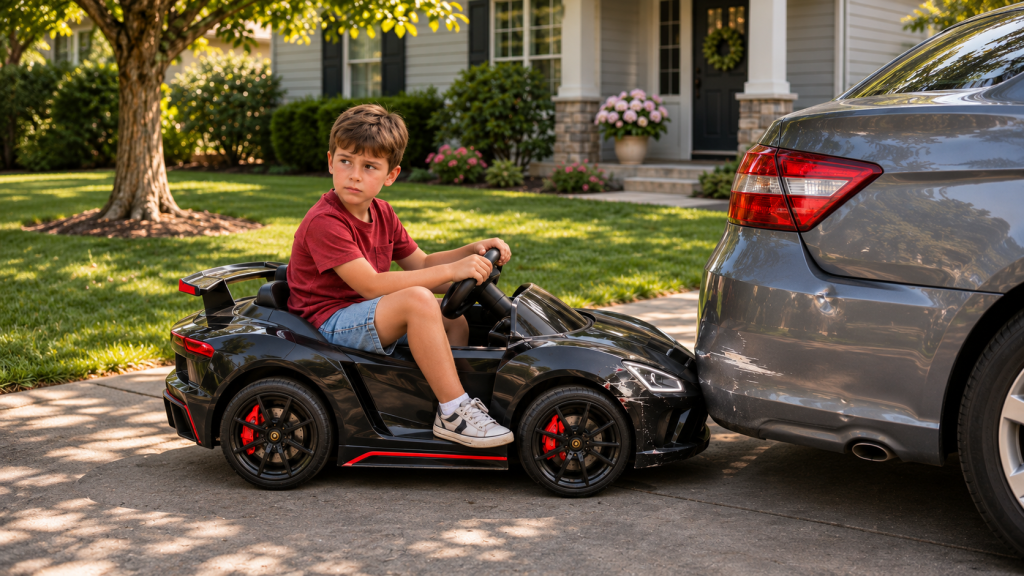
And my old Toyota, the car he’d mocked only minutes earlier, was still parked beside the road with its damaged bumper.
Everything had happened so quickly.
Yet suddenly, nothing seemed as important as the phone in Noah’s hands.
I hurried toward him.
“What did you find?”
He swallowed.
“There’s a video.”
My heart began pounding.
“What video?”
He looked toward Richard.
“Mom recorded it.”
Then he whispered words that made the afternoon seem colder.
“She said if anything happened to her, we had to show it to someone we could trust.”
My name is Emma Carter.
I’m twenty-two years old.
And for the past three years, I’ve been doing my best to raise my younger brothers, fifteen-year-old Daniel and eleven-year-old Noah.
When people ask whether it’s difficult, I usually smile.
“Some days are harder than others.”
It sounds better than the truth.
The truth is that sometimes I sit alone in our kitchen after the boys fall asleep and wonder whether I’m doing anything right.
I worry about grocery bills.
School supplies.
Dentist appointments.
The strange noise our refrigerator makes when it starts.
I worry that Daniel is growing up too quickly because he knows how much responsibility I carry.
I worry that Noah pretends not to need things because he thinks asking will make me sad.
And I worry about our old Toyota because without it, I can’t get to the medical supply warehouse where I work.
That car isn’t beautiful.
Its paint is faded.
The driver’s seat has a tear covered with duct tape.
And the air conditioner only works when it feels generous.
But it belonged to our mother.
She drove us to school in it.
Sang along with the radio.
And used to say that a car didn’t need to impress anyone as long as it got the people you loved home safely.
After she died, I promised myself I’d keep it running.
Not because it was worth much money.
Because it carried so much of her.
Before the crash, Richard Whitmore had been our neighbor for almost two years.
He lived in the enormous house above our street.
A mansion built into the hillside, with white stone columns, security cameras, and a driveway that curved past an ornamental fountain.
His property sat on land that had once belonged to an older family.
After purchasing it, Richard had transformed the hillside.
Trees disappeared.
Heavy machinery arrived.
Truckloads of soil were moved.
And a tall retaining wall rose behind his property.
He told everyone he was improving the neighborhood.
But the improvements never seemed to benefit anyone except him.
During construction, muddy water flooded our backyard after every heavy rain.
Our garden began washing away.
A crack appeared in the concrete beside our back steps.
When Mom complained, Richard laughed.
“Old houses have problems,” he told her.
Mom didn’t laugh.
She kept taking photographs.
At the time, I thought she was just being stubborn.
Now I understood that she’d been frightened.
I took the phone from Noah.
Its screen was scratched.
The protective case was faded blue.
A tiny photograph of the three of us with Mom was tucked beneath its clear backing.
For one terrible moment, I couldn’t unlock it.
Then Daniel appeared beside me.
“Try Mom’s birthday,” he whispered.
I did.
The screen opened.
Noah pointed toward a video folder labeled:
HILLSIDE — KEEP SAFE
Inside were dozens of clips.
Photographs of construction trucks.
Images of exposed soil.
Close-ups of the concrete retaining wall.
And one recording dated eleven days before Mom died.
My hands began shaking.
I opened it.
Mom’s face appeared on the screen.
She was standing in our backyard.
Her brown hair was pulled into the messy ponytail she wore when she was gardening.
Behind her, the hillside rose toward Richard’s mansion.
She looked tired.
But her eyes were determined.
“If anyone is watching this,” she began, “I need you to understand something.”
My throat closed.
I hadn’t heard her voice in almost three years.
Not clearly.
Not like this.
For a moment, the rest of the world disappeared.
I could almost smell her coffee.
Almost feel her hand brushing my hair away from my forehead.
Then she continued.
“The retaining wall behind the Whitmore property was built on unstable ground. I’ve been asking questions because the soil has been moving since they cleared the trees.”
The camera turned.
She showed a deep crack running through the earth near our fence.
“I’ve reported it to the county twice. The first report disappeared. The second was marked resolved, even though nobody inspected the property.”
She paused.
Then said something that made my blood turn cold.
“Richard Whitmore told me to stop asking questions.”
I looked up from the phone.
Richard was watching us.
He couldn’t hear the recording from where he stood.
But he recognized something.
The way I held the phone.
The expression on my face.
Perhaps the simple fact that our mother had left behind evidence.
His mouth tightened.
I pressed play again.
Mom’s voice continued.
“He said I should be grateful he’d improved property values. When I told him our house could be damaged, he asked whether I could afford a lawyer.”
The video shook slightly.
Then Mom turned the camera toward herself.
“I don’t know whether anything will come of this. But I’m keeping copies of everything because I don’t want my children living beneath a hillside that somebody knew was dangerous.”
Her voice softened.
“Emma, sweetheart, if you ever find these videos, please don’t try to fight anyone by yourself. Get help. Find someone who will listen.”
A tear rolled down my cheek.
Then Mom smiled sadly into the camera.
“And tell your brothers I love them.”
The recording ended.
I couldn’t breathe.
Daniel reached for my shoulder.
“Em?”
I shook my head.
Mom had been afraid.
And I’d never known how afraid.
I remembered the last months of her life.
She’d been making telephone calls.
Collecting documents.
Taking photographs whenever construction trucks arrived.
I’d teased her once.
“Mom, you’re turning into a detective.”
She’d smiled.
“Somebody has to pay attention.”
I hadn’t understood.
I was nineteen then.
Working evenings.
Taking community college classes.
Trying to help with bills.
I thought Mom was simply upset about the construction.
I never imagined she’d been documenting something that might endanger our entire street.
A woman’s voice interrupted my thoughts.
“Excuse me.”
I turned.
One of the county inspectors stood beside us.
She wore a yellow safety vest and carried a clipboard.
“I’m Elena Ruiz, county building inspector.”
I wiped my face.
“I’m Emma Carter.”
She nodded.
“I understand your mother may have documented concerns about the retaining wall.”
I stared at her.
“She did.”
Elena looked toward the damaged hillside.
“Would you be willing to share those records?”
I gripped the phone.
“Yes.”
Then I hesitated.
“But I want copies.”
Her expression softened.
“Of course. Keep the original safe. We’ll arrange to receive copies and record where they came from.”
She looked toward my brothers.
Then back at me.
“Emma, I also need to tell you something important.”
My stomach tightened.
“What?”
Her expression became serious.
“The wall may be unstable. We’re arranging an emergency engineering assessment.”
I glanced toward our house.
“Are we in danger?”
She took a breath.
“We can’t determine the full risk from here. Until we have a qualified assessment, we need residents in the potential impact area to leave as a precaution.”
I stared.
“Leave?”
She nodded.
“For now.”
I looked toward our little house.
The peeling porch paint.
The flowerbeds Mom had planted.
The kitchen window where Noah liked to sit and do homework.
Everything we had left.
“Where are we supposed to go?”
Elena’s expression softened.
“We’re coordinating temporary accommodations for affected residents.”
I swallowed.
Then asked the question that frightened me most.
“Are we going to lose our home?”
She was quiet.
Finally, she said, “I don’t know yet.”
Behind us, Richard approached.
“Now hold on,” he said. “Let’s not overreact.”
Elena turned sharply.
“Mr. Whitmore, please remain outside the restricted area.”
He ignored her.
“My contractors are professionals. That wall cost more than these houses combined.”
The words struck me.
More than these houses combined.
I stared at him.
He looked toward my Toyota and gave a small shrug.
“Look, I understand everyone’s upset because of the accident, but we’re talking about a perfectly good structure.”
Elena held up a photograph.
“Mr. Whitmore, the visible cracking suggests significant movement. We have to evaluate the possibility of failure.”
Richard laughed nervously.
“It’s cosmetic.”
She studied him.
“That determination belongs to qualified engineers, not the property owner.”
Then she glanced toward my phone.
“And we now have evidence that concerns about the slope may have been raised years ago.”
Richard’s face changed.
“What evidence?”
I looked at him.
“My mother’s.”
His jaw tightened.
Then he whispered something so quietly I almost missed it.
“That woman never knew when to stop.”
I felt something inside me snap.
I stepped forward.
“Don’t talk about my mother.”
Richard looked startled.
“Emma, I didn’t mean—”
“She was trying to protect us.”
His mouth opened.
I continued.
“She told you this wall was dangerous. She took photographs. She reported it.”
My voice began shaking.
“And you laughed at her just like you laughed at me today.”
Richard glanced toward the inspector.
“Your mother misunderstood the construction.”
I stared at him.
“Then why were the reports closed without proper inspection?”
He went silent.
Elena looked toward him.
“That’s something we’ll be reviewing.”
For the first time since I’d known him, Richard Whitmore looked frightened.
Not irritated.
Not offended.
Frightened.
And I realized that whatever happened next, the world he’d built around himself was beginning to crack.
Just like the wall above our homes.
We packed in twenty minutes.
Clothes.
Schoolbooks.
Medication.
Mom’s phone.
Our birth certificates.
A photograph of all four of us at the beach.
Daniel carried the important papers.
Noah grabbed his stuffed dinosaur, even though he’d stopped sleeping with it years earlier.
I pretended not to notice.
Before leaving, I stood in the living room and looked around.
The couch Mom had bought secondhand.
The bookshelf Dad had built before he died.
The pencil marks on the kitchen doorway where we’d measured the boys’ height.
Our home wasn’t worth much according to the real estate websites.
But to us, it was everything.
Daniel appeared beside me.
“Em, we need to go.”
I nodded.
Then looked toward the window.
Richard’s mansion rose above the neighborhood.
White stone.
Tall windows.
Expensive landscaping.
The kind of house people slowed down to admire.
And beneath it, our little street waited to learn whether the hillside would hold.
We spent that night at a hotel arranged through the emergency response team.
The room had two beds and a sofa.
Noah fell asleep quickly.
Daniel sat beside the window, staring at the parking lot.
I knew that look.
He was trying to be brave.
At fifteen, he’d already learned too much about pretending everything was fine.
I sat beside him.
“Talk to me.”
He shrugged.
“There’s nothing to say.”
I waited.
Finally, he whispered, “What if the house falls down?”
My heart tightened.
“We don’t know that it will.”
“But what if?”
I took his hand.
“Then we’ll figure out what comes next.”
He looked at me.
“With what money?”
The question hurt because it was exactly what I’d been wondering.
I swallowed.
“I don’t know yet.”
Daniel looked down.
Then said something that broke my heart.
“I can get a job.”
“No.”
“Em—”
“No, Daniel.”
I turned toward him.
“Your job is to go to school. Play basketball. Complain about homework. Be fifteen.”
His eyes filled.
“But you’re doing everything.”
I shook my head.
“Not anymore.”
He stared.
I continued.
“We’re going to ask for help where we need it.”
He began crying.
And I realized how badly I’d needed to hear those words myself.
For three years, I’d believed loving my brothers meant never admitting we were struggling.
I’d worked overtime.
Skipped meals.
Ignored headaches.
And told everyone we were doing fine.
But Mom’s last message had been clear.
Don’t try to fight anyone by yourself.
Get help.
Find someone who will listen.
For the first time, I intended to obey her.
The next morning, I called my manager.
I explained what had happened.
She listened quietly.
Then said, “Emma, take the time you need.”
My throat tightened.
“I can’t afford unpaid leave.”
She paused.
“Let me check what emergency leave and assistance options we have. I can’t promise anything, but you’re not going to face this without us trying.”
I began crying.
“Thank you.”
Then I called a legal aid organization.
They referred me to an attorney named Claire Bennett, who had experience with property damage and construction disputes.
I also contacted our homeowners’ insurer, arranged an inspection of my Toyota, and began making a list of everything that had happened.
The broken window.
The damaged flowerbeds.
The electric toy car.
The retaining wall.
Mom’s photographs.
Her reports.
The threat Richard had made.
For once, I wasn’t going to let everything disappear because the person responsible had more money than I did.
Claire met me two days later.
She was a calm woman in her forties with sharp eyes and an old leather briefcase.
She listened to my story.
Reviewed the evidence.
And asked careful questions.
When I finished, she said, “Emma, we need to separate the car damage from the hillside issue.”
I nodded.
“The accident involving the toy car is one matter. We’ll examine the damage, the circumstances, and the available insurance coverage.”
“And the wall?”
“That may involve construction records, permits, inspections, engineering evidence, and potentially several responsible parties.”
I swallowed.
“Can Richard just pay someone to make it go away?”
Claire looked at me.
“Money can pay for lawyers. It cannot change what properly preserved records show.”
She paused.
“And your mother’s documentation may be important.”
My eyes filled.
“She tried so hard.”
Claire nodded.
“Then let’s make sure her efforts are taken seriously.”
The engineering assessment began that week.
Surveyors arrived.
Geotechnical specialists examined the hillside.
Officials reviewed permit records.
And workers placed monitoring instruments near the retaining wall.
The results were worse than anyone expected.
The wall had been built without the approvals required for its final design.
Drainage measures were inadequate.
And the soil behind it had been accumulating water.
The recent movement had increased the risk of a partial collapse during heavy rain.
Several houses below the slope, including ours, remained under evacuation orders until stabilization work could be completed.
I listened as Elena Ruiz explained the findings at a neighborhood meeting.
My hands went cold.
Mom had been right.
All those years ago.
She’d looked at the hillside and recognized something was wrong.
And instead of being heard, she’d been dismissed.
But that wasn’t the worst discovery.
The county began reviewing the old complaint records.
Two reports from Mom appeared in archived files.
Both had been closed.
One contained a note claiming an inspector had visited the property.
But the named inspector had been working in another county that day.
The second report had been marked resolved after a telephone conversation that nobody could document.
Claire studied the copies.
“This suggests serious irregularities.”
I stared.
“Does it prove Richard paid someone?”
“Not by itself.”
She looked at me.
“But it gives investigators specific questions to pursue.”
Then she pointed toward a signature on the second report.
“Do you recognize this name?”
I leaned closer.
Harold Whitmore.
I frowned.
“Richard’s father?”
Claire nodded.
“According to the ownership records, Harold was involved in the development company before he died.”
I stared at the paper.
Richard had always spoken of his father as a respected businessman.
A self-made man.
Someone whose success had built the family’s fortune.
But this document suggested Harold Whitmore had been involved in the hillside project from the beginning.
Claire continued.
“We’ll need to establish who actually made the decisions and who had authority at the time.”
I nodded.
But something about the name bothered me.
I’d heard Mom mention it before.
Harold Whitmore.
Where?
Then I remembered.
A conversation at our kitchen table.
Mom had been holding a letter.
She’d looked upset.
I asked what was wrong.
She said, “Sometimes wealthy people think history belongs to them.”
At nineteen, I’d thought she was talking about politics.
Now I wasn’t so sure.
That evening, I searched through Mom’s old boxes.
They were stored in the hallway closet of our house, which I had been allowed to enter briefly with approval from the emergency team.
I found tax returns.
Old photographs.
School certificates.
Receipts.
And a faded envelope addressed to my mother.
Inside was a letter from a local historical preservation organization.
It referred to a survey of the original hillside property.
And mentioned an old drainage channel.
I stared at the words.
The channel had once carried water beneath the slope and safely toward the creek.
According to the letter, it had been filled during the Whitmore development.
I looked up.
Filled.
The water hadn’t stopped existing.
It had simply lost its path.
I took the letter to Claire.
She studied it carefully.
“This could be important.”
I swallowed.
“Why?”
“If the drainage channel was blocked, it may help explain how water pressure accumulated behind the wall.”
I stared at the document.
“Mom knew?”
“She appears to have been investigating it.”
Then Claire turned the page.
A handwritten note was attached.
Mom’s handwriting.
Three sentences.
Harold knows about the old creek.
Richard signed the revised plans.
Ask Samuel about the missing survey.
I stared.
“Samuel?”
Claire looked up.
“Do you know anyone by that name?”
I shook my head.
Then remembered something.
Our father had once worked as a survey technician.
He’d died in a workplace accident when I was sixteen.
His closest friend had been a man named Samuel Pierce.
I hadn’t seen him in years.
After Dad died, Samuel had moved away.
But Mom had stayed in contact with him.
I looked at Claire.
“I think I know who she meant.”
Finding Samuel took two days.
He lived in a small town nearly three hours away.
When I called, his voice was cautious.
“Emma Carter?”
“Yes.”
A long pause followed.
“Your mother’s daughter?”
My throat tightened.
“Yes.”
He exhaled.
“How are you, sweetheart?”
I nearly cried at the familiar kindness.
“I need to ask you something about the hillside.”
Silence.
Then he whispered, “I wondered when someone would.”
Samuel agreed to meet.
He arrived the next afternoon driving a battered blue truck.
He was sixty-two, with silver hair and deep lines around his eyes.
When he saw me, his expression softened.
“You’re the image of your mother.”
I smiled sadly.
“Everyone says that.”
He looked toward Daniel and Noah.
Then sighed.
“Your parents would be proud of you.”
I swallowed.
“I hope so.”
We sat in Claire’s office.
Samuel opened a canvas bag and removed a roll of old survey drawings.
He spread them across the table.
The papers were yellowed.
The ink faded.
But the details were clear.
Our street.
The hillside.
The original drainage channel.
And the area where Richard’s mansion now stood.
Samuel pointed toward the drawings.
“Your father worked on this survey years before Whitmore bought the land.”
I stared.
“Dad?”
He nodded.
“He helped document the natural drainage system.”
My chest tightened.
“Why?”
“Because the county was considering future development restrictions. That hillside was known to be sensitive to changes in drainage.”
I looked at the drawing.
“So they knew?”
Samuel took a breath.
“Some people did.”
He pointed toward the upper slope.
“These plans show where water was supposed to go. Later development changed the grading.”
Claire leaned forward.
“Do you have records showing these drawings were submitted?”
Samuel nodded.
“I kept copies of correspondence.”
He removed another folder.
Inside were letters.
Technical notes.
And an old memorandum addressed to Harold Whitmore’s development company.
The memorandum warned that filling the drainage channel without a suitable alternative could increase water pressure and slope instability.
At the bottom was a signature.
My father’s.
I pressed my hand against my mouth.
Dad had warned them.
Years before Mom began complaining.
My parents had both tried to protect our neighborhood.
And neither had been taken seriously.
Samuel looked at me.
“Emma, your father was a careful man.”
Tears filled my eyes.
“He never liked arguing.”
Samuel smiled sadly.
“No. But he believed drawings should tell the truth.”
He looked toward Claire.
“I don’t know whether these documents prove wrongdoing. But they show that the drainage issue was recognized before the wall was built.”
Claire nodded.
“They’ll help us ask the right questions.”
Then Samuel turned toward me.
“There’s something else your mother wanted you to know.”
I froze.
“What?”
He swallowed.
“She was planning to tell you about the hillside after you finished your first year of college.”
My eyes filled.
“Why didn’t she?”
“She didn’t want you worrying. She knew how much you were already doing.”
I looked down.
Then whispered, “I should have noticed.”
Samuel shook his head.
“No, Emma.”
His voice softened.
“You were a child who had already lost her father. Your mother was trying to protect you.”
I began crying.
He reached across the table and squeezed my hand.
“And now you’ve been trying to protect everyone else.”
I nodded.
He looked at me gently.
“Your parents didn’t raise you to carry the whole world alone.”
For a long time, I couldn’t speak.
Then I whispered, “I miss them.”
Samuel’s eyes filled.
“I know, sweetheart.”
The investigation continued.
The recovered surveys helped engineers understand the original drainage system.
Old correspondence raised questions about what Richard and his father’s company had known.
County officials reviewed the irregular complaint closures.
And the emergency stabilization work began.
Contractors installed temporary drainage measures.
Engineers monitored ground movement.
And plans were developed to address the structural problems before residents could safely return.
Richard hired an expensive legal team.
He gave a statement blaming previous contractors.
He insisted he’d relied on professionals.
He denied knowingly hiding any danger.
But the documents complicated his explanation.
He’d signed revised plans.
Received correspondence concerning drainage.
And been informed about cracks appearing below the property.
I watched him from across the street one afternoon.
He stood beside his ruined fountain, arguing into a phone.
His designer coat looked ridiculous against the mud.
For a moment, I remembered how he’d laughed when I asked him to repair my Toyota.
“Then buy another one, sweetheart!”
The words returned with painful clarity.
He’d believed the damage to my car was beneath his concern.
Now the hillside beneath his mansion had become a problem his money couldn’t immediately erase.
But something unexpected happened that afternoon.
Tyler approached me.
He walked slowly.
His expensive sneakers were muddy.
His face was pale.
“Emma?”
I turned.
“Hi, Tyler.”
He looked toward my Toyota.
Then at the ground.
“I’m sorry.”
I stared at him.
He swallowed.
“For hitting your car.”
I nodded.
“Thank you for saying that.”
He took a breath.
“And for the window last month.”
I felt my chest tighten.
He continued.
“And the flowers.”
I looked at him.
“Tyler, why are you telling me this now?”
His eyes filled.
“Because you saved me.”
I was quiet.
Then he whispered, “Dad said you were making a big deal out of nothing.”
I swallowed.
“About the car?”
He nodded.
“But then the truck came.”
His voice broke.
“And you ran toward me.”
I knelt so we were nearly eye level.
“Tyler, you made some mistakes.”
He nodded.
“But that doesn’t mean you deserved to get hurt.”
Tears spilled down his cheeks.
“My dad says people like you only want money.”
I stared at him.
Then answered gently.
“Sometimes people ask for money because something they own has been damaged. That doesn’t mean they’re greedy.”
He looked toward the Toyota.
“You need your car for work.”
“Yes.”
His face crumpled.
“And I broke it.”
I nodded.
“That’s true.”
He began crying harder.
I waited.
Then he whispered, “I don’t want to be like Dad.”
The words startled me.
I studied him.
“Tyler, you get to decide how you treat people.”
He wiped his face.
“Even if Dad doesn’t like it?”
I smiled sadly.
“Especially then.”
That evening, Tyler returned with an envelope.
Inside was a handwritten apology.
His spelling wasn’t perfect.
The letters leaned.
But every word was his.
He admitted damaging the car, window, and flowers.
He acknowledged that he’d behaved badly.
And he promised to make better choices.
At the bottom, he’d written:
Thank you for saving me even though I was mean to you.
I read the letter twice.
Then placed it inside Mom’s old recipe book.
Not because it erased anything.
But because it reminded me that people can learn.
Even when the adults around them refuse to.
The car damage was resolved separately through an appropriate payment arrangement.
The repair shop replaced the damaged bumper and checked the vehicle for hidden problems.
It wasn’t transformed into a shiny new car.
It was still my old Toyota.
Still scratched.
Still loud.
Still ours.
But when I drove it home, I cried.
Because the familiar sound of that engine reminded me of Mom.
And for the first time since the accident, I felt as though one small piece of our life had been returned.
Three months after the crash, a public hearing was held concerning the hillside development.
The room was packed.
Neighbors.
Reporters.
County officials.
Engineers.
Lawyers.
Families who had spent months worrying about their homes.
I sat between Daniel and Noah.
Samuel sat behind us.
Claire was beside me.
Richard arrived with his attorneys.
He didn’t look at us.
The engineers presented their findings.
The drainage system had been altered.
The retaining wall had significant deficiencies.
And the slope required extensive corrective work before the risk could be reduced sufficiently for normal occupancy below.
Then officials discussed the historic complaint records.
Questions about the missing inspection documentation were referred for further investigation.
The county also reviewed whether the required approvals had been obtained and whether false or misleading information had been submitted.
It wasn’t the dramatic courtroom scene I’d imagined.
Nobody stood up and shouted that Richard was guilty of everything.
There was no sudden confession.
No judge declaring that a rich man had finally received what he deserved.
Instead, there were documents.
Expert opinions.
Witness statements.
And a slow, careful reconstruction of decisions made over many years.
But something powerful happened when Claire submitted Mom’s photographs and the old survey documents.
The room became quiet.
Then Elena Ruiz read part of Mom’s original complaint.
It described the cracks.
The blocked drainage.
The muddy water entering our yard.
And her fear that the hillside might eventually collapse.
I stared at the front of the room.
Mom’s words.
Three years after her death.
Finally being heard.
I began crying.
Daniel took my hand.
Noah leaned against my shoulder.
And for a moment, I felt as though our mother was standing beside us.
Not because she had returned.
But because she had refused to let the truth disappear.
After the hearing, Richard approached me.
Claire stepped closer.
He looked exhausted.
For the first time, his expensive clothing couldn’t hide how frightened he was.
“Emma,” he began.
I waited.
He swallowed.
“I owe you an apology.”
I stared at him.
He glanced toward Tyler, who stood several feet away.
Then back at me.
“For the car. For the way I spoke to you.”
I said nothing.
He continued.
“And for dismissing your mother’s concerns.”
My throat tightened.
“Did you know she was right?”
Richard looked down.
For a moment, he didn’t answer.
Then he whispered, “I knew there were questions about the drainage.”
My heart pounded.
“And you ignored them?”
He swallowed.
“I thought the contractors had handled it.”
I stared at him.
“Did you ever check?”
Silence.
I took a breath.
“Richard, my mother spent months trying to get someone to listen.”
His eyes filled.
“I know.”
“She was afraid our house would be damaged.”
He nodded.
“And you treated her like she was bothering you.”
His face crumpled.
“I can’t undo that.”
“No,” I whispered.
“You can’t.”
He looked toward my brothers.
Then said quietly, “I’ll cooperate with the corrective work and the legal process.”
I studied him.
“That’s what you should have done from the beginning.”
He nodded.
“You’re right.”
I walked away.
Not because I wanted revenge.
Because an apology couldn’t rebuild a damaged hillside.
Actions mattered now.
The following months brought difficult negotiations and continuing investigations.
Richard’s company and other involved parties faced claims related to construction defects, property damage, and the costs of stabilization.
Officials examined the irregularities in the earlier complaint handling.
Some matters proceeded through administrative processes.
Others became part of civil litigation.
The county required substantial corrective measures, and financial responsibility was addressed through enforcement actions, insurance review, and legal agreements.
The work was expensive.
It took time.
And it affected more than Richard.
Residents needed temporary housing.
Businesses lost income.
Families worried about whether their savings were enough.
For years, Richard had treated his wealth as proof that he was more important than his neighbors.
Now the value of his property depended on engineers, contractors, officials, and the cooperation of people he’d once dismissed.
But the greatest consequence wasn’t simply financial.
His reputation changed.
The wealthy businessman who had once boasted about improving the neighborhood became associated with a project that had endangered it.
People began asking questions about his company’s practices.
Former employees provided additional information to investigators.
And the public attention made it harder for anyone to ignore the records.
I didn’t celebrate his humiliation.
I had too much of my own life to rebuild.
By late autumn, the engineering team reported that the necessary stabilization measures had reached a stage where certain homes could be reoccupied subject to final approvals.
Our house, however, required additional inspection and repairs.
The shifting ground had damaged sections of the foundation.
Water had entered the crawl space.
And the back steps were no longer safe.
Claire helped us pursue the property damage claim.
The process was slow.
There were estimates.
Inspections.
Disagreements over costs.
But eventually, a settlement provided funds toward the required repairs and other documented losses.
It didn’t make us rich.
It didn’t replace Mom.
It didn’t erase the months we’d spent away from home.
But it allowed us to restore the place we’d been afraid of losing.
The first day we returned, Noah ran straight to the kitchen doorway.
The pencil marks were still there.
His height at seven.
At eight.
At nine.
Daniel’s marks higher up.
And one final mark Mom had made just before she died.
Noah touched it.
“She was here.”
I nodded.
“Yes.”
He looked at me.
“Do you think she’d like what we did?”
I swallowed.
Then looked around.
The repaired walls.
The new back steps.
The garden slowly returning.
The framed photograph of Mom and Dad above the mantel.
“I think she’d be proud of us.”
Daniel appeared behind him.
“Even though everything got messed up?”
I smiled through tears.
“Especially because we kept going.”
We spent the next several weeks making the house feel like ours again.
Daniel painted the hallway.
Noah helped plant flowers.
I repaired the kitchen cabinets.
Samuel came every Saturday with tools and stories about our parents.
Sometimes he told us things I’d never known.
How Dad used to sing terribly when he worked.
How Mom once brought sandwiches to an entire survey crew because she thought everyone looked hungry.
How they’d met at a county fair and argued for twenty minutes over whether a particular roller coaster was safe.
The boys laughed.
And I realized how many stories we’d almost lost.
For years, grief had made us afraid to talk about our parents.
We thought remembering would hurt too much.
But now those memories began filling the house again.
One evening, Samuel brought a small wooden box.
“This belonged to your father,” he said.
Inside was an old compass.
The brass was scratched.
The glass had a tiny crack.
On the back, Dad had engraved three initials.
E.
D.
N.
I stared.
Emma.
Daniel.
Noah.
Samuel smiled sadly.
“He had it made after Noah was born.”
My eyes filled.
“He carried it at work?”
“Every day.”
I held the compass carefully.
Then Samuel said something I’ll never forget.
“Your father used to say a good compass doesn’t stop the storms. It just helps you remember which way you’re going.”
I looked toward my brothers.
Then whispered, “I think I understand.”
As winter approached, I finally allowed myself to consider something I’d avoided for three years.
My future.
Not simply surviving.
Not simply paying bills.
My future.
I’d always wanted to become a nurse.
Mom knew.
Dad knew.
They’d encouraged me when I was younger.
But after they died, college had seemed impossible.
I needed a steady income.
Daniel needed someone at home.
Noah was still so young.
So I took a job at the warehouse.
It paid enough to keep us going if I watched every dollar carefully.
But every time I drove past the community college, I felt a quiet ache.
I wanted to study.
To build a career helping people.
To become something more than a frightened twenty-two-year-old counting grocery money.
One afternoon, Daniel found an old nursing-school brochure in my desk.
“Em?”
I looked up.
“Yeah?”
“Why didn’t you apply?”
I smiled sadly.
“Life got busy.”
He stared at me.
“You mean us.”
My heart tightened.
“No.”
He raised an eyebrow.
“Emma.”
I sighed.
“Okay. Partly.”
He sat beside me.
“Do you still want to go?”
I looked down.
“Of course.”
“Then why don’t you?”
I laughed softly.
“Because tuition costs money. And school takes time.”
He thought for a moment.
Then said, “You told me my job was to be fifteen.”
I smiled.
“I did.”
He nodded.
“Then your job is to remember you’re twenty-two.”
I stared at him.
He continued.
“You’re allowed to have a life too.”
Tears filled my eyes.
I reached for him.
He hugged me tightly.
And for the first time, I realized that protecting my brothers didn’t have to mean abandoning every dream I’d ever had.
With help from a college adviser, I explored financial aid, part-time coursework, and programs designed for working students.
I began taking prerequisite classes.
Just two at first.
It wasn’t glamorous.
I studied at the kitchen table after the boys went to bed.
Worked during the day.
And sometimes fell asleep over my notes.
But every completed assignment felt like a promise kept.
Not to someone else.
To myself.
Tyler changed too.
Not overnight.
Not magically.
He was still twelve.
He still made mistakes.
Sometimes he spoke without thinking.
Sometimes he grew impatient when things didn’t go his way.
But he began showing up differently.
One Saturday, he knocked on our door holding a packet of flower seeds.
I opened it cautiously.
“Hi, Tyler.”
He swallowed.
“Can I help fix the garden?”
I looked toward the flowerbeds he’d destroyed months earlier.
Then at him.
“Why?”
He looked embarrassed.
“Because I broke it.”
I considered him.
Then stepped aside.
“You can help.”
For three hours, Tyler worked beside Daniel and Noah.
He pulled weeds.
Carried soil.
And learned that flowers didn’t grow simply because someone paid for them.
They needed attention.
Patience.
And time.
When he finally stood up, his hands were muddy.
He stared at them.
Then laughed.
“I’ve never done this before.”
I smiled.
“There’s a first time for everything.”
He looked toward our house.
Then asked quietly, “Do you think your mom would like the flowers?”
My throat tightened.
“Yes.”
I smiled.
“I think she would.”
Tyler nodded.
Then returned to planting.
A year after the crash, the neighborhood held a small gathering to celebrate the completion of the major hillside safety work.
It wasn’t a fancy event.
Just folding tables, homemade food, children playing, and neighbors who’d spent too many months worrying about their homes.
Elena Ruiz attended.
So did Samuel.
Claire stopped by briefly.
And the truck driver who had lost control that afternoon came with his wife.
His name was Frank Morales.
He had survived the accident with minor injuries, but he’d carried enormous guilt.
When he approached me, his eyes filled.
“Emma, I’ve wanted to thank you.”
I shook my head.
“For what?”
“Getting Tyler out of the road.”
I looked toward the boy playing basketball with Daniel.
“You don’t have to thank me.”
Frank smiled sadly.
“I do.”
He told me the truck’s brake system had developed a serious problem during the descent.
Investigators had examined the vehicle and its maintenance history.
The incident had led to a separate review of the equipment and procedures involved.
“I thought I was going to kill somebody,” he whispered.
I felt my chest tighten.
“But you didn’t.”
He nodded.
“Because you moved that boy.”
For a moment, neither of us spoke.
Then he looked toward the hillside.
“Funny thing about that day.”
I waited.
“If I hadn’t come down that street, maybe nobody would’ve looked closely enough at the wall.”
I thought about it.
Then answered carefully.
“Maybe.”
But I also remembered Mom’s reports.
Her videos.
Dad’s surveys.
The warnings that had existed long before the crash.
And I said, “The truth was already there. People just hadn’t listened.”
Frank nodded.
“You’re right.”
Later that afternoon, Richard arrived.
He came without photographers.
Without the expensive crowd that usually surrounded him at neighborhood events.
Tyler walked beside him.
Richard looked uncomfortable.
Almost out of place.
He approached me near the garden.
“Emma.”
I nodded.
“Richard.”
He looked toward the flowers.
“They look nice.”
“Thank you.”
He hesitated.
Then said, “Tyler tells me you’ve been helping him with the garden.”
I smiled faintly.
“He’s doing most of the work.”
Richard looked toward his son.
For a moment, his expression softened.
Then he turned back.
“I wanted to say something.”
I waited.
He took a breath.
“I spent a long time believing that because I could afford things, I understood their value.”
I stared at him.
He continued.
“When Tyler damaged your car, I saw an old vehicle.”
His voice tightened.
“I didn’t see the only way you could get to work.”
I swallowed.
He looked toward our house.
“And when your mother complained about the hillside, I saw an inconvenience.”
He lowered his head.
“I didn’t see a woman trying to protect her children.”
For a long moment, neither of us spoke.
Then he whispered, “I’m sorry.”
I studied him.
He looked different from the man who’d laughed in my driveway.
Still wealthy.
Still dressed well.
But quieter.
Less certain that the world owed him deference.
I took a breath.
“Richard, I appreciate the apology.”
His eyes lifted.
“But I hope you understand something.”
He nodded.
“My mother didn’t need you to agree with everything she said.”
I swallowed.
“She needed you to take her concerns seriously.”
His face tightened.
“And I didn’t.”
“No.”
I looked toward Tyler.
“Your son is learning something important.”
Richard followed my gaze.
“What’s that?”
I smiled sadly.
“That being wrong doesn’t make you worthless. But refusing to take responsibility can hurt people.”
Richard stared at me.
Then nodded slowly.
“He’s been teaching me that too.”
We stood quietly.
There was no dramatic embrace.
No instant friendship.
And no reason to pretend the damage had never happened.
But for the first time, Richard seemed willing to hear what someone else was saying without measuring the value of their house or car.
That mattered.
As the sun began setting, I stood near our front porch and looked toward the hillside.
The retaining wall had been rebuilt and reinforced according to an approved engineering plan.
New drainage systems carried water safely away.
Monitoring instruments remained in place.
And the county had established procedures intended to prevent similar failures from being ignored.
The neighborhood looked different.
Not because Richard’s fountain had been destroyed.
Not because his mansion had lost some of its shine.
But because the people living below the hill had learned the importance of speaking up together.
Mom had tried to warn everyone alone.
Now an entire community understood why her concerns mattered.
Elena approached me.
“Emma?”
I turned.
She smiled.
“I wanted to show you something.”
She handed me a photograph.
It showed the original hillside before the development.
Trees covered the slope.
The natural drainage channel curved toward the creek.
And in the foreground stood a younger woman holding a clipboard.
Mom.
I gasped.
“Where did you find this?”
Elena smiled.
“It was included in one of the archived survey files.”
I stared at the photograph.
Mom looked younger.
Her hair was blowing across her face.
And she was smiling directly at the camera.
I began crying.
Elena placed a hand on my shoulder.
“Your mother kept asking questions when people wanted her to stop.”
I nodded.
“She did.”
Elena looked toward the hillside.
“Her records helped us understand the history of the problem.”
I wiped my face.
“Thank you for listening.”
She smiled gently.
“She deserved to be heard.”
After Elena left, I sat on the porch steps.
Daniel joined me.
Then Noah.
For a while, we watched the neighbors laughing beneath the evening sky.
Noah leaned against me.
“Em?”
“Yeah?”
“Do you think Mom knows we fixed the house?”
I looked at him.
I wasn’t sure how to answer.
I couldn’t promise things I didn’t know.
But I could tell him what I believed.
“I think she’d be happy that we’re safe.”
He smiled.
“And Dad?”
I looked toward the compass Samuel had given us, resting inside by the window.
“I think he’d be proud we kept going.”
Daniel nodded.
Then said quietly, “You know, Emma, you don’t have to be our mom.”
My heart tightened.
I looked at him.
“What?”
He swallowed.
“I mean, we know you try.”
Tears filled his eyes.
“But you’re our sister.”
I stared.
He continued.
“And that’s enough.”
I began crying.
Daniel wrapped his arms around me.
Noah joined us.
For a long moment, the three of us sat tangled together on the porch steps.
Three children who had lost too much.
Three people who had spent years trying not to fall apart.
And for the first time, I understood something.
I had been so determined to replace our parents that I’d forgotten the boys didn’t need me to become someone else.
They needed me.
Their sister.
Imperfect.
Sometimes frightened.
Sometimes exhausted.
But there.
I held them close.
“I love you both.”
Noah smiled.
“We know.”
Daniel laughed softly.
“Even when you burn dinner.”
I gasped.
“That happened once!”
“Three times,” Noah corrected.
We burst out laughing.
And for a moment, I felt lighter than I had in years.
The following spring, the flowers in our garden bloomed.
Yellow marigolds.
Purple petunias.
White daisies.
And a row of pink roses Tyler had helped plant.
On Mother’s Day, Daniel and Noah surprised me.
They’d been working on something for weeks.
Samuel helped them.
When I stepped into the backyard, I found a small wooden bench beneath the old maple tree.
A brass plaque was attached to the back.
It read:
IN LOVING MEMORY OF MARY CARTER
SHE ALWAYS STOOD UP FOR THE PEOPLE SHE LOVED.
I covered my mouth.
The boys stood beside the bench, looking nervous.
Daniel cleared his throat.
“We thought Mom should have somewhere here.”
Noah nodded.
“Not just in pictures.”
I sat down.
Ran my fingers across the plaque.
And cried.
Then I noticed something carved beneath it.
A tiny compass.
And three initials.
E.
D.
N.
I looked toward Samuel.
He smiled.
“Your dad would’ve liked that.”
I couldn’t speak.
So I simply reached for my brothers.
And held them.
That evening, I made Mom’s favorite meal.
Chicken with rosemary potatoes.
Green beans.
And the chocolate cake she baked for every birthday, even when we insisted we were too old for birthday cakes.
We ate at the kitchen table.
Talked about school.
About my nursing classes.
About Daniel’s basketball team.
About Noah’s latest science project.
Nothing extraordinary happened.
No millionaire appeared with a check.
No dramatic secret was revealed.
No one burst through the door carrying another piece of evidence.
It was simply dinner.
Three siblings.
A warm house.
And the knowledge that tomorrow we would wake up and continue building our lives.
For years, I’d imagined that happiness would arrive when everything was finally fixed.
When the bills were paid.
When the car stopped making strange noises.
When I no longer worried about the boys.
When the future became certain.
But sitting at that table, I realized life would never be completely free of problems.
There would always be something.
A difficult exam.
An unexpected expense.
A bad day at work.
A disagreement.
A mistake.
The difference was that I no longer believed I had to solve every problem by myself.
I had my brothers.
Samuel.
Friends.
Neighbors.
People who cared.
And the courage to ask for help when I needed it.
That was something no amount of money could buy for me.
People in our neighborhood still talk about the afternoon Richard Whitmore’s son crashed his toy electric car into my Toyota.
They remember Richard laughing.
The truck coming down the hill.
The terrible sound of metal against stone.
The shattered fountain.
The inspectors arriving.
And the moment a forgotten phone revealed that my mother had warned about the retaining wall years earlier.
Some people call it karma.
Maybe they need a word for the strange way consequences sometimes arrive when nobody expects them.
But I don’t believe the truck was punishment sent from somewhere above.
A driver nearly lost control.
A child nearly died.
And a neighborhood faced a real danger.
Those were frightening events, not something to celebrate.
What mattered was what happened afterward.
The warning was finally investigated.
People were held accountable through the appropriate processes.
The wall was repaired.
Our homes were protected.
And a wealthy man who had spent years dismissing others began to understand that his money didn’t make their lives less valuable.
The greatest surprise wasn’t that Richard’s expensive fountain was destroyed while my old Toyota remained repairable.
It was that the person he’d dismissed as a poor orphan turned out to be the daughter of two people who had spent years trying to protect the neighborhood.
My father had drawn the maps.
My mother had saved the evidence.
And somehow, their children were there when the truth finally came into the light.
I still drive Mom’s Toyota.
The repaired bumper doesn’t perfectly match the faded paint.
The radio occasionally loses reception.
And the driver’s seat still has that old strip of duct tape.
But every time I start the engine, I remember something she used to say.
“Emma, don’t measure people by what they drive or what they own. Measure them by how they treat someone who can’t do anything for them.”
Richard had measured me by my car.
My clothes.
My little house.
The fact that I was young and raising my brothers without much money.
He saw poverty and assumed weakness.
He saw an old Toyota and assumed it didn’t matter.
He saw a mother asking questions and assumed she wasn’t worth listening to.
He was wrong.
And the strange thing is, I didn’t have to become rich to prove it.
I didn’t need a mansion.
A luxury vehicle.
Or an expensive lawyer paid for out of my own pocket.
I needed the truth.
People willing to listen.
And enough courage to keep asking questions even when the answers frightened me.
Today, I’m still twenty-two in my memories of that afternoon.
Still standing beside a damaged Toyota.
Still hearing Richard laugh.
Still watching a truck appear around the corner.
But when I remember the moment I told him to look behind him, I no longer think about the fountain.
Or the gates.
Or the damage to his property.
I remember Tyler standing frozen in the street.
I remember running.
I remember pulling him to safety.
And I remember what I told him later.
“You were never my enemy.”
Because the real problem was never a frightened twelve-year-old boy who had learned arrogance from his father.
It was the belief that some people’s lives matter less because they own less.
And that belief can damage far more than a car.
It can silence warnings.
Destroy trust.
Endanger neighborhoods.
And teach children to mistake cruelty for strength.
Tyler learned something different.
So did Richard.
And so did I.
I learned that kindness doesn’t mean allowing people to hurt you without consequences.
That forgiveness doesn’t require forgetting.
That being poor doesn’t mean being powerless.
And that family isn’t only the people whose names appear on your birth certificate.
Sometimes family is also the neighbor who brings dinner when you’re exhausted.
The old friend who carries your father’s maps across three hours of highway.
The inspector who refuses to ignore a warning.
The attorney who takes your case seriously.
And the people who stand beside you when the ground beneath your feet feels uncertain.
One evening, almost two years after the crash, I stood in the backyard watching Daniel help Noah build a birdhouse.
The sun was setting.
The garden was blooming.
The hillside beyond our fence was quiet.
I held Mom’s old phone in my hands.
I’d transferred the photographs and videos to secure storage long before, but I’d kept the phone itself.
Sometimes I still opened the recording.
Not to relive the fear.
But to hear her voice.
That evening, I played the final few seconds.
Mom looked into the camera.
Her eyes softened.
And she said:
“Tell your brothers I love them.”
I pressed the phone against my chest.
Then looked toward the boys.
Daniel was laughing because Noah had somehow glued his sleeve to the birdhouse.
I smiled through tears.
“We’re okay, Mom,” I whispered.
The wind moved gently through the maple tree.
The flowers swayed.
And somewhere beyond the yard, a bird began singing.
I didn’t know exactly what the future held.
I still had nursing exams ahead of me.
Bills to pay.
Two growing boys to guide.
And a thousand ordinary challenges waiting beyond the next sunrise.
But I wasn’t afraid in the same way anymore.
Because I finally understood that strength wasn’t pretending nothing could hurt me.
Strength was being willing to stand up when something was wrong.
To accept help when I needed it.
And to protect the people I loved without forgetting that my own life mattered too.
Richard Whitmore once laughed at my old Toyota and told me to buy another one.
He believed money made him untouchable.
But less than three hundred feet from his mansion stood a little house containing the evidence that would finally bring years of ignored warnings into the open.
The truth had been waiting there all along.
In a cracked phone.
A faded survey.
And the determination of two parents who had loved their children enough to keep asking questions.
And when the day finally came for those questions to be answered, it wasn’t wealth that made the difference.
It was courage.
The rich man thought my little family had nothing worth protecting.
But the house he looked down upon held the truth that his mansion could never hide.
And in the end, the greatest victory wasn’t watching Richard face the consequences of his decisions.
It was standing in our repaired garden, holding my brothers close, and knowing we had kept the one thing money could never replace.
Our home.