For a moment, I forgot how to breathe. I stood in my kitchen with Mr. Patel’s envelope in one hand and my phone in the other, staring at the photograph of my children. There they were. My two beautiful boys. Oliver, eight years old, with his navy school jumper slightly crooked and his backpack hanging off one shoulder.
And Jamie, six, holding his older brother’s hand as they walked through the school gates. It was an ordinary photograph. The kind I might have taken myself on a happy morning. Except I hadn’t taken it. Someone else had. Someone who had been watching my children. And underneath the picture were six words that turned my blood cold. “Next time, keep your mouth shut.”
The kitchen seemed to tilt. For twenty-two mornings, I’d believed I was dealing with an inconsiderate neighbour. A selfish woman who enjoyed making other people’s lives difficult. I’d thought the worst she could do was make my children late for school or threaten my job. But now I understood that the silver Corsa blocking my driveway might have been part of something much larger.
And whoever was behind it knew exactly where my children went to school.
Mr. Patel saw my expression change.
“Rachel?”
I couldn’t answer.
He stepped closer.
“What’s wrong?”
I turned the phone toward him.
His face drained of colour.
For a long moment, he said nothing.
Then he whispered, “Oh, dear God.”
I looked toward the window.
Our street lay quiet beneath the afternoon sunlight.
The front gardens were neat.
The pavement was empty.
A postman walked toward the corner.
Everything looked normal.
And that frightened me most.
Because somewhere behind those ordinary doors, someone had decided that threatening two little boys was an acceptable way to frighten their mother.
I gripped the phone.
“What do I do?”
Mr. Patel looked directly at me.
“You call the police.”
My name is Rachel Bennett.
I’m thirty-six years old, married, and the mother of two boys who still believe that most problems can be solved with a hug, a biscuit, and enough time.
Until Denise moved into number fourteen, I’d believed our street was one of the safest places in the world.
Not perfect.
Not glamorous.
But ours.
We lived in a modest brick house with a narrow driveway, a small back garden, and a kitchen that caught the afternoon sunlight.
My husband, Daniel, worked as an electrical engineer.
I worked in an administrative role for a local medical equipment supplier.
We weren’t wealthy.
We had a mortgage.
An aging family car.
And the usual collection of household expenses that somehow arrived whenever we thought we’d managed to save a little money.
But we were happy.
Oliver loved dinosaurs and football.
Jamie loved drawing, particularly pictures involving enormous green dragons and people with unusually long arms.
On Sunday mornings, Daniel made pancakes.
On Friday evenings, we watched family films beneath the same blanket.
And every spring, we planted flowers along the front path because my mother had always said a home should welcome people before they reached the door.
I’d never imagined that a driveway could become the centre of a nightmare.
Mr. Patel pulled out a chair.
“Sit down, Rachel.”
I shook my head.
“I need to get the boys.”
He glanced at the clock.
“They’re still at school.”
“I know.”
My voice cracked.
“But someone took their photograph.”
He nodded.
“And you need to tell the school immediately. But first, preserve that message.”
I swallowed.
He spoke gently.
“Don’t reply. Don’t delete it. Keep the original and make a note of when it arrived.”
I stared at him.
The man standing in my kitchen was seventy-three years old.
He’d lived on our street for more than thirty years.
He grew roses so carefully that strangers sometimes stopped to photograph them.
He remembered everyone’s birthdays.
And every Christmas, he delivered little tins of homemade shortbread, claiming his late wife had taught him the recipe.
I’d never seen him look frightened.
Now his hands were trembling.
“Mr. Patel,” I whispered, “what aren’t you telling me?”
He looked down at the envelope.
Then slowly removed another document.
It was an old letter dated almost four years earlier.
Across the top was a company name.
Ashcroft Urban Developments Ltd.
Beneath it was a formal proposal to purchase our property.
The price was listed.
So was an invitation to discuss “future development opportunities.”
I frowned.
“I’ve never seen this.”
Mr. Patel nodded.
“Your husband probably has.”
I stared at him.
“What?”
He sighed.
“Several of us received similar letters.”
My stomach tightened.
“And?”
“We refused.”
He looked toward our front window.
“After that, things started happening.”
I sat down slowly.
“What things?”
Mr. Patel took a breath.
“Cars blocking entrances. Complaints about garden boundaries. Anonymous letters saying properties needed repairs.”
I stared.
He continued.
“Mrs. Wilkinson at number eighteen had someone repeatedly leave rubbish beside her fence. The council was told she was causing a nuisance.”
My pulse quickened.
“Who reported her?”
“Nobody could establish that.”
He looked down.
“But the trouble stopped shortly after she sold her house.”
A cold sensation moved through my stomach.
“To whom?”
Mr. Patel looked at me.
“A company connected to Ashcroft.”
I stared at the envelope.
The letters.
The dates.
The complaints.
The same pattern repeated across different homes.
And suddenly, Denise’s behaviour seemed less random.
Twenty-two mornings.
Always across our driveway.
Always during the school run.
Always when she knew I’d be desperate to leave.
I’d begged her.
Explained the situation.
Told her my boys were frightened about being late.
And she’d looked directly into my eyes and said:
“You’ll survive.”
I had assumed she was cruel.
Now I wondered whether someone had been rewarding that cruelty.
I reached for my phone and called Daniel.
He answered on the second ring.
“Hey, love. Everything okay?”
I tried to speak.
But my throat closed.
“Rachel?”
I swallowed.
“Can you come home?”
His voice changed immediately.
“What’s happened?”
“Someone sent me a photograph of the boys.”
Silence.
“What?”
“Outside their school.”
His breathing sharpened.
“Who?”
“I don’t know.”
He spoke quickly.
“Are they safe?”
“They’re still at school. I’m calling the headteacher.”
“I’m leaving work now.”
“Daniel—”
“Rachel, listen to me.”
His voice softened.
“You’re not dealing with this alone.”
I called the school office.
The receptionist knew me.
I’d helped organize the summer fair the year before.
But when I explained what had happened, her friendly tone became serious.
“Mrs. Bennett, please hold for the headteacher.”
A moment later, Mrs. Harding came onto the line.
I told her about the photograph and the threat.
She listened carefully.
Then said, “Thank you for telling us immediately.”
My eyes filled.
“Are my boys safe?”
“They are in their classrooms. We’ll make sure the appropriate staff are aware, and we’ll follow our safeguarding procedures.”
I exhaled shakily.
“I want to collect them.”
“Of course. Please come to the office when you arrive.”
Mr. Patel drove me.
I didn’t trust myself behind the wheel.
Every car we passed seemed suspicious.
Every person standing near the pavement made my heart race.
I knew fear could distort ordinary things.
But knowing that didn’t make it disappear.
At the school, Mrs. Harding met us personally.
She had already spoken to the safeguarding lead.
They documented what I knew, checked the relevant arrangements for collecting the children, and advised me to report the threat to the police.
She also explained that the school would review whether any available CCTV showed someone photographing the boys near the gate.
I thanked her.
Then waited while Oliver and Jamie were brought into the office.
Jamie ran toward me.
“Mummy!”
I dropped to my knees and held him.
His little arms wrapped around my neck.
Oliver approached more slowly.
He looked worried.
“Are we in trouble?”
My heart broke.
“No, sweetheart.”
He frowned.
“Did we do something wrong?”
I shook my head.
“Not at all.”
I looked at both boys.
“Someone behaved unkindly, and we’re making sure everyone stays safe.”
Jamie rested his head against my shoulder.
“Was it the parking lady?”
I froze.
Oliver looked at me.
For a moment, I didn’t know what to say.
Then I answered carefully.
“We don’t know who sent the message.”
Oliver nodded.
But his eyes were filled with a worry no eight-year-old should have to carry.
That evening, after the police took the initial details and advised us about preserving the evidence, Daniel and I sat at the kitchen table.
Mr. Patel’s documents were spread between us.
The boys were upstairs watching a film.
We could hear Jamie laughing at something on television.
That ordinary sound nearly made me cry.
Daniel studied the old acquisition letter.
His expression darkened.
“I remember this.”
I looked up.
“You received one?”
He nodded.
“Four years ago.”
My stomach tightened.
“Why didn’t you tell me?”
He looked surprised.
“I did.”
I stared.
Then remembered.
A passing conversation.
Daniel standing beside the kitchen counter.
Something about a development company offering to buy houses.
I’d been making dinner.
Jamie was a toddler.
Oliver had a temperature.
I’d barely listened.
“Right,” I whispered.
Daniel nodded.
“I told them we weren’t interested.”
I looked at the letter again.
“What happened afterward?”
He considered.
“Nothing. At least, I thought nothing.”
He frowned.
“Actually…”
I looked up.
“What?”
“About two months later, someone submitted a complaint about our driveway.”
My pulse quickened.
“What complaint?”
Daniel looked toward the window.
“That our car was creating a traffic hazard.”
I stared at him.
“Our car?”
He nodded.
“Even though it was parked on our own property.”
“Who complained?”
“The council never told us.”
I swallowed.
Another complaint.
Another attempt to create trouble around our home.
I thought about how often I’d apologized for ordinary things over the years.
Our recycling bin being too close to the pavement.
The boys playing football in the garden.
A tree branch overhanging the fence.
Small things.
Annoying things.
The sort of neighbourhood disputes people usually resolve with a polite conversation.
But what if those incidents had been encouraged?
What if someone had been trying to make living here feel impossible?
Daniel took my hand.
“We don’t know that they’re connected.”
I nodded.
“I know.”
“We need evidence.”
I looked toward the photograph on my phone.
“Someone has already threatened our children.”
His jaw tightened.
“Then we’ll make sure the police know everything.”
The next morning, Denise returned.
I knew because I heard a car stop outside.
When I looked through the curtains, she was standing beside a dark blue hatchback.
Not her silver Corsa.
That was still at the recovery compound.
Denise looked toward our house.
Then toward the driveway.
Her expression was furious.
For one moment, I thought she might approach our door.
Instead, she took out her phone and made a call.
I couldn’t hear what she said.
But I saw her glance toward number twenty-one.
The house at the end of the street.
A property that had stood empty for almost a year.
My stomach tightened.
Because Mr. Patel had told me that number twenty-one belonged to a company connected to Ashcroft.
I photographed what I could from our window, then stepped away.
I wasn’t going to confront her.
Not after the threatening message.
Not with two children in the house.
Instead, I sent the information to the officer handling our report.
And waited.
By lunchtime, something unexpected happened.
A woman knocked on our door.
She looked to be in her late forties, with tired eyes and a raincoat buttoned tightly around her.
“Mrs. Bennett?”
I kept the security chain on.
“Yes?”
She swallowed.
“My name is Helen Marsh.”
I didn’t recognize her.
She looked down at her hands.
“I used to work for Ashcroft Urban Developments.”
My pulse quickened.
“What do you want?”
Her eyes filled.
“I think I know why your neighbour keeps blocking your driveway.”
I didn’t let her inside immediately.
I asked her to explain why she’d come.
She glanced toward the street.
Then lowered her voice.
“Because I saw your name in a file.”
My stomach tightened.
“What file?”
She swallowed.
“An acquisition file.”
I stared.
She continued.
“Your address was marked as a priority property.”
I felt cold.
“Priority for what?”
Helen looked toward the driveway.
“For purchase.”
I shook my head.
“We already told them we weren’t selling.”
Her expression crumpled.
“I know.”
There was a pause.
Then she whispered something that made me reach for the doorframe.
“That’s why they started making your life difficult.”
I told her I wanted to speak with the police before discussing anything further.
She nodded immediately.
“I understand.”
Then she handed me a business card.
On the back, she’d written a telephone number and the name of a solicitor.
“I’ve already spoken to someone about the documents,” she said.
I looked at her.
“Why come to me?”
Her eyes filled.
“Because I kept quiet when another family was pressured.”
She swallowed.
“And I’ve regretted it every day since.”
After speaking with the officer handling our report, I arranged to meet Helen at a solicitor’s office.
Daniel came with me.
Mr. Patel provided copies of his old complaints.
The solicitor, Amelia Grant, had agreed to review the situation before anyone made further allegations.
Helen arrived carrying a slim folder.
She sat opposite us.
And for several minutes, she struggled to speak.
Finally, she opened the folder.
Inside were emails.
Property maps.
Acquisition notes.
And a list of addresses.
Our street.
Our house was highlighted in yellow.
Number twelve.
Beside it were three words.
RESISTANT OWNER — PRIORITY.
I stared.
Then noticed another column.
Occupant pressure indicators.
I looked up.
“What does that mean?”
Helen closed her eyes.
“It was an internal description used by the acquisition team.”
Daniel leaned forward.
“Pressure?”
Helen nodded.
“Complaints. Parking issues. Noise disputes. Anything that might make a homeowner more willing to consider selling.”
My heart began pounding.
“Are you saying these problems were arranged?”
Helen looked directly at me.
“I saw correspondence encouraging staff to identify situations that might increase pressure on certain owners.”
Amelia leaned forward.
“Do the documents specifically connect those instructions to Mrs. Bennett’s driveway?”
Helen hesitated.
“Some do.”
She produced another page.
It was an email printed on company letterhead.
Dated three weeks before Denise moved into number fourteen.
The subject line read:
NUMBER 12 — ACCESS CONCERNS.
I scanned the text.
The email discussed our morning routine.
The times Daniel left for work.
The school run.
The fact that our car usually remained in the driveway until just before eight.
And an observation that repeated disruption could “encourage renewed consideration of the acquisition offer.”
My hands began shaking.
Someone had studied our family schedule.
Our children.
Our ordinary mornings.
Then discussed using that information to make our lives harder.
Daniel stood abruptly.
“Who wrote this?”
Helen looked down.
“The acquisition manager.”
“Name?”
She swallowed.
“Martin Ashcroft.”
I stared at her.
The company’s owner.
The landlord of number fourteen.
The man who had been sending letters to homeowners for years.
My voice came out barely above a whisper.
“And Denise?”
Helen turned another page.
A property management note referred to the tenant at number fourteen and an arrangement concerning vehicle access complaints.
It didn’t prove every morning had been orchestrated.
But it showed that Denise’s behaviour was known and discussed by people connected to the development company.
I looked at Helen.
“Did they pay her?”
She hesitated.
“I don’t know.”
Then she added, “There were rent concessions recorded around the same time.”
Amelia raised a hand.
“We’ll need the underlying records before drawing conclusions.”
I nodded.
But I felt sick.
Because for twenty-two mornings, I’d believed I was begging one selfish woman to stop.
Now it appeared that other people might have been benefiting from every minute my children sat trapped in the car.
Helen looked toward me.
“I’m sorry.”
I stared at her.
She continued.
“I didn’t create this system. But I saw enough to know something was wrong, and I didn’t speak up soon enough.”
I swallowed.
“Why now?”
Tears filled her eyes.
“Because my daughter is six.”
She looked down.
“When I saw the reports about your children being late for school, I imagined her sitting in that car.”
Her voice broke.
“And I realized I’d been telling myself it was only a property dispute because that was easier than admitting real people were being hurt.”
For a moment, nobody spoke.
Then I asked the question that had been tormenting me since the threatening message arrived.
“Did Martin Ashcroft send the photograph of my boys?”
Helen shook her head.
“I don’t know.”
I studied her.
“Do you suspect him?”
She swallowed.
“I know some staff were asked to monitor properties.”
Then she looked directly at me.
“But I have no evidence identifying who sent that message.”
I appreciated the distinction.
Because I wanted the truth.
Not a convenient accusation.
Over the following week, the police reviewed the threatening message alongside the information Helen had provided.
The solicitor advised us not to publish the documents or confront anyone involved.
The council also reviewed the repeated driveway obstructions and the enforcement history.
The separate issues required different processes.
But for the first time, our twenty-two mornings of photographs were part of a much larger picture.
Then another neighbour came forward.
Mrs. Wilkinson.
She had sold number eighteen two years earlier.
I’d barely known her.
She was a widow in her sixties who used to wave while watering her hanging baskets.
After moving, she’d sent us a Christmas card once.
Then we’d lost touch.
She called after hearing from Mr. Patel.
Her voice was shaky.
“Rachel, I think I owe you an apology.”
I frowned.
“For what?”
“Because I knew something strange was happening on your street.”
She explained that before selling her house, she’d experienced months of nuisance complaints.
Someone reported her garden as overgrown.
Another person repeatedly parked across her access.
Then came an anonymous letter warning that repairs to nearby infrastructure might make her property harder to sell.
She had been exhausted.
Recently widowed.
Afraid of unexpected expenses.
When Ashcroft offered to purchase her house, she accepted.
“I thought I was lucky,” she whispered.
My heart tightened.
“Why?”
“Because I believed they were rescuing me from a difficult situation.”
She began crying.
“Then the problems stopped as soon as I moved.”
I sat quietly.
Mrs. Wilkinson continued.
“I didn’t have proof. I just had a feeling.”
I swallowed.
“You weren’t responsible for what happened.”
She sighed.
“I know. But I wish I’d told someone.”
After we hung up, I looked toward Daniel.
He was standing beside the kitchen counter.
His face was grim.
“Rachel, we need to think about the boys.”
I nodded.
“I know.”
He came closer.
“Not just the police report.”
I looked up.
He continued.
“How they’re feeling.”
That night, we sat with Oliver and Jamie in the living room.
The television was off.
The boys wore their pyjamas.
Jamie held his stuffed fox.
Oliver kept twisting the sleeve of his jumper.
Daniel spoke gently.
“Someone has behaved badly toward our family.”
Oliver looked at me.
“Is it the parking lady?”
I took a breath.
“We’re still finding out who was involved.”
He nodded.
Then whispered, “Will they come to school?”
My heart tightened.
I moved closer.
“The school knows what happened, and the adults are working to keep you safe.”
Jamie looked frightened.
“Do we have to move?”
I froze.
For one terrible second, I couldn’t answer.
Because I had wondered the same thing.
Not because I wanted to sell.
Because I wanted my children to feel safe again.
Daniel put his arm around Jamie.
“We don’t have to make that decision tonight.”
I nodded.
“And whatever happens, we’ll talk about it together.”
Oliver looked toward the window.
Then said quietly, “I like our house.”
My eyes filled.
“So do I.”
He swallowed.
“I like the garden.”
Jamie nodded.
“And my bedroom.”
Then Oliver whispered something that broke my heart.
“I don’t want mean people to make us leave.”
I pulled both boys close.
“Neither do I, sweetheart.”
That night, after they fell asleep, I stood in the kitchen staring at the old acquisition letter.
I thought about the morning I’d told Denise, “You’ll survive.”
At the time, it had felt like a small victory.
After twenty-two mornings of frustration, I’d finally stopped begging.
But the truth was that I didn’t want Denise to suffer.
I wanted my children to reach school on time.
I wanted my employer to trust me.
I wanted to reverse out of my driveway without wondering whether someone would block it again.
I hadn’t asked for a battle.
But somebody had decided our ordinary life was an obstacle to a business plan.
And now, for the first time, I understood what we were really fighting for.
Not just a driveway.
Our right to live peacefully in the home we’d chosen.
The next morning, a letter arrived.
No return address.
My name printed neatly across the envelope.
Inside was a single sheet.
Mrs. Bennett,
Ashcroft Urban Developments remains interested in acquiring your property at a competitive market valuation.
Given the recent difficulties in your neighbourhood, we believe a sale may provide a practical and beneficial solution.
Please contact our office to discuss available options.
I stared at the words.
Given the recent difficulties.
As though those difficulties had arrived naturally.
Like bad weather.
As though someone hadn’t documented the possibility of using them to pressure homeowners.
Daniel read the letter.
His jaw tightened.
“Unbelievable.”
I shook my head.
“Don’t reply.”
He looked at me.
“I wasn’t going to.”
I took a breath.
“We’ll send it to Amelia.”
For once, I wasn’t frightened of an envelope.
I was angry.
But it was a useful kind of anger.
The kind that made me more determined to protect my family without doing something reckless.
Three days later, another document surfaced.
Helen had located an internal map showing proposed redevelopment of several connected properties.
Our home stood at the centre of the proposed access route.
Number twelve.
Our little brick house.
The place where Oliver had taken his first steps.
Where Jamie learned to ride a bicycle.
Where we’d celebrated birthdays with homemade cakes because money was sometimes tight.
According to the preliminary concept, the developer wanted to combine several adjoining plots into a larger residential scheme.
But our property interrupted the planned layout.
The drawing included a proposed route through the land occupied by our driveway and garden.
I stared at it.
“So that’s why they wanted our house?”
Amelia nodded.
“It appears to be an important property for their proposed development.”
Daniel leaned forward.
“But we never agreed to sell.”
“Correct.”
I swallowed.
“And they can’t make us?”
Amelia looked at us carefully.
“A private developer cannot simply purchase your home without your agreement. There are separate legal processes that may apply in limited circumstances, but nothing in these documents establishes that anyone has the authority to force a sale.”
I exhaled.
Then looked down at the map.
All those mornings.
All those late arrivals.
All those worried conversations with my manager.
And behind it, a plan drawn by people who saw our home as a shape on paper.
Amelia folded the map.
“Rachel, there’s something else you should know.”
I looked up.
She hesitated.
“The company has submitted a preliminary planning proposal.”
My stomach tightened.
“When?”
“Last month.”
I stared.
“Before Denise’s car was removed?”
She nodded.
I looked at Daniel.
His expression was grim.
Then Amelia continued.
“The application includes a statement about local access conditions.”
I frowned.
“What does it say?”
She read from the document.
Existing residential access arrangements present ongoing practical difficulties.
My heart began pounding.
I stared at her.
“Are they using the problems they created as evidence that the neighbourhood needs redevelopment?”
Amelia set the paper down.
“That is one concern we can raise with the planning authority, supported by the records.”
I sat back.
For a long moment, I couldn’t speak.
Then I whispered, “They were trying to turn our suffering into their business case.”
And that was when I understood the true cruelty of the situation.
The blocked driveway wasn’t simply an annoyance.
It could become a statistic.
A complaint.
A record of recurring access problems.
Something that made the street look dysfunctional.
Something a developer might cite when arguing that the existing homes should be replaced.
Our children being late.
My problems at work.
The photographs I’d taken.
All of it could be twisted into a story about why our neighbourhood needed to change.
I looked toward Amelia.
“What can we do?”
She took a breath.
“We respond with evidence.”
For the first time in weeks, I smiled.
Because evidence was something I had.
Twenty-two mornings of it.
And now, thanks to people who had finally decided to speak, much more besides.
The following Saturday, twenty-three neighbours gathered inside the little community hall beside the church.
Mr. Patel had organized the meeting.
He arrived carrying a folder so thick that it barely closed.
Mrs. Wilkinson travelled back from her new home.
Two families from the next street came with letters they’d received from Ashcroft.
And several residents brought photographs of incidents they’d once dismissed as isolated nuisances.
I stood near the front beside Daniel.
My stomach twisted.
I had never liked public speaking.
At work, I preferred helping other people prepare presentations rather than giving them myself.
But when I looked around the room, I realized every person there had something in common.
They were frightened of losing the place they called home.
Mr. Patel cleared his throat.
“Thank you for coming.”
The room quietened.
He continued.
“For years, some of us have felt that something wasn’t right.”
He looked toward Mrs. Wilkinson.
“We’ve had complaints, disputes, and unexpected pressure to sell.”
Then he looked at me.
“But now we have documents suggesting some of those events may have been connected.”
A woman near the back raised her hand.
“Are you saying the developer arranged all of this?”
Amelia, who had agreed to attend, answered carefully.
“We have evidence that warrants serious investigation. We cannot assume every complaint or dispute was orchestrated.”
She glanced around the room.
“But residents are entitled to submit relevant information to the council, report suspected offences, and challenge inaccurate claims made in planning documents.”
I looked toward the audience.
Then took a breath.
“I don’t know who caused every problem on this street.”
My voice shook.
“But I know what happened to my family.”
I told them about the blocked driveway.
Twenty-two mornings.
My children being late.
The trouble at work.
The school reports.
And the moment Denise dismissed my concerns with three words.
“You’ll survive.”
Then I explained the threatening photograph.
The room fell silent.
An elderly woman covered her mouth.
A father near the back stared at me in disbelief.
I swallowed.
“Someone photographed my children outside their school and tried to frighten me into silence.”
My eyes filled.
“And I don’t want that happening to anyone else’s family.”
For a long moment, nobody spoke.
Then Mrs. Wilkinson stood.
“I wish I’d spoken up sooner.”
Her voice trembled.
“I thought selling my house was the only way to escape the trouble.”
She looked around the room.
“But nobody should be made miserable just because somebody else wants their land.”
A murmur of agreement spread through the hall.
Then another neighbour stood.
And another.
People began sharing stories.
One family described repeated complaints about their garden fence.
Another had received letters warning that future development could affect property values.
A retired couple recalled someone approaching them with an unsolicited offer shortly after they complained about nuisance parking.
Not every incident was necessarily connected.
But the pattern deserved examination.
And together, we had something we’d lacked individually.
A voice.
By the end of the meeting, the residents agreed to submit a coordinated response to the planning application, each person providing only evidence they could personally support.
We also formed a neighbourhood group to share information and offer practical help.
Not to harass anyone.
Not to spread rumours.
But to make sure nobody felt pressured into making decisions alone.
When the meeting ended, Mr. Patel approached me.
“Rachel?”
I smiled tiredly.
“Yes?”
His eyes filled.
“Your mother would be proud of you.”
I blinked.
“My mother?”
He nodded.
“She always said you cared too much about keeping everybody happy.”
I laughed softly.
“That sounds like her.”
He smiled.
“She also said that if anyone ever threatened your boys, they’d discover you were much stronger than you looked.”
I began crying.
Mr. Patel gently squeezed my shoulder.
“She was right.”
The next significant development came from the police.
An officer contacted us to explain that further inquiries had identified a possible connection between the threatening message and someone associated with the property business.
The information needed to be tested.
Investigators were still establishing who had sent the photograph and under whose instructions.
But they had enough to continue pursuing a specific line of inquiry.
I sat at the kitchen table after the call, staring at my hands.
Daniel sat beside me.
“How do you feel?”
I considered.
“Relieved.”
He nodded.
“Frightened.”
He squeezed my hand.
“And angry.”
I looked toward the garden.
Oliver and Jamie were playing football.
Their laughter drifted through the open window.
Then I whispered, “Mostly, I want this to be over.”
Daniel pulled me close.
“I know.”
Weeks passed.
The police continued their investigation.
The council reviewed the planning submissions and the relevant enforcement records.
The residents provided statements and documentary evidence through appropriate channels.
Helen cooperated with investigators concerning the records she’d preserved from her time at Ashcroft.
Then came the news we’d been waiting for.
The planning authority announced that the application would not proceed in its submitted form.
The developer would need to address substantial concerns about the proposal, including its access assumptions and the representations made about the surrounding properties.
The application had not automatically disappeared.
But the claim that our neighbourhood’s problems justified the proposal was being scrutinized rather than simply accepted.
When Amelia called, I could barely believe it.
“So they’ve stopped it?”
“Not permanently,” she said. “The company may revise its proposals, and future applications would need to be assessed on their merits.”
I swallowed.
“But they can’t just use those allegations without challenge?”
“Your evidence is now part of the record.”
I closed my eyes.
For the first time, I felt as though we weren’t merely defending ourselves.
We were being heard.
Then another surprise arrived.
Denise asked to speak with me.
Not through an angry note.
Not by shouting across the street.
She contacted Amelia and requested a meeting.
At first, I refused.
I had no interest in another doorstep confrontation.
But after discussing it with Daniel, I agreed to a brief conversation in a neutral setting.
Denise arrived looking nothing like the woman who had laughed at me from her doorway.
Her hair was tied back.
She wore a plain blue jumper.
And she seemed genuinely nervous.
She sat across from me.
For a long moment, neither of us spoke.
Then she whispered, “I’m sorry.”
I stared at her.
She swallowed.
“For blocking your driveway.”
I waited.
She looked down.
“And for what I said about your children.”
My throat tightened.
“Why did you keep doing it?”
She began twisting her hands.
“I was told there were ongoing access disagreements with your property.”
I frowned.
“By whom?”
She hesitated.
“My landlord.”
I took a breath.
“Martin Ashcroft?”
She nodded.
“He said your family were difficult neighbours.”
I stared.
She continued.
“He told me you were constantly complaining and that parking across the entrance would force the council to deal with the access arrangements.”
I felt sick.
“So you knew you were blocking us?”
Tears filled her eyes.
“Yes.”
There it was.
A simple admission.
No excuse about not noticing.
No claim that I’d misunderstood.
Denise continued.
“He reduced my rent for a while.”
I stared at her.
“In exchange?”
She lowered her eyes.
“He said it was compensation for inconvenience while the parking situation was being resolved.”
I took a breath.
“And you never questioned why your landlord wanted you to obstruct another family’s driveway?”
She began crying.
“I should have.”
I looked away.
For twenty-two mornings, I’d stood outside her door asking for basic consideration.
She’d watched my children become frightened.
Watched me arrive late to work.
And accepted a cheaper rent while pretending the problem was mine.
I swallowed.
“Did you send the photograph of my boys?”
She shook her head immediately.
“No.”
Her voice trembled.
“I swear I didn’t.”
I studied her.
“I don’t know whether I believe you.”
She nodded.
“I understand.”
Then she whispered something unexpected.
“I have a son too.”
I looked up.
“He’s grown now.”
She wiped her eyes.
“I keep thinking about how I’d feel if someone frightened him like that.”
I stared at her.
Then answered quietly.
“You didn’t need to imagine it happening to your son to know it was wrong.”
Denise lowered her head.
“You’re right.”
There was nothing satisfying about the meeting.
No triumphant speech.
No moment when Denise suddenly became a different person.
She had made deliberate choices that hurt my family.
And an apology couldn’t erase them.
But she had begun cooperating with inquiries and provided information about her communications with the landlord.
That mattered.
Not because it guaranteed forgiveness.
Because telling the truth was something she should have done much earlier.
A little over two months after the threatening photograph arrived, investigators established who had sent it.
It was a man employed in a security and property-monitoring role connected to Ashcroft’s operations.
He had photographed the boys near the school and sent the message from a number associated with him.
The evidence supported action concerning the threatening communication.
His involvement and the circumstances surrounding it became part of the formal proceedings.
When the officer told me, I sat silently for several seconds.
Then asked one question.
“Was Denise involved?”
The officer explained that the evidence did not establish that Denise had sent or directed the threatening message.
I nodded.
For weeks, I’d suspected her.
Sometimes I’d been certain.
But certainty without evidence was exactly the kind of thinking I didn’t want guiding my decisions.
I thanked the officer.
Then hung up.
Daniel found me crying in the kitchen.
“Rachel?”
I looked at him.
“They found the person who sent it.”
His expression changed.
He sat beside me.
“Are you okay?”
I shook my head.
Then nodded.
Then began crying harder.
He held me.
And for the first time since that photograph appeared on my phone, I felt the terror beginning to loosen.
Someone had been watching my children.
Someone had threatened us.
But the threat had not been ignored.
We’d asked for help.
And people had taken it seriously.
The wider allegations concerning the development company continued through investigation and legal review.
The documents Helen provided, Denise’s account, and records from other residents raised significant questions about efforts to pressure property owners.
Some matters resulted in formal action.
Others were disputed.
And not every suspicious incident could be conclusively linked to the company.
It wasn’t the simple ending people sometimes expect.
Martin Ashcroft didn’t stand in the middle of the street and confess to everything.
No magistrate announced that every inconvenience of the previous four years was part of one grand conspiracy.
The processes took time.
Evidence was challenged.
Documents were examined.
And different individuals faced consequences according to what could be established.
But something fundamental had changed.
Our neighbourhood was no longer a collection of isolated households struggling separately.
We knew one another.
We shared information.
We attended meetings.
And we stopped assuming that the loudest or wealthiest person in the room automatically deserved to be believed.
Meanwhile, life slowly returned to normal.
The boys began arriving at school on time.
My manager stopped asking whether I had another transport problem.
And one morning, she called me into her office.
My heart sank.
I still remembered how embarrassed I’d felt when she’d questioned my punctuality.
But this time, she smiled.
“Rachel, I owe you an apology.”
I looked startled.
“For what?”
She folded her hands.
“I should have taken your concerns more seriously.”
My eyes filled.
She continued.
“You had eleven years of excellent attendance. When things suddenly changed, I should have asked what support you needed instead of treating it as a personal failing.”
I swallowed.
“Thank you.”
She smiled.
“And for what it’s worth, you’ve handled a very difficult situation with remarkable determination.”
I laughed softly.
“Mostly, I feel exhausted.”
She nodded.
“That sounds reasonable.”
Then she offered me flexible start times for the next few weeks while our family settled back into its routine.
I nearly cried again.
Not because the arrangement was extraordinary.
Because it was such a relief to be believed.
At home, Oliver was changing too.
He no longer stared anxiously at the clock during breakfast.
He stopped asking whether he’d be punished for arriving late.
And one morning, he came downstairs carrying a drawing.
“Mum?”
I looked up.
“Yes, sweetheart?”
He handed me the paper.
It showed our little house.
Our blue front door.
The flowerbeds.
The driveway.
And our family standing together beneath a bright yellow sun.
I smiled.
“It’s beautiful.”
He looked pleased.
Then pointed toward the driveway.
“Look.”
I leaned closer.
It was empty.
I began laughing.
Oliver grinned.
“Nobody’s blocking it.”
Then he added something that made my eyes fill.
“And we’re all happy.”
I pulled him close.
“Yes, sweetheart.”
I kissed his forehead.
“We are.”
By the following spring, the neighbourhood had begun to feel like itself again.
Mr. Patel planted new roses.
Mrs. Wilkinson visited for tea and told us she was learning to enjoy her new home.
The families who had met at the community hall continued gathering occasionally.
Not always to discuss serious matters.
Sometimes just for coffee.
Sometimes to exchange gardening tips.
Sometimes because they had discovered that being good neighbours meant more than living beside one another.
Denise eventually moved away.
I didn’t celebrate.
I didn’t stand at the window waiting to watch the removal van leave.
I’d spent too much time thinking about her car already.
When I heard she’d gone, I simply felt relief.
The house at number fourteen was later occupied by a family with two young daughters.
On their first weekend, the father knocked on our door.
“Hello,” he said cheerfully. “We’re the new neighbours.”
I smiled.
“Welcome.”
He pointed toward the road.
“I just wanted to check where everyone normally parks. Don’t want to cause problems.”
For a moment, I stared at him.
Then I began laughing.
He looked confused.
“Have I said something funny?”
I shook my head.
“No.”
I smiled through sudden tears.
“Actually, that’s the nicest thing a neighbour has said to me in a very long time.”
That summer, we held a barbecue.
Nothing elaborate.
A few folding chairs.
A borrowed table.
Burgers on the grill.
Children running through the gardens.
Mr. Patel arrived with shortbread despite the fact that it was July.
Jamie immediately ate three pieces.
Oliver challenged Daniel to a football match.
And I stood beside the driveway holding a glass of lemonade.
For a moment, I looked toward the road.
The entrance was clear.
The pavement was quiet.
Nobody was waiting to humiliate me.
Nobody was threatening my children.
It was just an ordinary summer afternoon.
Daniel stepped beside me.
“What are you thinking?”
I smiled.
“About how much I used to dread this driveway.”
He looked toward it.
Then nodded.
“I know.”
I took a breath.
“Twenty-two mornings.”
He slipped his arm around my shoulders.
“Twenty-two too many.”
I rested my head against him.
Then whispered, “Do you think we would’ve sold if they kept going?”
Daniel was quiet.
Finally, he answered.
“I don’t know.”
I nodded.
He continued.
“But I’m glad we didn’t have to find out.”
I looked toward the children.
Oliver was laughing.
Jamie had somehow managed to get ketchup on his forehead.
And Mr. Patel was pretending not to notice as the boys attempted to recruit him into their football game.
For the first time in months, I felt completely at home.
People sometimes ask whether I regret what happened that morning when Denise’s silver Corsa was removed.
They expect me to laugh.
To describe the look on her face.
To repeat the words I’d said when she complained about missing work.
“You’ll survive.”
And yes, I remember the moment.
I remember the relief of seeing our driveway clear.
The satisfaction of finally being able to take my children to school without begging someone else to move.
But when I think about that morning now, the recovery truck isn’t the most important thing.
Neither is the penalty notice.
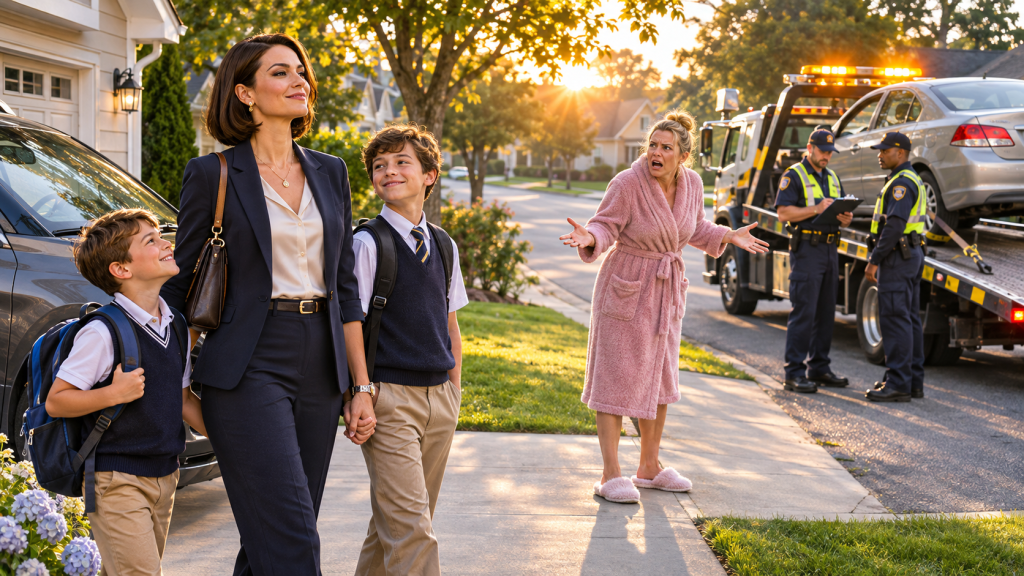
Or Denise standing on the pavement in her slippers.
What matters is what happened afterward.
The envelope Mr. Patel brought.
The records other neighbours had saved.
The courage of people who decided to speak.
The officials who listened.
And the realization that a small family shouldn’t have to surrender its peace simply because someone with more money wants what belongs to them.
I learned that kindness does not require endless tolerance.
That asking politely is important, but accepting repeated cruelty isn’t a duty.
And that standing up for yourself doesn’t mean becoming cruel in return.
I also learned something about my children.
They had watched me feel helpless.
They had watched me worry.
They had seen how frightening an ordinary morning could become when somebody decided their needs didn’t matter.
But they also watched me ask for help.
Keep records.
Follow proper procedures.
And refuse to let fear make every decision.
I hope that is what they remember.
Not the shouting.
Not the threatening message.
Not the anxious mornings.
I hope they remember that their mother took them seriously when they said they were frightened.
That she didn’t blame them for being late.
And that when a problem became too large for one family, she found people willing to stand beside them.
Because courage isn’t always a dramatic confrontation.
Sometimes it’s taking another photograph when you’re exhausted.
Making a difficult phone call.
Telling the truth to an employer even when you’re embarrassed.
Or asking neighbours whether they’ve experienced the same thing.
Sometimes courage is simply deciding that your children deserve to grow up without being afraid of the place they call home.
Today, our driveway looks exactly as it did before Denise arrived.
There is no monument.
No plaque.
No sign announcing what happened.
Just a strip of concrete leading from the road to our little brick house.
And that’s how I like it.
Every weekday morning, I make breakfast.
Oliver looks for his missing school jumper.
Jamie announces that his shoes have mysteriously disappeared.
Daniel reminds everyone to take their water bottles.
And eventually, after the usual confusion, we all make our way toward the car.
Sometimes we run late.
Because children are children.
Because toast burns.
Because schoolbags get forgotten.
Because life is wonderfully imperfect.
But now, when I reverse out of the driveway, there’s nothing blocking our way.
And every time I glance into the rearview mirror, I see two little boys who no longer worry that someone else’s cruelty will make them feel ashamed.
That means more to me than any argument I could have won.
Denise thought she could make our mornings miserable because she believed there would never be consequences.
The developer thought our family would eventually surrender our home because we were easier to pressure than to persuade.
But they underestimated something stronger than money or intimidation.
They underestimated a mother who had finally had enough.
Neighbours who were tired of staying silent.
And the quiet power of people who refused to let the truth disappear.
In the end, I didn’t need to shout louder than Denise.
I didn’t need revenge.
And I didn’t need to become the kind of person who enjoyed watching someone else suffer.
I needed evidence.
I needed help.
And I needed to remember that my family’s peace was worth protecting.
The greatest victory wasn’t seeing a silver car lifted onto a recovery truck.
It was standing outside our home months later, watching my children play safely beneath the afternoon sun.
Because a driveway is only concrete.
But the freedom to leave your home without fear, return without anxiety, and raise your children in peace?
That’s priceless.
And if anyone ever asks what happened to the neighbour who told me, “You’ll survive,” I simply smile.
Because she was right about one thing.
We did survive.
But we did more than that.
We stood together, protected our home, and learned that nobody has the right to make another family’s life miserable simply because they believe they can get away with it.