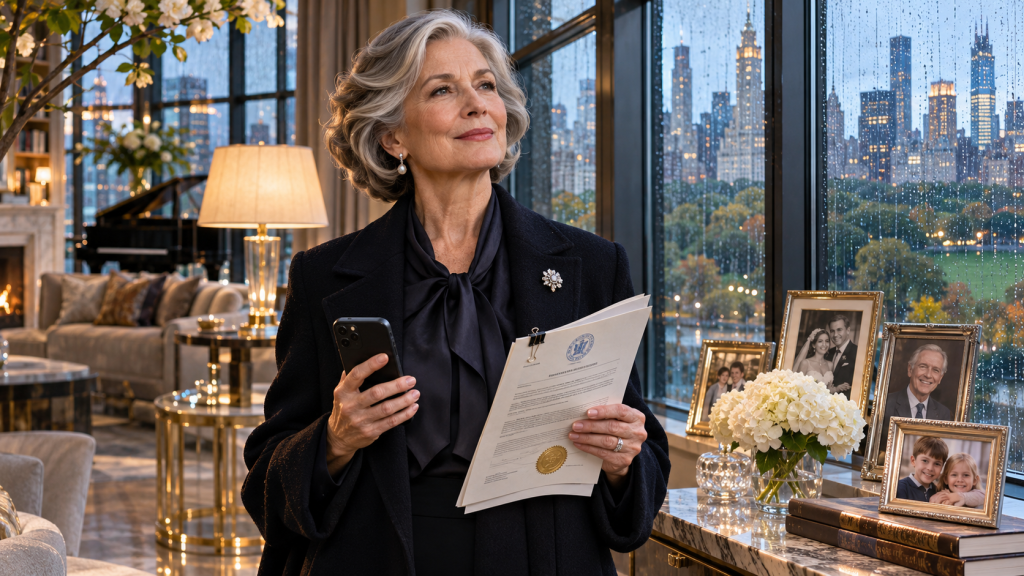
For a moment, I thought I had misheard my son. Outside the enormous windows of my Manhattan penthouse, rain streaked the glass, turning the lights of Central Park South into trembling ribbons of gold. I stood beside the window with my husband’s photograph in one hand and my phone pressed against my ear.
“Daniel,” I whispered, “what recording?” He was crying. Not the irritated, wounded crying I’d heard when he was a teenager and didn’t get his way. This sounded different. Frightened. Almost desperate. “Dad made it three weeks before he died.” My fingers tightened around the phone.
“Three weeks?” “At the hospital.” I closed my eyes. Three weeks before Henry died, he had still been able to speak clearly. He was weak, but his mind was sharp. He’d spent most of those days worrying about whether I was eating properly, whether the nurses were comfortable, and whether someone had remembered to water the small fern on our kitchen windowsill.
He hadn’t mentioned making any recording.
I swallowed.
“What did he say?”
Daniel’s breathing became uneven.
“Mom, I need to show you. Please.”
I looked toward the marble fireplace.
Above it hung a painting I hadn’t chosen.
The penthouse was beautiful, but even after three months, it still felt like a place I was learning to inhabit.
And suddenly, all I wanted was the old kitchen on Maple Avenue.
My husband’s voice.
The little clock above the stove.
The ordinary life we’d shared before everything fell apart.
“Why does Vanessa know about it?” I asked.
Daniel went silent.
“Daniel.”
“She found the file on my phone.”
My stomach tightened.
“And?”
“She copied it.”
I stared at the rain.
“Why?”
His next words came out barely above a whisper.
“Because Dad knew what she’d done. And he knew what I had helped her do.”
I lowered myself into the chair beside the window.
“What have you done, Daniel?”
He didn’t answer immediately.
I heard a door close somewhere behind him.
Then footsteps.
“Mom, I can’t talk here.”
My heart began pounding.
“Where are you?”
“At the house.”
My house.
The house where I’d raised him.
The house where I’d cooked birthday dinners and folded school uniforms and listened to my husband laugh over the morning newspaper.
The house my son had allowed his wife to push me out of while the flowers from Henry’s funeral were still fresh.
I swallowed the familiar ache.
“Daniel, listen carefully. I want you to send the recording to Eleanor. Don’t edit it. Don’t delete anything. Let her know exactly where it came from.”
He sniffed.
“Will you listen to it?”
“Yes.”
“Will you let me explain?”
I looked at Henry’s photograph.
For a moment, I remembered Daniel at seven years old, standing in our kitchen with a broken toy truck.
He’d been terrified I’d be angry.
I’d knelt beside him and said, “You can tell me the truth, sweetheart. We can face a mistake. We cannot fix a lie.”
Now he was forty-one.
And I was still waiting for him to tell me the truth.
“I’ll listen,” I answered.
“But Daniel, listening doesn’t mean everything will go back to the way it was.”
He began crying again.
“I know, Mom.”
For the first time in years, I thought he might actually understand.
My name is Martha Vance.
I’m sixty-eight years old, a retired hospital nurse, a widow, and the mother of one son.
For most of my life, those were the identities that mattered.
I knew how to change a dressing without causing unnecessary pain.
How to recognize fear behind an angry patient’s voice.
How to work a double shift and still remember to buy birthday candles on the way home.
I also knew how to make a small amount of money last longer than it had any right to.
What I hadn’t known, until three months earlier, was how to live for myself.
Henry and I had married when I was twenty-six.
He was a quiet young man with serious eyes and a talent for finding possibility in places other people overlooked.
I worked at Saint Vincent’s Hospital.
He worked in real estate and investments.
People assumed that meant we were wealthy.
But Henry never behaved like a wealthy man.
He drove the same sedan for twelve years.
Repaired things before replacing them.
And insisted that a good pair of shoes was worth more than an expensive watch.
We lived in the same White Plains house for forty years.
We ate dinner at the same kitchen table.
And whenever someone asked why we hadn’t moved somewhere grander, Henry would smile.
“Why leave the place where all our best memories live?”
I loved him for that.
I never imagined he was quietly building a fortune that would one day become my protection.
At nine the next morning, Eleanor Price arrived at the penthouse.
She was my attorney, but over the past three months she’d become something else.
A steady voice when grief made ordinary decisions feel impossible.
She was in her early fifties, with silver-threaded dark hair and an expression that rarely revealed more than she intended.
She carried a leather briefcase and two coffees.
“Good morning, Martha.”
I managed a tired smile.
“Did Daniel send it?”
She nodded.
“Yes.”
My heart began racing.
“And?”
“I haven’t listened to the complete recording yet. I wanted to review it with you.”
I sat down.
Eleanor placed a tablet on the coffee table.
“Before we begin, there’s something I want you to understand.”
I looked at her.
“Whatever your husband said, it doesn’t automatically establish the truth of every allegation. We will need to compare it with the records.”
I nodded.
She continued gently.
“And you don’t have to make any decisions today.”
I looked toward Henry’s photograph.
“I want to hear him.”
Eleanor’s expression softened.
“Then we’ll listen.”
The recording began with a soft electronic beep.
Then came the faint hum of hospital equipment.
I recognized the sound immediately.
Forty years of nursing had trained my ears to distinguish the noises of a medical ward.
And beneath them was something that made my chest ache.
Henry’s breathing.
Slow.
Labored.
But steady.
Then his voice.
“Daniel, is it recording?”
My hands flew to my mouth.
My husband.
My Henry.
For three months I’d been listening to old voicemail messages just to hear him say my name.
Now his voice filled the room.
Daniel answered quietly.
“Yes, Dad.”
There was a pause.
Then Henry spoke again.
“Good. I want you to keep this because I don’t know whether I’ll have another chance to say everything.”
I began crying.
Eleanor slid a box of tissues toward me.
I barely noticed.
Henry continued.
“Son, I love you. I’ve loved you since the nurse placed you in my arms forty-one years ago. Nothing that happens afterward changes that.”
Daniel made a small sound.
“Dad—”
“Let me finish.”
Henry coughed.
I could hear him adjusting his position.
Then he said something that made my blood run cold.
“I know about the loan documents.”
Silence.
“I know my signature was used without my permission.”
Daniel whispered, “I didn’t know Vanessa had done that until afterward.”
Henry sighed.
“You knew before the money was spent.”
Another silence.
“Yes.”
I gripped the arm of the chair.
My son had known.
Not simply suspected.
Known.
And said nothing.
Henry’s voice continued.
“I spent years paying off debts you told me were temporary. I helped because I believed you were struggling. But somewhere along the way, you stopped asking for help and started assuming I would rescue you.”
Daniel began crying.
“I’m sorry.”
“Sorry is a beginning, son. It isn’t a plan.”
I closed my eyes.
That sounded exactly like Henry.
Gentle.
Practical.
Unwilling to confuse affection with permission.
Then his voice grew firmer.
“Listen carefully. The Maple Avenue house belongs to your mother. The trust arrangements are for her protection. You have no authority to transfer her property or decide where she lives.”
My breath caught.
Henry had known.
He’d known they might try to take the house.
He’d known before he died.
I pressed a hand against my chest.
On the recording, Daniel whispered, “Vanessa thinks Mom won’t manage everything alone.”
Henry answered immediately.
“Your mother managed hospital wards, raised you, kept this family together, and cared for me when I couldn’t dress myself. Don’t insult her by pretending she can’t understand her own life.”
Tears streamed down my face.
For the first time since the funeral, I felt something stronger than grief.
I felt seen.
Then Henry said:
“Daniel, I’m going to ask you a question. And I want the truth.”
A pause.
“Has Vanessa ever discussed having your mother declared incapable of managing her affairs?”
My body went cold.
Daniel didn’t answer.
Henry repeated the question.
“Son?”
Finally, Daniel whispered, “She said it might be easier if we had control of the finances.”
Eleanor sat perfectly still.
The recording continued.
“And did you agree?”
Daniel’s answer was almost inaudible.
“I told her we’d talk about it after you were gone.”
I stared at the tablet.
After you were gone.
Not after Henry recovered.
Not after we discussed our finances.
After he was dead.
I felt suddenly sick.
Henry’s breathing grew louder.
Then he said, slowly and clearly:
“Your mother is grieving. Grief is not incapacity. Don’t you dare use her sadness as evidence that she cannot care for herself.”
I covered my face.
For years, I’d cared for frightened people in hospital rooms.
I’d defended patients who struggled to make themselves understood.
I’d explained to families that being old didn’t mean becoming invisible.
And now my own husband had been defending me in a room where I wasn’t present.
Henry continued.
“I’ve made arrangements to protect Martha’s financial interests. But what I want most is for her to be treated with dignity.”
Daniel sobbed.
“Dad, I wouldn’t hurt her.”
Henry was quiet for several seconds.
Then he answered:
“Then prove it.”
The recording lasted another eleven minutes.
Henry spoke about the debts.
About the documents.
About how much he regretted keeping certain financial matters from me.
And about the danger of allowing family members to believe that love meant limitless forgiveness.
Near the end, his voice grew softer.
“Daniel, if your mother ever hears this, I want her to know something.”
My heart stopped.
“Tell her I’m sorry I didn’t explain everything sooner.”
I bent forward, crying.
“Tell her I was trying to protect her, but I should have trusted her enough to tell her the whole truth.”
There was a pause.
Then:
“Tell her the best years of my life were the ordinary ones. The morning coffee. The garden. The sound of her coming home from the hospital.”
I couldn’t breathe.
“And tell her she doesn’t have to spend the rest of her life fixing what other people break.”
The recording ended.
For several minutes, Eleanor and I said nothing.
The city continued moving outside.
Cars traveled along Fifth Avenue.
People crossed streets.
A helicopter passed somewhere above the park.
And I sat in my beautiful penthouse feeling as though my husband had reached across death to hold my hand.
Finally, I whispered:
“He knew.”
Eleanor nodded.
“Yes.”
“He knew what they were planning.”
“At least part of it.”
I looked down.
“And he still loved Daniel.”
Eleanor’s expression softened.
“Love doesn’t always disappear when trust is broken.”
I began crying again.
“No.”
I looked toward the tablet.
“But trust doesn’t survive simply because love remains.”
That afternoon, I received another call from my son.
This time I answered.
“Mom?”
His voice sounded exhausted.
I closed my eyes.
“Daniel.”
He swallowed.
“Did you listen?”
“Yes.”
Silence.
Then he whispered, “I’m sorry.”
I sat beside the window.
“For what?”
He began crying.
“Everything.”
I took a breath.
“That’s too large a word, Daniel. Tell me what you’re sorry for.”
He went quiet.
For a moment, I thought he might hang up.
Then he said:
“I’m sorry I let Vanessa tell you to leave.”
My throat tightened.
He continued.
“I’m sorry I didn’t speak when she moved your things.”
A pause.
“I’m sorry I knew Dad had protected you and still let her pretend the house was ours.”
I pressed my lips together.
Then he whispered:
“And I’m sorry I didn’t call you for three months.”
That was the one that broke me.
Not because it surprised me.
Because he’d finally said it aloud.
Three months.
Ninety days.
He hadn’t asked whether I had somewhere to sleep.
Whether I was eating.
Whether I needed help.
He hadn’t known about the penthouse.
He’d believed I was an elderly widow who had left her home with one suitcase.
And he’d chosen not to find out where I went.
I swallowed.
“Daniel, do you understand what those three months felt like?”
He cried quietly.
“I think so.”
“No,” I answered.
“You don’t.”
He went silent.
I continued.
“I buried the man I’d loved for forty-two years. Then I lost my home. And then I discovered that my only child could go ninety days without wondering whether I was safe.”
My voice broke.
“I kept checking my phone.”
Daniel sobbed.
“Mom—”
“Every morning.”
I wiped my cheeks.
“I told myself maybe you’d call that afternoon. Maybe you’d ask if I’d eaten. Maybe you’d remember I was still your mother.”
I swallowed.
“But you didn’t.”
He cried for a long time.
I let him.
For most of his life, I’d rushed to comfort him whenever he was upset.
Now I understood that some pain belonged to the person who had caused it.
And I didn’t need to make it disappear.
Eventually, he whispered:
“What can I do?”
I looked toward Henry’s photograph.
“Start telling the truth.”
That evening, Eleanor returned with new information.
Her team had finished reviewing part of the financial records Henry had left behind.
The documents confirmed something extraordinary.
Over fifteen years, Henry had made payments totaling nearly nine hundred thousand dollars toward debts connected to Daniel and his business ventures.
Some were legitimate loans.
Others were obligations Henry had guaranteed.
A number involved money he’d paid to prevent creditors from pursuing assets tied to earlier agreements.
The figures were heartbreaking.
But what disturbed me most wasn’t the total.
It was a series of emails Henry had saved.
One was from Vanessa.
Dated eight months before his death.
It read:
Henry, if you want Daniel to have a chance at rebuilding his business, you need to stop treating Martha’s future comfort as more important than your son’s survival.
I stared at it.
Then read the next line.
She’s getting older. She doesn’t need the same level of control over everything.
I felt my face grow hot.
Eleanor watched me carefully.
“There’s more.”
She opened another message.
Vanessa had written:
Once the estate is settled, it will make more sense for Daniel and me to manage the house and remaining assets.
I sat back slowly.
They hadn’t simply behaved cruelly in the confusion after Henry died.
At least some of the planning had begun while he was still alive.
While I was sitting beside his hospital bed.
Holding his hand.
Reading to him when he was too tired to speak.
I looked toward Eleanor.
“Did Henry respond?”
She nodded.
Then showed me his reply.
It contained only three sentences.
Martha is not a problem to be managed.
She is my wife.
Do not contact me again about taking control of her property.
I pressed my hand against my mouth.
Henry.
My quiet husband.
The man who hated arguments.
Had finally drawn a line.
And that line had been me.
But the next discovery was even more painful.
Among the documents was a handwritten statement from Daniel, dated six months before Henry’s death.
It acknowledged that Vanessa had used Henry’s signature on certain loan documents without authorization and that Daniel had learned about the matter afterward.
It also stated that Daniel had continued using funds associated with the transaction.
The statement was signed.
Dated.
And witnessed.
I stared.
“Why would Daniel sign this?”
Eleanor folded her hands.
“Your husband apparently wanted a written record of what his son knew.”
My throat tightened.
“Did he intend to report it?”
“Possibly. We haven’t established his intentions completely.”
I looked down.
Henry had spent years rescuing our son from financial disasters.
But near the end, he had begun insisting on accountability.
Not because he stopped loving Daniel.
Because he understood that protecting someone from every consequence can eventually become another way of harming them.
I looked toward the papers.
Then whispered:
“I think Henry was trying to save us all.”
The following morning, I returned to Maple Avenue.
Not to move back.
Not to confront Vanessa.
I returned because my husband’s piano was still there.
And because Eleanor had arranged for a properly supervised inventory of our belongings.
The house looked smaller than I remembered.
The same white shutters.
The same maple tree beside the front steps.
The same little crack in the pavement where Daniel had once fallen off his bicycle.
I stood at the gate for several minutes.
Forty years of memories lived behind those windows.
I remembered bringing our newborn son home.
Henry carrying the car seat as though it contained something made of glass.
I remembered Christmas mornings.
Birthday cakes.
The smell of roast chicken.
The sound of rain on the roof.
And I remembered leaving.
One suitcase.
One word.
“Okay.”
Eleanor touched my arm.
“Are you ready?”
I nodded.
As ready as I could be.
A court-authorized officer and an inventory specialist were present to ensure the visit complied with the arrangements governing the property and disputed belongings.
There would be no dramatic confrontation.
No surprise locks changed in the middle of the night.
No personal revenge disguised as legal procedure.
I wanted my home and belongings protected.
And I wanted everything handled properly.
When the door opened, Vanessa was standing in the hallway.
For a moment, she didn’t recognize me.
I’d had my hair cut.
The grey strands were styled in a soft bob.
I wore a navy coat, comfortable leather shoes, and the pearl earrings Henry gave me on our thirtieth anniversary.
I hadn’t dressed to impress her.
I had dressed like myself.
Something I’d forgotten how to do during the months when grief made every morning feel impossible.
Vanessa stared.
“Martha?”
I nodded.
“Hello, Vanessa.”
Her eyes moved toward Eleanor.
Then the officer.
Her face tightened.
“You brought people.”
Eleanor spoke calmly.
“We’re here for the agreed inventory and collection of designated personal property.”
Vanessa crossed her arms.
“This is ridiculous.”
I looked at her.
“No.”
My voice was steady.
“What’s ridiculous is that I needed legal arrangements to retrieve belongings from my own home.”
She opened her mouth.
Then closed it.
For a moment, her old confidence faltered.
And I realized something.
Vanessa had only seemed powerful because I’d spent years allowing her to decide the rules.
Now those rules had boundaries.
Written boundaries.
Legally enforceable boundaries.
And she couldn’t simply shout them away.
We entered the living room.
My breath caught.
The furniture had been rearranged.
The curtains were different.
A new television hung above the fireplace.
Our wedding photograph was gone.
For a moment, anger surged through me.
Then I saw the piano.
My grandmother’s piano.
The dark walnut had been polished.
But a scratch marked the side near the keyboard.
I approached slowly.
Touched the wood.
And remembered being six years old.
My grandmother sitting beside me, guiding my fingers over the keys.
“Music doesn’t have to be perfect, Martha,” she’d say.
“It only has to be honest.”
My eyes filled.
I lifted the lid.
Inside was a small folded piece of paper.
The same note Eleanor had spotted in the online listing.
For Martha, when the truth becomes unbearable.
I unfolded it carefully.
There was more writing on the reverse.
Henry’s writing.
My darling Martha,
If you’ve found this, then perhaps there are things I couldn’t bring myself to tell you while I was alive.
I was afraid you would be angry about the money I spent rescuing Daniel.
You would have had every right to be.
I kept telling myself I was protecting our family, but I see now that secrecy was making things worse.
I should have trusted you.
You were always stronger than I understood.
My hands trembled.
I continued.
The greatest regret of my life is not that I helped our son.
It is that I helped him without making him accountable, and in doing so allowed him to believe that love meant he would never face consequences.
Please don’t continue my mistake.
I covered my mouth.
The room blurred.
Vanessa stood near the doorway.
Eleanor remained quietly beside me.
I kept reading.
The money, the penthouse, and the arrangements I’ve made are not rewards for suffering.
They are tools for freedom.
Use them to live.
Travel.
Learn something new.
Buy flowers for yourself even when nobody is coming to visit.
And if you ever feel guilty for choosing peace, remember that I spent forty-two years loving you because of who you are, not because of what you gave everybody else.
Tears fell onto the paper.
At the bottom, Henry had added one final line.
And please, sweetheart, play the piano again.
I bent forward.
For years, the piano had sat against our living-room wall.
I had stopped playing when Daniel was young.
There were school schedules.
Hospital shifts.
Bills.
Dinner.
Laundry.
Then Henry’s illness.
There had always been something more urgent than music.
And somehow, forty years passed.
I sat on the bench.
My hands shook as I rested them on the keys.
I hadn’t played in nearly twenty years.
I pressed one note.
Then another.
A simple melody began to emerge.
The same lullaby my grandmother taught me.
The sound filled the room.
Thin at first.
Then stronger.
I began crying so hard I could barely see.
But I kept playing.
Because Henry had asked me to.
Because my grandmother had loved that song.
And because somewhere beneath all the grief and betrayal, there was still a woman named Martha who had once loved music simply because it made her happy.
When I finished, the room was silent.
Even Vanessa had stopped moving.
I stood.
Folded the letter.
And placed it inside my handbag.
Then I turned toward Eleanor.
“I want the piano brought to Manhattan.”
She nodded.
“We’ll arrange it.”
Vanessa’s face changed.
“You can’t take everything!”
I looked at her.
“I’m taking what belongs to me.”
She stepped forward.
“What about Daniel?”
I felt a sharp ache.
“What about him?”
Her voice rose.
“He’s your son!”
I swallowed.
“Yes.”
Then I said quietly:
“And I’m his mother. But that didn’t stop either of you from telling me to leave.”
She stared at me.
I continued.
“Being family doesn’t make cruelty disappear.”
For a moment, I thought she might cry.
Instead, she folded her arms.
“You’re enjoying this.”
The words struck me.
Because they were so far from the truth.
I looked toward the piano.
The wedding photograph missing from the mantel.
The hallway where Daniel had learned to walk.
And the woman who had helped turn my home into a battlefield.
“No, Vanessa.”
My voice broke.
“I’m not enjoying any of this.”
I took a breath.
“I would give every dollar in that penthouse to have my husband alive and my family whole.”
She looked away.
“But I cannot purchase those things by surrendering my dignity.”
I left before the tears overwhelmed me.
Outside, the March wind moved through the bare branches of the maple tree.
I looked back at the house.
Then walked toward the waiting car.
And this time, leaving felt different.
Three months earlier, I’d walked away because I was being pushed out.
Now I was leaving because I had somewhere else to build my life.
The legal process concerning the house continued.
Although the initial papers had been described to my son as an immediate eviction warrant, Eleanor explained that the actual steps had to follow the court’s orders and the applicable procedures.
My ownership was supported by the title records.
The attempted transfer documents hadn’t been signed by me.
And the claims concerning unauthorized disposal of belongings were being addressed separately.
Daniel and Vanessa were given formal deadlines through the appropriate process.
I refused to turn the case into a public spectacle.
There were no newspaper interviews.
No photographs of Vanessa carrying boxes.
No celebrations when the court ruled in my favour on disputed property issues.
I had no desire to humiliate anyone.
I wanted my home protected.
My belongings returned.
And my right to decide how I lived respected.
Eventually, Daniel and Vanessa moved out.
Some heirlooms were returned.
Others could not be recovered immediately.
The antique watch Henry had inherited from his father had been sold to a dealer.
After Eleanor contacted the relevant parties, ownership and recovery were addressed through a negotiated arrangement.
The watch eventually came back to me.
I held it in my palm for a long time.
The glass was scratched.
The leather strap was worn.
But it was the same watch Henry had shown Daniel when he was a little boy.
I remembered my son at eight years old.
“Dad, will that be mine someday?”
Henry had smiled.
“If you learn to take care of the things you love.”
I closed my eyes.
Then placed the watch in a small wooden box.
Not because it was valuable.
Because it reminded me of the father Daniel had once admired.
And the man he’d become too frightened to disappoint honestly.
The financial dispute took longer.
Henry’s records documented years of support.
But Eleanor made something clear.
Not every payment could simply be demanded back.
Some had been gifts.
Some loans.
Some guarantees.
And the question of whether money was recoverable depended on the agreements and the circumstances.
I listened.
I wasn’t looking for a number large enough to frighten my son.
I wanted accountability.
The forged loan documents were examined separately.
Vanessa denied certain allegations.
Daniel provided statements about what he’d known and when.
The relevant institutions and authorities reviewed the evidence.
The consequences were not instantaneous.
Nor were they all within my control.
But the truth no longer depended on my husband’s silence.
And that mattered.
Several weeks after Daniel moved out of Maple Avenue, he asked to see me.
I didn’t answer immediately.
Instead, I spoke with Eleanor.
Not because I needed a lawyer’s permission to speak to my son.
Because after so much manipulation, I wanted to approach the conversation with clear boundaries.
We agreed to meet in a small café near Central Park.
Public.
Quiet.
Neutral.
I arrived early.
Ordered tea.
And sat beside the window.
Daniel entered ten minutes later.
For a moment, I barely recognized him.
He had lost weight.
His shoulders were rounded.
Dark circles marked his eyes.
He looked older than forty-one.
When he saw me, he stopped.
“Mom.”
I nodded.
“Daniel.”
He approached the table.
Then hesitated.
“Can I hug you?”
My throat tightened.
There had been a time when he never would have asked.
He would have assumed my arms were always available.
No matter what had happened.
No matter how deeply I’d been hurt.
I studied his face.
Then stood.
“Yes.”
He held me.
And I felt something inside me break.
Because no matter how much pain he had caused, I still remembered the baby I’d carried through feverish nights.
The boy who used to run into my arms after school.
The teenager who left dirty football boots beside the back door.
The young man who cried when his grandfather died.
He was all those people.
And he was also the adult who had abandoned me.
Both truths existed.
I couldn’t erase either one.
When we sat down, Daniel wiped his eyes.
“I don’t know where to begin.”
I folded my hands.
“Begin with the truth.”
He nodded slowly.
Then spoke.
He told me about the failing business.
The debts.
The pressure he’d felt to maintain the lifestyle Vanessa wanted.
The expensive holidays.
The leased cars.
The constant need to look successful.
He admitted that every time his father rescued him, he felt relieved.
Then ashamed.
Then angry at himself for needing help.
Instead of facing that shame, he borrowed more.
Made promises.
Hid losses.
And allowed Vanessa to tell him that Henry was being unfair whenever he hesitated to provide more money.
“I kept thinking one good deal would fix everything,” Daniel whispered.
I looked at him.
“And did it?”
He shook his head.
“No.”
He continued.
“Then Dad got sick.”
His eyes filled.
“And everything became real.”
I swallowed.
“Why didn’t you tell me?”
He looked down.
“Because I knew you’d be disappointed.”
The words struck me.
I stared at him.
“Daniel, I was disappointed because you lied.”
He nodded.
“I know.”
I leaned forward.
“Your father and I could have faced financial difficulties with you. But you didn’t give us the truth.”
He wiped his eyes.
“I was afraid.”
I took a breath.
“Fear explains some decisions. It doesn’t excuse all of them.”
He nodded.
Then he said something I hadn’t expected.
“I started seeing a therapist.”
I looked up.
He swallowed.
“And a financial counsellor.”
He continued.
“I’m working with someone to understand why I kept hiding problems and expecting Dad to rescue me.”
I studied him.
“That’s good.”
He nodded.
“But it doesn’t fix what I did to you.”
“No,” I answered.
“It doesn’t.”
For a moment, he looked like he might cry again.
Then he asked:
“Can you ever forgive me?”
I stared at my son.
The question I’d known was coming.
The question I’d feared.
Forgiveness had always been complicated in our family.
For years, it meant pretending something hadn’t happened.
Smiling through dinner.
Avoiding difficult conversations.
Allowing the same behaviour to return because bringing up the past would make everyone uncomfortable.
I didn’t want that anymore.
“Daniel,” I said gently, “I love you.”
His eyes filled.
“I know.”
“But I don’t trust you right now.”
He nodded.
“I understand.”
I continued.
“Forgiveness may come with time. Trust will require consistent actions.”
He swallowed.
“Okay.”
I looked directly at him.
“I will not give you control of my finances.”
He nodded.
“I won’t ask.”
“I will not pay new debts to protect you from consequences.”
“I know.”
“And I will not pretend you did nothing wrong simply because you’re my son.”
He began crying.
Then whispered:
“That’s fair.”
For a long time, we sat quietly.
Then he looked toward my hands.
“Are you happy in Manhattan?”
The question surprised me.
I considered it.
“Some days.”
He nodded.
“Do you miss the house?”
I smiled sadly.
“Every day.”
He looked down.
“I’m sorry.”
I took a breath.
“I miss the memories, Daniel. But I don’t know whether I want to live there again.”
He nodded.
Then whispered:
“Dad would’ve wanted you to be happy.”
My eyes filled.
“Yes.”
For the first time, we were talking about Henry without pretending that one of us owned the grief more than the other.
The meeting lasted nearly two hours.
Daniel didn’t ask for money.
He didn’t blame Vanessa for everything.
He acknowledged his own choices.
And when we parted, he didn’t demand another meeting.
He simply said:
“Thank you for seeing me, Mom.”
I nodded.
“Take care of yourself.”
As he walked away, I felt a deep sadness.
But also a fragile hope.
Not that everything would return to the way it had been.
That was impossible.
Perhaps it was never healthy to begin with.
I hoped we might build something more honest.
Something smaller.
But real.
That spring, I began doing something I hadn’t done in more than forty years.
I started making plans that belonged only to me.
Not for Henry.
Not for Daniel.
Not for the hospital.
For Martha.
My first decision was to take piano lessons.
It sounds ridiculous, perhaps, for a sixty-eight-year-old woman to hire a teacher to learn something she’d once known.
But the piano had arrived safely at the penthouse, and every time I passed it, I heard Henry’s words.
Please, sweetheart, play the piano again.
My teacher was a young woman named Isabel Morales.
She was twenty-nine, cheerful, and entirely unimpressed by the expensive apartment.
On our first afternoon, she asked me what I wanted to learn.
I looked toward the keys.
“I want to remember how to enjoy something without being good at it.”
She smiled.
“That’s a wonderful reason.”
My fingers were stiff.
I missed notes.
Forgot chords.
And occasionally stopped halfway through a piece because a memory caught me unexpectedly.
Isabel never rushed me.
One afternoon, when I apologized for making the same mistake three times, she shook her head.
“Martha, you’re allowed to be a beginner.”
I laughed.
“At my age?”
“Especially at your age.”
I stared at her.
Then began crying.
Because I couldn’t remember the last time someone had told me I was allowed to learn without already knowing how.
I also began meeting an old friend for lunch.
Her name was Ruth Alvarez.
We’d worked together at Saint Vincent’s Hospital for nearly twenty years.
She was the kind of woman who could comfort a frightened patient while simultaneously terrifying an arrogant surgeon.
When she heard about everything that had happened, she arrived at my penthouse with a container of homemade soup and a very strong opinion.
“Martha Vance,” she said, standing in my doorway, “if you spend the rest of your life sitting in this beautiful apartment feeling guilty for owning it, I will personally come back and drag you outside.”
I laughed for the first time in days.
“Hello to you too, Ruth.”
She hugged me.
Then looked around.
“Well. Henry certainly knew how to choose a view.”
Over lunch, I told her about the trust.
The house.
The recording.
And Daniel’s apology.
Ruth listened without interrupting.
When I finished, she set down her spoon.
“Do you know what I remember about you?”
I frowned.
“My terrible handwriting?”
She laughed.
“Besides that.”
I smiled.
“What?”
She leaned forward.
“When the hospital was short-staffed, you always stayed.”
I looked down.
“When someone needed help, you volunteered.”
I shrugged.
“That was the job.”
“No,” Ruth replied.
“That was you.”
Her expression softened.
“But somewhere along the way, you began believing you had to be needed to deserve a place in people’s lives.”
My throat tightened.
I looked toward the window.
Then whispered:
“I don’t know how to stop.”
Ruth reached across the table.
“Start by allowing people to love you when you’re doing absolutely nothing for them.”
That afternoon, we walked through Central Park.
We bought hot chocolate.
Sat on a bench.
And watched children sail little boats across the pond.
I didn’t solve anyone’s problem.
Didn’t cook dinner.
Didn’t make a reservation.
Didn’t write a check.
I simply existed.
And somehow, that felt revolutionary.
A month later, Eleanor asked me to visit her office.
When I arrived, she had a small wooden box waiting on her desk.
I recognized it immediately.
It was Henry’s old document box.
The one he’d kept in the bottom drawer of his study.
My stomach tightened.
“Where did you find that?”
Eleanor smiled gently.
“It was among the materials collected from Maple Avenue.”
I opened it.
Inside were old photographs.
Business cards.
A fountain pen.
And a small spiral notebook.
I recognized Henry’s handwriting on the cover.
MARTHA’S IDEAS.
I stared at it.
“What is this?”
Eleanor shook her head.
“I thought you should discover that yourself.”
I opened the notebook.
The first page contained a list.
Places Martha wants to visit.
Paris.
Maine in autumn.
The English countryside.
The coast of Italy.
I covered my mouth.
Henry had written down things I’d mentioned over the years.
Little passing wishes.
Things I’d said while washing dishes or folding laundry.
I turned another page.
Things Martha says she’ll do when she has time.
Take piano lessons.
Learn to paint.
Volunteer at a free clinic.
Plant a proper rose garden.
Write down her mother’s recipes.
Tears filled my eyes.
I remembered saying those things.
Always with the same phrase.
Someday, when things settle down.
But things never settled down.
There was always another shift.
Another bill.
Another family emergency.
Another reason to postpone something that mattered to me.
Near the back of the notebook, Henry had written:
If I go first, I hope Martha realizes she can finally say yes to herself.
I began crying.
Eleanor sat quietly.
Then said:
“Your husband also left a letter of wishes concerning the trust.”
I looked up.
She continued.
“It isn’t a binding instruction about how you must spend your money. He was very clear that these decisions belong to you.”
I nodded.
“But?”
Her expression softened.
“He mentioned something he’d hoped you might consider.”
She handed me a page.
I read it slowly.
Henry had written about my years at the hospital.
About the young nurses I’d mentored.
About how often I’d worried that talented people couldn’t afford the education they needed.
He remembered a young nursing assistant named Clara who’d worked two jobs while attending school.
I remembered her too.
She had been intelligent.
Patient.
Gentle with elderly people.
But tuition and childcare costs nearly forced her to quit.
Henry had once listened to me talk about her for an entire evening.
I hadn’t known he remembered.
His letter read:
If Martha wants to use part of the trust to help students like Clara, I think that would make her happy.
But she must decide for herself.
She’s spent enough years carrying everybody else’s expectations.
I sat back.
For a long moment, I stared at the paper.
Then I smiled through tears.
“Henry, you wonderful man.”
That was how the idea began.
Not with a grand announcement.
Not with a publicity campaign.
With one memory of a young woman struggling to pay tuition.
Over the following months, Ruth and I worked with advisers to establish a scholarship program for nursing students facing financial hardship.
We named it the Henry and Martha Vance Nursing Opportunity Fund.
I initially wanted Henry’s name alone.
But Ruth refused.
“Martha, he didn’t work at that hospital for forty years.”
I laughed.
“He worked pretty hard elsewhere.”
“Then his name belongs there too.”
The first scholarships supported students who were balancing education with work or family responsibilities.
We partnered with an established educational organization so the process would be administered carefully and fairly.
I didn’t want students to have to tell dramatic stories of suffering to prove they deserved help.
I wanted them judged on their needs, commitment, and potential.
When the first recipients were selected, I attended a small gathering.
One young woman approached me afterward.
She was twenty-three, with tired eyes and a smile that reminded me of myself at that age.
“Mrs. Vance?”
I smiled.
“Yes?”
She held her acceptance letter carefully.
“I just wanted to say thank you.”
I shook my head.
“You’ve worked very hard for this.”
Her eyes filled.
“I almost dropped out.”
My throat tightened.
She continued.
“My mother is sick, and I help care for my younger brother. I didn’t know how I was going to afford next semester.”
I took her hand.
“I’m glad you’re continuing.”
She began crying.
“Someday I want to help people the way you helped me.”
I looked at her.
Then whispered:
“Then you’ll be giving me something wonderful in return.”
That evening, I returned to the penthouse and placed the scholarship program beside Henry’s photograph.
I sat down.
Looked at his smile.
And cried.
For months, I’d thought the inheritance represented protection from my son’s betrayal.
But now it represented something else.
Possibility.
Henry had given me enough security to make choices without fear.
And I was finally beginning to understand that his greatest gift wasn’t the amount in the trust.
It was the freedom to decide what my life could become.
My relationship with Daniel continued slowly.
He sent occasional messages.
Not demands.
Not requests for money.
Simple things.
Good morning, Mom. Hope you’re well.
I started the financial counseling program.
I found steady work. It’s not glamorous, but it’s honest.
Would you be comfortable talking next week?
Sometimes I answered immediately.
Sometimes I needed a few days.
And for the first time, he accepted that without accusing me of being unloving.
One afternoon, he asked whether he could visit the penthouse.
I hesitated.
The apartment had become my sanctuary.
I wasn’t sure I wanted the memories of our conflict inside it.
But after thinking carefully, I agreed.
Daniel arrived carrying flowers.
Not expensive ones.
A small bunch of yellow tulips.
My favourites.
He looked nervous when I opened the door.
“Hi, Mom.”
I smiled faintly.
“Hello, Daniel.”
He held out the flowers.
“I remembered you liked these.”
My eyes filled.
For years, he’d sent elaborate birthday gifts that Henry helped pay for.
Now he stood before me with flowers he’d purchased himself.
And somehow, they meant more.
We sat in the living room.
He looked around.
“It’s beautiful.”
I nodded.
“Yes.”
Then he noticed the piano.
His eyes widened.
“Grandma’s piano.”
I smiled.
“I had it brought here.”
He approached slowly.
“Can I touch it?”
“Of course.”
He ran his fingers over the wood.
Then whispered:
“Remember when you used to play for me?”
My heart tightened.
“Yes.”
He smiled sadly.
“I used to fall asleep on the sofa while you played.”
I swallowed.
He looked toward me.
“I forgot how much I loved that.”
I sat on the bench.
Opened the music.
And began playing the old lullaby.
My fingers still made mistakes.
But I didn’t stop.
Daniel stood beside the piano.
When I finished, he was crying.
“Mom…”
I looked up.
He swallowed.
“I wish I could go back.”
My eyes filled.
“So do I.”
For a long moment, neither of us spoke.
Then I said something that had taken me months to understand.
“But we can’t rebuild a life by pretending the damage never happened.”
He nodded.
“I know.”
I took his hand.
“We can only decide what kind of people we want to be now.”
He began crying harder.
Then whispered:
“I want to be someone Dad would’ve been proud of.”
I looked toward Henry’s photograph.
Then back at my son.
“Then become someone you can respect when nobody is watching.”
Daniel nodded.
And for the first time, I felt that he was beginning to understand what his father had tried to teach him.
As for Vanessa, her marriage to Daniel deteriorated as the financial and property disputes unfolded.
Eventually, they separated.
I didn’t celebrate that either.
I had once hoped my son’s marriage would bring him happiness.
But I couldn’t force two people to build a healthy life together.
And I refused to become responsible for fixing their relationship.
Vanessa’s actions remained subject to the relevant proceedings.
Where the evidence established wrongdoing, the consequences belonged to her.
Where allegations were disputed, they had to be resolved fairly.
I no longer needed to know every detail of her daily life.
She had occupied too much space in my thoughts already.
One day, I received a handwritten letter from her.
It was brief.
She acknowledged the cruelty of what she’d said after Henry’s funeral.
She wrote that she’d been frightened about money and had convinced herself that gaining control of the house would solve everything.
She didn’t ask to meet.
She didn’t demand forgiveness.
She simply apologized.
I read the letter twice.
Then placed it in a drawer.
I didn’t reply.
Not because I wanted revenge.
Because an apology doesn’t create an obligation to resume a relationship.
Some doors can remain closed without hatred.
And that was a lesson I’d needed to learn.
By autumn, I had made a decision about Maple Avenue.
I would not move back.
For weeks, I’d struggled with guilt.
The house held forty years of memories.
Henry’s garden.
Daniel’s childhood.
Christmas mornings.
The old kitchen.
But every time I imagined living there alone, I remembered the funeral.
The sticky notes on the furniture.
The wedding photograph leaning against the wall.
The way my son had stood silent while Vanessa told me to leave.
I didn’t want those memories to become the last chapter of our home.
But I also didn’t want to spend the rest of my life trying to recreate a past that was gone.
So I decided to sell the house.
Carefully.
At a fair price.
To a young family who fell in love with the old maple tree and the sunny kitchen.
When I visited for the final time, the rooms were empty.
My furniture had been moved.
The curtains packed.
The walls bare.
I walked slowly through the hallway.
Touched the place where Daniel’s height had been marked year after year.
Remembered the birthday parties.
The laughter.
The arguments.
The quiet evenings when Henry and I sat together watching television.
Then I entered the kitchen.
The same counter where I’d made coffee at 4:30 every morning.
For forty years.
I placed my palm against it.
And whispered:
“Thank you.”
Not because the house could hear me.
Because I needed to say goodbye.
Outside, the maple tree had turned brilliant gold.
Leaves drifted across the driveway.
The air smelled of autumn.
I stood beneath the branches.
Then looked back at the house.
For a moment, I imagined Henry standing in the doorway.
Smiling.
Holding two mugs of coffee.
Waiting for me to come inside.
Tears filled my eyes.
“I love you,” I whispered.
Then I walked away.
The sale proceeds were added to my financial plan.
I made sure the new family understood how much I’d loved the place.
And I left one small gift on the kitchen counter.
A handwritten note.
May this home hold as much love and laughter for you as it held for us.
No warning.
No bitterness.
No mention of the people who had hurt me.
Just a blessing.
Because I didn’t want the house remembered for how I lost it for three months.
I wanted it remembered for the forty years when it had been filled with love.
One year after Henry’s death, I visited his grave.
The sky was pale blue.
A cool breeze moved through the cemetery.
I carried yellow tulips and a small photograph of our wedding day.
I placed them beside the headstone.
Then sat on the grass.
“Hello, sweetheart.”
My voice trembled.
I looked at his name.
HENRY VANCE.
Beloved Husband.
Father.
Friend.
For a long time, I said nothing.
Then I began telling him about the year.
About the piano.
The scholarship students.
The sale of our house.
The afternoons in Central Park with Ruth.
And the trip to Maine I’d finally booked for October.
I told him about Daniel too.
How he was trying.
How we were learning to speak honestly.
How I still loved our son, even though rebuilding trust was taking longer than either of us wanted.
Then I took the little brass key from my handbag.
The one Henry had pressed into my palm three weeks before he died.
The key that had led me to the safe-deposit box.
The trust documents.
And the life he had prepared for me.
I held it between my fingers.
And smiled through tears.
“Henry, I thought this key was the greatest thing you left me.”
The wind moved softly through the trees.
“But it wasn’t.”
I swallowed.
“The greatest thing was knowing that even when I felt helpless, you believed I could build a life of my own.”
I touched his headstone.
“And I’m doing it.”
For the first time since his death, I left the cemetery without feeling that I was abandoning him.
I was carrying his love into the life I still had.
There are people who believe this story is about money.
Twenty-eight million dollars.
A penthouse overlooking Central Park.
A daughter-in-law who thought she could throw an elderly widow out of her own home.
And a legal notice that shattered the illusion of control.
I understand why those details attract attention.
But when I remember what happened, the money is not what hurts me.
And it isn’t what healed me.
What hurts is remembering my son standing silently behind his wife.
The funeral flowers.
The packed suitcase.
The wedding photograph removed from the mantel.
And the terrible realization that the people I’d spent my life protecting were willing to treat me as though I no longer mattered.
What healed me was discovering that I did matter.
Not because I had an inheritance.
Not because I could afford a lawyer.
Not because I lived in an expensive apartment.
I mattered when I was standing in that old kitchen wearing my black funeral dress.
I mattered when I was working double shifts at the hospital.
I mattered when I was raising my son, caring for my husband, and stretching every dollar.
I had always mattered.
I simply forgot that my needs deserved a place beside everyone else’s.
Henry knew that.
It took me longer to understand.
Today, I still live in Manhattan.
My piano stands beside the windows.
Every morning, sunlight spills across its polished wood.
I make coffee, open the curtains, and look toward Central Park.
Sometimes I play before breakfast.
Sometimes I call Ruth.
Sometimes I work with the scholarship program.
And sometimes I spend an entire afternoon reading a book without feeling guilty that I haven’t accomplished anything.
I’m learning that peace isn’t something you have to earn through exhaustion.
It’s something you can choose to protect.
Daniel visits occasionally.
We share meals.
Talk about ordinary things.
And sometimes remember Henry together.
Our relationship isn’t perfect.
But it is becoming more honest.
And for now, that is enough.
I no longer write checks to prove my love.
I no longer apologize for saying no.
And I no longer believe that being a mother means surrendering every boundary.
One morning, while practicing the old lullaby, I noticed Henry’s photograph reflected in the piano’s glossy surface.
I stopped playing.
Looked at his smile.
And suddenly remembered something he’d said during our anniversary dinner years earlier.
“Martha, promise me one thing.”
I’d laughed.
“What?”
He’d reached across the table.
“If I ever go first, don’t stop living just because I’m not there.”
At the time, I’d brushed away his words.
“Don’t talk like that.”
He’d smiled.
“I’m serious.”
I remembered squeezing his hand.
“I promise.”
For years, I’d forgotten that conversation.
Now I understood what he had meant.
I placed my fingers back on the keys.
And began playing again.
The melody filled the penthouse.
Gentle.
Imperfect.
Beautiful.
Outside, the city carried on.
And inside, a sixty-eight-year-old widow finally began keeping the promise she’d made to the man she loved.
My daughter-in-law told me to cry, pack my things, and live on the streets.
My son stood there and said nothing.
They believed my husband’s death had left me powerless, without money, without a home, and without a voice.
But the truth was that my husband had left me more than a fortune.
He had left me protection.
A choice.
And a reminder that my life wasn’t finished simply because his had ended.
The legal notice made them understand that I still owned my home.
The financial records made them confront the consequences of their choices.
But the greatest victory was something they never saw.
It was the morning I sat at my grandmother’s piano, looked across the sunlit city, and realized I was no longer waiting for someone else’s permission to be happy.
They thought they were throwing a helpless widow out of her own life.
Instead, they pushed me toward the freedom I had forgotten I deserved.
And in the end, I didn’t need revenge.
I didn’t need them to suffer.
I only needed to remember who I was.
Martha Vance.
A wife who had been deeply loved.
A mother who was learning to love without surrendering herself.
A nurse who had spent decades helping others.
And a woman whose life still contained more beauty than she had ever imagined.
Because losing my husband was the end of our life together.
But it was never meant to be the end of mine.