For a long time, I simply stared at the final sentence in my daughter’s note. And Malcolm isn’t telling you how he knows about our family. The heart monitor beside me continued its steady rhythm. Outside, Seattle rain slid down the hospital window in silver streams. And in the chair beside my bed sat Malcolm Chen, the man who had just reminded me that kindness could survive almost half a century.
Only minutes earlier, I had been looking at him with gratitude. Now I was looking at him with fear. “Malcolm,” I whispered. He lifted his eyes. “Yes, Adrienne?” I held up Sarah’s letter. “How did you get those documents?” For the first time since he’d entered my hospital room, his confidence seemed to disappear.
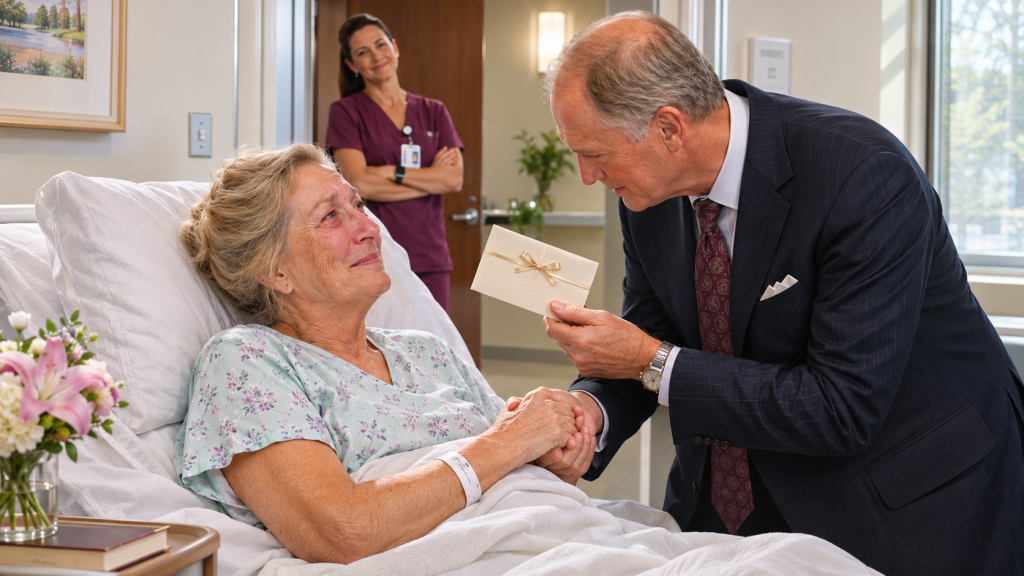
He looked toward the folder resting on his lap. Then back at me. “Adrienne, I can explain.” My chest tightened. “That’s what people say when they should have explained something sooner.” He closed his eyes briefly. I continued. “You told me someone sent copies to your office.” “Yes.” “Who?”
He hesitated.
And that hesitation hurt more than I expected.
Because after everything I’d just learned about my children, I desperately needed one person in that room to tell me the truth without making me beg for it.
“Please,” I whispered. “Don’t turn this into another secret.”
Malcolm leaned forward.
“You’re right.”
He took a slow breath.
“I should have told you immediately.”
He reached into his briefcase.
This time, he removed a small envelope.
Inside was a photograph.
An old photograph of a school cafeteria.
A young woman stood behind a serving counter, wearing a white apron and smiling at the camera.
Beside her was a little boy with dark hair and enormous brown eyes.
I recognized him instantly.
“Malcolm.”
He nodded.
“And do you recognize the woman?”
I looked closer.
My breath caught.
“Is that your mother?”
He shook his head.
“My foster mother. Eleanor Peterson.”
I remembered her.
A kind, exhausted woman who sometimes came to Franklin Elementary to collect Malcolm after school.
She had always worn a faded brown coat.
“She was lovely,” I whispered.
Malcolm’s eyes softened.
“She thought the world of you.”
I looked at him.
“Why are you showing me this?”
His expression became serious.
“Because Eleanor had another foster child.”
I stared.
“A girl.”
He nodded.
“Her name was Rachel.”
My heart tightened.
“And?”
“She’s a lawyer now.”
I glanced toward the documents.
Malcolm continued.
“Rachel Peterson works in elder law. Several weeks ago, she was consulted about a proposed guardianship involving a woman named Adrienne Davis.”
I felt the blood drain from my face.
“Me?”
“Yes.”
I tightened my grip on the blanket.
“Did my children hire her?”
“No.”
“Then how did she know?”
Malcolm swallowed.
“She was asked to review a conflict involving one of the firms connected to the matter.”
I stared at him.
“And she told you?”
His expression darkened with regret.
“She recognized your name from stories Eleanor had told us. She contacted me to ask whether I remembered you.”
My heart began pounding.
“Did she give you confidential documents?”
Malcolm looked down.
“She gave me more information than she should have, and I didn’t stop her.”
The room seemed to grow very quiet.
I looked at the man who owned four hospitals.
The boy whose lunches I’d once purchased.
The stranger who had become a source of comfort at the worst moment of my life.
“You knew that was wrong?”
He nodded.
“Yes.”
“Then why did you do it?”
His eyes filled.
“Because when I realized you might be in trouble, I stopped thinking clearly.”
I turned my face toward the window.
For several seconds, neither of us spoke.
Then Malcolm said quietly:
“I spent years wondering how I could repay what you did for me.”
I looked back.
He continued.
“When I heard that your children might be trying to take control of your property, I became frightened.”
His voice shook.
“I thought if I gathered enough information, I could protect you before anyone hurt you.”
A tear slipped down my cheek.
“Malcolm, I’m already hurt.”
His face crumpled.
“I know.”
I swallowed.
“And what frightened me most wasn’t that you knew about my finances.”
He looked up.
“It was that you knew things about my life that I hadn’t chosen to tell you.”
He nodded slowly.
“You’re right.”
I took a breath.
“You should have asked whether I wanted help.”
For a moment, he looked exactly like the frightened little boy I remembered.
Then he placed the folder on the bedside table.
“Adrienne, I owe you an apology.”
His voice was steady now.
“I should never have allowed gratitude to become an excuse for crossing your boundaries.”
I stared at him.
He continued.
“I’ll disclose what happened to the appropriate people, cooperate with any review, and make sure no one at this hospital uses their position to obtain information about you without a legitimate reason.”
I closed my eyes.
“And Rachel?”
“She’ll have to account for her own decisions.”
I looked toward the old yellow lunch card resting beside my bed.
When I’d given Malcolm those tickets fifty years ago, I hadn’t expected anything in return.
Not a career.
Not a hospital.
Not the protection of a wealthy man.
I’d simply seen a hungry child and decided he deserved lunch.
Now that child had grown into someone powerful enough to help me.
But power, I was beginning to understand, could become dangerous even when it arrived carrying flowers and good intentions.
I reached for his hand.
“Malcolm?”
He looked at me.
“Yes?”
“You don’t owe me your life.”
His eyes filled.
I squeezed his fingers gently.
“You never did.”
He bowed his head.
For a moment, he couldn’t speak.
Then he whispered:
“I needed to hear that.”
A quiet knock interrupted us.
The nurse entered.
Her name was Olivia.
She glanced at the folder, then at my pale face.
“Mrs. Davis, how are you feeling?”
I tried to smile.
“Like I’ve aged another twenty years since breakfast.”
Her expression softened.
“I’m sorry.”
She checked the monitor.
Then looked toward Malcolm.
“Sir, the patient needs rest.”
Malcolm nodded immediately.
“Of course.”
He stood.
“Adrienne, I’ll leave you to recover.”
I watched him collect his briefcase.
Then I said:
“Malcolm?”
He turned.
“Yes?”
“I would still like to know the boy who grew up after third grade.”
His eyes filled.
“But first, I need to understand what’s happening to my family.”
He nodded.
“Then that’s what matters.”
After he left, Olivia pulled a chair beside my bed.
For a moment, she simply sat quietly.
Then she said:
“Mrs. Davis, may I ask you something?”
I nodded.
“Do you feel safe receiving visitors?”
The question surprised me.
“I don’t know.”
She looked at me gently.
“That’s an acceptable answer.”
I swallowed.
“My children want to take my house.”
Her expression remained calm.
“Would you like help speaking with a hospital social worker or patient advocate?”
I stared.
“Can they do that?”
“Yes. They can help you understand available resources, document concerns, and plan for your recovery.”
My eyes filled.
“Even if my children disagree?”
Olivia nodded.
“Your care team needs to assess your medical needs. Your family can be involved according to your wishes and any applicable legal requirements.”
I turned toward the three empty chairs.
They were still there.
Still waiting.
But something had changed.
For the first time since waking from surgery, I realized that an empty chair did not mean I had no choices.
I might have been weak.
Frightened.
Dependent on nurses to help me sit upright.
But I was still Adrienne Davis.
A sixty-four-year-old widow.
A retired school employee.
A mother.
And a woman who had lived an entire life before anyone decided she was too old to manage it.
“Yes,” I whispered.
Olivia leaned closer.
“Yes?”
“I’d like to speak with someone.”
She smiled.
“Of course.”
The social worker arrived the next morning.
Her name was Grace Bennett, and she had the calm manner of someone who had spent years helping frightened people find words for their fears.
She pulled a chair beside my bed.
“Mrs. Davis, I’m here to listen.”
I looked at her.
“Not to decide whether my children are right?”
She shook her head.
“No. My role is to help you understand the situation and connect you with appropriate support.”
I took a shaky breath.
Then I told her everything.
The surgery.
The empty chairs.
The parking excuse.
Malcolm’s visit.
The documents.
Sarah’s letter.
By the time I finished, tears were rolling down my cheeks.
Grace handed me a tissue.
Then she said something I’ll never forget.
“Mrs. Davis, needing help while recovering from surgery does not automatically mean you’re incapable of managing your life.”
I stared at her.
She continued.
“Medical recovery, decision-making ability, and legal guardianship are different questions. They shouldn’t be confused.”
I closed my eyes.
For the first time in two days, I felt a little room open inside my chest.
Not the physical space my surgeon had repaired.
Something else.
The space where hope had been hiding.
“Could my children really have me declared incapable?” I asked.
Grace answered carefully.
“They can seek legal advice or file a petition, but they cannot simply declare you incapable. Such decisions require appropriate legal procedures and evidence.”
I swallowed.
“And if I disagree?”
“You have rights, including the opportunity to obtain independent advice and contest a petition.”
My hands trembled.
“I don’t have much money.”
Grace nodded.
“There may be legal assistance and elder-rights resources available. We can help you find them.”
I looked toward the window.
Then whispered:
“Thank you.”
Later that morning, my surgeon came to visit.
Dr. Elena Ruiz was a woman in her fifties with silver-streaked hair and a firm, reassuring voice.
She examined my incision and reviewed the latest results.
“Your recovery is progressing,” she said.
I smiled weakly.
“That’s good.”
She studied my face.
“But you’ve been under considerable stress.”
I looked down.
“Yes.”
Dr. Ruiz sat beside me.
“Adrienne, I understand there are family concerns involving your ability to make decisions.”
I swallowed.
“Do you think I’m incapable?”
She shook her head.
“I haven’t seen evidence that would justify that conclusion merely because you had surgery. We evaluate medical decision-making ability when appropriate, and we document what we actually observe.”
I felt tears gathering.
“So forgetting a word because I’m tired doesn’t mean I’m losing my mind?”
She smiled gently.
“No. Recovery from anesthesia, pain medication, exhaustion, and stress can affect how people feel and function temporarily. We monitor those things, but we don’t turn ordinary postoperative difficulties into sweeping judgments.”
I stared at her.
Then whispered:
“My children think I should move into assisted living.”
Dr. Ruiz considered.
“Depending on your recovery needs, you may benefit from short-term support. But permanent living arrangements are a separate discussion.”
I nodded.
She continued.
“Our goal is to help you recover safely and participate in decisions about your own care.”
For the first time since I’d awakened, I felt like a person instead of a problem.
That afternoon, my eldest son called.
David.
Forty-one years old.
A successful accountant, or so I’d always believed.
He had my late husband’s serious eyes and a voice that became clipped whenever he was annoyed.
“Mom?”
I swallowed.
“Hello, David.”
“How are you feeling?”
The question startled me.
“Recovering.”
“Good.”
There was a pause.
Then he said:
“We need to talk about your discharge plans.”
My stomach tightened.
“Do we?”
“Mom, don’t be difficult.”
I closed my eyes.
There it was.
The familiar tone.
The one he’d begun using after his father’s death.
As though I had become a child who needed supervision.
“David,” I said quietly, “I need to ask you something.”
He sighed.
“What?”
“Did you meet with a lawyer while I was in surgery?”
Silence.
Then:
“Who told you that?”
My heart sank.
“So it’s true.”
“Mom, you don’t understand.”
“Then explain it.”
He exhaled sharply.
“We were trying to protect you.”
I looked toward the empty chair beside my bed.
“From what?”
“From making bad decisions.”
My hands began trembling.
“What bad decisions?”
Another pause.
Then he said:
“Giving away money you can’t afford to lose.”
I stared at the wall.
“David, what money?”
He hesitated.
“Mom, you’ve been helping all three of us.”
I swallowed.
“Yes.”
“And you can’t keep doing that on your pension.”
“I know.”
He sounded surprised.
“You know?”
I looked down at my blanket.
“Yes, David. I know exactly how much money I have.”
For several seconds, he said nothing.
Then I continued.
“And I’ve decided I’m no longer paying your business expenses, Sarah’s credit cards, or Michael’s vehicle loan.”
The silence became heavy.
Finally, David whispered:
“Mom, you can’t just do that.”
A strange calm settled over me.
“Yes,” I said. “I can.”
His voice sharpened.
“What happened to you?”
I almost laughed.
“Heart surgery.”
“Mom, I’m serious.”
“So am I.”
He took a breath.
“You’re being influenced by somebody.”
I looked toward the window.
“David, asking questions doesn’t mean somebody is controlling me.”
He sighed.
“Listen, I’ll come by tonight. We can discuss the paperwork.”
My stomach tightened.
“What paperwork?”
“The arrangements we’ve been making.”
I took a breath.
“Don’t bring anything for me to sign.”
He went quiet.
Then asked:
“Why?”
“Because I won’t sign documents I haven’t reviewed with someone independent.”
His voice grew cold.
“Mom, you’re making this unnecessarily complicated.”
I closed my eyes.
“No, David.”
I swallowed.
“I’m finally making it clear.”
When the call ended, I cried.
Not because I’d changed my mind.
Because I’d never imagined setting a boundary with my son would make me feel as though I were standing at the edge of a cliff.
For forty-one years, I’d loved David.
I’d held him through fevers.
Helped with homework.
Attended school concerts.
Stood proudly at his graduation.
When his accounting firm ran into trouble, I gave him money from the savings I’d built with my late husband, Robert.
I’d told myself it was what mothers did.
But now I was beginning to wonder when helping my children had become an obligation they no longer questioned.
That evening, Sarah came.
She entered my room carrying pale yellow flowers.
Her eyes were red.
Her hair was tied back in a loose ponytail.
And when she saw me, she stopped in the doorway.
“Mom.”
I stared at her.
For a moment, I saw the little girl she’d once been.
The one who climbed into my bed during thunderstorms.
The one who left handwritten notes on the refrigerator.
I love you more than all the stars, Mommy.
Then I remembered her letter.
The photograph of David and Michael leaving the lawyer’s office.
The warning not to trust anything they brought.
“Sarah,” I whispered.
She hurried toward me.
And began crying.
She took my hand.
“I’m so sorry.”
I swallowed.
“Why did you leave?”
She closed her eyes.
“Because David told us we needed to go.”
I stared at her.
“Why?”
Her voice shook.
“He said we had a meeting with the attorney at four.”
I felt cold.
“You scheduled a meeting while I was undergoing heart surgery?”
Sarah nodded miserably.
“David did.”
I looked away.
My heart monitor began beeping faster.
She squeezed my hand.
“Mom, please.”
I swallowed.
“Tell me the truth.”
Sarah sat down.
Then began speaking.
David’s accounting firm was struggling far more seriously than he’d admitted.
A major client had left.
Several business loans were approaching repayment.
And he’d guaranteed debts he couldn’t easily cover.
Michael had signed a personal guarantee on one of those loans.
Sarah had borrowed money to help Michael meet some of his obligations, then used credit cards to manage her own expenses.
Their debts had become tangled together.
I stared at her.
“So you all needed money.”
Sarah nodded.
“And you decided my house was the answer.”
She began crying.
“David said we could sell it and move you somewhere safer.”
I swallowed.
“Did he ask me?”
She shook her head.
“No.”
The words hurt.
Not because I wanted to believe my children were perfect.
But because I had always believed they understood that my house was more than an asset.
Robert and I had bought it thirty-five years earlier.
We’d planted a cherry tree in the backyard.
Painted the kitchen ourselves.
Measured the children’s heights against the pantry door.
After Robert died, the house became the place where I could still feel his presence.
And now my children had discussed selling it while I lay unconscious.
I looked at Sarah.
“What exactly did David tell you?”
Her voice trembled.
“He said you’d become forgetful.”
I stared.
“Forgetful?”
“He mentioned the time you left your keys in the refrigerator.”
For a moment, I couldn’t speak.
Then I remembered.
That had happened six months earlier.
I’d come home exhausted after taking Michael to a medical appointment.
I’d put groceries away while talking on the phone.
Later, I’d discovered my keys beside the milk.
We’d all laughed.
Now that ordinary mistake had apparently become evidence against me.
“Anything else?” I whispered.
Sarah looked ashamed.
“He said you weren’t handling money responsibly.”
I closed my eyes.
“Because I helped you?”
She began crying harder.
“Yes.”
For a moment, I felt something inside me break.
Not my heart.
The fragile belief that every sacrifice a mother makes will be remembered with gratitude.
My children had accepted my money.
Then used that generosity as an argument that I couldn’t manage it.
I took a slow breath.
“Sarah, why did you go along with it?”
She looked down.
“Because I was afraid.”
“Of what?”
“David said if we didn’t cooperate, we’d all lose everything.”
Her voice broke.
“He told me he’d stop helping with my rent if I interfered.”
I swallowed.
“And you believed him?”
She nodded.
“Yes.”
I watched my daughter cry.
Part of me wanted to comfort her immediately.
To tell her everything would be fine.
That I understood.
That she hadn’t really done anything wrong.
But another part of me knew that love without honesty had brought us here.
I reached for her hand.
“Sarah, I love you.”
She looked up.
Tears filled her eyes.
“But you had a choice.”
Her expression crumpled.
I continued gently.
“You were frightened. I understand that.”
My voice trembled.
“But I was lying in surgery while you discussed what would happen to my home.”
She began sobbing.
“I’m sorry, Mom.”
I squeezed her fingers.
“I believe you.”
Then I whispered:
“But an apology is the beginning of making something right. It isn’t the end.”
She nodded.
For a long time, we sat quietly.
Then Sarah opened her handbag.
“Mom, there’s something else.”
My stomach tightened.
“What?”
She removed a small flash drive.
“David gave me this before the surgery.”
I stared.
“What’s on it?”
She swallowed.
“Copies of financial records.”
I looked at her.
“Mine?”
She nodded.
“And a draft document transferring authority over your accounts.”
My hands went cold.
“Sarah,” I whispered, “why did he give that to you?”
Her voice shook.
“Because he wanted me to explain the paperwork to you if you woke up confused.”
I stared.
She continued.
“He thought you’d trust me more than him.”
For a moment, I couldn’t breathe.
Then I asked:
“Did you agree?”
Sarah covered her face.
“At first.”
A tear rolled down my cheek.
She looked up.
“But when I read what the document actually said, I couldn’t do it.”
I stared at her.
“What did it say?”
She swallowed.
“It gave David broad authority over your property and financial accounts.”
My chest tightened.
“And you didn’t want to ask me?”
She shook her head.
“He said you might refuse because you were emotional.”
I closed my eyes.
Another familiar word.
Emotional.
As though loving my husband.
Remembering my home.
And wanting to control my own savings were signs that I couldn’t be trusted.
Sarah leaned toward me.
“Mom, I brought everything because I want you to know the truth.”
I looked at the flash drive.
Then at my daughter.
“Thank you.”
She began crying again.
I squeezed her hand.
“But please understand something.”
She nodded.
“You don’t need to rescue me by becoming responsible for your brothers.”
Her eyes widened.
I continued.
“And you don’t need to buy my forgiveness by turning against them.”
I swallowed.
“I want you to tell the truth because it’s the right thing to do.”
Sarah nodded slowly.
Then whispered:
“I think I’ve spent my whole life trying not to disappoint anyone.”
I smiled sadly.
“So have I.”
That night, after Sarah left, I lay awake listening to the rain.
My chest hurt when I moved.
The incision pulled whenever I tried to adjust the blanket.
And my body was exhausted.
But my mind kept returning to the same question.
How had we become this family?
Robert and I had never been wealthy.
We’d worked hard.
Saved carefully.
Taught our children to share.
We’d told them that kindness mattered more than expensive things.
Yet somehow, in the years after Robert died, love had become entangled with money.
David needed help with his business.
Sarah needed help paying bills.
Michael needed help buying a car.
And I had given.
Again.
And again.
Until my children stopped asking whether I could afford it.
They simply assumed I would find a way.
I remembered something Robert used to say.
“Adrienne, our job isn’t to make the children’s lives painless. It’s to help them become strong enough to live them.”
I’d laughed whenever he said it.
Then quietly slipped the children extra money anyway.
Now I wondered whether I’d misunderstood what helping truly meant.
Perhaps I’d protected them from the very consequences that might have taught them responsibility.
Perhaps I’d mistaken being needed for being loved.
And perhaps they had too.
The next morning, Malcolm returned.
He knocked before entering.
“May I come in?”
I looked up.
“Yes.”
He carried no briefcase this time.
Only a small paper bag.
He smiled gently.
“I brought something.”
I raised an eyebrow.
“More documents?”
His smile faded.
“No.”
He opened the bag.
Inside was a small wooden box.
He placed it on the table.
I stared.
“What is it?”
He opened the lid.
Inside were several old lunch cards.
Yellow.
Blue.
Green.
Each worn at the edges.
My eyes filled.
“Malcolm…”
He sat beside me.
“I thought I only had one left.”
I looked at him.
He continued.
“But after our conversation, I went through a box of things Eleanor kept.”
His voice softened.
“She saved the others.”
I touched one of the cards.
On the back, in my sixteen-year-old handwriting, were the words:
Good for one hot lunch.
I began crying.
Malcolm smiled through tears.
“Eleanor told me you probably didn’t understand what those tickets meant to me.”
I looked at him.
He continued.
“She said sometimes people change the course of somebody’s life without ever knowing.”
I swallowed.
“Your foster mother was a wise woman.”
He nodded.
“She was.”
For a while, we talked about Franklin Elementary.
The cafeteria.
The playground.
The old principal who wore bow ties.
The teacher who kept sweets in her desk.
And the little boy who used to sit alone, pretending he wasn’t hungry.
Then Malcolm grew serious.
“Adrienne, I wanted to update you.”
I looked at him.
“About the documents?”
He nodded.
“I’ve informed the appropriate people that I received information I shouldn’t have accepted. I’ve stepped away from any involvement in reviewing your family’s legal matters.”
I swallowed.
“And Rachel?”
“She’s obtaining independent advice and addressing her part in it.”
I nodded.
Malcolm continued.
“I also want you to know that your medical care will remain entirely separate from my personal involvement.”
I looked at him.
He smiled sadly.
“I spent years thinking the best way to thank you was to become important enough to help you.”
My eyes filled.
“But now I understand that being helpful isn’t the same as being in charge.”
I reached for his hand.
“Malcolm, when I bought your lunches, I didn’t know what kind of man you’d become.”
He looked at me.
“I simply knew you were hungry.”
He smiled through tears.
I continued.
“And I didn’t want you to feel alone.”
For a moment, he couldn’t speak.
Then he whispered:
“I don’t anymore.”
We sat quietly.
Then Malcolm asked:
“Would you allow me to help in one small way?”
I studied him.
“What kind of help?”
“Not with your money. Not with your house. Not with decisions about your children.”
I raised an eyebrow.
He smiled.
“I’d like to arrange for someone from our patient-support team to explain the hospital’s financial-assistance programs and parking options for families.”
I blinked.
“Parking?”
He nodded.
“That was what started all this, wasn’t it?”
For the first time in days, I laughed.
A small, painful laugh that made me hold my chest.
“Apparently.”
Malcolm smiled.
“And I think no family should have to choose between supporting a loved one and a parking bill.”
I nodded.
“That would be a good thing.”
He leaned back.
“But I won’t make it about you unless you want that.”
I smiled.
“Thank you.”
As he stood to leave, I called after him.
“Malcolm?”
He turned.
“Yes?”
I looked at the lunch cards.
“You’re still allowed to visit me.”
His eyes filled.
“I’d like that.”
That afternoon, an independent attorney came to see me.
Her name was Rebecca Morgan.
She had been referred through an elder-rights legal assistance program, and she made it clear that she represented my interests, not my children’s.
She sat beside my bed and opened a notebook.
“Mrs. Davis, before we discuss any documents, I want you to tell me what you want.”
The question caught me off guard.
“What I want?”
She nodded.
“Yes.”
I stared at her.
For years, whenever decisions were made, the questions had been about what David needed.
What Sarah couldn’t afford.
What Michael was worried about.
What the family expected.
Now someone was asking what I wanted.
I looked toward the rain.
Then whispered:
“I want to go home.”
Rebecca nodded.
“What else?”
I swallowed.
“I want to recover.”
She smiled gently.
“And?”
Tears filled my eyes.
“I want my children to love me without needing my money.”
Rebecca’s expression softened.
She waited until I could speak again.
Then said:
“Those are important wishes. We can work on protecting your legal rights and helping you make informed choices. But we can’t force other people to love you the way you deserve.”
I nodded.
“I know.”
She continued.
“What we can do is make sure your decisions are yours.”
She reviewed the draft guardianship papers Sarah had supplied through the proper channels.
She explained the difference between temporary assistance, powers of attorney, healthcare directives, and court-appointed guardianship.
She helped me understand which documents required my consent and which would involve judicial proceedings.
And she made one thing very clear.
I should not sign anything I hadn’t read and understood.
Not because all documents were dangerous.
But because no one should surrender control of important decisions under pressure.
“Mrs. Davis,” she said finally, “your children appear to have been discussing a significant change in how your affairs would be managed.”
I nodded.
“But the documents we’ve reviewed do not establish that anyone has authority over your property.”
I let out a shaky breath.
She continued.
“Your house is still yours, subject to the ordinary legal arrangements already in place.”
My eyes filled.
“Thank God.”
Rebecca leaned forward.
“Now, there’s another issue.”
My stomach tightened.
“What?”
“The financial records Sarah provided suggest your children have been discussing more than the sale of your home.”
I stared.
She turned a page.
“There is a proposed private agreement among them concerning how funds from a sale might be distributed.”
I felt cold.
“Distributed?”
Rebecca nodded.
“Before your long-term living expenses were fully accounted for.”
I stared at her.
For a moment, the room seemed to tilt.
My children had discussed selling my house.
And using the proceeds to solve their financial problems.
Without first determining how I would pay for the rest of my own life.
I closed my eyes.
Robert and I had spent thirty-five years paying off that house.
Every mortgage payment.
Every repaired roof.
Every sacrificed vacation.
Every evening we sat at the kitchen table deciding what we could afford.
We had done it so that when we grew old, we would have a place to call our own.
And now my children had looked at that house and seen an answer to their debts.
I whispered:
“They were going to leave me with nothing.”
Rebecca answered carefully.
“We can’t know exactly what would have happened. These are draft arrangements, and no transfer has occurred.”
I nodded.
She continued.
“But they raise serious concerns about whether your interests were being adequately protected.”
I looked toward the window.
Then said:
“Well, they’re going to be protected now.”
The next day, Michael came to see me.
My youngest son was thirty-two.
He had always been the child who could make me laugh when the world seemed unbearable.
As a little boy, he collected smooth stones and insisted each one contained a secret treasure.
At seventeen, he cried when our old dog died.
And when Robert passed away, Michael had been the one who stayed beside me through the first terrible night.
Now he stood in my hospital doorway holding a paper coffee cup.
“Hey, Mom.”
I looked at him.
“Hello, Michael.”
His smile faded.
“You look tired.”
“I had heart surgery.”
He winced.
“Right.”
Then he looked toward the empty chair.
“Can I sit?”
I nodded.
For several minutes, we talked about ordinary things.
His job.
The weather.
My recovery.
Then I asked:
“Michael, did you know David wanted to seek guardianship over me?”
He stared at his cup.
“Mom…”
“Please answer.”
He nodded.
My throat tightened.
“Did you agree?”
He looked down.
“At first.”
I closed my eyes.
“Why?”
His voice broke.
“Because David said we’d lose everything.”
I looked at him.
“Everything?”
He nodded.
“His business. My savings. Maybe my apartment.”
I swallowed.
“And my house was supposed to fix that?”
He began crying.
“That’s what he said.”
I watched him struggle.
Then I asked quietly:
“Michael, did you ever consider that I might need my house?”
His face crumpled.
“Yes.”
“Then why didn’t you say something?”
He covered his eyes.
“Because I’m a coward.”
I was silent.
He continued.
“I’ve spent my whole life depending on somebody else to rescue me.”
His voice shook.
“Dad rescued me when I got into trouble. Then you did. Then David.”
He looked up.
“And every time somebody helped, I promised I’d never need help again.”
Tears filled my eyes.
“Michael…”
He shook his head.
“No, Mom. Please let me finish.”
He took a breath.
“I knew David was making things sound worse than they were.”
My stomach tightened.
“What do you mean?”
“He kept saying you were confused. That you couldn’t manage money. That after surgery you’d need us to make decisions.”
Michael swallowed.
“But two nights before the operation, you called me and reminded me to pay my car insurance.”
I stared.
He gave a broken laugh.
“You remembered the exact date it was due.”
My eyes filled.
“And I still let him tell everyone you were losing your judgment.”
For a moment, neither of us spoke.
Then Michael reached into his jacket.
He removed a folded document.
“I brought this.”
I frowned.
“What is it?”
“It’s a copy of the agreement David wanted us to sign.”
My stomach tightened.
Michael continued.
“He said if we helped arrange the sale, we’d each receive money once your care was paid for.”
I stared.
“How much?”
He swallowed.
“Enough to clear our debts.”
I looked down.
Then noticed something handwritten near the bottom.
A note beside Michael’s signature line.
Subject to mother’s approval.
I looked up.
“Did you write this?”
He nodded.
“Yes.”
“When?”
“At the lawyer’s office.”
I stared.
“Why?”
His voice broke.
“Because I couldn’t stop thinking about Dad.”
My heart tightened.
Michael wiped his eyes.
“He used to say that the day we started treating you like a burden would be the day we’d forgotten everything he taught us.”
I began crying.
Michael continued.
“I asked the lawyer whether you could refuse the sale.”
“And?”
“She said you had rights and there would be procedures. She wouldn’t promise David what he wanted.”
I swallowed.
“Then why did you leave the meeting without telling me?”
He looked down.
“Because David got furious with me.”
A tear rolled down his cheek.
“And I went home instead of coming back to the hospital.”
I thought about the empty chairs.
The nurse’s uncomfortable expression.
The explanation about parking.
Then I whispered:
“Michael, do you know what I thought when I woke up?”
He shook his head.
“I thought I wasn’t worth twenty dollars.”
He covered his mouth.
I continued.
“I lay here wondering whether my children had become so tired of me that even waiting for me to open my eyes was too much trouble.”
He began sobbing.
“Mom, no.”
I looked at him.
“But you did leave.”
He nodded helplessly.
“Yes.”
For a long moment, I let him cry.
I wanted to comfort him.
To tell him it was all right.
But the truth was that it hadn’t been all right.
And pretending otherwise would only return us to the same place.
Finally, I reached for his hand.
“Michael, I love you.”
He squeezed my fingers.
“But I need you to become a man who can make the right decision even when your brother is angry.”
He nodded.
“I know.”
“And I can’t keep paying your bills.”
He closed his eyes.
“I know that too.”
He stayed for another hour.
Before leaving, he asked whether he could speak with Rebecca.
I told him he could provide information, but Rebecca represented me and would decide what contact was appropriate.
He nodded.
Then kissed my forehead.
“I’ll come back tomorrow, Mom.”
I looked at him.
“Because you want to?”
His eyes filled.
“Because I want to.”
He kept that promise.
The following afternoon, Michael arrived carrying a crossword puzzle.
We completed three clues before he admitted he was terrible at crosswords.
I laughed so hard that my incision hurt.
And for the first time since the operation, I saw a small glimpse of the son I remembered.
Not the one who signed financial agreements.
The boy who once brought me a smooth stone and told me it was worth a million dollars because he’d found it for me.
David was different.
He did not return immediately.
Instead, he sent messages.
First apologetic.
Then defensive.
Then increasingly angry.
He complained that I was allowing strangers to interfere in family matters.
He accused Sarah of betraying him.
He said Michael didn’t understand the consequences of the firm’s financial problems.
And he insisted that everyone had misunderstood his intentions.
Rebecca advised me not to debate complex legal matters by text.
So I wrote one message.
David, I love you. I am recovering from surgery and need peace. Any documents concerning my home or finances must go through my attorney. I will not sign anything under pressure. When you’re ready to speak honestly about what happened, we can arrange a conversation.
Then I put the phone away.
Three days later, something unexpected happened.
David’s attorney contacted Rebecca.
The proposed guardianship documents would not be filed.
The private family agreement concerning my home’s sale had been withdrawn.
And David had agreed to provide an accounting of the funds I’d lent him.
When Rebecca told me, I cried.
Not because every problem was solved.
It wasn’t.
But because for the first time, the danger surrounding my home seemed less immediate.
And because I’d begun to understand that saying no did not require me to stop loving my children.
Still, I needed answers.
I wanted to know why David had been so determined to take control.
I wanted to understand how a boy I’d raised with such care had become a man willing to speak about his mother’s home as though she were already gone.
The answer arrived from an unexpected direction.
A woman named Caroline Foster called Rebecca.
Caroline had been David’s business partner for eleven years.
She had known my family since Sophie—my granddaughter, not my daughter—was born.
And she asked whether she could provide information about David’s financial troubles.
Rebecca arranged a meeting through appropriate channels.
Caroline arrived looking exhausted.
She wore a gray coat and carried a small folder.
When she saw me, her eyes filled.
“Mrs. Davis.”
I smiled sadly.
“Hello, Caroline.”
She sat down.
Then whispered:
“I should have come sooner.”
I studied her.
“What happened?”
She took a breath.
“David’s firm didn’t collapse because of one bad client.”
My heart tightened.
“What do you mean?”
She looked down.
“He began using company money to cover personal debts.”
I stared.
Caroline continued carefully.
“There are disputed transactions and obligations being reviewed. I can’t give you a complete legal conclusion. But the firm had serious financial problems before he told you.”
I swallowed.
“How serious?”
“Serious enough that outside advisers were brought in.”
My hands trembled.
“And my money?”
She looked at me with sorrow.
“Some of the money you advanced appears to have been used to cover urgent obligations rather than the business expansion David described.”
I closed my eyes.
I remembered the day David came to my kitchen table and told me he needed twenty-five thousand dollars.
He had looked frightened.
I’d asked whether his business was in trouble.
He said no.
Just a temporary cash-flow problem.
I’d written the check before he finished explaining.
Because he was my son.
Because I’d held him as a newborn.
Because when our children are frightened, sometimes the old instinct to protect them is louder than common sense.
Caroline continued.
“David believed he could fix everything with one more infusion of money.”
I looked up.
“From my house.”
She nodded.
“That’s what he discussed.”
I swallowed.
Then asked:
“Did he really think I’d agree?”
Caroline looked away.
Finally, she said:
“He told me you never refused him.”
The words struck harder than any accusation.
You never refused him.
It wasn’t that David believed I couldn’t make decisions.
It was that he’d spent years making them for me because I so rarely objected.
And when he finally feared I might say no, he considered a way to take the decision out of my hands.
I looked down at my hands.
They were old hands.
Veins visible beneath thin skin.
Fingers slightly crooked from arthritis.
Hands that had changed thousands of diapers.
Cooked countless meals.
Held sick children through long nights.
Worked two jobs after Robert became ill.
Hands that had given so much.
And now those hands were resting quietly in my lap, finally refusing to reach for the checkbook.
I whispered:
“Thank you for telling me.”
Caroline’s eyes filled.
“I’m sorry.”
I nodded.
“So am I.”
That evening, Malcolm visited again.
He brought no flowers.
No expensive gifts.
Only two cups of tea from the hospital café.
He placed one beside my bed.
“May I sit?”
I smiled.
“Of course.”
He looked at me carefully.
“You seem different.”
I laughed softly.
“That’s a polite way of saying I look exhausted.”
He smiled.
“No.”
He paused.
“You look as though you’re beginning to trust yourself.”
I stared at him.
Then smiled.
“Maybe I am.”
We talked for nearly an hour.
He told me about his adoption.
About the family who had taken him in when he was nine.
About the long road from a hungry child at Franklin Elementary to medical school.
He told me he had failed an important examination once and nearly given up.
And about Eleanor, his foster mother, who had placed the old yellow lunch card beside his textbook.
“She told me that someone had believed I was worth feeding before I had anything impressive to offer.”
His voice softened.
“I never forgot that.”
I looked at him.
“Malcolm, you were worth feeding because you were a child.”
He nodded.
“I know that now.”
I smiled gently.
“And you didn’t have to become successful to deserve it.”
His eyes filled.
“That’s something I still struggle to remember.”
For a while, we sat quietly.
Then Malcolm reached into his pocket.
He removed a small photograph.
It showed a smiling woman standing beside him in a garden.
“My wife, Helen,” he said.
I looked at the photograph.
“She’s beautiful.”
He smiled sadly.
“She died seven years ago.”
My heart tightened.
“I’m sorry.”
He nodded.
“Thank you.”
He studied the photograph.
“After she died, I kept working. Buying hospitals. Building programs. Making plans.”
I looked at him.
“And?”
He smiled faintly.
“I think I was trying to make myself too busy to be lonely.”
I understood that feeling.
After Robert died, I’d filled my days with errands for the children.
David’s paperwork.
Sarah’s shopping.
Michael’s appointments.
I’d told myself I was simply being useful.
Perhaps I had also been afraid of sitting alone in the house that still smelled faintly of my husband’s favorite coffee.
I looked at Malcolm.
“Maybe we’ve both been trying to fill empty places by taking care of everyone else.”
He nodded slowly.
“Maybe.”
He reached for his tea.
Then said something that stayed with me.
“Adrienne, kindness should be a gift.”
I looked at him.
He continued.
“It shouldn’t become a debt the giver spends the rest of their life collecting.”
I smiled through tears.
“Or one the giver feels obligated to keep paying.”
He nodded.
“Exactly.”
I spent another eleven days in the hospital.
Each morning, I grew a little stronger.
At first, walking to the bathroom left me exhausted.
Then I managed the hallway.
Then, with a physical therapist beside me, I walked past the nurses’ station and back without stopping.
The first time I completed the route, Olivia clapped.
I laughed.
“You’d think I’d run a marathon.”
She grinned.
“Every recovery has its own finish lines.”
Sarah visited almost every evening.
Sometimes we talked about difficult things.
Sometimes we simply watched television.
She began working with a nonprofit credit counselor and created a repayment plan for her debts.
It wasn’t glamorous.
It didn’t erase the mistakes she’d made.
But it was a beginning.
One evening, she looked at me and said:
“Mom, I always thought you helped us because you had more than you needed.”
I smiled sadly.
“I helped because I loved you.”
She nodded.
“I know.”
Then she whispered:
“But love doesn’t mean you should have to go without.”
My eyes filled.
“No, sweetheart. It doesn’t.”
Michael returned to his job with a determination I hadn’t seen in years.
He arranged his own repayment plan and stopped asking me to cover his vehicle expenses.
He also began talking more openly about his fear of disappointing his brother.
For the first time, he admitted that much of his adult life had been shaped by trying to keep up with David.
I told him he didn’t need to compete with anyone.
Especially not for my love.
David remained distant.
But eventually, he asked to meet.
Rebecca helped arrange a conversation at a time that would not interfere with my recovery.
By then, I was sitting upright comfortably and could walk short distances with assistance.
David entered the room carrying a small bouquet of white daisies.
Robert used to bring me daisies on our anniversary.
Seeing them made my throat tighten.
“Hi, Mom.”
I looked at him.
“Hello, David.”
He placed the flowers on the table.
Then sat down.
For several moments, neither of us spoke.
Finally, he said:
“I’ve been thinking about what happened.”
I nodded.
“And?”
He looked down.
“I was wrong.”
I waited.
He swallowed.
“I was frightened about the business.”
His voice shook.
“I thought if I could get enough money, I could save it. Then Michael wouldn’t lose what he’d guaranteed. Sarah wouldn’t be pulled into the mess.”
I looked at him.
“And I would lose my house.”
His face crumpled.
“Yes.”
A tear slipped down my cheek.
David covered his eyes.
“I told myself you’d be safer somewhere smaller.”
I nodded.
“Maybe someday I will choose a smaller home.”
He looked up.
“But that’s the important word, David.”
He swallowed.
“Choose.”
For a long moment, he stared at me.
Then I said:
“You didn’t come to me and explain the truth about your business.”
He shook his head.
“You discussed taking control of my affairs.”
He began crying.
“I know.”
“You used my generosity as evidence that I couldn’t manage money.”
He covered his face.
“I know.”
I took a breath.
“And you left the hospital while I was in surgery.”
David lowered his hands.
His eyes were red.
He whispered:
“I thought we’d be back before you woke up.”
I stared at him.
“David, you knew I was frightened.”
He nodded.
“You knew I might not survive.”
He began crying harder.
“And you chose a meeting about money.”
For a long moment, I couldn’t speak.
Then I said quietly:
“I can’t tell you how much that hurt.”
David bowed his head.
“I’m sorry, Mom.”
I believed he was sorry.
But I also understood that sorrow could not undo what he’d done.
He looked up.
“Can you forgive me?”
I considered.
I loved my son.
I always would.
But love did not require me to pretend that trust could return overnight.
“David,” I whispered, “I want us to have a relationship.”
His eyes filled.
“But it will need to be different.”
He nodded.
“I understand.”
I continued.
“I won’t finance your business. I won’t sign documents because you pressure me. And I won’t allow you to speak to me as though age has taken away my judgment.”
His chin trembled.
“Okay.”
I studied him.
“And if you ever become concerned about my health or memory, you can speak to me honestly and encourage an appropriate medical assessment. But you cannot turn ordinary mistakes into reasons to take control of my life.”
He nodded slowly.
“You’re right.”
I reached for his hand.
He squeezed it.
For the first time in months, I felt the possibility of something healing between us.
Not the old relationship.
Not the one built around my willingness to sacrifice.
Something more honest.
Something that might last precisely because I was finally willing to say no.
David stayed for another twenty minutes.
Before leaving, he looked toward the flowers.
“Dad used to bring you those.”
I smiled sadly.
“Yes.”
He swallowed.
“I thought they’d make you happy.”
I looked at him.
“They’re lovely.”
His eyes filled.
Then I added gently:
“But next time, just bring yourself and the truth.”
He nodded.
And walked out quietly.
Three weeks later, I went home.
Not to an assisted-living facility chosen by my children.
Not to a house sold to repay their debts.
To my own little home in Seattle.
The one Robert and I had bought when David was six.
My medical team had arranged appropriate short-term support for recovery.
A home-health professional visited according to my care plan.
Sarah helped with groceries.
Michael drove me to follow-up appointments when I asked.
And David respected the visiting arrangements we’d agreed upon.
It wasn’t perfect.
There were still painful conversations.
And moments when old habits resurfaced.
But there was something new in our family.
The understanding that my kindness was not an unlimited resource anyone could claim without asking.
The first morning home, I stood in the kitchen.
Sunlight fell across the old wooden table.
The refrigerator hummed.
The cherry tree outside had begun to blossom.
I touched the back of a chair and closed my eyes.
Robert’s chair.
For thirty-five years, he’d sat there drinking coffee and reading the newspaper.
I could almost hear him.
“Morning, Addie. Did you sleep well?”
Tears slipped down my cheeks.
Then I whispered:
“I’m home, Robert.”
I walked slowly toward the pantry door.
The pencil marks were still there.
David at eight.
Sarah at ten.
Michael at six.
Every mark represented a birthday.
A summer.
A little life growing taller.
I touched them gently.
For a moment, grief washed over me.
Because the children I’d raised had grown into adults capable of hurting me deeply.
But then I remembered something important.
Their worst choices were not the entire story of who they were.
And my love for them did not have to disappear for me to protect myself.
I sat at the kitchen table.
Then took out a notebook.
On the first page, I wrote:
Things I Want to Do for Myself.
For a long time, I stared at the blank paper.
I had spent decades making lists for other people.
David’s appointments.
Sarah’s errands.
Michael’s bills.
Robert’s medications.
School events.
Family dinners.
Birthdays.
Holidays.
But I’d almost forgotten how to imagine a future that belonged to me.
Finally, I began writing.
I wanted to visit the ocean again.
Take a watercolor class.
Grow tomatoes.
Read books without checking my phone every ten minutes.
Volunteer with children who needed encouragement.
And have Sunday dinner with my family when everyone came because they wanted to be together, not because they needed something.
I looked at the list.
Then laughed.
For sixty-four years, I’d thought happiness required everybody around me to be comfortable.
Now I was discovering it might begin with a small notebook and the courage to ask what made me feel alive.
That summer, Malcolm invited me to visit a community program supported by his hospital network.
It provided meals and practical assistance to children receiving medical treatment and their families.
He asked whether I’d like to speak to the volunteers.
I hesitated.
“I’m not very good at speeches.”
He smiled.
“Adrienne, you don’t have to give a speech.”
“Then what should I do?”
“Just tell them why a hungry child matters.”
I agreed.
On the morning of the visit, Malcolm met me at the entrance.
He wore a simple blue shirt instead of his usual suit.
For a moment, he looked less like a wealthy hospital owner and more like the little boy I remembered.
Inside, volunteers were preparing meals.
Children sat at tables drawing pictures.
Parents talked quietly over cups of coffee.
And the room smelled of soup and warm bread.
I stood beside Malcolm, watching a little girl carefully unwrap a sandwich.
Something tightened in my chest.
“She reminds me of you,” I whispered.
Malcolm looked toward her.
Then smiled.
“That’s why this place exists.”
Later, the volunteers gathered.
Malcolm introduced me.
“This is Adrienne Davis,” he said.
“Many years ago, she noticed a boy who couldn’t afford lunch.”
I felt my cheeks warm.
He continued.
“She didn’t ask whether he deserved help. She didn’t demand to know whether he would become successful.”
His voice softened.
“She simply made sure he could eat.”
I looked toward the volunteers.
Then spoke.
“When I was sixteen, I thought buying a few lunch tickets was a very small thing.”
I smiled.
“I couldn’t afford much. I certainly didn’t imagine anybody would remember those tickets fifty years later.”
A few people laughed gently.
I continued.
“But I’ve learned something since then.”
I took a breath.
“Kindness matters because it tells someone they are worth noticing.”
My eyes filled.
“Not because they might become wealthy.”
“Not because they might repay us.”
“And not because helping them gives us the right to control their lives.”
I looked toward Malcolm.
His eyes were shining.
Then I continued.
“Real kindness leaves people with their dignity.”
The room became very quiet.
I smiled through tears.
“And sometimes, the person who needs to learn that lesson most is the one who has spent a lifetime helping everybody else.”
Afterward, Malcolm walked with me into the garden.
The afternoon sun filtered through the trees.
He looked at me.
“How are things with your children?”
I considered.
“Better in some ways.”
He nodded.
“And difficult in others?”
I smiled.
“Very.”
He laughed softly.
I looked toward the flowers.
“Sarah is taking responsibility for her debts. Michael is learning to stand on his own. David is dealing with the consequences of his business decisions.”
Malcolm nodded.
“And you?”
I took a breath.
“I’m learning that I don’t have to rescue them from every mistake.”
He smiled.
“That sounds important.”
I nodded.
“It is.”
For a moment, we stood quietly.
Then Malcolm reached into his pocket.
He removed the old yellow lunch card.
The one he’d carried for nearly fifty years.
“Adrienne, I’ve been thinking about this.”
I looked at it.
He continued.
“For most of my life, I believed this card was proof that I owed you something.”
My eyes filled.
“But now I see it differently.”
I smiled.
“How?”
He looked toward the building.
“It’s proof that one kind act can travel farther than the person who offers it will ever know.”
I reached for his hand.
“Then perhaps we’ve both learned something.”
He nodded.
“Yes.”
A year after my surgery, my children came to my house for dinner.
All three.
David brought a salad.
Sarah made dessert.
Michael arrived with flowers from the supermarket and a joke so terrible it made me laugh before he’d finished telling it.
We sat around the old wooden table.
The same table where they’d once argued over the last piece of chicken.
The same table where Robert had helped with homework.
The same table where I’d written checks whenever my children told me they were in trouble.
But this time, nobody asked for money.
Nobody brought documents.
Nobody talked about selling the house.
We ate.
We laughed.
We remembered Robert.
And when the evening ended, David stood beside me at the door.
“Mom?”
I looked up.
“Yes?”
He swallowed.
“I’m glad you’re still here.”
My eyes filled.
For a moment, I remembered waking after surgery.
The empty chairs.
The nurse’s uncomfortable silence.
The terrible thought that I wasn’t worth the cost of parking.
Then I looked at my son.
“I’m glad too.”
He hugged me.
And for the first time in a long while, I allowed myself to enjoy the embrace without pretending that everything had been forgotten.
Because love could return slowly.
Trust could be rebuilt carefully.
And forgiveness did not require erasing the past.
That night, after the house grew quiet, I sat beside the window.
The cherry tree swayed in the breeze.
Robert’s photograph rested on the table.
And beside it lay the little yellow lunch card Malcolm had given back to me.
I picked it up.
Fifty years earlier, I had been a sixteen-year-old girl who saw a hungry child.
I had no money to spare.
No important position.
No idea what my future would hold.
But I had three dollars.
And I had a choice.
I thought that choice had been forgotten.
Instead, it had returned to me at sixty-four, in a hospital room where I felt more abandoned than I ever had in my life.
A little boy had become a successful man.
And when he saw the woman who once helped him, he remembered.
Not just the lunch.
The dignity.
The tenderness.
The feeling that he mattered.
But the greatest gift Malcolm gave me wasn’t his influence.
It wasn’t his hospitals.
It wasn’t the thick folder revealing my children’s plans.
It was the reminder that I had value even when the people closest to me forgot to show it.
I had spent my life believing a good mother never said no.
That love meant sacrifice without limits.
That if my children needed me, I should give whatever I had.
But heart surgery had forced me to confront something I hadn’t understood before.
My life was not an account waiting to be emptied.
My home was not a solution to everybody else’s financial mistakes.
And my love was not permission for anyone to take away my choices.
I am Adrienne Davis.
I’m sixty-five now.
I have a scar across my chest.
A house full of memories.
Three grown children who are learning that love and accountability must exist together.
And a dear friend named Malcolm who still calls sometimes just to ask whether I’ve eaten lunch.
I used to think the happiest ending would be seeing all three of my children sitting beside my hospital bed when I woke up.
But life gave me something different.
It showed me that the people we love can disappoint us.
That strangers can remember kindness long after we’ve forgotten giving it.
And that even a mother who has spent her whole life caring for everyone else deserves to be cared for without surrendering her freedom.
On the anniversary of my surgery, Malcolm called.
“Adrienne?”
“Hello, Malcolm.”
He laughed.
“Have you had lunch?”
I smiled.
“Yes, young man.”
He chuckled.
“Good.”
Then he paused.
“Are you happy?”
I looked around my kitchen.
At the sunlight.
The old wooden table.
The flowers from my children.
The notebook filled with plans for the coming year.
And the little yellow lunch card lying beside Robert’s photograph.
“Yes,” I whispered.
Then I smiled.
“Because I’ve finally learned something.”
“What’s that?”
I looked toward the cherry tree.
And answered:
“Kindness is one of the greatest gifts we can give. But we must never forget to offer some of it to ourselves.”
After heart surgery, I woke to three empty chairs.
I thought my children had abandoned me because parking was too expensive.
Instead, I discovered a heartbreaking plan involving my home, my savings, and the independence I’d worked a lifetime to preserve.
But I also discovered that a small act of kindness from fifty years earlier had never been forgotten.
The little boy I once fed came back to remind me that I deserved more than being needed.
I deserved to be respected, protected, and loved.
And most importantly, I deserved the freedom to decide what happened to the life I’d spent sixty-five years building.