The message from the resort manager glowed on my phone as though someone had placed a small, unforgiving light inside my hand. Mrs. Jensen, before your arrival, someone requested that your room be moved to a separate building. We also received instructions to charge additional guests’ expenses to your card.
I read it twice. Then a third time. For six weeks, I had told myself Amber was simply difficult. That perhaps she felt uncomfortable having her mother-in-law along on a vacation. That perhaps I was too sensitive about being excluded from the group chat conversations, the restaurant reservations, and the little private jokes she shared with Bradley.
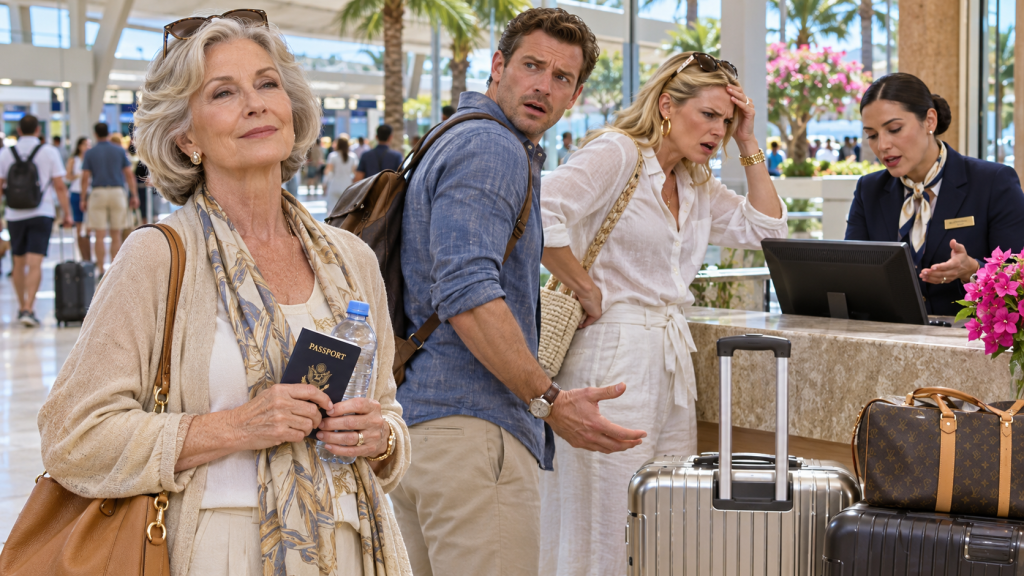
But this wasn’t a careless remark. This was planning. Someone had deliberately arranged for me to be separated from the vacation I’d paid for while leaving my credit card available for their expenses. I looked back toward the transportation counter. Amber stood beside Bradley, gesturing angrily at the resort representative. My son kept checking his phone, his shoulders tense beneath his expensive travel jacket.
I remembered buying him his first suit.
He’d been twenty-one, newly graduated, and preparing for an interview at an engineering firm.
Tom had insisted on going with us.
“Buy something that fits,” he’d told Bradley. “The price tag doesn’t make the man.”
Bradley had laughed and rolled his eyes.
Now, watching my forty-year-old son argue over a luxury vacation he hadn’t paid for, I wondered when he’d forgotten that lesson.
“Mrs. Jensen?”
A uniformed driver stood beside me.
“Your vehicle is ready.”
I looked at him.
“Thank you. Just one moment.”
Then I turned away from Bradley and Amber and called the resort directly.
The woman who answered introduced herself as Sofia Ramirez, the guest relations manager.
“Mrs. Jensen, thank you for returning my message.”
“Ms. Ramirez, I need to clarify something about my reservation.”
“Of course.”
I took a slow breath.
“Who requested that my room be moved?”
There was a brief pause.
“The request came from a guest listed on the booking.”
“Which guest?”
Sofia hesitated.
“I can review the reservation notes with you as the primary account holder. The request was submitted under Mrs. Amber Jensen’s guest profile.”
My fingers tightened around the phone.
“And where was she asking you to put me?”
“In our garden annex.”
I stared toward the airport windows.
The garden annex.
I remembered seeing it on the resort map.
It wasn’t a terrible location.
But it was a considerable walk from the main beachfront suites.
The building was primarily used for guests who preferred quieter, more economical accommodations.
“Was my room originally booked there?”
“No, ma’am. Your original reservation was for an ocean-view suite in the main building.”
I closed my eyes.
“And Amber requested the change?”
“Yes.”
“Why?”
Sofia consulted her notes.
“She indicated that you preferred solitude and that a location away from the main activities would be more suitable.”
I almost laughed.
More suitable.
Amber had never asked what I wanted.
She had simply decided that a sixty-eight-year-old widow belonged somewhere out of sight.
“Ms. Ramirez, was there a change in price?”
“Yes. The garden annex room was less expensive.”
I swallowed.
“Where was the difference going?”
“The request was to apply the difference toward an upgraded room package for the other two guests, subject to approval.”
I stared at the floor.
“Did I approve that?”
“No, Mrs. Jensen. The change was not finalized because we required confirmation from the primary booking holder.”
A small wave of relief moved through me.
At least someone had insisted on asking.
“And the additional charges?”
Sofia’s voice became careful.
“Mrs. Jensen, our notes include a request that your card remain available for spa services, dining, and other incidental expenses associated with the other room.”
I felt something inside my chest harden.
“Who made that request?”
“Mrs. Amber Jensen.”
I closed my eyes.
There it was.
Not an insult.
Not a misunderstanding.
An actual attempt to direct how my money would be used without asking me.
“Ms. Ramirez, I want my payment authorization restricted to expenses I personally approve. I do not authorize room charges, spa treatments, dining, or other incidentals for Bradley or Amber Jensen.”
“Understood. We’ll document that. We can also review any existing prepaid amounts and cancellation terms with you.”
“Thank you.”
I hesitated.
“One more thing. I don’t want anyone’s room canceled or changed improperly. I simply want the hotel to follow its booking terms and stop treating me as the person responsible for everyone else’s spending.”
“That is completely reasonable, Mrs. Jensen.”
I swallowed.
“And please preserve the reservation communications.”
“Of course. Our team can provide available records through the appropriate process.”
I ended the call.
Then stood very still.
For most of my married life, Tom had handled major financial decisions with me sitting beside him.
Not because he thought I was incapable.
Because we believed marriage meant sharing responsibility.
After he died, I learned to manage the investments, insurance proceeds, property taxes, and retirement accounts myself.
I’d done it carefully.
I’d never missed a mortgage payment.
I’d never asked Bradley for money.
Yet I had allowed Amber to make me feel foolish for questioning how my own savings were being spent.
I thought about that for a moment.
Then I climbed into the waiting car.
The drive from the airport toward the coast was beautiful.
Mountains rose beyond the highway.
The sky was impossibly blue.
Sunlight shone on the distant water.
Under different circumstances, I would have spent the journey pointing things out to Bradley.
I would have remembered the road trips we took when he was little.
The time he lost his favorite toy truck at a rest stop and Tom drove forty miles back to retrieve it.
The summer we camped near Lake Tahoe and Bradley insisted he wasn’t afraid of the dark, despite sleeping between us all night.
Instead, I sat alone in the back seat, watching the scenery pass.
My phone rang.
Bradley.
I let it ring.
A moment later, he called again.
Then Amber.
Then Bradley.
Finally, a message appeared.
Mom, we need you to come back. The transfer company won’t take us without another payment.
I looked down at the screen.
Then typed:
You can arrange your own transportation. The resort has confirmed that my card will cover only expenses I authorize.
His reply came immediately.
Are you seriously doing this?
I stared at the words.
For years, I had paid for dinners, birthdays, unexpected expenses, and family outings.
I had given Bradley money when his car needed repairing.
Helped with a down payment.
Covered Amber’s dental bill when their insurance changed.
Every time, I told myself that parents were supposed to help their children.
But somewhere along the way, help had become an expectation.
And an expectation had become entitlement.
I typed:
Yes, Bradley. I am.
Then I put the phone away.
At the resort, Sofia Ramirez met me near the entrance.
She was a woman in her early forties with dark hair neatly pinned behind her head.
“Mrs. Jensen?”
“Carol, please.”
She smiled.
“Welcome, Carol. I’m sorry your arrival has been stressful.”
I gave a tired laugh.
“That seems to be putting it mildly.”
She led me toward a quiet seating area overlooking the gardens.
A staff member brought chilled water and a small plate of fruit.
I looked at it and almost cried.
Such a simple kindness.
A glass of water.
A comfortable chair.
Someone speaking to me as though I mattered.
Sofia opened the reservation details on her tablet.
She carefully explained what had already been paid, what remained subject to cancellation terms, and what the resort could and couldn’t change.
The original prepaid booking wasn’t magically erased by removing the stored credit card.
There were deposits.
Room allocations.
Cancellation penalties.
And amounts already settled.
The transfer reservation, however, had required additional payment authorization that was no longer available, so the shared transportation had been released.
I listened and asked questions.
Then I made my decision.
“I would like to keep my original ocean-view room.”
Sofia nodded.
“And the other guests?”
“They can decide whether to use their reservation under the resort’s terms, but they will need to supply their own payment method for anything outstanding or additional.”
“Of course.”
“I don’t want to leave anyone stranded.”
She smiled gently.
“You aren’t required to pay another person’s expenses simply because they’re traveling with you.”
I swallowed.
For some reason, hearing those words from a stranger made my eyes sting.
Sofia studied me for a moment.
“Carol, may I ask something?”
“Certainly.”
“Are you comfortable being in the same building as the other guests?”
I looked down.
That was a question nobody had asked me in weeks.
Was I comfortable?
What did I want?
Where would I prefer to stay?
I took a breath.
“I’d like some privacy.”
“Then I can arrange an appropriate room away from theirs without reducing the quality of your accommodations.”
I nodded.
“Thank you.”
An hour later, I opened the door to a beautiful ocean-view suite.
Warm sunlight spilled across cream-colored furniture.
Beyond the balcony, the Pacific Ocean stretched toward the horizon.
White curtains moved gently in the breeze.
There was a small table by the window with a bowl of flowers.
And on the bed lay a folded note welcoming me to the resort.
I set my little carry-on beside the dresser.
Then walked onto the balcony.
For a long time, I stood there looking at the water.
I thought about Tom.
How he loved the ocean.
How he always said that waves reminded him life kept moving even when people wanted it to stand still.
Then I began crying.
Not because I was unhappy with the room.
Because for the first time since planning the trip, I had stopped wondering whether Bradley and Amber would enjoy themselves.
And I didn’t know what to do with that freedom.
That evening, I ate dinner alone.
Not in the casual restaurant Amber had recommended for me.
Not in a quiet corner where nobody would notice me.
I went to the resort’s beautiful seafood restaurant.
The one I’d been excited about before Amber told me it was too upscale.
I wore a pale blue dress Tom had bought me for our twenty-fifth anniversary.
It was simple and elegant, with little pearl buttons along the sleeves.
I’d almost left it at home.
Amber had said I should pack something “age appropriate.”
But that night, I looked in the mirror and decided I was exactly the right age to wear whatever made me feel beautiful.
The hostess led me to a table overlooking the water.
“Will anyone be joining you?” she asked.
I hesitated.
Then smiled.
“No. Just me.”
She nodded warmly.
“A wonderful table for one, then.”
I laughed.
“That sounds perfect.”
I ordered grilled fish, roasted vegetables, and a glass of sparkling water.
As the sun descended, the sky turned pink and orange.
A guitarist played softly near the terrace.
Couples talked over dinner.
Families laughed.
And I sat alone without feeling abandoned.
It was a strange sensation.
For years, I’d confused having company with having companionship.
But Bradley and Amber had spent the entire morning treating me as though I was an obstacle.
Now, in a dining room full of strangers, I felt more respected than I had in my own family’s company.
Halfway through dessert, my phone vibrated.
Bradley.
We got here. We had to pay for a taxi. Amber is furious.
I read the message.
Then set the phone aside.
A minute later, another appeared.
Mom, please don’t make this worse.
I stared at those words.
I remembered every time Bradley had used that phrase.
When Amber criticized my cooking.
When she complained that my Christmas gifts were embarrassing.
When she insisted I stop inviting her to family gatherings because she didn’t like feeling obligated.
Don’t make this worse, Mom.
Somehow, the responsibility for everyone else’s bad behavior had always ended up in my lap.
I picked up the phone.
Then typed:
I am having dinner. We’ll discuss practical arrangements tomorrow if necessary. I won’t argue tonight.
I put the phone away.
Then finished my dessert.
The next morning, I woke to the sound of waves.
For several seconds, I forgot where I was.
Then I remembered the airport.
Amber’s hand on my shoulder.
Bradley’s silence.
The resort message.
I reached for my phone.
There were eleven notifications.
I didn’t open them.
Instead, I made coffee and carried it onto the balcony.
The ocean was silver beneath the early sunlight.
A pelican glided over the water.
Somewhere below, workers were preparing umbrellas around the pool.
I sat quietly.
And for the first time in years, I asked myself a question that had nothing to do with my son.
What would I like to do today?
The answer surprised me.
I wanted to go whale watching.
Tom and I had always dreamed of taking a boat trip together.
We’d talked about it for years.
But there was always something else.
Work.
Bills.
Bradley’s college tuition.
The house needing repairs.
Then Tom died.
And I put the dream away with a dozen others I convinced myself were no longer worth pursuing.
I opened the resort activities page.
A small boat tour was available that afternoon.
I booked one seat.
For myself.
And I smiled.
At breakfast, I met a woman named Eleanor Price.
She was seventy-two, with short silver hair and a cheerful laugh.
She was reading a novel at the table beside mine when she noticed the book peeking out of my handbag.
“Oh, I loved that one,” she said.
I looked up.
“You’ve read it?”
“Twice. Although I still think the ending was terrible.”
I laughed.
“That’s what I’m afraid of.”
She introduced herself.
I told her my name.
And within ten minutes, we were talking as though we’d known each other for years.
Eleanor was a retired school principal from Oregon.
Her husband had died six years earlier.
She traveled twice a year, sometimes with friends and sometimes alone.
“People always ask if I’m lonely,” she said.
I smiled sadly.
“Are you?”
“Occasionally.”
She took a sip of coffee.
“But I was lonely at times during my marriage, too. Being surrounded by people doesn’t guarantee you’re being seen.”
I stared at her.
She smiled.
“Something tells me you know what I mean.”
For a moment, I considered pretending everything was fine.
Then I surprised myself.
I told her about the airport.
About Amber.
Bradley.
The vacation.
And the reservation.
Eleanor listened without interrupting.
When I finished, she leaned back.
“Carol, may I ask you something?”
“Of course.”
“If your son hadn’t been involved, would you have tolerated that behavior from anyone else?”
I stared at my coffee.
“No.”
She nodded.
“Then perhaps being his mother is a reason to care about him, not a reason to accept being mistreated.”
I swallowed.
Those words stayed with me long after breakfast ended.
At eleven, Bradley finally found me.
I was sitting near the gardens, reading beneath a shaded umbrella.
He approached looking exhausted.
Amber wasn’t with him.
“Mom.”
I looked up.
“Hello, Bradley.”
He sat across from me.
For a moment, neither of us spoke.
Then he said:
“Amber thinks you’re trying to humiliate her.”
I closed my book.
“And what do you think?”
He frowned.
“I think this whole situation got out of control.”
I studied him.
“How?”
He rubbed his forehead.
“You canceled the transfer. The hotel was asking for a card. Amber was embarrassed.”
I nodded.
“And what happened at the airport?”
He looked away.
“Mom, she was frustrated.”
I waited.
He sighed.
“She shouldn’t have said those things.”
“No. She shouldn’t.”
He looked at me.
“But you didn’t have to make it such a big deal.”
I took a slow breath.
“Bradley, your wife told a crowded gate that I hadn’t paid for the vacation.”
He shrugged.
“She was angry.”
“And you knew it wasn’t true.”
He looked down.
I continued.
“She told me to move out of the way as though I wasn’t entitled to stand in the line for my own seat.”
He said nothing.
“And you stood beside her.”
His jaw tightened.
“What’s the point of going over it again?”
I felt something settle inside me.
“The point is that you keep asking me to understand Amber’s feelings without acknowledging mine.”
Bradley stared at the table.
Then whispered:
“She’s my wife.”
I nodded.
“Yes.”
“I have to support her.”
I looked at him.
“Supporting your wife doesn’t require pretending she can never behave badly.”
He frowned.
“You don’t understand.”
I leaned forward.
“Then explain it.”
He hesitated.
I waited.
For once, I wasn’t going to fill the silence with an apology.
Finally, he said:
“Amber has been under a lot of pressure.”
I nodded.
“From what?”
He rubbed his hands together.
“Money. Work. Everything.”
I studied him.
“Bradley, you told me you were both exhausted. That’s why I offered to pay for this trip.”
He looked down.
“And I appreciated it.”
I swallowed.
“Then why did you let her tell me I’d contributed nothing?”
He didn’t answer.
I leaned back.
The silence between us was beginning to feel like the most honest conversation we’d had in years.
Then he whispered:
“I didn’t know what to say.”
I stared at him.
“You could have said, ‘Mom paid for the trip.'”
His eyes filled.
“It would have started a fight.”
I nodded slowly.
“So instead, you let her fight with me.”
Bradley looked up.
For a moment, he seemed genuinely startled.
As though he’d never considered that distinction before.
I stood carefully.
My knees weren’t as strong as they used to be, but I wasn’t about to spend the entire morning explaining basic kindness to a grown man.
“Mom, wait.”
I looked at him.
He swallowed.
“Are you really going to spend the whole week ignoring us?”
I shook my head.
“I’m going to spend the week enjoying the vacation I paid for.”
His expression fell.
“And us?”
I took a breath.
“You and Amber can enjoy yours. But I’m not going to finance additional expenses, and I’m not going to participate in conversations where I’m insulted.”
Bradley stared.
Then whispered:
“You’re different.”
I smiled sadly.
“No, sweetheart.”
My throat tightened.
“I’m simply tired of pretending that being treated poorly is the price of being included.”
I picked up my book.
And walked away.
The whale-watching boat departed just after two.
I arrived wearing a wide-brimmed hat, comfortable sandals, and the little gold necklace Tom had given me on our twentieth anniversary.
Eleanor was waiting near the dock.
“Carol!”
I smiled.
“Eleanor?”
She lifted her ticket.
“Apparently we had the same idea.”
I laughed.
“Apparently.”
We boarded together and found seats near the railing.
The guide introduced himself as Mateo and explained that wildlife sightings could never be guaranteed.
I appreciated that.
After the previous twenty-four hours, honesty had become strangely comforting.
The boat moved through the harbor and out toward the open water.
The coastline slowly grew smaller behind us.
Sea birds circled overhead.
Salt spray touched my face.
And the wind lifted my hair.
I closed my eyes.
Tom would have loved this.
He would have stood beside me, pointing toward the horizon and telling me something unnecessarily detailed about the boat’s engine.
I could almost hear him.
“That’s a beautiful piece of machinery, Carol.”
I smiled.
Then cried a little.
Eleanor noticed but didn’t ask intrusive questions.
She simply handed me a tissue.
“Beautiful, isn’t it?” she said.
I nodded.
“Very.”
Nearly an hour into the trip, Mateo suddenly pointed toward the water.
“Over there!”
Everyone turned.
A dark shape moved beneath the surface.
Then a magnificent whale rose from the ocean.
For one breathtaking moment, its enormous body broke through the water, gleaming in the afternoon sunlight.
Someone gasped.
A child shouted with delight.
And the whale disappeared beneath a shower of silver spray.
I stood frozen.
It was one of the most beautiful things I’d ever seen.
Then I began laughing.
Not politely.
Not quietly.
I laughed until tears rolled down my face.
Eleanor grinned.
“Was it worth coming?”
I looked toward the water.
“Every minute.”
As the boat headed back toward shore, I thought about Tom’s letter.
Live your life, Carol.
Be happy.
Don’t save everything for a future that may never arrive.
For nine years, I’d read those words as permission to spend money.
But perhaps that wasn’t what he’d meant.
Perhaps he wanted me to spend my remaining years on experiences that mattered.
Not purchasing the affection of people who offered me scraps of attention.
Not sitting alone in airport lounges while pretending I wasn’t hurt.
But standing on a boat beneath the Mexican sun, laughing because the world was still capable of astonishing me.
That evening, another surprise arrived.
Sofia called my room shortly before dinner.
“Carol, may I speak with you about the reservation records?”
“Of course.”
“We’ve completed an internal review of the requests received before your arrival.”
My stomach tightened.
“And?”
“The changes to your accommodation and the incidental billing instructions came through a guest services questionnaire submitted approximately ten days before your trip.”
I remembered Amber saying she’d handled some of the resort preferences.
At the time, I’d been grateful.
She seemed excited.
Helpful, even.
“Was the questionnaire submitted under Amber’s name?”
“Yes.”
Sofia paused.
“There’s something else I think you’ll want clarified.”
I sat down.
“What is it?”
“The request included a note stating that you had agreed to provide the other guests with a generous spending allowance during the trip.”
I stared at the wall.
“A spending allowance?”
“That was the phrase used.”
My hands went cold.
“How much?”
“The note referred to up to three thousand dollars in additional charges.”
For several seconds, I couldn’t speak.
Three thousand dollars.
On top of the nearly twelve thousand I’d already committed.
I thought about my pension.
Our retirement savings.
The money Tom had carefully put aside.
Every year of his life spent driving the same old car because he believed financial security mattered more than appearances.
And Amber had apparently assumed she could spend thousands more of it without asking me.
“Ms. Ramirez,” I whispered, “I never agreed to that.”
“I understand. The resort did not accept it as authorization, and those charges have not been placed on your card.”
I closed my eyes.
Relief swept over me.
Then anger.
Not the sharp anger I felt at the airport.
Something quieter.
More painful.
Because this wasn’t about a rude comment anymore.
It was about the belief that my money belonged to other people simply because I loved them.
Sofia offered to provide me with copies of the relevant guest requests.
I accepted.
Then I asked whether there were any outstanding charges connected with my account.
She explained the amounts carefully.
The room arrangements were being handled according to the booking terms.
Any additional services for Bradley and Amber required their own payment authorization.
Some originally prepaid costs could not be recovered.
And any future refund would depend on the provider’s policies.
I thanked her.
It wasn’t perfect.
But the situation was under control.
And for the first time, I was controlling my own spending.
The next morning, I called my financial adviser in Denver.
His name was Martin Hayes.
He had worked with Tom and me for more than twenty years.
When he answered, he sounded surprised.
“Carol? Aren’t you in Mexico?”
“I am.”
“Everything all right?”
I looked toward the ocean.
“That’s what I wanted to discuss.”
I explained the situation.
Not every painful detail.
Just enough for him to understand why I was worried about payment access and future financial expectations.
Martin listened.
Then said:
“Carol, we should review your card authorizations, account access, and any recurring payments you may have established for Bradley and Amber.”
I nodded.
“I’d like that.”
“Do you suspect unauthorized transactions?”
“I don’t know. I want to check rather than assume.”
“That’s sensible.”
We arranged to review everything when I returned.
Before ending the call, Martin hesitated.
“Carol, may I say something?”
“Of course.”
“Tom was always careful about the difference between helping Bradley and making Bradley dependent on your finances.”
My throat tightened.
“I remember.”
Martin continued.
“He used to say, ‘Give the boy a ladder when he needs one. Don’t carry him up every staircase.'”
I laughed through tears.
“That sounds exactly like Tom.”
Martin chuckled.
“He was a good man.”
“Yes,” I whispered. “He was.”
After the call, I opened my email and searched for the resort confirmations.
Buried among the messages was one from Amber, sent two weeks before the trip.
Carol, I’ve handled the room preferences and extras so you don’t have to worry. Just enjoy yourself!
At the time, I’d thought it was considerate.
Now I realized she’d been making decisions without consulting me.
I took screenshots and saved the correspondence.
Not because I wanted revenge.
Because I’d spent too many years allowing other people to redefine what had happened.
This time, I wanted the details clearly documented.
That afternoon, I received a knock at my door.
When I opened it, Amber stood in the hallway.
She wore a white sundress and oversized sunglasses.
For a moment, I was so surprised that I didn’t speak.
“Carol.”
“Amber.”
She lowered her sunglasses.
“Can we talk?”
I considered refusing.
Then stepped into the hallway, closing my room door behind me.
“What would you like to discuss?”
She looked irritated.
“Bradley says you’re still upset.”
I stared at her.
“Yes.”
She sighed.
“Look, the airport thing got out of hand.”
I waited.
She crossed her arms.
“I was stressed. Traveling is stressful. The bags were a nightmare, and you were standing in the way.”
I took a slow breath.
“Amber, I was standing in line for my assigned seat.”
She rolled her eyes.
“You’re really going to keep bringing that up?”
I nodded.
“Until we’re able to discuss it honestly.”
She looked toward the elevator.
Then back at me.
“Fine. I shouldn’t have pushed past you.”
I waited.
She sighed.
“And maybe I shouldn’t have said you didn’t pay.”
“Maybe?”
Her face tightened.
“All right. I shouldn’t have said it.”
I nodded.
“Thank you for acknowledging that.”
She looked relieved.
“Good. Then can you restore the card for the spa reservation? They’re saying our appointments won’t go through.”
I stared at her.
For a moment, I actually thought I’d misheard.
“What?”
“The couples massage. It’s already booked, but they need a payment method. Bradley says you won’t approve any charges.”
I looked at her.
“You came here to ask me to pay for a massage?”
She frowned.
“Well, you offered to cover the vacation.”
I took a slow breath.
“I offered to cover the trip we agreed upon. I did not offer unlimited spending.”
Amber folded her arms.
“You’re making this about money.”
I shook my head.
“No, Amber. You made it about money when you told me I hadn’t paid.”
Her face reddened.
“That’s unfair.”
I looked at her carefully.
“Did you ask the resort to move me to the garden annex?”
She went still.
For one brief second, the confident expression disappeared.
Then she shrugged.
“I thought you’d prefer somewhere quieter.”
“Did you ask whether I would?”
She looked away.
“You don’t like crowds.”
“I like being consulted.”
Amber said nothing.
“Did you also request that my card cover additional expenses?”
She swallowed.
“I thought you wanted us to have a good time.”
I nodded slowly.
“And did you tell them I’d agreed to another three thousand dollars?”
Her face changed.
For a moment, she looked genuinely frightened.
Then she snapped:
“The resort wasn’t supposed to bother you with all the details.”
I stared at her.
There it was.
Not a misunderstanding.
Not a mistake caused by excitement.
She hadn’t wanted me involved in decisions about my own money.
I took a breath.
“Amber, I’m not paying for your massage.”
She stared.
“Seriously?”
“Yes.”
“After all this?”
“Yes.”
She laughed bitterly.
“Bradley was right. You’re trying to punish us.”
I shook my head.
“No. I’m declining to pay for something I didn’t authorize.”
She looked toward the elevator.
Then whispered angrily:
“You know, this is why Bradley doesn’t visit more often.”
The words struck deep.
I felt them in the same place where grief had lived since Tom died.
But I stayed quiet.
Amber continued.
“You make everything about yourself.”
For a moment, I considered telling her exactly how cruel she’d been.
How many nights I’d spent hoping Bradley would call.
How often I’d prepared dinner for three only to receive a last-minute cancellation.
How I’d saved every birthday card he sent, even when it contained nothing more than a hurried signature.
But then I realized something.
I didn’t need to convince Amber that I deserved respect.
I needed to behave as though I already knew it.
I looked at her.
“Amber, I hope you enjoy the rest of your vacation.”
She blinked.
“What?”
“But I won’t be paying for additional services, and I won’t continue this conversation while you insult me.”
Her expression hardened.
“You’re just going to walk away?”
I nodded.
“Yes.”
I opened my door.
Then stepped inside and closed it.
For several seconds, I stood with my back against the door.
My hands were shaking.
My chest hurt.
And tears filled my eyes.
Setting a boundary, I discovered, didn’t instantly make the pain disappear.
It simply meant I was finally refusing to add more pain to the old.
I walked to the balcony and looked at the water.
Then whispered:
“Tom, I wish you were here.”
The waves rolled toward the shore.
No answer came.
But I remembered his words.
Live your life.
And I knew what I had to do.
The next few days became some of the most unexpectedly beautiful of my life.
I joined Eleanor for a cooking class.
We learned to prepare fresh tortillas and a rich tomato salsa.
I spilled flour on my blouse.
Eleanor laughed so hard she nearly dropped her rolling pin.
The instructor, a cheerful woman named Lucía, told us that good cooking required patience and the willingness to make mistakes.
I smiled.
“That sounds like life.”
She nodded.
“Exactly.”
The following day, I visited a small art gallery in San José del Cabo.
I bought a watercolor painting of the sea.
Nothing extravagant.
Just a beautiful little picture in shades of blue and silver.
For years, I’d bought gifts for Bradley and Amber whenever I traveled.
This time, I bought something for myself.
I imagined hanging it in the hallway beside Tom’s photograph.
Then smiled.
He would have liked it.
One evening, Eleanor and I walked along the beach.
The sand was warm beneath our feet.
The sunset turned the water gold.
We talked about our husbands.
About getting older.
About the strange freedom and loneliness of widowhood.
Then Eleanor said something I’ll never forget.
“Carol, there’s a difference between being needed and being loved.”
I looked at her.
She continued.
“Sometimes people need what we can provide. Our money. Our time. Our help. And because we’re kind, we mistake that dependence for affection.”
I swallowed.
“And how do you tell the difference?”
She smiled sadly.
“Notice who still wants to sit with you when you have nothing to give them.”
I stared at the horizon.
Then thought about Tom.
He’d sit beside me for hours while I read.
He’d bring me coffee before I asked.
He’d listen to stories he’d already heard because he knew I enjoyed telling them.
He’d never made me feel that I had to earn my place beside him.
I wiped my eyes.
Eleanor took my arm.
“You’re allowed to be loved like that again, Carol.”
I nodded.
“Even by myself?”
She laughed softly.
“Especially by yourself.”
On the sixth day of the trip, Bradley called.
This time, I answered.
“Hello, sweetheart.”
His voice sounded different.
Tired.
Uncertain.
“Mom, can we meet?”
I hesitated.
“About what?”
He took a breath.
“I want to talk about what happened.”
I looked toward the painting I’d bought.
“All right.”
“Just us?”
I considered.
“Yes. We can meet in the public café near the lobby.”
He agreed.
And when I ended the call, I realized I wasn’t nervous about what he might say.
I was nervous about whether I could bear hearing him make another excuse.
Bradley arrived ten minutes early.
He looked exhausted.
His shoulders were slumped, and the confident expression he’d worn at the airport was gone.
He sat across from me.
For a long time, he stared at his hands.
Then he whispered:
“I’m sorry, Mom.”
I didn’t answer immediately.
I wanted to hear what came next.
He took a breath.
“I’m sorry I let Amber talk to you that way.”
My throat tightened.
He continued.
“I’m sorry I didn’t say anything at the gate.”
I looked at him.
“Why didn’t you?”
His eyes filled.
“Because I knew she’d be furious.”
I nodded slowly.
“So you let me bear the cost.”
He looked down.
“Yes.”
For several seconds, we sat in silence.
Then Bradley whispered:
“I’ve been thinking about Dad.”
My eyes filled.
“He never would have stood there while someone treated you like that.”
I swallowed.
“No.”
Bradley covered his face.
“He would have been so disappointed in me.”
I took a slow breath.
“Bradley, your father loved you.”
He looked up.
“But he also expected you to take responsibility for your choices.”
Tears rolled down his cheeks.
“I know.”
He wiped his face.
Then said:
“I didn’t know Amber had asked to move your room.”
I studied him.
“She did.”
“I know now.”
He swallowed.
“She told me the resort had suggested it because you’d be more comfortable.”
I looked at him.
“And you believed that?”
He nodded.
“At first.”
I took a breath.
“Did you know about the additional charges?”
He looked away.
“Some of them.”
My stomach tightened.
“Which ones?”
He hesitated.
“The massage. Some dinners. The upgrade.”
I stared.
“And did you ask whether I’d agreed?”
He closed his eyes.
“No.”
I leaned back.
For a moment, I felt twenty years older.
“Bradley, you’re forty years old.”
He nodded.
“You and Amber both work.”
He looked down.
“And yet you allowed me to pay nearly twelve thousand dollars for a vacation while treating my presence as an inconvenience.”
His eyes filled.
I continued.
“You knew I was excited to spend time with you.”
A tear slipped down my cheek.
“You knew how lonely I’d been since your father died.”
He began crying.
“And you let me sit alone in the airport lounge while you and Amber laughed at me.”
He covered his face.
“I’m so sorry.”
I looked toward the window.
For a long moment, I couldn’t speak.
Then I whispered:
“Bradley, I don’t need you to choose between your wife and your mother.”
He looked up.
“I need you to choose whether you’re willing to be kind.”
He stared at me.
I continued.
“You can love Amber and still tell her when she’s wrong.”
He nodded.
“You can have your own life and still treat me with respect.”
Tears filled his eyes.
“And you can disagree with me without allowing someone to humiliate me.”
Bradley wiped his cheeks.
“I know.”
I studied him.
“Do you?”
He took a deep breath.
“I’m beginning to.”
For a moment, we sat quietly.
Then he reached into his pocket.
“I brought something.”
He placed a folded piece of paper on the table.
It was a copy of a bank transfer confirmation.
I frowned.
“What’s this?”
He swallowed.
“I moved money from our savings account to repay part of what you’ve spent.”
I looked at the amount.
It was two thousand dollars.
Not everything.
Not nearly everything.
But it was a start.
“Bradley…”
He shook his head.
“I know it isn’t enough.”
I looked up.
He continued.
“And I know money won’t fix what happened.”
His voice trembled.
“But I want to stop acting like your money is ours.”
I studied him.
“Did Amber agree to this?”
He looked down.
“No.”
My heart tightened.
“Then be careful. You need to handle your shared finances responsibly.”
He nodded.
“I know. This is money from my own account, and I can document that.”
I took a breath.
“Bradley, I don’t want you damaging your household finances to prove a point.”
He looked up.
“I understand. But I want to contribute to a trip I said I’d earned.”
For the first time since the airport, I saw a glimpse of the boy Tom and I had raised.
Not because he was giving me money.
Because he was beginning to understand that generosity wasn’t something to exploit.
It was something to honor.
I folded the paper.
“Thank you for taking a step.”
His eyes filled.
“Can we start over?”
My throat tightened.
I wanted to say yes.
I wanted to forget the airport.
The lounge.
The humiliating words.
But I knew better now.
“We can begin again,” I said gently.
He smiled through tears.
Then I added:
“But rebuilding trust will take time.”
He nodded.
“I understand.”
Before leaving, he looked at me.
“Mom?”
“Yes?”
“Have you enjoyed the trip?”
I smiled.
“Actually, I have.”
He looked surprised.
I laughed softly.
“I went whale watching.”
His eyes widened.
“You did?”
“Yes.”
“Did you see one?”
I nodded.
“A magnificent one.”
He smiled.
For a moment, it felt like an ordinary conversation between a mother and son.
Then he whispered:
“Dad would have loved that.”
My eyes filled.
“Yes. He would.”
The final morning in Cabo arrived beneath a clear blue sky.
I woke early and packed my little carry-on.
It still contained more than enough clothing.
Amber had laughed at its size when we left Denver.
Now I understood that traveling lightly could be a blessing.
I hadn’t needed three enormous suitcases.
I hadn’t needed expensive accessories.
And I certainly hadn’t needed anyone’s permission to enjoy myself.
Before checking out, I met Eleanor for breakfast.
She brought me a small gift.
A postcard showing the Cabo coastline.
On the back, she’d written:
For Carol, who remembered that the world is still waiting for her.
I read it twice.
Then hugged her.
“Thank you.”
She smiled.
“Don’t disappear when you get back to Denver.”
“I won’t.”
“We should plan another trip.”
I laughed.
“Already?”
She raised an eyebrow.
“Why not? We’re not getting younger.”
I smiled.
“You’re right.”
At the airport, Bradley and Amber stood near the check-in counters.
They were quieter than they’d been a week earlier.
Amber avoided my eyes.
Bradley stepped toward me.
“Mom.”
“Hello, sweetheart.”
He took my bag.
I almost protested.
Then let him.
It was a small kindness.
And I was learning that accepting kindness wasn’t the same as surrendering independence.
Amber approached slowly.
“Carol.”
I nodded.
“Amber.”
She looked toward Bradley.
Then back at me.
“I wanted to apologize.”
I waited.
She took a breath.
“What I said at the airport was disrespectful.”
I nodded.
“It was.”
Her face reddened.
“I shouldn’t have acted like you’d contributed nothing.”
I studied her.
“And the reservation changes?”
She looked down.
“I shouldn’t have made those requests without asking you.”
I swallowed.
“Thank you for acknowledging that.”
She shifted uncomfortably.
“I thought you’d be happier in a quieter room.”
I looked at her.
“Amber, you don’t need to decide what’s best for me without including me.”
She nodded.
“I understand.”
I wasn’t sure she did.
But I didn’t need to settle that question in an airport.
I simply needed to decide how I would respond to her actions in the future.
Bradley looked toward me.
“Would you like to sit with us before boarding?”
The invitation surprised me.
A week earlier, they’d walked past me in the lounge as though I was invisible.
Now my son was asking.
I considered.
Then smiled gently.
“Yes. For a little while.”
We found three chairs near the windows.
Nobody laughed at me.
Nobody asked me to move.
We talked about the weather in Denver.
The whale-watching trip.
And the little art gallery I’d visited.
Bradley listened carefully.
Amber remained quiet.
It wasn’t a perfect family moment.
But it was different.
And sometimes different is where change begins.
When we boarded, Bradley paused beside my seat.
“Mom?”
I looked up.
“Yes?”
“I’m glad you came.”
My throat tightened.
I smiled sadly.
“So am I.”
Back in Denver, I began making the changes I’d promised myself.
Martin helped me review my financial arrangements.
I checked recurring payments, card access, and the accounts connected with family expenses.
I canceled unnecessary authorizations and made sure future payments required my clear approval.
I also reviewed my estate plan with an attorney.
Not to punish Bradley.
Not to threaten him with disinheritance.
But to make certain my affairs reflected my wishes and that I would remain financially secure throughout my retirement.
I decided that gifts would once again be gifts.
Offered freely.
Within limits I chose.
Without strings attached.
And without the expectation that I would pay whenever somebody else wanted something.
Several months later, Bradley invited me to dinner.
Not at an expensive restaurant.
At his house.
He cooked spaghetti using Tom’s old recipe.
The sauce was a little too salty.
The garlic bread was almost burned.
But when I arrived, Bradley opened the door and hugged me.
“Hi, Mom.”
I smiled.
“Hello, sweetheart.”
He took my coat.
Then asked:
“How have you been?”
Such a simple question.
Yet it had been a long time since he’d asked it without immediately requesting something.
We ate dinner at the kitchen table.
Amber was polite.
Not particularly warm.
But respectful.
She asked about Eleanor.
About my volunteer work.
About the painting I’d hung in the hallway.
And when dessert arrived, Bradley placed a small envelope beside my plate.
I looked at him.
“What’s this?”
He smiled nervously.
“Another repayment.”
I took a breath.
“Bradley, you don’t have to make every dinner about money.”
He nodded.
“I know.”
Then he added:
“But I made a commitment, and I want to keep it.”
I studied him.
Then smiled.
“Thank you.”
He reached for my hand.
“Mom, I’ve been thinking about what you said in Cabo.”
I looked up.
“Which part?”
He swallowed.
“That you didn’t need me to choose between my wife and my mother. You needed me to choose kindness.”
My eyes filled.
He continued.
“I think I’ve spent too much time avoiding disagreements because I was afraid of upsetting someone.”
I nodded.
“And?”
He looked down.
“I ended up hurting you instead.”
For a moment, I couldn’t speak.
Then I reached across the table.
“Bradley, I don’t expect you to be perfect.”
His eyes filled.
“I know.”
“I just want us to be honest with each other.”
He squeezed my hand.
“I want that too.”
Our relationship didn’t become perfect overnight.
There were still awkward moments.
Occasional disagreements.
Times when Bradley slipped into old habits and expected me to make things easier.
But something important had changed.
I no longer apologized simply because someone was unhappy with a boundary.
And Bradley was slowly learning that being a loving son required more than saying he loved me.
It required showing up.
Listening.
And treating me as a person whose feelings mattered.
The following spring, I took another trip.
This time, I went with Eleanor.
We visited a quiet coastal town, walked through art galleries, and spent long afternoons drinking coffee beside the water.
I paid for my own room.
She paid for hers.
We shared expenses fairly.
And not once did either of us suggest the other should feel lucky to be included.
One evening, I sat on a balcony watching the sunset.
I took Tom’s letter from my handbag.
The paper was worn now.
The fold lines were soft from being opened so many times.
I read his words again.
Live your life, Carol.
Be happy.
Don’t save everything for a future that may never arrive.
I smiled.
For years, I’d thought honoring Tom meant carefully protecting everything he’d left behind.
Now I understood that honoring him also meant remembering why we’d worked so hard.
It wasn’t so I could spend the rest of my life feeling guilty about enjoying myself.
It wasn’t so I could purchase my son’s affection.
It was so I could live with dignity.
Freedom.
And joy.
I looked toward the ocean.
Then whispered:
“I’m finally doing it, Tom.”
People sometimes ask whether I regret what happened at the Cabo airport.
I regret that the argument happened.
I regret the humiliation.
And I regret how many years I spent making excuses for behavior that hurt me.
I also understand now that removing a stored credit card isn’t a magical way to cancel paid travel arrangements. Contracts, refunds, and outstanding charges still have to be handled properly.
But I don’t regret saying no to further spending I hadn’t authorized.
And I don’t regret finally insisting that my generosity be met with respect.
Amber believed I should move aside because I was older.
Bradley believed keeping his wife happy meant keeping quiet while she mistreated me.
And for a long time, I believed my role as a mother was to make everyone else’s life easier, even when it made mine smaller.
We were all wrong about something.
I am Carol Jensen.
I’m sixty-eight years old.
A widow.
A mother.
A woman who still misses her husband every single day.
And a woman who finally understands that love should never require her to disappear.
That vacation cost me more than I originally planned.
Not because of the airfare or the resort.
Because it forced me to confront a painful truth about my family.
But it also gave me something I hadn’t expected.
The courage to stop buying invitations into other people’s happiness.
And the freedom to create happiness of my own.
Sometimes I still think about the moment Amber tried to push me out of the first-class boarding line.
She wanted me to step aside.
To make room.
To accept that my presence mattered less than hers.
But the lesson I carried home wasn’t about who boarded an airplane first.
It was about who had the right to decide where I belonged.
I had spent years paying for a place in my son’s life.
That day, I finally remembered I deserved respect whether I paid for anything or not.
And now, when I make plans for another adventure, I don’t begin by asking who might be willing to include me.
I begin with a much simpler question.
Carol, where would you like to go?
Then I smile.
Because the answer is finally mine.