For several moments, nobody in our section seemed to know whether to cheer or cry. Daniel stood between the rows of stadium seats, his face buried against my husband’s shoulder. Chris held him tightly, one hand resting against the back of his head. And Ethan, my beautiful little boy, sat beside them with Sophie’s blue scarf folded carefully across his knees.
“You can borrow my dad whenever you miss being one.” Those were the words my son had just spoken. Ten simple words. Yet somehow, they had reached a place in Daniel’s heart that months of condolences had never touched. I looked at the enormous screen. The quarterback’s recorded message had ended, but the camera was still focused on our little section.
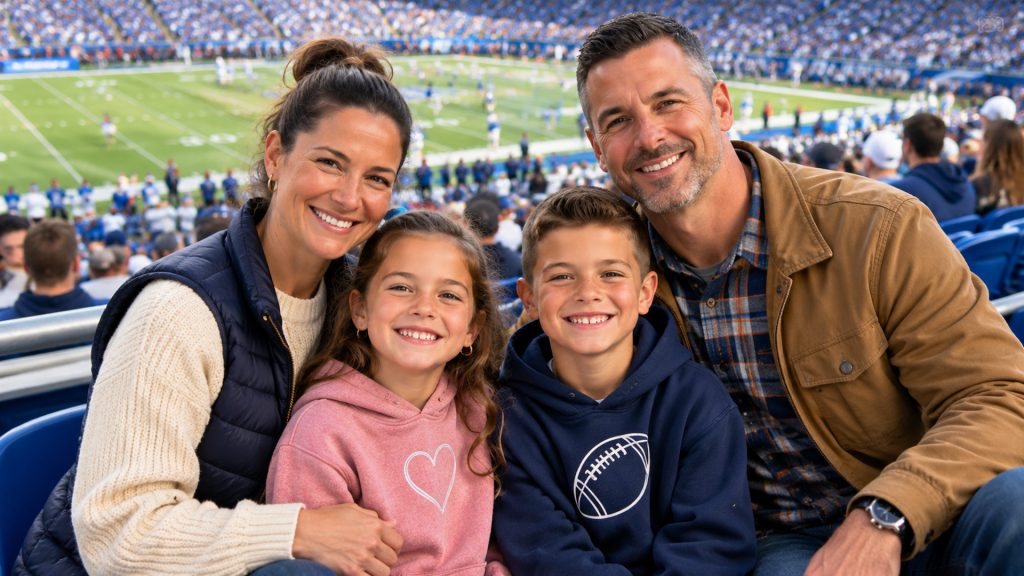
Thousands of people were applauding. Some were standing. Others wiped their eyes. A woman in the row behind us whispered, “God bless that little boy.” I wanted to say something. To thank her. To explain that Ethan wasn’t always brave. That sometimes he cried during treatments. That he’d once thrown his favorite stuffed dinosaur across the hospital room because he was tired of being told to be strong.
That courage wasn’t something he possessed every moment.
It was something he kept finding, even when he was frightened.
But my throat was too tight to speak.
Ethan looked up at Daniel.
“Are you okay?”
Daniel knelt beside him.
“I’m getting there, buddy.”
Ethan studied his face.
“Did I make you sad?”
Daniel shook his head.
“No, Ethan.”
His voice trembled.
“You reminded me of somebody I love very much.”
Ethan looked toward Sophie’s photograph.
“Your daughter?”
Daniel nodded.
“Yes.”
My son smiled gently.
“Then you should talk about her.”
Daniel closed his eyes.
And I saw the moment those words settled inside him.
Because grief had apparently convinced this father that mentioning his daughter would make other people uncomfortable.
But my ten-year-old son, who was facing the possibility of his own death, understood something the adults around him were still struggling to learn.
Love doesn’t become less important when the person we love is no longer beside us.
The woman standing behind Daniel stepped forward.
She looked about forty, with soft brown hair and tired blue eyes. She held Sophie’s framed photograph against her chest.
“I’m Rachel,” she said quietly. “Sophie’s mother.”
I stood and embraced her.
Neither of us knew what to say.
What words could possibly pass between two mothers standing on opposite sides of the same terrible fear?
Rachel had already buried her child.
I was terrified that I would soon bury mine.
She held me tightly.
“I’m so glad Ethan came today,” she whispered.
I pressed my lips together.
“Thank you for being here.”
She pulled back and looked at my son.
“He’s wonderful.”
My eyes filled.
“Yes,” I whispered. “He is.”
A stadium representative approached our row and gently explained that the organization had arranged a short visit to a private hospitality room during the next break.
The quarterback, Nathan Brooks, wanted to meet Ethan.
My son nearly jumped out of his seat.
“THE REAL NATHAN BROOKS?”
Chris laughed through his tears.
“The one and only, Captain.”
Ethan grabbed my arm.
“Mom! Did you hear?”
I smiled.
“I heard, sweetheart.”
He looked down at Sophie’s scarf.
“Can I wear this?”
Rachel knelt beside him.
“That would make Sophie very happy.”
Ethan carefully draped the blue fabric around his shoulders.
It was slightly too long for him.
The ends hung past his waist.
But he wore it as proudly as if someone had placed a championship medal around his neck.
The stadium staff guided us toward an accessible elevator.
Daniel walked beside Chris.
Rachel stayed close to me.
And Ethan kept looking over his shoulder to make sure his new friends were following.
As we moved through the corridor, he tugged at Daniel’s sleeve.
“Mr. Daniel?”
“Yes, buddy?”
“Did Sophie like quarterbacks?”
Daniel smiled sadly.
“She loved quarterbacks.”
“Did she like Nathan Brooks?”
“She thought he was the greatest player in the history of football.”
Ethan grinned.
“She was right.”
Daniel laughed.
A real laugh.
Warm and surprised.
Rachel stopped walking for half a second.
I noticed.
So did Chris.
Later, she would tell me it was the first time she’d heard her husband laugh like that since Sophie died.
The private room overlooked the field through enormous glass windows.
There were comfortable chairs, refreshments, and a quiet area where Ethan could rest if he became tired.
The wish-granting representative explained that the team had coordinated everything with Ethan’s medical support arrangements.
I felt profoundly grateful.
Even on his happiest days, Ethan’s body could surprise us.
An exciting outing didn’t erase his illness.
We still needed to watch for fatigue, discomfort, and the other symptoms his medical team had helped us prepare for.
But that afternoon, every detail seemed designed to allow him to enjoy the experience without pretending those needs had disappeared.
Ethan sat near the window, staring at the field.
“This is better than television,” he announced.
Chris smiled.
“Really?”
Ethan nodded seriously.
“Except I can’t tell the referee what to do.”
Daniel laughed again.
“Trust me, plenty of people try.”
About twenty minutes later, a door opened.
A tall man wearing team clothing stepped into the room.
Ethan turned.
Then froze.
Nathan Brooks.
His favorite quarterback.
The player whose jersey hung in Ethan’s bedroom.
The athlete whose interviews he’d memorized and repeated while pretending to hold press conferences in our living room.
Nathan smiled.
“Who’s Ethan?”
My son raised his hand so quickly that Sophie’s scarf nearly slipped off his shoulders.
“ME!”
Nathan laughed.
“Well, I’ve been looking for you.”
Ethan stared.
“You have?”
“Absolutely.”
He approached and knelt beside my son.
“I heard there’s a young man here who knows more about our offense than half the coaching staff.”
Ethan looked at Chris.
“Dad told him!”
Chris raised both hands.
“I plead guilty.”
For the next several minutes, Ethan forgot to be shy.
He asked Nathan about difficult defenses.
About his favorite touchdown.
About how he stayed calm when thousands of people were shouting.
Nathan answered every question with the patience of a man who understood that the conversation mattered more than the schedule waiting outside the room.
Then Ethan asked something that made everyone quiet.
“Are you ever scared?”
Nathan looked surprised.
“Sure.”
“Even before games?”
“Especially before important ones.”
Ethan considered that.
“Me too.”
Nathan nodded.
“Being scared doesn’t mean you’re not brave.”
My son looked down at the scarf.
“My doctors tell me that.”
Nathan’s expression softened.
“Sounds like you’ve got some smart doctors.”
Ethan smiled.
“Yeah.”
Then he whispered, “But sometimes I’m tired of being brave.”
Nathan didn’t rush to answer.
He simply sat beside him.
And after a moment, he said:
“Then sometimes you don’t have to be. You can just be Ethan.”
My son looked up.
For one beautiful moment, his face relaxed.
As though someone had given him permission to stop carrying an invisible burden.
Before Nathan left, he signed Ethan’s jersey.
Then he took a photograph with him.
Another with Chris and me.
And finally one with Daniel and Rachel.
When Ethan insisted that everybody stand together, Nathan happily agreed.
The photographer arranged us beside the enormous windows.
Chris stood behind Ethan.
I held my son’s hand.
Rachel stood beside me.
Daniel placed one arm around his wife.
And Nathan crouched at the front.
For the photograph, Ethan lifted Sophie’s blue scarf.
“She’s here too,” he said.
Rachel began crying.
Daniel pulled her closer.
The camera clicked.
I didn’t know it then, but that photograph would eventually become one of the most precious things our two families possessed.
After Nathan left, Ethan grew tired.
The excitement had carried him through most of the afternoon, but I recognized the change in his expression.
His shoulders drooped.
His eyes became heavy.
And he leaned against Chris.
“Mom?”
“Yes, sweetheart?”
“Can we sit somewhere quiet?”
“Of course.”
We moved to the resting area.
Chris helped Ethan settle comfortably.
I checked with the medical support staff, who confirmed we could follow the symptom-management plan we’d brought with us.
Daniel and Rachel waited nearby.
Ethan reached for Daniel’s hand.
“Don’t go.”
Daniel sat beside him.
“I’m not going anywhere.”
My heart tightened.
Those words.
I’m not going anywhere.
How many times had I said them beside Ethan’s hospital bed?
How many times had I hoped that, somehow, promising to stay would be enough to keep him with us?
Ethan looked at Rachel.
“Can I hear about Sophie?”
She hesitated.
Daniel looked toward her.
For a moment, I thought the question might be too painful.
But Rachel smiled through her tears.
“Of course.”
She sat beside Ethan.
“Sophie was nine when she died.”
My son listened carefully.
“Almost my age.”
“Yes.”
“Was she funny?”
Rachel laughed softly.
“Oh, she was very funny.”
Daniel smiled.
“She once convinced her teacher that I’d been a professional football player.”
Ethan’s eyes widened.
“Were you?”
Daniel shook his head.
“Not even close.”
“What happened?”
Rachel laughed through tears.
“Her teacher asked him to come speak to the class about his career.”
Ethan giggled.
Daniel covered his face.
“I had to explain I was an accountant.”
My son burst into laughter.
For a few moments, the room filled with something we hadn’t expected.
Not sorrow.
Not fear.
Just the ridiculous memory of a little girl who thought her father was capable of anything.
When the laughter faded, Rachel looked at Sophie’s photograph.
“She always wanted to help people feel better.”
Ethan studied her.
“Like you?”
Rachel’s eyes filled.
“I tried.”
My son shook his head.
“No. I mean she probably learned it from you.”
Rachel covered her mouth.
I watched her shoulders begin to shake.
Then she leaned forward and kissed Ethan gently on the forehead.
“Thank you, sweetheart.”
On the drive home that evening, Ethan fell asleep with Sophie’s scarf wrapped around him.
Chris drove.
I sat in the back seat beside our son, supporting his head against a pillow.
The stadium lights disappeared behind us.
Outside the window, the world was turning dark.
I watched Ethan sleep.
His eyelashes rested against his pale cheeks.
His hand remained loosely closed around the edge of the scarf.
I wanted to stop time.
To keep that exact moment forever.
The boy who had cheered at a football game.
The boy who’d met his hero.
The boy who had reminded two grieving parents that their daughter still mattered.
But time continued moving.
And no amount of love could persuade it to stop.
Chris reached back and touched my knee when we stopped at a red light.
“Are you okay?”
I tried to answer.
Nothing came out.
He looked at me through the rearview mirror.
I shook my head.
Tears slid down my face.
Chris’s own eyes filled.
Neither of us spoke.
We had given Ethan the day he’d dreamed of.
And now we had to return to the reality waiting for us.
The medications.
The appointments.
The uncertainty.
The awful knowledge that every happy memory might also become something we would someday grieve.
That night, after Ethan was asleep in his own bed, Chris and I sat on the kitchen floor.
We hadn’t planned to.
I had been putting away the bags from our trip when my legs suddenly felt too weak to hold me.
I sank beside the cabinets.
Chris sat down next to me.
For a long time, we held each other.
Then he whispered:
“I thought seeing Daniel would break me.”
I looked at him.
“Why?”
He wiped his face.
“Because when Sophie died, he called me.”
I stared.
“What?”
Chris looked down.
“I never told you.”
My stomach tightened.
“What happened?”
He swallowed.
“Daniel and I exchanged numbers at the hospital. After we talked that night, we stayed in touch for a while.”
I listened.
“When Sophie died, he called. He wanted to tell me himself.”
Chris covered his face.
“I was sitting in the parking garage outside Ethan’s oncology appointment.”
My throat closed.
“He kept saying he didn’t know how to go home.”
I reached for Chris’s hand.
“He said he couldn’t bear to walk into a house where her shoes were still by the door.”
Tears filled my eyes.
Chris looked toward the hallway.
“And all I could think was that someday I might be saying exactly the same thing.”
I leaned against him.
“Why didn’t you tell me?”
His voice broke.
“Because I was afraid.”
I swallowed.
“Of what?”
“If I talked about Sophie dying, I thought I was admitting Ethan might die too.”
I closed my eyes.
For months, we’d both been living inside that fear.
But we’d rarely spoken about it directly.
We had become experts at discussing medication schedules and appointment times.
We could explain test results.
Remember every nurse’s name.
Describe the side effects of treatments with frightening precision.
Yet the possibility of losing our son remained something we tried not to say aloud.
As though silence might protect him.
Chris held my hand.
“After Sophie’s funeral, Daniel stopped answering for a while. I thought he needed space.”
I nodded.
“He did.”
“But a few weeks ago, he texted me. He said he was trying to find a way to honor Sophie by helping other families.”
I looked up.
“Did you know he was coming today?”
Chris shook his head.
“No.”
“Not at all?”
“No. I knew he’d been working with some people connected to the hospital, but I didn’t know the organization had reached him.”
I stared toward Ethan’s bedroom.
“Then how did they arrange it?”
Chris shook his head.
“I don’t know.”
That question would remain with us until the following morning.
And the answer would change the way we understood our son’s wish.
The next morning, Ethan woke up asking for pancakes.
It was such an ordinary request that I nearly cried.
For several weeks, his appetite had been unpredictable. There were days when even the smell of breakfast made him uncomfortable.
But that morning, he wanted pancakes.
With strawberries.
And exactly three chocolate chips on each one.
“Three?” Chris asked.
Ethan nodded seriously.
“Not four.”
“Why not four?”
“Because I’m the boss.”
Chris laughed.
“Yes, Captain.”
We made the pancakes together.
Ethan sat at the kitchen counter, wrapped in his favorite blanket, directing the operation with the confidence of a football coach managing the final minutes of a championship game.
He was tired.
But he was smiling.
And for a little while, we allowed ourselves to enjoy the morning without imagining what might happen next.
At eleven, my phone rang.
It was Olivia Bennett, the woman from the wish-granting organization.
“Good morning,” she said warmly. “How’s our superstar?”
I looked toward Ethan.
“Demanding pancakes like a king.”
Olivia laughed.
“That sounds wonderful.”
I thanked her for everything.
The stadium.
The special seating.
The quarterback.
The photograph.
And especially Daniel and Rachel.
There was a pause.
Then Olivia said:
“Actually, there’s something about that last part I wanted to explain.”
My heart tightened.
“What do you mean?”
“Do you remember when Ethan first told us about his wish?”
“Of course.”
“He told me he wanted to attend a football game with his mom and dad.”
I smiled.
“Yes.”
Olivia continued.
“But when I visited him again to discuss the details, he asked me another question.”
I sat down.
“What question?”
She hesitated.
Then said softly:
“He asked whether we could invite somebody who didn’t have a child to take to the game anymore.”
I stopped breathing.
“Olivia,” I whispered, “what?”
She spoke gently.
“Ethan told me his dad had a friend from the hospital whose little girl had died.”
I covered my mouth.
“He said he didn’t know the man’s last name. Only that his name was Daniel.”
My eyes filled.
“He said Chris always looked sad after speaking with him.”
I looked toward the kitchen.
Ethan was sitting beside his father, carefully arranging the last few strawberries on his plate.
Olivia continued.
“Ethan told me he thought football might help that man feel happy again.”
A sob rose in my throat.
I pressed my hand against my mouth.
“He asked if we could find him,” Olivia said.
“Did Ethan really arrange that?”
“He asked us to try. We coordinated with the hospital support team, with the necessary permissions, and eventually reached Daniel and Rachel.”
I closed my eyes.
“So Daniel didn’t know Ethan had asked?”
“Not initially. We explained the invitation was connected to a child’s wish and let them decide whether they felt ready to attend.”
Tears streamed down my face.
Olivia’s voice softened.
“Your son said something I’ll never forget.”
I gripped the phone.
“What?”
“He told me, ‘Everybody keeps trying to make me happy because I’m sick. But maybe other people need happy things too.'”
After the call, I stood in the kitchen doorway.
Ethan looked up.
“Mom? Why are you crying?”
I wiped my cheeks.
“Happy tears, sweetheart.”
He tilted his head.
“Did somebody score a touchdown?”
Chris laughed.
I walked toward our son and knelt beside his chair.
“Olivia told me you asked her to invite Daniel.”
Ethan looked slightly embarrassed.
“Oh.”
I touched his hand.
“Why didn’t you tell us?”
He shrugged.
“I wanted it to be a surprise.”
Chris stared.
“You planned that, Captain?”
Ethan nodded.
“Sort of.”
My husband sat down slowly.
“Ethan, how did you know Daniel needed cheering up?”
Our son looked at him.
“Because sometimes you talk about him after you think I’m asleep.”
Chris covered his face.
Ethan continued.
“You said he was really sad because Sophie died.”
He looked down at the scarf resting beside his breakfast plate.
“I thought maybe if he came to the game, he’d remember something fun about her.”
Chris began crying.
Not loudly.
Not dramatically.
His eyes simply filled as he looked at our son.
“Ethan,” he whispered, “you didn’t have to do that.”
Our little boy frowned.
“Why not?”
Chris swallowed.
“Because yesterday was supposed to be your special day.”
Ethan considered that.
Then he said:
“It was.”
He smiled.
“Daniel was there.”
I stared at him.
Sometimes children say things that sound profound because adults have forgotten how simply love can be expressed.
Ethan wasn’t trying to teach us a lesson.
He was just explaining the world as he understood it.
A person he cared about was hurting.
He had a chance to include that person in something wonderful.
So he did.
Later that afternoon, Daniel called.
Chris put the phone on speaker.
“Hey, buddy,” Daniel said when Ethan answered.
“Hi, Mr. Daniel!”
“How’s my favorite football expert?”
“Good. Did you watch the last touchdown again?”
“About six times.”
Ethan laughed.
Then Daniel became quiet.
“Your mom told us something today.”
Ethan glanced toward me.
I nodded.
Daniel continued.
“She said you asked for us to come to the game.”
My son smiled shyly.
“Yeah.”
There was a pause.
Then Daniel whispered:
“Why did you do that, Ethan?”
Our son thought for a moment.
“Because my dad said you missed Sophie.”
Daniel’s voice broke.
“I do.”
Ethan looked at Sophie’s scarf.
“Maybe you can show me pictures of her sometime.”
Daniel was silent.
Then he said:
“I would love that.”
The following weekend, Daniel and Rachel visited our house.
They brought a small photo album filled with pictures of Sophie.
There was Sophie dressed as a princess.
Sophie riding a bicycle.
Sophie holding a puppy.
Sophie laughing with chocolate frosting on her nose.
And Sophie wearing the same blue scarf Ethan had received at the football game.
Our son turned the pages slowly.
“She looks happy.”
Rachel nodded.
“She was happy a lot.”
Ethan studied another photograph.
“She had cancer too.”
Daniel sat beside him.
“Yes.”
My son’s expression became serious.
“Did she hurt?”
For a moment, nobody spoke.
Then Rachel answered gently.
“Sometimes. Her doctors and nurses worked hard to help her feel comfortable.”
Ethan nodded.
“So do mine.”
He turned another page.
“And did you stay with her?”
Rachel reached for Daniel’s hand.
“Every moment we could.”
Ethan smiled.
“Good.”
A few minutes later, he asked something that made my heart stop.
“Was Sophie scared of dying?”
Rachel took a careful breath.
“Sometimes she was scared.”
Ethan looked toward me.
I felt Chris’s hand find mine.
Rachel continued.
“And sometimes she wanted to talk about ordinary things instead. Her dog. Her friends. What she wanted for breakfast.”
Ethan nodded.
“I do that.”
Daniel’s eyes filled.
Our son looked down at the album.
Then whispered:
“Sometimes I’m scared too.”
The room became very still.
I moved closer.
“Oh, sweetheart.”
He looked at me.
“I don’t like when everybody gets sad because I ask questions.”
My heart broke.
I had tried so hard to protect him from our fear.
But somehow, he’d begun protecting us from his.
I took his hand.
“Ethan, you can ask us anything.”
His lower lip trembled.
“Even the scary stuff?”
I nodded.
“Especially the scary stuff.”
He looked at Chris.
“Dad, am I going to die?”
For a moment, I felt as though the world had stopped.
Chris’s eyes filled.
I wanted to say no.
I wanted to promise that another treatment would work.
That doctors would discover something extraordinary.
That our son would grow up and forget the worst parts of this year.
But we had promised ourselves we would not make Ethan carry false reassurances simply because the truth frightened us.
Chris leaned closer.
“Buddy, the doctors are very worried that your cancer isn’t getting better.”
Ethan swallowed.
“Does that mean I might die?”
My husband’s voice broke.
“Yes, Captain. It does.”
Tears filled Ethan’s eyes.
He looked toward me.
“Will it hurt?”
I wrapped my arms around him.
“We’re going to keep telling your doctors what you feel, and they’ll keep helping us make you as comfortable as possible.”
He began crying.
I held him.
Chris joined us.
And for several minutes, the three of us cried together.
Not because we’d given up loving him.
But because loving him meant being willing to hear his fear without pretending it wasn’t real.
After a while, Ethan wiped his eyes.
“Mom?”
“Yes, baby?”
“Will you still be my mom?”
I held him tighter.
“Always.”
“Even if I die?”
My voice trembled.
“Always, Ethan.”
He turned toward Chris.
“And you’ll still be my dad?”
Chris could barely speak.
“Forever, buddy.”
Ethan nodded slowly.
Then he looked toward Daniel.
“Like Sophie?”
Daniel’s eyes filled.
“Exactly like Sophie.”
Our son seemed to consider that for a moment.
Then he reached for his photo album.
“Can we look at the puppy picture again?”
Rachel laughed through tears.
“Of course.”
And somehow, the ordinary life of the room returned.
The pictures.
The laughter.
The sound of rain against the windows.
The strange and beautiful way children can move between enormous questions and simple joys without believing one cancels out the other.
That evening, after Daniel and Rachel left, Chris and I sat beside Ethan’s bed.
Our son was sleeping peacefully.
His scarf lay folded beside his pillow.
Chris stared at it for a long time.
“I’ve been so afraid to talk to him,” he whispered.
I nodded.
“Me too.”
“I thought if we told him the truth, we’d take away his hope.”
I looked at Ethan.
“But he already knew something was wrong.”
Chris wiped his eyes.
“He needed us to be honest.”
I reached for his hand.
“And now he knows he doesn’t have to protect us from being sad.”
We sat quietly.
Then Chris whispered:
“How are we supposed to do this?”
I didn’t have an answer.
So I gave him the only one I could.
“Together.”
Over the following weeks, Ethan’s condition became more difficult.
There were good mornings.
Afternoons when he wanted to watch football highlights.
Evenings when he asked us to read another chapter of his favorite adventure book.
But there were also days when he slept for hours.
When eating was difficult.
When he needed more help moving around the house.
His medical team adjusted his care and worked closely with us to manage symptoms.
We became familiar with a different kind of hope.
Not the hope that every problem would disappear.
But the hope that Ethan could feel safe.
That he could rest.
That he could be surrounded by love.
That his remaining time would belong to him as much as possible.
Daniel and Rachel became part of our lives.
They visited when Ethan felt well enough.
Sometimes they brought photographs of Sophie.
Sometimes they watched football with Chris.
Sometimes Rachel helped me fold laundry while Ethan slept.
There were afternoons when we barely spoke.
We didn’t need to.
The friendship had grown from something neither family had chosen.
Grief.
Fear.
Love.
And the unexpected kindness of a little boy who wanted to share his special day.
One afternoon, Rachel found me in the kitchen crying over a basket of clean towels.
I hadn’t meant to cry.
I was simply folding one of Ethan’s favorite shirts.
Blue.
With a cartoon football on the front.
Suddenly I realized there might come a day when I folded it for the last time.
I pressed the shirt against my face.
Rachel came in quietly.
She didn’t ask what was wrong.
She simply sat beside me.
After a while, I whispered:
“How did you survive losing Sophie?”
Rachel looked toward the window.
Her eyes filled.
“I didn’t survive it all at once.”
I turned toward her.
She continued.
“At first, I survived one morning. Then one afternoon. Sometimes I survived ten minutes.”
I began crying harder.
“I don’t think I can do it.”
Rachel took my hand.
“I know.”
Her voice trembled.
“I remember thinking the same thing.”
I looked down.
She continued.
“And I won’t tell you it gets easy. It doesn’t become easy.”
She swallowed.
“But little by little, you learn how to carry love and grief together.”
I stared at the blue shirt.
“What if I forget his voice?”
Rachel’s face changed.
She knew that fear.
“I was terrified of that with Sophie.”
I wiped my cheeks.
“What did you do?”
“We saved recordings. Videos. Little messages. Even ordinary things.”
She smiled through tears.
“There’s a recording of Sophie arguing with Daniel about whether ketchup belongs on scrambled eggs.”
I laughed weakly.
“What did she think?”
“That it was absolutely essential.”
We both smiled.
Then Rachel reached for my hand.
“You don’t have to preserve every second perfectly. You just have to love him while he’s here.”
I looked toward the hallway.
Ethan was sleeping in the living room.
His favorite blanket covered his legs.
I swallowed.
“I do.”
Rachel squeezed my hand.
“I know.”
The next day, Chris found an old video camera in the garage.
It was dusty.
The battery barely held a charge.
But it worked.
He placed it on the kitchen counter.
Ethan looked at it suspiciously.
“Dad, what’s that?”
Chris grinned.
“Our official family interview camera.”
My son laughed.
“Are you interviewing me?”
“Absolutely.”
“Am I famous?”
“Very.”
Ethan straightened in his chair.
“Okay. Ask me questions.”
Chris pressed record.
“What is your full name?”
“Ethan Christopher Bennett.”
“Age?”
“Ten.”
“Occupation?”
Ethan considered.
“Professional football expert.”
I laughed behind the camera.
Chris nodded solemnly.
“Excellent credentials.”
We asked him about his favorite foods.
His favorite movies.
His funniest memory.
The best touchdown he’d ever seen.
And what he liked most about his family.
He thought carefully.
Then said:
“Mom makes really good pancakes.”
I laughed.
“Thank you, sweetheart.”
“And Dad lets me stay up to watch football sometimes.”
Chris smiled.
“Don’t tell your mother.”
Ethan giggled.
Then looked directly into the camera.
“But mostly I like when we’re all together.”
My throat tightened.
Chris lowered the camera slightly.
Ethan frowned.
“Hey! You’re supposed to keep filming!”
Chris laughed through tears.
“Sorry, Captain.”
A few evenings later, Ethan asked for Daniel.
He’d been unusually tired all day.
When Daniel arrived, my son was resting in bed.
“Hey, buddy,” Daniel whispered.
Ethan smiled.
“Hi.”
Daniel sat beside him.
“What’s on your mind?”
Our son looked toward the blue scarf.
“Can I ask you something?”
“Anything.”
Ethan took a breath.
“When Sophie died, did everybody stop talking about her?”
Daniel’s expression changed.
“For a while, some people didn’t know what to say.”
Ethan nodded.
“Did that make you sad?”
“Yes.”
My son looked down.
Then whispered:
“I don’t want Mom and Dad to stop talking about me.”
I covered my mouth.
Chris stood beside the window, his eyes closed.
Daniel took Ethan’s hand.
“They won’t, buddy.”
Ethan looked up.
“How do you know?”
Daniel smiled through tears.
“Because your mom and dad love you. And because stories about you will always be part of their lives.”
Ethan considered that.
Then said:
“Make sure they tell the funny ones.”
Daniel laughed.
“I promise.”
Before Daniel left, Ethan handed him a small envelope.
“What’s this?” Daniel asked.
“A secret.”
Daniel smiled.
“What kind of secret?”
“The kind you open later.”
Our son looked toward us.
“Not yet.”
Daniel nodded solemnly.
“Understood.”
He slipped the envelope into his jacket.
I didn’t ask about it.
There were so many things I wanted to know.
So many questions I wanted Ethan to answer.
But he was entitled to have little surprises too.
Even now.
Especially now.
Two weeks later, Nathan Brooks sent a package.
Inside was a football signed by several players.
A photograph of Ethan at the stadium.
And a letter.
Chris read it aloud.
Dear Ethan,
Thank you for coming to our game. Meeting you reminded me that football is about more than winning.
I hope you’re having good days with your family. Keep asking questions, keep enjoying the game, and keep being yourself.
Your friend, Nathan.
Ethan held the letter against his chest.
Then looked at me.
“Mom?”
“Yes?”
“Can you put it beside my bed?”
“Of course.”
He smiled.
“And the football too.”
Chris arranged both where Ethan could see them.
Our son gazed at them for a long time.
Then whispered:
“That was a really good day.”
I sat beside him.
“The best?”
He shook his head.
I smiled.
“No?”
He thought carefully.
“One of the best.”
“What was the best?”
He looked at Chris.
Then at me.
And said:
“Probably all the days before I got sick.”
My heart broke.
Because he was right.
We’d spent months trying to give him extraordinary moments.
But the life he missed most was the ordinary one.
Running across the backyard.
Riding his bike.
Getting ready for school.
Arguing about bedtime.
Playing football with his dad.
Making pancakes.
Being a child without thinking about illness.
I kissed his forehead.
“I loved those days too.”
He smiled.
“Me too, Mom.”
As autumn approached, Ethan grew weaker.
His doctors explained that the changes we were seeing were consistent with the progression of his illness.
The medical team helped us arrange the care he needed at home, where he felt most comfortable.
We moved his favorite chair near the living room window.
Placed his football beside it.
Kept Sophie’s scarf within reach.
And made sure there was always someone nearby when he wanted company.
Some days, he wanted to talk.
Other days, he wanted silence.
We learned to follow his lead.
One evening, Chris was reading beside Ethan’s bed when our son interrupted.
“Dad?”
“Yeah, Captain?”
“Can you do something for me?”
Chris smiled.
“Anything I can.”
Ethan looked toward the window.
“When football season starts again, will you watch the games with Daniel?”
My husband swallowed.
“Of course.”
“And Mom can come too.”
I smiled through tears.
“I’d like that.”
Ethan nodded.
“And Rachel.”
“Absolutely.”
He looked relieved.
Then whispered:
“Good. Because I don’t want everybody sitting around being sad all Sunday.”
Chris laughed softly.
“We’ll probably be sad sometimes.”
Ethan considered that.
“That’s okay.”
Then he smiled.
“Just don’t forget to yell at the referees.”
Chris began crying.
And somehow, so did I.
A few days later, Ethan asked to see the photograph from the stadium.
The one with Nathan Brooks.
Daniel.
Rachel.
Chris.
Me.
And Sophie represented by the blue scarf.
I placed it beside him.
He studied every face.
Then smiled.
“Everybody looks happy.”
I nodded.
“We were.”
He looked at me.
“Even Daniel.”
“Yes, sweetheart.”
Ethan touched the photograph.
“That was my favorite part.”
I leaned closer.
“Meeting Nathan?”
He shook his head.
“Making Daniel smile.”
I pressed my forehead against his.
For a long moment, I held him.
Then he whispered:
“Mom, are you proud of me?”
My heart nearly stopped.
“Oh, Ethan.”
I took his face gently between my hands.
“I have been proud of you every day of your life.”
He smiled faintly.
“Even when I was bad?”
I laughed through tears.
“Even when you colored on the hallway wall.”
He giggled.
“That was a dinosaur.”
“I know.”
“It was a good dinosaur.”
I kissed his forehead.
“The very best.”
Ethan died peacefully at home several days later, with Chris and me beside him and the support of the care team who had helped us through his final weeks.
I will not pretend that moment was beautiful simply because we loved him.
It was devastating.
There was no way to prepare my heart for the stillness that followed.
No words capable of making sense of a world where my ten-year-old son was no longer breathing.
I held his hand.
Chris held mine.
And for a long time, we remained beside our boy.
The room was quiet.
His football rested near the window.
Nathan’s letter stood beside his bed.
And Sophie’s blue scarf lay folded over his blanket.
I looked at my son and remembered the first time I’d held him.
Ten years earlier.
A tiny baby with dark hair and a fierce cry.
I had promised him I would always love him.
And even in that terrible moment, I knew that promise hadn’t ended.
The days after Ethan’s death passed in a blur.
There were arrangements to make.
People to call.
Decisions neither parent should ever have to make.
I remember standing in the grocery store and suddenly realizing I no longer needed to buy Ethan’s favorite cereal.
I left my shopping cart beside the aisle and cried in my car.
I remember Chris opening the refrigerator and finding a bottle of Ethan’s favorite juice.
He held it for a long time.
Then sat at the kitchen table and wept.
Grief appeared in places I hadn’t expected.
A pair of sneakers beside the door.
A toothbrush.
A forgotten football card beneath the sofa.
A little voice that no longer called from the hallway.
Daniel and Rachel came the morning after Ethan died.
They didn’t arrive with advice.
They brought breakfast.
Rachel embraced me.
Daniel held Chris.
For a long time, the four of us cried together.
Then Daniel reached into his jacket.
He removed the envelope Ethan had given him.
“I haven’t opened this,” he said quietly.
I looked at it.
Our son’s handwriting was written across the front.
For Mr. Daniel. Later.
My throat tightened.
Chris stared.
“Do you think…?”
Daniel shook his head gently.
“I don’t know.”
He looked toward me.
“Would you like to open it together?”
I nodded.
We sat at the kitchen table.
Daniel carefully unfolded the paper.
Inside was a drawing.
Two men stood beside a football field.
One was wearing a blue shirt.
The other wore a brown jacket.
Between them stood two children.
A girl with long hair.
And a boy wearing a blue jersey.
Above the picture, Ethan had written:
Me and Sophie cheering for our dads.
At the bottom were six words.
Please keep being friends after me.
Daniel covered his face.
Chris began sobbing.
Rachel reached for my hand.
And I pressed the drawing against my chest.
Even near the end of his life, Ethan had been thinking about the people he loved.
At Ethan’s memorial service, the church was filled.
Teachers.
Doctors.
Nurses.
Friends.
Neighbors.
Families from the hospital.
And people from the wish-granting organization.
Several football team representatives attended, including a member of the community relations staff who delivered a personal message from Nathan Brooks.
The message was simple.
He spoke about Ethan’s enthusiasm, his questions, and the extraordinary kindness he’d shown Daniel and Rachel.
But the moment I remember most clearly came when Chris stood to speak.
My husband walked toward the front carrying Ethan’s little football.
His hands were shaking.
He looked at our son’s photograph.
Then began.
“Ethan loved football.”
A faint smile moved through the congregation.
“He thought he knew more than every coach in the league.”
A few people laughed softly.
Chris swallowed.
“And sometimes I think he was right.”
He looked toward Daniel.
“Our boy taught me something I didn’t understand until the day we took him to that stadium.”
His voice broke.
“Even when he was frightened, even when he was tired, he could still notice somebody else’s sadness.”
Chris paused.
“He didn’t spend his last months teaching us how to be brave all the time.”
Tears filled his eyes.
“He taught us that it’s okay to be afraid, that people need each other, and that love doesn’t stop when life becomes unbearably difficult.”
Then my husband whispered:
“Thank you for being my son, Captain.”
There wasn’t a dry eye in the room.
After the service, Daniel approached us with a small wooden box.
He held it carefully.
“This belonged to Sophie,” he said.
I looked at him.
Inside was a tiny silver football charm on a blue ribbon.
Rachel smiled through tears.
“Sophie wanted to attach it to her scarf, but we never got around to it.”
Daniel looked toward Ethan’s photograph.
“We thought perhaps the two things should stay together.”
I embraced them.
And suddenly I understood that our families had become connected by more than loss.
They were connected by the memories our children had helped create.
The following football season was the hardest one of our lives.
On the opening Sunday, Chris sat in the living room staring at the television.
He hadn’t turned it on.
I sat beside him.
“Are you ready?”
He shook his head.
“No.”
I took his hand.
“Me neither.”
A few minutes later, the doorbell rang.
Daniel and Rachel stood outside carrying snacks.
Daniel held a bag of pretzels.
Rachel carried a small framed photograph.
The stadium picture.
All of us together.
They placed it beside the television.
Then Daniel looked at Chris.
“Ready to yell at the referees?”
My husband began crying.
Daniel hugged him.
After a while, Chris laughed through his tears.
“Only if they’re terrible.”
Daniel nodded solemnly.
“They’re always terrible.”
We turned on the game.
And kept our promise.
Months became a year.
The pain did not disappear.
But life slowly began to contain moments of warmth again.
Chris and I attended grief counseling.
We learned to speak about Ethan without feeling that every conversation had to end in silence.
Sometimes we laughed at memories.
Sometimes we cried.
Sometimes we did both.
Daniel and Rachel continued visiting.
We celebrated Sophie’s birthday by sharing stories about her.
We marked Ethan’s birthday by making pancakes with exactly three chocolate chips on each one.
And every football season, we watched at least one game together.
With the help of the wish-granting organization and other families, we eventually established a small annual project in Ethan’s memory.
It wasn’t elaborate.
We helped provide comfortable game-day experiences for children receiving serious medical care and their families, when the children’s health and wishes allowed.
Sometimes that meant tickets to a professional game.
Sometimes a smaller local sporting event.
Sometimes simply arranging a television watch party in a hospital room.
We called it Ethan’s Extra Seat.
The idea came from the little boy who had looked at his own dream and asked whether someone else might need to share it.
On the second anniversary of Ethan’s stadium visit, Chris and I returned to the same football field.
Daniel and Rachel came with us.
We sat together in a quieter section.
At halftime, the stadium showed a short tribute to children whose lives had touched the team’s community program.
Ethan’s photograph appeared.
There he was.
Our smiling boy.
His oversized blue jersey.
His bright eyes.
Sophie’s scarf around his shoulders.
I began crying.
Chris put his arm around me.
Daniel reached for Rachel’s hand.
And thousands of people applauded a little boy they had never known.
I looked at the screen.
For one moment, I could almost hear Ethan shouting:
“MOM! LOOK UP!”
Today, when I think about that football game, I remember more than the stadium.
I remember Chris’s pale face when Daniel appeared.
Rachel holding Sophie’s photograph.
Nathan Brooks kneeling beside Ethan.
The laughter.
The tears.
The blue scarf.
And the incredible way a ten-year-old boy found room in his own difficult life to comfort a grieving father.
Most of all, I remember the words Ethan whispered:
“You can borrow my dad whenever you miss being one.”
My son didn’t understand the enormity of what he was giving.
He wasn’t trying to change the world.
He simply saw somebody who was hurting and wanted that person to feel less alone.
There are days when I would give anything to hear Ethan laugh again.
To find his shoes in the hallway.
To hear him argue with Chris about football.
To make another plate of pancakes with three chocolate chips on each one.
I miss him in ways language will never fully explain.
But I no longer believe that his life should be measured only by the years he didn’t get to live.
He had ten years.
Ten precious, complicated, beautiful years.
He loved.
He laughed.
He complained.
He asked impossible questions.
He made friends.
And he reminded us that even in the presence of terrible sorrow, kindness could still find a way through.
Our son went to that football game hoping to see his favorite team.
He came home having given two grieving parents a memory they could carry beside their sadness.
And in the years since, I have come to understand something I wish no parent had to learn this way.
We cannot measure the meaning of a life by its length. We can only honor the love that life brought into the world.
Ethan was not here long enough.
No amount of beautiful memories can make that loss fair.
But the love he gave us remains.
In every football Sunday we share with Daniel and Rachel.
In every story we tell about Sophie.
In every child who receives an extra seat at a game.
And in every moment when we choose to notice someone else’s pain instead of turning away.
Sometimes, when the house is quiet, I sit beside Ethan’s photograph and speak to him.
I tell him about the game.
About his dad.
About Daniel and Rachel.
About the children who smile because of the project created in his memory.
And then I always say the same thing.
“You did it, sweetheart.”
I touch the blue scarf beside his photograph.
“You made more people happy than you ever knew.”
Then I close my eyes and remember his voice.
Bright.
Excited.
Full of wonder.
“Mom, this is the best day ever!”
And although I would give anything to have him here again, I am grateful beyond words that, for one unforgettable afternoon, the world gave my little boy the chance to feel exactly that.