For several seconds, I stared at the message glowing on my phone. Before you confront anyone, check what happened to room 312. The rain continued beating against the windshield. Beside me, Marisol sat motionless, holding the thermos between her hands. She had just learned that the old man Sterling had thrown out of the hotel was its owner.
And I had just learned that the room where my wife and I had spent some of our happiest evenings might be at the center of something I didn’t yet understand. I read the message again. Then I looked toward the hotel. Thirty years earlier, my wife, Eleanor, and I had stood on those front steps while construction workers carried furniture through the lobby.
We had bought a struggling mountain lodge with the savings from our first successful business. Everyone told us it was a mistake. The roof leaked. The heating system barely worked. And the previous owner had left behind enough debt to frighten every banker in the county. But Eleanor had walked through the empty ballroom, placed her hand on the dusty piano, and said, “Thomas, this place could make people feel like they belong somewhere.”
That was all it took. We spent the next eighteen years restoring the building. Room by room. Wall by wall. Until the old lodge became the most beloved hotel in the valley. Now, sitting in my pickup outside that same building, I was beginning to wonder whether everything we’d created had been quietly dismantled after her death. “Who sent that?” Marisol asked.
I looked at her.
“The accountant you mentioned.”
Her eyes widened.
“Mr. Price?”
I nodded.
“Apparently he knows I’m here.”
Marisol leaned toward the phone.
“Did he say anything else?”
“Only that I should check room 312.”
She went very still.
I noticed immediately.
“Marisol?”
Her fingers tightened around the thermos.
“That room has been closed for a long time.”
“Closed?”
She nodded.
“Management says there’s a problem with the plumbing.”
My stomach tightened.
“How long?”
“Maybe fourteen months. Nobody’s supposed to enter without Mr. Vain’s permission.”
I stared toward the upper windows.
Room 312 occupied the western corner of the third floor.
It had a balcony overlooking the valley and the little chapel where Eleanor and I renewed our vows on our twenty-fifth anniversary.
After she died, I’d instructed the hotel to preserve the room’s original character.
Not to turn it into a shrine.
Not to keep it permanently empty.
Simply to maintain the furniture, photographs, and small details she had loved.
“Has anyone stayed there?” I asked.
Marisol hesitated.
“I don’t know.”
“What do you mean?”
She looked down.
“Sometimes I see lights beneath the door late at night.”
I felt cold.
“And sometimes,” she continued, “laundry comes down from that floor even though the room is supposed to be closed.”
I looked back at my phone.
Check what happened to room 312.
I could feel something awful taking shape.
“Marisol, you shouldn’t have to investigate this for me,” I said.
She looked up.
“Then what are you going to do?”
“I’m going to find out what’s happening without putting you in danger.”
She gave a sad smile.
“People keep saying they’ll protect the staff.”
I understood the bitterness in her voice.
“Have they?”
She shook her head.
I leaned back against the seat.
For a moment, I couldn’t speak.
I owned five hotels across three states.
I reviewed budgets.
Approved renovations.
Read guest satisfaction reports.
Attended quarterly meetings.
And believed I understood what was happening in the businesses Eleanor and I had built.
But my employees were apparently being threatened for questioning dishonest charges.
A guest had been told to sleep in his truck during a rainstorm.
And a room connected to my most precious memories had become a secret nobody wanted to explain.
I looked at Marisol.
“You’re right not to trust promises.”
She studied me.
“Then why should I trust you?”
I thought carefully before answering.
“You shouldn’t have to. Watch what I do.”
The accountant’s name was Owen Price.
I called him from the truck.
He answered immediately.
“Mr. Mercer?”
“Yes.”
“Thank God.”
His voice sounded exhausted.
“Where are you?”
“Outside the hotel.”
He was silent.
Then said, “Please don’t go inside alone.”
I looked toward the entrance.
“Why?”
“Because Sterling knows more than you realize, and he’s already telling people you’re an unstable former employee trying to cause trouble.”
I frowned.
“I’m not a former employee.”
“I know. He doesn’t know who you are yet. He thinks you’ve been sent here to investigate the fees.”
I glanced at Marisol.
“How did you know I was coming?”
Owen sighed.
“Mason called me after Sterling ordered you out. He recognized your name from an old photograph in the staff office.”
I felt a small warmth in my chest.
At least somebody still remembered.
“Can you meet me?”
“Yes. There’s an all-night diner about ten minutes down the road.”
“I know it.”
Eleanor and I used to eat breakfast there after staying up late planning hotel renovations.
Owen gave me the address anyway.
Then added, “Bring whatever receipt they handed you. And Mr. Mercer?”
“Yes?”
“The room is only part of it.”
Marisol returned to the hotel through the employee entrance.
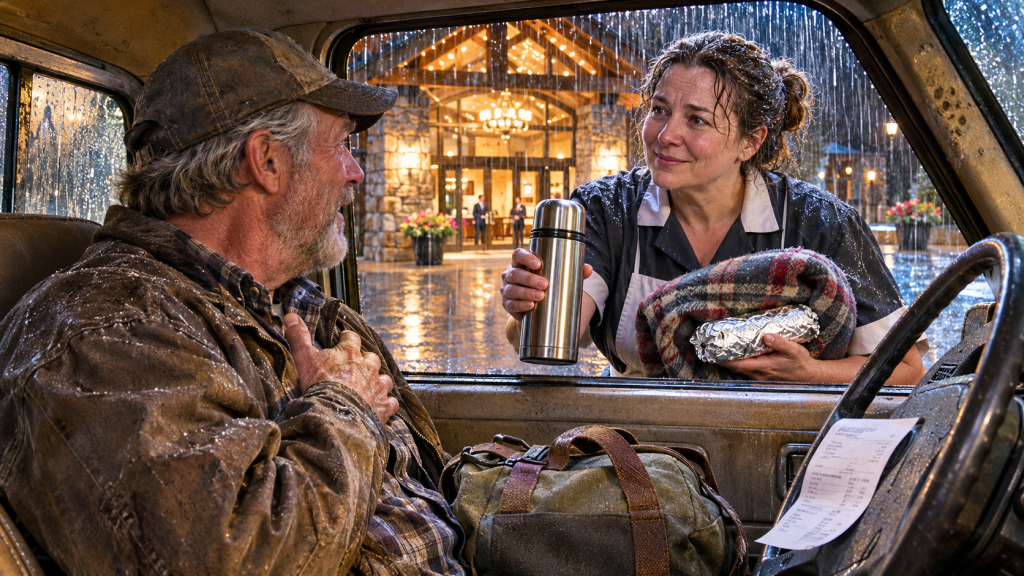
Before leaving my truck, she placed the blanket across my knees.
“Keep it,” she said.
“I’ll return it.”
She shook her head.
“My grandmother made it.”
I stared at the worn blue stitching.
“Then I definitely need to give it back.”
She smiled.
For a moment, the fear disappeared from her face.
Then she climbed into the rain and hurried toward the side door.
I watched until she was safely inside.
Only then did I start the engine.
Owen Price was waiting in a booth at the diner.
He looked about forty-five, with thinning hair, tired eyes, and the expression of a man who hadn’t slept properly in weeks.
There were three folders on the table and an untouched cup of coffee.
When he saw me, he stood so quickly that his chair scraped against the floor.
“Mr. Mercer.”
I shook his hand.
“Thomas is fine.”
He nodded.
Then looked down.
“I’m sorry about Mrs. Mercer.”
The words caught me off guard.
I had grown accustomed to people speaking about Eleanor carefully.
As though her death were a fragile object they might accidentally break.
But Owen sounded genuinely sad.
“Did you know her?” I asked.
He smiled faintly.
“She hired me.”
My throat tightened.
“She did?”
“Twenty-two years ago. I was finishing college. My father had just died, and I was working nights to help my mother.”
He looked toward the rain-streaked window.
“Mrs. Mercer found me doing homework in the employee cafeteria and asked what I was studying.”
I smiled.
“Accounting?”
He nodded.
“She told me the hotel needed somebody who understood numbers and people.”
I laughed softly.
“That sounds like Eleanor.”
Owen’s eyes filled.
“She paid for my certification classes.”
For a moment, I couldn’t speak.
My wife had done so many quiet things.
Paid school fees.
Helped employees buy winter tires.
Sent groceries to families after unexpected illnesses.
She rarely told me about them.
Not because she was hiding anything.
Because she believed kindness didn’t need an audience.
Owen opened his first folder.
“I started noticing discrepancies six months ago.”
He showed me a series of financial reports.
Occupancy figures.
Daily revenue summaries.
Fee income.
Bank deposits.
Some were ordinary.
Others contained adjustments that made little sense.
“The hotel’s booking system shows the heritage preservation fee was eliminated after your instruction,” he said.
I frowned.
“Then why was it on my receipt?”
“Because Sterling created a second charge category.”
Owen pointed toward a line in the report.
“It uses a slightly different internal code, but the guest-facing description is identical.”
I stared.
“So the system technically shows the old fee disabled.”
“Exactly.”
“While guests continue being charged.”
He nodded.
I sat back.
Sterling hadn’t merely forgotten to remove a charge.
Someone had deliberately reintroduced it under a different code.
“How much money are we talking about?”
Owen turned a page.
“Based on the records I’ve reviewed, approximately seventy-eight thousand dollars in questionable fee collections over the past six months.”
I stared.
“Seventy-eight thousand?”
“Some charges may have been refunded, and we need a full reconciliation. But the pattern is serious.”
I remembered Kendall turning the receipt facedown.
Her nervous glance beneath the counter.
The way Sterling had appeared so quickly.
“Who authorized it?”
Owen hesitated.
“That’s what got me fired.”
He explained that Sterling had arranged for certain charges to be routed through accounting categories associated with guest services and property improvements.
Several payments then went to a vendor called Summit Guest Solutions.
The invoices described services such as guest-experience consulting, premium reservation management, and heritage programming.
But Owen couldn’t find meaningful evidence that those services had been provided.
“I questioned Sterling,” he said.
“What happened?”
“He told me I didn’t understand the new revenue strategy.”
I frowned.
“Then?”
“I asked for contracts, supporting documents, and approval records. Some were incomplete, and others didn’t match the amounts paid.”
I looked at him.
“And he fired you.”
Owen nodded.
“He said I was insubordinate.”
I felt anger rising.
“Did you report the concern to corporate?”
His expression changed.
“I tried.”
I went still.
“What do you mean?”
He opened another folder.
Inside were copies of emails.
Messages addressed to the regional operations office.
Follow-up reminders.
Requests for an independent review.
Some had gone unanswered.
Others had received brief replies saying the matter was being handled locally.
I stared at the names.
Then saw one I recognized.
Grant Hollis.
Our regional director of operations.
A man I’d personally promoted three years earlier.
Owen watched my face.
“That’s why I didn’t know whether contacting you would help.”
My stomach sank.
Grant Hollis reported directly to me.
He attended our quarterly meetings.
He was the person responsible for ensuring hotel managers followed company policies.
And he had been receiving warnings for months.
“Why didn’t you call me?” I asked.
Owen looked down.
“Mr. Mercer, I did.”
I stared.
“What?”
He opened his phone and showed me the call history.
Three calls to my corporate office.
Two voicemail messages left with the executive assistant.
One letter sent by certified mail.
My chest tightened.
I hadn’t seen any of them.
Owen looked at me.
“I was told you were unavailable.”
I closed my eyes.
For nearly two years after Eleanor’s death, I’d avoided this hotel.
Then I gradually stopped visiting the other properties as often.
I still worked.
Still approved decisions.
Still read the reports Grant sent me.
But I had allowed too much distance to grow between myself and the people who depended on my leadership.
I thought I was grieving privately.
Now I saw that my absence had created opportunities for others to hide behind my name.
“I’m sorry,” I whispered.
Owen shook his head.
“You didn’t know.”
I looked at him.
“That doesn’t mean I had no responsibility to find out.”
Then Owen opened the final folder.
“This concerns room 312.”
My heart began pounding.
He pushed a report toward me.
It showed fourteen months of room status entries.
Every day, the room had been marked unavailable for maintenance.
No ordinary reservations.
No guest revenue.
No documented repair completion.
Yet the hotel’s purchasing records showed repeated deliveries of luxury linens, expensive wine, imported toiletries, and specialty foods billed to that room.
I stared at the figures.
“Who approved these expenses?”
“Sterling.”
“What happened to the supplies?”
Owen looked at me.
“According to several staff members, the room was being used for private guests.”
I felt sick.
“What kind of guests?”
“People connected to Sterling’s business associates.”
I looked down at the report.
There were dates.
Amounts.
And handwritten notes describing special arrangements.
“Why wasn’t the room in the booking system?”
Owen hesitated.
“Because the payments apparently weren’t always going through the hotel.”
I looked up.
He continued.
“We found references to direct transfers made to an outside hospitality company.”
“Summit Guest Solutions?”
He nodded.
I stared at the table.
Someone had been using Eleanor’s favorite room as a private commercial suite.
Possibly collecting money outside the hotel’s normal accounting system.
And recording it as unavailable while the property absorbed the expenses.
I couldn’t speak.
Owen’s eyes softened.
“There’s something else.”
I looked at him.
“What?”
He hesitated.
“Staff say several of Mrs. Mercer’s personal items were removed.”
The diner seemed to fall silent.
My hands went cold.
“What items?”
Owen swallowed.
“The photographs. Her books. The little blue porcelain vase.”
I closed my eyes.
Eleanor had bought that vase during our first anniversary trip.
It had stood on the bedside table in room 312 for decades.
Every spring, she filled it with wildflowers from the hillside.
After her death, I couldn’t bear to move it.
And now somebody had apparently treated her belongings like inconvenient decorations.
I stared through the diner’s window.
Rain streaked the glass.
A truck passed outside, its headlights briefly illuminating the empty road.
Owen sat quietly.
Finally, I asked, “Do you know where those things went?”
“Not all of them.”
I looked at him.
He continued.
“One housekeeper told me the items were packed into boxes. Some went into storage. Others were moved to the manager’s office.”
I swallowed.
“Are there photographs?”
“Yes.”
He opened his phone.
The first image showed room 312 as I remembered it.
The familiar bed.
The cream-colored curtains.
The blue vase beside the lamp.
Eleanor’s framed photograph near the balcony door.
Then he swiped to another picture.
The walls were painted charcoal gray.
The furniture had been replaced.
A minibar stood where Eleanor’s writing desk once belonged.
The framed photographs were gone.
Even the little reading chair where she used to sit had disappeared.
I felt a terrible pressure behind my eyes.
For a moment, I was no longer a business owner examining financial misconduct.
I was simply a widower looking at the remains of a room where his wife had once been happy.
“I should have come back sooner,” I whispered.
Owen shook his head.
“Mr. Mercer—”
“I knew the room mattered to her. I knew what we’d built here.”
My voice broke.
“But I couldn’t bear to walk through the door after she died.”
Owen sat beside me in silence.
Then said something I wasn’t expecting.
“Mrs. Mercer told me once that grief could make a good person feel like a stranger in their own life.”
I looked at him.
“She said that?”
He nodded.
“After my father died.”
I covered my face.
Owen continued gently.
“She told me that when I was ready, I should return to the places that reminded me of him. Not because it would stop hurting, but because those memories belonged to me.”
Tears slipped between my fingers.
For years, Eleanor had comforted other people.
Now, through a man she’d helped decades earlier, her kindness had found its way back to me.
We talked until dawn.
I asked Owen to preserve his own records and provide relevant evidence through proper channels.
I told him not to access systems he was no longer authorized to use.
His dismissal and the accounting concerns needed independent review, not another mistake that could compromise the investigation.
Before leaving, I called our company’s outside legal counsel.
Her name was Rebecca Caldwell.
She had advised us for more than fifteen years and had known Eleanor personally.
When I explained what had happened, her voice became serious.
“Thomas, do not confront Sterling alone.”
“I wasn’t planning to.”
“Good. We need to preserve the hotel’s electronic records immediately, notify the appropriate people, and examine whether your regional director is involved.”
I looked toward the mountains.
“And the employees?”
“We’ll protect them from retaliation while the investigation proceeds. But I want independent human-resources and forensic-accounting professionals involved, not people who report to the managers under review.”
I nodded.
“Arrange it.”
Rebecca paused.
“Thomas?”
“Yes?”
“Are you all right?”
I thought of Eleanor’s blue vase.
The empty walls.
The room that had become a private playground for people who didn’t know what it meant to us.
“No,” I answered.
“But I’m going to make sure this hotel becomes worthy of her name again.”
By eight that morning, I was back at the hotel.
The rain had finally stopped.
Clouds clung to the mountains, and water dripped from the wooden eaves.
My pickup looked particularly battered beside the polished SUVs in the parking lot.
I climbed out wearing the same old coat.
This time, I carried a folder instead of an overnight bag.
Mason stood near the entrance.
When he saw me, his expression changed.
“Mr. Mercer.”
I smiled faintly.
“Morning, son.”
He stepped closer.
“I’m sorry about last night.”
I shook my head.
“You tried to make sure I was safe.”
He looked uncomfortable.
“I still escorted you out.”
“Because Sterling instructed you to.”
Mason lowered his eyes.
I studied him.
“Did you know who I was?”
“Not at first.”
“When did you recognize me?”
“After you left. I remembered your photograph from the staff training room.”
I nodded.
“And you called Owen?”
“Yes, sir.”
“Why?”
Mason swallowed.
“Because something wasn’t right.”
I looked toward the lobby.
Then back at him.
“That’s a good reason to speak up.”
His eyes filled unexpectedly.
“Thank you.”
Kendall was behind the reception desk.
She looked as though she hadn’t slept.
When she saw me, her fingers stopped moving over the keyboard.
“Sir.”
“Good morning, Kendall.”
She glanced toward the manager’s office.
“Mr. Vain isn’t available.”
“That’s all right.”
I placed the receipt on the counter.
“I’d like to ask you something.”
Her face reddened.
“About last night?”
“Yes.”
She looked down.
“I’m sorry if I was rude.”
I studied her.
“Did you create those charges?”
Her eyes widened.
“What?”
“Did you decide to add them?”
She shook her head quickly.
“No.”
“Who instructed you?”
Kendall swallowed.
For a moment, she seemed unable to answer.
Then she whispered, “Mr. Vain.”
I nodded.
“Was everyone charged the same way?”
Her eyes filled.
“No.”
“How did you decide?”
She looked toward the office again.
“Mr. Vain told us to use the premium pricing category for guests who didn’t look like our regular clientele.”
I felt sick.
“What did that mean?”
She hesitated.
“People arriving in older vehicles. People without expensive luggage. People he thought might be difficult.”
I stared at her.
“Did he tell you to explain the fees?”
“He said not to discuss internal pricing.”
I looked down at the receipt.
“And the comments about sleeping in my truck?”
Kendall began crying.
“That was me.”
I waited.
She wiped her cheeks.
“I was frustrated. You kept asking questions, and I knew I couldn’t answer them honestly without getting in trouble.”
Her voice broke.
“But you didn’t deserve that.”
I nodded slowly.
“No, Kendall. I didn’t.”
She lowered her head.
“I’m sorry.”
I looked at the young woman standing behind the desk.
She had made a cruel choice.
But she was also working under someone who had apparently taught his employees that obedience mattered more than decency.
Both truths deserved attention.
“Thank you for apologizing,” I said.
She looked up.
“Am I fired?”
I took a breath.
“That decision won’t be made in this conversation. There will be a fair review of what happened, including the instructions you were given and your own conduct.”
She nodded through tears.
Then I added, “But I want you to remember something. A person’s clothing doesn’t tell you how much respect they deserve.”
Kendall whispered, “I know.”
“I hope you do.”
Sterling appeared a moment later.
He stepped from his office carrying a cup of coffee.
When he saw me, he stopped.
His expression hardened.
“You again.”
I turned.
“Good morning.”
He looked toward Kendall.
“Why is he still here?”
She froze.
I answered before she could speak.
“Because I need to inspect room 312.”
Sterling gave a short laugh.
“That room is closed for maintenance.”
“What repairs are underway?”
“Plumbing.”
“Which plumbing contractor?”
He frowned.
“Sir, we’ve discussed this.”
“Then perhaps you can show me the work order.”
His eyes narrowed.
“You’re not entitled to inspect our internal maintenance records.”
I opened my folder.
“Sterling, who authorized the heritage preservation fee?”
He sighed theatrically.
“Corporate.”
“Which corporate officer?”
“That’s confidential.”
I nodded.
“Did Grant Hollis approve the charge?”
Something moved behind his eyes.
Then he said, “I don’t have time for this.”
I stepped closer to the desk.
“Neither do the guests who’ve been paying for services they didn’t request.”
Sterling’s face reddened.
“Security!”
Mason didn’t move.
Sterling turned.
“Mason, remove this man.”
Mason glanced toward me.
Then said quietly, “Sir, I think you should let him finish.”
Sterling stared.
“What?”
Before he could respond, Rebecca Caldwell entered the lobby with two representatives from our corporate office and an outside investigator.
She approached us calmly.
“Mr. Vain.”
Sterling’s expression changed.
“Ms. Caldwell?”
Rebecca held out her hand.
“I’m here on behalf of Mercer Hospitality Group.”
Sterling straightened.
“Of course. Is there a problem?”
She looked toward me.
“Yes. I believe you’ve already met the company’s owner.”
For several seconds, Sterling didn’t move.
Then he turned toward me.
His face drained of color.
“Mr. Mercer?”
I took off my reading glasses.
“Good morning, Sterling.”
The silence that followed was extraordinary.
Kendall stood motionless behind the desk.
Mason looked toward the floor.
Several guests stopped near the staircase.
Sterling opened his mouth.
Then closed it.
Finally, he managed, “Sir, I had no idea.”
I looked at him.
“That’s the problem.”
He swallowed.
“I assure you, if I’d known who you were—”
I raised my hand.
“Don’t finish that sentence.”
His eyes widened.
I looked directly at him.
“The important question isn’t how you would have treated me if you’d known I owned the hotel.”
I paused.
“It’s how you’ve been treating people you believed couldn’t challenge you.”
Rebecca stepped forward.
“Mr. Vain, you are being placed on administrative leave pending an independent investigation into hotel operations, financial records, guest billing practices, and employee complaints.”
Sterling stared.
“This is outrageous.”
Rebecca remained calm.
“You’ll receive written instructions concerning preservation of company information and the review process.”
He looked toward me.
“Mr. Mercer, please. This is all a misunderstanding.”
I thought of Marisol standing in the rain.
Owen losing his job.
Kendall fearing she’d lose her shifts.
The charges on my receipt.
And Eleanor’s room.
“Then the records should help establish what happened,” I answered.
Sterling’s jaw tightened.
He glanced toward the manager’s office.
“May I collect my belongings?”
Rebecca nodded.
“With an authorized representative present.”
Sterling looked as though he wanted to argue.
Then he walked away.
The entire lobby remained silent until his office door closed.
I turned toward the guests.
Some had witnessed the confrontation.
Others were watching from the staircase.
I cleared my throat.
“Ladies and gentlemen, I’m Thomas Mercer. My wife and I founded this hotel many years ago.”
A few people murmured.
I continued.
“I’ve recently learned of serious concerns about billing and guest treatment. We’re arranging an independent review and will make sure guests have a clear way to raise concerns and request corrections.”
I looked toward the brass plaque.
Every guest is somebody.
“We built this place on a promise that every guest would be treated with dignity. I’m sorry we’ve fallen short of that promise.”
I didn’t ask anyone to applaud.
I didn’t expect them to forgive me because I had spoken kindly.
I simply wanted them to know that somebody with authority was finally listening.
The next several days uncovered more than I expected.
A forensic accounting team reviewed the hotel’s records, including legitimate access logs, invoices, payment histories, and approved financial reports.
The review found a pattern of questionable guest charges and vendor payments.
Summit Guest Solutions was connected to an entity in which Sterling had an undisclosed financial interest.
Grant Hollis, our regional director, had approved several agreements and failed to disclose that relationship in his oversight reports.
Whether every questionable transaction constituted fraud required further examination.
But the conflicts of interest and accounting irregularities were serious enough that both men were removed from decision-making responsibilities while the review continued.
Grant called me repeatedly.
I didn’t answer.
Instead, I directed him to our attorneys and the independent investigators.
For years, he’d enjoyed my confidence.
I had promoted him because he seemed organized, capable, and loyal.
Now I needed to know what the evidence showed, not what he could persuade me to believe over the telephone.
The investigation also confirmed that room 312 had been used for private arrangements outside the hotel’s authorized reservation process.
Its maintenance designation had concealed repeated occupancy.
Some stays had been arranged for Sterling’s associates.
Others involved payments directed through outside accounts rather than properly recorded through the hotel.
The room had been refurbished without appropriate approval, and company funds had covered expenses associated with those uses.
I read the findings in silence.
Then asked Rebecca, “Where are Eleanor’s things?”
She opened a separate inventory.
“Some were found in storage. Some in the manager’s office. We’re still tracing the remainder.”
My throat tightened.
“The vase?”
Rebecca looked down.
“Not yet.”
I closed my eyes.
For a moment, I couldn’t speak.
Then I asked, “Can I see the room?”
She nodded.
“Of course.”
I climbed the stairs alone.
The third floor smelled faintly of fresh paint.
I walked slowly along the hallway, passing the rooms where Eleanor and I had once left handwritten welcome cards for guests.
At the far end stood room 312.
The familiar brass number was still attached to the door.
I placed my hand against the wood.
For a moment, I couldn’t turn the key.
I remembered Eleanor standing in the hallway in her wedding dress.
She had been twenty-nine.
Her hair was pinned loosely above her shoulders.
She carried a bouquet of white flowers and laughed when I struggled to fit the enormous room key into the lock.
“Thomas,” she’d said, “if you can’t open one door, how are we going to run a hotel?”
I’d laughed.
Then kissed her.
Now I stood in the same place, older by decades, holding another key in a shaking hand.
I opened the door.
The room was almost unrecognizable.
The cream curtains were gone.
The old wooden dresser had been replaced by a glossy modern cabinet.
Eleanor’s writing desk was missing.
The walls were dark.
The bed was larger.
The artwork looked expensive but meaningless.
I stepped inside.
My shoes made almost no sound on the thick carpet.
For a while, I simply stood there.
Then I walked toward the balcony.
The mountain view was unchanged.
Beyond the glass lay the same valley where Eleanor and I had watched a thousand sunsets.
The same hills.
The same distant church steeple.
The same narrow road winding through the trees.
I opened the balcony door.
Cold air touched my face.
And suddenly, I could hear her laughter.
Not literally.
Only in memory.
But it was so vivid that I had to grip the railing.
I remembered her leaning against me one summer evening.
“Promise me something, Thomas.”
“Anything.”
“If we ever become successful, don’t let this place turn into somewhere people have to prove they belong.”
I had kissed the top of her head.
“I promise.”
Tears rolled down my cheeks.
“I’m sorry, Ellie.”
The words disappeared into the mountain air.
“I’m so sorry.”
I stayed on the balcony until the afternoon light began to fade.
Then there was a gentle knock.
“Mr. Mercer?”
I turned.
Marisol stood in the doorway.
She held a cardboard box.
“Rebecca said I could bring this up.”
I wiped my eyes.
“What is it?”
She stepped inside and placed the box on the bed.
“We found it in the linen-storage room.”
I approached slowly.
Inside were several books.
A framed photograph.
A folded scarf.
And a small notebook with a blue cover.
My breath caught.
The notebook belonged to Eleanor.
She used to write down little details about guests.
Not their secrets.
Just the things that made them feel welcome.
Mrs. Peterson likes peppermint tea.
The Johnson children love blueberry pancakes.
Remember extra pillows for Mr. Alvarez.
I picked it up carefully.
The leather cover was worn.
The corners were bent.
For a moment, I couldn’t speak.
Marisol watched me.
Then whispered, “Your wife was very kind to me.”
I looked up.
“You knew her?”
She nodded.
“I started working here during the last year of her life.”
My throat tightened.
“She used to ask about my children. She remembered their birthdays.”
I smiled through tears.
“That was Eleanor.”
Marisol hesitated.
“There’s something I’d like to tell you.”
I waited.
“The night she came to the hotel for the last time, she was very tired. I helped her upstairs.”
My heart began pounding.
I remembered that night.
Eleanor had been undergoing treatment.
She was weak.
But she insisted she wanted one more evening overlooking the valley.
I helped her settle into room 312.
Then went downstairs to arrange dinner.
Marisol continued.
“Before I left, she asked whether I’d promise her something.”
“What?”
“That if I ever saw someone standing outside this hotel who needed help, I’d remember they might be carrying more sorrow than anyone could see.”
My eyes filled.
Marisol smiled sadly.
“That’s why I came out to your truck.”
I couldn’t speak.
My wife’s kindness had crossed the years without either of us knowing it.
And on the very night I felt most abandoned, it had returned in the hands of a housekeeper carrying a blanket and a warm meal.
I opened Eleanor’s notebook.
The final pages contained familiar handwriting.
Some entries were guest preferences.
Others were little reminders.
Then, near the back, I found a sentence underlined twice.
The most important guest may be the one who cannot afford to stay.
I stared at it.
Beneath the sentence, Eleanor had written:
Thomas and I should establish a fund for travelers stranded by emergencies. No publicity. No embarrassing questions. Just a warm room when someone needs one.
I sat on the bed.
My chest tightened.
We had discussed something like that years earlier.
A guest assistance program.
A way to provide temporary accommodation for people stranded by storms, sudden illness, or family emergencies.
But Eleanor became sick before we’d completed the plan.
After she died, I allowed the idea to disappear beneath other responsibilities.
Now I was sitting in a room that had been misused for private profit, holding the very notebook in which she’d imagined using our hotel to help strangers.
The contrast was unbearable.
I looked toward Marisol.
“She wanted to make sure people had somewhere safe to sleep.”
Marisol nodded.
I thought of the pickup.
The rain.
Sterling telling me to find another hotel.
And Kendall suggesting I could sleep in my truck.
I closed the notebook carefully.
“Then that’s what we’re going to do.”
The reforms didn’t happen overnight.
I wanted to gather every employee in the lobby, make a grand announcement, and promise that everything would change immediately.
But Owen reminded me that genuine reform required more than a speech.
We needed accurate records.
Clear policies.
Independent oversight.
A safe way for employees to report concerns.
And managers who understood that their authority existed to serve the hotel, not themselves.
So we began there.
An outside team audited the questionable charges.
Guests who had paid fees that should not have been assessed were identified, notified when possible, and offered refunds or appropriate corrections.
The company strengthened its procedures for authorizing rate changes and vendor contracts.
New reporting channels allowed employees to raise concerns without going through the very managers they were questioning.
We also reviewed the treatment of staff members who had lost shifts or faced discipline after speaking up.
Some employment and financial matters required separate legal proceedings.
The potential misconduct was referred to the appropriate authorities for review.
I refused to announce accusations as established crimes before the evidence had been assessed.
Eleanor had always believed fairness was most important when it was inconvenient.
I wanted to remember that.
Owen’s dismissal received an independent review.
After examining the circumstances, the company offered to reinstate him with appropriate remedies for the period he’d been out of work.
He accepted.
But when I asked whether he wanted his old position, he surprised me.
“I’d rather work in corporate compliance.”
I smiled.
“Why?”
He looked toward the reception desk.
“Because I never want another employee to spend months trying to make someone listen.”
We discussed the role through the proper hiring process.
Several weeks later, Owen joined the company’s strengthened internal compliance team.
He wasn’t given unchecked power.
Nobody was.
But he had a voice.
And this time, the organization was structured to hear it.
Kendall remained at the hotel after a formal review, corrective action, and additional training.
Her behavior toward me had been unacceptable.
She acknowledged it without trying to excuse herself.
What mattered next was whether she changed.
One morning, I saw her helping an elderly couple who had arrived after a flat tire delayed their journey.
They wore inexpensive coats and carried a single suitcase.
The husband apologized because they didn’t have their booking confirmation.
Kendall smiled.
“That’s all right. Let’s get you warm while I find your reservation.”
She offered them seats near the fireplace.
Then brought hot tea.
She didn’t know I was watching.
And that made the moment meaningful.
Later, she approached me.
“Mr. Mercer?”
“Yes, Kendall?”
“I wanted to thank you for giving me a chance to improve.”
I considered her words.
“Make the most of it.”
She nodded.
“I will.”
I hoped she meant it.
But I also understood that one kind interaction didn’t erase the hurtful one.
Character was something we demonstrated repeatedly.
Especially when nobody important was looking.
Mason was offered additional training and responsibilities after the review confirmed that he had raised concerns appropriately and helped preserve information.
Marisol initially refused every suggestion that her kindness deserved a reward.
“I didn’t do it for money,” she told me.
“I know.”
“Then please don’t make a fuss.”
I smiled.
“All right.”
But I did ask whether she wanted to participate in developing the guest assistance program.
Her eyes widened.
“Me?”
“Who better?”
She looked toward Eleanor’s notebook.
Then smiled through tears.
“I’d like that very much.”
We called the program Eleanor’s Open Door.
It was funded through a dedicated company budget, with clear eligibility guidelines and oversight.
Partner organizations and hotel staff could help stranded travelers, families facing emergencies, and others who needed temporary shelter.
The program didn’t replace public services or claim to solve every hardship.
It simply gave our hotels a practical way to help when help was appropriate and available.
The first family assisted through the program arrived during a late winter storm.
Their car had broken down on a mountain road.
They had two young children, very little cash, and nowhere nearby to stay.
A local roadside assistance worker contacted the hotel.
Our staff arranged a room and helped connect the family with transportation and repair services.
The following morning, I found a note at the reception desk.
Thank you for treating us like people instead of a problem.
I read it three times.
Then carried it upstairs.
I placed it beside Eleanor’s photograph.
And whispered, “We finally did it, Ellie.”
Restoring room 312 took several months.
We found Eleanor’s writing desk in a storage area.
The old reading chair needed new upholstery.
Her framed photographs had survived, although one frame was broken.
A carpenter repaired the dresser she’d loved.
We replaced the dark curtains with the soft cream fabric she preferred.
The room slowly began to feel familiar again.
But the blue porcelain vase remained missing.
I searched the storage rooms.
Asked the investigators to include it in the property inventory.
And accepted that we might never recover it.
Then, one afternoon, Rebecca called.
“Thomas, something turned up.”
My heart tightened.
“What?”
“The vase.”
I sat down.
“Where?”
“It had been removed with other decorative items and later transferred to a storage unit associated with one of the vendor arrangements. It was identified during the property recovery process.”
I closed my eyes.
“Is it damaged?”
“A small chip near the bottom. Otherwise, it’s intact.”
I covered my face.
For a moment, I couldn’t speak.
Then I began crying.
I had been able to face questionable financial reports, difficult conversations, and the humiliating discovery of how badly my hotel had been managed.
But the thought of Eleanor’s little blue vase returning home undid me completely.
The first evening room 312 reopened, I stayed there alone.
Not as the owner inspecting a renovation.
Not as a businessman reviewing expenses.
Simply as a man returning to the place where he had once been happiest.
I placed my overnight bag beside the bed.
Set Eleanor’s photograph on the dresser.
And filled the blue vase with wildflowers from the hillside.
The vase had a tiny chip.
I turned it toward the window.
Then smiled.
Eleanor would have laughed.
She used to say that objects became more precious when they carried evidence of having been loved and used.
I opened the balcony door.
The mountains stretched beyond the railing.
The sunset painted the valley gold.
I sat in her favorite chair.
For a long time, I listened to the evening birds.
Then I opened her notebook.
On the final page, beneath the sentence about the guest who couldn’t afford to stay, she’d written something I had overlooked.
Thomas worries too much about whether everything is perfect. I hope he learns that people remember how they felt long after they’ve forgotten what a room cost.
I laughed through tears.
“Oh, Eleanor.”
I could almost hear her answering.
“What did I tell you?”
A year after that rainy night, I returned to the hotel in my old pickup.
I wore the same jacket.
The cuffs were more frayed now.
And the truck still made an embarrassing noise whenever I turned sharply.
I parked beside a polished black SUV and carried my canvas bag through the entrance.
Kendall was working at the desk.
She smiled when she saw me.
“Good afternoon, Mr. Mercer.”
“Afternoon, Kendall.”
“Room 312?”
“If it’s available.”
She checked the reservation system.
“It is.”
Then she handed me the registration details.
The nightly rate was clearly displayed.
Taxes were itemized.
There were no mysterious heritage charges.
No fabricated mountain experience.
No unexplained deposit marked nonrefundable.
I studied the paper.
Then looked up.
“Looks good.”
Kendall smiled.
“Would you like some coffee before going upstairs?”
I nodded.
“That would be wonderful.”
As I walked toward the fireplace, I noticed a young couple entering with two children.
Their coats were wet.
Their luggage was old.
The father looked uncertain as he approached the desk.
“Excuse me,” he said. “Is this hotel very expensive?”
Kendall smiled warmly.
“Our standard room rates are posted here, and I’d be happy to explain the total before you decide.”
The man’s shoulders relaxed.
His daughter pointed toward the piano.
“Can somebody play that?”
I turned.
The black piano still stood beneath the brass lamp.
The same one Eleanor had played on Friday evenings.
For months after her death, its silence had felt unbearable.
Now I walked toward it.
The little girl watched me.
“Do you know how?”
I smiled.
“Not very well.”
She giggled.
I sat down anyway.
Then played the few simple chords Eleanor had taught me.
They weren’t perfect.
I missed a note.
Then another.
But the little girl laughed, and her parents smiled.
Around us, the lobby filled with the ordinary sounds of guests arriving, suitcases rolling across the floor, and coffee cups touching saucers.
For the first time in years, those sounds didn’t make me miss Eleanor less.
They made me remember why we’d loved the place together.
Before going upstairs, I stopped beside the brass plaque.
The potted fern had been moved.
Nothing covered the words anymore.
Every guest is somebody.
I ran my fingers across the engraving.
A year earlier, I’d arrived in the rain, carrying a cheap bag and wearing an old coat.
I had been treated like someone who didn’t deserve a room.
The hotel manager had assumed I was powerless.
The receptionist had assumed I was poor.
And both had made the same mistake.
They believed dignity was something a person earned through wealth.
They had no idea I owned the building.
But that wasn’t what made their behavior wrong.
It would have been just as wrong if I’d owned nothing at all.
My name is Thomas Mercer.
I built a successful hospitality business with the woman I loved.
After losing her, I allowed grief to distance me from the people and promises we’d spent our lives serving.
I cannot undo every mistake.
I cannot recover every guest who was treated badly.
And no amount of money will bring Eleanor back.
But I can listen.
I can take responsibility.
And I can make certain that the hotel she loved reflects the values she lived by.
That is a better tribute than any marble statue or engraved portrait.
That evening, I stood on the balcony of room 312.
The blue vase rested beside Eleanor’s photograph.
Below me, lights glowed along the garden paths.
Somewhere downstairs, the piano began playing.
I smiled.
Then whispered into the mountain air:
“Ellie, I came home.”
The breeze moved gently through the curtains.
And for the first time since her death, the room didn’t feel like a place where happiness had ended.
It felt like a place where love had left something worth continuing.
Because the true measure of a person isn’t how they treat someone powerful enough to reward them. It’s how they treat someone they believe has nothing to offer.