The former principal stopped walking. For ten years, Adrian had imagined what it would feel like to stand in front of the people who once made his life miserable. He had imagined anger. He had imagined telling them about the afternoons he spent hiding in empty classrooms, the birthday parties he was never invited to, and the mornings when he begged me to let him stay home.
But nothing had prepared him for the moment he discovered that the adults who should have protected him might have concealed the truth about what happened. Across the ballroom, the former principal, Richard Whitmore, slowly turned around. The music had stopped. The guests stood beneath the chandeliers, their faces illuminated by the pale glow of the presentation screen.
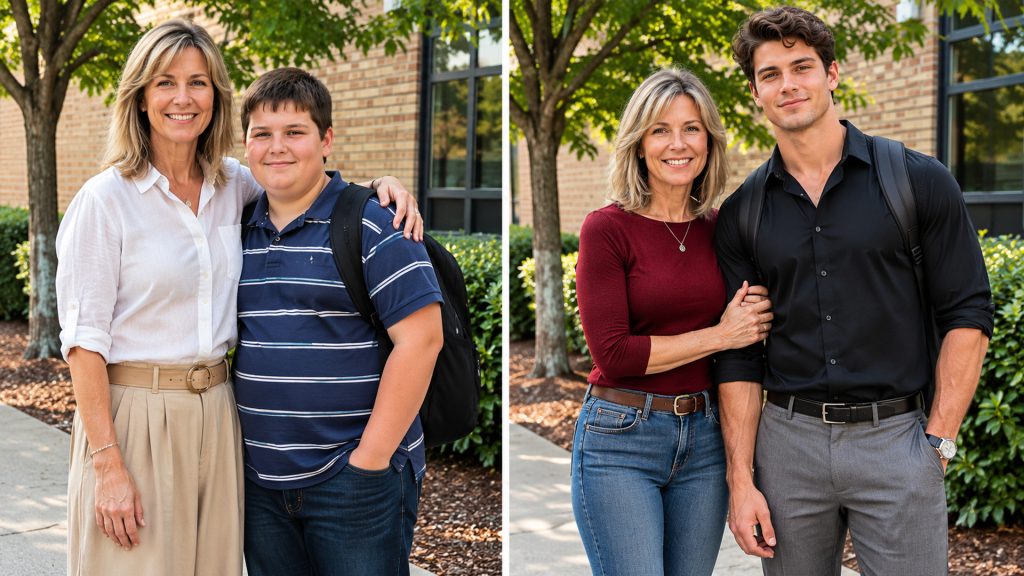
Adrian held the microphone in one hand. In the other was a letter that had been quietly delivered to the event coordinator earlier that evening. His name appeared on it. His supposed signature appeared at the bottom. And the date matched a week when I’d been desperately pleading with the school to intervene after another cruel incident. “Mr. Whitmore,” Adrian said, his voice steady despite the pain rising in his chest, “do you remember this document?”
The former principal adjusted his jacket.
“I don’t think this is the appropriate place to discuss confidential school matters.”
Adrian nodded.
“You’re right about one thing. Student records deserve privacy.”
He lowered the letter.
“I’m not going to read its contents aloud. But the document concerns me, and I know I never signed it.”
A murmur spread across the room.
Travis folded his arms.
“Oh, come on. Are we seriously turning a reunion into a courtroom?”
Adrian looked toward him.
“No. A courtroom is where people establish legal responsibility. Tonight, I’m explaining why I believe the school’s response to bullying deserves an independent review.”
Whitmore’s expression tightened.
“This happened a long time ago.”
Adrian paused.
Then answered quietly.
“So did the things we came here to remember.”
Nobody laughed.
My name is Margaret Cole.
I wasn’t at the reunion that evening.
I was sitting at home, watching the clock, wondering whether my son was about to reopen wounds that had taken him years to survive.
Adrian had promised to call when he was ready to leave.
He hadn’t told me every detail of his plan.
I knew he intended to speak about Second Table, the nonprofit he’d established to support students facing isolation and bullying.
I knew he had been working with school administrators and community donors to establish funding for counseling, peer-support programs, and student inclusion initiatives.
And I knew he hadn’t received an invitation to his own ten-year reunion.
But I didn’t know someone had sent him an old school document.
I didn’t know the letter contained a signature he insisted wasn’t his.
And I certainly didn’t know that the man who had repeatedly dismissed my complaints would be standing in the same room when Adrian discovered it.
At eleven seventeen that night, my phone rang.
I answered immediately.
“Adrian?”
For a moment, all I heard was breathing.
Then my son whispered, “Mom, do you remember the complaint you filed after they locked me in the equipment room?”
I closed my eyes.
Of course I remembered.
Some memories don’t fade with time.
They simply stop announcing themselves every day.
“Yes, sweetheart.”
His voice trembled.
“Mom, they said I withdrew it.”
I sat upright.
“What?”
“There’s a document. It says I asked them to close the complaint because everything had been resolved.”
My hands went cold.
“Adrian, you never asked for that.”
“I know.”
I heard him swallow.
“And there’s a signature that looks like mine.”
For several seconds, I couldn’t speak.
Then I whispered, “Where are you?”
“Outside the hotel.”
“Are you alone?”
“No. The event coordinator is here, and Megan’s waiting nearby.”
I took a breath.
“Come home when you’re ready. We’ll look at everything together.”
He was quiet.
Then he asked something that broke my heart.
“Mom, why didn’t they believe us?”
I closed my eyes.
I had spent years asking myself the same question.
“I don’t know,” I whispered. “But we’re going to find out what we can.”
When Adrian arrived at my house shortly after midnight, he looked exhausted.
The suit he’d worn so carefully that evening was wrinkled.
His tie hung loosely around his neck.
And his eyes were red.
He stood in the doorway like the boy who used to come home from school pretending nothing was wrong.
I opened my arms.
He stepped forward and hugged me.
For a long time, neither of us spoke.
Then I whispered, “I’m proud of you.”
His shoulders began trembling.
“Mom, I didn’t even get to finish the scholarship announcement.”
I held him tighter.
“That can happen another day.”
He stepped back.
“No. It matters. Those students need the funding.”
I smiled sadly.
“Then we’ll make sure they receive it.”
He looked down.
“I just never expected that letter.”
I guided him toward the kitchen.
“Come sit with me.”
I made tea while Adrian told me what had happened after he challenged Whitmore.
The former principal had refused to discuss the document publicly.
That was probably the only sensible decision he’d made all evening.
The coordinator, a woman named Elena Morris, had gently intervened and asked everyone to return their attention to the scheduled program.
Adrian had lowered the microphone.
He had thanked the guests for listening.
Then he had announced that Second Table would proceed with its planned scholarship and student-support funding, subject to its existing agreements and independent oversight.
The event had continued, although the atmosphere had changed.
Some classmates approached him afterward.
Others avoided him.
Travis accused him of seeking attention.
And Whitmore left before dessert.
But the most unexpected development came from Megan.
She waited beside Adrian near the hotel entrance, crying.
“Adrian,” she said, “there’s something I should have told you years ago.”
He didn’t know what to say.
Megan had once been his closest friend.
In middle school, she’d shared her lunch with him, helped him study, and invited him to sit beside her during assemblies.
Then, when their classmates began mocking him, she gradually stopped.
By high school, she sometimes laughed along.
I remembered Adrian asking me one evening why losing one friend hurt more than having twenty people dislike him.
I’d told him that betrayal often hurts most when it comes from someone who once made us feel safe.
Now Megan was standing outside the reunion asking him to listen.
“She told me she remembered the equipment-room incident,” Adrian said.
I put down my mug.
“Did she see it happen?”
He nodded.
“She said Travis and two other boys pushed me inside and blocked the door.”
I felt my chest tighten.
I remembered that afternoon as clearly as if it had happened yesterday.
Adrian was fourteen.
He arrived home with a bruise on his forearm and dust on his school uniform.
When I asked what happened, he said he’d fallen.
I didn’t believe him.
Later that evening, after hours of gentle questioning, he finally told me.
Several boys had trapped him in a storage room near the gym.
They laughed through the door.
One shouted that nobody would notice if Adrian disappeared.
He was left there until a custodian heard him calling for help.
When he told me, I felt something inside me break.
The next morning, I went to the school.
I spoke with an assistant principal.
I submitted a written complaint.
I asked that the incident be documented and investigated.
And I insisted that my son shouldn’t have to sit in class beside people who frightened him.
A week later, I received a letter saying the matter had been resolved.
I called to ask what had been done.
The office told me that the students had been counseled and no further action was required.
I remember standing in our kitchen afterward, holding the telephone, feeling completely powerless.
Now Adrian was telling me that somewhere in the school’s records was a document claiming he had voluntarily withdrawn the complaint.
“What else did Megan say?” I asked.
Adrian stared into his tea.
“She said the boys were called into the principal’s office.”
I nodded.
“That much we knew.”
“But she heard Travis bragging afterward.”
My stomach tightened.
“About what?”
Adrian looked at me.
“He said his father had made the problem disappear.”
I sat very still.
Travis’s father, Leonard Price, had been a prominent local businessman.
He owned several car dealerships and donated generously to the school’s athletics program.
His name appeared on a plaque near the gymnasium.
He regularly attended fundraising dinners.
And the administration treated him with a kind of careful respect I’d noticed even when Adrian was young.
I had never liked assuming that money explained every unfair decision.
But I remembered the way Whitmore’s expression changed when I mentioned Travis by name.
How quickly he began speaking about misunderstandings.
How firmly he discouraged me from escalating my complaint.
“What does Megan think happened?” I asked.
“She doesn’t know. She only remembers what Travis said.”
I nodded.
That distinction mattered.
A cruel boast wasn’t proof that a financial donor had influenced a school investigation.
But it was enough to make me wonder whether the records would tell a different story from the one we’d been given.
Adrian opened his laptop.
He showed me a photograph of the document he’d received.
The letter was dated ten years earlier.
It carried the school’s former letterhead.
Near the bottom was a line stating that Adrian Cole wished to withdraw his complaint and considered the matter resolved.
Beneath it appeared a signature.
I leaned closer.
It looked familiar.
But something was wrong.
Adrian had always written the last letter of his surname with a sharp upward stroke.
This signature curved downward.
I examined the date again.
Then a memory came back.
“Adrian,” I whispered, “you weren’t at school that day.”
He frowned.
“What?”
I looked at him.
“That was the week you had pneumonia.”
His eyes widened.
I remembered sitting beside his bed, taking his temperature and making sure he drank enough water.
The doctor had advised him to stay home while he recovered.
I had taken time off work.
He hadn’t been in school for several days.
I reached for my phone.
“Mom?”
“I kept your medical records.”
He stared at me.
“After all this time?”
I nodded.
“I kept everything I thought might matter.”
For years, my son had believed I was simply a mother who worried too much.
Now, for the first time, I wondered whether that old folder of school letters, attendance notices, and medical documents might finally help us establish what happened.
The next morning, I climbed into the attic.
Adrian followed me.
Dust floated through the narrow beam of sunlight entering through the window.
I pulled an old plastic storage box from beneath a shelf.
Written across the lid in black marker were two words.
ADRIAN — SCHOOL.
He stared.
“Mom.”
I smiled faintly.
“What?”
“You kept my spelling tests?”
“Some of them.”
He laughed.
“Why?”
“Because you worked hard.”
His smile faded.
He knelt beside me.
Inside were report cards, certificates, photographs, birthday cards from classmates who had once been kind, and documents I’d gathered during the years when school became a place of dread.
I found a folder labeled Complaints.
My hands trembled as I opened it.
There were letters to teachers.
Notes from meetings.
Copies of emails.
And, near the back, a medical certificate confirming Adrian’s absence during the week the supposed withdrawal had been signed.
I handed it to him.
He stared.
Then whispered, “Mom, this proves I wasn’t there.”
“It supports that you were absent,” I answered. “We’ll need to establish exactly how the signature entered the file.”
He looked up.
I continued.
“We won’t make accusations we can’t support. But we aren’t going to ignore it.”
For a moment, he looked like a frightened boy again.
Then his shoulders straightened.
“Okay.”
That afternoon, Adrian contacted an attorney named Rebecca Lawson.
She had experience with education-related disputes, records requests, and nonprofit governance.
Adrian explained what had happened.
I provided the documents I had preserved.
Rebecca listened carefully.
Then asked several questions.
“Do you have the original alleged withdrawal form?”
“No,” Adrian answered. “Only a photograph and the copy supplied at the reunion.”
“Do you know who provided it?”
“The coordinator said someone left it in an envelope addressed to me.”
“Have they identified the sender?”
“Not yet.”
Rebecca nodded.
“We should preserve the envelope, the copy, and any communications about its delivery. Then we can request the relevant records through the proper process.”
I leaned forward.
“Can we find out who signed my son’s name?”
“Possibly. But we need to examine the original document and any available records showing when it was created, received, or filed.”
Adrian swallowed.
“Could somebody be prosecuted?”
Rebecca answered carefully.
“That depends on what actually occurred, the laws involved, available evidence, and any applicable time limits. Let’s establish the facts before discussing outcomes.”
He nodded.
She continued.
“And Adrian, I understand this document is deeply personal. But protecting your reputation and funding student programs are separate matters. I’d recommend keeping the nonprofit’s activities independent from any dispute involving your former school.”
Adrian looked at her.
“I don’t want the students to lose anything because of me.”
“Then we’ll take steps to protect them.”
The next few weeks were difficult.
Adrian returned to work.
Second Table continued its existing programs.
And Rebecca began seeking the records needed to understand the school’s response to the complaints.
But my son became quieter.
I recognized the signs.
He slept poorly.
He checked his phone too often.
And when someone mentioned the reunion, he changed the subject.
One evening, I found him sitting on my back porch.
The sun was setting behind the trees.
He held a photograph from high school.
I recognized it immediately.
Adrian stood at the far edge of a class picture.
His shoulders were slightly hunched.
His expression was guarded.
Everyone around him appeared to be laughing.
I sat beside him.
“What are you thinking?”
He stared at the photograph.
“That I wasted so much time trying to make them like me.”
My heart tightened.
“You were a child.”
He nodded.
“I know.”
He looked toward the garden.
“But sometimes I still feel like that kid.”
I reached for his hand.
“That’s understandable.”
He turned toward me.
“Mom, I built a company. I started a nonprofit. I have people who respect me.”
I nodded.
“Yes.”
“Then why did walking into that ballroom make me feel fourteen again?”
I didn’t answer immediately.
Then I said, “Because success doesn’t erase what happened to you. It gives you a different life, but healing still takes work.”
His eyes filled.
“I thought I’d moved past it.”
I squeezed his hand.
“Maybe moving past something doesn’t mean never feeling it again.”
He looked down.
“Then what does it mean?”
I thought about the boy who used to sit alone at lunch.
The teenager who cried quietly in the bathroom because he didn’t want me to hear.
And the adult beside me, who had chosen to create opportunities for children facing the same pain.
“It means the hurt no longer gets to decide what kind of person you become.”
Adrian began crying.
I put my arm around him.
And for a while, we simply watched the last light disappear behind the trees.
The first significant discovery came from an unexpected source.
A woman named Linda Harper contacted Rebecca’s office.
Linda had worked as an administrative assistant at the high school during Adrian’s final years there.
She was retired now.
And she’d seen photographs from the reunion circulating online.
One showed Adrian speaking at the microphone.
Another included the former principal leaving the ballroom.
Linda recognized both men.
She also recognized the document described in a short account of the evening.
She asked whether she could speak with us.
Rebecca arranged a meeting.
I went with Adrian.
Linda arrived carrying a small notebook and looking terribly nervous.
She was in her late sixties, with kind eyes and hands that trembled slightly when she reached for her coffee.
“Adrian,” she said, “I remember you.”
My son smiled politely.
“Hello, Mrs. Harper.”
She looked at me.
“And I remember your mother.”
I nodded.
“Thank you for coming.”
Linda took a breath.
“I should have spoken up years ago.”
Adrian went still.
She looked down.
“When you were a student, your mother filed several complaints. Some concerned verbal bullying. Others involved physical intimidation.”
I felt my chest tighten.
Linda continued.
“The school office received them. I helped log correspondence.”
Rebecca asked whether Linda had retained any official records.
“No,” she answered. “I didn’t take confidential student files when I retired. But I remember the process, and I kept personal notes about meetings I attended.”
Rebecca nodded.
“What do you remember about the withdrawal?”
Linda’s eyes filled.
“I remember being asked to file paperwork showing that the matter had been resolved.”
Adrian leaned forward.
“Who asked you?”
She swallowed.
“Principal Whitmore.”
The room became silent.
Linda continued.
“I didn’t see you sign anything. I was told the document had been received and approved.”
She looked at Adrian.
“But I remember thinking it was strange, because your mother had been so persistent about asking for protection.”
I felt tears gathering.
For years, I’d wondered whether the school staff saw me as difficult.
Now I was hearing that someone had noticed how desperate I’d been.
Linda reached into her handbag and removed a notebook.
Its cover was faded.
Several pages were filled with dates and brief reminders.
She opened it carefully.
“Here,” she said.
Rebecca examined the entry.
It referred to a meeting involving Whitmore, the athletics director, and Leonard Price, Travis’s father.
The meeting occurred two days before the alleged withdrawal was filed.
Adrian stared at the page.
“What did they discuss?”
Linda shook her head.
“I wasn’t in the room.”
“Did anybody tell you afterward?”
She hesitated.
“The principal said the matter had been handled and that the school shouldn’t continue escalating a dispute between students.”
Rebecca made a note.
“Do you know whether the meeting concerned a donation?”
Linda shook her head.
“No. I remember Mr. Price was active in fundraising, but I can’t say what was discussed.”
I appreciated her honesty.
It would have been easy to imagine a secret arrangement in which a wealthy donor paid the school to conceal bullying.
But suspicion wasn’t proof.
What we had was a meeting.
A questionable document.
And a former employee who remembered being asked to file it.
It was a beginning.
Not yet an answer.
Before leaving, Linda looked directly at Adrian.
“There’s something I want to say.”
He nodded.
She took a shaky breath.
“I saw you sitting alone in the cafeteria more than once.”
My son’s expression changed.
“I remember.”
“I wanted to ask whether you were okay.”
He swallowed.
“But I didn’t.”
Linda’s eyes filled.
“I told myself it wasn’t my responsibility. I thought a teacher or counselor would handle it.”
She wiped her cheeks.
“I was wrong.”
Adrian stared at her.
For a moment, I thought he might turn away.
Instead, he whispered, “Thank you for saying that.”
Linda nodded.
“I’m sorry I didn’t say it when you were fourteen.”
After she left, Adrian remained seated.
Then he said quietly, “Mom, she was one of the adults I thought didn’t even notice.”
I looked at him.
“She noticed.”
He lowered his eyes.
“And still didn’t help.”
I reached for his hand.
“That’s why the work you’re doing now matters.”
Meanwhile, the reunion had stirred unexpected conversations among Adrian’s former classmates.
Several contacted him privately.
Some apologized for participating in the bullying.
Others admitted they had watched without intervening.
One former classmate, Jordan Blake, wrote a message that made Adrian cry.
I remember you helping me with mathematics when everyone else laughed at my grades. I never thanked you because I was afraid people would start teasing me too.
You were kind to me when I wasn’t brave enough to be kind to you.
Adrian read it twice.
Then sent a short reply.
Thank you for remembering. I hope you’re doing well.
He didn’t accept every invitation to reconnect.
He didn’t feel obligated to become friends with people simply because they apologized.
But he began to realize that not every face in the reunion photograph represented the same degree of cruelty.
Some had been bullies.
Some had been bystanders.
Some had been frightened children trying to survive a social environment they didn’t know how to challenge.
Their choices still mattered.
But understanding the differences helped Adrian stop imagining his entire graduating class as one enormous enemy.
Travis, however, reacted differently.
A week after the reunion, he posted a lengthy message online.
He claimed Adrian had arrived uninvited to embarrass former classmates and promote himself.
He described the bullying allegations as exaggerated.
Then he added a sentence that made my blood run cold.
Some people build entire careers out of pretending they were victims.
Adrian showed me the post.
His face was pale.
I felt anger rise instantly.
“That man has learned nothing.”
Adrian didn’t answer.
I looked at him.
“What do you want to do?”
He sat down.
“I don’t know.”
I wanted to defend him.
To write a furious reply.
To tell everyone about the equipment room, the broken schoolbag, the cruel messages, and the years of humiliation.
But I remembered something Rebecca had told us.
Public arguments can create new problems without resolving old ones.
So I waited.
Adrian eventually said, “I’m not responding.”
I nodded.
“Okay.”
He looked at me.
“I know what happened. You know what happened. We have the records we’re trying to verify.”
His voice trembled.
“I don’t need Travis to admit I’m telling the truth before I can keep living.”
I felt tears gathering.
“That’s a good decision.”
He smiled sadly.
“I wish it felt better.”
I squeezed his shoulder.
“It may take time.”
Two months after the reunion, the school district confirmed that it had located additional archived materials concerning Adrian’s complaints.
Some records had been retained.
Others were incomplete.
Rebecca reviewed what could lawfully be disclosed to Adrian and me.
The records showed multiple complaints filed during his school years.
They also showed that several incidents had been closed following administrative review.
But there were inconsistencies.
In one case, a complaint was marked withdrawn even though the attached paperwork contained no clear record of a direct conversation with Adrian.
Another file referred to a parent meeting that I had never attended.
And the equipment-room incident was recorded as a disagreement involving several students rather than an allegation of confinement and intimidation.
When Rebecca explained this, I felt a terrible sense of recognition.
I remembered the assistant principal telling me the boys had merely been fooling around.
I remembered insisting that my son had been frightened.
I remembered hearing the phrase boys will be boys.
Now I was looking at records that seemed to minimize what Adrian had described.
Adrian sat quietly while Rebecca reviewed the documents.
Then he asked, “Does this prove they forged the withdrawal?”
“Not yet,” she answered.
“The records raise questions about authenticity and how the complaint was closed. We still need to establish who prepared the document, whether the original exists, and whether the signature can be reliably evaluated.”
He nodded.
I looked at him.
“Are you okay?”
He stared at the papers.
Then whispered, “I spent so many years wondering whether I remembered things wrong.”
My heart broke.
He continued.
“Sometimes people told me I was too sensitive. That I couldn’t take a joke. That I made everything bigger than it was.”
His eyes filled.
“After a while, I started believing them.”
I moved closer.
“Adrian.”
He shook his head.
“Mom, the records aren’t perfect, but they show you kept complaining. They show something was happening.”
I took his hand.
“Of course something was happening.”
He began crying.
For years, he’d carried the burden of proving that his pain had been real.
Now, sitting in an attorney’s office, he was beginning to understand that he hadn’t imagined it.
The district agreed to commission an independent review of its historical complaint-handling practices.
The decision came after concerns were raised not only about Adrian’s file but also about how other incidents from that period had been documented.
The review wasn’t a criminal trial.
It couldn’t restore Adrian’s teenage years.
And some potential legal claims relating to those events might be affected by time limits or evidentiary challenges.
Rebecca made certain we understood that.
But the district could still examine its records, identify process failures, and improve current procedures.
For Adrian, that mattered.
He wasn’t seeking a dramatic financial settlement.
He wanted to understand what happened.
And he wanted the children attending that school now to receive better protection than he had.
The independent reviewers interviewed former employees, examined available records, and evaluated how student complaints had been handled.
Some witnesses remembered very little.
Others provided useful details.
Whitmore, through counsel, denied directing anyone to falsify Adrian’s signature.
He maintained that the complaint had been resolved through the school’s ordinary procedures.
The review did not immediately establish who had placed the signature on the disputed form.
And I learned that the absence of a definitive answer could be profoundly frustrating.
There were days when Adrian wanted to abandon the entire process.
Other days when he spent hours examining old documents.
I worried about him.
Not because I thought he was weak.
But because I knew how easily the search for justice could become another way for the past to occupy every waking moment.
One evening, I asked him, “What would help you feel at peace if we never find out who signed that paper?”
He looked surprised.
“I don’t know.”
I nodded.
“Neither do I.”
We sat quietly.
Then he whispered, “I think I need to know that I can stop looking someday without feeling like I’ve let myself down.”
I reached for his hand.
“You can.”
He looked at me.
“You can pursue the truth and still decide how much of your life you’re willing to give to it.”
During that period, something beautiful happened at Second Table.
Adrian received a letter from a fourteen-year-old student named Marcus.
The boy attended a different school in a neighboring district.
He’d been eating lunch alone for months.
His classmates called him strange.
A few had shared cruel pictures of him online.
When Second Table helped his school establish a peer-support initiative, Marcus reluctantly attended an introductory meeting.
He didn’t expect much.
But another student invited him to join a robotics club.
Then two more invited him to sit with them at lunch.
The letter said:
Mr. Cole, I still have bad days. But now I know there are people who want me around.
I thought nobody would ever choose me.
Thank you for helping my school make a place for kids like me.
Adrian showed me the letter.
His eyes were shining.
“Mom, look.”
I read it slowly.
Then smiled through tears.
“That’s wonderful.”
He nodded.
For a long moment, he stared at the paper.
Then whispered, “I wish somebody had done this for me.”
My heart tightened.
“I know.”
He looked up.
“But maybe that’s why I understand how much it matters.”
I nodded.
Sometimes the good we create cannot change the suffering we endured.
But it can prevent someone else from feeling quite so alone.
The district’s review eventually produced findings that were both meaningful and incomplete.
It identified weaknesses in the handling and documentation of bullying complaints during Whitmore’s administration.
Several files lacked adequate evidence of follow-up.
Some incidents had been categorized too narrowly.
And the procedures for confirming whether a student or parent wished to withdraw a complaint were insufficient.
In Adrian’s case, the reviewers could not substantiate that he had voluntarily withdrawn the equipment-room complaint.
The original signature’s origin remained unresolved.
The district corrected the status of the relevant record to reflect that the purported withdrawal had not been verified.
It also acknowledged the failures in its historical complaint-handling practices.
The report recommended stronger documentation requirements, more consistent follow-up with students and families, staff training, and independent oversight of serious bullying allegations.
It didn’t declare that every teacher had acted maliciously.
It didn’t establish a secret payment from Leonard Price.
And it didn’t give Adrian back the years he’d lost.
But it said something we’d spent a decade waiting to hear.
His concerns had deserved a better response.
When Adrian read the findings, he didn’t smile.
He sat quietly.
Then he closed the report.
I looked at him.
“Sweetheart?”
He nodded.
“I’m okay.”
But his eyes were full of tears.
I sat beside him.
He whispered, “They should’ve helped me.”
I felt my heart break.
“Yes.”
“That’s all I wanted.”
He began crying.
I put my arms around him.
For years, I’d watched my son grow into a successful man.
He had built a thriving technology consulting business.
He had created a nonprofit.
He had learned to speak confidently in rooms filled with strangers.
But at that moment, he was still the boy who wanted an adult to open a locked door and tell the other children to stop laughing.
I held him.
And whispered what I wished somebody at that school had said when he was fourteen.
“You deserved to be safe.”
Whitmore eventually released a brief public statement through his attorney.
He expressed regret that former students had experienced bullying and said he supported improvements in school procedures.
He did not admit falsifying records.
Adrian read the statement once.
Then put it away.
Travis made no public apology.
Leonard Price’s involvement in any improper influence over the complaint process was not established by the review.
For a while, that disappointed Adrian.
He’d imagined finding one document that explained everything.
One secret agreement.
One clear confession.
One moment when everyone who had hurt him would admit the truth.
Instead, he discovered that institutional failures could develop through a mixture of negligence, poor judgment, inadequate procedures, and people avoiding uncomfortable decisions.
Sometimes the harm was undeniable even when every individual responsibility couldn’t be fully reconstructed.
That was a difficult lesson.
But an important one.
The scholarship announcement finally took place three months after the reunion.
Not at a luxury hotel.
Not beneath chandeliers.
Adrian chose the community center where Second Table had held its first volunteer meeting.
The room was simple.
Folding chairs.
A wooden podium.
Photographs of student projects displayed on the walls.
There were teachers, parents, counselors, donors, and several young people who had benefited from programs supported by the nonprofit.
Adrian stood near the window before the event began.
I approached him.
“Nervous?”
He smiled.
“A little.”
I adjusted his tie.
He laughed.
“Mom, I’m thirty-eight.”
“And I’m still your mother.”
He shook his head affectionately.
Then his expression softened.
“Thank you for coming.”
I looked at him.
“Adrian, I wouldn’t miss this.”
For a moment, he looked like the boy who once asked whether I’d attend a school play even though he’d been given only one line.
I had attended.
Of course I had.
I’d sat in the second row, clapping louder than anybody else.
He remembered that.
And I remembered too.
When Adrian took the stage, the room fell quiet.
He looked at the students seated near the front.
Then at the adults who had gathered to support them.
“Ten years ago,” he began, “I graduated believing something was wrong with me.”
My throat tightened.
He continued.
“I thought being excluded meant I wasn’t interesting enough. Being laughed at meant I wasn’t good enough. And being ignored by adults meant my problems weren’t important.”
He paused.
“Those beliefs followed me long after school ended.”
I wiped my eyes.
“But I eventually learned that cruelty isn’t evidence of the victim’s worth. And silence from people who should help isn’t proof that help isn’t deserved.”
Several audience members nodded.
Adrian took a breath.
“That’s why Second Table exists.”
Behind him, the screen displayed photographs of school libraries, community centers, and youth mentoring activities.
No vulnerable students were identified without appropriate permission.
No old classmates were singled out for humiliation.
The event was about building something better.
“Today,” Adrian continued, “we’re announcing funding for counseling partnerships, student-led inclusion projects, and scholarships supporting young people who have demonstrated perseverance and kindness.”
He looked toward the students.
“Not because kindness makes you more deserving of safety. Everyone deserves that. But because I want young people who feel overlooked to know their contributions matter.”
Applause filled the room.
I began crying.
The first scholarship recipient was a seventeen-year-old girl named Ava.
She had struggled with severe social isolation after transferring schools.
During her final year, she’d helped establish a student welcome group for newcomers.
She didn’t become popular overnight.
She didn’t suddenly forget the pain of being excluded.
But she’d created a place where students could meet without feeling they had to prove themselves.
When Adrian presented her with the scholarship certificate, she began crying.
“Thank you,” she whispered.
He smiled.
“You’re welcome.”
She looked down at the certificate.
“I didn’t think anybody noticed what we were doing.”
Adrian’s expression changed.
For a moment, I saw the younger version of him.
The boy who worked so hard to be kind while wondering whether anyone cared.
Then he answered.
“I noticed.”
Ava smiled through tears.
And something inside me felt lighter.
After the ceremony, an unexpected guest approached.
It was Megan.
She had attended quietly and waited until the crowd began thinning.
I recognized her immediately.
Older.
More serious.
But still the girl who used to sit beside Adrian at our kitchen table doing homework.
She stopped in front of me.
“Mrs. Cole.”
I nodded.
“Megan.”
Her eyes filled.
“I don’t expect you to be happy to see me.”
I considered that.
“No. It brings up difficult memories.”
She lowered her head.
“I know.”
There was silence.
Then she whispered, “I wanted to apologize to you too.”
I looked at her.
“For what?”
“For watching Adrian suffer and pretending it wasn’t happening.”
Her voice broke.
“I knew he was being treated badly. But I wanted the other kids to like me, and I was afraid they’d turn on me if I defended him.”
I felt tears gathering.
Megan continued.
“I hurt someone who trusted me.”
I studied her face.
For years, I’d imagined what I’d say to the children who made my son’s life miserable.
I thought I’d demand to know how they could be so cruel.
But standing before this adult woman, I saw genuine shame.
And I remembered something important.
People could acknowledge wrongdoing without deserving immediate forgiveness.
I took a breath.
“Megan, what you did hurt him.”
She nodded.
“I know.”
“But I’m glad you’re willing to admit it now.”
Her eyes filled.
“Thank you.”
Then she whispered, “Do you think he’ll ever forgive me?”
I looked toward Adrian, who was speaking with a group of students.
“That’s his decision.”
Megan nodded.
“Of course.”
I smiled sadly.
“And if he doesn’t, you can still choose to treat people better.”
She began crying.
“I will.”
Adrian and Megan eventually spoke.
Not that afternoon.
Not in front of an audience.
A few weeks later, they met for coffee.
He told me afterward that the conversation had been difficult.
Megan apologized without blaming other classmates or insisting that she hadn’t understood what she was doing.
She acknowledged that she had joined in when Adrian became an easy target.
And Adrian told her how deeply it had hurt to lose the one friend who once made school bearable.
They didn’t become inseparable again.
Some relationships cannot return to what they were before trust was broken.
But they agreed to remain on friendly terms.
Megan later volunteered with a local youth mentoring initiative.
Not as a public demonstration of how sorry she was.
But because she wanted to become the adult she had needed someone to be when she was a frightened teenager.
Adrian respected that.
So did I.
As for Travis, life eventually brought an encounter neither of us expected.
Almost a year after the reunion, Adrian attended a regional nonprofit conference.
During a break, he noticed Travis standing near the refreshments.
For a moment, they stared at each other.
Travis looked different.
His hair was thinning.
He appeared tired.
The confident smirk I’d seen in old school photographs was gone.
He approached Adrian slowly.
“Hey.”
Adrian nodded.
“Hello, Travis.”
There was an awkward pause.
Then Travis said, “I heard about the scholarship program.”
“Yes.”
“Seems like you’re doing good work.”
Adrian studied him.
“Thank you.”
Travis looked down.
“I’ve thought about what happened at the reunion.”
Adrian didn’t respond.
Travis continued.
“And about school.”
He swallowed.
“I was cruel to you.”
My son stood very still.
Travis looked up.
“I don’t have an excuse.”
There was silence.
Then he said, “I’m sorry.”
Adrian took a slow breath.
He had imagined hearing those words for years.
But now that they had arrived, they didn’t produce the dramatic satisfaction he’d expected.
He simply felt sad.
“For a long time,” Adrian said, “I thought an apology from you would change how I remembered school.”
Travis nodded.
“And now?”
Adrian looked at him.
“Now I know the memories are mine to work through, whether you apologize or not.”
Travis lowered his eyes.
“I understand.”
Adrian hesitated.
Then said, “I appreciate you acknowledging it.”
They shook hands.
And walked in different directions.
That evening, Adrian called me.
“Mom, you’ll never guess who I saw.”
I smiled.
“Who?”
“Travis.”
My heart tightened.
“What happened?”
“He apologized.”
I sat down.
“He did?”
“Yes.”
I was quiet.
Then I asked, “How do you feel?”
Adrian considered it.
“Strange.”
“Strange how?”
“I spent years imagining he’d eventually realize what he’d done. Then today he said it, and I realized I didn’t need him to say it anymore.”
My eyes filled.
“That sounds important.”
He laughed softly.
“It is.”
Then he added, “I think I’m finally beginning to let go.”
I looked toward the old school photograph I’d kept in a drawer for years.
The one showing my son standing alone at the edge of the group.
And I smiled.
“I’m glad, sweetheart.”
The greatest change happened quietly.
Adrian stopped checking social media for updates about former classmates.
He stopped replaying the reunion speech in his head.
He no longer asked whether Whitmore had privately admitted anything to the investigators.
He continued supporting the district’s improvements through appropriate community channels, but he allowed the independent organizations to do their work.
He returned his attention to his business.
To Second Table.
To friends who valued him.
And to the ordinary pleasures that had once felt impossible.
Weekend hikes.
Cooking elaborate meals.
Watching terrible movies and laughing at them.
He even started dating someone named Hannah Reed, a pediatric occupational therapist he met through mutual friends.
She was warm, funny, and completely unimpressed by his professional success.
The first time I met her, she told me Adrian had spent twenty minutes explaining why his homemade pizza dough needed another hour to rise.
I laughed.
“He’s always been particular.”
Hannah grinned.
“I like that about him.”
Adrian blushed.
And for a moment, I saw something I’d wanted for my son since he was little.
He was comfortable.
Not performing.
Not trying to earn approval.
Simply being himself with someone who liked the person he was.
One Sunday afternoon, Adrian visited me carrying a small box.
I was planting flowers near the porch.
He called from the driveway.
“Mom!”
I looked up.
“Hello, sweetheart.”
He grinned.
“I brought something.”
I wiped my hands.
“More paperwork?”
He laughed.
“No.”
Inside the box was a framed photograph.
I recognized the scene.
A long table in a school cafeteria.
Students sitting together.
Several laughing.
Others talking quietly.
At the center sat a boy who looked uncertain but was smiling.
Beneath the photograph was a small engraved plaque.
SECOND TABLE
Because everyone deserves a place to belong.
I stared at it.
My eyes filled.
“Adrian, this is beautiful.”
He nodded.
“It’s from one of our partner schools.”
I looked at the photograph.
“Who are the children?”
“Students participating in a peer-support project. Their families gave permission for this picture to be shared with the program.”
I smiled.
Then he said something that made me cry.
“Mom, remember when you used to pack an extra sandwich for me?”
I laughed through tears.
“Of course.”
I’d done that because Adrian sometimes gave his lunch to classmates who forgot theirs.
Even after being treated cruelly, he had continued noticing when someone else was hungry.
He looked at me.
“You used to tell me there was always room for one more person at the table.”
I nodded.
“Yes.”
He touched the frame.
“That’s where the name came from.”
I stared at him.
“Second Table?”
He smiled.
“The first table is the one where everyone thinks they have to be invited. The second is the one we build ourselves.”
For a moment, I couldn’t speak.
Then I pulled him into my arms.
That evening, we hung the photograph in my living room.
Beneath the old family pictures.
Beside Adrian’s college graduation portrait.
And near a smaller photograph taken when he was fourteen.
He was standing in our backyard, holding a birthday cake.
Only three people had attended his party that year.
Me.
His grandmother.
And our neighbor Mrs. Jenkins.
I remembered how he’d smiled for the camera despite spending the morning checking his phone for messages from classmates who never arrived.
For years, I couldn’t look at that photograph without crying.
Now I studied it differently.
I saw a boy who had been deeply hurt.
But also a boy who had kept growing.
Who had learned.
Created.
Helped.
And eventually built something beautiful from an experience that should never have happened.
Adrian stood beside me.
“Mom?”
“Yes?”
“Can I ask you something?”
I smiled.
“Always.”
He looked at the old birthday photograph.
“Did you ever think I’d be okay?”
My throat tightened.
I considered the question.
Then answered honestly.
“There were times when I was frightened.”
He nodded.
“I know.”
“But I never stopped believing you deserved a good life.”
His eyes filled.
I continued.
“I couldn’t promise the world would be kind to you. I couldn’t make your classmates behave decently. And I couldn’t force the school to protect you the way it should have.”
I took his hand.
“But I could keep showing you that you were worth loving, even when other people made you doubt it.”
Adrian began crying.
He embraced me.
Then whispered, “You did.”
My name is Margaret Cole.
For years, I watched my son suffer because other children decided he didn’t belong.
I watched him sit alone.
Come home with tears he tried to hide.
And wonder why being kind never seemed to make anybody choose him.
When his graduating class organized a ten-year reunion and left him off the invitation list, I thought it might reopen every wound we’d fought so hard to heal.
Instead, Adrian walked into that ballroom and reminded everyone that he had never needed their permission to become someone extraordinary.
The mysterious letter brought painful questions about the past.
The investigation revealed failures that should never have been allowed to happen.
And the apologies that followed helped him understand something important.
He could acknowledge the people who had hurt him without allowing them to define the rest of his life.
Last weekend, I visited a school where Second Table had helped fund a student inclusion program.
Adrian was giving a short talk.
I stood quietly near the back of the room.
Afterward, a little boy approached him.
He looked about eleven.
His glasses were too large for his face, and he held a notebook tightly against his chest.
“Mr. Cole?”
Adrian knelt slightly so they could speak comfortably.
“Yes?”
The boy hesitated.
“Did kids really make fun of you?”
Adrian nodded.
“Yes.”
“Did it hurt?”
“Very much.”
The boy looked down.
“Sometimes they make fun of me too.”
I felt my heart tighten.
Adrian’s expression softened.
“I’m sorry that happens to you.”
The boy swallowed.
“Does it ever get better?”
My son was quiet for a moment.
Then he answered.
“It can. You deserve help with what’s happening now, and you deserve people who treat you kindly. There are adults here who want to help you.”
The boy looked up.
“Really?”
Adrian nodded.
“Really.”
A counselor standing nearby stepped closer, ready to offer support.
Then the boy smiled.
A small, uncertain smile.
But real.
Adrian smiled back.
And from where I stood, I could see something extraordinary.
The boy my son used to be was finally able to offer another child the reassurance he’d needed so desperately.
As we left the school, Adrian walked beside me through the parking lot.
The afternoon sunlight shone across the playground.
Children laughed in the distance.
I looked at him.
“Are you happy?”
He thought for a moment.
Then smiled.
“Yes, Mom.”
I nodded.
“Good.”
He slipped his arm around my shoulders.
“Actually, I think I’m happier than I ever imagined I could be.”
My eyes filled.
We walked toward the car together.
And I realized that for years, I’d measured my son’s healing by whether he could forget the people who hurt him.
Now I understood something different.
Healing wasn’t forgetting.
It was reaching a day when the past no longer decided how much joy you were allowed to feel.
On the drive home, Adrian glanced at me.
“Mom?”
“Yes?”
“Do you remember what I told you before the reunion?”
I smiled.
“That you were going anyway?”
He laughed.
“Yeah.”
“And you told me it was time.”
He nodded.
I looked out at the passing trees.
“What did you mean?”
He thought for a moment.
Then answered.
“I think I meant it was time to stop waiting for those people to decide whether I belonged.”
I looked at him.
He continued.
“All those years, I wanted an invitation. To parties. To lunch tables. To the reunion.”
His voice softened.
“But the life I’ve built now doesn’t depend on being invited back into the one that hurt me.”
I reached across the console and squeezed his hand.
He smiled.
And for the first time, I knew with certainty that my son wasn’t returning to the past.
He was finally moving beyond it.
The children who once refused to save him a seat never imagined he would grow up to build a table where nobody had to sit alone.
And that was a victory no reunion invitation could ever have given him.


