The name written beside those three withdrawals seemed to change the temperature in the kitchen. Mark. My sister’s husband. The man who’d undergone back surgery the previous September. The man Pam had been trying to protect. The man whose medical bills had supposedly forced her to use our mother’s heating money. For several seconds, nobody spoke.
The ham continued roasting in the oven. The clock above the refrigerator ticked steadily. Through the window, I could see the last patches of snow melting beside Dad’s old machine shed. Mom stood beside the table, holding the bank statement with both hands. Her fingers trembled. “Mother,” Pam whispered, “where did you get that?” Mom looked at her. “It’s my bank statement, sweetheart.”
Pam’s face went pale. Rob leaned forward. “What withdrawals?” Mom handed me the paper. I looked down. Three transactions had been circled in blue ink. November 14 — $1,200. December 6 — $950. January 9 — $1,800. A total of $3,950. All three were electronic transfers to an account I didn’t recognize. Beside them, in Mom’s careful handwriting, was one name. Mark. I looked up.
“Mom, why did you write his name here?”
She lowered herself slowly into her chair.
“Because he told me he needed help.”
Pam made a small sound.
“What?”
Mom looked at her daughter with an expression that broke my heart.
“I thought you knew.”
And with those four words, the Easter dinner we’d planned became something none of us would ever forget.
My name is Ellen, and I’m fifty-four years old.
I live in Bismarck, North Dakota, about a hundred miles from the farm where my parents raised us.
Dad died seven years ago.
He was the kind of man who believed a person should keep their promises, repair what could be repaired, and never allow a neighbor to go without heat in winter.
He’d worked that farm for nearly five decades.
Cattle.
Wheat.
Sunflowers.
Long days when the wind cut through his coat and the snow made the roads disappear.
Mom, whose name is Ruth, worked beside him through everything.
She raised five children, kept the books, helped with the animals, and somehow always found time to make kuchen for church suppers.
By eighty-two, she’d earned the right to spend her winters somewhere warm.
But she loved the farm.
It was where she’d married Dad.
Where she’d raised us.
Where every fence post and kitchen cabinet carried a memory.
She wanted to stay.
And as her children, we’d agreed to help her do that safely.
Or at least, I’d believed we’d agreed.
That Easter afternoon, the five of us were supposed to eat ham and talk about spring planting.
My brothers Rob, Dean, and Steve had been busy with their own lives.
Rob ran cattle west of town.
Dean worked in agricultural equipment sales.
Steve maintained county roads and spent most winter storms inside a snowplow.
Pam lived closest to Mom.
Her house was only fifteen minutes away.
That was why we’d trusted her to handle the propane arrangements.
Every October, Rob, Dean, and I sent Pam $250 apiece.
Pam said she’d contribute another $250.
One thousand dollars total.
The arrangement wasn’t supposed to cover every heating expense for an entire North Dakota winter.
Propane prices changed, and the farmhouse was old.
But the money was meant to secure the first delivery and provide a reserve for a refill.
If more was needed, we’d contribute again.
We had never refused to help.
The problem wasn’t simply that the money ran short.
It was that nobody told us.
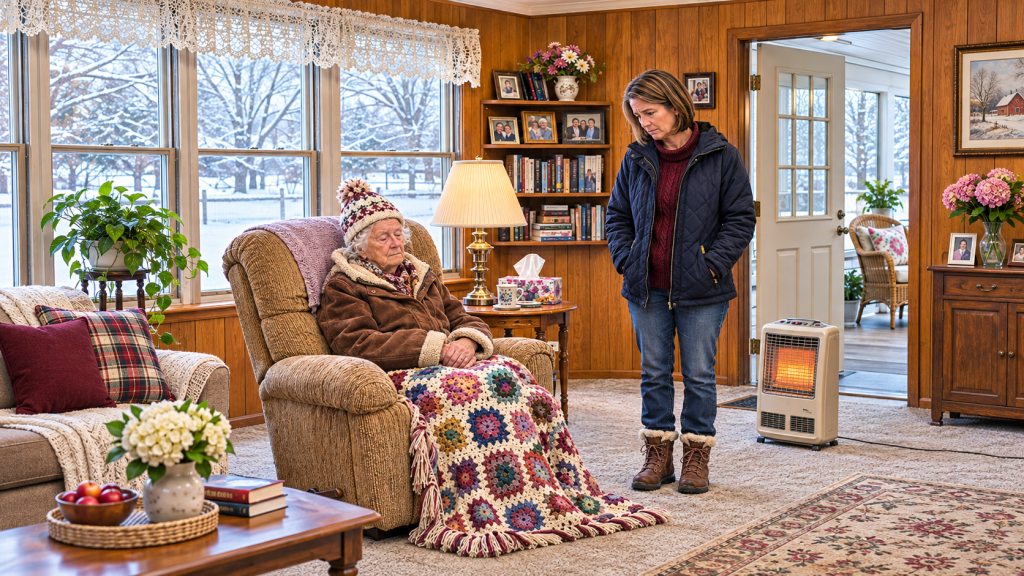
And by the coldest week of January, Mom had been sleeping in Dad’s old recliner wearing her winter coat while her propane tank showed only five percent remaining.
I’d found her that way.
I’d paid for an emergency delivery.
And I’d put the propane account in my name.
I thought the worst discovery would be learning that Pam had used the heating fund for her husband’s expenses.
I was wrong.
“Mom,” I said gently, “can you tell us exactly what happened with these transfers?”
She looked at Pam.
Then at the rest of us.
“I didn’t mean to make trouble.”
Dean let out a sharp breath.
“Mom, you didn’t make trouble.”
She lowered her eyes.
“Mark came by in November. He said he was embarrassed to ask Pam for money because she’d already been worrying so much about his surgery.”
Pam stared.
“He told you that?”
Mom nodded.
“He said he needed twelve hundred dollars for a medical bill.”
Pam gripped the back of a chair.
“He never told me.”
Mom continued.
“Then in December, he said the insurance company was holding up another payment.”
Rob rubbed his forehead.
“And January?”
Mom hesitated.
“That was for the truck.”
“The truck?” I repeated.
“He said it needed repairs so he could get to his appointments.”
I looked at the bank statement.
Three transfers.
Nearly four thousand dollars.
Money taken from the modest savings Mom had spent years carefully protecting.
“Did you send the transfers yourself?” I asked.
She shook her head.
“Mark helped me do them on my computer.”
Dean went still.
“He had access to your online banking?”
Mom looked frightened.
“I sat beside him.”
I took a breath.
“Did you approve each amount?”
She thought carefully.
“I remember telling him I could help with the first bill. After that, I thought he was showing me what I owed him for things he’d bought.”
Pam covered her mouth.
I felt my stomach tighten.
That wasn’t a clear answer.
And I wasn’t going to pretend it was.
Dean pushed his chair away from the table.
“I knew something was wrong with that man.”
“Dean,” Mom whispered.
“No, Mom. Enough.”
His face was red.
“First the propane money. Now this?”
Pam began crying.
“Stop talking about him like he’s a criminal!”
Rob stood.
“Everybody sit down.”
Dean turned toward him.
“Are you serious?”
“Yes.”
Rob’s voice was steady.
“Mom is sitting right here. We can ask questions without yelling at her.”
For a moment, nobody moved.
Then Dean sat.
Pam lowered herself into the chair beside Mom.
I remained standing with the statement in my hand.
My mind kept returning to January.
Mom sleeping beneath an afghan.
Frost along the windows.
Her fingers icy against mine.
She’d been trying to save propane because she believed her children couldn’t afford to help her.
Meanwhile, other money had been leaving her accounts.
And nobody knew exactly why.
“Pam,” I asked, “did Mark tell you Mom was lending him money?”
She shook her head.
“No.”
“Did he tell you about these transfers?”
“No.”
She reached for the statement.
I handed it to her.
She examined the dates.
Then her face changed.
“What is it?” I asked.
Pam pointed to the December transaction.
“That was the day he told me the insurance company had finally approved his reimbursement.”
She looked at Mom.
“He said we were going to be all right.”
The room fell silent.
Pam’s hands began trembling.
“He brought home groceries that night. He told me not to worry about Christmas.”
Her voice broke.
“I thought things were finally getting better.”
Dean looked away.
I could see the anger draining from his face, replaced by something more complicated.
Pam hadn’t merely been dishonest with us.
She might also have been lied to.
But that didn’t erase what she’d done with the heating fund.
And it didn’t tell us whether Mark had knowingly misused Mom’s accounts.
We needed facts.
Not more assumptions.
Mom reached toward Pam.
“Honey, I wanted to help.”
Pam began sobbing.
“I know, Mom.”
“I didn’t want you two losing your house.”
Pam covered her face.
Mom looked at me.
“I thought if I helped quietly, nobody would have to worry.”
I knelt beside her chair.
“Mom, helping somebody isn’t wrong.”
Her eyes filled.
“But?”
“But you shouldn’t have to be frightened of telling us what happens with your own money.”
She looked down.
“And nobody should be using your accounts without your clear permission.”
She nodded.
I took her hand.
“We’re not going to make decisions about Mark today. We’re going to check the records first.”
For the first time since the statement appeared, Mom seemed to relax.
Then she whispered something that stayed with me.
“I didn’t want my children fighting after your father died.”
I swallowed.
“Neither did he.”
The rest of Easter dinner was quiet.
We ate because Mom had spent two days preparing the meal.
Rob carved the ham.
Steve arrived after finishing an emergency road assignment and listened as we carefully explained what we’d discovered.
He didn’t shout.
He simply looked at Mom and asked whether she’d eaten enough.
That was Steve.
He was never a man of many words.
But I noticed he moved his chair closer to hers.
After dessert, we agreed on three immediate steps.
We would help Mom review her bank accounts and improve their security, with her permission.
We would ask Pam to obtain the documentation she could legitimately access concerning Mark’s claimed medical and vehicle expenses.
And we would keep the propane account under my supervision while making sure Mom retained a clear record of every delivery and charge.
Nobody would take Mom’s checkbook away.
Nobody would declare her incapable of managing her money.
She was eighty-two.
Not a child.
She’d kept farm records through decades of difficult seasons.
She deserved assistance that respected her independence.
Before leaving, Pam stood beside the kitchen door holding her purse.
Her eyes were swollen.
“Ellen?”
I turned.
“Yes?”
She swallowed.
“I’m sorry.”
I looked at her.
“For what?”
She began crying again.
“For lying about the propane.”
I waited.
She continued.
“I knew there wasn’t enough fuel. I kept telling myself I’d fix it before anyone noticed.”
My chest tightened.
“Pam, Mom could have been seriously hurt.”
“I know.”
“At thirty-one below zero, losing the furnace altogether could have become an emergency. She should never have felt she had to manage by wearing her winter coat inside.”
Pam nodded.
Tears fell onto her coat.
“I was ashamed.”
I looked toward the living room.
Mom was laughing quietly at something Steve had said.
I lowered my voice.
“Shame didn’t make the decision. You did.”
Pam closed her eyes.
“I know.”
I took a breath.
“But you brought the records today. You repaid the seven hundred and fifty dollars we sent. That’s a start.”
She looked at me.
“Do you hate me?”
The question startled me.
“No.”
Her face crumpled.
“But I don’t trust you to handle Mom’s money right now.”
She nodded slowly.
“I understand.”
Then she left.
The following morning, I drove Mom into Harvey.
The snowbanks along the roads were still high.
Fields stretched white and brown beneath a pale spring sky.
Mom sat beside me wearing her blue church coat.
She kept her purse in her lap, both hands folded around the strap.
It reminded me of the way she’d sat beside Dad whenever they drove into town to buy supplies.
We went to her bank first.
I had called ahead to arrange a meeting with a representative.
Mom verified her identity herself and explained that she wanted to review recent electronic transactions.
The representative, a woman named Karen, treated her respectfully.
She didn’t look at me for permission to speak.
She looked at Mom.
“Mrs. Ruth, would you like your daughter to stay for this conversation?”
Mom nodded.
“Yes, please.”
Karen explained the options for reviewing access, changing credentials, reporting disputed transactions, and adding alerts.
She also explained that the bank would need to investigate before deciding which transactions were authorized.
Mom listened carefully.
Then asked, “If I let somebody help me with a payment, does that mean they can take money whenever they want?”
Karen shook her head.
“Not necessarily. We need to examine what you authorized, how each transfer occurred, and any account agreements or access permissions. Helping someone with one transaction doesn’t automatically establish permission for unrelated transactions.”
Mom nodded.
“I want to know what happened.”
I squeezed her hand beneath the table.
And for the first time since Easter, I felt we were moving toward answers.
The bank opened a review of the disputed transfers.
Mom changed her online banking credentials and established additional authentication protections.
She chose to receive paper statements at the farmhouse and transaction alerts through a method she could reliably use.
We arranged for a second trusted contact for account concerns, without giving that person unrestricted access to her money.
Most importantly, Mom remained the person making the decisions.
When Karen asked whether she wanted to give me authority to transfer funds, Mom thought for a moment.
Then shook her head.
“Not today.”
I smiled.
“That’s fine, Mom.”
She looked surprised.
“You’re not upset?”
“Of course not.”
I took her hand.
“It’s your money.”
Her eyes filled.
For years, she’d quietly worried that needing help would mean losing control.
I wanted her to know those weren’t the same thing.
After the bank, we stopped at the grocery store.
Mom insisted on buying bread, milk, and a bag of oranges.
At the register, she reached for her purse.
I smiled.
“Mom, I’ve got it.”
She looked at me sharply.
“No, you don’t.”
I raised both hands.
“All right.”
She paid for her groceries.
Then looked up at me with a mischievous expression.
“I’ve been buying my own oranges since before you learned to walk.”
I laughed.
“Yes, ma’am.”
As we left, she slipped her arm through mine.
And suddenly, for a moment, she looked less frightened.
Not because the mystery had been solved.
But because she knew nobody was going to punish her for asking questions.
The following Thursday, Pam called.
I was sitting at my kitchen table in Bismarck when her name appeared on my phone.
For a moment, I considered letting it ring.
Then I answered.
“Hello, Pam.”
Her voice sounded exhausted.
“Ellen, I found something.”
I straightened.
“What?”
“Mark has been getting letters from a finance company.”
I waited.
“He told me they were business advertisements. But I found one in his workshop.”
She swallowed.
“It’s a delinquency notice.”
“What kind of loan?”
“A short-term business loan. He took it out before his surgery.”
My stomach tightened.
“How much?”
“Twenty-four thousand dollars.”
I closed my eyes.
She continued.
“He borrowed against equipment and expected to repay it from a construction job. The job was delayed. Then he hurt his back.”
I rubbed my forehead.
“Did you know about the loan?”
“No.”
“Does he know you’ve found the letter?”
“Not yet.”
I was quiet.
Then I asked, “Pam, are you safe?”
She seemed surprised.
“Yes. Why?”
“Because confronting somebody about hidden debt can become a difficult conversation. I want you to have support if you need it.”
Her voice softened.
“I’m safe, Ellen.”
I nodded.
“Good.”
Then she whispered, “I think he’s been lying to me for months.”
I stared at the window.
“Pam, I think we need to let the documents tell us what happened.”
She began crying.
“I don’t know who to believe anymore.”
I felt my anger soften.
“I know.”
That evening, Pam confronted Mark.
She later told me they’d sat at their dining table with the overdue loan notice between them.
At first, he’d insisted the problem wasn’t serious.
Then he’d said the lender was being unreasonable.
Finally, when Pam asked directly whether he’d taken money from Mom, his expression changed.
“Your mother offered to help,” he said.
Pam stared at him.
“With almost four thousand dollars?”
He looked away.
“She knew we were struggling.”
“Did she know about the business loan?”
He didn’t answer.
Pam leaned forward.
“Mark, I need the truth.”
He rubbed his hands over his face.
“I was trying to keep us from losing everything.”
She began crying.
“And you thought taking Ruth’s savings was the answer?”
“I didn’t take it. She helped.”
Pam put the bank statement in front of him.
“Then explain every transfer.”
For the first time, he stopped defending himself.
The next morning, Mark called me.
“Ellen, I’d like to talk.”
I stood beside the window, looking out at the street.
“About what?”
“Your mother’s money.”
I took a breath.
“Then I think we should speak with Mom present, if she’s willing, and keep the discussion focused on the records.”
He sounded irritated.
“Do we really need to make this so formal?”
“Yes.”
There was silence.
Then he said, “I’ve been part of this family for nineteen years.”
“I know.”
“You don’t think I’d deliberately hurt Ruth.”
I looked toward the stack of documents on my table.
“I think your intentions matter, but they don’t replace authorization or an accounting.”
He sighed.
“I made mistakes.”
“Then help us understand them.”
After another pause, he agreed.
We met that Saturday at the farmhouse.
Mom sat at the head of the table.
I sat beside her.
Pam and Mark sat across from us.
Rob attended too, at Mom’s request.
Dean offered to come, but Mom said she wanted a smaller conversation first.
There was something unbearably sad about sitting at the same table where we’d celebrated birthdays and Christmases, now discussing whether a family member had misused an elderly woman’s savings.
Mark looked thinner than I’d remembered.
He still walked with a slight stiffness.
His recovery from surgery had been difficult.
I knew that.
I also knew that pain and financial distress didn’t give someone permission to deceive people who trusted them.
Mom spoke first.
“Mark, I want to ask you something.”
He looked at her.
“Of course, Ruth.”
“Why didn’t you tell me how much money you needed?”
He swallowed.
“I was embarrassed.”
Mom nodded slowly.
“I understand being embarrassed.”
She looked at the statement.
“But I don’t understand why the amounts on here don’t match what I remember.”
Mark lowered his eyes.
For a long moment, nobody spoke.
Then he said, “The first transfer was twelve hundred dollars. You agreed to that.”
Mom nodded.
“I remember.”
“The second was nine hundred and fifty. I explained it was for medical expenses.”
She frowned.
“I thought you were showing me a bill. I don’t remember agreeing to send it.”
Mark stared at his hands.
Then Rob asked, “And the eighteen hundred in January?”
Mark didn’t look up.
Finally, he whispered, “I transferred that myself.”
Pam made a sound like she’d been struck.
Mom went completely still.
I leaned forward.
“Using Mom’s account access?”
Mark nodded.
“She’d helped me before. I knew the login.”
I felt anger rise.
“Did you ask permission?”
He shook his head.
“No.”
Mom’s face changed.
For a moment, she looked confused.
Then terribly sad.
“Mark,” she whispered, “you could have asked.”
His eyes filled.
“I thought you’d say no.”
She stared at him.
“Maybe I would have.”
He began crying.
“I was behind on the loan. They were threatening collections. I thought if I could make one payment, I’d have time to fix everything.”
Rob’s jaw tightened.
“You used an eighty-two-year-old woman’s money because you couldn’t admit your business was failing.”
Mark nodded.
“Yes.”
Pam covered her mouth.
I looked at him carefully.
“Did you know Mom was running low on propane?”
He hesitated.
“I knew Pam was worried about heating costs.”
My chest tightened.
“Did you know we’d been sending money for Mom’s fuel?”
“Pam mentioned it.”
I stared at him.
“And you still took eighteen hundred dollars from her account in January?”
Mark’s eyes filled.
“I wasn’t thinking.”
I shook my head.
“No. You were thinking about how to keep your business alive. You weren’t thinking about what might happen to her.”
He began crying harder.
But Mom didn’t reach for him.
She sat quietly with her hands folded.
Then said, “I worked too hard for that money to have somebody take it without asking.”
The sentence was simple.
But it carried forty years of farm work.
Every early morning.
Every calf she helped deliver.
Every harvest when there wasn’t enough rain.
Every dollar she and Dad saved for old age.
Mark lowered his head.
“I’m sorry.”
Mom looked at him.
“I hear you.”
Then she added, “But I don’t know whether I can trust you again.”
We documented what Mark acknowledged.
Mom made it clear that she was disputing the January transfer and still questioned the December one.
The bank continued its independent review.
We didn’t ask Mom to withdraw her complaint because Mark apologized.
And we didn’t promise to conceal the matter from the authorities if the evidence justified further action.
I wanted Mark to understand that family relationships didn’t make financial misconduct disappear.
He agreed to provide records of his loan and the expenses he’d claimed.
Rebecca Lawson, an attorney Rob knew through a farm cooperative, advised Mom about her options and reviewed the repayment proposal without representing Mark or Pam.
She explained that repayment and questions of authorization were separate matters.
If Mark returned the money, that wouldn’t automatically establish that every transaction had been legitimate.
Nor would it necessarily prevent further consequences.
Mom listened.
Then asked, “Can I decide whether I ever lend him money again?”
Rebecca smiled gently.
“Yes, Mrs. Ruth. That decision remains yours.”
Mom nodded.
“Then I’ve already decided.”
She looked at Mark.
“No more loans.”
Pam didn’t go home with Mark that afternoon.
She stayed at the farmhouse.
After Mark left, I found her standing beside the kitchen window.
She was staring toward the road.
I approached quietly.
“Pam?”
She wiped her cheeks.
“I feel like such a fool.”
I stood beside her.
For a moment, I thought about every angry word I’d wanted to say since January.
How I’d imagined confronting her.
How I’d rehearsed the speech about responsibility and trust.
But now my sister was standing in front of me, discovering that her marriage contained secrets she’d never suspected.
I took a breath.
“You’re not a fool for trusting your husband.”
She looked at me.
“But I was wrong to use Mom’s propane money.”
“Yes.”
She nodded.
“And I lied about the delivery.”
“Yes.”
Her eyes filled.
I continued.
“Those were your choices. But Mark’s unauthorized transfer was his.”
She began crying.
I put an arm around her.
“We can hold both truths at once.”
That evening, Pam told me something I’d never known.
After Mark’s surgery, he’d been struggling with more than physical pain.
He couldn’t work.
The bills mounted.
And the longer he remained home, the more ashamed he became.
He stopped answering calls from friends.
He avoided the men he’d worked with for years.
Sometimes he stayed in bed until noon.
Other days he insisted he’d return to work the following week, even when his surgeon hadn’t cleared him.
Pam had been frightened.
Not only about money.
About losing the man she’d married.
She’d taken on extra shifts at the grocery store.
Canceled her dental appointment.
Stopped buying anything she couldn’t justify as essential.
Then the October heating contributions arrived.
Seven hundred and fifty dollars from her siblings.
Pam was supposed to add her share and arrange the deliveries.
Instead, she used some of the money to address household bills and a payment Mark said couldn’t wait.
She bought only two hundred gallons of propane for Mom.
Then she told herself she’d replace the rest before winter grew dangerous.
But winter came early.
And the money never returned.
“I kept thinking I’d fix it,” Pam whispered.
I looked at her.
“Why didn’t you call us?”
She shook her head.
“Because I didn’t want you all thinking I couldn’t manage.”
I felt something painful twist inside me.
For years, Pam had been the responsible daughter.
The one who lived nearby.
The one who checked the farm.
The one who handled appointments and knew which prescription needed refilling.
She’d built part of her identity around being needed.
And when her own household began falling apart, she couldn’t bear admitting she needed help too.
I understood that.
But understanding didn’t erase the harm.
“Pam,” I said, “we didn’t ask you to be perfect.”
She looked down.
“We asked you to tell us when Mom needed fuel.”
She began crying.
“I know.”
I took her hand.
“Next time, call before there’s a crisis.”
She nodded.
Then whispered, “I hope there is a next time.”
I squeezed her fingers.
“There can be. But it will look different.”
The most unexpected discovery came three weeks later.
I was helping Mom sort through Dad’s old office when she pulled a metal file box from beneath the desk.
It was dusty.
The handle had rusted slightly.
A faded label on the front read:
WINTER EXPENSES.
Mom smiled.
“Your father kept everything.”
I laughed.
“That’s where you learned it.”
She opened the box.
Inside were folders of propane invoices, furnace service records, and handwritten notes.
Dad had tracked fuel costs for years.
He recorded deliveries.
Compared prices.
And estimated how much propane the farmhouse needed during particularly cold winters.
I flipped through the pages.
Then stopped.
Near the back was a folder labeled:
RUTH — IF I’M GONE.
My throat tightened.
“Mom?”
She looked up.
“What is it?”
I handed it to her.
She stared at Dad’s handwriting.
For a long moment, she didn’t move.
Then she opened it.
Inside was a letter.
And a small notebook.
Mom unfolded the letter slowly.
I watched her lips move as she read.
Then she began crying.
Dad had written it after a hospital stay nearly ten years earlier.
He knew his health was failing.
And he’d been worried about leaving Mom alone at the farm.
The letter began with practical instructions.
Where the insurance papers were kept.
Which neighbor could help if the well pump stopped.
How to contact the propane supplier.
And which furnace technician he trusted.
Then the tone changed.
Ruth, I know you love this place. I love it too.
But a farm is only a home as long as it keeps you safe.
Don’t sit in the cold because you’re afraid of spending money. Don’t leave the heat off to save a few dollars. And don’t let the children argue about which one is helping more.
They all love you, even when they have foolish ways of showing it.
Mom pressed the letter against her chest.
I wiped my eyes.
Dad continued:
There is enough money for you to have heat.
Use it.
And if you ever find yourself sitting in my old chair wearing your winter coat because the furnace isn’t running, promise me you’ll call somebody.
I covered my mouth.
Mom began sobbing.
Because seven years after Dad died, that was exactly where I’d found her.
In his old chair.
Wearing her winter coat.
Trying to survive a cold night without asking for help.
Mom held the letter for a long time.
Then she whispered, “Oh, Henry.”
Dad’s name was Henry.
She hadn’t spoken it like that in years.
Not with so much tenderness and regret in the same breath.
I sat beside her.
She looked at me through tears.
“He knew.”
I shook my head.
“He knew you.”
She smiled sadly.
“He always said I was too stubborn.”
I laughed through tears.
“He wasn’t wrong.”
Mom looked down at the letter.
Then whispered, “I thought if I spent less money, there’d be more for you children someday.”
My heart tightened.
“Mom.”
She looked at me.
I took both her hands.
“We don’t need you to leave us more money.”
Her eyes filled.
“We need you to stay warm. Eat well. See the doctor when you need to. And enjoy the years you have.”
She nodded.
I continued.
“Dad worked all those years so you could live comfortably, not so you could freeze while protecting an inheritance nobody asked you to save.”
She began crying again.
And I held her.
That night, we called all the siblings.
Even Pam.
Mom wanted everyone to hear Dad’s letter.
We gathered around the kitchen table on a video call.
Rob was sitting in his farm office.
Dean was at home.
Steve had just returned from a road shift.
Pam was staying temporarily with a friend while she and Mark worked through their situation.
Mom read Dad’s words aloud.
Her voice trembled.
When she reached the part about the winter coat, she stopped.
Nobody spoke.
Then Steve covered his face.
Rob looked down.
Dean wiped his eyes.
And Pam began crying.
For years, we’d been trying to keep the farm running the way Dad had.
Now we were being reminded of what he’d actually wanted.
Not perfect fences.
Not a spotless house.
Not every dollar preserved.
He’d wanted Mom safe.
Warm.
And surrounded by people who cared.
After the call, Dean phoned me privately.
“Ellen?”
“Yes?”
“I owe you an apology.”
I sat down.
“For what?”
“For how angry I got at Easter.”
I shook my head.
“You had reason to be upset.”
“Yes. But I made Mom feel like she was responsible for all of us fighting.”
I was quiet.
He continued.
“And I didn’t help enough before January.”
I looked toward the window.
“Dean, we all could’ve checked more carefully.”
He sighed.
“We sent the money and assumed everything was handled.”
“Yes.”
“I never once called the co-op.”
“Neither did I.”
He was silent.
Then he said, “We should change that.”
I smiled sadly.
“We are.”
By early summer, we had a proper plan.
The propane supplier remained authorized to monitor the tank and schedule deliveries under the keep-full arrangement.
I received the invoices and arranged payment.
Mom received copies.
Rob and Dean contributed to the heating fund as they were able, with clear records of what each payment covered.
Steve preferred to help with snow removal and emergency transportation, since his county work already placed him near Mom during winter storms.
Pam wasn’t asked to manage money.
But she could help with groceries or appointments if Mom wanted her to.
Nobody was given an unlimited obligation.
Nobody was asked to contribute more than they could afford without discussion.
And nobody was allowed to conceal a problem because they were embarrassed to ask for help.
We also arranged a furnace inspection and an assessment of the farmhouse’s insulation.
The technician found worn weatherstripping, an aging thermostat, and a few drafts around the back door.
Nothing dramatic.
But enough to make the house harder to heat.
We repaired what needed repairing.
Installed an easy-to-read thermostat.
And helped Mom set up a simple check-in system for extreme weather.
It wasn’t meant to take away her independence.
It was meant to make sure nobody discovered an emergency two days too late.
The bank’s review concluded later that summer.
The first transfer had been made with Mom’s knowledge.
The circumstances of the second remained disputed because the available records didn’t clearly establish what she’d understood or approved.
The third had been initiated using her banking credentials without her authorization, as Mark had already admitted.
The bank addressed the disputed activity under its procedures and provided Mom with its written findings, including the outcome of the reimbursement review and information about any further options.
The matter was also reported to the appropriate authorities for independent assessment.
Mark faced consequences beyond a difficult conversation at Easter.
His financial problems didn’t disappear.
Neither did his responsibility to account for the money.
Through a documented repayment arrangement reviewed separately from the bank’s investigation, he agreed to reimburse Mom for the funds he acknowledged taking improperly and to address the other disputed expenses.
We didn’t pretend signing an agreement meant everything had been fixed.
He had to make the payments.
And he had to accept that Mom no longer wanted him involved in her financial affairs.
Pam and Mark began marriage counseling.
They also met with a qualified financial counselor to review their debts, income, and realistic repayment options.
Pam didn’t move home immediately.
She needed time to decide whether she could rebuild trust with a husband who’d hidden serious financial problems and used her mother’s money without permission.
Mark remained in medical rehabilitation and gradually explored work that fit his physical limitations.
Some days, Pam wanted to forgive him.
Other days, she couldn’t bear hearing his voice.
I didn’t tell her what to do.
For years, I’d thought being a good sister meant offering an opinion whenever Pam made a decision I didn’t like.
Now I understood that support sometimes meant letting someone make a difficult choice without demanding they make the choice I preferred.
But I did tell her one thing.
“Pam, whatever happens with your marriage, you’re still my sister.”
She began crying.
“And Mom?”
I smiled sadly.
“She’s your mother. You two will have to rebuild trust together.”
That process began on an ordinary Tuesday.
Pam arrived at the farmhouse carrying a bag of groceries.
Mom was sitting at the kitchen table working on a crossword puzzle.
Pam stopped in the doorway.
“Mom?”
Mom looked up.
“Hello, honey.”
Pam swallowed.
“Would you mind if I made lunch?”
Mom studied her.
Then nodded.
“There’s chicken in the refrigerator.”
Pam smiled faintly.
“Okay.”
For a while, neither spoke.
Pam made sandwiches.
Mom worked on her crossword.
Then Pam placed a plate in front of her.
“Mom, I’m sorry I let you get so cold.”
Mom put down her pencil.
“I know you are.”
Pam’s eyes filled.
“I should’ve told Ellen and the boys.”
“Yes, you should have.”
Pam looked down.
Mom reached across the table.
“But you’re here now.”
Pam began crying.
Mom squeezed her hand.
“That’s where we start.”
By October, Mom had a full propane tank, a serviced furnace, and a list of numbers beside her telephone.
She had also started doing something none of us expected.
She began inviting friends over on Sunday afternoons.
For years, she’d worried about heating rooms nobody was using.
Now she made coffee, baked kuchen, and filled the kitchen with people.
Sometimes Harold from the next farm came with his wife.
Sometimes the church ladies visited.
And occasionally, all five of us managed to gather around the table without discussing money at all.
The first time that happened, I nearly cried.
Because I’d spent months afraid we’d never feel like a family again.
One November evening, I called Mom before bed.
The temperature outside was dropping.
“How’s the house?”
“Warm.”
“How’s the furnace?”
“Running.”
“Tank level?”
She laughed.
“Ellen, I checked it this morning. The account is scheduled for a delivery when the supplier says it needs one.”
I smiled.
“Good.”
She paused.
Then said, “I have something to tell you.”
My stomach tightened.
“What?”
“I bought myself a new winter coat.”
I blinked.
“Mom?”
She laughed.
“A pretty blue one. With a hood.”
I smiled.
“That sounds nice.”
“And Ellen?”
“Yes?”
“I’m planning to wear it outside.”
I began laughing.
Then crying.
Mom laughed too.
The following January, exactly one year after I’d found her sleeping in Dad’s recliner, I drove out to the farm.
The wind swept across the fields.
Snow lay deep beside the fences.
It was the kind of North Dakota winter morning that made the world seem empty and endless.
I parked beside the house.
Then opened the kitchen door.
Warm air rushed toward me.
The furnace hummed.
A pot of coffee sat on the counter.
And Mom was standing beside the stove, wearing slippers and a light sweater.
No winter coat.
No knitted cap.
No afghan wrapped tightly around her shoulders.
She turned when she heard me.
“Ellen!”
I smiled.
“Hi, Mom.”
She crossed the kitchen and hugged me.
I held her longer than usual.
Then looked toward Dad’s recliner.
It was empty.
For a moment, I remembered the fear I’d felt standing in that doorway a year earlier.
The frost.
The silence.
The thought that Mom might have been in danger while all her children believed somebody else was handling things.
I swallowed.
Mom noticed.
“What is it, honey?”
I shook my head.
“Nothing.”
She studied me.
Then smiled.
“You’re thinking about last winter.”
I nodded.
She took my hand.
“Come sit down.”
We drank coffee beside the window.
Mom told me about her friends.
About the church supper.
About Pam stopping by the previous weekend.
Then she looked at me.
“Ellen, I’ve been thinking about something.”
I smiled.
“That sounds dangerous.”
She laughed.
Then grew serious.
“I spent so much of my life trying not to be a burden.”
My throat tightened.
She continued.
“When your father died, I thought being strong meant never needing anything.”
I took her hand.
“But I was wrong.”
I waited.
Mom looked toward Dad’s old chair.
“Your father and I raised five children. We didn’t do it so you’d owe us money.”
Her voice trembled.
“We did it because we loved you.”
I squeezed her fingers.
She continued.
“And you children don’t have to prove you love me by arguing over who’s helping most.”
I smiled through tears.
“Then what should we do?”
She thought for a moment.
“Call me.”
I nodded.
“Visit when you can.”
Another nod.
“And if I tell you something’s wrong, listen. If I say everything’s fine, you’re allowed to ask a few questions.”
I laughed.
“That sounds fair.”
Mom squeezed my hand.
“But don’t forget I’m still your mother.”
I kissed her cheek.
“Never.”
That afternoon, Pam arrived with a pan of baked macaroni.
Rob came later with homemade sausage.
Dean brought dessert.
Steve stopped by after finishing his road shift.
For the first time in a year, all five of us sat around Mom’s table without an argument.
We talked about the weather.
The cattle.
Grandchildren.
And the terrible football season Dean refused to stop complaining about.
Pam laughed at one of Rob’s jokes.
Mom reached for another helping of potatoes.
The kitchen was warm.
And for a moment, everything felt ordinary.
Not because the past had disappeared.
Mark still had obligations to meet.
Pam still had decisions to make.
And some trust might never return to what it had been.
But we were learning that family didn’t have to mean pretending nothing had happened.
It could mean telling the truth, accepting responsibility, and continuing to care without surrendering our boundaries.
When I left that evening, Mom followed me to the door.
She was carrying Dad’s old winter coat.
My heart tightened.
“Mom, why do you have that?”
She smiled.
“I’ve been meaning to give it to Steve.”
I looked at her.
“Why?”
“He can use it when he’s out plowing snow.”
I stared.
Then I laughed.
She folded the coat carefully.
“Your father would like that.”
I nodded.
“Yes, he would.”
Mom looked around the warm kitchen.
Then whispered, “I don’t need it in the house anymore.”
I felt tears gather.
I kissed her forehead.
“No, Mom.”
I smiled.
“You don’t.”
Sometimes I think about how close we came to losing something far more precious than seven hundred and fifty dollars.
We could have lost Mom’s sense of safety.
Her trust.
Her belief that she could ask her children for help without creating a fight.
We could have allowed shame, secrecy, and financial desperation to destroy relationships that had taken a lifetime to build.
But we made a different choice.
We told the truth.
We checked the records.
We established clear boundaries.
And we remembered that protecting someone isn’t the same thing as controlling them.
My mother wasn’t a responsibility to be passed from one sibling to another.
She was a woman who’d spent eighty-two years loving her family.
She deserved warmth.
Respect.
And the freedom to grow old without being frightened of the next heating bill.
Last Sunday, Mom called me.
It was snowing again.
I answered immediately.
“Hi, Mom. Everything okay?”
She laughed.
“Everything’s fine, Ellen.”
“Furnace working?”
“Yes.”
“Plenty of propane?”
“Yes.”
“Are you wearing your winter coat inside?”
She burst out laughing.
“No, ma’am.”
I smiled.
“Good.”
Then she grew quiet.
“Ellen?”
“Yes?”
“Thank you for coming that day.”
My throat tightened.
I looked toward the photograph of Dad and Mom hanging above my desk.
“Of course.”
She paused.
“I was so cold.”
I closed my eyes.
“I know.”
Then she whispered, “But you came.”
Tears filled my eyes.
I thought about driving through the snow.
Finding her in the recliner.
The five-percent gauge.
The emergency delivery.
And the long, painful months that followed.
Then I smiled.
“I’ll always come when I can, Mom.”
She laughed softly.
“I know you will.”
Before hanging up, she added, “And Ellen?”
“Yes?”
“Tell your brothers I made kuchen. If they want some, they’d better get here before it’s gone.”
I laughed through my tears.
And after the call ended, I sat for a moment thinking about what Dad had written.
A farm is only a home as long as it keeps you safe.
He was right.
But I’d learned something else.
A family is only a refuge when love is accompanied by honesty, responsibility, and the courage to ask for help.
That winter, Mom’s house was warm.
Her children knew where the propane money went.
And Dad’s old recliner was finally just a place to sit and watch the snow.
Not a place where an eighty-two-year-old woman had to sleep in her winter coat.


